Yemeni FM berates Biden for faking ‘concern’, says US complicit in war, siege
Press TV – April 5, 2023
Yemen’s foreign minister says the United States is bent on whitewashing its complicity in the Saudi-led aggression against the impoverished Arab country by pretending to be concerned about achieving peace there.
Hisham Sharaf was cited by the Yemeni Saba news agency as making the remarks on Tuesday, two days after US President Joe Biden released a statement on the anniversary of the start of an UN-sponsored ceasefire in Yemen and stressed Washington’s “support” for all efforts aimed at reaching a comprehensive peace in the war-ravaged country.
Underlining that the US was “trying to evade its responsibilities” as a party responsible for the Saudi-led war and was profiting from it, Sharaf challenged Washington to “prove” its sincerity in wanting peace in Yemen by taking “concrete steps on the ground” and condemning the actions of the Saudi-led coalition.
“The countries that claim to be keen on achieving peace in Yemen should be sincere in their intentions by condemning the aggression and siege on Yemen for the ninth year in a row, stopping the supply of weapons and military experts to aggression countries, and putting pressure on the aggression countries,” Sharaf said.
The top Yemeni diplomat said Biden’s statement and the concern he showed regarding achieving permanent peace in Yemen are “not commensurate with what America is doing in reality by providing cover for the aggression countries.”
“The United States of America is trying with such a statement to evade its responsibilities as a party that participated in the aggression and siege on Yemen, which caused the largest humanitarian crisis in contemporary history, and to present itself as a dove of peace,” he added.
Emphasizing Yemen’s call for a just peace, Sharaf concluded by expressing Sana’a’s readiness to defend the Yemeni people through all legitimate means and the country’s ability to meet the legitimate demands of the Yemeni people.
Omani-hosted talks between the sides in the protracted conflict have been ongoing for the past several months, with the Iran-Saudi rapprochement having increased hopes that an end to the war could be imminent.
Saudi Arabia and the United Arab Emirates — the closest allies of the US in the region after the Israeli regime — have been waging the war on Yemen since March 2015.
The invasion has been seeking to change Yemen’s ruling structure in favor of the impoverished country’s former Riyadh- and Washington-friendly rulers and crush the popular Ansarullah resistance movement. The Saudi-led coalition has failed to meet any of its objectives.
The war, which has been enjoying unstinting arms, logistical, and political support on the part of the United States, has killed hundreds of thousands of Yemenis and turned the entire country into the scene of the world’s worst humanitarian crisis.
Yemen’s defense forces, which feature the country’s army and its allied Popular Committees, have, however, vowed not to lay down their arms until the country’s complete liberation from the scourge of the aggression.
Tyranny on the waters: The UAE-Israeli occupation of Yemen’s Socotra Island
By Karim Shami | The Cradle | March 24, 2023
Located off the southern coast of Yemen in the Arabian Sea, the Socotra archipelago has become a focal point of regional and international interest because of its strategic proximity to one of the world’s busiest shipping lanes.
On 21 June, 2020, the Yemeni island was militarily occupied by Saudi Arabia’s Emirati coalition partner, which has aggressively pursued a policy of establishing and controlling ports throughout West Asia and the Horn of Africa since 1999.
The archipelago consists of four large islands: Socotra (3,796km2), Abd al-Kuri (130.2km2), Samhah (39.6km2), and Darsah (7.5km2), as well as three small islets.
Socotra, the biggest of the islands, lies 350 km south of the Arabian Peninsula and 95 km from Somalia. It is surrounded by the Gulf of Aden, the Indian Ocean, and the Arabian Sea, and faces the Horn of Africa from the west. Around 20,000 shipping vessels pass around Socotra each year, including 9 percent of the world’s annual global petroleum supply.
The War on Yemen
The assault on Yemen was launched on 26 March, 2015, in an announcement by Saudi Ambassador Adel al-Jubeir from Washington DC, in which he stated that a coalition of ten countries, led by Saudi Arabia and the UAE, would take military action to reinstate the government of Yemeni President Abdrabbuh Mansour Hadi.
Hadi had been ousted in popular protests in 2014, after losing the capital city, Sanaa, to the joint forces of the Ansarallah movement and their allies in the country’s armed forces. Based in northern Yemen, the Ansarallah movement had been advocating for fair representation in the government for a long time.
With US-backing, Saudi Arabia launched “Operation Decisive Storm,” and the air strikes began. Initially expected to last only a few weeks or months – and according to MbS himself, just “a few days” – the Yemeni war has now entered its eighth year and taken on a markedly different shape than the coalition initially contended.
Two years into the war, the Emiratis began pursuing their own hidden agenda of establishing a “self-styled maritime empire” in Yemen, which veered sharply from Riyadh’s objectives. To achieve this goal, Abu Dhabi sought to control the country’s southern coastline and its ports and enlisted the help of a local Yemeni proxy called the Southern Movement.
The Southern Movement was formed by secessionist tribes and groups seeking to divide Yemen along the old partition lines of 1967–1990. However, the movement had to be restructured to match the UAE’s aspirations, and in 2017 it was transformed into the Southern Transitional Council (STC).
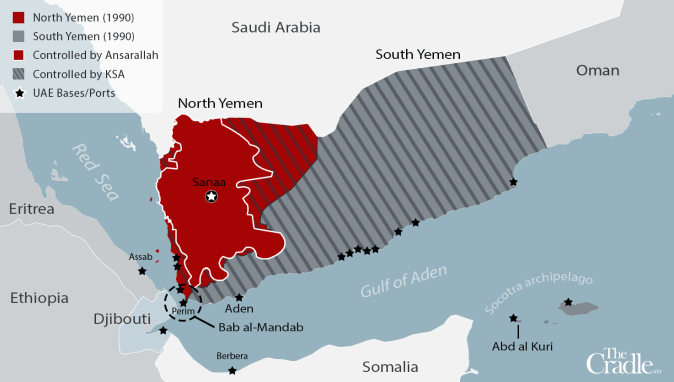
Map of the Emirati-controlled areas and ports in southern Yemen
The significance of Socotra
Socotra Island falls under the territorial jurisdiction of the exiled Hadi government, which to this day – despite his physical absence and the replacement of the “presidency” with an 8-member, Saudi-sponsored Presidential Leadership Council (PLC) – remains Yemen’s internationally-recognized government.
However, on 30 April, 2018, the UAE deployed hundreds of troops with artillery and armored vehicles on the island, which is located 350 km away from the mainland conflict, without any prior coordination with Yemeni authorities.
The Riyadh-backed Yemeni government condemned the Emirati aggression, backed by local islanders protesting against the occupation of their territory. The Saudis were forced to intervene by sending troops and training locals to deter the UAE from seizing the island.
But later that year, UAE General Khalfan al-Mazrouei arrived on Socotra Island and has since been considered its de facto ruler. Under his leadership, the Emiratis gained the loyalty of local tribes by using bribery under the guise of “humanitarian aid.” They offered Socotra residents UAE passports and promised them an improved quality of life.
The STC seizes Socotra
On the morning of 21 June, 2020, the UAE-backed STC separatists forcibly seized control of Socotra and ousted the Saudi-backed, pro-Hadi forces.
The UAE had been planning and preparing for this operation for two years, using its Yemeni proxies to gain full control over the Socotra archipelago. The Emirati flag was raised across the territory, and UAE telecommunication companies replaced Yemeni ones. Consequently, all phone calls from Socotra now register Emirati phone networks.
UAE-Israel normalization
Three months after the seizure of Socotra, the highly-controversial Abraham Accords was signed in Washington DC between Israel and the UAE, along with Bahrain, Morocco, and Sudan. On the Arab side, the normalization thrust was led by Abu Dhabi, which quickly moved to expand its diplomatic, military, and economic ties with Tel Aviv.
Shortly after the signing of the Abraham Accords, reports and images of Israeli “tourists” visiting Socotra began to emerge. According to an Al-Mayadeen report, however, the Israeli visitors were not tourists, but rather, military experts.
Abd al-Kuri Island
In February 2023, Ansarallah released a statement condemning the UAE’s eviction of residents from Abd al-Kuri, the archipelago’s second-largest island. The resistance movement accused Abu Dhabi of carrying out a long-planned operation to transform Socotra into an Israeli-Emirati military and intelligence hub.
These actions by the UAE are not isolated incidents. In another 2022 episode, Ansarallah accused Abu Dhabi of transferring fishermen from the small island of Perim (13 km2) to other parts of the Taiz Governorate. Several months later, satellite imagery revealed the construction of a military base runway on the volcanic Island. Perim is now empty of its original inhabitants, according to media reports.
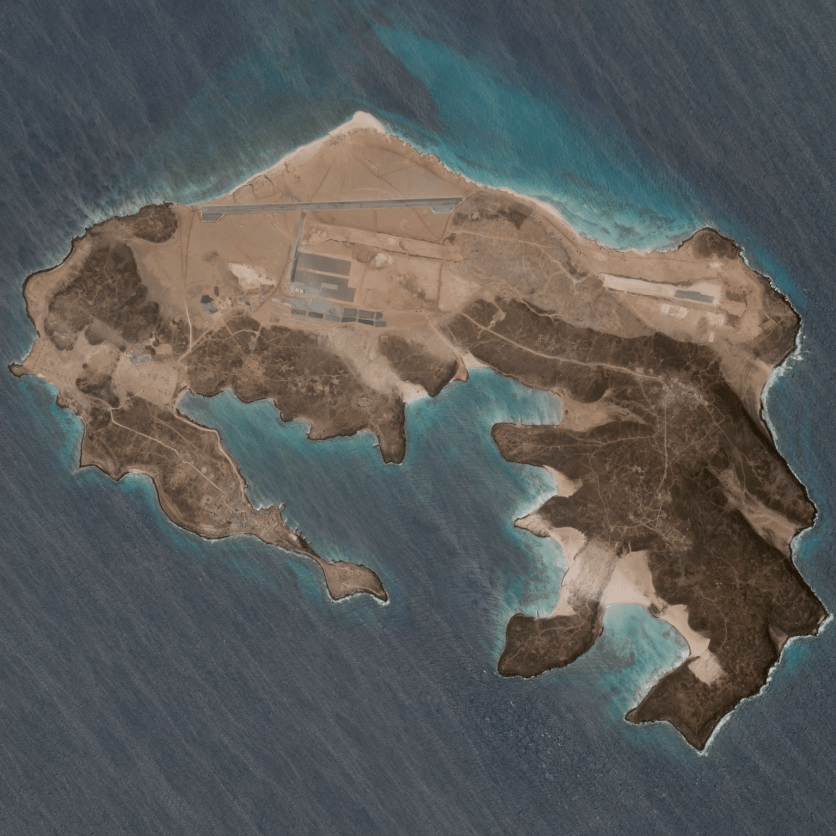
An Emirati military base on Perim Island (Mayyun in Arabic) on the Bab al-Mandab Strait
Perim Island has historically divided the Bab al-Mandab Strait into two waterways – whoever controls the island holds strategic influence over the strait. While Ansarallah’s statement about Emirati designs on Socotra was not entirely new, it raised hackles throughout the Arab world by confirming Israel’s military and intelligence presence on this key Yemeni island.
The UAE’s maritime ambitions
Many have questioned Abu Dhabi’s motivation for seizing Socotra and risking its relationships with Saudi Arabia and neighboring Oman (virtually overnight surrounded by UAE ports and bases). The UAE’s actions may be entirely attributed to the strategic vision of its President Mohammed bin Zayed (MbZ) and his no-longer secret desire to establish an Emirati maritime empire –from the Persian Gulf to the Red Sea – by controlling the region’s key waterways.
The UAE’s economic reliance on these waterways is a clear driver of MbZ’s plans: non-petroleum commodity re-exports make up almost half of Abu Dhabi’s total exports. As such, maritime security is a top priority in the country’s foreign policy calculations.
The UAE currently controls 12 ports off the coast of Yemen, including Aden, Makha, Mukalla, Al-Dabba, Bir Ali, Belhaf, Rudum, Zoubab, Al-Khawkhah, Al-Khouba, Qena, and Al-Nashima. The country is also building a new port in Al-Mahra that will cost an estimated $100 million.
By controlling these ports and the Bab al-Mandab Strait, the UAE can dominate one of the busiest shipping lanes in the world, elevating its position in global and regional trade to a strategic player.
In addition to its aggressive accumulation of Yemeni ports, the UAE also has a significant presence in the Horn of Africa, where it currently controls two ports in Eritrea and one in Somalia. It previously owned a port in Djibouti, but this became a point of territorial friction between the two countries. The UAE’s control over these ports and their strategic location in the region allow it to project its power and expand its influence in East Africa.
Why is Socotra important to Israel?
The UAE and Israel share mutual security concerns over Iran’s regional ascension over the past decade. The Islamic Republic’s naval presence is expanding into many new waterways, and its seaborne activities from the Persian Gulf to the Red Sea alarm both nations. Given Washington’s growing reluctance to engage its armed forces in West Asia, MbZ turned to the region’s military behemoth and main Iranian rival to help him execute his vision. Unlike Israel, no other regional state has the ability to garner unconditional US support – nor the willingness to cavalierly defy international law and territorial integrity.
Abu Dhabi has calculated that it stands to benefit from Israel’s intelligence network and early warning systems, particularly after its cities were subject to unprecedented Ansarallah missile and drone strikes in January 2022.
For Tel Aviv, its physical presence in any Arab state is perceived as a victory, which aligns with its ambitions for regional expansion. By establishing a base on Abd al-Kuri Island, Israel can reinforce its maritime security – around 25 percent of its trade passes through the Bab al-Mandab Strait. Another objective of the Israeli-Emirati military and intelligence hub could be to gather data or engage in espionage activities in the southern Arabian Peninsula and the Horn of Africa.
During the 1973 Arab-Israeli war, Yemen – in partnership with Egypt – blocked the passage of Israeli ships and tankers from accessing the strategic strait, leading to disastrous consequences for Israel.
The tactic could be replicated under Ansarallah Chief Abdel Malak al-Houthi’s leadership, since the movement considers Israel one of its main regional adversaries. While it may seem like a distant possibility, if the war concludes under current Riyadh-Sanaa peace efforts and Ansarallah gains control of Yemen’s south, the movement will enjoy unusual leverage to obstruct Israeli shipments whenever Tel Aviv launches regional aggressions. It should be noted that Ansarallah has already publicly threatened, on several occasions, to strike sensitive Israeli sites with its new missile capabilities.
Moreover, there has been an ongoing “ghost ship war” between Israel and Iran for several years, with occasional reports of Iranian or Israeli ships being attacked in these waterways. Israel’s presence on Socotra Island could provide it with leverage over Iran in their waterway stand-off and enable Tel Aviv to counter Ansarallah inside Yemeni territory.
NATO’s Combined Maritime Forces
It is important to note that the involvement of the US in the Israeli-Emirati collaboration and actions in Yemeni waters is not confirmed. However, it is true that the US has been a maritime security provider for the Persian Gulf monarchies for decades, and its NATO-led Combined Maritime Forces (CMF) have been present in West Asian waters since 1983 – including leading hostile actions against Iraq and Somalia.
The CMF alliance has assumed responsibility for the security of four bodies of water: The Red Sea, Persian Gulf, Arabian Sea, and the Gulf of Aden.
But with China’s rapid rise as a global economic competitor, US policy pivoted further eastward, and Washington has sought to subcontract out its West Asian security policies to its regional allies.
As such, last December, the CMF assigned command of its Red Sea task force to the Egyptian Navy, who took over from US naval forces. In this regard, the UAE, backed by Israel, may be another candidate to lead a NATO-backed naval security operation in the region.

Map of the NATO-led Combined Maritime Forces (CMF) areas of operation in West Asian waterways
Implications for Iran and Saudi Arabia
Any Israeli expansion is likely to alarm Iran and vice versa, potentially leading to direct or proxy clashes in various regional theaters. However, the presence of the UAE – Iran’s second-largest trading partner – in southern Yemen may limit Tehran’s options. Unless Iran perceives a serious security threat from the new “Arab-Israeli alliance,” it is unlikely to take any significant actions that could harm its trade relations with Abu Dhabi.
The war against Yemen has severely damaged Saudi Arabia’s image as a regional powerhouse. During the last few years, all major Saudi cities have been the subject of Ansarallah missile and drone strikes – including the country’s key oil infrastructure.
It has been humiliating for the Persian Gulf’s wealthiest and most heavily militarized state to have its vulnerabilities so completely exposed by West Asia’s poorest nation. In contrast, the UAE has thus far only benefited from the Yemen war and expanded its influence in the region.
Recently, there have been reports of a possible breakthrough in negotiations between Riyadh and Ansarallah, and observers are hoping for an early roadmap to end the conflict during the holy month of Ramadan. Obstacles are aplenty: The UAE is notably absent from the discussions, the Emirati-backed Yemeni separatists – the STC – reject any solution that doesn’t leave them in control of the south, and the US has sought to scuttle any final solution that undermines Washington’s regional leverage.
Liberating the island
Of all the stakeholders with interest in Socotra Island, none are ultimately as important as the Yemeni ones, primarily the UAE-backed STC, the Saudi-backed PLC, and Iran-backed Ansarallah.
In his most recent televised appearance, Ansarallah’s Abdel Malik al-Houthi stated: “We seek to defeat the aggression, whether on the islands, on land or at sea, and from anyone who violates our independence and the sovereignty of our country.” Unlike other leaders, al-Houthi’s threats are usually translated into action and Ansarallah will not hesitate to strike the Israeli-Emirati bases or seize their ships if the aggression continues.
Ansarallah is currently the strongest player in Yemen, controlling more than 80 percent of the country in terms of population density. On the other hand, the PLC is the most vulnerable of the three main Yemeni players, and Riyadh’s recent rapprochement agreement with Tehran has further weakened the group. If an agreement is reached between Riyadh and Sanaa, the PLC will have one of two options: to hand over their weapons or merge into Ansarallah’s armed forces.
On the other side of the spectrum, the UAE-backed STC is worried about ongoing peace talks and fears being left alone to fight head-to-head with Ansarallah-aligned armed forces.
The question now is whether there will be a peace deal between Saudi Arabia and Ansarallah that excludes the UAE and its Yemeni proxies. If that happens, Sanaa’s armed forces will almost certainly turn their big guns on the Emiratis and their Yemeni interests. The Saudis will have already calculated this outcome as they seek to advance a deal with Ansarallah. In this event, it is unlikely that Riyadh will come to Abu Dhabi’s assistance. Their common goals in Yemen ended years ago.
Yemeni prisoner exchange deal reached
The Cradle | March 20, 2023
The head of the National Committee for Prisoners’ Affairs, Abdul Qader al-Murtada, announced on Monday, 20 March, that a deal to exchange prisoners had been reached between the Ansarallah resistance movement and the Saudi-led coalition, with implementation to take place in three weeks, Al-Masirah TV reported.
Al-Murtada stated that “Today we concluded the latest round of negotiations in Switzerland regarding prisoners, and it was agreed, praise be to God, to implement a broad prisoner exchange deal that includes 706 of our prisoners in exchange for 181 prisoners of the other side, including Saudis and Sudanese.”
“The deal will be implemented after three weeks, hopefully, and another round will be held after the month of Ramadan to complete the implementation of the rest of the agreement,” Al-Murtada added.
The latest round of negotiations began 10 days ago under the auspices of the United Nations.
The prisoner exchange deal comes amid renewed hopes for a broader end to the Yemen conflict.
UN Special Envoy to Yemen Hans Grundberg told the UN Security Council on 15 March that “Intense diplomatic efforts are ongoing at different levels to bring the conflict in Yemen to an end” and that “we are currently witnessing renewed regional diplomatic momentum, as well as a step change in the scope and depth of the discussions.”
Much of this momentum has resulted from a recent agreement between rival Islamic powers Saudi Arabia and Iran to resume diplomatic relations and work toward peace in the region. As part of this reconciliation, Iranian President Ebrahim Raisi is set to visit Saudi Arabia for talks with Saudi King Salman in the coming weeks.
Since the beginning of the Saudi-led war in Yemen, which began in early 2015, an estimated 377,000 Yemenis have died, according to a UN Development Programme report issued in late 2021.
Some 60 percent of these deaths were caused by the indirect effects of the war, such as lack of safe drinking water, hunger, and disease, while fighting has directly killed more than 150,000 people.
Most of those killed by the war’s indirect effects were “young children who are especially vulnerable to under- and malnutrition,” according to the report.
During the same period, the US government provided $54.6 billion of military aid to Saudi Arabia and the United Arab Emirates, according to a report issued by the US Government Accountability Office. The report noted that the US has 140 military advisers working in Saudi Arabia on training missions and to facilitate weapons sales.
The New York Times reported that the internal government report concluded that the US State Department and Department of Defense “failed to assess civilian casualties caused by a Saudi-led coalition in the catastrophic war in Yemen and the use of American-made weapons in the killings.”
The hidden security clauses of the Iran-Saudi deal
By Hasan Illaik | The Cradle | March 12, 2023
Under Chinese auspices, on 10 March in Beijing, longtime regional competitors Iran and Saudi Arabia reached an agreement to restore diplomatic relations, after a break of seven years.
In its most optimistic reading, the deal can be seen as a historic strategic agreement, reflecting major changes underway in West Asia and the world. At worst, it can be characterized as an “armistice agreement” between two important rivals, that will provide a valuable space for direct, regular communications.
The Sino-Saudi-Iranian joint statement on Friday carried strong implications beyond the announcement of the restoration of diplomatic relations between Tehran and Riyadh, severed since 2016.
The statement is very clear:
- The embassies of Saudi Arabia and the Islamic Republic Iran will reopen in less than two months.
- Respect for the sovereignty of States.
- Activating the security cooperation agreement between Saudi Arabia and Iran signed in 2001.
- Activating the cooperation agreement in the economic, trade, investment, technology, science, culture, sports and youth sectors signed between the parties in 1998.
- Urging the three countries to exert all efforts to promote regional and international peace and security.
At first glance, the first four clauses suggest that the Chinese-brokered deal is essentially a mending of diplomatic relations between the two longtime adversaries. But in fact, the fifth clause is far from the standard text inserted into joint statements between states.
It appears to establish a new reference for conflicts in West Asia, in which China plays the role of “peacemaker” — in partnership with Iran and Saudi Arabia — in which Beijing assumes a role in various regional conflicts or influences the relevant parties.
Sources familiar with the negotiations have revealed to The Cradle that Chinese President Xi Jinping did not merely coat-tail a deal already underway between Tehran and Riyadh. Xi has, in fact, personally paved the way for this agreement to materialize. The Chinese head of state delved deep into its details since his visit to Saudi Arabia in December 2022, and then later, during Iranian President Ebrahim Raisi’s visit to Beijing in mid-February 2023.
More than one round of negotiations was held under Chinese auspices, during which the Iranians and Saudis finalized details negotiated between them in Iraq and Oman, during earlier rounds of talks.
It was by no means a given that the two sides would arrive at an agreement in their last round of discussions (6-10 March, 2023). But the Chinese representative managed to overcome all obstacles between the two delegations, after which the parties obtained approval from their respective leaderships to announce the deal on Friday.
China as regional guarantor
In the past couple of days, much has been written about the strategic implications of a Chinese-brokered Saudi-Iranian agreement and its impact on China’s global role vis-à-vis the United States. The Persian Gulf is a strategic region for both powers, and the main source of China’s energy supply. It is likely why Beijing intervened to stem tensions between its two strategic allies. It is also something Washington, long viewed as the region’s “security guarantor,” could never have achieved.
Undoubtedly, much will be said about Saudi Crown Prince Mohammed bin Salman’s (MbS) “strategic adventurism” and his exploitation of global changes to offset the decline of US regional influence. The rise of a multipolar, post-American order allows traditional US allies some space to explore their international options away from Washington, and in service of their immediate national interests.
Saudi Arabia’s current interests are related to the ambitious political, economic, financial, and cultural targets that MbS has set out for his country, and are based on two pillars:
- Diversifying regional and global partnerships in order to adapt to global systemic changes that will help realize Riyadh’s grand plans.
- Establishing security and political stability to allow Saudi Arabia to implement its major projects, especially those outlines in MbS’ “Vision 2030,” through which Riyadh envisions itself transforming into a regional incubator for finance, business, media, and the entertainment industry – similar to the role played by the UAE in decades past, or by Beirut before the Lebanese civil war in 1975.
In short, regional and domestic security and stability are vital for Riyadh to be able to implement its strategic goals. As such, confidential clauses were inserted into the Beijing Agreement to assure Iran and Saudi Arabia that their security imperatives would be met. Some of these details were provided to The Cradle, courtesy of a source involved in the negotiations:
- Both Saudi Arabia and the Islamic Republic of Iran undertake not to engage in any activity that destabilizes either state, at the security, military or media levels.
- Saudi Arabia pledges not to fund media outlets that seek to destabilize Iran, such as Iran International.
- Saudi Arabia pledges not to fund organizations designated as terrorists by Iran, such as the People’s Mojahedin Organization (MEK), Kurdish groups based in Iraq, or militants operating out of Pakistan.
- Iran pledges to ensure that its allied organizations do not violate Saudi territory from inside Iraqi territory. During negotiations, there were discussions about the targeting of Aramco facilities in Saudi Arabia in September 2019, and Iran’s guarantee that an allied organization would not carry out a similar strike from Iraqi lands.
- Saudi Arabia and Iran will seek to exert all possible efforts to resolve conflicts in the region, particularly the conflict in Yemen, in order to secure a political solution that secures lasting peace in that country.
According to sources involved in the Beijing negotiations, no details on Yemen’s conflict were agreed upon as there has already been significant progress achieved in direct talks between Riyadh and Yemen’s Ansarallah resistance movement in January. These have led to major understandings between the two warring states, which the US and UAE have furiously sought to undermine in order to prevent a resolution of the Yemen war.
In Beijing however, the Iranian and Saudis agreed to help advance the decisions already reached between Riyadh and Sanaa, and build upon these to end the seven-year war.
Hence, although the Beijing statement primarily addresses issues related to diplomatic rapprochement, Iranian-Saudi understandings appear to have been brokered mainly around security imperatives. Supporters of each side will likely claim their country fared better in the agreement, but a deeper look shows a healthy balance in the deal terms, with each party receiving assurances that the other will not tamper with its security.
While Iran has never declared a desire to undermine Saudi Arabia’s security, some of its regional allies have made no secret of their intentions in this regard. In addition, MbS has publicly declared his intention to take the fight inside Iran, which Saudi intelligence services have been doing in recent years, specifically by supporting and financing armed dissident and separatist organizations that Iran classifies as terrorist groups.
The security priorities of this agreement should have been easy to spot in Beijing last week. After all, the deal was struck between the National Security Councils of Saudi Arabia and Iran, and included the participation of intelligence services from both countries. Present in the Iranian delegation were officers from Iran’s Ministry of Intelligence and from the intelligence arms of the Islamic Revolutionary Guard Corps (IRGC).
On a slightly separate note related to regional security — but not part of the Beijing Agreement — sources involved in negotiations confirmed to The Cradle that, during talks, the Saudi delegation stressed Riyadh’s commitment to the 2002 Arab peace initiative; refusing normalization with Tel Aviv before the establishment of an independent Palestinian state, with Jerusalem as its capital.
What is perhaps most remarkable, and illustrates the determination by the parties to strike a deal without the influence of spoilers, is that Iranian and Saudi intelligence delegations met in the Chinese capital for five days without Israeli intel being aware of the fact. It is perhaps yet another testament that China — unlike the US — understands how to get a deal done in these shifting times.
Washington gives secret bailout to companies accused of war crimes in West Asia
The Cradle | March 6, 2023
US lawmakers last year secretly authorized a bailout for weapons makers for unproven inflation burden as part of the record-breaking 2023 annual defense budget, which allotted over $800 billion for defense spending.
The bailout provision, crafted behind closed doors and quietly added to the approved budget, allows for “extraordinary relief” via unchecked price hikes to Pentagon contracts in response to any alleged losses weapons makers experience “due solely to economic inflation.”
However, there are no requirements for defense contractors to prove their costs increased due to inflation alone. Earlier versions of the defense budget did not include this provision, and it was reportedly added by a handful of congressional negotiators without broader congressional input.
“The new law places no restrictions on when contractors may ask for increases in contract prices; the only requirement is that costs exceed the original agreed upon price,” Responsible Statecraft reports.
The bailout was approved despite the senate striking down a similar provision and defense contractors failing to demonstrate to the Pentagon that inflation was threatening their bottom line, as they have managed to report record profits despite the economic effects of the pandemic or the war in Ukraine.
As a result of this, US taxpayer money is now being earmarked to provide “profit insurance” to giant corporations like Lockheed Martin, Raytheon, General Dynamics, Northrop Grumman, and Boeing.
Their profits are also bolstered by US officials covertly deploying troops and waging secret wars over the past two decades in dozens of countries across the globe.
US defense contractors have repeatedly been accused of having responsibility for countless war crimes committed in West Asia and other regions of the world.
Last week, a group of Yemeni nationals filed a lawsuit against several US weapons makers for their role in the bombing of a wedding and a funeral in Yemen.
“Year after year, the bombs fell – on wedding tents, funeral halls, fishing boats, and a school bus – killing thousands of civilians and helping turn Yemen into the world’s worst humanitarian crisis,” reads the lawsuit.
Yemen’s parliament calls for confrontation with foreign occupation forces
Press TV – March 5, 2023
Yemen’s parliament has reiterated its rejection of the presence of foreign occupation troops in the country.
The lawmakers called on the Yemeni people to confront the foreign forces to prevent any outside intervention in the country’s internal affairs.
The Yemeni parliament warned in a statement on Sunday of American plots to target the unity and sovereignty of the country amid the US-British-Saudi presence in the southeastern province of al-Mahrah, according to Yemen’s al-Masirah television network.
It called for standing united in the face of invaders and occupiers while blaming the coalition of aggression and its mercenaries for tampering with the wealth of the Yemeni people and forfeiting the sovereignty, independence and unity of Yemen and its territorial integrity.
The statement strongly condemned any foreign presence in “Yemeni lands, islands and waters, whatever its justifications.”
The House of Representatives also condemned the suspicious American movements taking place in the occupied Yemeni provinces, the latest of which was a visit by the American ambassador and the commander of the US Fifth Fleet under the pretext of combating smuggling.
The US military moves in the southeastern provinces of al-Mahra and Hadhramaut have escalated significantly and provocatively over the past months, in parallel with Washington’s attempts to thwart peace efforts and circumvent the demands of the Yemeni People and the requirements for a solution, including the complete departure of foreign forces from Yemen.
The American news website Huffington Post recently confirmed that the United States is moving in the path of seizing al-Mahra Province for “geopolitical purposes and long-term economic ambitions and goals, including control of the governorate’s coasts and ports.”
The site revealed that “US soldiers and military experts frequent the province, moving around it, away from the media spotlight.”
Saudi Arabia launched the devastating war on Yemen in March 2015 in collaboration with its Arab allies and with arms and logistics support from the US and other Western states.
The objective was to reinstall the Riyadh-friendly regime of Abd Rabbuh Mansur Hadi and crush the Ansarullah resistance movement, which has been running state affairs in the absence of a functional government in Yemen.
While the Saudi-led coalition has failed to meet any of its objectives, the war has killed hundreds of thousands of Yemenis and spawned the world’s worst humanitarian crisis.
Yemen condemns Israeli, Emirati eviction of Socotra island residents

The Cradle | February 24, 2023
The Ministry of Fishing in Yemen’s National Salvation Government in Sanaa has strongly condemned the UAE’s eviction of residents from the Abd al-Kuri Island of the Socotra archipelago off the Yemeni coast, which Abu Dhabi has been carrying out as part of its long-active plan of transforming Socotra into an Israeli-Emirati military and intelligence hub.
The ministry strongly condemned “the forced displacement of fishermen and residents of the island, and [their forced eviction towards the coastal town of] Hadiboh,” a 22 February statement read.
The statement added that the displacement of the island’s residents and fishermen represents a “flagrant violation” of Yemen’s sovereignty, as well as a threat to navigation and the residents of nearby islands.
The ministry also highlighted the “geostrategic importance of Abd al-Kuri Island” and demanded that the UN Security Council call for an immediate cessation of the UAE’s forced eviction of the island’s residents.

According to the Yemeni statement, these forced evictions follow the recent arrival of Israeli officers to Socotra and the construction of new barracks and military facilities on Abd al-Kuri Island.
This is confirmed by Yemeni journalist and activist Anis Mansour, who on 20 February strongly condemned the “bringing in of Israeli and Emirati forces to the island without the knowledge of the leadership or authorities, in a blatant challenge to Yemeni dignity and sovereignty.”
Mansour said that “the invading forces began to expel the Yemeni local armed tribes from the island, and the residents present there are also being expelled to the Qusa’ir area.”
Mansour also claimed that the Saudi-led coalition plans to ‘secure housing’ in Hadhramaut for about 1,000 fishermen from the island in order to limit the island to the presence of Emirati-Israeli military and intelligence officials only.
Israel is interested in the strategic archipelago because it serves as a potential flashpoint for a confrontation with Iran. In 2020, the Washington Institute published an analysis examining how Israeli submarines could potentially strike the Islamic Republic from positions near Yemen.

An Israeli tourist stands on a hilltop in Yemen’s Socotra Island. January 2022. (Photo credit: Twitter)
In January 2022, Socotra made headlines due to controversial photos of Israeli tourists who had visited the islands under a UAE-issued visa.
Yemeni officials assess damage to ancient sites bombed by Saudi-led coalition
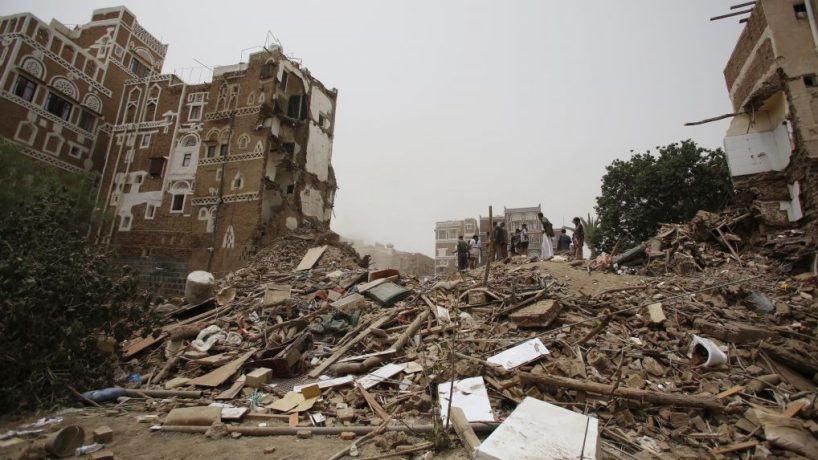
The Cradle | February 20, 2023
The head of Yemen’s General Authority for Antiquities, Manuscripts, and Museums, Dr. Obbad bin Ali Al-Hayyal, visited several historical and archeological sites in the provinces of Marib and Jawf on 18 February to assess the damages caused to them by the Saudi-led coalition airstrikes, SABA news agency reported.
Hayyal and his team visited the ancient city of Baraqish in Marib’s Mazjar district, the Rusf Temple in Al-Jawf, and several other archeological sites.
According to SABA, they received briefings from local authorities on the damages to ancient columns, inscriptions, and structures due to “Saudi and Emirati warplanes,” as well as the “looting and theft” of antiquities and artifacts by coalition forces from museums across the country.
During the visit, Hayyal stressed the importance of “integrating official and popular efforts” to protect these sites from ‘vandalism and looting.’
Since the start of the Saudi-led war against Yemen in 2015, coalition airstrikes have posed a significant threat to the country’s archeological sites and historical monuments.
In May 2015, coalition airstrikes struck the ancient Sabaean ruins of the Great Marib Dam, which date back to the seventh century BC.
That year, the Saudi-led coalition bombarded the ruins of the ancient city of Baraqish, several ancient temples, and an entire museum filled with countless precious artifacts – which was “reduced to piles of shattered stone,” according to a 2015 report by US media outlet The Intercept.
The Saudi-led bombing also decimated sections of the capital Sanaa’s Old City, which is listed as a UNESCO World Heritage site and dates back 2,500 years.
Several ancient buildings and structures have since collapsed from weakened foundations. Until October 2019, over 237 archeological sites had been directly targeted by the coalition in what has been described as a systematic campaign aimed at deliberately erasing Yemeni culture and history.
Aside from bombing, several ancient sites and museums have been looted and stripped of valuable artifacts by UAE-backed mercenary groups, whose ranks are filled with ISIS and Al-Qaeda militants.
In 2019, a member of Yemen’s Supreme Political Council, Mohammad Ali al-Houthi, said about UAE-backed groups: “The mercenaries are antiquity thieves. Where did the antiquities of the Marib Museum go? … Where are the monuments from the rest of the museums in the occupied governorates? … The mercenaries are committing historical, social, and cultural crimes.”
Saudi Arabia is well-known for its destruction of heritage, particularly within its borders, where many of the ancient cities, towns, and sites dating back to the birth of Islam have been wiped out as part of a campaign motivated by the kingdom’s Wahhabi ideology.
Why Arabs Bolster Energy & Security Cooperation With Russia in Defiance of Western Sanctions
By Ekaterina Blinova – Samizdat – 19.01.2023
Arab countries have not joined the anti-Russian sanctions, despite pressure from the West, as Russian Foreign Minister Sergey Lavrov stressed during his press conference this week. What’s behind the Arab world’s resilience?
“The policy of the West in the East has gone bankrupt,” political analyst Vladimir Ahmedov told Sputnik.
“[Middle Eastern players’] trust in the United States, the leading western European states – the former colonizers who had colonies in this region – has already been largely lost,” the specialist in the modern history of Arab countries and senior research fellow at the Institute of Oriental Studies of the Russian Academy of Sciences continued.
New major players have entered the global arena: China, India, Iran, Turkey, Egypt, and Saudi Arabia, the scholar emphasized.
Ahmedov believes that the sanctions imposed against Russia are dictated by purely political considerations of a narrow circle of the western political elite. Meanwhile, the system of international relations and the world order has been undergoing changes, and the indirect proof of this is the position taken by the Arab countries, according to him.
“Russia’s policy in the East at the present time, and Russia’s policy in the world in general, has changed in comparison with the 1990s and the beginning of the 2000s,” the researcher continued. “Now it is a resolute policy aimed at defending [Russia’s] national state interests and the national interests of third countries. It impresses the countries of the East and, above all, the countries of the Middle East, which have been waiting for such a policy for a long time. This policy is in great demand in the East and therefore it meets with approval and understanding.”
In light of this, Russia’s efforts to mediate the Israeli-Palestine conflict as well as those in Syria and Iraq – mentioned by Lavrov during his Wednesday presser – are steps in the right direction, according to the scholar. In addition, Russia’s military presence in Syria serves as a stabilizing factor, he added.
Meanwhile, the West’s Ukraine strategy looks like nothing so much as its previous Middle Eastern policies. The West is using Ukrainians much in exactly the same way it previously used Arabs in order to reach its geopolitical objectives, and Middle Eastern players are well-aware of that, according to the researcher.
“Russia is not fighting against Ukraine or the fraternal Ukrainian people, but against the West, which wants to dismember Russia, belittle its role, minimize it, and so on,” Ahmedov said. “And [the Western policy] does not meet with any approval from the political elites of the East, who themselves suffered from it previously.”
Opportunities in the Middle East and North Africa
“The region of the Middle East and the Arab world in general is of tremendous importance in the world system in terms of geography, demography, a powerful energy market, the world’s oil and gas pantry and as a very important transport artery. Therefore the attention to this region will only grow,” Ahmedov emphasized.
The region develops its position by becoming an influential energy actor, echoed Ramy El Kalyouby, a visiting lecturer at the School of Orientalism of the National Research University Higher School of Economics (HSE).
“Gulf countries profited a lot from oil prices increase, and at some moment the Kingdom of Saudi Arabia’s oil revenues jumped to more than $1 billion daily,” El Kalyouby told Sputnik. “Egypt is also getting its chance to become an important gas supplier to the EU after discovering a few huge fields in the Mediterranean.
The academic singled out Egypt, the world’s biggest wheat importer. According to El Kalyouby, Russia can help Cairo replace a deficit of Ukrainian wheat, open its markets for Egyptian fruits and vegetables, and provide more tourists.
“There is also a project of a Russian industrial zone in Egypt that would help Russia to get around sanctions by changing the origin of products, and also to profit from the African Union free trade zone,” the lecturer highlighted.
Last year, the construction of Egypt’s first nuclear power plant was launched on July 20 in El Dabaa, Matrouh Governorate, by Russia’s State Atomic Energy Corporation Rosatom.
The El Dabaa NPP is meant to be the cornerstone of Egypt’s energy diversification policy, allowing Cairo not only to cover its own electricity needs, but also to provide energy to its neighbors. On November 19, the main construction phase for Unit 2 of the NPP began in the northern African country.
“Gulf countries could cooperate with Russia in the regulation of the oil market, although this becomes more difficult, as Russia provides important reductions on Urals oil,” El Kalyouby continued, adding that “Russia also remains a key actor in Syria as a mediator between Damascus and Ankara.”
Regional Security
Nonetheless, the Middle East and Northern Africa (MENA) region is continuing to suffer from local conflicts stemming from the bitter consequences of the Arab Spring, according to Ahmedov. The scientist noted that the reformatting of political systems of these countries is still going on while the common regional security system has not been formed yet.
Russia shares the same “geopolitical space” with the countries of the region and its objectives there include not only maintaining working ties with Middle Eastern players but also to protect its “soft underbelly” from extremist and terrorist elements reinvigorated by the Arab Spring havoc, the researcher explained.
In addition, Russia’s experience as a power broker in the region could come in handy for the West, since the latter has proven incapable of solving regional conflicts on its own, continued the scientist. According to him, European countries have no other alternative but to deal with Russia in the Middle East in the future if they want to ensure their security in the Mediterranean and Southern Europe.
Ahmedov noted that while Moscow cannot ensure a complete comprehensive settlement and stabilization of the situation in the Middle East, it can help regional players reach these goals.
“Russia can make a certain contribution to ensuring the system of regional security with the participation of other states,” he said. “We have excellent relations with Iran. And in this regard, of course, the Arab countries are interested in Russia in terms of softening the Iranian policy towards the Arab countries, which causes concern today in the Arab world. We have excellent relations with Turkey, which also plays a very important role as a major regional actor or player in this region, just like Iran. And therefore, in this case, we have a lot of advantages that we can realize. We have long-standing ties with Palestine since Soviet times. And therefore, in this case, we have a lot of advantages that we can realize.”
Russia has a long and successful record of work in the region, according to the scientist: in the 1960-1980s the USSR provided the primary industrialization of many MENA countries, including Iraq, Syria, Egypt, Algeria, Sudan, and Yemen. While developing ties with the region, Russia can build upon its expertise and best practices of the past, Ahmedov concluded.
US meddled in Saudi-Yemen peace process
The Cradle | January 6, 2023
Lebanese daily newspaper Al-Akhbar reported on 6 January that Saudi Arabia has expressed its readiness to end the status quo in Yemen and withdraw under the conditions set by Ansarallah.
The kingdom agreed to lift the blockade, and pay compensations for the war after retreating under a pledge not to interfere in the country’s political process.
For that, Riyadh demanded the government in Sanaa present a set of “guarantees” that it will not threaten Saudi Arabia and its security, nor allow hostilities to originate from Yemeni soil.
According to Al-Akhbar, these demands were reiterated by Iran and the Sultanate of Oman, who assured the kingdom of Ansarallah’s willingness to meet Riyadh’s demands.
Despite that, no progress has been made to end the current state, which has left Yemen torn between peace and war. This lack of progress has prompted Ansarallah’s leadership to publicly reject that this limbo becomes a permanent reality.
In an interview with Al-Masirah TV on 1 January, Ansarallah’s spokesman and peace envoy, Mohammed Abdel Salam, demanded a permanent ceasefire between Yemen and Saudi Arabia.
“We are working to reach a point of clarity in Yemen, in which we move into either a truce or permanent ceasefire, and we have presented our point of view to the Omani mediator,” said Abdel Salam.
He added that this would require opening all ports, airports, and roads, and paying salaries with the revenue generated from Yemen’s oil and gas exports.
A source close to Ansarallah in Sanaa revealed to The Cradle that Saudi Arabia agreed to this demand in October 2022, and was ready – along with Qatar – to finance the salaries of all government employees in northern Yemen.
However, the US sabotaged this agreement and blocked the solution by pressuring Riyadh to cease its efforts.
The leader of Ansarallah, Abdul-Malik al-Houthi, has ordered the military to prepare for a scenario in which all prospects for peace diminish, as the status quo is no longer acceptable.
On the other hand, the UN coordinator for Yemen, Hans Grundberg, and US Deputy Assistant Secretary of State for Arabian Gulf Affairs, Tim Lenderking, met in Riyadh on 5 January, to discuss the developments with the head of the Yemeni Presidential Leadership Council, Rashad al-Alimi.
According to local media, the meeting tackled the UN’s efforts to coordinate with the international community to keep the peace process on track and explore ways to end Yemeni suffering.
However, progress has yet to materialize, and no plan has been set to find ways to establish communication with the Sanaa government, as a key to peace.
More than 3,000 Yemeni civilians killed, injured by Saudi-led coalition’s airstrikes in 2022
Press TV – January 2, 2023
More than 3,000 civilians, including women and children, were killed or injured in the airstrikes launched by the Saudi-led coalition against Yemen in the year 2022, according to a Yemeni rights group.
The Humanity Eye Center for Rights and Development issued a report on Monday, showing that the total number of casualties was 3,083 during last year’s war on Yemen, which included the death of 643 citizens and the wounding of 2,440 others.
The report said 102 children lost their lives and 353 others sustained injuries, in addition to 27 women killed and 97 others wounded.
The Yemeni rights group confirmed that 514 men were killed and 1,990 others injured.
As for the damage to Yemen’s infrastructure in 2022, the report said the Saudi-led coalition warplanes destroyed 14,367 homes, 134 mosques, 5 tourist facilities, 12 hospitals, 64 educational centers, 1987 agricultural fields and seven media facilities.
The aggression also destroyed 22 power stations, 974 roads and bridges, 46 communication towers and stations, 334 tanks and water stations, and 57 government facilities.
The Humanity Eye Center for Rights and Development also reported that the coalition destroyed many business firms, which amount to 229 business facilities. In addition, the warplanes targeted 1,022 means of transportation, 29 chicken farms, 37 medicine storehouses, 95 food trucks, 21 fuel stations and 13 fuel tankers.
Saudi Arabia, in collaboration with its Arab allies and with arms and logistics support from the US and other Western states, launched the devastating war on Yemen in March 2015.
The objective was to crush the Ansarullah resistance movement, which has been running state affairs in the absence of a functional government in Yemen, and reinstall the Riyadh-friendly regime of Abd Rabbuh Mansour Hadi.
While the Saudi-led coalition has failed to achieve any of its objectives, the war has killed hundreds of thousands of Yemenis and spawned the world’s worst humanitarian crisis.
Featured Video

Chinese jet fuel and the myth of energy independence
or go to
Aletho News Archives – Video-Images
Book Review
Former Insiders Criticize Iran Policy as U.S. Hegemony
By GARETH PORTER | CounterPunch | February 27, 2013
“Going to Tehran” arguably represents the most important work on the subject of U.S.-Iran relations to be published thus far.
Flynt Leverett and Hillary Mann Leverett tackle not only U.S. policy toward Iran but the broader context of Middle East policy with a systematic analytical perspective informed by personal experience, as well as very extensive documentation.
More importantly, however, their exposé required a degree of courage that may be unparalleled in the writing of former U.S. national security officials about issues on which they worked. They have chosen not just to criticise U.S. policy toward Iran but to analyse that policy as a problem of U.S. hegemony. … continue
Blog Roll
 Aletho News
- What is fueling unrest across the EU?
- Why no power can undermine Iran’s eternal dominance over the Strait of Hormuz
- Is The War Against Iran Over?
- Iran war will leave long-term ‘scar’ on Wall Street, investors warn
- How Iran decimated US power projection in West Asia: Military lessons of 40-day war
- Iran’s report details US-Israeli war crimes in targeting schools, hospitals, livelihoods
- NATO’s Slow Fracture: How Trump’s Iran War Exposed the Instrument of Hegemony
- Chinese jet fuel and the myth of energy independence
- Ukraine Sea Drone Fired From Libya Hit Russian Tanker in Mediterranean
- IRGC: Iranian forces launched no attacks during ceasefire hours
- If Americans Knew
- Military aid to Israel emerges as the latest political litmus test for Democrats
- The only Palestinian children’s rights organization closes following years-long Israeli campaign against it
- ‘I Can’t Forget the Smell’: Lebanese Reel After Israel Kills Over 300 in Single Day
- DNC Shoots Down Resolutions Calling Out AIPAC and Limiting Arms to Israel
- TCN: Is Israel Blackmailing President Trump?
- Israel killed at least 303 Lebanese yesterday – who were they? Daily Update
- Amnesty: Urgent – Protect Lebanese civilians from brutal escalation in Israeli attacks
- Is The War Against Iran Over?
- Inside the Israeli army’s propaganda wing
- Hundreds of Gaza Amputees Stranded in Legal Limbo
- No Tricks Zone
- New Study: No Linear Warming Or Glacier Retreat Along Northern Antarctic Peninsula Since 1980s
- An Inconvenient Tree: Uncovered In Alps… Europe Much Warmer Than Today 6000 Years Ago
- New Study Reports A 60% Slowdown In Greenland’s Ice Loss Rate In The Last Decade
- Low Intensity Tornado Wrecks Major Solar Farm, Creating A Potential Toxic Dump
- New Study Finds Warming Saves Lives…Cold Temperatures 12 Times More Deadly Than Excess Heat
- German Science Blog Accuses PIK Climate Institute Of Hallucinating Climate Tipping Points
- Devastating Assessment Of Comirnaty Vaccine By Former Senior Pfizer Europe Toxicologist
- New Study: CO2 Is ‘Effectively Negligible’ As An Explanatory Climate Change Factor Since 2000
- Former Pfizer Toxicologist Dr. Helmut Sterz Tells Bundestag Hearing Pfizer Vaccine Should Have Never Been Approved
- Energy Expert: Germany’s Nuclear Phaseout Was A “500 Billion Euro Mistake”
 Aletho News