The Houthis Are Preparing for a Planned Israeli Attack on Yemen
By Ahmed Abdulkareem | MintPress News | November 11, 2019
SANA’A, YEMEN — As the war in Yemen nears the end of its fifth year, the situation in the country seems to be escalating. There are strong indications that Israel is planning to launch airstrikes against the country under the pretext of preventing an Iranian military presence from taking hold, a move that is likely to open the door for further escalation.
On Saturday, Ansar Allah, the political wing of Yemen’s Houthis, announced that Yemeni forces would not hesitate to “deal a stinging blow” to Israel in the case Tel Aviv decides to launch attacks in Yemen. The Houthis reaffirmed that their anti-Israel position is based on a principled, humanitarian, moral, and religious commitment. Historically, neither the Yemeni Army nor the Houthis themselves, have ever targeted Israel directly.
The threat from Israel is not without precedent. Israel has used claims of alleged Iranian military attachments in countries like Syria and Iraq as justification for airstrikes and bombings against those nations. Now, Israel appears to be using Iran’s alleged presence in Yemen, an allegation that both Tehran and the Houthis deny, as a pretext for military action in the country despite no evidence indicating that there are any Iranian forces present there.
Ansar Allah leader Abdulmalik al-Houthi said in televised speech marking the anniversary of the Prophet Muhammad, “Our people will not hesitate to declare jihad (holy war) against the Israeli enemy, and to launch the most severe strikes against sensitive targets in the occupied territories if the enemy engages in any folly against our people.” The occasion marks the largest festival held by the Houthis during which they reveal their domestic and foreign policies for the coming year.
The Houthis also called on the Saudi regime to stop the war and siege on Yemen, warning that there would be risks and consequences for the Kingdom should they continue their attacks. Al-Houthi also confirmed that Yemenis will continue to develop their military capability, adding that, “Anyone who uses the war and siege to control us and subjugate us is seeking the impossible, and the consequence is failure.”
Al-Houthi also pointed to the ongoing mass protest movements in Lebanon and Iraq, advising nations in the Middle East to resolve their issues vigilantly. He asked those nations to exercise vigilance in the face of what he called Israeli plots to gain a political, military, and cultural foothold in their respective countries.
On Saturday, massive demonstrations took place across Yemen’s major cities to commemorate the Prophet Mohammed’s birth, an occasion known to Muslims as Maulud Nabi. While the occasion is a religious one, it is a public holiday in Yemen and is marked with the singing of the national anthem and the waving of green flags. Many protesters told MintPress News that any attack by Israeli would not cause the Yemeni people any more suffering than they have already endured, but would push them to join a “holy war” against Israel.
According to three government officials in Sana’a that spoke to MintPress on the condition of anonymity, the Houthi’s warnings are both serious and well-placed. Those officials said that the government in Sana’a has already confirmed information that Israel is preparing to launch airstrikes on both military sites and civil targets in Yemen, especially on the country’s west coast and along the Saudi-Yemen border in coordination with the Saudi-led Coalition.
Ansar Allah’s announcement also comes in the wake of a number of recent statements made by a number of Israeli officials claiming that Yemen has become a threat to Israel. Speaking during a visit by U.S. Secretary of Treasury Steven Mnuchin and White House aid Jared Kushner, Netanyahu claimed that Iran has supplied missiles to the Houthis that could hit Israel. The Houthis regard these statements as a justification and prelude to strikes on the country, similar to those that Israel unilaterally carried out against sites in Syria and Iraq.
In August, Kuwaiti newspaper al-Jarida released a report saying that Israel is planning on striking sensitive positions on the Bab al-Mandab strait which links the Red Sea and the Gulf of Aden, to target “Houthis” in the area. The newspaper, which cited an anonymous informed source, said Israeli intelligence agency Mossad has been monitoring activities in the Yemeni strait.
Israel’s entry into the Yemen war could indeed open the door for further escalation, a prospect made more likely by both the increased strength of Ansar Allah forces and by Israel’s increasingly cozy relationship with the Gulf Arab countries of the coalition. The fact that Saudi Arabia and the UAE recently sought negotiations with Houthis after they were unable to win the war militarily, despite their superior firepower and funding, only increases the likelihood of Israel’s entry into Yemen.
In fact, Israel is alleged to have already participated in the war against Yemen on behalf of the Saudi-led coalition as a part of a series of covert interventions involving mercenary forces, the reported launching of dozens of airstrikes in the country and even the dropping of a neutron bomb on Nuqm Mountain in the middle the capital Sana’a in May of 2015.
Kicking the hornet’s nest
Like Saudi Arabia and the UAE, there is a problem with the Israeli assessment of the situation in Yemen, as the Houthis have never threatened to hit an Israeli target and Houthi attacks on Saudi-led Coalition countries have always been retaliatory, not preemptive. There are no vital targets to be bombed in Yemen as the Saudi-led coalition has already destroyed nearly every potential target, including civilian infrastructure. Moreover, any attack by Israel against Yemen will gain the Houthis even more popular support both inside of Yemen and across the Islamic and Arab world.
Furthermore, there is no evidence that Iran has any military sites or experts in Yemen, and Yemen’s Army, loyal to Ansar Allah, are not the “Iran proxy fighters” that international media so often claims them to be. Indeed, the U.S. State Department even admitted in leaked cables that the Houthis were not an Iran proxy and that they received neither funding nor weapons from Iran.
There are a convergence of interests between the Houthis and Iran, including opposition to Israel’s internationally-recognized theft of Palestinian land, but if Israel involves itself directly in the conflict in Yemen, it is likely that the Houthi alliance with Iran will grow and may actually spur Tehran into providing precise and sophisticated weapons to Ansar Allah, turning the fears of Israel into a self-fulfilling prophecy.
Meanwhile, many Israeli activists and media pundits are expressing concerns over what they consider serious threats from Yemen, pointing out that these threats “should not be underestimated by the Israelis.” The Israeli security parliament said that Israeli intelligence must strictly monitor Yemen and take necessary steps to secure Israeli ships sailing in the Bab Al-Mandab area, describing the statements made by Abdulmalik al-Houthi as serious.
A well-stocked arsenal
Indeed the threats of Ansar Allah, a group known to strike sensitive targets without hesitation, are not without precedent. On September 14, Ansar Allah hit two of Saudi Arabia’s oil facilities in Abqaiq and Khurais, an attack that led to a suspension of about 50 percent of the Arab Kingdom’s crude and gas production.
Prior to that, they targeted vital facilities deep inside of Saudi Arabia and the United Arab Emirates, including the Barakah Nuclear Power Station in Abu Dhabi, the capital of the UAE, as well as the King Khalid International Airport near Riyadh, more than 800 km from Yemen’s northern border. Now, they have developed their arsenal of ballistic missiles and drones even further and experts say are likely capable of hitting vital targets inside of Israel. Yemen’s Army is ready to launch those missiles if Ansar Allah’s leader asks it to do, one high-ranking military officer told MintPress.
Yemen’s Army, loyal to the Houthis, is equipped with the Quds 1 winged missile which was used in an attack on the Barakah Nuclear Power Station in Abu Dhabi in December of 2017. This year, several generations of the Quds 1 were reworked to provide the “ability to hit its targets and to bypass enemy interceptor systems,” according to Ansar Allah.
The Borkan 3 (Volcano 3), whose predecessors were used by the Houthis to strike targets inside of Saudi Arabia and the UAE, is capable of traveling even further than the Borkan 1 and 2. The Borkan is a modified Scud missile and was used in a strike on the King Khalid International Airport near Riyadh, more than 800 km from Yemen’s northern border. The missile was able to evade U.S. Patriot missile air-defense systems.
Yemen’s Army also posses the Samad 3 reconnaissance drone and the Qasef 2K drone. Both were used in strikes against the Abu Dhabi and Dubai airports. The Samad 3 has an estimated range of 1,500 to 1,700 km. Moreover, the Yemen Army recently unveiled a new drone with a range exceeding 1,700 km and equipped with advanced technology that would render it difficult for air defense systems to detect.
One Ansar Allah military source told MintPress that mines would also be deployed against Israeli battleships and watercraft in the Red Sea if Israel decides to launch attacks against Yemen. Indeed, Yemen’s military recently revealed its domestically-manufactured marine mines dubbed the “Mersad,” and is reportedly “actively developing its naval forces and naval anti-ship missiles.”
Despite the well-established precedent, many still doubt that the Houthis are capable of carrying out attacks on the scale and range of the attack that struck an Aramco facility in Saudi Arabia earlier this year — instead, accusing Iran of orchestrating the attacks. Yet repeatedly underestimating the Houthis was one of the major mistakes made by the Saudi-led coalition, who has failed to defeat the group after nearly five years of fierce battles against them, despite being equipped with the latest U.S.-supplied weaponry — everything from M1A2 Abrams tanks and M2 Bradley fighting vehicles to AH-64D Apache helicopters, as well as having an air force equipped with a high-tech arsenal.
However, it would be difficult for the Yemeni Army to prevent aerial attacks by Israel. Yemeni airspace has been open to the coalition and to American drones since the war broke out in 2015. Any attack by the Yemen army would likely come in retaliation to an Israeli attack and would hit Israeli military bases in Eritrea, Israeli ships in the Red Sea as well as hit vital targets deep inside of Israel, according to Yemeni military sources.
An already dire situation
The war, which began in March 2015, has led to the world’s worst humanitarian crisis resulting from the bombing and a blockade which has led to mass starvation and history’s largest cholera outbreak, among other dire consequences.
The coalition, backed by the United States, has killed tens of thousands of Yemeni civilians since the war began. Moreover, the coalition’s blockade of food and medicine has plagued the country with an unprecedented famine and has triggered a deadly outbreak of preventable diseases that have cost thousands of people their lives.
Last week, the Armed Conflict Location & Event Data Project revealed that Yemen’s death toll rose to a shocking 100,000 since 2015. The database shows approximately 20,000 people have been killed this year, already making 2019 the second-deadliest year on record after 2018, with 30,800 dead. Those numbers do not include those who have died in the humanitarian disasters caused by the war, particularly starvation.
Given the nature of Israel’s recent wars against Gaza and Lebanon, it is unlikely that Israel would feel constrained by any moral dilemma should they chose to launch airstrikes against civilians in Yemen.
Ahmed AbdulKareem is a Yemeni journalist. He covers the war in Yemen for MintPress News as well as local Yemeni media.
‘Israel’ Says US Sanctions Failed to Subdue Iran & Axis of Resistance, Warns of Rising Yemeni Threat
Al-Manar | November 10, 2019
The Israeli media considered that the US economic sanctions had failed to subdue Iran and all the axis of resistance, adding that Tel Aviv and Washington did not reach any achievement in this regard.
The Zionist reports pointed out that the attacks which targeted Aramoci oil facilities in addition to the tankers indicate that Iran will strike ‘Israel’ in response to any military operation in the region.
In the meantime, the Israeli media highlighted the vow of Yemen’s Ansarullah Chief Sayyed Abdul Malik Al-Houthi to respond to any Israeli assault on Yemen by attacking the Zionist entity, emphasizing that this is a new threat.
Five Years On, Saudi Attacks on Yemen’s Farmers Are Pushing the Whole Country into Famine
By Ahmed AbdulKareem | MintPress News | November 1, 2019
HODEIDA, YEMEN — The country of Yemen, known in the medieval period as “Green Yemen,” is one of the most extensively terraced areas of the world. There, Yemeni farmers transformed rugged mountain slopes into terraces and built dams like the Great Marib, a structure whose history spans long enough that it was mentioned in the Quran. During the medieval period, Yemen had one of the widest ranges of agricultural crops in all of the Middle East.
Farhan Mohammed is one of the richest farmers in Qama’el, a rural village in the region of Baqim in northwestern Yemen. He owns 50 hectares of land which he uses to cultivate corn, pomegranates, and apples. Now, Farhan is struggling to keep his farm afloat after Saudi airstrikes targeted his fields, burning his crops and rendering the soil so toxic that it’s no longer able to sustain life. Saudi Arabia’s now nearly five-year-old project in Yemen has decimated the incomes of Farhan and most other Yemeni farmers. Fuel is hard to come by thanks to a Saudi-led coalition blockade and the fuel that is available has become prohibitively expensive. Airstrikes targeting farm fields and orchards have rendered large swaths of Yemen’s arable land too toxic to use.
Almost immediately after March 2015, when the war began, the Saudi-led Coalition began targeting Yemen’s rural livelihood, bombing farms, food systems, markets, water treatment facilities, transportation infrastructure, and even agricultural extension offices. In urban areas, fishing boats and food processing and storage facilities were targeted.
Before the war began, over 70 percent of Yemen’s population lived in villages dispersed in the mountains and small towns with irregular, and at times torrential, summer rainfall. These rural residents relied on agriculture and animal husbandry and grew fruits and vegetables to feed their own families and to sell to markets. Yet that way of life has all but disappeared since the Saudi attacks began, undermining rural livelihoods, disrupting local food production, and forcing rural residents to flee to the city.
Now, Yemen’s nationwide level of household food insecurity hovers at over 70 percent. 50 percent of rural households and 20 percent of urban households are now food insecure. Almost one-third of Yemenis do not have enough food to satisfy basic nutritional needs. Underweight and stunted children have become a regular sight, especially amongst the holdouts in rural areas. Families that have fled to cities are often forced to beg or to pick through the trash for food scraps.
According to a recent report by the United Nations Development Program (UNDP), poverty in Yemen has jumped from 47 percent of the population in 2014 to a projected 75 percent by the end of 2019 because of the war. The report warned, “If fighting continues through 2022, Yemen will rank the poorest country in the world, with 79 percent of the population living under the poverty line and 65 percent classified as extremely poor.”
The intentional targeting of agriculture
The targeting of the Yemeni agriculture sector and rural livelihoods is not merely accidental collateral damage incurred while targeting military sites. Data from the country’s Ministry of Agriculture shows that in the period between March 2015 and March 2019, the Saudi-led Coalition launched at least 10,000 airstrikes that struck farms, 800 that struck local food markets, and about 450 airstrikes that hit silos and other food storage facilities in the country.
According to the Ministry, crop-area cultivation declined an average of 40 percent and crop yields by 45 percent in rural areas. Many farmers in these areas reported that they could no longer produce yields at pre-war levels due to the extensive damage to infrastructure, the high cost of diesel fuel and other agricultural inputs, a collapse in markets and the destruction of roads and storage facilities.
According to a field survey carried out by the Ministry of Agriculture in the period between March 2015 and March 2018, Saudi attacks completely destroyed 270 agricultural buildings and facilities, 43 agricultural associations, 9,017 traditional irrigation canals, 54 agricultural markets, and 45 export centers.
High precision U.S. bombs dropped by Saudi-led coalition warplanes destroyed at least 1,834 irrigation pumps, 109 artesian and surface wells, 1,170 modern irrigation networks, 33 solar irrigation units, 12 diggers, 750 pieces of agricultural equipment, 940,400 farms, 7,531 agricultural reserves, 30 productive nurseries, 182 poultry farms, and 359,944 beehives.
Yemen has no major rivers like the Euphrates in Iraq and Syria or the Nile River, which supplies water to farmers in a number of African countries. This leaves farmers reliant on irrigation canals that channel rain and floodwaters into weirs and bunds built by local communities that are vulnerable to Saudi attacks. Attacks that have already completely destroyed at least 45 water installations (dams, barriers, reservoirs) and partially destroyed at least 488, including the ancient Marib Dam.
Yemen’s fishing sector has not been spared either. By the end of May 2019, every fish off-loading port in Yemen had been targeted by Saudi attacks. At least 220 fishing boats have been destroyed, 222 fishermen have been killed and 40,000 fishermen lost their only source of income. According to Yemen’s Ministry of Fishing Wealth, this has affected the lives of more than two million people living in coastal cities and villages.
Data shows that Saudi Coalition forces have stopped at least 4,586 fishing boats from leaving port in the directorates of Midi, Hajjah, Dabab, Bab al-Mandab, and in the Mukha districts in the Taiz governorate. Thirty fishing industry companies have left the country and about fifty fish factories have closed, causing catastrophic damage to Yemen’s fishing industry. Even before the war, Yemen’s fishermen were amongst the poorest segments of society.
As the war nears its fifth year, the Saudi-led coalition has continued to target the livelihoods of Yemen’s food producers. The coalition has expanded its military offensive to include large areas of agricultural lands and valleys in the K16, Durahami, Al-Jah, A-Tahita, Al-Faza, Jabaliya, Al-Mughrous, Al-Khokha and Hays countrysides.
Yemen’s breadbasket withers
With family in tow, Haddi Ibrahim Koba fled his family home in Al-Shaab in northwestern Tihama months ago after Saudi airstrikes destroyed his farm. The Koba family now struggles to eke out an existence 60 km away in the populous Hajjah province. Once proudly self-sufficient, relying on animal husbandry and farming for their livelihood, they now depend on handouts from humanitarian organizations, the meager bodies of their children already show signs of malnutrition.
According to a study by the Sana’a University-based Water & Environment Centre (WEC) in collaboration with the Flood-Based Livelihoods Network issued in November 2017 to assess the impact of the current war on food security in Yemen, the war is already drastically aggravating Yemenis’ ability to earn a livelihood, rapidly deteriorating the availability of food and elevating the complexity of an already dire humanitarian crisis in the country.
The study, The War Impact on Food Security in the Tihama, (Tihama is a region of Yemen traditionally known to be the country’s breadbasket) showed how agriculture in Tihama, which sustains most of the country’s population, has been seriously disrupted by the war. This, the study’s authors say, is undermining the productivity and investment capacity of the entire country.
Wadi Zabid is one of Tihama’s main valleys located in the Houthi stronghold of Hodeida, the second-largest governorate in Yemen. It is the second-largest valley in Tihama, with an area of 4,639 square kilometers. Before the war, Wadi Zabid was a model of sustainable agriculture and food security, but as of June 2017, when the WEC study was released, 43 percent of the valley’s residents were going hungry every night. Land cultivation has decreased by 51 percent and crop yields per hectare have declined between up to 61 percent. The production of fruits and vegetables has been wiped out as has the livestock population. Today, conditions for farmers in Tihama are likely even more dire than they were when the study was released.
Tihama’s woes are not due to climate change or local mismanagement. Instead, they are a direct result of the destruction of irrigation and water infrastructure resulting from Saudi attacks on the valley’s diversion dams and irrigation systems. Water in the irrigation canals in the downstream villages of both of Tihama’s main valley’s has decreased by about 60 percent since the war began, according to the study.
That damage has also created a massive impact on upstream areas that rely heavily on floodwater irrigation and has damaged irrigation systems and diversion dams affecting up to 75 percent of Tihama’s households.
Creating a toxic legacy
The Saudi-led coalition’s blockade on Yemen’s ports, airports and borders has only exacerbated the suffering of the country’s farmers and rural residents. The coalition has prevented the export of their products, especially to wealthy Gulf countries which imported thousands of tons of pomegranates and vegetables from Yemen before the war began. Importing pesticides, agricultural fertilizers and fuel has also become difficult due to the frequent seizure of seafaring vessels by the coalition.
For 77 days, the coalition, led by Saudi Arabia and the United Arab Emirates, has continued to hold ships loaded with oil derivatives at sea, preventing them from entering the port of Hodeida. The four ships that were allowed in carried transport fuel, not the fuel needed to power generators on which farmers rely.
Like in Tahamah, the blockade and attacks on agricultural targets across Yemen have not only destroyed machinery and infrastructure, it has had acute ecological impacts that may take decades to reverse. The accumulation of sediment in flood channels due to damaged gates and automatic barriers has caused trees to begin to reclaim now-dormant stream beds and flood plains, hampering the arrival of much-needed floodwaters to agricultural fields.
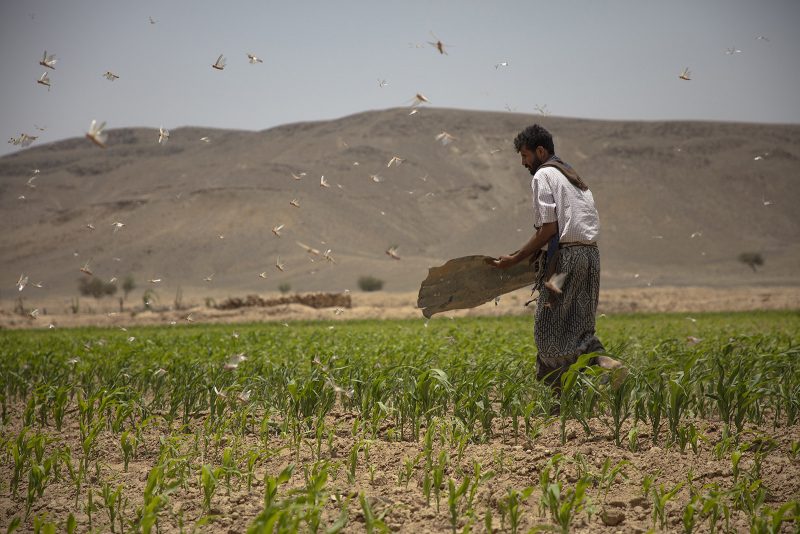
A Yemeni farmer tries to chase locusts off of his fields. Photo | UNFAO
Fertile soil, especially in the border areas in Saada and Hajjah, has become environmentally polluted due to the number of weapons dropped in more than half a million airstrikes. That pollution has not only affected the soil, experts fear it could genetically alter the pomegranates, grapes and coffee that were once staple crops in Yemen. Farmers and their families are at constant risk from unexploded ordnance, especially cluster bombs like the one that killed a young boy on his family farm in Hodeida last Thursday.
Agricultural and environmental experts that spoke to MintPress said that the effects of the Saudi coalition’s targeting of the agricultural sector will likely last for decades. The Director of Agricultural Extension in Yemen, Salah al-Mashreqi, said that more catastrophic effects will appear in the medium and long term, including genetic changes to pomegranates, for which Yemen is famous.
The deliberate targeting of food is prohibited by article 54 of the Geneva Conventions and the May 24, 2018, UN Security Council resolution 2417 on the protection of civilians in wartime, specifically reiterates this principle. Article 14 of the 1977 Protocol Additional to the Geneva Conventions clearly states that starvation as a means of combat is not allowed: ‘’It is prohibited to attack, destroy, remove, or render useless objects indispensable for the survival of the civilian population.” Yet the international community has done little to curb the Saudi-led coalitions use of starvation as a tactic of war in Yemen.
This, in large part, according to many Yemenis and legal scholars alike, is because Saudi Arabia enjoys the near-total diplomatic protection of the United States. Without that support, Saudi Arabia’s airstrikes, which rely on American contractors, targeting software, training, weapons, and technicians to target farmers that are concerned with little more than feeding themselves and their country, would not be possible.
Ahmed AbdulKareem is a Yemeni journalist. He covers the war in Yemen for MintPress News as well as local Yemeni media.
Yemen’s Ansarullah offers new prisoner swap deal to Saudi-backed ex-govt
Press TV – October 11, 2019
Yemen’s Houthi Ansarullah movement has offered the Saudi-backed former government a new deal for exchange of prisoners over a week after the popular movement unilaterally released hundreds of detainees.
Head of Yemen’s National Committee for Prisoners Affairs (NCPA), Abdulqader al-Mortada, said Friday the group had told “local mediators” that it was ready to implement a prison exchange within one week.
“We are waiting for the other side to respond,” he noted, according to a report by Al Masirah TV.
The Ansarullah official said the deal offered to the other side would cover 2,000 prisoners in the “first phase”.
The offer came days after the Houthi movement released hundreds prisoners, including three Saudi nationals, in its latest goodwill gesture.
Through the release, the Ansarullah movement and its allies in the Yemeni army said they sought to underline their commitment to peace negotiations held in Sweden last December.
The talks with Yemen’s Saudi-backed former government resulted in an agreement, which calls for a ceasefire in Hudaydah, a prisoner exchange and a statement of understanding on the southern city of Ta’izz.
The unilateral release of prisoners proved Ansarullah’s “credibility in implementing the Sweden agreement and we call on the other party to take a comparable step,” the NCPA head said at the time.
The released detainees were “included in the prisoner lists of the Sweden deal,” Mortada said in a press conference.
Mortada noted that the Ansarullah movement launched the initiative due to the big delay in the implementation of the prisoner swap deal.
It is the latest goodwill gesture from the Ansarullah movement which called for a cessation of strikes in September.
President of the Supreme Political Council in the Yemeni capital, Mahdi al-Mashat, on September 20 said the Ansarullah movement would stop targeting Saudi territories with drones and ballistic missiles, hoping Riyadh would reciprocate the gesture.
Saudi Arabia and a number of its allies launched a devastating campaign against Yemen in March 2015, with the goal of bringing the former regime of Abd Rabbuh Mansur Hadi back to power.
The US-based Armed Conflict Location and Event Data Project (ACLED), a nonprofit conflict-research organization, estimates that the war has claimed more than 91,000 over the past four and a half years.
The war has also taken a heavy toll on the country’s infrastructure, destroying hospitals, schools, and factories. The UN says over 24 million Yemenis are in dire need of humanitarian aid, including 10 million suffering from extreme levels of hunger.
Yemen Is Now Saudi Arabia’s “Vietnam War”
By Paul Antonopoulos | October 1, 2019
Something does not appear right in Saudi Arabia. Although the Wahhabi Kingdom has a technological, demographical and economical advantage over Yemen, it has completely failed to break the Yemeni resistance, headed by the Houthi-led Ansarullah Movement. The Ansarullah Movement has not just been on the defensive against Saudi Arabia’s advancements, but has also taken the fight directly to them despite the Kingdom controlling the seas and the high skies.
On September 14, the Yemeni Resistance attacked a Saudi Aramco oil facility, causing billions of dollars in damage that will take months to completely fix. However, it is the capture of thousands of Saudi soldiers, including high-ranking officers, and mercenaries that has consolidated the idea that Saudi Arabia is experiencing its own so-called “Vietnam War.”
Although Saudi Arabia has the fifth biggest military budget in the world, ahead of even Russia, France and the United Kingdom, it has not been able to dislodge the Ansarullah Movement from power. With Saudi Arabia dropping bombs indiscriminately in Yemen, including on mosques, markets, schools, hospitals, wedding parties and funeral processions, the country has become the world’s biggest humanitarian crisis. Even Ansarullah leader Abdul-Malik Badreddin al-Houthi has visibly lost a significant amount of weight over the course of the war as over 10 million Yemenis are starving or on the verge of starvation.
Saudi Arabia’s state budget is fuelled by oil and the Aramco company is in the six largest corporations globally, with annual revenue of around $350 billion recently, about the GDP of Denmark. Yemen is far off from Saudi Arabia in every developmental metric, but yet, they have not been able to dislodge the Ansarullah Movement from the Yemeni capital of Sana’a.
Saudi Arabia has mobilized about 150,000 of its soldiers and mostly Sudanese mercenaries, and has used hundreds of jets with U.S.-provided weapons to attack Yemen and its infrastructure because of their defiance in not being subjugated to Riyadh’s demands. Saudi officials also went on a diplomatic mission to include Morocco, the United Arab Emirates (UAE) and Sudan in their war against Yemen. This was all in an effort to remove what Riyadh believes to be an Iranian proxy on its border, an allegation both the Ansarullah Movement and Tehran deny.
Ansarullah have not just remained passive as the Saudi-led coalition began its aggression, and have utilized rockets and drones to attack directly into Saudi Arabia’s southern regions, despite the Kingdom possessing the U.S.-made Patriot Missile Defense System. Although Saudi Arabia has air and naval superiority, it cannot convert this control into successes on the ground, and rather has relied on mercenaries, to fight its war against the Ansarullah Movement.
One is not motivated to unnecessarily die for the sake of money, but are willing to take the risk of dying, two very different things. It is for this reason, on Saturday, the Ansarullah Movement captured over a thousand soldiers from the Saudi Coalition, mostly low-ranking soldiers and Sudanese mercenaries, but also some high-ranking officers, when they were surrounded and ambushed. The mercenaries are willing to fight for money, but not die in vain, which is why they surrendered en masse when flanked by the Ansarullah fighters.
Well, comparisons with Vietnam can certainly begin to be drawn now. It is much deeper than the analogy of David and Goliath, as by all means, the odds should be further into Riyadh’s favor rather than Goliath’s was against David.
Saudi Arabia has used all their political leverage in the Arab League and the Gulf Cooperation Council, invested billions into a costly war that it had no reason to intervene in and suffered a dramatic defeat. How could the Ansarullah Movement with limited resources and on the verge of starvation do this? It was concluded by Riyadh that the only explanation for this embarrassment is that Iran orchestrated the attack against Aramco and captured the thousands of soldiers. This bares resemblance to when the U.S. refused to recognize that the Vietnamese were defeating them, and credited the Vietnamese victory directly to the Soviet Union and China, rather than the Vietnamese people.
Riyadh diverting attention away from the Ansarullah movement helps them save face as they can accredit the victories to a rival anti-U.S. and anti-Israel regional power, Iran. Therefore, this can help legitimize a U.S. intervention in Yemen as Saudi-Iranian relations are traditionally poor over theocratical, geopolitical and economic reasons.
More importantly, it could bait Washington to justify military aggression against Iran. However, for the U.S. and Israel, the possibility of waging a “proxy conflict” between Saudi Arabia and Iran would be preferable with their limited intervention. This is a risky gambit as Saudi Arabia produces about 15% of crude oil globally, and can significantly influence the world economy.
Although it would be in Saudi Arabia’s interest to avoid being bogged down in an endless war that drains its resources and manpower, as the U.S. had experienced in their invasion of Vietnam, there is little suggestion that it will disengage from what is the Arab world’s poorest country.
Simply comparing the military budgets of Saudi Arabia and/or the U.S.’ with Yemen or Iran, is not enough to predict a final outcome of this conflict, as Saudi Arabia is learning the hard way with the continued setbacks. With over a thousand soldiers and mercenaries captured, it shows Riyadh has a fighting force lacking motivation and willingness. This is completely opposite to the Ansarullah Movement that believes its engaged in an anti-imperialist struggle.
If Saudi Arabia is to avoid further economic risk and military embarrassments, it would be in the primary interest of Saudi Arabia to disengage in Yemen and accept its losses on this front in the wider Saudi-Iranian geopolitical rivalry. Just as the U.S. finally found the sense to withdraw from Vietnam after a long 18 year involvement that resulted in nearly 60,000 American deaths, Riyadh now must find its sense, much quicker than Washington’s policy towards Vietnam, and accept the situation in Yemen is untenable and unwinnable.
Paul Antonopoulos is the director of the Multipolarity research centre.
Three Saudi Brigades Annihilated in Devastating Houthi Offensive in Saudi Arabia
By Federico Pieraccini | Strategic Culture Foundation | September 30, 2019
Many may have hitherto been led to believe that the Houthis were a ragtag armed force lacking in sophistication. Many, seeing the drone and missile attacks on Saudi oil plants, may have declared it to be a false-flag attack carried out by Riyadh to boost Aramco’s market value; either that or it was an operation carried out by Iran or even Israel. On Saturday September 28, the Houthis put paid to such speculation by confirming what many, like myself, have been writing for months; that is, that the asymmetrical tactics of the Houthis, combined with the conventional capabilities of the Yemeni army, are capable of bringing the Saudi kingdom of Mohammed Bin Salman to its knees.
The Yemeni army’s missile forces are able to carry out highly complex attacks, no doubt as a result of reconnaissance provided by the local Shia population within the Kingdom that is against the House of Saud’s dictatorship. These Houthi sympathisers within Saudi Arabia helped in target identification, carried out reconnaissance within the plants, found the most vulnerable and impactful points, and passed this intelligence on to the Houthis and Yemeni army. These Yemeni forces employed locally produced means to severely degrade Saudi Arabia’s crude-oil-extraction and processing plants. The deadly strikes halved oil production and threatened to continue with other targets if the Saudi-conducted genocide in Yemen did not stop.
On Saturday 29 the Houthis and the Yemeni army conducted an incredible conventional attack lasting three days that began from within Yemen’s borders. The operation would have involved months of intelligence gathering and operational planning. It was a far more complex attack than that conducted against Aramco’s oil facilities. Initial reports indicate that the forces of the Saudi-led coalition were lured into vulnerable positions and then, through a pincer movement conducted quickly within Saudi territory, the Houthis surrounded the town of Najran and its outskirts and got the better of three Saudi brigades numbering in the thousands and including dozens of senior officers as well as numerous combat vehicles. This event is a game changer, leaving the US, Mike Pompeo and the Israelis and Saudis unable to lay the blame on Iran as all this took place a long way from Iran.
The large-scale operation was preceded by Yemeni rocket artillery targeting Jizan airport, with 10 missiles paralyzing any movements to and from the airport, including denying the possibility of air support for the encircled troops. The Houthis also hit the King Khalid International Airport in Riyadh in a key operation that targeted Apache helicopters, forcing them to leave the area. Nearby military bases were also targeted so as to cut off any reinforcements and disrupt the chain of command. This led to the Saudi forces fleeing in disorganization. Images shown by the Houthis show a road in the middle of a valley on the outskirts of Najran with dozens of Saudi armored vehicles trying to flee while being attacked from both sides by Houthi RPGs together with heavy and light weapons. Visual confirmation of the debacle can be seen in the number of casualties as well as in the number of prisoners taken. Images show lines of Saudi prisoners walking under Yemeni guard towards prison camps. This is something extraordinary to behold: the Saudi army, the third largest purchaser of weapons in the world, getting comprehensively walloped by one of the poorest countries in the world. The numbers say it all: the Houthis were able to control more than 350 kilometers of Saudi territory. Given that the Saudi military budget is almost 90 billion dollars a year, this achievement is made all the more extraordinary.
Houthi forces employed drones, missiles, anti-aircraft systems, as well as electronic warfare to prevent the Saudis from supporting their troops with aviation or other means to assist their trapped men. Testimony from Saudi soldiers suggest that efforts to rescue them were half-hearted and of little effect. Saudi prisoners of war accuse their military leaders of having left them prey to their opponents.
The Yemeni army and the Houthis were within less than 10 days able to inflict a devastating blow to both the credibility of US defense systems and the Saudi military. They did this by employing creative methods suitable for the objective at hand.
They initially revealed the internal vulnerability of the Kingdom through such a level of penetration into Saudi Arabia that they were able to conduct internal reconnaissance through the assistance of infiltrators or local collaborators so as to know exactly where to hit the oil installations for maximum effect and damage.
They subsequently demonstrated their technical and cyber capabilities through an asymmetrical operation employing drones of various types as well as electronic warfare to blind the US Patriot system’s radars, in the process halving Saudi Arabia’s oil production for a period of time Aramco is yet to determine.
Finally, the most surprising and astounding aspect of these recent events is this most recent Yemeni ground operation that was carried out in hostile territory and succeeded in surrounding three brigades consisting of thousands of men and their equipment. Thousands of Yemeni soldiers loyal to Ansarullah (Houthis) took part in this successful operation, supported by drones, ground-attack aircraft and air-defense batteries. Such capabilities are ordinarily better associated with well-trained and well-equipped militaries rather than militaries coming from the Third World.
The Houthis issued a clear message to Riyadh when they hit its oil installations. They effectively let it be known that they had the means and capability to damage the Kingdom irreparably, leading ultimately to the overthrow of the House of Saud.
The Yemeni army spokesman announced, after hitting the Saudi oil facilities, that they would stop all offensive actions using drones and missiles, leaving it up to Riyadh to decide whether things stopped there and they sat down at the negotiating table to end the conflict, or whether Saudi Arabia was in the mood for more of the same treatment.
Mohammed bin Salman would no doubt have received manifold reassurances from the Americans, explaining away the failure of the Patriot systems and assuring him that more American assistance was on the way; and that it would, moreover, be impossible to come to an agreement with the Houthis, especially given that they are considered to be a proxy of the Iranians (a debunked lie); not to mention, of course, the huge loss of prestige that would befall the Saudis, Israelis and Americans were such a capitulation to occur.
There is already talk in Riyadh of receiving new supplies of the THAAD system (similarly useless against Houthi asymmetrical warfare) and other very expensive American air-defense systems. It is too bad for the Saudis that the US has nothing like the Pantsir and the Russian BUK systems, which allow for a multi-layered air defense, ideal for defending against small, low-flying drones and missiles that are difficult to intercept with such systems as the Patriot and THAAD.
Instead of starting peace talks to stop the ongoing genocide in Yemen and being hit again by the Houthis in response, Mohammed bin Salman and his advisors seem to have seen it fit to commit further war crimes in Yemen.
Faced with such intransigence, the Houthis went ahead with a new attack even more devastating for Saudi morale and discombobulating for Western policy-makers. Thousands of men and their equipment were either killed, wounded, or taken captive in a pincer movement reminiscent of the DPR and LNR’s actions in Ukraine in 2015 where Kiev’s forces was similarly surrounded and destroyed.
Usually such pincer movements require thorough reconnaissance to determine where best to surround the enemy. Furthermore, air support and air-defense systems would be necessary to ward off American and Saudi responses. In addition to all this, troops and their equipment are needed together with the necessary training for such assaults that require coordination as well as quick and effective execution of orders. All these requirements were met as a result of the excellent preparation and knowledge of the terrain by the Yemeni army and the Houthis.
If the attack on Saudi oil facilities had such an impact, then the even more dramatic attack of this last Saturday will have forced Mohammed bin Salman and his American allies to face a very harsh reality. Saudi Arabia, it will now need to be recognized, does not have the capacity to defend its borders from Yemen, leaving the Houthis and the Yemeni army free to enter Saudi territory at will while showing little regard for the opinion and feelings of the Saudis and Americans.
This is a triple checkmate for the Houthis against Riyadh. Firstly, they showed that they had enough local support within Saudi Arabia to have ready internal saboteurs in the event of an all-out war with Iran or Yemen. Then they showed they have the capacity to cripple Saudi Arabia’s oil production. Ultimately, Yemen’s conventional forces could redraw the boundaries between Saudi Arabia and Yemen in the latter’s favor should Yemeni leaders decide to invade and occupy a strip of Saudi territory to secure a buffer zone, given that Saudi forces have been violating Yemen’s sovereignty and massacring civilians willy nilly for the last five years.
It bears reflecting on the significance of these events. The third-biggest arms spender in the world is incapable of defeating the poorest Arab country in the world. It is, moreover, incapable of protecting its national interest and borders from this impoverished Arab country. The Houthis are showing to the world what a poor but organized and motivated armed force can do using asymmetrical methods to bring one of the best-equipped militaries in the world to its knees. This conflict will be studied all over the world as an example of how a new means of warfare is possible when technological and cyber capabilities are democratized and available to those who know how to use them appropriately, as the Houthis have shown with their use of drones and electronic warfare.
With the Houthis enjoying a high level of leverage, through a combination of missile capabilities, the holding of many prisoners of war, and saboteurs spread throughout Saudi Arabia (apropos, a strange fire occurred in Jeddah on Sunday at the Al-Haramain railway station), it may be time for Riyadh to accept the tragic consequences of this useless war and sit down at the negotiating table with Ansarullah.
Washington and Tel Aviv will try in every way to prevent such negotiations. But if Mohammed bin Salman and his family wish to save their kingdom, it is better to start talking to the Houthis immediately. Otherwise it is only a matter of time before another attack by Ansarullah leads to the complete collapse and ruin of the House of Saud and the Kingdom of Saudi Arabia.
US and EU Gang up to Demonize Iran Over Saudi Airstrikes
Strategic Culture Foundation | September 27, 2019
The European Union’s statement this week condemning Iran over the recent airstrikes on Saudi Arabia’s key oil industry sites was a tawdry piece of political cowardice. Not only tawdry, but dangerous as well.
For the EU is giving credence to Washington’s intensified attempts to demonize Iran, imposing ever-harsher economic sanctions and escalating tensions that could explode into an all-out war. Ironically, this is in spite of the EU claiming to be facilitating diplomacy to promote peace and security in the Middle East.
To be more precise, it wasn’t an EU joint statement issued at the United Nations general assembly this week. It was a statement formulated by only three members of the bloc: Britain, France and Germany. In practice, however, the biggest members of the EU were speaking on behalf of the others. (Full statement here.)
British Prime Minister Boris Johnson, French President Emmanuel Macron and German Chancellor Angela Merkel stated the following:
“We condemn in the strongest terms the attacks on oil facilities on Saudi territory on September 14, 2019 in Abqaiq and Khurais, and reaffirm in this context our full solidarity with the Kingdom of Saudi Arabia and its population. It is clear to us that Iran bears responsibility for this attack. There is no other plausible explanation. We support ongoing investigations to establish further details.”
Thus, the Europeans are repeating assertions made by the United States and Saudi Arabia by which they accuse Iran of being responsible for firing drones and cruise missiles at the vital Saudi oil installations. No credible proof has so far been presented to support such an assertion.
The European powers are engaging in a reprehensible blame game which will only embolden further Washington’s reckless aggression against Iran.
Tehran has categorically rejected all accusations that it was in some way involved in the airstrikes against Saudi Arabia. The Yemeni Houthi rebels have from the outset following the attacks claimed full responsibility.
Iran may support the Yemeni rebels and have at some time provided weapon technology, but the Houthis are capable of developing and deploying their own fire power.
By blaming Iran, the US and Europeans are giving political cover to Saudi Arabia and its nefarious role in starting and waging a genocidal war against Yemen for the past four years. It is arguably the right of the Yemenis to retaliate against Saudi Arabia in acts of self-defense. And it is in Iran’s right to support the Yemenis, just as the US, British and French support Saudi Arabia. Why should there be a double standard?
What is even more despicable is that the European trio (the so-called E3) have been massive weapons suppliers to Saudi Arabia, in particular Britain and France. The British and French (and Americans, of course) have made hundreds of millions of dollars in recent years from weaponizing the Saudi war on Yemen, even though that has led to nearly 100,000 civilian deaths. Why doesn’t the E3 issue condemnation, rather than “solidarity” to the Kingdom of Saudi Arabia, over this genocidal slaughter?
A further aspect to the joint statement issued by Britain, France and Germany is that these powers are signaling their support for US President Donald Trump’s efforts at sabotaging the international nuclear accord with Iran. That landmark deal was co-signed by the US, France, Britain, Germany, Russia and China back in July 2015.
Trump reneged on the UN-endorsed treaty when he unilaterally walked away from it in May 2018. It was typical American bad faith and backsliding whenever international agreements don’t suit their selfish interests.
Russia and China continue to support the Joint Comprehensive Plan of Action (JCPOA, as the nuclear deal is known formally as). Iran has recently begun to suspend certain commitments, such as increasing stocks of enriched uranium. The Iranian position of partial non-compliance is understandable. The US has trashed its obligations to the deal, and the Europeans have barely stepped up to the plate to implement sanctions relief for Iran, which is mandated by the JCPOA. Four years after the deal was done!
Britain, France and Germany claim to be still committed to the nuclear deal, according to a press statement by EU Foreign Affairs Commissioner Federica Mogherini at the UN this week.
But it is evident that, on the contrary, the E3 troika is instead moving to undermine the JCPOA. Blaming Iran with groundless accusations of attacking Saudi Arabia is part of the sinister shift by stealth. The day before the E3 issued their joint statement, Britain’s Boris Johnson was disparaging the nuclear as a “bad deal” and urged a renegotiation for what he sycophantically called a “Trump deal”.
Here is another weasel-worded section from the EU joint statement:
“Conscious of the importance of collective efforts to guarantee regional stability and security, we reiterate our conviction that the time has come for Iran to accept negotiation [sic] on a long-term framework for its nuclear program as well as on issues related to regional security, including its missiles program and other means of delivery… We urge Iran to engage in such a dialogue and refrain from further provocation and escalation.”
That is a clear – albeit with backhanded verbosity – attempt to pressure Iran into accepting Trump’s demand for the JCPOA to be replaced by further restrictions on Iran’s rights to pursue self-defense and normal regional and international relations. In weak-kneed fashion, the EU is augmenting Trump’s agenda of demonizing and criminalizing Iran so that it might succumb to subjugation.
Why the Europeans are acting with such cynicism is to conceal the glaring fact of their own weakness vis-a-vis Washington’s dictates and imperialist bullying. They should be admonishing the Americans for bad faith and reckless aggression; they should be condemning Saudi Arabia for a merciless slaughter in Yemen; they should be with-holding lucrative weapons sales to Saudi Arabia if they were really interested in peace; and if the Europeans really were genuine about non-proliferation and Middle Eastern stability, they should be whole-heartedly implementing the nuclear accord with Iran and providing the country the normalized economic trade that it is entitled to – just as Russia and China have done.
But no. And so to cover up their spinelessness, the Europeans are obliged to gang up with Washington to blame the victim of imperialist abuse – Iran. Such European cowardice is leading to more conflict.
Saudis Blame Iran for Aramco Strikes But Retaliate by Bombing Yemeni Civilians
By Ahmed Abdulkareem | MintPress News | September 24, 2019
AMRAN, YEMEN — Unlike the burning fields of neighboring Saudi Arabia, in Yemen scenes of massive fires have become commonplace, a reality that civilians do not accept but have come to expect. For nearly five years, since the Saudi-led Coalition began its bombing campaign in Yemen, Yemeni residents have watched as their neighbors’ homes have burned to the ground, often with whole families still inside, and as schools, factories, hospitals, mosques, and markets are rendered into piles of soot and ash following massive infernos sparked by near-constant Saudi airstrikes. Yet, unlike the attacks on Saudi oil facilities, rarely do the attacks on Yemen garner international media coverage or condemnation.
Thirty-two-year-old Yemeni Bedouin Saleh Masoud Jarwan did not expect that he and his family would be the next victims of the Saudi airstrikes, but on Monday Saleh was killed along with six family members in an airstrike by Coalition jets in Yemen’s Amran province. Saleh had hoped that Yemen would be safe after the attack on the Saudi Aramco facility, assuming that the attack would be enough to encourage the Kingdom to halt its drone and missile attacks against Yemen.
The scene of the attack was illuminated in red from the massive fires that followed the airstrikes, and this fire was not fueled by oil but by the bodies of more than ten civilians, including women and children. The screaming and crying of two children who survived the initial onslaught provided a backdrop to the shouts of rescuers who frantically worked their shovels and called out to victims as they worked to free Saleh and his family from the rubble of the mosque that collapsed on them in the airstrike.
A sustained Saudi barrage
The Coalition is estimated to have carried out at least 42 airstrikes in just a 24-hour period alone. By 2 a.m. on Sunday, local residents in the al-Sawad district of North Amran were living in horror as they sheltered in schools and mosques hoping to escape death from above as at least 12 Coalition airstrikes leveled their neighborhood. Thekra, Moamer, and Kubra — three young girls between the ages of three and eight — were among those who took refuge in a local mosque, only to be killed after Saudi warplanes brought it down over their heads.
In the village of al-Addi in the Harf Sufyan district, the air was suffused with the smell of charred bodies after a Saudi airstrike hit a car, instantly killing the two civilians inside. That attack was followed hours later by airstrikes targeting the nearby home of Ahmed Jimaie.
On Tuesday, 16 civilians, including four women and seven children, were killed when Saudi airstrikes hit the home of Abbas al-Halmi in Qataba, Al-Dali governorate, according to a local resident who spoke to MintPress but was unable to provide further details on the attack. The bodies of three children were later recovered from the rubble of that attack, adding to the already staggering death toll.
Saudis blame Iran, punish Yemen
The Grand Mufti of Yemen, Shams al-Din Sharaf al-Din, the highest religious authority in Yemen, laid blame on those who declared solidarity with Saudi Arabia following last week’s Aramco attacks but remain silent in the face of atrocities committed by Saudi Arabia and the United Arab Emirates in Yemen.
These latest Saudi-led Coalition attacks came days after Yemen’s Houthis announced responsibility for a spate of retaliatory attacks against positions inside Saudi Arabia. It is unclear why the Coalition launched the ostensibly retaliatory attacks on Yemen, as they claim that it was Iran, not the Houthis, that carried out the oil-field attacks.
Mahdi al-Mashat, Ansarullah’s (the Houthis’ political bloc) president of the Supreme Political Council in the Yemeni capital, Sana’a, warned that Yemenis would not hesitate to “launch a period of great pain if their calls for peace were ignored.” Al-Mashat made the comments following an announcement that the Houthis would temporarily cease all retaliatory missile and drone attacks against the Saudi monarchy as part of a Yemeni peace initiative. Al-Mashat said:
We announce the cessation of the targeting of Saudi Arabia’s territory by airborne missiles, ballistic missiles, drones and all forms of targeting, and we await a response to this initiative with a similar or a better one to halt all forms of attack.”
That announcement came just three days before the Coalition launched its deadly attacks in Amran.
The United Nations welcomed Ansarullah’s proposal, saying in a statement issued on Saturday by the UN Special Envoy for Yemen, Martin Griffiths, that it marked an important opportunity to move forward with all necessary steps to reduce violence, military escalation, and unhelpful rhetoric.
Griffiths emphasized that the implementation of the proposal by the Houthis was in good faith and could send a powerful message of their will to end the war. Saudi Arabia has so far refused to accept the offer and Saudi Minister of State for Foreign Affairs Adel al-Jubeir dismissed it, saying, “We judge other parties by their deeds [and] actions and not by their words, so we will see.”
The peace initiative follows Houthi airstrikes on two of Saudi Arabia’s oil facilities in Abqaiq and Khurais, which led to a suspension of about 50 percent of the Arab kingdom’s crude and gas production. That attack on a vital economic interest of the Kingdom garnered widespread support among many in Yemen’s capital city of Sana’a. On September 14, the day of that attack, hundreds of thousands of residents from Sana’a and its neighboring provinces took to the streets carrying Yemeni flags and holding banners emblazoned with messages of steadfastness and support for Houthi drone and missile forces.
Many Yemenis see Aramco attack as justified last line of self-defense
For many, the Houthis’ setting fire to the Kingdom’s Aramco oil fields represented the last hope to quell Saudi attacks on Yemen. In a staggering show of solidarity on Sunday, an estimated 1,200 cars filled the streets of 70th Area, a neighborhood in southern Sana’a, to drop off food donations for families of victims of Saudi airstrikes. According to many of the families, the attack on Aramco is revenge for the blood of the estimated 100,000 people killed in the Saudi-led Coalition’s war in Yemen.
Indeed, the Coalition has used systematic economic strangulation as a weapon of war — targeting jobs, infrastructure, the agricultural sector, fuel and water pumping stations, factories, and the provision of basic services, as well as imposing a land, sea and air embargo impacting the country’s imports, causing the spread of famine throughout the country. This, to the many in Yemen who celebrated the Aramco attack, is sufficient justification for targeting the heart of Saudi Arabia’s economy.
However, many still doubt that the Houthis were capable of carrying out an attack of the scale and range of the one that struck Saudi Arabia — instead accusing Iran of orchestrating the attacks. Others await the results of an international investigation, but the Houthis, who comprise a major component of Yemen’s resistance to Saudi interference in their country, say the evidence that they carried out the attacks exists and that they will share it with the media.
The Houthis over the past two years have launched a series of sophisticated attacks on Saudi coalition targets deep inside the Kingdom, establishing a precedent for the most recent attacks. Houthi officials say the attacks on the Aramco facilities were launched from three different locations, based on their flight endurance and designated targets, and that various types of combat drones were used in the attack, some capable of carrying four precision-guided bombs and of striking their targets from several angles.
Moreover, the Houthis’ third-generation Qasef (Striker) combat drones and long-endurance Sammad-3 (Invincible-3) drones have an operational range of 1,500 kilometers to 1,700 kilometers.
The attack on Aramco came at a time when the de facto leader of the Kingdom, Crown Prince Mohammed bin Salman, was attempting to refloat the much-delayed public offering of Aramco shares, and that attack would not likely not have succeeded without the cooperation of members of Saudi royalty and former Saudi officers, according to some Houthi sources.
Ahmed AbdulKareem is a Yemeni journalist. He covers the war in Yemen for MintPress News as well as local Yemeni media.
Beware False Flag Drone Attacks
Opinion by Walrus | Sic Semper Tyrannis | September 21, 2019
The corollary to the Houthis brilliant use of do – it – yourself drones and perhaps cruise missiles, is that anyone else can do the same. This makes the possibility of false flag attacks using such weapons more likely in my opinion. Such attacks would not even necessarily require the resources of a State actor to execute, all the materials, bar perhaps the explosive, are freely available around the globe.
I will not explain the mechanics of manufacturing such weapons. Take it from me that a group of determined hobbyists could do so, provided they have sufficient security and money. Such weapons could be labeled for example “made in Iran” in such depth that it would be impossible to refute their origin, no matter how good ones forensics are.
A State actor, perhaps bent on mischief, could do this rather quickly. While this is just a guess, I would be surprised if various Western countries security services did not already have an operation underway to replicate the Houthi achievements, if only to answer the politicians question: “How did they do that??” and to start thinking about countermeasures.
My reason for being concerned enough to raise this topic is that President Trump has committed troops to Saudi Arabia and we already have other troops and assets in the region. If they were subject to attack and we took casualties, I don’t see how the President could avoid war assuming Iran was blamed.
What triggered me was this article in the WSJ (paywalled) whose opening sentence is:
Yemeni Rebels Warn Iran Plans Another Strike Soon
“BEIRUT—Houthi militants in Yemen have warned foreign diplomats that Iran is preparing a follow-up strike to the missile and drone attack that crippled Saudi Arabia’s oil industry a week ago, people familiar with the matter said.
Leaders of the group said they were raising the alarm about the possible new attack after they were pressed by Iran to play a role in it…”
Once technology is out of the box, as the Houthis have demonstrated, it can’t be returned. How do we avoid false flag attacks?
A Precision Strike on US Credibility – Shattering a US Paradigm
By Alastair Crooke | Strategic Culture Foundation | September 23, 2019
The precision attack on the Saudi ‘jewel in the crown’, crude-processing installation last week, is also a precision assault on Saudi credibility, on the believability of the US security ‘umbrella’, and a humiliation for Trump, and particularly to America’s image as a competent military and intelligence power.
Gulf States will be pursing their lips as they consider now their own vulnerabilities and question their reliance on that US umbrella. Even the Pentagon might be questioning, ‘what then – is the point to CentCom’ in light of what has happened? And above all, Israel will be experiencing a very chill wind sending shivers up the spine: Israelis cannot but be a tad struck in awe at the attack’s precise targeting and technical efficacy. Quite impressive – especially given that Saudi spent $65 billion on weaponry last year, to no good avail.
Facing this humiliation, the US Administration has been ‘blowing smoke’: tossing around red-herrings about the origin and launch of the UAVs and cruise missiles. ‘It can’t be AnsarAllah (the Houthis), because such an operation was sophisticated beyond their capabilities’. Apart from the obvious Orientalism to this assertion (for, if Hizbullah can manufacture smart drones and smart cruise missiles, why shouldn’t the Houthis be able so to do?), do the exact, individual contributions towards the strike on Abqaiq really matter? What is most telling is that the US – with all its massive resources in the Gulf – cannot provide the evidence from whence came these UAVs to Abqaiq.
Actually, the ambiguity about the strike modus operandi represents just another layer to the sophistication of the attack.
The US is ‘blowing smoke’ about launch sites mainly to divert from the very obvious (but embarrassing) fact that the raining down of missiles on Abqaiq, primordially owes to the Saudi war on Yemen (supported unreservedly by Trump). The Houthis have claimed the attack; they say they will demonstrate their weaponry (which certainly in the case of the Houthi Quds 1 cruise missile is no mere copy of the Iranian Soumar missile – see here), and promise to repeat their attacks in the near future.
What the precision strike has done is to shatter the ‘vessel’ of the US posing as somehow ‘guardian’ of the Gulf, and guarantor of the crude oil lifeblood feeding into the veins of a fragile world economy. This to say, it was a precision strike aimed at the prevailing paradigm – and it scored a direct hit. It exposed the hollowness of both claims. Anthony Cordesman writes, “the strikes on Saudi Arabia provide a clear strategic warning that the US era of air supremacy in the Gulf, and the near US monopoly on precision strike capability, is rapidly fading”.
Were the Iranians directly or indirectly involved? Well … it doesn’t really matter. To understand the implications properly, it should be understood as somehow a joint message – coming from a common front (Iran, Syria, Hizbullah, Hash’d a-Shaibi and the Houthis). This was about blasting the wider sanctions crisis to a head: a strategic (missile) popping of the over-inflated ‘balloon’ of the efficacy of US “maximum pressure” tactics. Trump’s ‘sanctioning/tariffing the world’ had to be brought to a head – and be exploded. Russia and China would almost certainly concur, and (quietly) applaud.
There are clear risks to this approach. Will the message be heard correctly in Washington? For, as Gareth Porter points out in a different context, Washington’s ability to comprehend, or to ‘read well’, its ‘enemies’ mind seems to have been somehow lost – out of a failure in Washington to discover any strain of empathy towards ‘otherness’ (either Iranian, Chinese or Russian). So the prospects, probably, are not great. Washington will not ‘get it’, but rather, may double-down, with potentially disastrous consequences. Porter writes:
“The Abqaiq strike is also a dramatic demonstration of Iran’s ability to surprise the United States strategically, [thus] upsetting its political-military plans. Iran has spent the last two decades preparing for an eventual confrontation with the United States, and the result is a new generation of drones and cruise missiles that give Iran the ability to counter far more effectively any US effort to destroy its military assets and to target US bases across the Middle East.
“The United States was apparently taken by surprise when Iran shot down a high-altitude … surveillance drone … Iran’s air defence system has been continually upgraded, beginning with the Russian S-300 system it received in 2016. Iran also just unveiled in 2019 its Bavar-373 air defence system, which it regards as closer to the Russian S-400 system coveted by India and Turkey – than to the S-300 system.
“Then there is Iran’s development of a fleet of military drones, which has prompted one analyst to call Iran a ‘drone superpower’. Its drone accomplishments reportedly include the Shahed-171 “stealth drone” with precision-guided missiles, and the Shahed-129, which it reverse-engineered from the US Sentinel RQ-170 and the MQ-1 Predator” [link added].
Understanding Porter’s message represents the key to comprehending the nature of the ‘Great Shift’ taking place in the region. Robot planes and drones – simply – have changed the calculus of war. The old verities no longer hold – there is no simple US military solution to Iran.
A US attack on Iran will bring only a firm Iranian response – and escalation. A full US invasion – as in the 2003 invasion of Iraq – is no longer within US capabilities.
There is only a political answer. But for now, the US and MbS both, are in a stage of denial: the latter apparently believes that continuing with the partial sale of Aramco might solve his problems (though markets have just re-awoken to geo-political risk to assets, such as Aramco), and Trump seems still to believe that maximum pressure might still come up trumps.
For the rest of us, ‘the political’ is pretty obvious for Saudi Arabia: Accept defeat in Yemen, and with it, its corollary – engaging with Iran and Russia is a sine qua non for achieving any settlement. For sure it will be costly for MbS, both politically and financially. But what is the alternative? Wait upon further Abqaiqs? To be fair, there are reports that the al-Saud understand their situation now to be existential. We shall see.
And for Trump, the lesson surely is clear. The strike on Abqaiq could have been easily worse (with greater interruption to oil supplies). Oil markets and markets more generally have woken up to the geo-political risks to Trump’s maximum pressure tactics. And they are becoming nervous, as world trade falters.
Headlines such as “Stunning weekend attacks take out 50% of Saudi Arabia’s oil output … Can the economy survive a higher oil price…?” may be a bit too alarmist, but they make the point: Supply disruption could easily tip the fragile US and the global economy into recession, were higher prices to be sustained.
No one is more aware of this than President Trump because his re-election chances in 2020 may hinge on whether the US can stay out of recession. Generally speaking, US Presidents who seek a second term are always re-elected, unless they have a recession late in their first term. This happened to Jimmy Carter and George H.W. Bush – both lost re-election bids because of recessions on their watches.
Already both Saudi Arabia and Trump are rowing back from a possible (diversionary) confrontation with Iran (in lieu of addressing the Yemen issue, which remains at the root of Saudi’s difficulties). The question is how long denial over the flaws to the maximum-pressure Iran policy might continue? Up to the elections? Probably yes. Trump has some constituency egos he must stroke – in parallel to avoiding the potentially fatal landmine of recession – if he is to gain a second term. And that means pandering to the Evangelical and AIPAC obsession with Iran as our era’s ‘cosmic evil’ – one positive ‘straw in the wind’ might be the end to the Netanyahu reign (although Gantz is no Iran ‘dove’).
Saudi regime owes US $181mn for refueling support in bombarding Yemen
Press TV – September 22, 2019
Saudi Arabia still owes the US military $181 million for aerial refueling assistance it received for its brutal bombardment of Yemen’s mostly civilian targets amid Pentagon plans to send more troops to the despotic kingdom to purportedly bolster its air defenses against retaliatory drone attacks by Yemeni forces.
Despite Washington’s emphasis on US-Saudi alliance following Yemen’s destructive drone attack on the Kingdom’s huge Aramco oil facilities, Riyadh has failed to repay the Pentagon for providing midair refueling assistance for Saudi Arabia’s bombing runs over Yemen nine month after American military announced plans to seek reimbursement of its expenses, US-based Defense News reported Friday citing congressional sources.
‘Saudi Arabia pays cash’
The development came after US President Donald Trump emphasized to reporters on Monday that the despotic regime in Riyadh has been a “great ally” for its investments across America, insisting that “Saudi Arabia pays cash.”
While addressing reporters at the White House on Friday, Trump further pointed to Washington’s efforts to build a regional coalition against Iran and emphasized: “We’re also working on the cost of this whole endeavor, and Saudi Arabia has been very generous.”
According to the report however, Saudi’s refusal to pay for US refueling support has already enraged American legislators, many of whom feel frustrated with the kingdom’s involvement in the brutal murder of journalist Jamal Khashoggi as well as the massive civilian casualties the regime has inflicted during its war of aggression on neighboring Yemen.
Saudi’s refusal to pay Pentagon dues angers US lawmakers
“Saudi failure to reimburse us for aircraft refueling — hundreds of millions in taxpayer dollars — involves both deep insult and costly injury. It is entirely unacceptable that the Saudis have not reimbursed the Department of Defense for hundreds of millions in refueling costs,” said Democratic Senator Richard Blumenthal of Connecticut in a statement cited in the report.
“The American taxpayer-funded US Department of Defense is not the Saudi Royal Family’s piggy bank,” it added.
Inquiries from Blumenthal and Senate Armed Services Committee ranking member Jack Reed of Rhode Island also prompted the US military to announce in December that it would seek to recoup the money it failed to charge Saudi Arabia and the United Arab Emirates (UAE) for the midair refueling assistance ― which Riyadh ended in 2018.
The report further cited congressional sources as saying that the original balance due was since revised from $331 million to $291 million, and the Pentagon has separately recovered $118 million from the UAE, but Saudi Arabia has not repaid the US.
Pentagon spokeswoman Cmdr. Rebecca Rebarich refused on Thursday to elaborate on its collection efforts but confirmed that “the process of reimbursement is continuing, and we continue to expect full reimbursement of refueling expenses.”
Trump warned against anti-Iran military move
This is while Trump was due to hold a meeting on Friday to purportedly consider military options against Iran, the report added, citing “US officials familiar with the planned discussions.” It further pointed out that the American president was also due to be warned that any military action against the Islamic Republic would likely escalate into a war.
The US announced Friday it would send more troops to Saudi Arabia and the United Arab Emirates in response to the recent attack on Saudi oil facilities.
Tehran has fiercely rejected any involvement in the retaliatory attack by Yemeni forces against Saudi oil facilities and warned Washington that any military action against it will spell into an “all-out war” with immediate retaliation.
Meanwhile, congressional critics of the US president insist that he should not lead the country into an unnecessary conflict with Iran to protect Saudi Arabian oil.
Virginia Democratic Senator Tim Kaine, who sits on Senate Foreign Relations and Armed Services committees, pledged to file a war powers resolution to force a Senate vote to immediately end any such military action.
Featured Video

Deception – Submarines against Olof Palme
or go to
Aletho News Archives – Video-Images
From the Archives
Woolsey Fire started at Santa Susana Field Lab — where “radioactive materials released were never accurately measured”
By John Laforge | CounterPunch | November 30, 2018
In my Nov. 16 column, I reported on potential radiation risks posed by California’s Woolsey wildfire having burned over parts or all of the Santa Susana Field Laboratory—south of Simi Valley, Calif., 30 miles outside Los Angeles—site of at least four partial or total nuclear reactor meltdowns.
The field laboratory operated 10 experimental reactors and conducted rocket engine tests. In his 2014 book Atomic Accidents, researcher James Mahaffey writes, “The cores in four experimental reactors on site … melted.” Reactor core melts always result in the release of large amounts of radioactive gases and particles. Clean up of the deeply contaminated site has not been conducted in spite of a 2010 agreement.
Los Angeles’s KABC-7 TV reported Nov. 13 that the Santa Susana lab site “appears to be the origin of the Woolsey Fire” which has torched over 96,000 acres. Southern Calif. Public Radio said, “According to Cal Fire, the Woolsey Fire started on the afternoon of Thursday, Nov. 8 … on the Santa Susana site.” … continue
Blog Roll
 Aletho News
- Feeling Better, Getting Worse: How Psychiatric Drugs Create the Illusion They Cure
- ‘Nobody Told Me’: Former Mental Health Patient Calls Out Dangerous Side Effects of Psychiatric Drugs
- Dr. Abu-Sitta: Beirut ‘felt like a day in Shifa Hospital’
- Iran Has Won the War, It Will Be Up to the US to Secure the Peace: Mohammad Marandi
- Iran condemns assassination threats against Iranian negotiators amid US talks
- Brussels cannot say where its own pipeline inspectors are as Hungary’s oil lifeline remains shut
- Israel’s Iran War: Myth and Reality
- Between war and industrial breakdown: The US-Israeli attrition crisis
- Pressure builds on Iran to ‘drop’ Lebanon ceasefire demand as Islamabad talks hang in balance
- In another clash report, US denies agreement to release Iran’s assets
- If Americans Knew
- Pro-Israel ‘Thinktanks’ and Individuals who Influence U.S. Foreign Policy
- Mearsheimer reveals how Israel dictates US policies on Iran, Gaza – video
- After killing 350+, Israel still has a “score to settle” with Lebanon before ceasefire – Daily Update
- Military aid to Israel emerges as the latest political litmus test for Democrats
- The only Palestinian children’s rights organization closes following years-long Israeli campaign against it
- ‘I Can’t Forget the Smell’: Lebanese Reel After Israel Kills Over 300 in Single Day
- DNC Shoots Down Resolutions Calling Out AIPAC and Limiting Arms to Israel
- TCN: Is Israel Blackmailing President Trump?
- Israel killed at least 303 Lebanese yesterday – who were they? Daily Update
- Amnesty: Urgent – Protect Lebanese civilians from brutal escalation in Israeli attacks
- No Tricks Zone
- German Expert: Heat Dome Led To Record Temps In Western USA…Warmer In 1934, 1936
- New Study: No Linear Warming Or Glacier Retreat Along Northern Antarctic Peninsula Since 1980s
- An Inconvenient Tree: Uncovered In Alps… Europe Much Warmer Than Today 6000 Years Ago
- New Study Reports A 60% Slowdown In Greenland’s Ice Loss Rate In The Last Decade
- Low Intensity Tornado Wrecks Major Solar Farm, Creating A Potential Toxic Dump
- New Study Finds Warming Saves Lives…Cold Temperatures 12 Times More Deadly Than Excess Heat
- German Science Blog Accuses PIK Climate Institute Of Hallucinating Climate Tipping Points
- Devastating Assessment Of Comirnaty Vaccine By Former Senior Pfizer Europe Toxicologist
- New Study: CO2 Is ‘Effectively Negligible’ As An Explanatory Climate Change Factor Since 2000
- Former Pfizer Toxicologist Dr. Helmut Sterz Tells Bundestag Hearing Pfizer Vaccine Should Have Never Been Approved
 Aletho News