Brethren Church Leader Deported from Israel
By Kawther Salam • Jan 27th, 2010
In early January 2010, On Earth Peace, an agency of the Church of the Brethren reported that the executive director Bob Gross was detained and deported by Israeli authorities when he arrived at the Tel Aviv airport as part of a Christian peacemaking delegation meant to build connections with Israelis and Palestinians who are working for a non-violent resolution to their conflict.
The deportation of Mr. Gross is not the first and it will not be the last. It also has nothing to do with terrorism or the security of Israel, but it has to do with the daily crimes of genocide committed by the Israeli occupation against the Palestinians in their own homeland, cities, towns and villages in the West Bank. It is all about the crimes which the Israeli occupation does not want the international delegations to see or to report about.
Mr. Gross stated in an interview which he gave to me by Email that he had previously visited Palestine and Israel on April 2002, November 2004, January 2006, and January 2008.
 According to on Earth Peace report, the deportation of the executive director of On Earth Peace is part of a pattern of excluding from Israel any visitor who seeks peace and security for both Palestine and Israel. This has the effect of blocking peacemaking efforts by churches and other groups, and sets back the hopes of a constructive Middle East peace.
The full text of an interview with Director Bob Gross is below.
Q: Had you ever visited Palestine and Israel before?
Gross: Four times before, April 2002, November 2004, January 2006, January 2008.
Each time I was with a Christian Peacemaker Teams delegation. In 2004, 2006, and 2008, I was the delegation leader. In those trips, we were in Jerusalem, East Jerusalem, Hebron, Bethlehem, and the South Hebron Hills. We met with Israeli, Palestinian and international peacemakers, and with Palestinian families, as well as one Israeli couple.
Q: Would you describe your trip since you were stopped by the Israeli customs officer and until your deportation?

Gross: I probably would not have been stopped at passport control, except that I was travelling with my colleague, who was to co-lead the delegation with me. Her name is not Alice Bartlett, but she has asked that her real name not be used so that any publicity about this trip will not affect her later efforts to travel in the Middle East. She is Egyptian-American, and has an Egyptian last name. For this reason alone, she and I were stopped and asked to wait for questioning rather than being allowed to enter Israel.
We were made to wait in a room in the arrival hall of the Tel Aviv airport, and we were each questioned separately for 5-10 minutes. Then we waited for an hour or so, then my colleague was questioned again for about 30 minutes.
Later they took us to find our checked bags, and searched both our checked and carry-on bags very thoroughly, and searched us with very close body searches (with clothes on).
After 9.5 hours, they called my colleague in and told her they were not going to allow her into Israel, and would ban her for 10 years. A few minutes later they called me in, and asked me for names of my Palestinian and Israeli contacts. I would not give them any names. They also said that I would need to sign a paper saying that I would not enter the “Palestinian territories” while in Israel. I did not sign this paper. So they denied entry for me also, with a 10-year ban. They took photographs and electronic fingerprints of each of us, and took us to gather our bags to wait for being moved to the jail. However, it was another two hours — 12 hours in all — before they took us to the jail.
Q: How did they treat you? How was the comportment of the israeli officers in general and towards you?
Gross: They treated us OK. They were not harsh and did not mistreat us, but they exercised complete control and authority, treating us sometimes as if we were a nuisance, sometimes as if we were dangerous, sometimes as if we were dishonest.
Q: How many hours did the Israelis “investigate” you?
Gross: 9.5 before deciding to deport us.
Q: What kind of questions did they ask you?
Gross: Always the first question was, “What is the purpose of your visit to Israel?”
We answered that question truthfully, but briefly, and they seemed to know there was more we were not saying.
I was asked where I had travelled in Israel/Palestine on my earlier visit, and what I did. As I said above, in the last interrogation they asked for my contacts names and information.
I don’t know all of the questions my colleague was asked, because we never had a chance to talk about what we each had been asked without being overheard, so we did not talk about that while we were being held.
Q: Which was the silliest question, and what did you answer?
Gross: Maybe it was when they said I should give them the names of some of my contacts in Israel and Palestine, so they could call them and ask whether I should be trusted.
Q: How did you spend your night at the Israeli airport jail?
Gross: I was in the cell from 5 pm to 5 am. There was one other prisoner there, also being deported. He was Muslim, from Morocco, and had lived and worked in the Netherlands for many years. He was denied entry simply because of who he was, it seemed.
We talked some, and I slept some in the evening, since I had spent two nights on air-planes by that time, and was tired. They brought us some kind of sandwich and tea for supper. As it happened, my cell-mate snored very loudly, and so it was hard to sleep that night. I slept only a little, and then got up and prepared to leave. Just walked back and forth, looked out the windows, sat on the bed, and waited.
Q: Would you explain me your feelings during your stay in jail?
Gross: I was concerned for my colleague, who was in a different cell, and so I could not talk with her. I was relieved to be out of the waiting and to know what their decision was, even though it was for deportation.
Q: How many people do you think were illegally jailed in Israel at the same time with you?
Gross: One additional person was brought in after midnight, so there were three of us in my cell, and there was one person in the cell with my friend. I don’t know how many others.
Q: Did you sign any papers during the investigation, or before your deportation? What did you sign exactly? What was the justification given by the Israelis for your deportation?
Gross: I don’t remember signing anything.
Q: Which was your reaction when they notified you of your deportation? What did you say or ask?
Gross: I was not surprised, and I did not ask anything. I was not willing to agree to their terms, and so I knew they would not allow me in.
Q: What is your message for Israel after this tragic deportation?
Gross: Israel will not be made secure by expelling persons who seek peace and security for both Palestine and Israel.
No comments yet.
Featured Video
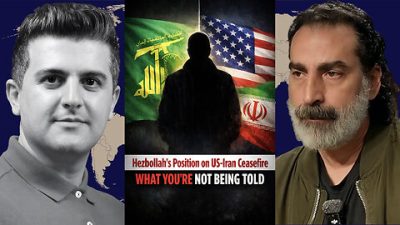
Laith Marouf: Hezbollah’s position on US-Iran ceasefire
or go to
Aletho News Archives – Video-Images
From the Archives
The Dirty Little Secret behind the “Global Terrorism Index”
The Omission of Israeli Terrorism in the Occupied Palestinian Territories
By Karin Brothers | Global Research | December 6, 2014
… The Israeli settlements — all of which are illegal – have been identified as a major impediment to peace. The refusal of a major “global” terrorism report to name the Israeli settlers as one of the groups most responsible for terrorism not only misrepresents a major source of regional violence but exposes the Global Terrorism Index as a propaganda tool that supports a U.S. agenda.
In recent years, governments have been attempting to thwart terrorism by blocking supportive fund-raising. When it comes to Israeli settlements, however, the US and Canada actually encourage fund-raising by giving organizations (such as Christian Friends of Israeli Communities (CFOIC) and the Jewish National Fund) financial support in the form of donor tax-deductions.
Charities which provide funds for the Israeli settlements should be regarded as terror-financing organizations. They should not only lose their tax-deductible status, but they should be banned because they support the violation of international humanitarian law. The terror-financing laws that are being strictly enforced for Muslim charities should be applied to Christian and Jewish charities as well. … Read full article
Blog Roll
 Aletho News
- The ‘Opposition Party’ Has Done Nothing to Stop the Iran War and Much to Goad Trump Into Continuing It
- Moscow backs Tehran on status of Lebanon in US-Iran deal
- How UK Regulator Ofcom Quietly Bypassed International Law to Police American Speech
- The Black Cube Files: How Former Mossad Operatives Flipped a Nation
- Laith Marouf: Hezbollah’s position on US-Iran ceasefire: What you’re not being told
- Israel’s priority lies in destroying chances of peace between Iran, US: Ex-UN nuclear chief
- Ceasefire for all or for none: Iran shuts Hormuz over Lebanon attacks
- Strait of Hormuz is Iran’s ‘nuclear weapon’ that forced US retreat: Medvedev
- Energy crisis will last for months – Kremlin envoy
- Europe’s quiet role in the war on Iran
- If Americans Knew
- This is ceasefire? Israel’s biggest massacre yet in Lebanon, another journalist killed in Gaza – Daily Update
- Tucker Carlson on Israel: This Is the Behavior of an Ally? Really?
- Gazans face a triple crisis: severe shortages of water and bread, healthcare in tatters
- NY Times reports how Netanyahu took the US into Iran War
- A sigh of relief over Iran, but Gaza and Lebanon in dire straits – Daily Update
- Thousands dead and neighborhoods razed to the ground: Aid agencies fear southern Lebanon is becoming the new Gaza
- The war the US is fighting for Israel could cost trillions
- ‘Cigarette Burns, Nail Wounds’: Toddler Tortured in Gaza to Coerce Father
- Trump Says US Sent ‘a Lot of Guns’ to Protesters in Iran
- Israeli forces destroy 17 UN peacekeeper cameras in south Lebanon
- No Tricks Zone
- An Inconvenient Tree: Uncovered In Alps… Europe Much Warmer Than Today 6000 Years Ago
- New Study Reports A 60% Slowdown In Greenland’s Ice Loss Rate In The Last Decade
- Low Intensity Tornado Wrecks Major Solar Farm, Creating A Potential Toxic Dump
- New Study Finds Warming Saves Lives…Cold Temperatures 12 Times More Deadly Than Excess Heat
- German Science Blog Accuses PIK Climate Institute Of Hallucinating Climate Tipping Points
- Devastating Assessment Of Comirnaty Vaccine By Former Senior Pfizer Europe Toxicologist
- New Study: CO2 Is ‘Effectively Negligible’ As An Explanatory Climate Change Factor Since 2000
- Former Pfizer Toxicologist Dr. Helmut Sterz Tells Bundestag Hearing Pfizer Vaccine Should Have Never Been Approved
- Energy Expert: Germany’s Nuclear Phaseout Was A “500 Billion Euro Mistake”
- New Research: South Australia’s Mid-Holocene Sea Surface Temperatures Were 4°C Warmer Than Today
 Aletho News
Leave a comment