Larijani: Iran proud to support the Palestinian and Lebanese resistance
20/01/2010

TEHRAN, (PIC)– Speaker of the Iranian parliament Ali Larijani on Tuesday expressed his country’s pride to support resistance movements in the region including the Lebanese resistance and the Movement of Hamas, stressing that the resistance became the only option to confront the occupation after the failure of peace projects.
These remarks came during a conference dubbed “Gaza, the symbol of resistance” which was organized by the association for the defense of the Palestinian people and attended by a representative of Hamas and Iranian officials.
According to the reporter of the Palestinian information center (PIC), Larijani stated in his speech that the resistance achieved tangible results in the 33-day war in Lebanon and the war on the Gaza Strip and announced that the Iranian parliament agreed January 19 to be marked annually as “Gaza day.”
The Iranian speaker recalled how the US and some European countries stood by Israel and provided it with all kinds of support and prevented many countries on many occasions from raising the issue of the Israeli military aggression on Gaza in the UN.
“During 22 days, no one talked about human rights and humanity, although we have seen the advent of the new US president who declared that he would make several changes in the policies of America and that he did not accept the practices of his predecessors,” the speaker underscored.
“And during the war, the Zionist entity killed more than 1,400 Palestinians, wounded more than five thousands, murdered large numbers of Palestinian children and turned Gaza into a scorched land, but all this was of no importance to Obama who preferred to be preoccupied with choosing a dog for his daughters,” he added.
Speaking about the visit of US president Barack Obama to Turkey and Egypt, the speaker said, “Obama told the Turkish parliament that he wanted to restore the Muslims’ rights and to adopt a new approach in dealing with them, and then traveled to Cairo and said there he knew about Islam and wanted to restore Palestinian rights, but it was shameful that he did nothing during this period, while Gaza is still besieged.”
Israel Finds a New Way to Play the Victim
By Ira Chernus, January 21, 2010
A report released by the United Nations last year says that Israeli settlers, angered over the destruction of Jewish outposts, could exact revenge on up to a quarter million Palestinians in the West Bank.
It’s not just vague speculation. The report, issued by the United Nations Office for the Coordination of Humanitarian Affairs, Occupied Palestinian Territory, names 22 specific Palestinian communities, with a total population of 75,900, that are “highly vulnerable” to revenge attacks, and another 59, with about 175,000 residents, that are “moderately vulnerable.” It also names numerous road segments and junctions where Palestinians are especially at risk.
The people who wrote this report have obviously been there, observed carefully, and know what they are talking about.
They’ve also listened to the Jewish settlers, who boast openly of their so-called “price tag” policy, by which they exact a “price” from Palestinians in response not just to terror attacks, but also to Israel Defense Forces (IDF) actions to evacuate unauthorized outposts. Of course, since they are more or less helpless against the IDF soldiers, the settlers intend to make Palestinians pay the price.
But the UN report stresses that the IDF is hardly the good guy here: “The main concern is the frequent failure of the Israeli security forces to intervene and stop settler attacks in real time, including the failure to arrest suspected settlers on the spot. … Among the main reasons behind this failure is the ambiguous message delivered by the government of Israel and the IDF top officials to the security forces in the field regarding their authority and responsibility to enforce the law on Israeli settlers.”
“Ambiguous” means that the IDF officially tells its soldiers to enforce the law, even when it means safeguarding Palestinian life. But when Israeli soldiers ignore that instruction, letting Palestinians suffer, the guilty Israelis virtually never suffer any consequences themselves. It’s the Israeli version of “Don’t ask, don’t tell.”
So the Israeli government, the occupying force ultimately responsible for the West Bank Palestinians’ security, is on notice that it’s facing a real risk of disaster. And it’s no longer a secret in Israel, where the nation’s top newspaper, Ha’aretz, has just made the UN report public.
So far, though, there is no indication that Israeli leaders have taken any steps to head off these revenge attacks. It’s certainly not being treated as a major issue in the Israeli press.
No, the Israelis have other worries on their minds. Right now, the hot new source of anxiety in Israel is an imagined worldwide conspiracy of anti-Semites bent on “delegitimization” – attacking the right of the Jewish state to exist. For many Israeli officials, it seems, this supposed conspiracy is all too real and all too dangerous. Soon they may be on full-scale alert, mobilizing their nation and its supporters to name this threat their “new battlefield,” make it a top priority, and fight back hard.
The idea of the “new battlefield” seems to have been born in the Reut Institute, a think-tank described by Thomas Friedman in the New York Times as “Israel’s premier policy strategy group.”
“Reut was established to serve Israeli government agencies and decisionmakers … from top-ranking politicians to government professionals,” its Web site explains – all at no charge, and no matter which party controls the government. When the current opposition leader, Tzipi Livni, was in the government as foreign minister, one of her advisers praised Reut: “They are very influential and highly respected. … Their alerts sometimes save the day.”
Now Reut is sounding the alert about the “new battlefield,” in a new report that’s been well-covered in the Israeli press. Here’s how Reut founder and president Gidi Grinstein explains it: “Turning Israel into a pariah state is central to its adversaries’ efforts. Israel is a geopolitical island. Its survival and prosperity depend on its relations with the world in trade, science, arts, and culture – all of which rely on its legitimacy. When the latter is compromised, the former may be severed, with harsh political, social, and economic consequences.”
The attack is being directed, Reut claims, from “hubs of delegitimization” – places like London, Toronto, Brussels, Madrid, and Berkeley that are hotbeds of anti-Israel criticism fueled by anti-Semitism.
One piece of this picture – and one piece only – is accurate enough. Worldwide criticism of Israel’s harsh occupation policies is growing rapidly, even among Jews, as well as millions of non-Jews whose moral credentials are spotless. That means the simplistic old charge that all critics of Israel are anti-Semitic is no longer plausible, even as a PR tactic.
So the sophisticated think-tankers at Reut have dreamed up a new way to try to make the stale charge of anti-Semitism stick. Now, it turns out, there is a crucial distinction we must all learn to make. “Soft critics” (including human rights groups like Oxfam) condemn Israeli policy but not necessarily the state’s legitimacy, and that’s apparently OK. Israel’s real enemies are the “hard-core delegitimizers,” fueled by anti-Semitic hatred, who are out to destroy the Jews.
The problem, Reut warns in good McCarthyite fashion, is that the “soft critics” are dupes of the “hard-core” anti-Semites, who want to use the “softies” to blur the difference between criticizing Israeli policy and denying Israel’s basic legitimacy. Reut calls for an all-out effort by Israel’s defenders to drive a wedge between the soft and hard-core critics.
That’s just part of the larger strategy described by Grinstein: “In every major country, Israel and its supporters must develop and sustain personal connections with the entire elite in business, politics, arts and culture, science, and academia.”
For example, a Reut blogger recently wrote, “Promoting Israel studies on campus [in the U.S.] and ‘branding Israel’ – a strategy aimed at associating Israel with positive characteristics unrelated to the Arab-Israeli conflict – are central to improving Israel’s international standing and countering delegitimacy.”
All this might be just a tempest in a think-tank teapot. But it seems that Reut’s claim of influence on the Israeli government is well-founded, at least in this case. Deputy Foreign Minister Danny Ayalon recently told a group of diplomats in Jerusalem that Israel’s foes now rely mainly on tactics like boycotts and economic and legal sanctions to delegitimize Israel.
Ayalon dubbed it “lawfare” – and apparently the name is catching on. Britain’s attorney general, Baroness Scotland of Asthal, just gave a lecture at the law school of Jerusalem’s Hebrew University. The title: “Lawfare: Time for Rules of Engagement?”
But Ayalon took Reut’s intellectual fantasy one crucial step further, into the very real and violent world of the Israel-Palestine conflict, when he charged that the whole “lawfare” campaign is being directed by the Palestinian Authority. Since Palestinian violence has declined so precipitously, Ayalon would have us believe, the Palestinians are taking the struggle to a new phase, centered on the global battlefield of “delegitimizing Israel.”
It all makes a neat package – much too neat, in fact. Rather than responding to the moderating trends in both the Palestinian Authority and Hamas with any concessions of their own, these Israeli leaders would rather find a new way to go on portraying Israel as the innocent victim of irrational hatreds, which can never be mollified at any negotiating table.
Ayalon made the punch line of his argument clear enough: The so-called lawfare will “directly damage our relations with the Palestinians and any possibility of a smooth and viable political process.” So, the whole fanciful notion of a Palestinian-directed global campaign becomes another excuse to avoid serious peace talks with the Palestinians.
Ayalon certainly does not speak for all Israelis. He’s a darling of the political Right. But lately some right-wing ideas have had a nasty way of moving toward the center of Israeli politics.
Most disturbingly, this idea may also be picked up by Israel’s military professionals. Ayalon’s view was repeated almost verbatim by Military Intelligence Chief Amos Yadlin in his latest testimony to the Knesset Foreign Affairs and Defense Committee. “The Palestinian Authority is encouraging the international arena to challenge Israel’s legitimacy and its activities,” he told the lawmakers. “The fact that Israel is no longer suffering from terror or from an immediate military threat has made it easier for the international community to accept claims against Israel’s security activities.”
Military officers have always been the most respected voices in Israel when it comes to issues of war and national security. If others repeat Yadlin’s claims, the “new battlefield” theory could easily become the common wisdom among Israeli Jews. And the Reut Institute’s subtle distinction between “soft” and “hard-core” critics of Israel is likely to get lost, as the right-wingers tout the other side of the Reut coin: the nonsensical but often repeated view that all the critics are ultimately driven by anti-Semitism.
That would be a disaster for Israel’s security, which can be improved only by negotiations leading to guaranteed security not only for Israel but for an independent, viable Palestinian state. The fundamental roadblock to peace and security for both sides is the persistent sense of fear and victimization that is the bedrock of political culture for Israeli Jews and for Israel’s apologists around the world.
The rising popularity of the “new battlefield” theory shows how far they will go to hold on to their fear and victimization – to see anti-Semitism, rather than the occupation, as the source of all their woes – and to avoid making the compromises that could open the path to peace.
The myth of Haiti’s lawless streets
To withhold aid because of the ‘security situation’ is a miserable excuse for agencies’ failure to deliver desperately needed help
By Inigo Gilmore | The Guardian | January 20, 2010

A man carries an injured child in Port-au-Prince, Haiti, six days after the earthquake.
Photograph: Emiliano Larizza/Contrasto / eyevine
As a member of the media covering the tragedy in Haiti, it’s with a sense of alarm and astonishment that I’ve witnessed how some senior aid officials have argued for withholding aid of the utmost urgency because of sensational claims about violence and insecurity, which appear to be based more on fantasy than reality.
John O’Shea, who runs the well-known Irish aid agency Goal, has joined this chorus, telling the Guardian he couldn’t get his trucks from the Dominican Republic to Haiti because he had no guarantees his drivers wouldn’t be “macheted to death on the way down”. He added that Goal has no plans to deploy its much-needed doctors and nurses on the streets of Port-au-Prince.
From what I’ve observed, such chilling claims do not match the reality on the ground; and by trumpeting a distorted and sensational picture about the violence, some senior aid officials may be culpable of undermining the very aid effort they are supposed to be promoting. When I traveled into Haiti’s disaster zone last week from the Dominican Republic, I did so alone and on a bus, whose passengers were mostly Haitians, including some living in the US. Since then, whether on the road to Port-au-Prince or within the city, I have not witnessed anyone wielding a gun, a machete or a club of any kind. Nor have I witnessed an act of violence. (I have seen one badly wounded man who had been shot in circumstances which were unclear and who was eventually rescued by US soldiers after an American reporter sought help.)
Any violence is localised and sporadic; the situation is desperate yet not dangerous in general. Crucially, it’s not a war zone; it’s a disaster zone – and there appears to have been little attempt to distinguish carefully between destructive acts of criminality and the behaviour of starving people helping themselves to what they can forage. For Haitians and many of those trying to help them, the overriding sentiment is that a massive catastrophe on this scale shouldn’t have to wait for aid because blanket security is the absolute priority.
Moreover hundreds of journalists, volunteers from churches and private individuals have traveled in from the Dominican Republic, some of them bringing in desperately needed aid. From what I know, not a single person who has attempted to provide assistance to the people of Port-au-Prince, including medics, has run into any serious trouble.
En route to Port-au-Prince I met David Pierre-Louis, a 31-year-old Haitian-American, who had come to find his mother and bring much needed medical supplies. Happily, he found her alive and well, and later, she and a local nurse used the medicine David brought all the way from Seattle to set up a makeshift clinic on a street near her shattered home.
David, who runs a jazz club in Seattle, is now trying to fill the void by sending in his own medical supplies paid for by donations from the Haitian-American community and other concerned Americans. He told me:
“Haitians here cannot understand why they’re not getting help, especially as the way the violence is portrayed is not right. The people are unhappy that there’s been no assistance but do you see them rioting in the streets? No.
“People are hungry and needy and yet they’re being portrayed as savages. Aid is not getting there quick enough and that’s sad because the solution is right there and we have the power to do it.”
John O’Shea has shown in the past that his aid agency has the power to do it. Yet this time, while the Irish people have generously donated more than 1m euros to Goal for their Haiti operations, the agency has yet to swing into action. While announcing that they hope to start some limited food distribution in one location in Port-au-Prince, O’Shea is insisting on a change in the security situation first before their operation can be rolled out, medics and all.
There are some real security issues in Port-au-Prince but some of the more alarming images and incidents portrayed in the media must be seen for what they are, and in context. Reports about marauding, machete-wielding gangs taking over Port-au-Prince are very wide of the mark. The people are welcoming and helpful to those who come to help them and, if anything, go out of their way to ensure you are safe.
Last weekend, in the park near the destroyed presidential palace, which has become a makeshift refugee camp for tens of thousands, we meet three Cuban doctors and nurses. They were working alone, without an escort, and they were treating a large group of injured men women and children, who calmly waited their turn. That night, on the other side of the park, I saw a group of homeless queueing patiently to collect water in plastic containers. No one was harassing them, and there was no sign of any of the criminal gangs that supposedly now rule the streets.
I can see no reason why, with some concerted pressure and a little coordination, aid agencies like Goal cannot deploy securely into the heart of Port–au-Prince, with their clinics and food distribution outlets. With thousands of the injured living in close quarters at makeshift camps, the rapid deployment of medical care is still paramount.
Of all the disasters I’ve covered in recent years, the response to this has perhaps been the most perplexing, and disastrous in itself. From the Haitian perspective, if anyone is dragging their feet it’s the aid agencies. One thing is clear: if aid agencies do not quickly roll out a coordinated and comprehensive response, then not only will many more die, but the deteriorating security situation, which is being talked up so much, may perhaps become a self-fulfilling prophecy.
So John O’Shea, if you are reading this, I put down this challenge to you: if you are prepared, in the next few days, to bring an aid van or truck to the Dominican/Haitian border, I will travel with it into Port-au-Prince. I will even help you to distribute the aid.
The Haitian people need help now, not excuses.
Copenhagen Accord formalized by 9 of 193 nations
Copenhagen Climate Accord Deadline Is Flexible, De Boer Says
By Alex Morales
Jan. 20 (Bloomberg) — The Jan. 31 deadline for countries to sign onto the Copenhagen Accord climate-change agreement that was brokered last month is flexible, United Nations climate chief Yvo De Boer said.
“I think you could describe it as a soft deadline,” de Boer said today on a Webcast from Bonn. “There’s nothing deadly about it. If you fail to meet it, you can still associate with the accord afterwards.”
The Copenhagen Accord was crafted by the U.S., China and two dozen other countries on the sidelines of a two-week UN climate summit in the Danish capital that was beset by walkouts and squabbles between developed and developing nations.
The accord called for countries to indicate their support by the end of this month. As of yesterday, nine of the UN Framework Convention on Climate Change’s 193 members had done so formally, a UN spokesman said. Most of the countries who agreed to the deal in Denmark have yet to do so, according to the UN.
Countries have been asked to “associate” themselves with the accord, which is “an important tool to advance the negotiations,” de Boer said. “Countries are not being asked to sign the accord, they’re not being asked to take on a legally binding target; they will not be bound to the action which they submit to the secretariat.”
De Boer said the deadline is to enable him to meet internal requirements to produce a report on the Copenhagen meeting and that countries can indicate whether they support the agreement and their own targets later.
‘Living Document’
“I very much see the accord as a living document that tracks actions that countries want to take,” de Boer said.
Under the deal, countries will aim to keep the global rise in temperatures since industrialization in the 1800s to 2 degrees Celsius (3.6 degrees Fahrenheit). Industrialized nations can submit greenhouse-gas reduction targets for inclusion in an appendix and developing nations can spell out in a separate annex actions they intend to take to limit their own emissions.
Australia, Canada, France, Ghana, the Maldives, Papua New Guinea, Serbia, Singapore and Turkey have notified the UNFCCC that they want to be “associated” with the accord while Cuba has rejected it, the UN spokesman said yesterday.
De Boer said the document will be an “important tool” to advance the formal UN negotiations, which countries “want to reach a conclusion” at another meeting in Mexico at the end of the year.
“Copenhagen didn’t produce the final cake but it left countries with all the right ingredients to bake a new one in Mexico,” de Boer said. Even so, it isn’t clear whether the outcome in Mexico will be a legally binding treaty, he said.
To contact the reporter on this story: Alex Morales in London at amorales2@bloomberg.net
Israel withholding NGO employees’ work permits
Amira Hass | Ha’aretz | 20 January 2010
The Interior Ministry has stopped granting work permits to foreign nationals working in most international nongovernmental organizations operating in the Palestinian territories, including East Jerusalem, Haaretz has learned.
In an apparent overhaul of regulations that have been in place since 1967, the ministry is now granting the NGO employees tourist visas only, which bar them from working.
Organizations affected by the apparent policy change include Oxfam, Save the Children, Doctors Without Borders, Terre des Hommes, Handicap International and the Religious Society of Friends (a Quaker organization).
Until recently, the workers would register with the international relations department at the Social Affairs Ministry, which would recommend the Interior Ministry to issue them B1 work permits. Although the foreign nationals are still required to approach the Social Affairs Ministry to receive recommendations to obtain a tourist visa, the Interior Ministry is aiming to make the Ministry of Defense responsible for those international NGOs and also requiring them to register with the coordinator of government activities in the territories (COGAT), which is subordinate to the Ministry of Defense.
Foreign nationals working for NGOs had understood they would receive a stamp or handwritten note alongside their tourist visa, permitting them to work “in the Palestinian Authority.” Israel is refusing work visas to most foreign nationals who state that they wish to work within the Palestinian territories, such as foreign lecturers for Palestinian universities and businessmen.
Israel does not recognize Palestinian Authority rule in East Jerusalem or in Area C, which comprises some 60 percent of the West Bank. The NGO workers say they’ve come to believe that the new policy is intended to force them to close their Jerusalem offices and relocate to West Bank cities. This move would prevent them from working among the Palestinian population of East Jerusalem, defined by the international community as occupied territory.
The organizations fear the new policy will impede their ability to work in Area C, whether because Israel doesn’t see it as part of the Palestinian Authority or because they will eventually be subjected to the restrictions of movement imposed on the Palestinians. Such restrictions include the prohibition to enter East Jerusalem and Gaza via Israel, except with specific and rarely obtained permits; and prohibition to enter areas west of the separation fence, except for village residents who hold special residency permits and Israeli citizens.
One NGO worker told Haaretz that the policy was reminiscent of the travel constraints imposed by Burmese authorities on humanitarian organizations, albeit presented in a subtler manner.
NGO workers told Haaretz that they had been informed by the COGAT official that a policy change was forthcoming, as early as July 2009. When a number of them approached the Interior Ministry in August to renew their visas, they found that their applications had been submitted to a “special committee.” They were not told who constituted this committee, and had to make do with a “receipt” confirming that they had submitted the request. The workers said the tourist visas they received differed from each other in duration and travel limitations, and surmised from this that the policy has not been entirely fleshed out.
Latest in a series of steps
A number of NGO workers who spoke with Haaretz voiced deep apprehensions about having to submit to the authority of the Defense Ministry. The groups are committed to the Red Cross code of ethics, and therefore see being subjugated to the ministry directly in charge of the occupation as problematic and contradictory to the very essence of their work.
Between 140 and 150 NGOs operate among the Palestinian population. Haaretz could not obtain the exact number of foreign nationals they employ.
The new limitations do not apply to the 12 organizations that have been active in the West Bank prior to 1967. Those groups, which include the Red Cross and several Christian organizations, were registered with the Jordanian authorities.
The new move by the Interior Ministry is the latest in a series of steps taken in the last few years to constrain the movement of foreign nationals in the West Bank and Gaza, including Palestinians with family and property in the occupied territories. Most of those who have been effected are nationals of countries with which Israel has diplomatic relations, especially Western states. Israel does not apply any similar constraints on citizens of the same countries traveling within Israel and West Bank settlements.
The Interior Ministry said in a statement that the only relevant authority empowered to approve the stay of foreign citizens in the Palestinian Authority is the coordinator of government activities in the territories. “The Interior Ministry is entrusted with granting visas and work permits within the State of Israel. Those staying within both the boundaries of Israel and the Palestinian Authority are required to secure their permits accordingly,” the ministry said.
“Recently, a question was raised on the issue of visas granted to those staying in the Palestinian Authority and in Israel, as it transpired that they spend most of their time in the PA despite having been provided with Israeli work permits,” the statement continued. “The matter is under intense discussions, with the active participation of the relevant military authorities, with a view to finding the right and appropriate solution as soon as possible.”
About that bank tax Obama touts
By Dean Baker | The Guardian | January 18, 2010
President Obama proposed a tax on the country’s largest banks to help recover the money lost under the Troubled Assets Relief Programme (Tarp). This tax is a positive step. However, it will not come close to recovering the losses incurred in the bailouts and it will do almost nothing to change the way that the banks do business. For this we will need a larger financial speculation tax.
First, it is necessary to be clear on the extent of the losses incurred in the bailouts of the financial system. The losses in the Tarp are currently pegged at close to $120bn, mostly due to the bailout of AIG, the giant US insurance company. This money was virtually a direct handout to several large banks, as the government’s money allowed AIG to make payments to Goldman Sachs and other large banks that would not have been possible if it had fallen into bankruptcy.
But these losses are far from the complete picture with the Tarp. On the night before Christmas, the Treasury department lifted the $200bn cap on the amount that both the mortgage agencies Fannie Mae and Freddie Mac can draw on the Treasury. They both now have unlimited lines of credit.
No one knows how much their bailouts will eventually cost taxpayers, but it is almost certain that their losses are not entirely attributable to the portfolio that the mortgage giants held on 7 September 2008 when they were put into government conservatorship. Many of the losses incurred by Fannie and Freddie are almost certainly due to losses on mortgages they purchased from banks after they went into conservatorship. In other words, Fannie and Freddie were paying too much for the mortgages they purchased from the banks. This is exactly what the Tarp was originally supposed to do.
In effect, the treasury department has run a version of Tarp through Fannie and Freddie. If we want to calculate the money taxpayers lost through from the Tarp programme we should certainly include the money lost bailing out these mortgage giants, which can now exceed $400bn if events turn out badly. This means that if the point is to recover the money lost in the Tarp, the bank tax is likely to fall short by a large margin.
The other key consideration in making the banks pay should be to structure a tax that changes the way the banks do business. This money lost in the Tarp programme is just a small fraction of what the banks’ greed cost the country. We will likely lose more than $4tn in output in this downturn, more than 40 times the projected revenue from the tax over the next decade.
The $9bn that is projected to be collected each year is equal to about 5% of their annual profits and bonuses. It is unlikely to have any noticeable impact on the way they do business. In other words, we can still expect them to be pursuing short-term profits and giving little consideration to long-term investments.
A tax on financial speculation more generally, which will also apply to hedge funds and other financial institutions, would be a far more effective mechanism in changing behaviour. It could also raise very substantial revenue. In the UK, a tax of 0.25% on the purchase and sale of shares of stock raises the equivalent of $30bn annually in the US relative to the size of its economy. A broadly based transactions tax – that would apply not only to stock, but also to options, futures, credit default swaps and other financial instruments – could raise more than $150bn a year in the US.
Such a tax would also make the financial sector more efficient by reducing the volume of short-term trading that serves no productive purpose. The share of the private sector that is devoted to investment banking and commodities trading has nearly quadrupled in the last three decades.
By reducing the volume of trading this tax would make the financial sector more efficient, freeing up resources for productive uses. This would be comparable to improving the trucking sector by reducing the number of trucks and drivers it takes to deliver goods to wholesalers and retailers. Industries are supposed to become more efficient as the economy develops. It is only finance that is becoming less efficient due to its ever-growing complexity.
In short, a tax on financial speculation is a win for just about everyone but the speculators. President Obama’s bank tax is a good start but we have to go much further.
Why I Voted for the Republican in Massachusetts
By John V. Walsh | January 20, 2010
“Get off your butts,” implored Boston Democrat Mayor “Mumbles” Menino. Thus spake the inarticulate mayor at the desperate rally featuring Barack Obama last Sunday before the special Senate election in Massachusetts. Mumbles was savvy enough to recognize that the Democratic base in Massachusetts, the only state to vote for George McGovern, was deeply disappointed in Obama and the Democrats.
Why did I vote for Republican Scott Brown? It took some persuasion. In the end it was my Democratic Party friends and activists who convinced me. Let me explain. It was clear that the special Senate election in Massachusetts was a referendum on Obama and the Democrats who control the entire federal government – Congress and the Presidency.
I must admit that my first instinct was to vote for a third Party candidate, a Libertarian. (There was no Green or other independent in this race.) After all, the Libertarian, a guy named Kennedy, agreed with me on opposition to wars and empire and in support of civil liberties. In contrast I knew damned well that when push came to shove the Republicrat candidates would be on the other side on all these issues – no matter what they said now in the heat of the campaign and desperate for votes. And of course all three candidates were against single-payer health care, a passion of this writer for twenty some years. So my first instinct was to vote for the Libertarian and get someone who agreed with me 70 per cent of the time versus 0 per cent.
Would I not risk the failure of the Obama health care bill if the Democrat did not win? But I do not want the Obama health care bill to succeed. It is little other than a formula for permanently handing our entire health care system over to the sector of finance capital known as the insurance industry, for taxing decent health care plans and for putting off to the indefinite future comprehensive, egalitarian, universal health care. Dr. Marcia Angel, former editor of the New England Journal of Medicine and long-time crusader for single-payer, has taken the position that it would be far better to have no new law than the Obamanation known as the Democrat Party “health care reform.” I agree with her on that, and so do many of my colleagues in Physicians for a National Health Program, although that is not our official position. So on the issue of health care, it made little difference which candidate I would vote for.
But why then not stick with the Libertarian? Why vote Republican? This is where my Democrat Party friends came in. Whenever I went to vote for Nader or a Green, they would explain that I was wasting my vote on a third Party candidate. Was I not doing the same here by voting Libertarian? Suddenly I realized that the Democrats were right. If I wanted to protest the lies of the Obmacrats and “send a message” to the Democrat Party elite, I should not waste my vote on the Libertarian. And so they convinced me to vote Republican. And so Scott Brown, the Republican, won in Massachusetts with my vote and that of many others pissed off at the betrayal of the Democrats.
Of course the Democratic operatives are now blaming the disconsolate and bewildered loser, Democrat Attorney General Martha Coakley, for running a “poor campaign.” But in what did the poverty of her effort consist? She merely assumed that the Democratic voters and the independents here in Mass who are by and large a pretty progressive lot had nowhere else to go. They had to vote for her, and so she did not need to campaign very hard after the primary. The Democrats were mightily surprised on this score. She is not to blame, but the Democrat Party assumption that they can take progressives for granted is very much to blame for this humiliating defeat.
I began to understand that something was afoot in this campaign when I noticed many folks out in the traffic circles and on street corners in Central Massachusetts, in and about Worcester, holding signs for Brown, even in the snow and sleet. There was no such enthusiasm for Coakley – not a single sign holder did I see. Now let me explain the demographics a bit. Central Mass is blue collar country, suffering deeply from the unemployment of the current recession. It is not clueless about bailouts for the banksters but no job creation for the hoy polloi the policy of Bush/Obama. And it was Central Mass that delivered a very big margin for Republican Brown who posed as a populist and captured their vote.
I vote not in central Massachusetts but in overwhelmingly and conventionally liberal Cambridge, but even there little enthusiasm for Democrat Coakley was evident. She had only taken a position against the Obama wars in Afghanistan and Pakistan when forced to do so by a primary opponent. There were no signs for Coakley at my polling place very close to Harvard Square. The peace constituency of Cambridge, in the words of the venerable “Mumbles” Menino, was voting with its butt which remained quite inert.
After voting Republican with some satisfaction at having not wasted my protest vote, I told a young student coming out of the polling place with me that I was so angry with the Democrats and Obama that I had voted Republican, remaining a bit unsure whether I should have gone the Libertarian route. He said that he felt the same way but voted Democrat anyway. He confessed that he was now having voter’s remorse.
So Massachusetts has delivered a warning to the Democrat Party. Do not take the peace vote or the jobless vote for granted. We want peace and we want jobs and we want decent affordable health care. If you do not deliver, we will go elsewhere. We will not vote for you. We will vote the other Party in protest. Or we will stay home and vote with our butts.
John V. Walsh can be reached at john.endwar@gmail.com
Source
Note – Independent pollster Scott Rasmussen reports that those who oppose Obama’s health insurance proposal voted overwhelmingly for Scott Brown; those in favor of it, voted for Coakley.
Zionism’s destabilizing force: “Israeli Exceptionalism” reviewed
Ahmed Moor, The Electronic Intifada, 20 January 2010
 |
In his new book Israeli Exceptionalism: The Destabilizing Logic of Zionism, M. Shahid Alam successfully argues that the moral force behind the Zionist movement is a sense of Jewish, and consequently Israeli, exceptionalism. This claim of exceptionalism underpins what he calls the “destabilizing logic of Zionism.” According to Alam, Zionism “could advance only by creating and promoting conflicts between the West and the Islamicate” (p. 3). He defines the “Islamicate” as consisting of the broader Muslim world, with the Middle East at its heart.
Alam, a professor of economics at Boston’s Northeastern University, begins his book by detailing the core problem that confronted the nascent Zionist movement: the creation of a Jewish nation from disparate and scattered Jewish communities. Zionists set out to solve this problem by creating a myth of exceptionalism that could be embraced by Jews around the globe. These myths were steeped in a combination of religious mythology and ethnic nationalist exclusivism that presented the Jews as the “chosen people” (p. 9) and Palestine as their sole and God-given birthright.
These claims were expanded upon during the British mandate of Palestine and after the founding of the State of Israel. Zionists asserted that the Jewish “liberation” movement was different from other liberation movements because “the long history of Jewish suffering, the Jewish ability to outlive their enemies, their signal contributions to human civilization, and their spectacular victories against Arab armies” demonstrated the purity of their cause and their exceptionalism (p. 5). Finally, they argued that Israel was a singular case because it was surrounded and threatened by hostile and murderous Arab states and masses. Through these arguments, Alam asserts, Zionists cultivated an environment that overlooks and in some cases endorses their movement’s human rights abuses and racist policies.
In the second segment of the book, Alam examines the history of the region, reviewing the violent history of the early Zionist colonists and describing it as a core, rather than incidental, program of Zionism. Violent, racist attitudes towards the Arabs generally and the Palestinians specifically had to be nurtured by those who would make Palestine the Jewish homeland. They acted as intermediaries between the “West” and the “Islamicate” insofar as they were of the former and claimed to understand the latter. To galvanize Western support for Israel, it was vital for Zionists to create a myth of Muslim-Christian antipathy. Alam paraphrases the perceptions caused by the myth: “[I]f the Islamists vent their anger at the United States, it is not because of its policies, but because it is Christian” (p. 42). Naturally then, a Jewish state in Palestine could act both as a buffer against Muslim masses, and a projection of Western power and interests. This is the argument presented by some Zionists.
It wasn’t enough to argue that the Arabs were uncivil to gain their land. Zionists also had to align themselves with anti-Semitic elements in Europe to advance their goals. Alam writes, “In the 1930s, the Nazis banned all Jewish organizations except those with Zionist aims; they even allowed the Zionists to fly their blue-and-white flag with the Star of David at its center. In violation of the Jewish boycott of the Nazi economy, the Zionists promised cash and trade concessions to Nazi Germany if they directed Jewish emigrants to Palestine” (p. 123). This was necessary to promote Jewish emigration to Palestine. The reality was, and continues to be today, that when Jewish people from Eastern Europe are given the choice, many will choose to emigrate to Western Europe and the US before Israel.
Through these means, Zionists gained the support of a variety of surrogate mother countries across the decades. Anti-Semitism, anti-Arabism and anti-Islamism, and Jewish influence all came together to persuade the Soviet Union, France, Great Britain and of course, the United States to support Zionism.
Israeli Exceptionalism also sheds light on British, and later, American evangelical support for Zionism. Evangelical Zionists, broadly termed Christian Zionists, came into being as a result of the Great Reformation. Catholics believe that God nullified his covenant with the Jews when they rejected Jesus Christ. But when Protestants overthrew the authority of the Catholic Church, they sought to differentiate themselves by reinstating God’s covenant with the Jews and recognizing “the Jews as God’s chosen people with eternal rights to Palestine” (p. 130). Although created by Jewish Americans, the American Palestine Committee (APC) was intended to marshal Christian support for the Jewish occupation of Palestine. By 1941, the APC’s membership included “70 US senators, 120 congressmen, the Attorney General, the Secretary of Interior, 21 state governors” and other prominent individuals (p. 134). Reinhold Niebuhr and other leading Christian Zionists later created the Christian Council on Palestine to influence fellow clergymen.
Alam argues convincingly that Zionism itself is destabilizing, and the force that sustains it — tension between the West and Islamic societies — is a deliberate, not incidental, feature of Zionism. Israeli Exceptionalism manages to provide a fresh view to a vast library of literature on Zionism by dispelling the myth of Jewish disempowerment and highlighting the role of anti-Semitism and anti-Islamic sentiment inherent in Israel’s establishment. His discussion of Reformation theology is also crucial to understanding the long-standing support for a “Jewish Palestine” in American civil life, even before the founding of Israel. Alam’s straightforward and accessible discussion of the world’s last “exclusive settler colony” makes Israeli Exceptionalism an important addition to the scholarship on Israel-Palestine.
Born in the Rafah refugee camp in the Gaza Strip, Ahmed Moor graduated from university in Philadelphia, after which he spent three years working in finance in New York. He is currently based in Beirut, Lebanon.
Israeli hand in Iraq’s Abu Ghraib exposed

Press TV – January 20, 2010
The former American military chief of the notorious Abu Ghraib prison in Iraq reiterates the Israeli involvement in the US-run facility, where hundreds of Iraqi suspects were tortured and sexually abused by US soldiers and interrogators.
Shedding further light on the scandal that has served as a controversy-magnet for Washington ever since its emergence in 2004, the retired US army colonel Janis Karpinski says that Israeli agents were recruited by the US military at Abu Ghraib to interrogate the prisoners suspected of attacking US forces in Iraq.
The report by the Lebanese newspaper Al-Akhbar is set to fuel more debate on the matter as Karpinski had, until recently, refused to expound on the Israeli connection at Abu Ghraib despite admitting earlier to the presence of Israeli interrogators in the US-run compound.
The former high-ranking US military officer in Iraq told the British state broadcaster, the BBC, in 2004 that she had met an Israeli interrogator who was working at a secret facility in Baghdad.
The prominent American investigative journalist Seymour Hersh brought the issue out in the open on May 10, 2004, when he published the article, “Torture at Abu Ghraib,” in The New Yorker Magazine. The article served to ignite the outpouring of reports and evidences on the alleged “abuse, torture, sodomy and homicide” conducted at the facility by US military and intelligence officers.
In May of last year, more pictures of such abuses leaked out and hit the media networks showing the indiscriminate sexual orientation of American soldiers and operatives, who were shown carnally violating male and female Iraqis alike and assaulting them with nightsticks, wires and phosphorescent tubes.
Following his explosive account on the Abu Ghraib abuses, Hersh asserted that one of the Israeli pursuits in the US-run prison was to gain access to the detained members of the Iraqi secret intelligence unit that specialized in Israeli affairs.
Israel has been widely criticized by international human rights organizations for the torture and abuse of Palestinian prisoners, including women and children, during interrogations and in prison cells.
US President Barak Obama has ‘strongly’ opposed the release of more photos and imagery of the Abu Ghraib abuses by American soldiers, despite promises to the contrary when he was first elected. Obama later argued that releasing the scandalous photos, labeled classified by the Bush Administration, would inflame “the theaters of war,” jeopardize US forces, and make the life of troops based in Iraq and Afghanistan “more difficult.”
Obama Needs a Major Course Correction to Excite Voters
By Kevin Zeese | January 20, 2010

First Step – Re-make the White House to get on the right side of corporate elites vs. the people
Second – Make challenging corporate power the 2010 election year issue
The Democrats are on the wrong side of a battle between big business elites and voters. If they stay on the side of the elites Massachusetts will not be the final defeat they suffer.
President Obama needs a rapid and major first-year course correction. He needs to learn from the Massachusetts senate race and two gubernatorial defeats in New Jersey and Virginia last year. The lessons: stop taking progressive voters for granted and make challenging corporate cronyism a top priority.
Obama campaigned in all three states; the results three Democratic defeats. The magic has worn off Obama’s elegant eloquence. People are seeing his policies are not “change” but a continuation of corporate domination. Rather than challenging the corporate cronies who pay off politicians with campaign donations, the Democrats are rewarding them. Corporate power dominates every issue whether it is war and militarism, Wall Street bailouts and health care, housing and jobs – corporate power rules in Washington, DC.
The Democrats have turned off their voting base. In all three elections the reason for defeat was turnout. People who voted for Obama in 2008 stayed home in 2009 and 2010. Unlike Republicans, who work to excite their base with red meat, right wing issues, the Democrats take their base for granted assuming they have no where else to go. Now they are paying a price, but the price will get higher if they do not learn the obvious lessons from these three elections: excite your base, challenge big business and demonstrate the change in direction by re-making the White House.
Where should Obama start? He should start with his first appointment, the White House Chief of Staff, Rahm Emanuel. Emanuel embodies corporate power; the former head of the corporate Democratic Leadership Council has been a corporate, militarist Democrat throughout his career and his politics have cost the Democratic Party repeatedly. He was the architect of NAFTA in 1993, resulting in unions staying home in 1994 and the Democrats losing 54 House seats. As anti-war sentiment raged in 2006, Emanuel, then head of the DCCC, recruited pro-war Democrats. The result, only nine of his hand picked 22 candidates won almost costing the Democrats the majority in a year they should have won a landslide. His unimpressive track record has continued with the Dems going 0 for 3 since Obama took office. Keep Emanuel in the leadership and 2010 will be a Democratic Party disaster.
He is wrong on the issues because of his personal and corporate connections. Emanuel is the bankers lobby favorite. He was the top recipient of donations from hedge funds, private equity, investment and securities firms when he served in Congress. Personally, he earned $18 million in 2.5 years between government jobs at a hedge fund firm. He served on the board of Freddie Mac from 2000-2001 when its decision making helped bring on the housing crisis. It is no surprise that health care reform turned into an insurance company giveaway, while banking reform is giving Wall Street everything it wants and the foreclosure crisis continues unabated.
Emanuel is also a hawk. His father was an Irgun terrorist for Zionists. Emanuel volunteered for the Israeli Defense Forces during the first Gulf War while serving in Congress. He endorsed Obama after the candidate gave a hawkish, pro-Israel speech before the right-wing Israeli lobby, AIPAC, and then introduced Obama to their executive board of major donors. In 2006, when the Democrats won with a mandate to end the war Emanuel made sure ending the war was off the table. It is not surprising he is chief of staff of a White House that has broken all war spending records and has escalated militarism around the globe.
He gained notoriety during the health care debate when he essentially said – take liberal legislators for granted. Emanuel’s strategy to get 60 votes in the Senate was bring the left of center Democrats on early to generate enthusiasm, then turn on them to woo conservatives in the end game. Newly elected Scott Brown began to overtake Coakley when he said he would be the vote that stopped health care. Opposing the Insurance Enrichment Act, aka health care reform, began to turn the election around for Brown.
The White House took the most popular reform, single payer health care, Medicare for All, off the table and then proceeded to craft a bill that did more for insurance and pharmaceutical corporations then it did for reforming health care. In his book “The Plan,” Emanuel urges Democrats not to pursue universal health care or real reform. He is so out of touch with the needs of Americans that he merely urged the expansion of the S-CHIP program. With Emanuel representing the White House in health care negotiations, and Obama holding press conferences with corporate interests, real reform was off the table.
Removing Rahm would be a first step toward a much need re-making of the White House. The Obama national security and economic teams are filled with appointees who need to be replaced: General Petraeus, General Jones, General McChrystal, Robert Gates, Lawrence Summers and Timothy Geitner to name a few. It is time to clean house, re-start and set a new direction more consistent with Obama’s promise to change the way Washington, DC does business, i.e. stop caving in to the corporate power that dominates the Democratic and Republican parties. It is time for the Democrats to put the people’s necessities ahead of their donor’s profits.
Of course, the problem in the end is not Rahm Emanuel or the other Obama appointees, it is Obama himself. Obama has surrounded himself with corporatists so he needs to reach outside the White House to get a clear reading of the mood of the country. The White House became a corporate bubble in Obama’s first year. Now it needs to be popped. From his appointees he will hear the corporate message – work with Republicans, support corporate solutions, don’t rock the boat – the recipe that resulted in three Democratic losses, so far.
Last year President Obama told a meeting of Blue Dogs that he is a New Democrat – this is the language for the discredited DLC. (As Black Agenda Report has written, Obama was listed as a member of the DLC but his name was removed from the roster as he began to run for office.) He consistently puts pleasing recalcitrant right-wing Republicans ahead of exciting his left of center base. If he wants to really bring hope and change to Washington he needs to put his voting base, not his donor base, first. He needs to become a progressive populist.
Obama is going to have to make a decision to set a new direction for his presidency or be a weak and unsuccessful president. He needs to really challenge corporate power, rally the people and make real reform the 2010 election year issue. These three early elections should teach him that financial support from corporations is insufficient; indeed being tied to the dollars of corporate elites is a recipe for defeat.
Obama can change course to a successful presidency or continue on the failed path he is currently on. But to do so he needs to recognize the urgency of now within his own White House and get on the side of the people.
-###-
Kevin Zeese is executive director of Prosperity Agenda www.ProsperityAgenda.US and Voters for Peace www.VotersForPeace.US.
Doctors Without Borders Plane with Lifesaving Medical Supplies Diverted Again from Landing in Haiti
Patients in Dire Need of Emergency Care Dying from Delays in Arrival of Medical Supplies
Port-au-Prince, January 19, 2010 – A Doctors Without Borders/Médecins Sans Frontières (MSF) cargo plane carrying 12 tons of medical equipment, including drugs, surgical supplies and two dialysis machines, was turned away three times from Port-au-Prince airport since Sunday night despite repeated assurances of its ability to land there. This 12-ton cargo was part of the contents of an earlier plane carrying a total of 40 tons of supplies that was blocked from landing on Sunday morning. Since January 14, MSF has had five planes diverted from the original destination of Port-au-Prince to the Dominican Republic. These planes carried a total of 85 tons of medical and relief supplies.
“We have had five patients in Martissant health center die for lack of the medical supplies that this plane was carrying,” said Loris de Filippi, emergency coordinator for the MSF’s Choscal Hospital in Cite Soleil. “I have never seen anything like this. Any time I leave the operating theater I see lots of people desperately asking to be taken for surgery. Today, there are 12 people who need lifesaving amputations at Choscal Hospital. We were forced to buy a saw in the market to continue amputations. We are running against time here.”
More than 500 patients in need of surgery have been transferred from MSF health center in the Martissant neighborhood to Choscal Hospital with more than 230 operated on since Thursday. MSF teams have been working since the first hours after the earthquake and these cargo shipments are vital to continue their ability to provide essential medical care to victims of the disaster. In five different locations in the city, MSF has given primary care to an estimated 3,000 people in the capital and performed more than 400 surgeries.
“It is like working in a war situation,” said Rosa Crestani, MSF medical coordinator for Choscal Hospital. “We don’t have any more morphine to manage pain for our patients. We cannot accept that planes carrying lifesaving medical supplies and equipment continue to be turned away while our patients die. Priority must be given to medical supplies entering the country.”
Many of the patients have been pulled from the rubble of collapsed buildings are at grave risk of death from septicemia and the consequences of “crush syndrome,” a condition where damaged muscle tissue releases toxins into the bloodstream and can lead to death from kidney failure. Dialysis machines are vital to keeping patients alive with this condition.
Another two planes carrying a total of 26 MSF aid workers were diverted to Dominican Republic. MSF has successfully landed five planes with a total of 135 tons of supplies into Port-au-Prince. Another 195 tons of supplies will need to be granted permission to land in the airport in the coming days in order to continue MSF’s scale up of its medical relief operation in Haiti.
More than 700 MSF staff are working to provide emergency medical care to earthquake survivors in and around Port-au-Prince. MSF teams are currently working in Choscal Hospital, Martissant Health Center, Trinite Hospital, Carrefour hospital, Jacmel Hospital, and are establishing a 100-bed inflatable hospital in the Delmas area. They are running exploratory assessment missions to other locations outside the capital as well.
Why Martha Coakley lost
US Democrats lose Massachusetts – and the Senate
By Daniel Patrick Welch | 20 January 2010
I’m sick of waiting for the post-election analysis where bobbling heads pick over the bones of what they already knew to look like sages. Or maybe I’m just lazy. In any event, call this a pre-mortem, or the audacity of losing a sure bet – something like that.
Yes, the polls are still open. But the potential – or as some might dare say (me!) impending – loss of Ted Kennedy’s seat to a faux populist republican nude model is so egregious, so telling, and so, well, inevitable, that it justifies jumping the gun just a bit.
What went wrong? What didn’t go wrong? The Democratic Pary is so convinced of its rightful place at what it likes to peg as the centre-left of the US electorate that it is completely tone deaf, out of touch, and self-congratulatory in its assumptions that its once core constituencies will follow it into the dustbin of history.
The most obvious and forgivable mistake was to assume – with complete historical justification – that the race was a foregone conclusion and that the real media show was in the Democratic primary. However reasonable, this assumption played neatly into the hands of a clever and well-tuned opposition, who were able to portray Democratic candidate Martha Coakley as thinking she deserved the seat, like it was some unwritten codicil in Teddy’s will.
Friends of Martha will protest, but no matter. The real problems started to mount when this effect began to snowball. Undeserved leadership is something of a sore spot for jilted voters who have realized with a vengeance that their love for the Democrats is unrequited. A party that seems unable either to oppose in opposition nor lead when in power is one that shouldn’t be allowed to play with matches, as long as there are any adults around to stop them.
This leads to the second huge mistake. The local party machine, knowing they were in serious trouble, appealed to the national machine to bring in the cavalry. Big mistake. Obama’s coattails are flapping somewhere around his shoulder blades, and the reputation of congressional Democrats is even worse. It’s possible that Democratic strategists simply can’t believe that there could have been such a massive shift in so little time, and that Barry the Rock Star with the mellifluous voice can still be counted on to turn them out.
People are pissed off. There really isn’t much more to it than that. And the more you try to schmooze them into believing things are better when they’re not, the more they will turn on you. Judas said it best (or at least Anthony Lloyd Weber): “You have set them all on fire/ They think they’ve found the new messiah/ And they’ll hurt you when they think you’ve lied.”
Don’t get me wrong: Scott Brown is a Republican, and maybe the continuous reiteration of that fact will hit home with Massachusetts voters at the last minute, helping Democrats to tap the almost overwhelming advantage they enjoy in the state. But the national party has quickly allowed itself to be something other than what voters wanted in 2008; if you can’t live up to expectations, you can’t take loyalty for granted.
Obama’s handlers in particular seem unaware of the anger seething at the grassroots. People are hurting, they are scared, they are angry, and Obama’s cool customer routine has worn thin fast. It doesn’t take a year to figure out that the same neo-liberal crap won’t work, and it doesn’t help that he has kept on some of the same flunkies, signed on to the same domestic as well as foreign policies, and just plain been too cautious even in a symbolic way. It wouldn’t surprise me if the last straw for some voters was Obama’s recent appointment of George W. Bush to help head up the Haiti relief effort.
But back to Massachusetts and Martha Coakley. As a lifelong resident, I am well aware that the Massachusetts “solution” to health care is not the wildly popular programme the elites like to make it seem. Obama, in fact, nailed it dead on when campaigning here in the primary in 2008: “Somehow I find it hard to believe that poor people don’t have health insurance simply because no one has yet forced them to buy it.” And yet it is exactly this wildly unpopular concept that has been woven into the industry-approved health insurance bailout now bubbling on Congress’ front burner. My wife and I pay 10,000 dollars a year for insurance just for the two of us – and that is not at all uncommon. They may not run in power circles, but many people I know pay the fines instead of buying the insurance – they have no choice.
Working people, poor people, are very, very angry – and they simply don’t see saving this lousy legislation as a reason to go to the polls on a snowy day in January. As far as the grassroots progressives, whose vaunted people power supposedly catapulted Obama into office? Though they lapped up his best seller, audacity of hope, they are not lining up for pre-orders on the sequel, the audacity of bombing the crap out of everyone for their own damn good. Democrats have stupidly squandered an incredible opportunity. The populist anger is still very real, but they have ceded it to the right in one of the worst performances in modern politically history. If they want to save their party, they had better take a much more radical turn – and fast. History doesn’t wait.
© 2010 Daniel Patrick Welch. Reprint permission granted with credit and link to http://danielpwelch.com. Writer, singer, linguist and activist Daniel Patrick Welch lives and writes in Salem, Massachusetts, with his wife, Julia Nambalirwa-Lugudde. Together they run The Greenhouse School. Source
Featured Video
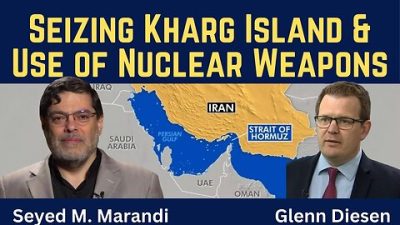
Marandi: Threat of Seizing Kharg Island & the Use of Nuclear Weapons
or go to
Aletho News Archives – Video-Images
Frlom the Archives
Iran War: United States Military Versus Israel Firsters
By James Petras | November 27, 2007
Why must Jewish organizations be and be seen as the loudest drum-beaters of all? Why can we not bring ourselves to say that military intervention is not on the table at all? Why not stash it under the table, out of sight and mount instead a diplomatic assault? – Leonard Fein, Forward
Introduction
As the White House and Congress escalate their economic sanctions and military threats against Iran, top military commanders and Pentagon officials have launched a counter-offensive, opposing a new Middle East War. While some commentators and journalists, like Chris Hedges (Truthdig, November 13, 2007), privy to this high stakes inter-elite conflict, attribute this to a White House cabal led by Vice President Cheney, a more stringent and accurate assessment puts the Zionist Power Configuration (ZPC) in the center of the Iran war debate.
There is a great deal riding in this conflict – the future of the American empire as well as the balance of power in the Middle East. Equally important is the future of the US military and our already heavily constrained democratic freedoms. The outcome of the continuous and deepening confrontation between top US military officials and the Israel Firsters over US foreign policy in the Middle East has raised fundamental questions over self-determination, colonization, civilian primacy and military political intervention, empire or republic. These and related issues are far from being of academic interest only; they concern the future of the United States. … continue
Blog Roll
 Aletho News
- How Zionist Control Is Hurting US Interests
- Iran warns it may target US missile launch sites in UAE cities
- American Military Failure in Afghanistan
- Friendly Skies of Georgia: Are Israeli-Linked Drones Launching False Flags from Georgian Territory?
- The Three Big Lies about Mammography Screening
- Ukrainian Embassy in Beirut sheltering top Mossad agent
- Palestinian family displaced after settlers violently attack them in Humsa, Jordan Valley
- The EU never learns – except for the wrong lessons
- Iran attacks on UAE leaves RSF militia high and dry
- Hosting Washington’s war: Bahrain faces the consequences
- If Americans Knew
- ‘Of Course’: IDF Drops Case Against Soldiers Accused of Raping Palestinian Prisoner
- Don’t Fall for the Regime Change Talk. Israel Is ‘Mowing the Lawn’ in Iran
- Will Israel and the US wreck the Gulf States along with Iran?
- US so far burned through ‘years’ of munitions in Iran war: Report
- How the Israeli Tail Wags the American Dog
- Outdated intel likely led to deadly U.S. strike on Iranian elementary school, sources say
- Pentagon insider says high U.S official Douglas Feith reported to Netanyahu
- In fond memory of Walid Khalidi, the historian of Palestine
- 6 more Americans killed, as Israel ‘mows the lawn’ in Iran – Not a ceasefire Day 154
- Are we on the precipice of World War III?
- No Tricks Zone
- New Studies: UK Sea Levels Were 4 Meters Higher Than Today During The Mid-Holocene
- Destructive Green New Deal: German Energy And Metal Group Warns Of Drastic Crisis
- New Study Documents A 20-Year Pause In Arctic Sea Ice Decline – Driven By Internal Variability
- Wake-up Call: Survey Shows Majority Of Germans Now Favor Postponing Climate Targets!
- Televised! Leading German Political Candidate Tells Schoolchildren CO2 Makes Sun Hotter!
- New Study: A Century Warming Of 1.1°C Is ‘Commonplace’ And ‘Not Unusual’ During This Interglacial
- New Study: ‘Internal Noise’ And Volcanic Forcing Can Trigger 10-15°C Warming Within Decades
- Glaciers Worldwide Are Suddendly Surging, Experts Blame Warming!
- Surprising Discovery: Sahara Is Greening…Billions Of Trees Where Once Thought To Be Barren
- New Research Reaffirms Clouds, Aerosols, And Surface Solar Radiation Are ‘Driving The Climate System’
 Aletho News