Glacier scientist: I knew data hadn’t been verified
By David Rose | Daily Mail | January 24, 2010
The scientist behind the bogus claim in a Nobel Prize-winning UN report that Himalayan glaciers will have melted by 2035 last night admitted it was included purely to put political pressure on world leaders.
Dr Murari Lal also said he was well aware the statement, in the 2007 report by the Intergovernmental Panel on Climate Change (IPCC), did not rest on peer-reviewed scientific research.
In an interview with The Mail on Sunday, Dr Lal, the co-ordinating lead author of the report’s chapter on Asia, said: ‘It related to several countries in this region and their water sources. We thought that if we can highlight it, it will impact policy-makers and politicians and encourage them to take some concrete action.
‘It had importance for the region, so we thought we should put it in.’
Dr Lal’s admission will only add to the mounting furore over the melting glaciers assertion, which the IPCC was last week forced to withdraw because it has no scientific foundation.
According to the IPCC’s statement of principles, its role is ‘to assess on a comprehensive, objective, open and transparent basis, scientific, technical and socio-economic information – IPCC reports should be neutral with respect to policy’.
The claim that Himalayan glaciers are set to disappear by 2035 rests on two 1999 magazine interviews with glaciologist Syed Hasnain, which were then recycled without any further investigation in a 2005 report by the environmental campaign group WWF.
It was this report that Dr Lal and his team cited as their source.
The WWF article also contained a basic error in its arithmetic. A claim that one glacier was retreating at the alarming rate of 134 metres a year should in fact have said 23 metres – the authors had divided the total loss measured over 121 years by 21, not 121.
Last Friday, the WWF website posted a humiliating statement recognising the claim as ‘unsound’, and saying it ‘regrets any confusion caused’.
Dr Lal said: ‘We knew the WWF report with the 2035 date was “grey literature” [material not published in a peer-reviewed journal]. But it was never picked up by any of the authors in our working group, nor by any of the more than 500 external reviewers, by the governments to which it was sent, or by the final IPCC review editors.’
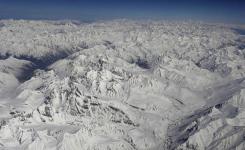 In fact, the 2035 melting date seems to have been plucked from thin air.
Professor Graham Cogley, a glacier expert at Trent University in Canada, who began to raise doubts in scientific circles last year, said the claim multiplies the rate at which glaciers have been seen to melt by a factor of about 25.
‘My educated guess is that there will be somewhat less ice in 2035 than there is now,’ he said.
‘But there is no way the glaciers will be close to disappearing. It doesn’t seem to me that exaggerating the problem’s seriousness is going to help solve it.’
One of the problems bedeviling Himalayan glacier research is a lack of reliable data. But an authoritative report published last November by the Indian government said: ‘Himalayan glaciers have not in any way exhibited, especially in recent years, an abnormal annual retreat.’
When this report was issued, Raj Pachauri, the IPCC chairman, denounced it as ‘voodoo science’.
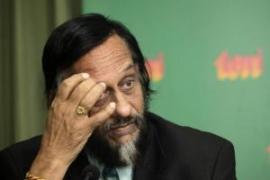
- IPCC chairman Raj Pachauri
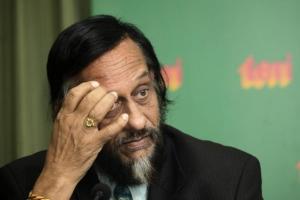
Having been forced to apologise over the 2035 claim, Dr Pachauri blamed Dr Lal, saying his team had failed to apply IPCC procedures.
It was an accusation rebutted angrily by Dr Lal. ‘We as authors followed them to the letter,’ he said. ‘Had we received information that undermined the claim, we would have included it.’
However, an analysis of those 500-plus formal review comments, to be published tomorrow by the Global Warming Policy Foundation (GWPF), the new body founded by former Chancellor Nigel Lawson, suggests that when reviewers did raise issues that called the claim into question, Dr Lal and his colleagues simply ignored them.
For example, Hayley Fowler of Newcastle University, suggested that their draft did not mention that Himalayan glaciers in the Karakoram range are growing rapidly, citing a paper published in the influential journal Nature.
In their response, the IPCC authors said, bizarrely, that they were ‘unable to get hold of the suggested references’, but would ‘consider’ this in their final version. They failed to do so.
The Japanese government commented that the draft did not clarify what it meant by stating that the likelihood of the glaciers disappearing by 2035 was ‘very high’. ‘What is the confidence level?’ it asked.
The authors’ response said ‘appropriate revisions and editing made’. But the final version was identical to their draft.
Last week, Professor Georg Kaser, a glacier expert from Austria, who was lead author of a different chapter in the IPCC report, said when he became aware of the 2035 claim a few months before the report was published, he wrote to Dr Lal, urging him to withdraw it as patently untrue.
Dr Lal claimed he never received this letter. ‘He didn’t contact me or any of the other authors of the chapter,’ he said.
The damage to the IPCC’s reputation, already tarnished by last year’s ‘Warmergate’ leaked email scandal, is likely to be considerable.
Benny Peiser, the GWPF’s director, said the affair suggested the IPCC review process was ‘skewed by a bias towards alarmist assessments’.
Environmentalist Alton Byers said the panel’s credibility had been damaged. ‘They’ve done sloppy work,’ he said. ‘We need better research on the ground, not unreliable predictions derived from computer models.’
Last night, Dr Pachauri defended the IPCC, saying it was wrong to generalise based on a single mistake. ‘Our procedure is robust,’ he added.
Related article
- Déjà Vu : Himalayan glaciers to melt (again) by 2035! (climatism.wordpress.com)
In first mention of destruction of Gaza’s flour mill, NYT’s Bronner serves up Israeli claims
By Philip Weiss | January 24, 2010
Here is a story by New York Times Jerusalem bureau chief Ethan Bronner in yesterday’s paper, anticipating the Israeli defense forces’ official response to the Goldstone Report. Bronner’s story is 99-44/100ths hasbara. He quotes an Israeli general, he quotes Moshe Halbertal. He even gets B’tselem to chime in against the Goldstone report. There is no effort, in the New York Times no less, to have anyone stand up for the Goldstone report, one of the most astonishing moral documents of human rights atrocities that has ever been compiled.
[Close your eyes. Imagine the Times submarining Seymour Hersh by quoting lots of people defending the My Lai massacre.]
Let me give you one example of the bias in this piece. Bronner writes:
The rebuttal will be given to United Nations officials in the coming weeks and its contents will remain under wraps until then. But officers involved in writing the report [i.e., I am serving as a conduit for hasbara] gave some details.
One concerned the destruction of Gaza’s sole flour mill. The Goldstone report asserts that the Bader flour mill “was hit by an airstrike, possibly by an F-16.” The Israeli investigators say they have photographic proof that this is false, that the mill was accidentally hit by artillery in the course of a firefight with Hamas militiamen.
The dispute is significant since the United Nations report asserts that “the destruction of the mill was carried out for the purpose of denying sustenance to the civilian population,” an explicit war crime.
Now let’s go over a few facts. First, I did a search; and it appears that this is the first reference to the el-Bader flour mill destruction in the New York Times. That is to say, despite the fact that Goldstone devoted a whole chapter to the flour mill’s destruction last September, this is the first time Bronner has thought to lift his pen to tell American readers about it. To repeat: the only source of flour inside Gaza is destroyed by the Israeli military, it is cited by an unimpeachable judge who investigated Bosnia and Rwanda as a war crime, and the New York Times correspondent only sees fit to mention it when Israeli officials confidentially tell him the “real” story.
Second, read Goldstone’s own narrative on the el-Bader flour mill, beginning on paragraph 913 of the report. Goldstone says that after two warnings (12/30/2008 and 1/4/2009) caused the flour mill’s 45 employees to have to evacuate, the mill was struck on Jan. 9 at 3 in the morning by an F-16. And that Apaches then struck it several more times with “missiles” that rendered it inoperative. Then for the next four days, Israeli soldiers occupied the plant–which is in the northwest of Gaza–and evidently used it as a base/machine gun nest. They left “100s” of spent 40 mm shells on the roof.
Goldstone got his information from the Hamada brothers, who own the plant and were interviewed four times, and from visits to the plant. “The Hamada brothers rejected any suggestion that the building was at any time used for any purpose by Palestinian armed groups,” Goldstone wrote. There was a high wall around the plant, and it was guarded 24/7. The brothers were issued “Businessman” cards by the Israeli gov’t so as to be able to travel to and fro from Israel, and were in touch with Israeli business associates during the war in an effort to protect their plant. They would never have gotten such cards, the Hamadas said adamantly, if the Israeli gov’t regarded them as a security risk.
Why doesn’t the Times print the Hamada brothers’ story? Why does it believe unnamed gov’t officials? Shouldn’t American readers be given both sides?
Report finds high rate of thyroid cancer in eastern Pa.; blames nuclear power plants
By REGINA MEDINA | Philadelphia Daily News | January 24, 2010
Residents of eastern Pennsylvania might not know it, but they’re living in the middle of a thyroid-cancer hot spot, according to a public-health advocate.
The eastern side of the state lays claim to six of the nation’s top 18 counties with the highest thyroid-cancer rates, according to figures from the Centers for Disease Control and Prevention.
Pennsylvania ranked as the No. 1 state in thyroid-cancer cases between 2001 and 2005, 12.8 cases per 100,000 residents. (New Jersey comes in at No. 5 with 11.8 cases per 100,000.)
Joseph Mangano, the executive director of the Radiation and Public Health Project research group, said yesterday that he believes the spike in cancer is due to the high number of nuclear plants in the area.
At a news conference at City Hall where thyroid-cancer survivors and physicians also spoke, Mangano said that within 100 miles of eastern Pennsylvania, 16 nuclear reactors are operating at seven nuclear plants, the highest concentration in the country.
The emissions from the Limerick and Three-Mile Island plants don’t come close to those from the 1945 bombing of Hiroshima or the 1986 Chernobyl accident, but “that doesn’t necessarily mean [it’s] safer,” Mangano said.
“Not only have we documented an epidemic of thyroid cancer in the area, but we have raised a red flag for more and more detailed study of the relationship between the reactor emissions and thyroid cancer,” Mangano said.
Mangano, who published his findings in the International Journal of Health Services, said that the only known cause of thyroid cancer is exposure to radiation, specifically radioactive iodine, “one of the 100 man-made chemicals” produced by nuclear energy.
One University of Pennsylvania doctor who has researched thyroid cancer called the findings “provocative” and “intriguing,” but added that the author needed to delve more into the subject.
“We do know nuclear plants give off radioactive iodine [and] radioactive iodine can be associated with thyroid cancer,” said Susan J. Mandel, a professor of medicine and radiology. “Does it mean it causes it? It requires further investigation to see if it’s causing it.”
Lehigh County had the highest thyroid-cancer rate; others in eastern Pennsylvania were: Northampton (3rd), Luzerne (6th), York (7th), Bucks (14th) and Lancaster (18th). In New Jersey, Camden was ranked No. 16 and Burlington was 17th.
Lebanese media warns of ban if US hits out at Hezbollah TV
DPA | January 23, 2010
Beirut – The National Lebanese Council for Audio-Visual Media and the Lebanese Press Association on Saturday urged the United States to reverse a decision to take ‘punitive measures’ against a satellite broadcaster run by the Shiite militant group Hezbollah.
The Council hinted that it will resort to banning from Lebanese airwaves US-networks such as Cable News Network (CNN) and others financed by the US.
Council head Abdel Hadi Mahfouz said that if the US bill against Hezbollah’s al-Manar television was adopted, ‘we as an independent council can cut off transmissions of US-based stations such as CNN and (US-backed Arabic satellite channel) al-Houra by asking cable distributors in Lebanon not to air such channels.’
‘We have expressed our refusal for such a legal measure against al-Manar and other channels which the US has listed as Arab terrorist entities,’ said Mahfouz.
The US House of Representatives passed a bill in December 2009 calling for ‘punitive measures’ against Middle East television networks, including al-Manar, seen to be fueling anti-US sentiment.
The bill was adopted in a decisive 395 to 3 vote against media outlets that broadcast ‘anti-American incitement to violence in the Middle East.’
The networks listed in the bill include Al-Aqsa, the television station of the Islamist Palestinian movement Hamas, which broadcasts from the Gaza Strip, and Hezbollah’s al-Manar.
Hezbollah’s al-Manar broadcasts from Beirut. It was launched in 1991. In 2004 it was banned from broadcasting in the US, France, Spain and Germany.

Settlers Attack Nablus Village, Two Youth Wounded By Soldiers
 January 24, 2010 – By Saed Bannoura – IMEMC & Agencies
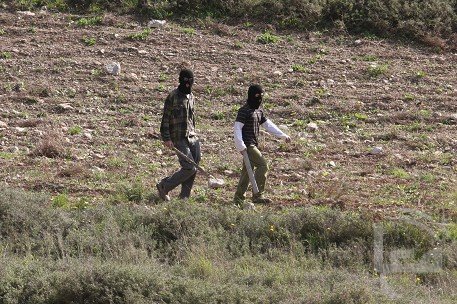
Palestinian medical sources reported on Saturday evening that two Palestinian youths were wounded by Israeli military fire as the soldiers opened fire at local residents who were defending themselves after being attacked by fundamentalist settlers near Nablus. The settlers attacked local villagers of Iraq-Burin village, south of Nablus, in the northern part of the West Bank.
Sources at the Palestinian Red crescent Society reported that Ahmad Isam Al Faqeeh, 16, was wounded by a rubber-coated bullet in his thigh, and was moved to the Rafidia Hospital. His condition was described as light-to-moderate. Resident Nasr Daoud Daqlous, 18, was lightly wounded and received treatment by medics at the scene.
The clashes started when dozens of fundamentalist settlers of the Yitzhar illegal settlement attacked the village and its residents.
Ghassan Douglas, in Charge of Settlements File in the northern part of the West Bank, stated that after the settlers attacked the residents, Israeli soldiers arrived at the scene and opened fire at the Palestinians instead removing the settlers who initiated the confrontation.
Iraq-Burin is a small village of nearly 1000 residents in addition to some 600 residents living abroad, especially in Jordan and Kuwait. It has 125 homes and the families living there are originally from Burin village.
Israeli forces detain three journalists across the West Bank
23/01/2010 20:18
Nablus – Ma’an – Israeli forces detained three journalists in separate incidents across the West Bank, as they compiled news reports near settlements on Saturday.
Al-Quds TV representatives said that a journalist and a cameraman were detained near the illegal settlement of Ariel, south of Nablus.
Correspondent for Al-Quds TV Mus’ab Al-Khatib, 25, and Ahmad Al-Kilani, 23, who works for Pal Media, were arrested whilst preparing a news report about a university near the settlement that was recognized recently by Israeli authorities.
Meanwhile, Israeli soldiers detained a Pal Media journalist on Saturday reporting on a demonstration organized by farmers from the At-Tuwani village to protest the recent destruction of an olive grove near the Israeli settlement outpost of Havot Ma’on, the Christian Peacemaking Team said in a statement.
” While Palestinian farmers, accompanied by internationals, were planting olive trees, fifteen settlers approached the area, some carrying slingshots,” the statement read.
“Israeli soldiers and police also entered the area. The soldiers informed the Palestinians that the area was a closed military zone, showing them a map that encompassed a large area south of Havat Ma’on outpost. Police arrested the journalist, saying he had violated the closed military zone order.”
CCTV in the sky: police plan to use military-style spy drones
By Paul Lewis | The Guardian | 23 January 2010
Police in the UK are planning to use unmanned spy drones, controversially deployed in Afghanistan, for the ”routine” monitoring of antisocial motorists, protesters, agricultural thieves and fly-tippers, in a significant expansion of covert state surveillance.
The arms manufacturer BAE Systems, which produces a range of unmanned aerial vehicles (UAVs) for war zones, is adapting the military-style planes for a consortium of government agencies led by Kent police.
Documents from the South Coast Partnership, a Home Office-backed project in which Kent police and others are developing a national drone plan with BAE, have been obtained by the Guardian under the Freedom of Information Act.
They reveal the partnership intends to begin using the drones in time for the 2012 Olympics. They also indicate that police claims that the technology will be used for maritime surveillance fall well short of their intended use – which could span a range of police activity – and that officers have talked about selling the surveillance data to private companies. A prototype drone equipped with high-powered cameras and sensors is set to take to the skies for test flights later this year.
The Civil Aviation Authority, which regulates UK airspace, has been told by BAE and Kent police that civilian UAVs would “greatly extend” the government’s surveillance capacity and “revolutionise policing”. The CAA is currently reluctant to license UAVs in normal airspace because of the risk of collisions with other aircraft, but adequate “sense and avoid” systems for drones are only a few years away.
Five other police forces have signed up to the scheme, which is considered a pilot preceding the countrywide adoption of the technology for “surveillance, monitoring and evidence gathering”. The partnership’s stated mission is to introduce drones “into the routine work of the police, border authorities and other government agencies” across the UK.
Concerned about the slow pace of progress of licensing issues, Kent police’s assistant chief constable, Allyn Thomas, wrote to the CAA last March arguing that military drones would be useful “in the policing of major events, whether they be protests or the Olympics”. He said interest in their use in the UK had “developed after the terrorist attack in Mumbai”.
Stressing that he was not seeking to interfere with the regulatory process, Thomas pointed out that there was “rather more urgency in the work since Mumbai and we have a clear deadline of the 2012 Olympics”.
BAE drones are programmed to take off and land on their own, stay airborne for up to 15 hours and reach heights of 20,000ft, making them invisible from the ground.
Far more sophisticated than the remote-controlled rotor-blade robots that hover 50-metres above the ground – which police already use – BAE UAVs are programmed to undertake specific operations. They can, for example, deviate from a routine flightpath after encountering suspicious activity on the ground, or undertake numerous reconnaissance tasks simultaneously.
The surveillance data is fed back to control rooms via monitoring equipment such as high-definition cameras, radar devices and infrared sensors.
Previously, Kent police has said the drone scheme was intended for use over the English Channel to monitor shipping and detect immigrants crossing from France. However, the documents suggest the maritime focus was, at least in part, a public relations strategy designed to minimise civil liberty concerns.
“There is potential for these [maritime] uses to be projected as a ‘good news’ story to the public rather than more ‘big brother’,” a minute from the one of the earliest meetings, in July 2007, states.
Behind closed doors, the scope for UAVs has expanded significantly. Working with various policing organisations as well as the Serious and Organised Crime Agency, the Maritime and Fisheries Agency, HM Revenue and Customs and the UK Border Agency, BAE and Kent police have drawn up wider lists of potential uses.
One document lists “[detecting] theft from cash machines, preventing theft of tractors and monitoring antisocial driving” as future tasks for police drones, while another states the aircraft could be used for road and railway monitoring, search and rescue, event security and covert urban surveillance.
Under a section entitled “Other routine tasks (Local Councils) – surveillance”, another document states the drones could be used to combat “fly-posting, fly-tipping, abandoned vehicles, abnormal loads, waste management”.
Senior officers have conceded there will be “large capital costs” involved in buying the drones, but argue this will be shared by various government agencies. They also say unmanned aircraft are no more intrusive than CCTV cameras and far cheaper to run than helicopters.
Partnership officials have said the UAVs could raise revenue from private companies. At one strategy meeting it was proposed the aircraft could undertake commercial work during spare time to offset some of the running costs.
There are two models of BAE drone under consideration, neither of which has been licensed to fly in non-segregated airspace by the CAA. The Herti (High Endurance Rapid Technology Insertion) is a five-metre long aircraft that the Ministry of Defence deployed in Afghanistan for tests in 2007 and 2009.
CAA officials are sceptical that any Herti-type drone manufacturer can develop the technology to make them airworthy for the UK before 2015 at the earliest. However the South Coast Partnership has set its sights on another BAE prototype drone, the GA22 airship, developed by Lindstrand Technologies which would be subject to different regulations. BAE and Kent police believe the 22-metre long airship could be certified for civilian use by 2012.
Military drones have been used extensively by the US to assist reconnaissance and airstrikes in Afghanistan and Iraq.
But their use in war zones has been blamed for high civilian death tolls.
Rubbing Salt in Guantánamo’s Wounds: Task Force Announces Indefinite Detention
Andy Worthington | 23.1.10

With a stunning lack of sensitivity, Barack Obama’s Guantánamo Task Force chose the anniversary of the President’s failed promise to close the prison to announce its conclusions regarding the eventual fate of the 196 prisoners who are still held, stating, with no trace of irony, that “nearly 50” of the men “should be held indefinitely without trial under the laws of war,” as the Washington Post explained.
The administration’s invocation of the laws of war actually refers to the Authorization for Use of Military Force (AUMF), passed by Congress in the wake of the terrorist attacks on September 11, 2001, which authorized the President “to use all necessary and appropriate force against those nations, organizations, or persons he determines planned, authorized, committed, or aided the terrorist attacks that occurred on September 11, 2001” (or those who harbored them), as interpreted by the Supreme Court in June 2004, in Hamdi v. Rumsfeld, in which it was asserted that “Congress has clearly and unmistakably authorized detention” of individuals covered by the AUMF.
This may technically be legal in the United States, but it is at odds with everyone else’s understanding of the laws of war. As every other civilized country understand them, the laws of war involve holding combatants for the duration of hostilities according to the Geneva Conventions, which, under Common Article 3, prohibit the “humiliating and degrading treatment” and coercive interrogations to which the men in Guantánamo were subjected, after President Bush declared in February 2002 that the Geneva Conventions did not apply to al-Qaeda or the Taliban.
Moreover, these men were never screened to ascertain whether they were actually combatants in the first place. Under Article 5 of the Third Geneva Convention (relative to the treatment of prisoners of war), if there is any doubt about whether those detained fit the description of Article 4 (broadly speaking, regular armed forces), they should be treated as Article 4 prisoners until their status has been determined by a competent tribunal. Held close to the time and place of capture, these were convened in every US war from Vietnam onwards, and in the first Gulf War, for example, 1,196 tribunals were held, and 886 men were subsequently released.
However, competent tribunals were not held in Afghanistan (and are still not held to this day, under President Obama), and irregular soldiers (such as those fighting for the Taliban, or military forces related to al-Qaeda who were supporting the Taliban) slipped through the cracks of the protections assured to everyone detained in wartime, whether combatant or civilian, and were labeled as “unlawful enemy combatants,” who, according to the Bush administration, could be deprived of all rights.
This was nonsense, as the International Committee of the Red Cross confirmed in 1958 in a commentary on the Fourth Convention (relative to the treatment of civilians) that “Every person in enemy hands must have some status under international law: he is either a prisoner of war and, as such, covered by the Third Convention, a civilian covered by the Fourth Convention, or … a member of the medical personnel of the armed forces who is covered by the First Convention.” Moreover, “There is no intermediate status; nobody in enemy hands can be outside the law.”
This interpretation was reinforced by the International Criminal Tribunal for the Former Yugoslavia in a judgment in 1998, but in the “War on Terror,” the result of the Bush administration’s cynical maneuvering was Guantánamo, a prison in which men who had never been adequately screened were presumed to be guilty, even though, in most cases, the authorities knew nothing about them. This was largely because 86 percent of them had not been seized “on the battlefield,” as senior officials claimed, but had been sold to the US military by their Afghan and Pakistani allies, at a time when bounty payments, averaging $5,000 a head, were being paid for al-Qaeda and Taliban suspects.
As a result, the Obama administration’s justification for holding 50 men indefinitely without charge or trial reinforces the Bush administration’s false claim that there is a category of wartime prisoner who can be held indefinitely (as opposed to being held as a prisoner of war until the end of hostilities). What makes this conclusion even more unnerving is that the justification for holding these men indefinitely is evidence that, by President Obama’s own admission, is “tainted” by the use of torture.
In a major national security speech in May, when he first signaled that he was reviving the Bush administration’s justification for holding men indefinitely without charge or trial, President Obama referred to prisoners who “cannot be prosecuted for past crimes, in some cases because evidence may be tainted, but who nonetheless pose a threat to the security of the United States.” … Full article
Media presents skewed image of Haiti rescue efforts
Why do we see Haitians begging for help but doing absolutely NOTHING to help themselves?!!
Why do they idly sit waiting for help to come (and I’m talking about the ones who were not injured, of course) or … “blocking the roads” instead of HELPING to clear them, HELPING to unload cargo ships and/or to clear port infrastructure from the debris.
BBC showed healthy men running around the collapsed house and doing absolutely NOTHING to save a living person under it who was lucky that the UN soldiers were nearby and just started … DIGGING! Nothing sophisticated but simply digging… I don’t understand…
Global Nomad responds:
I’ve been doing a lot of media interviews over the past five days and I can tell you that the media are not reporting facts per se – they are telling a story, and one they hope will catch their viewers’ attention. Many news outlets do some research, pick a couple of angles that grab attention, and then develop these angles specifically. So, in the Haiti context for example, the bulk of the media is really picking up on the violence/food-riot angle, on the delays-in-logistics-angle, on the involvement of foreign assistance (especially US military and search-and-rescue teams). They then build a story around these themes to show the viewer. Not necessarily a false story, but certainly not the full picture.
The question to ask is, why is the media showing pictures of foreign search and rescue teams, and not Haitian rescuers? Well, on a simple level, the media is playing to US/British/Australian audiences, who want to see their donations hard at work, so they want to see US/British/Australian rescue teams pulling people from rubble. These are the images that will stop people flipping the channel to see what else is on.
Here’s some facts from earlier today on foreign search and rescue teams. As of about 10pm Haiti time on Saturday, there were 1,200 foreign search and rescue personnel in Haiti, and about 100 sniffer dogs. Collectively over the days since the earthquake, they had pulled 83 people alive out of the rubble. That’s about on par for foreign SAR teams- a pretty normal figure following a major disaster.
I don’t know how much it costs to run a SAR team. I can assure you it’s expensive. The bill for 1,200 SAR personnel, complete with dogs, specialised equipment, transportation, lodging etc. will run into the hundreds of thousands of dollars per day.
Every life is precious. Every life saved is worth an investment. I’m not interested in making a judgement call about what dollar value you place on the life of a Haitian child pulled from the rubble after 8 hours of digging by one rescue team, as one was this afternoon. That life is a cause for celebration. Absolutely and unequivocably. Note however that a single team can spend hours and hours recovering a single person- or body. It’s no wonder the total number of lives saved is relatively small. Remember too that most of these teams don’t reach ground zero until 48 hours after the earthquake. Most urban burial situations have a window of 72 hours during which people trapped alive in rubble can be rescued. After that, most will be dead. And it’s an arithmetic curve- meaning, for every hour past the point of burial, a disproportionately small number of people will continue surviving.
Here’s the flip-side of the coin.
There are between three and five million Haitians living in the quake affected area. Somewhere between 50 and 150 thousand appear to have died. Uncounted tens of thousands were injured. Many of those injured- I would imagine also in the tens of thousands- would have been partially or completely buried at some point in the earthquake- hence receiving injuries. Those thousands of people had to be dug out by somebody.
As mentioned in my post, experience shows that the people who do the saving of lives are those people who in the first minutes and hours after a quake rush to their homes and their neighbours homes, and pull out friends and loved ones. They are the best to respond a) because they get there first before people die and b) because they know who to look for, and where. In the Bam earthquake in Iran in 2003, the buildings were made of mud-brick which crumbled to dust without leaving air-spaces. Anybody who wasn’t pulled from the rubble in the first few minutes suffocated. Locals saved thousands of lives, compared to the few dozen saved by international rescue teams.
I am in daily contact with several personal friends in Port-au-Prince in the course of my job. Yesterday they drove past a flattened school where dozens of Haitians were digging through the rubble with whatever they had available. Colleagues from our office in Port-au-Prince, within minutes of the quake hitting, were frantically trying to get home so they could rescue their loved ones. Haitians throughout the city have been working tirelessly since the quake hit to free people from the rubble. Their efforts will be credited with saving many thousands of lives.
Remember as well, four days on from the quake, that most rubble that can be dug through by hand will have been dug through – the rest requiring specialised equipment that local Haitians will not have access to. Most people who will survive the quake have already been pulled out; almost everybody else buried right now is either dead, or will shortly be dead. If people knew where their loved ones were buried at the time of the quake, they will have dug through those locations by now. So there is a lot less for local Haitians to do, while the small number of search and rescue personnel (for whom, I hasten to add, I do have a great deal of respect, and who risk their lives to save every life they recover) with their specialised equipment and training can tackle more complicated burial sites.
So my question really would be, why does our media chose to show pictures of Haitians sitting around and focus on foreigners digging through the rubble, when in fact this is an incredible distortion of the reality of what is happening, as you rightly alude to at the beginning of your comment?
I don’t doubt that there are some groups of men sitting around doing nothing, I hasten to add, or that there aren’t gangs making trouble for selfish gain, or that there aren’t some lazy people out there. But seeing a few shots of a few men sitting around is not indicative of what has generally been happening in Port-au-Prince since the quake, nor can we surmise that therefore a significant majority of Haitians are sitting around while their countryfolk are dying.
You’re absolutely right- there is a huge difference between victims and survivors. In any calamity there are both, and the media loves to show victims because it attracts attention, because humans have a warped tendancy to want to keep watching suffering. Survivors don’t get the same attention on our news media. However I can attest that there are vast numbers of survivors in Port-au-Prince right now based on the eye-witness accounts that I am getting across my desk regularly, and simply by looking at the magnitude of what has happened and the part that local Haitians have played in it versus the part that outsiders played. The majority of Haitians are working to pick up the pieces of their lives amidst the shock and violence of what they have just been through as best they can.
I close with an observation that the news cameras weren’t rolling in Port-au-Prince until 48 hours after the earthquake, but that the largest portion of the rescue and recovery efforts- carried out by local Haitians themselves- would have been completed during this time- indeed, during the first 12 hours. So we don’t see those pictures. Their contribution and the incredible bravery, sacrifice and drama of those moments, never made it into our living room. But this is the reality of what happened in Port-au-Prince, and not these 15-second snippets we see broken down for drama’s sake on our evening news bulletin.”
Israeli College Student Removed From Bus For Speaking Her Language
January 23, 2010 | by Saed Bannoura | IMEMC & Agencies
Israeli Ynet News reported that an Israeli-Arab student, studying at Ariel College, was humiliated and forced out of an Israeli bus after she “was heard” speaking Arabic on her cell phone.
She said that she was forced out of the bus for daring to speak her language while on board.
Hanin Musleh also said that she was subjected to a full body search, the Ynet added.
She is from Wadi Ara area and is studying at the college to obtain a degree in engineering.
Musleh was removed from the bus by two armed guards who boarded the vehicle near a roadblock just out of Ariel settlement, in the northern part of the occupied West Bank.
The guards forced her out of the bus after questioning her for speaking in Arabic.
She said that she takes the same bus every day to go to her college, and that she was removed out of the bus to be left on some isolated road.
She added that she told the guards that she is Israeli, with Israeli ID and citizenship, just like them, and that they should not be humiliating and degrading her like this.
Musleh even stated that she does not wear a veil or any traditional dress, and that she does not even look Arab.
“The only reason they removed me from the bus is because I spoke Arabic”, she added.
The Ynet stated that the Ariel municipality said that the guards work for a security agency that “operates in accordance to the guidelines of the Israeli military.
The Ariel College said that it regrets this incident, and that Arab students constitute 4% of the entire student body at the college.
The college added that several Arab students live in dorms and are involved with the community of Ariel settlement.
The college said that this is the first time such an incident happens, and that Arab students started enrolling 15 years ago.
But Musleh stated that several other Arab students were also humiliated at checkpoints leading to Ariel, and that they will be considering legal action.
What Robert Gates Didn’t Say – And The US Media Hides – About Blackwater In Pakistan
Two Pakistani employees of an American defense contractor engaged by the US Embassy in Islamabad have been linked to two attacks on Pakistani military and the assassination of a Brigadier. If this is not alarming, then consider that US Ambassador Anne Patterson’s name has come up in an investigation where thousands of dollars were paid in bribes to Interior Ministry to smuggle illegal weapons into Pakistan. Not to mention how Washington is empowering India in Afghanistan at Pakistan’s cost. When Pakistan takes countermeasures, US officials like Mr. Gates and Mr. Holbrooke accuse Pakistan of ‘anti-Americanism’ and harassing US diplomats. Time for some straight talk.
By AHMED QURAISHI | 23 January 2010
ISLAMABAD, Pakistan—US Defense Secretary Robert Gates admitted during an interview with a Pakistani TV station that Blackwater [now ‘Xe International’] and DynCorp are operating in Pakistan. Immediately after the statement, Pentagon tried to put a spin on his words.
But US meddling inside Pakistan –by posting private US defense contractors under diplomatic cover of the US embassy – is a reality for most Pakistanis. Some of these Americans have been caught disguised as Taliban right in the heart of Islamabad. Some Pakistanis were manhandled by some of these American militiamen on the streets of at least two Pakistani cities in recent months.
Since Pakistan is not Iraq or Afghanistan despite all the US direct and indirect misinformation, these US covert operators were arrested on several occasions.
The mainstream US media continues to keep the good American people and the world opinion in the dark about this. But this is probably one of the biggest untold stories in America’s war on terror. This is about the United States trying to put boots on the ground inside Pakistan through the help of a pro-US government in Islamabad that shares [or at least key figures in it] the US objective of containing and limiting the ability of Pakistan’s military to influence the country’s foreign policy. This is about Pakistan wanting to keep an independent foreign policy versus Pakistan blindly serving US policy on Afghanistan, India and China.
Mr. Gates tried to put a gloss on this US covert meddling when he said, ‘Well, they’re [Blackwater and DynCorp] operating as individual companies here in Pakistan, in Afghanistan and in Iraq.’
Not true. The truth is that the issue is so serious that, according to Pakistani investigators, US Ambassador to Pakistan Anne W. Patterson is a suspect in a case of bribes amounting to little over US $ 270,000 paid by DynCorp in 2009 to senior officials at the federal Interior Ministry in Pakistan. The money went in exchange for allowing illegal weapons into Pakistan to be used by private US defense contractors without informing the country’s security departments and intelligence agencies. Ms. Patterson personally lobbied Pakistani officials for this concession to DynCorp. She even wrote a letter to Pakistani officials, followed by a letter by her Deputy Head of Mission Mr. Gerald Feierstein, asking Pakistani Interior Ministry officials to issue permits for weapons to be used by DynCorp in the ‘entire territory of Pakistan.’ The US ambassador is directly linked to the probe, which has resulted in the arrest of a key aide to Pakistan’s Minister of State for the Interior. But the government of President Zardari will not dare allow Pakistani investigators to pursue the US Ambassador’s role in the scandal. A key question in the probe is how the US Embassy and DynCorp allowed the cargo of illegal weapons into Pakistan. According to one lead, a huge cache of weapons reached a Pakistani tribal leader on Pakistan’s border with Afghanistan, who in turn wrote to the Interior Ministry announcing he was ‘gifting’ the weapons to a Pakistani subcontractor of DynCorp.
Incidents like this and others raised alarm bells inside Pakistani security departments and the intelligence community. In effect, key figures in President Zardari’s government were found to have given approval for the entry of a large number of US citizens into Pakistan for ‘official US government business’ without explaining what that is. When Pakistani authorities tried to get to the bottom of how private US defense contractors ended up inside Pakistan in large numbers and what they were exactly doing here, US officials and media launched what appears to be a media trial of Pakistan, accusing the country of ‘harassing’ US diplomats and denying visas to them because of alleged anti-Americanism.
The unwillingness of the Zardari government to confront Washington and Pakistan’s generally weak media outreach skills allowed Washington to paint this as a case of anti-Americanism fueled by war on terror.
‘Conspiracy theories’ is another label that US officials and media have increasingly used recently as a cover to hide serious violations of diplomatic norms and sovereignty involving undercover private US operatives inside Pakistan.
This is how the Wall Street Journal tried to delegitimize serious Pakistani concerns raised during Mr. Gates’ visit in a report filed from Islamabad whose opening line read as follows, “U.S. Defense Secretary Robert Gates is overseeing wars with Sunni militants in Iraq and Taliban fighters in Afghanistan. In Pakistan, he’s facing a different foe: the pervasive conspiracy theories that fuel widespread anti-American feelings here.”
The truth is that there are no conspiracy theories but real events, reported and documented, that raise questions over US political, diplomtic, and covert meddling inside Pakistan. Here is a list:
1. NUCLEAR ESPIONAGE: In July 2009, four US ‘diplomats’ were arrested inside the maximum security perimeter around Pakistan’s premier nuclear facility at Kahuta. They failed to tell Pakistani investigators what they were doing there and how they managed to slip through the security checkpoints in the area. US Embassy intervened to rescue the four ‘diplomats’ after almost three hours in detention, citing diplomatic immunity. President Zardari’s government refused to let Pakistani security authorities press charges.
2. SUSPICIOUS CONDUCT: On Oct. 6, 2009, Pakistani police arrested two Dutch diplomats roaming the streets of Islamabad without a number plate carrying advanced weapons. Pakistani police were surprised when security personnel from the US Embassy reached the scene to rescue the Dutch. The Americans used their contacts within the Zardari government to get everyone released. Later, Pakistan Foreign Office summoned US and Dutch diplomats for a private meeting over the incident. But the Pakistani government refused to demand a public explanation from US and Dutch diplomats despite recommendations from police and security officials.
3. FACILITATING INDIAN ACTIVITIES: In this high profile case in May 2009, a US diplomat arranged a small meeting between an Indian diplomat and several senior Pakistani federal government officials at a private house. The invited Pakistanis worked in civilian positions, including one with access to Prime Minister’s Office. It appeared that the US diplomat was basically facilitating the Indian to meet senior officials who otherwise would be inaccessible for him. Pakistan Foreign Office took serious exception to the meeting, publicly reprimanded the Pakistani officials who attended the meeting but stopped short of seeking explanation from the US embassy. According to Pakistani investigators, for a US diplomat to indulge in facilitating possible espionage linked to an Indian diplomat was a matter of grave concern. It also fit with the US policy of exercising tremendous pressure on the pro-US government in Islamabad to give concessions to India at the expense of Pakistani strategic interests.
4. COVERT US MILITIAS IN THE HEART OF PAKISTAN: In September 2009, undercover US agents were found to have recruited a total of 100 former elite Pakistani military commandos to create rapid-intervention teams for unknown purposes. A hundred more were under training at a secret facility camouflaged as a workshop on the outskirts of the Pakistani capital when it was raided by Pakistani police. It turned out that DynCorp was training the men. US Ambassador Anne W. Patterson brought DynCorp to Pakistan by telling Pakistani officials that the private defense contractor would provide security to embassy buildings. But she never explained why DynCorp was secretly raising private militias on Pakistani soil without informing the Pakistani government or military or the intelligence agencies. Some of those who were under training at the time of the raid said that DynCorp focused on recruiting retired officers who had links and contacts within the Pakistani military and could glean information from their sources. [See video and pictures]
5. PUSHY US DIPLOMATS: The US Embassy in Islamabad has made it its business to mount pressure on owners of Pakistani newspapers to curtail or expel columnists and commentators critical of US policy. Specially targeted are those who expose how the US Embassy is meddling in Pakistani affairs and expanding the US footprint inside Pakistan. Last year, Ambassador Patterson sent a letter to one of the largest Pakistani media groups accusing a columnist of endangering American lives and succeeded in pushing her out. The US Embassy is also recruiting opinion makers within the Pakistani media, academia and military in order to promote the US agenda even at the cost of Pakistani interests, dismissing critics as ‘conspiracy theorists’ and accusing them of anti-Americanism. A senior Pakistani journalist Syed Talat Hussain exposed US activities in the following words,
“Pro-American lobby in Pakistan is growing in direct proportion to the scaling up of suspicions about the US. The main task of this lobby is to reduce the complexity of the US’s objectives towards Pakistan to romantic levels of trust (…) A motley crew of former diplomats, retired generals, socialites, slick civil society begums, self-styled analysts, businessmen, journalists, and now also lawyers — they are the darlings of the US embassy staff. They are the instruments of positive outreach and public diplomacy that US diplomats are so keen to expand in Pakistan.”
6. HARASSING PAKISTANIS: Private US security contractors, or militiamen, have been involved in at least three incidents registered by the Pakistani police where armed Americans physically assaulted unarmed ordinary Pakistanis in public places. In one case, the nephew of a senior member of President Zardari’s own government was manhandled and locked up in the toilet of a gas station by men described as armed military-looking civilian Americans.
7. RESISTING POLICE CHECKS: In at least five incidents, US ‘diplomats’ disguised as Taliban, complete with beards and Pashto language skills, were stopped at several police checkpoints in Islamabad and Peshawar. In some cases, these American ‘diplomats’ tried to speed through police barriers. In one recent case, this resulted in a brief police chase, where a Pakistani officer dragged the US ‘diplomats’ back to the police picket and forced the Americans to apologize to Pakistani police officers. Again, no charges were pressed because these private US agents carried diplomatic passports.
8. ENGINEERING DOMESTIC POLITICS: As recently as December 2009, US ambassador in Islamabad was found meeting senior Pakistani politicians at private homes of mutual friends in unannounced meetings restricted to 3 to 4 persons. The ambassador asked her guests to publicly support the embattled pro-US President Zardari. US diplomats in Islamabad and officials in Washington have been blatantly interfering in Pakistani politics. In addition to helping form the incumbent coalition government in Islamabad, made up of pro-US parties, US officials have been busy trying to save both Mr. Zardari and his key political adviser and ambassador to Washington Husain Haqqani. US officials in Washington have been briefing sympathetic US journalists about this. In one case, columnist Trudy Rubin had this to say while discussing Pakistan in an article published last month:
“Here is the first piece of good news: Pakistani President Asif Ali Zardari seems to have weathered a campaign by opponents, including the military, to force him out of office. Zardari has deep flaws, but his ouster would have hampered efforts to fight the jihadis. So would the removal, now averted, of Pakistan’s effective ambassador to Washington, Husain Haqqani, whom the Pakistani military had unfairly blamed for conditions that Congress imposed on aid to Pakistan.”
9. BRIBES AND ILLEGAL WEAPONS: This case is stunning because of the direct involvement of US Ambassador Anne W. Patterson in lobbying for DynCorp. The company ended up bribing Interior Ministry officials to smuggle banned weapons into Pakistan and then went on to raise private militias and hire retired Pakistani military officers to run rapid deployment teams and possibly even spy on the Pakistani military.
10. DEMONIZATION OF PAKISTAN: Since 2007, US officials and US media has systematically demonized Pakistan worldwide, creating false alarm over Pakistan’s strategic arsenal. US officials and media have also pushed to bracket Pakistan along with Iraq and Afghanistan in order to justify a possible military intervention. When Pakistan resisted US meddling recently, the US media again went on rampage, accusing Pakistan of ‘anti-Americanism’ and harassment of US diplomats. Additionally, there has been a marked increase of lectures and studies by US think-tanks inviting unknown separatist individuals and groups to speak and fan ethnic separatism inside Pakistan and theorize on the breakup of the country.
11. ABETTING TERROR INSIDE PAKISTAN: The suspicions about why DynCorp was secretly raising private militias inside the federal Pakistani capital almost turned real when a suspect in the attack on the Pakistani military headquarters in October 2009 was allegedly found to have been recruited by DynCorp. In a second case, another suspected DynCorp recruit was found involved in assassinating a senior Pakistani military officer as he drove to work. In other words, two Pakistani employees of a US defense contractor engaged by the US embassy have been linked to two terrorist attacks on the Pakistani military. Add to this that Pakistan’s military and intelligence are a favorite punching bag for the United States and its allies, like India and Britain, and the picture of what the US is doing in Pakistan becomes even more disturbing.
These points explain how ill-motivated the US complaints about delaying visas and alleged anti-Americanism in Pakistan are. This is what US Secretary of State Hillary Clinton, Mr. Holbrooke and Mr. Gates are loath to share with the American people and the world public opinion.
© 2007-2009. All rights reserved. AhmedQuraishi.com & PakNationalists
Verbatim copying and distribution of this entire article is permitted in any medium without royalty provided this notice is preserved.
Featured Video
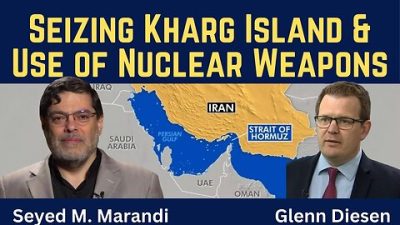
Marandi: Threat of Seizing Kharg Island & the Use of Nuclear Weapons
or go to
Aletho News Archives – Video-Images
Frlom the Archives
Iran War: United States Military Versus Israel Firsters
By James Petras | November 27, 2007
Why must Jewish organizations be and be seen as the loudest drum-beaters of all? Why can we not bring ourselves to say that military intervention is not on the table at all? Why not stash it under the table, out of sight and mount instead a diplomatic assault? – Leonard Fein, Forward
Introduction
As the White House and Congress escalate their economic sanctions and military threats against Iran, top military commanders and Pentagon officials have launched a counter-offensive, opposing a new Middle East War. While some commentators and journalists, like Chris Hedges (Truthdig, November 13, 2007), privy to this high stakes inter-elite conflict, attribute this to a White House cabal led by Vice President Cheney, a more stringent and accurate assessment puts the Zionist Power Configuration (ZPC) in the center of the Iran war debate.
There is a great deal riding in this conflict – the future of the American empire as well as the balance of power in the Middle East. Equally important is the future of the US military and our already heavily constrained democratic freedoms. The outcome of the continuous and deepening confrontation between top US military officials and the Israel Firsters over US foreign policy in the Middle East has raised fundamental questions over self-determination, colonization, civilian primacy and military political intervention, empire or republic. These and related issues are far from being of academic interest only; they concern the future of the United States. … continue
Blog Roll
 Aletho News
- American Military Failure in Afghanistan
- Friendly Skies of Georgia: Are Israeli-Linked Drones Launching False Flags from Georgian Territory?
- The Three Big Lies about Mammography Screening
- Ukrainian Embassy in Beirut sheltering top Mossad agent
- Palestinian family displaced after settlers violently attack them in Humsa, Jordan Valley
- The EU never learns – except for the wrong lessons
- Iran attacks on UAE leaves RSF militia high and dry
- Hosting Washington’s war: Bahrain faces the consequences
- The US fell for its own Iran propaganda
- Seyed M. Marandi: Threat of Seizing Kharg Island & the Use of Nuclear Weapons
- If Americans Knew
- ‘Of Course’: IDF Drops Case Against Soldiers Accused of Raping Palestinian Prisoner
- Don’t Fall for the Regime Change Talk. Israel Is ‘Mowing the Lawn’ in Iran
- Will Israel and the US wreck the Gulf States along with Iran?
- US so far burned through ‘years’ of munitions in Iran war: Report
- How the Israeli Tail Wags the American Dog
- Outdated intel likely led to deadly U.S. strike on Iranian elementary school, sources say
- Pentagon insider says high U.S official Douglas Feith reported to Netanyahu
- In fond memory of Walid Khalidi, the historian of Palestine
- 6 more Americans killed, as Israel ‘mows the lawn’ in Iran – Not a ceasefire Day 154
- Are we on the precipice of World War III?
- No Tricks Zone
- New Studies: UK Sea Levels Were 4 Meters Higher Than Today During The Mid-Holocene
- Destructive Green New Deal: German Energy And Metal Group Warns Of Drastic Crisis
- New Study Documents A 20-Year Pause In Arctic Sea Ice Decline – Driven By Internal Variability
- Wake-up Call: Survey Shows Majority Of Germans Now Favor Postponing Climate Targets!
- Televised! Leading German Political Candidate Tells Schoolchildren CO2 Makes Sun Hotter!
- New Study: A Century Warming Of 1.1°C Is ‘Commonplace’ And ‘Not Unusual’ During This Interglacial
- New Study: ‘Internal Noise’ And Volcanic Forcing Can Trigger 10-15°C Warming Within Decades
- Glaciers Worldwide Are Suddendly Surging, Experts Blame Warming!
- Surprising Discovery: Sahara Is Greening…Billions Of Trees Where Once Thought To Be Barren
- New Research Reaffirms Clouds, Aerosols, And Surface Solar Radiation Are ‘Driving The Climate System’
 Aletho News