Unrest continues in Shu’fat; overnight raids, youth detained
 09/02/2010
Jerusalem – Ma’an – Confrontations erupted between school children and border guards at the Shu’fat military checkpoint on Tuesday, leading to the detention of a 15-year-old and the injury of a soldier, witnesses said.
The clash followed a series of overnight raids where border guards handed out dozens of notices for residents to turn themselves in for questioning at Israeli intelligence compounds in Jerusalem. The raids came directly on the heels of an arrest campaign targeting dozens of Palestinian residents of the camp.
The teen detained in the most recent clashes was identified as Ahmad Jamil Abu Hamda, who was on his way to school when the clashes erupted.
Locals said soldiers used tear gas to disburse the crowds.
The secretary of Fatah in the camp, Khader Ad-Dibs, said that raids continued until 5am, and that more than a hundred soldiers guarded the entrances of the camp.
Ad-Dibs noted that some of the men and women detained Monday had already been transfered to the military court where their sentences were extended, and others who were released said they had been severely beaten.
Ethnic Cleansing Escalation in Jerusalem
Aletho News | February 8, 2010
Israeli occupation forces manning a military checkpoint at the Shu’fat refugee camp in Jerusalem set off protests Saturday due to the humiliating conditions inflicted on Palestinians on a daily basis. The residents, whom were displaced from their homes across Jerusalem, have been denied access to the city by the apartheid wall as well as various military checkpoints.
There have also been recent protests against home demolitions in the area. Palestine Information Center reports:
In the city’s Sheikh Jarrah suburb, an armed Israeli settler wearing military uniform pointed his rifle at Palestinian lady Refqa Al-Kurd, 85, in a bid to frighten her and force her out of what is remained of her house after the settlers occupied most of it.
- Refqa Al-Kurd, aged 85, after assault
The incident prompted clashes between the Palestinian neighbors, who rushed for the help of the elderly woman, and the settlers.
Another Israeli settler in the same suburb dropped a big stone at Palestinian teenager Murad Ateyyah, 14, prompting angry Palestinian citizens to intervene and clash with the settlers before the Israeli occupation police arrived and broke up the clashes.
Palestinian Jerusalemites asserted that attacks by Israeli settlers against them increased rapidly with the aim to force them out of the city.

Tensions were raised further by army raids on private residences in the Anata camp early on Monday. Packs of soldiers ransacked homes at daybreak in surrounding villages abducting residents for torture interrogations. House to house searches without search warrants resulted in the seizure of one homemade rifle.
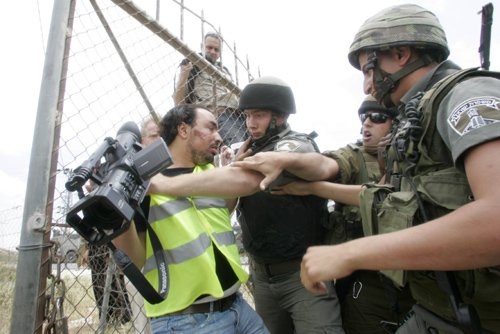
File photo
Ma’an reports that over 60 Palestinians were seized in the raids. Young Palestinians confronted the intruding forces by throwing stones. Journalists that attempted to record the clashes were fired upon with tear gas, rubber-coated bullets and stun grenades. Eyewitnesses also report the use of live ammunition. Several journalists were injured.
Occupation forces then attacked the local clinic and detained the doctors working there, preventing them from attending to the injured. The camp is now under military control, curfew has been imposed.
No, the Australian drought was not man-made
Another IPCC scare falls apart
By Andrew Bolt | Herald Sun | February 08, 2010
Melbourne University alarmist David Karoly once claimed a rise in the Murray Darling Basin’s temperatures was “likely due to the increase in greenhouse gases in the atmosphere from human acitivity” and:
Prime Minister Kevin Rudd grabbed the scare and exploited it:
BRENDAN Nelson was yesterday accused of being “blissfully immune” to the effects of climate change after he said the crisis in the Murray-Darling Basin was not linked to global warming…
In parliament yesterday, Kevin Rudd attacked Dr Nelson, accusing him of ignoring scientific facts.
“You need to get with the science on this,” the Prime Minister said. “Look at the technical report put together by the CSIRO and the Bureau of Meteorology.”
But the latest evidence indicates that Rudd and Karoly were wrong. In fact, there’s no evidence in the Murray Darling drought of man-made warming, says a new study in Geophysical Research Letters:
Previous studies of the recent drought in the Murray-Darling Basin (MDB) have noted that low rainfall totals have been accompanied by anomalously high air temperatures. Subsequent studies have interpreted an identified trend in the residual time-series of non-rainfall related temperature variability as a signal of anthropogenic change, further speculating that increased air temperature has exacerbated the drought through increasing evapotranspiration rates. In this study, we explore an alternative explanation of the recent increases in air temperature. This study demonstrates that significant misunderstanding of known processes of land surface – atmosphere interactions has led to the incorrect attribution of the causes of the anomalous temperatures, as well as significant misunderstanding of their impact on evaporation within the Murray-Darling Basin…
However, to accept the correlation [between temperature and rainfall] as the sole basis for the attribution of cause to human emissions is to implicitly assume that the correlation represents an entirely correct model of the sole driver of maximum air temperature. This is clearly not the case.
What’s causing the evaporation and temperatures is not (man-made) warming. It’s kind of the other way around: more sunshine, through lack of cloud cover, and lack of rain and therefore evaporation is causing higher temperatures.
Israeli forces detain wife of mayor in Ramallah
 08/02/2010
Jerusalem – Ma’an – Israeli forces detained Muntaha Tawil, wife of Al-Bireh Mayor Jamal Tawil, on Monday, after searching their home in Ramallah.
“Heavily armed soldiers and large numbers of military vehicles raided the mayor’s home on Monday early morning breaking the doors and damaging the house’ interior before they detained Muntaha Tawil, the mayor’s wife,” an Al-Birreh Municipal Council statement said.
Mayor Tawil said his wife’s detention would not hinder his ability to provide his constituents with the services they need, adding that Israel often attempts to exert pressure on mayors of Palestinian villages through detentions, forced home searches and summons orders.
Tawil is the mother of four and her husband has been detained several time by Israeli forces. Mayor Tawil previously served 13 years in an Israeli prison.
An Israeli military spokesman said that Muntaha Tawil was detained overnight by Israeli forces operating in Ramallah because of her involvement in activities “in the Hamas terrorist organization.”
###
Editor’s note:
Muntaha Tawil is one of the most active women working in the prisoners’ solidarity movement.
Berlusconi, Israel, and The Big Brother
|
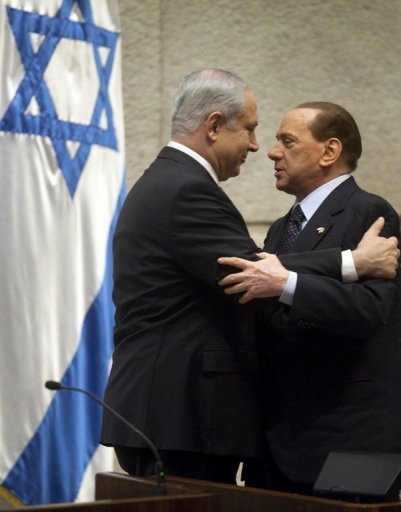
After the three-day visit of Italian Prime Minister Silvio Berlusconi to Israel and a short visit to the Occupied Palestinian Territories, a judgement is due. Berlusconi came with a large Italian ministry delegation (Foreign Minister Franco Frattini, Economy Minister Giulio Tremonti, Defense Minister Ignazio La Russa, Interior Minister Roberto Maroni, Public Works Minister Altero Matteoli and Health Minister Ferrucio Fazio) for the first Israeli-Italian joint cabinet meeting. It was the second joint-cabinet meeting for the Israeli government, after the joint German-Israeli session which was held in 2008. The same announcements and topics dominate speeches and actions of the Italian and Israeli politicians these days.
Holocaust, EU and the Big Brother
Berlusconi started his visit to Israel at Yad Vashem, the Holocaust Museum in Jerusalem. And the reference to the Holocaust pervaded the entire visit. The day before coming to Israel, Berlusconi delivered a written interview published in Haaretz on 31 January. In answer to the first question about the close relationship between his government and Israel (in a certain way new for the Italian political tradition), Berlusconi made reference to the Holocaust: “The visit I made to Auschwitz made a deep impression on me. I told myself there that it was impossible not to be Israeli.” But the most relevant nuance in Berlusconi’s words is that he presented a link between Israeli “struggle for freedom,” the process of European construction and the Holocaust. The result of that equation is that “Israel is part of Europe. It belongs to the West.” In his speech in front of the Knesset on 3 February, Berlusconi continued that “as both Pope John Paul II and Rabbi Eliyahu Tuaf said, Italy is like a ‘big brother’ to Israel, a bond which originates in the friendship and fraternity and common fate.”
In the present period when freedom of speech has become a sensitive issue in Italy with Berlusconi’s continuous attacks against journalists and when Israel restricts the possibilities for foreign journalists to enter, work and live in Israel and Palestinian Territories, the reference to Italy as a Big Brother of Israel reminds one more of the Orwellian 1984 scenario, rather than the particular “brotherhood” between Israelis and Italians.
Iran and the Economy
Iran was a top agenda topic during this visit. In his parallel between the current situation and the age of totalitarianism, Berlusconi stigmatized the Iranian president Ahmadinejad: “We must watch out,” because “we’ve already had one such madman in history,” clearly referring to Adolf Hitler. On 1 February, during the official dinner, talking about the Iranian regime, Israeli Prime Minister Benyamin Netanyahu stated that “humanity today is facing one of its most difficult challenges since World War II” and he added that “I must tell you, Silvio, my dear friend, you have a clear vision, you have determination and you have the courage of a genuine leader.”
In the Iranian chapter in the agenda of international relations, a large part is occupied by the economic issue. Meeting the Italian Prime Minister, the Israeli Foreign Minister Avigdor Lieberman asked Berlusconi on Tuesday to increase pressure on Russia to drop their opposition to economic sanctions against Teheran. Berlusconi’s personal story and career is strictly linked with business and he used that in every context: in the same Haaretz interview, he proudly declared that “for my entire life, first as an entrepreneur and later as prime minister, I have had a love of freedom.” He also proposed “the beautiful town of Arice as a location for future peace talks.” And to please the “little brother,” Berlusconi stated that from 2006, Italy has reduced trade with Iran. But Italy remains the largest European trading partner of Iran, more than 1,000 companies are involved in the Islamic Republic and prominent enterprises like Fiat, Eni and Ansaldo have offices and factories in Iran.
The Arab World
Except for Iran, during this three-day visit, the Arab world was the great absent in the political speeches and references. Even if Berlusconi states that “Italy today is an essential stop, sometimes the first, that Middle Eastern leaders make in Europe,” and that Italy is “involved in a lasting and comprehensive solution to the Palestinian question,” the marginality of the Palestinian cause and reality during this visit is clear to everybody.
Before his meeting with the Palestinian President Abu Mazen, the Italian Prime Minister denied the validity of the Goldstone report, because, according to him, Operation Cast Lead against Gaza last year was a “justified firing on Hamas’ rockets.” As the most important Italian newspaper, La Repubblica, noted, the adjective “justified” is not present in the written version of the speech spread in the Italian government website. This means that the Prime Minister voluntarily added this adjective at the eleventh hour. Moreover, during the press conference with Abu Mazen in Bethlehem, in answer to a question of what kind of feeling the Separation Wall in Bethlehem provoked in him, he replied that he didn’t see the Wall because he was too busy reading his notes.
Kissinger of Arcore
In one of the most important left-wing Italian newspapers, Il Manifesto, on 2 February, there appeared an article written by Zvi Schuldiner, professor of Political Science in the Israeli Sapir College, ironically defining Berlusconi as the “Kissinger of Arcore” (from the name of the village near Milan where Berlusconi lives). The reference to the American Secretary of State during the Nixon era is not casual: Berlusconi himself, in answer to the Haaretz correspondent’s questions, quoted Kissinger to draw a future scenario of war or peace in the Middle East: “Henry Kissinger used to say that there could never be war in the Middle East without Egypt, but no peace was possible without Syria.” However, behind these sentences, Israel knows that, despite his words and declaration, Berlusconi is one of the world’s most controversial men, morally, financially and politically. After this visit, in the next weeks and months the meaning of “brotherhood” between the Italian and Israeli governments will be revealed.
Time for an American Intifada?
By Jeff Gates | February 7, 2010
During the 1960 Christmas season, Americans flocked to the theaters to see Exodus, a 3-1/2 hour epic film featuring handsome freedom fighters and a riveting romance amidst the heroic triumph of Jewish Destiny over Arab Evil Doers. Set against a Yuletide backdrop of Biblical prophecy, moviegoers marveled as exiled Jews returned to their fabled promised land, a staple of popular culture to which Americans are first exposed as children in “Sunday school.”
Many moviegoers failed to realize that Exodus was not fact but fiction. Even now, few Americans realize the storyline was adapted for the screen from a 1958 novel by Leon Uris. The biggest bestseller since Gone with the Wind-a novel set during the Civil War of the 1860s-the filmadaptation was directed by Hollywood icon Otto Preminger. The blockbuster’s stars included a young Paul Newman with his leading lady a blond Eva Marie Saint.
The cast included character actor Lee J. Cobb and Peter Lawford, married to Pat Kennedy, a sister of John F. Kennedy who was elected president the same year. By then, Lawford was a famous member of pop culture’s high profile “Rat Pack” that included singer Frank Sinatra, Dean Martin, Sammy Davis, Jr. and Joey Bishop. Italian crooner Sal Mineo, then a teen heartthrob, received an Academy Award nomination for his portrayal of a Jewish émigré.
An Oscar should have been awarded to Israel and its supporters for portraying this extremist enclave as a legitimate nation-state when, in reality, its founding traces to an alluring storyline. Forty-five years after the release of Exodus, American naiveté was again targeted by Jewish storytellers to induce the U.S. to war in the Middle East-only this time for real.
Then as now, Americans are easily swayed by sympathetic portrayals of an enclave granted nation-state recognition by President Harry Truman, a Christian-Zionist. The Missouri Democrat had famously read the Bible cover-to-cover five times by age 15. Truman was a True Believer in the same way that fundamentalist Christians believe-truly believe-that their Messiah will not return until the “Israelites” recover their ancestral home.
Preying on similar beliefs, Republican George W. Bush, another Christian-Zionist president, was induced with phony intelligence to wage war in Iraq. The false intelligence was traceable to Israelis, pro-Israelis or assets developed for that purpose. That invasion had long been a priority goal of those who believe-truly believe-in their right to an expansionist Greater Israel.
Yet as Shlomo Sand chronicles in The Invention of the Jewish People (2009), the historical evidence is scant either for an exile or an “exodus.” As with the movie, the return of a “Jewish People” to a Jewish homeland is “a conscious ideological composition” meant “to claim a higher cultural lineage” than what can be supported by the facts.
In lieu of the novel-writing skills of Leon Uris, the Zionist narrative featured Biblical archeologists such as William F. Albright who, in the 1920s, traveled to the Holy Land to excavate artifacts that would, as Sand puts it: “reaffirm the Old Testament and thereby the New.”
By interpreting his finds in Christian-Zionist terms, Albright and his colleagues not only unearthed Biblical “facts” that shaped the Sunday school curriculum, they also helped pre-stage the perceived legitimacy of a Jewish people returning from exile to a Jewish homeland. As Sand points out, if there was no exodus, how can there be a return? If there is no “Jewish People,” how can there be a homeland?
Yet these widely held beliefs remain the premise underlying Israel’s expansionist agenda and its rationale for heaping six decades of abuse on Palestinians who have lived there for centuries.
Political Expedience or Biblical Prophecy?
White House counsel Clark Clifford cautioned Truman that his reelection was unlikely absent the funding that Jewish-Americans-with Israel’s recognition-were eager to provide. In early May 1948, General George C. Marshall, Truman’s Secretary of State, argued vigorously against recognition. Strong objections were also heard from the diplomatic corps, the fledgling Central Intelligence Agency and the Pentagon’s Joint Chiefs of Staff.
Marshall, the top-ranked U.S. military officer in WWII, was outraged that Clifford put domestic political expedience ahead of U.S. foreign policy interests. Marshall told Truman that he would vote against him if he extended sovereign status to an enclave of Zionist terrorists, religious fanatics and what Albert Einstein and Jewish philosopher Hannah Arendt called “Jewish fascists.” Marshall insisted that State Department personnel never again speak to Clifford.
In March 1948, a Joint Chiefs paper titled “Force Requirements for Palestine” predicted the “Zionist strategy will seek to involve [the U.S.] in a continuously widening and deepening series of operations intended to secure maximum Jewish objectives.” Those objectives included an expansionist agenda for Greater Israel that envisioned the taking of Arab land, ensuring armed clashes in which the U.S. was destined to become embroiled.
The Joint Chiefs listed Zionist objectives as:
– Initial Jewish sovereignty over a portion of Palestine,
– Acceptance by the great powers of the right to unlimited immigration,
– The extension of Jewish sovereignty over all of Palestine,
– The expansion of “Eretz (Greater) Israel” into Transjordan and portions of Lebanon and Syria, and
– The establishment of Jewish military and economic hegemony over the entire Middle East.
Akin to the fictional portrayal in Exodus, those Zionists lobbying Truman assured him they would remain within the initial boundaries. We now know that was a lie. They also promised that the Zionist state would not become what it quickly became: a theocratic and racist enclave-albeit widely marketed by pro-Israeli media as the “only democracy in the Middle East.”
To remove all doubt as to the extremist goals of the Zionist project, the Joint Chiefs assessment added ominously:
“All stages of this program are equally sacred to the fanatical concepts of the Jewish leaders. The program is openly admitted by some leaders, and has been privately admitted to United States officials by responsible leaders of the presently dominant Jewish group–the Jewish Agency.”
Deceit from the Outset
A beguiling combination of Hollywood fiction, manipulated beliefs and outright lies remain at the core of this entangled alliance and the U.S.-Israeli “special relationship.” The deceit deployed to advance the hegemonic goals of the Zionist project remains obscured by an undisclosed media bias reinforced by a widespread pro-Israeli influence in popular culture. As with the 1960 film, the ongoing manipulation of thought and emotion lies at the core of this duplicity a half-century later.
In The Persuasion Explosion (1985), author Art Stevens reports that Exodus was a public relations ploy launched by Edward Gottlieb who sought a novelist to improve Israel’s image in the U.S. The name Uris originates with Yerushalmi, meaning “man of Jerusalem.” The film rights to Exodus were sold in advance of the book’s publication. Translated into dozens of languages, this masterpiece of mental and emotional manipulation quickly became a global phenomenon as its created favorable impressions of Israel.
The rewards are real for those who offer aid and comfort to this trans-generational deceit. When Truman’s campaign train traversed the nation as part of a 1948 whistle-stop tour, grateful Jewish nationalists refueled his campaign coffers with a reported $400,000 in cash ($3.6 million in 2010 dollars). Those funds helped transform his anticipated loss into a victory with support from pro-Israeli editorial boards that-after recognition-boosted Truman’s sagging popularity.
The Creation of Reliable Assets
Clark Clifford was rewarded with his career goal when he emerged as a top-paid Washington lawyer. After proving himself a pliable personality, he remained a reliable asset. During the G.H.W. Bush presidency, his combination of political prominence and perceived credibility provided cover for a massive bank fraud involving the Bank of Credit and Commerce International aided by Roger Altman, his Ashkenazi law partner.
In 2009, Hollywood released an action thriller (The International) starring Clive Owen and a similar storyline involving the International Bank of Business and Credit. Neither Clifford nor Altman had experience in banking when their law firm enabled what prosecutors charged was a global criminal operation.
Media reports described the BCCI scheme as the largest bank fraud in history. This $20 billion transnational operation even featured the requisite Hollywood component: Clifford’s protégé was married to Lynda Carter, the star of Wonder Woman, a 1970s fantasy-adventure television series.
The real fantasy in this long-running geopolitical fraud lies in why U.S. lawmakers continue to befriend and defend a “nation” that has for so long-and so consistently-deceived and betrayed its most loyal ally. As a badly miscast Eva Marie Saint asked in her most memorable line in Exodus: “When will it ever end?”
The greatest wonder will be if, based on facts confirming the depth and duration of this duplicity, those lawmakers urging continued support for Israel are not charged with treason. [See: “How the Israel Lobby Took Control of U.S. Foreign Policy”]
To restore its national security, the U.S. must shake off its entangled alliance with this extremist enclave. “Shaking off” is the literal translation of “intifada.” Those who know the true facts behind this trans-generational deception are quickly reaching the conclusion that the recognition of this enclave as a legitimate state was key to this ongoing fraud. Others may be waiting for the movie, American Intifada.
The media’s tall tales over Iraq
Ann Clwyd’s false claims that Saddam used a people shredder was as dangerous a justification for war as Blair’s dodgy dossier
By Brendan O’Neill | guardian.co.uk | 4 February 2010
Why did Ann Clwyd get such an easy ride during her appearance at the Chilcot inquiry this week, from both m’luds and the media? Clwyd is at least as complicit as her former boss Tony Blair in the dissemination of tall tales designed to justify the attack on Iraq.
Clwyd is Labour MP for Cynon Valley and head of Indict, a group that campaigned for many years for the arrest and punishment of Saddam Hussein and his cronies under international law. On the eve of the Iraq War – 18 March 2003 to be precise – Clwyd wrote an article for the Times in which she claimed that Saddam had a people-shredding machine.
Apparently the Ba’athists would dump their opponents into a machine “designed for shredding plastic”, and later put their minced remains into “plastic bags” so they could eventually be used as “fish food”.
It gets worse: apparently these unfortunate men were put into the shredder feet first so that they could briefly behold their own mutilation before death.
Not surprisingly, Clwyd’s shocking claims spread around the world like a virus. The then prime minister of Australia, John Howard, talked of Saddam’s “human-shredding machine” in a speech justifying his decision to send troops to Iraq. Paul Wolfowitz, the Bush administration’s hawkish deputy defence secretary, expressed his admiration for Clwyd’s article and a link to it was posted on the US state department’s website. Numerous pro-war journalists repeated Clwyd’s claims.
There was only one problem: there was no strong evidence, and there still isn’t, that Saddam had anything like a people-shredding machine.
When I investigated this story for the Spectator and the Guardian in early 2004, I found no convincing evidence that such a medieval-sounding contraption ever existed.
It seems Clwyd based her story on the uncorroborated claims of one individual from northern Iraq. Neither Amnesty International nor Human Rights Watch, in their numerous investigations into human rights abuses in Iraq, had ever heard anyone talk of a human-shredding machine.
Worst of all for Clwyd, I interviewed one of the Iraqi doctors whose grisly job was to examine the bodies of executed prisoners at Abu Ghraib, where the shredder was allegedly based, and he said no prisoner was ever killed by being shredded. And for the record, he really hated the Ba’athist regime.
It’s worth remembering the role that Clwyd’s claims played back in mid-March 2003. There was widespread opposition to the war, as evidenced by the million-strong march in Hyde Park in February 2003.
People were already asking questions about the “dodgy dossier” and Blair’s claims about WMD. The story of the shredder seemed designed to jolt us all out of our stupidity and convince us to back the government’s war against evil. As the headline on Clwyd’s article in the Times put it: “See men shredded, then say you don’t back war.”
The shredder story was used in a last-ditch effort to change people’s minds. As Trevor Kavanagh at the Sun rather wishfully argued: “British resistance to war changed when we learned how sadist Saddam … fed dissidents feet first into industrial shredders.” If Blair’s dodgy dossier was cynically used to drum up support in the run-up to the invasion, then Clwyd’s shredder story was cynically used to batter the last bit of war-scepticism out of the British public.
And yet Clwyd has not been subjected to anything like the same level of media criticism as Blair has been. This points to a problem with the way we remember the Iraq war. In the mythical version of events that is being promoted by the media off the back of the Chilcot inquiry, Blair, and his evil sidekick Alastair Campbell, single-handedly duped the cabinet, parliament, the media and some of the public into supporting the war.
The truth is that it wasn’t only Blair who was spreading tall tales, and much of the media wasn’t nearly as critical as it should have been of the Bush/Blair drive to war. Clwyd’s appearance at the Chilcot inquiry was an opportunity to remind ourselves that Blair was not a superhuman warper of rational-mindedness and that the Iraq-related hysteria spread far beyond his coterie of advisers. Unfortunately, we’ve wasted this opportunity.
Former IPCC Chairman says UN panel is losing credibility
Jonathan Leake, Environment Editor | The Sunday Times | February 7, 2010
A LEADING British government scientist has warned the United Nations’ climate panel to tackle its blunders or lose all credibility.
Robert Watson, chief scientist at Defra, the environment ministry, who chaired the Intergovernmental Panel on Climate Change (IPCC) from 1997 to 2002, was speaking after more potential inaccuracies emerged in the IPCC’s 2007 benchmark report on global warming.
The most important is a claim that global warming could cut rain-fed north African crop production by up to 50% by 2020, a remarkably short time for such a dramatic change. The claim has been quoted in speeches by Rajendra Pachauri, the IPCC chairman, and by Ban Ki-moon, the UN secretary-general.
This weekend Professor Chris Field, the new lead author of the IPCC’s climate impacts team, told The Sunday Times that he could find nothing in the report to support the claim. The revelation follows the IPCC’s retraction of a claim that the Himalayan glaciers might all melt by 2035.
The African claims could be even more embarrassing for the IPCC because they appear not only in its report on climate change impacts but, unlike the glaciers claim, are also repeated in its Synthesis Report.
This report is the IPCC’s most politically sensitive publication, distilling its most important science into a form accessible to politicians and policy makers. Its lead authors include Pachauri himself.
In it he wrote: “By 2020, in some countries, yields from rain-fed agriculture could be reduced by up to 50%. Agricultural production, including access to food, in many African countries is projected to be severely compromised.” The same claims have since been cited in speeches to world leaders by Pachauri and Ban.
Speaking at the 2008 global climate talks in Poznan, Poland, Pachauri said: “In some countries of Africa, yields from rain-fed agriculture could be reduced by 50% by 2020.” In a speech last July, Ban said: “Yields from rain-fed agriculture could fall by half in some African countries over the next 10 years.”
Speaking this weekend, Field said: “I was not an author on the Synthesis Report but on reading it I cannot find support for the statement about African crop yield declines.”
Watson said such claims should be based on hard evidence. “Any such projection should be based on peer-reviewed literature from computer modelling of how agricultural yields would respond to climate change. I can see no such data supporting the IPCC report,” he said.
The claims in the Synthesis Report go back to the IPCC’s report on the global impacts of climate change. It warns that all Africa faces a long-term threat from farmland turning to desert and then says of north Africa, “additional risks that could be exacerbated by climate change include greater erosion, deficiencies in yields from rain-fed agriculture of up to 50% during the 2000-20 period, and reductions in crop growth period (Agoumi, 2003)”.
“Agoumi” refers to a 2003 policy paper written for the International Institute for Sustainable Development, a Canadian think tank. The paper was not peer-reviewed.
Its author was Professor Ali Agoumi, a Moroccan climate expert who looked at the potential impacts of climate change on Tunisia, Morocco and Algeria. His report refers to the risk of “deficient yields from rain-based agriculture of up to 50% during the 2000–20 period”.
These claims refer to other reports prepared by civil servants in each of the three countries as submissions to the UN. These do not appear to have been peer-reviewed either.
The IPCC is also facing criticism over its reports on how sea level rise might affect Holland. Dutch ministers have demanded that it correct a claim that more than half of the Netherlands lies below sea level when, in reality, it is about a quarter.
The errors seem likely to bring about change at the IPCC. Field said: “The IPCC needs to investigate a more sophisticated approach for dealing with emerging errors.”
US rejects EU diplomacy over Iran N program
Press TV – February 7, 2010
Leading US senators Joseph Lieberman and John Kerry inveigh against a top EU official for supporting further diplomatic talks with Iran over its nuclear program.
Speaking at the Munich Security Conference on Saturday, the two US officials criticized the European Union Foreign Policy Chief Catherine Ashto who threw her lot with more dialogue over Iran’s nuclear program.
The two went on to claim that Iran has been ‘explicitly dishonest’ over its uranium enrichment and thus does not deserve further dialogue, or diplomacy for that matter.
 “Iran comes to the international conference like this and talks in a way that is simply dishonest,” said Lieberman, who chairs the US Senate Committee on Homeland Security and Government Affairs and is known for his pro-Israeli stance on international issues.
Rather than dealing with Iran through diplomatic negotiations, Lieberman asserted that the US should try to deal with the Tehran government through other means.
“Dialogues have being going on for last six years, (and) there are always dialogues,” he said. “But the Iranians do not take the chance. I think it simply has to get a tougher economic sanction if any kind of diplomacy is over, and military will never be necessary.”
His remarks were instantly backed by John Kerry, the former US presidential candidate who now heads the Senate’s Foreign Relations Committee.
“We are united in the congress, senate house, the administration and with our allies here in Europe,” said Kerry.
This comes as Iran is trying to find a middle ground with the West in swapping its low-enriched uranium with more refined nuclear material for the Tehran research reactor.
Iranian Foreign Minister Manouchehr Mottaki expressed hope on Saturday that an agreement on the nuclear fuel proposal will soon be reached with the Western side, but with the changes that Tehran seeks.
His remarks were largely ignored by US Defense Secretary Robert Gates who has instead insisted on the imposition of fresh sanctions.
Washington accuses Iran of developing nuclear weapons and has for years levied sanctions and threatened the country with war scenarios to force the Tehran government into halting its nuclear activities.
Iran which has been under various US sanctions after the Islamic Revolution toppled a US-backed monarch in 1979 rejects the accusations as politically motivated.
Iran’s nuclear program was launched in the 1950s with the help of the United States as part of the Atoms for Peace program. After the 1979 Revolution, Western companies working on Iran’s program refused to fulfill their obligations even though they had been paid in full.
Iran is a signatory of the Nuclear Non-Proliferation Treaty and, unlike some of its regional neighbors, has opened its enrichment plants to UN inspection.
AP misquoted UN Sec’y Gen’l as praising Israel
By Philip Weiss | February 6, 2010 | Excerpt
Last night the New York Times printed an AP story about the United Nations’ followup to the Goldstone report, titled “UN Chief Praises Israel Probe of Its Gaza Actions.”
Secretary-General Ban Ki-moon says in a 72-page report Thursday night to the General Assembly that ”Israel followed up on every allegation.”
It turns out the Secretary-General never said that. Israel said it.
In today’s briefing at the UN, the UN made the point that Ban Ki-moon said no such thing. It explained that the 72-page report was mostly Israel’s report. It included just three pages from the Sec’y Gen’l.
The Spokesperson noted that in the document submitted by the Secretary-General to the General Assembly on the Goldstone report, only the first three pages are written by the Secretary-General and the Secretariat.
The remainder of the document consists of annexes containing information provided, respectively, by the Government of Israel, the Permanent Observer Mission of Palestine and the Permanent Mission of Switzerland.
Confused? Here is the 72-page UN report released yesterday. The Secy Gen’l’s judgment at the start is noncommital:
It is my sincere hope that General Assembly resolution 64/10 has served to encourage investigations by the Government of Israel and the Palestinian side that are independent, credible and in conformity with international standards. I note from the materials received that the processes initiated by the Government of Israel and the Government of Switzerland are ongoing… As such, no determination can be made on the implementation of the resolution by the parties concerned.
The long Israeli response follows (and is not clearly identified). In paragraph 185, Israel pats itself on the back:
Because Israel followed up on every allegation, regardless of whether the source was neutral, hostile, or friendly, it launched investigations into 150 separate incidents, including 36 criminal investigations opened thus far.
AP seems to have revised its coverage. But as Mark Twain said, a lie goes around the world in the time it takes the truth to tie its shoes.
This discovery was published at reddit, which says that the mistake demonstrates pro-Israel bias in the press.
China Says ICC Move Could Hit Sudan Peace Process
Al-Manar 06/02/2010 China has expressed concern over a move by a war crimes court to reconsider adding genocide charges to an arrest warrant for Sudanese President Omar el-Beshir, saying it could hurt the peace process.
Foreign ministry spokesman Ma Zhaoxu said the situation in Sudan was at a “complex, sensitive and critical” stage and such a move by the International Criminal Court (ICC) could “disturb or even damage the cooperative atmosphere.”
“Concerned sides” are trying to push forward the Doha peace talks between the Sudanese government and Darfur rebel groups, he said in a statement released Friday, according to Xinhua news agency.
Ma stressed that China had expressed “deep concern” since the start of proceedings against Beshir in 2008, together with “some African and Arabic developing countries, as well as regional organizations such as the African Union and the League of Arab States,” Xinhua reported.
The African Union said Friday the ICC’s move harmed the peace process in Sudan.
An ICC appeals chamber on Wednesday ordered a review of Beshir’s arrest warrant for alleged atrocities in the war-torn western Sudanese province of Darfur. It directed judges to reconsider their decision to omit genocide from the warrant issued in March last year, saying they had made “an error in law.”
The ICC issued the arrest warrant for Beshir on five counts of crimes against humanity and two of war crimes committed in Darfur.
Chief ICC prosecutor Luis Moreno-Ocampo first called for an arrest warrant to be issued against Beshir in July 2008.
Iran near $30bn oil deals with foreign firms
Press TV – February 6, 2010
Iran is in the final stage of talks with five companies to finalize deals for the development of oil and gas fields worth $30 billion, an official says.
Seifollah Jashnsaz, Managing Director of the National Iranian Oil Company (NIOC), predicted that the deals will be finalized within two months.
Speaking to Mehr news agency, he added that five Asian and European firms are expected to invest in the Lavan gas field, Phases 13 and 14 of the South Pars gas field, the Azadegan oilfield, the Kish gas field, and two exploratory blocks in the Caspian Sea. Jashnsaz did not give further details.
Iran’s fifth five-year development plan (2010-2015) has obliged the government to invest around $155 billion in the upstream sector of the oil and gas industry.
Jashnsaz said Iran’s total revenues from oil exports stood at $78 billion during the Iranian calendar year to March 2009.
The NIOC chief also added that the government allowed the Oil Ministry to invest $11 billion from its oil sales in oil industry development.
Jashnsaz stressed that Iran needs to attract more foreign investment to keep the oil industry live. “If we do not make the necessary investment, the harm of the lack of timely investment in the oil industry will be irreversible to the country,” he pointed out.
“We must go after foreign investment, the possibility of which also exists,” he said.
Featured Video

U.S. General Caine Warns: STRIKING IRAN is a HUGE RISK
or go to
Aletho News Archives – Video-Images
From the Archives
Stealth Bombers and Bunker Busters
A retrospective analysis of the so-called 12-Day War, and the triumphantly celebrated Operation Midnight Thunder

By William Schryver | imetatronink | November 28, 2025
The GBU-57 is a big fat gravity bomb with fins. To achieve effective precision, a B-2 bomber must drop it on its intended target from no further than about five nautical miles — essentially right on top of the target.
Its penetration depth is claimed to be 200 feet. But that capability has NEVER been tested against a seriously hardened deep-underground target encased in layers of high-performance concrete, and topped with a few dozen meters of solid rock. In that sort of real-world scenario, the GBU-57 would be lucky to drill down 50 feet, if that.
It was always ridiculous silly talk to suggest the GBU-57 was the wonder weapon it was made out to be. There is a good reason the US only produced a couple dozen of them and then stopped: they understood its acute limitations in a non-permissive combat environment.
And, notwithstanding the hyperbolic Israeli propaganda, there was never any credible evidence that Iranian medium- and long-range air defenses against fixed-wing aircraft were attrited to any significant degree. And Iranian short-range air defenses were increasingly effective against long-range Israeli drones with each passing day.
As for the B-2: it is a big fat subsonic aircraft. It flies at airliner speeds. A strike on Fordow would entail flying at least 500 miles in and out of Iran. … continue
Blog Roll
 Aletho News
- Zelensky Refused to Discuss Druzhba Pipeline Issue – Fico
- U.S. General Caine Warns: STRIKING IRAN is a HUGE RISK /Glenn Diesen & Lt Col Daniel Davis
- Israel designates five Palestinian media outlets as ‘terrorist organizations’
- Israel, not America, first: Carlson’s Huckabee interview lays bare US foreign policy priorities
- Israeli troops executed Palestinian aid workers at ‘point blank range’: Report
- Iran war What if today’s Iran is resigned to a long, hellish war with the US?
- Why Israel Is Escalating Its War Crimes Against Lebanon
- Iran in the face of the armed diplomacy of imperialism
- The US build-up around Iran constitutes strategic war option, not ‘deterrence’
- Iran to US: Sanctions and war failed; try diplomacy and respect
- If Americans Knew
- Footage Shows Israeli Troops Waiting in Ambush, Then Opening Fire on a Palestinian Teen
- The US is on the brink of a major new war that Trump has not even bothered explaining
- Latest Epstein document dump is one more cover-up
- No Protection, No Justice: US Citizens Killed with Impunity by Israel
- Maria Farmer: Epstein Victim Reveals Explosive Information Covered Up by Media
- Average of five Palestinians killed by Israel every day in Gaza since ceasefire – Not a ceasefire Day 136
- Palestinian church leaders admonish Christian Zionist Mike Huckabee – Not a ceasefire Day 135
- Ominous messaging from Trump’s “Board of Peace” – Not a ceasefire Day 134
- ‘Christians Out’: Jerusalem Church Tagged With Hate Graffiti, Police Investigating
- Israeli Settlers Kill American Teen
- No Tricks Zone
- New Research Reaffirms Clouds, Aerosols, And Surface Solar Radiation Are ‘Driving The Climate System’
- Germany: Electric Car Catches Fire At Charging Station, Sets Off Local “Inferno”, Widespread Damage
- New Study: Canada’s New Brunswick Was 1°C Warmer Than Today During The Medieval Warm Period
- Coal Power Back In Trend As Globe Tries To Keep Pace With Growing Demand For Power
- New Study: A 4°C Warmer Beaufort Sea Had ‘No Sea Ice’ 11,700 – 8200 Years Ago
- Unfudging The Data: Dutch Meteorological Institute Reinstates Early 20th Centruy Heat Waves It Had Erased Earlier
- German Gas Crisis…Chancellor Merz Allegedly Bans Gas Debate Ahead of Elections!
- Pollen Reconstructions Show The Last Glacial’s Warming Events Were Global, 10x Greater Than Modern
- Germany’s Natural Gas Storage Level Dwindles To Just 28%… Increasingly Critical
- New Study Rebuts The Assumption That Anthropogenic CO2 Molecules Have ‘Special’ Properties
 Aletho News