Why I Was Banned in the U.S.A.
By Tariq Ramadan | NEWSWEEK | From the magazine issue dated March 29, 2010
When the American embassy called in August 2004, I was just nine days away from starting a job at Notre Dame’s Kroc Institute for International Peace Studies. I had already shipped my possessions from Geneva, Switzerland, where I was living, to Indiana, and enrolled my kids in a school near our new home. Suddenly, however, an embassy official was telling me my visa had been revoked. I was “welcome to reapply,” the official said, but no reason was offered for my rejection. Sitting in a barren apartment, I decided the process had become too unpredictable; I didn’t want to keep my family in limbo, so I resigned my professorship before it began. I launched a legal battle instead.
It was hardly a fight I had expected. Less than a year earlier, the State Department had invited me to speak in Washington, D.C., and introduced me as a “moderate” Muslim intellectual who denounced terrorism and attacks against civilians. Now it was banning me from U.S. soil under a provision of the Patriot Act that allows for “ideological exclusions.” My offense, it seemed, had been to forcefully criticize America’s support for Israel and the wars in Iraq and Afghanistan. The U.S. accused me of endorsing terrorism through my words and funding it through donations to a Swiss charity with alleged ties to Gaza. Civil-liberties groups challenged my case in court for almost six years until, in late January, Secretary of State Hillary Clinton dropped the allegations against me, effectively ending my ban.
In early April I will make my first public appearance in the U.S., at New York City’s Cooper Union, participating in a panel discussion about Muslims. While it’s a victory of sorts, the fight is not over. Numerous foreign scholars remain banned from U.S. soil. Until the section of the Patriot Act that kept me out of the country is lifted, more people will suffer the same fate. Although the exclusions are carried out in the name of security and stability, they actually threaten both by closing off the open, critical, and constructive dialogue that once defined this country.
In my case, criticizing America’s Middle East policies cast doubt on my loyalty to Western values and cost me a job. But prejudice may ultimately cost the U.S. more. By creating divisions and disregarding its values, even in the name of security, America tells the world that it is frightened and unstable—above all, vulnerable. In the long term, it also reinforces the religious, cultural, and social isolation of minority groups, encouraging the very kind of disloyalty that these ideological exclusions are meant to prevent.
It’s not the first time America has tried to shield itself from dissenting opinions. During the Cold War, dozens of overseas artists, activists, and intellectuals—including British novelist Doris Lessing, Chilean poet Pablo Neruda, and Colombian author Gabriel García Márquez—were denied visas because of their left-leaning ideas. Today, though, the American concept of the “other” has taken on a relatively new and specific form: the Muslim. America must face the reality that, in the West, many adherents to Islam demonstrate loyalty to democratic values through criticism. While violence must always be condemned, such debate must be encouraged if those values are to last.
Ramadan is a professor of Islamic studies at St. Antony’s College, Oxford, and author of What I Believe.
© 2010
‘NYT’ peddles meaningless Peres plan
By Ira Glunts on March 21, 2010
Isabele Kershner, writing in the NY Times the other day, presented a scoop that surely made her controversial boss proud. Her boss, Jerusalem Bureau Chief Ethan “AbuBenTzali*” Bronner, has been criticized for his lack of objectivity, but his colleague Kershner showed that she too can compose pro-Israel slanted news stories.
Kershner reports that the octogenarian Israeli President, Shimon Peres, who she incorrectly implies has a moderating effect on Prime Minister Binyamin Netanyahu, floated a bridging proposal which was meant to mend the current rift between feuding American and Israeli officials.
Peres sought to introduce a distinction between building colonies on open land in and around occupied East Jerusalem (presumably OK) and building within already existing Arab neighborhoods there, which usually entails booting out Palestinian residents (presumably, not helpful.) Both practices are equally illegal and threaten the Arab presence in the city. The first, which has been going on for over forty years, is actually the more significant in terms of altering the demographics of the area, although the second has recently generated demonstrations and much bad publicity. The Obama administration has explicitly called for a halt to all new settlement construction. The Americans would surely dismiss Peres’ meaningless distinction, which Kershner finally acknowledges in her last paragraph.
Shimon Peres, who is a former Israeli Prime Minister, has had a more than six-decade career as an important Israeli politician. However, he now occupies the ceremonial position of President and his real influence on policy has diminished to close to zero. What makes Peres’ thoughts newsworthy is anyone’s guess. It definitely is not the modest venue in which he chose to “float” (Kershner’s word) the proposal, which was an elementary school in a suburb of Tel Aviv! This is decidedly an odd place to test out thoughts on foreign diplomacy. One wonders if Kershner personally attended the event or was it was covered by a local “stringer.” Maybe some precocious and enterprising sixth grader tipped the paper about the Peres statement.
After it was made public recently that Ethan Bronner’s son had enlisted in the Israeli Defense Forces (IDF), his editor Bill Keller dismissed charges of conflict of interest,arguing that the fact that his chief correspondent’s family is embedded in Israeli culture only increases the quality of his contacts and enhances his understanding of events. I suppose that Kershner, who like Bronner, is married to an Israeli and is said to be more embedded than him, could possibly have a son or daughter in the class that hosted Peres. How is that for having contacts that most American reporters lack!
Reporting the non-story of Shimon Peres’ meaningless proposal is only one small example of the bizarre lengths that Bronner and Kershner will go in order to make Israel look good. In fact in the same piece, Kershner leads with the claim that Netanyahu’s quick and official repudiation of his crackpot brother-in-law’s accusation that President Obama is an anti-Semite is an indication that the Israeli Prime Minister is trying to be conciliatory. Yet later on in the article she admits that Netanyahu shows no inclination to budge on the very issue that caused the flap: building in East Jerusalem.
Clark Hoyt, the Public Editor of the Times, recommended that Bronner be reassigned, since readers “don’t expect a correspondent sent to cover an intense overseas conflict to wind up heavily invested in one side….” This prescription should also apply to Kershner, whose life and writing, like Bronner’s, points to the fact that she is “embed.”
*AbuBenTzali may be translated from Arabic and Hebrew as “Father of Kid IDF.”
Netanyahu to Ask Obama for Bunker Buster Bombs against Iran
Al-Manar, 21/03/2010

Israeli Prime Minister Benjamin Netanyahu will press the American administration during his upcoming visit to Washington to release sophisticated bunker-busting bombs needed for a possible strike on Iran’s nuclear sites, the Sunday Times reported in its website.
Netanyahu will leave for the United States on Sunday evening in order to attend a meeting of the American Israel Public Affairs Committee (AIPAC). He is also expected to meet with senior administration officials.
In Washington, Netanyahu is scheduled to meet with Secretary of Defense Robert Gates, Secretary of State Hillary Clinton. A meeting with President Barack Obama is in the works.
The Scotland Herald reported last week that hundreds of powerful US “bunker-buster” bombs were shipped from California to the British island of Diego Garcia in the Indian Ocean in preparation for a possible attack on Iran. The newspaper quoted a manifest from the US navy as saying that the shipment included 387 “Blu” bombs used for blasting hardened or underground structures.
Experts told the paper that the ammunition was being put in place for an assault on Iran’s nuclear facilities. Although Diego Garcia is part of the British Indian Ocean Territory, the Herald said, it is used by the US as a military base under an agreement made in 1971. According to the newspaper, the preparations were being made by the US military, but it would be up to President Obama to make the final decision.
The London Weekly said that for the first time since Operation Cast Lead against Gaza, Israel has agreed to ease the blockade on the Strip, discuss all core issues during the proximity talks, with the condition of reaching final conclusions only in direct talks with the PA. It added that Netanyahu will seek returns for the concessions, asking Washington to provide the IAF with the ‘bunker-buster’ bombs.
Without proof, Israel and the West accuse Iran of using its enrichment program to build a nuclear bomb, a charge Tehran firmly denies. Iranian President Mahmoud Ahmadinejad issued on Saturday a Persian New Year’s address to Iranians, in which he said that Iran would resist Western pressure even more determinedly in the coming year.
Israeli education ministry censors Universal Declaration of Human Rights
By Ben White on March 21, 2010
On March 17, the following note appeared on the Promised Land blog:
And this also happened this week: the office of the minister of education forbade distributing a booklet for kids about the Universal Declaration of Human Rights, because it didn’t like two articles in the declaration, as well as some of the illustration in the booklet.
The relevant link was to an article in Hebrew. I asked Noam which two articles had been specified, and he replied that the nrg.co.il article implied Article 14 and Article 18. These two articles are as follows:
“Everyone has the right to seek and to enjoy in other countries asylum from persecution.” (Article 14)
“Everyone has the right to freedom of thought, conscience and religion; this right includes freedom to change his religion or belief, and freedom, either alone or in community with others and in public or private, to manifest his religion or belief in teaching, practice, worship and observance.” (Article 18)
But apart from that Hebrew language piece, there is also a translated version of the story available here. Here is an extract:
The Ariel municipality decided to buy hundreds of copies of the book to distribute them as a gift to kindergarten children. But after the Education Ministry’s intervention, the books were returned, even though they had already been bought with money and a message from the municipality pasted in them. This is because the Education Ministry inspectors from the state religious department did not like two illustrations and two sections of the declaration, and decided to disqualify the book…
Mayor Ron Nahman said, “it is positive and good to hand out a book about children’s rights. But our attention was drawn to two sentences that are not exactly what we teach the children. The Education Ministry said this was wrong and we accepted its decision.”
47 Residents Wounded In Hebron
By Saed Bannoura – IMEMC & Agencies – March 20, 2010
Palestinian medical sources in the southern West Bank city of Hebron reported Friday evening that 47 residents were wounded during clashes with Israeli soldiers in the city and the nearby Beit Ummar town.
21 residents received treatment after inhaling gas fired at them in Hebron, and nine others were wounded by rubber-coated bullets. The clashes took place near the Ibrahim Mosque.
Similar clashes took place in Al Zahed area in the city while the army fired gas bombs and rubber-coated bullets.
Sources at the Red Crescent in the Hebron reported that some of the wounded residents were moved to the local governmental hospital, and the Muhammad Al Muhtasib Hospital, while the rest received treatment by field medics.
The sources added that the army fired a gas bombs at one of the ambulances while transporting some wounded residents. The gas bombs hit the windshield of the ambulance and shattered it.
Soldiers also occupied rooftops of several homes and used them as military posts and monitoring towers.
Twenty residents received treatment after inhaling gas fired by the army while six others were wounded by rubber-coated bullets in Beit Ummar town.
Several youths hurled stones at settler vehicles causing damage to three cars; the army invaded the town and prevented local ambulances from reaching the wounded residents.
Nablus: Four dead in 24 hours
Ma’an – March 21, 2010

Bethlehem – Israeli soldiers shot dead two Palestinians near Nablus in the northern West Bank on Sunday.
Palestinian security sources identified the victims as 19-year-old farmers Muhammad Faysal and Salah Muhammad Qawariq.
Both were from the Awarta village, southeast of Nablus, and were en route to farmland carrying agricultural tools and herbicide, the same sources said.
Israel’s army said the two attempted to stab a soldier who was on a “routine patrol” near the Awarta military checkpoint. “In response, forces opened fire and identified a direct hit,” an army spokeswoman told Ma’an.
Eyewitnesses said Israeli forces declared the area a “closed military zone” and deployed in neighboring Palestinian villages. Soldiers closed the main entrance to the village of Madama, south of Nablus, they said.
Red Crescent officials told Ma’an that the army informed them that two Palestinians were killed near the illegal Itamar settlement southeast of Nablus, asking them to come and evacuate the victims.
They were the third and fourth killed in 24 hours in the northern West Bank. A teenager died early Sunday from injuries sustained at a protest a day earlier, when another boy was shot dead. Useid Qadus, 16, was shot in the head by Israeli forces, medics said, and Muhammad Qadus, also 16, died of a wound to the chest shortly after the a protest in Iraq Burin, another village south of Nablus.
The Israeli military said its forces opened fire with riot-control means to disperse a violent riot, denying allegations its soldiers used live ammunition against the two teenagers.
Medical officials and human rights advocates have disputed the army’s version of events, pointing to photographic evidence and an X-ray they say proves the army used live fire.
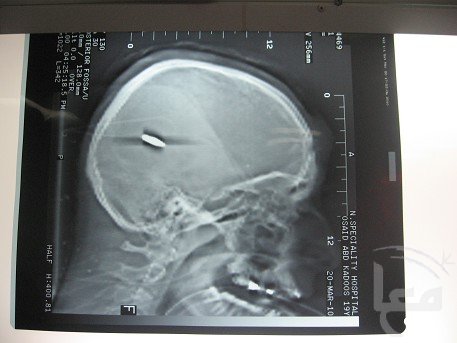 In this photo released by the Popular Struggle Coordination Committee, an
X-ray of Useid Qadus`s head, taken by the Israeli human rights group
B`Tselem`s Nablus field worker, appears to show a live bullet lodged in his
skull, 20 March 2010. [MaanImages/Salma Ad-Deb`i, HO]
‘US knows construction in al-Quds is as in Tel Aviv’
Press TV – March 21, 2010

Israeli Prime Minister Benjamin Netanyahu says construction policies in Jerusalem al-Quds are the same as in Tel Aviv and that the regime has informed Washington of that in writing.
“Construction in Jerusalem (al Quds) is like construction in Tel Aviv and we have clarified that for the American government,” Haaretz quoted Netanyahu as saying on Sunday at the start of the weekly cabinet meeting.
The Israeli prime minister also said that Israeli policy regarding construction in Jerusalem (al-Quds) has remained unchanged for different Israeli administrations.
Netanyahu has repeated his refusal to freeze settlement expansions in al-Quds. Just over a week ago, the premier approved the construction of another 1,600 settler units on occupied Palestinian land.
The remarks comes as there have been reports of an alleged row between the two allies [sic] over Israel’s settlement activity and US officials criticized Tel Aviv over the issue.
The Israeli prime minister is scheduled to leave for Washington Sunday night with Defense Minister Ehud Barak to attend the AIPAC Policy Conference in Washington. Opposition leader MK Tzipi Livni and Infrastructure Minister Uzi Landau will also accompany him.
An open letter to Ban Ki Moon, Secretary General of the United Nations
Gaza – March 21, 2010
Your Excellency:
You are already well aware of the worsening humanitarian situation in Gaza consequent on Israel’s devastating military attacks and its siege. As recently as December 27of 2009, you called the blockade of Gaza “unacceptable.” While this statement is certainly valid, it constitutes a gross understatement of the actual situation which amounts to slow genocide. Such understatement suggests that you are trimming your language to accommodate US pro-Israeli policy. We live an ongoing, illegal, crippling Israeli siege that has shattered all spheres of life, prompting the UN Special Rapporteur for Human Rights, Richard Falk, to describe it as “a prelude to genocide”. Your own UN Fact-Finding Mission on the Gaza Conflict, headed by the highly respected South African judge, Richard Goldstone, found Israel guilty of “war crimes and possible crimes against humanity,” as did major international human rights organizations, such as Amnesty International and Human Rights Watch. The Goldstone report concludes that Israel’s war on Gaza was “designed to punish, humiliate and terrorize a civilian population, radically diminish its local economic capacity both to work and to provide for itself, and to force upon it an ever increasing sense of dependency and vulnerability.”
Mr. Ban,
The 1948 Genocide Convention clearly says that one instance of genocide is “the deliberate infliction of conditions of life calculated to bring about the physical destruction of a people in whole or in part.” That is what has been done to Gaza since the imposition of the blockade by a UN member state, namely Israel, and the massacre of 1434 Palestinians, 90 per cent of whom were civilians, including 434 children.
On your second short visit to Gaza since the end of the Israeli onslaught in 2008-09, you will find what Professor Sara Roy, an expert on Gaza, describes as “a land ripped apart and scarred, the lives of its people blighted. Gaza is decaying under the weight of continued devastation, unable to function normally…” Professor Roy concludes that “[T]he decline and disablement of Gaza’s economy and society have been deliberate, the result of state policy–consciously planned, implemented and enforced… And just as Gaza’s demise has been consciously orchestrated, so have the obstacles preventing its recovery.” Israel is intent on destroying Gaza e because World official bodies and leaders choose to say and do nothing.
As civil society organizations based in Gaza, we call on you to use your position as Secretary General of the UN, the world body responsible for holding all governments accountable for the safeguarding of the human rights of all peoples under International Law to bring to bear on Israel the full force of your mandate to open the borders of Gaza to allow the import of building materials as well as all the other requirements for decent living conditions for us, the besieged Palestinians of Gaza.
We understand you are coming to Khan Younis to inspect an UNRWA housing project designed to provide housing for Palestinians whose homes were demolished by Israel’s war machine and who have been waiting for over five years for replacement. Of course the building project will not have been completed because of the blockade, even though it is an UNRWA project. The brazen refusal of Israel to cooperate with the decision of the International Community to re-construct Gaza, for which several billions of Euros were pledged, should not be tolerated. Israel’s attacks have damaged or completely destroyed many public buildings and have according to the UN’s own OCHA report as of April 30, 2009, severely damaged or completely destroyed some 21,000 family dwellings. Many other Palestinians who have spent the past several winters in flimsy tents have also been promised the means to rebuild homes and schools, though to date nothing has been done to alleviate their suffering.
In addition to the very visible lack of shelter, we, in Gaza, also suffer from the contamination of water, air and soil, since the sewage system is unable to function due to power cuts necessitated by lack of fuel to the main generators of the Gaza power grid. Medical conditions due to injuries from phosphorous bombs and other illegal Israeli weapons as well as from water contamination cannot be treated because of the siege. In addition to the ban on building materials, Israel also prevents many other necessities from being imported: lights bulbs, candles, matches, books, refrigerators, shoes, clothing, mattresses, sheets, blankets, tea, coffee, sausages, flour, cows, pasta, cigarettes, fuel, pencils, pens, paper… etc.
Mr. Secretary General,
When you visit Khan Younis, keep in mind that a huge UN storage depot was directly targeted by Israeli phosphorus bombs only last year destroying tons of badly needed food and other essentials. At that time your UNRWA chief John Ging spoke of massive obstacles preventing humanitarian aid from reaching the civilian population of Gaza: those obstacles must be removed. The Red Cross called the Israeli assault “completely and utterly unacceptable based on every known standard of international humanitarian law and universal humanitarian principles and values.”
We sincerely hope you will live up to your responsibility and speak for the suffering people of Gaza to those who hold the keys that could easily end the barbaric blockade, as the first step towards the implementation of all UN resolutions in Palestine.
Gaza,
2010-03-21
Signed by:
University Teachers’ Association in Palestine
General Union for Health Services Workers
General Union for Public Services Workers
General Union for Petrochemical and Gas Workers
General Union for Agricultural Workers
Union of Women’s Work Committees
Union of Synergies—Women Unit
Union of Palestinian Women Committees
Women’s Studies Society
Working Woman’s Society
Arab Cultural Forum
Palestinian Students’ Campaign for the Academic Boycott of Israel
One Democratic State Group
Al-Quds Bank for Culture and Information Society
The homeless pay the price
Sasha Abramsky | guardian.co.uk | 20 March 2010
Recently, I wrote about public education in crisis. But two other vital public services are also being hit hard by budget cuts: mental health care and assistance to the homeless.
Education is at least partly buttressed by the fact that almost everybody supports the idea of public schools. Cuts generally provoke an outcry, and politicians often pledge to do their best to restore funding as soon as the economy improves. Mental health and homelessness services, by contrast, are in some ways more vulnerable over the long-run: the constituencies they serve tend to be perceived by much of the public as nuisances at best, as societal menaces at worst; services to these groups tend to be costly; and the success rates (illnesses controlled, homeless folks moved into permanent housing) are, while a whole lot better than nothing, sometimes mediocre.
And so, as local and state government budget crunches worsen, it’s no surprise many of these services are on the chopping block.
The Centre on Budget and Policy Priorities (CBPP) reports that Connecticut’s governor has proposed suspending all state-funded homeless services for the rest of the fiscal year; California has eliminated funding for domestic violence shelters; Massachusetts has reduced spending on geriatric mental health services; Ohio has, according to the CBPP report “eliminated virtually all state funding for mental health treatment for individuals who are not eligible for the state’s Medicaid programme”; while Virginia has reduced the amount it pays hospitals to treat people with mental health or substance abuse issues and slashed its grants to local mental health service providers.
In fact, search online for mental health cuts by state, and it rapidly becomes clear that across America the already-fragile community mental health service infrastructure is being battered.
The impacts are by no means abstract. Community mental health clinics provide not just medicines and counselling services, but an array of other support: they help the mentally ill find housing and jobs; and they work with them to navigate complex government bureaucracies and access benefits. They provide friendship to people who are frequently lonely, depressed and marginalised from the broader community. Cuts to the mental health infrastructure in Kansas have resulted in a documented increase in calls to suicide hotlines and rising numbers of people being admitted to psychiatric hospitals in a psychotic state. Communities like Santa Barbara, California, have seen homelessness spike at least in part because broke local mental health services are having to turn sick men and women away.
And, once homeless, the mentally ill – as well as the non-mentally ill homeless – face a similar scramble for scarce resources. Tens of millions of dollars have been removed from city shelters in Washington DC, the nation’s capital. As winter set in last November in Minnesota, one of the coldest states in America, thousands of low-income families lost emergency financial assistance to help pay rent to avoid being evicted. The National Coalition for the Homeless estimates more than 700 homeless Americans die of hypothermia each year – and with homeless services being slashed, that number will likely increase in the years to come.
Meanwhile, New York City is considering closing the largest homeless drop-in centre in Manhattan. Activists worry that homeless residents with drug addictions, HIV, tuberculosis, or mental illnesses will find it harder to access treatment if they aren’t in stable housing situations. And that, ultimately, could trigger a broader public health problem.
In cities, counties, and states across America, homeless and mental health services are being eviscerated. As a result, programmes that have been carefully built up over decades are going to close. With them will go the expertise of trained staff; the accumulated experience of caseworkers who have gotten to know the needs and behaviours of individual clients, and who might have spent years getting those individuals to trust them enough to let them provide help; and the fragile bonds, the sense of belonging, that in some instances are the only things keeping a person on the edge from spiralling into more serious illness and more intractable long-term homelessness.
There are no easy answers here: too many branches of government have simply run out of cash and of quick-fix solutions. Without more support for these programmes from the federal government, or local ballot measures that earmark funds for particular social services, it’s inevitable that many of them will be cut in the next few years.
But, at the very least, this merits a frank conversation, an acknowledgment that the risks associated with dismantling this infrastructure are huge: tear down services to these groups during the down times and there is just no guarantee that a political consensus will emerge at the back end of the fiscal crisis to restore such services. After all, homeless people or the seriously mentally ill don’t tend to have much of a political voice. Their needs are, too often, seen as irrelevant.
The undermining of these vital social services will have an impact that long outlives the current economic crisis. Nothing would more forcefully illustrate the phrase “private affluence and public squalor“, coined by progressive economist John Kenneth Galbraith, than a booming America, its landscape littered by ever more homeless encampments, ever greater numbers of untreated mentally ill people and, in consequence, a growing sense that, for the affluent majority, public spaces are unsafe and unseemly. That happened in Victorian England; it occurred again in both America and the UK in the 1980s. It would be a great tragedy to let the 2010s and 2020s witness a repeat performance.
ISM volunteer shot, hospitalized; ISM co-founder arrested
International Solidarity Movement |19 March 2010

X-ray image of the large rubber bullet lodged into Ellen Stark’s arm when she was shot by an Israeli military barrage of tear gas and rubber bullets. The soldiers shot at her as she stood, un-armed, not engaged in the demonstration, from just three meters away. 19 March 2010, An Nabi Saleh
Friday’s demonstration in An Nabi Saleh saw an increase in violence and collective punishment from the Israeli military, as twenty-five demonstrators were injured, windows of cars and homes were intentionally shattered, and three were arrested. ISM volunteer Ellen Stark was shot at point blank range (4 meters) with a rubber bullet as she stood with medics, Popular Committee members and other internationals. ISM co-founder Huwaida Arraf was arrested while negotiating with the IOF to allow Ellen through the military line to get to the hospital. According to Ellen, “we were standing on Palestinian land, in support of the village who’s land has been confiscated but we weren’t even demonstrating yet. We were standing with medics who were also shot with tear gas.”
Ellen had to undergo surgery to remove the bullet, which was lodged between her ulna and radius of her right arm. Her wrist is broken as a result of the bullet impact. As of 12:00 pm Saturday, Palestine time, Huwaida has yet to be located in the Israeli prison system.
Over an hour before the demonstration began, soldiers took position on a hilltop near the house of an An Nabi Saleh Popular Committee member signaling to activists that the peaceful march would likely be cut short yet again by soldiers using crowd dispersal tactics such as tear gas and sound grenades. The demonstration was able to take it’s usual course, as IOF soldiers blocked the path of the activists, and began to surround them from multiple sides. Only ten minutes into the demonstration, the army began firing tear gas and rubber bullets at a small group of international, Israeli, and Palestinian activists only four meters away, injuring International Solidarity Movement volunteer, Ellen Stark. Omar Saleh Tamimi, Amjad Abed Alkhafeez Tamimi and International Solidarity Movement co-founder Huwaida Arraf were arrested as they asked Israeli military personnel to stop firing tear gas canisters and rubber bullets at Stark as she was helped to safety.
Israeli forces then entered the center of the village where they continued firing tear gas, sound grenades, and rubber bullets for several hours. Over twenty five were injured, including an 84-year old woman who suffered from tear gas inhalation after tear gas canisters were fired into her house, and three others who were shot with rubber bullets, including an Israeli activist; four remain hospitalized.
Later in the demonstration, soldiers began shooting rubber bullets through the windows of houses, shops, and cars, shattering homes and livelihoods, as they used collective punishment to attempt to suppress these weekly demonstrations.
These incidents come as the Israeli government intensifies repression of the unarmed, popular resistance to the occupation of the West Bank, illegal land confiscation by settlements such as Halamish, and construction of the illegal apartheid wall. Two weeks ago in An Nabi Saleh, 14-year-old Ehab Fadel Beir Ghouthi’s skull was fractured as a rubber bullet shot by the Israeli military, leaving him in a coma for several days. He remains in a hospital in Ramallah where he is recovering; his condition is stable and improving.
Today and every Friday since January, around 100 un-armed demonstrators leave the village center in an attempt to reach a spring which boarders land confiscated by Jewish settlers. The District Coordination Office has confirmed the spring is on Palestinian land but nearly a kilometer before reaching the spring, the demonstration is routinely met with dozens of soldiers armed with M16 assault rifles, tear gas, rubber bullets and stun grenades.
The Halamish Settlement has confiscated nearly half of An Nabi Saleh’s orchard and farmland since it was founded in 1977. According to village residents the settlement confiscates more land each year without consent or compensation of the landowners.
Fact Sheet: The Truth About the Health Care Bill
By Jane Hamsher | Fire Dog Lake | March 19, 2010
The Firedoglake health care team has been covering the debate in congress since it began last year. The health care bill will come up for a vote in the House on Sunday, and as Nancy Pelosi works to wrangle votes, we’ve been running a detailed whip count on where every member of Congress stands, updated throughout the day.
We’ve also taken a detailed look at the bill, and have come up with 18 often stated myths about this health care reform bill.
Real health care reform is the thing we’ve fought for from the start. It is desperately needed. But this bill falls short on many levels, and hurts many people more than it helps.
A middle class family of four making $66,370 will be forced to pay $5,243 per year for insurance. After basic necessities, this leaves them with $8,307 in discretionary income — out of which they would have to cover clothing, credit card and other debt, child care and education costs, in addition to $5,882 in annual out-of-pocket medical expenses for which families will be responsible. Many families who are already struggling to get by would be better off saving the $5,243 in insurance costs and paying their medical expenses directly, rather than being forced to by coverage they can’t afford the co-pays on.
In addition, there is already a booming movement across the country to challenge the mandate. Thirty-three states already have bills moving through their houses, and the Idaho governor was the first to sign it into law yesterday. In Virginia it passed through both a Democratic House and Senate, and the governor will sign it soon. It will be on the ballot in Arizona in 2010, and is headed in that direction for many more. Republican senators like Dick Lugar are already asking their state attorney generals to challenge it. There are two GOP think tanks actively helping states in their efforts, and there is a booming messaging infrastructure that covers it beat-by-beat.
Whether Steny Hoyer believes the legality of the bill will prevail in court or not is moot, it could easily become the “gay marriage” of 2010, with one key difference: there will be no one on the other side passionately opposing it. The GOP is preparing to use it as a massive turn-out vehicle, and it not only threatens representatives in states like Florida, Colorado and Ohio where these challenges will likely be on the ballot — it threatens gubernatorial and down-ticket races as well. Artur Davis, running for governor of Alabama, is already being put on the spot about it.
While details are limited, there is apparently a “Plan B” alternative that the White House was considering, which would evidently expand existing programs — Medicaid and SCHIP. It would cover half the people at a quarter of the price, but it would not force an unbearable financial burden to those who are already struggling to get by. Because it creates no new infrastructure for the purpose of funneling money to private insurance companies, there is no need for Bart Stupak’s or Ben Nelson’s language dealing with abortion — which satisfies the concerns of pro-life members of Congress, as well as women who are looking at the biggest blow to women’s reproductive rights in 35 years with the passage of this bill. Both programs are already covered under existing law, the Hyde amendment.
But perhaps most profoundly, the bill does not mandate that people pay 8% of their annual income to private insurance companies or face a penalty of up to 2% — which the IRS would collect. As Marcy Wheeler noted in an important post entitled “Health Care on the Road to NeoFeudalism,” we stand on the precipice of doing something truly radical in our government, by demanding that Americans pay almost as much money to private insurance companies as they do in federal taxes:
When this passes, it will become clear that Congress is no longer the sovereign of this nation. Rather, the corporations dictating the laws will be.
I understand the temptation to offer 30 million people health care. What I don’t understand is the nonchalance with which we’re about to fundamentally shift the relationships of governance in doing so.
We started down a dangerous road with Wall Street banks in the early 90s, allowing them to flood our political system with money and write our laws so that taxpayers would subsidize their profits, assume their losses and remove themselves from the necessity of competition. By funneling so much money into the companies who created the very problems we are now attempting to address, we further empower them to hijack our legislative process and put more than just our health care system at risk. We risk our entire system of government.
Congress may be too far down the road with this bill to change course and save themselves — and us. But before Democrats cast this vote, which could endanger not only their Congressional majority but their ability to “fix” things later on, they should consider the first rule of patient safety: first, do no harm.
Myth |
Truth |
| 1. This is a universal health care bill. |
The bill is neither universal health care nor universal health insurance.
Per the CBO:
|
| 2. Insurance companies hate this bill |
This bill is almost identical to the plan written by AHIP, the insurance company trade association, in 2009. The original Senate Finance Committee bill was authored by a former Wellpoint VP. Since Congress released the first of its health care bills on October 30, 2009, health care stocks have risen 28.35%. |
| 3. The bill will significantly bring down insurance premiums for most Americans. |
The bill will not bring down premiums significantly, and certainly not the $2,500/year that the President promised.
Annual premiums in 2016, status quo / with bill: Small group market, single: $7,800 / $7,800 Small group market, family: $19,300 / $19,200 Large Group market, single: $7,400 / $7,300 Large group market, family: $21,100 / $21,300 Individual market, single: $5,500 / $5,800* Individual market, family: $13,100 / $15,200* |
| 4. The bill will make health care affordable for middle class Americans. |
The bill will impose a financial hardship on middle class Americans who will be forced to buy a product that they can’t afford to use.A family of four making $66,370 will be forced to pay $5,243 per year for insurance. After basic necessities, this leaves them with $8,307 in discretionary income — out of which they would have to cover clothing, credit card and other debt, child care and education costs, in addition to $5,882 in annual out-of-pocket medical expenses for which families will be responsible. |
| 5. This plan is similar to the Massachusetts plan, which makes health care affordable. | Many Massachusetts residents forgo health care because they can’t afford it.A 2009 study by the state of Massachusetts found that:
|
| 6. This bill provide health care to 31 million people who are currently uninsured. |
This bill will mandate that millions of people who are currently uninsured must purchase insurance from private companies, or the IRS will collect up to 2% of their annual income in penalties. Some will be assisted with government subsidies. |
| 7. You can keep the insurance you have if you like it. |
The excise tax will result in employers switching to plans with higher co-pays and fewer covered services.
Older, less healthy employees with employer-based health care will be forced to pay much more in out-of-pocket expenses than they do now. |
| 8. The “excise tax” will encourage employers to reduce the scope of health care benefits, and they will pass the savings on to employees in the form of higher wages. | There is insufficient evidence that employers pass savings from reduced benefits on to employees. |
| 9. This bill employs nearly every cost control idea available to bring down costs. |
This bill does not bring down costs and leaves out nearly every key cost control measure, including:
|
| 10. The bill will require big companies like WalMart to provide insurance for their employees | The bill was written so that most WalMart employees will qualify for subsidies, and taxpayers will pick up a large portion of the cost of their coverage. |
| 11. The bill “bends the cost curve” on health care. |
The bill ignored proven ways to cut health care costs and still leaves 24 million people uninsured, all while slightly raising total annual costs by $234 million in 2019.“Bends the cost curve” is a misleading and trivial claim, as the US would still spend far more for care than other advanced countries.
In 2009, health care costs were 17.3% of GDP. Annual cost of health care in 2019, status quo: $4,670.6 billion (20.8% of GDP) Annual cost of health care in 2019, Senate bill: $4,693.5 billion (20.9% of GDP) |
| 12. The bill will provide immediate access to insurance for Americans who are uninsured because of a pre-existing condition. | Access to the “high risk pool” is limited and the pool is underfunded. It will cover few people, and will run out of money in 2011 or 2012Only those who have been uninsured for more than six months will qualify for the high risk pool. Only 0.7% of those without insurance now will get coverage, and the CMS report estimates it will run out of funding by 2011 or 2012. |
| 13. The bill prohibits dropping people in individual plans from coverage when they get sick. | The bill does not empower a regulatory body to keep people from being dropped when they’re sick.There are already many states that have laws on the books prohibiting people from being dropped when they’re sick, but without an enforcement mechanism, there is little to hold the insurance companies in check. |
| 14. The bill ensures consumers have access to an effective internal and external appeals process to challenge new insurance plan decisions. | The “internal appeals process” is in the hands of the insurance companies themselves, and the “external” one is up to each state. Ensuring that consumers have access to “internal appeals” simply means the insurance companies have to review their own decisions. And it is the responsibility of each state to provide an “external appeals process,” as there is neither funding nor a regulatory mechanism for enforcement at the federal level. |
| 15. This bill will stop insurance companies from hiking rates 30%-40% per year. |
This bill does not limit insurance company rate hikes. Private insurers continue to be exempt from anti-trust laws, and are free to raise rates without fear of competition in many areas of the country. |
| 16. When the bill passes, people will begin receiving benefits under this bill immediately |
Most provisions in this bill, such as an end to the ban on pre-existing conditions for adults, do not take effect until 2014. Six months from the date of passage, children could not be excluded from coverage due to pre-existing conditions, though insurance companies could charge more to cover them. Children would also be allowed to stay on their parents’ plans until age 26. There will be an elimination of lifetime coverage limits, a high risk pool for those who have been uninsured for more than 6 months, and community health centers will start receiving money. |
| 17. The bill creates a pathway for single payer. |
Bernie Sanders’ provision in the Senate bill does not start until 2017, and does not cover the Department of Labor, so no, it doesn’t create a pathway for single payer. Obama told Dennis Kucinich that the Ohio Representative’s amendment is similar to Bernie Sanders’ provision in the Senate bill, and creates a pathway to single payer. Since the waiver does not start until 2017, and does not cover the Department of Labor, it is nearly impossible to see how it gets around the ERISA laws that stand in the way of any practical state single payer system. |
| 18 The bill will end medical bankruptcy and provide all Americans with peace of mind. |
Most people with medical bankruptcies already have insurance, and out-of-pocket expenses will continue to be a burden on the middle class.
|
*Cost of premiums goes up somewhat due to subsidies and mandates of better coverage. CBO assumes that cost of individual policies goes down 7-10%, and that people will buy more generous policies.
Documentation:
- March 11, Letter from Doug Elmendorf to Harry Reid (PDF)
- The AHIP Plan in Context, Igor Volsky; The Max Baucus WellPoint/Liz Fowler Plan, Marcy Wheeler
- CBO Score, 11-30-2009
- “Affordable” Health Care, Marcy Wheeler
- Gruber Doesn’t Reveal That 21% of Massachusetts Residents Can’t Afford Health Care, Marcy Wheeler; Massachusetts Survey (PDF)
- Health Care on the Road to Neo-Feudalism, Marcy Wheeler
- CMS: Excise Tax on Insurance Will Make Your Insurane Coverage Worse and Cause Almost No Reduction in NHE, Jon Walker
- Employer Health Costs Do Not Drive Wage Trends, Lawrence Mishel
- CBO Estimates Show Public Plan With Higher Savings Rate, Congress Daily; Drug Importation Amendment Likely This Week, Politico; Medicare Part D IAF; A Monopoloy on Biologics Will Drain Health Care Resources, Lancet Student
- MaxTax Is a Plan to Use Our Taxes to Reward Wal-Mart for Keeping Its Workers in Poverty, Marcy Wheeler
- Estimated Financial Effects of the “Patient Protection and Affordable Care Act of 2009,” as Proposed by the Senate Majority Leader on November 18, 2009, CMS (PDF)
- ibid
- ibid
- ibid
- Health insurance companies hang onto their antitrust exemption, Protect Consumer Justice.org
- What passage of health care reform would mean for the average American, DC Examiner
- How to get a State Single Payer Opt-Out as Part of Reconciliation, Jon Walker
- Medical bills prompt more than 60 percent of U.S. bankruptcies, CNN.com; The Patient Protection and Affordable Care Act Section‐by‐Section Analysis (PDF)
Huffington Post’s Ventura Censorship Backfires
TPM | March 16, 2010
Did you know that Adam Lambert has a bulge in his crotch? Were you aware that the world’s shortest man recently died? Are you informed enough to know that Jessica Simpson says men are “undressing her with their eyes”?
Sorry, let me rephrase all that: Do you give a shit about any of that retarded “news”? I sure as hell don’t, but these were among the many absurd storys I found on the front page of a tabloid called the Huffington Post.
As far as genuine news goes the Huffington Post has some bizarre standards. Jesse Ventura honored the ragsheet by writing a great piece for them. The former Navy Seal and former Governor explained why over 1,000 Architects and Structural Engineers have come together to demand a new investigation regarding the collapse of three high-rise buildings on 9/11. It was a fact filled article that clearly explained the main technical issues that motivated the experts to demand a new investigation. Unfortunately, Ventura was informed that the article did not meet the high standards of the Huffington Post’s editorial policy.
Jesse Ventura blew it. He probably should have talked about the Engineers crotches, and included some bulge pictures. Maybe that would have put the article in line with the pathetic tabloid’s standards. Who knows. Maybe the Navy seal needed to include some discussion of a deformed midget Architect who was dying. That might have made Huffington’s day.
Either way, the censorship backfired and blew up in Arianna Huffington’s puffy face. Thousands of web pages have proudly stepped up to the plate and printed Ventura’s excellent article. Good websites. The article ended up getting way more exposure. Maybe the best thing is that Huffington’s censorship is now well known, and they have been fully exposed as the pathetic rag-sheet they are.
All is well that ends well.
.
Featured Video
No Threat Can Force Iran’s Surrender /Trita Parsi & Lt Cl Daniel Davis
or go to
Aletho News Archives – Video-Images
From the Archives
An Expert Military Analysis of War with China
Actually, None is Necessary
By Fred Reed • Unz Review • December 13, 2020
The Correlation of Armed Forces: U.S. goods and services trade with China totaled an estimated $634.8 billion in 2019. Exports were $163.0 billion; imports were $471.8 billion. The U.S. goods and services trade deficit with China was $308.8 billion in 2019. Trade in services with China (exports and imports) totaled an estimated $76.7 billion in 2019. Services exports were $56.5 billion; services imports were $20.1 billion. The U.S. services trade surplus with China was $36.4 billion in 2019.
There is talk within the Washingtoniat of a possible war with China. Steve Bannon, who apparently was dropped on his head as a child, actually favors such a war. We hear the usual shoo-the-boobs alarm about how the Chinese are doing something terrible and we must gird our loins and American values and show them what for, bow wow, woof. The danger is that the current game of who-blinks-first in Asian waters might actually provoke a shooting war. You know the kind of thing: One warship refuses to get out of the way of another, a collision ensues, some retard lieutenant who signed up on waivers opens fire, and we’re off and running. It is not a good idea to let children play with matches.
The said war is discussed either in emotional terms by idiots or in purely naval terms by those familiar with such things, so we hear of the First Island Chain and the Second Island Chain and whose missiles against the other’s missiles and so on. This would be appropriate if we were fighting World War Two again. Which we aren’t. Let’s take a quick-and-dirty look at how such a war might go.
To begin the war, America would overestimate itself and underestimate China. This is doctrine in the Pentagon. … continue
Blog Roll
 Aletho News
- Theodore Postol: Iran’s Missiles & Drones Were Underestimated
- Iran To Target Military Industrial-Tech Complex That Facilitated Gaza Genocide
- Collapsing Empire: The Resistance Disarms ‘Israel’
- Suicide Should Not Be a Government Service
- Rethinking America’s greatest threat: Iran vs. Israel-Firsters
- Iran accuses adversaries of false flags to strain Turkey ties
- Poland rules out sending Patriot missiles to US/Israel amid war on Iran
- Tehran approves new Hormuz plan with major restrictions
- No Threat Can Force Iran’s Surrender /Trita Parsi & Lt Cl Daniel Davis
- UK’s New Pandemic Plan Would Turn Big Tech Into a Mass Location Tracking Network
- If Americans Knew
- Ann Coulter Rips Into Fox News for Iran War Coverage, Compares to False Rigged 2020 Election Reporting
- Joe Kent Urges Americans To Call White House and Congress To Object To Sending Troops Into Iran
- DNC Resolution to Reject AIPAC Funding Puts Democratic Leaders in the Hot Seat
- Swedish foundation to build 400 schools as over 650,000 Gaza children remain without education for 2 years
- Israeli army admits photshopping image of slain Lebanese journalist
- This is how Israel is systematically killing health workers under the cover of war in Lebanon
- Carrying life under fire: Israeli invasion of Lebanon leaves pregnant women facing deadly risks
- Champagne all around for the new death penalty (for Palestinians) law – Not a ceasefire Day 172
- Why are Palestinian books struggling to be seen on Amazon?
- The Line Between Affinity and Conspiracy
- No Tricks Zone
- New Study Finds Warming Saves Lives…Cold Temperatures 12 Times More Deadly Than Excess Heat
- German Science Blog Accuses PIK Climate Institute Of Hallucinating Climate Tipping Points
- Devastating Assessment Of Comirnaty Vaccine By Former Senior Pfizer Europe Toxicologist
- New Study: CO2 Is ‘Effectively Negligible’ As An Explanatory Climate Change Factor Since 2000
- Former Pfizer Toxicologist Dr. Helmut Sterz Tells Bundestag Hearing Pfizer Vaccine Should Have Never Been Approved
- Energy Expert: Germany’s Nuclear Phaseout Was A “500 Billion Euro Mistake”
- New Research: South Australia’s Mid-Holocene Sea Surface Temperatures Were 4°C Warmer Than Today
- Storing Green Energy To Last Germany 10 Days Would Require A 60-Million Tonne Battery
- New Studies: UK Sea Levels Were 4 Meters Higher Than Today During The Mid-Holocene
- Destructive Green New Deal: German Energy And Metal Group Warns Of Drastic Crisis
 Aletho News