US violates UN law by threatening Iran
Press TV – April 12, 2010
Iran’s envoy to the UN nuclear watchdog says the US nuclear policy which allows the use of nuclear arms against Tehran is a clear violation of the UN Charter.
Speaking on Monday, Ali-Asghar Soltanieh called on the UN Security Council (UNSC) to deal with the US violations.
The US Nuclear Posture Review (NPR) purportedly restricts the use of its nuclear arms against most non-atomic states, except Iran and North Korea, which are accused by the US of seeking nuclear weapons.
Soltanieh also said the outcome of the upcoming Nuclear Security Summit in Washington is not binding as only a limited number of countries have been invited.
Unlike North Korea, Iran is a signatory to the Nuclear Non-Proliferation Treaty (NPT). Tehran has stressed that its nuclear program is only for the civilian applications of the technology.
The UN nuclear watchdog has, in many reports, declared that there is no evidence of military objectives in Iran’s nuclear program.
“According to international laws, any threat to use nuclear weapons against other countries … is against the UN Charter, the [International Atomic Energy] Agency’s regulations and international laws,” ISNA quoted Soltanieh as saying.
“The UN Security Council should act swiftly and deal with the US violations in this regard.”
Later on Monday, US President Barack Obama was to open the nuclear security summit which is being attended by the leaders of 46 other countries. Iran is not represented at the conference.
“The outcome of the Washington conference is already known. Any decision taken at the meeting is not binding on those countries which are not represented at the conference,” Soltanieh said.
The Iranian envoy said the NPR proves Washington’s unreliability on the nuclear arms issue, adding that the new US policy shows that the nuclear-armed power is in fact a big threat to international peace.
US diktat on Iran pipeline not to be entertained
By Baqir Sajjad Syed | 11 Apr, 2010

Last month the US counseled Pakistan against entering into a deal with Iran for building a multi-billion-dollar gas pipeline. “We do not think it is the right time for doing this kind of transaction with Iran,” US Assistant Secretary of State Robert Blake said recently.
ISLAMABAD: The Foreign Office said on Saturday Islamabad would not entertain pressure by Washington on its decision to have cooperation with Iran in the energy sector.
“We would like to have cooperation with Iran in all areas. If there are opportunities, Pakistan will pursue those. We have concluded the IP gas pipeline project with Iran. … This is our sovereign decision and the government of Pakistan will take decisions only in consonance with its own national interests,” Foreign Office spokesman Abdul Basit said at a media briefing.
The remarks came on the eve of Prime Minister Yousuf Raza Gilani’s meeting with President Obama. The meeting precedes a nuclear security summit scheduled for April 12 and 13 in Washington.
The meeting is a follow-up to last month’s strategic dialogue and part of efforts to transform the transactional nature of Pakistan-US relationship to a partnership.
Last month the US counseled Pakistan against entering into a deal with Iran for building a multi-billion-dollar gas pipeline. “We do not think it is the right time for doing this kind of transaction with Iran,” US Assistant Secretary of State Robert Blake said recently.
He said Pakistan had been asked to seek alternatives because of a dispute over Iran’s nuclear programme.
The situation poses a complex test for Pakistan’s diplomacy as the country aspires to have a civilian nuclear energy package from the US while pursuing the gas pipeline project with Iran.
“Our country is facing energy deficit. We are exploring all possible avenues to overcome our energy problem,” the spokesman said.
In an attempt to strike a delicate balance in its relations with the US and Iran, Pakistan has decided to attend the international disarmament conference convened by Tehran on April 17 and 18 — shortly after the nuclear summit and a fortnight before the nuclear non-proliferation treaty review.
The decision to attend the rival conference, albeit at a junior level with the country’s ambassador in Vienna representing Pakistan, is being seen in diplomatic circles as very significant because Tehran has convened the conference in a bid to counter the hardline attitude of the US-led international community towards its nuclear programme.
Moreover, it is interesting to note that Pakistan does not expect Iran to be censured at the US nuclear summit.
“We have been actively involved in the preparatory process of the nuclear security summit and I can tell you that its outcome will not be country specific,” Mr Basit said.
He said Pakistan believed all countries had the right to access nuclear technology for peaceful purposes. However, he said, countries should adhere to their international obligations and if there were differences and disputes these should be resolved through peaceful means and negotiations.
French-Style Nuclear Reprocessing Will Not Solve U.S. Nuclear Waste Problems
Institute for Energy and Environmental Research | Press Release
Contrary to some prevailing opinion, reprocessing would not eliminate the need for a deep geologic disposal program to replace Yucca Mountain. It aggravates waste, proliferation, and cost problems. The volume of waste to be disposed of in deep geologic repository is increased about six times on a life-cycle basis in the French approach compared to the once-through no-reprocessing approach of the United States.
A new report by the Institute for Energy and Environmental Research (IEER), a nonprofit scientific research group, shows that France uses less than 1 percent of the natural uranium resource, contrary to an impression among some policy makers. The report has several recommendations for President Obama’s Blue Ribbon Commission on America’s Nuclear Future, which was created to address U.S. nuclear waste issues after the administration’s cancellation of the Yucca Mountain program.
IEER President Dr. Arjun Makhijani, the author of the report: “In recent years, a ‘French fever’ has gripped the promoters of nuclear power in the United States. Praise of France’s management of spent fuel by reprocessing, including its use of the extracted plutonium as fuel in its nuclear power reactors, is now routinely heard. But it is a fantasy on the scale of the 1950s “too cheap to meter” mythology about nuclear power to imagine that 90 or 95 percent of the “energy value” of U.S. spent fuel can be extracted by reprocessing.”
Key IEER report findings include the following:
  --  On a life-cycle basis, French-style reprocessing and recycling increases
      the volume of waste that would have to be disposed of in a geologic
      repository. Reprocessing results in high-level radioactive waste and
      large volumes of Greater than Class C waste, both of which must be
      managed by deep geologic disposal. Their combined volume on a
      life-cycle basis is estimated to be about six times more than the
      no-reprocessing approach that is current U.S. policy, according to
      Department of Energy estimates. Low-level waste volume and waste
      transportation shipments are also estimated to increase several-fold.
  --  France spends about two cents per kilowatt-hour more for electricity
      generated from reprocessed plutonium compared to that generated from
      fresh uranium fuel.
  --  Attempting to combine reprocessing with breeder reactors to convert
      uranium in U.S. spent fuel in plutonium will create intolerable costs
      and risks. Reprocessing plus breeder reactors are much more expensive
      than light water reactors today, which are themselves expensive. Such
      a system is required to convert most of the uranium in spent fuel into
      a reactor fuel. Even a single penny in excess generation cost per
      kilowatt-hour in a breeder reactor-reprocessing system would lead to
      an added $8 trillion in costs to convert nearly all of the uranium in
      the 100,000 metric tons of U.S. spent into usable fuel. It would take
      hundreds of years to accomplish the task and require separation of
      tens of thousands of bombs equivalent of fissile material each year.
      The proliferation risks will be far greater than today.
  --  Adoption of a French-style reprocessing program would not eliminate the
      need for a deep geologic repository. Even complete fissioning of all
      actinides - an unrealistic proposition - will leave behind large
      amounts of very long-lived fission and activation products like
      iodine-129, cesium-135, and chlorine-36 that will pose risks far into
      the future -- much beyond the 24,100-year half-life of plutonium-239.
      In fact, France needs a geologic repository and opposition to one has
      been intense there. The French appear to dislike nuclear waste in
      their backyards as much as people in the United States.
  --  Proliferation risks are inherently part of the French (and any other)
      approach to reprocessing. Even advanced reprocessing technologies will
      not significantly reduce proliferation risks. For instance a study
      authored by scientists from DOE laboratories, including Los Alamos and
      Sandia, concluded that it would take only a few days or a few weeks
      for a proliferant country to make material for nuclear bombs once it had
      reprocessing plants. It found that new technologies, including
      electrometallurgical processing, resulted in "only a modest
      improvement in reducing proliferation risk over existing PUREX
      technologies and these modest improvements apply primarily for
      non-state actors." The IEER report concluded that electrometallurgical
      increases risks in other ways. For instance, it is far less difficult
      to conceal a plant than the present PUREX technology.
Other key findings include the following:
  --  Six decades of sodium cooled breeder reactor development has so far
      resulted in failure. Historical experience indicates no learning curve
      for the sodium cooled fast breeder reactor, which is the breeder
      technology that has received the most development. In fact, the two
      most recent large scale demonstration reactors, Superphénix in France
      and Monju in Japan, have been failures. Superphénix had a cumulative
      capacity factor of less than 8 percent before it was shut. Monju has
      been closed for almost 15 years, following a sodium fire, and has not
      generated a significant amount of electricity. Sodium cooled breeder
      reactors are not commercial today despite global expenditures on the
      order of $100 billion over six decades. They face a host of safety,
      proliferation and cost hurdles to overcome, some arising from the fact
      that they use liquid sodium for cooling. They are unlikely to be
      commercial in the near future. For instance, Japan's estimated date
      for commercialization of the sodium cooled fast breeder is 2050.
  --  Storage of liquid high-level wastes creates some risk of catastrophic
      releases of radioactivity. For instance, the Norwegian Radiation
      Protection Authority has estimated that a severe accident at the
      liquid waste storage facility in Sellafield, Britain, could result in
      cesium-137 contamination between 10 percent and 5,000 percent of that
      created in Norway by the 1986 Chernobyl nuclear reactor accident,
      which is the worst commercial accident to date, by far. A catastrophic
      release of radioactivity from a military high-level waste tank
      occurred in the Soviet Union in 1957.
  --  Using more than 1 percent of the uranium resource in a light water
      reactor system is technically impossible even with reprocessing and
      re-enrichment. In light water reactor systems, almost all the uranium
      resource winds up as depleted uranium or in spent fuel. Even with
      repeated reprocessing and re-enrichment, use of the natural uranium
      resource cannot be increased to more than 1 percent in such a system.
      A corollary is that the use of 90 to 95 percent of the uranium
      resource or of the material in the spent fuel is impossible in a light
      water reactor system even with reprocessing.
These are physical constraints that go with the system and also apply to France’s system.
The IEER report also sets out a number of recommendations for the Blue Ribbon Commission on America’s Nuclear Future appointed by Energy Secretary Steven Chu:
  --  Spent fuel from existing reactors should be slated for direct geologic
      disposal without reprocessing of any kind; a suitable path for a
      scientifically sound program should be set forth.
  --  In the interim, spent fuel should be stored on site as safely as
      possible - in low density configurations while in pools and in
      hardened storage when moved to dry casks.
  --  Breeder reactors and reprocessing are not commercial after six decades
      of development of sodium cooled breeder reactors, and enormous
      expenditures. Given the long time frame for commercialization
      estimated even by some promoters, the proliferation risks, and efforts
      already made, it does not appear to be a good investment to spend more
      R&D money in that direction. Rather energy supply R&D resources should
      be focused on development and deployment of renewable energy
      technologies and energy efficiency.
  --  The Commission should request the French company AREVA and/or the
      French government to supply it with data on the present use of the
      natural uranium resource purchased for French nuclear reactors,
      including, specifically, the increases in fission fraction that have
      actually been achieved by reprocessing and recycling.
  --  The Commission should also request official data on Greater than Class
      C waste equivalent expected to be generated on a life-cycle basis in
      France, and the total volumes and heat generation of packaged waste
      expected to be disposed of in a deep geologic repository, including
      estimates of decommissioning waste.
  --  The Commission should investigate the public support or lack thereof
      for repository programs in France and Britain, the countries with the
      longest history of commercial spent fuel reprocessing.
  --  The Commission should make the same requests regarding the British
      reprocessing program.
  --  Official analyses of the mechanisms, probability, and consequences of
      large accidental releases of radioactivity to the atmosphere from
      liquid high-level waste storage in tanks should be requested from the
      French and British governments.
ABOUT IEER
On March 24, 2010, IEER held a news conference to release documents acquired under the Freedom of Information Act (FOIA) showing that the outgoing Bush Administration inked 11th-hour agreements with more than a dozen utilities involving 21 proposed nuclear reactors. As IEER noted, between the output of existing commercial nuclear reactors and the 21 proposed nuclear reactors covered by the agreements quietly signed by the outgoing Bush Administration, the U.S. already has agreed to store enough spent (used) reactor fuel to fill the equivalent of not one, but two, Yucca Mountain high-level radioactive waste repositories. For more information on the March 24th news event, go to
The Institute for Energy and Environmental Research provides policy-makers, journalists, and the public with understandable and accurate scientific and technical information on energy and environmental issues. IEER’s aim is to bring scientific excellence to public policy issues in order to promote the democratization of science and a safer, healthier environment.
Source: Institute for Energy and Environmental Research, Takoma Park, MD
Netanyahu Worried about ‘World Silence on Iran’
Al-Manar TV, 12/04/2010
 Israeli Prime Minister Benyamin Netanyahu chided the international community for what he called “the relative silence in the face of Iranian threats” to destroy Israel, and the Islamic regime’s “race towards nuclear weapons.”
“Iran’s leaders are rushing to develop nuclear weapons as they freely announce their desire to destroy Israel,” Netanyahu said Sunday. “But in the face of these calls to erase the Jewish State from the face of the earth time and time again, we see at best mild protests, and these too seem to be fading,” he added.
“We don’t hear the forceful protests that are required, we don’t hear strong denouncement, or the angry voice,” he said. “But as usual, there are those who direct their criticisms against us, against Israel.” Netanyahu was speaking as he marked the so called Holocaust.
Speaking before the prime minister, President Shimon Peres also addressed the Iranian threat, stressing that the world could not display apathy.
“It is our right and duty to demand of the nations of the world not to repeat their indifference, which has cost millions of human lives, including theirs. The United Nations must be attentive to the threats of annihilation coming from one of its members, against another member state,” Peres said.
They’ve Stolen Our Road!
By Peter Balaam | Palestine Monitor | 8 April 2010
We sat with Jamal and Susan and in their home in Shufa. Their seven children peeped in from time to time, daring each other to go and speak to the foreigners. Jamal explained how the road to their village has literally been stolen by some Israelis who live in a nearby illegal settlement.
We already knew about this, because our taxi-ride to Shufa had been interrupted by a huge earth mound and some concrete blocks in the road. We had to get out and walk the last mile up a steep hill.
This stretch of road is now solely for the use of the settlers, who use it to get to their settlement from the main road. The Israeli army will not allow Palestinians to use the road except on foot or on a donkey.

Photo: Peter Balaam
The road was built in 1950 by the Palestinians. In 1987, the Israelis built 40 houses on Palestinian land and started to share the road with the local villagers. The settlement expanded for some years, and then in 1995, the Israeli army suddenly built the earth mound and forbade the Palestinians to use the road. Now Jamal has to drive home from the school where he is the headteacher, park his car by the earth mound and walk the last mile uphill to his home. And he does this every day, in any weather, including temperatures in the 40s in summer.
“Why?” I asked Jamal. “Why can’t they share the road with you?” Jamal had no answer. For years they had shared the road with no problem. The Israeli answer is just “Security”, but they refuse to explain what they mean by this.
The only explanation that Jamal can think of is that the Israelis simply want to cause the Palestinians to suffer. Another explanation I have heard is that if someone wished to attack people in the settlement, the road would have provided an easy way of escape. But there has been no such attack in 23 years. Perhaps it’s just that the settlers feel nervous about sharing a road with people whose land they appropriated in order to build their settlement.

Photo: Peter Balaam
The stolen road has all sorts of other consequences. Jamal and Susan cannot drive to see their family in Lower Shufa, which is the other side of the earth mound. Farmers’ profits are reduced because each time they take their produce to market in Tulkarem, they need fuel for a 25 km journey instead of 6 km.
The villagers of Shufa have learnt to live with the settlers. In the past, they have been attacked by settlers during the olive harvest and settlers have destroyed hundreds of their olive trees. But they do not face the daily threat of settler violence that other Palestinians face. Life is merely uncomfortable. And nothing changes the fact that their road has been stolen. They live with this reality every day – just one more quiet, unchanging injustice.
The article was written by Peter Balaam. He works for Quaker Peace and Social Witness as an Ecumenical Accompanier serving on the World Council of Churches’ Ecumenical Accompaniment Programme in Palestine and Israel (EAPPI). The views contained in this article are personal and do not necessarily reflect those of QPSW or the WCC.
The ‘Obama doctrine’: kill, don’t detain
Asim Qureshi | guardian.co.uk | 11 April 2010
In 2001, Charles Krauthammer first coined the phrase “Bush Doctrine”, which would later become associated most significantly with the legal anomaly known as pre-emptive strike. Understanding the doctrine with hindsight could lead to a further understanding of the legacy that the former administration left – the choice to place concerns of national security over even the most entrenched norms of due process and the rule of law. It is, indeed, this doctrine that united people across the world in their condemnation of Guantánamo Bay.
The ambitious desire to close Guantánamo hailed the coming of a new era, a feeling implicitly recognised by the Nobel peace prize that President Obama received. Unfortunately, what we witnessed was a false dawn. The lawyers for the Guantánamo detainees with whom I am in touch in the US speak of their dismay as they prepare for Obama to do the one thing they never expected – to send the detainees back to the military commissions – a decision that will lose Obama all support he once had within the human rights community.
Worse still, a completely new trend has emerged that, in many ways, is more dangerous than the trends under Bush. Extrajudicial killings and targeted assassinations will soon become the main point of contention that Obama’s administration will need to justify. Although Bush was known for his support for such policies, the extensive use of drones under Obama have taken the death count well beyond anything that has been seen before.
Harold Koh, the legal adviser to the US state department, explained the justifications behind unmanned aerial vehicles (UAVs) when addressing the American Society of International Law’s annual meeting on 25 March 2010:
“[I]t is the considered view of this administration … that targeting practices, including lethal operations conducted with the use of unmanned aerial vehicles (UAVs), comply with all applicable law, including the laws of war … As recent events have shown, al-Qaida has not abandoned its intent to attack the United States, and indeed continues to attack us. Thus, in this ongoing armed conflict, the United States has the authority under international law, and the responsibility to its citizens, to use force, including lethal force, to defend itself, including by targeting persons such as high-level al Qaeda leaders who are planning attacks … [T]his administration has carefully reviewed the rules governing targeting operations to ensure that these operations are conducted consistently with law of war principles …
“[S]ome have argued that the use of lethal force against specific individuals fails to provide adequate process and thus constitutes unlawful extrajudicial killing. But a state that is engaged in armed conflict or in legitimate self-defense is not required to provide targets with legal process before the state may use lethal force. Our procedures and practices for identifying lawful targets are extremely robust, and advanced technologies have helped to make our targeting even more precise. In my experience, the principles of distinction and proportionality that the United States applies are not just recited at meeting. They are implemented rigorously throughout the planning and execution of lethal operations to ensure that such operations are conducted in accordance with all applicable law.”
The legal justifications put forward by Koh are reminiscent of the arguments that were used by John Yoo and others in their bid to lend legitimacy to unlawful practices such as rendition, arbitrary detention and torture. The main cause for concern from Koh’s statements is the implication that protective jurisdiction to which the US feels it is entitled in order to carry out operations anywhere in the world still continues under Obama. The laws of war do not allow for the targeting of individuals outside of the conflict zone, and yet we now find that extrajudicial killings are taking place in countries as far apart as Yemen, the Horn of Africa and Pakistan. From a legal and moral perspective, the rationale provided by the State Department is bankrupt and only reinforces the stereotype that the US has very little concern for its own principles.
Despite the legalities of what is being conducted, the actuality of extrajudicial killings, especially through UAVs is frightening. The recent revelations by WikiLeaks on the killing of civilians by US Apache helicopters in Iraq has strongly highlighted the opportunities for misuse surrounding targeting from the air. In the Iraq case, there were soldiers who were supposed to be using the equipment to identify so-called combatants, and yet they still managed to catastrophically target the wrong people. This situation is made even worse in the case of UAVs, where the operators are far removed from the reality of the conflict and rely on digital images to see what is taking place on the ground.
Conservative estimates from thinktanks such as the New American Foundation claim that civilian causalities from drone attacks are around one in three, although this figure is disputed by the Pakistani authorities. According to Pakistani official statistics, every month an average of 58 civilians were killed during 2009. Of the 44 Predator drone attacks that year, only five targets were correctly identified; the result was over 700 civilian casualties.
Regardless of the figures used, the case that extrajudicial killings are justified is extremely weak, and the number of civilian casualties is far too high to justify their continued use.
A further twist to the Obama Doctrine is the breaking of a taboo that the Bush administration balked at – the concept of treating US citizens outside of the US constitutional process. During the Bush era, the treatment of detainees such as John Walker Lindh, Yasser Hamdi and Jose Padilla showed reluctance by officials to treat their own nationals in the way it had all those of other nationalities (by, for instance, sending them to Guantánamo Bay and other secret prisons). The policy of discrimination reserved for US citizens showed that there was a line the US was not willing to cross.
At least, today, we can strike discrimination off the list of grievances against the current president. The National Security Council of the US has now given specific permission to the CIA to target certain US citizens as part of counter-terrorism operations. Specifically, Anwar al-Awlaki has been singled out for such treatment, as it has been claimed that he was directly involved in the planning of the Major Hasan Nidal killings and the Christmas Day bomber attacks. Indeed, it is claims such as this that bring the entire concept of targeted assassinations into question. The US would like us to believe that we should simply trust that they have the relevant evidence and information to justify such a killing, without bringing the individual to account before a court.
The assumption that trust should be extended to a government that has involved itself in innumerable unlawful and unconscionable practices since the start of the war on terror is too much to ask. Whatever goodwill the US government had after 9/11 was destroyed by the way in which it prosecuted its wars. Further, the hope that came with the election of Barack Obama has faded as his policies have indicated nothing more than a reconfiguration of the basic tenet of the Bush Doctrine – that the US’s national security interests supersede any consideration of due process or the rule of law. The only difference – witness the rising civilian body count from drone attacks – being that Obama’s doctrine is even more deadly.
Israeli occupation forces surround school
Ma’an – 2/04/2010
 File Photo
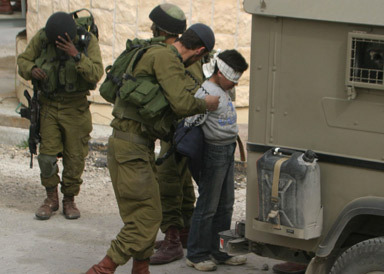
Qalqiliya – Israeli forces surrounded the Yasser Arafat School in the west end of Azzun, a town east of Qalqiliya on Monday. Troops demanded children evacuate the school so boys accused of rock throwing could be detained.
The school’s principal, Majid Odwan, said three military vehicles were stationed outside the gates of the building. Soldiers started by calling out the the children with loudspeakers demanding that they empty the school so several boys could be detained, he said.
Odwan shouted back that he refused the request and would keep children inside the school compound for the duration of their lessons, he said.
Responding to the principal’s remarks, soldiers declared that they would remain stationed outside the school until classes finished and take the children then. Soldiers remained outside the school for more than an hour, reports said.
An Israeli military spokeswoman confirmed the incident, but said a boy threw a “firebomb at an Israeli vehicle” and proceeded to “escape to a nearby school to hide out.”
Soldiers arrived to detain the child, she said, but did not in the end make an arrest.
Featured Video

Rewriting the risk? Inside the government’s vaccine safety messaging
or go to
Aletho News Archives – Video-Images
From the Archives
‘Israel sees Iran as obstacle to its policies’
Press TV – August 25, 2017
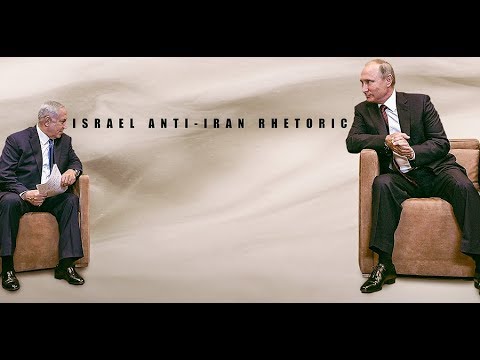
Prime Minister Benjamin Netanyahu has said that Israel felt threatened by Iran’s growing influence in the Middle East. Netanyahu expressed his Iranophobic view in a meeting with Russian President Vladimir Putin in Russia’s Black Sea resort of Sochi on Wednesday. Press TV has asked Scott Rickard, former American intelligence linguist from Tampa, Florida, and Brent Budowsky, a columnist at The Hill from Washington, to give their thoughts on the issue.
Rickard said Tel Aviv is concerned about the fact that the regime could not carry out its old project to spread sectarian divisions and pave the way for dismemberment of the countries in the Middle East region because of the Iranian-led resistance against Israeli policies, not only in the occupied territories of Palestine but also in the whole region.
“Iran is not a threat to Israel whatsoever. The threat that Israel sees is the fact that their Oded Yinon Plan is being put to a hold by Iran,” the intelligence linguist said on Thursday night.
“They (the Israelis) look at Iran as a threat only because they have no influence on their governments and Iran is autonomous and is not under the Zionist influence,” he added.
Since the victory of the Islamic Republic of Iran in 1979, Tehran has been critical of Israel’s policies in the region, whereas “no leaders [of other states] even dared to speak out against Zionism,” Rickard argued. … continue
Blog Roll
 Aletho News
- What’s Behind U.S./Israeli Strikes On Iranian Pistachio Factories?
- Seyed M. Marandi: U.S. Military DIVIDED? Iran’s Secret Defense EXPOSED
- How I fell foul of the BBC thought police
- The End of NATO
- 37 days of war on Iran cost US staggering $42bln, tracker shows
- Baghdad tells Asian refiners, traders to begin loading Iraqi crude amid Iranian exemption
- Under fire, Moscow and Tehran close ranks
- Iran, US receive Pakistan-mediated plan for ceasefire then final deal
- Iran submits demands for end to war as mediators scramble ahead of Trump deadline
- Iran Threatens Retaliatory Strike on Stargate AI Project in UAE
- If Americans Knew
- U.N. experts demand Israel release prominent Gaza doctor after reports of ‘severe torture’
- Israel’s Latest Genocide Is Against the Shias of Lebanon. Why Is the World Silent?
- How Eliot Cohen’s influence over U.S. war-making paved the way for Trump’s war crimes in Iran
- Israelis don’t pay for the weapons we ‘sell’ to them — US taxpayers do
- While Distancing from AIPAC, Most 2028 Democratic Hopefuls Are Still Embracing Israel
- A brief history of the Israeli nuclear program, the open secret at the heart of the Iran war
- Israeli Settlers Killed a Palestinian Farmer on His Own Land, in Front of His Father. Yes, Again
- The US-Israeli War on Science is an Assault on our Future
- 100+ International Law Experts Say US Strikes on Iran Violate UN Charter, Could Be War Crimes
- ‘Vile, Horrifying, Evil’: Trump Threatens to Bomb Nation of 90 Million People ‘Back to the Stone Ages’
- No Tricks Zone
- An Inconvenient Tree: Uncovered In Alps… Europe Much Warmer Than Today 6000 Years Ago
- New Study Reports A 60% Slowdown In Greenland’s Ice Loss Rate In The Last Decade
- Low Intensity Tornado Wrecks Major Solar Farm, Creating A Potential Toxic Dump
- New Study Finds Warming Saves Lives…Cold Temperatures 12 Times More Deadly Than Excess Heat
- German Science Blog Accuses PIK Climate Institute Of Hallucinating Climate Tipping Points
- Devastating Assessment Of Comirnaty Vaccine By Former Senior Pfizer Europe Toxicologist
- New Study: CO2 Is ‘Effectively Negligible’ As An Explanatory Climate Change Factor Since 2000
- Former Pfizer Toxicologist Dr. Helmut Sterz Tells Bundestag Hearing Pfizer Vaccine Should Have Never Been Approved
- Energy Expert: Germany’s Nuclear Phaseout Was A “500 Billion Euro Mistake”
- New Research: South Australia’s Mid-Holocene Sea Surface Temperatures Were 4°C Warmer Than Today
 Aletho News