Israeli Demolition Campaign in Three Towns Across the West Bank
Popular Struggle Coordination Committee | 14th April 2010
 House demolished by Israeli bulldozers in the village of Al-Khader, near Bethlehem. [MaanImages/Luay Sababa]
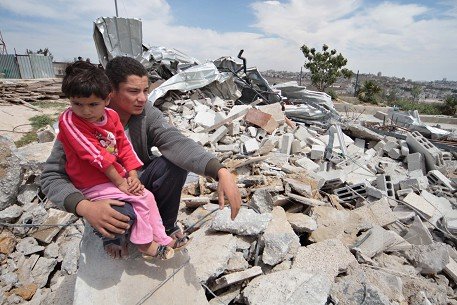
In an aggravation of Israeli policy of home demolitions, a house and two shops were razed in the Central West Bank village of Hares this morning. An additional house was reduced to rubble in the village of alKhadder, west of Bethlehem and a 1,000 square meters factory was demolished in the town Beit Sahour.
In what seems a coordinated move, Israeli forces carried out demolitions in two different areas of the West Bank today, rendering at least 16 people homeless. In recent months, international pressure has caused a significant decline in the demolition of Palestinian houses in the Israeli-controlled Area C of the West Bank. Israel uses its statutory authority in Area C, which spans over 60% of the West Bank, to dramatically limit Palestinian development. Palestinians fear that today’s concerted demolitions may be the opening salvo in a provocative change in Israeli policy.
Mahmoud Zwahare a popular committee member from the Bethlehem region said during the demolitions that “Israel keeps claiming it strives for peace and constantly complains about Palestinian incitement and violence. It is doing so while carrying out destructive and irreversible steps on the ground against ordinary civilians. The demolitions today have nothing to do with the security of Israelis and everything to do with provocation and injustice”.
A convoy of eight armored military jeeps and a D9 bulldozer entered the village of Hares in the early morning today and advanced towards the newly built house of Maher Sultan. The house, which Sultan had just finished constructing after five years, was to be home for himself, his wife and their five children. The two story house was quickly demolished by the bulldozer, which left nothing but rubble behind it.
The demolition order was posted on Sultan’s house a month ago, citing a Mohammed Mansour as the owner of the house, which complicated to procedures to stop the demolition. At the time of the demonstration, Sultan was actually at the DCO in Tulkarem to try an negotiate an injunction, unaware that his home is being razed.
After completing the demolition of Sultan’s house, the Israeli forces continued to demolish two stores in the outskirts of the village.
Almost simultaneously, a massive contingent of Israeli forces invaded the town of alKhadder, West of Bethlehem. The massive Israeli bulldozer demolished the house of Ali Mousa, which was home to nine people, including a one year old baby, as soldiers prevented anyone from nearing the house – including the family’s lawyer, who showed soldiers a 2006 court-issued injunction on the demolition.
After completing the demolition, an Israeli Civil Administration officer who was present at the scene informed people that more house demolitions will be carried in the near future.
Shortly after the alKhadder demolition, forces lead by the Israeli Civil Administration demolished a factory in the town of Beit Sahour. Roughly a year ago, Omar Ayyoub, the owner of the factory was served a halt-construction order by the civil administration, which he complied with and have been fighting ever since. When the bulldozers arrived today he pleaded with the officer in charge to stop the demolition, or at least present him with a valid demolition order. The officer refused and ordered Ayyoub removed from the scene.
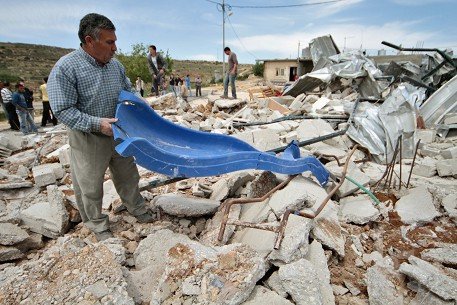 Home destroyed on 14 April 2010 under the pretext it was too close to Israel`s wall. [MaanImages/Haytham Othman]
Over 60 percent of the West Bank is currently classified as Area C, in which, under the Oslo accords, Israel has complete control, over both civil and security issues. According to the UN Office for the Coordination of Humanitarian Affairs (OCHA) some 70 percent of Area C, or approximately 44 percent of the West Bank, has been largely designated for the use of Israeli settlements or the Israeli military. The Israeli authorities generally allow Palestinian construction only within the boundaries of an Israeli-approved plan and these cover less than one percent of Area C, much of which is already built-up. As a result, Palestinians are left with no choice but to build “illegally” and risk demolition of their structures and displacement.
According to information released by the Israeli State Attorney’s Office in early December 2009, approximately 2,450 Palestinian-owned structures in Area C have been demolished due to lack of permit over the course of the past 12 years.
The Obama DOJ’s warrantless demands for emails
By Glenn Greenwald | April 15, 2010
A very significant case involving core privacy protections is now being litigated, where the Obama Justice Department is seeking to obtain from Yahoo “all emails” sent and received by multiple Yahoo email accounts, despite the fact that DOJ has never sought, let alone obtained, a search warrant, and despite there being no notice of any kind to the email account holders:
In a brief filed Tuesday afternoon, the coalition says a search warrant signed by a judge is necessary before the FBI or other police agencies can read the contents of Yahoo Mail messages — a position that puts those companies directly at odds with the Obama administration.
As part of a case conducted largely under seal and thus hidden from public view, the DOJ demanded these emails from Yahoo without any effort to demonstrate probable cause to believe the email user was involved in the commission of any crime, but instead merely based on the vague claim that there is “reasonable grounds to believe” the emails “are relevant and material to an ongoing criminal investigation.” If the DOJ position were accepted, Americans would have substantially less privacy protections in their email communications.
Federal law is crystal clear that a search warrant is required for the Government to obtain any emails that have been stored less than 180 days — one that requires a showing of probable cause and that the documents sought to be described with particularity. In contrast to the nation’s largest telecoms’ eager cooperation with Bush’s illegal surveillance programs, Yahoo — to its credit — refused to turn over any such emails to the Government without a search warrant. As a result, the DOJ is now seeking a federal court Order compelling the company to comply with its demands, and a coalition of privacy groups and technology companies — led by EFF and including Google — have now filed a brief supporting Yahoo’s position. Both Yahoo and that coalition insist that federal law as well as the Fourth Amendment’s search and seizure protection bar the Obama DOJ from acquiring these emails without a search warrant.
The law in question — the Stored Communications Act, 18 U.S.C. sec. 2703 — could not be clearer:
A governmental entity may require the disclosure by a provider of electronic communication service of the contents of a wire or electronic communication, that is in electronic storage in an electronic communications system for one hundred and eighty days or less, only pursuant to a warrant issued using the procedures described in the Federal Rules of Criminal Procedure by a court with jurisdiction over the offense under investigation or equivalent State warrant.
The DOJ’s blatantly twisted argument is that an email should be considered to be “in electronic storage” only for as long as it is unopened by the recipient; once it is opened, it is no longer “in electronic storage,” and no warrant is required for the Government to obtain and read it. Based on this rationale, the DOJ argues in its Brief that “a previously opened subscriber email is not ‘in electronic storage’.” In other words, claims the DOJ, the search warrant requirement protects your emails only to the extent you never read them, but as soon as you read them, the Government no longer needs a search warrant to obtain and read them; instead, it merely needs to claim to a court that the emails are somehow “relevant” to a criminal investigation, and then they must be turned over without any notice to you.
The DOJ insists upon this power notwithstanding a 2003 decision from the 9th Circuit Court of Appeals which explicitly rejected the claim that emails once read or downloaded are no longer “in electronic storage” under the Act. Worse, a separate provision of the law — 18 U.S.C. sec. 2510(17) — explicitly defines “electronic storage” to include “any storage of such communication by an electronic communication service for purposes of backup protection of such communication”: exactly what one does when one reads an email and leaves it on the server. The Obama DOJ’s position is as radical as it is invasive; as Yahoo explained, it “is an attempt to reverse seven years of established precedent requiring law enforcement to follow carefully proscribed rules when seeking to obtain email content from providers like Yahoo.”
At least as important, Yahoo and the coalition of privacy groups and technology firms are arguing for the application of the seminal 1967 Fourth Amendment case of Katz v. U.S. to email communications. In Katz, the Supreme Court held that the Fourth Amendment protects against government eavesdropping on telephone calls even though such calls are not technically “houses, papers [or] effects”; even though eavesdropping does not constitute a physical search of the individual’s property; and even though the telephone lines themselves are the property of the telephone company and not the individual. That is because, explained the Katz Court, “the Fourth Amendment protects people, not places.” Moreover, telephone calls had become such a common means of private communications by 1967 that there was a reasonable expectation of privacy as to their contents; thus, “to read the Constitution more narrowly is to ignore the vital role that the public telephone has come to play in private communication.”
That such reasoning extends at least as much to email communications is self-evident, as is the danger of allowing Government acquisition of emails without a search warrant. According to a 2003 Pew survey, “102 million Americans were email users in December 2002” and “more than nine in ten online Americans have sent or read email.” Those numbers were from 7 years ago and are obviously much higher now. By itself, according to its Brief, Yahoo is used by 30 million people to send and receive email.
To allow the Government to access without search warrants the contents of one’s private email communications — as opposed to, say, merely information showing from whom one received or to whom one sent email — is as central a violation of the Fourth Amendment’s guarantee as can be imagined. Of course, the FISA Amendments Act of 2008 — which passed with Obama’s support and was designed to legalize much of the Bush NSA surveillance program — already legalized warrantless surveillance of most emails sent internationally without any real court oversight, but the Obama DOJ’s position here would result in a far lower protections being applied to purely domestic emails (albeit with some minimal court involvement).
The Fourth Amendment threats are obvious. As the Katz Court said: “The Government’s activities in electronically listening to and recording the Petitioner’s words violated the privacy upon which he justifiably relied.” And numerous courts, including the Sixth Circuit Court of Appeals in a 2007 decision, have explicitly invoked this reasoning to extend Katz‘s Fourth Amendment protections from telephone calls to email communications:
It goes without saying that like the telephone earlier in our history, email is an ever-increasing mode of private communication, and protecting shared communications through this medium is as important to Fourth Amendment principles today as protecting telephone conversations in the past.
I don’t want to oversimplify the Fourth Amendment questions raised by this case. There are exceptions to the Constitutional warrant requirement which the DOJ likely will argue applies here [such as the claim that an individual has no “reasonable expectation of privacy” when communications are turned over to a third party, as emails technically are when they’re in the possession of service providers such as Yahoo (though no more so than a letter is “turned over” to the U.S. Postal Service)]. Whatever else is true, there is simply no viable way to distinguish the telephone conversations which the Katz court protected under the Fourth Amendment and the emails which most Americans now use on a daily basis for their most private communications.
If nothing else, consider the implications of allowing the U.S. Government to obtain and read emails simply by a vague showing of “relevance” to a criminal investigation, all without (a) any demonstration of probable cause, (b) a warrant from a court, (c) any notice provided to you that they’re doing so, and (d) any Fourth Amendment protections. As the brief filed by EFF, Google and others puts it, granting the Government such authority would have “extremely significant implications for the privacy of Americans’ communications.” Yet that is exactly the power the Obama DOJ is claiming it possesses.
Dr. Strangelove, Made in Israel
By Philip Giraldi | April 15, 2010
One would expect the Air Force’s top civilian adviser to be someone who has spent some time in the US military or who has a very particular educational or skills set that brings something special to what is, after all, a very senior and sensitive position. Not so. Dr. Lani Kass, who is the senior Special Assistant to the Chief of Staff of the United States Air Force General Norton A. Schwartz, was born, raised, and educated in Israel and then served in that country’s military where she reached the rank of major. She has a PhD in Russian studies but advises Air Force Generals on Cyberwarfare, terrorism, and the Middle East. And Kass appears to have close and continuing ties to her country of birth, frequently spicing her public statements with comments about life in Israel while parroting simplistic views of the nature of the Islamic threat that might have been scripted in Tel Aviv’s Foreign Ministry.
Kass’ official Air Force bio, which has been expunged from the Pentagon website possibly due to less than flattering commentary regarding her appointment, indicates that since January 2006 she has been “the principal adviser on policy and strategy and formulates, develops, implements, and communicates the policies, programs and goals of the Air Force.” Another official bio adds that she “…conducts numerous complex, high priority special assignments involving research and fact-finding to develop analyses, position and issue papers, and generate new initiatives based on a variety of strategic subjects of critical importance to the Joint Staff and/or the Joint Force.” There have also been suggestions that Kass has recently become an informal adviser to Admiral Mike Mullen, Chairman of the Joint Chiefs of Staff, on Middle Eastern policy.
Dr. Lani Kass is married to Norman Kass, a former Pentagon Deputy Assistant Secretary of Defense, and resides in McLean, Virginia. She has been naturalized as a US citizen and is presumably a dual national who now holds both American and Israeli passports. Her three children were all born in Israel. While it is perhaps not unusual for American citizens to volunteer with the Israel Defense Forces as White House Chief of Staff Rahm Emanuel did in 1991, it would have to be considered unprecedented for a senior Israeli military officer to obtain a high level position at the Pentagon. In fact, it is hard to imagine that anyone carrying out a security background investigation would approve such a transition under any circumstances, suggesting the possibility that Kass’s ascent to high office might have been aided or even godfathered by friends in key positions who were able to override or circumvent normal procedures.
Dr. Kass’s full first name is Ilana and her maiden name is Dimant. She has a 1971 BA in political-science and Russian area studies, summa cum laude, from the Hebrew University of Jerusalem and a 1976 joint PhD from the Kaplan School of the Hebrew University and Columbia University in international affairs. She apparently met her husband Norman at Columbia. Both she and her husband are fluent in Russian and Hebrew. After completing her PhD, she served in the Israeli Air Force, achieving the rank of major. For those who are unfamiliar with the military, the rank of major is a senior rank that normally would be awarded to a career officer.
Between 1979 and 1981, Kass worked at the Russian research Center of Booz Allen and Hamilton. Between 1985 and 2005 she held the position of Professor of Military Strategy and Operations of the National War College. In 1992 Dr. Kass obtained a senior position at the Pentagon as Special Assistant to the Director, Strategic Plans and Policy Directorate (J5). Dick Cheney was Secretary of Defense at the time. She returned to the Pentagon under Secretary William Cohen and stayed on during 2000 – 2001 as Senior Policy Adviser and Special Assistant for Strategic Initiatives to the Director, Strategic Plans and Policy Directorate (J5) under Donald Rumsfeld.
In early November 2006, US Air Force officials formed the Air Force Cyberspace Command that had the “authority to launch wars in cyberspace.” The command was reported to be “largely the brainchild of Dr. Lani Kass, director of the Air Force Cyberspace Task Force.”
Dr. Kass’ position and access inevitably raise a number of questions. Her appointment is somewhat unseemly, which even the Air Force appeared to recognize when it removed her bio from the website. Surely there must be qualified Americans who would be both delighted and proud to serve their country in the position she holds. Surely someone in Washington must see the security implications of a former foreign military officer holding a high level post in the Pentagon with full access to classified information. To challenge Dr. Kass’s position is not to question her academic credentials and intelligence or even her ability or integrity, but it is not unreasonable to ask why the Pentagon would appoint to a sensitive position someone who was born, raised, and served at a senior level with the armed forces in a foreign country.
And it is also not unreasonable to stop and consider whether Kass might well be an agent working for the Israeli government, which aggressively spies against the United States. She left Israel and began her journey through the US defense department in 1981, when Israeli spy Jonathan Pollard was still active. Israeli intelligence certainly was then and is now capable of what is referred to in intelligence jargon as a seeding operation in which “a mole” is placed in an innocuous position and expected to rise higher, eventually obtaining access to top secret information and even sometimes winding up in a position in which it is possible to direct policy as a so-called agent of influence. Kass started her ascent by working on Russia for beltway bandit Booz Allen Hamilton, quite likely for completely innocent reasons but also possibly because it was a non-threatening way to ease her entry into the world of government contractors.
In seeking to discover how she wound up where she is now it is fair to ask how exactly she obtained the positions that she has held with the Pentagon and who sponsored her through the bureaucracy. How did she manage to obtain a clearance in spite of the obvious red flags in her background? In light of legitimate security concerns, has she been polygraphed, what questions about her relationship with her former country were asked, and what were her answers? Was any deception indicated? Has she been re-polygraphed recently? This is not intended as harassment or as any accusation against Kass but rather to determine if she has been subject to normal and appropriate security measures. CIA officers are, for example, required to undergo polygraph exams every five years and the questions concentrate on possible unreported relationships with foreign governments.
Critics note that while Kass is genuinely an expert on Russia, she has little background to qualify her as an authority on the currently fashionable Cyberwarfare, where she has somehow turned herself into a major spokesman through mastery of the necessary buzzwords and talking points. Nor does she have any genuine expertise on the Middle East or on terrorism to share with Mullen and others, apart from her own Israeli perspective. Her access to the highest levels of the Air Force also raises the questions of just what is she advising and what does she know? Does she support an air war against Iran, for example, and is she actively promoting that option? Does she know how the Obama Administration will react if Tel Aviv tries to stage a unilateral attack on Iran? Such information would be pure gold for the Israeli government.
There are indications that Dr. Kass is a major player in shaping US security policy. She has been described as a “key participant” in the development of the national strategy for combating terrorism, as well as the national military strategic plan for the Global War on Terrorism. In September 2007, The Times of London reported that she was a leading participant in “Project CHECKMATE, a “highly confidential strategic planning group tasked with ‘fighting the next war’ as tensions rise with Iran” that was “quietly established” by the US Air Force in June 2007 as a “successor to the group that planned the 1991 Gulf War’s air campaign.”
Also per The Times, CHECKMATE “consists of 20-30 top air force officers and defense and cyberspace experts with ready access to the White House, the CIA and other intelligence agencies.” Its director Brigadier-General Lawrence A. Stutzriem and Kass reported directly to General Michael Moseley, at the time chief of staff of the Air Force. The Times cited Defense sources saying, “detailed contingency planning for a possible attack on Iran has been carried out for more than two years.” Regarding Iran operations, Kass was quoted as saying “We can defeat Iran, but are Americans willing to pay the price?”
Dr. Kass is not directly linked to any neoconservative groups but appears to be a kindred spirit, possessing a Manichean world view. Her comment cited above about defeating Iran has a dismissive tone to it, as if she is not identifying as an American herself. And she is also reported to have said “Remember what Israelis tell their children when they cry: ‘Don’t cry — you want to be a paratrooper don’t you?’” Some other public utterances are also revealing, suggesting that if General Schwartz and Admiral Mullen are actually listening to her it is no surprise that some US defense and security policies are largely based on simplistic bumper sticker analysis. In a speech at Mountain Home Air Force Base in Idaho on July 9, 2007, she said radical Muslims hate the western world because Europe took their dominant political position away and they want it back. To support her claim she produced a map taken from an obscure Jihadi website showing the entire world depicted as the “United States of Islam,” in which everyone will have to follow Sharia Muslim law. Kass likes to use the map as a prop in many of her public appearances. In her speech she explained that Muslims hate western culture and want to dominate the world, adding that because radical Islam has a “culture of death” all those who do not submit to Islam must die, an assertion so absurd that one suspects her political analysis derives from the Free Republic website. She also compared all Americans to sheep and sheepdogs. The former keep their heads down hoping that someone else will be eaten by wolves a.k.a. terrorists while the latter fight back. Kass sees herself as a sheepdog. For her Air Force audience she concluded that the long war against the Islamists will end “when they learn to love their children more than they hate us,” a comment originally attributed to Israeli Prime Minister Golda Meir.
Kass’s powerpoint demonstration “A Warfighting Domain,” dated September 26, 2006, is equally scary, and more than a little Strangelovean in its language and appeal. It includes the map of the United States of Islam and defines the “mission” as “to fly and fight in the Air, Space, and Cyberspace.” She boasts “as Airmen we are the nation’s premier multi-dimensional maneuver force, with the agility, reach, speed, stealth, payload, precision, and persistence to deliver global effects at the speed of sound and the speed of light.” Her objective? To “foster a force of 21st century warriors, capable of delivering the full spectrum of kinetic and non-kinetic, lethal and non-lethal effects in the Air, Space, and Cyber domains.”
Dr. Kass the Kremlinologist might have been a dab hand at interpreting the Nomenklatura standing on top of Lenin’s tomb but her embrace of Cyberwar and her comments relating both to terrorism and the state of the Middle East make one wonder how she has ascended to her lofty perch…and equally why she should remain there. Legitimate security concerns about her possible conflicted loyalty and her intentions should have blunted her trajectory long ago. But on the other hand, the global war on terror is so much of a joke that it perhaps needs someone like Dr. Kass to symbolize its absurdity and to launch the US Air Force on a vital new mission replete with lethal warrior-airmen delivering “global effects” at the speed of light. At an estimated cost of $100 billion, one might add. Captain Kirk? Are you ready to beam me up? Things are getting kind of strange down here.
Did Banned Media Report Foretell of Gaza War Crimes?
By Jonathan Cook – Nazareth – April 15, 2010
An Arab member of the Israeli parliament is demanding that a newspaper be allowed to publish an investigative report that was suppressed days before Israel attacked Gaza in winter 2008.
The investigation by Uri Blau, who has been in hiding since December to avoid arrest, concerned Israeli preparations for the impending assault on Gaza, known as Operation Cast Lead.
In a highly unusual move, according to reports in the Israeli media, the army ordered the Haaretz newspaper to destroy all copies of an edition that included Mr Blau’s investigation after it had already gone to press and been passed by the military censor. The article was never republished.
Mr Blau has gone underground in London after the Shin Bet, Israel’s secret police, demanded he return to Israel to hand back hundreds of classified documents they claim are in his possession and to reveal his sources.
He published several additional reports for Haaretz in 2008 and 2009 that severely embarrassed senior military commanders by showing they had issued orders that intentionally violated court rulings, including to execute Palestinians who could be safely apprehended.
Haneen Zoubi, an MP who previously headed an Israeli media-monitoring organisation, said it was “outrageous” that the suppressed report was still secret so long after the Gaza attack. She is to table a parliamentary question to Ehud Barak, the defence minister, today demanding to know why the army suppressed the article and what is preventing its publication now. Mr Barak must respond within 21 days.
She said publication of the article was important both because Israel had been widely criticised for killing many hundreds of civilians in its three-week assault on Gaza, and because subsequent reports suggested that Israeli commanders sought legal advice months before the operation to manipulate the accepted definitions of international law to make it easier to target civilians.
“There must be at least a strong suspicion that Mr Blau’s article contains vital information, based on military documentation, warning of Israeli army intentions to commit war crimes,” she said in an interview.
“If so, then there is a public duty on Haaretz to publish the article. If not, then there is no reason for the minister to prevent publication after all this time.”
Ms Zoubi’s call yesterday followed mounting public criticism of Haaretz for supporting Mr Blau by advising him to stay in hiding and continuing to pay his salary. In chat forums and talkback columns, the reporter has been widely denounced as a traitor. Several MPs have called for Haaretz to be closed down or boycotted.
A Haaretz spokeswoman refused to comment, but a journalist there said a “fortress mentality” had developed at the newspaper. “We’ve all been told not to talk to anyone about the case,” he said. “There’s absolute paranoia that the paper is going to be made to suffer because of the Blau case.”
Amal Jamal, a professor at Tel Aviv University who teaches a media course, said he was concerned with the timing of the Shin Bet’s campaign against Mr Blau. He observed that they began interviewing the reporter about his sources and documents last summer as publication neared of the Goldstone report, commissioned by the United Nations and which embarrassed Israel by alleging it had perpetrated war crimes in Gaza.
“The goal in this case appears to be not only to intimidate journalists but also to delegitimise certain kinds of investigations concerning security issues, given the new climate of sensitivity in Israel following the Goldstone report.”
He added that Mr Blau, who had quickly acquired a reputation as Israel’s best investigative reporter, was “probably finished” as a journalist in Israel.
Shraga Elam, an award-winning Israeli reporter, said Mr Blau’s suppressed article might also have revealed the aims of a widely mentioned but unspecified “third phase” of the Gaza attack, following the initial air strikes and a limited ground invasion, that was not implemented.
He suspected the plans involved pushing some of Gaza’s population into Egypt under cover of a more extensive ground invasion. The plan had been foiled, he believed, because Hamas offered little resistance and Egypt refused to open the border.
On Monday, an MP with the centrist Kadima Party, Yulia Shamal-Berkovich, called for Haaretz to be closed down, backing a similar demand from fellow MP Michael Ben-Ari, of the right-wing National Union.
She accused Haaretz management of having “chosen to hide” over the case and blamed it for advising Mr Blau to remain abroad. She said the newspaper “must make sure the materials that are in his possession are returned. If Haaretz fails to do so, its newspaper licence should be revoked without delay.”
Another Kadima MP, Yisrael Hasson, a former deputy head of the Shin Bet, this week urged Haaretz readers to boycott the newspaper until Mr Blau was fired.
A petition calling on the Shin Bet to end its threat to charge Mr Blau with espionage has attracted the signatures of several prominent journalists in Israel.
“We believe the Blau case is unique and are concerned this unique case will create a dangerous precedent,” their letter states. “Until now, prosecution authorities have not sought to try reporters for the offence of holding classified information, an offence most of us are guilty of in one way or another.”
A group of Israeli human rights organisations is due to submit a letter this week to the government demanding that the investigation concentrate on lawbreaking by the army rather the “character assassination” of Mr Blau and his sources.
Yesterday, the supreme court tightened restrictions on Anat Kamm, one of Mr Blau’s main informants, who has been under house arrest since December for copying up to 2,000 military documents while she was a soldier. She is accused of espionage with intent to harm the state, a charge that carries a tariff of 25 years in jail.
The papers copied by Ms Kamm, 23, included military orders that violated court rulings and justified law-breaking by soldiers.
Judge Ayala Procaccia said: “The acts attributed to the respondent point to a deep internal distorted perception of a soldier’s duties to the military system he or she is required to serve, and a serious perversion from the basic responsibility that a citizen owes the state to which he or she belongs.”
Ms Kamm, the court decided, must not leave her apartment and must be watched by a close relative at all times.
Media coverage of the case in Israel has been largely hostile to both Ms Kamm and Mr Blau. Gideon Levy observed in Haaretz today: “The real betrayal has been that of the journalists, who have betrayed their profession — journalists who take sides with the security apparatus against colleagues who are doing their job bringing light to the dark.”
Calling Israel “a Shin Bet state”, Mr Levy added: “If it depended on public opinion, Kamm and Blau would be executed and Haaretz would be shut down on the spot.”
When the Army Uses “Enhanced Interrogation” on an American Soldier
Joshua Kors | The Nation | April 14, 2010
I had been covering veterans’ issues for several years and thought I’d developed a thick skin. But the pain on the other end of the telephone line was difficult to stomach. Sergeant Chuck Luther, now back from Iraq, was describing his journey to hell and back. The worst part, he said, wasn’t battling insurgents or even the mortar blast that tossed him to the ground and slammed his head against the concrete — it was the way he was treated by the U.S. Army when he went to the aid station and sought medical help.
In gruesome detail, Luther described what happened to him at Camp Taji’s aid station. He thought he would receive medical care. Instead he was confined to an isolation chamber and held there for over a month, under enforced sleep deprivation, until he agreed to sign papers saying that he was ill before coming to Iraq and thus not eligible for disability and medical benefits. “They wanted me to say I had a ‘personality disorder,'” Luther told me.

Luther’s call did not come out of the blue. For two years I had been investigating this personality disorder scandal: how military doctors were purposely misdiagnosing soldiers, wounded in combat, as having this pre-existing mental illness. As in the civilian world, where people can be locked out of the insurance system if they have a pre-existing condition, soldiers whose wounds can be attributed to a pre-existing illness can be denied disability benefits and long-term medical care.
My reporting began with the case of Specialist Jon Town, who was wounded in Iraq, won a Purple Heart and was then denied disability and medical benefits. Town’s doctor had concluded that his headaches and hearing loss were not caused by the 107-millimeter rocket that knocked him unconscious but by a pre-existing personality disorder.
The spotlight on Town prompted military doctors to step forward and talk about being pressured by their superiors to purposely misdiagnose wounded soldiers. One doctor spoke of a soldier who returned from Iraq with a massive chunk missing from his right leg. The doctor quit after he was pressured to diagnose that soldier as having personality disorder.
Since 2001 more than 22,600 soldiers have been discharged with personality disorder (PD), saving the military billions in disability and medical benefits.
My articles on the scandal sparked a Congressional hearing, a Law and Order episode, and before leaving office, President Bush signed a law requiring the Pentagon to investigate PD discharges. In the wake of those developments, I was flooded with calls from soldiers who had fractured bones and been pierced by grenade shrapnel, only to be told that their wounds came from a problem with their personality — a pre-existing illness that had somehow gone undetected with each military screening and only popped up now, after they returned wounded from combat.
Luther was one of thousands severely wounded in Iraq and Afghanistan now facing a lifetime without medical care. I had spoken to dozens of soldiers in his shoes. But his call haunted me. He sent me photos of the isolation chamber. It was the size of a walk-in closet and was crammed with cardboard boxes, a desk and a bedpan. Armed guards monitored him 24 hours a day. Luther told me how they stopped him from sleeping, keeping the lights on and blasting heavy metal music at him all through the night: Megadeth, Saliva, Disturbed. When he rebelled, Luther was pinned down and injected with sleeping medication.
“This was an aid station,” he said, “but it felt a lot more like enhanced interrogation than medical care.”
After a month, Luther was willing to sign anything — and did. Soon after he signed his name to a personality disorder discharge, he was whisked back to Fort Hood and informed about a PD discharge’s disastrous consequences. No disability pay, no long-term medical care, and because he didn’t serve out his contract, he’d have to pay back a portion of his signing bonus. “They told me I now owed the Army $1,500.”
I would spend the next two years investigating Luther’s case: reading the stacks of medical records written by Luther’s doctors, which document his confinement; talking with a fellow soldier who visited Luther during his month in the aid station; and interviewing his commander, who confirmed all the details.
Israel Dismisses Obama Call to Join NPT
Minister: Obama Fine With Israel’s ‘Nuclear Ambiguity’
By Jason Ditz | April 14, 2010
As with previous discussions of the possibility, Israeli officials today reacted negatively to yesterday’s comment by President Obama in support of seeing Israel join the Nuclear Non-Proliferation Treaty (NPT).
“There is no room to pressure Israel to join,” insisted Defense Minister Ehud Barak, who added that it was unreasonable to ask Israel to join so long as Iran, a signatory to the NPT remains a “threat.”
But exactly how serious Obama’s comments even were is unclear. The president went out of his way to avoid the issue during the summit, and only mentioned that position when pressed. Moreover the US vigorously opposed an IAEA measure urging Israel to join the NPT late last year.
In fact according to Israel’s Deputy Foreign Minister Danny Ayalon, the Obama Administration has never asked them to change their policy of “nuclear ambiguity,” whereby Israel refuses to admit to its massive nuclear arsenal and refuses to join any group which would subject them to any sort of oversight.
Settlers uproot WB olive orchards
Press TV – April 15, 2010

Israeli settlers have attacked Palestinian orchards in central West Bank, damaging a vast area of olive stands by uprooting hundreds of trees.
The assault came Monday night in groves near the village of Mukhmas, a few kilometers northeast of Jerusalem (al-Quds), close to the illegal outpost of Migron, Haaretz reported.
Locals said this was the third time the settlers had attacked their gardens in the relatively quiet area, seldom a scene of confrontations with Israelis.
The extent of the destruction and the damage done to the trees across a wide swathe suggested the raid had been well-organized and carried out by a group of people.
The deputy mayor of the village, Mohammed al-Haj, said the village had seen similar attacks once in May 2008 and again in October 2009, where more damage was done to local olive orchards.
The villagers filed complaints with the police and the Civil Administration, while rights groups regret very few investigations into the uprooting cases have resulted in indictments.
Palestinian villagers complain that if Israeli forces guarded them as they guard the settlers, “none of it would have happened.”
Some of the villagers that own groves close to Migron accused Israeli settlers of sparking clashes every time Palestinians go there to take care of their trees, inflicting immense financial losses on the grove owners.
Palestinian olive orchards have long been a target of attacks by Israeli forces and settlers, something the Palestinians have described as a systematic move aimed at mounting financial pressure on Palestinian families and further undermine the territory’s crashing economy.
Earlier this month, Palestinian sources accused the Israeli regime of destroying some 400,000 trees during their incursions into territories under the Palestinian Authority’s rule in the last two years.
Lula’s Legacy: The Two Brazils
By James Petras | 04.14.2010
President Lula Da Silva announces the purchase of $4.4 billion dollars in new warplanes the same day that mudslides in Rio de Janeiro bury over 230 people living in precarious shanty slums neglected by the government housing authorities .While there is a total absence of a drainage system in the favelas, Lula spent billions on roads and ports for exporters but nothing for resident slum safety. Brazil is widely included as a newly emerging world power, along with China, Russia and India, the so called BRIC countries, and yet nearly forty percent of its population, lives on or below the poverty line, at or below the minimum wage of $200 dollars a month for a family of four.
Brazil’s attraction for many of its financial promoters is found in the size of its population of 210 million, the effective consumer market of over 100 million, and its agro-mineral resources: Brazil is one of the world’s biggest exporters of chicken, beef, soya, iron ore, cotton and ethanol.
Two other factors have recommended the Lula regime to both the right and left. The Right is pleased with Brazil’s stock market, financial sector and foreign owned banks (over 50%) which have gained and transferred over 150 billion in profits to overseas investors over the past 8 years of Lula’s rule. The ‘Left’ is enthusiastic about Lula’s independent foreign policy: his opposition to the US boycott of Cuba and exclusion from the Organization of American States; his economic relations with Iran despite pressure from Washington; his refusal to condemn Venezuelan President Chavez; and the fact that China has replaced the US as Brazil’s foremost trading partner as of 2010. Moreover, many defenders and apologists for Lula cite his “poverty program” which provides a $40 a month subsidy to 10 million destitute families , which has reduced poverty. The Lula Left forget the fact that the regime has failed to provide meaningful employment with adequate pay for the poverty subsidy recipients and has broken promises to carry out an agrarian reform for the 20 million landless rural workers. In other words, Lula’s supporters cite the regime’s policy of diversifying markets for Brazilian agro-mineral exporters and his multi-billion dollar electoral patronage subsidies to the poor as evidence of Lula’s “progressive” credentials.
Two other elements enter into the positive image of Lula: his working class, trade union origins and his continued high popularity ratings (according to recent polls over 60%). The “working class” background is over 20 years past: Lula has not worked in a factory for over 25 years.He has been a middle class political functionary of his party since the mid 1980’s. Moreover, Lula’s working class origins have no relevance to his current political and social commitments and appointments, which are tied to big business strategists and neo-liberal central bankers and economic ministers. What needs to be acknowledged is that Lula is a master at the politics of conservative populism: Lula excels in creating an emotional bond with the poor, through his face to face encounters and mass media imagery as “a man of the people”, even as he upholds a social hierarchy with the greatest inequalities in South America. No conservative neo-liberal leader in the US or EU can combine the façade of “populism” and the content of neo-liberal orthodoxy with the same success.
Myths and Reality of a Brazil as an “Emerging World Power”
Given the enduring mass poverty and social inequalities in land and wealth no perceptive observer can claim that Brazil’s new status as an emerging world power is due to Lula’s social policies. The entire basis for projecting Brazil onto the world stage is based on its economic performance. A brief but close examination of the empirical realties, raises profound doubts about Brazil’s performance and Lula’s claims of achieving the status of a world power. Between 2003-2009 Brazil’s GDP grew by a mere 3.4% and only 2% percapita, below the average for Latin America by at least 1%. If we compare Brazil’s performance in relation to the other BRIC countries, especially China and India, Brazil’s GDP grew at less than 40% of their rate of growth. Locating Brazil in the same league as China and India seems to be highly misleading. Moreover, while most of the growth of the other newly emerging powers is based on diversified industrial exports (China) and high tech information services (India), Brazil still depends on the dynamic expansion of agro-mineral exports.
Growth and stagnation characterized Lula’s eight years in office, depending on prices and demand for agro-mineral commodities. During the years of the commodity boom (2004 – 2008) Brazil grew by 4.5%; during the downturn in commodity prices (2003 and 2009) Brazil stagnated at less than 1%. In other words, Lula’s “free market policies” had less to do with Brazils’ economic performance than world market demand for commodities. Despite Lula’s claims that Brazil would avoid the impact of the world crises of 2008 -2010 because it was “delinked” from the imperial centers, in fact beginning in October 2008 and continuing through to January of 2010 Brazil entered into a recession with zero growth in 2009. Its recovery in 2010 is largely the result of the revival and explosion in commodity demand, led by China, and the sharp rise in prices of key export commodities such as iron ore which has doubled in price since the beginning of 2010.
Brazil’s economic performance under Lula appears favorable only in comparison to the disastrous results achieved under the previous ultra neo-liberal Cardoso regime which grew at a snail’s pace of less than 3%. What is most significant, however, is the strategic socio-economic and political continuities between the Cardoso and Lula regimes. Cardoso devastated the public sector, by privatizing and denationalizing, at ridiculously low prices, the most lucrative enterprises. The most glaring example was the sell off of one of the richest iron mines in the world Vale del Doce for less than a billion dollars, a firm which is now valued at over $20 billion dollars and with yearly profits exceeding $3 billion dollars. Lula has retained and even expanded Cardoso’s most dubious privatizations – including the banks, mines, oil and telecommunication companies which were acquired at below market prices.
Even before his first election victory in 2002 Lula signed an orthodox International Monetary Fund Agreement to retain a 4% budget surplus, to pursue an orthodox fiscal policy restraining social spending reducing public pensions and holding down wages. Lula was more successful than Cardoso in enforcing these orthodox monetary policies because of his influence over the major trade union confederation (CUT) leaders, who he co-opted via appointments to the Labor Ministry. In other words, Lula harnessed populist rhetoric to fiscal conservatism, symbolic labor appointments with economic policy czars with long-standing ties to major financial centers.
Lula received the enthusiastic endorsement of all the major financial newspapers for his switch from advocate of working class social reforms to staunch ally of the BOVESPA (Brazilian stock exchange). His policies of accumulating over $200 billion in foreign reserves, of prioritizing the paying down foreign debts instead of increasing social spending for education health and housing affecting 100 million Brazilians, won lasting praise among all orthodox economic experts. The “stability” of the economy was bought at the expense of the instability in the lives of the working class and the rural poor. Unemployment under Lula never went below 10%; the ‘informal sector’ remained at over 30%; four million rural families remained landless; the Amazon rain forest annually lost over 2 million hectareas per year, encouraged by Lula’s push to promote agro-business exports. Indian territorial reserves were violated, land was occupied, scores were killed, while federal and state agencies focused on prosecuting rural movements occupying uncultivated latifundios owned by business speculators. Lula’s policy of financing agro-business exporters was successful – cultivated lands expanded, revenues increased geometrically and wealth grew – for the owners, investors and stock owners. But at a tremendous cost: over 2 million rural workers were forced to migrate to slums and marginal employment, becoming easy recruits for the drug gangs which control the favelas of Rio and Sao Paolo. Millions of family farmers were forced to borrow at high interest rates and to compete with subsidized food imports, driving hundreds of thousands into bankruptcy and making Brazil a food deficit country.
Lula, during and immediately after his election, solemnly promised the powerful 350,000 member Landless Rural Workers Movement (MST) that he would carry out an agrarian reform settling 100,000 families a year with housing, credits and technical assistance. During his eight years in office, Lula broke his pledge every year, settling less than 40,000 families while under-financing the new and established co-operatives driving over one-third into bankruptcy. The MST in turn because of its “critical support” of Lula, lost the political initiative even as it continued its policy of occupying farms to secure land reform. After a brief period of tolerance, the government turned the military police against the Movement, arresting its leaders and criminalizing its activities. After a major corruption scandal affecting Lula’s top advisers and leaders in Parliament (2005 – 2006), he turned to the traditional rightist parties and established politicians including ex-President Sarney to promote his neo-liberal economic agenda. Lula’s new coalition with the traditional right was based on a common program of promoting big agricultural interests and guaranteeing their security against the land occupation strategy of the agrarian reformers in the MST. The result was an increasing concentration of landownership (1% of landholders own over 50% of the fertile lands) and an increasing number of movement leaders and activists awaiting trials and serving time in jail.
Lula’s legacy is essentially an “economically sound and stable market for investors” according to all orthodox economic experts. Brazil was rewarded by being awarded the site for the forthcoming Olympics. But given the severity of poverty and the dynamic growth of drug trafficking and armed organized gangs, Lula’s projections of nearly 50,000 soldiers to protect the spectators reveals the underside of his dream of an emerging world power.
Lula’s Political Legacy
Lula’s political legacy is on display in this year’s presidential elections, in which he must step down after two terms in office. In contrast to the past, there is now in place a modified two party system in which a variety of smaller groups coalesce around Lula’s Workers Party (PT) and Jose Serra’s Brazilian Social Democratic Party (PSDB). Neither party is what its label proclaims: over 80% of the delegates at the PT nominating convention were professionals, lawyers, functionaries and business people with a sprinkling of trade union bureaucrats and co-opted “movement” officials. There is nothing “socialist” about the party of Cardoso which privatized the jewels of the economy. The competition of the two parties is over who best represents the agro-mineral, banking and industrial elite of Sao Paolo and as a corollary who will receive the bulk of their financial contributions. Lula was eminently successful in securing tens of millions of dollars in contributions from the economic elite for his services on their behalf. In fact most of the really wealthy contribute to both major parties. Lula’s legacy is that he has de-radicalized Brazilian politics, leading to a consensus over the centrality of free markets, free trade and state promoted big business as the bases of economic policy. Beyond that Lula has enshrined the principle of poverty subsidies in place of social structural changes as the centerpiece of social policy.
Brazil: The Presidential Election 2010
The best analysis of the forthcoming Brazilian presidential elections (October 3) is found in the response of the stock market, credit agencies and investors: they envision no major changes on the horizon, continued support for orthodox fiscal policies, greater state promotion of private national and foreign investment and most important, social stability. The so-called “Workers” Party under Lula’s unchallenged authoritarian control, nominated Dilma Rousseff, his former ‘chief of staff’ as their candidate. The opposition rightwing PSDB nominated Sao Paulo State Governor Jose Serra, a former leftist who once contributed an essay to a book I edited back in 1972, titled “Dependence or Revolution”. One of the political ironies is that over the past two decades former Marxists, trade union leaders, even guerrilla activists have played a leadership and vanguard role in steering Brazil toward deeper integration into the world market, replacing socialist internationalism by embracing capitalist globalization.
To the extent that differences exist between Rousseff and Serra they revolve around issues of foreign policy, the role of public-private enterprise associations and the size and scope of public sector spending. Rousseff, promises to continue Lula’s promotion of billion dollar trade and investment agreements with all countries including Iran, Venezuela and Bolivia, regardless of US opposition. Serra, who is ideologically closer to Washington’s agenda, may reduce or limit these economic ties to accommodate the Obama regime. In other words, the Workers Party is a party with a greater commitment to independent market based global expansion than Serra’s more dogmatic ideologically influenced foreign economic policy. Officials in Washington have informed me that, the Obama regime will adopt a public posture of ‘neutrality’, since both candidates have affirmed friendly ties with Washington. Unofficially, I was told (off the record) that the Obama Administration prefers Serra because he is likely to side with Washington’s policy against Iran and be more outspokenly critical of President Chavez. However given the large scale engagement of Sao Paolo business interests in both countries, it remains to be seen how far Serra (if he is elected) would actually go in prejudicing Brazilian investors to satisfy US military driven empire building. Rousseff is likely to promote large scale public-private joint ventures to exploit multi-billion dollar off-shore oil and gas exploitation; Serra is more likely to promote exclusively private-foreign capital ownership and exploitation. Rousseff’s election campaign will receive big financial contributions from a long list of agro-mineral corporations, traders and national industrial manufacturers and construction contractors who received lucrative government contracts and subsidies and credit. Serra will be financially favored by the multi-national banks, rightwing landowners associations and the leaders of the Sao Paolo industrial elite. The trade union confederations and social movements will back Rousseff, either because of recent favorable wage agreements or because the PT is seen as the “lesser evil”. The Chamber of Commerce and some leading business associations and middle class “civic groups” will back Serra especially in the greater Sao Paolo region. While on the surface these political and social differences between the candidates appear to give some credibility to the idea of a ‘left-right polarization’ in reality the differences disappear when we examine closely the make-up of the political parties within the coalition backing the Rousseff. Four of the five major parties are on the conservative end of the political spectrum: the Brazilian Democratic Movement Party (PMDB), the Brazilian Republican Party (PRB), the Democratic Labour Party (PDT) and the Republic Party(RP). If Rousseff should be elected these four rightwing coalition partners will obtain the majority of ministries, leadership position in the Congress and ensure that the Rousseff regime does not trespass the boundries of orthodox neo-liberal fiscal policies.
What remains of the Left, is a fragmented assortment of micro parties with a strong presence in public sector trade unions (teachers, health workers) and some influence among the social movements. If the various groups united they might gather a respectable vote, but because of sectarian and opportunistic practices that is unlikely. Ciro Gomes, a former member of Lula’s cabinet is a likely candidate for the Socialist Party. But that is likely a mere a pretext to negotiate electoral support in the second round in exchange for a cabinet post if Rousseff is elected. Marina Silva, Lula’s former Environment Minister is a candidate for the Green Party, a party allied with the rightwing PSDB, PMDB as well as the PT whenever it is opportune: Silva will likely trade her voters to whichever party offers her a post. The two other explicitly “Marxist” parties, the United Socialist Workers Party (PSTU) and the Socialism and Freedom Party (PSOL), which tentatively agreed to present a common candidate have yet to resolve differences about acceptable coalition partners: the PSOL looks to the Green Party, the PSTU threatens to abandon the alliance.
Conclusion
Brazilian politics have moved a long way to the right over the past decade: the PT is now an openly pro-business party, whose fiscal policies are identical to the IMF recipes. The once militant trade confederation, the CUT, is now little more than an adjunct of the Ministry of Labor, well rewarded with economic subsidies but incapable of putting workers in the streets. Even the mass based rural landless workers (MST) which still retains its organizational autonomy feels weakened and isolated in the face of the PTs right turn. On the other hand, agro-export elites are thriving, investment bankers and overseas multi-nationals are pouring over $30 billion a year into Brazil; one of the worlds “safest emerging world powers”. Leftist leaders like Fidel Castro and Hugo Chavez praise Brazil’s “progressive” foreign policy even as Lula signs defense pacts with Obama for joint training and military exercises. No doubt Lula has gained greater international recognition for Brazil and will finish office with the greatest popularity ratings of any President in recent history. Yet with a cost of living comparable to that of Barcelona, over 30%, of Brazilian wage workers still receive a minimum wage of $200 dollars a month; the public school teachers in Sao Paolo receive between $436 – $505 dollars a month. One has only to visit the millions dwelling in the slums surrounding Sao Paolo, Rio and the other major cities to realize that there are two Brazils: the mass media publicized Brazil of the BRIC, the banker’s ‘emerging world power’, the Brazil of free elections and free markets, and then there is the “other Brazil” of forty million impoverished slum dwellers, twenty million landless rural workers, tens of thousands of dispossessed (Amazon) Indians, thousands of unpaid ‘slave laborers’ living in debt peonage, the millions of public school teachers, working two, three or more jobs up to 13 hours a day to earn a decent living. Lula’s presidency may have raised Brazil’s international stature and gained him the status of a ‘global statesman’ but most workers, peasants and Afro-Brazilians still work and live under Third World conditions.
Israelis Need to Lose the Attitude
By Joharah Baker | April 14, 2010

Recently, I found myself in a mild altercation with a middle aged Israeli stranger about Jerusalem. I usually don’t indulge in small talk with average Israelis, mostly because I hardly come into contact with them. The bulk of my interaction with Israelis is with their military establishment – policemen patrolling Jerusalem’s Old City streets, soldiers manning the Qalandiya checkpoint, which I cross at least five days a week or border crossing personnel whenever I travel via the Allenby Bridge outside the country.
This day however, as my friend and I had taken our four children to a grassy area near New Gate to play football, a lone Israeli man with a beautiful Labrador came into view. The man was throwing a tennis ball up in the air and the dog would dutifully fetch it. It took almost no time at all before our kids became intrigued and the man cordially eased some of our younger kids’ fears of the dog, telling them he does not bite and encouraging them to play ball with him.
While his accent was not typically Israeli, I figured he couldn’t be Palestinian or he would have addressed us in Arabic. Anyway, after some time, he asked us where we were from. “Palestine”, I answered simply but looking him straight in the eye just to make sure he knew I was serious. “Oh, Palestine, that’s good,” he answered under his breath. Not long after that, I volleyed the question back at him. “What about you? Where are you from?” I said. “From here, from Jerusalem, from Israel,” he answered, almost offended that I did not instinctively know.
That was my cue. I could not let this golden opportunity to speak my mind to an average Israeli pass me by. “But Jerusalem is Palestinian. This is Palestine,” I said mischievously. Technically, we were in the eastern sector of the city, so I thought even by political standards, I was playing it safe. But our friendly-turned-hostile dog walker wouldn’t have it. “No, this is Israel. This is all Israel.”
Well, I thought, if it is a war of words you want, then it’s a war of words you will get my friend. “Um, I don’t think so,” I said calmly. “This is Palestine, it always has been and always will be,” I said, throwing in a sly smile for good measure.
At this point, the man became clearly irate, especially when he refused to answer my question as to where his family originally came from. “I am Israeli and this is Israel,” he kept repeating. In the end, I guess he couldn’t take the heat from these awful Palestinians (who by the way were amused beyond description) and took his dog and left, muttering nasty Arabic cuss words under his breath as he fled the grassy hill.
While this minor episode hardly registers even as a blip across the bigger Palestinian-Israeli scene, it is indicative of the mindset of average Israelis. The friendly stranger who offered his dog as a plaything to four anonymous (English-speaking) children suddenly turned hostile and uncooperative once he knew we were Palestinians who believed in a Palestinian Jerusalem. This is not the first time, of course, that something like this has taken place. Jerusalem in particular is a sensitive subject both to Palestinians and Israelis. It invokes powerful emotions and since I consider myself to be an “average Palestinian” I know that nothing can push my buttons more than Israel’s claim of Jerusalem being the eternal and unified capital of Israel.
No doubt there are Israelis who are willing to negotiate a solution to Jerusalem where Palestinians have some claim to it. But unfortunately, the majority of Israel’s population is uncompromising, especially where Palestinian rights come into play. On our part, I believe the Palestinians have compromised just about as much as they can where their rights are concerned and east Jerusalem is a red line that cannot be crossed. We are willing to share – at least the overwhelming majority of us – we have said it time and again. If Jerusalem is not going to be an open capital for both peoples under international auspices, then it needs to be split along east-west lines. We can live with that. We will share. But, oh nameless and rude dog-owner, not with an attitude like that.
Joharah Baker is a Writer for the Media and Information Department at the Palestinian Initiative for the Promotion of Global Dialogue and Democracy (MIFTAH). She can be contacted at mid@miftah.org.
The West Bank expulsion order is merely the latest step in a long process
By Ahmed Moor on April 14, 2010
The Israeli army order that permits Israel to ethnically purge the West Bank of non-Jews (Palestinians and foreigners who are not Jewish) is the next rational step in the evolution of the Jewish state.
A Ha’aretz editorial calls this latest iteration of the ethnic cleansing of Palestine “a step too far.” The editors go on to state that “Israel, which justifiably prevents Palestinians from returning to where they lived before 1948… cannot expel Palestinians from the occupied territories on the basis of dubious bureaucratic claims.”
The Ha’aretz editors are confused, mistaking cause with the tools of implementation. They wrongly presume that Palestine is being purged of natives because of “dubious bureaucratic claims” and not because of any racist religious mandate or racist secular dogma.
Israel is locked in an interminable grind to rid the Holy Land of non-Jews. That process exploded with the creation of the colonial-settler state in 1948, and continues today. Anyone who opposes what is happening in the West Bank today should also oppose what happened in all of Palestine in 1948 out of logical and moral constancy. In 1948, war was the primary tool employed by the Zionist army for its “justifiable” territorial ethnic cleansing. In 2010, “bureaucratic claims” are merely the updated tactics; the racist toolbox is expansive.
It’s worth exploring the logic that likely underpins the “liberal” Zionist mindset. How is it that a contemporary Zionist can say that an ethnic purge is justifiable in at least one case, but not in others? It helps to understand that Zionist ideology is marred by an ethnocentric, exclusivist, us-above-all stain. Jewish exceptionalism permits Zionists to rationalize the suffering of others as a necessary price to be paid for Jewish supremacy within a territorial space. The difference between “liberal” Zionists and other Zionists is that the former seem to believe that the goal of securing that space has been achieved, while the others believe that the process is ongoing. Therefore, 1948 was justifiable, but 2010 is excessive, “a step too far.”
In both cases, Zionists rationalize atrocity as necessary for securing the Jewish people. The only difference is whether the process of securing the Jewish people is ongoing or complete. You are a ‘liberal’ Zionist if you think the process is complete, and a Kahanist-Liebermanist if you don’t. There is no contradiction here, after all.
I’ll end by noting that there is a silver lining to all this. The original Amira Hass article in Ha’aretz says that the order “disregards the existence of the Palestinian Authority and the agreements Israel signed with it and the PLO.” As the thin veils of self-deception fall away, more people will see things for what they are. The Palestinian struggle is quintessentially about equal rights in all Palestine/Israel. The right of return is at the core of that struggle.
Israeli Apartheid in al-Naqab
By Ben White | Pulse Media | April 14, 2010
The following is taken from an email sent out by Yeela Ranaan, from the Regional Council for the Unrecognized Villages (RCUV):
The Government of Israel is putting me on trial next week (Monday, April 19th, 11:00am in Beer Sheva): for expressing my displeasure at the brutal home demolitions in the Unrecognized Bedouin Villages. The government and its acting bodies do not want any resistance to the implementation of their racist policies, and therefore wish to scare and intimidate those who speak out…
I grew up in Arad, a town built among the Bedouin, to make sure that the Jews become the rulers of this space. It took me many years to realize that the Bedouin I saw every time I left my hometown are not part of nature, like the rocks and the wadis. It was not my education that had opened my eyes, a good Zionist education, teaching me to be part of a dream of redeeming the land. It was despite this education.
But once the blinds were lifted, it started hurting. I saw the pain in the injustice, in the ongoing feeling of my neighbors, now turned friends, of being treated as deserving less, as a bother to the natural development of our region – the Negev. Every baby born – a “demographic threat”, every time a home is built, economic stability achieved – it is seen as a menace in the only country they can call home…
[Two years ago] I arrived as part of the RCUV at the scene of a home demolition in the unrecognized village of A-Shahabi a few minutes before the bulldozers. Knowing full-well that I cannot stop the demolition – I sat in the house to give voice to the injustice of these demolitions, to the discriminatory, brutal and harmful policies. It was a peaceful, non-violent protest, sitting alone in a house with the bulldozer at the wall. As expected I was taken out by the police, and then I was arrested…
The commander of the police station was angry, he shouted at me, “The last thing we need is for Jews to join the struggle of the Bedouin…” And it is to frighten us so we stay away from working towards justice in our country, that I am being put on trial next week.
Raise your voice! Against the home demolitions, against the non-recognition of the villages and the ownership of the ancestral lands, and against the silencing of criticism of racist policies.
How?
- Join us on Monday at 10:30am standing together before the courts in Beer Sheva, and join us inside the courtroom at 11:00, to show that we stand united in our quest for real democracy.
- Write! To the Attorney General, Yehuda Weinstein. Demand that his office stop the persecution of civil rights activists, and the censure of political criticism through the court system.
Address: 29 Salah A-Din St., Jerusalem. 91010; tel: 02-6466521/2; fax: 02-6467001.
- To the Minister of Public Security, Isaac Aharonovitch, in charge of the police. Demand that the police cease from using its power to crush political criticism.
Tel: 02-5428500; fax: 02-5428039
- To Yehuda Bahar, director of the New Authority for the Regulation of Bedouin Settlement. He is in charge of implementing the governmental policies. Demand that he begin implementing just policies, policies that recognize the historical rights of the Bedouin, instead of brutal home demolitions and policies of oppression and subjugation.
Tel: 08-6263722; fax: 08-6263719; email: yehudab@moch.gov.il
- Help pay for the expenses! One of the aims of taking people like me to court is to make it expensive to express our opinions. Lawyers’ expenses are high. You can send a check directly to Adv. Gabi Laski, 18 Ben Avigdor St. P.O.Box 57092, Tel Aviv, 61570. ISRAEL (please let me know). You can also use my paypal account, associated with the email yallylivnat@gmail.com.
The RCUV also sent out a second email, regarding home demolitions:
Yesterday, Tuesday, April 13th, the Government of Israel demolished 3 homes and served many home demolition orders in the unrecognized village of El-Araqib. The government is coveting the lands of this village and lately has staged a major attack on the residents of this village to forcefully take the lands: the JNF (Jewish National Fund) is planting a forest on these lands; the residents are forced to come to the courts to defend their ownership of the lands, in a legal system that does not recognize any papers prior to the existence of the state; and the home are being demolished. The homes demolished yesterday have been demolished twice before in the past two months.
The government yesterday also razed to the ground all the homes and tents of the village of Twail abu-Jarwal. For these villagers – it is the 40th time that they have had to experience their entire village being demolished in the last couple of years. One wonders, is it not time to change tactics? The police and the inspectors also emptied out the water containers and attempted to bury them – leaving both humans and animals without water. One of the young men from the village asked: Did they also have a “spill water” court order?

A water tank destroyed by the government in former demolitions in Twail abu-Jarwal. Now the villagers use only smaller plastic containers, that were also destroyed yesterday (RCUV).
Featured Video

Iran Is Not Our Enemy
or go to
Aletho News Archives – Video-Images
Book Excerpt
“Vaccines Do Not Cause Autism!” The Science is Settled. Right?
ICAN urges the IACC to actually study infant vaccines and autism
 By Aaron Siri | Injecting Freedom | March 16, 2026
On behalf of ICAN, we just sent a copy of chapter 11 of Vaccines, Amen to the newly appointed members of the federal Interagency Autism Coordinating Committee (IACC).
If you haven’t already read this chapter, you can read the whole thing in the attached letter. I trust that after you read it, you’ll see why the statement “vaccines do not cause autism” is a belief, not science!

Blog Roll
 Aletho News
- Russia Strongly Condemns Actions Aimed at Harming Health of Iranian Leadership – Kremlin
- Israeli Journalist Demands Tucker Carlson and Candace Owens Be Placed in WWII-Style Internment Camps
- No Liability, No Studies, No Accountability: The Vaccine System Aaron Siri Exposed in Federal Court
- No time for losers: Why the war meant to save Israel may destroy it
- Top US Counterterrorism Official Resigns in Protest of Operation Against Iran
- Just Get Out! Now!
- Unpacking glaring contradictions in US-Zionist justifications for war against Iran
- Iranian model of warfare bleeds US dry while Persian Gulf states watch and learn: Analyst
- IRGC orders ‘defeated’ US to evacuate industrial facilities in region
- Hegseth’s call for ‘no mercy’ to Iranians deemed war crime
- If Americans Knew
- Trump’s counterterrorism chief, whose own wife was killed by ISIS, quits over Iran War saying Tehran posed ‘no imminent threat’
- Here’s what US could fund instead of Bibi’s war on Iran
- Israel Killed Over a Dozen Lebanese Paramedics in Three Days, Now Claiming That Ambulances Are “Hezbollah” Targets
- War on Iran: These are the heritage sites devastated by US and Israeli attacks
- Four news stories from Israeli media that illustrate Israeli “justice”
- CIA Prepares Criminal Referral of Tucker Carlson, as Israel and Its Loyalists Demand His Arrest
- Top US counterterror advisor resigns in protest of “war manufactured by Israel” – Not a ceasefire Day 157
- ‘I Liked the House’: When Israeli Soldiers Turn Palestinian Homes into Barracks
- ‘They Were All I Had’: Lebanese Father Buries Parents, 4 Daughters Killed by Israeli Bombing
- Israel and its supporters are causing attacks on Jewish institutions. Case in point: Michigan synagogue tragedy.
- No Tricks Zone
- New Research: South Australia’s Mid-Holocene Sea Surface Temperatures Were 4°C Warmer Than Today
- Storing Green Energy To Last Germany 10 Days Would Require A 60-Million Tonne Battery
- New Studies: UK Sea Levels Were 4 Meters Higher Than Today During The Mid-Holocene
- Destructive Green New Deal: German Energy And Metal Group Warns Of Drastic Crisis
- New Study Documents A 20-Year Pause In Arctic Sea Ice Decline – Driven By Internal Variability
- Wake-up Call: Survey Shows Majority Of Germans Now Favor Postponing Climate Targets!
- Televised! Leading German Political Candidate Tells Schoolchildren CO2 Makes Sun Hotter!
- New Study: A Century Warming Of 1.1°C Is ‘Commonplace’ And ‘Not Unusual’ During This Interglacial
- New Study: ‘Internal Noise’ And Volcanic Forcing Can Trigger 10-15°C Warming Within Decades
- Glaciers Worldwide Are Suddendly Surging, Experts Blame Warming!
 Aletho News