Israel’s stooges battle for British votes
By Stuart Littlewood | April 17, 2010
We can already see how disastrously the US election turned out, not just for Americans but the rest of us also. “The US president is simply the voice of the Zionist parasite,” writes a friend in Norway. “It is sickening and frightening that Obama is seen toeing the Zionist line.
“Zionism has the US administration and other western governments by the balls.”
Well, that’s certainly the way it looks. Last month Israel’s prime minister Netanyahu slapped America in the face by approving more illegal settlements during vice-president Joe Biden’s visit. What did Secretary of State Hillary Clinton do? She repeated the pathetic mantra: “We have an absolute commitment to Israel’s security. We have a close unshakeable bond between the United States and Israel and between the American and Israeli people”.
Clinton completed her surrender to the Israeli terror machine by sharing the AIPAC Conference platform with a triumphant Netanyahu.
Whereupon over half of America’s lawmakers topped Clinton’s performance by signing a letter committing to the US’s “unbreakable” bond with the racist regime.
Nine months earlier, speaking in a BBC interview, Obama said he believed the US was “able to get serious negotiations back on track” between Israel and the Palestinians. And when asked about Israel’s defiance when called on to halt construction of Jewish settlements in the West Bank, he urged patience. “Diplomacy is always a matter of a long hard slog. It’s never a matter of quick results.”
The fact is, diplomacy doesn’t work with the Israelis. Everyone knows the problem: Israel’s contempt for international law and UN resolutions. And now we see Obama’s contempt too. In this wobbly leader’s mind Israel is somehow exempt from the laws, conventions, codes of conduct and respect for the rights of others that apply to everyone else in the civilised world.
Forcing negotiations is immoral
And Obama should know better than to keep harping on about peace negotiations. It is absurd to put a weak party and a strong party together and expect fair results when the strong party is in permanent occupation and has its military boot on the weak party’s neck.
It is immoral to expect the weak party to negotiate while the strong party is in flagrant breach of international law, commits acts of piracy, maintains a crippling blockade, carries out daily air strikes on civilians and continues to steal the weak party’s land and resources.
It is immoral for sponsors of negotiations to be so partisan as to refuse to recognize the democratically elected representatives of the weak party or its right to self-determination and territorial integrity.
It is immoral to force negotiations without first establishing a level playing field and ensuring both sides are compliant with international law. The international community has shirked this responsibility for decades, not because the peoples of the community of nations lack the will but because their leaders are gutless and corrupt.
Then there’s the scandal of the US government’s aid to Israel which runs at nearly $3 billion annually and totals well over $100 billion since 1949. The money helps pay for Israel’s costly occupation of Palestinian territory, its F-16s, helicopter gun-ships, tanks, ordnance, Caterpillar bulldozers, and all the other tools of military oppression and territorial grand theft.
Israel gets more $billions in indirect aid – military support, loan write-offs, rich technology transfers and special grants. Before George W Bush left office he agreed an assistance package of $30 billion over the next ten years.
So the US taxpayer has been cheerfully funding Israeli operations to destroy Palestinian infrastructure (which in many cases has been paid for by British, EU and – yes – US taxpayers) and bring the whole civil society to its knees.
Most of this aid violates US laws that stipulate US-supplied weapons can only be used for “legitimate self-defense” and military assistance is prohibited to any country that engages in “a consistent pattern of gross violations of internationally recognized human rights”. Military assistance is also banned to any government that refuses to sign the Nuclear Non-Proliferation Treaty or allow inspection of its nuclear facilities. But thanks to the “unbreakable” bond with Israel these inconvenient laws might as well not exist.
Israelis fiercely attack any attempt to ‘de-legitimise’ their ill-gotten gains while more and more people argue that the state of Israel had no legitimacy in the first place. Nevertheless the Zionist menace now has nuclear fangs and the capability to target most European cities… and, as we have seen, has no sense of restraint whatever.
Gee, thanks, America. Before you go accepting any more peace prizes, Obama, how about bringing to heel this monster the US has been nurturing?
Israel’s ‘Voices’ compete for British vote
Here in Britain we have our own version of AIPAC. The Foreign Office has been under Zionist influence for decades. Our most important security bodies – the Intelligence & Security Committee, the Foreign Affairs Committee and the Defence Committee – are headed by Israel flag-wavers. They have embedded themselves in nearly ever nook and cranny of parliamentary life.
Right now these stooges are battling for our votes in a general election.
Before the election campaign the main parties, Labour and the Conservatives, were so wedded to the Zionist cause that both wished to change our laws to protect Israeli leaders from arrest on war crimes charges and provide them with a safe haven in Britain.
Now they keep very quiet about their pro-Israel antics, no doubt hoping the question won’t be brought under the public spotlight or need explaining.
Labour has been in power 13 years and is now under Blair’s successor Gordon Brown, a Zionist sympathizer and patron of the Jewish National Fund. The party’s 115-page manifesto barely mentions the fate of the Holy Land except to say: “We support the creation of a viable Palestinian state that can live alongside a secure Israel.” Note that it’s a secure Israel but only a viable Palestine. Israel must remain comfortably secure while continuing its ethnic cleansing and thieving.
The Conservative Party is favourite to win the election – or was until its leader, David “I’m-a-Zionist” Cameron, flunked a televised leaders’ debate. Cameron too is a dutiful patron of the JNF. His party’s 118-page manifesto says nothing about Britain’s responsibility towards the Palestinians apart from promising support for a two state solution to the Middle East Peace Process. That’s all, full stop.
80% of Conservative MPs and MEPs, it is claimed, are passionate admirers of racist Israel. But they don’t shout it from the rooftops at election time. No, they are furtive because they know deep down that it is a grubby, indefensible position and the public would react with revulsion if the party’s allegiance to a foreign military power that makes war on Christian communities was exposed in the mainstream media.
Sad to say, then, there is no sign of Labour or the Conservatives deviating from the path of betrayal.
Thankfully a third party, the Liberal Democrats, is emerging strongly. Its leader, Nick Clegg, is no rabid Zionist though readers will remember he recently sacked Baroness Jenny Tonge to appease the Israel lobby. However, the Liberal Democrats at least believe Britain and the EU must put pressure on Israel and Egypt to end the blockade of Gaza and talk of borders “which are secure and based on the situation before the 1967 conflict”.
This party looks less corruptible than the others and less likely to worship at the altar of Zionism. Not being considered serious contenders till now, Clegg and his team probably haven’t been groomed by the US administration’s spivs and pimps. So we can expect big efforts to discredit them in the days ahead.
In my simple way I see a glimmer of hope here.
When a proper history comes to be written, Americans will struggle to explain how the most powerful nation on earth was so easily conned and mugged for countless billions of tax dollars to finance the ambitions of a bunch of extremists bent on defiling the Holy Land and spreading their tentacles into every crevice of the western world.
The British also will have some explaining to do.
Stuart Littlewood is author of the book Radio Free Palestine, which tells the plight of the Palestinians under occupation. For further information please visit www.radiofreepalestine.co.uk
Palestinian Women and Children Behind Zionist Bars
By Reham Alhelsi | A Voice From Palestine | April 17, 2010

On a beautiful March day, I was on the way to school in Jerusalem when the bus I was in was stopped at Ras Il-Amoud. The soldiers got into the bus, told everyone to get out and told the bus driver to turn and go back from where it came. Some passengers started arguing with the soldiers, explaining they had jobs or classes to go to, but the soldiers didn’t want to know about that and started shouting and beating those present with their clubs, including me. We were school children and were not a threat to armed soldiers, nevertheless a number of us were arrested for daring to tell the soldiers to stop beating us. We were handcuffed and loaded into military jeeps. On the way, we were forced to bend our heads down the whole trip and the only thing I could see were the boots of the soldiers.
When the jeep finally stopped, we were ordered by the soldiers to step down and as I looked around me I realized we were in a military camp. The soldiers told us then to stand in a certain place, turn our backs to them and kneel on the ground. We were still handcuffed. Opposite me I could see the mountains of Jerusalem and I realized we were in the Abu-Dees military camp which occupied one of the hills. We weren’t allowed to sit but half kneel which was very painful. And as we half-knelt there, near each other but not able to talk to each other, the soldiers started throwing small stones at us. They were laughing and talking in Hebrew while throwing the stones. I didn’t understand what they were talking about, but I figured they were betting who would hit which one of us and where. I don’t remember how long this “game” lasted, but I remember how painful the kneeling was, how painful the stones were when they hit my head and how I wondered what would happen to us, what they would do to us here alone in this military camp with no Palestinian around. Every now and then I would take a quick peek at the hills in front of us and I would think about my parents and what they were doing. We tried comforting each other silently by touching our feet. We didn’t talk for we weren’t allowed to do that, but whenever someone near me touched my foot with theirs, it was like telling me: don’t worry, we’ll get through this, and I would return the gesture.
After seemingly long hours, maybe in the afternoon, we were loaded back into the jeeps, ordered to lower our heads again and a new journey started. When this second journey ended, we were in one of the detention centres. The soldiers separated us from each other and I was taken to a small room where one female soldier searched me thoroughly several times. Then another male soldier came and took me to another room and told me to keep standing the whole time and if I sit I will be punished and that they will be watching me. While waiting I could hear shouting and a boy crying a room nearby. They were interrogating him and I knew my turn would be next. That day, I was a school pupil on my way to school, I got beaten by armed Israeli soldiers, was used as a “target” in their games and ended up in a detention centre. I was a child, a little girl, and was surrounded and beaten by no less that 5 or 6 fully armed soldiers to be then detained for “attacking the soldiers”. It didn’t matter that I was a child, it didn’t matter that I was a girl, to the Israeli soldiers I am a Palestinian, thus beating me and detaining me for no reason is allowed.
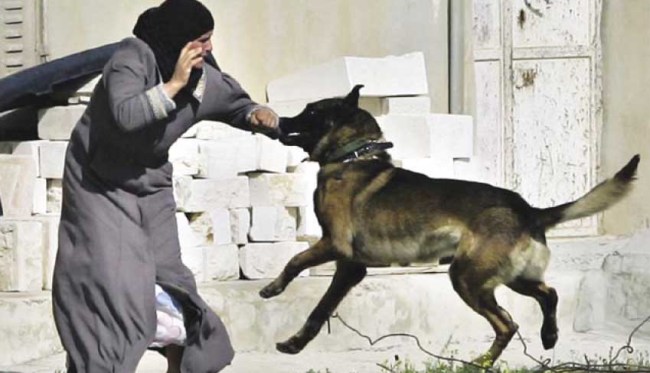
Photo – Multaqa.org

This is not an isolated case. Palestinian women and children are detained on almost a daily basis, and are physically and physiologically abused. They are beaten, humiliated and tortured during arrest, interrogation and detention. Their families are also harassed and sometimes other family members are arrested as well to extract a confession from the detainee. Palestinian children are interrogated by Israeli soldiers without the presence of a lawyer or a family member and later stand trial like adults. Families are often not allowed to see their children before or after trial.
Since 1967, Israel detained over 700,000 Palestinians including tens of thousands of children. Since the outbreak of Al-Aqsa Intifada in 09.2000, more than 8000 Palestinian children have been detained, of whom 337 are still in Israeli detention. According to “Defence for Children International/Palestine Section (DCI/PS)”, around 700 Palestinian children are detained yearly in Israeli jails. Of the over 8500 Palestinians currently detained in Israeli jails, at least 400 were children at the time of their arrest. Palestinian children are arrested from their homes, from schools, while playing in the streets or at checkpoints. They are blindfolded, shackled and taken into detention centers where they are separated from others. They are beaten, threatened and abused by the soldiers and interrogators, are not allowed to see a lawyer or a family member and are forced into singing papers in Hebrew which they don’t know. These children are prosecuted as adults in two military courts and by military officers who act both the prosecutor and the judge. Many of the children detained are subjected to administrative detention which means detention without charges or any trial. […]

One recent incident is that of Mohammad Al-Qunbar, a 14 year old from Jerusalem. On 15.03.2010 Mohammad was first hit by a police car, then beaten by the occupation police and detained despite his injury. The Israeli occupation police first claimed that Mohammad was hit by an “Arab” car, but pictures taken during the incident proved otherwise. Later, the boy testified he was threatened by investigators in the Maskubiyyeh with prison in case he revealed that he was hit by a police car. Mohammad said that an Israeli car came towards him and his friend, hit him the first time, turned and hit him a second time. Then those inside the car came out, arrested him and started beating him in the car while he was crying.
Children are also arrested during midnight raids. In recent years, mass arrests of Palestinian children have been reported. On 10.02.2010, and during a nightly military raid on Al-Jalazoun refugee camp in Ramallah, 19 children were detained from their homes. These were beaten and harassed and the families report that the IOF used excessive force during the arrests. The children were then taken to a detention centre and interrogated without the presence of a lawyer or any family member. According to the “Defence for Children International/Palestine Section (DCI/PS)” five of them were aged 14, seven were aged 15, four were aged 16 and three were aged 17. At least seven of them (aged 15 or less) were transferred to jails inside Israel which is, in addition to the illegality of detaining children, another violation of international law. During another similar midnight raid, this time in Silwan in Jerusalem, several Palestinian children aged 12 to 15 were detained. These were taken from their beds, handcuffed and transported to interrogation cells in the Maskubiyyeh and their parents were not allowed to accompany them. The children later testified that they were threatened and beaten during the interrogation. Similar midnight raids with mass arrests of children occurred in Tura Al-Gharbiyyeh on 19.01.2009, Azzun on 14.07.2009 and in Haris on 26.03.2009 where over 90 children were detained, beaten and threatened.
According to the Defence for Children International/Palestine Section (DCI/PS): [1]
90 Day: the period of time a Palestinian detainee, including a child, can be denied access to a lawyer and held in incommunicado detention (Military Order 378)
20 Years: the maximum sentence that can be imposed on a Palestinian, including a child, for throwing stones (Military Order 378)
188 Day: the length of time a Palestinian detainee, including a child, can be held in detention without charge (Military Order 378)
2 Years: the period of time a Palestinian detainee, including a child, can be held between indictment and trial.
Since 1967 more than 12,000 Palestinian women were detained by the Zionist entity. During the First Intifada 3000 women were detained and during Al-Aqsa Intifada more than 900 women were locked up behind Israeli bars. Currently, there are 35 Palestinian women detainees in the Israeli prisons Damon and HaSharon: among them 3 administrative detainees, 8 await trial, 23 sentenced of whom 5 are serving life sentences. Palestinian female detainees, like their brothers in detention, suffer from the brutality of the Israeli Prison Authority. They are punished for the slightest thing with isolation, are beaten, harassed, tied up for hours under hot sun or under rain, deprived of sleep, their rooms raided at night, continuously denied family visits and calls back home and letters are sent and brought only once every 3 months. Water is very dirty and food is inedible, thus the detainees are forced to buy their food and water from the prison canteen for very high prices. Some political prisoners are also locked up with Israeli criminals who abuse them. Their cells are over-crowded, damp, lack hygiene and are infested with insects.
The detainees are also denied appropriate and much needed medical treatment and most medications are expired; 13 detainees are in need of medical treatment. Amal Faiz Jum’a from Askar refugee camp suffers from womb cancer while Raja’ Al-Ghoul from Jenin refugee camp suffers from heart and blood pressure diseases and both don’t get the need treatment. Female detainees are only allowed to see a general doctor and no specialists, and some were forced to give birth while hand and leg cuffed such as Mirvat Taha and Manal Ghanim. Currently, there are at least 6 Palestinian mothers in detention. Others have their husbands or their brothers in Israeli detention as well, but are not allowed to visit them. Abir Odeh for example has 3 brothers in Israeli detention and Fatin Al-Shafi’ Al-Sa’di has a brother in jail.
Sources:
http://www.palestinebehindbars.org
http://www.waed.ps
http://www.dci-pal.org/
Footnotes
[1] http://www.dci-pal.org/english/camp/freedomnow/display.cfm?DocId=803&CategoryId=16
© http://avoicefrompalestine.wordpress.com

Gen McChrystal: No Proof Iran Sending Fighters or Weapons to Afghanistan
By Jason Ditz, April 16, 2010
Despite several claims made to the contrary over the past several months, US commander Gen. Stanley McChrystal today conceded that there was no proof that the Iranian government has been sending fighters or weapons to Afghanistan.
At the same time McChrystal did note that some weapons and ammunition have crossed the border from Iran to Afghanistan and that some Taliban may have even trained inside Iran, but that they were not “operationally significant” amounts.
Secretary of Defense Robert Gates had last month accused Iran of supporting the Taliban behind the scenes, despite Iran’s formal ties with the Karzai government and long history of animosity [toward the Taliban].
Though the flow of arms back and forth across the long, largely unguarded border is perhaps unsurprising, the claims of training camps operating in the area around Zahedan suggest that the more reasonable explanation is that Taliban receiving training there could well be forging ties with the Sunni insurgency in the Sistan-Balochistan region as opposed to the Iranian government.
China ups Iran gas sale amid US ire
Press TV – April 17, 2010
China’s plans to increase gasoline exports to Iran will effectively thwart US efforts to choke off the country’s energy sector, a recent report reveals.
Forbes reported on Friday that state-owned China National Petroleum Corp.’s trading unit, ChinaOil, has already sent 600,000 barrels of gasoline to Iran in two $55 million shipments. According to the article, the trading unit of China Petroleum & Chemical Corp. (Sinopec), Unipec, has also agreed to sell some 250,000 barrels to Iran through a third party in Singapore.
The report comes at a time when Washington is exerting pressure to halt Iran’s low-level nuclear activities by targeting the country’s gasoline trade.
A bipartisan slate of US senators and lawmakers, tabled a motion in April 2009 that advocated tough sanctions against countries that sell refined petroleum, including gasoline, to Iran. The Islamic Republic has been under US sanctions ever since the 1979 Islamic Revolution toppled a US-backed monarch in Iran.
Tehran says Washington has long been using sanctions, which normally pressure ordinary people in a country, as a tool to force independent nations bow to its “illogical demands.”
On Friday, Iranian Oil Minister Masoud Mirkazemi warned that US-led sanctions against Iran will fail to achieve their desired results as the country has managed to become self-sufficient in oil production and products. Mirkazemi further added that Iran has become “quite the expert in tackling sanctions imposed by Western countries” over the past three decades.
What happened to “look forward, not backward”?
By Glenn Greenwald | April 16, 2010
The Obama Justice Department today announced that it has secured a ten-felony-count indictment against Thomas Drake, an official with the National Security Agency during the Bush years. Drake’s indictment, of course, has nothing to do with the criminal surveillance undertaken by the NSA. Rather, the DOJ alleges “that between approximately February 2006 and November 2007, a newspaper reporter published a series of articles about the NSA,” and it claims “Drake served as a source for many of those articles, including articles that contained classified information.” In other words, he’s being subjected to what The New York Times’ Scott Shane calls a “highly unusual” prosecution for being a whistle-blower on the Bush era’s sprawling and secretive Surveillance State. Although the indictment does not specify Drake’s leaks, it is highly likely (as Shane also suggests) that it is based on Drake’s bringing to the public’s attention major failures and cost over-runs with the NSA’s spying programs via leaks to The Baltimore Sun.*
Let’s spend just a moment thinking about what this means. We’ve known since December, 2005, that Bush officials, including at the NSA, committed felonies by eavesdropping on Americans without the warrants required by law — crimes punishable by a five-year prison term and$10,000 fine for each offense. All three federal judges to rule on the question have found those actions to be in violation of the law. Yet there have been no criminal investigations, let alone indictments, for those crimes, and there won’t be any, due to Barack Obama’s dictate that we “Look Forward, Not Backward.” Thus, the high-level political officials who committed crimes while running the NSA will be completely immunized for their serious crimes.
By stark contrast, an NSA official who brought to the public’s attention towering failures and waste at the NSA — revelations that led to exposés that, as Shane put it, were “honored with a top prize from the Society for Professional Journalists” — is now being prosecuted for crimes that could lead to a lengthy prison term. Why doesn’t Obama’s dictate that we “Look Forward, Not Backward,” protect this NSA whistle-blower from prosecution at least as much as the high-level Bush officials who criminally spied on American citizens? Isn’t the DOJ’s prosecution of Drake the classic case of “Looking Backward,” by digging into Bush-era crimes, controversies and disclosures?
Interestingly, the Bush DOJ long threatened to prosecute not only NSA whistle-blowers but also The New York Times for revealing its illegal spying. It never did so, however, likely because, as Shane speculates, prosecutions for those leaks would cause light to be shined on what the NSA actually did when eavesdropping on Americans. Yet here is the Obama DOJ prosecuting a whistleblower, a prosecution that is certain to intimidate and deter other whistle-blowers, thus choking off one of the very few avenues which Americans have left for learning about what this sprawling, obsessively secret Surveillance State does. As Lucy Dalglish, Executive Director of the Reporters Committee for Freedom of the Presss, told the NYT today: “The whole point of the prosecution is to have a chilling effect on reporters and sources, and it will.”
For that reason, the DOJ’s aggressive prosecution of someone who exposed serious waste and mismanagement at the NSA could, as the NYT‘s Shane put it, “raise questions about whether the government is merely moving to protect itself from public scrutiny.” Whatever else is true, decreeing that we must “Look Forward, not Backward” — and then bestowing that Imperial Generosity only to the crimes of the President and his aides but not to courageous whistle-blowers (or, for that matter, anyone else) — is anything but “Justice.”
* The Atlantic‘s Marc Ambinder summarizes The Baltimore Sun revelations which are almost certainly what Drake is accused of leaking:
In 2006 and 2007, Siobahn Gorman, a highly regarded intelligence reporter for the Baltimore Sun, wrote a series of articles about how the National Security Agency was (mis)managing a highly sensitive, very expensive collection program known as Trailblazer. Relying on interviews with current and former senior intelligence officials as well as internal documents, Gorman was able to show that the NSA’s “state-of-the art tool for sifting through an ocean of modern-day digital communications” was a boondoggle of sorts — and that the agency had removed several of the privacy safeguards that were put in place to protect domestic conversations and e-mails from being stored and monitored.
How Obama Must Deal With Israeli Avoidance Methods
By NADIA HIJAB | April 16, 2010
As Barack Obama seeks leadership of the nuclear nonproliferation cause this week, the long shadow cast by the Arab-Israeli conflict is close by. And a proliferation of peace plan advice is coming his way, inspired by reports that his administration may be planning to issue its own plan.
So far, the heaviest hitters’ advice is that from former national security adviser Zbigniew Brzezinski and former Congressman Stephen Solarz, in their jointly written editorial in The Washington Post. They call on Obama to make a dramatic gesture: To travel to Jerusalem with world leaders and declare a four-point plan. This would, they argue, make it possible for Israeli and Palestinian leaders to deal with their recalcitrant elements.
I hope the president doesn’t listen to them. On the face of it, the Brzezinski-Solarz plan-for-Obama’s-plan looks eminently reasonable and even-handed, with bitter pills dished out to “both sides.” But it puts the United States in a needlessly exposed position.
It is one thing for former government representatives to airily dismiss international law as regards Palestinian refugee rights in exchange for an Israeli agreement to share Jerusalem, which is not legally Israel’s to share. It is quite another for the highest American official to do so.
The United States should indeed have a clear idea of its bottom line because it simply cannot leave the matter to be negotiated by the two sides, given the vast imbalance of power. But it should not publicly announce a peace plan. What it should publicly announce is that it will not recognize any changes Israel has made beyond the Green Line, and that it will encourage its partners to do the same.
For starters, Obama could dust off that 1979 State Department ruling that Israeli settlements are “inconsistent with international law.” Never revoked, it peeps through the verbiage every now and then. Now it needs to be rearticulated forcefully.
Further, the Administration should begin public investigations of how much of its own aid — and that of U.S. non-profits — supports settlement activity, with a view to stemming that flow.
This will send the clearest message yet to the Israeli government — and to the settlers — to stop settlements and begin to pull back. Buying property there will become unattractive while supporting settlements would be a risky enterprise for law-abiding Americans.
Concurrently, the Obama administration should continue the steady if unglamorous task of pushing for a final and comprehensive agreement, albeit at a much, much faster pace and backed by clear costs for Israel for not ending its occupation. And it should call on Europe — Israel’s largest trading partner — to help make the costs of occupation clear. This will lessen the heat on the Administration and present Israel with a determined united front that says: Yes, to security for the citizens of Israel, No to occupation, injustice, and inequality.
There is a pressing reason to go public with such a stand. The Israeli government and settlers are rapidly changing the nature of the West Bank and East Jerusalem by expanding settlements, roads, and barriers, according to the people impacted by them. And it is becoming increasingly untenable for Palestinians to hang on to their lands and homes or to a decent living, in spite of the happy spin sometimes spun about the occupied territories. Only U.S. pressure can put a stop to this, and it needs to be done now: Post-November’s midterm elections may be too late.
Any attempt to cajole Israel into better behavior and to seek incremental improvements will be met with well-honed Israeli avoidance methods, as the Administration discovered over the past year. Here are just three examples of such methods.
First, they keep everyone on the run. For example, as Ha’aretz just revealed, a new Israeli military order will enable the deportation of thousands of West Bank and East Jerusalem Palestinians. Israel benefits even if the order is never implemented: Attention will undoubtedly shift to this new emergency, sucking up time and energy now spent on Jerusalem and settlements.
Second, they dig in their heels for as long as possible, and only offer minor concessions while carrying on business as usual — as with the unconscionable siege of Gaza.
And third, they use diversionary tactics — lately, it is the Iranian ‘nuclear threat’, which even defense minister Ehud Barak said is not an existential threat to Israel.
So, as Obama sifts through the peace plan advice coming his way, he would do well to keep his intentions tucked up his sleeve, go public on what America will not support, and in other ways put a brake on Israel’s fast creation of facts on the ground — while remorselessly pushing the process to a conclusion. This approach won’t be easy. But it is more likely to succeed.
Nuclear Insanities
By Julien Mercille | April 16, 2010
Writing in the 19th century, Russian anarchist Michael Bakunin said that the State is “the most flagrant, the most cynical, and the most complete negation of humanity… this explains why kings and ministers, past and present, of all times and all countries — statesmen, diplomats, bureaucrats and warriors — if judged from the standpoint of simply morality and human justice, have a hundred, a thousand times over earned their sentence to hard labor or to the gallows.”
The nuclear arsenals built by the United States and Russia and their feeble attempts at dismantling them prove Bakunin right again. Washington and Moscow’s combined stockpiles contain over 10,000 nuclear warheads, each 5 to 25 times more powerful than the bomb that flattened Hiroshima. The just signed New START Treaty will probably result in total cuts of about 800 warheads: in other words, our magnanimous leaders have agreed to reduce the nuclear power they hold in their hands, and over our heads, from one 150,000 to 140,000 times greater than the bomb dropped on Hiroshima… Thank you so much, Mr Obama.
As if this wasn’t enough, the just released US Nuclear Posture Review (NPR) tells us how those weapons might actually be used. The NPR’s key sentence is the following: “the United States will not use or threaten to use nuclear weapons against non-nuclear weapons states that are party to the NPT and in compliance with their nuclear non-proliferation obligations.”
Supporters of the NPR call it an improvement over Bush’s because it states that the United States won’t respond to a chemical or biological attack with nuclear weapons, but rather, with a “devastating conventional military response”.
However, nuclear weapons still play an important role under Obama. First, they can be used against other states that do possess them (like China and Russia) if they attack the US with conventional, biological or chemical weapons, i.e., even if they don’t attack with nuclear weapons. Second, nukes could be used against “non-state actors” like Al Qaeda, as Robert Gates explained: “all options are on the table when it comes to… non-state actors who might acquire nuclear weapons”. This implies that the country in which those terrorists are located will face nuclear retaliation no matter its standing under the NPT.
Third, countries that Washington determines not to be in compliance with the NPT are subject to nuclear attack even if they don’t possess any nuclear weapons. The reference here is to Iran and North Korea, but since Washington makes that determination not based on facts but on whether a country is “with us or against us”, in practice it means that those the United States deems to be enemies are at risk.
Sadly, Obama is not ready to adopt a “no first use policy” and is content with a situation in which he could be the first to order a nuclear strike. He also leaves about 200 nuclear weapons in five European countries (Germany, Italy, Belgium, the Netherlands and Turkey). In short, as the Federation of American Scientists’ Hans Kristensen concludes his review of the NPR, the document is a “disappointment” for those who were hoping for clear and significant reductions in the role and numbers of nuclear weapons.
The New START Treaty, on its part, calls for two kinds of reductions: nuclear warheads and delivery vehicles.
Warheads are the part of a missile or bomb that contains the nuclear explosive charge, and currently, the US has about 2,200 strategic warheads and Russia 2,600. Under New START, both must reduce their arsenals to 1,550 deployed warheads by 2017. Media reports have emphasized that the treaty will “slash nuclear stockpiles” by about 30% compared to the Moscow Treaty signed by Bush in 2002 that imposed a limit of 2,200 warheads.
The problem with this 30% figure is that it is wrong: the real warhead reductions will be less than that, in fact, probably about 10-15%. This is because of a special counting rule in the treaty by which all warheads associated with one bomber aircraft are counted as one. For example, if an American bomber carries 20 nuclear bombs, that counts as only one warhead, not 20. Therefore, it’s easy to see that the 1,550 limit will in fact “hide” many more actual warheads. How many exactly will depend on how the US and Russia allocate their cuts among submarines, land-based missiles and bombers, but estimates are that when they reach the limit of “1,550” in 2017, the US will in fact possess about 1,800 warheads and Russia slightly less than 2,200 — reductions of about 13% compared to current arsenals, not 30%.
In short, the treaty gives no incentive to get rid of nuclear bombs launched by bomber aircrafts and as such underestimates the real number of warheads deployed by both powers. Further, the treaty does not require that any warhead be destroyed: they are merely to be moved into storage, and could be brought back into operation eventually. And there is no requirement to remove the 200 US tactical nuclear weapons located in Europe.
Delivery vehicles are what brings the warheads to explode on the adversary’s territory in war and are of three kinds: bomber aircrafts, ICBMs (Intercontinental Ballistic Missiles, land-based) and SLBMs (ballistic missiles launched by submarines). The treaty imposes a limit of 700 deployed delivery vehicles for each side. But here again, reductions are small: Russia currently has about 600, so it literally has nothing to do since it is already in compliance. The US has 798 and will have to reduce this by 12%, to 700.
The New START Treaty is only a slow move towards disarmament. A top nuclear expert based in the United States summed it all up when he told this author that “as most arms control treaties, New START just codifies the changes that were going to happen anyway.”
Nevertheless, it is important to appreciate the treaty’s positive aspects. For one, it establishes a structure of verification and confidence building between the United States and Russia that will allow for future deeper reductions, and it encourages the two countries’ leaders not to renege on planned cuts in their arsenals.
A question raised both by the NPR and New START is whether or not the Obama administration will build new nuclear weapons. During his election campaign, Obama had promised not to do so. Yet, his 2011 Budget request released last February calls for a 10% increase in nuclear weapons spending next year. Has he reneged on his promises?
The answer depends on how we define the term “new nuclear weapon”. When nuclear warheads age, instead of dismantling them, their life is often extended through various modifications ranging from rebuilding some or all the parts but keeping the original warhead design, to manufacturing new untested nuclear components of new design to replace existing ones. Which ones of those changes should be referred to as yielding a “new” warhead is debatable. The NPR states that “The United States will not develop new nuclear warheads” but that it will extend the lives of aging warheads using the “full range” of available methods. Some analysts have concluded that this in practice means new warheads, and would even permit production of Bush’s Reliable Replacement Warhead (RRW) program.
But there is another way in which Obama can be said to produce new nuclear weapons: he is building new delivery vehicles for warheads, such as the F-35 Joint Strike Fighter, a replacement for the Ohio-class nuclear-armed submarine, and modernizing existing strategic ballistic missiles such as the land-based Minuteman III and submarine-based Trident II, in addition to plans to replace the nuclear-capable Air Launched Cruise Missile (ALCM). Can’t those be considered new nuclear weapons since they are new vehicles to deliver warheads?
The bottom line is this: we can argue on what constitutes a new nuclear weapon and whether or not Obama is developing them. What is certain however, is that a president truly committed to nuclear disarmament would not even extend the life of aging nuclear warheads and would destroy them before they reach the end of their shelf life. Obama is clearly not that kind of president.
It is sometimes believed that nuclear weapons contribute to maintaining a balance between super-powers, making the international system more stable. In fact, there have been many nuclear near-accidents throughout the Cold War and since then, due to systems’ malfunctioning or human errors. Maintaining nuclear arsenals in place only increases the chance that a real accident will one day happen.
For instance, during the Cuban missile crisis in 1962, the world came very close to global nuclear war, averted thanks to a Soviet submarine commander, Vasili Arkhipov, who countermanded an order to fire a nuclear-tipped torpedo at US warships off Cuba. US destroyers whose orders were to enforce a naval quarantine did not know that the Soviet submarines sent to protect their ships were carrying nuclear weapons and fired at the submarines to force them to the surface. The officers in Arkhipov’s submarine thought this meant World War III might have started, and the first captain said “We’re going to blast them now! We will die, but we will sink them all. We will not disgrace our navy”. But Arkhipov calmed him down and torpedoes were not launched: in the words of Thomas Blanton, director of the National Security Archive, “The lesson from this is that a guy called Vasili Arkhipov saved the world.”
In 1983, at a time of tension in US-Soviet relations, a newly-inaugurated Soviet early-warning system detected incoming American nuclear missiles. However, Stanislav Petrov, the Soviet officer then in charge of monitoring the system and notifying his superiors if an attack was detected, chose not to let them know for he believed the new system was simply malfunctioning. He was right: there were no incoming missiles. The Russian system had indicated otherwise due to a unique alignment of its satellite’s viewing angle with the sun, which caused sunlight to be reflected by the clouds in a way that caused the warning system to indicate that several missiles had been launched against the Soviet Union. Had Petrov chosen to alert his superiors, they could have launched a massive retaliatory strike, changing the course of history.
In 1995, Norwegian and American scientists launched a large rocket from an island off the coast of Norway to study the northern lights. Russian radars detected the rocket but mistook it for a nuclear Trident missile launched from a US submarine. For a few moments, Russia was poised to launch a full-scale nuclear attack on the United States. Reportedly, Russian military doctrine allowed 10 minutes from the time of detection to decide on a course of action. The next day, then President Yeltsin stated that he had in fact activated, for the first time, his “nuclear football”, a device allowing him to communicate with his top military advisers to review the situation.
If the world is not to wait for decades before such risks become history, the New START Treaty must be implemented, and agreements on further cuts need to be reached — fast.
Note
See also “New START Treaty Has New Counting”, 29 March 2010, http://www.fas.org/blog/ssp/2010/03/newstart.php
Thousands rally to oust Georgian president
RT – April 14, 2009
Some 15,000 protesters have rallied in front of the President’s residence and the parliament building in the Georgian capital, Tbilisi. Peaceful protests are set to continue during the upcoming days.
The opposition has rejected proposals to form a coalition government, saying their aim is to oust President Mikhail Saakashvili and not to win seats.
Tents have been set up and hundreds of people filled the small square in front of the building while thousands gathered on the streets adjacent to the residence.
After the completion of the rally, around 20 tents stood and will be occupied by dozens of protesters who are expected to stay – ‘until Saakashvili resigns’.
Levan Gachechiladze of the opposition promised that “every street in Tbilisi will become a protest spot,” and all of Georgia will be involved in the demonstrations in the coming days.
“We declare Saakashvili to be persona non grata in Georgia,” said opposition leader Zviad Dzidziguri. He said Georgians would picket Saakashvili everywhere he goes.
Among the many events at the rally, protesters found a moment to release a white rabbit wearing a red tie onto the grounds of the residence hinting, once again, at the now-famous episode when Saakashvili was seen chewing his tie.
The opposition Conservative Party has called the president ‘rabbit’, accusing him of cowardice, and called on protesters to throw vegetables at the residence.
Meanwhile, Tbilisi authorities have labeled as ‘illegal’ the decision by protesters to picket the president’s residence.
As the mayor’s office has not authorized mass rallies in places other than Rustaveli Prospekt, “a 24-hour picketing of the president’s residence can be deemed as a violation of the law,” according to a source in the mayor’s office as quoted by the Interfax news agency.
Israeli shelling kills Palestinian in Shujaiyah area
Palestine information center – 16/04/2010

GAZA, (PIC)– A Palestinian citizen was killed Friday morning during Israeli artillery and aerial attacks on the eastern part of Al-Shujaiyah neighborhood to the east of Gaza city.
Dr. Muawiya Hassanein, the director of emergency unit in the health ministry told the Palestinian information center (PIC) soon after the shelling stopped that the medical crews were trying to evacuate the victim from the bombed area.
Israeli tanks and warplanes bombed the east of the neighborhood at the pretext of targeting resistance fighters who tried to plant an explosive device in the area.
Eyewitnesses told the PIC that the Israeli tanks stationed near the security fence east of Al-Shujaiya neighborhood and the surveillance towers surrounding the area opened intensive gunfire at the Palestinian homes before warplanes participated in the indiscriminate shelling.
Necessity and Defiance
By Eva Bartlett | April 16, 2010

Mohammed Abu Jerrad, 12, works with his older brother and 4 others to gather their wheat. Although it is still somewhat early for harvesting, the family hopes to harvest their 5 dunams quickly, preferring the early harvest over the possibility that Israeli soldiers will demolish or light their crops afire, as they have routinely done in the past. [One such incident occured in Johr Ad Dik last May, when Israeli soldiers shot incendiary devices into ripe wheat and barley fields, setting nearly 3 km, 200 dunams, of crops and fruit trees afire.]

Abu Jerrad’s 5 dunams lie roughly just over 300 metres from the border, along which Israeli military tower and remote controlled machine gun towers loom. From these towers, Israeli soldiers regularly shoot on farmers, workers gathering rubble and scrap metal for construction uses, and civilians on the land.
This plot of wheat is on rented land.
“We grow it to feed our sheep and goats,” Abu Jerrad says of his 150 animals.
“This morning when we came here to work the Israelis began shooting, so we left,” he says.
“Yes, Mohammed was with us,” he answers of the 12 year old helping him.
“Sometimes they even shoot at the sheep,” he adds. “Are they afraid of the sheep?” he jokes.
The 6 farmers can do two trips of 3 loaded donkey carts per day, if all goes well. It will take many more days before their crops are harvested.
In a Strip under years of siege and an area where Israeli shooting, shelling and kidnapping is the norm, every incident of farming is an act of necessity and an act of defiance: Palestinian farmers will not be driven off their land.


*Sheep, most often seen scouring Gaza’s vacant lots and garbage dumps, find good grazing land for a change. Much of Gaza’s prime grazing land has been destroyed or is inaccessible due to the Israeli-imposed “buffer zone”.
Adding Torture to Injury
By Pam Bailey | IPS | April 14, 2010
|

GAZA – It was bad enough that Ahmad Asfour was severely maimed by an Israeli drone strike outside his house on Jan. 9, 2009. But, his search for advanced treatment landed the journalism student, now 19, in Israeli prison where he remains.
According to Mahmud Abo Rahma of the Al Mezan Centre for Human Rights, not many Palestinians are arrested as Ahmed was, but it is increasingly common for patients entering Israel to be denied treatment unless the patient or family agrees to collaborate.
Al Mezan has joined the Physicians for Human Rights and the ADALA Centre (which defends the rights of Palestinian Arabs in Israel) to charge Israel with blackmailing Palestinian patients in Gaza, exploiting their need for medical treatment to pressure them into collaborating with its intelligence agencies.
Ahmad and four teenaged cousins were hit by fragments from a missile fired by an Israeli drone, east of Khan Younis, in the southern region of the Gaza Strip, just 14 days after Israel launched its massive, 22-day assault on the densely populated strip of land wedged between Israel and Egypt. The fragments lodged in his left eye, broke his jaw, shattered his teeth, severely lacerated both hands and right thigh, destroyed his genitals, and damaged his pancreas and intestines.
His father, Samir, was in Egypt at the time with one of Ahmad’s brothers, who had been injured just eight days before. Due to the siege imposed by Israel since Hamas took control in 2007, medical care in Gaza is often inadequate. Gazans have been unable to repair the 15 (out of 27) hospitals and 43 (of 110) primary healthcare facilities damaged in last year’s Israeli invasion, because of the ban on importation of construction materials.
Treatment in Egypt is not advanced and, according to Abo Rahma, the risk of contracting Hepatitis C is significant. Getting permission to enter Israel is difficult for Palestinians during normal times, and it was impossible during and immediately after the invasion. Even a year later, the UN reports that almost a quarter of the 1,103 patients who had sought permits for treatment in Israel in December 2009 were denied or delayed. As a result, 27 patients died while awaiting referral last year.
Ahmad and his cousins were rushed to the local hospital by his oldest brother, and the medical director sent them immediately to Egypt. Ahmad spent the next eight months there, but little could be done. In fact, because of the damage to his pancreas and the lack of appropriate treatment, he soon developed diabetes.
Doctors caring for Ahmad recommended he travel to Germany. But there was a catch: Ahmad needed a visa, and for that he was required to go to Tel Aviv – an impossibility for Gazans.
Finally, one physician suggested a hospital in Jerusalem, St. Joseph’s. As part of the approval process, Samir took his wheelchair-bound son to the Erez Crossing into Israel on Nov. 23. After waiting four hours, they were turned away, and told to return two days later. When they arrived, they were subjected to a harrowing ordeal.
“Here I am with my injured son, terrified about his health, and we were forced to remove all of our clothes so we could be strip searched. Then they took my son away from me,” recounted Samir through an interpreter. “Ahmad needed insulin every two hours, but I couldn’t give it to him…The next thing I know he is in shackles! They took the medication I had brought for Ahmed and all the money I had collected from charities (about US$2,500) and he was gone.”
It was 20 days, says Samir, before he finally found out what had happened to his son, after he sought help from human rights organizations.
Lawyers from the Al Mezan Center for Human Rights discovered that other young men who had gone before Ahmad to Erez and been interrogated had apparently implicated him, claiming he had been in possession of a gun and an explosive for one of the Gaza-based militias. (Samir claims the “explosive” was actually his son’s insulin vials.)
Ahmad maintained his innocence during his four hours of interrogation at Erez, and as a result, he was transferred to an Israeli prison in Ashkelon. After five consecutive days of further interrogation, Ahmad could take no more and confessed. The charges: ” membership in a terrorist organization, observation of and passing information to the enemy, providing services for a terrorist organization and possession of firearms.”
“He was subjected to practices that we consider torture and ill treatment, mainly in the form of forced stress positions for long hours, such as sitting on a chair with hands cuffed behind,” the Al Mezan legal team said in a response to an inquiry. “Torture is unconscionable at any time, but it is particularly cruel when the victim is already medically vulnerable.”
Samir, who receives information on his son from the attorneys and the Red Cross, said he learned later that his son had been told that his father was in jail as well, and that therefore he must cooperate with the Shin Bet, Israel’s internal security agency. Meanwhile, Physicians for Human Rights learned that Ahmad was being denied all medical treatment except for his insulin, and has been advocating on his behalf. Samir says the latest news he received is that one of his son’s arms may need to be amputated.
Today, Ahmed is still in prison, although he has been transferred to Beersheba. Based on his “confession,” he was offered a plea bargain of 33 months incarceration or a shortened list of charges with sentencing to be determined. He rejected the “bargain” and at a Mar. 24 session, the court set a new hearing for June, to allow the prosecution to call its witnesses – the police who conducted the interrogation.
“Every Palestinian has the right to health, which is enshrined in Article 25 of the Universal Declaration of Human Rights,” Al Mezan stated in a March 2009 report. “This right must be provided without any conditions hinged to it, a principle that Israel repeatedly violates. The Shin Bet has on numerous occasions pressured Palestinians in need of external medical treatment to become informants in exchange for permission to leave Gaza.’’
According to Physicians for Human Rights, agents interrogate Gazans who want to enter Israel for medical care about their relatives, neighbors and friends; those who don’t cooperate often don’t get travel clearance. It has received reports from 32 patients in Gaza who say they were denied permission to leave for refusing to cooperate with Israeli questioners at the Erez Crossing by answering questions about the political affiliations of relatives, friends and acquaintances.
Samir has hired an Israeli attorney to plead his son’s case, but so far doesn’t have the money to pay her. He will sell his house, he says, if he has to.
“My son is not guilty!” exclaims Samir in frustration and pain. “If my son was a militant, would I have tried to take him through Erez? He is just a boy who needs treatment, who is being used as part of their game.”
Afghans ‘abused at secret prison’ at Bagram airbase
By Hilary Andersson | BBC News | April 15, 2010
Bagram – Afghan prisoners are being abused in a “secret jail” at Bagram airbase, according to nine witnesses whose stories the BBC has documented. The abuses are all said to have taken place since US President Barack Obama was elected, promising to end torture.
The US military has denied the existence of a secret detention site and promised to look into allegations.
Bagram was the site of a controversial jail holding hundreds of inmates, who have now been moved to another complex.
The old prison was notorious for allegations of prisoner torture and abuse. But witnesses told the BBC in interviews or written testimony that abuses continue in a hidden facility.
Sleep deprivation
“They call it the Black Hole,” said Sher Agha who spent six days in the facility last autumn.
“When they released us they told us we should not tell our stories to outsiders because that will harm us.”
Sher Agha and others we interviewed complained their cells were very cold.
“When I wanted to sleep and started shivering with cold I started reciting the holy Koran,” he said. But sleep, according to the prisoners interviewed, is deliberately prevented in this detention site.
“I could not sleep, nobody could sleep because there was a machine that was making noise,” said Mirwais, who said he was held in the secret jail for 24 days.
“There was a small camera in my cell, and if you were sleeping they’d come in and disturb you,” he added.
The prisoners, who were interviewed separately, all told very similar stories. Most of them said they had been beaten by American soldiers at the point of arrest before being taken to the prison.
Mirwais had half a row of teeth missing, which he said was from being struck with the butt of a gun by an American soldier.
No-one said they were visited by the International Committee of the Red Cross during their detention at the site, and they all said that their families did not know where they were.
In the small concrete cells, the prisoners said, a light was on all the time. They said they could not tell if it was night or day and described this as very disturbing.
Mirwais said he was made to dance to music by American soldiers every time he wanted to use the toilet.
The ex-prisoners said they were imprisoned at the secret jail before being taken to the main detention centre at the Bagram airbase, a new complex called The Detention Facility in Parwan. Bagram’s prisoners were moved to the Parwan complex from the old notorious Bagram prison site on the airbase earlier this year… Full article
Featured Video

Iran Is Not Our Enemy
or go to
Aletho News Archives – Video-Images
Frlom the Archives
The 52 Major Jewish American Organizations and Israel Celebrate Passover with the Slaughter of 25 Muslim, Christian and Secular Palestinians
By James Petras • Unz Review • April 8, 2018
Introduction
As of April 7, nearly three thousand unarmed Christian, Muslim and secular Palestinians have been wounded, over three dozen are in critical condition and at least twenty-five unarmed protestors, including children have been assassinated by hundreds of Israeli snipers and heavily armed troops shooting tank shells into crowds of civilians protesting their decades of incarceration by the racist Israeli state.
The Israeli government praised the ‘restraint and morality’ of the IDF, as did the fifty-two Major Jewish American Organizations (MJAO) who largely control the US Congress. These grotesque massacres began during the Christian Holy Week on Good Friday and Easter, coinciding with the Jewish Passover. The self-righteous officials of the MJAO and their relatives and friends broke matzos at joyful Seders as the blood of Palestinians soaked into ground at the fence containing the largest open-air prison camp in history, Gaza.
While tribal loyalties bonded the Israeli and Jewish American leaders, the politicians of the Western oligarchic electoral regimes refrained from criticizing the shocking display of brute force and even defended Israel’s cold blood mass killings of Palestinian civilians in their Gaza prison.
This paper will discuss and analyze the reasons for Israel’s willing Western accomplices and the centrality of its fifth column in the United States. … continue
Blog Roll
 Aletho News
- Israeli Journalist Demands Tucker Carlson and Candace Owens Be Placed in WWII-Style Internment Camps
- No Liability, No Studies, No Accountability: The Vaccine System Aaron Siri Exposed in Federal Court
- No time for losers: Why the war meant to save Israel may destroy it
- Top US Counterterrorism Official Resigns in Protest of Operation Against Iran
- Just Get Out! Now!
- Unpacking glaring contradictions in US-Zionist justifications for war against Iran
- Iranian model of warfare bleeds US dry while Persian Gulf states watch and learn: Analyst
- IRGC orders ‘defeated’ US to evacuate industrial facilities in region
- Hegseth’s call for ‘no mercy’ to Iranians deemed war crime
- Iran War Exposes Limits of US Military Power – Journalist
- If Americans Knew
- Trump’s counterterrorism chief, whose own wife was killed by ISIS, quits over Iran War saying Tehran posed ‘no imminent threat’
- Here’s what US could fund instead of Bibi’s war on Iran
- Israel Killed Over a Dozen Lebanese Paramedics in Three Days, Now Claiming That Ambulances Are “Hezbollah” Targets
- War on Iran: These are the heritage sites devastated by US and Israeli attacks
- Four news stories from Israeli media that illustrate Israeli “justice”
- CIA Prepares Criminal Referral of Tucker Carlson, as Israel and Its Loyalists Demand His Arrest
- Top US counterterror advisor resigns in protest of “war manufactured by Israel” – Not a ceasefire Day 157
- ‘I Liked the House’: When Israeli Soldiers Turn Palestinian Homes into Barracks
- ‘They Were All I Had’: Lebanese Father Buries Parents, 4 Daughters Killed by Israeli Bombing
- Israel and its supporters are causing attacks on Jewish institutions. Case in point: Michigan synagogue tragedy.
- No Tricks Zone
- New Research: South Australia’s Mid-Holocene Sea Surface Temperatures Were 4°C Warmer Than Today
- Storing Green Energy To Last Germany 10 Days Would Require A 60-Million Tonne Battery
- New Studies: UK Sea Levels Were 4 Meters Higher Than Today During The Mid-Holocene
- Destructive Green New Deal: German Energy And Metal Group Warns Of Drastic Crisis
- New Study Documents A 20-Year Pause In Arctic Sea Ice Decline – Driven By Internal Variability
- Wake-up Call: Survey Shows Majority Of Germans Now Favor Postponing Climate Targets!
- Televised! Leading German Political Candidate Tells Schoolchildren CO2 Makes Sun Hotter!
- New Study: A Century Warming Of 1.1°C Is ‘Commonplace’ And ‘Not Unusual’ During This Interglacial
- New Study: ‘Internal Noise’ And Volcanic Forcing Can Trigger 10-15°C Warming Within Decades
- Glaciers Worldwide Are Suddendly Surging, Experts Blame Warming!
 Aletho News