The ‘Times’ finally covers settler funding in the US, but there is still much to tell
By Adam Horowitz on July 6, 2010
The New York Times has finally covered a story that has been sitting under its nose for years – the tax-exempt fund raising Israeli settlers are doing in the U.S. In an expansive article in today’s paper, three reporters combine to tell a familiar story of how nonprofit organizations are raising money in the US to help build settlements and in some cases arm settlers themselves.
I say the story has been right under the Times’s nose because so much of this story is a New York story. As we have been reporting on here for the past year and a half, the Central Fund of Israel, located in a fabric store on 36th Street and 6th Avenue in Manhattan just 6 blocks from the Times headquarters, has been one of the most important players in this story. The Times gives them their due, and even quotes their president Hadassah Marcus who explained, “We’re trying to build a land. . . All we’re doing is going back to our home.”
The article is huge, and the Times should be commended for running it.
Still the article obfuscates the story in some places. My biggest issue is that it totally ignores the widespread support these institutions enjoy in the Jewish community. The article says “donors to settlement charities represent a broad mix of Americans,” but then focuses on the more religious or ideological ones. As we have shown the apparent Central Fund donor list includes James Tisch, the CEO of Loews; Michael Milken, the banker/philanthropist; and Alan C. (Ace) Greenberg, the former CEO of Bear Stearns (the whole list is here). To me this is an interesting story.
And it’s not just about big names. The story says, “The settlements are a sensitive issue among American Jews themselves. Some major Jewish philanthropies, like the Jewish Federations of North America, generally do not support building activities in the West Bank.” This is not true. A reader writes us:
I know this to be untrue, first by virtue of the JFNA’s funneling American Jewish money to the Jewish Agency, which openly supports settlements. But some Federations sanction settlements directly, too: the SF Federation’s endowment fund allows donations to settler groups.
The list of the San Francisco Federation’s approved charities is here. Among the many settler organizations it includes are the American Friends of Ariel (a large settlement in the northern West Bank), American Friends of Bat Ayin Yeshiva (located in the Gush Etzion settlement block), and, not surprisingly, the Central Fund of Israel.
The Times makes it out that the American Jewish community is wringing its hands over this practice while the radicals raise the money. This is not the case. While I agree that the majority of American Jews might not support the settlements, the majority of the leadership of the American Jewish community does. The settlements have been a project of the American Jewish community as much as they have been Israel’s project. The leaders of the community need to be called to account.
Physicians For Human Rights – Israel: End Gaza Siege
By Circarre Parrhesia – IMEMC News – July 07, 2010
Physicians For Human Rights – Israel has released a report, on Wednesday, detailing the progressive degradation of the medical situation in the Gaza Strip as a result of the ongoing siege upon the coastal enclave. The report comes as a response to the Israeli cabinet decision of June 20, 2010, to ease the blockade.
PHR – Israel’s report calls for a complete end to the siege on Gaza and the end of practices by the Israeli government that restrict full access to proper healthcare for the inhabitants of Gaza.
The report considers three major areas in which the residents of the Gaza Strip suffer from inadequate healthcare due to Israel’s ongoing siege.
(1) Preventing the development of the healthcare system in the Gaza Strip while restricting patients’ exit for medical treatment including:
the restriction of medical equipment from passing into Gaza; restriction of training for the medical professionals of Gaza and; prevention of patients access to medical treatment outside of Gaza, despite inadequate facilities, whilst simultaneously preventing medical delegations from entering the Strip.
(2) Shin Bet uses unacceptable methods towards patients in need of medical treatment including:
summoning patients for interrogation before allowing them to exit Gaza for treatment, including scheduling interrogation after the patient’s date for treatment causing them to miss much needed medical care, and summoning patients who have applied for exit visas due to medical conditions only to arrest them, or place them in detention.
(3) Israel’s policy towards patients’ access to medical treatment involves extraneous considerations including:
tending to refuse exit visas to those who are not in a life threatening situations, a criteria that violates both international and Israeli human rights law; prevention of access to highest quality medical care due to prevention of development in Gaza, and refusal of travel; prevention of travel to patients who require follow up medical care; denying patients’ requests to travel, including critical cases, through fear that the patient will use the permit to unite with their families in the West Bank and; confiscation of patients personal belongings when returning to Gaza following medical care.
The report concludes that the actions of the Israeli government towards the Gaza Strip has a profound impact of the lives of the civilian population requiring medical care, leaving thousands suffering, and it should be noted that hundreds of Gazans have died since the beginning of the siege, in June 2007, due to inadequate or incomplete medical care.
The full report can be found at the following link:
http://www.reliefweb.int/rw/rwb.nsf/db900sid/FERB-874JAL/
Meg Ryan and Dustin Hoffman miss Jerusalem film festival after Gaza raid
By Ben Child | guardian.co.uk | 7 July 2010
Hollywood actors Meg Ryan and Dustin Hoffman cancelled plans to attend the Jerusalem film festival following Israel‘s raid on the Gaza-bound aid flotilla that left nine dead earlier this year, an official has told the Jerusalem Post newspaper.
Yigal Molad Hayo – associate director of the Jerusalem Cinemateque, the main venue for the event – said neither actor had cited the international outcry over the country’s actions as a reason for pulling out of the annual festival, but added: “It became quite clear that this was the reason.”
“Meg Ryan was supposed to come here – it had all been closed with her people,” he told the Post. “A day after the flotilla incident we got an email saying she was not going to attend, and although they claimed it was because she was too busy it was clear to me that it probably had something to do with what had happened.”
Hayo added: “We were very close to reaching an agreement with [Hoffman], then the flotilla happened and correspondence was ended.”
The two-week festival, which opens tomorrow, will nevertheless play host to some 150 international guests including heads of other international festivals, actors, producers and directors. It will debut around 50 Israeli movies, documentaries and short films.
European campaign receives 9,000 requests to participate in Freedom Flotilla 2
Palestine Information Center – 05/07/2010

BRUSSELS: The Brussels-based European Campaign to End the Siege on Gaza said that there has been a large turnout for Freedom Flotilla 2, in terms of activists requesting to participate, and in terms of the number of ships.
The campaign, which was one of the founders of the Freedom Flotilla coalition, in a press statement on Monday, boasted that the new flotilla has a few surprises in store for Israeli authorities, one of which is that seven of the ships scheduled to participate in the flotilla are from European counties.
The European campaign added that it received around nine thousand requests forms from sympathizers from around the world since opening registration to participate in the second Freedom Flotilla, which is expected to set sail into the Gaza Strip within a few weeks, despite Israel’s May 31st raid against the first Freedom Flotilla, which left nine dead, others injured, and properties confiscated and damaged.
The first Freedom Flotilla carried 750 activists from more than 40 countries, including 44 Arab and European government and political officials, including ten Algerian MPs, more than 10,000 tons of medical supplies, building materials, and timber, and 100 ready-made houses in support of the tens of thousands of people who lost their homes in the Israeli war on Gaza in late 2008 and early 2009. The ships also carried 500 electric vehicles for the use of the disabled, especially since the recent war left nearly 600 disabled in Gaza.
Meanwhile, in Gaza, independent MP Jamal al-Khudari, Chairman of the Popular Committee against the Siege, has confirmed that Israel has publically announced that it will ease the aggravated siege on Gaza, without any mention of ending the root of the crisis.
Khudari, in a press release on Monday, noted that ending the blockade would require a series of measures on the ground, the most important of which would be to completely open commercial crossings to allow the flow of goods, and to put an end to the “restricted lists” policy, underlining that Gaza is need of all the supplies it was deprived of since the institution of the blockade four years ago.
He noted that Israel was still closing all Gaza commercial crossings except the crossing point at Kerem Abu Salem, the absorptive capacity of which is small when compared to the Strip’s needs, the biggest proof that the broadcasted ease of the siege is merely an attempt to ease international pressure.
Preparations by European, Arab, and Islamic parties for new ships headed for the Gaza Strip are well underway, Khudari confirmed, adding that scheduled departures will soon be announced.
IAEA’s Heinonen Pushed “Fabricated” Iran Nuclear Weapons Intel
By Gareth Porter | IPS | July 2, 2010
|

WASHINGTON – Olli Heinonen, the Finnish nuclear engineer who resigned Thursday after five years as deputy director for safeguards of the International Atomic Energy Agency (IAEA), was the driving force in turning that agency into a mechanism to support U.N. Security Council sanctions against Iran.
Heinonen was instrumental in making a collection of intelligence documents showing a purported Iranian nuclear weapons research programme the central focus of the IAEA’s work on Iran. The result was to shift opinion among Western publics to the view that Iran had been pursuing a covert nuclear weapons programme.
But his embrace of the intelligence documents provoked a fierce political struggle within the Secretariat of the IAEA, because other officials believed the documents were fraudulent.
Heinonen took over the Safeguards Department in July 2005 – the same month that the George W. Bush administration first briefed top IAEA officials on the intelligence collection.
The documents portrayed a purported nuclear weapons research programme, originally called the “Green Salt” project, that included efforts to redesign the nosecone of the Shahab-3 missile, high explosives apparently for the purpose of triggering a nuclear weapon and designs for a uranium conversion facility. Later the IAEA referred to the purported Iranian activities simply as the “alleged studies”.
The Bush administration was pushing the IAEA to use the documents to accuse Iran of having had a covert nuclear weapons programme. The administration was determined to ensure that the IAEA Governing Board would support referring Iran to the U.N. Security Council for action on sanctions, as part of a larger strategy to force Iran to abandon its uranium enrichment programme.
Long-time IAEA Director-General Mohammed ElBaradei and other officials involved in investigating and reporting on Iran’s nuclear programme were immediately sceptical about the authenticity of the documents. According to two Israeli authors, Yossi Melman and Meir Javadanfar, several IAEA officials told them in interviews in 2005 and 2006 that senior officials of the agency believed the documents had been “fabricated by a Western intelligence organisation”.
Heinonen, on the other hand, supported the strategy of exploiting the collection of intelligence documents to put Iran on the defensive. His approach was not to claim that the documents’ authenticity had been proven but to shift the burden of proof to Iran, demanding that it provide concrete evidence that it had not carried out the activities portrayed in the documents.
From the beginning, Iran’s permanent representative to the IAEA, Ali Asghar Soltanieh, denounced the documents as fabrications. In Governing Board meetings and interviews, Soltanieh pointed to several indicators, including the absence of official stamps showing receipt of the document by a government office and the absence of any security markings.
The tensions between Heinonen and the senior officials over the intelligence documents intensified in early 2008, when Iran provided detailed documentation to the agency disproving a key premise of the intelligence documents.
Kimia Maadan, a private Iranian company, was shown in the intelligence documents as having designed a uranium conversion facility as part of the alleged military nuclear weapons research programme. Iran proved to the satisfaction of those investigating the issue, however, that Kimia Maadan had been created by Iran’s civilian atomic energy agency solely to carry out a uranium ore processing project and had gone out of business before it fulfilled the contract.
Senior IAEA officials then demanded that Heinonen distance the organisation from the documents by inserting a disclaimer in future agency reports on Iran that it could not vouch for the authenticity of the documents.
Instead Heinonen gave a “technical briefing” for IAEA member countries in February 2008 featuring a diagram on which the ore processing project and the uranium processing project were both carried out by the firm and shared the same military numbering system.
The IAEA report published just three days earlier established, however, that the ore processing project number — 5/15 — had been assigned to it not by the military but by the Atomic Energy Organisation of Iran. And the date on which it was assigned was August 1999 – many months before the purported nuclear weapons programme was shown to have been organised.
Heinonen carefully avoided endorsing the documents as authentic. He even acknowledged that Iran had spotted technical errors in the one-page design for a small-scale facility for uranium conversion, and that there were indeed “technical inconsistencies” in the diagram.
He also admitted Iran had provided open source publications showing spherical firing systems similar to the one depicted in the intelligence documents on alleged tests of high explosives.
Heinonen suggested in his presentation that the agency did not yet have sufficient information to come to any firm conclusions about those documents. In the May 2008 IAEA report, however, there was no mention of any such caveats about the documents.
Instead, the report used language that was clearly intended to indicate that the agency had confidence in the intelligence documents: “The documentation presented to Iran appears to have been derived from multiple sources over different periods of time, is detailed in content and appears to be generally consistent.”
That language, on which Heinoen evidently insisted, did not represent a consensus among senior IAEA officials. One senior official suggested to IPS in September 2009 that the idea that documents came from different sources was not completely honest.
“There are intelligence-sharing networks,” said the official. It was possible that one intelligence organisation could have shared the documents with others, he explained.
“That gives us multiple sources consistent over time,” said the official.
The same official said of the collection of intelligence documents, “It’s not difficult to cook up.”
Nevertheless, Heinonen’s position had clearly prevailed. And in the final year of ElBaradei’s leadership of the agency, the Safeguards Department became an instrument for member states – especially France, Britain, Germany and Israel – to put pressure on ElBaradei to publish summaries of intelligence reports portraying Iran as actively pursuing a nuclear weapons programme.
The active pressure of the United States and its allies on behalf of the hard line toward Iran was the main source of Heinonen’s power on the issue. Those states have been feeding intelligence on alleged covert Iranian nuclear activities to the Safeguards Division for years, and Heinonen knew that ElBaradei could not afford to confront the U.S.-led coalition openly over the issue.
The Bush administration had threatened to replace ElBaradei in 2004 and had reluctantly accepted his reelection as director-general in 2005. ElBaradei was not strong enough to threaten to fire the main antagonist over the issue of alleged studies.
ElBaradei’s successor Yukio Amano is even less capable of adopting an independent position on the issues surrounding the documents. The political dynamics of the IAEA ensure that Heinonen’s successor is certain to continue the same line on the Iran nuclear issue and intelligence documents as Heinonen’s.
Missing the Target
Hillary Clinton Blasts Steel Vise of Government Crushing Dissent
By DAVE LINDORFF | July 6, 2010
 Finally, a politician has stood up and boldly denounced the creeping fascism that is gradually crushing democracy and political activism.
Not mincing her words, or trying to justify the jackboot, Secretary of State and 2008 presidential aspirant Hillary Clinton roundly condemned government actions that she said are “closing in the walls” on unions, rights advocates and organizations that press for social change or that shine a light on government shortcomings.
“Democracies don’t fear their own people,” she declared in ringing tones. “They recognize that citizens must be free to come together to advocate and agitate.”
Clinton even got the normally taciturn President Obama to join her, releasing a statement in which he said he was concerned about “the spread of restrictions on civil society, the growing use of law to curb rather than enhance freedom, and wide-spread corruption that is undermining the faith of citizens in their government.”
Does this mean that the US government is finally going to reverse course? Will it now stop importing thousands of cops dressed in combat gear when there is a gathering of heads of state, as was done last September in Pittsburgh for the G-20 summit–where hundreds of peacefully assembled students were teargassed, clubbed and arrested in a scene that has now become all too familiar at legal protests? Does it mean a reversal of the latest Supreme Court decision making it a crime to give funds to a charity deemed by the government to be providing aid to “terrorism” even if the donor had no idea where the organization’s funds were going? Will the Justice Department drop the prosecution of NSA, CIA, and military whistleblowers? Will the cynically named PATRIOT Act, with its provisions for arrest for thought crimes, for guilt by association, and for detention without charge, be annulled? Will police-backed union-busting be outlawed? Will the government stop sending undercover spies to monitor the activities of peace organizations and other activist groups? Will the Transportation Security Administration purge its no-fly list of non-violent political activists and focus just on known threats to the safety of planes? Will the National Security Agency finally stop its wireless monitoring of millions of law-abiding citizens’ electronic communications? Will the US Coast Guard stop enforcing a corporate blackout by British Petroleum with threats to arrest on felony charges journalists and others who attempt to photograph, on public land, evidence of the destruction of the Gulf Coast by the BP blowout? Will the Obama Justice Department finally begin a serious campaign to root out the massive corruption in Washington that has caused most Americans to give up on their government as a lost cause?
You’d certainly think so to listen to the pronouncements of Clinton and Obama.
But no. The problem is that they weren’t talking about the USA. They were talking about other countries–China, Venezuela, Cuba, Egypt, Zimbabwe, Ethiopia and Iran, for example.
The truth is that as harsh as those countries may be on critics and activists in their own societies, the US, supposedly the “Land of the Free and Home of the Brave,” is in sorry shape today in terms of its vaunted freedoms of speech, assembly and press. Police-state tactics are now the norm at peaceful demonstrations. People are being arrested and held without charge with increasing frequency. The president has authorized the extra-judicial state murder of American citizens overseas deemed by himself to be threats to the country. Most Americans simply assume today that their phones and internet use are being monitored by the NSA. And most Americans today clearly see Washington as a cesspool of corruption where money buys not just access but special laws designed to enrich the powerful and screw the “small people.”
If Clinton and Obama were sincere in saying that democracy and political activism were under threat, they’d look to what is happening in their own country before criticizing other countries. This kettle here has gotten pretty black over the past decade and needs a good scouring, before we can go out and start pointing out threats to freedom abroad.
Clinton chose an apt metaphor in her misdirected warning about the threats to democracy and democratic activism. Noting that the Iron Curtain that Winston Churchill famously warned against 60 years ago had fallen, she cautioned that now, “we must be wary of the steel vise in which governments around the world are slowly crushing civil society and the human spirit.”
It is absolutely true that governments the world over are turning the screw on that vise, making use of more advanced electronic surveillance capabilities, and of improved technologies for “non-lethal” force–everything from rubber bullets and tasers to sound “guns” and even microwave beams–for breaking up demonstrations. But this is happening in the US too, where laws and court decisions are also slowly squeezing the margins around what is considered permissible dissent.
We all submit to this creeping fascism at our own risk.
Clinton, speaking at the meeting in Poland of a 16-nation group called the Community of Democracies, Clinton called for an organization to monitor the attacks on freedom, and said the US would continue to fund organizations that challenged such threats in other countries. Neither she nor President Obama said anything about funding some organization to monitor the erosion of democracy here in the US. Perhaps we Americans should take matters in our own hands and start funding the groups that are challenging this ongoing theft of our own freedom.
Dave Lindorff is a Philadelphia-based journalist and columnist. His latest book is “The Case for Impeachment” (St. Martin’s Press, 2006 and now available in paperback). He can be reached at dlindorff@mindspring.com
The deceptive rhetoric of “Invest for Peace”
By Charlotte Silver, The Electronic Intifada, 6 July 2010
The boycott, divestment and sanctions (BDS) movement is gaining significant momentum cross the United States and Europe, including at US campuses. In response, opposition to the movement is devising new ways to divert attention from efforts to hold Israel accountable for its violations of international law and flagrant abuses of Palestinian human rights.
At Stanford University, the school I graduated from last year, the Stanford Israel Alliance has created a counter-divestment campaign called “Invest For Peace.” Cloaked in the language of good intentions, Invest For Peace suggests that their campaign will work to uplift Palestinian society and economy by raising money to invest in micro-finance organizations in Israel and the occupied West Bank and Gaza Strip. Their mission states that in contrast to divestment, Invest For Peace makes positive contributions that “move beyond counterproductive rhetoric.” Invest For Peace calls for campus unity by suggesting it aspires to the same goal as the divestment movements, but by different means. This campaign muddies the issue by conflating the goals of campus unity and advancing justice, not to mention aligning itself with the policies of Israeli Prime Minister Benjamin Netanyahu.
The goal of divestment is to expose Israel’s oppressive policies and bring pressure to bear on Israel to end them. Stanford’s Invest For Peace campaign utterly denies Israel’s integral role in the debilitation of the Palestinian economy and therefore can have no credibility as a force to ameliorate the conflict. It ignores the fact that Israel has systematically and deliberately devastated Palestinian civil and economic society through its decades of usurpation of resources and military occupation.
The similarity in rhetoric between Invest for Peace and the Netanyahu government is conspicuous. Last year, Netanyahu called for an “economic peace” with the Palestinians, as opposed to a peace based on negotiations, rights and justice. In spite of his talk of improving the standard of living among Palestinians, Netanyahu has continued and expanded Israel’s policy of building settlements on Palestinian land in violation of international law while the siege of Gaza enters its 36th month. Netanyahu’s talk of an “economic peace” is empty rhetoric designed to disguise nefarious policies.
Moreover, investing in micro-finance organizations while demanding continued unquestioned US aid to Israel and its military is like dropping a quarter in someone’s tin cup after you’ve chopped off her hands. When Israel disconnects Palestinian orange groves from their water supplies, uproots its olive trees and cuts Gaza off from any potential trade, it commits intentional acts of destruction to the Palestinian economy. Invest For Peace speaks of the deterioration of the Palestinian economy as though it were a natural disaster, without specific and man-made origins, designed to ensure Palestinian economic dependency and penury.
In her book Failing Peace and other works, Harvard’s Sara Roy chronicles the deterioration of the Palestinian economy as it relates directly to Israel’s occupation and control of trade and borders. Roy identifies Israel’s imposition of closure policies as well as its division of Palestinian land as the principle culprits of the rapidly declining Palestinian economy. She states that “The result is de-development — a process I define as the deliberate, systematic and progressive dismemberment of an indigenous economy by a dominant one, where economic — and by extension — societal-potential is not only distorted but denied.”
Roy is not alone in her assessment. The World Bank has indicted Israel’s system of checkpoints, roadblocks, and obstructions to Palestinian movement as the chief source of the decaying economic life in the West Bank and Gaza Strip. In a 2007 report entitled “Movement and Access Restrictions in the West Bank,” the World Bank called for an overhaul in Israel’s treatment of the occupied West Bank and Gaza Strip, prescribing “a fundamental reassessment of closure practices, a restoration of the presumption of movement, and review of Israeli control of the population registry and other means of dictating the residency of Palestinians” (“West Bank Restrictions,” [PDF]).
Considering the brutality of Israeli policies and the clear effects they have on the Palestinian economy, it is hard to take seriously the Invest For Peace campaign’s assertion that it is seeking to take “effective action” to remediate poverty in the occupied West Bank and Gaza Strip. In an op-ed published by the Stanford Daily, Stanford student and member of the Stanford Israel Alliance and Invest For Peace, Yishai Kabaker argued that “In my experience with divestment when applied to this conflict, damage is wrought, but nothing positive comes of it.” He added: “In the past, divestment campaigns helped combat apartheid in South Africa and genocide in Darfur. However, the divestment campaign against Israel is a crass bludgeon, which reduces an incredibly complex situation to euphemisms and demonizations” (“We Choose to Invest,” 4 May 2010). Yet, the dissolution of Israel’s policies is precisely the “positive” outcome that divestment campaigns intend to achieve.
Historically, Israel-allied groups have inhibited Palestinian solidarity groups from gaining prominence on college campuses across the country. But that time is ending. The astonishing mobilization and collaboration that divestment efforts at schools like UC Berkeley, Hampshire College and Evergreen State College are generating reflect the broad support for divestment and the success that it will eventually achieve. Public opinion is catching up to the radical reality of Israeli policies in Palestine. The train for BDS has left the station, and you’re not going to catch it if you’re running in the opposite direction.
Charlotte Silver, a litigation assistant at the American Civil Liberties Union, can be reached at charlottesilver A T gmail D O T com.
Welcome to smart bombs
Ramzy Baroud | 6 July 2010
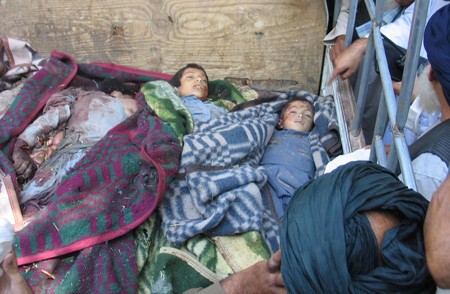
Cluster bombs are in the news again, thanks to a recent report from Amnesty International. The human rights agency has confirmed that 35 women and children were killed following the latest US attacks on an alleged al-Qaeda hideout in Yemen.
Initially, there were attempts to bury the story, and Yemen officially denied that civilians were killed as a result of the December 17 attack in southern Yemen. However, it has been impossible to conceal what is now considered the largest loss of life in one single US attack in the country. If the civilian casualties were indeed a miscalculation on the part of the US military, there should no longer be any doubt about the fact that cluster munitions are far too dangerous a weapon to be utilised in war. And they certainly have no place whatsoever in civilian areas. The human casualties are too large to justify. Yemen is not alone. Gaza, Lebanon and Afghanistan are also stark examples of the untold loss and suffering caused by cluster bombs.
Meanwhile, the unrepentant Israeli army will not consider dropping the use of cluster bombs in civilian areas altogether. Instead it is pondering ways to make them ‘safer’. The Jerusalem Post reported on July 2 that the army “has carried out a series of tests with a bomblet that has a specially designed self-destruct mechanism which dramatically reduces the amount of unexploded ordnance.” During the Israeli onslaught in Lebanon in 2006, Israel fired millions of bomblets. Aside from the immediate devastation and causalities, unexploded ordnance continues to victimise Lebanon’s civilians, most of whom are children. Dozens of lives have been lost since the end of this war.
In Gaza, the same terrible scenario was repeated between 2008 and 2009. Unlike Lebanon, however, trapped Palestinians in Gaza had nowhere to go. Now Israel is anticipating another war with the Lebanese resistance. In preparation for this, an Israeli PR campaign is already underway. It seeks to convince public opinion that Israel is doing its utmost to avoid civilian casualties. “Ahead of a potential new conflict with Hezbollah, the IDF has decided to evaluate the M85 bomblet manufactured by the Israeli Military Industries,” reports the Jerusalem Post. Of course, Israel’s friends will be pleased by the initial successes of the Israeli army testing.
Under pressure to ratify the agreement, these countries are only too eager to offer a ‘safer’ version of current cluster bomb models. This would help not only to maintain the huge profits generated from this morally abhorrent business, it would also hopefully quell growing criticism by civil society and other world governments.
In December 2008, the United States, Russia and China, among others, sent a terrible message to the rest of the world. They refused to take part in the historic signing of the treaty that banned the production and use of cluster bombs.
In a world that is plagued by war, military occupation and terrorism, the involvement of the great military powers in signing and ratifying the agreement would have signaled – if only symbolically — the willingness of these countries to spare civilians’ unjustifiable deaths and the lasting scars of war. Fortunately, the refusal didn’t completely impede an international agreement. The incessant activism of many conscientious individuals and organisations came to fruition on December 3 and 4 in Oslo, Norway, when ninety-three countries signed a treaty banning the weapon.
Not surprisingly, the US, Russia, China, Israel, India and Pakistan – a group that includes the biggest makers and users of the weapon — neither attended the Ireland negotiations of May 2008, and nor did they show any interest in signing the agreement in Oslo.
Most countries that have signed the accords are not involved in any active military conflict. They are also not in any way benefiting from the lucrative cluster munition industry.
But without the involvement of the major producers and active users of the weapon, the Oslo ceremony remained largely symbolic. However, there is nothing symbolic about the pain and bitter losses experienced by the many victims of cluster bombs.
According to the group Handicap International, a third of cluster-bomb victims are children.
Equally alarming, 98 per cent of the weapon’s overall victims are civilians. The group estimates that about 100,000 people have been maimed or killed by cluster bombs around the world since 1965.
Unlike conventional weapons, cluster bomblets survive for many years, luring little children with their attractive appearance. Children often mistake the bomblets for candy or toys.
Recently, some encouraging news emerged from the Netherlands. Maxime Verhagen, Minister of Foreign Affairs, urged his country’s House of Representative to ratify the Convention, which bans the production, possessions and use of such munitions. The ban leaves no room for any misguided interpretations and does not care for the Israeli army’s experimentations. In his speech, Verhagen claimed, “Cluster munitions are unreliable and imprecise, and their use poses a grave danger to the civilian population…Years after a conflict has ended, people – especially children – can fall victim to unexploded submunition from cluster bombs.”
To date, the agreement has been signed by 106 countries and ratified by 36 – and will enter into force on August 1, despite the fact that the big players refuse to take part. The Netherlands’ push is certainly a step in the right direction. But much more remains to be done.
The onus is also on civil societies in countries that are yet to ratify the agreement or sign it in the first place. “All that is necessary for evil to triumph is for good men (and women) to do nothing.” This holds as true in the issue of cluster bombs, as in any other where human rights are violated and ignored.
Ramzy Baroud is a distinguished Arab American commentator and author, most recently, of ‘My father was a freedom fighter’ published by Pluto Press
France probes US submarine link to fishing boat sinking
BBC | July 2, 2010
An investigation into claims that a US nuclear submarine accidentally sank a French fishing boat in 2004, killing five sailors, is to be reopened.
A French appeals court appointed two magistrates to relaunch a probe into the loss of the Bugaled Breizh off the Cornish coast in January 2004.
In particular, they have been asked to try and identify what US submarines were in the vicinity at the time.
The sinking happened a day before Nato military exercises began in the area.
Submarine expert Dominiques Salles said in May the sinking could have been caused by a US nuclear attack submarine.
He suggested the sub may have been spying on a top secret consignment of military grade plutonium, shipped from the French port of Cherbourg to Japan on board a British nuclear transport vessel.
An inquiry in 2008 concluded a nuclear submarine snagging the boat’s trawl was the “highly probable cause” of the sinking, but the judges recommended the investigation be wound up, with no guilty party traced.
Mr Salles’ findings were submitted in a report that had been commissioned by appeal judges in Rennes last November.
The 72ft (23m) Bugaled Breizh, which means “child of Brittany” in Breton, was based at the small port of Loctudy.
Lessons from Camp David
Ten years after Bill Clinton guided failed Israeli-Palestinian peace talks, the idea of a negotiation on equal terms is now defunct
By Ben White | guardian.co.uk | 1 July 2010
Ten years ago this month, Israelis and Palestinians gathered at Camp David, under the guidance of President Bill Clinton, for negotiations aimed at reaching a final agreement. The talks ended in failure, and by the end of September, the second intifada had begun.
The Camp David talks have largely been remembered in the context of apportioning blame. This was particularly true in the first months and years of the Palestinian uprising, as Israel spun the narrative of a rejectionist Palestinian leadership that had turned down an incredibly “generous offer” and instead opted for a campaign of violence.
A host of western commentators and diplomats embraced this propaganda, despite the wealth of contradictory evidence: the misleading percentages, the Israeli/US intention of annexing illegal settlement blocs, the trickery over Abu Dis, and indeed, according to Robert Malley and Hussein Agha, the fact that “strictly speaking, there was never was an Israeli offer” beyond “orally conveyed” proposals.
With American officials acting, in the words of US state department veteran Aaron David Miller, “as Israel’s attorney”, it shouldn’t be too surprising that Arafat refused the Camp David offer that even former Israeli foreign minister Shlomo Ben Ami said he himself would have rejected.
But simply analysing and debating who was responsible for the lack of a deal at Camp David is not enough; nor is it the most important lesson that the anniversary can offer. In the light of Oslo’s ruined remains, a collapsed peace process and an entrenched occupation, a more profound insight is sorely needed.
The Camp David summit was the fruit of the Oslo years, where the international community believed that mutual “confidence-building measures” would lead to final status talks and a permanent deal. In reality, the winners were successive Israeli governments who oversaw settlement expansion and West Bank colonisation, and a Palestinian political-economic elite.
Some thus concluded that the solution is to try and hash it all out together – including “final status” issues – rather than leave the “sensitive” questions to the end. Others have tried to repackage the approach of incrementalism under occupation as grassroots “state-building”. A sense of déjà vu about Israel “handing over” cities to well-behaved Palestinian Authority forces is understandable.
But the real lesson of the anniversary is not a reworking of the Oslo/Camp David framework, but rather the futility of negotiations between unequals. The common thread running from Clinton through to Obama via Bush is one of US partisanship – the world’s most powerful country aiding and covering for an occupying regional superpower against a stateless people.
A decade on from Camp David, it is clear that there can be no resolution of the conflict through the methods of occupation-lite, temporary borders, and “easing of restrictions”. The concepts of honest broker and envoys are bankrupt; what meaning can there be in a peace process that staggers on while Israel – with total impunity – practises collective punishment and facilitates the accelerated colonisation of East Jerusalem? Furthermore, the majority of the Palestinian people – specifically the refugees and those inside Israel – remain unrepresented in the “peace process”.
In the seven years I’ve been going to Palestine/Israel, I’ve watched illegal settlements expand street by street, and the Israeli mechanisms of control of the Palestinians grow ever more sophisticated and entrenched. The facts on the ground multiply each day, as more acres of Palestinian land are transformed into colonies that “everyone” knows will stay under Israeli control.
Israeli and Palestinian leaders will ultimately need to sit down and talk, but it is time for our understanding of how and when to be radically reshaped by Nelson Mandela’s famous words: “Only free men can negotiate.”
Israeli leaders have no intention of relinquishing control of the West Bank and East Jerusalem, nor of recognising fundamental Palestinian rights already spelled out in countless UN resolutions and global treaties. The response of the international community, if it is serious about a sustainable peace, must be enforcement and accountability, not more doomed summits and road maps.
Tony and the Shah of Palestine
Why Tony Blair is the Most Useless Peace Envoy on the Planet
By YVONNE RIDLEY | July 6, 2010
Ever since a group of ordinary people from more than 40 different countries came together and set sail for Gaza have we seen various world leaders scramble to persuade Israel to lift the blockade on Gaza. Why? To honour the memory of those martyred by Israeli soldiers who shot nine unarmed peace activists at virtually point-blank range? Hell no!
They realize that people power has achieved more in that one heroic action, than any of them have achieved for the people of Palestine. And, despite that brutal episode, they know that more flotillas and convoys are being planned because people power is achieving more than anything else has over the past 60 years for the people of Palestine.
The so-called Middle East Peace Envoy Tony Blair certainly does not want to see any more flotillas sailing for Gaza. It’s not because he lies awake at night thinking about the deaths of those innocent humanitarian activists. No, Blair is afraid – very afraid – that people power will expose him for what he is, probably the most useless peace envoy on this planet. Exactly what has he done for the Palestinians since he took the job? Actually it would be easier to list what he hasn’t done:
*HE HAS NOT stopped the land-grabbing Israelis from building ever more illegal settlements in complete defiance of international law.
* HE HAS NOT managed to lift the Siege of Gaza so that the thousands left homeless after last year’s invasion can start rebuilding their homes.
* HE HAS NOT been able to push ahead with an independent UN investigation in to the Israeli raid on and hijacking of the Freedom Flotilla.
* HE HAS NOT been able to stop babies dying in the hopelessly under-equipped Gaza maternity units.
* HE HAS NOT stopped or even attempted to expose the corruption of the Palestinian Authority.
* HE HAS NOT been able to make one iota of progress in fulfilling his job description.
Apart from the Shah of Palestine – Mahmoud Abbas – I am struggling to think of a more redundant individual than Tony Blair, but I’ll come to Abbas later.
Blair was on television recently boasting about how life is improving in the West Bank for the Palestinians and saying that there’s been a reduction in the number of checkpoints. What a stupid, silly, silly little man he is, almost as blinkered as the journalist who was interviewing him. There are fewer checkpoints because the Israelis are grabbing more land and huge swathes of stolen land are merging into other tracts of stolen land, making some checkpoints redundant. That doesn’t change the fact that the West Bank is now a series of small islands, cut off by Israel and its Apartheid Wall and settler-only roads, as well as the illegal settlements.
The inference during the interview was that if the people of Gaza dumped Hamas and put their faith once more in the Fatah-controlled Palestinian Authority then everyone’s lives would be so much easier.
What the journalist failed to ask and Blair failed to address is the fact that even with the horrendous hardships facing the people of Gaza and their children, many Palestinians living in the West Bank are actually worse off. The truth is, children living in the poorest parts of the occupied West Bank face significantly worse conditions than their counterparts in Gaza, according to a report by Save the Children UK.
The European Commission-funded study found that in “Area C” – the 60 percent of the West Bank under direct Israeli control – the poorest sections of society are suffering disproportionately because basic infrastructure is not being repaired due to Israel’s refusal to approve the work. Homes, schools, drainage systems and roads are in urgent need of repair, but instead of work being allowed, families are being forced to live in tents and do not have access to clean water. Restrictions on the use of land for agriculture have left thousands of Palestinian children without enough food and many are becoming ill as a result, the study found.
Conditions in Area C have reached “crisis point”, says Save the Children, with 79 percent of the local communities surveyed lacking sufficient food, a greater proportion than in blockaded Gaza, where the figure is 61 percent. Many children living in such communities are showing signs of stunted growth, with the figure running at more than double Gaza’s rate, and more than one in ten children surveyed for the study were found to be underweight.
So there you have it – the Shah of Palestine has delivered nothing but more hardship for his own people in the West Bank while lining his own pockets and those of his enforcers. Abbas has been praised by Tony Blair for making friends with Israel and proving he’s someone the West can do business with. This might be true but in the process he has well and truly sold his own people down the river and I hope they punish him in the ballot box, should there ever be another free and fair election.
No wonder Mahmoud Abbas has no time for the human rights activists and humanitarian aid workers who put their lives on the line to launch the Gaza-bound Freedom Flotilla. But that’s nothing new. I remember in 2008 being slightly crestfallen after arriving on the shores of Gaza on board one of the first boats in the Free Gaza Movement only to learn Abbas had brushed away our efforts with a shrug of the shoulders. Still, none of us were in it for the glory, we just wanted to raise public awareness about the Siege of Gaza, and I think it’s fair to say that virtually the whole world now knows about the Siege of Gaza and the brutality of the Israeli government. Why? Because of the efforts of those on board the Turkish-led flotilla, that’s why. The reality is that charities like the Turkish IHH and the UK-based Interpal, the Free Gaza Movement, Viva Palestina and other groups such as the International Solidarity Movement, have done so much more for the people of Palestine than the politicians.
That is why we can never leave Palestine to the politicians; if we had done so it would have been wiped off the face of the map completely by now. Instead, thanks to people power, Palestine has a global support movement among hundreds of thousands, if not millions, of ordinary people. We are too many in number to be bought off by the Israeli lobbies, and are too pure in heart to want our palms greased by even greasier individuals. We are people of all faiths and no faith, many cultures, skin colours, nationalities and political beliefs. We are going to cause great pain – as is already evident – through our boycotts of Israeli goods and products and we will continue until the Apartheid State of Israel is a fading memory just like the Apartheid State of South Africa.
It doesn’t matter how many corrupt politicians there are in the pay and sway of Tel Aviv, we, the ordinary people of the world, outnumber you and we are growing in number and strength.
There are more flotillas being planned, more land convoys in the making and more ordinary people prepared to step up to the plate to do what it takes to free Palestine. And we will. When the people lead the leaders must follow or they will become irrelevant and redundant. Just like Mr. Tony Blair.
Yvonne Ridley was on board the first boat to break the siege of Gaza with the Free Gaza Movement and she is one of the founders of Viva Palestina. She is also the European President of the International Muslim Women’s Union.
Featured Video
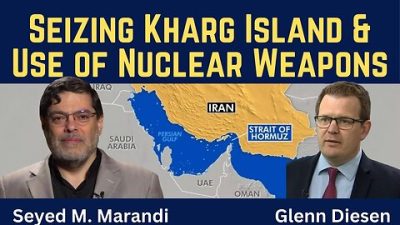
Marandi: Threat of Seizing Kharg Island & the Use of Nuclear Weapons
or go to
Aletho News Archives – Video-Images
Frlom the Archives
Provoking a Path to Persia
The Saban Center’s prescient paper on war with Iran
By Maidhc Ó Cathail | October 20, 2011
In June 2009, the Saban Center for Middle East Policy published “Which Path to Persia?—Options for a New American Strategy toward Iran.” Writing in a tone strikingly reminiscent of the Project for a New American Century’s infamous pre-9/11 paper “Rebuilding America’s Defenses,” the six co-authors noted that, “It seems highly unlikely that the United States would mount an invasion without any provocation or other buildup.” For a think tank specifically established by media mogul Haim Saban to protect Israel, this could prove to be a formidable obstacle impeding their desired march—of U.S. troops—to Tehran.
“In fact, if the United States were to decide that to garner greater international support, galvanize U.S. domestic support, and/or provide a legal justification for an invasion, it would be best to wait for an Iranian provocation, then the time frame for an invasion might stretch out indefinitely,” Saban’s think-tankers ruefully observed.
“With only one real exception, since the 1978 revolution, the Islamic Republic has never willingly provoked an American military response, although it certainly has taken actions that could have done so if Washington had been looking for a fight. Thus it is not impossible that Tehran might take some action that would justify an American invasion. And it is certainly the case that if Washington sought such a provocation, it could take actions that might make it more likely that Tehran would do so (although being too obvious about this could nullify the provocation). However, since it would be up to Iran to make the provocative move, which Iran has been wary of doing most times in the past, the United States would never know for sure when it would get the requisite Iranian provocation. In fact, it might never come at all.”
Seemingly undeterred by Iran’s frustrating unwillingness to provide the requisite provocation, the analysts continued to examine this option… continue
Blog Roll
 Aletho News
- Ukrainian Embassy in Beirut sheltering top Mossad agent
- Palestinian family displaced after settlers violently attack them in Humsa, Jordan Valley
- The EU never learns – except for the wrong lessons
- Iran attacks on UAE leaves RSF militia high and dry
- Hosting Washington’s war: Bahrain faces the consequences
- The US fell for its own Iran propaganda
- Seyed M. Marandi: Threat of Seizing Kharg Island & the Use of Nuclear Weapons
- Is there even an off ramp?
- Michael von der Schulenburg: Europe’s Self-Defeating Iran War Policy
- Sorry, The New Republic, Climate Change Isn’t Causing Somali Migration. Blame Civil Strife and Poverty.
- If Americans Knew
- ‘Of Course’: IDF Drops Case Against Soldiers Accused of Raping Palestinian Prisoner
- Don’t Fall for the Regime Change Talk. Israel Is ‘Mowing the Lawn’ in Iran
- Will Israel and the US wreck the Gulf States along with Iran?
- US so far burned through ‘years’ of munitions in Iran war: Report
- How the Israeli Tail Wags the American Dog
- Outdated intel likely led to deadly U.S. strike on Iranian elementary school, sources say
- Pentagon insider says high U.S official Douglas Feith reported to Netanyahu
- In fond memory of Walid Khalidi, the historian of Palestine
- 6 more Americans killed, as Israel ‘mows the lawn’ in Iran – Not a ceasefire Day 154
- Are we on the precipice of World War III?
- No Tricks Zone
- New Studies: UK Sea Levels Were 4 Meters Higher Than Today During The Mid-Holocene
- Destructive Green New Deal: German Energy And Metal Group Warns Of Drastic Crisis
- New Study Documents A 20-Year Pause In Arctic Sea Ice Decline – Driven By Internal Variability
- Wake-up Call: Survey Shows Majority Of Germans Now Favor Postponing Climate Targets!
- Televised! Leading German Political Candidate Tells Schoolchildren CO2 Makes Sun Hotter!
- New Study: A Century Warming Of 1.1°C Is ‘Commonplace’ And ‘Not Unusual’ During This Interglacial
- New Study: ‘Internal Noise’ And Volcanic Forcing Can Trigger 10-15°C Warming Within Decades
- Glaciers Worldwide Are Suddendly Surging, Experts Blame Warming!
- Surprising Discovery: Sahara Is Greening…Billions Of Trees Where Once Thought To Be Barren
- New Research Reaffirms Clouds, Aerosols, And Surface Solar Radiation Are ‘Driving The Climate System’
 Aletho News