Settled science: Can everyplace really be warming much faster than everyplace else?
Tom Nelson | July 24, 2010
Prof Gordon Conway, the outgoing chief scientist at the British government’s Department for International Development, and former head of the philanthropic Rockefeller Foundation, said in a scientific paper that the continent is already warming faster than the global average
North Pole Heating Faster than anywhere else
Many scientists seem mystified as to why the North Polar region is warming up several times faster than the rest of the planet.
Australia warming faster than rest of globe, climate report says
Kuwait: Alarm as Gulf waters warm three times faster than average
The seawater temperature in Kuwait Bay has been increasing at three times the global average rate since 1985
Antarctic air is warming faster than rest of world – Times Online
AIR temperatures above the entire frozen continent of Antarctica have risen three times faster than the rest of the world during the past 30 years.
Tibet warming up faster than anywhere in the world | Reuters
(Reuters) – Tibet is warming up faster than anywhere else in the world, Xinhua news agency said on Sunday.
European temperatures rising faster than world average, report says – The New York Times
Sundarbans water warming faster than global average
In the Sundarbans, surface water temperature has been rising at the rate of 0.5 degree Celsius per decade over the past three decades, eight times the rate of global warming, says a new study.
Climate change heating up China faster than rest of the world – report
In a new report, the China Meteorological Administration now says climate change is heating up the People’s Republic faster than the rest of the world
Global warming hits Mars too: study
Global warming could be heating Mars four times faster than Earth due to a mutually reinforcing interplay of wind-swept dust and changes in reflected heat from the Sun, according to a study released Wednesday.
Spain warming faster than rest of northern hemisphere: study
The country has experienced average temperature increases of 0.5 degrees Celsius per decade since 1975, a rate that is “50 percent superior to the average of nations in the northern hemisphere”, the study by the Spanish branch of the Clivar research network found.
U.S. West warming faster than rest of world: study
LOS ANGELES (Reuters) – The U.S. West is heating up at nearly twice the rate of the rest of the world and is likely to face more drought conditions in many of its fast-growing cities, an environmental group said on Thursday.
A New Leaderboard at the U.S. Open « Climate Audit
Four of the top 10 are now from the 1930s: 1934, 1931, 1938 and 1939, while only 3 of the top 10 are from the last 10 years (1998, 2006, 1999). Several years (2000, 2002, 2003, 2004) fell well down the leaderboard, behind even 1900.
Global warming is occurring twice as fast in the Arctic as in the rest of the world
Lake Superior is Warming [much stronger than the global average]
The really striking thing here is that the long-term trend in Superior is so much stronger than the global average. Well, we know that the upper midwest is warming more rapidly than the global average, but not this much more rapidly.
Himalayas warming faster than global average
New Delhi, June 4 (IANS) Northwestern Himalayas has become 1.4 degrees Celsius warmer in the last 100 years, a far higher level of warming than the 0.5-1.1 degrees for the rest of the globe, Indian scientists have found.
[Korean Peninsula]: Allegedly warming twice the global average]
According to the Korea Meteorological Administration, the climate has been warming on the Korean Peninsula twice more rapidly than in the rest of the world over the past century.
Let the apologies to Goldstone begin
By Philip Weiss on July 25, 2010
I missed this. After the Israelis came out with their lame investigation saying that they would indict several officers and soldiers in four cases arising from the Gaza conflict of ’08-’09, a fairminded South African columnist, Allister Sparks, published an important piece a few days ago, calling on South African rabbis to apologize to Judge Richard Goldstone for slamming Goldstone’s report last year.
The significance of the piece was explained to me by a friend: “This is an important statement recognizing that even the Israeli Gov’t is finding truth to the report’s findings—–it’s the beginning of a vindication of Goldstone… So why isn’t it all over the place that some of the findings in the report–a report that had been totally trashed by the Israeli gov’t and friends–are proving to be true? …Shouldn’t we challenge the overall attack on Goldstone and the report — like the SA rabbi being called to make a public apology?”
Great point. Here is Sparks’s case. Beautiful story about Naude, beautiful writing:
Chief Rabbi Warren Goldstein… chastised Goldstone for “doing great damage to the state of Israel”. He should have recused himself instead, Goldstein said, and taken no part in the investigating mission.
I have had difficulty understanding what the chief rabbi meant by this.
Goldstein is a trained lawyer as well as a rabbi. Did he mean that no Jew, however professionally disciplined — and Judge Goldstone’s legal reputation is among the highest in the world — can be objective when it comes to a matter involving Israel?
And if so, does that involve Jews individually or collectively as well, or just the interests of the state of Israel? Or did he mean that it is a Jewish person’s inherent duty either to set aside his professional ethics and find in favour of the state of Israel regardless of the merits of a case or, if that is unacceptable, to recuse himself? But that for a Jew to find against Israel is traitorous?
…I am reminded here of the conflict between the Dutch Reformed Church and Beyers Naude over the issue of apartheid.
I attended the Dutch Reformed Church service in Linden, Johannesburg, at which Naude had to respond to the church leaders’ demand that he choose between the church’s doctrine of support for apartheid and his commitment to the nonracial Christian Institute he had founded.
In other words, Naude was forced to choose between his moral principles and his loyalty to his own people and their church.
I heard Naude announce his decision that memorable day before the glitterati of Afrikaner nationalism in the packed pews before him. Smilingly, boldly, he told them simply: “I choose God before man.”
In other words, principles, truth and justice before ethnic or group loyalty. It was the defining moment of that great man’s life.
So I ask the chief rabbi that same question today: what is your choice? Then, at the level of plain human decency, don’t you think, Chief Rabbi Goldstein and those members of the Orthodox Jewish community and the South African Zionist Federation whom you lead, that you owe Judge Goldstone an apology? A public, abject apology.
Facebook: “No Palestinian Pages”
By Jilian C. York | July 25, 2010
I was surprised, but a little skeptical, this morning when I read a blog post stating that Facebook is blocking the word “Palestinian” from its Pages. After all, a search for “Palestinian” brings back a number of already created Pages. Here’s what the blogger wrote:
I thought it might be a good idea to make a Facebook page for Palestinian Refugee ResearchNet—a straight-forward thing to do, right? Apparently not, since it seems the very word Palestinian may “violate or page guidelines or contain a word or phrase that is blocked”……A mistake, perhaps? Well, Afghan Refugee ResearchNet is OK. So too is DR Congo RefugeeResearchNet. No threats to innocent Facebook users lurking in those terms, it seems…
…Are Palestinians the only group so banned? Well, not really… after a little fiddling around, I discovered that al-Qaida Refugee ResearchNet and Nazi Refugee ResearchNet are banned too.
It does seem a bit odd, however, that a population of up to 12 million people, receiving more than a billion dollars in international aid, recognized by the UN, and enjoying a degree of formal diplomatic recognition from the United States—is placed in the same banned category as Nazis and al-Qaida.
Odd, indeed. I decided to try it for myself, with the terms “Palestinian Refugee ResearchNet,” “Palestinian Folklore,” and “Palestinian Music”. Nada.
Of course, “Israeli Music,” “Israeli Folklore” and “Israeli Refugee ResearchNet” all created no problems.
What is Facebook trying to accomplish by eliminating page creation for a marginalized population? I would guess that they were trying to prevent abuse of some kind (e.g., pages set up to demean a certain group), but I can’t imagine what kind of abuse would affect Palestinians and not, for example, Israelis.
In any case, as usual, Facebook does not have a strong customer support team to handle complaints about this, nor do they seem to care. After all, this was their response to the blogger who first documented this:
Unfortunately, we cannot process this request. Your Page name must comply with the following standards:
- Accurately and concisely represent a musician, public figure, business or other organization
- Not contain terms or phrases that may be abusive
- Not be excessively long
- Not contain variations of “Facebook”
If you believe your Page name fits within these guidelines, please respond to this email and we will re-evaluate your request.
Again, activists, I would advise you to stop using Facebook.
The Gaza “shopping mall”: reality and hasbara
By Ali Abunimah | July 25, 2010
When he came to Washington a few months ago, Israeli Prime Minister Benjamin Netanyahu was touting the multiplex cinemas and shopping malls that have supposedly sprouted up in the West Bank as evidence of the “economic renaissance” going on there. There is no such economic renaissance — it is a mirage promoted by Israel and its collaborators — under the rubric of “economic peace.” In fact, in large parts of the West Bank, people are poorer even than in Gaza, which is saying something given the wretched poverty and unemployment in Gaza.
Now, Israel’s supporters have leapt on a minor story — the opening of a shopping “mall” in Gaza — to perform a similar hasbara trick: ‘there is no poverty in Gaza, no siege, no hunger, no malnutrition. Just look at them, they are living better than we do!’ I have seen such messages on many right-wing and pro-Israel sites.
Israel’s Ynet reported:
While Hamas continues to demand a full lifting of the blockade, the Gaza market seems to be doing alright. Gaza Mall, the first ever shopping center in the Strip was opened last Saturday with masses storming the new attraction.
The two-floor compound, each stretching over roughly 9,700 sq. ft, offers international brands as well as much-needed air conditioning. Tens of thousands of shoppers from Rafah to Beit Hanoun have already visited the site within a matter of days, making the center Gaza’s new craze.
First, note that the reported size is about 20,000 square feet (1,850 square meters). To put this in perspective, the average size of a Wal-Mart store in the US is five times larger than the entire Gaza “mall”: 108,000 square feet (with the largest Wal-Mart stores going up to 185,000 square feet!).
Now I have received this eyewitness account from a source in Gaza:
“I found out about the Gaza mall. Yes it exists. The goods in there are very expensive and it’s not a real mall, barely bigger than a little supermarket. It has 4 sections, one sells vegetables grown in Gaza, the 2nd section sells clothes and shoes, a 3rd section is like a huge supermarket with things brought to Gaza through the tunnels, and the last sells electric materials, TVs, stereos… The owners are very rich people in the Gaza Strip. Most of the stuff being sold are either made in Gaza, or brought via tunnels. And there are no thousands visitors, when I went there, I saw about 15-20 people only.”
Gaza is a territory with 1.5 million people. They ought to have a normal life. That this small store is being celebrated as a major achievement shows just how hard the Israeli siege is biting. It also shows — as I reported in a previous blog post — that the siege is producing a small wealthy economic elite, while the vast majority suffers.
Britain’s secret rendition programme
By Robert Verkaik | The Independent | July 23, 2010
MI5 was directly involved in the rendition of a Moroccan national, illegally taken from a Belgian prison to work for Britain’s Security Services in London, an investigation by The Independent has discovered.
The man, now aged 29 and who cannot be named for his own safety, was secretly transferred from a Brussels jail in April 2004 and then further held and interrogated by senior MI5 officers at a secret base near London.
Documents seen by The Independent show that in September 2003 a Belgian court sentenced the man to four years in prison for the use of false documents and association with terror suspects. Yet less than a year later Home Office papers reveal that the Moroccan, who was born in Rabat, was in Britain and had been granted leave to remain in the UK by the British Government.
The Home Office document, dated 4 November 2004, says: “It has been decided that the Secretary of State’s discretion should be exercised in your favour and you have been granted limited leave to remain in the United Kingdom for a reason not covered by the Immigration Rules.”
The case is the first evidence of a UK-based rendition recruitment programme operated by the Security Service after the 11 September attacks on America. Until now, Britain’s involvement in the practice appeared to be limited to providing assistance to American renditions.
In an interview with The Independent, the man’s Belgian lawyer, Christophe Marchand, said that the rendition took place while the suspect was waiting to appear before the central criminal court in Brussels in relation to his appeal.
Mr Marchand, Belgium’s foremost defence attorney and author of the book European Trends on the War on Human Rights, said his client, then 23 years old, had been questioned by MI5 agents in Forest Prison in Brussels where he had been detained without trial and held in solitary confinement for more than two years. During his later interrogation and detention at an MI5 safe house 40 minutes from central London, the man did not have access to a lawyer.
Last night MPs and human rights groups said the case illustrated the extent of Britain’s illegal role in the war on terror. Andrew Tyrie MP, chairman of the All Party Parliamentary Group on Extraordinary Rendition, said: “If it were to turn out that this man had been transferred to the UK against his will and against due legal process, we should well be concerned. Stories such as this underline the need for an inquiry to get to the bottom of what happened after 11 September.”
Clive Stafford Smith, director of the legal charity Reprieve, said: “We simply cannot be in the business of snatching people from foreign countries without any legal process. Why have we fought for the rule of law for all these decades if it is simply to be ignored when the Security Services decide it is not convenient to let judges into the debate?”
Mr Marchand suspects that the deal must have been approved by Belgium’s security services and the state prosecutor. A year after his mysterious disappearance from prison, the Moroccan national contacted Mr Marchand. “We met in central London. He told me the whole story about how MI5 had arranged for his release and secret flight to London on a specially chartered British Airways aircraft. He told me he felt vulnerable in prison and didn’t think he would ever be released. He feared being returned to Morocco even more because he felt sure that he would be tortured.
“They told him that if he agreed to work for MI5 he would have a new life in the UK. But he was very vulnerable at this time, he was young and held in solitary confinement where he was psychologically weak. He believed he had no choice. Once he arrived in the UK he was told that if he ever told anyone who he was working for his life would be in danger from al-Qa’ida. He told me that he thought this was an explicit threat that MI5 would make sure al-Qa’ida knew his identity if he ever broke his agreement with the Security Service.”
Mr Marchand, an international expert in human rights law, accused Britain of being directly involved in rendition. “Of course it is rendition – it is the illegal transfer of someone from one country to another. He was transferred from Belgium without any legal safeguards. It is a very clear violation of the rule of law. Pressure was huge on him because he knew he was condemned to years in prison.”
A spokeswoman for the Belgian embassy in London said she was aware of the case and the “disappearance” but could give no further details.
Lieve Pellens, of the Belgian Federal Prosecutors Office in Brussels, said she was sure the Prosecutors Office was “not implicated” in such an arrangement. “If a foreign authority wants to question someone held in the Forest Prison then they have to make a special request and we have to ensure that a Belgian officer is present,” said Ms Pellens.
A spokeswoman for the Security Service said: “We do not comment on individuals. We do not comment on operational security matters.”
Rendition: Explained
* Countries wishing to transfer a suspect from one state to another for arrest, detention or interrogation must operate through the judicial process, usually by making an extradition request.
* Where such transfers occur outside a legal framework, such as in the Brussels case which we have reported today, they are referred to as renditions.
* America’s extraordinary rendition programme involves the further element of torture, usually by a third-party proxy state. In the Brussels case the Moroccan suspect faced the prospect of torture in his homeland and could not freely give consent for his transfer to Britain.
* Upon his transfer to the UK he was held in an MI5 safe-house, where he was interrogated without legal representation. All the time he knew he was at risk of deportation.
Suspect in murder of four Palestinians was Shin Bet agent
By Jonathan Cook | The National | July 24. 2010
NAZARETH // The arrest by the Israeli internal security service, the Shin Bet, of an Israeli Jew accused of killing at least four Palestinians has thrown a rare light on the secret police, including claims that it tried to enlist the accused to assassinate a Palestinian spiritual leader.
Chaim Pearlman, who was arrested on July 13, has been charged with murdering four Palestinians in Jerusalem and injuring at least seven others in a series of knife attacks that began more than a decade ago. Police are still investigating whether he was involved in additional attacks.
Although Mr Pearlman had been denied access to a lawyer until Friday, since his arrest far-right groups have rapidly come to his aid, waging what the Shin Bet officials have described as “psychological warfare” by releasing damaging details about the case.
Ties between the Shin Bet and illegal settler organisations have come to light after Mr Pearlman’s arrest. The Shin Bet have been cornered into admitting that they recruited Mr Pearlman as an agent in 2000, in the midst of his alleged stabbing spree, despite the fact that he was a known member of Kach, an outlawed group calling for the expulsion of Palestinians from “Greater Israel”.
In addition, Mr Pearlman has also released tape recordings he secretly made of recent conversations with an undercover Shin Bet agent who tried to get Mr Pearlman to incriminate himself.
The agent, who befriended Mr Pearlman and was known as “Dada”, can be heard exhorting him both to go to an “Arab village” to “turn it into a fireworks display” and to execute Sheikh Raed Salah, a leader of the Islamic Movement and a recent participant in the aid flotilla to Gaza that was attacked by Israel.
In the 20 hours of recordings with Dada, some of which have been broadcast on Israeli television, the undercover agent can be heard repeatedly inciting Mr Pearlman to kill Sheikh Salah,
Dada says: “Why haven’t soldiers killed Raed Salah, may he die? Someone should take care of him, send him to the next world.”
He then suggests Mr Pearlman shoot at the sheikh’s car or put a bomb under it. “That’s the classic one. Nothing’s left, everything goes everywhere,” he says on the recording.
Dada’s advice came after Sheikh Salah had stated that Israeli commandos aboard Mavi Marmara ship had tried to kill him. Mr Pearlman, who apparently suspected he was being investigated, sent the recorded conversations with Dada to local media to be broadcast in the event of his detention.
In another blow to the Shin Bet, Mr Pearlman’s supporters have released a secretly filmed video of the head of the agency’s Jewish division, which arrested Mr Pearlman, naming him and identifying where he lives.
Although the agent is in charge of handling “Jewish terror” cases, the video states that he lives in Kfar Adumim, a West Bank settlement.
It is a criminal offence to identify any employee of the Shin Bet, but the release of details about such a senior figure is certain to provoke fears among officials that he may be in danger, including revenge attacks or future prosecution in an international tribunal.
Mr Pearlman’s supporters have posted the video on YouTube and other overseas websites, making it difficult for the Shin Bet to remove.
Nadia Matar, the leader of the pro-settler group Women in Green, told the Jerusalem Post last week that the Shin Bet divisional head “has to know that there is a price to stabbing Jewish brothers in the back. People have to be loyal or bear the consequences.”
The Shin Bet’s modus operandi was exposed in part by a rare decision from the judge supervising the investigation to partially revoke a gag order immediately after Mr Pearlman’s arrest.
Abir Baker, a lawyer with Adalah, a legal centre that handles Palestinian security cases, said: “The Shin Bet is facing an internal crisis over this arrest and the settlers are trying to exploit that with their campaign.
“Many members of the Shin Bet are settlers themselves and think of these extremists as their colleagues, not as the enemy. The line between the Shin Bet and these extremist organisations is very blurred.”
Unlike in the case of Palestinian attacks on Israelis, attacks by Jews on Palestinians are rarely solved, leading to criticism that the Shin Bet is not serious about tackling the problem of Jewish terror.
Amir Oren, a columnist for the liberal Haaretz newspaper, accused the Shin Bet of having “chains on its feet and weights around its neck” when it investigated such cases.
Yaakov Teitel, a settler who was arrested by the Shin Bet last year, was accused of his first murder of a Palestinian 14 years ago. Some observers have suggested he was only arrested after he started attacking left-wing Jews, including placing a bomb at the home of a prominent academic in 2008.
Ms Baker said Jewish terrorists often found it easy to evade the Shin Bet because they had learnt about the organisation’s investigation techniques while working as agents.
Although Mr Pearlman, 30, was living in the Israeli town Yavne, north of Ashdod, at the time of his arrest, he was raised on a settlement and spent time living in Kfar Tapuach, which is closely identified with the Kach movement. Despite being illegal, Kach operates relatively openly in settlements and Mr Pearlman’s connections to the group may explain the well-organised campaign quickly mounted in his defence.
Itamar Ben Gvir, a parliamentary aide to Michael Ben Ari, an MP who has maintained ties to Kach, was reported by the Israeli press to be behind the media campaign against Shin Bet. Mr Pearlman is also being helped by Honenu, a legal organisation that defends Jews accused of attacking Palestinians.
Anonymous Shin Bet officials told Channel 2 television that the campaign being waged against them by the far-right was “a completely different game” from previous confrontations.
foreign.desk@thenational.ae
Eritrea says talks not force right approach to Somalia
AFP | July 24, 2010
Africa should talk to Somalia’s Shebab rebels instead of sending in more troops, Eritrea said Saturday as the continent’s leaders gathered in Kampala for a summit dominated by the Somali conflict.
Two weeks after suicide attacks claimed by the Al Qaeda-linked group killed 76 people in the Ugandan capital, the African Union announced more troops were on the way to boost its AMISOM force in Mogadishu.
But Saleh, who dismissed accusations that Eritrea has been supporting the Shebab, warned that further troop deployments would only exacerbate regional insecurity.
“We believe that military involvement can not bring a peaceful solution,” Eritrean Foreign Minister Osman Saleh told AFP on the sidelines of the pre-summit ministerial gathering.
AMISOM was first deployed in 2007 to protect the western-backed transitional federal government (TFG) in Mogadishu. But it has failed to stabilise the country and been pinned back by the Shebab and their Hezb al-Islam allies.
“We say that priority should be given to a political situation,” he added.
“An all-inclusive political process has to take place, including Shebab, Hezb al-Islam, the TFG, Puntland and Somaliland,” he said referring to the rival movements and breakway regions inside Somalia.
The AU’s top executive, Jean Ping, announced on Friday that Guinea was ready to send a battalion to boost AMISOM’s current troop level, which currently comprises just over 6,000 Ugandans and Burundians.
Angola, Mozambique and South Africa are also expected to contribute forces, according to diplomats.
Some observers believe a beefed-up AMISOM could significantly weaken the Shebab and reduce their presence in Mogadishu if given a more robust mandate: the force’s present task however is mainly to protect the Somali government.
Saleh however drew parallels with Afghanistan, where an international force led by the United States has been bogged down in a fight against Taliban insurgents since 2001.
“There may be certain terrorist elements, but how can we wipe out this thing? Not by bringing international forces inside,” he said.
“Otherwise it’s going to be like Iraq and Afghanistan. The issue in Afghanistan is not solved… Now they are saying that we have to deal with constructive engagement with the Taliban. Why not here?” Saleh added.
“AMISOM might increase its size now and then, but so did Ethiopia,” he continued, referring to the December 2006-January 2009 Ethiopian military intervention in Somali in support of the government there.
“They did nothing but create the worst humanitarian situation in the world. In this way you can not save Somalia,” Saleh added.
The Eritrean minister will represent President Isaias Afeworki, who has rarely attended the bloc’s meetings since the 1998-2000 war with Ethiopia, where the AU’s headquarters are located.
Some African diplomats are sceptical of Asmara’s renewed involvement in the bloc’s activities, which contradicts Isaias’ longstanding criticism over a perceived bias towards Addis Ababa.
They say Eritrea is only acting after it was slapped with UN sanctions in 2009 over the “destabilising” impact of its alleged involvement in Somalia on the region.
Earlier in March, a UN report claimed the Red Sea state continued to support armed Islamist groups fighting the Somali government, in violation of an arms embargo.
On Tuesday, a senior US lawmaker called for Eritrea to be added to a terrorism blacklist, which currently only includes Cuba, Iran, Sudan and Syria.
Saleh dismissed the claims however.
“This is an allegation that doesn’t have any evidence. We haven’t supported the Shebab,” he said.
VENEZUELA BREAKS RELATIONS WITH COLOMBIA
By Eva Golinger | July 22, 2010
President Chavez ordered maximum alert on Venezuela’s border with Colombia after the Uribe administration made grave accusations against Venezuela claiming the Chavez government harbors terrorists and terrorist training camps
The outgoing government of Alvaro Uribe in Colombia gave a shameful presentation before member states of the Organization of American States (OAS) on Thursday, reminiscent of Colin Powell’s “weapons of mass destruction” power point evidence presented in 2003 before the United Nations Security Council to justify the war in Iraq.
Colombia alleged that Venezuela is harboring “terrorists” from the Armed Revolutionary Forces of Colombia (FARC) and the National Liberation Army (ELN) and hosting several “terrorist training camps” near the border region that divides the two nations.
During an extraordinary session convened at OAS headquarters in Washington on Thursday, upon request of the Uribe government, Colombia’s ambassador to the OAS, Luis Alfonso Hoyos, presented television and video images allegedly taken from computers confiscated during the illegal invasion of Ecuadorian territory on March 1, 2008, which resulted in the death of FARC leader Raul Reyes and a dozen other Colombian, Ecuadorian and Mexican citizens. Hoyos also presented several computer-generated maps and photographs of alleged members of the FARC, which he said were taken inside Venezuela.
NO REAL PROOF
Yet none of the images were authenticated or verified as reliable by any source other than the Colombian government. Colombia also used satellite map images, some from Google Earth, to show alleged “coordinates” where FARC members are in Venezuela.
Furthermore, the photographs presented by Hoyos had no source identification, dates or times, and merely showed alleged members of the FARC and ELN in different jungle and coastal areas.
Venezuela and Colombia share a porous, jungle and mountainous border and both countries have Caribbean coasts. The countries have similar vegetation, climate and scenery.
Venezuela’s ambassador to the OAS, Roy Chaderton said the photographs looked to him as though they had been taken in Colombia. “That looks like the beach in Santa Marta to me”, responded Chaderton, after Hoyos claimed a photo of a FARC member drinking a beer on the beach was taken at Chichirivichi, a Venezuelan beach town.
“There is no evidence, not a single piece of proof, of where those photographs were taken”, said Chaderton, adding that the “evidence” presented by Colombia was “confusing, imprecise and non-convincing”.
The Venezuelan army verified and thoroughly inspected the locations and coordinates provided by the Uribe administration on Thursday and found none of the alleged “terrorist sites”, “camps” or “guerrilla presence” claimed by Colombia.
Upon arriving at the first coordinate indicated in Colombia’s report, identified as an alleged terrorist camp of alias Ruben Zamora, the Venezuelan army found a farm growing plantains, yucca and corn. The second coordinate, which was the alleged camp of FARC commander Ivan Marquez, was merely an extensive field with no structures or presence of anyone or anything.
INTERNATIONAL INTERVENTION
During his two-hour long flamboyant presentation, Hoyos called for “international intervention” in Venezuela to verify the campsites and gave Venezuela a “30-day ultimatum”.
“Colombia requests a commission of international members, including all those of the OAS, go to Venezuela and verify each of the terrorist camp sites and coordinates to see the truth”, said Hoyos, adding, “we give the Venezuelan government 30 days”, although he didn’t specify what could happen afterward.
Hoyos also accused the Venezuelan government of facilitating drug trafficking, money laundering, illegal arms trade, attacks against Colombian armed forces and even went so far as to allege the Chavez government “squashes its opposition”, “represses freedom of expression”, “insults other governments” and “violates principles of democracy”.
At the same time, Hoyos said his government would be unwilling to listen to or respond to any accusations, insults or offenses made by the Venezuelan government.
Colombia’s position is an echo of Washington’s, which has accused Venezuela of harboring and providing refuge to members of the FARC during the past seven years. But, the US government has also failed to present any evidence to back such claims, and often makes contradictory statements, which appear to confirm the lack of solid proof.
In March 2010, US Southern Command (SOUTHCOM) chief General Douglas Fraser said that he had seen no evidence of any links between Venezuela and the FARC. “We have not seen any connections specifically that I can verify where there has been a direct government-to-terrorist connection”, declared Fraser during a hearing before the US Senate Armed Forces Committee.
However, the following day, General Fraser contradicted himself before the press, stating, “There is indeed clear and documented historical and ongoing evidence of the linkages between the Government of Venezuela and the FARC”.
Possibly, Fraser was referring to previous governments in Venezuela, such as those of Carlos Andres Perez (1989-1993) or Rafael Caldera (1994-1998), which actually housed an office of the FARC in the presidential palace. President Chavez shut down that office when he entered the presidency in early 1999.
Or maybe General Fraser was referring to the specific requests made by two Colombian presidents, Andres Pastrana and Alvaro Uribe, for Chavez to mediate the release of hostages held by the FARC.
With full disclosure and complete authority from President Alvaro Uribe, and based on his own personal request, in September 2007, President Chavez accepted the role as mediator in order to secure the release of several hostages held by the FARC inside Colombian territory. For that reason only, Chavez met with FARC commander Ivan Marquez and assured the release of Clara Rojas and Consuelo Gonzalez in January 2008.
But otherwise, the Venezuelan government has consistently and repeatedly denied any links or support given to the FARC or any other armed, irregular group from Colombia or elsewhere.
RELATIONS BROKEN
After Colombia’s presentation before the OAS, President Chavez announced a complete rupture in relations.
“It is with tears in my heart that I announce that we will break all relations with Colombia. We have no other choice, for our dignity and our sovereignty”.
Chavez also ordered troops to secure all border areas. “I have ordered a maximum alert on our borders. Uribe is a mafioso and a liar, and is capable of anything”, he said, recalling how Uribe ordered the invasion of Ecuador’s territory in 2008 and then lied to President Rafael Correa about what had happened.
Venezuela accused Colombia of failing to resolve its own internal conflicts, including a 60-year old civil war that has negatively impacted its neighbors with violence and drug trafficking spilling over the borders. More than 4 million Colombians, fleeing the violence in their country, live in Venezuela today.
The Colombian “show” appears to be an effort to justify preemptive war against Venezuela. Last year Colombia opened its territory to seven US military bases in an agreement that the US Air Force claimed was necessary in order to conduct “full spectrum military operations” throughout South America to “combat the constant threat of anti-American governments in the region”.
Veiled women kicked off London bus
Press TV – July 24, 2010

An investigation has been launched in response to allegations by two Muslim students that they were banned from boarding a London bus because of their veils.
The two Muslim students claim that the driver of a Metroline bus refused them entry onto the bus, claiming they posed “a threat,” The Independent reported on Saturday.
One of the women was wearing a hijab while her friend, Atoofa, was wearing a niqab which covers the face.
One woman, Yasmin, told the BBC, “When I went forward to show my ticket, he said, ‘Get off the bus.’ I presumed he was still angry because I got on the bus before.
“He said, ‘I am not going to take you on the bus because you two are a threat.’ I realized… this may be a racist attack.”
Yasmin then began to film the driver with her mobile phone and said he covered his face with a magazine. “I said, ‘It’s OK for you to cover your face on my recording, but it’s not OK for my friend to cover her face out of choice,’” the London Evening Standard quoted her as saying.
The Muslim Council of Britain stated it was “deeply concerned” about the allegations.
Metroline has now launched an “urgent” investigation into the incident.
Atoofa, who wears the niqab, said she hoped the driver would be educated about her religion rather than fired, the BBC reported.
“I would like him to understand why we wear it and I think I would like an apology,” she said.
“I want him to sit there and talk to me about why he felt the way he felt and maybe to understand where we are coming from.”
Toxic legacy of US assault on Fallujah ‘worse than Hiroshima’
Shocking rates of infant mortality and cancer
By Patrick Cockburn | The Independent | 24 July 2010
Dramatic increases in infant mortality, cancer and leukaemia in the Iraqi city of Fallujah, which was bombarded by US Marines in 2004, exceed those reported by survivors of the atomic bombs that were dropped on Hiroshima and Nagasaki in 1945, according to a new study.
Iraqi doctors in Fallujah have complained since 2005 of being overwhelmed by the number of babies with serious birth defects, ranging from a girl born with two heads to paralysis of the lower limbs. They said they were also seeing far more cancers than they did before the battle for Fallujah between US troops and insurgents.
Their claims have been supported by a survey showing a four-fold increase in all cancers and a 12-fold increase in childhood cancer in under-14s. Infant mortality in the city is more than four times higher than in neighbouring Jordan and eight times higher than in Kuwait.
Dr Chris Busby, a visiting professor at the University of Ulster and one of the authors of the survey of 4,800 individuals in Fallujah, said it is difficult to pin down the exact cause of the cancers and birth defects. He added that “to produce an effect like this, some very major mutagenic exposure must have occurred in 2004 when the attacks happened”.
US Marines first besieged and bombarded Fallujah, 30 miles west of Baghdad, in April 2004 after four employees of the American security company Blackwater were killed and their bodies burned. After an eight-month stand-off, the Marines stormed the city in November using artillery and aerial bombing against rebel positions. US forces later admitted that they had employed white phosphorus as well as other munitions.
In the assault US commanders largely treated Fallujah as a free-fire zone to try to reduce casualties among their own troops. British officers were appalled by the lack of concern for civilian casualties. “During preparatory operations in the November 2004 Fallujah clearance operation, on one night over 40 155mm artillery rounds were fired into a small sector of the city,” recalled Brigadier Nigel Aylwin-Foster, a British commander serving with the American forces in Baghdad.
He added that the US commander who ordered this devastating use of firepower did not consider it significant enough to mention it in his daily report to the US general in command. Dr Busby says that while he cannot identify the type of armaments used by the Marines, the extent of genetic damage suffered by inhabitants suggests the use of uranium in some form. He said: “My guess is that they used a new weapon against buildings to break through walls and kill those inside.”
The survey was carried out by a team of 11 researchers in January and February this year who visited 711 houses in Fallujah. A questionnaire was filled in by householders giving details of cancers, birth outcomes and infant mortality. Hitherto the Iraqi government has been loath to respond to complaints from civilians about damage to their health during military operations.
Researchers were initially regarded with some suspicion by locals, particularly after a Baghdad television station broadcast a report saying a survey was being carried out by terrorists and anybody conducting it or answering questions would be arrested. Those organising the survey subsequently arranged to be accompanied by a person of standing in the community to allay suspicions.
The study, entitled “Cancer, Infant Mortality and Birth Sex-Ratio in Fallujah, Iraq 2005-2009”, is by Dr Busby, Malak Hamdan and Entesar Ariabi, and concludes that anecdotal evidence of a sharp rise in cancer and congenital birth defects is correct. Infant mortality was found to be 80 per 1,000 births compared to 19 in Egypt, 17 in Jordan and 9.7 in Kuwait. The report says that the types of cancer are “similar to that in the Hiroshima survivors who were exposed to ionising radiation from the bomb and uranium in the fallout”.
Researchers found a 38-fold increase in leukaemia, a ten-fold increase in female breast cancer and significant increases in lymphoma and brain tumours in adults. At Hiroshima survivors showed a 17-fold increase in leukaemia, but in Fallujah Dr Busby says what is striking is not only the greater prevalence of cancer but the speed with which it was affecting people.
Of particular significance was the finding that the sex ratio between newborn boys and girls had changed. In a normal population this is 1,050 boys born to 1,000 girls, but for those born from 2005 there was an 18 per cent drop in male births, so the ratio was 850 males to 1,000 females. The sex-ratio is an indicator of genetic damage that affects boys more than girls. A similar change in the sex-ratio was discovered after Hiroshima.
The US cut back on its use of firepower in Iraq from 2007 because of the anger it provoked among civilians. But at the same time there has been a decline in healthcare and sanitary conditions in Iraq since 2003. The impact of war on civilians was more severe in Fallujah than anywhere else in Iraq because the city continued to be blockaded and cut off from the rest of the country long after 2004. War damage was only slowly repaired and people from the city were frightened to go to hospitals in Baghdad because of military checkpoints on the road into the capital.
Israel celebrates Irgun hotel bombers
In the midst of its campaign against Hizbollah and Hamas “terrorists”, Israel has been accused by Britain of feting Jewish “terrorists” whose bomb attack killed 28 Britons 60 years ago today.
The accusation, which reopens the debate about the use of politically-inspired violence in the region, follows the unveiling of a plaque commemorating the attack on the King David hotel in Jerusalem on July 22, 1946, by the Irgun Jewish “resistance” to British mandate rule in Palestine. The 28 Britons were among 91 people killed.
This week, former Irgun fighters and current Right-wing politicians unveiled the plaque at the hotel, which read: “The hotel housed the Mandate Secretariat as well as the Army Headquarters. On July 22, 1946, Irgun fighters at the order of the Hebrew Resistance Movement planted explosives in the basement. Warning phone calls had been made urging the hotel’s occupants to leave immediately. For reasons known only to the British, the hotel was not evacuated and after 25 minutes the bombs exploded, and to the Irgun’s regret and dismay 91 persons were killed.”
But Israel’s celebration of its “freedom fighters” remains highly controversial at a time when it continues to pound Palestinian “terrorists”.
Tzipi Livni, Israel’s foreign minister, has found herself deeply embroiled in the debate – her father, Eitan, was Irgun’s chief operations officer.
Simon Macdonald, the British ambassador to Israel, and consul general John Jenkins, wrote to the mayor of Jerusalem protesting at the plaque. “We don’t think it’s right for an act of terrorism to be commemorated,” their letter read.
The embassy said: “There is no credible evidence that any warning reached the British authorities.” The plaque has subsequently been amended, dropping the implication that Britain ignored any warnings.
Chomsky and Palestine: Asset or Liability?
Pulse Media | July 20, 2010
In a recent interview renowned linguist Noam Chomsky called the BDS campaign ‘hypocritical’. Jeffrey Blankfort, who is the author of an earlier important critique of Chomsky’s position on Palestine, responds:
When Noam Chomsky was stopped at Jordan’s Allenby Bridge and prevented from entering the Palestinian West Bank by Israeli occupation forces in May, the widespread condemnation of that action extended even into the mainstream media which in the past has paid little attention to his comings and goings and even less to what he has had to say.
Chomsky, who has visited Israel on a number of occasions and lived on a kibbutz in the 50s, had been invited to give a lecture at Bir Zeit University near Ramallah and had also arranged to meet with Salam Fayyad, the unelected prime minister of the Palestine Authority and a favorite of both Washington and Israel and, it would appear, of Chomsky.
The negative publicity arising from the incident caused the Israeli government to reverse its position, blaming its refusal to admit Chomsky on an administrative error. Chomsky was not mollified and decided to forego the trip to the West Bank and present his talk to the Bir Zeit students by video from Amman.
When interviewed by phone the following day from New York by Democracy Now! on which he is a familiar presence, Chomsky noted that “I was going to meet with the Prime Minister. Unfortunately, I couldn’t. But his office called me here in Amman this morning, and we had a long discussion. He is pursuing policies, which, in my view, are quite sensible, policies of essentially developing facts on the ground. It’s almost – I think it’s probably a conscious imitation of the early Zionist policies, establishing facts on the ground and hoping that the political forms that follow will be determined by them. And the policies sound to me like sensible and sound ones.”
Unfortunately, Chomsky was not questioned about his support for the nation building priorities of the earlier Zionists nor if he considered the Palestine Authority’s endorsement of Israel’s blockade of Gaza, of its attempts to suppress a UN investigation of the Goldstone Report, and of the role played by its US-trained militia in protecting Israel, to be also “sensible and sound.”
Missing from the discussion about what was made to appear a blunder on Israel’s part was a much more important issue: Why had Chomsky been invited to speak at Bir Zeit in the first place? For those puzzled by that question, be assured that it is meant to be taken quite seriously.
Once upon a time Prof. Chomsky was considered by many to be the most important spokesperson for the Palestinian cause. It was a position he attained largely on the basis of his writings and activism in opposing the Vietnam War and US intervention in Central America in which, unlike the case with Israel, he had no personal vested interest. That Chomsky has maintained that position despite the presence in the US of a number of distinguished Palestinian professors, among them the late Edward Said, who were and are more knowledgeable about the subject and could speak from personal experience that does not include prior service as “a Zionist youth leader”—Chomsky’s background– is a reflection of the political culture of the American Left which was and remains substantially if not predominantly Jewish, particularly in its leadership positions.
Support for Israel had become so ingrained and fear of anti-Semitism so deeply embedded in the psyche of American Jewish Leftists in the aftermath of World War 2, that if the Jewish state was to be criticized it had to be by someone from within the tribe who unequivocally supported its existence. Unfortunately, to the detriment of the Palestinians and the building of a viable Palestinian solidarity movement within the United States, that mindset persists to this day and largely explains why Chomsky maintains his reputation despite public utterances over the past half dozen years that have done more to undermine the Palestinian cause than to help it.
I examined Chomsky’s history in some detail in an article that I wrote for Left Curve in 2005 that called attention to the destructive role he has played regarding the Palestinian-based boycott, divestment and sanctions (BDS) campaign targeting Israel and the equally destructive impact of his dismissal of the pro-Israel lobby as an influential force in shaping US Middle East policy.
That he is still at it, and that his influence among what are considered “progressives” has lessened only imperceptibly, requires another look at the professor’s fierce and unyielding opposition to the BDS campaign launched by the leading organizations of Palestinian civil society. This movement has been gaining support in the world that exists outside of the United States, particularly among trade unions, a fact that is causing considerable concern within Israel and among its lobbyists/agents around the world who claim it is a campaign to “delegitimize” the Jewish state.
Within the United States, however, this campaign challenging Israel has frequently and in certain instances, intentionally, been confused with a vastly different, US-centered, campaign that avoids penalizing Israel while targeting US companies that provide goods and services that assist Israel in maintaining the occupation.
This latter campaign Chomsky does support as does the leading Jewish peace group, Jewish Voice for Peace which has recently been conducting a drive to get 10,000 signatures for its campaign to pressure Caterpillar to stop selling bulldozers to the Israel military which it has used to destroy Palestinian homes. While this is a worthy endeavor, does anyone seriously think that a refusal by Caterpillar to halt its sales to Israel would change the current situation for the Palestinians in any significant way? Or are we seeing something else here on the part of both Prof. Chomsky and JVP with their competing campaign, namely, damage control on Israel’s behalf?
One might certainly draw that conclusion from comments Chomsky has made over the past several years and most recently in interviews with Israeli television (http://www.youtube.com/watch?v=YCtYecGbQz8) and with Alison Weir of If Americans Knew, the newly appointed president of the Council for National Interest (CNI), on Jerusalem Calling, the CNI’s online radio program. (http://www.wsradio.com/internet-talk-radio.cfm/shows/CNI:-Jerusalem-Calling.html)
In the interview with Alison Weir, Chomsky not only repeatedly attacks advocates of an Israeli boycott as being hypocritical, he accuses them of doing damage to the Palestinian cause.
“What I have opposed,” says Chomsky, “is BDS proposals that harm Palestinians. If we are serious about BDS or any other tactic, we want to ask what the consequences are for the victims. We have to distinguish always in tactical judgments between what you might call ‘feel good’ tactics and ‘do good’ tactics. There are tactics that may make people feel good in doing something, but maybe they harm the victims.”
Pushed on the subject by Weir, he repeats that a boycott of Israel is “harmful to Palestinians and the reason is harmful is very obvious.” And what is obvious about it, Chomsky tells us in the very next sentence. “It is so hypocritical that it discredits the whole effort. I mean,” he says, “why boycott Israel and not boycott the United States? The US has a much worse record.”
When reminded by Weir that “Palestinian civil society issued a call, signed by dozens of diverse organizations calling for a boycott of Israel,” Chomsky was dismissive and condescending.
“There are groups who call themselves Palestinian civil society who are calling for a boycott,” he responds, “and I think they are making a mistake and I’ve explained why. I’m not going to take, adopt positions which have already been and will continue to be quite harmful to Palestinians.”
“If you want to, then do it,” Chomsky adds, upbraiding Weir and by implication, the Palestinian people themselves, “but it’s clear why the call for a boycott [of Israel] has been harmful for Palestinians and will continue to be.”
“The reason,” he repeated, “is very simple. It’s so utterly hypocritical that it’s basically a gift to the hardliners. They can say, ‘Look, you’re calling for a boycott of Israel, but you’re not calling for a boycott of the United States which has a much worse record, in fact, it’s even responsible for most of Israel’s crimes. (My emphasis)
“So therefore, if your position,” and from his tone of voice he is clearly jabbing a verbal finger at Weir, “is that hypocritical, how can we even take you seriously? That’s like giving a gift to the hard-line elements.
One might be forgiven for thinking that when Chomsky says “we” and refers to “hard-line elements” he is speaking of himself. He seems to confirm that later when, continuing his attack, he tells Weir:
“I find your commitment to harming Palestinians surprising. It is quite obvious why a call for a boycott of Israel is a gift to AIPAC. It’s a gift because they can point out that it is utterly hypocritical” and again, like a well rehearsed mantra he repeats, “We are not boycotting the United States, for example, which has a much worse record and is responsible for a lot of Israel’s criminal behavior.”
“I can give you cases if you want [but he doesn’t offer any] where the calls like the one you’re advocating have, in fact, for good reasons, harmed Palestinians, and he repeats once again that Weir’s “support for the efforts which are basically gifts to the hardliners…”
Let’s stop a moment before going on and ask ourselves some questions about what Chomsky has been saying.
One, shifting blame for Israel’s crimes against the Palestinians to the US (the Nakba?, the 1967 capture of the West Bank and Gaza?) he argues that rather than calling for a boycott of Israel, Palestinians should be calling for a boycott of the United States. Apart from the failure patently inherent in such a campaign, what does Prof. Chomsky believe would be the response of the majority of Americans to a call by Palestinians for such a boycott? Or, for that matter, a call by supporters of the Palestinians in the United States for a boycott of their own country? Beneficial for the Palestinians, Professor Chomsky, or harmful? Or just plain stupid?
Since the answer to that question is obvious, genuine supporters of the Palestinian struggle who still see Chomsky as an ally need to ask themselves why he would call for a campaign that would bring further disaster down upon the heads of the Palestinians.
Now think about his main argument that boycotting Israel as opposed to the United States is hypocritical; that the “hardliners,” in which he specifically includes AIPAC—which otherwise he dismisses– will use this against the Palestinians by pointing out that the US has committed far greater crimes than Israel. While there are some Jewish American settlers who have taken this position, referring to the Vietnam and Iraq wars, does Chomsky seriously believe that AIPAC or any major American Jewish organization would make this argument and compare America’s crimes to Israel’s? Again, the answer is obvious. But why does Chomsky insult our intelligence by asking us to believe such a fatuous claim? Why do those who know better let him get away with it?
The answer to the first question was given by Prof. Chomsky to the interviewer from Israel’ Channel Two television station who paid him a visit in Amman on May 19, two days after he was turned back at the Allenby Bridge.
When challenged about statements he had made strongly criticizing Israel, Chomsky responded, “I don’t regard myself as a critic of Israel. I regard myself as a supporter of Israel.”
Chomsky, who, in certain circles likes to boast of his early Zionist activities did so for both his Israeli interviewer and for Alison Weir. Noting that he had opposed the notion of a Jewish state in favor of a bi-national state, “once Israel was formed in 1948, my position has consistently been that Israel should have all the rights of every state in the international system, no more and no less. “ He would repeat exactly the same words when speaking with Weir six weeks later.
Chomsky volunteered to his Israeli interviewer that up to five or six years ago, he had considered living there as an alternative to the United States and in the 50s, “we had considered staying there, in fact.” In other words, he seems to have no problem with the Jewish “right of return” to what, until 1948, was Palestine, but considers a similar demand by the Palestinians who were actually born there to be not only unrealistic but potentially dangerous.
Although presented with an opportunity in both interviews to do so, Chomsky made no mention of the plight of the 750,000 Palestinians made refugees in the period of Israel’s founding nor of the more than 400 Palestinian villages that Israel purposely destroyed to wipe out their traces. In fact, that history and the situation of the now millions of Palestinian refugees today, is something he rarely, if ever mentions, unless asked about it.
On one such occasion, when he was asked if the refugees would be obligated to give up their “right of return” under a “two-state solution,” Chomsky’s preferred outcome, he replied: “Palestinian refugees should certainly not be willing to renounce the right of return, but in this world — not some imaginary world we can discuss in seminars — that right will not be exercised, in more than a limited way, within Israel. Again, there is no detectable international support for it, and under the (virtually unimaginable) circumstances that such support would develop, Israel would very likely resort to its ultimate weapon, defying even the boss-man, to prevent it. In that case there would be nothing to discuss. The facts are ugly, but facts do not go out of existence for that reason. In my opinion, it is improper to dangle hopes that will not be realized before the eyes of people suffering in misery and oppression. (Emphasis added) Rather, constructive efforts should be pursued to mitigate their suffering and deal with their problems in the real world.” (Znet,3/30.2004)
What Chomsky is saying to the refugees is that if they persist with their demand to return to Palestine, and should that demand, support for which is currently undetectable in Chomsky’s eyes, actually grow to the point where Israel feels threatened with an avalanche of returnees, it is likely to use its nuclear weapons and blow up the planet. So, for the sake of the “real world” that has ignored them and to keep Israel, a country that he unhesitatingly supports, from exercising the “Sampson Option,” the refugees should forget about going home and await some nebulous “constructive efforts….to mitigate their suffering.”
I can imagine what most Palestinians would say to that but it is unprintable.
When Weir asked if he had been aware of the Nakba in the days when he had been a Zionist youth leader, Chomsky acknowledged that he had been “well aware of that,” but rather than offer any opinion on it, he referred to his membership in Hashomir Hatzair which had supported a bi-national state and that he lived on a kibbutz which, prior to 1948, called for “Arab-Jewish cooperation in a socialist state.” He did not come to live on that kibbutz, however, until 1953, five years after the Nakba.
In speaking with Weir, Chomsky did not hesitate to defend Israel’s legitimacy.. “Within Israel,” he said, “within the so-called Green Line, the internationally recognized borders, it’s a democratic state in the sense of Western democracies. There are laws and more than laws, practices that assign second class citizenship to Palestinians. In that respect it is not different from the US and other Western democracies.”
While there are few who will deny that racism exists in every Western (and non-Western) society and that it has often taken violent forms, Chomsky’s attempt to rationalize Israel’s ongoing discrimination of those Palestinians who remained after the Nakba, by lumping it together with the forms of racism practiced in the US and elsewhere, is too riddled with holes to analyze here but raises additional questions about on which side of the barricades he stands. The fact that he says “the occupation is simply criminal” as if Israel is not should not deceive us.
It should also be pointed out that Chomsky’s accusing Weir of harming the Palestinian cause is in keeping with the modus operandi he has employed when challenged from the Left regarding his stands on the Israel-Palestinian issue. With Alison Weir, it was the boycott of Israel, with Noah Cohen, in 2004, it was the latter’s advocacy of a single state and the Palestinian right of return. Chomsky accused Cohen of “”serving the cause of the extreme hawks in Israel and the US, and bringing even more harm to the suffering Palestinians.”( Znet, 7/26/04))
I have also been not immune from such an attack. On November 12, 2004, before writing my article for Left Curve and after I had written the professor, asking him a number of questions that I hoped would clarify his positions he responded in a letter thusly:
“I have never really understood why you consistently take positions that so severely undermine any hope of justice for the Palestinians, find truth so offensive, and work so hard to evade our own responsibilities in favor of the much more convenient stance of blaming others [Israel]. But that’s your business. I don’t write or speak about it.”
What we are dealing with in the case of Prof. Chomsky is nothing less than intellectual dishonesty parading as its opposite and the boycott issue has brought it to the fore.
A glaring but little known example of that came in a speech that Chomsky made to the Harvard Anthropology Dept. in 2003 shortly after the MIT and Harvard faculties issued a joint statement on divestment. It was gleefully reported in the Harvard Crimson by pro-Israel activist, David Weinfeld, under the headline “Chomsky’s Gift”:
MIT Institute Professor of Linguistics Noam Chomsky recently gave the greatest Hanukkah gift of all to opponents of the divestment campaign against Israel. By signing the Harvard-MIT divestment petition several months ago—and then denouncing divestment on Nov. 25 at Harvard—Chomsky has completely undercut the petition.
At his recent talk for the Harvard anthropology department, Chomsky stated: “I am opposed and have been opposed for many years, in fact, I’ve probably been the leading opponent for years of the campaign for divestment from Israel and of the campaign about academic boycotts.”
He argued that a call for divestment is “a very welcome gift to the most extreme supporters of US-Israeli violence… It removes from the agenda the primary issues and it allows them to turn the discussion to irrelevant issues, which are here irrelevant, anti-Semitism and academic freedom and so on and so forth.” [Harvard Crimson, 12/2/2003] (Emphasis added.)
The following year, Chomsky clearly stunned Safundi, an interviewer for the Journal of South African and American Comparative Studies [5/10 2004] when in an exchange comparing Israel with the former apartheid regime, he again came to Israel’s defense and cast opposition to sanctions on Israel as a moral issue.
“One of the important tactics against the apartheid government was the eventual use of sanctions. Do you see that as a possibility?” asked Safundi.
“No,” Chomsky replied. “In fact I’ve been strongly against it in the case of Israel. For a number of reasons. For one thing, even in the case of South Africa, I think sanctions are a very questionable tactic. In the case of South Africa, I think they were [ultimately] legitimate because it was clear that the large majority of the population of South Africa was in favor of it.
“Sanctions hurt the population. You don’t impose them unless the population is asking for them. That’s the moral issue. So, the first point in the case of Israelis that: Is the population asking for it? Well, obviously not.
“So calling for sanctions here, when the majority of the population doesn’t understand what you are doing, is tactically absurd-even if it were morally correct, which I don’t think it is. The country against which the sanctions are being imposed is not calling for it.”
To which the bewildered Safundi understandably asked, “Palestinians aren’t calling for sanctions?”
“Well,” Chomsky responded, as if he had been asked a stupid question, “the sanctions wouldn’t be imposed against the Palestinians, they would be imposed against Israel.”
“Furthermore,” added, “there is no need for it. We ought to call for sanctions against the United States! If the U.S. were to stop its massive support for this, it’s over. So, you don’t have to have sanctions on Israel.”
It would seem from that exchange that Chomsky has more respect for the opinions of Israel’s Jews than those of his fellow Americans.
In applying double standards to Israel and the United States, Chomsky has been consistent.
After telling the Israeli interviewer that, speaking as an American citizen, “we are responsible for our own actions and their consequences,” in the very next breath he declares that “every crime that Israel commits is with US participation and authorization,” which, even if true, which it is not, presumably would make Israel culpable, but not apparently enough, in Chomsky’s eyes, to warrant a boycott.
At the end of the day, it is evident that Chomsky’s affection for Israel, his sojourn on a kibbutz, his Jewish identity, and his early experiences with anti-Semitism to which he occasionally refers have colored his approach to every aspect of Israel’s conflict with the Palestinians and explain his defense of Israel. That is his right, of course, but not to pretend at the same that he is an advocate for justice in Palestine.
That same background may also explain his resistance to acknowledging the very obvious power of the pro-Israel lobby over US Middle East policy which he, like many others who share a similar history, interpret as “blaming the Jews,” a most taboo subject. It is, without a doubt, far more comfortable for him and his followers to continue insisting that US support for Israel is based on it being a “strategic asset” for the United States even when an increasing number of mainstream observers who are not linked to AIPAC or the Zionist establishment have judged it to be a liability. Should not Chomsky himself, on the basis of his own statements, be judged as to whether he is an asset or a liability for the Palestinian cause? If they have not already done so, serious supporters of that cause, including Palestinians, need to ask themselves that question.
Featured Video
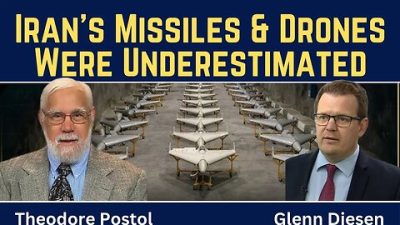
Theodore Postol: Iran’s Missiles & Drones Were Underestimated
or go to
Aletho News Archives – Video-Images
From the Archives
Wars for Israel: A reminder of who’s giving the marching orders
By Damian Lataan | February 7, 2012
As the West prepares to march off to yet another war in the Middle East, we should perhaps remind ourselves of who is giving the West their marching orders.
In February 2003, just weeks before the US and their allies launched their attack on Iraq and her peoples, a delegation of US congressmen, together with the US Ambassador to the United Nations, John Bolton, a well known pro-Zionist and neoconservative war-hawk, were in Israel at the invitation of the Israeli government then led by Israeli Prime Minister Ariel Sharon.
Addressing the congressmen, Sharon told them ‘that Iran, Libya and Syria should be stripped of weapons of mass destruction after Iraq’. Later, Sharon told John Bolton ‘that Israel was concerned about the security threat posed by Iran, and stressed that it was important to deal with Iran even while American attention was focused on Iraq’. … continue
Blog Roll
 Aletho News
- A New Resistance Front: How Does Syria Factor into the Regional War?
- Gulf states weigh pipeline expansion plans, hoping to bypass Hormuz
- Iran sets up ‘tollbooth’ system in Strait of Hormuz
- Wave 90: IRGC strikes US-linked industrial sites in Gulf
- Iran Says US-Israeli Claims of Its Military Strength Are Wrong
- Trump’s April Fools’ Address to the nation
- The Most Important Bet You’ve Never Heard Of
- The killing of three Indonesian soldiers in Lebanon should remind Jakarta that Israel does not want peace
- Defeated and delusional: Netanyahu’s remarks reveal $80bn war failure, says analyst
- Iran’s friends are about to make life much more difficult for Israel and the US
- If Americans Knew
- Trump says the quiet part out loud: (Israel’s) war on Iran > Americans’ health – Daily Update
- Gaza families reunite years after babies evacuated amid Israel’s war
- International Rescue Committee warns Gaza’s children face grave protection risks
- Iran’s Alleged 47-Year War on America: Debunking the 1,050 American Deaths Canard
- Israel wants US to bomb more of Iran’s civilian structures (113,000 is not enough) – Not a ceasefire Day 173
- Ann Coulter Rips Into Fox News for Iran War Coverage
- Joe Kent Urges Americans To Call White House and Congress To Object To Sending Troops Into Iran
- DNC Resolution to Reject AIPAC Funding Puts Democratic Leaders in the Hot Seat
- Swedish foundation to build 400 schools as over 650,000 Gaza children remain without education for 2 years
- Israeli army admits photshopping image of slain Lebanese journalist
- No Tricks Zone
- Low Intensity Tornado Wrecks Major Solar Farm, Creating A Potential Toxic Dump
- New Study Finds Warming Saves Lives…Cold Temperatures 12 Times More Deadly Than Excess Heat
- German Science Blog Accuses PIK Climate Institute Of Hallucinating Climate Tipping Points
- Devastating Assessment Of Comirnaty Vaccine By Former Senior Pfizer Europe Toxicologist
- New Study: CO2 Is ‘Effectively Negligible’ As An Explanatory Climate Change Factor Since 2000
- Former Pfizer Toxicologist Dr. Helmut Sterz Tells Bundestag Hearing Pfizer Vaccine Should Have Never Been Approved
- Energy Expert: Germany’s Nuclear Phaseout Was A “500 Billion Euro Mistake”
- New Research: South Australia’s Mid-Holocene Sea Surface Temperatures Were 4°C Warmer Than Today
- Storing Green Energy To Last Germany 10 Days Would Require A 60-Million Tonne Battery
- New Studies: UK Sea Levels Were 4 Meters Higher Than Today During The Mid-Holocene
 Aletho News