‘Fallujah cancer rate up by 3800%’
Press TV – August 7, 2010
One of the scientists, whose study revealed the devastating effect of US weapons in Fallujah, says in some cases cancer rates were 38 times higher than expected among Iraqis.
Dr. Chris Busby a scientist with a three-member team to conduct a study, titled “Cancer, Infant Mortality and Birth Sex-Ratio in Fallujah, Iraq 2005-2009,” discussed some if the aspects of the research with Press TV on Saturday.
“In the case of leukemia…we found that the rates of leukemia were 38 times higher than what we expected in the population that we sampled,” said Busby, the director of the environmental consultancy agency, Green Audit.
“And we had very high levels, 10-fold and so on levels of childhood cancers, breast cancer, lymphomas. All cancer types that were associated with radiation and which were found following the bombing of Nagasaki and Hiroshima. But actually these were much higher rates and they occurred much sooner after the event,” told Press TV.
“And the other thing that we found…was this peculiar sex ratio change which is a sure indicator of genetic damage and which was also found after Hiroshima and Nagasaki,” Busby said.
As opposed to a normal population, the plagued Iraqis were shown to have given birth to more females than males, he was quoted last-month by British newspaper The Independent as saying. The proportion, the like of which has been found in Hiroshima, shows genetic damage which affects boys more than girls.
“Cancer, Infant Mortality and Birth Sex-Ratio in Fallujah, Iraq 2005-2009,” survey sampled 4,800 people among the residents of the central Iraqi city that came under two wholesale American attacks in 2004.
The US troops have already admitted using phosphorous munitions during the operations.
When asked what kind of weaponry can bring about the extent of genetic damage in Fallujah, he said, “Well, as a scientist, all we can say is that it is a very serious mutagen. And we are not experts in weaponry, but I am something of an expert in effects of uranium and I have to say that all of these findings would be consistent with exposure to variously large amounts of uranium.”
“To produce an effect like this, some very major mutagenic exposure must have occurred,” he was cited by the daily as saying, referring to the cancers and birth defects.
Hiroshima urges end of nuclear umbrella
55,000 attend 65th anniversary of bombing
By ERIC JOHNSTON | Japan Times | Aug. 6, 2010
HIROSHIMA — At a memorial ceremony attended for the first time ever by a U.N. secretary general and a U.S. representative, Hiroshima on Friday marked the 65th anniversary of its atomic bombing by calling on Japan to withdraw from the U.S. nuclear umbrella and accelerate the progress made over the past 18 months to eliminate nuclear arms. […]
Earlier this week, Hiroshima Mayor Tadatoshi Akiba said it is ridiculous for Japan to think about national security policies while still being dependent on America’s nuclear umbrella.
Akiba’s call to turn Japan’s long-standing three nonnuclear principles into law is something antinuclear groups have long desired.
The three nonnuclear principles of not possessing, manufacturing, or introducing nuclear weapons were introduced as a Diet resolution in the late 1960s and adopted in 1971, but have yet to be codified into law.
The mayor also urged Prime Minister Naoto Kan to speak to nuclear weapons states directly and push them to disarm completely by 2020.
Kan, who was once an activist, gave credit to the hibakusha [atomic victims], their next of kin, and citizens’ groups worldwide for their efforts to rid the world of nuclear weapons, and for the recent political progress toward that goal.
“Last May, at the Nuclear Nonproliferation Treaty review conference in New York, nearly 100 hibakusha spoke about their experiences. Over 4,000 cities worldwide, including Hiroshima and Nagasaki, belong to the Mayors for Peace Conference, which is calling for the elimination of nuclear weapons. It is the activities of citizens and NGOs that have played a critical role in arms reduction,” he said.
U.S. Ambassador Roos laid a memorial wreath at the cenotaph, but did not address the ceremony… Full article
Dismembering Afghanistan
Wars are rarely lost in a single encounter; Defeat is almost always more complex than that. The United States and its North Atlantic Treaty Organization (NATO) allies have lost the war in Afghanistan, but not just because they failed in the battle for Marjah or decided that discretion was the better part of valor in Kandahar. They lost the war because they should never have invaded in the first place; because they never had a goal that was achievable; because their blood and capital are finite.
The face of that defeat was everywhere this past month.
According to the Afghanistan Rights Monitor, “In terms of insecurity, 2010 has been the worst year since the demise of the Taliban regime in late 2001.”
A recent U.S. government audit found that despite $27 billion spent on training, fewer than 12 percent of Afghan security forces were capable of operating on their own.
Some 58 percent of the American public think the war is “a lost cause,” and 60 percent think the United States should begin to withdraw in July 2011. Only Republican votes in Congress saved the Obama administration’s request for $33 billion to fuel the war in the coming fiscal year. The war is currently hemorrhaging money at a rate of $7 billion a month.
The British public — the United Kingdom is the second largest armed contingent in Afghanistan — opposes the war by 72 percent, and other coalition forces are quickly abandoning the effort in the war-torn Central Asian nation. Poland announced it would withdraw its 2,600 troops in 2012. The Dutch will be out this August. The Canadians in 2011. The Australians, along with the rest of the NATO allies, declined a plea in July to send more combat troops.
In a sign of the dire circumstances of the war effort, twice in this past month, Afghan soldiers turned their guns on NATO soldiers.
A poll by the International Council on Security and Development reaffirms that the NATO alliance is failing to win over Afghan civilians, a cornerstone of success in the current strategy employed in Afghanistan. The poll found that in the two provinces currently at the center of the war — Helmand and Kandahar — 75 percent of Afghans believe foreigners disrespect their religion and traditions; 74 percent think working for foreign forces is wrong; 68 percent believe NATO will not protect them; and 65 percent think Taliban leader Mullah Muhammad Omar should be part of the government.
The Arithmetic of Defeat
So does one calculate the arithmetic of defeat. But “defeat” does not mean the war is over. Indeed, the moment when it becomes obvious that victory is no longer an option can be the most dangerous time in a conflict’s history. The losers may double down, as the French and the United States did in Vietnam. They may lash out in a frenzy of destruction, as the United States did in Laos and Cambodia. Or they may poison the well for generations to come by dividing people on the basis of ethnicity, religion and tribe, as the British did when their empire began to disintegrate.
Faced with rising opposition at home, increased casualties on the battlefield, and growing isolation from its allies, the United States is casting about for a way to salvage the Afghan disaster, and coming up with schemes that may end up destabilizing not only Afghanistan, but much of Central and South Asia.
The most radical of these schemes is being floated by the former U.S. ambassador to India, Robert Blackwell, a neoconservative mainstay and currently a lobbyist for India. Blackwell proposes partitioning Afghanistan into two countries: an independent, Pashtun-dominated south, and a northern and western section where Tajiks, Uzbeks, and Hazaras make up the majority. According to the scheme , “Pashtunistan” would be kept in line by armed drones and 30,000 to 40,000 U.S. Special Forces.
Such an independent country would almost certainly destabilize Pakistan’s Northern Frontier and Tribal areas , where 40 million Pashtuns currently reside. Many of those Pashtuns have never accepted the 1893 Durand Line that the British used to divide Afghanistan from what was then India.
Pashtunistan would also be a template for an independent Baluchistan, further dismembering Afghanistan — certainly something the Indian Army would be delighted with — and serve as a rallying cry for marginalized ethnic groups all over the region, including those in Kashmir, China, Iran, Kyrgyzstan, Iraq, Russia, and areas in northern India.
It is not clear how much support the partition plan has, given the deep opposition of countries like Pakistan and China, but Blackwell has sprung the genie, and getting it back into the lamp will not be easy.
A second proposal — to create an army of local militias to fight the Taliban — is already underway, in spite of the disastrous experience with similar armed groups during the Soviet occupation. Those militias turned into warlord armies, which shook down local residents, protected the growing drug trade, and fought over tribal turf.
U.S. commander, Gen. David Petraeus insists that the armed groups will not be “militia,” but more like police — uniformed, armed, and paid by the government of President Hamid Karzai. But given that the Kabul government has virtually no presence outside the capital, how these groups will be controlled is not obvious. Furthermore, if for some reason these militias do confront the Taliban, they will be outgunned by more experienced guerilla fighters.
A June 9 incident in Kandahar is a case in point. The Taliban attacked a local militia that had gathered to celebrate a wedding, killing 40 and wounding 87. The unit had been recruited by U.S. Special Forces, which promised weapons and ammunition. But according to the New York Times, when militia commander, Mohammed Nabi Kako went to the Special Forces, the commander fobbed him off to the Karzi regime, which turned down his request — whether from fear of forming independent militias, or plain old corruption is not clear. When the Taliban attacked, the militia couldn’t defend itself.
The United States has a long track record of recruiting local people to fight and then abandoning them. The Montagnards in Vietnam’s highlands and the Hmong in Laos come to mind.
The model that has the most parallels with the situation in Afghanistan, however, is Guatemala, where the United States helped the military dictatorship create village militias to fight insurgents. If the militias did not fight the guerillas, the Guatemalan Army slaughtered the villagers. If the militias did fight, the villagers became targets in the long-running civil war.
Indeed, an argument can be made that the very idea of militias violates the Geneva Conventions against using civilians to fight in a war, although the United States could finesse that argument by claiming the militia members are “uniformed.” What is certain is that entire villages will be pulled into the war by making them targets for retaliation by a more experienced and better-armed Taliban.
However, the most obvious use for the militias will be to protect the vast drug trade that has made Afghanistan the source of 90 percent of the world’s opium. It is a trade that corrupts not only Afghans, but the police and military of surrounding countries. Indeed, it is a poisonous chain that leads into the heart of Europe, leaving dead and maimed in its path. More than 30,000 addicts die of heroin overdoses each year in Russia alone.
Arbitrary partitions and local militias will not salvage the war for the United States and NATO. The only way out is to cut a deal with the people we are fighting. That will not be easy. The Taliban offered a reasonable peace plan in 2007, and it was turned down. Given the obvious collapse of the allied effort, why should the Taliban want to negotiate? But the Pakistanis say the deal is doable, and of all the counties in the region, Islamabad has the closest ties to the mélange of groups waging war in Afghanistan.
We have lost the war. It is time to recognize reality and start talking.
Knesset member calls for international protection for Negev Bedouins
Middle East Monitor | August 5, 2010
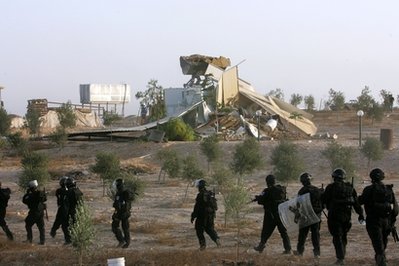
Last week, the Bedouin village of al-Arakib in the Negev was completely razed during a brutal surprise dawn raid by Israel Land Administration workers supported by thousands of black clad Israeli special unit forces, police officers and aerial units. Dr. Awad Abu-Farikh, a resident of Al-Arakib and a spokesman for the village said “We were stunned to witness the violent force being used.” All 45 homes in the village were completely destroyed.
Since then, the resilient inhabitants of the village have managed to construct 10 new structures on the ruins of their former homes. However, yesterday Israel Land Administration workers returned to the site and tore down the homes once again.
Yesterday’s brutal action was met by demonstrations and resistance from the now homeless villagers joined by Israeli Knesset member, Talab al-Sana, who barricaded himself inside one of the houses. Al-Sana was attacked by the police and forcefully removed from the house; he sustained injury and lost consciousness having to be evacuated to Beersheba Soroko Medical Centre. The police also arrested 6 individuals; five are considered ‘serial invaders’ while the sixth is suspected of assault on the police.
Since yesterday’s events, the Middle East Monitor (MEMO) has been in touch with Mr. Al-Sana who was in London as its guest during the first assault on al-Arakib and was able to give a graphic and detailed account of the situation facing the Bedouin of the Negev during an address in the Houses of parliament. He and his colleagues spoke about the Israeli campaign to persecute and intimidate Arab Israelis and to criminalise their political activities by delegitimising their democratically elected representatives.
According Mr. al-Sana who is of Bedouin origin, during yesterday’s indiscriminate and cruel assault, the police not only attacked him but also several women and children. He said that the destruction of al-Arakib village was not a question of law, but of Israel relating to its Arab citizens as enemies and being driven by the ideological motive of ‘redeeming the land’ from the hands of Arabs. He stressed that these current Israeli actions are in violation of all international laws and conventions including human rights laws. Given that during war time situations, the destruction of civilian homes is forbidden; that the Bedouin are not at war with Israel but citizens of the state makes the destruction of their homes a particularly heinous violation of law. The situation highlights Israel’s scant regard for human rights, and in particular, the rights of the Bedouin.
Al-Sana warned that if this is allowed to continue, we could soon see the expulsion of the 100,000 Bedouins of the Negev and that the next twelve months were crucial in determining the outcome of the standoff. This assessment was supported by the spokesman for al-Arakib village, Dr. Awad Abu-Farikh who asserted that “This operation is the first step in the uprooting of many villages. We shall return to our villages, build our homes and not leave this place”
Mr. Al-Sana, a vocal human rights activist and advocate for the Bedouin of the Negev, now intends to write to the Secretary General of the United Nations, Ban Ki-Moon and to the Human Rights Council to request protection from Israeli human rights abuses. He also expressed appreciation for the support given to their community by the international community and looked forward to its continuation.
The Bedouin of the Negev are a particularly vulnerable community in Israel and more so since it has stepped up its efforts to ‘Judaise’ the area through the Blueprint Negev plan and thus empty it of its indigenous inhabitants. Despite that their villages pre-date the establishment of the state of Israel in 1948, under Israeli law they are ‘unrecognised’ and therefore considered illegal settlements. There are approximately 45 such villages in the Negev which are not marked on commercial maps and are considered ineligible for municipal services such as electricity and water and are exposed to numerous environmental hazard. All these villages are now under imminent threat of destruction.
Was the tree really on Israeli territory? Not quite.
By Ann El Khoury | Pulse Media | August 6, 2010
In the aftermath of the bloody border skirmish between Lebanon and Israel, much of the Anglophone press seems to have dutifully accepted the UN’s assertion that the hapless tree at the centre of it all was on the Israeli side. Blogs have followed suit, publishing retractions or corrections to their earlier posts that the border had been breached by the IDF. But, as so often is the case, the devil is in the detail. The tree was located north of the Israeli self-erected ‘technical fence’, and south of the Blue Line. As Bart Peeters points out, the blue line is not an international border, nor an internationally recognised border, but simply an armistice line (and a contested one at that) set up by the UN in 2000 to mark the line of the Israeli withdrawal from its 18 year occupation of the south of Lebanon. The Blue Line is disputed by both Lebanon and Israel in many places. The tree, now removed, was located in a no-man’s land and apparently has no legal border status.
Particularly in this case, the UN has resembled a seriously frazzled parent who, faced with a normal child and a rogue child, apparently makes a small but disingenuous concession in a desperate and expedient attempt to quell the bad apple child’s accusations of their being biased in favour of the victimised normal child and regain some influence. “See? I’m not really biased or taking sides”, the UN is effectively signalling in this misguided attempt at even-handedness. The issue of who started this particular incident — was it Israel’s provocation because they went ahead, refusing a UN request to delay the tree cutting until it could be cleared with the Lebanese side, or Lebanon because it fired warning shots and the possible first fatal shooting? — has to be located against the backdrop of literally thousands of ongoing Israeli violations of UNSC 1701, that fragile ceasefire that formally ended the hafrada regime’s last destructive assault on Lebanon in 2006.
This incident clearly illustrates the untenability of a status quo predicated upon, from the Israeli side, military deterrence and informal arrangements in the lack of a clearly defined border. For the Lebanese, it may also illustrate the treachery of relying on the UN as an arbiter, though the incident has also had a rallying effect in support for the LAF. It is worth remembering that the Blue Line was signed off on with a great deal of reservation by the Lebanese. As the bloggers at Friday Lunch Club do well to point out, here is the actual conversation between then Lebanese President Emile Lahoud and then US Secretary of State Madeline Albright about the Blue Line in 2000 (another account detailing the episode can be found here):
Madeline Albright to President Emile Lahoud: “The Israelis pulled out, and we need you to ratify that so that we can proceed at the UN …”
Lahoud: “but Mrs. Secretary, they have not … I have an officer at the border who informs me that over a million square meters are still occupied…”
Albright: “… you sign off on the ‘withdrawal’… and I promise you, we’ll deal with that later…”
Lahoud: “No, I will not … Unless the withdrawal is complete, I will not allow it…”
Albright: “DO YOU KNOW WHO YOU’RE TALKING TO? I am the representative of the government of the USA!”
Lahoud: “And I am very tired (after 3:00AM) and I need to go to bed… Goodnight!”
Most of the territory was later evacuated prior to ratification, but the government of Lebanon signed off “with reservations.”
According to Lebanese political analyst Michel Samaha (as cited by Shmaysani), “Annan and then US Secretary of State Madeline Albright conspired to send Terje Rød-Larsen to delineate a Blue Line instead of implementing resolution 425. The aim was to make the pullout look like a full withdrawal according to the Truce Line. So Larsen invented the Blue Line and the Lebanese government cried foul because of the many gaps that kept Lebanese areas, including strategic spots and water sources, under occupation.”
Ret. Gen. Amine Hotait, who was the head of the committee to verify the Israeli pullout, told Al-Manar that
Our main concern was to determine the international border, but the Israeli enemy had changed the landmarks in several border areas. We started our mission based on official maps, but the Israelis made use of the so called ‘rolling borders’ and sought to delineate a new line that served its avarice, so it demanded a delineation based on more advanced methods. The United Nations adopted the Blue Line but we refused to recognize it as the international border since it missed at least 13 points. After tough negotiations we managed to gain back ten points, and three points remained outstanding: Rmeish, Odaisseh, and Metula.
And where did the incident happen? Right near Odaisseh.
Robert Fisk, to his credit and despite his clear dislike of Hezbollah, is one of the few who have qualified their analyses with recognition of this basic fact about the Blue Line and the lack of a border. Daniel Levy also has a fair summation of the situation and analysis on the perceived implications.
In the Israeli press, two pieces are worth mentioning. The first is an account by Nahum Barne in Yedioth Ahronoth which is revealing of the IDF attitude and segues well into the second piece by Gideon Levy in ‘Only We’re Allowed‘:
Maj. Gen. Eisenkot happened to be in the headquarters of Division 91 in Biranit at the time. He took control of the incident immediately. Eisenkot aspired to an outcome that would take a heavy toll from the Lebanese army, but would also not harm civilians and UN soldiers and would not drag the sides into war.
The shells that the tank fired did nothing but make noise. Therefore, Eisenkot ordered an attack on the forward outpost of the Lebanese army in the mountain located behind [the incident], Nabi al-Awadi. The Lebanese army outpost in the village Taibe was also attacked. Helicopter gunships and artillery were deployed.
The outcome was disappointing, as far as OC Northern Command was concerned. On the Lebanese side, there was a total count of five dead, four soldiers and a civilian. He expected a number three times as high, a number that would make it clear to Lebanon that such incidents have a price.
As one state grapples with the fall-out of the death of Hariri (and the other the death of Harari), Gideon Levy writes:
In this overheated atmosphere the IDF should have been careful when lighting its matches. UNIFIL requests a delay of an operation? The area is explosive? The work should have been postponed. Maybe the Lebanese Army is more determined now to protect its country’s sovereignty – that is not only its right, but its duty – and a Lebanese commander who sees the IDF operating across the fence might give an order to shoot, even unjustifiably.
Who better than the IDF knows the pattern of shooting at any real or imagined violation? Just ask the soldiers at the separation fence or guarding Gaza. But Israel arrogantly dismissed UNIFIL’s request for a delay.
It’s the same arrogance behind the demand that the U.S. and France stop arming the Lebanese military. Only our military is allowed to build up arms. After years in which Israel demanded that the Lebanese Army take responsibility for what is happening in southern Lebanon, it is now doing so and we’ve changed our tune. Why? Because it stopped behaving like Israel’s subcontractor and is starting to act like the army of a sovereign state.
And that’s forbidden, of course. After the guns fall silent, the cry goes up again here to strike another “heavy blow” against Lebanon to “deter” it – maybe some more of the destruction that was inflicted on Beirut’s Dahiya neighborhood.
Three Lebanese killed, including a journalist, are not enough of a response to the killing of our battalion commander. We want more. Lebanon must learn a lesson, and we will teach it.
And what about us? We don’t have any lessons to learn. We’ll continue to ignore UNIFIL, ignore the Lebanese Army and its new brigade commander, who has the nerve to think that his job is to protect his country’s sovereignty.
Masked settlers attack international peace activists in Hebron
International Solidarity Movement | 6 August 2010
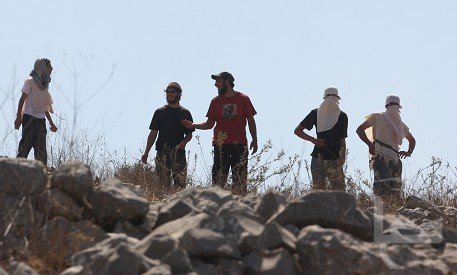
Al-Buwayra, HEBRON: This morning, in a second day of violence in the village of Al-Buwayra, near Hebron, two international peace activists were attacked by three Israeli settlers wearing black masks.
Both were left seriously injured and have been hospitalized following the unprovoked attack.
The settlers knocked Canadian Peter Cunliffe, 26, to the ground then beat him in the face and body using metal poles and wooden sticks. He is being treated for a probable broken nose and serious back injuries.
Danish peace activist Koba Soernesen. 23, is currently having his left foot examined as he is unable to stand.
He said: “We were sitting under a fig tree where we often sit, when they appeared out of nowhere, from the direction of the settlers’ area. Peter had his back to them and didn’t see them coming. They continued to beat him when he was on the floor, but I was able to fend them off a bit with my leg.
“They also stole my bag with my passport and camera in it.”
Both are currently receiving treatment in Hebron hospital.
The attack comes after violence erupted in Al Buwayra yesterday following the evacuation by Israeli authorities of an illegal Israeli outpost near the Kiyrat Arba settlement. Peace activists based in the area have been trying to prevent settlers setting fire to olive trees and documenting cases of attacks on Palestinians by settlers.
On 25th July two other peace activists, from the Christian Peacemaker Team, were attacked by settlers in Al Buwayra during a massive settler gathering at an illegal Israeli outpost.
CONTACT:
ISM Media Office: 054-618-0056
Available for interview: Koba Soerensen (English & Dansk): 052 821 0047
File photo by Ma’an Images
Weekly Standard Falsely Claims Iran Is Starting Proxy War With Israel
It’s nothing unusual for the flagship neocon rag, the Weekly Standard, to try to start wars in the Middle East. But Gabriel Schoenfeld’s post today on the magazine’s blog was irresponsible even by the Standard’s… well, standards.
Schoenfeld, a fellow at the neocon Hudson Institute, fabricates the details of incidents at the southern and northern edges of Israel in order to connect the attacks to the Islamic Republic.
In his post, ominously titled “Are the Winds of War Blowing?,” Schoenfeld wonders aloud, “Are the ayatollahs preparing preemptive action of their own, taking the battle to the borders of the Zionist enemy?”
Just how are the Iranians attacking the borders of Israel? Through their proxies Hamas and Hezbollah, of course. As evidence of this menacing military campaign, Schoenfeld cites three encounters over the past week:
On July 30, after a prolonged interval without such attacks, Hamas lobbed a Grad rocket into a residential area in the Israeli city of Ashkelon.
On August 2, another Grad was fired from the Sinai Peninsula toward the Israeli resort city of Eilat; it landed in the neighboring Jordanian city of Aqaba, where it killed a taxi driver and wounded five people.
On August 3, Hezbollah initiated a gun battle against Israeli soldiers operating within Israel next to its border fence, killing an Israeli officer.
No links are provided for the first two incidents, so let me clarify a few things: A rocket from Gaza did indeed land in Ashkelon last week, but Hamas did not launch or “lob” it. Even Haaretz reported that:
The Israeli military believes that Hamas was not responsible for the [rocket] attack and that the Islamist organization which controls the Gaza Strip is not interested in escalating tensions in the area, Army Radio reported.
In the second incident, of the rocket apparently fired from the Sinai, Haaretz reports that, “No group has yet taken responsibility for the attack.” Egypt, for its part, only blamed “Palestinian factions,” initially denying that the rockets had come from the Sinai at all, and failing to specify a group. (Hamas is an offshoot of the Egyptian-founded Muslim Brotherhood, which is banned in Egypt, so presumably the authorities would have little problem blaming the group if they suspected their involvement.)
For the third incident, Schoenfeld does provide a link. But if he bothered to read through the BBC article he chose, he would see that the clash on Israel’s northern border was with the Lebanese Army, not the Shia militia, Hezbollah, as Schoenfeld breathlessly states by claiming “Hezbollah initiated a gun battle against Israeli soldiers.”
Yes, both Hezbollah and Hamas are supported by the Islamic Republic as part of a far-reaching PR campaign by Iran to increase its regional clout (which is only aided by the festering Israeli-Palestinian conflict). But this does not, by default, mean that Iran is behind every clash in the region.
While the origins of the first two attacks remain in the dark, Schoenfeld is ready to proclaim Hamas the culprits with zero evidence. On the third score, he simply doesn’t know what’s going on or fabricates the events to blame another Iranian proxy.
All this winds up with him, perhaps in a case of projection, suggesting that Iran is starting a war with Israel, no doubt aiming to rile up U.S.-based support for taking Israel’s side in said war.
And this from a guy who wrote a piece last month for the Wall Street Journal titled “Avoiding Another Intelligence Failure on Iran.”
Before making his fact-free claims, however, Schoenfeld writes, “As Iran makes its way into the endgame of its nuclear-bomb making program, it may be growing more worried about the prospect of a preemptive Israeli strike.” Leaving aside his evidence-free assertions about the advancement of Iran’s nuclear program, Schoenfeld does cite here the more likely scenario, with Israel cast as the aggressor.
US INTERFERENCE IN VENEZUELA KEEPS GROWING
Broken Promises
By Eva Golinger – August 05, 2010
Despite President Obama’s promise to President Chavez that his administration wouldn’t interfere in Venezuela’s internal affairs, the US-funded National Endowment for Democracy (NED) is channeling millions into anti-Chavez groups.
Foreign intervention is not only executed through military force. The funding of “civil society” groups and media outlets to promote political agendas and influence the “hearts and minds” of the people is one of the more widely used mechanisms by the US government to achieve its strategic objetives.
In Venezuela, the US has been supporting anti-Chavez groups for over 8 years, including those that executed the coup d’etat against President Chavez in April 2002. Since then, the funding has increased substantially. A May 2010 report evaluating foreign assistance to political groups in Venezuela, commissioned by the National Endowment for Democracy, revealed that more than $40 million USD annually is channeled to anti-Chavez groups, the majority from US agencies.
The National Endowment for Democracy (NED) was created by congressional legislation on November 6, 1982. It’s mandate was anti-communist and anti-socialist and its first mission, ordered by President Ronald Reagan, was to support anti-Sandinista groups in Nicaragua in order to remove that government from power. NED reached its goal after 7 years and more than $1 billion in funding to build an anti-Sandinista political coalition that achieved power.
Today, NED’s annual budget, allocated under the Department of State, exceeds $132 million. NED operates in over 70 countries worldwide. Allen Weinstein, one of NED’s original founders, revealed once to the Washington Post, “What we do today was done clandestinely 25 years ago by the CIA…”
VENEZUELA
Venezuela stands out as the Latin American nation where NED has most invested funding in opposition groups during 2009, with $1,818,473 USD, more than double from the year before.
In a sinister attempt to censure the destination of funds in Venezuela, NED excluded a majority of names of Venezuelan groups receiving funding from its annual report. Nonetheless, other official documents, such as NED’s tax declarations and internal memos obtained under the Freedom of Information Act, have disclosed the names of those receiving its million dollar funding in Venezuela.
Of the more than $2.6 million USD given by NED to Venezuelan groups during 2008-2009, a majority of funds have gone to organizations relatively unknown in Venezuela. With the exception of some more known groups, such as CEDICE, Sumate, Consorcio Justicia and CESAP, the organizations receiving more than $2 million in funding appear to be mere façades and channels to distribute these millions to anti-Chavez groups.
Unknown entities such as the Center for Leadership Formation for Peace and Social Development received $39.954 (2008) and $39.955 (2009) to “strengthen the capacity of community leaders to participate in local democratic processes”.
For several years, the Civil Association Kapé Kapé, which no one knows in Venezuela, has received grants ranging from $45,000 (2008) to $56,875 (2009) to “empower indigenous communities and strengthen their knowledge of human rights, democracy and the international organizations and mechanisms available to protect them”. In a clear example of foreign interference, NED funds were used to “create a document detailing the human rights violations perpetrated against them and denounce them before international organizations”. In other words, the US funded efforts inside Venezuela to aid Venezuelans in denouncing their government before international entities.
FUNDING STUDENT MOVEMENTS
A large part of NED funds in Venezuela have been invested in “forming student movements” and “building democratic leadership amongst youth”, from a US perspective and with US values. This includes programs that “strengthen the leadership capabilities of students and youth and enhance their ability to interact effectively in their communities and promote democratic values”. Two jesuit organizations have been the channels for this funding, Huellas ($49,950 2008 and $50,000 2009) and the Gumilla Center Foundation ($63,000).
Others, such as the ‘Miguel Otero Silva’ Cultural Foundation ($51,500 2008 and $60.900 2009) and the unknown Judicial Proposal Association ($30,300 2008), have used NED funds to “conduct communications campaigns via local newspapers, radio stations, text messaging, and Internet, and distribute posters and flyers”.
In the last three years, an opposition student/youth movement has been created with funding from various US and European agencies. More than 32% of USAID funding, for example, has gone to “training youth and students in the use of innovative media technologies to spread political messages and campaigns”, such as on Twitter and Facebook.
FUNDING MEDIA AND JOURNALISTS
NED has also funded several media organizations in Venezuela, to aid in training journalists and designing political messages against the Venezuelan government. Two of those are the Institute for Press and Society (IPyS) and Espacio Publico (Public Space), which have gotten multimillion dollar funding from NED, USAID, and the Department of State during the past three years to “foster media freedom” in Venezuela.
What these organizations really do is promote anti-Chavez messages on television and in international press, as well as distort and manipulate facts and events in the country in order to negatively portray the Chavez administration.
The Washington Post recently published an article on USAID funding of media and journalists in Afghanistan (Post, Tuesday, August 3, 2010), an echo of what US agencies are doing in Venezuela. Yet such funding is clearly illegal and a violation of journalist ethics. Foreign government funding of “independent” journalists or media outlets is an act of mass deception, propaganda and a violation of sovereignty.
US funding of opposition groups and media inside Venezuela not only violates Venezuelan law, but also is an effort to feed an internal conflict and prop up political parties that long ago lost credibility. This type of subversion has become a business and source of primary income for political actors promoting US agenda abroad.
BAD DIPLOMACY
On Tuesday, statements made by designated US Ambassador to Venezuela, Larry Palmer, on Venezuelan affairs were leaked to the press. Palmer, not yet confirmed by the Senate, showed low signs of diplomacy by claiming democracy in Venezuela was “under threat” and that Venezuela’s armed forces had “low morale”, implying a lack of loyalty to the Chavez administration.
Palmer additionally stated he had “deep concerns” about “freedom of the press” and “freedom of expression” in Venezuela and mentioned the legal cases of several corrupt businessmen and a judge, which Palmer claimed were signs of “political persecution”.
Palmer questioned the credibility of Venezuela’s electoral system, leading up to September’s legislative elections, and said he would “closely monitor threats to human rights and fundamental freedoms”. He also stated the unfounded and unsubstantiated claims made by Colombia of “terrorist training camps” in Venezuela was a “serious” and real fact obligating Venezuela to respond.
Palmer affirmed he would “work closely to support civil society” groups in Venezuela, indicating an intention to continue US funding of the opposition, which the US consistently has referred to as “civil society”.
These statements are a clear example of interference in internal affairs in Venezuela and an obvious showing that Obama has no intention of following through on his promises.
Attacking Iran: US options
By GWYNNE DYER | ARAB NEWS | August 5, 2010
When Admiral Mike Mullen, chairman of the Joint Chiefs of Staff and the highest-ranking American officer, was asked recently on NBC’s Meet The Press show whether the United States has a military plan for an attack on Iran, he replied simply: “We do.”
General staffs are supposed to plan for even the most unlikely future contingencies. Right down to the 1930s, for example, the United States maintained and annually updated plans for the invasion of Canada — and the Canadian military made plans to pre-empt the invasion. But what the planning process will have revealed, in this case, is that there is no way for the United States to win a nonnuclear war with Iran.
The US could “win” by dropping hundreds of nuclear weapons on Iran’s military bases, nuclear facilities and industrial centers (i.e. cities) and killing five to 10 million people, but short of that, nothing works. On this we have the word of Richard Clarke, counterterrorism adviser in the White House under three administrations.
In the early 1990s, Clarke revealed in an interview with the New York Times four years ago, the Clinton administration had seriously considered a bombing campaign against Iran, but the military professionals told them not to do it.
“After a long debate, the highest levels of the military could not forecast a way in which things would end favorably for the United States,” he said. The Pentagon’s planners have war-gamed an attack on Iran several times in the past 15 years, and they just can’t make it come out as a US victory.
It’s not the fear of Iranian nuclear weapons that makes the US Joint Chiefs of Staff so reluctant to get involved in a war with Iran. Those weapons don’t exist, and the whole justification for the war would be to make sure that they never do.
The problem is that there’s nothing the US can do to Iran, short of nuking the place, that would really force Tehran to kneel and beg for mercy.
It can bomb Iran’s nuclear sites and military installations to its heart’s content, but everything it destroys can be rebuilt in a few years. And there is no way that the United States could actually invade Iran.
There are some 80 million people in Iran, and although many of them don’t like the present regime they are almost all fervent patriots who would resist a foreign invasion. Iran is a mountainous country, and very big: Four times the size of Iraq. The Iranian Army currently numbers about 450,000 men, slightly smaller than the US Army — but unlike the US Army, it does not have its troops scattered across literally dozens of countries.
If the White House were to propose anything larger than minor military incursions along Iran’s south coast, senior American generals would resign in protest. Without the option of a land war, the only lever the United States would have on Iranian policy is the threat of yet more bombs — but if they aren’t nuclear, then they aren’t very persuasive. Whereas Iran would have lots of options for bringing pressure on the United States.
Just stopping Iran’s own oil exports would drive the oil price sky-high in a tight market: Iran accounts for around seven percent of internationally traded oil. But it could also block another 40 percent of global oil exports just by sinking tankers coming from Iraq, and the Arab Gulf states with its lethal Noor anti-ship missiles.
The Noor anti-ship missile is a locally built version of the Chinese YJ-82. It has a 200-km. (140-mile) range, enough to cover all the major choke points in the Gulf. It flies at twice the speed of sound just meters above the sea’s surface, and it has a tiny radar profile. Its single-shot kill probability has been put as high as 98 percent.
Iran’s mountainous coastline extends along the whole northern side of the Gulf, and these missiles have easily concealed mobile launchers. They would sink tankers with ease, and in a few days insurance rates for tankers planning to enter the Gulf would become prohibitive, effectively shutting down the region’s oil exports completely.
Meanwhile Iran would start supplying modern surface-to-air missiles to the Taleban in Afghanistan, and that would soon shut down the US military effort there. (It was the arrival of US-supplied Stinger missiles in Afghanistan in the late 1980s that drove Russian helicopters from the sky and ultimately doomed the whole Soviet intervention there.)
Iranian ballistic missiles would strike US bases on the southern side of the Gulf, and Iran’s Hezbollah allies in Beirut would start dropping missiles on Israel. The United States would have no options for escalation other than the nuclear one, and pressure on it to stop the war would mount by the day as the world’s industries and transport ground to a halt.
The end would be an embarrassing retreat by the United States, and the definitive establishment of Iran as the dominant power of the Gulf region.
That was the outcome of every war-game the Pentagon played, and Mike Mullen knows it. So there is a plan for an attack on Iran, but he would probably rather resign than put it into action. It is all bluff. It always was.
— Gwynne Dyer is a London-based independent journalist.
Crazy Muslim conspiracy theories
By Glenn Greenwald | August 5, 2010

Rashad Hussain – Wikipedia
Politico‘s Laura Rozen points to this Times of India article, recounting how Rashad Hussain, the Obama administration’s envoy to the Muslim world, was angered and “shocked” yesterday when — as part of a tour of India to promote better relations with Muslims — “the head of a city-based Muslim institution [Akhtar Hasan Rizvi] slammed the US’ policies, not just in the Middle East, but towards Muslims everywhere”:
Rizvi held America responsible for many woes in the Muslim world. “You supplied arms to Iraq during the Iran-Iraq war, then invaded Iraq in the name of searching for weapons of mass destruction. You created the Taliban with the help of Pakistan. You have been backing Israel ever since its creation. First, right the wrongs that you have created if you want to establish peace in the world,” said Rizvi to applause from the students.
Shocked, Hussain who had earlier talked about the Obama administration’s resolve to partner with the Muslim world for winning hearts and minds, shot back: “I reject the conspiracy theories that are being floated” . . . . Hussain appeared so upset with Rizvi’s trenchant comments that he almost left the dais and wanted to walk out but the meeting’s conductor, Akhtar Chauhan, also director of the institute, requested him to stay back.
Are any of the accusations voiced by Rizvi actually “conspiracy theories,” or are they just all basic, undisputed facts? It certainly appears to me to be the latter. One of the favorite tactics of American political and media elites is to disparage the Muslim world as wallowing in “conspiracy theories” whenever they describe American actions in their part of the world. While there are undoubtedly some such theories in that part of the world and every other, this episode highlights that, more often that not, that claim is made to obfuscate basic truths and to deter those who would point them out.
No guns? They must be Terrorists
By Mark Steel | The Independent | 05. Aug, 2010
 Somehow, the Chilcot Inquiry has become like Big Brother. About once a month it pops up as a small item in the news and you think: “Oh blimey, I didn’t realise that was still going on.” Before long, like Big Brother, they’ll come up with stunts to try and revive some interest. So they’ll reintroduce contestants from previous inquiries such as Martin McGuinness and Christine Keeler, or make some witnesses complete a task of finding hidden ping-pong balls in the room or they have to give evidence blindfold.
So it might seem these procedures are pointless, in which case it makes no difference that the Israelis have agreed to co-operate with a United Nations inquiry into the episode in which nine people died after the Israeli Defence Force went aboard the Mavi Marmara as it sailed towards Gaza.
But it seemed to matter to the Israelis, because until this week they insisted their own inquiry was sufficient, and that was already under way. One fact emerging from this process was that the victims, according to “Sgt S” who shot six of them, “were without a doubt terrorists”. And he produced evidence to back this up, which was: “I could see the murderous rage in their eyes”.
This matches the classic definition of a terrorist according to international law, as someone “with murderous rage in their eyes”, and shows the key witness in any terrorist trial isn’t the forensics expert or explosives analyst but an optician. If they’re trained well enough they can shine a light at the iris and tell whether you’re short-sighted, long-sighted, Hamas or Basque separatist.
But there was more. According to the Jersusalem Post the IDF told the inquiry that the group on the boat were “well-trained and likely ex-military” because “each squad of the mercenaries was equipped with a Motorola communication advice, so they could pass information to one another”. A Motorola communication advice? So these so-called peace-activists were armed with mobile phones! It’s a wonder the whole Middle East wasn’t set alight. And to think Motorola and other sinister arms dealers such as Nokia and Orange go round trading in this deadly merchandise quite openly.
If the IDF were asked to police a rock festival, at the moment when everyone used their mobiles to take a photo they’d open fire on the whole crowd. Then once 3,000 were dead, Sgt S would say: “Well done, boys, if we hadn’t been so careful that could have turned quite nasty.”
One possible difficulty in proving the optically murderous gang’s intent could be that none of them had guns. But the IDF dealt with that by saying the “mercenaries” preferred to use “bats, metal bars and knives, since opening fire would have made it blatantly clear they were terrorists and not peace activists”. So this was another cunning trick of the terrorists, to disguise the fact they were terrorists by not doing anything terrorist. My neighbour’s much the same; disguising her terrorism by being 74 and spending all day peacefully doing the garden without ever shooting anyone, the evil witch.
Even more blatantly, the inquiry was told the group did have guns on board, but “the mercenaries threw their weapons overboard after the commandos took control of the vessel”. Because that’s classic guerrilla training, to carry guns right up until the moment when the enemy arrives, and then throw them away. This is the strategy of all great military thinkers. That’s why Nelson, at the Battle of Trafalgar said: “Men, I see the French, and so let every Englishmen do his duty, and chuck all our weapons in the sea. That’ll teach the bastards.”
On and on this goes, with Prime Minister Netanyahu making it clear he agrees with it, himself calling the victims “mercenaries”. Because these mercenaries were trying to get goods such as medicine to an area that’s under a blockade, which is typical mercenary behaviour, except instead of gun-running, they were inhaler-running.
But bit by bit Israel is finding it has to answer for itself publicly, and the old excuses are not so easily accepted. From now on they’ll have to put a bit more thought into their bollocks, which has got to be for the good.
Featured Video

Michael von der Schulenburg: Europe’s Self-Defeating Iran War Policy
or go to
Aletho News Archives – Video-Images
Frlom the Archives
Provoking a Path to Persia
The Saban Center’s prescient paper on war with Iran
By Maidhc Ó Cathail | October 20, 2011
In June 2009, the Saban Center for Middle East Policy published “Which Path to Persia?—Options for a New American Strategy toward Iran.” Writing in a tone strikingly reminiscent of the Project for a New American Century’s infamous pre-9/11 paper “Rebuilding America’s Defenses,” the six co-authors noted that, “It seems highly unlikely that the United States would mount an invasion without any provocation or other buildup.” For a think tank specifically established by media mogul Haim Saban to protect Israel, this could prove to be a formidable obstacle impeding their desired march—of U.S. troops—to Tehran.
“In fact, if the United States were to decide that to garner greater international support, galvanize U.S. domestic support, and/or provide a legal justification for an invasion, it would be best to wait for an Iranian provocation, then the time frame for an invasion might stretch out indefinitely,” Saban’s think-tankers ruefully observed.
“With only one real exception, since the 1978 revolution, the Islamic Republic has never willingly provoked an American military response, although it certainly has taken actions that could have done so if Washington had been looking for a fight. Thus it is not impossible that Tehran might take some action that would justify an American invasion. And it is certainly the case that if Washington sought such a provocation, it could take actions that might make it more likely that Tehran would do so (although being too obvious about this could nullify the provocation). However, since it would be up to Iran to make the provocative move, which Iran has been wary of doing most times in the past, the United States would never know for sure when it would get the requisite Iranian provocation. In fact, it might never come at all.”
Seemingly undeterred by Iran’s frustrating unwillingness to provide the requisite provocation, the analysts continued to examine this option… continue
Blog Roll
 Aletho News
- The EU never learns – except for the wrong lessons
- Iran attacks on UAE leaves RSF militia high and dry
- Hosting Washington’s war: Bahrain faces the consequences
- The US fell for its own Iran propaganda
- Seyed M. Marandi: Threat of Seizing Kharg Island & the Use of Nuclear Weapons
- Is there even an off ramp?
- Michael von der Schulenburg: Europe’s Self-Defeating Iran War Policy
- Sorry, The New Republic, Climate Change Isn’t Causing Somali Migration. Blame Civil Strife and Poverty.
- Expert Guts Claims That HPV Vaccine Reduces Cancer Risk
- No evidence Russia sabotaged Baltic cables – Finnish intel
- If Americans Knew
- 6 more Americans killed, as Israel ‘mows the lawn’ in Iran – Not a ceasefire Day 154
- Are we on the precipice of World War III?
- ‘Catastrophic,’ Says UNICEF: 1,100+ Children Killed or Wounded in Mideast Since US-Israel Launched Iran War
- The Unbelievable Madness of Our War With Iran
- World Council of Churches calls on govts to hold Israel accountable for violations of intl law
- How to end the war on Iran that costs US taxpayers $1M per minute – Not a ceasefire Day 153
- Israeli strategic plans to “remake the Middle East” from the 1950s and since
- Honoring Gaza’s women who refused to let the world look away
- 97% of victims of war on Iran are Iranian, 98% of victims in war on Gaza are Gazans – Not a ceasefire Day 152
- Early Iran strikes cost $5.6 billion in munitions, Pentagon estimates
- No Tricks Zone
- New Studies: UK Sea Levels Were 4 Meters Higher Than Today During The Mid-Holocene
- Destructive Green New Deal: German Energy And Metal Group Warns Of Drastic Crisis
- New Study Documents A 20-Year Pause In Arctic Sea Ice Decline – Driven By Internal Variability
- Wake-up Call: Survey Shows Majority Of Germans Now Favor Postponing Climate Targets!
- Televised! Leading German Political Candidate Tells Schoolchildren CO2 Makes Sun Hotter!
- New Study: A Century Warming Of 1.1°C Is ‘Commonplace’ And ‘Not Unusual’ During This Interglacial
- New Study: ‘Internal Noise’ And Volcanic Forcing Can Trigger 10-15°C Warming Within Decades
- Glaciers Worldwide Are Suddendly Surging, Experts Blame Warming!
- Surprising Discovery: Sahara Is Greening…Billions Of Trees Where Once Thought To Be Barren
- New Research Reaffirms Clouds, Aerosols, And Surface Solar Radiation Are ‘Driving The Climate System’
 Aletho News