US Government Report Argues for Police Force for American Interventions Overseas
By Matthew Harwood | t r u t h o u t | 07 September 2010
In May 2009, the federally financed RAND Corporation published a 183-page report, “A Stability Police Force for the United States: Justification and Options for Creating US Capabilities”. The report, conducted for the US Army’s Peacekeeping and Stability Operations Institute (PKSOI) at the Army War College, examined the need for a “stability police force” (SPF), which it described as “a high-end police force that engages in a range of tasks such as crowd and riot control, special weapons and tactics (SWAT) and investigations of organized criminal groups.” Most soldiers do not possess the specialized skills an SPF officer needs to prevent violence, the report notes. “Most soldiers are trained to apply overwhelming force to secure victory, rather than minimal force to prevent escalation.” The SPF would also train indigenous police forces, much like what occurs today in Iraq and Afghanistan.
According to the study led by Terrence K. Kelly, a senior researcher at RAND, the United States clearly needs an SPF. “Stability operations have become an inescapable reality of US foreign policy,” the report states. The RAND report estimates that creating such a paramilitary police force would cost about $637 million annually, require about 6,000 personnel and that it should be headquartered inside the US Marshals Service (USMS), not the US Army.
“Of the options considered,” the RAND report argues, “this research indicates that the US Marshals Service would be the most likely to successfully field an SPF, under the assumptions that an [military police] option would not be permitted to conduct policing missions in the United States outside of military installations except under extraordinary circumstances and that doing so is essential to maintaining required skills.” The idea here is that members of an SPF would be a “hybrid force” and could be embedded in police and sheriff departments nationwide to retain their policing skills when not deployed overseas. When needed, a battalion-sized SPF unit could be deployed in 30 days.
This recommendation did cause a small number of libertarians to take notice of the report after it was published because of the Posse Comitatus Act, which forbids using the military for domestic policing inside the United States. Libertarian William Grigg blogged on LewRockwell.com that he feared that an SPF could be used domestically. “If ‘peacekeepers’ end up patrolling American streets, they probably won’t be foreigners in blue berets, but homegrown jackboots commanded by Washington,” Grigg wrote. Chris Calabrese, a legislative counsel for the American Civil Liberties Union, was less fearful of an SPF, but he told Truthout that the report’s recommendation to headquarter “a super police force that would be deployed both foreign and domestically in the US Marshals Service” did violate the spirit of the Posse Comitatus Act.
“In essence, you have this force that would in theory be a civilian force that would be part of the US Marshal Service but they would be deployed as part of the Army and the military forces,” Calabrese said. “That would be their primary deployment purpose. Their civilian purpose would be secondary. They describe it as a training purpose. So who does this police force work for then?”
Talking to WorldNetDaily in January, Kelly did say an SPF could be deployed in the United States, although that’s not what their primary purpose is.
“If there were a major disaster like Katrina it could be deployed in the U.S. but that’s not the purpose of the research,” he said. “It’s important to point out that the goal was to create a force that’s deployable overseas. If it’s to be used in the United States it would be a secondary thing and then only in an emergency.”
The RAND Corporation would not make any of the report’s authors available for an interview. Emails to the USMS asking for a comment on the report and its recommendations also went unanswered.
Calabrese also said there are practical concerns behind such a force outside of the Posse Comitatus Act. “It’s also somewhat strange,” he said. Calabrese wonders what would happen when SPF personnel get called up from wherever they’re embedded to deploy overseas. “What happens to all the police work they’re doing domestically?” he asked.
But the RAND report has more implications for the future of US foreign policy than it does about the militarization of police inside the United States. It signals that some defense and peace intellectuals believe that the United States will continue to intervene in fragile and failing states. After listing the stability operations that the United States has participated in since the end of the cold war – Panama (1989), Somalia (1992), Haiti (1994), Bosnia (1995), Kosovo (1999), Afghanistan (2001), Iraq (2003)and Haiti again in 2004 – the RAND report notes this trend will continue. “There are several countries where the United States could become engaged in stability operations over the next decade, such as Cuba and Sudan,” according to the report. – Full article
America’s Economy Is Not Here to Pay for Wars
By Jason Ditz | Lew Rockwell | September 8, 2010
In a recent speech at Wayne State University in Detroit, America’s top military commander, Joint Chiefs of Staff Chairman Admiral Michael Mullen declared that the most serious threat to America’s national security is the national debt. His argument for this was that the debt and its deleterious effect on America’s economy could hinder the growth of military expenditures.
Mullen further lamented that current estimates have the federal government paying some $600 billion in interest on the debt in 2012 adding, “That’s one year’s worth of defense budget.”
But America’s civilian economy isn’t just something to be taxed to pay for war, and America’s civilian population is not just a collection of potential recruits and sources of revenue for the military. The military is supposed to be here to serve America, not the other way around.
And without downplaying the various serious economic consequences of America’s national debt, Admiral Mullen’s comments betray a very disturbing (and increasingly common) view of the American economy as little more than fuel for its ever-growing war machine.
In fact the $600 billion interest payment is coming in no small part because Admiral Mullen and the rest of the military’s leadership has been pressing for unprecedented increases in military spending. Now, having spent America’s economy to the brink of ruin, Admiral Mullen has the nerve to complain that the harm he has already done is hampering the harm he intends to do.
It isn’t even true, incidentally, that the $600 billion is “one year’s worth of defense budget.” Not anymore it isn’t. In fact President Obama is seeking over $700 billion for fiscal year 2011, and that is one budget item that, whether there is a Republican or Democrat in office, we always expect to grow.
But just 10 years ago it would’ve been two years worth. In 2000 America was spending around $300 billion on its military. That was by far the biggest military budget on the planet. If America still had a $300 billion military, it would still be the largest by far.
Instead America is barreling into the future with a military budget that rivals the rest of the world combined, and an endless wish list of very expensive new military goals. Is it really such a mystery that this is unsustainable?
The purpose of Admiral Mullen’s visit and his assorted talks in Detroit were to admonish local industry leaders that the “patriotic” thing to do was to hire more former soldiers, while insisting that “industry, community and military leaders share the same goals.” One wonders how industry and community leaders feel about an endless series of wars bankrupting the nation, but it can only be assumed that they feel differently than the admiral does.
Though many Americans are reluctant to openly criticize the nation’s military leadership in time of war, Admiral Mullen’s comments make it very clear how little regard he has for us and it is high time we, as Americans, make it clear that this country cannot and will not be sacrificed at the altar of a series of wars whose only goal seems to be fleecing the American taxpayer of an ever growing portion of what he produces. We’ve been down that road for the past decade and we can all see where it has led.
Wind Energy’s House of Cards
By Steve Goreham | August 31, 2010
The International Energy Agency (IEA) recently issued their 2009 Wind Energy Report. Brian Smith, chair of the IEA Wind Executive Committee, states that wind member countries “installed more than 20 gigawatts of new wind capacity” (nameplate capacity). The report was written by representatives of 20 member countries, consisting of 14 European nations, Australia, Canada, Japan, Korea, Mexico, and the United States.
The report is very optimistic about wind energy’s prospects. Member nations report on “how they have progressed in the deployment of wind energy, how they are benefitting from wind energy deployment, and how they are devising strategies and conducting research to increase wind’s contribution to world energy supply.” But a deeper analysis shows that the wind industry is a house of cards built on a foundation of sand.
The house of cards is a global industry based entirely on subsidies, price guarantees, and mandates. Wind generation systems are not deployed anywhere in the world without extensive government financial or mandated support. Fourteen of the 20 IEA member nations use feed-in tariffs (FITs) to force utility companies to buy electricity from wind farms at above market rates. Examples are FITs used by Finland, Germany, Greece, Netherlands, Portugal and Spain, which are set in the range of 7.8-12.1 Eurocents per kilowatt-hour, equal to 11.2-17.4 U.S. cents per kilowatt-hour. These are subsidized wholesale prices, yet significantly above the average U.S. retail price of 9.7 cents per kilowatt-hour. Nine of the twenty nations mandate that utilities supply a percentage of electricity from renewables. Nations that have provided little government support for wind, such as Japan, Korea, Mexico, and Norway, have seen little growth in installations.
In the U.S., the 2009 Recovery Act authorizes a direct cash grant of 30% of the total value to wind projects. Alternatively, the federal government provides a 30% investment tax credit, or a 2.1 cents per kW-hr production subsidy. State governments add loan guarantees, further investment tax credits, and the forbearance of property and sales taxes. Twenty-nine states have enacted Renewable Portfolio Standards to force utilities to purchase renewable energy, primarily wind. These mandates raise the price of wind energy, a further subsidy to the industry. In total, taxpayers are subsidizing 30-50% of the price U.S. wind energy installations. Wind must be subsidized because it is much more expensive than electricity from coal, natural gas, hydroelectric, and nuclear sources. According to the U.S. Department of Energy, wind-generated electricity is about 80% more expensive than coal-fired power, and off-shore wind is significantly more expensive. The IEA representatives from Denmark and the United Kingdom estimate costs for offshore wind at roughly double the cost of onshore wind. The planned Cape Wind project in Nantucket Sound reportedly will deliver electricity at a whopping 27 cents per kW-hour, compared to the Massachusetts average price of 16 cents per kW-hour and the U.S. average of 9.7 cents.
Advocates claim that subsidies are needed to help wind energy move down the learning curve to become cost competitive with other technologies. But wind turbines have been deployed for more than 20 years. As of 2009, the United States had installed about 33,000 wind turbine towers. World installations have exceeded 140,000 turbines. When will this cost competitiveness be achieved?
Despite the growing number of installations, total wind energy costs are increasing. Wind installation costs per kilowatt-hour decreased from the early 1990s until 2001, but have been rising since. For example, U.S. installations reached a cost low of $1,285 per kw-hr in 2001, but have since risen steadily to $2,080 per kw-hr in 2009, an increase of 62%. It’s unlikely that electricity from wind will ever be competitive with conventional fuel sources.
A close read of the IEA Wind Report reveals issues with actual wind turbine operating lifetimes and maintenance. Wind turbines that were installed in the 1990s are now being replaced in Denmark, Germany, Netherlands, and other nations. In the harsh weather environments of high-wind corridors, many of these turbines have not reached the 20-year lifetimes claimed by manufacturers. In comparison, operating lifetimes for coal-fired power plants consistently reach 50 years.
Very costly repairs are often required to maintain wind turbine operation. Japan reports that lightning hits and typhoons have damaged “a considerable number of wind turbines,” finding that on average, each turbine will fail three times over its 20-year life. Denmark reports that each turbine’s gearbox must be replaced on average four times during its lifetime, costing about 20% of the price of a wind turbine.
The story of Denmark is illustrative. Over the last 20 years, Denmark has installed 5,100 wind towers, one for every thousand citizens. A map with a black dot for each wind farm shows that 300-foot-high steel and concrete towers can be seen from almost every field, farm, hill, and seashore of this nation. In 2009, these towers provided only 767 megawatts of electricity, less than the output of a single conventional coal-fired power plant. This single power plant would occupy the space of one black dot on the map.
Wind towers provide only about 10% of Denmark’s electricity, but contribute to electricity rates of 28 Eurocents per kilowatt-hour, the highest in Europe and four times the U.S. price. Yet, Danish government officials are proud of their wind system. Why would they install 5,000 towers instead of one coal plant? It’s because they believe they are reducing global warming.
In fact, the global wind industry is built on a foundation of sand—the hypothesis that man-made global warming is destroying Earth’s climate. The IEA report contains repeated statements about carbon emissions saved by wind installations in each nation. Yet, mounting satellite temperature data, new studies of ocean cycles such as the Pacific Decadal Oscillation, and research on solar activity, show that global warming is due to natural cycles of the Earth,not man-made greenhouse gas emissions. Should global warming alarmism fail in its efforts to promote wind energy, the subsidies will disappear, and the house of cards will collapse. Then the world will be left with 140,000 silent monuments to Climatism.
Steve Goreham is Executive Director for the Climate Science Coalition of America and author of Climatism! Science, Common Sense, and the 21st Century’s Hottest Topic.
The Misnomer of the Peace Talks
By John Chuckman | Palestine Chronicle | September 7, 2010
I don’t know how anyone given the task could draw a map of Israel: it is likely the only country in the world with no defined borders, and it actually has worked very hard over many decades to achieve this peculiar state.
It once had borders, but the 1967 war took care of those. It has no intention of ever returning to them because it could have done so at any time in the last forty-three years (an act which would have been the clearest possible declaration of a desire for genuine peace with justice and which would have saved the immense human misery of occupation), but doing so would negate the entire costly effort of the Six Day War whose true purpose was to achieve what we see now in the Palestinian territories.
As far as peace, in the limited sense of the absence of war, Israel already has achieved a kind of rough, de facto peace without any help from the Palestinians. The Palestinians have nothing to offer in the matter of peace if you judge peace by the standards Israel apparently does.
Israel has the peace that comes of infinitely greater power, systematic and ruthless use of that power, the reduction of the people it regards as opponents to squatters on their own land, and a world too intimidated to take any effective action for justice or fairness.
Genuine peace anywhere, as Canadian physicist and Holocaust survivor Ursula Franklin has observed, is best defined by justice prevailing. But you can have many other circumstances inaccurately called peace; for example, the internal peace of a police state or of a brutally-operated colony.
Israel appears to have no interest or need for the kind of peace that the Palestinians can offer. What then can the Palestinians give Israel in any negotiation?
There are many “technical” issues to be settled between the Israelis and Palestinians, such as the right of return, compensation for property taken, the continued unwarranted expulsions from East Jerusalem, the Wall and its location largely on Palestinian land, but in a profound sense these are all grounded in the larger concept of genuine peace as Ursula Franklin defined it, something we have no basis for believing Israel is, or ever has been, interested in.
Israel wants recognition, not just as a country like any other, but as “the Jewish state,” whatever that ambiguous term may mean, given the facts both of Israel’s rubbery borders and the definition of Jewish, something which Israelis themselves constantly fight over – reformed, orthodox, ultra-orthodox, Ashkenazi, Sephardic, North African, observant, non-observant, and still other factions and divisions in what is quite a small population.
I very much think that the reasons Israel wants that particular form of recognition are not benevolent: it is the kind of term once put into a contract which opens the future interpretation of the contract to pretty much anything. After all, recognition of Israel as a state is something Arab states have long offered Israel in return for a just settlement, but Israel has never shown the slightest interest.
If recognition of Israel as “the Jewish state” were granted, what would be the status of any non-Jewish person in Israel? I think we can guess, given the awful words of Israel’s foreign minister Avigdor Lieberman, or the even more terrible words of Ovadia Yosef, founder of the Shas Party, a Netanyahu ally, and Israel’s former Chief Rabbi.
After all, about nineteen percent of Israeli citizens are non-Jews, mainly the descendants of Palestinians who refused to run from the terrors of the Irgun and Stern gangs in1948. They carry Israeli passports, but are not regarded as citizens in the same sense as Jewish citizens, and there are even laws and restrictions in place creating the kind of deadly distinction George Orwell wrote of in Animal Farm, “Some animals are more equal than others.”
The new talks do not include even the most basic requirement of a legitimate voice to represent the Palestinians, a desirable situation perhaps from Israel’s point of view, one Israel’s secret services have long worked towards with dark ops and assassinations. How do you negotiate with opponents you allow no voice?
Mahmoud Abbas, an almost pitifully shuffling character who is the man supposedly representing Palestinian interests, is now approaching two years of playing president without an election: he has zero legitimacy with the Palestinians and the outside world. Even at that, his assumed authority extends only to parts of the West Bank of the territories.
Hamas, despite the shortcomings found in any leadership of a heavily oppressed population is nevertheless the elected government of Gaza territory, but Israel has pressured the United States – and through it, effectively the world – to regard Hamas as a coven of witches, ready to unleash dark powers if only once Israel relaxes its stranglehold.
It would be far more accurate to talk of a settlement or an accommodation with the Palestinians than peace, but any reasonable agreement requires intense pressure on Israel, which holds all the cards, pressure which can only come from Washington. Accommodation involves all the difficult “technical” issues Israel has no interest in negotiating – right of return, compensation, the Wall, and East Jerusalem. Israel’s position on all of them is simply “no.”
But we know that Washington is contemptibly weak when it comes to Israel. The Israel Lobby is expert at working the phones and the opinion columns and the campaign donations. It even gets Washington to fight wars for it, as it did in Iraq, and as it now is attempting to do in Iran – surely, the acid test of inordinate influence on policy.
Most American Congressmen live in the same kind of quiet fear of the Israel Lobby as they once did of J.Edgar Hoover’s special files of political and personal secrets. Hoover never even had to openly threaten a Congressman or Cabinet Secretary who was “out of line.” He merely had a brief chat, dropping some ambiguous reference to let the politician know the danger he faced. It was enough to keep Hoover’s influence going for decades.
You never heard a thing in the press about the quiet power Hoover exercised in the 1940s and 1950s and 1960s, but it was there. Just so, the Israel Lobby today.
So where does the impetus for a fair accommodation come from?
Nowhere. Israel goes right on with its calculatedly-unfair laws taking the homes and farms of others, slowly but surely pushing out the people with whom it does not want to share space.
Anywhere else, this process would be called ethnic-cleansing, but not here, not unless you want to be called a bigot or an anti-Semite.
One says this about the impossibility of a settlement with a reservation. It is possible that the weak Abbas, locked in a room in Washington, could well be browbeaten and bribed into signing some kind of bastard agreement, giving Israel every concession it wants in return for a nominal rump Palestinian state composed of parcels Israel doesn’t want or hasn’t yet absorbed. It wouldn’t be worth the paper it was written on, but Israel would then undoubtedly assume its perpetual validity and in future interpret it as it wished.
After all, the history of modern Israel involves agreements divvying up the land of others without their consent, but even those historical divisions – look at the maps attending the Peel Commission (1937) or the UN decision on partition (1947), and you see roughly equally divided territory – today are ignored by Israel or given some very tortured interpretation. So what will have changed?
There simply can be no genuine peace with justice where there is no will for it.
– John Chuckman lives in Canada and is former chief economist for a large Canadian oil company.
The reasons the BDS movement is ‘gaining speed’
By Lawrence Davidson | Mondoweiss | September 8, 2010
On September 5, 2010 the Israel newspaper Haaretz published an article the headline of which read “Anti-Israel Economic Boycotts are Gaining Speed.” The subtitle went on to state that “the sums involved are not large, but their international significance is huge.” Actually, what seems to have triggered the piece was not international. Rather, it was the decision of a “few dozen theater people” to boycott “a new cultural center in Ariel,” an illegally settled town in the Occupied Territories. This action drew public support from 150 academics in Israel. The response from the Israeli right, which presently controls the government and much of Israel’s information environment, was loud and hateful.
Though this affair was domestic, it provided a jumping off point for Haaretz to go on and examine the larger international boycott of Israel which is indeed “gaining speed.” It noted that Chile had recently pledged to boycott products from the Israeli settlements and Norway’s state pension plan had divested itself of companies involved in construction in the Occupied Territories. The Haaretz article pointed out that these incidents (and there are others that can be named in such countries as Ireland and Venezuela) are signs that the boycott movement –so long the province civil society– is now finding resonance at the level of national governments. The Israeli paper declared that “the world is changing before our eyes. Five years ago the anti-Israel movement may have been marginal. Now it is growing into an economic problem.”
The article puts forth two explanations for this turn of events one of which is problematic, and the other incomplete. Let’s take a look at them.
1. “Until now boycott organizers had been on the far left. [Now] they have a new ally: Islamic organizations….The red side has a name for championing human rights, while the green side [the Islamic side] has money.” I have some personal knowledge of the boycott movement and I find some of these particulars to be, at best, exaggerations. The term “far left” must be based on some arbitrary Zionist definition of the political spectrum. Worldwide community support for the growing boycott movement has gone beyond political alignments. Today, it is a reflection of real united front seeking the promotion of Palestinian human rights (in this Haaretz is on the mark). As for the “green side” there is certainly an understandable affinity here. Muslims too are concerned about the human rights of Palestinians (including the Christians ones). However, the claim of any significant flow of cash is, as far as I know, another exaggeration. The Haaretz piece cites the example of the aid flotilla to Gaza, with its link to Turkey. But this is just one case in a worldwide movement. And, there was nothing illegitimate (despite Israeli propaganda) about the involvement of Turkish charities. It might come as a surprise to the Israelis, but you can run a boycott movement without heavy outside funding–as was the case of the boycott against South Africa.
2. Haaretz continues, “but then came the occupation, which turned us into the evil Goliath, the cruel oppressor, a darkness on the nations.” The article suggests that this is such a contrast with the righteous stand that helped convince the West to support the original formation of Israel that many have turned away from Israel in disappointment. “And now we are paying the price of presenting ourselves as righteous and causing disappointment: boycott.” No doubt there is much disappointment. The horrors of Israeli expansionism and occupation are such that they draw worldwide attention. And rightly so. But, they are symptoms of some deeper cause. What might it be? The state of Israel was founded on an ideological program called Zionism. That program called for the establishment of a state designed to serve the exclusive interests of one religiously identified group. While the Zionists felt this aim was justified by the centuries of persecution suffered by European Jews, it actually carried within it the seeds of its own corruption. The simple truth is that you cannot successfully design a state for one group only unless you found it on some desert island. If you put it down in a place that is occupied by others who are not of your group, what is the most likely next step? You turn into racists, ethnic cleansers, or worse. The Zionist adherence to their ideology and its program is the cause of their turning into “cruel oppressors.” The means dictated by their end made it so.
The Haaretz article does not go beyond these points, but there is plenty more to say. Those who wonder whether they should support the boycott should certainly consider the horrors of the Israeli occupation and its ghettoizing of the people of Gaza. They might also consider the following:
1. The non-Jewish population of Israel proper, that is Israel within the 1967 borders (the “Green Line”) are subject to segregation and economic and social discrimination that is both de jure and de facto. Their overall standards of living are lower than the Israeli Jews, their educational facilities inferior and their economic prospects poorer. This is to be expected. If you are running your state based on a racist principle, by definition discrimination must infuse the home front. This fact does not appear to fit with the often heard claim that the Israelis are “just like us” Americans. However, in a rather anachronistic way they are “like us” – that is like the United States prior to our civil rights legislation. In other words, Israel is like, say, Georgia or Alabama circa the 1920s.
2. The second factor worthy of consideration is the negative international impact of Zionist ideology, for the harm Zionism is not confined to either Israel or its Occupied Territories. The fact is that Zionist influence spreads far beyond Israel’s area of dominion and now influences many of the policy making institutions of Western governments, and particularly those of the United States. This influence is corruptive if only because it distorts both official and popular notions of national interests in the Middle East. When you have a powerful and single-minded lobby that is able to manipulate your government in such a fashion that it pours its national treasure into a racist state, arms it and protects it to the point of becoming an accomplice to its crimes, and by doing so willfully alienates 22% of the world’s population, you know that
your notion of national interest has been seriously mangled. This harmful influence makes it imperative that Israel’s oppressive behavior be singled out as a high priority case from among the many other oppressive regimes that may be candidates for boycott.
So no one in Israel, the U.S. or anywhere else should be surprised that the boycott against Israel, in its many manifestations, is “gaining speed.” If you are not yet a supporter you should become one. To join the boycott is good the world’s future in general. It is certainly good for the Palestinians, and yes, it is good for the Jews too.
Lawrence Davidson is a history professor at West Chester University.
U.S. Government lies about molten steel found at Ground Zero after 9/11
world911truth | August 21, 2010
NIST caught lying about pools of molten steel found at the basement of Ground Zero, says no evidence or eye witnesses. This videos shows that NIST officials lied about it and they should be investigated.
More info: http://world911truth.org
Zionist Settlers: A Long History of Terrorism
06/09/2010 — Reham Alhelsi
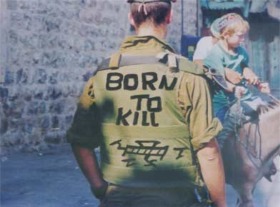
Zionist settlers, illegal colonists coming from all over the world to steal and occupy Palestinian land, armed with a green light to shoot and kill Palestinians whenever they want, won’t hesitate to use force against civilian Palestinians. Their violence includes shooting, stabbing beating, running over Palestinians, stealing their land, property and water, razing agricultural land, uprooting trees and burning crops, stealing harvest, raiding houses and blocking roads. Settler attacks are often initiated by them without any provocation or threat to their safety from Palestinians. In their attacks, the Zionist colonists are often accompanied by Israeli soldiers who either watch and don’t intervene to stop the settler terror or participate in the attacks and provide protection to the settlers. Zionist colonists are seldom prosecuted for their terror actions and in the very rare cases when they were prosecuted, they received very mild sentences. With every passing year, the terrorism of the Zionist colonists occupying Palestinian land increased in brutality and in quantity. Burning down Palestinian homes, mosques, cars and fields have become daily occurrences as beating and attacking Palestinian children on the way to school or Palestinian civilians on the way to work or home.
Looking back, I have tried to gather some examples of terror attacks carried out by Zionist colonists occupying Palestine (Quotations and info are from www.pchrgaza.org unless otherwise stated)
1983: On 26.07.1983 a group of Zionist colonists protected by Israeli soldiers raided the Hebron University campus and the lecture rooms, shooting and throwing hand grenades randomly. 3 Palestinians were killed and 22 injured. The 3 martyrs are: Said Iddin Hasan Dabri (39 yrs), Jamal As’ad Nazzal (29 yrs) and Samih Ammour (26 yrs).
1988: Beita: An example of Zionist terrorism and Israeli response to it
On 8:30 of the morning of 06.04.1988 a group of Zionist colonists from Elon Moreh stopped outside the Palestinian village of Beita. The group consisted of children and their armed guards. One Palestinian resident, Tayseer, tried dissuading the settlers from entering the village and offered to show them an alternative road around the village. The Zionists refused and by that time, some villagers who were working in the fields had gathered to see what the colonists wanted. One armed Zionist guard, Rumain Aldubi who was a known fanatic and violent colonist, ordered the residents of Beita to leave. As Tayseer turned to leave, the guard shot him in the stomach and the leg. He then continued shooting around him and killed Mousa daoud Bani Shamsi (20 yrs). The colonists then went down to the village and were met by the rest of Beita villagers who had heard the shooting and come to investigate. Some residents wanted to keep the colonists till the Israeli occupation forces came and hand over the murderers of Mousa to the IOF. Others were in favour of letting them go. The guard Aldubi began shooting again and killed Hatem Fayez Ahmad Jaber (22 yrs). According to the residents, one of the settler children, Tirza Porat, tried stopping Aldubi from shooting saying that what he was terrible. She tried grabbing his gun from him and he shot her. Bani Shamsi’s mother who was present hit Aldubi on the head. When he fell unconscious to the ground, the resident took his gun and that of the other guard and laid them on the ground until the IOF came. In the meantime the residents took care of the children and protected them. When the Israeli occupation army finally arrived, it was 10:30.
Beita was declared a closed military area. Then the IOF turned the village school into a detention centre and detained hundreds of residents. Isam Abdel Halim Mohammad (15 yrs), was shot dead by the IOF as he fled the village during the arrest campaign. On the same day tens of olive trees were uprooted and 5 Palestinian homes were blown up. The IOF told reporters at the time that they couldn’t establish a direct link between the “killing of the settler girl” and the demolished houses, i.e. the houses were chosen randomly to be demolished as a collective punishment for the village for a murder the villagers didn’t commit. Another 8 Palestinian houses were blown up the next day even after an Israeli military report found that it was in fact Aldubi’s gun that killed the girl. The Israeli army report confirmed that the bullet in the girl’s head was from Aldubi’s gun, the same gun that killed the two other Palestinians as well. The report noted that when the guns were grabbed by the Palestinians their magazines were empty. It also confirmed that the Palestinians had in fact protected the settler children. Israel also deported 6 Palestinians from the village as a further collective punishment for a murder committed by a settler. Even after the release of the Israeli military report, the Zionists continued accusing the Palestinians of killing the girl and stealing the guns from the guards. Israeli politicians, settler leaders and others called for revenge and for a brutal action against the Palestinians of Beita. Israeli minister of religious affairs at the time said that Beita doesn’t exist on the map anymore and that a settlement called Tirza Porat should be built in its place.
No Zionist colonist was ever punished for the murder of the 3 Palestinian residents of Beita.
The Beita tragedy is only one example of the nature of Zionism and Zionist colonists: they killed innocent civilian Palestinians for no reason and killed a Jewish girl as well, then blamed the murder of the girl on the Palestinians and incited against them. In the end it was the Palestinians who were punished for a crime they didn’t commit and punished for being the victims of this Zionist terrorist act.
1990: On 08.10.1990, some 200,000 Zionist colonists marched to Al-Aqsa mosuque. Assisted by Israeli occupation soldiers, the fanatic settlers starting shooting randomly at the unarmed Palestinians and using machine guns and gas bombs. Israeli helicopters participated in the massacre from the air. The massacre lasted 35 minutes during which at least 17 Palestinians were killed and some 900 injured, most of the wounds being in the head and in the heart.
1994: On 25.02.1994, Zionist colonist Baruch Goldstein, a leader of the fanatic terror organization Kach, entered the Ibrahimi mosque in Hebron and killed 29 Palestinian worshippers during dawn prayer. The shooting lasted 10 minutes during which the IOF soldiers stationed outside the mosque did not intervene to stop the massacre, instead they closed the doors of the mosque and prevented worshippers from escaping. After the massacre was over, the IOF soldiers, together with more Zionist colonists, entered the mosques and started shooting at those still alive inside. Another 30 Palestinian were killed by the IOF and Zionist colonists either while trying to provide medical help to those in the mosque, during the funerals of the massacre martyrs, or during protests against the massacre.
On 17.07.1994, Zionist colonists and Israeli occupation soldiers opened fire at Palestinians waiting at the Erez checkpoint. 11 Palestinians were killed and over 200 injured.
1996: On 15.10.1996 Zayid Fathi, 13 yrs, from Yabad, Jenine, was kidnapped by zionist settlers as he was walking home from school and brutally beaten. On the same day, another group of settlers in the Nablus area attacked 4 palestinian children and brutally beat them. One of the children, Mahmoud Bajawi, was beaten unconscious. On 24.10.1996 settlers set dogs at a group of Palestinian children on their way to school. On 27.10.1996 settlers beat Sahar Abdel Raouf Al-Muhtasib, 12 yrs, while Israeli soldiers watched.
2001: On 19.07.2001: a group of Zionist colonists stopped a Palestinian car carrying a family from Ethna, Hebron on its way back from a wedding. The colonists shot at everyone in the car, killing 3 Palestinians including a 3-month old baby and wounding at least 5. According to Amnesty International “The attack happened not far from an Israeli roadblock, but soldiers did not stop the killers car when it fled”.
According to PCHR “a group of settlers called “Halhul Cell” carried out a number of armed attacks on Palestinians killing and injuring some. On 11 April, the group fired at a Palestinian vehicle near Hebron. They also attacked a vehicle near “Rimunin” settlement and another one near “Ma’ale Adumim” settlement, killing a Palestinian. In July 2001, a group of settlers called “the Committee for Road Safety” claimed responsibility for an armed attack on a Palestinian car near Ethna village in Hebron, in which three Palestinian civilians, including a 2-month-old infant were killed. The circumstances of the attack indicate that it could not have succeeded without the protection and logistical support of other parties, and the tacit approval of Israeli forces. According to the Israeli newspaper Ha’aretz, Israeli authorities identified the attackers, but did not take any measure against them.”
“On 15 January, dozens of settlers from “Gush Qatif” settlement bloc attacked Al-Mawasi area in Khan Yunis which is under Israeli military control. According to eyewitnesses, settlers attacked the area at approximately 12:30, under the protection of Israeli occupation forces. They attacked Palestinian civilian facilities, houses, and agricultural land. Eyewitnesses added that settlers shot at Palestinian houses, set fire to three houses and some greenhouses, and destroyed irrigation networks on agricultural land. They also set fire to some restaurants and cafés on the seashore. Israeli occupation forces only intervened to put an end to the attack two hours later. By then, settlers had already terrified Palestinian residents and caused massive destruction.
On 28 March, more than 100 Jewish settlers and Israeli soldiers moved into al-Karantina area in the West Bank, and entered up to approximately 350m inside areas under full control of the PNA. Settlers, under full protection of Israeli forces, attacked Palestinian houses, throwing stones and incendiary materials at them, and breaking their windows with iron bars. They also attacked a number of Palestinian cars in the area, and set fire to nine of them, two of which belong to Hebron Municipality. In the afternoon, Jewish settlers set fire to a part of the headquarters of the Palestinian Ministry of Religious Endowments, located near “Avraham Avino” settlement, causing severe damage to its furniture.
On 19 June, a number of settlers set fire to Palestinian land to southwest of the road leading to “Ennab” settlement established on land of the Palestinian villages of Ramin, Beit Lied, and ‘Anabta near Tulkarm. Fire affected lands of the three villages. Approximately 2,500 donums of Palestinian agricultural land planted with olives, almonds and figs were burnt. According to eyewitnesses, Israeli forces were present in the affected areas, but did not intervene to stop the attack. They even prevented Palestinian civilians from putting out fire and fired at them.”
2002: “On 21 June 2002, armed settlers attacked Burin village, south of Nablus, breaking doors and windows of houses. A settler fired at ‘Othman Edris ‘Abdul Hamid Shehada, 23, killing him with a live bullet in the heart.
On 28 July 2002, a number of Jewish settlers attacked Palestinian houses in the old town of Hebron. They fired at Palestinian civilians and set fire to a number of houses and damaged their contents. A Palestinian girl, Nivin Mousa Jamjum, 14, was shot dead by a live bullet in the right eye.
On 26-28 July 2002, armed settlers waged a series of assaults against Palestinian civilians in the part of Hebron under full control of Israeli occupying forces. The settlers attacked Palestinian civilians and their houses in the old town and other areas in the centre of the city.” One Israeli female soldier told B’Tselem “concerning the settler attacks against Palestinian civilians and property in Hebron on 26-28 July 2002: “I saw a group of settlers, including adults, women and children, raiding Palestinian houses and destroying everything. They destroyed walls surrounding houses, flowerpots and cars. I saw one soldier on duty in the area. He was standing near a house that was raided by settlers and did not intervene. Soon, four soldiers arrived, but they also did not try to stop settlers.”
“In the context of these attacks, at approximately 19:00 on 26 July 2002, a number of settlers attacked the house of Yousef Nu’man al-Sharbati in the part of Hebron under Israeli security control. They set fire to a room and destroyed contents of the house, service networks and water tanks. Then, they seized control over the house, under full protection of Israeli occupying forces and police. Later, Israeli forces took the family of al-Sharbati out of the house, allegedly to protect them from settlers who seized the house. Despite attempts by the family to remain in the house, Israeli police used force to drive them out of the house, instead of expelling the settlers.
In the settler attacks against Burin village on 21 June 2002, according to eyewitnesses, Israeli forces did not intervene to stop these attacks. Rather they even prevented Palestinian civilians from defending themselves.”
On the previous day, 27 July 2002, a number of settlers from “Kiryat Arba’” settlement, southeast of Hebron, launched a series of attacks on the southern areas in Hebron, using firearms and sharp tools. They fired at 9-year-old Fawaz Radwan Edris, wounding him seriously with a live bullet in the head, while he was playing near his house. On the same day, a settler stabbed 7-year-old Ahmed Mohammed al-Natsha in the back, while settlers attacked the house of al-Natsha’s family.
On 17 September 2002, a bomb, apparently planted by extremist settlers, exploded in an elementary school in Zeif village, south of Hebron at approximately 10:00. Approximately 400 students were having classes at school when the explosion occurred; 9 students were injured. Israeli occupying forces arrived at the school and after searching, 2 other bombs were discovered and deactivated by Israeli occupying forces.
On 6 October 2002, while a number of Palestinian farmers from ‘Aqraba village were cultivating olives in their agricultural land in the northeast of their village, they were surprised by a number of settlers who opened fire, wounding Hani Yousef Bani Murra, 26, with a live bullet in the right thigh. As the settlers continued to fire, the farmers were not able to evacuate Murra to hospital for two hours. He was later taken to a medical center in the village, but he succumbed to his wound. Fadi Fadhel Bani Murra, 26, was also wounded in the attack by a live bullet in the right elbow.”
On 07.10.2002 Zionist colonists attacked olive harvesters in Nablus killing one Palestinian farmer and injuring two. “Israeli army officers confirmed that settlers in the area has been deliberately attacking olive harvesters, and that the army has taken no real measures to prevent it. “
2005: On 17.08.2005, a Zionist colonist killed 4 Palestinians in Nablus. According to the PCHR “Mohammed ‘Ali Hassan Mansour, 49, from Kufor al-Jaleel village near Nablus, and Khalil Mohammed Ra’ouf Welaiwel, 40, from Qalqilya, were traveling in an Israeli vehicle from their work place in “Shilo” settlement to their homes. The driver, who was an Israeli settler called Ashir Weisgen, 40, from “Shavot Rachel” settlement, stopped the vehicle and went towards the guard of the industrial zone of “Shilo” settlement. He drank water and stole the guard’s gun. Soon after, he ran back towards his vehicle and opened fire at the two Palestinian workers from a very close range. The two workers were instantly killed. Then, the settler ran into the industrial zone and opened fire at a number of Palestinian workers who were waiting for a vehicle to transport them out of the settlement. One of these workers, Bassam Mousa Tawafsha, 40, from Senjil village near Ramallah, was killed. Two other workers were also wounded: Ussama Mousa Tawafsha, 30, from Senjil village and Rawhi Abu Hani, 35, from Qaryout village near Nablus. The two were evacuated to an Israeli hospital, but the former was later pronounced dead.”
“On 6 August 2005, a number of Israeli settlers in settlement posts in the centre of Hebron attacked 16-year-old Anas Zuhair al-Bayed. He sustained injuries to the mouth, the neck and the right leg, and bruises throughout the body.
On 13 November 2005, a number of Israeli settlers from “Kiryat Arba” settlement, east of Hebron, attacked a number of houses in Wad al-Husain neighborhood using stones, iron bars and empty and explosive bottles. A Palestinian child, 3-year-old Nour Suleiman Abu Su’aifan was seriously injured in the left foot. Two houses were also damaged.
On 4 September 2005, 12 Israeli settlers armed with pistols, knives and iron bars, moved from “Ma’oun” settlement to the southeast of Yatta village, south of Hebron. They attacked tents and cattle farms belonging to a number of Palestinian civilians in the Khalayel al-‘Adra area to the west of the aforementioned settlement. They killed 6 sheep, injured 10 others and damaged the farms.”
On 04.08.2005 a Zionist colonist wearing Israeli army uniform stopped a bus full with Palestinian students on their way home and shot dead 4 Palestinians.
2006: “In 2006, PCHR documented 100 attacks by Israeli settlers: 75% in Hebron; 10% in Nablus; 6% in Qalqilya; 5% in Bethlehem; 2% in Jenin and Jericho. These attacks included: shooting; running down; attacks on houses; attacks on schools and students; attacks on religious sites; attacks on farmers and shepherds; and other attacks.”
2007: “In 2007, PCHR documented 100 attacks by Israeli settlers: 62% in Hebron; 19% in Nablus; 5% in Bethlehem; 5% in Tulkarm; 4% in Salfit; 3% in Jerusalem; 1% in Jenin; and 1% in Qalqilya. The categories of the attacks were: 29% of them were against farmers and shepherds and their property, 19% were against houses; 14% were beating; 6% were against religious sites; 5% were shootings; 2% were running down by cars; 2% were stabbing; and 23% were other attacks, including closing roads and throwing stones at Palestinian civilian vehicles.”
On 22.09.2007 settlers from Nikudim settlement near Bethlehem intercepted an ambulance and with gun point forced two paramedics out and then violently beat them.
“On 2 February 2006, an Israeli settler car intercepted a Palestinian school bus that was travelling on the Bethlehem-Hebron road, on its way to al-‘Arroub refugee camp. Four settlers, armed with pistols and M16 rifles, got out of the car. Two of the settlers entered the bus screaming at the driver and children and threatening and insulting them. The children were terrified and a number of them jumped out of the bus. A number of these children fainted or sustained bruises and fractures. Then, the two settlers violently beat the children who remained in the bus. Five children were injured.”
2008: “In 2008, PCHR documented 170 attacks by Israeli settlers, in comparison with 100 atttacks in 2007. Attacks in 2008 were: 90 in Hebron; 26 in Nablus; 20 in Ramallah and Al-Bireh; 12 in Qalqilya; 8 in Jerusalem; 7 in Salfit; 4 in Bethlehem; and 3 in Jenin. The categories of the attacks were: 48 of them were harassments; 36 were against houses; 34 were against farmers and shepherds and their property; 13 were shootings: 7 were against religious sites; 5 were running down by cars; and 27 were other attacks, including closing roads and throwing stones at Palestinian civilian vehicles.”
“At approximately 21:00 on Saturday, 27 September, dozens of armed Israeli settlers stormed Kufor al-Dik village, west of Salfit. They opened fire into the air to intimidate Palestinian civilians who came out of their houses to try to stop the raid. Israeli settlers stationed in the centre of the village then threw stones at houses under protection from IOF troops that stormed the area. A number of houses, cars and some public property were damaged. IOF troops fired rubber-coated metal bullets and tear gas canisters at dozens of Palestinian civilians who gathered to protect their houses and property. Isma’il Eyad Ahmed, 13, was wounded by a rubber-coated metal bullet to the left hand. Soon after, IOF imposed a curfew on the village and IOF military vehicles pursued Palestinian civilians to disperse and arrest them. ‘Abdul Rahim Hussein Ahmed, 29, was injured as he was hit by a military vehicle.
At approximately 10:00 on Thursday, 2 October, a number of Israeli settlers from “Shavot Aami” settlement near Kufor Qaddoum village, east of Qalqilya, launched an arson attack against large areas of agricultural land planted with olive trees that is located near Qalqilya-Nablus road. Residents of the village attempted to extinguish the fire, but IOF prevented them. According to owners of the land, Israeli settlers had already set up tents and seized a house on the land. Israeli official bodies ordered the evacuation of those settlers from the land, so they moved to a neighbouring area, from which they launched the arson attack under full protection by IOF.
At approximately 20:00 on the same day, dozens of Israeli settlers from “Janat Shomron” settlement, east of Qalqilya, attempted to break into ‘Azzoun village, east of Qalqilya. IOF intervened and prevented the settlers from entering the village to avoid clashes with Palestinian civilians who gathered at the northern entrance of the village to prevent the settlers from storming the village.
On Friday noon, 3 October, at least 50 Israeli settlers living in “Kiryat Arba” settlement, southeast of Hebron, attacked a number of Palestinian civilians, when the latter, in cooperation with international and Israeli peace activists, started to harvest olives from a tract of land belonging to the al-Ja’bari clan. As a result, ‘Abdul Karim Ibrahim al-Ja’bari, 39, was injured, and 2 Israeli peace activists sustained bruises.”[1]
On 02.08.2008, Zionist colonists from Kiryat Arba’ attacked a Palestinian wedding in Hebron and injured two Palestinians. The colonists also pushed Hamza Abu Hattah (15 yrs old) from the roof of his Hebron home, breaking his back. A day earlier, the colonists had attacked another Palestinian wedding injuring 5 Palestinians.
On Friday 05.12.2008, B’Tselem released video footage documenting a Zionist colonist shooting two Palestinians in Hebron. To protest the evacuation of an illegal settlement, Zionist colonists attacked Palestinians and Palestinian homes in Hebron on 04.12.2008. One Zionist colonist shot 40-year-old Hosni Abu Se’ifan (40 yrs old) in the chest and his father Abdil Hai Abu Sa’ifan (65 yrs old) in the arm.
2009: “In 2009, PCHR documented 233 attacks by Israeli settlers, the majority of them in Hebron. Attacks in 2009 were distributed as follows: 86 in Hebron; 67 in Nablus; 11 in Ramallah and Al-Bireh; 14 in Qalqilya; 22 in Jerusalem; 11 in Salfit; 12 in Bethlehem; 3 in Jenin; and 7 in Tulkarm. The categories of the attacks were:
47 cases of harassments; 40 attacks against houses; 63 attacks against farmers, shepherds and their property; 12 shootings: 9 attacks against religious sites; 6 attacks carried out with cars; and 56 other attacks, including closing roads and throwing rocks at Palestinian civilian vehicles.”
During 2009, Zionist colonists uprooted at least 5500 olive trees throughout the West Bank. Also, joint attacks by Zionist colonists and IOF were carried out on Palestinian civilians and their property. “On 8 April 2009, dozens of Israeli settlers, accompanied by IOF, stormed Kherbat Safa village, northwest of Hebron. They injured 9 Palestinian civilians. On 24 April 2009, 12 Palestinian civilians, including two children, were wounded, when armed Israeli settlers, accompanied by IOF, stormed ‘Ourif village, south of Nablus.”
2010: Throughout the year 2010 Palestinian families have been forcibly evicted from their homes by Israeli occupation forces and Zionist colonists who occupied these homes. On 30.01.2010 a Palestinian family was evicted from its home in the old city of occupied Jerusalem. On 28.04.2010, a Palestinian family was evicted from its home in Beit Safafa. Another family was evicted from its home in Beit Safafa on 03.05.2010. On 29.07.2010 Zionist colonists occupied a building in the old city of occupied Jerusalem, evicting the Palestinian families from their homes.
On 04.05.2010 Zionist colonists set fire to a mosque in Al-Lubban Ash-Sharqiyyeh, Nablus. The previous year, on 09.12.2009, Zionist colonists had set fire to the mosque of Yasuf, Salfit.
On 02.04.2010 Zionist colonists assaulted Rifqa Al-Kurd (89 yrs old) and her daughter Nadya (50 yrs old) from Sheikh Jarrah, occupied Jerusalem.
On 27.04.2010 Muhammad Ar-Ruweidi (11 yrs old) and Mustafa Al-Julani (12 yrs old) from Silwan, occupied Jerusalem, were brutally beaten by Zionist colonists.
On 03.06.2010 Mu’taz Mousa Omran Banat (16 yrs old) and Mohammad Ibrahim Al-Bis (16 yrs old) were shot by a Zionist settler at the entrance of Al-Arroub refugee camp, Hebron. The Zionist colonist stopped his car, stepped out of it and began shooting randomly at a group of children on their way to school. On 24.06.2010 Mohammad, who was shot in the chest, was told to come to Etzion detention center to make a report on the incident. He went with his father, and after several hours of interrogation, the child was fined by the Israeli occupation police despite the fact that the Zionist colonist who shot Mohammad had turned himself in to the Israeli police and admitted the shooting.
On 29.04.2010 Zionist colonists attacked the Palestinian village Huwwara, destroyed property, vandalized homes in the village and set fire to its farmlands. On 16.06.2010, dozens of Zionist colonists from Kiryat Arba’ raided several Palestinian homes in the Palestinian village Jabal Jalis at midnight, vandalized and destroyed the village’s farmland. On 30.07.2010, dozens of Zionist colonists attacked Burin and set fire to its farmland. A few days earlier, armed colonists had raided the village, opened fire on the villagers, uprooted olive trees and set the farmland on fire. On 6.08.2010, Zionist colonists set fire to hundreds of dunums of farmland in Beit Furik.
Following is a primary list of Palestinians killed by Zionist colonists:
(During my search for the names of the martyrs I came across many other names of Palestinians who were either beaten, shot or tortured to death and their bodies found in the vicinities of settlements, but it was not clear whether they were killed by the Zionist colonists or the Israeli occupation forces).
1983
Said Iddin Hasan Dabri (39 yrs), was shot dead by Zionist colonists on 26.07.1983
Jamal As’ad Nazzal (29 yrs) was shot dead by Zionist colonists on 26.07.1983
Samih Ammour (26 yrs) was shot dead by Zionist colonists on 26.07.1983
1987
On 08.12.1987 an Israeli settler deliberately ran over 4 Palestinians in Gaza, killing them. This led to the outbreak of the First Intifada against the brutal Israeli military occupation. The 4 martyrs are:
Taleb Mohammad Abdullah Abu Zeid (46 yrs old) from Al Maghazi RC.
Isam Mohammad Hammoudeh (29 yrs old) from Jabalia RC.
Sha’baan Sa’id Nabhan (26 yrs old) from Jabalia.
Kamal Qadourah Hasan Hamoudeh (23 yrs old) from Gaza.
1988
Rabih Hussein Mahmoud Ghanim (16 yrs old) from Bitin, Ramallah, shot dead by Zionist colonists on 11.01.1988
Mohammad Yousif Al-Yazuri from Rafah RC, Gaza, shot dead by Zionist colonists on 12.01.1988
Ahmad Ali Odeh Al-‘Ibiat (45 yrs old) from Bethlehem was shot dead by Zionist colonists on 14.01.1988
Ali Mohammad Mahmoud Dahlan (25 yrs old), from Khan Younis, Gaza, shot dead by Zionist colonists on 16.01.1988
Rawdah Mohammad Lutfi Najeeb (13 yrs old), from Baqa As-Sharqiyyeh, Tulkarim, shot dead by Zionist colonists on 23.02.1988
Hijjeh Mahmoud Abu Allan (60 yrs old) from Ath-Thahriyyeh, Hebron, was run over by Zionist colonists on 26.02.1988
Anwar Riziq Darwish ‘Amerah Al-Ghrisi (29 yrs old), from Ni’lin, Ramallah, shot dead by Zionist colonists after being kidnapped from his home on 26.02.1988
Ra’id Mahmoud ‘Awad Al-Bargouthi (17 yrs old), from ‘Aboud, Ramallah, shot dead by Zionist colonists on 28.02.1988
Ahmad Ibrahim Al-Jirn Al-Bargouthi (22 yrs old), from Ramallah, shot dead by Zionist colonists on 28.02.1988
Khadir Mohammad Hamidah (35 yrs old), from Al-Mazra’a Ash-Sharqiyyah, Ramallah, shot dead by Zionist colonists on 08.03.1988
Khamis Nimir (11 yrs old), from Jerusalem, hanged by Zionist colonists on 10.03.1988
‘Arif Mohammad Hussein ‘Abdo, from Jabal Al-Mukabbir, Jerusalem, died of burns sustained after Zionist colonists threw him inside oven of the bakery where he worked on 04.04.1988
Mousa Salih Mahmoud Bani Shamsi (20 yrs old), from Beta, Nablus, shot dead by Zionist colonists on 06.04.1988
Hatim Faiz Ahmad Said Jabir (22 yrs old), from Beta, Nablus, shot dead by Zionist colonists on 06.04.1988
Joudeh Abdallah ‘Awwad, from Turmus’ayya, Ramallah, shot dead by Zionist colonists on 05.05.1988
Husni Mohammad Al-Mahsiri (42 yrs old), from Ad-Doha, Beit Jala, killed by Zionist colonists on 15.05.1988
Ibrahim Msalam Abu ‘Esheh Al-‘Wewi (71 yrs old), from Hebron, stoned to death by Zionist colonists (smashed his skull) on 15.05.1988
Ahmad Tawfiq Sha’lan (11 yrs old), from Dheisheh RC, Bethlehem, killed by Zionist colonists who kidnapped him and threw his body in a well on 11.06.1988
Nishar Sharif Nassar Salameh (25 yrs old), from Beit Leed, Tulkarim, kidnapped and killed by Zionist colonists on 22.06.1988
Mousa ‘Omar Mahmoud (54 yrs old), from Brouqeen, Nablus, deliberately ran over by a Zionist colonist on 15.07.1988
Mohammad Sa’id Lhalid Kittaneh (27 yrs old), from An-Nazleh Ash-Sharqiyyeh, Tulkarim, killed and thrown in a water reservoir near the village on 24.07.1988
Riyadh ‘Odeh Mahmoud Khattab (28 yrs old), from Lufr Al-Lubbad, Tulkarim, deliberately ran over by a Zionist colonist on 25.07.1988
Khalil Mustafa Al-‘Abadlah (40 yrs old), from Khan Younis, Gaza, died on 11.08.1988 of burns caused by Zionist colonists who set fire to the hut in which Palestinian workers slept near Ur Yahuda illegal colony on 10.08.1988
Sa’id Ismail ‘Abid (22 yrs old), from Rafah, Gaza, died on 12.08.1988 of burns caused by Zionist colonists who set fire to the hut in which Palestinian workers slept near Ur Yahuda illegal colony on 10.08.1988
Nasim Ibrahim ‘Abid (27 yrs old), from Al-Maghazi RC, Gaza, died on 15.08.1988 of burns caused by Zionist colonists who set fire to the hut in which Palestinian workers slept near Ur Yahuda illegal colony on 10.08.1988
Mohammad Khalid Mahmoud Shqier (31 yrs old), from Tulkarim, killed by Zionist colonists on 24.08.1988
Mohammad Zain Ghazi Al-Karaki (18 yrs old), from Hebron, beaten to death by Zionist colonists on 30.09.1988
Kayed Hasan Abdel-Aziz Salah (42 yrs old), from Hebron, shot dead by fanatic terrorist colonist Rabbi Moshe Livinger on 30.09.1988
‘Amr Abdel-Qader Abu ‘Esha (21 yrs old), from Hebron, kidnapped and killed by Zionist colonists on 06.11.1988
1989
Ibtisam Abdil Rajim Bouziyyeh (13 yrs old) from Nablus was shot dead by Zionist colonists on 29.05.1989
‘Aziz Khamis ‘Arar (21 yrs old) from Qarawit Bai Zaid, Ramallah, was shot dead by Zionist colonists on 23.06.1989
Issa Mohammad Ali Sbeih (29 yrs old) from Al-Khadir, Bethlehem, was beaten to death by Zionist colonists on 18.11.1989
1990
Aziza Salim Jabir (27 yrs old) pregnant mother from Hebron, was killed by Zionist colonist Nahshon Fols shot at a group of Palestinians killing her and injuring others on 06.08.1990
Palestinians killed by Zionist colonists and Israeli occupation soldiers during Al-Aqsa massacre on 08.10.1990
Ribhi Hasan Rajabi,(61) Shot: 3x back / 1x chest
Izz Eddine Hamideh Yassini,(15) Shot: 6x head/torso/legs
Fayez Abu Sneineh,(18) Shot: 1x neck-head
Majdi Abu Sbeih,(17) Shot: 2x torso – abdomen
Ayman Ali Shami,(18) Shot: neck /back
Majdi Abu Sneineh,(17) Shot: 5x chest
Burhan Rahman Kashour,(19) Shot: shattered head
Jadu Rajeh Zadeh,(24) Shot: 2x chest/head
Ibrahim Ghurab,(31) Shot: 2x chest
Ibrahim Farhat Idkeidek,(16)Shot: 6x neck/side/legs
Maryam Makhtoub,(52) Shot: massive head injury
Mohammed Abu Sneineh,(30)Shot:3xhead/neck/arm
Nimer Dweik,(25) Shot: 4xeye/chest/abd/hand
Adnan Shteitwi Jinadi,(28) Shot:3x abdomen
Musa Abdel Sweiti,(27) Shot: 2xhead/side
Fawzi Ismail Sheikh,(63) Shot: 1x head
AbdelKarim Za Atreh,(40) Shot:unknown
1994
Palestinians killed by Zionist terrorist Baruch Goldstein, other Zionist colonists and IOF on the day of the Ibrahimi mosque massacre 25.02.1994
1 Ra’id Abdel-Muttalib Hasan An-Natsheh (20 yrs old)
2 ‘Ala’ Badir Abdel-Halim Taha Abu Sneneh (17 yrs old)
3 Marwan Mutlaq Hamid Abu Nijmeh (32 yrs old), father of 6
4 Thiab Abdel-Latif Hirbawi Al-Karaki (24 yrs old)
5 Khalid Khalawi Abu Hussein Abu Sneineh (58 yrs old), father of 8
6 Nuriddin Ibrahim Abdel-Muhtasib (22 yrs old)
7 Mohammad Kifah Abdel-‘Iz Zakariya Maraqa (11 yrs old)
8 Mahmoud Sadiq Mohammad Abu Za’nouneh (49 yrs old), father of 4
9 Sabir Mousa Husni Katbeh Bdeir (37 yrs old), father of 4
10 Nimir Mohammad Nimir Mujahid (34 yrs old), father of 4
11 Kamal Jamal Abdel-Ghani Qafeshah (13 yrs old)
12 ‘Arafat Mousa Yousif Burqan (28 yrs old), father of 4
13 Raji-Izzen Abdel-Khaliq Gheith (47 yrs old)
14 Walid Zuheir Mahfouth Abu Hamdieh (13 yrs old)
15 Sufian Barakat ‘Ouf Zaydeh (21 yrs old)
16 Jamal ‘Ayid Abdel-Fattah An-Natsheh (48 yrs old), supporter of 13
17 Abdel-Haq Ibrahim Abdel-Haq Al-Ja’bari (55), supporter of 13
18 Sliman ‘Awwad ‘Ilyan Al-Ja’bari (37 yrs old), father of 10
19 Tariq ‘Adnan Mahmoud ‘Ashour Abu Sneineh (14 yrs old)
20 Abdel-Rahim Abdel-Rahman Salameh (48 yrs old), supporter of 13
21 Jabir ‘Arif Abu Hadid Abu Sneineh (11 yrs old)
22 Hatim Khadir Nimir Al-Fakhouri (26 yrs old), father of 2
23 Salim Idris Falah Idris (27 yrs old), father of 2
24 Rami ‘Arafat Ali Ar-Rajji (11 yrs old)
25 Khalid Mohammad Hamzah Abdel-Rahman (18 yrs old)
26 Wa’il Salah Ya’coub Al-Muhtasib (28 yrs old), father of 3
27 Zidan Hamoudeh Abdel-Majid Hamid (26 yrs old), father of 4
28 Ahmad Abdallah Mohammad Taha Abu Sneineh (25 yrs old)
29 Talal Mohammad Daoud Mahmoud Dandash (26 yrs old), his wife was pregnant
30 ‘Atiyah Mohammad ‘Atiyah As-Salaymeh (33 yrs old), father of 5
31 Ismail Faiz Ismail Qufesheh (28 yrs old), father of 1 and his wife was pregnant
32 Nadir Salam Salih Zahdeh (19 yrs old)
33 Ayman Ayyoub Mohammad Al-Qawasmi (21 yrs old)
34 ‘Arafat Mahmoud Ahmad Al-Bayid (28 yrs old), father of 3
35 Abdel Rahim Abu Sneineh
36 Akram Kafisheh
37 Akram Joulani
38 Amjad Abdallah Sandal
39 Ayed Abu Hadid
40 Diab Muhtasab
41 Fawaz Zughair
42 Hamad Abu Nijmeh
43 Iyad Karaki
44 Khairi Aref Abu Hadid
45 Kifah Abdul Mu’az Marakeh
46 Marwan Abu Shareh
47 Raji Arafat Rajabi
48 Tariq Abdeen
49 Yasser Diab Kafisheh
50 Yazen Abdul Mu’ti Marakah
51 Yusef Hroub
52 Zeidan Jabber
53 Zein Gheith
54 Ziad Kafisheh
55 Mohammed Yusef Ghayatheh, shot by a Zionist colonist near Beit Jala hospital, Bethlehem
1996
Hilmi Shushah (10 yrs old) from Husan, Bethlehem was killed by a Zionist colonist on 24.09.1996. Hilmi and his friends were on their way back home from school when the settler stopped them and beat Hilmi to death.
1997
Isam Rashad Arafah (22 yrs old) from Hebron was killed by Zionist colonists
1998
1 Hani Salah Abu Hajaj (18 yrs) from Khan Younis, Gaza, was hit by a settler car on 01.05.1998
2 Ahmad Sllan Hamed (26 yrs) from Qaryout, Nablus, was shot dead by a settler on 06.05.1998
3 Khairi Mousa Alqam (51 yrs) from Jerusalem, was stabbed to death by a settler on 13.05.1998
4 Anwar Ibrahim Ali (26 yrs) from Sgufat RC, Jerusalem was stabbed to death by a settler on 10.06.1998
5 Abdel Majid Abu Turkiyyeh (48 yrs) from Hebron was attacked by 3 settlers who struck him with a metal bar killing him on 16.06.1998
6 Eyad Rauhi Karabsa (18 yrs) from Bytonia, Ramallah, while returning from school was shot dead by a settler on 17.09.1998
7 Lina Abu Arram (5 yrs) from Yatta, Hebron, was run over by a settler on 20.10.1998
8 Khalil Ibrahim Ikhshimat (44 yrs) from Anata, Jerusalem, was stabbed to death by a settler on 26.10.1998
9 Mohammad Sleiman Zalmot (70 yrs) from Nablus, was shot by a settler while picking his olive fields on 27.10.1998
10. Osama Mousa An-Natsheh (40 yrs) from Jerusalem, was stabbed to death by a settler on 2.12.1998
11. Nassir Ireqat (17 yrs) from Jerusalem was shot by a settler on 7.12.1998
1999
Israeli settlers ran over Mohammad Ali Al-Baddarin (12 yrs) from As-Samou’ in Hebron, killing him on 27.2.1999
2000
Sarah Abdel Athim Hasan Abdel Haq (18 months old) from Talfit, Nablus, shot dead by a Zionist colonist on 01.10.2000
‘Isam Judeh Mustafa Hammad (39 yrs old) from Um Saffa, Ramallah, tortured to death by Zionist colonists after being arrested on 09.10.2000
Mohammad ‘Udwan (39 yrs old) from Kufl Harith, Nablus, ran over by a Zionist colonist on 11.10.2000
Mohammad Ghassan Buziyyeh (49 yrs old) from Salfit, ran over by a Zionist colonist on 11.10.2000
Mahir Mohammad Mutlaq (24 yrs old) from Nablus, killed by Zionist colonist on 11.10.2000
Fareed Nasasrah (28 yrs old) from Beit Fourik, Nablus, shot dead by Zionist colonists on 17.10.2000
Ibrahim Abdel Rahman Al-‘Aallama (24 yrs old) from Beit Ummar, Hebron, shot dead by Zionist colonists on 18.10.2000
Zahi ‘Arda (35 yrs old) from ‘Askar RC, Nablus, shot dead by Zionist colonists on 19.10.2000
Ahmad Amin Abdel Min’im Al-Khuffash (7 yrs old) from Salfit, Nablus, ran over by a Zionist colonist on 07.11.2000
Mohammad Abdallah Diriyyeh (70 yrs old) from Nablus, ran over by a Zionist colonist on 08.11.2000
Mustafa Mahmoud Ilyyan (50 yrs old) from Askar, Nablus, killed by a huge rock thrown over his car by Zionist colonists on 14.11.2000
Shadi Ahmad Zaghloul (14 yrs old) from Husan, Bethlehem, ran over by a Zionist colonist on 30.11.2000
Hasan Ali Shahin Abu Mreish (20 yrs old) from Beytounia, Ramallah, tortured to death and killed by a sharp instrument by Zionist colonists after being kidnapped on 08.12.2000
Mohammad Hamid Shalash (18 yrs old) from Aboud, Ramallah, was shot dead by a Zionist colonist on 17.12.2000
Rashid Barhoum (24 yrs old) from Rafah, Gaza, was killed by Zionist colonists on 21.12.2000
Najib Mohammad Ibeido from Hebron, was killed by Zionist colonists on 22.12.2000
Sarhan Abu Rmeileh (31 yrs old) was strangled and stabbed to death by Zionist colonists on 25.12.2000
2001
Arij Sabir Al-Jabali (19 yrs old) from Hebron, was shot dead by a Zionist colonist on 05.01.2001
Palestinian from At-Tira was stabbed to death by settlers on 06.01.2001
Mohammad Ahmad Abu Suf (37 yrs old) from Haris, Nablus, was killed by Zionist colonists on 08.01.2000
Abdel Hamid Ahmad Al-Khrouti (34 yrs) from Gaza was shpt dead by Zionist colonists on 08.01.2000
Palestinian from Laqyeh, An-Naqab was tortured to death by Zionist colonists on 09.01.2000
Walid Khalil Al-Awadi (37 yrs old) from Gaza was tortured and shot dead by Zionist colonists after being kidnapped on 17.01.2001
Safwat Isam Qishta (16 yrs old) from Rafah., Gaza, was shot dead by security at Zionist colony on 25.01.2001
Ma’zouza Ar-Rimawi was on her way to hospital when stopped by colonists which led to her death on 26.02.2001
Ahmad Hassan ‘Allan (25 yrs) from Qariour, Nablus was shot dead on 03.03.2001 by a settler
Mohammad Ismail Hashim Nassar (10 yrs old) from Dahyat Al-Barid, Jerusalem, was beaten to death by Zionist colonists on 16.03.2001
Jabri Ahmad Hanashah (40 yrs old) from Dura, Hebron was beaten to death by Zionist colonists on 23.03.2001
Kifah Khalid Zu’rub (18 yrs old) from Gaza was killed by mad dogs released on him by Zionist colonists on 11.05.2001
Ziyad Mahmoud Abu Eid (32 yrs old) from Deir Dibwan, Ramallah was shot dead by Zionist colonists on 03.06.2001
Ayed Mahmoud Abu Eid (38 yrs old) from Deir Dibwan, Ramallah was shot dead by Zionist colonists on 03.06.2001
Mazin Al Julani (34 yrs old) from Anata, Jerusalem was shot dead by Zionist colonists on 03.06.2001
Khalid Tantawi (17 yrs old) from Gaza was killed by Zionist colonists on 07.06.2001
Ashraf Bardawil (27 yrs old) from Tulkarim was killed by Zionist colonists who blew up his car on 07.06.2001
Jamil Qasim Mohammad At-Turk (47 yrs) from Ad-Dik, Salfit, was beaten to death on 10.6.2001
Hikmat Al-Malalha (17 yrs old) from Nseirat RC, Gaza, was killed as a result of rocket fired from Nitsarim colony on 10.06.2001
Nasra Al-Malalha (65 yrs old) from Nseirat RC, Gaza, was killed as a result of rocket fired from Nitsarim colony on 10.06.2001
Salima Al-Malalha (35 yrs old) from Nseirat RC, Gaza, was killed as a result of rocket fired from Nitsarim colony on 10.06.2001
Awni Haddad (42 yrs old) from Hebron was killed by Zionist colonists on 13.06.2001
Ahmad Mahmoud Mohammad Ash-Sheikh (70 yrs) from Nablus, was run over by Zionist colonist on 18.06.2001
Fatima I’layan Abu Farwa (71 yrs) from Qalqilya was ran over by a settler on 19.06.2001
Diya’ Marwan At-Tmeizi (3 moths old) from Ithna, Hebron, was shot dead by Zionist colonists on 19.07.2001
Mohammad Hilmi At-Tmeizi (23 yrs old) from Ithna, Hebron, was shot dead by Zionist colonists on 19.07.2001
Mohammad Salamah At-Tmeizi (20 yrs old) from Ithna, Hebron, was shot dead by Zionist colonists on 19.07.2001
Khalid Arafat Isa Al-Batsh (3 yrs old) from Hebron, was killed by Zionist colonists on 09.09.2001
Ra’fat Mohammad Ihmeidan (25 yrs old) from Ramallah, was shot dead by Zionist colonists on 13.09.2001
Mustafa Abu Mousa (34 yrs old) from Deir Al-Balah, Gaza, was shot dead by Zionist colonists on 20.09.2001
Ahmad Ibrahim I’biat (24 yrs old) from Bethlehem was stabbed to death by Zionist colonists on 16.10.2001
Ahmad Abu Mustafa (13 yrs old) from Khan Younis, Gaza, was shot dead by a Zionist colonist on 12.11.2001
Ibrahim Mousa Yousif Hanani Ghalmi (80 yrs old) from Beit Fourik, Nablus, was run over by a Zionist colonist on 28.11.2001
2002
Luiai Ahmad Mousa Udeili (16 yrs old), from Ussarin was shot dead by a settler on 31.1.2002
Samir Ziad Abu Mayyaleh (14 yrs old) from Ath-Thuri, Jerusalem, was killed in suspicious circumstamces after being kidnapped by settlers on 08.02.2002
Alaa’ Hatem Fayiz Abdel Haj (19 yrs old) from Deir Abu Dhaif, Jenin, was shot dead on 2.4.2002 by a Zionist group that later calimed responsibility
Othman Idris Abdel Hamid Shihadeh (23 yrs old) from Burin, Nablus, was shot dead by a Zionist colonist on 21.06.2002
Nivin Mousa Jamjoum (14 yrs old), from Hebron was shot dead by a Zionist colonist on 28.07.2002
Ata Mahmoud Ibrahim Nimir (68 yrs old), from Al-Jib, Jerusalem died after being run over by a Zionist colonist on 29.07.2002
Jihad Mousa Mohammad Al-‘Athra (6 yrs old), from Yatta, Hebron, died after being run over by a Zionist colonist on 26.08.2002
Hani Yousif Bani Murra (26 yrs old), from ‘Aqraba, was shot dead by a Zionist colonists on 06.10.2002
2003
Khleif Abdil Rahman Khleif (85 yrs old) from Azzoun, Qalqilya, was run over by a Zionist colonist on 02.01.2003
Rayiq Mas’oud Abu Muhsin (30 yrs old) from Tubas, Jenin, was shot dead by a Zionist colonist on 30.04.2003
Mahmoud Mohammad Amin Hanni (23 yrs old) from Nablus, was killed by a Zionist colonist on 01.05.2003
Azhar Anan Hanni (18 yrs old) from Nablus, was killed by a Zionist colonist on 01.05.2003
Yazan Ibrahim At-Tal (11 yrs old) from Nablus, was killed by a Zionist colonist on 12.07.2003
Hamdan Mahmoud Hindi Al-‘Arramin (81 yrs old) from Si’ir, Hebron, was run over by a Zionist colonist on 14.11.2003
2004
Salman Safadi (16 yrs old) from Nablus, was beaten and shot dead by Zionist colonists on 27.10.2004
2005
Mohammad Ali Hasan Mansour (49 yrs old), from Furf Al-Jalil, Nablus, was killed by a Zionist colonist on 17.08.2005
Khalil Mohammad Ra’ouf Wleiwil (40 yrs old) from Qalqilya, was killed by a Zionist colonist on 17.08.2005
Bassam Mousa Tawafsheh (40 yrs old) from Sinjil, Ramallah, was killed by a Zionist colonist on 17.08.2005
Usama Mousa Tawafsheh (30 yrs old) from Sinjil, Ramallah, was killed by a Zionist colonist on 17.08.2005
Mousa Jamal Ibrahim Al-Alami (12 yrs old) from Hebron, was killed by a Zionist colonist on 27.07.2005
Hazar Adil Turki (23 yrs old) from Shafa Amre, was shot dead by a Zionist colonist on 05.08.2005
Dina Adil Turki (21 yrs old) from Shafa Amre, was shot dead by a Zionist colonist on 05.08.2005
Nadir Al-Hayik (55 yrs old) from Shafa Amre, was shot dead by a Zionist colonist on 05.08.2005
Michel Bahhout (56 yrs old) from Shafa Amre, was shot dead by a Zionist colonist on 05.08.2005
Yousif Mohammad Ghazal (80 yrs old) from Hebron, was killed by a Zionist colonist on 17.10.2005
Abdallah Faraj Yahya At-Tamimi (18 yrs old) from Ramallah, was killed by a Zionist colonist on 22.10.2005
2006
Hussein Fahmi Ali Mardawi (48 yrs old) from Habla, Qalqilya, was shot dead by a Zionist colonist on 06.08.2006
Yousif Hilal Badhah (12 yrs old), was killed by a Zionist colonist on 10.02.2006
Ahmad Hilal Badhah (12 yrs old), was killed by a Zionist colonist on 10.02.2006
Amal Hammad Al-Birawi (36 yrs old), from Yatta, Hebron, was killed by a Zionist colonist on 15.02.2006
2007
Mohammad kamal Battat (30 yrs old), was killed by a Zionist colonist on 18.01.2007
Yousif Wail Karawi (32 yrs old), was killed by a Zionist colonist on 10.03.2007
Mohammad Hamdan Ibrahim Bani Jaber (51 yrs old), from Aqraba, Nablus, was stabbed to death on 25.03.2007
Silmi Salim Nimir Hajjar (62 yrs old), was killed by a Zionist colonist on 12.05.2007
Ahmad Daoud Jum’a (69 yrs old), was killed by a Zionist colonist on 29.06.2007
Ahmad Mahmoud Al-Khatib (27 yrs old) from Kufr Manda, was shot dead by settler on10.08.2007
Mohammad Nasim Salim Abu Yacoub (14 yrs old) from Kufl Haris, Salfit, was run over on 17.09.2007
Kamal Mohammad Hamed Abdel qadir (40 yrs old) from Tulkarim was run over on 21.10.2007
Wasfi Al-Khatib (27 yrs old) from Qibya, Ramallah, was run over by settler on29.12.2007
2008
Mohammad Salih Mohammad Shreitih (18 yrs old) from Al-Mazra’a was shot dead by a Zionist colonist on 03.03.2008
Abdel Latif Ali Mohammad Hroub (21 yrs old) from Kharas, Hebron, was shot dead by a Zionist colonist on 31.03.2008
Sharif Bajjas Farid Shtayyeh (15 yrs old) from Salim, Nablus was run over by a Zionist colonist on 07.04.2008
Rashad Ali Khatir (20 yrs old) from Ein Sinya, Ramallah was shot dead by a Zionist colonist on 09.05.2008
Yahia Atiya Fahmi Bani Munya (18 yrs old) from Aqraba, Nablus was kidnapped and shot dead by a Zionist colonist on 27.09.2008
2009
Nasr Mustafa Daoud Odeh (16 yrs old) from ‘Azzoun, Nablus was shot dead by a Zionist colonist on 13.01.2009
Rabah Hjazi Mohammad Sidr (17 yrs old) from Hebron was shot dead by a Zionist colonist on 17.04.2009
Amjad Mohammad Khadir Abu Khdeir (33 yrs old) from Shu’fat, Jerusalem was shot dead by a Zionist colonist on 02.06.2009
2010
Aysar Yasir Al-Zaben (16 yrs old) from Al-Ma’sara, Ramallah was hot dead by settlers on 14.05.2010
Fatima Sabarneh (55 yrs old) from Beit Ummar, Hebron, was run over by a Zionist colonist on 31.05.2010
Mazen Al-Jamal (48 yrs old) from Hebron, was run over by Zionist colonist on 02.06.2010
Sources:
http://poppiesofpalestine.wordpress.com/
http://www.pchrgaza.org
http://www.kotleh.4t.com
http://www.freewebs.com
Footnotes:
[1] http://www.palestinematters.com/home.asp?productID=39
Reconstructing climate change…
Andrew McKillop | VHeadline | September 6, 2010
Through the whole year of 2009, building up to the failed Copenhagen “climate summit,” climate change was heavily promoted by a small but powerful group of OECD political leaders and their corporate, press and media elites as a major challenge to the planet and to our way of life. It was also the big signal for selling Low Carbon energy: from nuclear power and windfarms to landfill methane gas recovery or electric cars.
Anything not needing oil or seeming not to was a great big emerging and breaking business opportunity.
By midyear 2010, the climate change and green energy transition to “a new ecological society” theme had imploded and fallen off the teleprompters of the few political leaders whom had taken this theme as serious and had invested political “face” or capital in it. Climate change almost disappeared from public view. The USA’s voluntary but legally binding CO² emissions trading exchange, in Chicago, announced that it was scaling back its activity, and possibly going out of business, as the traded value of a ton of CO² fell to US10 cents. The UN IPCC was swiveled back into view with the role of scapegoat: this climate experts panel had delivered the wrong newsbytes and soundbytes to the few but important politicians who ran with the climate change ball in 2009.
By 2010 it was a ball and chain, the IPCC needed reform, and the IPCC’s communication needed serious reconstructing.
Reconstruction of news, science data, other views and different opinions is a long-term stalwart in modern society and its politics. From organizing public support for wars, even when the public itself may be attacked or subject to economic loss, to ensuring that political leaders are re-elected, or that women start smoking and the public keeps buying the consumer products which rack up the highest profits, the role of “communication” is primordial.
Communication & Public Relations (PR) are most basically propaganda, because the underlying facts and reality have to be reconstructed to make the message easy to sell. The climate change theme of 2009 was an example of this process, but in its quest to serve its masters and lever up its own prestige, the UN IPCC had gone too far in reconstructing climate science and data.
THE CRITICAL MOMENT
The window of opportunity for “saving climate change,” and perhaps re-launching it as a new dominant social, political and business theme, is narrow and likely already closing. For climate change this is a critical moment. The largest of its lies, or “enhanced truth” in PR newspeak have been exposed, and lesser extremes of generating constant fodder for the press, media and TV to uncritically recycle were also heavily criticized in the Climategate process. This underlines the critical challenge for attempts at saving the Climate Change and Anthropogenic Global Warming (CC and AGW) theme. When a big lie starts being exposed in public, or a previous completely accepted and slickly sold “truth” starts to slip in the opinion polls and lose traction in the minds of average consumers, the theme is in danger. At this time the role of PR is critical.
To save the theme, or in ecological parlance to “recycle” it needs a re-powering of the propaganda machine. This also needs political leaders prepared to stick their necks out a second time, and due to the presence of new truths and new doubts about the basic reality of climate change also competing for dominance, the so-called public debate is necessarily chaotic and clumsy, unsure and uncertain. The outlook for saving CC and AGW is therefore doubtful.
One key fact concerning the failed launch of climate change fear and admiration of green and low carbon energy is this effort only concerned 4 major political leaders. To be sure, these were from 4 leading OECD Old World rich nations, but this was always a minority — or elite — political quest. Their year-long and massive PR campaign on CC and AGW, ending in farce and chaos at the December 2009 Copenhagen “climate summit,” was only a minority endeavor.
Until December 2009, the four leaders Obama, Merkel, Sarkozy and the soon-voted-out Brown gave regular interviews where emotive soundbytes of the type “catastrophe,” “saving the planet,” “our last chance” were regularly utilized. Their doomster rhetoric was so extreme it was hard to believe they were much concerned about the trifling problem of their economies being mired in the worst economic crisis since the 1930s Great Depression, according to the equally hysterical IMF. Their handling of the economic crisis tended to confirm this conclusion.
The alternative offered by these four-only leaders was typically confused. Supposedly an “ecological” society totally dependent on “green energy” would arise, perhaps by about 2035, but this magical transformation would just as magically not affect sales of BMW cars, Boeing airplanes or French nuclear reactors in the meantime.
CO² emissions trading would of course vastly expand, but to what end?
How would this cash be “recycled” to build the bicycle-dependent eco-society just around the corner, in an eyeblink of time?
Proving the theme was launched in haste, with bad planning and logistics, the missing strands were more substantial than the substance of the magical transformation dangled by these 4 political leaders at the microphone, through 2009, but dropped like a lead weight in 2010. Since their failure at the Dec 2009 Copenhagen meeting to vendre la meche and obtain worldwide support for a supposed global transition to an ecological society depending on green energy, the 4 leaders have predictably “walked away” from the issue: this was especially easy for Gordon Brown. Today, the implosion of this new social, political and business theme is starkly evident.
RECONSTRUCTING THE PAST
With CC and AGW we are still in the “shock” phase following the effective collapse of what was launched as a new and dominant theme. These new dominant social themes are not painstakingly built, using large amounts of funds and the investment of “face” or personal prestige by political deciders and corporate elites for the fun of it. The new theme is launched to either reinforce existing, or build entirely new economic and financial, business and commercial themes. The personal investment by the four leaders was made clear by the speeches and pronouncements of this 4-person OECD launch team of CC and AGW fear and public admiration of so-called ecological lifestyles and alternate or renewable energy, throughout the whole year of 2009.
Failure of the launch process was made concrete by the North-South divide, between Old World and New World, on all parts and components of the new theme. This culminated in open stand-offs between the 4 OECD leaders and powerful Emerging economy leaders, at the ill-fated Copenhagen meeting. Quite shortly after this, culprits and scapegoats had to be found, and this was materialized by the UN IPCC group of experts on CC and AGW, who were blamed for various faults. These extended from plain lying, to exaggeration, distortion and more technical failures such as “imperfectly quantifying uncertainties,” yet another example of the incoherent, confused and unrealistic values and goals surrounding the CC and AGW theme.
Today, a “decent interval” after the Copenhagen farce and the resignation of its director, Yvo de Boer, the UN IPCC is now fully playing its scapegoat role. It is now in “reform and reconstruction,” and in major part this concerns its communication. The remaining figurehead, Rajendra Pachauri, may however not be forced to immediately quit, given the further loss of prestige for the IPCC that this would inevitably cause, a point well appreciated by Pachauri himself.
In a Times Of India interview, September 3, 2010, Pachauri had this to say about what the IPCC is supposed to communicate. Speaking of how he would go about “repairing” the panel’s governance and methods and keep his job, he said:
“At the (IPCC) meeting, we dwelt at length on Article 2 of the UN Framework Convention on Climate Change, which says the central objective of the convention is to prevent the anthropogenic interference with the climate system which is in terms of ecosystem, ensuring food security and ensuring that development can take place. These are the three central pillars.”
The newspeak or PR speak stands out in this confused mix-and-mingle of dominant social themes. Keywords like “ecological” and “anthropogenic interference” are jumbled with “pillars,” “food security” and economic development, while the now-controversial roles of green energy and energy transition are totally downplayed. This signals that green energy is at least on hold or has already been “recycled” to the wastebin of IPCC “communication.”
GIVING UP ENERGY TRANSITION
In early 2009, when the four-only world leaders who most openly nailed their colors to the mast or “pillar” of CC and AGW took their supposedly courageous, or foolhardy political decision to launch this totally new theme, world oil prices were still declining from their most recent all-time high of about US$ 145 a barrel, attained in July 2008. Natural gas prices would soon fall even more massively than oil or traded coal prices, due to the recession and the “supply side miracle” of shale and fracture gas reserves, at least in the USA. Due however to the slow-moving process of political thinking, or slow thinking by the persons who write politicians’ speeches, the very high price levels for oil and other traded fossil fuels in 2008 were a “founding fact” to exploit, as a key motivation for preaching energy transition away from oil and other fossil fuels.
The global economy had entered recession, also offering the CC and AGW theme as a way to get the public distracted from economic rout. The recession slashed economic growth, energy demand and traded energy prices along with employment, raised government debt and budget deficits to new and extreme highs in the Old World OECD countries — but not in the “decoupled growth” Emerging economies of Asia.
The political pressure, as well as economic rationale for “jump-starting” and “ramping up” green energy was always different in North and South, or East and West: recession sharpened and intensified this. The high oil and gas price driver, or rationale for green energy development greatly declined through the year of 2009, thanks to recession and the gas supply breakthrough. This made the December climate conference a conference too late for the OECD team’s announced goals of creating new and massive funding and financing mechanisms for green energy in the low income countries, mainly in Africa, to prevent them “getting the oil habit” and to siphon off more of their growing oil production. Similarly, the rationale for “ramping up” carbon finance and CO2 credits trading, to generate funds for investing in the Old World’s own transition to green energy also greatly declined in a single year, notably because the “feed through” from trading, to on-the-ground and real world green energy projects was so low. This was quickly reflected, in 2010 by “fledgling carbon markets” showing every sign of being crippled birds unable to fly, even if they chirruped loud and strong in their cash-stuffed nests.
To be sure, this left two of the IPCC’s supposed “pillars” — ensuring food security and economic development, but this through using more and more oil and other fossil fuels, as in China and India. World agriculture’s link with and dependence on climate and weather is of course well known, but its extreme, near-total dependence on oil and other fossil fuels is less well known or carefully ignored. Notably in the developed Old World North, in the OECD countries, farming and food production can attain extreme highs of oil intensity, as in Japan, exceeding 10 barrels of oil per hectare, per year, of direct farm input oil energy. Food security, very simply, is oil security. Using windmills and solar collectors to raise food output very simply lacks any credibility.
Also the IPCC’s role in preaching energy transition away from oil was never direct: the logical framework created to buttress this PR role of the IPCC was complex. It firstly posited a large or even near-apocalyptic CC and AGW, established this was heavily due to CO2 emissions by a careful choice of exaggerated data, and then identified mainly oil as being responsible for these CO2 emissions. This was despite the clear and massive role of coal-fired power stations as CO2 emitters, as underlined by James Hansen and the windpower, nuclear power, and other “low carbon” energy lobbies. The role of natural gas or methane, of which extremely large and fast increasing unburnt amounts are emitted each year, was never given high prominence by the IPCC, and will probably be given less in the future due to natural gas returning, provisionally of course, to the nice-price fold of cheap energy.
RECONSTRUCTING THE IPCC
It is certain the IPCC will be reformed and reconstructed, if only because of the heavy loss of face suffered by the three remaining political leaders of the 2009 four-person OECD leadership team advocating CC and AGW, and accelerated energy transition. From this year, the IPCC will be expected to be more scientific and less controversial, that is less easily faulted and harder to expose. Despite this “new moderation,” Pachauri engaged in “fighting talk,” in his September 3 Times of India interview, seeking a second term as chief of the IPCC, and promising, or threatening: “(I will) certainly shed any inhibitions or feelings of cowardice. I believe this is now my opportunity to go out and do what I think is right. In the second term I may be little more uncomfortable for the people than I was in the first.”
While oil prices stay relatively low — and as set by present ‘realistic anticipations’ of political and business leaders this would be anywhere below US$ 90 a barrel — and the OECD group remains mired by extreme public debt and budget deficits, the need for massive PR to achieve a quick transition away from oil has melted much faster than Pachauri’s melting Himalaya glaciers. Energy transition is now the “long term issue” it always was, and for political leaders a long-term issue is anything which extends through all or most of their mandate, about 4 years. This further places the CC and AGW theme outside the range and out of time for the real world temporal framework of political deciders.
The IPCC may therefore be allowed to die a timely death. Its budgets can be cut or frozen, and its transition to the added status of becoming a full-blown UN agency pushed further back.
To be sure, the vast quantities of impressively imaginative studies and scenarios produced under its aegis, some of which was the “meat” of Climategate, will continue being recycled in the press and media, on the inside pages, and in TV documentaries at off-peak hours, but as a new and powerful social theme announcing large scale economic, financial, business or commercial action the time has passed and the theme has failed.
Reconstruction will shade into destruction — unless the IPCC and budding green energy czars get the windfall gift of much higher oil prices and a raft of climate catastrophes to feed on.
###
Background:
Chicago Climate Exchange drops 50%, new record low
The only lower price than today’s closing price on a ton of carbon is ZERO
August 31, 2010 by Anthony Watts
And:
Where “Global Warming” and “Peak Oil” meet
Aletho News – November 11, 2009
Blair Reveals Cheney’s War Agenda
By Robert Parry | September 6, 2010
Ex-British Prime Minister Tony Blair’s new memoir offers the expected rationalizations for his joining in an illegal, aggressive war against Iraq, even to the point of quibbling about the death toll. But Blair does reveal how much more war was favored by Vice President Dick Cheney and the neocons.
In A Journey: My Political Life, Blair depicts Cheney as believing the United States was at war not only with Islamic terrorists but with “rogue states that supported them” and that “the only way of defeating [this threat] was head-on, with maximum American strength.”
Cheney wanted forcible “regime change” in all Middle Eastern countries that he considered hostile to U.S. interests, according to Blair.
“He would have worked through the whole lot, Iraq, Syria, Iran, dealing with all their surrogates in the course of it – Hezbollah, Hamas, etc.,” Blair wrote. “In other words, he [Cheney] thought the world had to be made anew, and that after 11 September, it had to be done by force and with urgency. So he was for hard, hard power. No ifs, no buts, no maybes.”
Over the years, there have been indications of this larger neoconservative strategy to attack America’s – and Israel’s – “enemies” starting with Iraq and then moving on to Syria and Iran, but rarely has this more expansive plan for regional war been shared explicitly with the American public.
Usually, the scheme could be found only in obscure neocon policy papers or as part of Washington scuttlebutt. After the Iraq invasion, a favorite neocon joke was whether to next head west toward Damascus or east to Tehran with the punch line, “real men go to Tehran.”
Under this neocon plan, once “regime change” was achieved in Syria and Iran, then Israel’s front-line adversaries, Hezbollah in Lebanon and Hamas in the Palestinian territories, would be left impoverished and isolated. Israel could dictate settlement terms to the Palestinians and incorporate the Jewish settlements on prime West Bank land into a Greater Israel.
A Clean Break
The early outlines of this aggressive concept for remaking the Middle East predated the 9/11 attacks by half a decade, when a group of American neocons, including Richard Perle and Douglas Feith, went to work for Israeli Likud leader Benjamin Netanyahu during his 1996 campaign for prime minister.
The neocon strategy paper, called “A Clean Break: A New Strategy for Securing the Realm,” advanced the idea that only regime change in hostile Muslim countries could achieve the necessary “clean break” from the diplomatic standoff that had followed inconclusive peace negotiations.
Under the “clean break,” Israel would no longer seek peace through mutual understanding and compromise, but rather through confrontation, including the violent removal of leaders such as Iraq’s Saddam Hussein.
The plan called Hussein’s ouster “an important Israeli strategic objective in its own right,” but also one that would destabilize the Assad dynasty in Syria and thus topple the power dominoes into Lebanon, where Hezbollah might soon find itself without its key Syrian ally. Iran also could find itself in the cross-hairs of “regime change.”
But what the “clean break” needed was the military might of the United States, since some of the targets like Iraq were too far away and too powerful to be defeated even by Israel’s highly efficient military. The cost in Israeli lives and to Israel’s economy from such overreach would have been staggering.
In 1998, the U.S. neocon brain trust pushed the “clean break” plan another step forward with the creation of the Project for the New American Century, which urged President Bill Clinton to seek the ouster of Saddam Hussein.
However, Clinton would only go so far, maintaining a harsh embargo on Iraq and enforcing a “no-fly zone” which involved U.S. aircraft conducting periodic bombing raids. Still, with Clinton or his heir apparent, Al Gore, in the White House, a full-scale invasion appeared out of the question.
The first key political obstacle was removed when the neocons helped engineer George W. Bush’s ascension to the presidency in Election 2000. However, the path was not fully cleared until al-Qaeda terrorists attacked New York and Washington on Sept. 11, 2001, leaving behind a political climate across America for war and revenge.
Though Hussein had no hand in 9/11 and rejected al-Qaeda’s religious extremism, Bush and Blair clambered onboard for an invasion of Iraq. Their differences were mostly tactical, such as whether to present the WMD case to the United Nations or to simply act unilaterally with the so-called “coalition of the willing.”
According to Blair’s memoir, hardliner Cheney opposed going to the UN at all, but Blair argued that the move was politically necessary and won over Bush during a visit to Camp David on Sept. 7, 2002.
“Once George declared he was in favour of going the UN route, the visit relaxed,” Blair wrote. “Dick Cheney had been there for part of the time, and made it clear he was not for going down the UN route. He was unremittingly hard line.”
Common Ground
But Blair explained that Cheney’s aggressive attitude differed from the Bush-Blair approach only by degree, not fundamentally. In that regard, Blair said he considered Cheney as unfairly maligned by progressives and many centrists.
“To those on the left, he is, of course, an uncomplicated figure of loathing,” Blair wrote. “Even for the middle ground, they tend to reach for the garlic and crucifixes. You have to go pretty far right to find Dick’s natural constituency.
“My take on him was different from that of most people. I thought he had one central insight which was at least worth taking seriously. He believed, in essence, that the U.S. was genuinely at war. … [And his response was] we’re coming after you, so change or be changed.”
Though acknowledging that Cheney’s “attitude terrified and repelled people,” Blair expressed a degree of solidarity with the former vice president, saying:
“I did not think [Cheney’s position] was as fantastical as conventional wisdom opined. It is one struggle. Our enemy has an ideology. It does threaten us. The ultimate answer is in the spread of democracy and freedom. It is even possible to conceive of this, in different language, as being a progressive position, certainly where removing someone like Saddam was concerned.
“My problem with the way he put it and wanted to do it was that the manner of doing it was incomplete. Precisely because the war was based loosely around an ideology, the fight had to be waged and won at the level of ideas and in a way that would appeal not to us, but to those who had fallen or might fall prey to that ideology.
“In other words, it couldn’t be a hard-power strategy alone. It had to encompass more than military might. It had to engage the people out in the Middle East, in the Muslim world, and had to build alliances within that world.
“This wasn’t some namby-pamby peacenikery; it was a critical part of winning.”
In other words, Blair saw Cheney’s determination to overthrow U.S.-disliked leaders in the Middle East as more a problem of PR tactics than core strategy.
Despite the widespread impression that Cheney’s grandiose neocon scheme for remaking the Middle East through warfare represented an extreme vision, Blair indicated that he and other supposed moderates shared Cheney’s broader determination to replace anti-U.S. and anti-Israeli governments across the Middle East with more compliant regimes under the banner of “democracy.”
That, in turn, suggests the danger of a wider regional war has not fully abated.
Robert Parry broke many of the Iran-Contra stories in the 1980s for the Associated Press and Newsweek. His latest book, Neck Deep: The Disastrous Presidency of George W. Bush, was written with two of his sons, Sam and Nat, and can be ordered at neckdeepbook.com
Meet the Chernicks
By Philip Weiss on September 7, 2010
A few weeks back Juan Cole created a data point to explain the neocons:
They have more assets than is visible on the surface. They have perhaps half of America’s 400 billionaires on their side.
I am deeply grateful to Cole for that assertion. Even if it’s imprecise, even if it’s off, it’s obviously based on knowledge of how the discourse works and it’s got a large truth in it: it explains the fiendish persistence inside the political establishment of neoconservatism. I wish Chris Matthews would have Cole on and ask him why he believes this, ask him who gives money to Yale and why Yale wouldn’t have Cole but Yale would have a conference that attacked Palestinian identity formation and “self-hating Jews.”
Long preamble. Politico follows the money on the Islamic center opposition campaign, though it buries the neoconservative angle, the juicy one, deep in the story, who’s funding the opposition:
there’s also big money behind the mosque opposition, as highlighted by the relationship between Horowitz’s Los Angeles-based nonprofit, Jihad Watch — the website run by Spencer “dedicated to bringing public attention to the role that jihad theology and ideology play in the modern world” — and Joyce Chernick, the wife of a wealthy California tech company founder.
Though it was not listed on the public tax reports filed by Horowitz’s Freedom Center, POLITICO has confirmed that the lion’s share of the $920,000 it provided over the past three years to Jihad Watch came from Chernick, whose husband, Aubrey Chernick, has a net worth of $750 million, as a result of his 2004 sale to IBM of a software company he created, and a security consulting firm he now owns.
A onetime trustee of the hawkish Washington Institute for Near East Policy, Aubrey Chernick led the effort to pull together $3.5 million in venture capital to start Pajamas Media, a conservative blog network that made its name partly with hawkish pro-Israel commentary and of late has kept up a steady stream of anti-mosque postings, including one rebutting attacks by CAIR against Spencer — who Pajamas CEO Roger Simon called “one of the ideological point men in the global war on terror.”..
The David Horowitz Freedom Center had a budget of $4.5 million last year, according to its tax filings, of which $290,000 came from the conservative Bradley Foundation, which also gave $75,000 to the Center for Security Policy last year. Horowitz has received an average of $461,000 a year in salary and benefits over the past three years, while Spencer has pulled in an average of $140,000, according to the center’s IRS filings.
To its credit, the Jewish Telegraphic Agency then followed up that report:
Aubrey and Joyce Chernick, Politico reported, have over the years contributed to, among other groups, the Jewish Federation Council of Greater Los Angeles; the Anti-Defamation League; the Zionist Organization of America; MEMRI, a group that distributes translations of inflammatory Arabic language material; the Investigative Project on Terrorism, a group that tracks what it depicts as the threat of radical Islam; the American Jewish Congress; CAMERA, a group that tracks what it says is anti-Israel bias in the media; the Central Fund for Israel, a clearinghouse for moneys directed to pro-settler groups; and a number of conservative think tanks.
Aubrey Chernick, additionally, was at one time a trustee of the Washington Institute for Near East Policy.
Finally, Laura Rozen also follows up on it, showing the Chernicks’ links to the Hudson Institute, Foundation for the Defense of Democracies, and…. inevitably… the Central Fund of Israel, which funds settlers in the West Bank, including their “urgent security needs,” and is administered by a 6th Avenue fabric store. Read Rozen’s list of Chernick contributions for her delicious twist on religiosity and secularism:
Similar donations in 2007 and 2006, including $190k in 2007 to the Hudson Institute; $200k in 2006 to the Zionist Organization of America, and $250k to ZOA in 2005; $60k in 2005 to the Central Fund of Israel, a U.S. nonprofit that funds settler security and other programs in Israel, and on whose board (listed in 2008 as vice president) is Itamar Marcus, who heads Palestinian Media Watch; $25k in 2005 to fund projects by Tariq Ismail at the Council for Secular Humanism (the funding for Islamic secularism contrasting with the foundation’s generous funding of Jewish religiosity, including Aish HaTorah of Los Angeles); $120k in 2005 to the Foundation for the Defense of Democracies, on whose board Chernick’s wife Joyce Chernick served.
Notice that Richard Silverstein has described Aubrey Chernick’s funding for StandWithUs, the Israel lobby group, and the neoconservative website Pajamas Media ($7 million, slightly more than the seed funding for this website) and pointing out that Jim Koshland of the Levi Strauss family was in on the deal– Silverstein speculates so that Koshland could get into the good business graces of the dynamic Chernick. Oh and Alex Kane posts on the Chernicks here.
Boycotting Ariel: Missing the Forest for the Trees
Palestinian Campaign for the Academic and Cultural Boycott of Israel – September 2010
Provoked by the recent announcement of the inauguration of a cultural center in Ariel, the fourth largest Jewish colony in the occupied Palestinian territory, 150 prominent Israeli academics, writers, and cultural figures have declared that they “will not take part in any kind of cultural activity beyond the Green Line, take part in discussions and seminars, or lecture in any kind of academic setting in these settlements” [1]. A few protestors went as far as reiterating the fact that all Israeli colonies built on occupied Palestinian land are in violation of the Fourth Geneva Convention and thus constitute a war crime.
This position by tens of Israeli academics and artists has generated a great deal of controversy within the Israeli public sphere, attracting rebuke from across the political spectrum and especially from the academic and cultural establishment. All major theaters were quick to declare their refusal to boycott Ariel under the pretense of serving “all Israelis;” university administrations echoed this position or resorted to silence, continuing business as usual with Ariel and other settlements. The terms of the discourse, however, raise a number of issues for supporters of Palestinian rights. While we welcome acts of protest against any manifestation of Israel’s regime of colonialism and apartheid, we believe that these acts must be both morally consistent and anchored in international law and universal human rights.
First, we believe that the exclusive focus on settlement institutions ignores and obscures the complicity of all Israeli academic and cultural institutions in upholding the system of colonial control and apartheid under which Palestinians suffer. PACBI believes there is firm evidence of the collusion of the Israeli academic and cultural establishment with the major oppressive organs of the Israeli state. Focusing solely on obviously complicit institutions, such as cultural centers in a West Bank colony, serves to shield mainstream Israeli institutions from opprobrium or, ultimately, from the growing global boycott movement that consistently targets all complicit institutions.
Furthermore, the cherry-picking approach behind targeting a notorious colonial settlement in the heart of the occupied West Bank diverts attention from other institutions built on occupied land. Supporters of this peculiarly selective boycott must be asked: Is lecturing or performing at the Hebrew University, whose Mount Scopus campus sits on occupied Palestinian land in East Jerusalem, acceptable?
If opposition to Israel’s military occupation is driving this movement, then why has the deplorable stifling of cultural institutions in occupied Jerusalem, for example, been ignored? In 2009, the Arab League with support from UNESCO declared Jerusalem the Arab Cultural Capital for that year. Celebrations that were to be held across the city throughout the year highlighting the historical and cultural role of Jerusalem in Palestinian society and beyond were shut down and at times physically attacked by Israeli security forces in their ongoing attempt to stifle expressions of Palestinian identity in the occupied city. In scenes worthy of Kafka’s novels, organized activities throughout East Jerusalem were summarily cancelled as Palestinian artists, writers and cultural figures resorted to underground techniques to celebrate their city’s cultural and popular heritage [2].
If the artists’ and intellectuals’ role as voices of moral reason is behind this most recent call to boycott Ariel, where were these voices when academic and cultural institutions were wantonly destroyed in Israel’s war of aggression on Gaza in 2008-2009?
It has not gone without notice in Israel that BDS is gaining momentum internationally as an effective means of resisting Israeli colonial oppression. Given this context, one may be excused to assert that these recent efforts to narrow the focus of the boycott against Israel may be deliberately missing the forest for the trees.. It is important to reiterate the morally-consistent rationale and principles of the Palestinian boycott campaign against Israel.
The BDS movement derives its principles from both the demands of the Palestinian BDS Call, signed by over 170 Palestinian civil society organizations in July 2005 [3], and, in the academic and cultural fields, from the Palestinian Call for the Academic and Cultural Boycott of Israel, issued a year earlier in July 2004 [4]. Together, the BDS and PACBI Calls represent the most authoritative and widely supported strategic statements to have emerged from Palestine in decades; all political factions, labor, student and women organizations, and refugee groups across the Arab world have supported and endorsed these calls. Both calls underline the prevailing Palestinian belief that the most effective form of international solidarity with the Palestinian people is direct action and persistent pressure aimed at bringing an end to Israel’s colonial and apartheid regime, just as the apartheid regime in South Africa was abolished, by isolating Israel internationally through boycotts and sanctions, forcing it to comply with international law and respect Palestinian rights.
Those who claim to care about the coherent application of international law and the primacy of human rights are urged to recognize the “forest” of academic and cultural complicity beyond the “trees” of Ariel and act accordingly and consistently.
[2] http://news.bbc.co.uk/2/hi/8338316.stm
[3] http://bdsmovement.net/?q=node/52
[4] http://www.pacbi.org/etemplate.php?id=869
http://www.bricup.org.uk/documents/archive/BRICUPNewsletter32.pdf
Featured Video

Iran Is Not Our Enemy
or go to
Aletho News Archives – Video-Images
Book Excerpt
“Vaccines Do Not Cause Autism!” The Science is Settled. Right?
ICAN urges the IACC to actually study infant vaccines and autism
 By Aaron Siri | Injecting Freedom | March 16, 2026
On behalf of ICAN, we just sent a copy of chapter 11 of Vaccines, Amen to the newly appointed members of the federal Interagency Autism Coordinating Committee (IACC).
If you haven’t already read this chapter, you can read the whole thing in the attached letter. I trust that after you read it, you’ll see why the statement “vaccines do not cause autism” is a belief, not science!

Blog Roll
 Aletho News
- Russia Strongly Condemns Actions Aimed at Harming Health of Iranian Leadership – Kremlin
- Israeli Journalist Demands Tucker Carlson and Candace Owens Be Placed in WWII-Style Internment Camps
- No Liability, No Studies, No Accountability: The Vaccine System Aaron Siri Exposed in Federal Court
- No time for losers: Why the war meant to save Israel may destroy it
- Top US Counterterrorism Official Resigns in Protest of Operation Against Iran
- Just Get Out! Now!
- Unpacking glaring contradictions in US-Zionist justifications for war against Iran
- Iranian model of warfare bleeds US dry while Persian Gulf states watch and learn: Analyst
- IRGC orders ‘defeated’ US to evacuate industrial facilities in region
- Hegseth’s call for ‘no mercy’ to Iranians deemed war crime
- If Americans Knew
- Trump’s counterterrorism chief, whose own wife was killed by ISIS, quits over Iran War saying Tehran posed ‘no imminent threat’
- Here’s what US could fund instead of Bibi’s war on Iran
- Israel Killed Over a Dozen Lebanese Paramedics in Three Days, Now Claiming That Ambulances Are “Hezbollah” Targets
- War on Iran: These are the heritage sites devastated by US and Israeli attacks
- Four news stories from Israeli media that illustrate Israeli “justice”
- CIA Prepares Criminal Referral of Tucker Carlson, as Israel and Its Loyalists Demand His Arrest
- Top US counterterror advisor resigns in protest of “war manufactured by Israel” – Not a ceasefire Day 157
- ‘I Liked the House’: When Israeli Soldiers Turn Palestinian Homes into Barracks
- ‘They Were All I Had’: Lebanese Father Buries Parents, 4 Daughters Killed by Israeli Bombing
- Israel and its supporters are causing attacks on Jewish institutions. Case in point: Michigan synagogue tragedy.
- No Tricks Zone
- New Research: South Australia’s Mid-Holocene Sea Surface Temperatures Were 4°C Warmer Than Today
- Storing Green Energy To Last Germany 10 Days Would Require A 60-Million Tonne Battery
- New Studies: UK Sea Levels Were 4 Meters Higher Than Today During The Mid-Holocene
- Destructive Green New Deal: German Energy And Metal Group Warns Of Drastic Crisis
- New Study Documents A 20-Year Pause In Arctic Sea Ice Decline – Driven By Internal Variability
- Wake-up Call: Survey Shows Majority Of Germans Now Favor Postponing Climate Targets!
- Televised! Leading German Political Candidate Tells Schoolchildren CO2 Makes Sun Hotter!
- New Study: A Century Warming Of 1.1°C Is ‘Commonplace’ And ‘Not Unusual’ During This Interglacial
- New Study: ‘Internal Noise’ And Volcanic Forcing Can Trigger 10-15°C Warming Within Decades
- Glaciers Worldwide Are Suddendly Surging, Experts Blame Warming!
 Aletho News