Settlers make renewed attempt on Jerusalem home
Ma’an – September 16, 2010
JERUSALEM — Jerusalem’s Qeresh family said friends and neighbors helped them resist what witnesses described as an attempted home take over on Wednesday.
The event reportedly began in the early morning in the As-Sa’diyah neighborhood in the old city of Jerusalem, as Israeli settlers entered a wing of the family home and allegedly began removing furniture.
Family members said young men from the neighborhood came to the scene, and forcibly prevented the settlers from taking the furniture out of the home.
“The settlers tried to throw the furniture,” one man told Ma’an, and added that police were not called, as the family feared its sons would be detained for preventing the settler action.
The attempted take over came as Israeli and Palestinian leaders met less than four kilometers away at the Israeli Prime Minister’s Residence, for the latest round of direct peace talks.
Mahmoud Abbas has repeatedly said that if settlement projects continue in Palestinian areas, including East Jerusalem, he will walk away from talks.
Latest in 14-year settler battle for home
The Qeresh family continues a court battle following the 29 July forcible entry of two settler families into the home.
At the time, Israeli National Police spokesman Mickey Rosenfeld said two Jewish families entered the building “based on documents claiming that they owned the property.”
Police said they were examining the documents presented by two Jewish families who evicted the Qeresh families from their home. A police spokesman said the day after the forcible eviction, that he had “no idea whatsoever” as to how long it would take police to verify the papers.
He explained that if police decided the documents were authentic, the matter would be transferred to court.
According to Qeresh family members, the matter was transferred to courts, which put a freeze on settler action on the home, including the removal of furniture, until the matter was decided.
Fatah official for Jerusalem Affairs Hatem Abdel Qader said publicly that the documents presented by settlers to police were fake, noting the settlers who entered the homes were part of a Jewish group that lost a lawsuit in 1996, wherein they sought to take over the same home but failed to sufficiently prove ownership.
Palestinian defendants proved to an Israeli court that the home was owned by Kamal Handal and rented by the Qeresh family, Abdel Qader said following the July attempt.
“This armed burglary is considered an attack on a Palestinian home and will not pass silently,” he added at the time.
Israel arrests MP’s brother five days after release from PA prison
Palestine Information Center – 16/09/2010

AL-KHALIL — Israeli troops raided the south Al-Khalil neighborhood of Wadi al-Hurriya Thursday morning and arrested Subhi Kafisha, 46, the brother of MP Hatem Kafisha, five days after he was released from a PA intelligence prison in Al-Khalil.
MP Hatem Kafisha said the Israeli force entered the neighborhood at 1:00 am Thursday morning and arrested his brother Subhi without specifying the reason for his arrest.
Subhi Kafisha was released the night of Eid al-Fitr after he was detained by PA militia intelligence in a recent campaign against Hamas MPs and their relatives in the West Bank.
Informed Palestinian sources reported that Israeli forces stormed a number of neighborhoods in Al-Khalil and arrested several ex-detainees and Hamas affiliates.
The same sources said Sheikh Mustafa Shawir, 55, a prominent Islamic figure in Al-Khalil, was taken into custody after he was released several months back from Israeli jails.
Sufyan Jumjoum, a 15-year prisoner released about a year ago, was also arrested, as was Sheikh Marwan Sarsour.
The Palestinian Authority arrested Anas Saeed and others waiting for him moments after leaving the Israeli Ofer prison before they reached their homes in Al-Khalil.
Meanwhile, Israeli soldiers arrested four Palestinians on Thursday in Jenin and Nablus after searching their homes. Local sources said Israeli forces arrested Ahmed Hisham Kamil, 26, and Yousef Ahmed Sabri Assaf, 27, after storming their homes in Qabatiya town, Jenin district.
Israeli forces raided the Old City of Nablus and arrested Moataz al-Wawi and Younis Sabri after raiding the neighboring village of Kafr Qalil. Local sources said they heard gunfire and stun grenades during the incursion.
Turkey to ‘triple’ trade volume with Iran
Press TV – September 16, 2010
Turkish Prime Minister Recep Tayyip Erdogan says the country plans to triple its trade volume with Iran within five years, stressing the importance of ties with Iran.
“Our bilateral trade ties have reached $10 billion … when we complete our preferential trade agreement we can reach a bilateral trade volume of $30 billion in five years,” Reuters quoted Erdogan as saying on Thursday.
“Why can’t we establish a mechanism of unrestricted trade with Iran similar to the one we have with Europe? I personally don’t see any reason why we should not be able to accomplish this,” he said in the Iran-Turkey Business Forum, Anatolia News Agency reported.
“Just as we are Iran’s gate into Europe, Iran is our most important gate into Asia,” Erdogan said, adding that economic cooperation between the two countries could be further expanded, IRNA reported.
The Turkish prime minister said the “geographic proximity” offers the two countries unique opportunities to improve their “commercial and economic ties.”
Earlier Thursday, Iranian First Vice President Mohammad-Reza Rahimi, who also attended the forum, stressed the importance of expanding ties between the two countries’ private sectors.
“We intend to promote economic cooperation with Turkey, Syria, Iraq and other countries in the region,” he said.
Doubling of SOF Night Raids Backfired in Kandahar
By Gareth Porter | IPS | September 15, 2010
WASHINGTON – During a round of media interviews last month, Gen. David Petraeus released totals for the alleged results of nearly 3,000 “night raids” by Special Operations Forces (SOF) units over the 90 days from May through July: 365 “insurgent leaders” killed or captured, 1,355 Taliban “rank and file” fighters captured, and 1,031 killed.
Those figures were widely reported as highlighting the “successes” of SOF raids in at least hurting the Taliban.
But a direct correlation between the stepped up night raids in Kandahar province and a sharp fall-off in the proportion of IEDs being turned in by the local population indicates that the raids backfired badly, bolstering the Taliban’s hold on the population in Kandahar province.
Night raids, which are viewed as a violation of the sanctity of the home and generate large numbers of civilian casualties, are the single biggest factor in generating popular anger at U.S. and NATO forces, as Gen. Stanley A. McChrystal conceded in his directive on the issue last March.
Nevertheless, McChrystal had increased the level of SOF raids from the 100 to 125 a month during the command of his predecessor, Gen. David McKiernan, to 500 a month during 2009. And the figures released by Petraeus revealed that McChrystal had doubled the number of raids on homes again to 1,000 a month before he was relieved of duty in June.
The step up in night raids has been overwhelmingly concentrated on districts in and around Kandahar City. It began in April as a prelude to what was then being billed as the “make or break” campaign of the war.
The response of the civilian population in those districts can be discerned from data on the Taliban roadside bombs and the proportion turned in by the population. Increasing the ratio of total IEDs planted found as a result of tips from the population has been cited as a key indicator of winning the trust of the local population by Maj. Gen. Michael Oates, head of the Pentagon’s Joint IED Defeat Organization (JIEDDO).
But JIEDDO’s monthly statistics on IED’s turned in by local residents as a percentage of total IEDs planted tell a very different story.
The percentage of Taliban roadside bombs turned in had been averaging 3.5 percent from November 2009 through March 2010, according to official statistics from JIEDDO. But as soon as the SOF raids began in Kandahar in April, the percentage of turn-ins fell precipitously to 1.5 percent, despite the fact that the number of IEDs remained about the same as the previous month.
The turn-in ratio continued to average 1.5 percent through July.
There is a similar correlation between a sudden increase in popular anger toward foreign troops in spring 2009 and a precipitous drop in the rate of turn-ins.
In the first four months of 2009, turn-ins had averaged 4.5 percent of IED incidents. But in early May 2009 a U.S. airstrike in Farah province killed between 97 and 147 civilians, according to the Afghanistan Independent Human Rights Commission. As popular outrage over the biggest mass killing of civilians in the war spread across the country, the ratio of turn-ins fell to 2.1 percent of the total for the month, even though IEDs increased by less than 20 percent.
Then McChrystal took command and ordered a quadrupling of the number of night raids. The turn-in ratio continued to average just 2.2 percent for the next five months.
In Kandahar, as elsewhere in Afghanistan, popular anger at foreign troops was undoubtedly stoked by the inevitable killing and detention of the innocent people that accompanies SOF night raids.
According to the figures released by Petraeus, for every targeted individual killed or captured in the raids, three non-targeted individuals were killed and another four were detained.
Based on past cases of false reporting by SOF units, a large proportion of the 1,031 killed in the raids and identified as “insurgents” were simply neighbours who had come out of their homes with guns when they heard the raiders.
Gen. McChrystal referred to that chronic problem in a statement on his directive on night raids last March. “Instinctive responses” by an Afghan man to “defend his home and family are sometimes interpreted as insurgent acts, with tragic results,” McChyrstal said.
SOF units have routinely reported those killed under such circumstances as insurgents rather than as innocent civilians.
When an SOF unit raided the home of a low-level commander in Laghman province on Jan. 26, 2009, 13 men came out of nearby homes. They were all killed and later included in the tally of Taliban reported killed in the raid.
The problem of false reporting was brought to light most dramatically after a botched SOF raid in Gardez Feb. 12, when two men who emerged from buildings in the compound targeted by an SOF unit were shot and killed. Within hours of the raid, ISAF issued a statement describing the two men as “insurgents”.
That falsehood was later revealed only because the two men happened to be a police official and a government prosecutor. In the same incident, the SOF unit accidentally killed three women, two of whom were pregnant, but reported to headquarters that the women had been found tied up.
McChrystal defended the SOF unit against charges by eyewitnesses that its members had tried to cover up the killing, even after the head of the Afghan interior ministry investigation of the incident publicly declared that the testimony was credible.
The figure of 1,355 insurgents “captured” in the raids given out by the International Security Assistance Force is also highly misleading. In response to an IPS query about the figure, ISAF public affairs officer Maj. Sunset R. Belinsky confirmed that the figure “reflects insurgents or suspected insurgents captured during operations”.
In fact, the vast majority were simply swept up because they happened to be present in a house or compound targeted in a raid.
An ISAF press release Sep. 8 illustrates how such a larger number was accumulated. In a raid on the compound of a suspected “insurgent commander” in Paktika province Sep. 7, the SOF unit ordered all occupants to leave the compound and detained “several suspected insurgents” after “initial questioning”.
U.S. forces in Afghanistan have never released figures on what proportion of Afghans detained as suspected insurgents were eventually released because of lack of evidence. Maj. Gen. Douglas Stone, who reviewed U.S. detainee policies in early 2009, was reported by The Guardian Oct. 14, 2009 to have concluded that two-thirds of the detainees still being held by the U.S. military as Taliban insurgents were innocent.
The claim of 365 “insurgent leaders” killed or captured is also highly misleading.
At his confirmation hearing in June, Petraeus referred to the targets of SOF raids as “middle and upper level Taliban and other extremist element leaders”.
That terminology was later abandoned, however. When questioned about the figure last month, an ISAF official, speaking on condition of anonymity, conceded that it was not clear what authority the targeted “leaders” had. There is no organisational diagram for the Taliban, the official told IPS, and Taliban fighters are not organised in military units.
The vast majority of those “leaders”, it appears, were low level Taliban personnel who are easily replaced.
*Gareth Porter is an investigative historian and journalist specialising in U.S. national security policy. The paperback edition of his latest book, “Perils of Dominance: Imbalance of Power and the Road to War in Vietnam”, was published in 2006.
Saudi splurges on weapons … for what?
By Teymoor Nabili | Al-Jazeera | September 14th, 2010
Saudi Arabia is about to buy another $60bn worth of military hardware from the US, and even The Guardian is dutiful in parroting, without question, the accepted western narrative :
The sale, under negotiation since 2007, is aimed mainly at bolstering Saudi defenses against Iran, which the US suspects will achieve a nuclear weapons capability within the next few years. The transfer of advanced technology, mainly planes, is to provide Saudi Arabia with air superiority over Iran.
Ignoring the fact that miltary aircraft (which form the bulk of the deal as we know it) are pretty much useless against a nuclear missile, especially one that does not exist, $60bn buys a mind boggling amount of firepower, so that must mean that Saudi Arabia’s military capacity right now is woefully insufficient compared to Iran’s, right?
Er, no.
Saudi military spending already dwarfs Iran’s by a factor of six. Indeed, by head of population, Saudi is the world’s biggest purchaser of military hardware.
Global Firepower has a direct comparison of the two nations’ military strengths, and it turns out that Iran’s military is only superior in terms of manpower numbers.
So if Iran’s intention is to send waves of soldiers marching across the desert, then maybe Saudi has something to fear.
But when it comes to “air-based weapons”, Global Firepower puts the relative numbers (before this deal) at Saudi 453, Iran 84. (Bear in mind also that Iran’s aircraft are widely described as museum pieces by military analysts, because the sanctions mean that Iran has no access to spare parts or modern technology).
So why does Saudi need 84 new F-15 fighter jets, 70 upgraded F-15s, 70 Apaches, 72 Black Hawks and 36 “Little Birds”, just to fight a land army?
And when you consider the reality that Saudi has the full support of all the US military bases in the region, the suggestion that Riyadh has something to fear from Tehran is laughable.
So if the numbers don’t add up, what about the politics? Well, the suggestion that Iran is keen to invade Saudi Arabia makes even less sense than the suggestion that Tehran intends to attack Israel, and the Arab world knows it.
As King Abdullah of Jordan said recently, the Arab world is much more concerned about the Israeli-Palestinian conflict than any Iran issue.
And, as a major survey of the Arab public opinion found recently, the Arab majority not only agrees with King Abdullah but is in fact very sympathetic of Iran’s right to nuclear technology, with a majority saying a nuclear-armed Iran may in fact be a good thing for the region.
Amjad Atalla of New America Foundation has an excellent summary of this whole debate here.
And the American Foreign Policy Project covers many of the myths and nuances of the military and security debates concerning Iran here.
So, if the mainstream media have missed the point, then what is really going on?
Well, with America suffering it’s worst recession in 60 years, the biggest arms contract ever signed would certainly be a welcome boost to earnings in the military industrial sector.
And as I blogged a year ago, Saudi Arabia has always been keen to buy as much favor in Washington as it can, because it’s concerned that any hint of warming relations between DC and Tehran would almost by definition be a threat to Riyadh’s regional hegemony.
Washington peace talks: democracy need not apply
Matthew Cassel, The Electronic Intifada, 15 September 2010
 |
From left to right: Egyptian President Hosni Mubarak, Israeli Prime Minister Benjamin Netanyahu, US President Barack Obama, Palestinian Authority President Mahmoud Abbas and Jordan’s King Abdullah at the White House on 1 September 2010. (AFP) |
It was an image for the history books. At least that’s what the five world leaders would like to have thought as they strutted down the red carpeted hall of the White House recently with their heads held high. Forming a well-choreographed and symbolic flying “V,” the US president led the way, flanked by his counterparts representing Israel, Palestine, Jordan and Egypt. These men in suits wanted to show the world that they’re ready to plow through any and all obstacles that stand in the way of peace in the Middle East.
It’s a picture that bears a striking resemblance to one taken a decade and a half earlier when then US President Bill Clinton led the same nations’ representatives down the the same red-carpeted hall at the White House. All one needs to do is replace those leaders with their successors, save the Egyptian president who was present in both. Another historic image — although one most have probably forgotten — that also sought to send the message that peace is on its way.
And yet here we are, 16 years later, with the highly anticipated peace still on its way, or so we’re told. A closer look at the five representatives in the picture should help explain why it’s yet to arrive.
Spearheading the group is Barack Obama. Despite running a campaign built around the slogan of “change,” the US president has shown that when it comes to the Middle East his policies barely differ, if at all, from those of his predecessors. Not only has he continued the occupations of Iraq and Afghanistan while arming and supporting the most brutal and undemocratic autocracies around the region, but he has also been sure to maintain the US’ “special friendship” with Israel regardless of the ongoing injustices the latter commits on a daily basis.
Next to him is Benjamin Netanyahu, the Israeli prime minister. As leader of the country who receives the most aid from the US, Netanyahu has not only continued the occupation and the siege of Gaza, but he refuses to slow down — not to mention end — the ongoing colonization of Palestinian land in the West Bank through settlement construction and land theft. If left unchecked, Netanyahu’s aggressive rhetoric and actions toward nearby nations will most likely spark another regional Israeli-led conflict before he leaves office.
But more importantly than understanding these two nations whose roles in the Middle East should come as no surprise to anyone by now, is understanding the “other” side represented in Washington: the Arab governments.
At the forefront is the supposed representative of the Palestinian people, Palestinian Authority President Mahmoud Abbas. In recent years, the PA’s most notable governing role has been its repression of an already oppressed people in the occupied West Bank and Gaza Strip. To quell any popular protest by Palestinians against the Israeli occupier, the PA has used its American-supplied and Israeli-approved weaponry and riot gear, and arrested and beaten Palestinians who voice their dissent. This was most clear during Israel’s brutal assault on Gaza in the winter of 2008-09 and after the more recent attack on the Gaza Freedom Flotilla when Palestinian protestors in Ramallah and elsewhere were prevented from taking to the streets. Only two weeks ago, after a car full of Israeli settlers were killed in the occupied West Bank, the PA waged an arrest campaign rounding up hundreds of Palestinians in the occupied territory in a move that has been condemned by numerous Palestinian human rights organizations.
More importantly than the above, is the question of the Abbas government’s legitimacy. Recently, the Israeli daily Haaretz quoted Abbas’ spokesperson Nabil Abu Rudaineh as saying: “President Mahmoud Abbas came to power through free, democratic and authentic elections supervised by more than two thousand international and Arab monitors.”
One has to first wonder how “free” and “democratic” elections can be when held in a territory under foreign military occupation. Moreover, the majority of Palestinians are living in a forced state of exile and were not invited to cast their ballots. But for the sake of argument, let’s take Abu Rudaineh at his word.
Abu Rudaineh seems to contend that those elections, held in January 2005, somehow granted the PA president with an unlimited mandate. However, the term was limited, and Mahmoud Abbas was elected by voters to serve four years in office, meaning that his elected mandate as president of the PA expired more than a year and a half ago.
In a move out of the autocratic ruler playbook, Abbas’ term was extended by the PA’s “emergency powers” out of fear that he would be replaced by someone from a rival party — most likely from the more popular Hamas movement — should new elections be held. Ironically, the most recent “free” and “democratic” elections held in Palestine were in 2006, when Hamas defeated Fatah, taking the majority of seats in parliamentary elections. It’s no surprise that Abu Rudaineh made no mention of this event in his statement.
Despite being elected by the Palestinian people living under occupation, Hamas has been subjected to boycott by the US and the PA and the area of governance it has been confined to laid siege to by Israel and Egypt. While Hamas hasn’t been ideally democratic in its governing of the besieged Gaza Strip, its continued ostracism by Washington, Israel and the PA sends the message that when it comes to peace talks, democracy need not apply.
This message was reinforced through the presence of the two other Arab leaders at Abbas’ side.
On one end is Hosni Mubarak who has ruled Egypt under suffocating “emergency laws” (sound familiar?) since 1981 when he became president. Although friendly with the US and Israel, Mubarak runs one of the most brutal and corrupt dictatorships in the region. With a leadership dependent on — and one of the main beneficiaries of — US aid, Mubarak’s mukhabarat (intelligence service) tolerates no dissent. Many of those who have tried to challenge his rule have joined the tens of thousands of political prisoners in Egypt’s jails, where torture and abuse are well-documented and commonplace.
Pictured opposite Mubarak is Jordan’s King Abdullah II bin al-Hussein. Although Jordan is often hailed in the US as a “modern” and “moderate” state, there is little democracy to speak of there. Parliament, which has very little power, was dissolved last year half way through its term without any explanation, and elections delayed until this November will be held under a law widely criticized by opponents and passed by cabinet decree under “emergency provisions.” Draconian laws on the press and nongovernmental organizations severely limit freedom of speech and association, and political activists carry out their work in the ubiquitous shadow of the country’s security services.
It’s no coincidence that both of these men are considered two of the US’ strongest allies in the Middle East. Both continue a US-backed policy of “peace” with Israel despite that policy having little to no support from their populations.
That said, the image of the five men at the White House can easily be dissected as the following: a dictator, a monarch, a puppet and two heads of government responsible for the region’s only military occupations — not the best ingredients for making world peace.
Although not invited to the White House, the numerous grassroots movements across the Middle East present the best hope for bringing peace and justice to this region. And it’s those increasingly popular movements that people around the world concerned with the fate of the Middle East should support. In the meantime, let the puppets and their masters walk on red carpets in Washington while the real change is made by those with their feet on the ground.
Matthew Cassel is based in Beirut, Lebanon and is Assistant Editor of The Electronic Intifada. His website is http://justimage.org.
Due to Gaza closure, 40,000 students refused from UNRWA schools
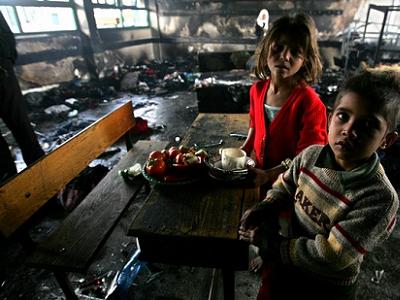 Notebooks and pens are in, construction materials are out
GISHA | September 15, 2010
- UNRWA can’t meet enrollment demand because of ban on construction materials
- UNRWA needs to build 100 schools, none built since 2007 closure
- UNRWA schools have specialized curriculum on human rights and critical thinking, not available in government schools
Despite Israel’s promise to ease the closure of the Gaza Strip, the Gaza school year opened this week with a severe shortage of classrooms. While for the first time in three years Israel has allowed the import of school supplies for government schools in Gaza, the almost absolute ban on the import of construction materials has left students with lots of pens and notebooks but without classrooms.
UNWRA needs 100 new schools to meet the enrollment demands of the children of Gaza. But despite the “easing” of the closure, building materials for the construction of schools have not been approved to enter Gaza since 2007. Therefore, UNRWA has had to turn away 40,000 children eligible to enroll in its schools for the academic year that began yesterday. Students at UNRWA schools study a specialized curriculum in human rights and critical thinking, not available in government schools. Furthermore, according to UNWRA records, students in its schools score 20% higher than government school students on international aptitude tests.
Students being turned away from UNRWA schools is only one consequence of the classroom shortage in the Gaza Strip. To deal with the shortage of classroom space, students in most of Gaza’s schools study in two shifts, in classrooms with up to 50 students, and sometimes oversized metal containers are used as classrooms, with three children seated at desks designed for two.
Onerous bureaucracy, limited capacity of crossings
Construction of a standard school requires an estimated 220 truckloads of building materials, or 22,000 truckloads for 100 schools. The only crossing Israel allows to open, Kerem Shalom, can accommodate just 250 truckloads per day, mostly for food and basic humanitarian supplies. Despite promises, Israel has yet to approve a single truckload of construction materials for UNRWA’s schools and has agreed to “negotiate” coordinating materials for just 8 out of the 100 needed schools. Since the “easing” of the closure, Israel has allowed just 240 truckloads of construction materials monthly for all uses, compared with more than 5,000 trucks monthly before the closure (4% of pre-closure levels).
According to UNRWA’s Gaza Director John Ging: “The right to education is a basic right of children everywhere. For the children of Gaza, realization of that right depends on the continued construction of schools, because all of the temporary measures and substitutes have already been exhausted”.
For an information sheet on the changes in the closure policy since the June 2010 cabinet decision, see: Unraveling the Closure of Gaza.
States test whether public pension benefits given can be taken away
By Stephen C. Fehr | Stateline | August 10, 2010
 State legislators are beginning to challenge one of the ironclad tenets of public pension policy: that states cannot legally reduce pension benefits for current and future retirees. Lawmakers in Colorado, Minnesota and South Dakota voted earlier this year to limit cost-of-living increases they previously had promised to thousands of current and future retirees, who courts historically have protected from benefit reductions. Not surprisingly, retirees in each state have filed lawsuits asking judges to restore their annual benefit increases to what they were previously.
Lawmakers, state retirement systems, public employee unions and others in the pension policy arena are closely watching the outcome of the legal challenges. If the courts do not reinstate the retirees’ benefits, a flood of states could follow the lead of Colorado, Minnesota and South Dakota. The reverse also would be true. “If the plaintiffs are successful, it may discourage legislators in other states from attempting to diminish benefits,” says Keith Brainard, research director at the National Association of State Retirement Administrators.
California Governor Arnold Schwarzenegger and New Jersey Governor Chris Christie, among other officials, favor scaling back pension benefits already promised to current employees and retirees. And a lively debate on the issue is underway in Illinois, where lawmakers reduced the cost-of-living adjustment for newly hired workers. Interest is keen everywhere: Lawmakers from around the country packed a session on modifying public pension benefits at the recent annual meeting of the National Conference of State Legislatures in Louisville.
Up to now, states trying to trim the rising cost of worker retirement benefits have taken the legally safer — and politically easier — approach of targeting benefit cuts at newly hired employees. Steps states have taken this year include increasing the amount employees contribute toward their own pensions, raising the retirement age and adjusting the formula upon which benefits are based.
But many state lawmakers and pension administrators have concluded that cutting benefits for new employees alone will not save enough money in the short term to keep pension plans solvent over time. So they are searching for ways to zero in on the benefits of current retirees and employees.
Colorado lawmakers, facing projections showing the state’s pension system would run out of money within 30 years, approved a package of benefit reductions that lowered the annual 3.5 percent cost-of-living increase for retirees in 2010 to zero. In future years, the increase will be set at 2 percent, barring another sharp decline in investments. If the changes stand, the average retiree would lose more than $165,000 in benefits over the next 20 years, the retirees say in court papers.
South Dakota reduced the cost-of-living increase from 3.1 percent to 2.1 percent this year; future-year amounts will be tied to how well the system’s investments perform in the market. Minnesota eliminated a 2.5 percent cost-of-living increase and set it at between 1 and 2 percent for its different employee pension funds.
Case law and state constitutions
History is on the employees’ side. State statutes, constitutions and case law consistently define a public pension as a contract between the state and its employees that cannot be impaired. For example, Alaska’s state constitution makes it clear that “membership in employee retirement systems of the state or its political subdivisions shall constitute a contractual relationship. Accrued benefits of these systems may not be diminished or impaired.” Eight other states protect workers in their constitutions. They are Arizona, Hawaii, Illinois, Louisiana, Michigan, New Mexico, New York and Texas.
In states without constitutional guarantees — Colorado, Minnesota and South Dakota fall into this category — statutes and court cases consider retirement benefits an unbreakable contract between the state and workers. That same protection is in the contract clause of the U.S. Constitution, which says: “No state shall … pass any … law impairing the obligations of contracts.”
Courts have determined that cost-of-living increases, which keep pension income on pace with inflation, are part of a worker’s benefits that cannot be diminished. (Generally, increasing benefits faces no legal hurdles.) The principle of safeguarding the purchasing power of pension income through a cost-of-living adjustment is well established. Social Security, the federal government’s retirement program, instituted automatic annual cost-of-living increases in 1975. The amount of the increase has averaged about 3.3 percent a year, although for the first time in 2010, there was no increase because the consumer price index did not rise.
The Colorado, Minnesota and South Dakota lawmakers are hoping that the courts will agree that the current financial turmoil facing states imperils public pension systems as never before and calls for a new approach. If legislatures are not permitted to cut retirement costs now, the argument goes, the ability of the public pension systems to pay future benefits will be jeopardized.
“If we don’t reduce these automatic pension increases, the entire fund is poised to go bankrupt,” Republican Josh Penry, minority leader of the Colorado state Senate, told the Denver Post. “Think United [Airlines]. Think GM. That didn’t work out well for the company or the retirees.”
Attorneys for the states say in court filings that limiting cost-of-living increases was justified, and actuarily necessary. “There can be no dispute that preserving the solvency of PERA [The Colorado Public Employees’ Retirement Association] is a legitimate governmental interest,” Colorado officials argue. Minnesota’s pension legislation “was reasonable and necessary to maintain and restore the financial stability of Minnesota’s public pension plans,” say the state’s pleadings.
Managing market swings
Although Colorado lawmakers and state pension officials blame much of the retirement fund’s current financial troubles on investment losses suffered during the 2007-09 recession — the median decline for funds nationally was 25 percent in 2008 — the truth is that Colorado lawmakers failed to make their annually required contributions to state pension funds in good times and bad. They also boosted retiree benefits without considering future costs.
Colorado’s pension fund was fully funded in 2000. Eight years later, before the recession hit, Colorado fell to 70-percent funded and was heading down further, according to a report released in February by the Pew Center on the States, which publishes Stateline. Most pension specialists recommend a funding level of 80 percent or higher.
Minnesota lawmakers also slid on their pension fund payments. Their pension system’s funding level dropped from 101 percent in 1999 to 81 percent in 2008.
“The Legislature was cutting off funds and starving the pension system,” says Stephen Pincus, a Pittsburgh attorney representing the retirees in all three states. “They shouldn’t now be able to cry there’s no money in the pension system. They had a large hand in creating the crisis.”
South Dakota offers a twist. The state Legislature has been one of the best in the nation at financing its public employee pension system over the years; it was 97-percent funded in 2000 and 2008, according to the Pew report. Lawmakers even increased benefits two years ago. The state retirement system investments did lose more than 20 percent in value in 2008, but gained as much in fiscal 2010.
Pincus says that makes South Dakota’s targeting of current employees and retirees suspect. “There’s no crisis in South Dakota,” he says. “They had one bad year. So they’re going to shore up their pension fund by cutting benefits to those who already receive them?”
Rob Wylie, executive director of the South Dakota retirement system, counters that when the funding level fell to 76 percent after the 2008 losses, it triggered for the first time a state law requiring the pension system to take immediate steps to return the funding level to 100 percent. Savings gained from reducing benefits for newly hired employees would have taken too many years for the system to catch up, Wylie says. So after consulting with retirees the pension board chose to ask lawmakers to trim the cost-of-living increase.
“We could have reversed the increase in the funding formula we approved in 2008,” says Wylie. “But the retiree groups said can you find another way to slow the growth in costs without decreasing the formula? So we did.”
Asked why states are taking the risky strategy of aiming at current retirees, Robert Klausner, a Florida attorney who specializes in public pension law, says many state officials believe they have less to lose in the courtroom by challenging pension protections than taking no action at all. “The belief is that if the employer [the state] prevails, it will have been worth the political risk,” Klausner says. “And if they lose, they will be no worse off than before.” Klausner adds that legislatures are taking the politically-difficult step and letting the courts be the “bad guy” if they overturn the law. Retired judges are among the plaintiffs in Colorado and South Dakota.
The first case to be heard is the one in Minnesota, where a September 15 hearing is scheduled on a motion for summary judgment that will be filed by the state. Colorado’s Supreme Court already has sided once with retirees, saying in a 1961 ruling, “Whether it be in the field of sports or in the halls of the legislature it is not consonant with American traditions of fairness and justice to change the ground rules in the middle of the game.”
Meredith Williams, executive director of the Colorado retirement system, says he is confident the state can prove that the system’s current and future financial stress will compel the court to allow the cost-of-living rollback. “PERA has been upfront about the challenges we face,” he says.
See related stories:
Pension overhaul treats lawmakers, other state workers differently (7/29/2010)
In graying West Virginia, a mountain of retiree health bills (7/13/2010)
In some states, pension pain yields budget gains (5/20/2010)
In New Hampshire, a new way on retiree health costs (5/12/2010)
Vermont’s pension experiment (3/25/2010)
States tackling public employee retirement benefits in 2010 (2/19/2010)
—Contact Stephen C. Fehr at sfehr@pewtrusts.org.
Stateline Staff Writer John Gramlich contributed reporting to this piece. Photo illustration by Danny Dougherty, Stateline.
The Bizarre Background of the ‘911’ New York Mosque
By F William Engdahl | Global Research | September 14, 2010
For days the headline in US and even world news has been whether or not a fanatic Christian preacher from a tiny Florida church will or will not burn the Moslem Koran in protest to the announced plans to build a mosque 400 meters from the site of the World Trade Twin Towers. Conveniently, the drama was focused on the 9th anniversary of the collapse of three (not two as widely believed) towers on September 11, 2001. Now details about the real estate group that is allegedly ready to invest $100 million in the mosque construction suggest that the entire drama is being deliberately orchestrated. The question is by whom to what ends?
In a move to maintain high drama, on September 10, bombastic New York real estate wheeler-dealer Donald Trump made public his offer to buy out the prime owner of the proposed Islamic Center for “patriotic” reasons. The deal was reportedly rejected categorically by Hisham Elzanaty, an Egyptian-born businessman who says he provided a majority of the financing for the two buildings where the center would be built. Here is where it begins to become interesting.
It turns out according to investigations by various New York newspapers that the property is registered not in the name of Elzanaty, but of an entity called Soho Properties, a real estate company at 552 Broadway, New York, New York. According to their website Soho Properties was founded by Sharif El-Gamal in 2003. The website describes their activities: “We are a company focused on pursuing the real value in real estate investments, especially when pricing dislocations create value-driven opportunities. Soho Properties unlocks the value in an investment by successfully executing various strategies, which include re-tenanting/repositioning assets, renovations, aggregations, developments and participating in unique opportunistic situations.” 1
Who is Sharif El-Gamal then? It seems, according to various New York police records and the research of a Florida private detective on behalf of clients who claim to have been defrauded by the El-Gamal group, that Sharif El-Gamal has a rather dubious background, for someone who is the mogul of a $100 million real estate deal. Sharif is in a partnership with his brother, Sammy El-Gamal, and Nour Mousa, nephew of Amr Moussa, an Egyptian diplomat and the Secretary General of the Arab League.
In November 2009, it was reported that the firm spent $45.7 million to buy 31 West 27th Street in New York City, a 12-story 10,000 m2 office building. El-Gamal said: “We just bought it for the income. It’s got great long-term leases, and the financing was really attractive.” In a depressed New York real estate market, the El-Gamal brothers seem not to be such shrewd businessmen. They reportedly bought it from the Witkoff Group, which had bought the building in 2006 for $31.5 million, during the boom in New York real estate.2
Then in July 2009, Soho bought the 47–51 Park Place building on the site of the planned Cordoba House, now referred to as the “Ground Zero Mosque” and “Park51”, to allegedly build a $100 million, 13-story, glass and steel Islamic cultural center and mosque that is in the planning stage. Soho Properties paid the owner $4.85 million in cash for the property.
Waiters into real estate tycoons
The question being asked is where did the large sums of money come from for the two El-Gamal brothers? It seems they are anything but your typical New York millionaire real estate tycoons.
According to an article in the New York Post, Hisham Elzanaty, one of the money men behind the developer of the “Ground Zero” mosque was sued for allegedly defrauding an insurance company for nearly $1.8 million, according to court documents. Elzanaty, who reportedly owns medical companies that operate out of a building in the Bronx, allegedly billed State Farm Insurance for unnecessary tests related to automobile accidents that would maximize the insurance payout, the court papers say. Elzanaty, who was reportedly a “significant investor” in mosque developer Sharif el-Gamal’s $4.8 million mosque project, was also ordered to repay $331,000 after an audit showed Medicaid had overpaid him. 3
According to Florida private investigator Bill Warner and to various New York reports, there is an investigation ongoing into Sammy and Sharif El-Gamal of the SOHO Properties by the New York State Dept of Licensing in Manhattan for non-payment of apartment rental deposits to customers that were supposed to be in escrow.
Court records from Florida to New York State reveal that Sharif and his younger brother, Samir “Sammy” El-Gamal, 35, a partner with him in his company SoHo Properties, both have a history of numerous tax and debt issues, dating from at least 1994 to the present. In one case, a NY Police officer arrested Sharif in 1994 for “promoting prostitution.” He pleaded guilty to a mis-demeanor of disorderly conduct. In another instance, Sharif told a court he didn’t hit a tenant from whom his brother and he were trying to collect back rent. He said to police, the tenant’s “face could have run into my hand.” 4
The brothers’ background does not suggest billionaire real estate project preparation. Sharif waited tables at the restaurant Serafina, while Sammy waited tables at Tao. Then Sharif worked as a waiter at Michael Jordan’s, named after basketball star. But he, ostensibly a devout muslim, was fired for arriving reeking of alcohol, among other things. This is around when Sharif started acquiring a criminal record, say people familiar with his career.5
The geopolitical manipulation
The entire ‘911’ Mosque controversy has been made into world news by CNN and other select media. The US head of the military command in Afghanistan, General Petraeus got into the fray with a plea to the Florida pastor not to burn Korans, a move which naturally led several other wanna-be preacher bigots to say they too planned to burn Korans on the ninth anniversary of the World Trade Center event. The President, Barack Obama, got into the act by praising the building of the mosque as a symbol of Americans’ religious freedom and tolerance.
At the end of the day it all fueled a “Clash of Civilization” tension across America, and had the convenient effect, whether the mosque is built on the site or not, of reinforcing the US Government version of the collapse of the World Trade towers on September 11, 2001, namely that the destruction was carried out by two commercial hijacked jets being deftly rerouted into the two towers. And that the Boeing jets had been allegedly hijacked by 19 Arab students, armed only with paper box cutters, who had just been trained at a Florida flight school to fly small Cessna-size private planes. By keeping alive the myth of the “Second Pearl Harbor,” as George W. Bush once called 911, perhaps some people such as Barack Obama or General Petraeus hope to keep attention on the need for US military occupation in Iraq and Afghanistan, or even spreading the war beyond Afghanistan.
One interesting question in the entire business is who put up millions of dollars for the sleazy El-Gamal brothers’ Soho Properties to pay $5 million cash for the property and to buy the other property for $46 million? Did the very established Witkoff Group, whose head, Steven Witkoff was selected as “Man of the Year” by The Jeffrey Modell Foundation in 1998, and who do major deals from London to New York not do a due diligence research on their new potential clients? Or is this all play money games using intelligence agency or other fake companies to create the explosive scenario at the anniversary of 911? These are some of the interesting questions to ask.
Notes:
1 Soho Properties, accessed in http://www.sohoproperties.com/pdfs/SP3rdQ08Newsletter.pdf
2 Dana Rubenstein, SoHo Properties Buys Chelsea Building for $45.7 M., The New York Observer Real Estate, November 9, 2009, accessed in
http://www.observer.com/2009/real-estate/witkoff-sells-chelsea-building-457-m
3 Tom Liddy, Ripoff Mosque Man Sued, New York Post, September 4, 2010.
4 Asra Q. Nomani , Rift Imperils Ground Zero Mosque, August 30, 2010, Yahoo News, accessed in
http://news.yahoo.com/s/dailybeast/9670_sharifelgamalandthegroundzeromosque
5 Ibid.
Kelly’s strange death linked to Iraq war
Press TV – September 15, 2010
The mysterious death of British weapons inspector David Kelly could be linked to the controversial invasion of Iraq in March 2003, according to a group of experts.
The invasion of Iraq was carried out under the pretext that the country’s ruler at the time, Saddam Hussein, was in possession of weapons of mass destruction (WMD), deployable within 45 minutes.
Kelly began one of the most explosive episodes in British politics when he communicated his doubt about the issue to a number of journalists, including Andrew Gilligan.
On July 17, 2003, Dr. Kelly was found dead. The Hutton Inquiry into the highly suspicious case was sealed as suicide.
Over the past seven years, there have been numerous calls for a new inquiry. The largest and most persistent calls came from two groups of doctors and former doctors who argue the manner of Kelly’s death does not seem to match known evidence.
Gilligan, who has since become one of the key figures in the Kelly investigations, has accused the British Labor Government for exaggerating the claims for going to war with Iraq.
Gilligan’s main source for his allegations against the government of Tony Blair was none other than Kelly himself.
“I came across him as somebody with an expertise in the field, I was covering Iraqi biological and chemical weapons,” Gilligan told Press TV about his first meeting with Kelly.
Gilligan said that Kelly had doubts over one of the key pieces of intelligence that had underpinned the WMD dossier. “The source was not regarded by Kelly and other experts as reliable.”
Gilligan says Kelly’s death came as a shock to him. “He didn’t strike me as the suicidal type. He had been a weapons inspector in Iraq for goodness sake; he was perfectly well used to confrontation and pressure.”
One of the strongest cases for an alternate theory of what happened to Kelly has come from a Liberal Democrat MP Norman Baker, whose 2007 book on Kelly’s points to murder and not suicide.
Lord Howard, a former Conservative Party leader, says a new inquest would be the only way to clear up any lasting doubts.
However, Justice Secretary Kenneth Clark has so far resisted calls to re-open the case and make public the records that were sealed by Lord Hutton for a period of 70 years.
Retired doctor David Halpin recently held a meeting with a group of lawyers concerning the case. He says they are looking for ways to push for a fresh inquiry into the case.
When Press TV asked Halpin about the importance of investigating the true nature of Kelly’s death, he quoted leader of the enlightenment in England John Locke, “Where the law ends, tyranny begins.”
All That You Have Done: Colonialism, Ethnic Cleansing and the Web

During a march, Bassem Abu Rahma, unarmed, was shot and killed.
By Roger Sheety | Palestine Chronicle | September 15, 2010
Despite the current facade of yet another round of fake peace talks, the Israeli government and its professional apologists remain in a panic. Hardly a week passes by without complaint that Israel “is being isolated” or that it is facing a campaign of “delegitimization.” In February of this year the Reut Institute, an Israeli group-think tank, published a remarkably delusional, ahistorical piece of propaganda masquerading as a scholarly report and warning of an internationally concerted effort that seeks to “erode” Israel’s diplomatic status which “may develop into a comprehensive existential threat within a few years.” (*) In essence, any organization or individual that dares criticize Israeli policy in the Occupied Palestinian Territories in particular is a de facto member of this dreaded network of delegitmization. As with all Israeli hasbara (explanation), the Reut Institute blames primarily the Palestinian victims and secondarily those who report or publicize their plight.
Since then, various Israeli officials have dutifully echoed the report’s supposed findings. Thus, in the June 21st edition of The Jerusalem Post we are informed by the outgoing Israeli Ambassador to the UN Gabriella Shalev that Israel is “the most isolated, lonely country in the world.” “The biggest threat to [Israel’s] existence is not Iranian nuclear proliferation,” the article goes on, “but international attempts to delegitimize it.” Note how both Shalev and the article’s author repeat verbatim the Reut Institute’s apocalyptic language and assumptions. Even more recently, the long-disgraced and discredited Tony Blair has used the exact same language. The delegitmization of Israel is an “affront” not only to Israelis but to those “everywhere, in every part of humanity, who share the values of a free and independent human spirit” said Blair in a speech at a conference on, yes, the delegitimization of Israel.
But where precisely is the hard evidence of this malicious campaign of isolation and delegitimization? It certainly does not come from the American government. On July 16, 2010 the U.S. State Department’s Andrew J. Shapiro proudly announced that “For Fiscal Year 2010, the Administration requested $2.775 billion in security assistance funding specifically for Israel, the largest such request in U.S. history.” Furthermore, “Congress fully funded our request for FY 2010, and we have requested even more – $3.0 billion – for FY 2011. These requests fulfill the Administration’s commitment to implementing the 2007 memorandum of understanding with Israel to provide $30 billion in security assistance over 10 years.” A conservative study published two years ago by Washington Report on Middle East Affairs puts the total amount of U.S. official direct aid to Israel from 1949 to 2008 at nearly $114 billion. Perhaps, then, Europe is the culprit? Not according to Robert Fisk who recently wrote that Israel has all but officially become a member of the European Union. Fisk cites the work of David Cronin who concludes that “Israel has developed such strong political and economic ties to the EU over the past decade that it has become a member state of the union in all but name.”
As American and European governments clearly remain committed to rewarding Israel regardless of its crimes, what then is really frightening the only nuclear-armed state in the Middle East and the world’s fourth most powerful military machine? The great Palestinian poet Mahmoud Darwish once famously wrote: “All that you have done to our people is registered in notebooks.” But even Darwish could not have known how prophetic his words would be. For today what is being done to the Palestinian people is not only being documented by scholars and journalists, but also by Palestinians themselves on YouTube, Google video and a myriad other video-hosting websites, independent online journals, human rights organizations and blogs. Today we can see for ourselves the continuing colonization and ethnic cleansing in Palestine, online, in context and without censorship. Although one can cite literally hundreds of such examples across all of historical Palestine, I will concentrate on only three recent cases.
Case 1 – The village of Bil’in
A clear case of colonialism, what is happening in Bil’in, a village of about two thousand residents located in the Occupied Palestinian Territories, is a microcosm of what is happening over the whole of the West Bank. Since 2005 its residents have been organizing weekly, non-violent marches protesting Israel’s illegal annexation wall which has separated the villagers from 60 percent of its farmland. Recently the villagers have been joined by Israeli citizens as well as other internationals. Inevitably the protesters are then attacked by Israeli Occupation Forces often resulting in injuries and even death. On April 17, 2009 during a march, Bassem Abu Rahma, unarmed, was shot and killed by an Israeli soldier. This wanton act of murder, fully documented on video, was dismissed by an Israeli judge one year later. Bil’in is in an area which is nominally under Palestinian control yet there is no accountability, no law, and whatever the Israeli state orders is the new reality. Anyone still naive enough to ask questions like, “Where is the Palestinian Gandhi?” should begin looking in Bil’in—there are some two thousand Gandhis there.
Case 2 – Sheikh Jarrah, East Jerusalem
According to international law East Jerusalem is a part of the Occupied Palestinian Territories. As such, the Israeli state has no right to transfer any part of its own population into these territories, nor does it have any right whatsoever to remove any of its residents. In 2008 alone the Israeli state revoked the legal residencies of 4,577 Palestinians in East Jerusalem leaving them vulnerable to forcible removal by Israeli Occupation Forces. As seen in several extraordinary reports by Sherine Tadros and Jacky Rowland of Al Jazeera, the neighbourhood of Sheikh Jarrah has fallen victim to this continuing ethnic cleansing, “house by house, family by family.” Palestinians are literally being forced from their homes in tears, their possessions thrown into the streets, as they watch helplessly while Jewish settlers move in under armed Israeli protection. What we are seeing here is not the result of some natural disaster but a consequence of deliberate Israeli government policies which are supported and funded by American and European governments. When Tony Blair pontificates on “shared values of a free and independent human spirit,” one wonders if he has ever set foot in East Jerusalem?
Case 3 – The village of Al-Arakib
Located in the Naqab (Negev), Al-Arakib, a village of some 300 Palestinian Bedouins, has been destroyed several times within a span of three months. Despite the fact that they are Palestinian citizens of Israel, the state refuses to recognize their legal land claims which date to the Ottoman period. Indeed, Al-Arakib is but one of some 50 Palestinian Bedouin villages which Israel does not recognize as legal. In the summer of 2010 the Israeli government decided to make an example of Al-Arakib and, as shown by Max Blumenthal in several shocking reports, destroyed the village on five separate occasions leaving its residents homeless and destitute. As seen in Blumenthal’s video footage, the emptied homes are ripped to pieces by bulldozers and tractors as the villagers sit outside and watch. In one particulary disgraceful demolition, Israeli high school students are brought in and allowed to enter and deface the home-owners’ left-over belongings before the homes are then destroyed. Israel’s excuse, that it needs the villagers’ land for forestation projects, is deeply cynical and hollow. How perverse are Israel’s constant cries for “security needs” as it violently uproots its own Palestinian citizens.
The work of those such as Jacky Rowland, Sherine Tadros, Max Blumenthal and many others stands in marked contrast to the supine, corporate journalists who continuously parrot tired Israeli propaganda. It is beyond comprehension how mainstream North American media largely ignores Palestinian non-violent resistance to Israeli occupation. Of course, what we are seeing today is nothing new to Palestinians who have experienced dispossession and expulsion for over 62 years; what is new is merely the methodology: Byzantine Israeli “laws” targeting Arab neighbourhoods and villages, annexation walls and barriers separating villagers from their farm land and water resources, and then diverting those same resources to nearby illegal Jewish colonies.
One does not have to be an expert in international law or hold multiple post-graduate degrees to know right from wrong. Ordinary people know ethnic cleansing and colonialism when they see it; they understand its profound evil and inherent violence. This is especially true for many people from the so-called “Third World” where colonialism and its ensuing brutality remain fresh in their collective memories and experiences. These video images are being watched time and again by hundreds of thousands of people around the world. Their content is unforgiving, their effects are visceral. Indeed, however much one is aware of the historical background, it takes a certain kind of callousness to watch and not be moved by the plight of Palestinians at the hands of their colonizers.
In reality, honest, contextual reporting on its own will not bring justice to the Palestinian people. However, when combined with the boycott, divestment and sanctions campaign (BDS), the attempts to break the brutal siege of Gaza, as well as the movement to implement international law, suddenly the Israeli government, long accustomed to committing its crimes with impunity, takes notice. Nothing frightens any state elite and its professional apologists more than an increasingly conscious, politically engaged and questioning citizenry. More specifically, nothing frightens the colonizer more than the de-colonized mind. The tide of mass consciousness is turning and, as the once-segregated U.S. south, the Soviet Union and apartheid South Africa learned not so long ago, no military however powerful, and no state however repressive, can stop it.
Notes:
(*) See Reut Institute document.
Featured Video
Prof. Ted Postol: Iran Already Achieved Nuclear Deterrence Against Israel
or go to
Aletho News Archives – Video-Images
From the Archives
How the occupied mentality syndrome works
Saudi Arabia on the American chessboard – Part 3
By B. J. Sabri | American Herald Tribune | June 27, 2016
Read part 2: “The occupied mentality Syndrome“
Previously I argued whether Saudi Arabia’s repeated involvements in U.S. interventions and wars stem from free national will or in response to a specific condition. For starters, in Saudi Arabia there is no national will. In Saudi Arabia, the national will is the will of the Al Saud clan. Still, when a major Arab state allies itself with a superpower that committed unspeakable crimes against humanity in almost every Arab country, then something is wrong. This fact alone should compel us to examine the U.S.-Saudi relation for one exceptional reason. As a result of the U.S.-Saudi wars, hundreds of thousands of people in Afghanistan, Iraq, Iran, Libya, Syria, Yemen, and Somalia have lost their lives. Millions became displaced in their own homelands. And millions more rendered refugees.
Attributing the Saudi policies to the bonds of “partnership” with the U.S. is frivolous. There are no bonds between these two thugs except those of business, military deals, secret plots, and wars. Proving this point, bonds such as these have no space for the American and Saudi peoples to share significant cultural or societal exchanges. If partnership is not the reason for the Saudi contribution to the U.S. strategy of empire and imperialism, then another reason must exist.
This leads to three possibilities. … continue
Blog Roll
 Aletho News
- NIAID/NIH and USDA Fund Bioengineered Chimeric Influenza Viruses Built Using Pandemic H1N1 Components: Journal ‘Science Advances’
- Hezbollah hits Israeli warship off Lebanon’s coast, sets it aflame
- Iran slams US strikes on B1 bridge, Mahshahr petrochemical plants as ‘blatant acts of state terrorism’
- In letter to UN chief, Araghchi warns of dire consequences of US-Israeli attacks on Iran’s nuclear facilities
- Why the CIA conspiracy to invade Iran with Kurdish militias failed
- Why Are Upbeat US Claims About Mission to Rescue Pilot ‘Highly Questionable’?
- Aircraft destroyed during US ‘rescue’ of downed F-15 pilot cost more than $100 million each
- Washington University removes professor who condemned US-Israeli war on Iran
- Russia Warns of Retaliation as UK Authorizes Seizure of Vessels
- Serbia thwarts plot to bomb Russia-Hungary gas pipeline – Vucic
- If Americans Knew
- In Iran, Israel-US take aim at “reason, research, and freedom of thought” – Daily Update
- US loses planes over Iran, Israel downgrades Lebanon war goals – Daily Update
- Israel Is Blocking Palestinians from Easter at Church Where Jesus Resurrected
- Plot to assassinate Palestinian activist follows harassment campaign promoted by Zionist groups and elected officials
- Prominent New York synagogue hosts presentation on why U.S. Jews should support the ethnic cleansing of Gaza
- Tapper vs. Piker: Is the CNN Anchor Auditioning for David Ellison?
- Shouldn’t Democrats Be Able to Condemn Genocide?
- Israel-US kill negotiators, destroy civilian structures, but Iran’s military capabilities still largely intact – Daily Update
- ‘War crime’: Global condemnation as Israeli ministers celebrate death penalty law targeting Palestinian prisoners
- 7 Ways Israel Is Turning Lebanon Into Gaza
- No Tricks Zone
- An Inconvenient Tree: Uncovered In Alps… Europe Much Warmer Than Today 6000 Years Ago
- New Study Reports A 60% Slowdown In Greenland’s Ice Loss Rate In The Last Decade
- Low Intensity Tornado Wrecks Major Solar Farm, Creating A Potential Toxic Dump
- New Study Finds Warming Saves Lives…Cold Temperatures 12 Times More Deadly Than Excess Heat
- German Science Blog Accuses PIK Climate Institute Of Hallucinating Climate Tipping Points
- Devastating Assessment Of Comirnaty Vaccine By Former Senior Pfizer Europe Toxicologist
- New Study: CO2 Is ‘Effectively Negligible’ As An Explanatory Climate Change Factor Since 2000
- Former Pfizer Toxicologist Dr. Helmut Sterz Tells Bundestag Hearing Pfizer Vaccine Should Have Never Been Approved
- Energy Expert: Germany’s Nuclear Phaseout Was A “500 Billion Euro Mistake”
- New Research: South Australia’s Mid-Holocene Sea Surface Temperatures Were 4°C Warmer Than Today
 Aletho News