The STL and the myth of judicial virginity
By Helena Cobban | January 13, 2011
The myth propagated by supporters of the various “international” criminal tribunals established since 1992 has been that somehow a judicial proceeding could rise completely above the sordid field of politics and follow its own complete integrity. I used to subscribe to that myth. But in 2000-01, as I started to investigate more closely the work of the two ad-hoc tribunals created by the UN during the mid-1990s, it became clear that “international” criminal tribunals can never, ever, be separated either from the politics of the countries whose developments they probe (and whose politics are inevitably affected by the work of the tribunals themselves)– or, from the politics of the “international” constellation of governments that establish, fund, and provide continued support for these tribunals’ work.
My 2006 book Amnesty After Atrocity? provided copious evidence of this, with regard to the work of the International Criminal Tribunal for Rwanda. But it is not only the ICTR whose work is irredeemably politicized. So has been the work of all “international” tribunals running from the Ur-example in Nuremberg through to today’s “International Criminal Court.” As longtime JWN readers know, I’ve written a lot about this issue, both here and (earlier) on the now nearly-defunct “Transitional Justice Forum” blog. Check over there for, in particular the field reports of the reporting trip I made to northern Uganda in 2006, to assess the very harmful effects that the work of the ICC was having on peacemaking there.
And then, there was the travesty of the (heavily U.S.-supported) Saddam Hussein trial…
Plus, the fact that the government leaders in Washington responsible for launching the completely unjustified invasion of Iraq in 2003, and therefore also all the deaths and violence that ensued from that invasion and occupation, were easily able to evade ever being held to account for that act of aggression (an act that was, at Nuremberg, certainly prosecutable– and prosecuted.) This, while the U.S. has also stood quite aside from all entreaties that it join the ICC– though over recent years it has given extensive logistic and financial support to some, but not all, of the ICC’s investigations and prosecutions… when this suited Washington’s own, inevitably political, purpose.
The neutrality of these judicial bodies before an “impartial” international law? That is nowhere to be seen.
… And then, there is the Special Tribunal for Lebanon,a body that has been irrevocably “politicized” and “political” ever since its establishment in 2006-07. It is a joint project of both the U.N. Security Council and the Government of Lebanon, established at a time when the U.S. still held important sway over both bodies.
Now, Hillary Clinton and her people are busy talking about the need to allow the STL to continue doing its allegedly quite “impartial” work. The STL has been the focus of considerable controversy and swirling allegations and counter-allegations over its years in existence, and I confess I have not followed these with enough diligence to be able to make clear-cut judgments regarding them.
What I can say with a high degree of confidence, based on my own work on this issue of international tribunals over the past decade is that no criminal court, within a country or at the global level, can ever have its work divorced from politics. Criminal prosecutions at a national level involve the state using the laws that already exist within the country to bring a prosecution against a defendant, who may upon being found guilty be subjected to serious sanction by the state– even, in the U.S. and elsewhere, the death penalty.
At the national level, too, the head of state or government always has the power to give clemency or pardon to convicted criminals (as in the case of Elliott Abrams in the U.S.), and leaders often use these powers with the goal of fostering national unity, or other worthwhile political goals.
And at the global level? Where is the agreed-upon, duly legislated, and equality-respecting legal basis for the work of international prosecutors? Where is the opportunity for global political leaders to issue pardons or enact clemency? Where, in short, is the supra-“judicial” legal-political infrastructure that can assure the impartiality as well as general social utility of the work of prosecutors and judges?
It doesn’t exist. In a world marked by striking political inequalities– especially between countries that have P-5 status on the Security Council, and those that don’t; and between countries that have at least submitted themselves to the judgments of the ICC, and those that haven’t– the “impartiality” of international criminal courts is a myth.
I wish it weren’t so. I wish we had the kind of global system in which all national leaders and other significant political actors could be held equally accountable for their actions. But we don’t. Rights activists from around the world who have put so much energy into fighting for the establishment and support of the existing international courts really also need to examine closely the effects that these courts have had on the lives, livelihoods, and well-being of the millions of citizens of the countries that have been their targets. In Amnesty After Atrocity? I looked at the effects on the citizenries of Rwanda, South Africa, and Mozambique of the widely differing approaches those three countries adopted to the issue of seeking “accountability” for past war crimes, crimes against humanity, and genocide. The two countries that decided against using criminal courts to deal with perpetrators of atrocities during the episodes of severe violence that all of them had suffered were the ones that came out with their social cohesion, political purpose, and the rights situation of their citizenries the best assured.
It is not only in Lebanon that a crucial “trade-off” exists between the work of (an inevitably “political” and backward-looking) international tribunal and the prospects for peace and people’s well-being going forward. Look at some of my own past work on this issue. Look at what the Obama administration is now actively considering doing in the context of Sudan, for goodness sake! Today, White House officials including “Ms. Anti-Genocide” herself, Samantha Power, are openly talking about the possibility of easing up the pressure that Pres. Omar Hassan al-Bashir has been subjected to from the ICC, in exchange for his cooperation with implementing the results of the South Sudan referendum.
It surely should not be that only in Lebanon does Washington pursue the chimera of the “impartiality” of a tribunal with strong international dimensions at the expense of the well-being of the target country’s citizenry.
Accountability for Rafiq Hariri’s killing? One day, let’s hope, the facts will all emerge. But this highly politicized judicial process centered in The Hague looks unlikely to be able credibly to uncover them. And if it does issue indictments, what then? STL prosecutor Daniel Bellemare and whose army will arrest those indicted? What of the Lebanese government’s supposedly co-equal role in managing this whole “criminal justice” project?
The next time Sec. Clinton or a State Department spokesman starts talking about the need to preserve the “impartiality” of this court, the STL, they should be asked about some of these very important questions…
No comments yet.
Featured Video
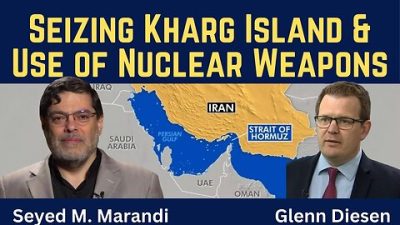
Marandi: Threat of Seizing Kharg Island & the Use of Nuclear Weapons
or go to
Aletho News Archives – Video-Images
Frlom the Archives
Provoking a Path to Persia
The Saban Center’s prescient paper on war with Iran
By Maidhc Ó Cathail | October 20, 2011
In June 2009, the Saban Center for Middle East Policy published “Which Path to Persia?—Options for a New American Strategy toward Iran.” Writing in a tone strikingly reminiscent of the Project for a New American Century’s infamous pre-9/11 paper “Rebuilding America’s Defenses,” the six co-authors noted that, “It seems highly unlikely that the United States would mount an invasion without any provocation or other buildup.” For a think tank specifically established by media mogul Haim Saban to protect Israel, this could prove to be a formidable obstacle impeding their desired march—of U.S. troops—to Tehran.
“In fact, if the United States were to decide that to garner greater international support, galvanize U.S. domestic support, and/or provide a legal justification for an invasion, it would be best to wait for an Iranian provocation, then the time frame for an invasion might stretch out indefinitely,” Saban’s think-tankers ruefully observed.
“With only one real exception, since the 1978 revolution, the Islamic Republic has never willingly provoked an American military response, although it certainly has taken actions that could have done so if Washington had been looking for a fight. Thus it is not impossible that Tehran might take some action that would justify an American invasion. And it is certainly the case that if Washington sought such a provocation, it could take actions that might make it more likely that Tehran would do so (although being too obvious about this could nullify the provocation). However, since it would be up to Iran to make the provocative move, which Iran has been wary of doing most times in the past, the United States would never know for sure when it would get the requisite Iranian provocation. In fact, it might never come at all.”
Seemingly undeterred by Iran’s frustrating unwillingness to provide the requisite provocation, the analysts continued to examine this option… continue
Blog Roll
 Aletho News
- Ukrainian Embassy in Beirut sheltering top Mossad agent
- Palestinian family displaced after settlers violently attack them in Humsa, Jordan Valley
- The EU never learns – except for the wrong lessons
- Iran attacks on UAE leaves RSF militia high and dry
- Hosting Washington’s war: Bahrain faces the consequences
- The US fell for its own Iran propaganda
- Seyed M. Marandi: Threat of Seizing Kharg Island & the Use of Nuclear Weapons
- Is there even an off ramp?
- Michael von der Schulenburg: Europe’s Self-Defeating Iran War Policy
- Sorry, The New Republic, Climate Change Isn’t Causing Somali Migration. Blame Civil Strife and Poverty.
- If Americans Knew
- ‘Of Course’: IDF Drops Case Against Soldiers Accused of Raping Palestinian Prisoner
- Don’t Fall for the Regime Change Talk. Israel Is ‘Mowing the Lawn’ in Iran
- Will Israel and the US wreck the Gulf States along with Iran?
- US so far burned through ‘years’ of munitions in Iran war: Report
- How the Israeli Tail Wags the American Dog
- Outdated intel likely led to deadly U.S. strike on Iranian elementary school, sources say
- Pentagon insider says high U.S official Douglas Feith reported to Netanyahu
- In fond memory of Walid Khalidi, the historian of Palestine
- 6 more Americans killed, as Israel ‘mows the lawn’ in Iran – Not a ceasefire Day 154
- Are we on the precipice of World War III?
- No Tricks Zone
- New Studies: UK Sea Levels Were 4 Meters Higher Than Today During The Mid-Holocene
- Destructive Green New Deal: German Energy And Metal Group Warns Of Drastic Crisis
- New Study Documents A 20-Year Pause In Arctic Sea Ice Decline – Driven By Internal Variability
- Wake-up Call: Survey Shows Majority Of Germans Now Favor Postponing Climate Targets!
- Televised! Leading German Political Candidate Tells Schoolchildren CO2 Makes Sun Hotter!
- New Study: A Century Warming Of 1.1°C Is ‘Commonplace’ And ‘Not Unusual’ During This Interglacial
- New Study: ‘Internal Noise’ And Volcanic Forcing Can Trigger 10-15°C Warming Within Decades
- Glaciers Worldwide Are Suddendly Surging, Experts Blame Warming!
- Surprising Discovery: Sahara Is Greening…Billions Of Trees Where Once Thought To Be Barren
- New Research Reaffirms Clouds, Aerosols, And Surface Solar Radiation Are ‘Driving The Climate System’
 Aletho News
Leave a comment