Why Washington Clings to a Failed Middle East Strategy
By Gareth Porter | Lobe Log | January 31st, 2011
The death throes of the Mubarak regime in Egypt signal a new level of crisis for a U.S. Middle East strategy that has shown itself over and over again in recent years to be based on nothing more than the illusion of power. The incipient loss of the U.S. client regime in Egypt is an obvious moment for a fundamental adjustment in that strategy.
But those moments have been coming with increasing regularity in recent years, and the U.S. national security bureaucracy has shown itself to be remarkably resistant to giving it up. The troubled history of that strategy suggests that it is an expression of some powerful political forces at work in this society, as former NSC official Gary Sick hinted in a commentary on the crisis.
Ever since the Islamic Republic of Iran was established in 1979, every U.S. administration has operated on the assumption that the United States, with Israel and Egypt as key client states, occupies a power position in the Middle East that allows it to pursue an aggressive strategy of unrelenting pressure on all those “rogue” regimes and parties in the region which have resisted dominance by the U.S.-Israeli tandem: Iran, Iraq, Syria, Hezbollah and Hamas.
The Bush administration’s invasion of Iraq was only the most extreme expression of that broader strategic concept. It assumed that the United States and Israel could establish a pro-Western regime in Iraq as the base from which it would press for the elimination of resistance from any of their remaining adversaries in the region.
But since that more aggressive version of the strategy was launched, the illusory nature of the regional dominance strategy has been laid bare in one country after another.
- The U.S. invasion and occupation of Iraq merely empowered Shi’a forces to form a regime whose geostrategic interests are far closer to Iran than to the United States.
- The U.S.-encouraged Israeli invasion of Lebanon in 2006 only strengthened the position of Hezbollah as the largest, most popular and most disciplined political-military force in the country, leading ultimately the Hezbollah-backed government now being formed.
- Israeli and U.S. threats to attack Iran, Hezbollah and Syria since 2006 brought an even more massive influx of rockets and missiles into Lebanon and Syria which now appears to deter Israeli aggressiveness toward its adversaries for the first time.
- U.S.-Israeli efforts to create a client Palestinian entity and crush Hamas through the siege of Gaza has backfired, strengthening the Hamas claim to be the only viable Palestinian entity.
- The U.S. insistence on demonstrating the effectiveness of its military power in Afghanistan has only revealed the inability of the U.S. military to master the Afghan insurgency.
And now the Mubarak regime is in its final days. As one talking head after another has pointed out in recent days, it has been the linchpin of the U.S. strategy. The main function of the U.S. client state relationship with Egypt was to allow Israel to avoid coming to terms with Palestinian demands.
The costs of the illusory quest for dominance in the Middle East have been incalculable. By continuing to support Israeli extremist refusal to seek a peaceful settlement, trying to prop up Arab authoritarian regimes that are friendly with Israel and seeking to project military power in the region through both airbases in the Gulf States and a semi-permanent bases in Iraq and Afghanistan, the strategy has assiduously built up long-term antagonism toward the United States and pushed many throughout the Islamic world to sympathize with Al Qaeda-style jihadism. It has also fed Sunni-Shi’a tensions in the region and created a crisis over Iran’s nuclear program.
Although this is clearly the time to scrap that Middle East strategy, the nature of U.S. national security policy-making poses formidable obstacles to such an adjustment Bureaucrats and bureaucracies always want to hold on to policies and programs that have given them power and prestige, even if those policies and programs have been costly failures. Above all, in fact, they want to avoid having to admit the failure and the costs involved. So they go on defending and pursuing strategies long after the costs and failure have become clear.
An historical parallel to the present strategy in the Middle East is the Cold War strategy in East Asia, including the policy of surrounding, isolating and pressuring the Communist Chinese regime. As documented in my own history of the U.S. path to war in Vietnam, Perils of Dominance, the national security bureaucracy was so committed to that strategy that it resisted any alternative to war in South Vietnam in 1964-65, because it believed the loss of South Vietnam would mean the end of Cold War strategy, with its military alliances, client regimes and network of military bases surrounding China. It was only during the Nixon administration that the White House wrested control of national security policy from the bureaucracy sufficiently to scrap that Cold War strategy in East Asia and reach an historic accommodation with China.
The present strategic crisis can only be resolved by a similar political decision to reach another historical accommodation – this time with the “resistance bloc” in the Middle East. Despite the demonization of Iran and the rest of the “resistance bloc”, their interests on the primary issue of al Qaeda-like global terrorism have long been more aligned with the objective security interests of the United States than those of some regimes with which the United States has been allied (e.g., Saudi Arabia and Pakistan).
Scrapping the failed strategy in favor of an historic accommodation in the region would:
- reduce the Sunni-Shi’a geopolitical tensions in the region by supporting a new Iran-Egypt relationship;
- force Israel to reconsider its refusal to enter into real negotiations on a Palestinian settlement;
- reduce the level of antagonism toward the United States in the Islamic world and
- create a new opportunity for agreement between the United States and Iran that could resolve the nuclear issue.
It will be far more difficult, however, for the United States to make this strategic adjustment than it was for Richard Nixon and Henry Kissinger to secretly set in motion their accommodation with China. Unconditional support for Israel, the search for client states and determination to project military power into the Middle East, which are central to the failed strategy, have long reflected the interests of the two most powerful domestic U.S. political power blocs bearing on national security policy: the pro-Israel bloc and the militarist bloc. Whereas Nixon and Kissinger were not immobilized by fealty to any such power bloc, both the pro-Israel and militarist power blocs now dominate both parties in the White House as well as in Congress.
One looks in vain for a political force in this country that is free to press for fundamental change in Middle East strategy. And without a push for such a change from outside, we face the distinct possibility of a national security bureaucracy and White House continuing to deny the strategy’s utter failure and disastrous consequences.
Share this:
Related
January 31, 2011 - Posted by aletho | Militarism, Timeless or most popular, Wars for Israel
No comments yet.
Featured Video
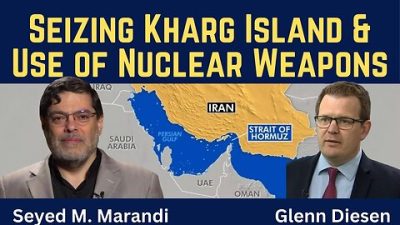
Marandi: Threat of Seizing Kharg Island & the Use of Nuclear Weapons
or go to
Aletho News Archives – Video-Images
Frlom the Archives
Provoking a Path to Persia
The Saban Center’s prescient paper on war with Iran
By Maidhc Ó Cathail | October 20, 2011
In June 2009, the Saban Center for Middle East Policy published “Which Path to Persia?—Options for a New American Strategy toward Iran.” Writing in a tone strikingly reminiscent of the Project for a New American Century’s infamous pre-9/11 paper “Rebuilding America’s Defenses,” the six co-authors noted that, “It seems highly unlikely that the United States would mount an invasion without any provocation or other buildup.” For a think tank specifically established by media mogul Haim Saban to protect Israel, this could prove to be a formidable obstacle impeding their desired march—of U.S. troops—to Tehran.
“In fact, if the United States were to decide that to garner greater international support, galvanize U.S. domestic support, and/or provide a legal justification for an invasion, it would be best to wait for an Iranian provocation, then the time frame for an invasion might stretch out indefinitely,” Saban’s think-tankers ruefully observed.
“With only one real exception, since the 1978 revolution, the Islamic Republic has never willingly provoked an American military response, although it certainly has taken actions that could have done so if Washington had been looking for a fight. Thus it is not impossible that Tehran might take some action that would justify an American invasion. And it is certainly the case that if Washington sought such a provocation, it could take actions that might make it more likely that Tehran would do so (although being too obvious about this could nullify the provocation). However, since it would be up to Iran to make the provocative move, which Iran has been wary of doing most times in the past, the United States would never know for sure when it would get the requisite Iranian provocation. In fact, it might never come at all.”
Seemingly undeterred by Iran’s frustrating unwillingness to provide the requisite provocation, the analysts continued to examine this option… continue
Blog Roll
-
Join 2,450 other subscribers
Visits Since December 2009
- 7,411,778 hits
Looking for something?
Archives
Calendar
Categories
Aletho News Civil Liberties Corruption Deception Economics Environmentalism Ethnic Cleansing, Racism, Zionism Fake News False Flag Terrorism Full Spectrum Dominance Illegal Occupation Mainstream Media, Warmongering Malthusian Ideology, Phony Scarcity Militarism Progressive Hypocrite Russophobia Science and Pseudo-Science Solidarity and Activism Subjugation - Torture Supremacism, Social Darwinism Timeless or most popular Video War Crimes Wars for IsraelTags
9/11 Afghanistan Africa al-Qaeda Australia BBC Benjamin Netanyahu Brazil Canada CDC Central Intelligence Agency China CIA CNN Covid-19 COVID-19 Vaccine Donald Trump Egypt European Union Facebook FBI FDA France Gaza Germany Google Hamas Hebron Hezbollah Hillary Clinton Human rights Hungary India Iran Iraq ISIS Israel Israeli settlement Japan Jerusalem Joe Biden Korea Latin America Lebanon Libya Middle East National Security Agency NATO New York Times North Korea NSA Obama Pakistan Palestine Poland Qatar Russia Sanctions against Iran Saudi Arabia Syria The Guardian Turkey Twitter UAE UK Ukraine United Nations United States USA Venezuela Washington Post West Bank WHO Yemen Zionism
Aletho News- Ukrainian Embassy in Beirut sheltering top Mossad agent
- Palestinian family displaced after settlers violently attack them in Humsa, Jordan Valley
- The EU never learns – except for the wrong lessons
- Iran attacks on UAE leaves RSF militia high and dry
- Hosting Washington’s war: Bahrain faces the consequences
- The US fell for its own Iran propaganda
- Seyed M. Marandi: Threat of Seizing Kharg Island & the Use of Nuclear Weapons
- Is there even an off ramp?
- Michael von der Schulenburg: Europe’s Self-Defeating Iran War Policy
- Sorry, The New Republic, Climate Change Isn’t Causing Somali Migration. Blame Civil Strife and Poverty.
If Americans Knew- ‘Of Course’: IDF Drops Case Against Soldiers Accused of Raping Palestinian Prisoner
- Don’t Fall for the Regime Change Talk. Israel Is ‘Mowing the Lawn’ in Iran
- Will Israel and the US wreck the Gulf States along with Iran?
- US so far burned through ‘years’ of munitions in Iran war: Report
- How the Israeli Tail Wags the American Dog
- Outdated intel likely led to deadly U.S. strike on Iranian elementary school, sources say
- Pentagon insider says high U.S official Douglas Feith reported to Netanyahu
- In fond memory of Walid Khalidi, the historian of Palestine
- 6 more Americans killed, as Israel ‘mows the lawn’ in Iran – Not a ceasefire Day 154
- Are we on the precipice of World War III?
No Tricks Zone- New Studies: UK Sea Levels Were 4 Meters Higher Than Today During The Mid-Holocene
- Destructive Green New Deal: German Energy And Metal Group Warns Of Drastic Crisis
- New Study Documents A 20-Year Pause In Arctic Sea Ice Decline – Driven By Internal Variability
- Wake-up Call: Survey Shows Majority Of Germans Now Favor Postponing Climate Targets!
- Televised! Leading German Political Candidate Tells Schoolchildren CO2 Makes Sun Hotter!
- New Study: A Century Warming Of 1.1°C Is ‘Commonplace’ And ‘Not Unusual’ During This Interglacial
- New Study: ‘Internal Noise’ And Volcanic Forcing Can Trigger 10-15°C Warming Within Decades
- Glaciers Worldwide Are Suddendly Surging, Experts Blame Warming!
- Surprising Discovery: Sahara Is Greening…Billions Of Trees Where Once Thought To Be Barren
- New Research Reaffirms Clouds, Aerosols, And Surface Solar Radiation Are ‘Driving The Climate System’
Contact:
atheonews (at) gmail.com
Disclaimer
This site is provided as a research and reference tool. Although we make every reasonable effort to ensure that the information and data provided at this site are useful, accurate, and current, we cannot guarantee that the information and data provided here will be error-free. By using this site, you assume all responsibility for and risk arising from your use of and reliance upon the contents of this site.
This site and the information available through it do not, and are not intended to constitute legal advice. Should you require legal advice, you should consult your own attorney.
Nothing within this site or linked to by this site constitutes investment advice or medical advice.
Materials accessible from or added to this site by third parties, such as comments posted, are strictly the responsibility of the third party who added such materials or made them accessible and we neither endorse nor undertake to control, monitor, edit or assume responsibility for any such third-party material.
The posting of stories, commentaries, reports, documents and links (embedded or otherwise) on this site does not in any way, shape or form, implied or otherwise, necessarily express or suggest endorsement or support of any of such posted material or parts therein.
The word “alleged” is deemed to occur before the word “fraud.” Since the rule of law still applies. To peasants, at least.
Fair Use
This site contains copyrighted material the use of which has not always been specifically authorized by the copyright owner. We are making such material available in our efforts to advance understanding of environmental, political, human rights, economic, democracy, scientific, and social justice issues, etc. We believe this constitutes a ‘fair use’ of any such copyrighted material as provided for in section 107 of the US Copyright Law. In accordance with Title 17 U.S.C. Section 107, the material on this site is distributed without profit to those who have expressed a prior interest in receiving the included information for research and educational purposes. For more info go to: http://www.law.cornell.edu/uscode/17/107.shtml. If you wish to use copyrighted material from this site for purposes of your own that go beyond ‘fair use’, you must obtain permission from the copyright owner.
DMCA Contact
This is information for anyone that wishes to challenge our “fair use” of copyrighted material.
If you are a legal copyright holder or a designated agent for such and you believe that content residing on or accessible through our website infringes a copyright and falls outside the boundaries of “Fair Use”, please send a notice of infringement by contacting atheonews@gmail.com.
We will respond and take necessary action immediately.
If notice is given of an alleged copyright violation we will act expeditiously to remove or disable access to the material(s) in question.
All 3rd party material posted on this website is copyright the respective owners / authors. Aletho News makes no claim of copyright on such material.

Leave a comment