Justice for victims of the police
By Alessandro Tinonga | January 5, 2011
OAKLAND, Calif.–On New Year’s Day, nearly 100 people gathered at the Fruitvale BART station to remember Oscar Grant III and other victims of police brutality.
Grant died in the early morning of January 1, 2009, after he was shot in the back by BART cop Johannes Mehserle. The incident was caught on several cell phone videos that showed that Grant was face down on the ground, with his hands behind his back, and was unarmed when he was shot.
“Two years ago Oscar Grant was murdered up there,” said Jack Bryson, father of Grant’s friends who witnessed the shooting. My spirits are low since the courts passed the unjust sentence.”
Since Grant’s death, a deeply committed movement has pressed for justice–with mixed results. Following a public outcry, Mehserle was arrested and charged with murder. After the trial was moved to Los Angeles County, Mehserle became the first California officer convicted of a wrongful on-duty shooting. He was convicted of involuntary manslaughter, and sentenced to two years with credit for time served.
He will most likely be released within the next few months.
“You always hope your children will bury you, you never imagine you’d bury your children,” said Wanda Johnson, Grant’s mother. “I hope there will be no more cover ups and the police take responsibility. My heart bleeds everyday.”
As if to remind us that Oscar’s murder was not an isolated event by a “bad apple” (the story advanced by the media and local politicians), five people have been shot to death by Bay Area police in the past two months.
In November, Oakland police shot and killed a local barber named Derrick Jones. Despite early claims by police, Derrick was unarmed and was shot from the front.
The killing sparked outrage by the community and led to several protests. Members of the Jones family attended the vigil to support the family of Oscar Grant.
“We’re trying to make people more aware about what has happened with these murders,” said Frank Jones, Derrick’s father. “We have to stop the killings, that’s the number one thing. We are waiting for city hall but nothing concrete has happened.”
Relations between police and the community are severely strained. The public’s expectation of police accountability is so low that Police Chief Anthony Batts actually asked the FBI to investigate the shooting of Jones. If federal investigators step in, they will join investigations already underway in the Oakland’s internal affairs unit, homicide team and the district attorney’s office.
In another case, an unarmed woman recently was shot dead by San Leandro police in Oakland following a car chase. Police said that they were pursuing a stolen car which led to a crash in a residential neighborhood. Allegedly, the woman was shot for fear she would use the car to assault officers and escape.
However, a witness interviewed by the San Jose Mercury News said, “They [the police] crashed the car and right away he said, ‘Get out, get out,’ two times, and then he started dumping the whole clip on her. He actually reloaded when he was done.”
Despite Johannes Mesherle’s wrist-slap punishment, the recent string of shootings by police and a heavy police presence at the New Year’s Day vigil (including over a dozen patrol cars and an armored personnel carrier), everyone in the crowd stood firm in their commitment to achieve justice.
“We’re gathered here to remember…and celebrate life,” said Cephus Johnson, Oscar Grant’s uncle. “This is a time of celebration, reflection, and to embrace each other.”
A common message that most speakers related at the vigil is their optimism that the struggle will continue.
“It’s good we still got people out here,” said Bryson. “We won’t let things fade away.”
Cephus Johnson added, “[The] community still standing gives us the strength to keep fighting.”
See also:
Brutal Reprisals Against Peaceful GA Inmate Strikers Confirmed, Was One Victim Hidden For Weeks By Prison Authorities?
By Bruce A. Dixon | Black Agenda Report | January 5, 2010
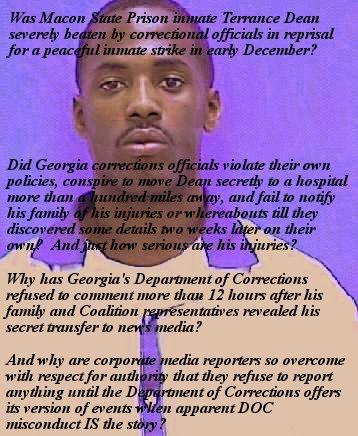
Black, brown and white inmates in 6 Georgia prisons nonviolently locked themselves in their cells for several days beginning December 9, demanding wages for work, educational opportunities, adequate food and medical care, just parole decisions and access to their families. The peaceful inmate strikers, as we reported the following day, were already victims of brutal retaliation on the part of correctional officials, ranging from cutoffs of heat and hot water to unprovoked assaults by correctional employees upon prisoners.
It now appears that at least one inmate, Terrance Dean of Bibb County GA was brutally assaulted by staff at Macon State Prison on or about December 16 was so severely injured prison officials secretly evacuated him to a hospital in Atlanta without bothering to inform his family. It’s not known at this time which Department of Corrections officials authorized the secret evacuation, who decided not to notify Dean’s family of either his injuries or his whereabouts, or whether the prisoner was transported the roughly 130 miles to Atlanta via ground or air ambulance. The first word the prisoner’s family received of either the beating or Dean’s whereabouts was when they were contacted December 30 or 31 by the friends and associates of other prisoners on the outside. Neither the Department of Corrections nor Atlanta Medical Center, where the prisoner was held for about two weeks, has released any information about the extent of the prisoner’s injuries, his current medical condition, or how he was injured.
The morning of Friday, December 31, Dean’s sister, along with ACLU attorney Chara Jackson and GA state NAACP chief Ed DuBose representing the Concerned Coalition to Respect Prisoner’s Rights showed up at the Atlanta Medical Center demanding to see the injured prisoner or at least have his whereabouts confirmed. After several hours of delay, correctional officials said his mother and sister, along with the attorney would be allowed to visit him at Jackson State Prison Sunday, January 2, but they offered no explanation of the reasons for his secretive transfer. Hospital officials also refused to offer any information on Dean’s injuries, even to his family, on grounds of doctor-patient confidentiality.
“We assume that state officials have a written policy requiring them to inform family members in the event of the serious injury of their loved ones in prison,” said the Georgia Green Party’s Hugh Esco. “If Georgia corrections personnel did brutally beat Terrance Dean, transfer him secretly more than a hundred miles from the scene of the crime scene and neglect to inform his family about his injuries or whereabouts they could be parties to a criminal conspiracy. The Green Party has written a letter to the outgoing and incoming governors asking them to look carefully at the events surrounding the case of Mr. Dean. We also note that the Department of Corrections promised access to the 37 prisoners whom it transferred as a result of the inmate strike that began on December 9. We hope this is a promise they keep, so that the public can get a complete and accurate picture of what goes on behind those walls.”
Dean’s sister, attorney Chara Jackson, and the NAACP’s Ed DuBose briefed the press at Atlanta Medical Center, including representatives from at least one local TV station repeatedly beginning at noon on Friday, and assured Black Agenda Report that they will attempt to see Terrance Dean at Jackson State Prison on Sunday, January 2. But as of nearly 24 hours later, on the morning of January 1, 2011 no corporate news outlet is publicly asking or answering any of the key questions around the assault on Terrance Dean, or what look for all the world like official attempts to conceal it from his family and the public.
“This is no surprise,” offered BAR executive editor Glen Ford. “For corporate journalists, a story without input from government or corporate officials is no story at all. For these so-called reporters, the story has a big hole in it as long as state officials decline to comment, even though official misconduct on the part of government IS the story. If the state declines to comment until Sunday or Monday, they will sit on the story till then. Establishment journalists are nothing if not disciplined and well-trained.”
Bruce A. Dixon is managing editor at Black Agenda Report, based in Marietta GA, and a member of the state committee of the Georgia Green Party. Both Black Agenda Report and the Georgia Green Party are members of the Concerned Coalition to Respect Prisoner’s Rights.
Background:
GA Prison Inmate Strike Enters New Phase, Prisoners Demand Human Rights, Education, Wages For Work
Video interview:
Elaine Brown on GA Prison Strike, December 14 Democracy Now Video Interview
And related video report:
Torture: America’s Brutal Prisons
Savaged by dogs, Electrocuted With Cattle Prods, Burned By Toxic Chemicals, Does such barbaric abuse inside U.S. jails explain the horrors that were committed in Iraq?
They are just some of the victims of wholesale torture taking place inside the U.S. prison system that we uncovered during a four-month investigation for the UK’s Channel 4 originally aired in 2005.
The Micro-guide to Spotting Propaganda
By Lila Rajiva / Dissident Voice / January 5th, 2011
Listening to the frenzied accusations of “disinformation”, “shill”, “stooge”, “cointelpro”, “propagandist” that activists and journalists are wont to hurl at each other, I decided to jot down some of the markers that set off my BS detector.
Obviously, these are only very rough indicators and due diligence is also needed. But off the top of my head here are some things that will help you figure out whether a writer is reliable or not.
1. Look at the writer’s track-record. With so much writing now on the web, it’s easy to research a writer and find out where they were standing on issues years ago. How does their performance stack up? You don’t need Nostradamus, but the conclusions of a good writer/researcher will tend to be borne out most of the time. If someone had told you in 2003 that the Iraq war was going to be a cake-walk, had told you in 2006 to buy a bigger house for less money down, and encouraged you to sell gold short in 2009, you might be forgiven if, in 2010, you’d come to suspect his intelligence or motives…or both.
2. Look for details that you know about and see if the writer is accurate. If she isn’t and there is no good reason, then be wary. What’s a good reason? Well, if a Scottish writer isn’t a Sinologist and doesn’t pretend to be one, a mistake about Chinese history can be put down to error. If he is a Sinologist, then he should know better. If it is a one time mistake or a very minor one, put it down to sloppiness or human error. If it’s big and repeated, it’s not an error. It’s a sign of incompetence or disinformation.
3. Suspect cuing and stage whispers. When everyone in the blogosphere points you to certain sources over and over, be cautious. Sometimes it’s only a well-meaning attempt to help the public. Mostly, however, it’s a way to control the debate. New and interesting research/analysis pops up all the time, from all sorts of people. Even alternative voices shouldn’t be set up as final authorities. I am especially suspicious when mainstream sources like the Wall Street Journal or the Washington Post point to certain bloggers as more reliable. These are efforts to co-opt or channel genuinely free, popular debates.
4. Follow writers for a while, before you make up your mind. Making up your mind about the reliability of a source from one article is not only silly, it’s impossible. You need to read writers consistently for a long time on many different issues before you can assess their reliability. You should read as much as you can by a writer before coming to a judgment. Even then, it’s always wise to hold off dismissing someone entirely or buying into them completely.
5. Realize that there are constraints on everyone who writes publicly. There is no such thing as perfectly open or transparent writing. Sometimes writers don’t touch on certain topics because they might distract, not because they are “covering up.” Or they might fear libel suits. Or they might feel they don’t know enough to comment. Or they might think they aren’t the right people to comment. An immigrant might feel diffident about discussing questions about national security. A heterosexual male might not want to corner a debate on female experiences of rape. Some writers won’t touch material that is controversial not because they are careerists, but because they have family members who might be vulnerable to harassment. Give people a break. Put yourself in their shoes – how much would you write if someone was threatening you or blackmailing you or warning you you’d lose your job?
6. Pay attention to style and tone. Credible sources rely on logic, reason, facts and evidence. They are likely to be cautious in interpreting events until they have researched them personally. If they are passionate, it is genuine emotion, not cheap rhetoric, personal attacks and vulgarities. When confronted with a mistake, they are reasonable enough to acknowledge it and make corrections or retractions. They compare and evaluate their sources and admit when they don’t know something. They apologize, if necessary. They tend to be personally polite, even if they are critical or sharp in their general tone. Denunciation of monetary policy is not the same thing as calling someone a buffoon and a liar because he disagrees with your way of thinking.
7. Study the main logical fallacies (red herrings, straw men, hasty generalizations – you know, all the stuff in English 101) and check whether a writer is prone to making them or not. Repeated use of ad hominem is one of the surest signs of a propagandist. However, make sure you know the difference between ad hominem and criticism that is warranted and related to the target’s professional conduct. If you don’t know the difference, study and find out.
You’ll notice that I haven’t mentioned anything about credentials, prizes, fame, peer recognition, or publishing record. This isn’t because I think those things are irrelevant. But I don’t any more think they are good guides to a source’s reliability. There are well-credentialed people who are reliable and there are people who have no recognizable credentials who are. There are prize-winning highly-paid journalists who are great. And there are unpaid bloggers who are too.
As for peer review, some of the best information comes to writers in the form of anonymous links and tips. Or on forums that the mainstream won’t touch with a barge-pole. Or from insiders who don’t want their names in the press. Even scholars work in herds.
8. Check your gut reaction. Truth-telling on controversial matters is usually a lonely business or done with only the company of other loners. Once the crowd gets in on the act, even the best popular movements go awry. The reason is most people automatically tailor their thoughts to please others. It’s part of man’s inherently social nature. White lies are natural to even the best of us. And when we’re not lying to others, we’re busy soothing our egos with more lies.
And that’s why the most important tip I can give you is one that doesn’t even have to do with other people. It’s to do with yourself.
It is simple. Look inside and do some truth-telling there as well.
The more honest and truthful you are, the more you will recognize it in others.
_____________________________________________________________________________________________________
Lila Rajiva is a freelance journalist and the author of The Language of Empire: Abu Ghraib and the US Media (Monthly Review Press, 2005) and Mobs, Messiahs and Markets (with Bill Bonner-Wiley, September 2007). She has also contributed chapters to One of the Guys (Ed., Tara McKelvey and Barbara Ehrenreich, Seal Press, 2007), an anthology of writing on women as torturers, and to The Third World: Opposing Viewpoints (Ed., David Haugen, Greenhaven, 2006). She can be reached at lrajiva@hotmail.com or visit Lila’s website.
Israeli police raid leftist homes
By Mya Guarnieri | Ma’an | 05/01/2011
TEL AVIV, Israel — Israeli activists who participate in protests against their country’s separation barrier came under state attack on Wednesday, with special forces entering homes in Tel Aviv.
Israeli special police forces showed up outside one home in central Tel Aviv, shared by a number of left-wing activists. After spending some time outside the residence, forces attempted to enter and conduct a search. Activists said that they were not shown a search permit and refused to submit to the search.
A spokeswoman for the activists, who requested not to be identified, quoted a witness to the incident, who said “there was an aggressive attempt to do a search without a search warrant,” and speculated that the attempt may have been connected to those involved in a protest outside the residence of the US ambassador on 1 January. Protesters gathered outside the building in protest of what were reported to be US-made tear-gas canisters whose fumes killed a Palestinian protester the day before.
“It’s not clear whether it was in connection to the episode at the embassy or if it was the private initiative of the [israeli] police. Their excuse was that they suspected [someone in the house] of holding drugs,” the witness said.
The move comes amidst a general crackdown on left-wing activities. In recent weeks, the Shabak, Israel’s internal security service, has been calling protesters asking them to come in for “friendly chats.” All those who have reported receiving the calls have refused, since by law they are not required to comply with the requests unless they receive an official summons from the police.
Last week, a Tel Aviv court sentenced the prominent left-wing activist Johnathan Pollak to three months in jail for his role in a small, non-violent protest held in Tel Aviv against the Israeli siege on Gaza. Pollak was the only protester who was arrested for the demonstration, which was held in 2008, leading many observers to believe that Pollak is being singled out and punished for his continuing activism, and role as the spokesman for the West Bank’s Popular Organizing Committee, which issues news and testimony from the village of Bil’in.
Earlier in December 2010, Matan Cohen, an Israeli who is active in the Boycott, Divestment and Sanctions movement and is studying in the United States, was detained for several hours in Ben Gurion International Airport upon return to Israel. His luggage was searched and officials told him he was suspected of being involved in “hostile terrorist activities.”
Cohen reported that while he has been questioned briefly upon leaving the country he has never been detained upon arrival.
“This is definitely a step up in the level of political repression against anti-apartheid activists in general, and BDS activists in particular,” Cohen remarked.
‘Iran oil exports to India unaffected’
Press TV – January 5, 2011
India’s Petroleum and Natural Gas Ministry says Iran’s oil exports to the country will not be affected as alternative payment routes have been put in place.
“There has been no disruption in supply since [Reserve Bank of India] RBI issued new payment guidelines. A cargo for delivery on January 8 and 9 is currently being loaded in Iran and we have no problems sourcing crude from Iran,” India Today quoted India’s Petroleum Secretary S. Sundareshan as saying on Tuesday.
He also said that the National Iranian Oil Company (NIOC) is willing to accept payments from Indian oil firms through the Europaisch-Iranische Handelsbank (EIH Bank) in Hamburg, Germany.
Oil companies working with Iran like Hindustan Petroleum Corp Ltd (HPCL) and Mangalore Refinery and Petrochemicals Ltd (MRPL) will make payments to NIOC’s EIH Bank account in Hamburg via the State Bank of India (SBI).
According to Sundareshan, the two central banks will meet in Tehran from January 14 to 16 to find a permanent solution to the matter.
Part of the meeting will involve choosing a payment currency, such as the Iranian Rial, Dirham and Yen, which are not susceptible to US pressure.
The problem arose when the Indian Central Bank said import payments to Iran would have to be settled outside the existing Asian Clearing Union (ACU) mechanism.
Under the ACU mechanism, every two months imports by the nine member-nations are settled by every member paying for its import surplus.
‘Charlie Rose’ transcript saves Hoenlein from on-air allegation he served as Netanyahu’s emissary
By Philip Weiss on January 4, 2011
Watch this Charlie Rose episode from last night to hear Rashid Khalidi soberly explain reality: Palestinians were promised a state 63 years ago and the check is still in the mail; and meantime, there is only one sovereign political entity between the river and the sea and it is or will be majority Palestinian but ruled by Jews. Palestinian statehood without the ability to keep Israeli soldiers from entering any one’s home in the West Bank whenever they like is meaningless. Ramallah is an “excrescence” on Palestine, it is a bubble of prestige and sink of international dollars where, yes, you can get a cappucino for $12.
Also watch it to see
Aluf Benn of Haaretz say at 11:00 or so that rumor has it that Malcolm Hoenlein of the Conference of Presidents of Major American Jewish Orgs went to Syria at the behest of Netanyahu to negotiate with the Syrians… Hoenlein has admitted going to Syria and meeting President Assad but said that it was not at the behest of Netanyahu, a humanitarian mission. I imagine there could be an issue of needing to register the Conference of Presidents under the Foreign Agents Registration Act?
Then read the official transcript at Charlie Rose, the name Malcolm Hoenlein does not appear in the transcript, though it’s in the interview. Nor the name Ron Lauder. Despite my headline, I don’t know if there’s a rat here. These transcripts are not all that great. Note that the transcriber dropped some other language later in the answer, of a trivial character. Transcript, with dropped words in [BRACKETS]:
CHARLIE ROSE: My understanding and my impression is notwithstanding everything you just said that very recently there’s been some suggestion that they’re prepared to do [Turkey is prepared to play intermediary role between Israel and Syria]–
ALUF BENN: They’re always prepared to do it. Israel is not so happy about that, but, again, unless there’s something secret going on that we don’t know about, Prime Minister Netanyahu to this day has not shown signs of taking the Syrian threat seriously. Every other week there’s a story about a messenger. Only tonight [IT WAS PUBLISHED THAT MALCOLM HOENLEIN] one of the American Jewish leaders went to Damascus and met Syrian officials and obviously the rumor is that he was sent by Netanyahu in a similar way to — an [THAT RONALD LAUDER, ANOTHER] American Jewish leader[,] mediated 12 years ago. But it takes time to see these things are serious. But there is strong voice, especially among the Israeli security establishment which says the [BEST WAY AND THE SHORTEST WAY AND] surest way around Israel’s strategic problems is making peace with Syria.
Will Zuma’s Foreign Policy on Palestine Take a Leap Forward?
By Iqbal Jassat – Palestine Chronicle – January 2, 2010
Pretoria – If Karima Brown is correct in her evaluation of President Jacob Zuma’s canny ability to gain ascendancy despite teetering on the brink, would it be an unreasonable expectation to have him propel South Africa to take a more hands-on approach regarding apartheid Israel?
I raise this question in respect of what is generally perceived to be South Africa’s weak and indecisive foreign policy that, barring occasional censure of Israeli conduct, seems to be largely silent and ineffective.
Brown, a highly respected journalist and commentator, in reviewing Zuma’s troubled past, points out how he bounces back to not only providing leadership to a fractured alliance, but also to effectively marginalize threats from a variety of internal threats.
Nevertheless, this otherwise fine analysis lacks a significant dimension: Zuma’s foreign policy!
Given that our advocacy work revolves around issues of Islamophobia and a number of themes related to the “war on terror” and the manner whereby rogue states such as Israel exploit these to shield their cowardly oppression from public scrutiny, the Media Review Network has always maintained that South Africa’s foreign policy initiatives to assist Palestine have been inadequate.
Current developments in the region along with the right-wing Netanyahu regime’s to scuttle America’s “peace” endeavours, makes an independent intervention by the Zuma presidency imperative and urgent.
Some cynics may think it ridiculous to imagine Zuma succeeding while powerful America cannot! Others may argue that it’s unthinkable for any developing country to arouse the wrath of Zionist lobbies that wield significant clout in the corporate environment. Yet other skeptics may wonder why on earth South Africa would venture into territory that may result in severe backlash not only from Israel, but also from so-called “frontline” Arab states whose frontline status derives from capitulating to the apartheid regime!
Notwithstanding the mythical creation of a wide array of convoluted and complex issues, I am convinced that a greater number of people require South Africa’s political, business and religious leadership – along with civil society and social movements – to reaffirm their collective moral authority by demanding the end of Israel. Indeed by being categorical in this demand insist too that all the inhabitants of Israel, the Occupied Territories and the millions of Palestinian refugees reclaim their right to live in equality and dignity within a single democratic state.
It’s a paradigm unique to South Africa and thus easier for leadership to undertake. After all it required the end of South Africa during the apartheid era for a new country to emerge wherein a Bill of Rights and Constitution guarantee life, liberty and more to all its citizens.
Demanding that Israel de-links from ideological values as abhorrent as apartheid and abandons Bantustan strategies whereby Palestinians are hostage to perpetual oppression could be an elementary, yet essential initial step. If it’s true that today one cannot find any South African who rationalizes apartheid’s legitimacy, then surely it ought not be difficult for Zuma to speak on behalf of the entire country in denouncing apartheid Israel and her repugnant human rights violations!
If anti-apartheid campaigns were initiated in Europe and elsewhere by the African National Congress [ANC] to successfully isolate racism and punish its perpetrators through sporting and cultural boycotts, it is nor far-fetched to advocate that similar campaigns be orchestrated and led against Israel today by the ruling party being the ANC.
During 1996, two years into the Nelson Mandela presidency, Edward Said expressed hope that the unworkability of Oslo embodied the end of the two-state solution. The challenge he identified was to find a peaceful way in which Jews, Muslims and Christians could coexist as equal citizens in the same land.
Fourteen years later, with Zuma having consolidated his leadership, it is an opportune time for him to chart a decisive foreign policy designed to urgently end repressive Israeli conduct and restore justice for Palestinians.
As Said would say: “The time has come to put Palestine back in the center as an ideal for individual action and individual commitment to principle in the same way that Mandela’s actions and principles inspired the anti-apartheid movement”.
Indeed, capitulation by the Obama administration has signaled that the time for South Africa to adopt a new policy towards Palestine has arrived.
– Iqbal Jassat is chairperson of the Media Review Network (MRN), an advocacy group based in Pretoria, South Africa. He contributed this article to PalestineChronicle.com. Visit: http://www.mediareviewnet.com.
Israeli airstrikes hit Gaza twice overnight
Ma’an – 05/01/2011
TEL AVIV, Israel — Israel’s airforce struck two areas in the Gaza Strip overnight, in what a statement said was a “response to this morning’s firing of a Qassam Rocket,” which allegedly hit outside Ashkelon on Tuesday.
According to the military, the sites targeted were a “Hamas terror activity center” in the central Gaza Strip and a smuggling tunnel in the south near Rafah.
While the military said “Direct hits were confirmed,” there have been no reports of injuries.
No resistance faction has claimed to have launched a projectile toward Israel since the evening of January 2.
In its statement, Israel noted that it “holds the Hamas terrorist organization solely responsible for maintaining the calm in the Gaza Strip and for any terrorist activity emanating from it,” and added that its forces would “continue to respond harshly to any attempt to use terror against the State of Israel.”
Reports in the Israeli media last week said a meeting between factions in Gaza resulted in a decision to stem the flow of projectiles fired toward Israel.
Israeli officials have reported an increase in projectile launches toward Israeli targets from within the Gaza Strip, while a report from the country’s intelligence office said the number of projectile attacks by Gaza militants had sharply fallen in 2010.
Britons protest forests sell-off scheme
Press TV – January 5, 2011

Thousands of Britons have convened a protest in the Forest of Dean against the British government’s plans to sell off some of the country’s forests to the private sector.
More than 3,000 people, backed by celebrities, bishops, leading conservationists and politicians, attending the rally vowed to defend “the people’s” trees from a corporate land grab, the daily Guardian said in a report.
Based on a bill, expected to be debated in the House of Lords within three weeks, to become law, developers, charities and power companies could apply for the entire 650,000-acre forestry commission estate in England.
The government claims it wants more land to be forested and is hoping local communities will buy and manage much of the acreage put up for sale.
But protesters believe the sell-off is short-sighted and fear that woods will be bought by developers and energy companies who will limit access to trails and seek to fell as many trees as possible for a quick profit.
“It is extraordinary that one of the country’s most ancient forests – a place of great beauty that is enjoyed by so many people – is also one of its least protected. The Forest of Dean … should continue to be managed as a whole for the widest public benefit,” said the writer Bill Bryson, president of the Campaign to Protect Rural England.
“The green heart of Britain is not for sale,” said conservationist David Bellamy.
Today, more than 110,000 people had signed a petition against the coalition’s proposed sale of all Forestry Commission land in England.
Opposition to the sale of nearly 20 percent of all England’s wooded area is fiercest in Gloucestershire where yellow ribbons and posters have been tied around thousands of trees.
More than 30 other crown forests as well as large areas of heathland and bogs currently managed by the Forestry Commission in England are expected to be sold.
“There are no guarantees that income from sales will be used to support forestry,” said Hilary Allison, policy director of the Woodland Trust.
“No decisions have been taken on any particular sites. We will not compromise the protection of our most valuable and bio-diverse forests”, said a spokesman for the Department for the Environment, Food and Rural Affairs (Defra).
Are you a member of a pension plan?
This is what Ontario teachers are doing:
Petition to the Board of Directors of the Ontario Teachers Pension Plan Board
Posted by Farah Rowaysati
Petition
We, members of the Ontario Teachers Pension Plan, ask the Board of Governors of the Ontario Teachers Pension Plan Board to initiate the process that will make the necessary changes in legislation and investment policy which would enable the Plan to:
1. Immediately divest from the following five companies in its portfolio: Lockheed Martin, Finning International, Cement Roadstone Holdings, Siemens AG, and MacDonald, Dettwiler and Associates;
2. Become a signatory to the Principles of Responsible Investment Initiative;
and
3. Divest from, as well as refrain from investing in, any company that contributes to violations of human rights or international law by:
– directly profiting from, or contributing to, the Israeli occupation of Gaza and the West Bank, including East Jerusalem;
– providing products or services that contribute to the construction and maintenance of Israeli settlements and/or the Separation Wall, both of which are illegal under international law;
– providing products or services that contribute to or enable violent acts that target civilians.
Sign petition
Bill being Drafted to Bar International Peace Activists from Entering Israel
Alternative Information Center | January 4, 2010
Knesset Member Yariv Levin, of the right-wing Likud party, together with the pro-settlement group The Legal Forum for the Land of Israel, are currently working on an “anti-subversive” bill aimed at anarchists and supporters of the Palestinian call for Boycott, Divestment and Sanctions (BDS).
If approved the law would allow Israel’s Interior Ministry to bar international activists from entering Israel. The law would apply restrictions to anyone who acts against Israel, denies the Holocaust, works to boycott Israel and/or attempts to place Israeli leaders on international trial for what they did in the line of duty, reported Arutz Sheva.
“The suggested legislation would apply to anyone who incites against the country, carries out verbal or physical attacks, organizes hostile activities or tries to interfere with foreign diplomatic and trade relations,” the news daily reported.
“The aim of the bill is to give the country the tools to deal with hostile elements that work against Israel from within the country and who endanger the security of Israeli citizens as well as foreign trade and diplomatic ties,” explained MK Levin.
“Many people why call themselves call themselves ‘peace activists’, along with all other Israel-haters who often are called ‘human rights activists,’ often act against the rights of Israeli citizens and are free to travel in the country without any restrictions,” added Nochi Eyal, director of the Legal Forum.
This is not the first anti-freedom of speech bill aimed at those critical of Israeli policies.
In summer 2010 the Knesset began hearings on a “Boycott Bill” that was meant to discourage participation, particularly by Israelis, in boycotts of Israel.
Under the new law, any group could sue for damages of up to NIS 30,000 from anyone who launched a boycott against them, or incited for boycott, without having to prove that damage was indeed caused, according to the Israeli news daily Haaretz. An additional sum could then be demanded once damages were proven.
The proposal has yet to move past the initial hearing phase.
Facts contradict Israel’s assertions in Bilin death
Press release, Popular Struggle Coordination Committee, 4 January 2011

The family of Jawaher Abu Rahmah mourns during her funeral in the West Bank village of Bilin, 1 January 2011 (Oren Ziv/Activestills)
The following edited press release was issued by the Popular Struggle Coordination Committee on 4 January 2010:
Since yesterday, the Israeli army has been promoting in the Israeli media a mendacious version regarding the events that led to the death of Jawaher Abu Rahmah of Bilin on Friday, 31 December 2010. According to the army’s version, Jawaher was not injured by tear gas and was possibly not even present at the demonstration. The army spokesperson did not see fit to publish an official statement on the matter, instead passing the information to the media in the name of anonymous “army sources.”
The facts of the matter — which are supported by the testimony of eyewitnesses who were present at the demonstration, as well as by the ambulance driver who evacuated her to the hospital — contradict completely the army’s version:
Soubhiya Abu Rahmah, mother of Jawaher: “I was standing beside Jawaher on the hill that is near the place where the demonstration took place, when we were injured by a cloud of tear gas. Jawaher began to feel unwell from inhaling the gas and started to move back from the place; soon after that she vomited and collapsed. We took her to the nearest road, and from there she was evacuated by ambulance to the hospital, where she remained until her death. She was not sick with cancer, nor did she have any other illness; and she was not asthmatic.”
Ilham Fathi: “I was on the roof of my house, which is located a few meters from where Jawaher stood. When the cloud of tear gas moved in our direction, I went downstairs in order to close the windows. While I was closing one of the windows, I saw her lose consciousness from the gas and ran over to her, together with Islam Abu Rahmah, in order to pull her away. We picked her up together and carried her to my garden. We called for help and she began to vomit and foam at the mouth.”
Islam Abu Rahmah: “I was standing with Jawaher, her mother and my grandmother in order to watch the confrontation that was going on just in front of us, in the area of the fence. The wind moved the gas in our direction, making our eyes itch and tear up. After that she [Jawaher] began to cough and foam at the mouth. Soon after that she became weak and lay down on the ground. I succeeded in carrying her as far as the Abu Khamis home, about 40 meters in the direction of her house, but then she became terribly weak, vomited violently and foamed at the mouth. She was having difficult breathing and lost her sense of direction. We got a few women to help her by waving a paper fan over her face in order to provide some oxygen. After that she was taken to the hospital.”
Saher Bisharat, the ambulance who evacuated Jawaher: “We received Jawaher near the entrance that is parallel to the fence, which is where the demonstration was taking place. She was still partially conscious, answered questions, and said that she had choked on gas. I took her straight to the hospital” (See the Palestine Red Crescent Society report).
The army has also claimed that the reports about Abu Rahmeh’s injuries started to arrive only several hours after the incident, in the evening. That claim is contradicted by a tweet sent by the nongovernmental organization Jewish Voice for Peace (JVP), which reported the injury of Jawaher, including her name, in real time (see JVP’s Twitter feed). The tweet was sent at 2:36pm (4:36 am on the West Coast of the United States). Wafa, the Palestinian news service, published a report that includes the injury of Jawaher Abu Rahmah shortly after the event (Four civilians injured and Israeli journalist arrested in Bilin march“).
Also according to “army sources,” which remain anonymous, Jawaher Abu Rahmah suffered from a serious illness, possibly leukemia; the “sources” postulate that she died from a pre-existing condition rather than tear gas inhalation. Several sources reject that claim.
Dr. Uday Abu Nahlah: “Jawaher Abu Rahmah was employed in my home on a regular basis. On Thursday she was at work as usual, healthy, only one day before her death.”
Jawaher had an inner ear infection, which affected her balance, for which she was recently given a CT scan. The radiologist who performed the CT scan, Dr. Hamis Al Sahfi’i, confirmed that the brain scan was normal (see the CT scan results). Jawaher had a minor health issue involving fluids in her inner ear. Her physicians insist that she did not suffer from any illness or from any symptoms that might, if combined with tear gas, lead to her death.
There is not, nor could there be, any indication that Abu Rahmah had cancer; in fact, she was in good health. The director of the hospital refutes the claim that she died from a pre-existing condition:
Mohammed Aida, director of the Ramallah health center where Abu Rahmah received her care: “Jawaher Abu Rahmah died from lung failure that was caused by tear gas inhalation, leading to a heart attack. She arrived at the hospital only partly conscious, and then lost consciousness completely” (See the hospital’s official medical report [PDF]).
Mohammed Khatib, a member of Bilin’s Popular Coordinating Committee: “The army is trying to evade its responsibility for Jawaher’s death with lies and invented narratives that have no basis. They are spreading these lies and invented narratives via the media, which is not bothering to do basic fact checking. Our version is supported by named sources and with medical documents. In a properly functioning society, the army’s version, which has been spread by anonymous sources, would not be considered worthy of publication.”
Featured Video
Prof. Ted Postol: Iran Already Achieved Nuclear Deterrence Against Israel
or go to
Aletho News Archives – Video-Images
From the Archives
How the occupied mentality syndrome works
Saudi Arabia on the American chessboard – Part 3
By B. J. Sabri | American Herald Tribune | June 27, 2016
Read part 2: “The occupied mentality Syndrome“
Previously I argued whether Saudi Arabia’s repeated involvements in U.S. interventions and wars stem from free national will or in response to a specific condition. For starters, in Saudi Arabia there is no national will. In Saudi Arabia, the national will is the will of the Al Saud clan. Still, when a major Arab state allies itself with a superpower that committed unspeakable crimes against humanity in almost every Arab country, then something is wrong. This fact alone should compel us to examine the U.S.-Saudi relation for one exceptional reason. As a result of the U.S.-Saudi wars, hundreds of thousands of people in Afghanistan, Iraq, Iran, Libya, Syria, Yemen, and Somalia have lost their lives. Millions became displaced in their own homelands. And millions more rendered refugees.
Attributing the Saudi policies to the bonds of “partnership” with the U.S. is frivolous. There are no bonds between these two thugs except those of business, military deals, secret plots, and wars. Proving this point, bonds such as these have no space for the American and Saudi peoples to share significant cultural or societal exchanges. If partnership is not the reason for the Saudi contribution to the U.S. strategy of empire and imperialism, then another reason must exist.
This leads to three possibilities. … continue
Blog Roll
 Aletho News
- NIAID/NIH and USDA Fund Bioengineered Chimeric Influenza Viruses Built Using Pandemic H1N1 Components: Journal ‘Science Advances’
- Hezbollah hits Israeli warship off Lebanon’s coast, sets it aflame
- Iran slams US strikes on B1 bridge, Mahshahr petrochemical plants as ‘blatant acts of state terrorism’
- In letter to UN chief, Araghchi warns of dire consequences of US-Israeli attacks on Iran’s nuclear facilities
- Why the CIA conspiracy to invade Iran with Kurdish militias failed
- Why Are Upbeat US Claims About Mission to Rescue Pilot ‘Highly Questionable’?
- Aircraft destroyed during US ‘rescue’ of downed F-15 pilot cost more than $100 million each
- Washington University removes professor who condemned US-Israeli war on Iran
- Russia Warns of Retaliation as UK Authorizes Seizure of Vessels
- Serbia thwarts plot to bomb Russia-Hungary gas pipeline – Vucic
- If Americans Knew
- In Iran, Israel-US take aim at “reason, research, and freedom of thought” – Daily Update
- US loses planes over Iran, Israel downgrades Lebanon war goals – Daily Update
- Israel Is Blocking Palestinians from Easter at Church Where Jesus Resurrected
- Plot to assassinate Palestinian activist follows harassment campaign promoted by Zionist groups and elected officials
- Prominent New York synagogue hosts presentation on why U.S. Jews should support the ethnic cleansing of Gaza
- Tapper vs. Piker: Is the CNN Anchor Auditioning for David Ellison?
- Shouldn’t Democrats Be Able to Condemn Genocide?
- Israel-US kill negotiators, destroy civilian structures, but Iran’s military capabilities still largely intact – Daily Update
- ‘War crime’: Global condemnation as Israeli ministers celebrate death penalty law targeting Palestinian prisoners
- 7 Ways Israel Is Turning Lebanon Into Gaza
- No Tricks Zone
- An Inconvenient Tree: Uncovered In Alps… Europe Much Warmer Than Today 6000 Years Ago
- New Study Reports A 60% Slowdown In Greenland’s Ice Loss Rate In The Last Decade
- Low Intensity Tornado Wrecks Major Solar Farm, Creating A Potential Toxic Dump
- New Study Finds Warming Saves Lives…Cold Temperatures 12 Times More Deadly Than Excess Heat
- German Science Blog Accuses PIK Climate Institute Of Hallucinating Climate Tipping Points
- Devastating Assessment Of Comirnaty Vaccine By Former Senior Pfizer Europe Toxicologist
- New Study: CO2 Is ‘Effectively Negligible’ As An Explanatory Climate Change Factor Since 2000
- Former Pfizer Toxicologist Dr. Helmut Sterz Tells Bundestag Hearing Pfizer Vaccine Should Have Never Been Approved
- Energy Expert: Germany’s Nuclear Phaseout Was A “500 Billion Euro Mistake”
- New Research: South Australia’s Mid-Holocene Sea Surface Temperatures Were 4°C Warmer Than Today
 Aletho News

