Why Obama’s “new thinking” initiative on Middle East peace is doomed to fail
By Lawrence Davidson | January 22, 2011
According to Laura Rozen, a journalist specializing in foreign policy matters and writing in Politico (13 January 2011), the Obama administration is seeking “new ideas from outside experts on how to advance the peace process” in the Middle East. This is because the president and his counsellors are “utterly stuck” following the failure of last year’s efforts to strong-arm Mahmoud Abbas and bribe Binyamin Netanyahu into negotiations. Quoting an administration consultant, Rozen tells us “there is no pretence of progress. With the State of the Union coming up and the new GOP [Grand Old Party – the Republican Party] Congress, they [the administration] are taking a few weeks to regroup and solicit ideas to push forward and … to give a real jump-start” to the negotiation process”.
On the surface this would appear to be welcome news. The White House entourages having this revelation that their process, and that of their predecessors too, have all failed and so we need some new, progressive thinking about peace in the Holy Land. Maybe there should be a new approach that would play to the leverage the US can bring to bear on both parties (and not just the Palestinians). But then Rozen proceeds (in a completely dead pan style) to explain to us how the administration is going about its search for “new ideas from outside experts”.
Two separate efforts have been set up to brainstorm these new ideas:
1. “One task force has been convened by Sandy Berger and Stephen Hadley”. Who are they? Berger was national security adviser to Bill Clinton. He was a “prominent actor at the Camp David 2000 Summit”. What about Hadley? He was assistant to Undersecretary of Defence Paul Wolfowitz during George W. Bush’s first term of office and then national security adviser to the president during Bush’s second term. In these positions he worked closely and comfortably not only with Wolfowitz, but also with men like Dick Cheney and Donald Rumsfeld.
2. “A second effort [is] led by Martin Indyk.” And who is Martin Indyk? Indyk served twice as US ambassador to Israel as well as being a member of the National Security Council (NSC) under Clinton. Before that he was deputy research director for the American Israel Public Affairs Committee (AIPAC) and served eight years as the executive director of the pro-Israel Washington Institute for Near East Policy (WINEP), which he helped co-found. WINEP is supported by AIPAC. According to Rozen’s report, one of the first things Indyk has done in his search for “new ideas” is to seek out, among others, “senior NSC Middle East/Iran adviser Dennis Ross”. And who is Dennis Ross? Ross was Bill Clinton’s Middle East envoy in the 1990s. Before that he was on Ronald Reagan’s NSC and, along with Indyk, helped co-found WINEP.
These are the people who the Obama administration is looking to for new thinking about the peace process. One is left simply amazed at this development. Almost, but not quite, speechless. For all these men – Berger, Hadley, Indyk and Ross – are strongly biased in favour of Israel, and among the folks who have been running the US side of the peace process at least since the 1980s. They are not “outside experts” at all. They are retreaded inside “experts” whose records, with very minor exceptions, in regard to the peace process, are ones of failure. Going to these people for “new ideas” that will “jump-start” peace talks in the Middle East is like going to Supreme Court Justice Anthony Scalia for a forward-looking and progressive take on the US Constitution. Such an effort is a standing contradiction. It is a rigged game designed to get you the opposite of what you claim to seek.
The unavoidable question is why is the Obama administration wasting its time and our money doing this? The answer has to be first and foremost domestic politics. Although Barack Obama would, understandably, still like to make a positive impact on the Palestinian-Israeli impasse, he is convinced that any effort in this regard must conform to the wishes of domestic political forces led by the Zionist lobby. For instance, what would happen if he decided that all those listed above were hopeless failures and, instead of going to back to them, he was going to turn to, say, Rashid Khalidi, the Edward Said Professor of Modern Arab Studies at Columbia University? Khalidi is undoubtedly an expert on the Middle East and the Palestinian-Israeli question. However, he is also very much in favour of justice for the Palestinians. If President Obama was to consult Khalidi there would be an immediate knee-jerk reaction in Congress consisting of quite literal screaming and yelling. AIPAC would call Obama a man seriously lacking in judgment and Khalidi a friend of terrorists. The president’s possibilities for re-election would, allegedly, recede dramatically. On the other hand, there is no doubt that he would get “new ideas” from an “outside expert”.
The political pragmatist might argue, what good are “new ideas” if they cannot be implemented? But this position accepts the same assumption noted above, that any US president must be tied down by the political power of the Zionist lobby. It is, in fact, an assumption that must be challenged if any future progress is to be made. Thus, the president should take a chance. He should consider making a new and forceful initiative and demand Israeli compliance like Eisenhower did at the end of the Sinai Crisis of 1956. He should go to the American people and explain what he is doing and why. He should use every presidential prerogative there is, including the negative ones, to assure Israeli cooperation, etc. Oh, this is political suicide, answers the political pragmatist; it will never work. But, as is obvious, nothing else has worked to date. We are spending enormous sums to subsidize Israeli obstinacy and, according to General David Petraeus, the man who leads the American effort in Afghanistan, doing so is helping to kill American soldiers. So, go ahead Mr President, take the bull by the horns already.
Alas, he will not. And Rozen’s report is proof positive that the president will not do this. He is first and foremost a domestically-oriented politician cut out of a very standard mould. Politically, then, it has been judged safer to resurrect the dead in the form of Berger, Hadley, Indyk and Ross. So, there you have it. What is necessary for success in the peace process is always assumed to equal political failure at home. On the other hand, political success at home (which entails letting the Zionist lobby set the criteria for what is possible) equals continued failure of the peace process. It also equals ever increasing danger for US interests in the Middle East and the Muslim world. This latter equation is not based on an assumption. It is a historically demonstrated fact.
This is why we fail. No one wants to seriously test the old standing assumptions. Our political system is ossified. It is trapped in a lobby-driven, financially-corrupt rut. And until we find a way out of it we are doomed to go round in circles. That is what the administration’s pseudo effort at seeking “new ideas from outside experts” amounts to, going in a circle. Round and round and round and round.
The Feds Go Fishing
By RON JACOBS | CounterPunch | January 21, 2011
Back in September 2010, a series of FBI raids were conducted in Minneapolis/St. Paul, Chicago and North Carolina. These raids were conducted under laws pertaining to US citizens providing “material aid to terrorists” and targeted members of antiwar, leftist, and solidarity organizations. Since the raids, various activists that were targeted have been subpoenaed to appear at a grand jury and have refused to do so. By refusing, those subpoenaed are risking arrest for contempt. However, as of this writing, none have been taken to jail yet. As I wrote in an article first published in CounterPunch on September 27, 2010: “These raids are a clear and vicious attempt to intimidate the antiwar movement.” and the grand jury “is a fishing expedition, as evidenced (for example) by the warrant asking for papers from no determined time.”
The reaction of those whose homes were raided and their supporters was quick and determined. The targeted activists, their attorneys, and local supporters held a couple of press conferences within days of the raids and original subpoenas and a national network organized protests at Federal Buildings in a number of US cities and towns. Resolutions attacking the raids and subpoenas and pledging support for the activists and the right to organize were introduced and passed by a number of city councils and antiwar and labor organizations. The office of the US Attorney for the Northern Illinois District under the direction of US Attorney Patrick Fitzgerald temporarily withdrew the subpoenas. However, they were reinstated in December, leading to the aforementioned refusal of those subpoenaed to appear in front of the grand jury. Several more subpoenas were served on other activists. In fact, nine more activists have been ordered to testify before the grand jury on January 25, 2011 in Chicago.
A sidebar regarding Patrick Fitzgerald might be beneficial here. If that name seems familiar, it is because he is associated with many high profile cases. He helped prosecute Scooter Libby in the case known as the Valerie Plame affair. For those who don’t remember this case, it involved members of the George Bush White House releasing the name of a CIA agent to the media–a federal offense. Although Libby was convicted of the crime, it has always been believed that others in the White House, including Vice President Cheney, were involved in its commission. This demands the question as to why no one else was prosecuted and how much the prosecutor (Fitzpatrick) was involved in limiting the prosecution to one individual, thereby sparing the White House from a criminal investigation. Patrick has also been involved in many other high profile cases, including the prosecution off Illinois governors Ryan and Blagojevich in separate corruption cases and a case involving torture by the Chicago police that resulted in the conviction of Chicago detective Jon Burge.
In another investigation targeting leftist, anarchist and antiwar political activists in the Twin Cities, several homes and offices were raided before and during the 2008 Republican National Convention in Minneapolis. If one recalls, that convention also saw the arrest of media members including Amy Goodman of Democracy Now, brutal attacks on protestors by police and private “contractors” working with police, and a lockdown against free speech activities in certain areas of the city. Several hundred people were arrested and many were beaten. Nine organizers were eventually charged with acts of terrorism. During their trial it became clear that the organizations these individuals were affiliated with had been infiltrated by government informers.
Similarly, last week the AntiWar Committee (one of the organizations targeted in the September raids) of the Twin Cities discovered that they too had had an informer in their midst since 2008. Going by the name Karen Sullivan, this woman claimed to be a single parent and a lesbian who did not get along with her child’s father. According to statements from members of the AntiWar Committee that appeared in the press, the group’s members were sympathetic to her cover story and, despite an initial concern by some members, accepted and befriended the woman. Also, since the AntiWar Committee (AWC) believed their meetings and activities to be covered by the first amendment and were always open to the public, there was little concern for secrecy.
“Ms. Sullivan” involved herself in AWC activities and meetings, even chairing some of them. She was also one of three AWC members that traveled to Palestine. As soon as they reached Israel, the members were told they would be detained unless they turned back. Two chose to stay and were detained while “Sullivan” went back to the US. It turns out that the Israeli authorities had prior knowledge of the visit and the intention of the group to meet with Palestinian women. While no one in the group could figure out how this was so, it seems apparent now that the “Ms. Sullivan” had provided this information to her handler who had in turn provided it to US officials, who then passed it on to the Israeli government.
In the wake of the January 8, 2011 shooting in Tucson, Arizona there have been calls by a number of politicians, media commentators and others suggesting the need for new laws limiting political speech in the United States. Meanwhile, efforts are underway in Congress to renew sections of the PATRIOT Act that are due to expire soon. History tells us that when laws designed to curb political speech are enacted in the US, they are used primarily against groups and individuals on the left side of the political spectrum. There is no need for more laws. Instead, there is a need for more free speech. Laws like the PATRIOT Act and The Effective Death Penalty and Anti-Terrorism Act of 1996 and the subsequent interpretation of those laws by the courts have criminalized political activities that were previously legal. The investigation that led to the raids and grand juries discussed here are an example of this.
The intention of the government in this and other similar investigations is to intimidate people into keeping silent so they can carry on their business with a minimum amount of attention from the public. As the discovery of an informer in the AWC shows, they will stop at nothing in their attempt to silence protest against their imperial designs. It doesn’t matter if they get any convictions or even an indictment out of their fishing expedition. If they have intimidated those who oppose imperial war and support people around the world in their struggle against military occupation, they will have accomplished their goal. This is reason enough to support those currently targeted by the FBI in the investigations discussed here. It is more than enough reason to attend the protests against the grand jury on January 25, 2011 around the US.
Ron Jacobs is the author of The Way the Wind Blew: A History of the Weather Underground. Jacobs’ essay on Big Bill Broonzy is featured in CounterPunch’s collection on music, art and sex, Serpents in the Garden. His first novel, Short Order Frame Up, is published by Mainstay Press. His most recent book, titled Tripping Through the American Night is published as an ebook. Fomite (Burlington, VT.) is publishing his new novel, titled The Co-Conspirator’s Tale in Spring 2011 He can be reached at: rjacobs3625@charter.net
An Ecological Bomb in the Mediterranean
The Ships of Poison Cover-Up
By MICHAEL LEONARDI | January 21, 2011
While the global and Italian national media focuses on allegations of Berlusconi’s latest sexual exploits including reports of hedonistic orgies with teenage prostitutes at his luxurious villas, the much more devastating story of the intentional sinking of ships laden with radioactive and toxic materials into the Mediterranean Sea has quietly developed some new twists and turns in another of Italy’s notorious and grand cover-ups. Surely Berlusconi’s sexcapades make Bill Clinton’s impeachable blow job pale in comparison, but the the tabloid headlines could be replaced by the indignation of the Italian Media at least, with the intentional contamination of the beloved blue waters of the Mediterranean and the dismantling of the Italy’s social democracy rather than dedicating the entirety of their attention to prostitutes being paid to entertain one of our most sick and twisted world leaders.
We pick up this story in June of 2010 with the revelations that there is indeed what Italian state prosecutor Bruno Giordano called an “ecological bomb” in the valley of the Oliva river that flows down the mountains and past the towns of Aiello Calabro and Amantea on its way to the Tyrrhenian Sea. This is where it is believed that the cargo of the Jolly Rosso was intentionally dumped and buried. State agencies found the valley to be contaminated with thousands of cubic meters of industrial mud laced with very high levels of cobalt, nickel, mercury, lead, and other heavy metals. They found the presence of cesium 137, and they found more contaminated locations than previously anticipated, leading investigators to believe that not only was the cargo of the Jolly Rosso dumped here but that the area was then used as an illegal dumping grounds for years. There are no industries in this area that produce these materials so it is clear that they were produced and shipped in from other places. A formal request has been made to the minister of the environment Stefania Prestigiacomo to declare this zone an environmental disaster area and to begin cleaning it up. More than six months later there has been NO response.
State secrets still cloak the investigation into the case of what the Italian’s call the Navi dei Veleni Ships of Poison. State secrets still mask the murders of key investigators into the network of international business men, the Italian military, SISMI (the Italian secret service), NATO and state governments as they worked together to create and hide a network of waste and arms trafficking traversing the high Seas from the major Italian port of La Spezia to Alessandria, Egypt, Beruit, Lebanon and onward to Africa and Mogadishu in Somalia. Key investigators into the story of the Ships of Poison, Naval Captain Natale de Grazia, journalist Ilaria Alpi and cameraman Miran Hrovatin lost their lives for what many believe was their discovering of key truths that could expose an international network involving the Italian government that traded military weapons for the disposal of hazardous industrial wastes. Alpi and Hrovatin were gunned down in Mogadishu on the 20th of March 1994 by a Somali commando unit. Captain Natale de Grazia died of sudden cardiac arrest on the 13th of December 1995 only days before he was to deliver his report on his investigation into the Ships of Poison.
Now fast forward to 2011 and several recent developments that should be grabbing headlines. Two Italian journalists, Andrea Palladino, journalist for the communist daily il Manifesto and Vincenzo Mulè, journalist for Terra (Earth) News, have reported on a secret document that has come to the surface in the Parliamentary Commission on the Cycle of Garbage in Italy. This document dated December 11th 1995 describes financing by the Italian government under Lamberto Dini to the Italian Secret Service for the management of trafficking in arms and nuclear waste. While parts of this document have been acknowledged by the parliamentary commission, it still remains state secret. This document became state secret in 1995 and state secrets in Italy are supposed to be bound by a statute of 15 years that should have been up in 2010, however, this document still remains a secret.
Just this week, in an unexpected move from the Parliamentary Commission on the Cycle of Garbage in Italy, the investigation into the murder of journalist Ilaria Alpi and her cameraman Miran Hrovatin was reopened after being closed since 2006. It is believed that Italians paid the Somalis with weapons in exchange for using their sea and land as dumping grounds for toxic and radioactive wastes and that Alpi and Hrovatin had discovered too much. They were gunned down just days after Alpi had interviewed the Sultan of Bosaso, her notes from this interview were never found. Many believe that Alpi was killed because of what she had discovered about the ties between the Italian military and corrupt elements of the Somali leadership. This was all taking place during the time of Blackhawk down and the U.S. led occupation. According to the mafia turncoat Francesco Fonti, they had seen an exchange involving the Italian military and were assassinated for this reason. Their case was reopened because of a note about their deaths that was found among the belongings of Italian businessman Giorgio Comerio by Captain Natale de Grazia’s investigation.
This shady Italian businessman named Giorgio Comerio plays heavily into the reopening of this investigation. Comerio had come up with an idea for disposing of hazardous and radioactive wastes by torpedoing these wastes into the Sea floors. He was notorious for the trafficking of waste and part of a network intent on collecting insurance for old ships that were in need of disposal. His name has been associated with the purchase of the Jolly Rosso, the ship that beached on the shores of Amantea from the Messina shipping company. Old ships it seems are difficult and expensive to dispose of so Comerio and some mafia bosses came up with the bright idea of sinking them and collecting on their insurance policies while at the same time disposing of industrial wastes. Comerio has testified that “disposal at Sea was the only viable option for disposing of radioactive wastes at that time, as sending them off in the space shuttle was too dangerous because of the possibility of an explosion in the Earth’s atmosphere.”
In Captain Natale de Grazia’s investigation he found a report about the killing of Alpi and Hrovatin in Comerio’s files. It has been stated that De Grazia also found a copy of Ilaria Alpi’s death certificate at Comerio’s house on Lago di Como, but that this document disappeared from case files that were in the offices of state prosecutor Francesco Neri in Reggio Calabria. Neri says he remembers this document in the files and that De Grazia’s investigation had discovered it a Comerio’s house but that it has mysteriously disappeared.
Natale de Grazia’s investigation was also focused on another Italian businessman linked to the waste trade from La Spezia. De Grazia was focusing on the major port of La Spezia where NATO operates its undersea research center NURC and where arms and waste shipments are a big business. Orazio Duvia was identified by De Grazia as a key figure in the trafficking of both arms and toxic and radioactive wastes. He was the owner and operator of a mega and quite possibly largest industrial hazardous waste dump in Italy, the landfill of Pittelli on one of the hills overlooking the gulf of La Spezia. According to the research of Andrea Palladino, the CIA looked to the corrupt and criminally operated Pittelli landfill as a model for industrial waste disposal. In May of 1995 De Grazia reported to a group of forest rangers that Duvia’s landfill was one of the logistical platforms for the shipping and sinking of wastes. In this presentation that he made under the code name “pinnochio” in order to protect his identity, he described the sinking of a ship called the Rigel said to be full of nuclear waste and sunk in the waters of the Ionian Sea off the coast of Calabria.
Captain Natale de Grazia was said to be in perfect health by his friends and family. He had however voiced concern about his investigation to his brother in law and had indicated that he may have been treading in dangerous waters as his discoveries led him to conclusions that would be highly uncomfortable for the entire Italian and possibly international power structure. His sudden cardiac arrest happened just days before he was to give his report.
All indicators point to a collusion of forces in this horrific saga of the Ships of Poison, a collusion between SISMI (the Italian secret service), the Italian government, big business, NATO and organized crime families from the Calabrian based crime syndicate l’ndrangheta. Many are now hoping that the reopening of the Ilaria Alpi/Miran Hrovatin case will finally bring the truth to light, but this is doubtful. The Parliamentary Commission on Italy’s Garbage Cycle is being led by a good friend and lawyer of Silvio Belusconi, Gaetano Pecorella. Pecorella began his political career as a radical communist but has moved sharply to the right over the years culminating in what is considered to be the legal mind of the Berlusconi phenomenon. Unless he’s being riddled by some kind of catholic guilt for a life of vile hypocrisy, things don’t bode well for a truly transparent investigation. Pecorella has also defended elements of the Neapolitan based mafia the Camorra noted for its traffic of garbage and creation of the continuing garbage crisis in Naples and surrounding areas.
Italy is at a very critical juncture and whether Berlusconi survives yet again or not is only part of the problem. The Italian economy is in turmoil, the public eduction system is being dismantled and the health care system is under attack while being wrought with corruption. Civil unrest over the past several months has led nowhere but to heightened tensions with an increasingly militarized police state. The country is divided and while a growing majority is crying out for change a large minority still supports the despicable leadership of the neo-fascists running the country. Only time will tell if the mass movement of the past months will bear the fruits of change toward a sustainable economy that are sorely needed. America’s military presence in Italy must be challenged and dismantled for any real change to happen and the center-left has traditionally rubber stamped America’s imperial presence on the peninsula.
Michael Leonardi is currently living in Toledo, Ohio and can be reached at mikeleonardi@hotmail.com
Previous coverage of the Ships of Poison saga.
http://www.counterpunch.org/leonardi09182009.html,
http://www.counterpunch.org/leonardi10092009.html,
http://www.counterpunch.org/leonardi11042009.html .
Related article
Hebron: Checkpoint soldiers shoot driver
Ma’an – 21/01/2011
HEBRON — Soldiers at a flying checkpoint on Route 60 north of Hebron shot and critically wounded a Palestinian citizen of Israel on Thursday night.
The Israeli military said events around the shooting were unclear.
Security sources identified the man as 28-year-old Jalal Al-Masri, and said he sustained a bullet wound in his head.
Officials said the Israeli report was that Al-Masri disobeyed orders of checkpoint soldiers and was fired on.
According to reports by the Israeli newspaper Yedioth Ahronoth, the military is investigating the possibilities that the driver either did not notice the flying checkpoint, or that he intended to harm soldiers and sped toward it.
Hours earlier in the northern West Bank, the Ya’bad Mevo Dotan checkpoint was closed and eyewitnesses said the body of a Palestinian man remained lying in the car passage terminal after the Israeli military reported a man was shot in an exchange of gunfire.
The slain man, identified as Salem Omar As-Samudi, 24, from Yamoun in the Jenin district, was said by eyewitnesses to have opened fire on Israeli forces at the checkpoint, confirming Israeli military reports that a man approached checkpoint soldiers and opened fire.
Two others had been shot dead at checkpoints in the last three weeks. On January 8 Israeli troops stationed at Hamra checkpoint east of Nablus shot and killed a Palestinian man who onlookers identified as 25-year-old Khaldoun Sammoudi, of Al-Yamun village near Jenin.
An Israeli military spokesman said a man approached the checkpoint in a taxi, then got out of the vehicle and ran towards forces holding a suspicious object and shouting “Allahu Akbar.” He did not heed orders to stop and forces followed operational procedures and shot him, the army official said.
At the same checkpoint on January 1, soldiers shot and killed a 21-year-old Palestinian identified as Ahmad Maslamani, who a military spokeswoman said approached soldiers in an unauthorized lane carrying a glass bottle and did not heed orders to stop.
Witnesses said the victim approached the checkpoint carrying a coca-cola can, a female soldier shouted at him and two male soldiers immediately opened fire. Medics said Maslamani’s body was riddled with bullets.
Reuters’ Twisted Journalism
By Les Blough – Axis of Logic – January 20th 2011
In a recent Reuters report, the corporate media (CNBC/Reuters) overstepped itself – again – taking every conceivable opportunity to attack President Chávez in what should have been a simple, straight-forward news bulletin. They begin by raising questions about his character, then continue an attempt to undermine his statement about Venezuela’s oil reserves:
“…the former soldier said in a speech in which he denied he is a dictator, complained he was being unfairly demonized.”
What has this description of the president to do with the report on oil reserves? In a similar report about Saudi Arabian oil would they refer to the unelected King Abdullah Bin Abdul Aziz as one who denies he is a dictator? (On the other hand, how could the Abdullah deny the obvious!)
“There are suggestions that countries, including Saudi Arabia and Venezuela, have exaggerated their oil reserves in the past.”
“There are suggestions” – by whom? CNBC and Reuters or their “experts?” Can Reuters provide us with a credible example?
“Others say the lack of independent verification gave rise to doubts.”
“others say” – who are they and who is doing the doubting?
“A year ago, the U.S. Geological Survey reported that the Orinoco belt held some 513 billion barrels of crude that could be recovered — if costs were not an issue.”
If the U.S. Geological Survey does not qualify as “independent verification” in the eyes of Reuters, who does?
“Some experts say … that even with global prices currently climbing to close to $100 a barrel, exploiting most of it would be prohibitively expensive.”
Here again, “Some [unidentified] experts”, suggest that extraction of Venezuelan oil would be “prohibitively expensive”. Crude oil in the Orinoco River Belt is currently being extracted and the price today is $91.02. Are PDVSA and partner oil companies extracting it? Yes. Are they making a profit? Yes. Where’s the problem?
“Some experts say the area’s geology means it is uncertain how much oil could actually be extracted …”
And again, Reuters cites “some experts” who are “uncertain” how much of Venezuelan can be extracted “because of the area’s geology” – even though it’s being extracted now and has been so for many years. “The area’s geology?” without any explanation? It’s just another example of throwing shit at the wall of readers’ minds to see how much of it sticks.
“There are also doubts about when touted Orinoco projects will come online because of mismanagement in the state oil company PDVSA, ”
“… because of mismanagement in the state oil company PDVSA”
– this statement is a gratuitous, unfounded accusation; neither, Reuters nor CNBC can provide a single credible source for this outrageous claim. It works like this: 1. The Venezuelan private media makes these claims, based only on hearsay (i.e. gossip). 2. The Western Media, like Washington Post, New York Times, BBC, etc., repeat the hearsay and repeated often enough, it becomes “fact.” In this case, Reuters/CNBC didn’t even bother to cite “some experts” or “some reports”; rather, they directly stated that PDVSA is mismanaged.
There [is] uncertainty about investing in Venezuela, where Chávez has nationalized most of the oil industry.
Of course some corporations are uncertain about investing in Venezuela where the interests of the people are put ahead of the corporations and where in this case, the transnational oil companies can no longer strip Venezuela’s petroleum and walk, paying 0 to 1% royalties as they had done for decades before the people elected Hugo Chávez Frias as president for the first time in 1998.
Actually, Venezuela was nationalizing its oil industry in the early 70’s – when Hugo Chávez was still a teenager. Nationalization was complete and PDVSA was born when he was 22 years old. So Chávez did not nationalize Venezuela’s oil industry as Reuters states. He did however, put teeth into the then existing nationalization, requiring foreign oil companies to pay for what they had previously paid little to nothing – and forced them to give up controlling interest to the government, i.e. the people. Reported in Wikipedia:
“So for all practical purposes, Venezuela was already well on its way to nationalization by 1972. It did not become official however until the presidency of Carlos Andrés Pérez, whose economic plan, ‘La Gran Venezuela’, called for the nationalization of the oil industry and diversification of the economy via import substitution. The country officially nationalized its oil industry on 1 January 1976, and along with it came the birth of Petróleos de Venezuela S.A. (PDVSA) which is the Venezuelan state-owned petroleum company. All foreign oil companies that once did business in Venezuela were replaced by Venezuelan companies. PDVSA controls activity involving oil and natural gas in Venezuela. In 1980, PDVSA bought the US company Citgo and is the third-largest oil company in the world.”
Finally, look at the numbers reported by Reuters in the self-same article:
“OPEC said that Saudi Arabia’s reserves stood at 265 billion barrels in 2009.” – and …
“A year ago, the U.S. Geological Survey reported that the Orinoco belt held some 513 billion barrels of crude that could be recovered.”
So what is Reuter’s problem with the claim made by President Chávez?
This is not journalism. This is poorly written fiction. A first year student in a creative writing class could do better!
A State of Permanent Human Bondage
By Malcom Lagauche | January 19, 2011
The goal of Desert Storm was to destroy the country of Iraq under the guise of liberating Kuwait. In February 1991, during the height of U.S. bombing, former U.S. Attorney General Ramsey Clark visited Iraq and reported his findings. At that time, few photos had come from Iraq showing the devastation. Most reporters left Iraq on the eve of the bombing campaign and spent their time in Saudi Arabia listening to the daily propaganda given by the U.S. military. They became so bored that they began to interview each other.
What Clark saw was not pretty. He stated:
The effect of the bombing, if continued, will be the destruction of much of the physical and economic base for life in Iraq. The purpose of the bombing can only be explained rationally as the destruction of Iraq as a viable state for a generation or more.
Clark’s message was not widely reported. After all, the U.S. version of events stated that the only reason for the aggression was to remove Iraqi soldiers from Kuwait. The lack of coverage of what was occurring in Iraq was convenient for the U.S. because it allowed the destruction of Iraq to continue with no world outcry.
After the bombing ceased, pictures began making their way to the outside world. When this information reached the U.S., the administration called it lies and propaganda. At other times, it accused Iraq of destroying its own institutions and blaming it on U.S. bombs. Once people from outside Iraq began to visit the country, the blatant U.S. lies were exposed. The following is a list of the numbers of facilities destroyed during the 42-day bombing campaign. It was compiled and published by the Iraqi Reconstruction Bureau:
· Schools and scholastic facilities — 3960
· Universities, labs, dormitories — 40
· Health facilities (including hospitals, clinics, medical warehouses) — 421
· Telephone operations, communication towers, etc. — 475
· Bridges, buildings, housing complexes — 260
· Warehouses, shopping centers, grain silos — 251
· Churches and mosques — 159
· Dams, pumping stations, agricultural facilities — 200
· Petroleum facilities (including refineries) — 145
· General services (shelters, sewage treatment plants, municipalities) — 830
· Houses — 10,000 to 20,000
In April 1991, a fact-finding team from Greenpeace visited Iraq and nobody was prepared for the display of massive devastation. When Greenpeace issued its report, it said Iraq had been bombed back to a pre-industrial era. The report added, “New technology did not make the U.S. military better at preventing destruction, it just made it more efficient at destruction itself.”
The U.S. press ignored most of the reports by various groups that visited Iraq after Desert Storm. The few words reported, along with the absence of photos, assured a lack of public outcry condemning the slaughter.
The massacre should not have surprised those who followed incidents leading to Desert Storm. As early as September 1990, a high-up military person mapped the plans for the invasion. On September 16, 1990, General Dugan stated that the proposed plans for combat included the destruction of the Iraqi civilian economy and infrastructure. At that time, no one could envisage the U.S. attacking Iraq because the Iraqi soldiers were in Kuwait and the U.S. demanded their exit. Most people thought, if there was to be a war, it would be conducted in Kuwait, not Baghdad. General Dugan was immediately removed from office. The Bush administration negated Dugan’s claims and discredited him. In hindsight, we see that Dugan’s testimony was about the only truth we heard from the U.S. government or military at that time. He let the cat out of the bag, but government damage control quickly led the people to believe he made up the scenarios he predicted.
For the first week of Desert Storm, everyone seemed to be mesmerized by the “smart bombs” that were going down chimneys and smashing through the windows of weapons warehouses. When the odd person asked about civilians being hit, the standard response was, “We’re not targeting civilians.” What we were not told was that 93% of the bombs dropped were “dumb bombs” and the civilian infrastructure of Iraq was being destroyed. Only about 30 to 40% of the dumb bombs hit their targets. The others randomly created havoc by killing civilians and destroying Iraq’s cities and towns.
After Desert Storm, some military people admitted the real nature of the attacks. Air Force General Tony McPeak stated on March 20, 1991, “I’ve got photographic evidence of several where the pilot just acquired the wrong target.” When asked why that information had not come forth earlier, he added, “It ain’t my call. I made some recommendations about this; it got turned around, quite frankly.”
Those who questioned the U.S. government’s reports of only hitting military targets had their fears verified on January 22, 1991. Pictures of a destroyed baby milk factory in the region of Abu Ghraib were broadcast worldwide. Many people were aghast at the bombing of a civilian industry crucial for the existence of youngsters.
The Pentagon immediately went into high gear to try to dispel the protests of those who questioned such barbaric actions. The administration stated that it was a biological weapons plant. Colin Powell said”
It is not an infant formula factory, no more than the Rabta chemical plant in Libya made aspirin. It was a biological weapons facility, of that we are sure — and we have taken it out.
The administration came up with the excuse that “Baby Milk Factory” signs around the plant were written in English and Arabic and they had just been mounted after the bombing to try to make people think it was a baby formula factory. The American public bought the excuse.
The public never researched to discover that many signs in Iraq included both English and Arabic versions because of the substantial English-speaking population who worked in Iraq prior to Desert Storm. The sign at the baby milk factory had been in place for several years prior to its bombing. Peter Arnett of CNN stated after Desert Storm that the same factory and sign were evident in a documentary that CNN produced in the late 1980s.
Nestlé of Switzerland is a leading producer of infant foods. A spokesman for the company said, “We know this was a state-built infant formula plant.” Company officials said they had regularly observed its construction in the past, “because we like to be aware of the competition.”
U.S. audiences rarely heard or saw what other countries reported concerning Desert Storm. A British TV show, “Panorama,” was broadcast on March 25, 1991 which included an interview with General Leonard Perroots, a consultant to U.S. intelligence in Desert Storm. He addressed the bombing of the baby milk factory and he quickly put the matter to rest as he said, “We made a mistake.”
The bombing of the baby milk factory put the world on alert that the information broadcast at the daily military briefings was untruthful. At that time, those who opposed Desert Storm were shocked at the widespread destruction in Iraq. They wondered how the U.S. public, which usually would have treated such barbaric designs with disdain, had acquiesced to cheering such actions. The answer lies in the demonizing of Iraq and its president, Saddam Hussein.
In George Bush’s Thanksgiving speech to U.S. troops in Saudi Arabia in 1990, he stated:
Every day that passes brings Saddam one step closer to realizing his goal of a nuclear weapons arsenal, and that’s why more and more your mission is marked by a real sense of urgency. You know, no one knows exactly who they may be aimed at down the road, but we know this for sure, he’s never possessed a weapon he didn’t use.
At the time of his speech, Bush knew that Iraq was at least five years away from developing its first crude atomic weapon, yet he made it sound as though Iraq was on the verge of obtaining a comprehensive nuclear arsenal. In further speeches, he suggested that in six months, Iraq would be a nuclear threat to the world. The myth of an Iraqi nuclear warehouse was a prime excuse for Bush II invading Iraq in 2003. And, to this day, many U.S. citizens believe Iraq possessed nuclear weapons.
Even after the bombing of the baby milk factory, the U.S. denied bombing civilians or buildings used in civilian industries. When the Iraqi government stated that a village or suburb was hit, the U.S. government would say the Iraqis weren’t telling the truth. Because of the demonizing of Iraq, most Americans thought all Iraqi information consisted of lies.
On January 31, an independent source announced that the U.S. was bombing civilians. The Jordanian Foreign Ministry stated that coalition planes had bombed oil trucks and civilians moving along the highway from Iraq to Jordan. Again, the U.S. denied the allegations, but some eyes were being opened.
In Iran, reports were made stating that the bombing was so intense that the ground in Iran was shaking. On February 5, 1991, an official in Basra described “a hellish nightmare” of fires and smoke so dense that eyewitnesses say the sun had not been clearly visible for days at a time; that the bombing was leveling entire city blocks; and that there were bomb craters the size of football fields and an untold number of casualties.
On February 7, the military still denied that civilians were being targeted. When asked about the allegations, General Richard Neal told the press, “It’s a target-rich environment and there’s plenty of other targets we can attack.”
While Neal was making his statement, Ramsey Clark was traveling throughout Iraq but his assessment differed greatly from that of the general. In describing the reality in Iraq, Clark stated:
Over the 2,000 miles of highway, roads and streets we traveled, we saw scores, probably several hundred, destroyed vehicles. There were oil tank trucks, tractor trailers, lorries, pickup trucks, a public bus, a mini bus, a taxi cab and many private cars destroyed by aerial bombardments and strafing. We found no evidence of military equipment or supplies in the vehicles.
Along the roads, we saw several oil refinery fires and numerous gasoline stations destroyed. One road-repair camp had been bombed on the road to Amman (Jordan). As with the city streets in residential and commercial areas where we witnessed damage, we did not see a single damaged or destroyed military vehicle, tank, armored car, personnel carrier or other military equipment, or evidence of any having been removed.
Basra was probably the hardest-hit city during Desert Storm. There was evidence of weapons that are normally used against military personnel having been deployed in civilian areas of Basra: cluster bombs. Clark saw this evidence and reported:
Small, anti-personnel bombs were alleged to have fallen here (Basra) and we saw what appeared to be one that did not explode imbedded in the rubble. We were shown the shell of a “mother” bomb which carries the small fragmentation bombs.
When he left Iraq in February 1991, Clark gave an overview of the situation:
United States annual military expenditures alone are four times the gross national product of Iraq. The use of highly-sophisticated military technology with mass destructive power against an essentially defenseless civilian population of a poor nation is one of the greatest tragedies of our times.
A few days after Clark left Iraq, an incident occurred that astonished the world. On February 13, a pair of Stealth F-117 bombers dropped two 2,000-pound laser-guided bombs on a concrete building in the Amiryah section of suburban Baghdad. The case-hardened bombs were directed to penetrate the steel reinforced roof and detonate inside. It was a civilian bomb shelter.
The reports of the number of civilians killed in the building — more than half were children — ranged from 400 to more than 1,000. Because the bodies were so badly burned and melted, no one will ever know the exact total.
The U.S. administration first proclaimed that the target was an Iraqi command-and-control post and the dead were Iraqi military personnel. The cameras eventually showed charred bodies of women and children, so the U.S. story had to be revised. The administration then said that the building was a military target in which Saddam Hussein placed civilians to protect the military personnel. Dick Cheney, then the U.S. Secretary of Defense, stated, “Saddam might be resorting to a practice of deliberately placing civilians in harm’s way.”
The U.S. government scrambled to try to explain the massacre of so many people inside a civilian bomb shelter. General Neal stated the government’s case as he said, “From a personal point of view, I’m outraged that civilians might have been placed in harm’s way, and I blame the Iraqi leadership for that.” Unfortunately, many Americans believed Neal’s twisted excuse of blaming the Iraqi leadership for the incineration of hundreds of people by deadly superbombs.
Within a few hours, the truth emerged. The Amiryah bomb shelter was built for civilian defense during the Iran-Iraq War. The engineer who designed it appeared on television and told the world there was no way it could be a military asset.
After the lies were put to rest, it became evident that the U.S. had either mistaken the target as a military venue, or it had deliberately destroyed it knowing it was a bomb shelter. Since February 14, 1991, the subject of the bombing of the Amiryah bomb shelter has been left unspoken in the U.S.
Those inside the bomb shelter died horrific deaths. First, a 2,000-pound bomb crashed through the shelter, creating a massive tunnel in which the second 2,000-pound projectile entered. Then, both exploded, leaving a huge hole. Those who died saw the first bomb and had a few seconds of life left before the second burrowed its way into the shelter and discharged.
Despite the ensuing international outcry about the destruction of the Amiryah shelter, the U.S. did not cut back on the bombing. Actually, the bombing of the Iraqi infrastructure increased. According to Greenpeace in a report called On Impact::
Despite numerous statements of U.S. military leaders that the Iraqi army had been defeated, as well as some confidence that contact between Baghdad and the front in the south had been severed, communications targets, mostly serving civilian functions, continued to be struck and re-struck to the end. If fact, according to Air Force Times, during the final ground phase, “Baghdad was targeted for some of the heaviest bombardments since January 17.”
The cease-fire did not solve all the problems for the civilians of Iraq. Shortly after, George Bush called for the Iraqi people to “take matters into their own hands” in ridding Iraq of its government. For the next few weeks, some Shi’ites in the south, heavily aided and infiltrated by Iranians, wreaked havoc, while certain Kurdish factions started an insurrection in the north of Iraq. There was bloody fighting and at one time, the Shi’ite and Kurdish elements controlled 16 of Iraq’s 18 provinces. Both movements eventually were brought under control by the Iraqi government. Not content with destroying Iraq by bombing it back to a “pre-industrial era,” Bush prompted even more destruction by urging factions within Iraq to overthrow the government. He promised both groups military assistance from the U.S., but none came.
In April 1991, the outside world saw Iraq for the first time since it had been destroyed by U.S. bombs and missiles. The nightmarish pictures started to appear. They showed a country that was bombed so heavily that the most common sites were craters and twisted, melted and devastated structures.
Ramsey Clark made another trip to Iraq to document the devastation. Once there, he noticed an ongoing operation that was meant to terrorize the population:
On our second night there, and several other times, at about 2:30 a.m., U.S. jets flew over the city (Baghdad), deliberately creating an enormous sonic boom that sounded as if the bombing had started again. The next morning, people would describe how their children had awakened in terror.
Clark chronicled the civilian industries that were demolished during the bombing of Iraq:
Twenty minutes outside the city (Baghdad), in Al Taji, we saw the country’s largest frozen meat storage and distribution center; one of two main centers for the entire country, which also included a laboratory for testing meat quality. It had been completely obliterated by the bombing. The center held 14,000 tons of frozen meat. The plant had been bombed three times, at 8:00 a.m., 3:00 p.m., and 8:00 p.m., and workers inside the plant had been killed.
All over Iraq, Clark saw the same mindless destruction. In Babylon, he visited a textile weaving plant that was totally destroyed. The plant was bombed at 3:00 in the afternoon and two women were killed working at their stations. According to the plant manager, Mr. Hassan, the factory was built by an Italian company and the new structure next door, containing no equipment, was untouched.
Dr. Al Qaysi, an Iraqi medical official, put everything in perspective when he stated:
No home remained untouched, no family unharmed, if not through death in the war, through malnutrition, disease, or new-found poverty. This is a return to colonialism. The U.S. is asking for terms like another Treaty of Versailles. Iraq is dependent on the outside world to repair its infrastructure and I fear Iraq will be in a state of permanent human bondage.
The Iraqi Minister of Trade, Mohammed Mahdi Saleh, realized the enormity of the task of trying to rebuild Iraq, particularly with the encompassing trade embargo in place. Despite the U.S. administration maintaining that Iraq was able to import humanitarian goods, there was virtually no way to obtain food, medicine, and parts to repair destroyed machinery. Saleh stated, “If it was possible, the Bush administration would have prevented the air from coming in.”

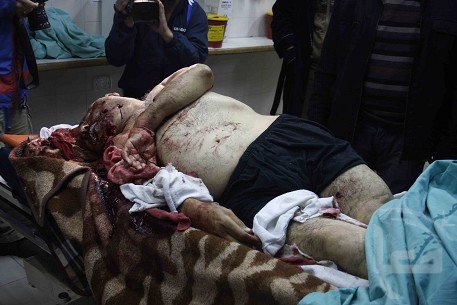
No discharge for soldier who initiated Hebron slaying
Ma’an – 20/01/2011
TEL AVIV — The Israeli military announced late Wednesday evening that the soldier who killed a civilian in his Hebron home would not be discharged, while a second officer who joined in the killing would have his military career “terminated.”
The investigation looked into the death of the death of a civilian during an arrest raid in Hebron targeting Hamas men released from PA custody the day before, where Israeli forces shot and killed a 66-year-old man in his bed, in what appeared to be a case of mistaken identity.
Investigating officer GOC Central Command, Major General Avi Mizrahi was said in a statement to have absolved the officer who started shooting at the sleeping Omer Salim Al-Qawasmi.
The statement said “a suspicious movement [..] caused the soldier to feel that his life was threatened.”
According to the statement, the soldiers fear was excused, “especially having known about the actions of Wael Bitar, a senior Hamas operative who was the main suspect of the arrest operation.”
Al-Bitar, who was detained in June 2008 by what witnesses at the time said were Israeli forces. The arrest followed a violent standoff as Israeli soldiers surrounded and demolished Al-Bitar’s home, after demanding he give up a man who was staying in the building and stood accused of assisting a resistance fighter. The home was demolished around Al-Bitar, and the alleged fighter he was harboring killed in the demolitions. Later reports said Al-Bitar was detained by PA intelligence officials.
Israeli military officials said Al-Bitar assisted in the planning of a 2008 attack that killed one Israeli woman, and was behind the planning of several attacks that were thwarted.
A second soldier, who was also said to have fired on the sleeping man, was found by the inquiry to have “acted unprofessionaly.”
The unidentified officer, “who, having watched the first soldier firing at Qawasme, began firing at him as well.”
According to the military statement the investigating officer concluded that “while the second soldier did feel threatened, he acted unprofessionaly [… and] ordered that the soldier’s military term be terminated.”
It was not clear whether the soldier was honorably or dishonorably discharged.
Mizrahi was said to have “concluded that this firing was executed in accordance with IDF rules of engagement,” though the statement said the death of Al-Qawasmi was “regrettable.”
According to a security source, the officers were part of the “‘Duvdevan’ counter-terrorism elite unit” which was “called in for an arrest operation in the city of Hebron.”
The source described the unit as “a professional, elite unit specializing in close combat, camouflage and assimilation into hostile territory.”
Al-Qawasmi was shot 13 times in the face, neck at torso as he slept.
Can a criminal state deal with war criminals?
By Gilad Atzmon | January 19, 2011
Haaretz reported yesterday that Israeli citizen Aleksander Cvetkovic, 42, is suspected of participating in the murder of at least 1,000 Bosnian Muslims at the Branjevo farm near the city of Zvornik.
Cvetkovic, 42, was arrested at the request of the Bosnia-Herzegovina government. He is suspected of participating in the murder of between 1,000 and 1,200 Bosnian Muslims at the Branjevo farm near the city of Zvornik. This was one of a series of mass murders over a 10-day period of the Bosnian War that are collectively known as the Srebrenica Massacre. In 2006, Cvetkovic immigrated to Israel with his Jewish wife and received citizenship.
Cvetkovic’s defense lawyer Vadim Shub said yesterday that Israel has never extradited citizens on charges of genocide, “and we do not think this is a proper place to begin.”
Shub obviously plucked the right string. He knows that the Israeli society is riddled with war criminals and mass murderers. Shimon Peres, Tzipi Livini, Ehud Olmert and Ehud Barak amongst many others, have far more blood on their hands than suspect Cvetkovic.
In remarks to Israel’s Army Radio, Shub insightfully suggested that extraditing Cvetkovic could set a precedent for the prosecution abroad, of numerous Israeli officials and military personnel.
The extradition request exposes a shockingly detailed description of some devastating murderous enthusiasm:
On July 16, 1995, the unit’s commander summoned eight soldiers, including Cvetkovic, and ordered them to the city of Pilica, where they were to take part in the execution of Bosnian Muslim prisoners held in a local school. Cvetkovic and the other soldiers were then taken to the Branjevo farm, where they waited for the prisoners to arrive.
The prisoners were brought to the farm on buses, some of them handcuffed and blindfolded. They were then taken off the buses in groups of ten and led a short distance away, where the soldiers lined them up and shot them with automatic weapons, including both machine guns and pistols.
After each initial barrage, the soldiers would walk among the victims, locate wounded survivors and finish them off. The Bosnian request asserts that at one point, Cvetkovic offered to use an M-84 machine gun to accelerate the killing. According to estimates by soldiers who took part in the killing, and by a few people who survived by pretending to be dead, the massacre went on for 10 hours.
It would be very interesting to examine the integrity of the so-called Israeli and Jewish Nazi-hunters behind the notorious ‘Operation Last Chance.’ Cvetkovic’s case may verify whether Israelis oppose genocide in general, or just crimes against Jews.
UN Security Council: An organization for injustice
By Kourosh Ziabari | The People’s Voice | January 19, 2011

Since its very inception in 1946, the United Nations Security Council demonstrated that it cannot be trusted as a podium of justice for the world countries, specially the oppressed and defenseless nations which eye the assistance and patronage of the powerful and economically influential nations for tackling their political predicaments and crises, and showed that it merely pursues the interests of its small bloc of five permanent members and undemocratically discriminates against a multitude of countries who don’t have a say in the policies which directly affects them.
United Nations Security Council is said to be one of the principal organs within the operative system of the United Nations and is “allegedly” charged with the maintenance of international peace and security. The authorities possessed by UNSC are the establishment of peacekeeping missions, imposition of international sanctions and authorization of military actions whenever necessary.
UNSC has five permanent members: China, Russia, Britain, France and the United States. What’s the reason? Why should the UNSC have permanent members which cannot be removed from power and must wield an unyielding and resolute authority to make decision over the international affairs? The answer is simple: these five countries are the victorious powers of the Second World War. Their victory in a war which took place and was concluded more than half a century ago minimally accounts for the eternality and endlessness of the power which they possess.
UNSC has also 10 non-permanent members which are elected on a rotating basis and through the vote of the members of United Nations General Assembly.
According to the Article 27 of the UN Charter, a draft resolution on non-procedural matters is adopted if nine or more of the fifteen members of the UNSC vote for the resolution, provided that none of the permanent members veto it.
What is the veto power? The answer is simple. It’s a discriminatory and biased privilege given to five countries to dictate their own will to some 200 countries as they wish. If a draft resolution, put forward by one of the fifteen members of the UNSC, is vetoed by any of the five permanent members, its adoption will be precluded. Veto power, seen by many as the most unfair and inequitable law of the world which enables a powerful and authoritative minority to determine the fate of an indispensable and subjugated majority, is unquestionably an insult to the insight and perception of the international community.
The permanent members of the UNSC are free to exercise their right of veto whenever they wish to, and nobody can question the legitimacy or justifiability of this approach. Several international organizations, lawyers and lawmakers, journalists, politicians and even statesmen have put forward alternatives to the right of veto wielded by the Big 5, but all of their efforts have been in vain, as the United Nations Security Council has showed the least flexibility with regards to the reformation of its autocratic and undemocratic structure.
Interestingly, all of the permanent members of the UNSC are the countries which we’ve long got used to hearing their claims of being the pioneers of democracy and freedom; nevertheless, in the very approach which they’ve implemented over the past fifty years and the manner of their interaction with the other countries of the world, one can hardly trace the footsteps of democratic and civilized behavior.
Unfortunately, the United Nations Security Council has become an instrument for the five superpowers to further their political will in the arena of international politics and alter the political equations according to their interests. They put forward a draft resolution whenever their interests are jeopardized and pressure the rest of members to vote for it, and veto the resolutions in which the interests of their allies are endangered.
Since its establishment up to now, the UNSC has adopted 1966 resolutions. Now the question lies: how many of these resolutions have become operative and come into effect? How many of these resolutions have been fair, lawful and defendable? Whose interests are met through these resolutions? Is the will of five nations more valuable or worthy than the will of 200 countries who don’t have access to UNSC?
Let’s bring up some examples. UNSC’s treatment with Iran is a notable and clear example of discrimination and prejudice exercised by the Security Council against an independent nation which wants to stride on its own path towards self-sufficiency and progress, free from the pressure of bullying powers. Since 2006 UNSC has adopted seven resolutions against Iran’s civilian nuclear activity and imposed four rounds of sanctions against the country for what it claims to be “Iran’s failure to halt its uranium enrichment program”. The imposition of four rounds of sanctions against an independent country which tries to achieve a scientific breakthrough is an ironic drama. All of the reports published by the International Atomic Energy Agency attest to the legality and rightfulness of Iran’s nuclear program. There has been not a single paper of evidence signifying that Iran wants to develop nuclear weapons. All the international community knows about Iran’s nuclear program is that Iran enriches uranium, and enriched uranium, to some certain extents, might be used to fuel a nuclear bomb! At the same time, the international community is well aware of the fact that the regime of Israel possesses 170 to 200 nuclear warheads, and this is a figure which is confirmed by the Federation of American Scientists, an organization within the country which is the staunchest ally of Israel. So why did the UNSC, being headed by the Big 5, impose four rounds of crippling sanctions and pass seven resolutions against Iran instead of condemning Israel and imposing sanctions on it?
Ironically, 118 members of the Non-Aligned Movement and 57 members of the Organization of Islamic Conference unconditionally backed Iran’s peaceful nuclear program; however, the country should face financial sanctions because 5 countries like this way. Is it fair, not? Five is bigger than 118!
World superpowers don’t tolerate the emergence of a new political and scientific power. Iran is an inspiring example for the developing world and should be obstructed at any rate, so the UNSC can effectively function as an impediment on the way of Iran and any country such as Iran which looks for improvement and progress.
However, UNSC’s treatment with Iran was a simple example of the discriminatory approach of this unfair and unjust organization with the world nations. Hundreds of unfair and unjust resolutions have been passed against the oppressed nations of the world, from the Latin America to Africa, adding to the pains and problems of these impoverished nations.
UNSC needs a drastic reformation. The veto power should be dissolved as soon as possible. There should be a permanent seat for the representative of the Islamic world with more than 1.5 billion population. The power to authorize sanctions or military expeditions should be handed over to the UN General Assembly rather than the Security Council. The members of UNSC should be held accountable for the decisions which they make. Their responsiveness to the international community should be built up. The impunity of UNSC members should be abolished. They should not be able to make any decision which they want and get away with it. It’s only with the implementation of such reforms that we can be hopeful for a successful future for the UNSC; otherwise, this organization will forever remain an organization of injustice and bias.
-###-
– Kourosh Ziabari is an Iranian freelance journalist
Featured Video
Prof. Ted Postol: Iran Already Achieved Nuclear Deterrence Against Israel
or go to
Aletho News Archives – Video-Images
From the Archives
How the occupied mentality syndrome works
Saudi Arabia on the American chessboard – Part 3
By B. J. Sabri | American Herald Tribune | June 27, 2016
Read part 2: “The occupied mentality Syndrome“
Previously I argued whether Saudi Arabia’s repeated involvements in U.S. interventions and wars stem from free national will or in response to a specific condition. For starters, in Saudi Arabia there is no national will. In Saudi Arabia, the national will is the will of the Al Saud clan. Still, when a major Arab state allies itself with a superpower that committed unspeakable crimes against humanity in almost every Arab country, then something is wrong. This fact alone should compel us to examine the U.S.-Saudi relation for one exceptional reason. As a result of the U.S.-Saudi wars, hundreds of thousands of people in Afghanistan, Iraq, Iran, Libya, Syria, Yemen, and Somalia have lost their lives. Millions became displaced in their own homelands. And millions more rendered refugees.
Attributing the Saudi policies to the bonds of “partnership” with the U.S. is frivolous. There are no bonds between these two thugs except those of business, military deals, secret plots, and wars. Proving this point, bonds such as these have no space for the American and Saudi peoples to share significant cultural or societal exchanges. If partnership is not the reason for the Saudi contribution to the U.S. strategy of empire and imperialism, then another reason must exist.
This leads to three possibilities. … continue
Blog Roll
 Aletho News
- Al Mayadeen voices solidarity with Dr. Marandi amid death threats
- US dismantling international law in its war against Iran while claiming ‘false’ victory: Legal scholar
- One martyr, 5 injuries in US attack on Iraqi border crossing with Iran
- ‘This war is Israel’s war’: World facing ‘security breakdown’, says Qalibaf
- IRGC decries attack on US embassy in Riyadh, says executed by ‘Israel’
- Iran blasts EU hypocrisy as EU invokes international law over Hormuz
- There is no military solution to Strait of Hormuz
- NATO’s structural collapse – the outcome of deviation from reality
- Poll finds world views China better than US
- One Of America’s Leading Neo-Cons Has Turned Against The Iran War And Israel
- If Americans Knew
- US loses planes over Iran, Israel downgrades Lebanon war goals – Daily Update
- Israel Is Blocking Palestinians from Easter at Church Where Jesus Resurrected
- Plot to assassinate Palestinian activist follows harassment campaign promoted by Zionist groups and elected officials
- Prominent New York synagogue hosts presentation on why U.S. Jews should support the ethnic cleansing of Gaza
- Tapper vs. Piker: Is the CNN Anchor Auditioning for David Ellison?
- Shouldn’t Democrats Be Able to Condemn Genocide?
- Israel-US kill negotiators, destroy civilian structures, but Iran’s military capabilities still largely intact – Daily Update
- ‘War crime’: Global condemnation as Israeli ministers celebrate death penalty law targeting Palestinian prisoners
- 7 Ways Israel Is Turning Lebanon Into Gaza
- World’s Leading Football Bodies Under Fire Over Israel Policies
- No Tricks Zone
- An Inconvenient Tree: Uncovered In Alps… Europe Much Warmer Than Today 6000 Years Ago
- New Study Reports A 60% Slowdown In Greenland’s Ice Loss Rate In The Last Decade
- Low Intensity Tornado Wrecks Major Solar Farm, Creating A Potential Toxic Dump
- New Study Finds Warming Saves Lives…Cold Temperatures 12 Times More Deadly Than Excess Heat
- German Science Blog Accuses PIK Climate Institute Of Hallucinating Climate Tipping Points
- Devastating Assessment Of Comirnaty Vaccine By Former Senior Pfizer Europe Toxicologist
- New Study: CO2 Is ‘Effectively Negligible’ As An Explanatory Climate Change Factor Since 2000
- Former Pfizer Toxicologist Dr. Helmut Sterz Tells Bundestag Hearing Pfizer Vaccine Should Have Never Been Approved
- Energy Expert: Germany’s Nuclear Phaseout Was A “500 Billion Euro Mistake”
- New Research: South Australia’s Mid-Holocene Sea Surface Temperatures Were 4°C Warmer Than Today
 Aletho News