Israeli bulldozers do the talking
By Khaled Amayreh | Al-Ahram | January 13, 2011
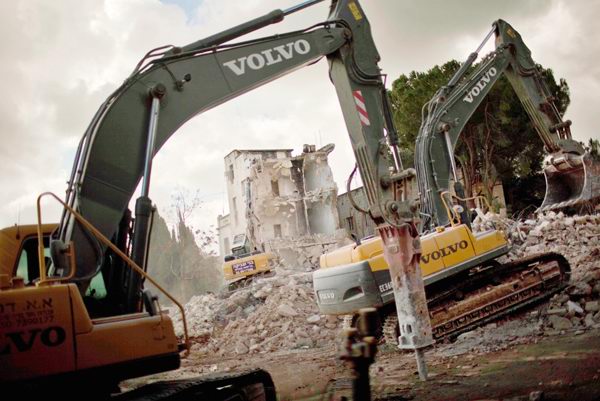
Israel this week demonstrated once again its determination to scuttle any genuine peacemaking effort that might lead to the establishment of a viable Palestinian state based on 1967 borders.
Israeli bulldozers and huge hydraulic jackhammers descended on the Palestinian neighbourhood of Sheikh Jarrah to demolish the Shepherd Hotel, a huge complex dating back to the 1930s. Part of the structure served as home to the former grand mufti of Jerusalem Haj Amin Al-Husseini. The doomed structure thus had a lot of historical significance related to the history of the Palestinian struggle.
The demolition was the latest step by Israel to consolidate Jewish hegemony over the occupied Arab town and obliterate its erstwhile Arab- Islamic identity. The forced Judaisation of the city — holy to Muslims, Christians and Jews — is done feverishly through shadowy deals and dubious expropriation practices in which deception, cheating and trickery loom large.
Moreover, Zionist circles in cooperation with the Israeli government and Jewish settler interests have allocated hundreds of million of dollars for the purpose of channelling Arab-owned property to Jewish interests all over East Jerusalem. The demolition of the Shepherd Hotel took place despite international — including American — objections.
However, given the generally ineffectual nature of these objections, the Israeli government has grown accustomed to taking them lightly, calculating that they are only meant for public relations consumption and that in no way do they constitute a credible challenge to Israel’s settlement policy.
According to reliable Israeli sources in Jerusalem, the Israeli municipal authorities are awaiting an opportune time to carry out further large-scale demolitions of Arab homes in the Silwan neighbourhood. “If the government finds out that international reactions, especially US reactions, are weak as usual, then it will mean a kind of go-ahead signal for the demolitions,” said the source that was not authorised to speak to the media.
“They [the pro-settler Municipal Council of the city] want to desensitise international public opinion to accept [their] reality and come to terms with the fact that Israel will have its way in Jerusalem.”
Reactions to the latest provocation in East Jerusalem have been “normal”, whether from the Palestinian Authority (PA) — which as usual appealed to “the international community” to pressure Israel — or from EU, UN and Arab states, which more or less repeated the same old platitudes pertaining to Israel’s settlement policy being unlawful and counterproductive to peace.
Saeb Ereikat, the chief Palestinian negotiator, urged the West to act on its condemnation of Israeli provocations. “The UN and governments around the world, including the US and the UK, have already condemned plans to demolish this particular hotel. We call on the world to take a strong stand in defence of their positions. This intransigent and illegal behaviour on behalf of Israel must not be allowed to proceed unchecked.”
Speaking in desperate tone, Ereikat said Israeli Prime Minister Binyamin Netanyahu was undercutting and corroding international efforts to create a Palestinian state. “While Netanyahu continues his public relations campaign regarding the peace process, on the ground he is rapidly moving to prevent the establishment of a sovereign Palestinian state.
“Israel continues to change the landscape of Jerusalem aiming to change its status and turn it into an exclusive Jewish city. This process of cleansing and colonisation must be stopped to change the dark reality of Israeli occupation into a free and sovereign Palestinian state with East Jerusalem as its capital.”
Meanwhile, the Israeli government has been trying to give the impression that diplomatic movement was underway, probably to create a public relations counterbalance to settlement expansion and ethnic cleansing of Palestinians in East Jerusalem and the West Bank.
Netanyahu met with Egyptian President Hosni Mubarak in Cairo this week. He also asked for a meeting with King Abdullah of Jordan, ostensibly for the same reason. Mubarak did urge Netanyahu to reverse present Israeli policies vis-à-vis the Palestinians and the peace process. Netanyahu heard Mubarak’s appeal but didn’t listen to it. For as soon as he returned to Israel, the demolitions in East Jerusalem took place.
Meanwhile, Israel is about to dispatch an envoy to Washington to assure the Obama administration that the Netanyahu government is still committed to the peace process. This comes in the aftermath of the clarion failure of the Obama administration to convince Israel to freeze settlement expansion in the occupied Palestinian territories, even in exchange for huge diplomatic inducements and military incentives.
Some analysts believe that the obsequious American behaviour towards the Netanyahu government, especially the excessive patience displayed by Secretary of State Hillary Clinton, has further emboldened Israel and encouraged the Israeli leadership to ignore US pressure. “I am sure that Mrs Clinton dreads Israeli wrath and displeasure more than the Israelis dread American wrath and displeasure,” said one veteran European journalist based in East Jerusalem.
The US reaction to the demolition of the Shepherd Hotel as well as the latest coldblooded killing of innocent Palestinians in the West Bank and Gaza Strip, including farmers tilling their land and old men sleeping in their beds, has been characteristically hollow and wrapped in diplomatic jargon.
Meanwhile, Clinton put the peace process on the backburner as she toured Gulf Arab emirates and sheikhdoms, inciting them against Iran’s nuclear programme. Predictably, Clinton implied that Israel posed no threat to the Arabs and that the real common enemy of both Israel and the Arabs is Iran. Clinton went as far as discrediting statements by former Mossad chief Meir Dagan in which he said that Iran wouldn’t have nuclear weapons capability before 2015.
A few weeks ago, Clinton dismissed the charge that “unilateral Israel actions” were derailing the peace process. “Bilateral negotiations,” she said, “are the only way to reach peace between Israel and the Palestinians.” One PA cabinet minister commented on Clinton’s remarks, saying: “This is very much like telling a rapist and his victim to sort it out among themselves.”
Tunisia to hold polls in 60 days
Press TV – January 15, 2011
Tunisia’s constitutional council says the presidential election must be held within 60 days, after placing the country’s Parliament speaker in power.
The council, Tunisia’s highest legal authority on constitutional issues, decided to formally oust president Zine El Abidin Ben Ali and put Speaker Fouad Mebazaa in charge based on Article 57 of the Constitution.
Premier Mohammad Ghannouchi had earlier taken over from Ben Ali.
Tunisian airports were reopened after Ben Ali fled to Saudi Arabia.
Ben Ali ruled Tunisia for more than two decades. His era was marred by repeated human rights violations and torture.
Meanwhile, unrest continues in the capital Tunis where the central railway station and a market were set on fire. Witnesses have reported lootings in shopping centers.
Police have arrested several people in central Tunis during the overnight curfew.
Analysts believe the ouster of the Tunisian president is a warning to authoritarian regimes across the Arab world.
In an interview with Press TV, Clovis Maksoud, Lebanon’s former ambassador and permanent observer of the League of Arab States in the United Nations described the Tunisian uprising as a wake-up call for the Arab world.
“It’s going to be infectious in several other areas in a manner that might not necessarily lead to bloodshed but [could] weaken the authority [in many Arab countries],” Maksoud told Press TV.
Meanwhile in another development in the country, reports also say that at least 42 inmates have been killed in an inferno at a jail in the Tunisian resort town of Monastir.
“The whole prison is on fire, the furniture, mattresses, everything,” Reuters quoted one witness as saying.
The STL and the myth of judicial virginity
By Helena Cobban | January 13, 2011
The myth propagated by supporters of the various “international” criminal tribunals established since 1992 has been that somehow a judicial proceeding could rise completely above the sordid field of politics and follow its own complete integrity. I used to subscribe to that myth. But in 2000-01, as I started to investigate more closely the work of the two ad-hoc tribunals created by the UN during the mid-1990s, it became clear that “international” criminal tribunals can never, ever, be separated either from the politics of the countries whose developments they probe (and whose politics are inevitably affected by the work of the tribunals themselves)– or, from the politics of the “international” constellation of governments that establish, fund, and provide continued support for these tribunals’ work.
My 2006 book Amnesty After Atrocity? provided copious evidence of this, with regard to the work of the International Criminal Tribunal for Rwanda. But it is not only the ICTR whose work is irredeemably politicized. So has been the work of all “international” tribunals running from the Ur-example in Nuremberg through to today’s “International Criminal Court.” As longtime JWN readers know, I’ve written a lot about this issue, both here and (earlier) on the now nearly-defunct “Transitional Justice Forum” blog. Check over there for, in particular the field reports of the reporting trip I made to northern Uganda in 2006, to assess the very harmful effects that the work of the ICC was having on peacemaking there.
And then, there was the travesty of the (heavily U.S.-supported) Saddam Hussein trial…
Plus, the fact that the government leaders in Washington responsible for launching the completely unjustified invasion of Iraq in 2003, and therefore also all the deaths and violence that ensued from that invasion and occupation, were easily able to evade ever being held to account for that act of aggression (an act that was, at Nuremberg, certainly prosecutable– and prosecuted.) This, while the U.S. has also stood quite aside from all entreaties that it join the ICC– though over recent years it has given extensive logistic and financial support to some, but not all, of the ICC’s investigations and prosecutions… when this suited Washington’s own, inevitably political, purpose.
The neutrality of these judicial bodies before an “impartial” international law? That is nowhere to be seen.
… And then, there is the Special Tribunal for Lebanon,a body that has been irrevocably “politicized” and “political” ever since its establishment in 2006-07. It is a joint project of both the U.N. Security Council and the Government of Lebanon, established at a time when the U.S. still held important sway over both bodies.
Now, Hillary Clinton and her people are busy talking about the need to allow the STL to continue doing its allegedly quite “impartial” work. The STL has been the focus of considerable controversy and swirling allegations and counter-allegations over its years in existence, and I confess I have not followed these with enough diligence to be able to make clear-cut judgments regarding them.
What I can say with a high degree of confidence, based on my own work on this issue of international tribunals over the past decade is that no criminal court, within a country or at the global level, can ever have its work divorced from politics. Criminal prosecutions at a national level involve the state using the laws that already exist within the country to bring a prosecution against a defendant, who may upon being found guilty be subjected to serious sanction by the state– even, in the U.S. and elsewhere, the death penalty.
At the national level, too, the head of state or government always has the power to give clemency or pardon to convicted criminals (as in the case of Elliott Abrams in the U.S.), and leaders often use these powers with the goal of fostering national unity, or other worthwhile political goals.
And at the global level? Where is the agreed-upon, duly legislated, and equality-respecting legal basis for the work of international prosecutors? Where is the opportunity for global political leaders to issue pardons or enact clemency? Where, in short, is the supra-“judicial” legal-political infrastructure that can assure the impartiality as well as general social utility of the work of prosecutors and judges?
It doesn’t exist. In a world marked by striking political inequalities– especially between countries that have P-5 status on the Security Council, and those that don’t; and between countries that have at least submitted themselves to the judgments of the ICC, and those that haven’t– the “impartiality” of international criminal courts is a myth.
I wish it weren’t so. I wish we had the kind of global system in which all national leaders and other significant political actors could be held equally accountable for their actions. But we don’t. Rights activists from around the world who have put so much energy into fighting for the establishment and support of the existing international courts really also need to examine closely the effects that these courts have had on the lives, livelihoods, and well-being of the millions of citizens of the countries that have been their targets. In Amnesty After Atrocity? I looked at the effects on the citizenries of Rwanda, South Africa, and Mozambique of the widely differing approaches those three countries adopted to the issue of seeking “accountability” for past war crimes, crimes against humanity, and genocide. The two countries that decided against using criminal courts to deal with perpetrators of atrocities during the episodes of severe violence that all of them had suffered were the ones that came out with their social cohesion, political purpose, and the rights situation of their citizenries the best assured.
It is not only in Lebanon that a crucial “trade-off” exists between the work of (an inevitably “political” and backward-looking) international tribunal and the prospects for peace and people’s well-being going forward. Look at some of my own past work on this issue. Look at what the Obama administration is now actively considering doing in the context of Sudan, for goodness sake! Today, White House officials including “Ms. Anti-Genocide” herself, Samantha Power, are openly talking about the possibility of easing up the pressure that Pres. Omar Hassan al-Bashir has been subjected to from the ICC, in exchange for his cooperation with implementing the results of the South Sudan referendum.
It surely should not be that only in Lebanon does Washington pursue the chimera of the “impartiality” of a tribunal with strong international dimensions at the expense of the well-being of the target country’s citizenry.
Accountability for Rafiq Hariri’s killing? One day, let’s hope, the facts will all emerge. But this highly politicized judicial process centered in The Hague looks unlikely to be able credibly to uncover them. And if it does issue indictments, what then? STL prosecutor Daniel Bellemare and whose army will arrest those indicted? What of the Lebanese government’s supposedly co-equal role in managing this whole “criminal justice” project?
The next time Sec. Clinton or a State Department spokesman starts talking about the need to preserve the “impartiality” of this court, the STL, they should be asked about some of these very important questions…
The Well-Deserved Collapse of Lebanon’s Government
Blame Hillary, Not Hezbollah
By RANNIE AMIRI | CounterPunch | January 14, 2011
Wednesday’s timeline from the Lebanese news portal Naharnet.com read as follows:
5:17 pm Agence France Presse: Prime Minister Saad Hariri went into talks with U.S. President Barack Obama at the moment that Opposition ministers resigned from the Lebanese government.
5:32 pm Minister of State Adnan Sayyed Hussein announced in a statement his resignation from Cabinet.
In that 15 minute span, President Obama went from meeting Lebanese Prime Minister Hariri to ex-Prime Minister Hariri. The unity government under his premiership had fallen, and deservedly so.
Events had rapidly unfolded.
Last weekend, U.S. Secretary of State Hillary Clinton met Hariri in New York. The visiting prime minister was holding consultations with Saudi Arabia’s King Abdullah, recuperating from recent back surgery there, on the Special Tribunal for Lebanon’s (STL) impending indictments.
The STL is widely expected to implicate Hezbollah members in the February 2005 assassination of late premier Rafiq Hariri despite evidence pointing to Israel’s complicity in the crime. Saad Hariri’s Western-backed ruling March 14 coalition backs the tribunal while the opposition March 8 coalition has called for its boycott.
Hopes have been riding on a Saudi-Syrian, or “S-S” initiative that would effectively mediate between the rival camps on how best to handle the STL’s imminent verdict. Syrian President Bashar Assad and King Abdullah, respective patrons of the March 8 and March 14 blocs, sought to broker a solution to both side’s satisfaction.
Although details of the alleged initiative were not made public, speculation exists it may have entailed Hariri distancing himself from the STL decision in exchange for March 8 dropping its pursuit of charges against the “false witnesses”—those who initially fingered Syria for Hariri’s murder but whose testimony against Damascus was ultimately found to have been fabricated. Some of these witnesses are thought to be Hariri confidantes.
Not long after Hariri had finished meeting with Clinton, opposition leader and Free Patriotic Movement head Michel Aoun declared Tuesday the S-S initiative was dead:
“We thank the Saudi king and the Syrian president for the efforts they have exerted, although their initiative has ended with no results. The Hariri-led camp didn’t respond to these efforts, that’s why we’ve reached a dead end.”
A statement released by the opposition said the endeavor “ … reached a dead end due to U.S. pressures and the other camp’s compliance with these pressures, despite the fact that we had positively dealt with that initiative and provided it with chances of success.”
Progressive Socialist Party head and Druze leader Walid Jumblatt remarked, “Saad Hariri was on the brink of making a major concession as concerns the tribunal, but occult forces prevented him from doing so.” After meeting with the Maronite Patriarch on Wednesday, he said, “dark forces intervened in the ongoing Syrian-Saudi talks and sidetracked this initiative from its original course.”
According to Labor Minister Muhammad Fneish, the Saudi-Syrian effort was sabotaged by “American intervention and the inability of the other side to overcome American pressure.” When asked why it ultimately failed, Fneish replied, “Ask Mrs. Clinton.”
The Obama administration and the U.S. State Department never wanted, nor would they have tolerated, an intra-Arab solution to Lebanon’s predicament. They ensured there would be no obstacle in the way of a discredited tribunal from issuing its findings based on doctored evidence, one that would sully Hezbollah’s reputation in Lebanon and throughout the Arab and Muslim world.
When it became clear the S-S initiative and whatever promise it held had been quashed, opposition members called on Hariri to urgently convene a cabinet meeting by the following day (Wednesday) to address what the government’s position toward the STL would now be.
The prime minister, still in New York, refused.
Ten opposition ministers in his 30-member cabinet then proceeded to tender their resignations.
Because the “one-third-plus-one” formula mandates at least 11 resign before the cabinet can be dissolved, one more minister was needed. That came when Minister of State Adnan Sayyed Hussein—one of five ministers directly appointed by President Michel Suleiman—announced his resignation. With that, Hariri’s 14-month-old government fell.
“The grace period has ended, and the waiting stage that we lived through without any result has ended,” said Energy Minister Jibran Bassil.
Saad Hariri rightly wants to see those who murdered his father and 22 others that fateful February day brought to justice. It is a wish shared by all Lebanese.
But Hariri and his coalition allies could not put their political and sectarian biases aside long enough to see how badly compromised the STL had become; its subjective investigatory methods, its reliance on Israeli-infiltrated telecommunication data, its refusal to even entertain the notion that Tel Aviv could possibly be involved in the assassination despite plausible evidence procured against it (not to mention the military benefits it reaped from Rafiq Hariri’s killing).
Although a compromise appeared at hand, one that would satisfy both coalitions and guarantee the nation’s well-being, Hariri was unwilling to overcome U.S. pressure. He allowed Secretary of State Clinton to veto overnight a plan that was months in the making.
What Clinton’s action did make clear is that any outside solution will always be subject to such interference. It only reinforced calls for the Lebanese to assume control of their own affairs and reach an agreement a third party cannot abrogate.
After meeting with Hariri, Clinton embarked on a tour of Persian Gulf countries, continuing the mission to promote division between Arab and Iranian, Sunni and Shia. When asked on Al-Arabiya television to comment on the situation in Lebanon, she said “stability requires justice.”
Ironically, a concept she tried to subvert and one Hariri never understood.
Rannie Amiri is an independent Middle East commentator.
The Wrong Kind of Climate Control & The Risks of Free Speech
By Kieran Manjarrez | Woodchip Gazette – Journal | January 10, 2011
As sure as rain follows upon dark clouds, the cry has gone up to “do something” about so-called hate speech. Fairly typical of the reactions to the shooting of Congresswoman Gifford and several others by Jared Loughner was ‘ Tikkun’s’ Rabbi Michael Lerner, who rhetorically intoned: “Isn’t it time for us to demand that our government investigate the violence-generating discourse of the racists and the haters?”
The Constitutional answer is: absolutely not! Lerner and those of like mind need to read — thrice and slowly — the words of James Madison on this very issue:
“There are … two methods of removing the causes of [political] faction: the one, by destroying the liberty which is essential to its existence; the other, by giving to every citizen the same opinions, the same passions, and the same interests.
“It could never be more truly said of the first remedy, than it was worse than the disease. Liberty is to faction what air is to fire, an aliment without which it instantly expires. But it could not be less folly to abolish liberty, which is essential to political life, because it nourishes faction, than it would be to wish the annihilation of air, which is essential to animal life, because it imparts to fire its destructive agency.
“The second expedient is as impracticable as the first would be unwise. As long as the reason of man continues fallible, and he is at liberty to exercise it, different opinions will be formed.” (Federalist Paper No. 10.)
What Lerner is urging, in modern form, is the revival of laws against sedition. The “protected values” (or in modern legal lingo, the “cognized groups”) may be different but the principle is the same: words which have a “tendency” to incite violence and/or threaten the security or well being of … [insert your cherished value-of choice here]… need to be outlawed and criminally punished.
Whether enacted in 1789, 1918 or 2011, laws against sedition are inimical to a free society; and no amount of spurious sociological “impact studies” (so-called) can change that constitutional fact.
What does it actually mean to call for government “investigation” of “violence-generating” speech?
The investigation part is fairly easy to answer: it means police and FBI agents keeping tabs of what you say, interviewing your neighbors about what do, getting warrants to poke into your reading habits and ultimately detaining you for further questioning. Such investigations inevitably entail what the Nazis called “block wardens” — neighbors and other snitches who make it their business to overhear your chat and take note of the books and guests you bring home. Already both the government and various interest groups have set up networks and web pages to recruit security-volunteers to poke around and keep an ear out for terrorism- or racist- generating violence.
What then is to be the casus for such inquisitions? What exactly is ‘violence-generating’ speech?
Let us be plain and simple, for Thucydides tells us that simplicity of speech is the mark of a noble man. Websters (1913 edition), defines violence as “physical force, strength of action or motion; as the violence of a storm; the violence of a blow or conflict;” also, “to assault or injure”. By metaphorical extension: “moral force; vehemence.”
Clearly (and simply) words are not violence; they do not cause physical injury. Concoctions like ‘verbal assault’ are confusions of speech which are the marks of hysteria or sophistry.
Words may be uttered with “moral vehemence.” Preachers do it all the time. Implacable foes along the Great Abortion Divide are very morally vehement. But is it ‘violence generating’ to call abortion murder?
According to Lerner, violence-generating words are those which “create a climate of hate.” Murder is certainly loathsome. Pictures of aborted foetuses certainly engender revulsion and disgust. But are the pictures false? If abortion foes cannot call abortion “murder” then what must they call it? Whether it is or is not murder is the whole issue of the debate. In effect, Lerner’s demand “creates a climate” where abortion foes are intimidated (under threat of government investigation) into silence. The same holds true when the intimidation works in the other direction.
Attentive readers of Lerner’s article will have noticed a subtle switch from his vaguish opening reference to “violence-generating” speech to the ensuing and even more vague reference to “rhetoric” which “contributes” to a “climate of hate” which “individuals act on.”
The reason for the verbal shuffling is that Lerner can’t quite get himself to say that speech causes violence. It doesn’t, period. The quintessential scientific test of causality is replication and predictability; and no one has ever demonstrated that a particular word, phrase or book has consistently and predictably caused a violent reaction — the dread ‘Mein Kampf’ included. Even if human predispositions are genetically determined or environmentally influenced, action is the result of free will.
Sometimes, action is the result of craziness as in Loughner’s case or as in the case of Don Quixote who devoured novels of chivalry until “being quite out of his wits, he hit upon the strangest notion that ever a madman in this world hit upon, and that was that it was right and requisite that he should make a knight-errant of himself, roaming the world in full armor on horseback … righting every kind of wrong, and exposing himself to peril and danger from which he was to reap eternal renown and fame.” In other words, he became a militia-man.
But the underlying point of Cervantes’ satire was precisely that books do not cause madness. In case anyone might not get it, he made this clear in a prefatory couplet where he wrote that madness is the “cure” for sadness. What drove Don Quixote on his errands of mayhem, chaos and absurdity was an inner grief.
The fact is that people make of words what they will, often bending them all out of shape to suit some inner purpose or drive. Perhaps we might all be better off without speech altogether. As Jesus advised, “let your speech be, Yea or Nay: for whatsoever is more than these cometh of evil.” (Math. 5:37) But Man is nothing if not a loquacious animal, and the desire to speak freely is the foremost urge of our souls or at least of our egos.
Laws against sedition, in whatever guise, are an attack on free speech. They are always couched in vague, open ended terms because the real target is not the alleged “dangers” protected against but some political agenda or ideology that is opposed.
Section 2 of the Alien and Sedition Act of 1789 provided
“…be it further enacted, That if any person shall write, print, utter, or publish,… any false, scandalous and malicious writing or writings against the government of the United States, … with intent to defame the said government, … or to excite against [it] … the hatred of the good people of the United States, …”
The Sedition Act of 1918 made it a crime to
“willfully utter, print, write, or publish any disloyal, profane, scurrilous, or abusive language about the form of government of the United States, or the Constitution of the United States, or the military or naval forces of the United States….”
California’s Criminal Syndicalism Act 1919 made it a crime to advocate or teach “any doctrine or precept” that espoused “unlawful acts of force and violence or unlawful methods of terrorism as a means of accomplishing a change in industrial ownership or control or effecting any political change.”
Section 13 of the Reich Editorial Law (4 October 1933) prohibited publication of anything which “tends to weaken the strength of: the German Reich, outwardly or inwardly, the common will of the German people, the German defense ability, culture or economy….” (1933 Reichsgesetzblatt, Part I, page 713.)
What all these laws have in common is a heap of nefarious adjectives coupled with a “tendency” connected to some protected good.
The United States Supreme Court initially upheld these laws precisely on the grounds that they combated a subversive climate.
In Frohwerk v. United States (1919) 249 U.S. 204 the Court held that “a person may be convicted of a conspiracy to obstruct recruiting by words of persuasion.” In that case the defendant had published a pamphlet in which he called war “murder” and in which he went “on to give a picture, made as moving as the writer was able to make it, of the sufferings of a drafted man.” Most horribly, the author had sneered at various British nobles and had said that “the sooner the public wakes up to the fact that we are led and ruled by England, the better.”
In Debs v. United States (1919) 249 U.S. 211, the Court followed suit and upheld the criminalization of a pamphlet by Eugene Debs in which the famous labor leader had given:
“illustrations of the growth of Socialism, a glorification of minorities, and a prophecy of the success of the international Socialist crusade, with the interjection that ‘you need to know that you are fit for something better than slavery and cannon fodder.’ “
That statement, the Court held, did not simply oppose war in general but opposed the present and the particularly noble war the nation was embarked upon and “opposition was so expressed that its natural and intended effect would be to obstruct recruiting.” (Id., at p. 251.)
This line of reasoning culminated in Whitney v. California, (1927) 274 U.S. 357, where the Court ruled that “the Constitution d[id] not confer an absolute right to speak, without responsibility, whatever one may choose,” and that government had the power to punish those who “abused” their rights of speech “by utterances inimical to the public welfare, tending to incite crime, disturb the public peace, or endanger the foundations of organized government and threaten its overthrow.” (Id., at p. 371.)
The common theme of these and too many like cases is that they sought to punish a “tendency” which is subjectively perceived to “endanger” some asserted good. Just as typically, some untoward event such as a Reichstag Fire, a bombing or the murder of an official, was exploited as the necessity to protect “public safety.”
Tyranny always rides to town on the pony of safety.
Today’s political correctness mavens may use adjectival gerunds and verbal-burble which has an impressive sociological sounding ring, but the mental paradigm is the same. They either seek to mandate a uniformity of opinion on whatever subject they are obsessing over, or they seek to cast any opposition to their pet-rocks as creating some kind of danger.
Often times they heighten the “climatology” by invoking a so-called “clear and present danger” to something or other. But this erstwhile standard — derived from Schenck vs. United States (1919)249 U.S. 47 — is simply a rhetorically tweaked version of the “bad tendencies” rule. Any danger is always “present” precisely because a ‘danger’ is simply the present prospect of some possible future harm. Schenck was overruled because, as Justice Douglas put it, “[t]he only difference between the ‘expression of an opinion’ and an ‘incitement’ … is the speaker’s enthusiasm for the result. (Brandenburg v. Ohio (1969) 395 U.S. 444, 452.)
And Man is certainly an enthusiastic animal. Once again it behooves us to listen to Madison:
“As long as the reason of man continues fallible, and he is at liberty to exercise it, different opinions will be formed. As long as the connection subsists between his reason and his self-love, his opinions and his passions will have a reciprocal influence on each other….
“The latent causes of faction are thus sown in the nature of man; and we see them everywhere brought into different degrees of activity, according to the different circumstances of civil society. A zeal for different opinions concerning religion, concerning government, and many other points, as well of speculation as of practice; an attachment to different leaders ambitiously contending for pre-eminence and power; or to persons of other descriptions whose fortunes have been interesting to the human passions, have, in turn, divided mankind into parties, inflamed them with mutual animosity, and rendered them much more disposed to vex and oppress each other than to co-operate for their common good. So strong is this propensity of mankind to fall into mutual animosities, that where no substantial occasion presents itself, the most frivolous and fanciful distinctions have been sufficient to kindle their unfriendly passions and excite their most violent conflicts.” (Federalist Paper No. Ten.)
Madison’s misanthropy is more than justified by the media’s screaming rabble-rousers and by Palin’s smart-alec thuggishness. But Madison also understood that “the most common and durable source of factions has been the various and unequal distribution of property.” (Ibid) Put another way, the human tendency toward disputatious vehemence is increased by inequality and insecurity.
Thus, it is a useless, if pretty, piety to urge everyone to be “civil” in their discourse. The reason for the inflamed nature of present political debate in the United States is that the country is in decline and economic inequality and insecurity have destroyed our social and cultural fabric. This creates a terminal downward spiral because the insecurity-generated yelling and accusing prevents the emergence of fair and reasonable solutions to economic and social problems whose very gravitational pull is aggravated by the inflamed rhetoric generated.
To make matters even worse, some of the very forces which generate the economic inequality also finance the spewing of inflamed rhetoric which they then assert needs to be controlled in the name of personal or national safety.
It is a false consciousness to think that “civility” in discourse can be restored by political correctness or laws against seditious incivility. A greater modicum of civility will be restored to political discourse when and only when our civis itself becomes more fair and just and when we cease chasing after the chimera of militarized security. That will be a hard reversal to manage.
©Woodchip Gazette, 2011
FBI Targets Critics Of Government With Home Visits After Arizona Shootings
Another victim of the Tucson tragedy – the right to criticize your Congressperson without getting a knock on the door from the feds
Paul Joseph Watson | Prison Planet | January 14, 2011
We can add another victim to the Tucson tragedy – the right to criticize government without fear of getting a knock on your door from the feds. Despite the fact that shooter Jared Loughner was not politically motivated, the FBI is now compiling a list of Americans deemed a potential threat because they criticized their representative – and targeting them with home visits.
An Ozark man who ran a blog last year critical of Republican Congressman Billy Long was shocked to see an FBI agent turn up on his doorstep asking questions. The agent was accompanied by Green County Sheriff Jim Arnott, who had stepped outside of his jurisdiction to become involved in this act of political repression directed against Clay Bowler, a resident of Christian County.
The FBI agent wanted to know if Bowler was a threat to Long because he had used an Internet blog to highlight claims of cronyism and corruption involving the Congressman before the southwest Missouri election in November, in which Long defeated Democrat Scott Eckersley to replace outgoing Rep. Roy Blunt.
The most heated confrontation Bowler had with Long was when he asked him a question about political donations Long had made. The video clip of the incident shows Bowler calmly asking Long a question as the Congressman walks away. He ran a website called “Long is wrong” in an attempt to prevent Long from being elected last year. The website has since been discontinued and Bowler hasn’t had any contact with Long since September.
Even the FBI agent who visited Bowler had to agree that his actions represented no kind of threat whatsoever.
“I’m not a threat to Billy Long,” Bowler said Thursday. “I find the whole thought very funny, because I’m such an advocate for constitutional rights that I would never do anything that would put in jeopardy those constitutional rights like the Second Amendment.”
In the aftermath of the Tucson tragedy, the father of Christina Green, the 9-year-old girl killed in the massacre, pleaded with the nation that his daughter’s death should not be exploited as a justification to crush constitutional rights. In addition, it has been confirmed in triplicate that shooter Jared Loughner was not motivated by politics. Earlier this week one of his closest high school friends told ABC News that Loughner, “Did not watch TV. He disliked the news. He didn’t listen to political radio. He didn’t take sides. He wasn’t on the left. He wasn’t on the right.”
Green County Sheriff Jim Arnott’s justification that it’s best to “err on the side of caution” in targeting critics of government with home visits has no place in a free country. Perhaps Arnott would feel more at home in the former East Germany or the Soviet Union.
“Arnott confirmed to KSPR News that Bowler isn’t the only local person who’s been scrutinized in the wake of last weekend’s shooting of Rep. Gabrielle Gifford (D-AZ) during a meet-and-greet with constituents in Tucson, Ariz,” states the report, affirming that the authorities are compiling new lists of Americans who are now considered to be potentially violent threats for the crime of asking their own public servants uncomfortable questions. Separately it was reported that the FBI was preparing to visit other bloggers in the area.
Targeting anyone who exercises their First Amendment right to redress their grievances against local representatives who are paid to serve them with home visits accompanied by FBI agents only has one outcome – it chills free speech and discourages other Americans from speaking out against the government. These tactics also have the impact of making asking questions of elected officials, the lifeblood of a free society, seem somehow abnormal or suspicious. … Full article
Anti-War and International Solidarity Activists Denounce FBI Infiltration
2011-01-12 | Committee to Stop FBI Repression
The anti-war and international solidarity activists who are being called before a grand jury in Chicago have learned that beginning a few months before the protests against the Republican National Convention in the 2008 in St. Paul, Minnesota, a law enforcement officer infiltrated the Twin Cities Anti-War Committee (AWC). The infiltrator went by the name Karen Sullivan, joined the AWC in April 2008, and about a year later she joined the Freedom Road Socialist Organization.
Misty Rowan, of the Anti-War Committee, said, “The AWC played an important role in organizing the permitted march on the Republican National Convention on September 1, 2008, and also organized a rally and march on the fourth day of the convention. We can only assume that this First Amendment protected organizing was the reason that this agent, Karen Sullivan, infiltrated the AWC. It is the same kind of infiltration criticized in the September 2010 inspector general report and highlighted in the recent release of documents from the Richmond, Virginia, police, where any sort of assembly is defined as a disturbance and threat.”
Jess Sundin, of the Anti-War Committee, said; “This professional liar posed as a fellow activist for two and a half years, and acted as if she was our friend. She spent time around my child, and even attended a small BBQ to celebrate my release from the hospital after I survived a near-fatal brain hemorrhage in April of last year. This event had no investigative value. By attending personal events like this, she showed how unprincipled she was.”
 In the summer of 2009, the agent signed up to go on a solidarity trip to Palestine. Three members of the delegation were denied entry at the Tel Aviv airport and eventually sent back to the U.S., Sarah Martin, Katrina Plotz and the agent. We have now learned that on the word of this agent, these political activists were prevented from witnessing first-hand what is paid for with U.S. tax dollars in Israel and the Occupied Territories.
In conversations between our attorneys and the prosecutor’s office in Chicago, we have had confirmation that Karen Sullivan was in fact a law enforcement officer working undercover.
It now appears that the investigation of the U.S. Attorney is focused on small donations to the daycare and women’s center projects of the Union of Palestinian Women’s Committees, an NGO registered with the Palestinian Authority with local offices in towns across the the West Bank and Gaza. The Union is a progressive women’s organization that strives to build respect for women’s rights.
Steff Yorek, of Freedom Road Socialist Organization said, “We are appalled that we were infiltrated by police agents, targeted for our political organizing and views. This violates our rights to freedom of association and speech.”
The Committee to Stop FBI Repression is planning a National Day of Protest for January 25, in cities across the country. This protest is in solidarity with people refusing to testify at the secret grand jury in Chicago on that day.
Pictured: “Karen Sullivan” (right) with her associate “Daniela Cardenas”
Featured Video
Prof. Ted Postol: Iran Already Achieved Nuclear Deterrence Against Israel
or go to
Aletho News Archives – Video-Images
From the Archives
How the occupied mentality syndrome works
Saudi Arabia on the American chessboard – Part 3
By B. J. Sabri | American Herald Tribune | June 27, 2016
Read part 2: “The occupied mentality Syndrome“
Previously I argued whether Saudi Arabia’s repeated involvements in U.S. interventions and wars stem from free national will or in response to a specific condition. For starters, in Saudi Arabia there is no national will. In Saudi Arabia, the national will is the will of the Al Saud clan. Still, when a major Arab state allies itself with a superpower that committed unspeakable crimes against humanity in almost every Arab country, then something is wrong. This fact alone should compel us to examine the U.S.-Saudi relation for one exceptional reason. As a result of the U.S.-Saudi wars, hundreds of thousands of people in Afghanistan, Iraq, Iran, Libya, Syria, Yemen, and Somalia have lost their lives. Millions became displaced in their own homelands. And millions more rendered refugees.
Attributing the Saudi policies to the bonds of “partnership” with the U.S. is frivolous. There are no bonds between these two thugs except those of business, military deals, secret plots, and wars. Proving this point, bonds such as these have no space for the American and Saudi peoples to share significant cultural or societal exchanges. If partnership is not the reason for the Saudi contribution to the U.S. strategy of empire and imperialism, then another reason must exist.
This leads to three possibilities. … continue
Blog Roll
 Aletho News
- Hezbollah hits Israeli warship off Lebanon’s coast, sets it aflame
- Iran slams US strikes on B1 bridge, Mahshahr petrochemical plants as ‘blatant acts of state terrorism’
- In letter to UN chief, Araghchi warns of dire consequences of US-Israeli attacks on Iran’s nuclear facilities
- Why the CIA conspiracy to invade Iran with Kurdish militias failed
- Why Are Upbeat US Claims About Mission to Rescue Pilot ‘Highly Questionable’?
- Aircraft destroyed during US ‘rescue’ of downed F-15 pilot cost more than $100 million each
- Washington University removes professor who condemned US-Israeli war on Iran
- Russia Warns of Retaliation as UK Authorizes Seizure of Vessels
- Serbia thwarts plot to bomb Russia-Hungary gas pipeline – Vucic
- Al Mayadeen voices solidarity with Dr. Marandi amid death threats
- If Americans Knew
- In Iran, Israel-US take aim at “reason, research, and freedom of thought” – Daily Update
- US loses planes over Iran, Israel downgrades Lebanon war goals – Daily Update
- Israel Is Blocking Palestinians from Easter at Church Where Jesus Resurrected
- Plot to assassinate Palestinian activist follows harassment campaign promoted by Zionist groups and elected officials
- Prominent New York synagogue hosts presentation on why U.S. Jews should support the ethnic cleansing of Gaza
- Tapper vs. Piker: Is the CNN Anchor Auditioning for David Ellison?
- Shouldn’t Democrats Be Able to Condemn Genocide?
- Israel-US kill negotiators, destroy civilian structures, but Iran’s military capabilities still largely intact – Daily Update
- ‘War crime’: Global condemnation as Israeli ministers celebrate death penalty law targeting Palestinian prisoners
- 7 Ways Israel Is Turning Lebanon Into Gaza
- No Tricks Zone
- An Inconvenient Tree: Uncovered In Alps… Europe Much Warmer Than Today 6000 Years Ago
- New Study Reports A 60% Slowdown In Greenland’s Ice Loss Rate In The Last Decade
- Low Intensity Tornado Wrecks Major Solar Farm, Creating A Potential Toxic Dump
- New Study Finds Warming Saves Lives…Cold Temperatures 12 Times More Deadly Than Excess Heat
- German Science Blog Accuses PIK Climate Institute Of Hallucinating Climate Tipping Points
- Devastating Assessment Of Comirnaty Vaccine By Former Senior Pfizer Europe Toxicologist
- New Study: CO2 Is ‘Effectively Negligible’ As An Explanatory Climate Change Factor Since 2000
- Former Pfizer Toxicologist Dr. Helmut Sterz Tells Bundestag Hearing Pfizer Vaccine Should Have Never Been Approved
- Energy Expert: Germany’s Nuclear Phaseout Was A “500 Billion Euro Mistake”
- New Research: South Australia’s Mid-Holocene Sea Surface Temperatures Were 4°C Warmer Than Today
 Aletho News