Street protests banned in Baghdad
By Sara Ghasemilee | Al Arabiya | 14 April 2011
Iraq has decided to officially ban street protests in the capital Baghdad and limited approved demonstrations sites to three soccer stadiums, a security official said on Wednesday, according to reports.
“We have specified Al-Shaab, Kashafa and Zawraa stadiums as permitted sites for demonstrations in Baghdad instead of Ferdus or Tahrir squares,” the capital’s security spokesman Major General Qassim Atta said at a news conference televised by state broadcaster Iraqiya TV.
The decision follows after regular demonstrations were held in Bagdad with thousands of people protesting against government corruption, poor basic services and unemployment.
“Many shop owners and street vendors have called us and complained to us because demonstrations have affected their work and the movement of traffic, “Major General Atta said.
Following uprisings in Tunisia and Egypt, Iraqis have frequently been protesting since late February around the country, from the mainly Kurdish north to the Shiite south.
The authorities have responded by deploying guards, troops and internal security forces.
More than eight years after the U.S.-led invasion that ousted President Saddam Hussein, Iraq’s infrastructure remains severely damaged. The country suffers a chronic water shortage and electricity supply is intermittent making daily life difficult and leaving many Iraqis feeling frustrated.
Egypt to revise gas deals with Israel
Press TV – April 13, 2011
Egypt’s Prime Minister Essam Sharraf has asked for the revision of all contracts related to natural gas exports abroad, particularly to Israel.
Sharraf said on Wednesday that Cairo’s planned revision could bring Egypt an extra three to four billion dollars in revenues.
Israel is expected to be hit hard by the measure since Egypt supplies an estimated 40 percent of its gas.
The deal with Tel Aviv was a highly controversial issue during the rule of ousted president Hosni Mubarak.
Four Israeli firms have signed agreements to import gas under a 20-year contract.
The agreement has been repeatedly challenged in Egyptian courts as it was without parliament’s consultation.
Sharraf will also meet with the Jordanian energy minister to discuss the gas deal with his country.
Opposition groups have long complained that Mubarak was selling natural gas to Israel at preferential prices.
The developments come as Egypt’s public prosecutor has summoned the former president and his son for questioning over corruption and the use of violence against peaceful protesters.
Earlier reports said Mubarak and his former petroleum minister were also being investigated for selling artificially cheap gas to the Israeli regime.
The chief prosecutor had received evidence that Mubarak and Sameh Fahmy had sold natural gas to Israel and several Western countries for under market prices.
Fahmy has recently told investigators that he was just carrying out orders from Mubarak.
However, Mubarak has rejected the corruption accusations as libel.
Israel steps up Jerusalem expulsions
Even Tony Blair can’t save Palestinian bookseller to the stars
By Jonathan Cook in Jerusalem | Redress | 14 April 2011
Munther Fahmi is known as the “bookseller of Jerusalem”. Among his customers are to be found Tony Blair, Kofi Annan, Jimmy Carter and Hollywood actress Uma Thurman.
In a city riven by political and social tensions, Mr Fahmi’s bookshop has provided an oasis of dialogue between Palestinians and Israelis, with well-known writers and scholars from both sides of the divide regularly invited to give readings and talk about their work.
But despite his high-profile connections, Mr Fahmi’s days in the city of his birth look to be numbered.
Israeli officials have told him that, after 16 years running his bookshop in the grounds of East Jerusalem’s landmark 19th-century hotel the American Colony, he is no longer welcome in either Israel or Jerusalem.
Two months ago he exhausted his legal options when Israel’s high court refused to overturn the deportation order. His only hope now rests with a governmental committee to which he has appealed on humanitarian grounds.
Mr Fahmi, 57, is far from optimistic. “My lawyer tells me applications from Palestinians are almost never accepted.”
The holder of an American passport for many years, Mr Fahmi said he was staying on a tourist visa that expired on 3 April. “If the committee rejects my case, I will be sent packing on a plane at very short notice.”
Mr Fahmi is one of thousands of Palestinians who over the past four decades have fallen foul of an Israeli policy stripping them of their right to live in Jerusalem, said Dalia Kerstein, director of Hamoked, an Israeli human rights group.
Although Israel annexed East Jerusalem in 1967, in violation of international law, most of its Palestinian population received only Israeli residency permits, not citizenship.
According to Israeli figures, more than 13,000 Palestinians – from a current population of 260,000 in East Jerusalem – have had their residency revoked since then.
Ms Kerstein said the number of revocations had risen sharply in recent years, with more than 4,500 Palestinians losing residency in 2008 alone, the last year for which complete figures are available.
Israeli law stipulates that Palestinians in Jerusalem can be stripped of residency if they spent at least seven years abroad – defined as including the occupied Palestinian territories of the West Bank and Gaza – or acquired a foreign passport.
Since a test case in 1988, the Israeli courts have backed revocations in cases where the authorities claim Palestinians have transferred their “centre of life” elsewhere.
“There is clearly a policy to push Palestinians out of Jerusalem and Israel to reduce what is called here the ‘Palestinian demographic threat’,” said Ms Kerstein. “It’s really a case of ethnic cleansing.”
Last week Hamoked and another human rights group, the Association of Civil Rights in Israel (Acri), petitoned Israel’s Supreme Court to overturn the policy, arguing that it contravenes international law.
Oded Feller, a lawyer for Acri, said Palestinians in East Jerusalem were effectively “prisoners”, punished by Israel if they took part in a more globalized world.
“The problem for people like Munther is that the Israeli government and the courts treat them as though they are immigrants, ignoring the fact as the city’s native residents they have an inalienable right to live here,” Ms Kerstein said.
Like most other Palestinians in East Jerusalem, Mr Fahmi’s family declined Israeli citizenship in 1967. “We are Palestinians and Israel is occupying us. Why would we take citizenship and give a stamp of legitimacy to our occupation?”
But that decision left him and other Palestinians in Jerusalem in a precarious position.
Mr Fahmi’s residency was revoked – without his knowledge – during a long period spent in the United States, starting in 1975 when he left to study. He gained his American passport after marrying there and raising a family.
He decided to settle back in Jerusalem in 1995, after the signing of the Oslo accords. “I had seen Yasser Arafat [the Palestinian leader] and Yitzhak Rabin [Israel’s prime minister] shake hands in front of the White House. Naively, I thought it heralded a new era of reconciliation.”
For the last 16 years, he has been forced to exit and enter the country every few months on a tourist visa.
But Mr Fahmi learnt the full significance of his loss of residency 18 months ago, when Interior Ministry officials told him that, according to a new policy, he would no longer be automatically issued tourist visas.
Now, he has been told, he can spend only three months a year in Israel, including Jerusalem. In his appeal to the humanitarian committee, he has said he needs to be in Jerusalem to care for his 76-year-old mother.
“Is there any other country where the native population is treated like this in its homeland?” he said.
The policy to withhold tourist visas to Palestinians with foreign passports has been only patchily implemented, said Ms Kerstein, following objections from US and European embassies.
Mr Fahmi appeared a surprising choice for enforcement, given his influential supporters. A petition has attracted more than 2,000 signatures, including those of the British novelist Ian McEwan, who won this year’s Jerusalem Prize for literature, the historian Eric Hobsbawn, and Simon Sebag Montefiore, whose book Jerusalem: The Biography has been a bestseller.
Mr Fahmi hopes backing from many Israelis and diaspora Jews, including Israel’s two most famous novelists, Amos Oz and David Grossman, may forestall his expulsion.
“I hope the authorities will take note that many of my supporters are people who describe themselves as friends of Israel,” he said.
Mr Grossman told Reuters news agency last week that the Israeli government’s actions were “a scandal”.
Rashid Khalidi, a professor of Middle East history at Columbia University in New York, who has also signed the petition, said Mr Fahmi’s case highlighted Israel’s determination to maintain a clear Jewish majority in Jerusalem.
A formula devised by an Israeli government committee in 1973 fixed the percentage ratio of Israeli Jews to Palestinians in the city at 73 to 27. Despite an aggressive policy of settling Jews in East Jerusalem, higher birth rates among Palestinians have seen their proportion swell to just over a third of the city’s total population.
“There isn’t a family I know in East Jerusalem that doesn’t have someone affected by this revocation policy,” said Professor Khalidi. “It’s systematic.”
Last year Israel appeared to be expanding the policy when it revoked the residency of four Hamas members of the Palestinian legislative council who live in East Jerusalem.
Earlier this year it also banned from Jerusalem Adnan Gheith, a prominent Palestinian political activist who has opposed a Jewish settlement drive in his Silwan neighbourhood of East Jerusalem. He was told to keep out of the city for four months.
Reports in the Israeli media suggest that Israel’s security services have drawn up a list of several hundred activists in Jerusalem who they want issued with expulsion orders.
In an indication of the fear among Palestinians in East Jerusalem that their residency rights are under threat, Israeli officials have noted a marked increase in Palestinians applying for Israeli citizenship over the past five years.
Figures this year from the Israeli interior ministry revealed that about 13,000 Jerusalem Palestinians, or 5 per cent of the population, are now Israeli citizens.
Jonathan Cook is a writer and journalist based in Nazareth, Israel. His latest books are “Israel and the Clash of Civilisations: Iraq, Iran and the Plan to Remake the Middle East” (Pluto Press) and “Disappearing Palestine: Israel’s Experiments in Human Despair” (Zed Books). His website is http://www.jkcook.net.
A version of this article originally appeared in The National (www.thenational.ae), published in Abu Dhabi.
San Francisco to require ID scans, photos of everyone who goes to a venue
By Cory Doctorow | Boing Boing | April 12, 2011
San Francisco’s Entertainment Commission has proposed that all bars, clubs, and venues should be required to photograph and collect ID from everyone who comes in for a drink or a show. The photos and personal information would be retained so that police could get a list of every person who was in the club on any given night. Leaving aside the (obvious) fourth amendment issues inherent in governments collecting massive databases of presumed-innocent people’s lawful activities and movements, this is also a security nightmare, in which thousands of club staff and their friends would have access to personal information that would be of great interest to stalkers, creeps and identity thieves.
The Electronic Frontier Foundation will present their critique of this proposal to the Commission at a public meeting on April 12.
Events with strong cultural, ideological, and political components are frequently held at venues that would be affected by these rules. Scanning the ID’s of all attendees at an anti-war rally, a gay night club, or a fundraiser for a civil liberties organization would have a deeply chilling effect on speech. Participants might hesitate to attend such events if their attendance were noted, stored, and made available on request to government authorities. This would transform the politically and culturally tolerant environment for which San Francisco is famous into a police state.We are deeply disappointed in the San Francisco Entertainment Commission for considering such troubling, authoritarian, and poorly thought-out rules. The Commission should reject this attack on our most basic civil liberties. San Francisco cannot hope to remain a hub of cultural and political activity if we are stripped of our civil liberties the moment we walk through the door of a venue.
EFF to San Francisco Entertainment Commission: Don’t Turn SF into a Police State
Flotilla organizers ask Europe for protection from Israel
13 April 2011 / TODAY’S ZAMAN, İSTANBUL
 Organizers of a new flotilla to deliver aid to Gaza have called on European states not to bow to pressure from Israel to stop their mission and have asked for protection against what they say are threats from Israel.
The new flotilla, called Freedom Flotilla 2, is expected to sail to Gaza in the coming weeks, a year after a raid by Israeli forces on a similar mission that left eight Turkish citizens and one American citizen dead. About 15 ships are expected to take part in the mission, although organizers, speaking after a meeting in Athens on Monday, declined to give an exact number due to security considerations.
Israel has appealed to the UN and European nations to stop the flotilla. Organizers, which include activists from a number of countries including several European nations, US and Turkey, said they were determined to continue with the convoy, despite last May’s fatal raid on Gaza-bound Turkish aid ship Mavi Marmara and the threat of new violence. “Now, on the eve of the second Freedom Flotilla 2 voyage, the Israeli government is threatening to attack us again. As occurred last year before the first Freedom Flotilla, Israeli leaders are busy developing an atmosphere of hostility that should leave no doubt as to their intentions if and when they illegally attack this civilian flotilla,” organizers said in a statement posted on their website.
“Therefore, we are calling on all our governments, the international community and the United Nations not to succumb to Israel’s intimidation. Governments need to fulfill their ‘responsibility to protect’ their own citizens. The threats against the Flotilla are not just at sea, but also in our home countries, as Israeli agencies are targeting individual groups and personalities,” read the statement.
Organizers added that Freedom Flotilla 2 partners will go to the European Parliament in early May for meetings with members of European Parliament as well as the UN and other international bodies to present Freedom Flotilla 2’s goals. Organizers statements came as Israel urged European states to stop their nationals participating in the flotilla. On Monday, Israeli Prime Minister Benjamin Netanyahu appealed for action from EU ambassadors in Jerusalem during a meeting with them. “This flotilla must be stopped,” he told ambassadors.
On April 1, Netahyahu’s office also asked UN Secretary General Ban Ki-moon to stop the planned flotilla setting sail to Gaza, claiming that there are extremist Islamic elements whose aim is to create a provocation and bring about a conflagration among the organizers.
A UN panel is still investigating the May 31 raid on the Mavi Marmara, which took part in an humanitarian aid flotilla meant for Gaza last summer, and is expected to finish its work in the coming weeks. A final report may be ready in May, according to sources close to the investigation. Turkey demands an apology from Israel and compensation for families of the victims. Israel rejects both demands, saying its soldiers acted in self-defense.
Participants in the Freedom Flotilla 2 convoy will include Turkish, Algerian, Scottish, Spanish, Dutch, Irish, Italian, Swedish, Norwegian, Jordanian, Malaysian, Indonesian, Swiss, US, Canadian, British and French nationals, and include lawmakers and journalists.
Turkish charity Humanitarian Relief Foundation (İHH), which owned the Mavi Marmara, said its activists will be among the passengers of the Freedom Flotilla 2, although it plans to send a separate convoy, whose flag ship will again be the Mavi Marmara, after Turkey’s parliamentary elections on June 12. “Our activists will join the European convoy but our own convoy will head to Gaza after the elections,” İHH spokesman Salih Bilici told Today’s Zaman in a phone interview on Tuesday.
In Athens, a Freedom Flotilla 2 organizer suggested that the two convoys could unite. “We are seriously considering the Turkish elections and we are examining whether to depart after the elections so that we could start our mission as a big and strong convoy,” Vaggelis Pissias, a Greek organizer, was quoted as saying by private news agency Cihan at the press conference in Athens on Monday.
“Preparations are on track, adequate conditions for the departure of the ships will be met by the end of May,” Pissias added.
Bahraini Bookshop Owner Dies under Torture while in Police Custody
Al-Manar | April 13, 2011
 Abdul Karim Al-FakhrawiAbdul Kareem al-Fakhrawi, a prominent Bahraini businessman, was martyred on Tuesday due to severe torture while in prison, the opposition al-Wefaq group said.
Fakhrawi is the fourth Bahraini, tortured to death, since anti-government protests began in the country in mid-February. The 49-year-old businessman disappeared on or around April 4, when he went to file a police report against policemen who had earlier raided his home, reports said.
Fakhrawi had been a potential parliamentary candidate in Bahrain’s 2006 elections.
The circumstances surrounding his disappearance, detention, and death remain unclear but according to sources his brother identified the body at a local morgue. The Bahrain interior ministry has not commented on the incident.
Fakhrawi owned the Fakhrawi bookshop chain and was an investor in the independent daily al-Wasat.
His death comes just a day after Bahrain buried blogger Zakria Rashid al-Asherri, 40, martyred while in police custody.
Bahraini forces have severely suppressed the anti-regime protests with the help of Saudi, the UAE and Kuwaiti troops.
Signs of abuse on bodies of detained
In recent days Human Rights Watch, Amnesty International, and Doctors Without Borders/Medecins Sans Frontieres (MSF) among other rights groups had criticized the Bahraini government crackdown.
“Bahrain should investigate the death in police custody of three people,” U.S.-based HRW said on Wednesday, saying one of the bodies bore signs of physical abuse.
The opposition says hundreds have been arrested and four have died in police custody over the past 10 days.
“It’s outrageous and cruel that people are taken off to detention and the families hear nothing until the body shows up with signs of abuse,” said Joe Stork, deputy Middle East director for the New York-based group.
HRW said it had seen the body of Ali Saqer, one of the men who died in police custody, and that it bore signs of severe physical abuse.
Bahrain has accused human rights activist Nabeel Rajab, head of the Bahrain Center for Human Rights, of doctoring pictures of the corpse. “We viewed Ali Saqer’s body just prior to his burial and its condition was exactly as shown in the photo that Nabeel Rajab circulated,” Stork said.
Featured Video
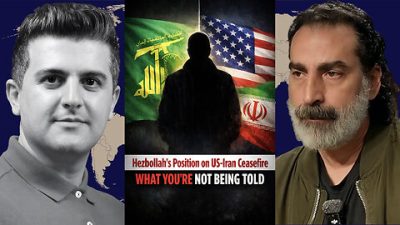
Laith Marouf: Hezbollah’s position on US-Iran ceasefire
or go to
Aletho News Archives – Video-Images
From the Archives
The Dirty Little Secret behind the “Global Terrorism Index”
The Omission of Israeli Terrorism in the Occupied Palestinian Territories
By Karin Brothers | Global Research | December 6, 2014
… The Israeli settlements — all of which are illegal – have been identified as a major impediment to peace. The refusal of a major “global” terrorism report to name the Israeli settlers as one of the groups most responsible for terrorism not only misrepresents a major source of regional violence but exposes the Global Terrorism Index as a propaganda tool that supports a U.S. agenda.
In recent years, governments have been attempting to thwart terrorism by blocking supportive fund-raising. When it comes to Israeli settlements, however, the US and Canada actually encourage fund-raising by giving organizations (such as Christian Friends of Israeli Communities (CFOIC) and the Jewish National Fund) financial support in the form of donor tax-deductions.
Charities which provide funds for the Israeli settlements should be regarded as terror-financing organizations. They should not only lose their tax-deductible status, but they should be banned because they support the violation of international humanitarian law. The terror-financing laws that are being strictly enforced for Muslim charities should be applied to Christian and Jewish charities as well. … Read full article
Blog Roll
 Aletho News
- Spain orders reopening of Tehran embassy, condemns Israel’s carpet bombing of Lebanon
- Israel faces ‘unsustainable’ strategic crisis following 40-day war against Iran: Analyst
- Iran restricts Hormuz access to 15 vessels per day under ceasefire terms: Report
- The ‘Opposition Party’ Has Done Nothing to Stop the Iran War and Much to Goad Trump Into Continuing It
- Moscow backs Tehran on status of Lebanon in US-Iran deal
- How UK Regulator Ofcom Quietly Bypassed International Law to Police American Speech
- The Black Cube Files: How Former Mossad Operatives Flipped a Nation
- Laith Marouf: Hezbollah’s position on US-Iran ceasefire: What you’re not being told
- Israel’s priority lies in destroying chances of peace between Iran, US: Ex-UN nuclear chief
- Ceasefire for all or for none: Iran shuts Hormuz over Lebanon attacks
- If Americans Knew
- This is ceasefire? Israel’s biggest massacre yet in Lebanon, another journalist killed in Gaza – Daily Update
- Tucker Carlson on Israel: This Is the Behavior of an Ally? Really?
- Gazans face a triple crisis: severe shortages of water and bread, healthcare in tatters
- NY Times reports how Netanyahu took the US into Iran War
- A sigh of relief over Iran, but Gaza and Lebanon in dire straits – Daily Update
- Thousands dead and neighborhoods razed to the ground: Aid agencies fear southern Lebanon is becoming the new Gaza
- The war the US is fighting for Israel could cost trillions
- ‘Cigarette Burns, Nail Wounds’: Toddler Tortured in Gaza to Coerce Father
- Trump Says US Sent ‘a Lot of Guns’ to Protesters in Iran
- Israeli forces destroy 17 UN peacekeeper cameras in south Lebanon
- No Tricks Zone
- An Inconvenient Tree: Uncovered In Alps… Europe Much Warmer Than Today 6000 Years Ago
- New Study Reports A 60% Slowdown In Greenland’s Ice Loss Rate In The Last Decade
- Low Intensity Tornado Wrecks Major Solar Farm, Creating A Potential Toxic Dump
- New Study Finds Warming Saves Lives…Cold Temperatures 12 Times More Deadly Than Excess Heat
- German Science Blog Accuses PIK Climate Institute Of Hallucinating Climate Tipping Points
- Devastating Assessment Of Comirnaty Vaccine By Former Senior Pfizer Europe Toxicologist
- New Study: CO2 Is ‘Effectively Negligible’ As An Explanatory Climate Change Factor Since 2000
- Former Pfizer Toxicologist Dr. Helmut Sterz Tells Bundestag Hearing Pfizer Vaccine Should Have Never Been Approved
- Energy Expert: Germany’s Nuclear Phaseout Was A “500 Billion Euro Mistake”
- New Research: South Australia’s Mid-Holocene Sea Surface Temperatures Were 4°C Warmer Than Today
 Aletho News