SOUTH HEBRON HILLS: Israeli settlers invade Palestinian village of Tuba
CPTnet | 16 May 2011
Israeli settlers invaded the village of Tuba in the South Hebron Hills late Sunday night, 15 May. They damaged property and killed and stole livestock belonging to the Ali Awad family. Palestinians of Tuba reported that they counted seven masked settlers, who entered and left the village on foot, and saw two cars at the outskirts of Tuba, near the chicken barns of Ma’on settlement. sight where one of the sheep was attacked and killed 008
The rampaging settlers stole seven sheep, killed two, and injured others, including one which lost an eye. In addition, the settlers upended three water tanks, which held a total of 4.5 cubic meters of water. They destroyed fences, punctured a storage tent and three large sacks of yogurt, damaged a goat pen and destroyed the ventilation pipe of an outhouse. They also set loose a donkey, which later returned.
A Tuba resident called Christian Peacemaker Teams about midnight Sunday to report the settler invasion and request help in urging the Israeli police to respond. The police refused to go to the village because no one there could speak to them in Hebrew. Two Israeli soldiers arrived in Tuba on Monday morning, but did not speak Arabic and so could not communicate with the villagers.
The Ali Awad family is considering making a complaint to the Israeli police, despite the fact that all their previous complaints about settler attacks, vandalism or harassment have not yet resulted in any indictments or compensation. On 21 March 2011, a masked settler from the illegal outpost of Havat Ma’on stabbed Mahmoud Ibrahim Ali Awad as the Palestinian traveled by donkey from Tuba to the city of Yatta. Mahmoud Ali Awad spent a week in the hospital recovering from stab wounds on his chest and arm.
Israeli Navy Attack Aid Ship to Gaza and Force it Back to Egypt
PNN – 16.05.11
Egypt – Israeli Naval forces attacked and intercepted on Monday morning aid boat named “The Spirit of Rachel Corrie Mission” off the Gaza coast. The ship’s 12 crew and passengers are safe. Currently the ship has been forced to anchor in the Egyptian waters at one and a half nautical miles from the Gazan waters. The vessel left the Port of Piraeus, Greece on Wednesday, May 11.
The humanitarian initiative is sponsored by Perdana Global Peace Foundation (PGPF) and participating in this mission includes anti-war activists and journalists from the Asian, American and European continents.
The cargo ship The Spirit of Rachel Corrie (officially known as FINCH) is carrying 7.5 kilometers of UPVC (plastic) sewage pipes to help restore the devastated sewerage system in Gaza. The ship was named after the courageous American activist who was crushed and killed by an Israeli bulldozer in 2003 while trying to prevent the demolition of another Palestinian home. She died at 23.
The Spirit of Rachel Corrie Mission is part of the Perdana Global Peace Foundation’s (PGPF) “Break the Siege on Gaza” campaign. The purpose of this campaign is to highlight the effects of the illegally imposed Israeli siege and raise awareness of the human rights violations of the people of Gaza. Breaking the siege and ending the illegal collective punishment of 1.5 million people must be a priority for the international community.
“The Palestinian struggle is nothing more than a struggle for justice, to which they, as much as everyone else, have a right.” Tun Dr. Mahathir Mohamad, President of PGPF stated.
In a press release by PGPF the group said that on 27 December 2008, the Israeli military launched Operation Cast Lead, which not only killed some 1400 Palestinians, but also destroyed vital infrastructure leaving the Gazans with critical water and sewage problems. PGPF says Repair of the infrastructure has proved impossible as Israel has prevented the entry of construction materials and fuel to resolve this dire situation.
According to a report from the Emergency Water, Sanitation and Hygiene group (EWASH), “the release of 80 million litres of untreated or partially treated sewage into the environment and Mediterranean Sea each day is primarily a result of the Israeli imposed blockade on the Gaza Strip.”
According to Physicians for Human Rights-Israel: “Between 90% and 95% of the aquifers in the Gaza Strip are not safe for drinking.” The primary cause of the current problem originates from the destruction, during Operation Cast Lead, of “20 kilometers of water pipes, 7.5 kilometers of sewage pipes and 5,700 mobile water tanks”.
Interview: Undercover Israeli soldiers arrest West Bank demonstrators
Electronic Intifada | 15 May 2011
Approximately 250 persons were injured today at the Qalandiya checkpoint between Ramallah and East Jerusalem in the occupied West Bank. Israeli forces opened fire on approximately 600 marchers demanding the right of return of Palestinian refugees on the date that Palestinians mark the Nakba or “catastrophe” — the forced dispossession of their homeland in 1947-48 with the establishment of the State of Israel.
Palestinian medical crews reported that of the 250 who were treated for injuries and tear gas inhalation, “40 had been marked as seriously injured from bullet wounds,” Ma’an News Agency reported (“Clashes at Qalandiya see 40 seriously injured,” 15 May 2011).
“A report from the Palestinian Red Crescent said two were hit with live rounds, 15 were injured by rubber-coated bullets, and 120 suffered tear-gas inhalation,” Ma’an added.
The Electronic Intifada spoke with Jon Elmer (www.jonelmer.ca), a Canadian independent journalist based in Bethlehem who documented protests in the occupied West Bank today.
The Electronic Intifada: Describe where you were today. Set the scene.
Jon Elmer: Things got going at about 11:00am, with a couple of marches that left from different places. There was a [Palestinian] government-sanctioned march that left from Arafat’s tomb to al-Manara square [in Ramallah] … it was a brief demonstration.
The march that happened at Qalandiya began a little bit earlier. People had marched towards the checkpoint, where protests usually take place. The Israeli soldiers were on the other side of the wall — they had come inside to confront the demonstrations. And that set off to what amounted to about six or seven hours of back and forth street fighting between stone-throwing teenagers and Israeli security forces who fired mostly tear gas and rubber-coated steel bullets. Palestinians set up makeshift defenses within the refugee camp itself and on the border of the camp.
It was hard to say how many people were in the street. It wasn’t a massive demonstration but it definitely had staying power. People were in the streets all day and demonstrations took place in a number of different spots throughout the West Bank.
EI: How would you describe the mood of the people on the streets, and the mood of the soldiers?
JE: With such an overwhelming power dynamic with massive amounts of weaponry, it’s always interesting to watch how the Israeli army operates. The soldiers move in packs, they’re constantly wide-eyed and seem to have their hands full despite the fact that they have the strength of an army behind them, whereas the [Palestinian] teenagers who are just out in the streets with their neighbors and friends and comrades are willing to stay out in the streets for seven hours, challenging that army at every step.
If people are determined not to leave, and the army is inside their community, and that’s the way that it carries out all day, the soldiers are left with very few options besides escalating the violence to try to quell the demonstrations.
We saw that late in the afternoon — the undercover units broke out of the demonstration where they had been hiding in disguise, acting as Palestinian demonstrators. They pulled out their handguns and made a series of arrests while the army backed them up by moving forward and basically trying to put an end to the demonstration. While they arrested people, the protesters began the demonstration again within moments once people re-emerged from the alleyways.
There is so much concern within the Israeli army about what they’re going to do and how they are going to quell demonstrations. If there were, let’s say, thirty demonstrations [across the West Bank], that is a worst-case scenario for the Israeli army. The army reported that there were more than ten today.
EI: What about the mood in Bethlehem, where you are based, and elsewhere around the West Bank on Nakba day?
JE: The demonstrations have been moving from community to community over the last four or five days. Bethlehem had a demonstration a few days ago.
It’s important to understand that while there are exciting political formations developing and re-emerging at this moment, there is a significant malaise that has dominated Palestinian political culture over the last few years, particularly with the aggressive crackdown on the second intifada, which really devastated the core elements of life here in the West Bank and in the Gaza strip as well.
[Israel] attacked people’s livelihoods and their ability to carry on the most basic necessities of life … So there is a period right now of regeneration which is natural after significant national trauma. And the Fatah-Hamas voided election, and the internal fighting, left Palestinians with not too many favorable options.
EI: Given that this is the 63rd anniversary of the Nakba, what are the conversations that are happening in the West Bank right now? What are people saying about the significance of this date in the context of the expansion of both Israel apartheid policies and Palestinian resistance?
JE: [The Nakba is] an important part of the national narrative, arguably the most important part of the national narrative. At the same time, day to day life in the West Bank tends to be dominated by the more direct concerns of the settlements and the checkpoints and the lack of ability to move and the lack of independence and the lack of decent-paying jobs. Basic life necessities are most in focus at the moment.
Although we read in The New York Times about these “success stories” about Ramallah and the transformation of the Palestinian economy in the West Bank over the last five years, the development aid has benefited really only a narrow sector of the population.
In general, people are still dealing with the same elementary needs of citizenship, identification cards, the ability to travel to one now-ghetto to the next. It keeps people focused on the here and now, and the long string of political let-downs and failures of the international community to affect a just resolution to the conflict keeps people modest about envisioning future successes. But the refugee issue is alive; it affects every Palestinian family.
EI: You’ve been documenting various upheavals and protests and demonstrations over the last decade in Palestine. What was most emblematic of what you witnessed today?
JE: I think what happened in south Lebanon was a very significant moment. The descriptions of people going back to their villages and hiking over those mountains today — both young children who have it ingrained in their psyches and the elderly who have never given up — today marching on the border is something that was a great moment. And it was something we can point to as something emblematic.
Although it ended in typically tragic circumstances, that type of spirit and continuity and steadfastness is what is the most threatening to Israel. People never forget, and people will never leave again. These sort of national narratives are crucial to understanding the Palestinian political situation.
Jewish settlers throw firebombs into Palestinian home
Palestine Information Center – 16/05/2011
AL-KHALIL — Armed Jewish settlers tossed a number of Molotov cocktails into the house of a Palestinian citizen in the Old City of Al-Khalil on Sunday night after encircling it.
The owner, Jamal Su’ifan, said that tens of settlers besieged his home and threw the firebombs into it, starting fire and burning part of the house, which was sheltering 20 individuals.
He said that Israeli soldiers were escorting the settlers, noting that two members of the Temporary International Presence in the City of Hebron (TIPH) team in Al-Khalil arrived to his home to check the incident but were also surrounded by those settlers.
The Su’ifan home is only a few meters away from the Kiryat Arba settlement, which was established on Palestinian land east of Al-Khalil. Settlers in Arba routinely attack nearby Palestinian homes in a bid to terrorize their inhabitants away and take control of them.
Israel Attacks Humanitarian Ship to Gaza in International Waters
By Michel Chossudovsky | Global Research | May 16, 2011

Global Research has been in contact with the Spirit of Rachel Corrie, a Malaysian ship carrying a humanitarian aid cargo to Gaza, which has been attacked in international waters by Israel.
The vessel left the Port of Piraeus, Greece on Wednesday, May 11 carrying 7.5 kilometers of UPVC (plastic) sewage pipes to help restore the devastated sewerage system in Gaza. The humanitarian initiative is sponsored by Perdana Global Peace Foundation (PGPF) and participating in this mission includes anti-war activists and journalists, consisting of 7 Malaysians, 2 Irish, 2 Indians and 1 Canadian.
The Spirit of Rachel Corrie is an initiative of The Perdana Global Peace Foundation (PGPF) chaired by Malaysia’s former Prime Minister Dr. Mahathir Mohamed. The Centre for Research on Globalization (CRG) (Global Research) is also participating in this mission.
At 10.54 pm Eastern Time (EDT), the Spirit of Rachel Corrie was intercepted by an Israeli ship and a Egyptian ship in international waters.
10:54pm EDT, Gaza 5:54am: We have been intercepted by Israeli ship and Egyptian ship. We are disobeying the orders and sailing ahead to Gaza.
10:57pm EDT, Gaza 5:57am: One Israeli warship coming to us very fast! We are in international waters, therefore they have no right to attack us. We are still sailing ahead.
10:59pm EDT, Gaza 5:59am: They are opening fire across our ship! We are still sailing ahead.
11:09pm EDT, Gaza 6:09am: They are shooting all over the place. We can’t continue …
11:35pm EDT, Gaza 6:35am: They circled our ship twice and fired across our ship. Machine guns. No one was injured. One of the fishing nets caught the propeller, so we can’t move now.
11:37pm EDT, Gaza 6:37am: The Israeli ship was coming from one end and the Egyptian ship was coming from another end. Firing. We are just stalled now. Everybody is okay. No one is injured.
In a subsequent communication from the boat, it would appear that Israel sought the active collaboration of Egypt in the interception of the humanitarian mission to Gaza, involving prior coordination between the Israelis and the Egyptian navy.
We will be informing our readers as events unfold.
UPDATE
AFP REPORT
The first press reports state that:
“Israeli naval forces fired warning shots at a Malaysian ship carrying aid to Gaza as it approached the shore, forcing it to withdraw to Egyptian waters, the vessel’s Malaysian organiser told AFP.”
“The MV Finch, carrying sewage pipes to Gaza, had warning shots fired at it by Israeli forces in the Palestinian security zone this morning at 0654 Jordan time (0354 GMT),” said Shamsul Azhar from the Perdana Global Peace Foundation.
Israeli naval forces fired warning shots at a Malaysian ship carrying aid to Gaza as it approached the shore, forcing it to withdraw to Egyptian waters, the vessel’s Malaysian organiser told AFP.
“The MV Finch, carrying sewage pipes to Gaza, had warning shots fired at it by Israeli forces in the Palestinian security zone this morning at 0654 Jordan time (0354 GMT),” said Shamsul Azhar from the Perdana Global Peace Foundation.
“Currently the ship has been forced to anchor in Egyptian waters, 30 nautical miles from Gaza,” he told AFP.” emphasis added
The information we have received from the ship is that (1) these were not “warning shots” as conveyed in the press reports.
The ship was (2) in international waters when it was attacked by Israel in violation of international law.
Israeli Puppets: Exposing the Enemies of the Free Flotilla to Aid Gazans
Aletho News | May 16, 2011
On Wednesday, Reps. Steve Israel (D – NY) and Tom Cole (R – OK) led a bipartisan letter to Turkish Prime Minister Recep Tayyip Erdoğan urging the Prime Minister to stop another flotilla from departing Turkey for the Gaza Strip.
Thirty-six Members of Congress signed the bipartisan letter including:
New York 2
Israel, Steve D 2457 RHOB 202-225-3335 (NO COMMITTEE ASSIGNMENT)
5 Ackerman, Gary D 2111 RHOB 202-225-2601 Financial Services
Foreign Affairs7 Crowley, Joseph D 2404 RHOB 202-225-3965 Ways and Means
8 Nadler, Jerrold D 2334 RHOB 202-225-5635 Judiciary
Transportation and Infrastructure24 Hanna, Richard R 319 CHOB 202-225-3665 Education and the Workforce
Transportation and Infrastructure
14 Maloney, Carolyn D 2332 RHOB 202-225-7944 Financial Services
Oversight and Government ReformOklahoma 4
Cole, Tom R 2458 RHOB 202-225-6165 Appropriations
BudgetCalifornia
28 Berman, Howard D 2221 RHOB 202-225-4695 Foreign Affairs
Judiciary29 Schiff, Adam D 2411 RHOB 202-225-4176 Appropriations
Permanent Select Intelligence
30 Waxman, Henry D 2204 RHOB 202-225-3976 Energy and Commerce JASON CHAFFETZ
Montana
At Large Rehberg, Dennis R 2448 RHOB 202-225-3211 Appropriations Texas
6 Barton, Joe R 2109 RHOB 202-225-2002 Energy and Commerce 2 Poe, Ted R 430 CHOB 202-225-6565 Foreign Affairs
Judiciary28 Cuellar, Henry D 2463 RHOB 202-225-1640 Agriculture
Homeland Security29 Green, Gene D 2470 RHOB 202-225-1688 Energy and Commerce Nevada
1 Berkley, Shelley D 405 CHOB 202-225-5965 Ways and Means Illinois
5 Quigley, Mike D 1124 LHOB 202-225-4061 Oversight and Government Reform
Judiciary9 Schakowsky, Jan D 2367 RHOB 202-225-2111 Energy and Commerce
Permanent Select IntelligenceArkansas
4 Ross, Mike D 2436 RHOB 202-225-3772 Energy and Commerce Florida
19 Deutch, Ted D 1024 LHOB 202-225-3001 Foreign Affairs
Judiciary20 Wasserman Schultz, Debbie D 118 CHOB 202-225-7931 Budget
JudiciaryLouisiana
1 Scalise, Steve R 429 CHOB 202-225-3015 Energy and Commerce North Carolina
2 Ellmers, Renee R 1533 LHOB 202-225-4531 Agriculture
Foreign Affairs9 Myrick, Sue R 230 CHOB 202-225-1976 Energy and Commerce
Permanent Select Intelligence11 Shuler, Heath D 229 CHOB 202-225-6401 Budget
Transportation and InfrastructureKansas
2 Jenkins, Lynn R 1122 LHOB 202-225-6601 Ways and Means Wisconsin
8 Ribble, Reid R 1513 LHOB 202-225-5665 Agriculture
BudgetNew Jersey
8 Pascrell Jr., Bill D 2370 RHOB 202-225-5751 Budget
Ways and Means9 Rothman, Steven D 2303 RHOB 202-225-5061 Appropriations West Virginia
2 Capito, Shelley Moore R 2443 RHOB 202-225-2711 Financial Services
Transportation and InfrastructureConnecticut
5 Murphy, Christopher S. D 412 CHOB 202-225-4476 Foreign Affairs
Oversight and Government ReformPennsylvania
3 Kelly, Mike R 515 CHOB 202-225-5406 Education and the Workforce
Foreign Affairs
Oversight and Government ReformOhio
2 Schmidt, Jean R 2464 RHOB 202-225-3164 Agriculture
Foreign Affairs
Transportation and Infrastructure6 Johnson, Bill R 317 CHOB 202-225-5705 Foreign Affairs
Natural Resources
Veterans’ AffairsColorado
5 Lamborn, Doug R 437 CHOB 202-225-4422 Armed Services
Natural Resources
Veterans’ Affairs
Bin Laden Data Used For Blackmail
Moon of Alabama | May 15, 2011
It is claimed that the raid on the Bin Laden home in Abbottabad also caught a huge amount of data from computer storage devices allegedly found there.
Because no one else has this alleged data, the administration can use it as cover to claim anything about anyone. As I half jokingly wrote:
I am told that the huge amount of data found on DVD disks and memory sticks during the alleged assassination of Osama bin Laden contains proof of a railway plot and also reveals that:
a. Iran will have nuclear weapons within three years,
b. Iran’s president Ahmedinejad uses sorcery,
c. Iran’s supreme leader Khamenei has a chronic flatulence problem,
d. Iran has special trucks in which Khamenei produces those deadly islamist bio-weapons which makes him the world’s greatest threat.
Other great, top secret facts from the found data will be revaled by the administration whenever it will fit its agenda.
We have already seen how this alleged data is used to defame Bin Laden by claiming, without any proof, that the data contained pornography.
Now the U.S. is using the threat to find something culpable in the secret data against Pakistan. As top NYT administration stenographer David Sanger sets out in a preview of Senator Kerry’s current pressure mission in Pakistan:
A senior administration official said Saturday that the United States would try to use the threat of Congressional cuts to the $3 billion in annual American aid to Pakistan as leverage. Any evidence of Pakistan’s complicity in sheltering Bin Laden — culled from the hundreds of computer flash drives and documents recovered in the raid — could also be used, the official said. So far, no such evidence has been found.
…
Mr. Kerry’s main piece of negotiating leverage is Pakistan’s uncertainty about what officials are finding in the trove of computer data — which Mr. Donilon has compared to “a small college library” — about Pakistani complicity hiding the Qaeda leader.
This is pure blackmail: “We might have some evidence against you and publish it, but if you do what we want, then we might not have any.”
Having secret data from Bin Laden will allow all kinds of such threats against many nations and people. Beware of believing any of it.
Meanwhile where is Obama holding Osama’s son Hamza?
Dominique Strauss Kahn arrested- IMF names replacement?
Penny For Your Thoughts | May 15, 2011
That didn’t take long!
His allies are suggesting this is politically motivated….
A “conspiracy.” A word that has morphed into a buzz word used for derision & dismissal.
This arrest works out well for Sarkozy. Notice how quickly the IMF names a replacement?
Within hours.
I.M.F. Names Replacement as Chief Awaits Arraignment Strauss- Kahn, has not even been arraigned and he is out!
John Lipsky is in.
Mr. Lipsky, the I.M.F.’s first deputy managing director, is a former U.S. Treasury executive and onetime banker at JP Morgan. William Murray, an I.M.F. spokesman, said that Mr. Lipsky, who has been overseeing the logistics of the bailout of the Greek economy, would meet with members of the I.M.F. board in Washington later in the day, according to Reuters.
A JP Morgan man at the head of the IMF.
Wow! JP Morgan’s reach just got a whole lot longer. More on Mr Lipsky
Was this politically motivated?
Dominique Strauss-Kahn is victim of trap, minister suggests
A French government minister said Sunday he could not rule out that IMF head Dominique Strauss-Kahn’s arrest for alleged sexual assault was the result of a set-up with political motives. “We cannot rule out the thought of a trap,” Henri de Raincourt, minister for overseas co-operation in President Nicolas Sarkozy’s government, said in a broadcast interview.
Strauss-Kahn arrest removes Sarkozy’s toughest rival
Dominique Strauss-Kahn’s arrest on sexual assault charges removes the toughest rival to French President Nicolas Sarkozy for the 2012 presidential race, bumping up his chances of re-election to a second term.
Who benefits?
Had Kahn conducted himself in this fashion previously and got away with it?
Perhaps this time he miscalculated his political opponents?
Can Fukushima Cause a Turko-Armenian Rapprochement?
By Serhan Ünal | International Relations | May 9, 2011
The Fukushima nuclear power plant (NPP) disaster presents a chance to reinvigorate the stalled momentum for a Turko-Armenian rapprochement. The earthquake, tsunami, and nuclear melt-down which devastated Japan may have world-wide repercussions. One of these could be the creation of confidence-building measures over the similarly risky status of the only NPP in Armenia: Metsamor. Metsamor NPP was built in 1979 and was closed after a 1988 earthquake in Armenia. However, after the fall of the Soviet Union, and following the Azeri-Armenian War over Nagorno-Karabakh, it was re-commissioned by Yerevan in 1995 to meet increasing energy demand. Metsamor NPP uses first generation technology, and is distinguished for being “the oldest and the least secure” of the existing NPPs, according to the European Union (EU). It is located some 20 kilometres from the Turko-Armenian border and faces serious financial problems, even in re-fuelling. Under such conditions, it is difficult to convince Armenia to take the necessary security measures; there is a vital risk for the whole region, a risk to match a Chernobyl-like disaster. At this very point, this unlucky and risky situation of Metsamor provides Turks and Armenians with a timely opportunity. At present, the security of NPPs has been forced onto the world’s energy security agenda. Ankara should use this momentum smartly and take one step toward Yerevan. A deal on Metsamor’s security can enable parties to deepen the dialogue; both parties stand to gain from this cooperation.
Firstly, Turkey can help Armenia in finding loans and forming a consortium to shoulder the burden mutually, for the sake of regional security and stability. According to a prediction, a new NPP will cost approximately $5 billion. It is totally inconceivable for Armenia, which only possesses approximately $2 billion in national revenue as of 2010, to make such a large investment. Perhaps Turkey can play a primary role in forming a tripartite or quadripartite enterprise in which Armenia, Turkey, the EU and the US have shares, to make investment and generate electricity for the Armenian economy by using reliable, sustainable, cleaner and less dangerous resources. Russia can be enticed to join the new project to maintain the regional balance too. Thus, all the major actors (Washington, Brussels and Moscow) will be included in the investment with regional parties Yerevan and Ankara. The Minsk Group, which mainly consists of France, Russia and the US, can also be the institutional roof under which negotiations occur. Under the consortium (or the Minsk Group), profits can be re-invested to the region and this can develop the necessary infrastructure for re-opening the common Turko-Armenian border.
Secondly, the establishment of a consortium (or at least developing a plan for the future of Metsamor mutually) may cause much-needed political and social linkages across both countries. What is needed in Turko-Armenian relations is mutual understanding and confidence. During the negotiations, an interaction between the parties is inevitable; this will be the key for better understanding. If the parties can build confidence during the technical and economic negotiations, this may spill over into other areas from the issues being agreed on. Because the main obstacle for the Turkish government and its Armenian counterpart is public opposition to any agreement made with the opposite side, this obstacle can be eliminated through political and social rapprochement. Plus, as peculiar to Turkey, Azerbaijan’s opposition is significant; but, even Azerbaijan which has a cease-fire with Armenia, not a permanent peace, may support a solution to the risky situation of Metsamor. Within the framework of good neighbourhood and mutual understanding, parties may take one step further. This programme could proceed under the label “Atoms For Confidence”, like US president Eisenhower’s famous “Atoms For Peace” speech. There is real hope and possibility for this to succeed.
Even if the parties cannot build confidence and move discussions to other fields—like debates over the events of 1915 or the future demarcation of their common border—there will remain one, concrete achievement: the removal of a regional nuclear disaster risk. The momentum now exists. All nuclear-powered countries are debating the risks of nuclear energy, and some countries have already decided to suspend their investments. For example, Germany has just decided to speed up its abandonment of nuclear energy. Public opposition to nuclear energy could play a part in raising more awareness about the topic. This may enable the Turkish and Armenian governments to take steps towards each other much more easily, by exploiting the dangerous situation of Metsamor, without facing harsh public opposition. There is nothing to lose for either party; the chances are that they both stand to gain mutually from the deal. The international community would appreciate this positive development, too. In brief, the destructive tsunami which wreaked untold devastation upon Japan can serve as a cautionary tale for the South Caucasus, by forcing regional actors to engage in confidence-building measures and to remove the common danger of nuclear disaster.
—
Serhan Ünal is a student at the department of International Relations at Bilkent University – Ankara, Turkey.
1948 – Al Nakba: a family’s collective memory
By Myrna Azzeh – 15 May 2011
“The old will die and the young will forget.” This was the prediction of the first Israeli Prime Minister David Ben Gurion. 63 years later, I still wonder what made him think so. Would the Jewish masses – or indeed any of the other groups of people – that suffered the Holocaust ever forget?
As far as I know, having lived in a refugee camp for most of my life, there has always been much space in the tiny alleys of the camp for the collective memory of Israeli massacres, systematic displacement and ethnic cleansing. These images have been printed in the minds of Palestinian refugees both young and old.
I never forget that 2003 Spring when my grandmother and I “went back” to our destroyed village Beit Jibrin. We managed to get there despite the checkpoints and high level of security. It isn’t easy although the actual distance that separates my refugee camp from the village is less than an hour’s drive. I’d been there a few times before but never with her. This was the first time. I walked behind her climbing up a hill in the village. She seemed much stronger and able to walk faster than I remembered. She knew where exactly we were going as if she was there yesterday.
Under a fig tree we sat and my grandmother smiled and remembered when she used to play with her friends, decades ago. She said, “It’s the same tree, a little bit different now; it’s been more than 50 years after all. Nonetheless, it is the same tree.”
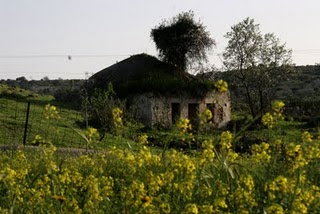 My head was saturated with thoughts; she must have whispered some of her childhood secrets to the old tree. She didn’t say much but the sadness in her eyes said it all. We smiled and kept seated, listening to birds singing and breathing as much of the village’s fresh air as possible as if we had never drawn breath before. This is, after all, the village I have been raised to understand is mine.
Her memories dated back to 1948. She was nearly 10 years old. Despite her young age, she remembered. She remembered her school, the lovely summer evenings she spent with her family in the village. She remembered the harvest time and travelling to Haifa and Yafa with her dad to sell their produce. She also remembered the nights when the peaceful village was first attacked. “We never saw a fighter jet before”, she said. Maybe they had, I thought, but I’m sure it wasn’t the same sight as the one that was now spreading death and fear into people’s hearts in 1948. This was the same year that witnessed over 750,000 of the native Palestinian population expelled from their homes and villages. So far, to this day, they have never been able to return.
63 years since, and in spite of the number of UN resolutions and world condemnations, Israel’s impunity still prevails. No justice has been achieved as Palestinian refugees are yet to see the implementation of the United Nation’s Resolution 242 that clearly affirms “a just settlement of the refugee problem” as well as Resolution 149 which states that “refugees wishing to return to their homes and live at peace with their neighbours should be permitted to do so at the earliest practicable date”.
As much as these resolutions have been alive in my grandmother’s memory, they are also imprinted in refugees’ consciousness whether they are acquainted with international law or not. Every Palestinian refugee resolutely believes in the right to live in the town or village from where they originate, and indeed where they and their families have been uprooted from by force.
Photo taken by Makbula Nassar- Al Jazeera documentary 2009
My grandmother passed away last March 2010 in the refugee camp. However, her dream of returning to Beit Jibrin is still alive and I deeply believe that she is in a place where borders do not exist. Her soul is finally free of the shackles of ethnic division, and she is able to hover over Palestine and our beloved village, our home, Beit Jibrin. She might be whispering secrets to the fig and olive trees there right now. Her dreams of return are still alive. As I will never forget her nor will I forget her passion when talking abut the village, I will always make sure I pass her dreams and aspirations to the coming generations. This, I believe is a promise that each refugee has taken unintentionally until the return and the full realisation of rights.
We will never forget my village and all the ethnically cleansed Palestinian villages as the memory remains in the heart and soul of all Palestinians. For us, the old may well die, but the young will never forget.
Featured Video
The Source of America’s Wars – Kristol Clear
or go to
Aletho News Archives – Video-Images
From the Archives
Is Israel to blame for the Iraq War?
American Goy | March 10, 2008
I am so tired of this old canard that “Israel had nothing to do with USA’s war with Iraq – in fact, it officially advised America against it”.
Bullshit. … continue
Blog Roll
 Aletho News
- Ceasefire for all or for none: Iran shuts Hormuz over Lebanon attacks
- Strait of Hormuz is Iran’s ‘nuclear weapon’ that forced US retreat: Medvedev
- Energy crisis will last for months – Kremlin envoy
- Europe’s quiet role in the war on Iran
- Forty days that shook the Empire: How Iran turned the tables on US and prevailed
- Netanyahu unilaterally declares Lebanon outside of ceasefire deal
- Israeli leaders: ‘Not a single goal’ achieved in war with Iran
- What on earth just happened? Trump, Iran, and the unlikely ceasefire
- Alberta Bill Would Fine Political Deepfakes $10,000 Without Satire Exemptions
- Iran declares ‘historic victory’ over US, says enemy forced to accept its proposal
- If Americans Knew
- Gazans face a triple crisis: severe shortages of water and bread, healthcare in tatters
- NY Times reports how Netanyahu took the US into Iran War
- A sigh of relief over Iran, but Gaza and Lebanon in dire straits – Daily Update
- Thousands dead and neighborhoods razed to the ground: Aid agencies fear southern Lebanon is becoming the new Gaza
- The war the US is fighting for Israel could cost trillions
- ‘Cigarette Burns, Nail Wounds’: Toddler Tortured in Gaza to Coerce Father
- Trump Says US Sent ‘a Lot of Guns’ to Protesters in Iran
- Israeli forces destroy 17 UN peacekeeper cameras in south Lebanon
- US-Israeli strikes ‘completely destroy’ synagogue in Tehran
- Archbishop for US Military Says Iran War Is Unjust Under Catholic Teaching
- No Tricks Zone
- An Inconvenient Tree: Uncovered In Alps… Europe Much Warmer Than Today 6000 Years Ago
- New Study Reports A 60% Slowdown In Greenland’s Ice Loss Rate In The Last Decade
- Low Intensity Tornado Wrecks Major Solar Farm, Creating A Potential Toxic Dump
- New Study Finds Warming Saves Lives…Cold Temperatures 12 Times More Deadly Than Excess Heat
- German Science Blog Accuses PIK Climate Institute Of Hallucinating Climate Tipping Points
- Devastating Assessment Of Comirnaty Vaccine By Former Senior Pfizer Europe Toxicologist
- New Study: CO2 Is ‘Effectively Negligible’ As An Explanatory Climate Change Factor Since 2000
- Former Pfizer Toxicologist Dr. Helmut Sterz Tells Bundestag Hearing Pfizer Vaccine Should Have Never Been Approved
- Energy Expert: Germany’s Nuclear Phaseout Was A “500 Billion Euro Mistake”
- New Research: South Australia’s Mid-Holocene Sea Surface Temperatures Were 4°C Warmer Than Today
 Aletho News