Bahrain arrests freelance photographer
Press TV – May 12, 2011
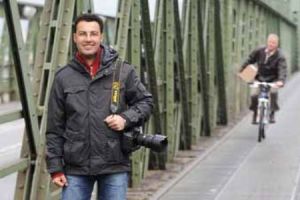
Mohammad Salman al-Sheikh, freelance photographer
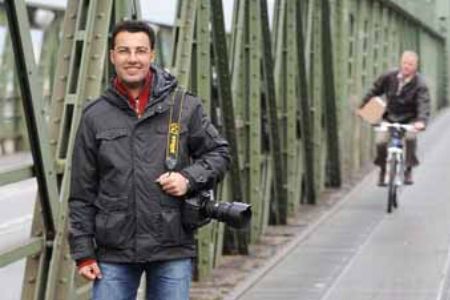
Saudi-backed Bahraini forces have arrested a prominent freelance photographer as the Manama regime continues its brutal crackdown on anti-government protesters.
The Bahrain Youth Society for Human Rights (BYSHR) said on Wednesday that Mohammad Salman al-Sheikh was arrested the previous day in his apartment in the town of Sanabis.
Al-Sheikh, who heads Bahrain’s Society of Photography, is the winner of more than 13 international awards. His most important prize was a silver medal in international competition titled “Slovenia Exposed” in 2009.
He is also a member of the international organizations of photography.
BYSHR is deeply concerned about the arrest of al-Sheikh and has called on international organizations to act urgently to protect him.
Saudi-backed regime forces have detained more than a thousand opposition activists since the anti-government protests erupted in mid-February.
Bahraini regime forces have also raided dozens of mosques, schools, sacred sites and even graves in persisting efforts to suppress protesters.
Protesters are demanding an end to the rule of the Al Khalifa dynasty.
Taxpayer funded BBC censors “Palestine” from rap song
WPN | May 10, 2011
The Palestine Solidarity Campaign has issued this important statement regarding the BBC.
BBC Radio 1xtra has removed the word ‘ Palestine ’ when playing a song by artist, Mic Righteous. In an extraordinary act of censorship, the word was filtered out of a recording as Mic Righteous sang the words ‘Free Palestine’, part of his song ‘Fire in the Booth’.
The censorship took place on the BBC show, Hip Hop M1X with Charlie Sloth, and the BBC has since issued a statement saying: ‘All BBC programmes have a responsibility to be impartial when dealing with controversial subjects…and an edit was made in this instance to ensure that impartiality was not compromised.’
Listen to the recording, with edit, here: http://www.bbc.co.uk/programmes/p00f15g4
There are several questions to be asked here of the BBC:
Is the word ‘ Palestine ’ controversial only when used in songs, or will the BBC be deleting it from all its programming?
Is the word ‘ Israel ’ similarly controversial?
How does the BBC decide what is a controversial subject? Which other news subjects does it deem to be controversial and worthy of BBC edits?
As a news organisation, how can the BBC report on news when it feels it has to censor ‘controversial subjects’ in order to maintain impartiality? All political news, by its nature, is controversial and excites a range of viewpoints – there is no consensus on anything political. Why is the BBC making this decision only over Palestine ? This in itself reveals the partiality of the BBC.
Is the BBC aware that Palestine is a geographical area and therefore can’t be controversial? If Palestinian leaders declare a sovereign Palestinian state in September, how will the BBC report on this if it considers the word ‘ Palestine ’ too controversial to be mentioned?
Is the BBC aware that the word ‘ Palestine ’ is recognised and used freely by MPs, and even by the Prime Minister, David Cameron?
When the band, The Special A.K.A, released its song ‘Free Nelson Mandela’ in 1984, why were the words ‘Nelson Mandela’ not censored by BBC radio? Apartheid in South Africa was a controversial subject, and Mandela was still considered a terrorist by the UK and US governments.
While the BBC may have appeared to make itself look utterly ridiculous with this edit, the action itself reveals its ingrained bias against Palestine and is a serious matter.
It follows the BBC’s refusal to screen the DEC Appeal during Israel’s air, land and sea assault on a besieged Gaza in 2008/9, and its screening of the one-sided Panorama programme Death in the Med last August, which even the BBC’s own complaints panel found breached its guidelines on accuracy and impartiality in several instances.
You can take the following actions:
Write to the BBC via the complaints form on its website, and ask for a reply: https://www.bbc.co.uk/complaints/forms/
Leave a message on the BBC’s message board under the Charlie Sloth programme: http://www.bbc.co.uk/programmes/p00f15g4
Write a letter for publication to the Radio Times: radio.times@bbc.co.uk By post: Radio Times, Media Centre, 201 Wood Lane, London W12 7TQ
Get as much publicity for this song as possible – ask your local radio station, community radio station, hospital radio, student campus radio etc to play it
Write to the BBC and demand it plays the song without an edit: radio1.enquiries@bbc.co.uk Write also to your local BBC radio station.
I have another question: How will/would the BBC treat the Desmond Dekker former No. 1 single “Israelites” ? If they applied the same political censorship, there would be nothing left.
I tried to comment on the “song” (the tune is hard to whistle) but the BBC website was mysteriously “undergoing maintenance” and cannot be accessed.
This is a blatant case of pro-Israel bias in the BBC, always apparent, often covert, but in this case, astonishingly all too stark. The licence-payers should be aware of how their money is being spent.
At least as pertinent, is the fact that the BBC should realise its licence payers are adults, well able to make their own judgements on political partiality, and don’t need the BBC to do it for them.
Israeli forces, tanks cross into Gaza
Press TV – May 11, 2011

Israeli forces backed by tanks and bulldozers have crossed into the Gaza Strip, destroying Palestinian farmlands in north of the enclave.
Israeli soldiers apparently entered the Palestinian territory from Karni crossing on Wednesday and advanced hundreds of meters toward the east of Gaza City.
According to Press TV’s correspondent in Gaza, Israeli soldiers dug a series of holes in the area and filled them with explosives.
Israeli soldiers then blew up the explosives, causing loud explosions in the area, our correspondent added.
Israeli officials claim that the troops were searching and destroying “possible tunnels” in the area that could be used by Palestinian resistance fighters to enter Israeli posts and capture Israeli soldiers.
But analysts believe the Israeli attack aimed at provoking Palestinian fighters into firing on Israeli troops, which could have escalated the situation.
It was the first Israeli attack on Gaza after the two main Palestinian factions, Hamas and Fatah, signed a unity deal.
Israel has repeatedly voiced anger at the reconciliation accord signed between the two Palestinian groups which aimed at forming a Palestinian unity government.
Pizzarotti should follow in Deutsche Bahn’s footsteps
By Stephanie Westbrook | Mondoweiss | May 11, 2011
Italian construction firm Pizzarotti is stupefied, bewildered, stunned.
In an article on today’s Corriere della Sera, Italy’s top newspaper, covering Deutsche Bahn’s withdrawal from the Israeli project for a high-speed train line that cuts through the Occupied Palestinian Territories, Michele Pizzarotti said “We are astonished to find ourselves involved in these protests.”
Pizzarotti, through a joint venture with Israeli Shapir Engineering, has been contracted to build tunnels in section C of the planned A1 train route from Jerusalem to Tel Aviv; section C starts in the Latrun enclave and ends at Cedars Valley, both in the occupied West Bank.
Michele Pizzarotti can’t seem to understand what all the fuss is about. “We are not the project leaders, we entered into the Israeli high-speed rail as mere executors of a project designed by others, which has already been modified by the Israeli Supreme Court. We had no idea there were complications with the peace process.”
Complications indeed. The German Minister of Transport defined the project as “problematic” from a foreign policy perspective and “possibly in violation of International Law,” leading to the withdrawal of Deutsche Bahn.
In addition to the easily rebutted justifications presented by Pizzarotti during a recent meeting with the Italian Coalition Stop That Train, including having no role in planning the route, the limited environmental impact of tunnels and that the firm is only working on the end of the tunnel on the Israeli side of the Green Line, the Corriere della Sera article included two new gems.
“[T]he railroad could connect Ramallah and be used by Palestinians, and in our construction sites we provide work to Arab technicians and workers.”
The idea that the train would some day link Ramallah, a sort of “railroads for peace,” has often been trotted out by Israeli officials looking to defend the extraterritorial railway. However, as Who Profits pointed out on their Facebook page, in an interview with Israel’s Channel 7 (Hebrew) last August, Minister of the Environment Gil’ad Ardan candidly stated that “reports of a new train line between Ramallah and Gaza, via Ben Gurion Airport, were premature… This is not due to become reality anytime soon, it was only a legal requirement that permitted land confiscations across the Green Line for the needs of the Tel Aviv – Jerusalem train.”
The Pizzarotti construction site as a jobs-for-“Arabs” vehicle would be laughable, if it weren’t so sad. In the Bidu enclave, the area hardest hit by the planned rail route, unemployment is 70%, or twice the average for the West Bank, due to access to Jerusalem, their traditional economic center, being cut-off by the Apartheid Wall – built on Palestinian land. In addition, a document on the Philippines Overseas Employment Office web site shows Pizzarotti wasn’t exactly recruiting “Arabs”.
When asked by Corriere della Sera if they would be following in Deutsche Bahn’s footsteps, Michele Pizzarotti replied, “Not only would that be a disaster for us, because we have already invested 70 million in machinery, but it would also be pointless: the work would continue just the same via our Israeli partner.”
If their Israeli partner had the necessary know-how to build Israel’s longest tunnel, Pizzarotti wouldn’t be involved in the first place. The massive tunnel boring machines used by Pizzarotti have, in fact, never been used before in Israel and partnering with experienced foreign contractors was a formal requirement in some contracts. (See the 28-page report on the A1 Train line from Who Profits)
The Italian Coalition Stop That Train, a network of over 80 associations, is working to convince Pizzarotti to pull out of the project. On Monday a campaign was launched to “Declare Your City Pizzarotti-free”, with a sample resolution to be presented in city and provincial councils throughout Italy excluding Pizzarotti from contracts for public works. The same tactic, drawing on a EU directive that allows for exclusion of companies “guilty of grave professional misconduct,” was used in the campaign against French multinational Veolia, who’s involvement in the light rail project in occupied East Jerusalem has cost the company $10 billion in lost contracts.
And change.org has just recently launched a petition calling on Pizzarotti to “end their involvement with this rail line”.
Fukushima Update – May 11
Moon of Alabama
The big mess at the Fukushima Daiichi plant continues as the damaged reactors there are still releasing radioactive substances into the environment. A new leak through a cable shaft and to the cooling water intake of the no 3 reactor to the sea was found only today.
At the no 1 plant the reactor vessel continues to be fed with cooling water but can not be filled up above the level of the exposed nuclear fuel likely because of leaking pipe connections at a certain height. Now the primary containment vessel around the reactor vessel will get filled with water. This creates a “water sarcophagus” to cool the reactor vessel from the outside. So far over 9,900 tons of water have been pumped into it. Eventually water will be filled high enough to submerge the reactor vessel and thereby refill it through the leaking pipe connection.
Yesterday workers could access the inner no 1 reactor building for the very first time and they tried to install some new monitoring systems as the old ones are broken. Before the access door was opened and the workers could enter air was pushed through the building and through filters to reduce the radiation in the building. This was not very successful. Tepco had hoped to reduce radiation there to 1 millisievert per hour, but some areas inside the building that eventually need to be entered still have radiation levels between 600 and 700 millisieverts per hour, much higher than the maximum 250 millisievert lifetime(!) radiation limit that nuclear workers can be exposed to in emergency cases. Those areas will need to get shielded off before work around them can continue.
The spent fuel pool in no 1 continues to get refilled with water which then continues to evaporate through the severely damaged roof. Hydrazine was added to the water as corrosion inhibitor.
The number no 2 reactor vessel and primary containment are still leaking water into the basement of the machine hall of no 2 and 3 and from there through various ways into the environment. Work has started to pump the water out for decontamination and to block all ways from the basement into the environment. Eventually the leak in the containment vessel (likely at the damaged torus outside the primary containment which holds condensation water) will have to be repaired to allow for restoring a permanent cooling loop or to attempt to create a “water sarcophagus” around it. This will be very difficult to achieve as the water coming from the leak is radioactive.
The no 2 spent fuel pool seems for now to be fine as an improvised cooling loop has been established for it.
The no 3 reactor shows increasing reactor vessel temperature. Over the last 10 days the temperature temperature at the feedwater nozzle increased from below 100 degrees centigrade to over 221 degrees now. As the reactor vessel and primary containment is also likely damaged this also increases evaporation and releases into the environment.
The spent fuel pool in no 3 continues to get intermittently refilled with water which then continues to evaporate through the severely damaged roof. A camera view (see May 10 entry) into the water filled pool showed only tons of heavy debris from the collapsed roof.
The heavily damaged no 4 building had no active reactor at the time of the quake but a full spent fuel pool. A few days ago a camera view (see entry at May 8) into the pool showed no visible damage to the fuel elements but some rubble on top of them. Some gas bubbles were coming up from the fuel elements which points to some damaged fuel rods and continued hydrate release.
According to this Russia News report there is some speculation (starting at 3:10) that the building of reactor no 4 began to lean to one side. NISA, the Japanese regulator had ordered Tepco to check the statics of that building some weeks ago. Maybe they had good reason to do so?
In the general surrounding of the plant rubble gets removed with remote operated machines and synthetic resin gets sprayed on all surfaces to prevent radioactive dust from coming up.
Some people where allowed to visit the evacuated areas to remove items from their homes. The government seems to finally adopt the evacuated area to a real assessment of the radiation. It had at first created a 20 kilometers and then a 30 kilometer circular evacuation zone. But the days after the explosions at the plant the wind blew over land towards north-northwest before turning back to the sea and that area has of course higher radiation levels now even beyond the 30 kilometer zone than areas more near to but south of the reactors. (I remember seeing a German radiation prediction chart just a few days after the reactor explosions that showed just that. What took the Japanese government so long to come to this conclusion?) Higher levels of radiation have been found in wastewater facilities beyond the current evacuation area. This will likely be from runoff water that went into the sewage. The sludge that the wastewater facilities create is used to produce cement which will now be slightly radiated.
The prime minister of Japan has ordered another nuclear site with six reactors, Hamaoka, to shut down as it stands above a tectonic fault which is suspected to create a big quake and probably soon. This will increase the electricity deficit this summer, which will lead to blackouts and further economic damage.
Additional resources:
Update from Dr. Saji former Secretariat of Japan’s Nuclear Safety Commission <— NEW!
AllThingsNuclear Union of Concerned Scientists
Bulletin of the Atomic Scientists
Atomic power review blog
Digital Globe Sat Pictures
IAEA Newscenter
NISA Japanese Nuclear Regulator
Japan Atomic Industry Forum (regular updates)
Japanese government press releases in English
Kyodo News Agency
Asahi Shimbun leading Japanese newspaper in English
NHK World TV via Ustream
Status reports for the German Federal Government by the Gesellschaft für Reaktorsicherheit in German language
Occupied Palestine: Aid work delayed by barriers
IRIN | May10, 2011

Truckloads of humanitarian aid and commercial goods bottle-necked at Kerem Shalom crossing along the Gaza-Israel border
Photo: Erica Silverman/IRIN
RAMALLAH – The delivery of humanitarian aid to the occupied Palestinian territories (OPT) has been hampered by severe restrictions on staff movements, hurting the quality, scope and sustainability of operations, say the UN and international NGOs.
“Delays in the movement of staff that are guiding, monitoring and executing programmes mean delays in implementation and rising costs,” UN Humanitarian Coordinator for OPT, Max Gaylard, said. “Services to beneficiaries may be delayed and their quality reduced.”
OPT has some of the largest humanitarian operations in the world. Every day, thousands of aid workers battle with the physical barriers of occupation just like the 4.5 million Palestinians residents. The barriers include nearly 1,000 internal West Bank checkpoints, roadblocks, earth mounds and trenches that are part of Israel’s complex security regime.
Israel says the checkpoints are necessary to ensure the security of Israeli citizens against terror attacks.
About 17,000 UN staff, including about 450 internationals, work for nine UN humanitarian entities in the OPT. About 16,000 work for the UN Relief and Works Agency (UNRWA) and another 1,000 for other UN agencies. More than 100 INGOs, employing a few thousand staff, along with thousands of national NGOs, work in the OPT, according to the UN Office for the Coordination of Humanitarian Affairs (OCHA).
INGOs estimate the restrictions on OPT staff cost about US$4.5 million annually, excluding additional costs incurred by implementing partners.
Checkpoints
In 2010, there was a monthly average of 92 permanently and partially staffed checkpoints, 519 staffed obstacles, and an additional 414 “flying” or random checkpoints in the West Bank, reports OCHA.
The total area of the West Bank, 5,860 sqkm, ranks 171st globally in terms of size, while Gaza is just 365 sqkm.
Over the past six months, the number of fixed internal West Bank checkpoints has decreased, according to OCHA, although the number of “flying” West Bank checkpoints has increased, making planning increasingly difficult.
Aid workers faced an average of 44 incidents of delayed or denied access at West Bank checkpoints per month in 2010, 32 of which occurred at Jerusalem periphery checkpoints.
Checkpoints on the “separation barrier”, particularly those along the Jerusalem periphery, are more problematic for humanitarian staff and for Palestinians to cross, because Israelis view this as the point of entry into the state of Israel.
On average, about 385 UN and 123 INGO vehicles, which also carry staff, cross eight of the 21 fixed checkpoints located along the Jerusalem periphery daily to enter and exit the West Bank. An average 29 staff days were lost per month in 2010 to “checkpoint incidents”, says OCHA.
In 2010, 98 roadblocks were removed throughout the West Bank, leaving 16 operational, most of them normally open, according to the Israeli coordinator of government activities in the (Palestinian) territories (COGAT).
Delivery delayed
INGOs say the restrictions on their movement reduce the effective delivery of aid to some of the most vulnerable Palestinian communities, mainly those in Gaza and in Area ‘C’ of the West Bank.
“The biggest problem for us is getting permits for national staff to leave Gaza and travel to the West Bank and East Jerusalem,” says Oxfam international policy officer Lara El-Jazairi. “It’s impossible to get permits for West Bank nationals to enter Gaza.”
Oxfam has been forced to hire more international staff and to duplicate positions, increasing costs and spending funds that could otherwise be spent on project implementation, says El-Jazairi.
The UN has been told by Israeli authorities that the Israeli Crossing Points Administration (CPA), a civilian department linked to the Defence Ministry, will eventually operate all checkpoints from 2012.
The CPA requires regular searches of UN vehicles, unless the driver is an international staff member, and national UN staff are subject to body searches and required to walk through the crossings the CPA operates.
“We are working for the OPT, but Israel has full control in the West Bank and Gaza,” says Gaylard, and “Nothing and no-one goes in or out of the West Bank or Gaza for UN purposes without approval from the Israeli government.”
UN humanitarian supplies are basically food and medication. INGOs also face greater difficulties in obtaining necessary visas and work permits from the Israeli Interior Ministry than UN internationals under the jurisdiction of the Israeli Foreign Ministry, says Gaylard.
Wael Qadan, director of planning and development with the Palestinian Red Crescent Society in Ramallah, says the restrictions have hit East Jerusalem’s medical sector hardest. PRCS operates emergency ambulance services in East Jerusalem.
“Two-thirds of PRCS staff in East Jerusalem are from the West Bank, and every three months their permits must be renewed,” says Qadan. “There are frequent delays and some are denied, which means ambulance services in East Jerusalem are understaffed.”
“Only doctors can cross checkpoint in a vehicle; all medical staff must cross on foot, exposed to the elements,” says Jihad Alouni, a physical therapist from Augusta Vitoria Hospital. “The process is gruelling, and there are often delays,” he says.
~
See also:
Israel hampers aid agencies at Gaza crossings
IRIN | 29 March 2011
An open letter to Bill Clinton from CPT in Hebron
8 May 2011
To: The Honorable William J. Clinton
55 West 125th Street
New York, N.Y. 10027
From: The Christian Peacemaker Team in Hebron
Dear Mr. Clinton,
In 1997, USAID renovated Shuhada Street in Hebron and the water, sewage and electrical infrastructure of Hebron’s Old City. The U.S. undertook these renovations as part of the Oslo II Hebron Protocol with the stipulation that Shuhada Street, once the main thoroughfare in Hebron, would remain open to both Israeli and Palestinian traffic, and that Old City residents would have the same supply of water and electricity that the Israeli settlers in Hebron did.
Members of Christian Peacemaker Teams in Hebron were witnesses in 1997 to the attacks Israeli settlers made on the Palestinian laborers and USAID engineer David Muirhead. As you probably know, these attacks and Israeli-imposed curfews caused the renovations to end up costing U.S. taxpayers twice as much as projected. Shuhada Street has never fully reopened, and it has been years now since Palestinians have freely walked on it. The alley where our apartment has been since 1995 once teemed with commerce; now only our neighbor, a small shop selling pigeons, and we are left.
More urgently, the USAID water and electricity, which were supposed to serve both the Hebron settlers and the residents of the Old City, are no longer available to the Old City residents. Some of our neighbors recently went ten days without water that you guaranteed them when you supported the Hebron Protocol.
We know you must feel grieved that your attempts to promote peace between Palestinians and Israelis during your presidency have come to naught, and we know you care about Israeli security. But a very small positive action you could take is insisting that the Israeli government live up to its commitment to provide the same supply of electricity and water to Hebron’s Old City that it provides to the Hebron settlers. Doing so will not harm Israeli security and will make an enormous improvement in the lives of the struggling and impoverished Old City residents.
With hopes for peace and human rights,
Christian Peacemaker Teams-Hebron
Greeks strike protesting budget cuts
Press TV – May 11, 2011
Greek labor unions have staged a one-day strike in Athens against the government’s austerity measures adopted to tackle the country’s ailing economy.
Hundreds of thousands of civil servants, teachers and hospital staff, later joined by journalists, went on strike on Wednesday.
“We strike to show our anger and our opposition to the policies that are being introduced and new measures that hit workers and labor instead of those with money,” AFP quoted Stathis Anestis, a senior member of the confederation of Greek workers, as saying.
The unions argue that a recovery plan applied by the European Union and the International Monetary Fund, aimed to rescue the troubled economy of Greece, has deteriorated the living condition in the country.
“After a year, we find ourselves in a worse situation,” Anestis said. “Unemployment has skyrocketed, salaries are at their lowest point and there is no breakthrough in sight.”
The walk-out came a day after international debt inspectors headed to Athens to assess the country’s financial and economic progress and to determine whether Greece meets the conditions to receive the next bailout.
The European Union and the International Monetary Fund granted a USD 158-billion loan to the troubled state in 2010.
The bailout loan saved Greece from the brink of default. However, Athens was obliged to implement a strict austerity package, including the cutting of public sector salary and pensions, increasing taxes and overhauling the pension system, to survive.
Scottish First Minister supports sanctions against Israel
By Mick Napier | Pal Telegraph | 10 May 2011

London – First Minister Alex Salmond supported economic sanctions against Israel. He described Israel’s massacre of nine Mavi Marmara passengers as an “atrocity on the high seas” and put Israel firmly beyond the pale. “This has implications for example in trading relationships—you can’t have normal relationships if you believe another country has been involved in what Israel has been involved in.”
Scotland’s elections shattered political mould – SNP triumphant. The pro-war and pro-Israel Labour, Tory and Lib Dem parties punished SNP Leader Alex Salmond tried to impeach Tony Blair for war crimes in Iraq. Scottish Government offered open access to Scottish hospitals for Palestinian victims of Operation Cast Lead. Nationalist government must be pressured to match deeds with words Scotland’s elections have shattered the political mould, battered every political party other than the SNP (Scottish National Party) and given us a nationalist majority in the Edinburgh Parliament. The voting system was expressly designed to prevent such an outcome. Unlike Palestinians, though, we do not expect to be punished severely for voting in a way that London disapproves of.
The Labour, Tory and Lib Dem parties that are attacking living standards have been punished and the SNP has reaped the benefits of being seen to oppose the cuts to living standards, services and jobs .
We should also remember that the SNP leader, Alex Salmond, has steered his party over the years to oppose many of the core militarist policies of the other parties: he launched an initiative in 2004 to impeach Tony Blair for war crimes in Iraq, and the SNP opposes the Trident nuclear weapons system.
Salmond, far and away Scotland’s most popular and effective politician, has also been harshly and publicly critical of Israeli crimes. Following Israel’s abuse of British passports to murder a Hamas official in a Dubai hotel room in March 2010, First Minister Salmond supported the idea of economic sanctions against Israel. He dismissed the London Government’s expulsion of a low level Israeli Embassy official when he told a BBC Question Time audience that Israel’s unceasing crimes merited more than a “diplomatic dance” over passport mis-use.
Salmond labelled Israel’s massacre of nine Mavi Marmara passengers as an “atrocity on the high seas”. No UK Government officials would condemn Israel for the killings and David Miliband said he was “seeking clarification” from Israeli Foreign Minister Lieberman. Alex Salmond, in contrast, put Israel firmly beyond the pale. “This has implications for example in trading relationships—you can’t have normal relationships if you believe another country has been involved in what Israel has been involved in”.
One newly elected MSP, Humza Yousef, correctly pointed out in a letter to SPSC that there have
“been actions also, hundreds of thousands of pounds have been released in aid to Gaza , and opening our hospitals to treat those who were injured in the horrific assault in 2009 (this was an appeal you made at the time directly to the Scot Gov’t).”
Alex Salmond has also opposed those who seek to conflate political criticism or opposition to Israeli crimes with hostility to the Jewish Community. Addressing a Glasgow Jewish community meeting in May 2010, he was asked “to do what he could to halt” BDS actions outside Glasgow supermarkets. Salmond responded with an elementary distinction:
“I don’t think we should accept as a community that your position in Scottish society should be judged or affected by the policies of Israel. The Jewish community is not liable for those policies. It is possible to be critical of Israel without being anti-Semitic. The Jewish community should not be judged on whether people approve or disapprove of the actions of Israel.”
He also dismissed claims by some Zionists that anti-Semitism was driving Jews out of Scotland, an unfounded claim that serves the Zionist programme to have Jews move to Israel:
“I don’t share the analysis that the Jewish community is suffering a wave of persecution or that anti-Semitism in Scotland is rapidly growing and such a severe problem that it is jeopardising this community..I don’t believe that the Jewish community is under siege nor do I believe that it feels itself to be under siege…Scotland has never had to introduce any laws to deal with anti-Semitism”.
Salmond’s positions have been in sharp contrast to the London Government, which attacked and invaded Iraq and Afghanistan and endorsed every Israeli crime. David Miliband, for example, refused to condemn the Israeli attacks on boats to Gaza with humanitarian aid and David Cameron described himself as “a proud Zionist” supporting Israel, which acted with “great restraint” against Lebanese or Palestinian “terrorists”.
But the Israeli violations of international law, and the ongoing killings, mass imprisonment and dispossession of the Palestinian people, mean that we have to go beyond humanitarian aid and words to support the Palestinian appeal for BDS, boycott, divestment and sanctions against Israel until Palestinians gain their freedom.
That means that we must pressure the newly-mandated Scottish Government to live up to First Minister Alex Salmond’s words that Israel’s behaviour merits trade sanctions. That must include the rescinding of the £200,000 Scottish Enterprise grant to Eden Springs, the Israeli water cooler company involved in serious human rights violations in the Golan, Syrian territory held by the British Government to be illegally occupied by Israel.
Help us to keep the pressure on the Government to act on First Minister Alex Salmond’s call for trade sanctions against Israel. Join and support the Scottish Palestine Solidarity Campaign.
Mick Napier
Chair, Scottish Palestine Solidarity Campaign
c/o Peace & Justice Centre
Princes Street
Edinburgh EH2 4BJ
chair@scottishpsc.org.uk
00 44 (0)131 620 0052 / 00 44 (0)795 800 2591
Bethlehem-Area Village of al Walaje Soon to be Completely Enclosed by Separation Wall
By Marta Fortunato for the Alternative Information Center | 10 May 2011

Ongoing construction of the Separation Wall around the Bethlehem-area village of al Walaje (photo by Marta Fortunato)
“Movement will be controlled, not restricted”, declared the Israeli High Court to the residents of al Walaje, a West Bank village four kilometres from Bethlehem which will be soon be completely enclosed by the Separation Wall.
Access to and from the village will be controlled by a gate, manned 24 hours a day by the Israeli army. Over 15000 dunams of al-Walaje’s lands have been confiscated by Israel since 1948, and now just 2800 dunams remain for the village.
The tormented story of al Walaje began in 1948 when the Israeli army occupied the village, confiscated its lands and forced the residents to leave their houses and move into caves. “Since that time our life has changed, family and social connections have started to weaken” Shirin al-‘Araj, one of the leaders of the Popular Committee of al Walaje, tells the Alternative Information Center (AIC). “In one day the residents of the village were scattered throughout different parts of the valley, living in caves. Communication was difficult. My parents, like thousands of other Palestinian refugees, thought they would return to their homes very soon”. On the contrary, time passed and they were prevented from going back. At the same time they didn’t want to leave the caves because “moving in other places was like a defeat for them, because it meant they never would return to their homes” Shirin continues.
However, during the 1960s, al Walaje residents started moving into new buildings located on the land left to the village after 1948. And this is the place where the village is perched today.
The tragedy of al Walaje continued in 1967 when part of the village was annexed by the Jerusalem Municipality, even though West Bank identity cards were given to the residents. In the beginning nobody understood the difference between the identity cards because at that time people were free to move between the West Bank and Israel. “Only from 1994, after the first check points and the first restrictions on our right of movement, we understood the meaning of our identity card: going to Jerusalem would soon be impossible,” Shirin concludes.
Israel’s land confiscation has never stopped: in 1971 more than 4000 dunams of lands were confiscated to build the East Jerusalem colony of Gilo and later, in 1979, the hill where today the colony of Har Gilo is being built, was taken from the village. Over 15000 dunams of al-Walaje’s lands have been taken away since 1948 and now just 2800 dunams remain for the residents of this village, who struggle daily against construction of the Separation Wall. Once the Separation Wall is completed, al Walaje will be totally enclosed by it and a tunnel and gate will provide the only access out, to nearby Beit Jala. This means that al Walaje will be completely closed and all access to and from the village will be monitored and controlled by the Israeli army. “We fear that al Walaje will become a new Qalandya, where the only checkpoint to enter the city closes at 5pm and access is permitted only to residents” Shirin says. “Every day we lose some of our rights and our freedom, including the right to demonstrate in a non-violent way”.
Al Walaje residents are afraid of organizing non violent demonstrations against the Separation Wall because in the past some residents, including several children, were severely injured by the Israeli army and work permits were torn up by Israeli soldiers in front of the residents, who stood in disbelief. Why take this risk? Why render al Walaje’s children innocent victims of Israel’s injustice?
“We don’t want other children injured, we don’t want other innocent people punished just because they take part in non-violent demonstrations. We can’t bear this burden anymore, it’s too much” Shirin continues.
Walking in the village it’s impossible not to notice construction of the Separation Wall: noisy trucks carry sand and stones from one part of the village to the other and there is a gray wall that defines the perimeter of al Walaje and suddenly stops. The Separation Wall won’t be built on the Green Line, here as in many other villages in the West Bank. It is just one of the several ways that Israel uses to occupy Palestinian land and annex it to Israel. To be on the Green Line, the Separation Wall in al Walaje should be built far to the West, on the slope of Gilo settlement, but it will be built on the other side of the valley, close to the village of al Walaje. This means that thousands of dunams will be confiscated.
This plan was further sustained by the Salesian community, whose monastery is located between the settlement of Gilo and al-Walaje, between the Green Line and the rapidly rising Separation Wall. The Salesian community didn’t stand against the Israeli plan and did not support the struggle of al-Walaje community.
It was particularly shocking to hear the story of a family in al Walaje, whose house will be separated from the village and will be on the “Israeli” side once construction of the Separation Wall is completed. However, the Israeli government doesn’t want this family to have free access to Israel, so it is planning to build a four meter high electronic fence all around the house and to establish a personal check point for access to al Walaje. Moreover, the family’s land will be confiscated because it will then be located on the other side of the Separation Wall.
One of the reasons given by the Israeli government for the planned route of the Separation Wall and to justify the annexation of thousands of dunams of land is that the Wall would pass “too close” to the zoo in West Jerusalem if it was built on the Green Line. “Do you understand how serious this situation is?” Shirin asks with indignation. “This means that for the Israeli government, the life of Israeli animals is more important than life of a Palestinian family”.
Featured Video
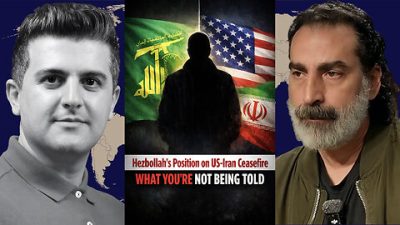
Laith Marouf: Hezbollah’s position on US-Iran ceasefire
or go to
Aletho News Archives – Video-Images
From the Archives
Is Israel to blame for the Iraq War?
American Goy | March 10, 2008
I am so tired of this old canard that “Israel had nothing to do with USA’s war with Iraq – in fact, it officially advised America against it”.
Bullshit. … continue
Blog Roll
 Aletho News
- Laith Marouf: Hezbollah’s position on US-Iran ceasefire: What you’re not being told
- Israel’s priority lies in destroying chances of peace between Iran, US: Ex-UN nuclear chief
- Ceasefire for all or for none: Iran shuts Hormuz over Lebanon attacks
- Strait of Hormuz is Iran’s ‘nuclear weapon’ that forced US retreat: Medvedev
- Energy crisis will last for months – Kremlin envoy
- Europe’s quiet role in the war on Iran
- Forty days that shook the Empire: How Iran turned the tables on US and prevailed
- Netanyahu unilaterally declares Lebanon outside of ceasefire deal
- Israeli leaders: ‘Not a single goal’ achieved in war with Iran
- What on earth just happened? Trump, Iran, and the unlikely ceasefire
- If Americans Knew
- Gazans face a triple crisis: severe shortages of water and bread, healthcare in tatters
- NY Times reports how Netanyahu took the US into Iran War
- A sigh of relief over Iran, but Gaza and Lebanon in dire straits – Daily Update
- Thousands dead and neighborhoods razed to the ground: Aid agencies fear southern Lebanon is becoming the new Gaza
- The war the US is fighting for Israel could cost trillions
- ‘Cigarette Burns, Nail Wounds’: Toddler Tortured in Gaza to Coerce Father
- Trump Says US Sent ‘a Lot of Guns’ to Protesters in Iran
- Israeli forces destroy 17 UN peacekeeper cameras in south Lebanon
- US-Israeli strikes ‘completely destroy’ synagogue in Tehran
- Archbishop for US Military Says Iran War Is Unjust Under Catholic Teaching
- No Tricks Zone
- An Inconvenient Tree: Uncovered In Alps… Europe Much Warmer Than Today 6000 Years Ago
- New Study Reports A 60% Slowdown In Greenland’s Ice Loss Rate In The Last Decade
- Low Intensity Tornado Wrecks Major Solar Farm, Creating A Potential Toxic Dump
- New Study Finds Warming Saves Lives…Cold Temperatures 12 Times More Deadly Than Excess Heat
- German Science Blog Accuses PIK Climate Institute Of Hallucinating Climate Tipping Points
- Devastating Assessment Of Comirnaty Vaccine By Former Senior Pfizer Europe Toxicologist
- New Study: CO2 Is ‘Effectively Negligible’ As An Explanatory Climate Change Factor Since 2000
- Former Pfizer Toxicologist Dr. Helmut Sterz Tells Bundestag Hearing Pfizer Vaccine Should Have Never Been Approved
- Energy Expert: Germany’s Nuclear Phaseout Was A “500 Billion Euro Mistake”
- New Research: South Australia’s Mid-Holocene Sea Surface Temperatures Were 4°C Warmer Than Today
 Aletho News