Mohammad Mahjoub: The life of a security certificate detainee
By sara falconer | Rabble | June 1, 2011
It’s a fresh spring day in Toronto, and Mohammad Mahjoub is experiencing something for the first time in over a year: the simple pleasure of small talk.
Since March 2010, Mahjoub, a security certificate detainee, was forbidden to speak to anyone he encountered in the few hours he was allowed outside. That one condition has now been lifted, but it’s a small comfort against the daily deprivation he continues to endure, under the harshest house arrest conditions in Canadian history.
And the kicker? He hasn’t been charged with a crime.
In 1995, Mahjoub fled political persecution in Egypt, where he had been tortured and imprisoned without trial. He was granted refugee status by Canada in 1996, and settled in Toronto, where he married Mona el Fouli and later had two sons, Ibrahim and Yusuf.
In June 2000, Mahjoub was arrested on a security certificate, a controversial measure of the Immigration and Refugee Protection Act that was used to indefinitely detain five Muslim men, without charges or trial, on secret evidence. They became known as the Secret Trial Five.
A 2007 Supreme Court ruling abolished the process, calling it unconstitutional. Eight months later, the Conservatives created Bill C-3, re-introducing security certificates with few substantial changes. Bill C-3 also failed to address what many view as a fundamental issue with the process: that matters of national security have no place being legislated in immigration policy, but should instead be dealt with under the Criminal Code. But the bill passed, and no time flat, secret trials were back in business.
For over a decade, Mahjoub has attempted to contest the certificate, fearing torture or worse if he is deported to Egypt. Throughout the process, he has denounced the conditions of his detention, resorting to a 76-day hunger strike in 2005 and losing 110 pounds before he was hospitalized. In 2006, he and three other members of the Secret Trial Five were transferred to a specially constructed, multi-million dollar facility in Kingston dubbed “Guantanamo North.” Mahjoub went on another hunger strike, this time lasting for 93 days before the Federal Court ordered him released in Feb. 2007.
But the conditions of his release were so severe that he described his home as a prison, and his family as reluctant guards. “His family were forced to act as his sureties,” says his lawyer, Yavar Hameed. “When they reported information to the Canadian Border Services Agency (CBSA), that information was not taken at face value. The CBSA would try to find ways to find them in violation… It was a very adversarial process with Canada Border Services, making it impossible for anyone to lead a normal life.”
In March 2009, Mahjoub asked to be returned to Guantanamo North, rather than continuing to subject his family to the constant surveillance and pressure from the CBSA and Canadian Security Intelligence Service (CSIS). In early 2010, following yet another hunger strike, he was again released on house arrest. This time, he opted to protect his family from his conditions by moving into a small basement apartment on St. Clair West in Toronto.
“There is no liberty by any means under these severe conditions,” Mahjoub said in a recent recording. “It has massive mental, physical and psychological impact on me and my family… I don’t know what to do after 11 years.”
One of his infrequent visitors is Murray Lumley, who first became aware of Mahjoub’s case through a small group called Toronto Action for Social Change. He attended rallies at CSIS headquarters and wrote letters to his MP and government ministers, and eventually became one of Mahjoub’s court-approved “supervisors.” Lumley helps accompany him when he needs something outside of his authorized area, such as a lawyer visit or a new fax machine. “I would like people to know what an honourable man Mohammad is,” he says.
Despite a recent detention review that relaxed his conditions slightly, Mahjoub is still held under surveillance that is completely unprecedented in the judicial system in Canada. He wears a GPS tracking bracelet at all times. A camera outside his door monitors his every move, and he is only permitted to leave the house for four hours a day, and only within a few blocks of his apartment. CSIS monitors every phone call — in fact, they were caught listening to protected solicitor-client phone calls between Mahjoub and his lawyer, contrary to a court order.
He has limited contact with his wife and young sons, which Lumley says has been very difficult. “It is quite amazing to me that they have been so resilient in the face of such abuse — that seems to go on and on… While they do complain of the length of time taken from their lives, they still live with some hope that this may one day end.”
If it all sounds a bit Orwellian… it is, says Hameed, who specializes in immigration and refugee law work as well as national security cases. He has been representing Mahjoub since last August, and is deeply familiar with the security certificate process, having assisted Adil Charkaoui’s legal team with their Supreme Court appeals. Charkaoui won his case against a security certificate in 2009.
A series of public hearings to determine the “reasonableness” of the certificate against Mahjoub are expected to continue until mid-July, when the in camera part of the process begins. Hameed’s job is complicated by the fact that he is only given access to a small portion of the evidence against his client for reasons of “national security.” “There’s an understanding of what the basic allegation is, but what we don’t know… is the source of the information,” he explains. “It’s kind of like a puzzle trying to put it together.”
He knows, for instance that Mahjoub is accused of being a high-ranking member of the Vanguards of Conquest, a militant Islamic group that seeks to overthrow the Egyptian government. What’s missing is the source of the “intelligence” that led to the accusation. Much of the secret evidence being used against security certificate detainees is believed to have been obtained using torture by foreign agencies. Last summer, in a significant court victory, the Federal Court ruled that part of the evidence against Mahjoub was probably obtained using torture, and could not be accepted.
“Based on the evidence we see publicly, there is a flimsy case against Mr. Mahjoub. It’s supported by innuendo; it’s weak,” Hameed says. Some of the “sources” in the case include Internet articles from foreign news services. “We’re not actually talking about things that have been investigated… The kind of information that passes for evidence in the public case is what we call hearsay.”
Hameed is also skeptical of any claims that Mahjoub poses a potential future threat to Canadian security. “The argument is that [Mahjoub’s] liberty, the fact of his liberty, would act as sort of a beacon of radicalization for persons who would be interested in supporting terrorist or Islamic extremist views,” Hameed scoffs. “We were quite shocked to learn that that’s what the case is against him, going forward. The absurdity of this process… That is so offensive to the character of what it means to live in a free and democratic society.”
You can sign a petition calling for an end to security certificates at www.justiceforharkat.com.
Sara Falconer is a Toronto-based freelance journalist.
Seymour Hersh and Iranian Nukes: A Primer
Daniel Luban | LobeLog | June 4th, 2011
Seymour Hersh’s new piece in the New Yorker has generated a fair amount of buzz, so much so that Iran hawks have quickly leaped into action to try to discredit it. Virtually none of the criticism of Hersh’s piece has actually addressed the substance of his article, however, and since the article is subscription-only, it’s possible that not many people have actually gotten a chance to read it. It may therefore be worthwhile simply to spell out what Hersh’s piece actually says.
By far the most significant revelation in the piece concerns the recently-completed 2011 National Intelligence Estimate (NIE). NIEs represent the consensus judgments of the 16 agencies that make up the U.S. intelligence community, and as such their findings frequently have major political ramifications. The 2007 NIE was particularly important (and contested), for it concluded that Iran had halted its nuclear weapons program in 2003 and found no evidence that the program had resumed.
Predictably, the 2007 NIE elicited howls of outrage from hawks who have been pushing military action against Tehran, and in the years since they have constantly attempted to discredit it. It’s worth making clear, however, just what the NIE did and didn’t say. It found no evidence of an active Iranian nuclear weapons program — that is, a nuclear program with elements that had no conceivable civilian uses (e.g., nuclear warhead design). The NIE never claimed that Iran had halted its nuclear program entirely, only that none of the nuclear program’s projects were unambiguously military in scope. Thus, to point to the fact that Iran continues to enrich uranium as evidence that the 2007 NIE has been discredited, as the Iran hawks have frequently tried to do, simply misses the point; the NIE did not suggest that Iran had stopped enriching uranium.
Nor did the NIE claim that it’s inconceivable that the Iranian regime ultimately seeks a nuclear weapon. It’s quite plausible that the regime does (not least, to deter U.S. or Israeli military action). What the NIE claimed was that there was no hard evidence or smoking gun proving that this was the case. Thus the relevant question is not whether we believe in our heart of hearts that Iran is seeking nukes, but whether there is any incontrovertible evidence that it is. This question is particularly salient in the wake of the Iraq war intelligence fiasco. In the runup to war, most people (including many war opponents) suspected that Saddam Hussein had WMD programs of some kind, but the U.S. would have been better served to put less weight on such suspicions and more weight on the actual evidential record.
So what does the Hersh piece actually say? The biggest revelation is that despite four years of intense political pressure from Iran hawks pushing the intelligence community to renounce the 2007 NIE, the just-released 2011 NIE continues to find no clear evidence of an Iranian nuclear weapons program. According to Hersh, analysts at the military’s Defense Intelligence Agency (DIA) in particular have pushed back against this political pressure; in fact, the DIA analysts suggest that Iran’s nuclear weapons program was primarily directed at Saddam Hussein’s Iraq, not Israel, and was abandoned following the fall of Saddam.
Typically, a declassified version of the NIE is released for public consumption. This has not been done with the 2011 NIE, however, for reasons that are unclear. It’s possible that the Obama administration fears a political backlash along the lines of the 2007 version, or that it is worried that publicizing the new NIE would undercut its relatively hard-line stance on Iran. Regardless, the fact that a declassified version of the NIE has not been released means that Hersh’s piece is the first time the public is hearing about it.
In light of this, it is obvious that most of the criticism of Hersh’s piece completely ignores its central contention. The issue, once again, is not whether we should believe in our heart of hearts that Iran is seeking a nuclear weapon. The issue is whether the U.S. intelligence community has found any incontrovertible evidence that this is the case. If Hersh’s account of the 2011 NIE is correct, the intelligence community has not, and this is a fact that surely deserves to be mentioned in discussions of the Iranian nuclear issue.
Private Israeli guard opens fire on protesters, protester hit by shrapnel
4 June 2011 | Ni’lin
A private Israeli guard opened live fire on protesters marching on an illegal quarry near the West Bank village of Shuqba.
The march was organized by the Ni’lin and Budrus popular committees and commenced at noon. Dozens of Palestinian and Israeli activists marched toward the illegal quarry to stop the further confiscation of Palestinian lands from the nearby villages of Ni’lin, Qibya, Shuqba and Shebteen.
As demonstrators were marching towards the quarry, an Israeli security guard opened fire. Villagers had not even arrived to the designated spot of protest, the quarry, before live ammunition was shot. The injured protester from Budrus was evacuated to the hospital for necessary treatment.
After some time, 3 three Israeli military jeeps arrived and began firing tear gas canisters at the protest. Many suffered from gas inhalation and a few olive trees caught on a fire.
The quarry, owned by an Israeli commander, rests on lands confiscated from Palestinian villages. The demonstrators hope to deter further confiscation, since the quarry continues to be expanded illegally.
The Obama Surveillance State
By Margaret Kimberley | BAR | June 1, 2011
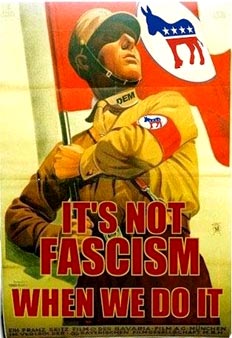 The state security apparatus which came into being during the Bush administration is now supported just as strongly, if not more so, under president Barack Obama. There has been no let up, no change in course for a system which becomes stronger with each passing day and which faces almost no political opposition.
The Obama justice department recently asserted that it can withhold classified information from a federal judge. Federal judges have security clearances and are permitted to see classified information in cases brought before them. The Obama justice department says that only the executive branch has the power to determine what information courts ought to have. The government attorney asserted, “There is no right for the plaintiff to give the court classified information at all.” The federal judge was so stunned that she described herself as “literally speechless” over the government claim that she ought to be kept in the dark.
The case in question is a remnant of the worst abuses brought about by the Bush administration, involving the kidnapping and rendition of Muslim cleric Abu Omar in Milan, Italy in 2003. A former CIA operative with State Department cover is now suing the federal government because it did not protect her right to diplomatic immunity. That operative was found guilty in absentia in an Italian court and faces arrest should she ever travel to Europe again. Now the Obama administration is once again protecting the Bush abuses which its supporters thought would now be long gone.
This is not the only instance of the current justice department moving forward with Bush administration prosecutions. Thomas Drake is a former employee of the National Security Administration now charged with violating the Espionage Act. He faces 35 years in prison, having been accused of giving documents to a reporter. Candidate Obama said he would protect the rights of whistle blowers, but now as president he tries to send them to jail. The Obama administration has brought five Espionage Act prosecutions to court, more than all other past administrations combined.
Not content to defend Bush era abuses, and send whistle blowers to jail, Obama and Congress have extended the Patriot Act, without changes, yet again. Two Democratic members of the intelligence committee, Ron Wyden and Mark Udall, were not only among those who voted no, but they also exposed how the act is being interpreted in a new and dangerous way by the administration. The Obama justice department has decided to interpret the act in a way which it will not reveal to the public. In other words, the government has a secret way of determining what is and isn’t legal but will not share that secret with congress or with the people. Orwell and Kafka would find new sources of inspiration with this president.
When George W. Bush was president, I and many others often used the word fascism to describe the growth of government powers and the diminution of our rights. Now that those very same assertions of executive power are being made by Barack Obama, should we not continue to raise the same concerns?
The sad fact is that the surveillance state has strong bi-partisan support and it is likely to only expand. … Full article
“Real Reconciliation Does Not Exist In The West Bank”
By Saed Bannoura | IMEMC & Agencies | June 04, 2011
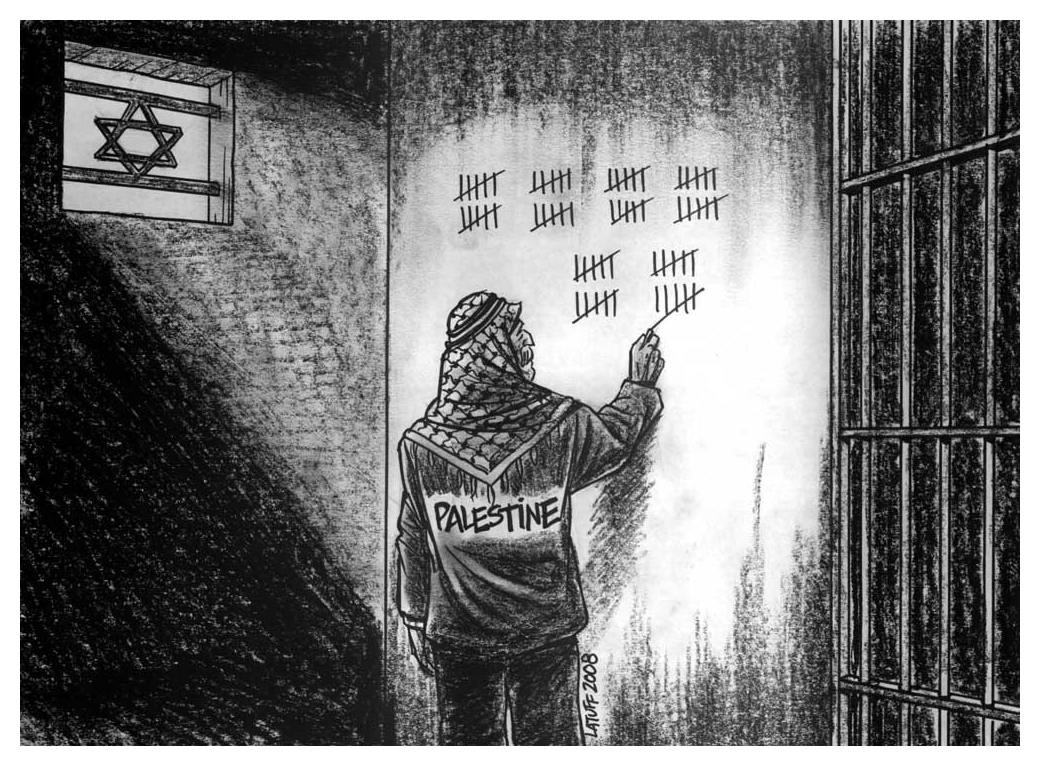
Former Minister of Detainees, Hamas political official, Wasfi Qabha, stated that there are no real indications of reconciliation in the West Bank as the Palestinian security forces are still interrogating Hamas members and supporters.
Qabha told the Haas-affiliated Palestinian Information Center that “the situation has not changed in the West Bank’”, adding that political prisoners are still in prison, and more persons are being interrogated and questioned by the security forces.
The Hamas leader further stated that despite repeated promises by the Palestinian security forces to release political prisoners, the P.A is still holding captive more than 35 prisoners.
He added that he hopes all political prisoners will be released without any delays and obstructions.
“More than a month have passed since the unity agreement was signed”, Qabha said, “But most of the prisoners are still behind bars”.
Qabha also stated that such violations are against reconciliation, and that the Fateh movement of President Mahmoud Abbas in the West Bank must act to protect unity and national interests.
Europe’s New Road to Serfdom
Trichet Threatens Greece with Iron Heel
By MICHAEL HUDSON | CounterPunch | June 3, 2011
Soon after the Socialist Party won Greece’s national elections in autumn 2009, it became apparent that the government’s finances were in a shambles. In May 2010, French President Nicolas Sarkozy took the lead in rounding up €120bn ($180 billion) from European governments to subsidize Greece’s unprogressive tax system that had led its government into debt – which Wall Street banks had helped conceal with Enron-style accounting.
The tax system operated as a siphon collecting revenue to pay the German and French banks that were buying government bonds (at rising interest-risk premiums). The bankers are now moving to make this role formal, an official condition for rolling over Greek bonds as they come due, and extend maturities on the short-term financial string that Greece is now operating under. Existing bondholders are to reap a windfall if this plan succeeds. Moody’s lowered Greece’s credit rating to junk status on June 1 (to Caa1, down from B1, which was already pretty low), estimating a 50/50 likelihood of default. The downgrade serves to tighten the screws yet further on the Greek government. Regardless of what European officials do, Moody’s noted, “The increased likelihood that Greece’s supporters (the IMF, ECB and the EU Commission, together known as the “Troika”) will, at some point in the future, require the participation of private creditors in a debt restructuring as a precondition for funding support.”
The conditionality for the new “reformed” loan package is that Greece must initiate a class war by raising its taxes, lowering its social spending – and even private-sector pensions – and sell off public land, tourist sites, islands, ports, water and sewer facilities. This will raise the cost of living and doing business, eroding the nation’s already limited export competitiveness. The bankers sanctimoniously depict this as a “rescue” of Greek finances.
What really were rescued a year ago, in May 2010, were the French banks that held €31 billion of Greek bonds, German banks with €23 billion, and other foreign investors. The problem was how to get the Greeks to go along. Newly elected Prime Minister George Papandreou’s Socialists seemed able to deliver their constituency along similar lines to what neoliberal Social Democrat and Labor parties throughout Europe had followed –privatizing basic infrastructure and pledging future revenue to pay the bankers.
The opportunity never had been better for pulling the financial strings to grab property and tighten the fiscal screws. Bankers for their part were eager to make loans to finance buyouts of public gambling, telephones, ports and transport or similar monopoly opportunities. And for Greece’s own wealthier classes, the EU loan package would enable the country to remain within the Eurozone long enough to permit them to move their money out of the country before the point arrived at which Greece would be forced to replace the euro with the drachma and devalue it. Until such a switch to a sinking currency occurred, Greece was to follow Baltic and Irish policy of “internal devaluation,” that is, wage deflation and government spending cutbacks (except for payments to the financial sector) to lower employment and hence wage levels.
What actually is devalued in austerity programs or currency depreciation is the price of labor. That is the main domestic cost, inasmuch as there is a common world price for fuels and minerals, consumer goods, food and even credit. If wages cannot be reduced by “internal devaluation” (unemployment starting with the public sector, leading to falling wages), currency depreciation will do the trick in the end. This is how Europe’s war of creditors against debtor countries turns into a class war. But to impose such neoliberal reform, foreign pressure is necessary to bypass domestic, democratically elected Parliaments. Not every country’s voters can be expected to be as passive in acting against their own interests as those of Latvia and Ireland.
Most of the Greek population recognizes just what has been happening as this scenario has unfolded over the past year. “Papandreou himself has admitted we had no say in the economic measures thrust upon us,” said Manolis Glezos on the left. “They were decided by the EU and IMF. We are now under foreign supervision and that raises questions about our economic, military and political independence.” On the right wing of the political spectrum, conservative leader Antonis Samaras said on May 27 as negotiations with the European troika escalated: “We don’t agree with a policy that kills the economy and destroys society. … There is only one way out for Greece, the renegotiation of the [EU/IMF] bailout deal.”
But the EU creditors upped the ante: To refuse the deal, they threatened, would result in a withdrawal of funds causing a bank collapse and economic anarchy.
The Greeks refused to surrender quietly. Strikes spread from the public-sector unions to become a nationwide “I won’t pay” movement as Greeks refused to pay road tolls or other public access charges. Police and other collectors did not try to enforce collections. The emerging populist consensus prompted Luxembourg’s Prime Minister Jean-Claude Juncker to make a similar threat to that which Britain’s Gordon Brown had made to Iceland: If Greece would not knuckle under to European finance ministers, they would block IMF release of its scheduled June tranche of its loan package. This would block the government from paying foreign bankers and the vulture funds that have been buying up Greek debt at a deepening discount.
To many Greeks, this is a threat by finance ministers to shoot themselves in the foot. If there is no money to pay, foreign bondholders will suffer – as long as Greece puts its own economy first. But that is a big “if.” Socialist Prime Minister Papandreou emulated Iceland’s Social Democratic Sigurdardottir in urging a “consensus” to obey EU finance ministers. “Opposition parties reject his latest austerity package on the grounds that the belt-tightening agreed in return for a €110bn ($155bn) bail-out is choking the life out of the economy.”
At issue is whether Greece, Ireland, Spain, Portugal and the rest of Europe will roll back democratic reform and move toward financial oligarchy. The financial objective is to bypass parliament by demanding a “consensus” to put foreign creditors first, above the economy at large. Parliaments are being asked to relinquish their policy-making power. The very definition of a “free market” has now become centralized planning – in the hands of central bankers. This is the new road to serfdom that financialized “free markets” are leading to: markets free for privatizers to charge monopoly prices for basic services “free” of price regulation and anti-trust regulation, “free” of limits on credit to protect debtors, and above all free of interference from elected parliaments. Prising natural monopolies in transportation, communications, lotteries and the land itself away from the public domain is called the alternative to serfdom, not the road to debt peonage and a financialized neo-feudalism that looms as the new future reality. Such is the upside-down economic philosophy of our age.
Concentration of financial power in non-democratic hands is inherent in the way that Europe’s centralized planning in financial hands was achieved in the first place. The European Central Bank has no elected government behind it that can levy taxes. The EU constitution prevents the ECB from bailing out governments. Indeed, the IMF Articles of Agreement also block it from giving domestic fiscal support for budget deficits. “A member state may obtain IMF credits only on the condition that it has ‘a need to make the purchase because of its balance of payments or its reserve position or developments in its reserves.’ Greece, Ireland, and Portugal are certainly not short of foreign exchange reserves … The IMF is lending because of budgetary problems, and that is not what it is supposed to do. The Deutsche Bundesbank made this point very clear in its monthly report of March 2010: ‘Any financial contribution by the IMF to solve problems that do not imply a need for foreign currency – such as the direct financing of budget deficits – would be incompatible with its monetary mandate.’ IMF head Dominique Strauss-Kahn and chief economist Olivier Blanchard are leading the IMF into forbidden territory, and there is no court which can stop them.” (Roland Vaubel, “Europe’s Bailout Politics,” The International Economy, Spring 2011, p. 40.)
The moral is that when it comes to bailing out bankers, rules are ignored – in order to serve the “higher justice” of saving banks and their high-finance counterparties from taking a loss. This is quite a contrast compared to IMF policy toward labor and “taxpayers.” The class war is back in business – with a vengeance, and bankers are the winners this time around.
The European Economic Community that preceded the European Union was created by a generation of leaders whose prime objective was to end the internecine warfare that tore Europe apart for a thousand years. The aim by many was to end the phenomenon of nation states themselves – on the premise that it is nations that go to war. The general expectation was that economic democracy would oppose the royalist and aristocratic mind-sets that sought glory in conquest. Domestically, economic reform was to purify European economies from the legacy of past feudal conquests of the land, of the public commons in general. The aim was to benefit the population at large. That was the reform program of classical political economy.
European integration started with trade as the path of least resistance – the Coal and Steel Community promoted by Robert Schuman in 1952, followed by the European Economic Community (EEC, the Common Market) in 1957. Customs union integration and the Common Agricultural Policy (CAP) were topped by financial integration. But without a real continental Parliament to write laws, set tax rates, protect labor’s working conditions and consumers, and control offshore banking centers, centralized planning passes by default into the hands of bankers and financial institutions. This is the effect of replacing nation states with planning by bankers. It is how democratic politics gets replaced with financial oligarchy.
Finance is a form of warfare. Like military conquest, its aim is to gain control of land, public infrastructure, and to impose tribute. This involves dictating laws to its subjects, and concentrating social as well as economic planning in centralized hands. This is what now is being done by financial means, without the cost to the aggressor of fielding an army. But the economies under attack may be devastated as deeply by financial stringency as by military attack when it comes to demographic shrinkage, shortened life spans, emigration and capital flight.
This attack is being mounted not by nation states as such, but by a cosmopolitan financial class. Finance always has been cosmopolitan more than nationalistic – and always has sought to impose its priorities and lawmaking power over those of parliamentary democracies.
Like any monopoly or vested interest, the financial strategy seeks to block government power to regulate or tax it. From the financial vantage point, the ideal function of government is to enhance and protect finance capital and “the miracle of compound interest” that keeps fortunes multiplying exponentially, faster than the economy can grow, until they eat into the economic substance and do to the economy what predatory creditors and rentiers did to the Roman Empire.
This financial dynamic is what threatens to break up Europe today. But the financial class has gained sufficient power to turn the ideological tables and insist that what threatens European unity is national populations acting to resist the cosmopolitan claims of finance capital to impose austerity on labor. Debts that already have become unpayable are to be taken onto the public balance sheet – without a military struggle, needless to say. At least such bloodshed is now in the past. From the vantage point of the Irish and Greek populations (perhaps soon to be joined by those of Portugal and Spain), national parliamentary governments are to be mobilized to impose the terms of national surrender to financial planners. One almost can say that the ideal is to reduce parliaments to local puppet regimes serving the cosmopolitan financial class by using debt leverage to carve up what is left of the public domain that used to be called “the commons.” As such, we now are entering a post-medieval world of enclosures – an Enclosure Movement driven by financial law that overrides public and common law, against the common good.
Within Europe, financial power is concentrated in Germany, France and the Netherlands. It is their banks that held most of the bonds of the Greek government now being called on to impose austerity, and of the Irish banks that already have been bailed out by Irish taxpayers.
On Thursday, June 2, 2011, ECB President Jean-Claude Trichet spelled out the blueprint for how to establish financial oligarchy over all Europe. Appropriately, he announced his plan upon receiving the Charlemagne prize at Aachen, Germany – symbolically expressing how Europe was to be unified not on the grounds of economic peace as dreamed of by the architects of the Common Market in the 1950s, but on diametrically opposite oligarchic grounds.
At the outset of his speech on “Building Europe, building institutions,” Trichet appropriately credited the European Council led by Mr. Van Rompuy for giving direction and momentum from the highest level, and the Eurogroup of finance ministers led by Mr. Juncker. Together, they formed what the popular press calls Europe’s creditor “troika.” Mr. Trichet’s speech refers to “the ‘trialogue’ between the Parliament, the Commission and the Council.”
Europe’s task, he explained, was to follow Erasmus in bringing Europe beyond its traditional “strict concept of nationhood.” The debt problem called for new “monetary policy measures – we call them ‘non standard’ decisions, strictly separated from the ‘standard’ decisions, and aimed at restoring a better transmission of our monetary policy in these abnormal market conditions.” The problem at hand is to make these conditions a new normalcy – that of paying debts, and re-defining solvency to reflect a nation’s ability to pay by selling off its public domain.
“Countries that have not lived up to the letter or the spirit of the rules have experienced difficulties,” Trichet noted. “Via contagion, these difficulties have affected other countries in EMU. Strengthening the rules to prevent unsound policies is therefore an urgent priority.” His use of the term “contagion” depicted democratic government and protection of debtors as a disease. Reminiscent of the Greek colonels’ speech that opened the famous 1969 film “Z”: to combat leftism as if it were an agricultural pest to be exterminated by proper ideological pesticide. Mr. Trichet adopted the colonels’ rhetoric. The task of the Greek Socialists evidently is to do what the colonels and their conservative successors could not do: deliver labor to irreversible economic reforms.
“Arrangements are currently in place, involving financial assistance under strict conditions, fully in line with the IMF policy. I am aware that some observers have concerns about where this leads. The line between regional solidarity and individual responsibility could become blurred if the conditionality is not rigorously complied with.
“In my view, it could be appropriate to foresee for the medium term two stages for countries in difficulty. This would naturally demand a change of the Treaty.
“As a first stage, it is justified to provide financial assistance in the context of a strong adjustment program. It is appropriate to give countries an opportunity to put the situation right themselves and to restore stability.
“At the same time, such assistance is in the interests of the euro area as a whole, as it prevents crises spreading in a way that could cause harm to other countries.
It is of paramount importance that adjustment occurs; that countries – governments and opposition – unite behind the effort; and that contributing countries survey with great care the implementation of the programme.
But if a country is still not delivering, I think all would agree that the second stage has to be different. Would it go too far if we envisaged, at this second stage, giving euro area authorities a much deeper and authoritative say in the formation of the country’s economic policies if these go harmfully astray? A direct influence, well over and above the reinforced surveillance that is presently envisaged? … (my emphasis)
The ECB President then gave the key political premise of his reform program (if it is not a travesty to use the term “reform” for today’s counter-Enlightenment):
“We can see before our eyes that membership of the EU, and even more so of EMU, introduces a new understanding in the way sovereignty is exerted. Interdependence means that countries de facto do not have complete internal authority. They can experience crises caused entirely by the unsound economic policies of others.
“With a new concept of a second stage, we would change drastically the present governance based upon the dialectics of surveillance, recommendations and sanctions. In the present concept, all the decisions remain in the hands of the country concerned, even if the recommendations are not applied, and even if this attitude triggers major difficulties for other member countries. In the new concept, it would be not only possible, but in some cases compulsory, in a second stage for the European authorities – namely the Council on the basis of a proposal by the Commission, in liaison with the ECB – to take themselves decisions applicable in the economy concerned.
“One way this could be imagined is for European authorities to have the right to veto some national economic policy decisions. The remit could include in particular major fiscal spending items and elements essential for the country’s competitiveness. …
By “unsound economic policies,” Mr. Trichet means not paying debts – by writing them down to the ability to pay without forfeiting land and monopolies in the public domain, and refusing to replace political and economic democracy with control by bankers. Twisting the knife into the long history of European idealism, he deceptively depicted his proposed financial coup d’état as if it were in the spirit of Jean Monnet, Robert Schuman and other liberals who promoted European integration in hope of creating a more peaceful world – one that would be more prosperous and productive, not one based on financial asset stripping.
“Jean Monnet in his memoirs 35 years ago wrote: ‘Nobody can say today what will be the institutional framework of Europe tomorrow because the future changes, which will be fostered by today’s changes, are unpredictable.’
“In this Union of tomorrow, or of the day after tomorrow, would it be too bold, in the economic field, with a single market, a single currency and a single central bank, to envisage a ministry of finance of the Union? Not necessarily a ministry of finance that administers a large federal budget. But a ministry of finance that would exert direct responsibilities in at least three domains: first, the surveillance of both fiscal policies and competitiveness policies, as well as the direct responsibilities mentioned earlier as regards countries in a ‘second stage’ inside the euro area; second, all the typical responsibilities of the executive branches as regards the union’s integrated financial sector, so as to accompany the full integration of financial services; and third, the representation of the union confederation in international financial institutions.
“Husserl concluded his lecture in a visionary way: ‘Europe’s existential crisis can end in only one of two ways: in its demise (…) lapsing into a hatred of the spirit and into barbarism ; or in its rebirth from the spirit of philosophy, through a heroism of reason (…).’”
As my friend Marshall Auerback remarked in response to this speech, its message is familiar enough as a description of what is happening in the United States: “This is the Republican answer in Michigan. Take over the cities in crisis run by disfavored minorities, remove their democratically elected governments from power, and use extraordinary powers to mandate austerity.” In other words, no room for any agency like that advocated by Elizabeth Warren is to exist in the EU. That is not the kind of idealistic integration toward which Trichet and the ECB aim. He is leading toward what the closing credits of the film “Z” put on the screen: The things banned by the junta include: “peace movements, strikes, labor unions, long hair on men, The Beatles, other modern and popular music (‘la musique populaire’), Sophocles, Leo Tolstoy, Aeschylus, writing that Socrates was homosexual, Eugène Ionesco, Jean-Paul Sartre, Anton Chekhov, Harold Pinter, Edward Albee, Mark Twain, Samuel Beckett, the bar association, sociology, international encyclopedias, free press, and new math. Also banned is the letter Z, which was used as a symbolic reminder that Grigoris Lambrakis and by extension the spirit of resistance lives (zi = ‘he (Lambrakis) lives’).”
As the Wall Street Journal accurately summarized the political thrust of Mr. Trichet’s speech, “if a bailed-out country isn’t delivering on its fiscal-adjustment program, then a ‘second stage’ could be required, which could possibly involve ‘giving euro-area authorities a much deeper and authoritative say in the formation of the county’s economic policies …’” Eurozone authorities – specifically, their financial institutions, not democratic institutions aimed at protecting labor and consumers, raising living standards and so forth – “could have ‘the right to veto some national economic-policy decisions’ under such a regime. In particular, a veto could apply for ‘major fiscal spending items and elements essential for the country’s competitiveness.’”
Paraphrasing Mr. Trichet’s lugubrious query, “In this union of tomorrow … would it be too bold in the economic field … to envisage a ministry of finance for the union?” the article noted that “Such a ministry wouldn’t necessarily have a large federal budget but would be involved in surveillance and issuing vetoes, and would represent the currency bloc at international financial institutions.”
My own memory is that socialist idealism after World War II was world-weary in seeing nation states as the instruments for military warfare. This pacifist ideology came to overshadow the original socialist ideology of the late 19th century, which sought to reform governments to take law-making power, taxing power and property itself out of the hands of the classes who had possessed it ever since the Viking invasions of Europe had established feudal privilege, absentee landownership and financial control of trading monopolies and, increasingly, the banking privilege of money creation.
But somehow, as my UMKC colleague, Prof. Bill Black commented recently in the UMKC economics blog: “One of the great paradoxes is that the periphery’s generally left-wing governments adopted so enthusiastically the ECB’s ultra-right wing economic nostrums – austerity is an appropriate response to a great recession. … Why left-wing parties embrace the advice of the ultra-right wing economists whose anti-regulatory dogmas helped cause the crisis is one of the great mysteries of life. Their policies are self-destructive to the economy and suicidal politically.”
Greece and Ireland have become the litmus test for whether economies will be sacrificed in attempts to pay debts that cannot be paid. An interregnum is threatened during which the road to default and permanent austerity will carve out more and more land and public enterprises from the public domain, divert more and more consumer income to pay debt service and taxes for governments to pay bondholders, and more business income to pay the bankers.
If this is not war, what is?
~
Michael Hudson is a former Wall Street economist. A Distinguished Research Professor at University of Missouri, Kansas City (UMKC), he is the author of many books, including Super Imperialism: The Economic Strategy of American Empire (new ed., Pluto Press, 2002) and Trade, Development and Foreign Debt: A History of Theories of Polarization v. Convergence in the World Economy. He can be reached via his website, mh@michael-hudson.com
Greek protesters seize finance ministry
Press TV – June 3, 2011
 The Greek finance ministry building, on which protesters hang a giant banner calling for a general strike in Athens, June 3, 2011.
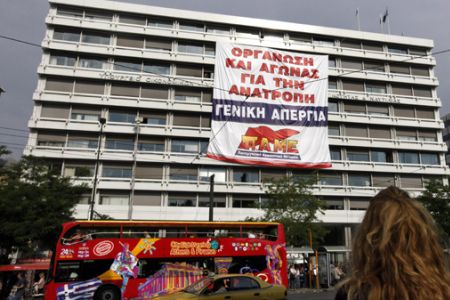
Greek protesters have taken over the finance ministry building in Athens as the country agreed with its European partners to introduce new austerity measures in return for a new bailout package.
Protesters belonging to the left-wing The All-Workers Militant Front (PAME) union unfolded a giant banner from the roof of the finance ministry building on the central Syntagma square, calling for a nationwide strike against the new austerity measures that the government agreed to take in return for the new bailout package.
“From dawn today forces of PAME have symbolically occupied the finance ministry, calling on workers to rise, organize their struggle and prevent the government’s barbarous and anti-popular measures from passing,” the front said, AFP reported.
Angry citizens in the country have now, for a tenth consecutive day, held anti-government demonstrations against the austerity measures.
Protesters have set up a camp in the central square of the capital, in a move modeled after the Spanish M-15 movement and the uprisings in the Middle East and North Africa.
The new bailout plan will mean harsher austerity measures, as it is aimed at reducing the 2011 budget deficit by EUR 6.5 billion. PAME said the new plan would “turn workers into slaves.”
The plan, however, is set to be approved by EU finance ministers on June 20. Additionally, the government will also commence its EUR 50 billion privatization program.
Greece received a EUR 110 billion EU-IMF bailout loan last year, as it faced a massive debt crisis, but did not manage to resolve its financial problems.
Since last year, Greece has witnessed massive anti-government protests which turned violent at times and left scores of protesters and security forces dead or injured.
A poll conducted recently found that the majority of Greeks no longer have confidence their government can pull the country out of its national debt.
A State for Jews
By William James Martin | Palestine Chronicle | June 3, 2011
I grew up in NC and was around for the transformation to an integrated society where in the laws of the state and nation became color-blind; and blacks were afforded equal protection under the law. My parent’s generation were generally decent honorable people who wished no one harm, neither black nor white, they believed in the humane treatment of everyone, but many also believed in the doctrine of separate but equal. This doctrine had been affirmed by the US Supreme Court in 1896 -Plessy v Ferguson – and the court contained such notables as Oliver Wendel Holmes. A subsequent decision, Brown vs the Board of Education, 1954, was essentially unimplemented until the mid to late 1960’s with the onset of the administration of Lyndon Johnson. This transformation was a difficult one for many, but certainly not all, of my parent’s and grandparent’s generation.
It is hard for me, and I am sure for them as well, to imagine the return to a segregated society. So I think they might ask, since the people of NC made a sometimes painful transformation, why are we providing almost incalculable support and sustenance to a state – Israel- which is a state “for Jews”, and exclusively for Jews, at the expense of the indigenous native Palestinians. I think the people of NC would wonder at the apparent contradiction if they remembered the difficult times everyone went through and if they understood the legal configuration of Israeli law within the Jewish state.
Let us review some of the laws of Israel which define the legal contours of the state.
Though Israel was never able to agree on a constitution, the Israeli Knesset, however, passed a series of ‘Basic Laws, which functions, more or less, as a constitution, absent something corresponding to a bill of rights protecting the liberties of its citizens.
The First Basic Law states that Israel is a state for the Jewish people.
Identification cards must be carried at all times and define the carrier’s nationality which may be ‘Jewish’, ‘Arab’, Druse, etc., but not ‘Israeli’. An Israeli nationality is not recognized.
In a legal challenge to this classification system which was denied, the president of the High Court, Justice Shimon explained that recognizing an Israeli nationality would negate the very foundation upon which the State of Israel was formed.’
A Basic Law, passed in 1985, ensures the official exclusion from political participation of any party that does not assent to the primacy of Israel’s Jewish identity and raison d’etre.
Another Basic Law, The Law of Return, passed by the Knesset in 1950, states that ‘any Jew has a right to come to this county and shall be granted a visa upon his expressing a desire to settle in Israel. ‘Return’ is used in an unusual sense, as the person ‘returning’ may never have set foot in Israel at any time previously.
Thus any Jew in the world can become an Israel national merely by showing up with the intent to settle in Israel. This right is denied to a Palestinian though he may have been expelled from what may have been his ancestral home in the 1948 wave of expulsions from inside present day Israel.
Jews immigrating are provided with an ‘absorption grant’ which varies depending on one’s origin of immigration, but may be greater than $20,000 per family in the case of immigration from the former Soviet Union. All Jews immigrating to Israel immediately receive the right to vote in elections to the Knesset.
Israeli citizens who left the country for a time but who are defined as ‘those who can immigrate in accordance with the Law of Return’, i.e., Jews, are eligible to receive generous customs benefits, to receive either a grant or a loan, on easy terms, for the purchase of an apartment, as well as other benefits. Such benefits are not available to non-Jews, who are citizens of Israel but are not Israeli nationals.
Palestinian citizens of Israel, about a fifth of the population, 1.5 million, cannot benefit from any of the institutions reserved for Israeli nationals. These quasi-state institutions include The Jewish National Fund, The World Zionist Organization, Israeli Land Authority and The Jewish Agency.
The Israeli Land Authority controls a third of the water resources of the state while the Israeli Land Authority controls 92% of the land of Israel and operates according to regulations issued by the Jewish National Fund, an affiliate of the World Zionist Organization. These regulations deny the right to reside, to open a business, and often to work, to anyone non-Jewish. Jews, by contrast are not prohibited from working anywhere within the State of Israel. Jews who are settled on National land are ‘strictly prohibited’ from sub-renting even part of their land to Arabs, punishable by heavy fines. The land of Israel is administered for Jewish development and can never be transferred to others.
In 1958, the Israeli Knesset passed the Israeli Lands Law which prohibits the transfer of land ownership, whether by sale or in any other manner to those not eligible to benefit from the Law of Return, i.e. non-Jews.
The ‘Absentee law’, enacted in 1950, authorized the state to confiscate property from anyone absent from his home, either within the borders of Israel or outside, even for one day, between November 1947 and May 19, 1948. This law was retroactive and designates dates occurring before Israel was even declared a state and during a period when violence was heaviest and about half of the 750,000 Palestinian refugees were driven from their land.
According to the Arab Association for Human Rights, there are about 100 Palestinian villages in Israel that the government does not officially recognize. These villages, containing over 700,000 Palestinian Arab Israeli citizens, are constantly threatened with destruction. They are not shown on any map and their residents are prevented from development of their property or any new building. They are not provided with public schools, or drinking water, or health clinics. Sometimes whole villages are fenced off.
Moshe Shohat, the Israeli Minister of Bedouin Affairs, spoke of the “bloodthirsty Bedouins who commit polygamy, have 30 children, and continue to expand their illegal settlements taking over state land.” As for providing schools with indoor plumbing, he added, “In their culture, they take care of their needs outdoors … they don’t even know how to flush a toilet.”
These are some of the overarching laws within the pre- 1967 borders of Israel. Nothing has been said of the 4.5 million Palestinians living under Israeli military occupation or those under occupation who watch as their land is confiscated.
The United States supports Israel generously, supplying it with about $3 billion annually together with top drawer military hardware, along with veto-protection in the UN Security Council. The Civil Rights laws of the 1960’s were enacted as a result of a deep sense of basic fairness. The people of NC who are supporting Israel with their tax dollars and socially induced loyalty should give the Arab-Israeli conflict some very hard thought.
~
William James Martin teaches in the Department of Mathematics at the University of New Orleans. Contact him at: wjm20@caa.columbia.edu.
Israel Plans to Expel 30,000 Palestinians
Al-Manar | June 3, 2011
Israel plans to evict 30,000 Palestinians from the south of the occupied territories in the course of five years.
The office of Israeli Prime Minister Benjamin Netanyahu has drafted a plan to evict 30,000 Palestinians of the Bedouin community from the Negev desert to expanded areas of existing Negev Palestinian towns such as Rahat, Kseifa and Hura.
The plan is in line with recommendations made by the Goldberg Committee and will be put to vote in the Israeli cabinet in the coming weeks, Israeli daily Ha’aretz reported on Thursday.
The Goldberg Committee has been established by Israel to present recommendations regarding the Palestinian settlement in the Negev. The plan is estimated to cost between USD 1.7 and USD 2.3 billion.
According to the project, Palestinians will receive replacement land of half the area they claim and will be compensated either with cash or with construction sites the state promises to develop.
Representatives of Palestinians and human rights organizations are scheduled to meet this weekend at Neveh Shalom. Bedouin leaders have threatened to take legal action to stop the plan if it is approved.
Leading Palestinian activist Awad Abu Farih has called the plan a disaster that will stoke conflict between the Palestinian residents of the Negev.
Human rights activists also said the measure does not provide recognition of Bedouin natives and forces them to relocate against their will.
June 5th March Postponed In Lebanon

Israeli soldiers put up new barbed wire near the Lebanese border village of Kfar Kila on Friday June 3, 2011.
By Kevin Murphy | IMEMC and Agencies | June 03, 2011
A high ranking Palestinian leader has told Lebanon Daily Star newspaper that the June 5th march by Palestinian refugees will be postponed due to pressure from the Lebanese government.
The Daily Star report said that organisers of the march did not intend to unsettle Lebanese stability and was not concerned of the timing of the march.
The report claims that US Embassy to Lebanon put the Lebanese government under significant pressure to prevent the march.
Lebanese officials have held meetings with Palestinian leaders to encourage them to cancel moves to repeat the protests to Israel’s borders that occurred on Nakba Day this year and left 16 protesters dead.
Israel has threatened Lebanon and Syria in the run up to June 5th to prevent any repeat of the events of Nakba Day which Israel say were coordinated by resistance group Hezbollah, Iran, Syria and Hamas.
The Lebanese military were coordinating with UNIFIL forces on the ground on how best to contain refugees. The military had announced the area surrounding the border to be a closed military zone.
Jewish colonists attack Palestinian villagers in Nablus and Ramallah districts
Palestine Information Center – 03/06/2011
NABLUS, RAMALLAH — Dozens of fanatic Jewish settlers attacked Palestinian villagers to the south of the northern West Bank city of Nablus resulting in clashes in which two Palestinians were injured and three others were arrested by the Israeli Occupation Forces (IOF).
Hebrew sources said that dozens of settlers from Havat Gilad, which is built on confiscated Palestinian land belonging to the villagers of Kasra and neighbouring villages, attacked Palestinian homes at a late hour Thursday resulting in the injury of two Palestinians who were taken to hospital for treatment.
Local sources said that the IOF intervened to protect the settlers and arrested three Palestinian youth who clashed with the attacking settlers.
Meanwhile, fanatic Jewish settlers carried out provocative acts on Friday morning in the village of Deir Nithanto the north west of the southern West Bank city of Ramallah
Locals said that a large number of settlers from Hamlish settlement close to the village are roaming the streets and fields of the village and are provoking the Palestinian villagers by writing racist graffiti and hanging Israeli flags on trees.
Featured Video

Iran Is Not Our Enemy
or go to
Aletho News Archives – Video-Images
Book Excerpt
“Vaccines Do Not Cause Autism!” The Science is Settled. Right?
ICAN urges the IACC to actually study infant vaccines and autism
 By Aaron Siri | Injecting Freedom | March 16, 2026
On behalf of ICAN, we just sent a copy of chapter 11 of Vaccines, Amen to the newly appointed members of the federal Interagency Autism Coordinating Committee (IACC).
If you haven’t already read this chapter, you can read the whole thing in the attached letter. I trust that after you read it, you’ll see why the statement “vaccines do not cause autism” is a belief, not science!

IACC Public Comment Letter
1.53MB ∙ PDF file
Includes chapter 11 of Vaccines, Amen
Blog Roll
 Aletho News
- Iran made ‘unexpectedly substantial’ offer during Geneva talks, US envoys ‘dragged’ Trump into war: Report
- Russia condemns Israel’s attack near Bushehr plant, files complaint
- Russia Strongly Condemns Actions Aimed at Harming Health of Iranian Leadership – Kremlin
- Israeli Journalist Demands Tucker Carlson and Candace Owens Be Placed in WWII-Style Internment Camps
- No Liability, No Studies, No Accountability: The Vaccine System Aaron Siri Exposed in Federal Court
- No time for losers: Why the war meant to save Israel may destroy it
- Top US Counterterrorism Official Resigns in Protest of Operation Against Iran
- Just Get Out! Now!
- Unpacking glaring contradictions in US-Zionist justifications for war against Iran
- Iranian model of warfare bleeds US dry while Persian Gulf states watch and learn: Analyst
- If Americans Knew
- Trump’s counterterrorism chief, whose own wife was killed by ISIS, quits over Iran War saying Tehran posed ‘no imminent threat’
- Here’s what US could fund instead of Bibi’s war on Iran
- Israel Killed Over a Dozen Lebanese Paramedics in Three Days, Now Claiming That Ambulances Are “Hezbollah” Targets
- War on Iran: These are the heritage sites devastated by US and Israeli attacks
- Four news stories from Israeli media that illustrate Israeli “justice”
- CIA Prepares Criminal Referral of Tucker Carlson, as Israel and Its Loyalists Demand His Arrest
- Top US counterterror advisor resigns in protest of “war manufactured by Israel” – Not a ceasefire Day 157
- ‘I Liked the House’: When Israeli Soldiers Turn Palestinian Homes into Barracks
- ‘They Were All I Had’: Lebanese Father Buries Parents, 4 Daughters Killed by Israeli Bombing
- Israel and its supporters are causing attacks on Jewish institutions. Case in point: Michigan synagogue tragedy.
- No Tricks Zone
- New Research: South Australia’s Mid-Holocene Sea Surface Temperatures Were 4°C Warmer Than Today
- Storing Green Energy To Last Germany 10 Days Would Require A 60-Million Tonne Battery
- New Studies: UK Sea Levels Were 4 Meters Higher Than Today During The Mid-Holocene
- Destructive Green New Deal: German Energy And Metal Group Warns Of Drastic Crisis
- New Study Documents A 20-Year Pause In Arctic Sea Ice Decline – Driven By Internal Variability
- Wake-up Call: Survey Shows Majority Of Germans Now Favor Postponing Climate Targets!
- Televised! Leading German Political Candidate Tells Schoolchildren CO2 Makes Sun Hotter!
- New Study: A Century Warming Of 1.1°C Is ‘Commonplace’ And ‘Not Unusual’ During This Interglacial
- New Study: ‘Internal Noise’ And Volcanic Forcing Can Trigger 10-15°C Warming Within Decades
- Glaciers Worldwide Are Suddendly Surging, Experts Blame Warming!
 Aletho News