UK arms sales to despots enjoy rise
Press TV – August 29, 2011
Britain has increased by about 30 percent its weapons exports to the Middle East and North African regions, where a wave of Islamic Awakening is challenging totalitarian regimes.
A new inquiry found that the UK has exported arms worth at least £30.5 million to various countries, including Bahrain and Saudi Arabia between February and June this year, as compared to £22million in the same period of 2010, The Times newspaper reported.
According to the report, arms exports to countries, where human rights records are deteriorating, have spiked by one third at the same time when the rulers of these countries are brutally repressing their own people.
The arms exports included weapons used for internal repression, such as small arms ammunition, rifles and sub-machine guns, the report said.
This was despite the Foreign Office promising in February an “immediate and rapid” review of all military exports to the region.
Shortly before the UN Security Council imposed an embargo on weapon supplies to Libya in February this year, Britain provided the Libyan regime with ammunition worth a total of £64,000, the report added.
Meanwhile, the UK weapons manufacturers continued selling weapons to Yemen, Bahrain and Egypt during the period from February to April. The Bahraini regime received the British-made weapons in April, several weeks after its troops violently broke up a pro-democracy rally in Manama’s Pearl Square.
The revelations add to the UK government’s double standard policy as it has been harshly denouncing Bahraini regime of al-Khalifa for gunning down pro-democracy activists in the country, and at the same time selling them weapons, which its regime used to suppress dissent.
It is also difficult to assume that the British authorities were unaware of weapon supplies to the troubled countries of the Middle East and North Africa, given that the country’s license to sell arms is under strict control of the government.
British laws accurately outline that the license should not be issued if weapons sold may be used for internal repressions, attacks against other countries, as well as heating up or extending armed conflicts.
Meanwhile, the UK’s largest peace campaign group, Stop the War Coalition (STWC) has said in a report that Britain is one of the prominent “gunrunners” to the world’s most oppressive and corrupt regimes.
“Britain is one of the world´s biggest arms traders, with a long history of arming the most oppressive regimes, like Libya, Bahrain and Saudi Arabia, who we can assume used UK arms in putting down Arab Spring rebellions,” STWC said.
“Out of the 26 countries that the UK has highlighted as being ‘countries of concern´ on human rights, we sell arms to 16 of them,” it said.
Swedish chain kicks out drink machines made in Israeli settlements
Sodastream lists pressure on companies to leave the West Bank as a “risk factor” in its SEC filing
By Stephanie Westbrook | The Electronic Intifada | 29 August 2011
The summer of 2011 has been a long, hot one for Israeli and international companies complicit in human rights violations in the occupied West Bank.
Facing an intense Europe-wide boycott campaign, Israel’s largest produce exporter, Agrexco, filed for bankruptcy. French multinational Veolia, an urban systems corporation contracted with the Israeli government to provide light rail services for Israeli settlers in the West Bank, announced massive losses due to sustained pressure by activists around the world.
Meanwhile, in Sweden, the Israeli maker of home carbonation devices, Sodastream, took a direct hit when the Coop supermarket chain announced on 19 July that it would stop all purchases of its products due to the company’s activity in illegal Israeli settlements. This marked another important victory for the boycott, divestment and sanctions (BDS) movement, as Sweden is Sodastream’s largest market, with an estimated one in five households owning a Sodastream product (“Coop Sweden stops all purchases of Soda Stream carbonation devices,” 21 July 2011).
The Israeli company has been the target of a two-year campaign by Swedish activists who seek to highlight the company’s complicity with the Israeli occupation. The main production facilities for Sodastream are located at Mishor Adumim, the industrial zone of the Israeli settlement Maaleh Adumim in the occupied West Bank.
Sodastream, whose products are sold in 41 countries, has repeatedly attempted to deflect attention from the factory in the occupied West Bank, claiming that it is just one of many around the world.
In an interview last March with the Israeli financial daily The Marker (published by Haaretz), Sodastream CEO Daniel Birnbaum went so far as to say that “all Sodastream products sold in Sweden are made in China, not Israel” (“Sodastream setting up plant within Green Line,” 3 March 2011).
Sodastream’s documents disprove its claims
Sodastream’s own annual report demonstrates Birnbaum’s claims to be patently false. On 30 June, the company filed a report with the US Securities and Exchange Commission (SEC), as required for publicly traded companies (Sodastream is listed on NASDAQ). That report describes that the 164,214-square-foot facilities at Mishor Adumim include “a metal factory, plastic and bottle blowing factory, machining factory, assembly factory, cylinder manufacturing facility, CO2 refill line and cylinder retest facility,” while two subcontractors in China produce nothing more than “certain components” for Sodastream products (“Sodastream International Ltd.; Annual report,” 30 June 2011 [PDF]).
The widely-trumpeted “factories around the world” — namely Australia, Germany, the Netherlands, New Zealand, South Africa, Sweden and the United States — are shown in the annual report to be limited to carbon dioxide refilling services.
Coop Sweden initially tried to defend its ties with Sodastream, repeating claims that the products on Swedish retailer shelves were made in China. However, as highlighted in a report presented to Coop by the Palestine Solidarity Association of Sweden (PGS) last January, the main issue was that the company had partnered with Israeli firms complicit in violations of international law (“PGS urges Coop to stop supporting the occupation,” 14 January 2011 [Swedish]).
As the PGS report emphasizes, “[A] product is part of a firm, and if you buy a product from a firm with an unethical operation, then you support the firm’s operation.”
The decision by Coop Sweden, with 21.5 percent of the Swedish grocery retail sector, came after a nationally televised report covering Sodastream’s ongoing operations in Mishor Adumim aired on 4 July. Using information from Israeli journalists and human rights organizations as well as Sodastream’s own corporate data, the TV4 report showed that despite claims to the contrary by both Sodastream and its Swedish distributor, Empire, products sold in Sweden were produced in an illegal settlement in the occupied West Bank. Promises had been made by Empire three years ago that production in the settlement would cease (“TV report: Continued production on occupied land,” 4 July 2011 [Swedish]).
Sodastream taxes finance settlement
Sodastream was a natural choice for the case study in corporate activity in illegal Israeli settlements in the detailed report released in January 2011 by the Who Profits project of the Coalition of Women for Peace in Israel (“Sodastream: A case study for Corporate Activity in Illegal Israeli Settlements,” January 2011 [PDF]).
The report underscores how purchasing Sodastream products directly supports the Maaleh Adumim settlement. In its report Who Profits states that the municipal taxes the company pays are used exclusively to “support the growth and development of the settlement.”
Created in 1974, the illegal industrial park at Mishor Adumim was integral to the establishment of the Maaleh Adumim settlement. The ministerial committee tasked with executing the plan to create the industrial park expropriated an area seven times that originally recommended, stealing lands from the surrounding Palestinian towns of Abu Dis, Azarya, al-Tur, Issawiya, Khan al-Ahmar, Anata and Nabi Moussa. The Who Profits report notes this is “considered the largest single expropriation in the history of the Israeli occupation.”
In addition to the industrial park, the ministerial committee also added a camp to the plan “for workers whose work is in the area.” One year later, the workers’ compound was erected and declared the settlement of Maaleh Adumim, and in 1977 as the Likud party gained power, the Israeli government officially recognized Maaleh Adumim as a “civilian community,” according to a report by Israeli human rights groups B’Tselem and Bimkom (“The Hidden Agenda: The Establishment and Expansion Plans of Ma’ale Adummim and their Human Rights Ramification,” December 2009 [PDF]).
Today, it is Israel’s largest settlement in terms of geographical area and, with 35,000 settlers, third in population. Strategically positioned to link settlements in East Jerusalem to the Jordan Valley, Maaleh Adumim effectively bisects the West Bank, cutting off the north from the south.
Sodastream whitewashes exploitation of Palestinian workers
Meanwhile, the company’s leadership has attempted to paint Sodastream as an attractive place at which Palestinians would be lucky to work.
Sodastream Italy’s marketing director, Petra Schrott, responded with corporate talking points to a question posted on Yahoo Answers last June regarding the company’s West Bank location. Schrott described Sodastream as “a wonderful example of peaceful coexistence” where “160 Palestinians are employed and receive full social and health services” not to mention “daily hot meals” (“A question about Sodastream“ [Italian]).
As the Who Profits report points out, Palestinian workers, left with few choices other than working in settlements due to high unemployment in the West Bank, are “occupied subjects and thus they do not enjoy civil rights, and depend on their employers for work permits.” Efforts by Palestinian workers to organize and demand their due rights often result in the revocation of work permits, leading few to make any requests of their employers at all.
According to the Israeli workers rights organization Kav LaOved, Palestinian workers in Israeli settlements are underpaid, subjected to extensive security checks, exposed to workplace hazards and are left to fend for themselves if injured on the job (“Palestinian Workers in Israeli West Bank Settlements – 2009,” 13 March 2010).
Kav LaOved has assisted workers at the Sodastream factory in their struggle to obtain improved working conditions, better salaries and, at times, unpaid wages.
In 2008, workers complaining of pay far below the required minimum wage and twelve-hour workdays organized a protest at the factory after their appeals for better wages had met with no results. Seventeen workers were fired. It was only after Kav LaOved intervened via letters and meetings with Sodastream management and after Sodastream earned itself unflattering publicity in the Swedish press that the company — begrudgingly — rehired the Palestinian workers and granted them their due rights. However, as Kav LaOved noted, they remain “at the bottom of the hierarchy in the factory and constantly fear their dismissal.”
The story repeated itself in April 2010, when 140 Palestinian workers were fired and not paid their wages for the previous month. Kav LaOved again succeeded in obtaining back pay and in having the workers rehired, except for the two who led the struggle. Since that time, Kav LaOved has been unable to gather any information on working conditions at the Sodastream factory (“Employees at Soda Club fired without wages (follow up report),” 27 April 2010).
Unsurprisingly, the Palestinian workers at the Sodastream factory come from some of the very villages whose land was stolen to create Maaleh Adumim, including Abu Dis and Azarya — Azarya alone lost 57 percent of its village lands.
Greenwashing the occupation
Sodastream markets its products as “eco-friendly.” That’s an idea that is difficult to reconcile with the fact that the very settlement the company financially supports is responsible for “managing” the infamous Abu Dis landfill. That landfill is built on expropriated land from the village of the same name, where garbage from areas in Jerusalem and the surrounding settlements is dumped.
In June 2011, the Jerusalem municipality finally agreed to comply with an order from the Ministry of the Environment filed in October 2010 to reduce the 1,100 tons of waste per day being sent to Abu Dis because the dump was “polluting nearby streams and land” (“J’lem trash crisis solved, Abu Dis dump to be phased out,” The Jerusalem Post, 17 June 2011).
The Abu Dis landfill sits atop the Mountain Aquifer, the primary water source in the occupied West Bank. Under the Oslo accords, the agreement signed by Israel and the Palestine Liberation Organization in the mid-1990s, Israel is granted four times more of the water from the aquifer than are Palestinians.
Furthermore, Palestinians are required to obtain approval for the development and maintenance of their own water resources from the Joint Water Committee. This joint Israeli-Palestinian committee, however, deals only with water and sewage-related issues within the West Bank, effectively giving Israel exclusive veto power on all decisions on water resource and infrastructure development, including in Oslo-designated areas A and B, areas of the West Bank ostensibly under Palestinian administrative control.
Since Oslo, not one new permit for agricultural wells has been issued and 120 existing Palestinian wells are not functioning for lack of approval for repairs, according to water rights organization Ewash. Palestinians are forced to purchase their own water from the Israeli water utility, Mekerot (“Water resources in the West Bank“ [PDF]).
Settlement investment a “risk factor”
In disclosing risk factors as required in SEC filings, Sodastream listed both remaining in and transferring from Mishor Adumim as potential liabilities. The risks associated with staying include “negative publicity, primarily in Western Europe, against companies with facilities in the West Bank” and “consumer boycotts of Israeli products originating in the West Bank.”
Complying with international law and leaving the illegal settlement, on the other hand, would “limit certain tax benefits” enjoyed by companies in industrial parks in illegal settlements.
However, for more and more companies, those tax incentives fail to compensate for the negative publicity. On 19 July, the multinational corporation Unilever, after unsuccessfully attempting to sell its shares in the company, formally announced plans to move its Bagel and Bagel pretzel factory from the Barkan industrial zone in the Ariel settlement bloc to within the green line, Israel’s internationally-recognized armistice line with the occupied West Bank (“Bagel Bagel leaving territories,” 19 July 2011).
And while the Israel Lands Administration announced tenders for six new factories in Mishor Adumim, Israeli settlement watchdog group Peace Now points out that this is a recycled tender issued under the Olmert administration in 2008, which failed to find any takers (“Boycott Law Passes Knesset – Now Govt Establishes New Factories in Settlements,” Peace Now, 14 July 2011).
Sodastream itself has exhibited signs of bowing to international campaigns against the company. A press release on 6 July announced the groundbreaking of a new factory within the green line. The new facility is expected to begin operations in 2013, the same year the lease on the Mishor plant is due to expire (“SodaStream Announces the Groundbreaking of a New Primary Manufacturing Facility,” 6 July 2011).
In the press release, CEO Birnbaum says the company looks forward to leveraging “free trade agreements with the EU and North America.” In 2010, Sodastream was at the center of a European Court of Justice ruling that declared products originating in the settlements in the occupied Palestinian territories ineligible for preferential trade tariffs under the EU-Israel Agreement. Though several other legal actions were included in Sodastream’s SEC filings, this particular case was conspicuously missing.
Sodastream looking to expand but meets protest
Sodastream is largely an export company with only three percent of sales made in Israel, according to an article published last February on the Israeli promotional site Israel 21c (“Putting the ‘pop’ back into soda pop,” 22 February 2011).
While Sweden is currently Sodastream’s largest market, the advertising blitz taking place in several European countries and the US indicates the company is looking to expand. On 12 July Sodastream announced a 3.4-million euro ($4.9 million) TV ad campaign in the UK, and in Italy a 1.8-million euro ($2.6 million) campaign was announced in June.
Sodastream’s annual report shows its advertising budget more than doubled from 10.5 million euros ($15 million) in 2009 to 21.5 million euros ($31 million) in 2010.
Sodastream identifies the US as its “most important target market” in its annual report and US activists are gearing up to meet the challenge. In a coordinated action last March, a petition with more than 2,500 signatures calling on Bed Bath & Beyond to stop selling Sodastream products (as well as products from Ahava, the settlement-based cosmetics company), was delivered to 15 locations up and down the West Coast, from Seattle to Los Angeles (“Tell Bed Bath & Beyond to Stop Carrying Illegal Settlement Products!”, CodePink).
Earlier this month, a group of activists dressed as brides held a mock wedding inside Bed Bath & Beyond in Los Angeles calling on concerned brides everywhere to strike Sodastream (and Ahava) off their bridal registries (“BDS Brides Boycott SodaStream and Ahava Sales at Bed Bath & Beyond,” YouTube, 12 August 2011).
The recent decision by Coop Sweden, as well as the financial woes of occupation-complicit companies, will give BDS campaigns around the world a boost. And the comments sections for online Sodastream promotional pieces provide a prime space for activists to get the word out on Sodastream’s complicity in human rights violations.
Stephanie Westbrook is a US citizen based in Rome, Italy. Her articles have been published on Common Dreams, Counterpunch, The Electronic Intifada, In These Times and Z Magazine. She can be reached at steph AT webfabbrica DOT com.
Exploiting Norway’s Terror
By Maidhc Ó Cathail | August 29, 2011
In the wake of any major terrorist event, it’s generally worth noting who is especially quick off the mark to exploit the tragedy.
Within hours of planes striking the World Trade Center on 9/11, the then former Israeli prime minister Ehud Barak was in the BBC’s London studios calling for a “war on terror” against “rogue states” which just happened to be enemies of Israel (none of whose agents, unlike Israel’s, were seen filming and celebrating as the twin towers collapsed into their own footprint). And soon after ICTS International, an Israeli security firm established by former intelligence officers, allowed a young Nigerian without a passport to “slip through” Amsterdam’s Schiphol Airport to board Northwest Flight 253 on Christmas Day two years ago, former Homeland Security chief Michael Chertoff, the son of a suspected Mossad operative, was on CNN touting one of his client’s full-body scanners as the answer to America’s airline security problems.
In the case of the July 22 twin terror attacks in Oslo and on Utøya Island, however, some of Israel’s more provocative propagandists appear to have been wrong-footed by Anders Behring Breivik’s apparent admiration for their Islamophobic rants. While the likes of Bat Ye’or, Daniel Pipes and Pamela Geller were seen scrambling to distance themselves from Breivik, Norway’s massacre has indeed been seized upon by others with their own, albeit less transparent, ties to the Jewish state.
Mr. and Mrs. Sikorski’s War on “Dangerous Emotions”
During visits to two European capitals over the following week, Poland’s staunchly pro-Israel foreign minister, Radoslaw Sikorski, appeared to be particularly exercised by the tragedy. While in London for discussions about the Polish Presidency of the Council of the European Union and the EU’s Eastern European policy, Sikorski took a swipe at some of his critics in Poland, where he claimed “there is no lack of people who think like Behring Breivik, a man who shot at his own people in order to bring down a government he believed had lost its political and legal right to govern.” The foreign minister, one of the highest-ranking Polish leaders not on board the plane that crashed killing much of Warsaw’s political and military leadership last year, said that his country also has “groups who believe that the democratically elected president and government are traitors who have no real interest in Poland or the Polish people. These are very dangerous emotions which, if stoked, could have unpredictable consequences.” As an example of such “dangerous emotions,” Sikorski cited an ongoing court case in which he is suing a couple of Polish newspapers for failing to remove readers’ anti-Semitic comments about his wife, Anne Applebaum.
Later in Brussels, before an emergency meeting of counter-terrorism officials on how to combat attacks such as Norway’s, the Polish foreign minister repeated his allegations during a press conference with his British counterpart, William Hague. Claiming that “certain political parties had expressed their approval of the terrorist,” Sikorski went on to cite the internet as “a potentially sinister tool for those bent on propagating agendas of hate.” Referring again to the remarks made online about his wife, he described the net as a “cesspool.”
The Polish foreign minister’s legal crusade against “dangerous emotions” had already received a significant endorsement in a May 11 op-ed piece in The Economist magazine from someone writing under the pseudonym “E.L.,” who described Sikorski as “an old friend of mine.” Reproducing one such comment in Polish which was considered “simply too unpleasant to translate,” E.L. cited “another rather milder one” which “merely accuses Mr Sikorski of being the ‘husband of an orthodox Jew, an enemy of Poland controlled by his father-in-law,’ bent on the ‘the destruction and destabilisation of Poland’ and a ‘hidden, ruthless traitor.’” Having disclosed that Sikorski was an “old friend,” E.L. somehow neglected to mention that the Polish foreign minister’s wife accused of betraying Poland to foreign interests is a former editor of The Economist. As for the op-ed writer’s own identity, it may be more than a coincidence that the name of the holding company owned by Sir Evelyn de Rothschild and his wife, Lady Lynn Forester de Rothschild, which manages its investments in The Economist Group, owner of The Economist magazine, is E.L. Rothschild.
Sikorski’s allegedly influential father-in-law, Harvey Applebaum, is a partner in Covington and Burling, an international law firm which advises multinational corporations on significant transactional, litigation, regulatory, and public policy matters. Among its more controversial clients are Chiquita, the first major U.S. corporation to be convicted of financing terrorism; and Halliburton and Xe Services (formerly Blackwater), two of the biggest beneficiaries of the “war on terror.” Its current and former attorneys include such proficient pro-Israeli warmongers as John Bolton, senior fellow at the neoconservative American Enterprise Institute (a former employer of both Mr. and Mrs. Sikorski); Stuart Eizenstat, Special U.S. Envoy for Holocaust Issues during the Clinton administrations; and the aforementioned Michael Chertoff.
Having covered the demise of the Soviet Union as a Warsaw-based correspondent for The Economist during the late 1980s,
Anne Applebaum has long been one of the most prominent anti-Russian advocates of economic and political “liberalisation” in the former Soviet Bloc and beyond. In a 2004 op-ed in The Washington Post, she dismissed as “Freedom Haters” those who saw “insidious neocon plots” behind the supposedly disinterested “democracy promotion” of George Soros and what she sarcastically referred to as “the evil triumvirate” of the National Democratic Institute, the International Republican Institute and Freedom House, which she praised for “diligently training judges, helping election monitors and funding human rights groups around the world for decades, much of the time without getting much attention for it.” Prefiguring her husband’s current concerns, Applebaum bemoaned “the international echo chamber that the Internet has become” in which such cynical ideas “have traction.”
In the wake of Norway’s terror, Anne Applebaum’s response was as swift as it was revealing. Within 48 hours, she had an op-ed piece in The Washington Post entitled “Norway massacre and anti-government obsession.” Sounding a similar note to Sikorski, she opined that Breivik’s obsessions “sprang from an insane conviction that his own government was illegitimate.” Applebaum, however, seemed more concerned about Americans who might think like Breivik. Coining the term “illegitimists” to describe Breivik’s supposed American analogues, she cited Birthers, who claim that Barack Obama isn’t American-born, as the contemporary right-wing manifestation. “It is not accidental,” Applebaum observed, “that the one note of sympathy for Breivik in the U.S. media came from the birtherist and illegitimist Glenn Beck, who helpfully compared the young Norwegians murdered by Breivik to Hitler youth. Presumably if they are Hitler youth, then they deserved to die?”
It is hardly accidental either that Applebaum, who has lauded Daniel Pipes as “one of the best” American analysts of the Middle East, omitted to mention that the Birther movement is spearheaded by Orly Taitz, a Soviet Jewish emigré and pro-Israel activist who had lived in Israel for years prior to her inciting Americans against their president; or that Glenn Beck — whose over-the-top exposés of influential figures such as George Soros conveniently serve to discredit more measured critiques — is engaged in a mutual love affair with the Israeli right-wing, whose backing has been crucial to his lucrative career of demagoguery.
After the Norway massacre, of course, it’s going be even harder for genuine critics of government to publicly express their displeasure. From now on, anyone who questions the bona fides of such avid “freedom lovers” as the Sikorskis and their powerful transnational associates risks being labelled a potential “Breivik” whose “dangerous emotions” need to be kept in check.
Maidhc Ó Cathail is an investigative journalist and Middle East analyst.
Gunmen kill Baghdad University professor
By Laith Jawad – Azzaman – August 26, 2011
Unidentified gunmen have killed another university professor in Baghdad, the latest victim of a bloody campaign targeting the cream of Iraqi intelligentsia.
Baghdad University’s Professor Hussein Kadhem was shot dead by a silencer gun as he left his home for work in Baghdad’s al-Adel neighborhood.
Scores of university professors have been killed in Baghdad since the 2003 U.S. invasion, most of them in al-Adel, a neighborhood inhabited mainly by university faculty members.
There are no exact figures on the number of Iraqi intellectuals and scientists who have been killed since the U.S. invasion. But conservative estimates put the number at more than 300, among them highly qualified doctors, nuclear scientists and physicists.
The violence targeting Iraqi scientists has forced many of them to flee the country. Iraqis with higher degrees from top Western universities make a large portion of faculty at universities in Jordan and Arab Gulf states. Hospitals and research centers in the Gulf welcome Iraqi scientists.
Palestinian man wounds eight Israelis in Tel Aviv
By Saed Bannoura | IMEMC News | August 29, 2011
Israeli sources report that a Palestinian man attacked a crowd of Israelis outside a nightclub early Monday morning, stabbing several of them with a knife.
The stabbings came after the man stole a taxi, then ran over a Border Police officer near the nightclub. A barrier had been set up by Border police outside of the Tel Aviv nightclub ‘Hoamin 17’ for a big party attended by 2,000 people. The attacker drove through the barricade, then jumped out of the vehicle and began stabbing both police and partygoers, according to the Israeli police.
One employee of the nightclub told reporters with Ha’aretz newspaper, “We saw the taxi run into the barrier and we ran to help. We thought it was an accident.”
Border police added that they originally thought the driver was drunk, and drove through the barrier by accident. But when he pulled a knife and stabbed people with it while shouting ‘Allahu akbar (God is great)’, they say they realized it was a politically-motivated attack, and subdued the man.
He was taken to a Tel Aviv hospital with wounds sustained when Israeli border police subdued the man. Israeli authorities confirm that he is currently undergoing interrogation by Israeli intelligence services.,
According to Israeli police, the attacker, who resides in Nablus in the West Bank, hailed a cab in the city of Jaffa, south of Tel Aviv, and then stabbed the taxi driver in the hand and stole the taxi.
The attack comes after a week of deadly Israeli airstrikes on Gaza that killed eighteen. A shooting attack against Israeli soldiers and civilians in southern Israel the previous week was initially blamed on Palestinians by the Israeli authorities, but was apparently carried out by Egyptians.
Honduras: Aguán Massacres Continue to Support Production of Biodiesel
ARMED FORCES “TRAIN” PRIVATE SECURITY FORCES
By Annie Bird | Rights Action | 28 August 2011
Witnesses report that African palm plantation security forces are trained at the 15th Battalion of the Honduran Armed Forces and in private African palm plantations by men in Honduran military uniforms.
There are reports that 40 to 60 Colombians, who wear Honduran army uniforms, are training the paramilitaries. There are reports that US Army Rangers have engaged in training activities, and that the US donated military equipment that has been used in the repression.
Poor campesinos in the Aguán region, in need of a means of survival, are reclaiming lands that have been illegally and violently taken from them by wealthy land-owners backed by the regime. These campesino communities are thus in direct conflict not only with police, military and paramilitary forces, but also organized crime networks (including drug traffickers) who reportedly maintain close collaboration with the police, military, and private security forces.
Extreme corruption of the justice system has not only helped create the conflicts that exist today, by not resolving the legal actions through which campesinos have attempted to regain land rights for over 15 years, but also contributes to the repression through the criminalization of land rights defenders and enforcing total impunity for killers.
According to reports, around noon on Saturday, August 20, 2011 Secundino Ruiz Vallecillo, vice president of the Movimiento Campesion Unificado del Aguan del a Margen Derecha (MUCA-MD), and president of the San Isidro Empresa Campesina Cooperative, was shot and killed while in a taxi in the town of Tocoa by a masked gunman aboard a passing motorcycle.
That afternoon Arnoldo Portillo, member of the 5 de Enero Empresa Campesino Cooperative, of the La Concepcion community, left his home, and did not return. His neighbors began a search early the morning of August 21, 2011. His badly brutalized body was found in the dump of the La Lempira campesino community; he had been killed by machete strikes and gunfire.
Later on August 21, 2011, at approximately 8pm, Pedro Salgado, the president of the 5 de Enero cooperative and his wife, Irene Licona, were murdered in their home by machetes and gunfire. Salgado, like the presidents of all the cooperatives claiming rights to land used by African palm oil businessmen in the Aguan, had been subject to constant death threats. Salgado had recently met with the commander of the Xatruch operation, asking for protection.
OVER 50 CAMPESINOS KILLED, & counting …
These killings occurred amidst a military occupation, called the “Xatruch II” operation, that was launched after two massacres on August 14th and August 15th that left 11 dead.
Since training of African palm oil company paramilitary security forces reportedly began in January 2010, over 50 campesinos have been killed, the majority in drive-by shootings.
COMPLICITY
On July 21, 2011 it was reported that the United Nation’s Clean Development Mechanism (CDM) board “undertook an investigation and after full consideration found that the consultation met the CDM requirements under the parameters of its mandate. It’s a matter for Honduras to deal with outstanding land disputes and responsibility for violence in the region.”
This decision is a complete abdication by the United Nations of the United Nations’ mandate to protect human rights – the UN is complicit in violence in the Aguán.
The complicity – direct or indirect – extends to the governments of Canada and the US. Just days before the August 14 massacre, Canadian Prime Minister Stephan Harper signed a so-called “free” trade agreement on August 12th with Honduras, ignoring the systemic repression carried out by the Honduran regime since the June 2009 military coup. The newly appointed US ambassador to Honduras, Lisa Kubiske, has focused her career on promoting biofuel investment and free trade agreements.
Contact Rights Action to plan educational presentations in your community, school, place of worship, home (info@rightsaction.org)
Palestinian Americans “unequivocally reject” PA’s UN statehood bid
By Ali Abunimah – The Electronic Intifada – 08/28/2011
Palestinian Americans have called on Arabs, Palestinians and their allies everywhere to reject a bid by the Palestinian Authority (PA) to ask the United Nations next month to admit the “State of Palestine” as a full member.
In a 27 August statement from its coordinating committee, the US Palestinian Communities Network (USPCN) wrote:
We call on all Palestinian and Arab community associations, societies and committees, student organizations, solidarity campaigns, to reject fully and unequivocally the Statehood initiative as a distraction that unjustifiably and irresponsibly endangers Palestinian rights and institutions.
The USPCN statement comes amid growing concern globally among Palestinians that the PA’s UN bid harms Palestinian rights. USPCN describes itself as “US Palestinian Community Network (USPCN) is a grassroots community network with over twenty democratically-elected chapters.”
Earlier this month, as The Electronic Intifada reported, the Boycott National Committee (BNC) of the Palestinian campaign for boycott, divestment and sanctions on Israel also issued a warning about the UN bid.
Endangering Palestinian rights
Like the BNC, the USPCN statement emphasizes that fundamental Palestinian rights, not “statehood” remain the core of Palestinian efforts:
As has been recently revealed, this initiative in no way protects nor advances our inalienable, and internationally recognized, rights—fundamental of which are our right to return to the homes and properties from which we were forcibly expelled, our right to self-determination, and our right to resist the settler colonial regime that has occupied our land for more than 63 years.
The Palestinian people, wherever they are, hold these rights. They are non-negotiable. No one can barter them away for false promises of “peace” and “stability.” The cynical irony of turning a UN resolution enshrining our right to return under international law (UNGA Res. 194) into a rhetorical ploy should give anyone pause. That it is being advanced at a time when the PA does not even have the political mandate of Palestinians in the West Bank and Gaza through Palestinian Legislative Council elections must also give us pause.
USPCN also urged Palestinians and allies to attend a 15 September rally at the United Nations in New York “For Palestine and the Right of Return.”
International law expert confirms widespread fears about UN bid
USPCN’s statement follows, and makes reference to, a recent memorandum by Guy Goodwin-Gill, an international law expert at the University of Oxford which warned that the UN bid could see most Palestinians legally disenfranchised if an illusory “State of Palestine” were to replace the PLO as the holder of Palestine’s seat at the UN.
Legally, the PLO has long been recognized as the “sole legitimate representative of the Palestinian people,” even though its structures have long been defunct or inoperable. USPCN echoed widespread calls for the reconsitution of the PLO on a democratic and representative basis.
Goodwin-Gill’s memo and an interview he gave explaining its implications have heightened concern among Palestinians about the PA’s ill-thought out and desperate step which comes after the complete failure of the US-sponsored “peace process” on which the PA bet all its cards.
In recent months, a consensus has emerged among Palestinian experts and organizations that the UN statehood bid is useless at best, and highly damaging to Palestinian rights at worst.
The soldier is a human being, isn’t he?
By Aya Kaniuk and Tamar Goldschmidt | Mahsanmilim | August 27, 2011
 Ali Khalifa
  Mu’tasem Udwan
On Monday, August 1st, 2011, at dawn, the Occupation soldiers murdered Mu’tasem Udwan and Ali Khalifa and seriously wounded Ma’amun Awad.
It was the first morning of Ramadan.
Murder is always shocking. And because afterwards there is nothing. But what shocked me in particular was how Mu’tasem’s mother saw him very soon after he was murdered, lying on the ground by his house door, his brain splashed on the asphalt. This is how she saw him, her son, and somehow this is what shocks me most of all. Because as soon as he is dead, he is already gone and my thoughts go to the holes that he has left behind. But this particular hole, of Mu’tasem’s mother, is what turns off all the lights for me.
On the one hand, what happened that dawn in Qalandiya refugee camp is not extraordinary. Such things happen all the time. The Occupation soldiers invade one Palestinian locality or another, especially at night, under this or that pretext, and then they break doors, and after breaking in they smash things inside the house, closets and plate glass and television sets, and usually pick up one or another youth, about whom this or that has been said, some truth or some falsehood, usually taken as testimony from another boy under some pressure or other, whereby it is reasonable to assume that he would say anything he was told to say and confess anything he was ordered to confess, and usually there are also stones hurled at the Occupation soldiers and mostly the Occupation soldiers shoot at the stone throwers who are usually mere children, and they also fire rubber or teargas ammunition and even live bullets into homes and on the streets just like that, and here and there at the end of all of this people are wounded or killed, and all this is not that extraordinary. Not in the Qalandiya refugee camp, not throughout the Occupied West Bank.
Still, the murders of Ali Khalifa and Mu’tasem Udwan were cast in the camp as a unique event and different from all the other events that have become routine with the dripping of the years.
Again and again people have been saying, “how could they possibly do this”, and “why of all days on the first day of Ramadan”, the religious and the secular ask alike.
And not because the blood of a person murdered during Ramadan is more precious than that of a victim on any other day. But perhaps it is only that people cannot complain to the same extent at any given moment and shout ‘No!’ and that it is unbearable, unacceptable. For if they did that, no joy would be left, no endurance and the ability to exert oneself and bring up one’s children properly in spite of it all, and live in spite of everything, and also it is normally too dangerous to revolt, and involves tremendous effort.
But there are such moments when the truth, always present, emerges and is heard, and time stops.
Ramadan is such a symbolic moment. Perhaps because in Ramadan the shops remain open at night, too, and one has the duty of doing good deeds, and because people need such moments of shift away from the everyday, and this is provided by religion and tradition, and not only for Palestinians under Occupation.
“This is what happened that night”, says Haitham Hamed, our friend. A gentle, special man from Qalandiya refugee camp. “This is what I heard happened”.
“They came for Wajih. Wajih Haitham Khatib. He is a 15-year old boy. More than 200 soldiers came. 200 soldiers to catch a 15-year old boy. 200 soldiers came for one kid and killed two adults. That’s what happened. They always come, all the Israeli soldiers, to the camp. They bring with them all those forces just to pick up a kid or two… And the Border Patrol and… They keep coming from a thousand ways. From down here, from outside, from the settlement above. They come down, or up, and around the camp where the airplanes were (what used to be the Atarot airfield) and from the main road, from lots of roads. This time, too. They came from near the settlement.
And he’s accused – this I heard in the camp – do you know of what? Are you familiar with the settlement next to the camp? Not Psagot, what’s it called? Kochav Hashachar. He’s accused of having burnt the mountain. Burnt the mountain? With all those soldiers and Border Patrol and the guys with the guns and jeeps and fence and guards and cameras all around. He came to them and burnt a mountain there?
What a story. Just doesn’t enter one’s head. But that’s what his parents told me. That this is what he is accused of. That this 15-year old kid went near the settlement and burnt the mountain. The soldiers didn’t know his real address. So they entered more than one house. And in every house they broke stuff. That’s what I heard. And it’s normal for them to break stuff. They don’t know any other way. First they break the doors with their special machines that they bring. They don’t knock. Only this way, without saying a word, they place the device on the door and press a button and – pow – it opens the door. Always. Not once or twice. Like they did at our home, remember? People replace doors a lot in our camp.
In short, they came to the camp, and didn’t find the boy. They didn’t find the boy. So if you don’t find the boy, you raise such hell? Right, Tammi? You don’t find the boy so you go ahead and kill two people? And then what did they do? What they did was to pick up his cousin. 22-years old. They didn’t find Wajih so they took his cousin, and said that they were taking him until the kid’s father would turn him in.”
And Tamar said: “It’s shocking, Haitham. Shocking. Not only do they kill them, they take in his nephew… kidnap…”
“Yes,” said Haitham. “And his dad brought him to Ofer prison the next day, I think. So his nephew would be released… Under what kind of law do they do this? Taking his cousin, telling his dad if you bring your own son, you can take back your nephew… What law has such words… For the father to hand in his own child. In his own hands he takes his child to prison. And the child knows he’s going… I can’t lie to you, stones have been thrown at them. They left Wajih’s house on the way to another one, and stones were thrown at them. But often they entered the camp and picked the people up, and every time stones were thrown at them. But they didn’t always do this. So why did you come this time, in Ramadan? For a boy no older than 15 or 16? And you knew there were people in the street because of Ramadan. And you knew stones would be thrown at you. And I want to say something about the stone-throwing thing. Throwing stones, that’s the maximum. For who in the camp would have the heart to pick up a gun and shoot at soldiers? So maximum they throw stones. Say a Molotov cocktail, right, Tammi? At most, a Molotov cocktail or stones. So a stone was thrown, so what. They don’t kill you with a stone, right? A stone doesn’t kill, only wounds you. So for this you came and killed two?”
“Mu’tasem, Mu’tasem Udwan, the first fellow they killed. He is my neighbor,” says Majdi from the camp, whom we have just recently met. “He lives just 10 meters away. We were all woken up by the shooting… it was war… I went up to the roof. And there was this soldier down in the street. His rifle placed on a tripod… And Mu’tasem opened his door to take a look outside because of the shooting and the noise. Terrible noise… and teargas and lots of shooting. Mu’tasem who looked down didn’t notice the soldier. The soldier shot him in the head, and he fell to the floor. He opened the door of his home and the soldier shot him with a live bullet to the head… and his brain spilt on the ground. And he didn’t have a head anymore. He didn’t have a head…I saw all that from my roof. I’ll never forget this as long as I live. He had no more head… and his brain spilt on the floor. Abu Ali, Ali Khalifa the second one, he lives down hill. But that night he was at the camp. With his friends. That’s how it is during Ramadan. A bit like your Thursday and Friday nights. People hanging out together. All night. And guys beating traditional drums to wake people up before dawn so they might still get bread or other things for the house before the fast……. And then it all began…. When the shooting got really heavy he wanted to go back home. To get away. His car was parked near my house. He may have come there because he wasn’t as familiar with the camp as we are, so he came back for his car. And he saw Mu’tasem lying on the ground. All alone. It was just 6 minutes after he was shot. And he went over, to Mu’tasem, he may have thought he was wounded, and wanted to help him. He didn’t notice the soldier… and the soldier shot him too. Two bullets. One came out the other side. And a hole opened up in his abdomen. And then he fell, right by Mu’tasem.”
“That’s how he went… How Abu Ali went…”
“Haitham, did you call him Abu Ali?”
“His name was Ali Khalifa. But he was called this way. Abu Ali, because his name is Ali. So you add the Abu. Like that.”
“Everyone knows these guys”, says Haitham. “The camp is small, but everyone knows Abu Ali most. I knew him well, the day before I saw him at the gas station, washing his car. But earlier too. He was with me in prison. As a boy. At the Russian Compound. He was a good person… He used to help people, the elderly, all of us cannot believe he’s dead, I swear to you. That he’s gone. Unbelievable. And he is a Jerusalemite. A Jerusalemite. He lives down the hill. Not in the camp… His parents pay municipal taxes. I knew Mu’tasem, too, but not well. He’s a nice guy. Really nice. Studied at the university. He was about to graduate in a year’s time. And he didn’t do anything. Doesn’t throw stones. He was at home. Looking out through his own door and was shot in the head.”
“And the one who was wounded, Ma’amun Awad, he was shot inside his car”, says Majdi. “He was trying to get away, and the soldiers wouldn’t let him pass, and he pleaded, and finally they threw a gas canister into his car, and smoke broke out, and he opened the car door to escape the smoke, and they shot him, they had an M-16, and he is wounded now. Badly wounded.”
“Maybe you know him”, says Haitham, “this is Ma’amun Awad, whose father owns a gas station at Semiramis, where the army camp used to be and the soldiers would throw stones at the taxis, remember? Poor guy. Got two bullets. Two bullets sitting in his backbone, and the doctors fear that if they’re removed, he will become paralyzed. They say if the bullets are taken out, he’ll end up paralyzed.”
And we fell silent again. Time passed. Then I asked: “Haitham, after that happened to Mu’tasem, did his family see?” Because I kept thinking of it the whole time.
“Sure they saw. He was shot at the entrance to his house. In the beginning his mother was upstairs, watching everything. She saw someone on the ground, his brain spilt… she didn’t realize at first that it was her own son she was seeing. Poor guy, she said, poor wounded child, crying for him not knowing it was her son. But shortly afterwards she knew. And rushed out. She couldn’t recognize him. his head was blasted, the brain was spilt on the ground. That’s what they say. And from the eyes up there’s nothing… And his mother went mad, poor woman. We all cried for her. Pulling at her hair. She’s ill. She’s ill now…”
“The thing that hurts you about Mu’tasem is that the fellow was inside his own home. Standing inside his home. You know what that means, at home? Where the heart is. That’s the worst. The most painful. Right?”
“I couldn’t eat for 4, 5 days after all of this”, says Majdi, “nor sleep properly… not after seeing his brain splashed on the ground.. his flesh hot. His and Abu Ali’s, hot… Abu Ali’s abdomen on the floor… all the flesh, the meat… After the soldiers left I went down where they lay, Mu’tasem and Abu Ali. I thought I’d pick all that up from the ground and put it away, on the side. But I was told not to. That they will take it too, to later sew it back into their bodies… So we collected all of this and put it in plastic bags, and it was hot, hot, their flesh was hot.”
“I think they do it on purpose”, Haitham added. “It’s on purpose. Tammi…. People are sitting like this anyway, and have nothing, and their life is hard. Such a hard life… So why pack in Ramadan like this? Why do this and leave people with no illusions? That’s the reason, I say. To take away their illusions. Their… How do you say this in Hebrew, I’ve forgotten. To take away their hope, Aya. That’s the word. That’s the point and I’m not racist. I look at things from many angles. This will happen and that will happen and I’ll think again and again. And I don’t see everyone the same way. But they did this out of racism. That’s what I think. Not because of the stones, and not because of Wajih. Because of racism. Otherwise they wouldn’t kill two people. It’s their racism that got Mu’tasem. And Abu Ali. Their racism…”
“The camp is very heavy now. Our heart is heavy” says Haitham, after we sat quietly for some more moments. “And fear. People are walking around afraid of soldiers, that if they go out at night, they’d be killed. From far away. And it’s quiet at night. People don’t open their windows out of fear. This is the story of what happened that night of Ramadan in our camp… This is what happened.”
And this is what our friend A., another friend from Qalandiya, told us (A. is a very close friend of ours, and he is always asking us to keep him anonymous because he is afraid that if the soldiers find out that he is talking about what happens at the camp, they would hurt his family). He is the one who first told us about this all, right after it happened. He called us twenty minutes after the murder in the camp, to tell, while the calls for the first prayer of Ramadan were still heard in the background, and Mu’tasem was already dead, and Ali not yet, and Ma’amun unconscious, and it all sounded unreal, like a film or a book or a nightmare:
“Mu’tasem, you know, is such a cute guy. He heard a noise… We say “this guy’s clock is through”. Now he stepped out of the door, the soldiers standing outside, saw a guy look out, so they shot him. I don’t know, I say this, you know, he’s dead, but someone shot him. The guy who shot, I mean what is he saying in his own home now? He’s sitting alone, I think he has kids, he too has a family, or a mother, brothers, his father… And he’s sitting at home, and saying I killed a child today. Why? He can’t say why. Because, why? What did the kid do? What did he do to me? Was he armed? No, he carried no weapon. Was he, how do you say this, was he one of the Arab fighters? No, he was not one of those. And I know he had nothing on him. He didn’t throw stones. He just stepped out of his home, and suddenly I killed him – the soldier would say and I say, this soldier, what can he say? If he has a heart, what does he end up saying? He’d say, wow, why did I kill him? That’s what I think. Just like that. Because, why? What did he do?”
And Tamar said, “I think he’s sitting at home and making this… screen… making up some story for himself.”
“No, no, listen”, A. interrupts her. “He did this and he knows. He could have aimed at the leg, no? He could shoot at the leg and wound him. If he’d want to. But he aimed at the head. And Tammi, on their rifle they have this… he sees through his sights… he looks, he knows. You understand… So I don’t know, I don’t know what he… how he sits at home, knowing, knowing he killed. Say, the soldier is a human being, right? He has a heart, doesn’t he? So what does he tell himself. That I killed a boy today. What does he tell himself…”
Murdoch Press and the Fictional Jewish Chocolatier

BDS poses a great danger for Israel. (BDS campaign graphic)
By Samah Sabawi | Palestine Chronicle | August 27, 2011
The Murdoch press in its zeal to attack the Palestinian Boycott Divestment Sanctions (BDS) campaign has misrepresented facts and even ran an entire article quoting a fictional character that simply does not exist. The invention of Max Brenner the Jewish chocolatier demonstrated the lack of integrity and journalistic ethics employed within the Murdoch press’s campaign against the pro-Palestinian advocacy groups who have called for a boycott of the Israeli owned Max Brenner chocolate franchise.
Despite overwhelming evidence to the contrary, senior reporter Cameron Stewart (The Australian: August 20, 2011) still referred to the protests against the Max Brenner franchise as “marching on a Jewish-owned chocolate shop” and repeated the claim that BDS aim to “harm a legal Jewish business”. This deliberate misrepresentation of the corporate Israeli franchise directly linked to the military, and of the BDS protests, is part of a larger campaign by The Australian that is carefully orchestrated to play on Jewish stereotypes and to shamelessly manipulate the emotions of the Jewish community creating an atmosphere of fear, mistrust and hostility.
Most astounding was the article’s reference to Max Brenner as “the man whose real name is Oded Brenner”. This is very revealing of the journalistic spin used to distract and misinform readers about these legitimate protests. Putting the spotlight on the man behind the name behind the corporation is a cheap tactic, a diversion meant to humanize a corporate entity for the purposes of adding to the demonization of the protestors. But wait, there is more!
The Australian pursuit of the Max Brenner story has indeed gone too far. The same reporter Cameron Stewart (August 13, 2011) tried to further humanize the franchise by running an article entitled “Targeted chocolatier Max Brenner ‘a man of peace’”. In this article Stewart wrote “it seems Max Brenner, the company’s founder, is perplexed and dismayed at finding himself as an unwitting symbol of the Palestinian-Israel conflict.” But, the missing truth from this heart wrenching story of a Jewish chocolatier trying to survive in the big anti-Semitic world is that the man doesn’t exist.
Max Brenner, the corporate entity, was founded in 1996 in Ra’anana Israel, by Max Fichtman and Oded Brenner, using a conjunction of their names. Max Fichtmann is no longer associated with the Max Brenner entity. Oded Brenner remains. Since 2001, the company has become a part of Strauss Group which supports Israel’s military. There was never a Jewish chocolatier named Max Brenner yet the Australian senior reporter Cameron Stewart dedicated an entire article about this non-existent ‘man of peace’.
It seems The Australian will do what it can to paint the BDS advocates as “radical” “anti-Semitic” and “anti-Israeli bullies” while ignoring the reasons behind the boycott call – Israel’s atrocious treatment of the Palestinian people, its land and water theft, its violence and terror against the population it occupies and its system of discrimination which has been likened by leading human rights organizations and advocates to the apartheid system which once plagued South Africa.
The campaign for BDS is not “radical” unless in the view of The Australian calling for international law to be respected is a radical notion, but it is effective and perhaps this is the greater danger and the reason why the right leaning newspaper The Australian is leading the fight against it.
In demanding equality for Palestinians and Jews, BDS poses a great danger for Israel, a state that defines itself along ethnocentric lines and considers all non-Jews, including citizens of the Israeli state, a demographic threat.
It is worth mentioning that I had a lovely cup of coffee just yesterday in St. Kilda in an area surrounded by Jewish owned businesses where I enjoyed an environment that was peaceful and pleasant. The good news is that there is no call to march on Jewish-owned businesses by any group of people. But also worth knowing is that if indeed Jewish businesses were ever targeted by any group I would not be surprised to find the same human rights advocates who are marching against Israel today standing to defend the Jewish community’s right to live free of racism and intolerance. These are the values held by the BDS movement: non- violence, equality, justice for all and zero tolerance for all forms of racism and discrimination. But you would never know that, if your primary source of information is The Australian newspaper.
– Samah Sabawi is a Palestinian writer and is Public Advocate for Australians for Palestine.
Hamas members ‘arrested in Jenin’
Ma’an – 27/08/2011
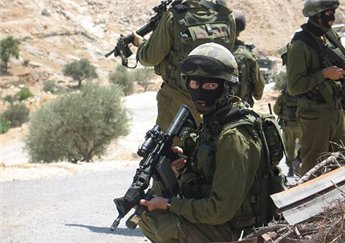 Israeli soldiers deploy during an arrest raid near Jenin [MaanImages, File]
JENIN – Israeli forces arrested two Hamas members in Jenin late Friday, local residents and security sources said.
Muhammad Ahmad Sokiyeh, 38, and Mahdi Hasan Hifawiyah, 34, were driving with their wives when “undercover” forces stopped their cars and took them to an undisclosed location, Palestinian security sources said.
The sources said Israel’s operatives opened fire in order to stop their cars. There were no reports of injury.
Sokiyeh has been wanted since 2005 and Hifawiyah has spent time in Israeli custody.
An Israeli military spokeswoman said there were no arrests in Jenin overnight.
Israeli occupation detains lawmaker Anwar Zaboun
Palestine Information Center – 26/08/2011
 BETHLEHEM — Israeli Occupation Forces (IOF) detained, Friday at dawn, Anwar Zaboun (45 years), member of the Palestinian Legislative Council, after raiding his home in the southern West Bank city of Bethlehem.
Local sources in the Bethlehem district said that a number of IOF troops aboard a number of military vehicles entered Bethlehem, they encircled the home of Anwar Zaboun, raided it and took the lawmaker away.
Zaboun was detained along with other Hamas PLC members in 2006 after occupation soldier Gilad Shalit was captured by Palestinian resistance. He was released about 18 months ago after serving a 49-month term.
With the arrest of Zaboun, the number of Hamas lawmakers detained by the Israeli occupation rises to 19, including lawmaker Muhammad Abu Juhaisha who was arrested a few days ago in al-Khalil.
The Israeli occupation has escalated its arrests of Hamas supporters in the southern West Bank districts of al-Khalil and Bethlehem after the Elat attack.
CIA censors ex-FBI agent’s 9/11 book
Press TV – August 27, 2011
The US Central Intelligence Agency (CIA) has expurgated extensive parts of a book by a former FBI agent on September 11, 2001 events in a bid to rewrite the history of post-9/11 America, a report says.
The CIA will not allow the full publication of a memoir by Ali H. Soufan, the former FBI agent that spent years near the center of the battle against al-Qaeda, The New York Times reported on August 25.
Soufan argues in the book that the CIA missed a chance to derail the 2001 incident by withholding from the FBI information about two 9/11 hijackers living in San Diego, the report says.
He also gives a detailed, firsthand account of the US spy agency’s move toward brutal treatment of detainees in its interrogations, saying the harsh methods were unnecessary and counterproductive.
Soufan, a counterterrorism agent that played a central role in many major terrorism investigations between 1997 and 2005, has told colleagues he believes the censored portions of his book are intended not to protect national security, but to prevent him from recounting episodes that reflect badly on the CIA.
In a letter sent on August 19 to the FBI’s general counsel, Valerie E. Caproni, a lawyer for Soufan, David N. Kelley, wrote that “credible sources have told Mr. Soufan that the agency has made a decision that this book should not be published because it will prove embarrassing to the agency.”
Soufan has called the CIA’s cuts to and editing of his book “ridiculous,” but said he thought he would prevail in getting them restored for a later edition.
He said he believed that counterterrorism officers have an obligation to face squarely “where we made mistakes and let the American people down.”
The book, entitled The Black Banners: The Inside Story of 9/11 and the War Against Al Qaeda has been written with the assistance of Daniel Freedman, a colleague at Soufan’s New York security company, and is scheduled to go on sale on September 12.
US government employees who hold security clearances are required to have their books vetted for classified information before publication. However, since decisions on what should be classified can be highly subjective, the prepublication review process often becomes a battle.
Several former US spies have gone to court to fight redactions to their books, and the Defense Department spent nearly $50,000 last year to buy and destroy the entire first printing of an intelligence officer’s book, which it said contained secrets, the report adds.
Featured Video
Laith Marouf: Hezbollah’s position on US-Iran ceasefire
or go to
Aletho News Archives – Video-Images
From the Archives
Is Israel to blame for the Iraq War?
American Goy | March 10, 2008
I am so tired of this old canard that “Israel had nothing to do with USA’s war with Iraq – in fact, it officially advised America against it”.
Bullshit. … continue
Blog Roll
 Aletho News
- Laith Marouf: Hezbollah’s position on US-Iran ceasefire: What you’re not being told
- Israel’s priority lies in destroying chances of peace between Iran, US: Ex-UN nuclear chief
- Ceasefire for all or for none: Iran shuts Hormuz over Lebanon attacks
- Strait of Hormuz is Iran’s ‘nuclear weapon’ that forced US retreat: Medvedev
- Energy crisis will last for months – Kremlin envoy
- Europe’s quiet role in the war on Iran
- Forty days that shook the Empire: How Iran turned the tables on US and prevailed
- Netanyahu unilaterally declares Lebanon outside of ceasefire deal
- Israeli leaders: ‘Not a single goal’ achieved in war with Iran
- What on earth just happened? Trump, Iran, and the unlikely ceasefire
- If Americans Knew
- Gazans face a triple crisis: severe shortages of water and bread, healthcare in tatters
- NY Times reports how Netanyahu took the US into Iran War
- A sigh of relief over Iran, but Gaza and Lebanon in dire straits – Daily Update
- Thousands dead and neighborhoods razed to the ground: Aid agencies fear southern Lebanon is becoming the new Gaza
- The war the US is fighting for Israel could cost trillions
- ‘Cigarette Burns, Nail Wounds’: Toddler Tortured in Gaza to Coerce Father
- Trump Says US Sent ‘a Lot of Guns’ to Protesters in Iran
- Israeli forces destroy 17 UN peacekeeper cameras in south Lebanon
- US-Israeli strikes ‘completely destroy’ synagogue in Tehran
- Archbishop for US Military Says Iran War Is Unjust Under Catholic Teaching
- No Tricks Zone
- An Inconvenient Tree: Uncovered In Alps… Europe Much Warmer Than Today 6000 Years Ago
- New Study Reports A 60% Slowdown In Greenland’s Ice Loss Rate In The Last Decade
- Low Intensity Tornado Wrecks Major Solar Farm, Creating A Potential Toxic Dump
- New Study Finds Warming Saves Lives…Cold Temperatures 12 Times More Deadly Than Excess Heat
- German Science Blog Accuses PIK Climate Institute Of Hallucinating Climate Tipping Points
- Devastating Assessment Of Comirnaty Vaccine By Former Senior Pfizer Europe Toxicologist
- New Study: CO2 Is ‘Effectively Negligible’ As An Explanatory Climate Change Factor Since 2000
- Former Pfizer Toxicologist Dr. Helmut Sterz Tells Bundestag Hearing Pfizer Vaccine Should Have Never Been Approved
- Energy Expert: Germany’s Nuclear Phaseout Was A “500 Billion Euro Mistake”
- New Research: South Australia’s Mid-Holocene Sea Surface Temperatures Were 4°C Warmer Than Today
 Aletho News