French giant Veolia cut down to size for abusing Palestinian rights
Maren Mantovani and Michael Deas – The Electronic Intifada – 26 August 2011
The French corporation Veolia once appeared unassailable; today it is ailing. It is faced not only with the global economic crisis but also the growing impact of the boycott, divestment and sanctions (BDS) campaign against its involvement with Israeli apartheid infrastructure and transport projects. A recent merger between Veolia’s transport division and a subsidiary of the main French state investment fund indicates French industry and government have united to find a simple solution to Veolia’s problems: let the taxpayers finance Veolia’s income losses — and its complicity with Israeli war crimes and human rights abuses against the Palestinian people.
On 4 August, Veolia management held a conference call with major financial analysts to defend the company’s latest figures. It wasn’t an easy task. Veolia’s management was forced to gloss over the terrible financial situation of the group that has forced it to draw up sharp cost reduction plans, initiate a complete restructuring of management, plan the pullout from more than forty countries and search for more investors to cover a high debt.
Veolia has lost more than 50 percent of its share value since March 2011, according to tear sheet data from The Financial Times (“Marketdata: Veolia Environnement Ve SA,” accessed 25 August 2011).
However, among the underlying financial data discussed — €67 million ($96 million) in net loss during the first half of this year; €15 billion ($21.6 billion) net debts; €250 million ($360 million) yearly cost reduction — one number did not come up: the massive financial damage the company has faced at the hands of the BDS movement. Since the beginning of the Palestinian-led campaign in 2005, Veolia has lost contracts worth more than €10 billion ($14 billion) following high profile campaigns.
Veolia’s chief financial officer Pierre-Antoine Riolacci had to admit that its municipal services are suffering a downturn in some countries “in particular with pressure on the downside, namely in the UK where things are rather difficult.”
Ignoring London loss
Surely the CFO had heard the news from across the English Channel the day before the conference call, where Veolia had failed to be selected for a £300 million ($493 million) contract by Ealing Council in London following a determined campaign by the local branch of the Palestine Solidarity Campaign.
The worldwide campaign against Veolia was initiated in response to the company’s five percent stake in the consortium that is constructing the light rail project that links West Jerusalem with illegal Israeli settlements in occupied East Jerusalem and the surrounding West Bank, thereby cementing Israeli colonization and creating the necessary infrastructure for its further expansion. Moreover, Veolia holds a thirty-year contract for the operation of its first line, due to open later this month. Veolia and its subsidiaries also operate bus services, waste management and a landfill all deep within the occupied West Bank, and all for the use of Israeli settlers. All of these projects contribute to war crimes, as defined by the Fourth Geneva Convention and the Rome Statute of the International Criminal Court.
Refusal to withdraw from Israel
Despite its apparent desperation to reduce costs, Veolia has yet to implement the most effective cost reduction strategy it could: including Israel in the list of countries it plans to withdraw from. Rather than divesting from Israeli colonization of Palestinian land, Veolia is turning to the French state for financial assistance, involving public money in operations abetting Israeli war crimes.
This spring Veolia Transport merged with Transdev into a newly created company Veolia Transdev (“Veolia Transdev: Creation of the world’s leading private-sector company in sustainable mobility,” press statement, 3 March 2011).
Transdev was a subsidiary of the French Caisse des Dépôts (CDC), a public investment authority that manages public funds and is overseen by the French parliament. The CDC is now a 50 percent partner in the newly created Veolia Transdev transport company. According to Veolia’s Pierre-Antoine Riolacci, the entrance of Transdev intp the group has allowed Veolia to “cut back our debt by €159 million [$229 million].” The degree to which Veolia Transdev has come under the protection of the French state is evident in the fact that during the conference call, Veolia Transdev issues were directly dealt with by the CDC’s chief executive Jerome Gallot.
On its website, CDC boasts that it exists to “serve the general interest and the economic development” of France. But pumping French tax money into Veolia to make up for its financial troubles, thus allowing it to push forward projects that serve illegal Israeli population transfers into occupied Palestinian territory, is unlikely to help attain either goal. Moreover, the Jerusalem light rail project contradicts French government policy that East Jerusalem should be the capital of a future Palestinian state. Promoting the project in 2005, then Israeli Prime Minister Ariel Sharon stated, “This [light rail] should be done … to strengthen Jerusalem, construct it, expand it and sustain it for eternity as the capital of the Jewish people and the united capital of the state of Israel.”
Even before its partial ownership of Veolia Transdev, CDC was involved in the light rail project through its subsidiary Egis Rail, which won a contract in 2008 to assist with managing the project. The current role of Egis Rail is unclear.
Private companies have long been heavily involved in Israeli violations of Palestinian human rights, such as building and maintaining the illegal settlement infrastructure, and the wall built on Israeli-occupied Palestinian land in the West Bank. But by investing in Veolia, the French government is bucking a recent European trend of governments to start ensuring public enterprises and institutions are not complicit with Israeli violations of international law.
The German government recently responded to public pressure by taking steps to end the state-owned company Deutsche Bahn’s involvement in the construction of a train line from Jerusalem to Tel Aviv passing through the occupied West Bank. Explaining its intervention, the German transport ministry pointed to the “potentially illegal” nature of the project and the fact that it is inconsistent with government policy toward Israel and the Palestinians (“Letter from German government to Die Linke parliamentarian concerning A1 train project,” 10 May 2011). The German foreign ministry has admirably published an alert on its website warning German companies about the potential legal consequences of Israeli projects in the occupied West Bank (“West Bank, Economy”).
Precedents set by other European capitals
The Norwegian government took a precedent-setting step when it excluded Elbit Systems from its investment portfolio. Elbit is an Israeli arms company involved in the construction of Israel’s illegal wall in the West Bank. It subsequently also excluded Africa Israel and Danya Cebus, two companies which build illegal Israeli-only settlements in the West Bank (“Norwegian government pension fund excludes more Israeli companies,” 23 August 2010).
The British government also took a stand on the issue when, in 2009, the foreign ministry pulled out of a deal to rent office space for its embassy in a building owned by Lev Leviev, the Israeli diamond tycoon who owns Africa Israel and finances development of illegal settlements in the West Bank. The British government also withdrew export licenses to Israel from UK arms companies that provided the Israeli military with weapons or components that have been used during the winter 2008-09 attacks on the Gaza Strip (“Israel arms licenses revoked by Britain,” The Huffington Post, 13 July 2009).
In September 2009, the Spanish government excluded Ariel university from a state-sponsored architecture competition after having become aware that it was located in an illegal settlement.
The French government, however, has so far failed to take action to end such complicity. By doing so, France is not only undermining important precedents set by its allies. It also violates its obligations under international law and the voluntary commitments it has made regarding good governance and corporate social responsibility.
France must honor obligations
When the International Court of Justice ruled on the illegality of Israel’s apartheid wall and related infrastructure in the occupied West Bank, it also ruled that third party states are obliged not to aid or assist the maintenance of the unlawful situation created by Israel or infringements of the right to Palestinian self-determination. Two companies owned by the French state fund CDC — Veolia and Egis Rail — are involved with and profit from such unlawful acts. This calls France’s commitment to international law into question.
In June, the United Nations Human Rights Council approved its new Guiding Principles for the implementation of the Protect, Respect and Remedy Framework, designed to help states and businesses understand their duty to prevent corporate abuse of human rights and their obligations under international law (“Guiding Principles on Business and Human Rights: Implementing the United Nations ‘Protect, Respect and Remedy’ Framework,” 21 March 2011).
According to these principles, “states should take additional steps to protect against human rights abuses by business enterprises that are owned or controlled by the state … [including by] denying access to public support and services for a business enterprise that is involved with gross human rights abuses and refuses to cooperate in addressing the situation.”
Involvement in the light rail project also violates the Organization for Economic Cooperation and Development’s guidelines on multinational companies. Considering that Paris is the seat of the OECD, this is particularly ironic (“OECD Guidelines for Multinational Enterprises,” 2008 [PDF]).
The OECD guidelines call for companies to “respect the human rights of those affected by their activities consistent with the host government’s international obligations and commitments.” Israel’s settlements and associated infrastructure violate several key international law treaties, including the Fourth Geneva Convention, the International Covenant on Economic, Social and Cultural Rights and the International Covenant on Civil and Political Rights, all of which have been ratified by Israel and France.
The French government has become a shareholder in Veolia in full knowledge of that company’s role in supporting Israeli occupation and colonization of Palestinian land. The principal victims of this French policy are the Palestinian people. However, this development should also be of concern to all those who believe in the importance of a functioning system of international law and the implementation of human rights standards. The French people, whose taxes have financed the Veolia Transdev merger, should be especially concerned.
It will be up to campaigners in France and all around the globe to stop governmental buy-ins to illegal operations of private or state enterprises. It will be their task to ensure that the Transdev deal will not be enough to shield Veolia from the impact of the BDS movement’s demand for accountability. The group is in financial trouble and its CFO has admitted that Veoila is losing municipal service contracts in cities and regions that have seen meticulous grassroots campaigning. In December, Veolia will present the full list of countries which it is leaving (“Veolia to leave 37 countries as loss spurs quicker revamp,” Bloomberg, 4 August 2011).
This might be another chance for the company to show that it has learned that failure to respect human rights and the Palestinians’ right to self-determination comes with a price.
Maren Mantovani is coordinator for international relations with Stop the Wall, the Palestinian Grassroots Anti-Apartheid Wall Campaign.
Michael Deas is Europe coordinator for the Palestinian Boycott, Divestment and Sanctions National Committee (BNC).
Western press and addressing grievances in Gaza
By Mohammed Suliman – The Electronic Intifada – 08/26/2011
In 2006, the Israeli authorities imposed an overall siege on the Gaza Strip forcing 1.6 million Palestinians to live under miserable conditions. Since then, Gaza, depending on the degree of instability in the area, has been largely covered in the world media, sometimes enjoying the status of a quasi-main theme.
However, many of these subjects dealt with by the Western press are quite unimportant to deal with publicly. The only importance they have seems to be that of their context.
One needs though to be as critical as not to fall victim to any deliberate misrepresentation of facts or any other well-handled, yet ill-timed treatment of any of these controversial subjects.
The real oppressor of Gaza women’s rights
Only last night, a fellow journalist and I had an argument over the recently recurring theme in the Western press of the oppression of women’s rights in the Gaza Strip. We both came to an agreement that one can confidently state women’s rights are flagrantly abused in Gaza but, unlike how Western press tends to show it, the question remains who the real oppressor of women’s rights in Gaza is.
The issue of women’s rights in Gaza is one part of a larger— to avoid the word “propaganda”— misinformation scheme that should be seen as an attempt to divert the world’s attention from the indispensable issues which need to be constantly and unfalteringly addressed in the Western press.
Take this for example. “Sorry, Hamas, I’m wearing blue jeans” is an article that, on the surface of it, seems to be a credible and well intentioned attempt to encapsulate how women’s rights are abused a daily basis in Gaza by the government, the people, their religion and customs. It features the resentment of “a defiant Palestinian feminist from Gaza reflect[ing] on being secular in a religious land.”
Reading through the article, one can’t but feel irritated at the blatantly Orientalist character of it. It is indeed one of the most deeply flawed and misrepresentative articles that falls into this exact category of misinformation that I have spoken of earlier.
I will not go further to reply to this article since the real resentment felt toward it and generated by its blatant inaccuracy has already been highlighted by several responses which none has written but Palestinian women (and men) from Gaza refuting its baseless arguments and countering what it displays as “facts”.
The unfortunate “Gaza Youth Manifesto”
Likewise, recently a group of Palestinian youth from Gaza has issued a “manifesto” on their Facebook page called Gaza Youth Breaks Out. It outstandingly highlighted the anger and frustration that have grown so immense inside the chests of young Gazans that they cannot be any longer suppressed. Unluckily, however, its writers poured out their fury indiscriminately at every possible cause they deemed as conducive to their miserable conditions instead of carefully underlining the principal source and prime perpetrator of this unendurable suffering.
Hence, the true causes for this suffering, i.e. Israel, its 2008/09 invasion of the Gaza Strip, the five-year relentless blockade, and its daily heinous crimes against Palestinian civilians, were (unintentionally, I assume) relegated and not as much accentuated as the uncommendable behavior of the Hamas government in Gaza toward its people which replaced Israel as the originator of Gaza’s youth distress.
That said, the GYBO manifesto has received worldwide attention from Western press and media outlets including the Guardian and the BBC. But did any of them take the time to listen to the grievances the manifesto itself prompted in a considerable portion of Gaza’s youth due to its misguided content and damaging quality?
Of course, not. Because simply that is what Western press had been looking for and now that it rose from within Gaza youth itself, they wouldn’t hesitate to embrace this unfortunate manifesto. (Note: under great deal of criticism, the group had to issue a second manifesto, which appears on the group’s Facebook page).
Whether deliberate or not, digressions as such only harm the Palestinians and are aimed at diverting the world’s attention from the base injustice the Palestinians are forced to live under besides the daily crimes committed against them by the Israeli armed forces. Moreover, they do seem to attract the attention of an audience, that has become used to prosaic coverage of continuous and flagrant Israeli violations of basic human rights.
Still, this does not mean issues of human rights’ abuses should be disregarded. The suppression exercised by the government and other violations of human rights should always be brought to light to help fight against it.
But there is still a huge difference between objective reporting of incidents of human rights violations and other obviously subjective and unrepresentative or misleading publications.
The “rising middle class” and addressing minor grievances
Similarly, a newly published Associated Press feature story throws light on the widening gap between a very tiny (rising?) middle class and the majority of the people who live under the poverty line, as the article illustrates.
Well-written, objective, and supported with facts and figures as it might seem, the article should nonetheless be dismissed as misleading and lacking in analytical interpretation necessary to explain the real origins of the discontent the people of Gaza have.
“A budding middle class in the impoverished Gaza Strip is]…[fueling perhaps the most acrimonious grass roots resentment yet toward the ruling Hamas movement.”
The introductory statement of the article is inaccurate since, from the beginning it presupposes the presence of this “resentment” toward the Hamas government in Gaza, and it doesn’t go further to place this feeling within its greater context which is that of the Israeli occupation and its blockade of the Gaza Strip.
The only and real grievances the people of Gaza have are those toward Israel and its blockade of the Gaza Strip which has fueled in them so much anger and despair to the extent that, like the GYBO, they started to resent everything around them, on the top of which is the Hamas government. So even this sense of dissatisfaction toward the government is basically a form of grievous indignation toward Israel itself.
Quite normally people would hate the government under whose control they have had to endure the most miserable conditions. It is true the government in Gaza isn’t doing enough to at least alleviate the people’s Israeli-inflicted suffering. It’s also true that there is too much corruption inside the government itself to be concealed or ignored any longer, but trying to make these issues the prime source of people’s anger is dubious since it ignores the fact that what people are enraged about, above all things, is the Israeli siege.
However, since this siege is something the people of Gaza have started to take for granted, criticizing the government, blaming it, and feeling resentment toward it has become a trend. It has become much easier and, indeed, practical for them. (One feels obliged to praise Israel for having relieved itself of the burden of taking responsibility for the people it occupies).
Although, the article makes it clear the majority of the people are discontented and frustrated, at some point it seems to ridiculously question the fact that there is a humanitarian crisis in Gaza while there are others— a very small minority— who live in self-indulgence. It also never accounts for the so called “rise of the middle class” in Gaza except by simplistically relating it to the attitudes of the Hamas government and the “corruption” of some of its “loyalists”.
The only thing this article seems to do is deflect the readers’ attention from the real origins of frustration in Gaza represented by Israel’s overall inhuman policy toward the Palestinians to few, indeed, unimportant issues.
Israel’s siege and crimes are always the issue
While in other countries, which seem to enjoy wealth and maintain stability, suppression is exercised by governments on a larger scale and women’s rights are abused at a more serious level, little attention is paid to them. Likewise, the grievances toward an assumed middle class rise in Gaza is a completely preposterous issue to discuss when only a few days ago Israeli airstrikes killed 15 Palestinians in the Gaza Strip. (update: 11 Palestinians were killed in Israeli airstrikes during the past two days).
At a time when the people of the Gaza Strip, both wealthy and poor, are woken from their sleep by Israeli warplanes bombing their neighborhoods, grievances, suffering and anger of this sort is all what the world needs to know about Gaza.
Seeking Social Justice Through Education in Chile
By Ramona Wadi | Upside Down World | 25 August 2011
 The ongoing student protests in Chile are an unwavering accomplishment aimed at combating the social injustice riddling the country’s education system. What started out as a series of peaceful protests has become a manifestation of unity between students, artists and much of the general population in a stance defying the current government’s position regarding social class, cultural difference and political division with regard to education.
Upon assuming power in a military coup that ousted President Salvador Allende, General Augusto Pinochet implemented a series of policies that spelled poverty for the working class. To this day, remnants of the military dictatorship are evident in Chile. Upon Milton Friedman’s advice, Pinochet altered the education system in Chile. Responsibility for public schooling was transferred from the Ministry of Education to public municipalities. Private schools were financed by the voucher system in proportion to student enrollments. The elite families began enrolling their children into schools which charged for enrollment. No effort was made on behalf of the government to improve the curriculum, education quality or management, resulting in a society which, for decades had to contend with social class division within education.
Private universities meant excessive tuition fees, causing students and their families to incur debts whilst education quality was barely improved. Universities were mostly attended by students from the middle class and higher income families. Impoverished areas had no access to quality education, with low income families obliged to send their children to public schools where no incentives, such as better working conditions for teachers were offered, to promote and enhance student educational performance. Discrepancy in Chile’s education system led to society incurring yet another split. The current system exploits class as well as cultural differences. Low income families have no option but to send their children to public municipal schools. Mapuche people living in rural areas having to contend with an inferior education as well as lack of intercultural awareness.
Students are demanding the state assumes responsibility to provide free education and broader access to education. The students’ proposals include eliminating the business concept of education, ensuring the quality of public education, the creation of an education system which falls under the responsibility of the Ministry of Education and ensuring educational rights for Chile’s indigenous people.
Protests have ranged from sit-ins, to barricades and marches, as well as hunger strikes as a mark of resistance. Hunger strike protestors have read statements holding the government responsible for their plight. Cacerolazo protests (a common form of protest in Latin American countries which involves banging on pots with kitchen utensils) have also gained ground within the movement and Chilean society. This form of protest, which can even be performed from home, has achieved a high level of solidarity with the student protestors.
Thousands of students in Santiago clashed with the police as force was used in an attempt to restore what the state defines as public order. The students were met with tear gas, water cannons and rubber bullets. In what may be portrayed as another relic of the dictatorship some protests were deemed illegal, citing the lack of a permit allowing students to demonstrate.
 Camila Vallejo, spokesperson for the student’s movement described the state repression as a great mistake, adding that the student movement was not intimidated by threats and encouraging the students to persist in their various forms of protest.
President Sebastian Piñera’s attempts to appease the students have been rejected outright. In a televised speech, Piñera’s proposals, including a cabinet reshuffle and an annual education fund used to support public education, were dismissed as not addressing the students’ concerns and demands. While the students were calling on the government to end private education schemes, Pinera declared that nationalizing the education system would damage quality and freedom of education.1
The second attempt at reform was the government’s 21 point plan2, which was once again swiftly rejected by the students. The right to a quality education, promoting student involvement, promoting multiculturalism in higher education and an inclusive admission system were listed amongst the proposals being branded as reform.
The discrepancies in Piñera’s proposals highlight Chilean divisions. There is no mention of state takeover of education; hence the right to a free quality education for all society remains debatable. Education administered by the private sector remains the estate of the privileged, enforcing further gaps within Chilean society. Student involvement in education remains a distant objective, as protests continue to be met with force. Multiculturalism awareness and inclusive admission border on illusion when considering the intolerance and abuse of human rights suffered by indigenous people.
As a result of state repression against indigenous people, the Mapuche have been subjected to discrimination. Apart from the anti terror law, which allows the state to prosecute Mapuche in a military court, the community has been subjected to cultural repression. Yonatan Cayulao, leader of the Mapuche Federation of Students has proposed a Mapuche University3, stating that Chilean education has marginalized indigenous people in its quest to create a homogeneous nation. The Mapuche University would allow the community to protect their culture within their own environment.
In the latest turn of events, Camila Vallejo was reported to have delivered a letter4 to President Piñera, challenging the president to a transparent debate and urging him to acknowledge education as a universal right instead of a consumerism scheme, as he had previously announced. The letter denounced student segregation under the current education system and called for education to be guaranteed constitutionally ‘as a social law’.
Reminiscent of the past is the way nueva canción singers are uniting once again in support of Chileans. In a message broadcast on You Tube5, Inti Illimani’s Jorge Coulon reiterated his support for the students. “We admire and respect tremendously the current student movement in Chile and we are glad to participate in it since they (the students) are not only writing, but rewriting the history of Chile, which is full of episodes in which the students have been fundamental. The present time is one of them, and you – the students, are playing a leading role in this history.”
Pinochet’s influence in Chilean democracy is never far from the people’s consciousness. Each year Chile’s September 11th anniversary is marked with violent incidents and manifestations – a reminder that justice remains a remote illusion for many victims of the military dictatorship. With the protests set to continue, talk emerges regarding the possibility of the army being deployed against the students if the protests continue up to that date.
An issue which portrays the social injustice incited by Pinochet is the attitude of Chileans towards state violence. In a conversation with Julieta, a local anthropology student, I was told “In Chile, because we are accustomed to police violence, we have naturalized this violence that we receive.” The memory of the military coup is far from being relegated to the confines of history. With a democracy that molds itself on past legislation, the concept of freedom and dignity for Chileans remains a battle to be fought from many societal aspects and the struggle for free education seems to have ignited the memory of the past to be combated in the contemporary realm.
Ramona Wadi is a freelance writer living in Malta. Visit her blog at http://walzerscent.blogspot.com.
Notes:
2. http://www.mineduc.cl/index2.php?id_portal=1&id_seccion=10&id_contenido=15546
3. http://www.unpo.org/article/13030
4. http://www.nuestrocanto.net/joo/index.php?option=com_content&view=article&id=2013%3Acarta-de-la-confech-al-presidente-sebastian-pinera&catid=36%3Achile
5. http://www.youtube.com/watch?v=itfa8lqaSfk&feature=youtu.be
On Al-Quds Day, marches in Middle East call for liberating all of Palestine
Al-Manar | August 26, 2011
Massive rallies for commemorating International Al-Quds Day have taken place Friday in various countries including Iran, Egypt, Iraq, Turkey, Kuwait, Bahrain, as well as Gaza and the West Bank in occupied Palestine.
In the Islamic Republic of Iran, massive marches took place in various provinces, where people raised slogans like “Death to America”, “Death to Israel”, as well as pictures for Leader of the Islamic Revolution Imam Ruhollah Khomeini, Ayatollah Sayyed Ali Khamenei, and Hezbollah and the Palestinian resistances’ flags.
They chanted in support of Al-Quds and against all the Judaization conspiracies that the Zionist entity is executing against the sacred city.
For his part Iranian President Mahmoud Ahmedinejad delivered a speech before a crowd of commemorators in Tehran, in which he assured that Al-Quds Day is a day that revives human dignity, indicating that the Zionist entity is the axis of the unity of thieves in the world.
“The Zionist entity’s role is to spread incitement in the region and blocking any kind of development,” Ahmedinejad added.
Regarding the regional situation, the Iranian President emphasized that the right of self-determination, freedom, and spreading justice could not be attained with the assistance of the NATO forces or American military tanks. He further reassured that the West or the Zionist Entity will fail to have any Power in the new Middle East.
In Iraq, thousands of Iraqis, regardless of sect or affiliation, rallied in commemoration of Al-Quds Day. The Marchers called for the liberation of Al-Quds, and assured that it is the central cause for the region. Iraq furthered witnessed various conferences about Al-Quds and the importance of unity in order to defeat the Zionist entity and regain the Islamic Sanctity.
In parallel, millions of Egyptians demonstrated Friday near the Israeli embassy in response to Egyptian political and youth parties’ invitations for marches of millions, calling for the expulsion of the Israeli ambassador from their country.
The protestors raised Palestinian flags, pictures of late Egyptian President Jamal Abdul Nasser, and slogans against the occupying entity, including “We take part in Al-Quds Day to liberate Palestine”. They further called for ending diplomatic relations between Egypt and the Zionist entity, and reconsidering the application of the Camp-David accord.
In addition, Media reports have pointed out that demonstrators will return to the streets after the Iftar dinner and prayers, and will continue to protest until an official decision is issued regarding their demands.
The Ghosts of Empire Are Returning To Haunt Britain – and the US
By Johann Hari – May 28, 2009
In a few weeks, a group of quiet, dignified elderly men and women will arrive in London to explain how the forces of the British state crushed their testicles or breasts with pliers. It was part of a deliberate policy of breaking a civilian population who we regarded as “baboons”, “barbarians” and “terrorists.” They will come bearing the story of how Britain invaded a country, stole its land, and imprisoned an entire civilian population in detention camps – and they ask only for justice, after all this time.
As a small symbol of how we as a country have not come to terms with our history, compare the bemused reaction to the arrival of these Kenyan survivors of Britain’s gulags to the recent campaign supporting the Gurkhas. We have all waxed lyrical over the Nepalese mercenaries who were, for two centuries, hired by the British Empire to fight its least savory battles. Sometimes they were used in great causes, like the defeat of Nazism. Sometimes they were used to viciously crush democratic movements in India or Malaya or Pakistan. But they obediently did the bidding of the Empire – so they are a rare bunch of foreigners who the right will turn moist over and welcome to our island.
I too strongly supported their rights to reside in Britain, out of simple humanity – if they’re good enough to die for us, they’re good enough to live with us. But isn’t it revealing that even in 2009, we can cheer the servants of Empire but blank the people mutilated and murdered by it? There will be no press campaigns or celebrity endorsements for the survivors of the Kenyan suppression when they issue a reparations claim in London next month. They will be met with a bemused shrug. Yet their story tells us far more.
The British arrived in Kenya in the 1880s, at a time when our economic dominance was waning and new colonies were needed. The Colonial Office sent in waves of white settlers to seize the land from the local “apes” and mark it with the Union Jack. Francis Hall was the officer of the East India Company tasked with mounting armed raids against the Kikuyu – the most populous local tribe – to break their resistance. He said: “There is only one way of improving the [Kikuyu] and that is to wipe them out; I would only be too delighted to do so but we have to depend on them for food supplies.”
The British troops stole over sixty thousand acres from the Kikuyu, and renamed the area “the White Highlands.” But the white settlers were aristocratic dilettantes with little experience of farming, and they were soon outraged to discover that the “primitives” were growing food far more efficiently on the reserves they had been driven into. So they forced the local black population to work “their” land, and passed a law banning the local Africans from independently growing the most profitable cash crops – tea, coffee, and sisal.
The people of Kenya objected, and tried to repel the invaders. They called for “ithaka na wiyathi” – land and freedom. After peaceful protests were met with violence, they formed a group, dubbed the Mau Mau, to stop the suppression any way they could. They started killing the leaders appointed by the British, and some of the settlers too. As a result, the London press described them as “evil savages” and “terrorists” motivated by hatred of Christianity and civilization. They had been “brainwashed” by “Mau Mau cult leaders”, the reports shrieked.
The 1.5 million Kikuya overwhelmingly supported the Mau Mau and independence – so the British declared war on them all. A State of Emergency was announced, and it began with forced removals of all Kikuyu. Anybody living outside the reserves – in any of the cities, for example – was rounded up at gunpoint, packed into lorries, and sent to “transit camps”. There, they were “screened” to see if they were Mau Mau supporters. One of the people locked up this way for months was Barack Obama’s grandfather.
Professor Caroline Elkins, who studied the detention camps for five years for her remarkable book ‘Britain’s Gulag: The Brutal End of Empire in Kenya’, explains the tactics adopted by the British to snuffle out Mau Mau. “Electric shock was widely used, as well as cigarettes and fire,” she writes. “Bottles (often broken), gun barrels, knives, snakes, vermin and hot eggs were thrust up men’s rectums and women’s vaginas. The screening teams whipped, shot, burned, and mutilated Mau Mau suspects.”
The people judged to be guilty of Mau Mau sympathies were transferred to torture camps. There, each detainee was given a number which they had to wear on a band on their wrist. They were then stripped naked and sent through a cattle dip, before the torture would begin again. “Detainees were frog-marched around the compound and beaten until blood ran from their ears,” Elkins writes.
The Kikuyu survivor Pascasio Macharia describes some of the tortures he witnessed: “The askaris [guards[ brought in fire buckets full of water, and the detainees were called on by one, [my friend] Peterson first. The asakaris then put his head in the bucket of water and lifted his legs high in the air so he was upside down. That’s when [one of the camp commandants] started cramming sand in Peterson’s anus and stuffed it in with a stick. The other askari would put water in, and then more sand. They kept doing this back and forth… Eventually they finished with Peterson and carried him off, only to start on the next detainee in the compound.”
Another favoured torment was to roll a man in barbed wire and kick him around until he bled to death. Typhoid, dysentery and lice sycthed through the population. Castration was common. At least 80,000 people were locked away and tortured like this. When I reported from Kenya earlier this year, I met elderly people who still shake with fear as they talk about the gulags. William Baldwin, a British member of the Kenya Police Reserve, wrote a memoir in which he cheerfully admits to murdering Kikuya “baboons” in cold blood. He bragged about how he gutted them with knives while other suspects watched. Another British officer, Tony Cross, proudly called their tactics “Gestapo stuff.”
For the civilians outside, life was only slightly better. Women and children were trapped in eight hundred “sealed villages” throughout the countryside. They were surrounded by barbed wire and armed guards, and forced at gunpoint to dig trenches that sealed them off from the world.
There was always another, honorable Britain who fought against these crimes. The Labour left – especially Barbra Castle and Nye Bevan – fought for the camps to be exposed and shut. They didn’t succeed until the British imperialists were finally forced to scuttle away from the country entirely. We will never know how many people they murdered, because the colonial administration built a bonfire of all the paperwork on their way out the door. Elkins calculates it is far more than the 11,000 claimed by the British government, and could be as many as 300,000.
Yet in Britain today, there is a blood-encrusted blank spot about Empire. On the reality show The Apprentice, the contestants recently had to pick a name for their team, and they said they wanted “something that represented the best of British” – so they settled on “Empire.” Nobody objected. Imagine young Germans blithely naming a team “Reich”: it’s unthinkable, because they have had to study what their fathers and grandfathers did, and expunge these barbarous instincts from their national DNA.
This failure to absorb the lessons of Empire is not only unjust to the victims; it leads us to repeat horrifying mistakes. Today, we are – with the Americans – using unmanned drones to bomb the Pakistan-Afghan borderland, as we did a few years ago in Iraq. Nobody here seems to remember that the British invented aerial counter-insurgency in this very spot – with disastrous consequences. In 1924, Arthur ‘Bomber’ Harris bragged that all rebellion could be stopped with this tactic. We have shown them “what real bombing means, in casualties and damage: they know that within 45 minutes a full-sized village can be practically wiped out and a third of its inhabitants killed,” he said. Yet instead of “pacifying” them, it radically alienated the population and lead to an uprising. If we knew our history, we would not be running the same script and expecting a different ending.
Gordon Brown said last year (in India, of all places) that “the days of Britain having to apologise for its colonial history are over.” The survivors of England’s blanked-out torture camps are entitled to ask: when did we start?
To read my series of articles criticizing the imperialist historians Niall Ferguson and Andrew Roberts, click here, here and here.
Johann Hari is an award-winning journalist who writes twice-weekly for the Independent, one of Britain’s leading newspapers.
Locals can own land now in Sinai according to new law
Ahram Online | 23 August 2011
The Egyptian Cabinet has issued a new law that permits the locals in Sinai to own land there, after years of denying them this right for security reasons. The cabinet also decided in a meeting to set up the Special Supreme Council for Developing Sinai, with an independent budget and jurisdiction, dedicated to the integrated development of the peninsula.
The new council’s headquarters will be in Sinai and its chairman will report directly to the prime minister.
The government has also decided to set up a new public university in North Sinai, and to issue a license for a private university in South Sinai. Moreover, the government will develop major roads in Sinai to improve tourism in the peninsula.
The government has decided to issue a quota for the employment of Sinai’s locals in public and private companies and projects.
It is also considering setting up a new governorate in the middle of the Sinai peninsula, as this zone in particular suffers from poverty.
Israel kills six Gazans in 24 hours
Press TV – August 25, 2011
Medical sources in the Gaza Strip say at least six people have been killed in Israeli attacks against the coastal sliver in the past 24 hours.
Five people were killed and 30 others wounded in a series of pre-dawn Israeli attacks that continued into the early hours of Thursday, AFP Adham Abu Selmiya, a spokesman for Gaza’s emergency services, as saying.
Among the killed were two members of the Islamic Jihad Movement identified as Ismail al-Asmar, 34, and Ismail Amum, 65.
Asmar was killed when his vehicle was targeted by an Israeli missile on Wednesday morning in the southern city of Rafah. Amum’s body was also found after he was killed in an earlier strike near Deir al-Balah in central Gaza.
Another Jihad activist, 20-year-old Atiya Muqat also lost his life in an Israeli attack on Wednesday evening and a separate attack on Rafah killed a civilian working inside Gaza’s underground tunnels across the Egyptian border.
Israel continued its attacks on the beleaguered Gaza Strip on Thursday morning, when its warplanes pounded a sports hall in the northern town of Beit Lahiya, killing a civilian and wounding another 20.
Hours later, a civilian critically wounded in Beit Lahiya died due to the severity of his injuries.
Tel Aviv has threatened more attacks on the Gaza Strip, which has been under an all-out Israeli siege tightened since 2007.
Israel has stepped up its airstrikes against the besieged Gaza Strip over the past few days, killing more than 20 people in the Palestinian coastal sliver and leaving scores more injured.
Don’t look away from Kashmir’s mass graves and people’s struggle
By Ali Abunimah – The Electronic Intifada – 08/24/2011
Last Summer, during a massive unarmed revolt against Indian rule in Kashmir, the writer Pankaj Mishra posed the following question about the situation in the territory. It remains as valid today as a year ago – especially after the recent discovery of thousands of bodies in mass graves:
Once known for its extraordinary beauty, the valley of Kashmir now hosts the biggest, bloodiest and also the most obscure military occupation in the world. With more than 80,000 people dead in an anti-India insurgency backed by Pakistan, the killings fields of Kashmir dwarf those of Palestine and Tibet. In addition to the everyday regime of arbitrary arrests, curfews, raids, and checkpoints enforced by nearly 700,000 Indian soldiers, the valley’s 4 million Muslims are exposed to extra-judicial execution, rape and torture, with such barbaric variations as live electric wires inserted into penises.
Why then does the immense human suffering of Kashmir occupy such an imperceptible place in our moral imagination? After all, the Kashmiris demanding release from the degradations of military rule couldn’t be louder and clearer. India has contained the insurgency provoked in 1989 by its rigged elections and massacres of protestors. The hundreds of thousands of demonstrators that fill the streets of Kashmir’s cities today are overwhelmingly young, many in their teens, and armed with nothing more lethal than stones. Yet the Indian state seems determined to strangle their voices as it did of the old one. Already this summer, soldiers have shot dead more than 50 protestors, most of them teenagers.
The tolls of last summer’s unarmed uprising, violently suppressed by Indian forces with live fire, eventually rose to more than 100. And, though Kashmir is even less in the headlines today, protests and abuses – particularly the arrests and mistreatment of teenage boys – continue.
For decades, until today, the two-thirds of Kashmir under Indian control has been ruled under the Armed Forces Special Powers Act, emergency rule as repressive as the worst Arab dictatorship.
Mass graves uncovered
If all the suffering of the living in Kashmir has not succeeded in awakening international concern, the recent revelations of mass graves must. Amnesty International reported on 22 August:
Following a report by a police investigation team, confirming the existence of unmarked graves containing bodies of persons subject to enforced disappearances, urgent action needs to be taken including preserving the evidence and widening the investigation across Jammu and Kashmir said Amnesty International today.
Over 2700 unmarked graves have been identified by the 11-member police team of the State Human Rights Commission (SHRC) in four districts of north Kashmir. Despite claims of the local police that the graves contained dead bodies of “unidentified militants”, the report points out that 574 bodies have been identified as disappeared locals – 17 of these have already been exhumed and shifted to family or village grave sites.
The police report concludes that there is “every probability” that the remaining over 2100 unidentified graves “may contain the dead bodies of [persons subject to] enforced disappearances.” The report further clarifies that the only way to negate such a claim is to study the DNA profiles of the unidentified dead bodies and warns that in the absence of such tests, “it has to be assumed/ presumed that [the] State wants to remain silent deliberately to hide the Human Rights violations.”
While Amnesty welcomed this report, it calls on Indian authorities:
to initiate thorough investigations into unmarked graves throughout the state. All unmarked grave sites must be secured and investigations carried out by impartial forensic experts in line with the UN Model Protocol on the disinterment and analysis of skeletal remains.
The fact that an investigation has reached this point at all is to India’s credit, but given its appalling record in Kashmir, there is little reason to believe that India will provide justice for victims without strong pressure and exposure.
The silence of the liberals
While almost every other week, the United States issues orders to this or that country’s leader to step down, or to (very selectively) “respect human rights,” the Obama administration has been totally silent about the crisis in Kashmir. During his visit to India last year, Obama did not mention it.
In US media and establishment discourse, India is often presented as a colorful, “vibrant democracy” with a booming economy and an emerging middle class which is eyed hungrily by American corporations looking to export consumer goods – or jobs to India’s cheaper labor force.
I was reminded of the general obliviousness to the situation in Kashmir by a recent comment on Twitter from Princeton Professor Anne-Marie Slaughter, former Director of Policy Planning in Obama’s State Department, on the occasion of India assuming the chairmanship of the UN Security Council:
@SlaughterAM
Anne-Marie Slaughter If India wants to distinguish itself as chair of the UNSC in August, it can take the lead on a serious int’l response to Syrian violence.
Aug 02 via webFavoriteRetweetReply
I can’t think of an occasion when I have heard American establishment intellectuals call for a “serious international response” to the repression in Kashmir; and surely if India wants to “distinguish itself” in international leadership it should deal frankly with the situation in Kashmir.
Israel and India, Hindutva and Zionism
Although the crisis in Kashmir is off the media radar – and that of many writers and activists concerned with Palestine – thanks to many people in Kashmir I have encountered via Twitter, I have become more educated about the situation. Nonetheless, in recent years, the patterns of Indian behaviour and discourse around Kashmir have come to closely resemble those of Israel toward the Palestinians.
This has been particularly true with the rise of Hindutva over the past two decades – an extreme form of Indian nationalism which views Muslims as alien and often denigrates them in ways familiar to Palestinians subjected to such dehumanizing discourses from Islamophobic Zionists and their allies in Europe and the United States.
Hindutva nationalists and Zionists often try to reframe the “conflicts” not as ones over human and political rights, sovereignty, consent and self-determination, but as being caused by irrational and implacable “Muslims” and “Islamists” who if not confronted and stopped will take over the world. In this context, all the repression and state violence to which millions of people are subjected is justified in the name of “fighting terror” and defending “democracy” and “civilized values.”
And, as Yasmin Qureshi pointed out in an analysis for The Electronic Intifada, Zionist and Hindutva groups are increasingly cooperating on US university campuses to try to shut down discussions of both Palestine and Kashmir.
India-Israel alliance aids repression
The cooperation moreover is not just discursive: India has greatly increased its military ties with, and weapons purchases from Israel – including drones. And Shin Bet and other Israeli agencies responsible for human rights abuses and extrajudicial executions of Palestinians and Lebanese have provided training and advice to India on how to suppress the people of Kashmir.
“My most recent film is about the Jammu Kashmir Liberation Front in India. I am not allowed in India anymore. Interestingly, India is one of the biggest arms trade partners of Israel,” Israeli filmmaker Udi Aloni told The Electronic Intifada last year, “India uses the same tactics against the Kashmir people as Israel does against the Palestinians.”
Justice must not be delayed
Ultimately there can be no solution to the question of sovereignty over Kashmir – a painful remnant of British colonialism – until the region’s people are given the right to determine their future, a promise made and long denied to them, free from manipulation by India or Pakistan, which controls most of the rest of the territory (China also occupies a smaller segment). Pakistan has its own ignoble record of interference in Kashmir and using its people as pawns in its conflict with India.
In the meantime, India’s global image as a “vibrant democracy” should not be allowed to obscure the reality of mass repression – and mass graves – or to delay justice for the victims any further.
Israel uses mini-drone for assassinations
Press TV – August 24, 2011
 Israel has designed a miniature unmanned aerial vehicle (UAV) to help Israeli intelligence services identify and target leaders of Palestinian resistance movements.
The newly unveiled spying UAV, dubbed Ghost, is an almost silent drone that weighs 9 pounds (nearly 4 kilograms), UPI reported.
The twin-rotor vertical take-off drone is designed for special clandestine operations in urban areas and has a range of around 2.5 miles (four kilometers), a flight endurance of 6 hours and speed of around 37 miles (59.5 kilometer) an hour.
The device can be carried in backpacks, along with spare batteries and a computer, by two soldiers who control it from a laptop computer.
The mini-helicopter, 4.76 feet in length and with a rotor span of 2.46 feet, is said to be capable of flying into buildings through windows to provide real-time intelligence for special forces or company-size infantry units. It can also provide ground forces with a unique horizontal, eyelevel visibility. Which means a comprehensive view of their targets and operational environment that lookdown UAVs cannot offer.
First displayed in March, the Ghost is to be soon marketed in the United States, where it was first unveiled.
The UAV can track targets for assassination by war drones, helicopter gunships or F-16 strike jets using precision-guided munitions, a tactic frequently used against Palestinian leaders.
Featured Video
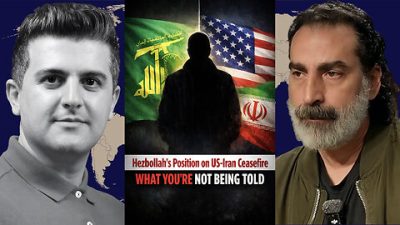
Laith Marouf: Hezbollah’s position on US-Iran ceasefire
or go to
Aletho News Archives – Video-Images
From the Archives
Is Israel to blame for the Iraq War?
American Goy | March 10, 2008
I am so tired of this old canard that “Israel had nothing to do with USA’s war with Iraq – in fact, it officially advised America against it”.
Bullshit. … continue
Blog Roll
 Aletho News
- Laith Marouf: Hezbollah’s position on US-Iran ceasefire: What you’re not being told
- Israel’s priority lies in destroying chances of peace between Iran, US: Ex-UN nuclear chief
- Ceasefire for all or for none: Iran shuts Hormuz over Lebanon attacks
- Strait of Hormuz is Iran’s ‘nuclear weapon’ that forced US retreat: Medvedev
- Energy crisis will last for months – Kremlin envoy
- Europe’s quiet role in the war on Iran
- Forty days that shook the Empire: How Iran turned the tables on US and prevailed
- Netanyahu unilaterally declares Lebanon outside of ceasefire deal
- Israeli leaders: ‘Not a single goal’ achieved in war with Iran
- What on earth just happened? Trump, Iran, and the unlikely ceasefire
- If Americans Knew
- Gazans face a triple crisis: severe shortages of water and bread, healthcare in tatters
- NY Times reports how Netanyahu took the US into Iran War
- A sigh of relief over Iran, but Gaza and Lebanon in dire straits – Daily Update
- Thousands dead and neighborhoods razed to the ground: Aid agencies fear southern Lebanon is becoming the new Gaza
- The war the US is fighting for Israel could cost trillions
- ‘Cigarette Burns, Nail Wounds’: Toddler Tortured in Gaza to Coerce Father
- Trump Says US Sent ‘a Lot of Guns’ to Protesters in Iran
- Israeli forces destroy 17 UN peacekeeper cameras in south Lebanon
- US-Israeli strikes ‘completely destroy’ synagogue in Tehran
- Archbishop for US Military Says Iran War Is Unjust Under Catholic Teaching
- No Tricks Zone
- An Inconvenient Tree: Uncovered In Alps… Europe Much Warmer Than Today 6000 Years Ago
- New Study Reports A 60% Slowdown In Greenland’s Ice Loss Rate In The Last Decade
- Low Intensity Tornado Wrecks Major Solar Farm, Creating A Potential Toxic Dump
- New Study Finds Warming Saves Lives…Cold Temperatures 12 Times More Deadly Than Excess Heat
- German Science Blog Accuses PIK Climate Institute Of Hallucinating Climate Tipping Points
- Devastating Assessment Of Comirnaty Vaccine By Former Senior Pfizer Europe Toxicologist
- New Study: CO2 Is ‘Effectively Negligible’ As An Explanatory Climate Change Factor Since 2000
- Former Pfizer Toxicologist Dr. Helmut Sterz Tells Bundestag Hearing Pfizer Vaccine Should Have Never Been Approved
- Energy Expert: Germany’s Nuclear Phaseout Was A “500 Billion Euro Mistake”
- New Research: South Australia’s Mid-Holocene Sea Surface Temperatures Were 4°C Warmer Than Today
 Aletho News