Whither Gaddafi and Libya?
The Strange Calm Over Tripoli
By FRANKLIN LAMB | CounterPunch | August 22, 2011
Tripoli – The large gold framed portrait of Colonel Muammar Qaddafi that adorned the wall behind the reception desk of my hotel since it opened many years ago has vanished. Also gone are the 72 green flags that flew on the white poles which have also been removed. It’s not polite to inquire of the skeleton staff about who removed these items because the act of removal could become very serious offenses depending on the final outcome here. But, my friend Ismail, manning the front desk, just grinned at me when I commented on the hotel’s fine new mirror that hangs in the leader’s space.
Looking over the skyline of Tripoli at 7:30 a.m. 8/22/11 from the 26th floor of the Corinthia Hotel it seems that it’s just about over for the Qaddafi regime.
All night one heard in central Tripoli mainly celebratory gunfire from areas like the nearby newly renamed “Martyrs Square” (formerly ‘Green Square’) but so many questions are on most people minds this morning. Some ask, are the Qaddafi forces opening a trap for the rebel forces allowing them to come in quickly and easily and then when they are gathered in public celebrations and seek rest, counter attack?
The claim of the NTC representative this morning that the rebels control 95 per cent of Tripoli seems farfetched. This is a very spread out city and its clear rebel forces are not deployed everywhere.
A column of 22 camouflaged painted military vehicles full of government fighters slowly passed by our hotel at 8:10 this morning and turned right into the seaside compound which includes the Bab al Bahar Hotel (“gate to the sea”), and on its edge, the unoccupied JW Marriott, from which witnesses said the sniper who shot me in my right leg yesterday morning was perched. My doctor gave me the bullet as a souvenir and I will be fine although the damned thing hurts. An arriving hotel worker just reported seeing government forces assembling in Tripoli’s neighborhoods over the past several hours.
On the other side of my hotel I can see rebel pickups filled with fighters and new tricolor Libyan flags driving very slowly towards Green (Martyr’s) Square. I am thinking what would happen if they make a wrong turn.
Reports of Saif and Mohammad Qaddafi’s capture supports the idea that the government here wildly exaggerated its solid support and that the public largely believed them. Already among the few staff and some kids who come early to jump the hotel fence and use the swimming pool, and their trademark chants of “Allah, Mohammad, Muammar, Libya wa bass” have ended their chants and now support for ousting “the leader” is widespread. Most hotel staff at my hotel appear crestfallen.
The outpouring of support for Qaddafi’s departure by the same crowds who seemed to adore him at Green Square the past five months I have been monitoring them is surprising but perhaps reveals why all powerful despots are often more form than substance and can collapse quickly under certain conditions.
The questions being asked here this morning by student friends include what happened to the resistance to NATO and its supported rebels, where are the “65,000 professional soldiers waiting to repel “NATO’s rebels” from entering Tripoli, mentioned just last night by Government spokesman, Musa Ibrahim, was there ever a real Libyan army of thousands ready to defend Tripoli, what will the transition be like, will there be tribal conflicts for power, will Libya have to pay for all the infrastructure damage, will NATO countries, given the widespread hostility to NATO killing so many civilians be granted oil contracts, will the US get another military base (Wheelus was closed by Qaddafi on June 1970), will the new government recognize Israel as NATO is said to be demanding, will the National Transition Council fulfill its pledges for a just, quick transition with early elections, and on and on.
Yesterday morning, as I embarked on a bike tour of Tripoli, there were signs that something incongruous was happening. Security guards, normally about 20 outside the hotel were nowhere to be seen. Also, no staff came to work. Ismail and the IT guy slept at the hotel—and the British lady “Miss Lorraine” who is in charge of hotel Hospitality lives at the hotel and was understandably and visibly upset.
As I left the hotel close to 7:30 a.m. by bicycle yesterday morning I was surprised to see one woman standing alone on the street in front of the hotel. I was more surprised when she lit up with a broad smile as she chimed “Hello Mr. Lamb!”
She is Marianne, who works with Lorraine somewhere in the bowels of this claimed “7 Star Hotel” I had spoken with her on the phone but we never met personally. When I asked her why she was standing in the empty street, she replied, “I need to find a ride to the port!” That seemed odd, given what is happening here, so I asked her why. “My two week vacation starts today and I need to get a boat to Malta”. I was shocked, “Sweetheart, please, for sure there is no boat to Malta now and it’s dangerous for you to go to the Port.” “But, my boyfriend is waiting for me in Malta” she wailed. “Ok, but if you find a ride call my room and I will pay half and come with you to the Port”. Marianne agreed. I never saw her again.
The UN delegation left yesterday after their five day “fact finding mission.” Not sure what facts they found because they mainly stayed in the hotel waiting and waiting, like most other foreigners here do, for a promised appointment with a government official or someone. Their leader, a stellar Palestinian lady from Nazarath in Occupied Palestine, convinced NATO to let some foreigners make use of empty UN plane seats so this hotel was essentially emptied of guests.
There has been no sign of Colonel Gaddafi. A strange calm has spread over Tripoli.
Franklin Lamb is in Tripoli. He can be reached c/o fplamb@gmail.com.
Many injured in Hebron house demolition
22 August 2011 | International Solidarity Movement, West Bank
At 10pm Sunday August 21st the Hasan Ali Darwish Al-Qawasmi house in the Abo Ktelah district was raided and later destroyed by Israeli Occupation Forces (IOF). Around eight armoured vehicles surrounded the house and at least 40 soldiers were blocking every entrance. The IOF had arrived at the house at 8 pm. They told family members that it would take 20 minutes but three and a half hours later they remained in occupation of the house. A row of 14 soldiers blocked the main entrance to the house. Female family members stood in front of them and demanded that they be allowed back into their home.
A family member accounted that Israeli soldiers had already arrested their husbands and were also guilty of the imprisonment of seven brothers and the death of two other brothers of one particular woman. This woman arrived at the house with her baby in her arms to defy and stand up to the Israeli soldiers. After a while the army emerged from the house with a blindfolded and handcuffed man who looked as though he had been beaten.
The soldiers took him away in a jeep. The IOF informed the family and other bystanders that a suspected “suspicious object” was in the home that needed to be disposed of, which coincidentally meant exploding a section of the house. Everyone was pushed aside in preparation for the explosion, which took place in the yard of the house. The massive explosion smashed all the windows and damaged a neighbor’s home.
During the raid clashes between Palestinians and the army started, leaving at least 30 injured with the possible rumor that of the injured, one was killed. Details have yet to be confirmed.
The army was shooting a large amount of tear gas directly at protesters and according to witnesses they probably also used rubber coated steel bullets. The IOF fled at around midnight and the protestors went to inspect the damaged house. Once being allowed back into the home the family members found their home torn apart. Sofa chairs had been ripped open, picture frames had been smashed and glass lay everywhere. Their home had been destroyed.
Witnesses said that 10 days ago another member of the Al-Qawasmi family had been arrested. On the night of August 20th IOF arrested 10 other people in this same neighborhood. This frightful scene concluded with an elderly female relative, who had been trapped in the house during the raid, being carried out on a stretcher by Palestinian ambulances. The ambulances also tended to severely injured protestors.
Night of Israeli violence: Al Aqsa Mosque barricade, house demolition, gang beating, arrests
22 August 2011 | International Solidarity Movement, West Bank
Just after midnight on Monday, August 22 the Israeli Occupation Forces (IOF) took the opportunity to trap 1500 Palestinian youth inside al-Aqsa mosque in Jerusalem, blow up a house in Hebron (injuring 30 people in the ensuing riots), and arrested a member of the Freedom Theatre in Jenin.
In Jerusalem, thousands of Palestinians gathered to protest the Israeli escalation of violence in the Gaza Strip. Starting from the Bab Al `Amoud (Damscus Gate) area and marching toward Salah El Deen Street, the protesters suddenly found themselves under attack by IOF soldiers after the latter claimed that a soldier had been stabbed. IOF soldiers and border police closed off the Bab Al Amoud area and Salah El Deen Street and kidnapped several Palestinian youth who were taken to the Al Maskobiyya interrogation center, west of Jerusalem. They also attacked Palestinian medics and ambulances in the area.
The protesters continued their march into the Old City, prompting hundreds of policemen to break into several homes and cause damage in the area. The protesters ended up inside al-Aqsa mosque, where policemen trapped them inside, closed off the mosque, placed ladders on walls surrounding the mosque, and provoked protesters and those who were simply there to pray and worship during the last ten holy days of Ramadan.
In another incident in Jenin, IOF soldiers surrounded the Freedom Theater at 2 am, closed off the area, and arrested Mohammed Naghnaghiye, the security guard and technician of the theater. On the way out, they fired live ammunition to disperse the crowd of Palestinians who had gathered.
This is the third attack on the Freedom Theater by the IOF this month.
55 Palestinians injured as Israeli army invades Hebron
By Saed Bannoura | IMEMC & Agencies | August 22, 2011
Palestinian medical sources in Hebron, in the southern part of the West Bank, reported that 55 residents were injured following clashes that took place between local residents and Israeli soldiers who invaded the city.
The sources stated that some of the wounded residents were hit by rubber-coated metal bullets fired by the soldiers; others were treated for the effects of teargas inhalation, while the rest were violently attacked and beaten by the soldiers.
Also, soldiers broke into the home of detainee Mahmoud Al Qawasmi of the Hamas movement, in Wadi Abu Kteila area, north west of Hebron, and detonated some of its walls. Al Qawasmi has been imprisoned by Israel for the past seven years.
The soldiers detained dozens of residents and interrogated them in the streets, and broke into several homes that belong to members of Al Qawasmi family, Karama, and Al Joulani.
Sporadic clashes took place in Bab Al Zawiya area, in the center of Hebron, as local residents hurled stones and bottles at the invading military forces. The soldiers fired gas bombs and rubber-coated metal bullets.
Other clashes took place at the Tareq Bin Ziad junction, south of the city, while the army placed more forces in the area and chased the residents; no arrests were reported.
Soldiers also invaded several nearby villages and town, and conducted military searches of homes.
On Sunday at dawn, troops invaded Hebron, broke into and searched dozens of homes, and kidnapped dozens of Hamas members and supporters, including elected legislator Mohammad Abu Jheisha, and a number of Hamas political leaders.
Naval Base Tears Apart Korean Village
“The land and sea isn’t something you bought,” explained Kang Ae-Shim. “Why are you selling something that was there long before you were born?”
Kang Ae Shim is a haenyo, one of the legendary Korean women sea divers from Jeju Island who can hold their breath for up to two minutes while foraging the ocean floor for seafood. But today Kang and others are fighting to save their island from the pending construction of a South Korean naval base in Gangjeong village, which threatens to tear apart the age-old sisterhood of the haenyo and destroy the pristine ecology of Jeju’s shores. The government and construction contractors are attempting to stamp out the outcry by arresting, beating, fining, and threatening villagers and activists.
In April, renowned South Korean film critic Yang Yoon Mo was arrested for erecting and living in a tent on the coast for years to impede construction. Yang subsequently went on hunger strike for 71 days, 57 of which were spent in prison. In May, Choi Sung-hee, an artist and peace activist living with the villagers, was arrested for demonstrating and standing in the way of cement trucks to prevent them from pouring concrete over lava rock along the coastline. In June, Gangjeong village chief Kang Dong-kyun and peace activist Song Kang-ho confronted a large Samsung construction vessel in a small tugboat. When Song attempted to board the vessel, he was beaten and thrown back into the tugboat.
In July, I traveled to Gangjeong to witness the courageous fishing and farming community fight to keep their beautiful coastline from becoming the site of a naval base.
During my five days there I interviewed the villagers, including farmers, haenyo, and the village chief, as well as others from Jeju Island supporting the resistance. I learned three things: the process that led to Gangjeong becoming the base site was grossly undemocratic; the community fabric is being torn apart; and the Korean War is still playing out in this struggle on Jeju Island.
The Wall
The morning after my nighttime arrival, I was stunned to see an approximately 30-foot tall fence surrounding the massive area of the proposed base. According to the villagers, the navy seized 160,000 pyong or 130 acres of farmland — equivalent to 169 football fields — from the port to the river. Inside the fenced-in area are remnants of greenhouses, torn-up farmland, huge cement planks, and abandoned tractors and other large machinery. The farm road to the coastline where the anti-base resistance has established a camp is bordered by amazingly rich and fertile soil, which during the Japanese occupation was allegedly the only soil on the volcanic island that could grow rice.
But the base’s impact isn’t limited to land. Off the coast of Jeju is the absolutely stunning Tiger Island and its sparkling surrounding waters, a UNESCO ecological reserve. According to Koh Yoo-Ki, an environmental policy analyst from Jeju, the planned naval base construction would destroy 98 acres of ocean floor inhabited by soft coral reef and nine endangered species.
The Jeju Island government had designated the coastline as a preservation area in 1991, but in December of 2009 then-Jeju Governor Kim Tae Hwan nullified the 1991 designation to make way for the naval base. “I cannot understand how there was five different protections for this area,” says Koh. “Before this naval base project, the state invested tons of money to preserve this area. Scholars used to come from the mainland to research corals. Now all of this has been undone.”
Undemocratic Process
According to an August 7 letter to the editor in The New York Times, the South Korean embassy in Washington wrote, “The construction site was selected after accommodating opinions of local residents in a legitimate process, including town hall meetings.” The villagers say it was far from legitimate, democratic, or just.
On April 24, 2007, former village chief Yoon Tae Jun announced his approval of the planned base and said that an application to the Jeju governor, would be made. Typically a meeting to discuss similar civic action is held after a one-week waiting period, but this time it was scheduled for only three days later. On April 26, only 87 of the 1,050 Gangjeong residents – less than 10 percent – were present. Approximately half of those present were elderly haenyo, which according to Gangjeong farmer Jung Young-hee was strange since these women rarely, if ever, participated in village committee meetings. In an unprecedented manner, a vote to endorse the base was held by clapping. Never before in Gangjeong history had a vote been conducted this way. Yoon said he would hold another village committee meeting within 10 days and promised that if more people opposed the base, he would revoke his approval. But he never followed through.
On May 14, Jeju governor Kim Tae Hwan announced that Gangjeong village would be the site. The outraged villagers mobilized, forced the village chief out of power, and held a referendum on the proposed base in August 2007. According to Gangjeong village chief Kang Dong-Kyun, “On Aug 20 we held another referendum. 94 percent opposed the base. 725 people participated. 680 voted against, only 36 for, and nine votes were defective. The central government only recognized the first vote by the villagers committee; the second one wasn’t recognized.”
In January 2009, the Ministry of Defense approved the construction plan, and in April Gangjeong village filed a lawsuit in response, arguing that the nullification of the preservation area should be recalled, which the judge denied. The villagers appealed, and the case is now pending in the Supreme Court. A decision is likely due sometime this winter.
Bribing the Elderly
According to a 65-year-old haenyo from Gangjeong who opposes the base, the former village chief Yoon and a representative from the fishermen’s cooperative convened a meeting of haenyo before the April vote, and claimed they would be compensated if they supported the base project. When I asked her why she thought the haenyo supported the base, she said, “If there was no money, they would all protest the base.”
She went on to describe a deliberate effort by government and naval officials to bribe several haenyo. She said that the gentlemen were waiting to take the elderly haenyo out for meals after they had just returned from diving for several hours. The men told the haenyo that the navy would build a hospital for the elder haenyo. Her husband chimed in, “These elderly women didn’t know. [The Navy] used money to lure them. This is unethical and wrong to take advantage of them.”
Before Gangjeong was selected as the designated naval site, the Korean authorities approached two other villages –Hwasoon and Wimi –as early as 2002, but the residents, largely haenyo and fishermen who militantly opposed the base, blocked the initiative.
By round three, the Navy had become more sophisticated. “With the experience they had, the government went after the haenyo first in Gangjeong,” explains Lee Kyung-Sun, the general secretary of the Jeju Women’s Association. “They were cowardly for going after them,” says Lee, who insists that the haenyo should not be blamed if they supported the base, and that the focus ought to be on the government’s tactics. “Haenyo are victims too. They were tricked,” she said. “I still respect the haenyo. They have supported their family and the village, and they have preserved this area.”
Community Torn Apart
The row over the naval base has cleaved the community of Gangjeong haenyo who have worked together for over 40 years into two opposing groups. The 65-year-old haenyo from Gangjeong says that a few haenyo in opposition to the base refuse to enter the water with base supporters. “Now there is no conversation between the two groups,” she laments.
Kang Ae-Shim, a 56-year old haenyo from the neighboring village of Bopan explained, “The money that the haenyo was given is what you can make in one year.” She described how the haenyo from Gangjeong and Bopan physically fought in the water — the very same women who for years ate dinner and sang together at noraebang (karaoke). But the Gangjeong base decision changed that dynamic. The haenyo from Gangjeong “don’t have much to say because they are ashamed,” says Kang. There is a saying that it’s better to go into the ocean rather than go to one’s own mother’s home to borrow money. “All the things that come from the ocean, the abalone, the snails — these are not just a matter of life, they are medicine that strengthens the life spirit.” Kang argues that pollution from the naval base will threaten the haenyo’s livelihood.
Gangjeong villagers told me of a recent survey revealing that 50 percent of haenyo were suicidal and 70 percent are extremely psychologically stressed. Hyun Ae-Ja, the former Jeju representative to the National Assembly who has chained herself to a tree blocking police and construction trucks from entering the farm road believes that “ultimately the Jeju naval base will bring the destruction of the community and life.”
The Never-ending Korean War
The unresolved Korean War has served as justification for the continued militarism of the Korean peninsula, including the build-up of nuclear weapons in North Korea, massive military spending on both sides of the DMZ, intensified U.S.-ROK military exercises, and the expansion of military bases, like the one under construction on Jeju. The irony here is that South Korea is forcibly destroying the livelihoods of farmers, fishermen, women sea divers, and the rich marine ecosystems –on which we all depend for our human security –in the name of “national security.”
According to the South Korean embassy, “The Jeju base was built solely for the defense of the Republic of Korea and has no connections to American military installations. There are no plans to use the base for American missile defense, nor have Korea and the United States had any discussion regarding this issue.”
But many defense analysts challenge this claim. According to the Monterey Institute’s arm control specialist Jeffrey Lewis in an article in The New York Times, “the new Aegis destroyers to be based in Jeju would help defend South Korea against Chinese missiles and help defend Japan against missiles from both China and North Korea, [but they] won’t provide much defense for South Korea against North Korean missiles… Very few North Korean missiles would rise high enough on their way toward South Korea to give South Korean destroyers a shot.” Also in a rejoinder to the Embassy’s New York Times letter, Matt Hoey, a missile defense analyst at the Military Space Transparency Project, argues, “The Aegis sea-based missile defense system planned for Jeju is networked to United States space systems and ground-based X-band radar.”
Furthermore, earlier this spring, when I and several other Americans called the Korean Embassy in Washington to register our concerns, we all received similar versions of the same prepared response, “Don’t call us; call the U.S. State or Defense Departments; they are the ones who are pressuring us to build this base.” And it’s not just ordinary Americans who have been told that the United States is involved with the Jeju base. Even former U.S. Senator Fritz Hollings wrote in a June 15, 2011 op-ed in the Huffington Post that the Obama administration is “establishing a naval base with South Korea on Jeju Island.”
At a time of severe economic recession, the global community can no longer afford to spend billions of dollars daily on a misguided notion of military security that only increases the threat of military action, loss of human life, environmental contamination, and the loss of precious biodiversity.
Under Siege
On the morning we departed the mayor of Seogwipo announced that the police could seal off access to the public agricultural road to the coastline, blocking off primary access to anti-base protesters. National Defense Minister Cho Hyun-oh promised Jeju’s police commissioner as many resources as was needed to remove the base resistance camp. Police and undercover vans now monitor the three entrances to the base site 24 hours a day.
Since I left Gangjeong there has been an intense stand-off. Hundreds of police attempted to come through the farm road where several women chained themselves to trees to block their access. Thanks to the increasing pressure by civil society on the South Korean government to release the villagers and activists from prison, all have now been released, including the artist and activist Choi Sung-hee.
But as the global community’s awareness of the issue rises, so has Seoul’s crackdown on the peaceful protestors. On August 15th a reported 700 riot police from the mainland landed on Jeju with three water cannons, 16 large buses, and 10 riot control vehicles. Nevertheless, the villagers and activists have remained courageous and resolved to resist through nonviolent disobedience for their village, land, and sea. We must not relent as long as the villagers don’t.
What Congress Won’t See on Its Trip to Israel This Month
By Michael Berg | News Wire | August 20th, 2011
Congressman Russ Carnahan joined nearly 20 percent of the United States House of Representatives in a trip to Israel this month. Paid for by an affiliate of the American Israel Public Affairs Committee, these 81 representatives are supposed to represent our interests but are choosing to spend their recess in Israel — and briefly in the occupied West Bank — at a time when Americans are suffering and scared from high unemployment, a tanking stock market and a downgrade of our national bond rating.
I also recently traveled to the Holy Land, although I paid my own way. I was part of the “Welcome to Palestine” delegation. I was lucky. Most of my colleagues on the delegation were not allowed to join me. On July 8 over 120 people from Europe, North America and Australia were detained at Israel’s Ben Gurion airport. They were then imprisoned by the State of Israel, most for over a week. Their only crime was that when Israeli custom officials asked what they were doing in Israel, they responded that they were planning to visit Palestinian friends in the Aida Refugee camp in Bethlehem. Three hundred other delegates who planned to visit Bethlehem and other places in the occupied West Bank were forced off their flights in Europe due to Israeli pressure.
During my time in the Holy Land, I had an opportunity to meet and talk with many Palestinians and Israelis. I learned about a system in Israel that discriminates against Palestinians on the basis of their ethnicity. In the West Bank, things are far worse. I observed an explicit system of racial segregation and ethnic cleansing, where Palestinians are separated from their own lands and water by walls, barbed-wire fences and machine-gun-wielding soldiers and Jewish settlers.
I saw the remains of an entire demolished Bedouin village, destroyed in order to expand an illegal Jewish settlement in the Jordan Valley. The settlement uses what used to be the wells of the Bedouin village in order to provide water for its swimming pools.
I witnessed a Palestinian farmer coming under fire from projectiles merely for trying to farm his own land. The excuse? His land is too close to a Jewish-only settlement. A European with me did not leave the vicinity as quickly as Israeli soldiers wanted and had his face smashed into the ground. He was detained for approximately one week and then deported.
I observed how Bethlehem, the birthplace of Jesus, is being economically and socially stunted by a giant wall that separates it from Jerusalem. It is a wall that Israelis can cross freely to travel between settlements and the rest of Israel. For Palestinians living in the West Bank, it is quite difficult to get a pass to go to Jerusalem, and if they do they must go through a humiliating inspection procedure at the checkpoint.
Israel systematically abuses the human rights of Palestinians who live within the territory it controls. In fact, what I saw can most accurately be described as apartheid.
Israel is certainly not the only country in the world that discriminates on the basis of ethnicity. It is not the only country that abuses fundamental human rights.
But it is the only country of this nature that receives over $3 billion a year in American aid money. It is the only foreign nation to which American politicians routinely offer their “unwavering support,” as Rep. Carnahan’s sister Robin did in her recent campaign for United States Senate.
And it is the only foreign nation that is receiving 81 American congressional delegates in three delegations, split among 55 Republicans and 26 Democrats, during a time of great difficulty for our own country.
Unfortunately, members of these delegations did not see the same reality that I did. This is not the goal of AIPAC, which calls itself “America’s Pro-Israel Lobby,” or its affiliate leading the junkets. In an interview in Israel, Congressman and tour leader Steny Hoyer stated that the American economic crisis will have no impact on our financial assistance to Israel.
I hope that Rep. Carnahan sees something that Rep. Hoyer did not. Rep. Carnahan has an opportunity to promote human rights over repression and the economic well-being of the United States over that of an apartheid state.
Air raids exact heavy toll on Gaza health and sanitation infrastructure
Ma’an – 21/08/2011
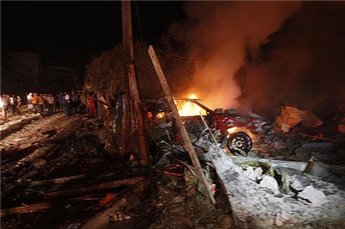
GAZA CITY — A physiotherapy clinic, sewerage pump, civil society organizations and government buildings have been damaged in Israeli raids on the Gaza Strip since Thursday, witnesses and officials said.
Israeli warplanes have bombarded the coastal enclave for three days in what the military says is a response to a deadly attack in southern Israel on Thursday.
Fourteen Palestinians were killed and more than 40 wounded in a series of airstrikes across the Gaza Strip.
A specialist physiotherapy clinic in Gaza City funded by the Organization of Arab Petroleum Exporting Countries was amongst the buildings seriously damaged in the assault, witnesses said.
The clinic was the first of its kind in Gaza and run by the Arab Fund for Economic and Social Development.
An electricity generator and four water pumps for the sewerage system in An-Nuseirat refugee camp were destroyed on Friday, causing power cuts in central Gaza.
The offices of the Organization of Islamic Cooperation sustained damages in air raids at dawn on Friday. The Gaza City office was opened to provide humanitarian assistance to Gaza residents in the wake of Israel’s Operation Cast Lead offensive in December 2008.
The same building was also bombed in July 2010. Officials said the damage would affect the organization ability to provide humanitarian services.
Israeli forces also shelled a library located in a residential area and among government buildings, the Gaza government said.
The Hamas-run Ministry of Justice, civil servants’ bureau and government media office were severely damaged, the ministry said.
In a statement, the justice ministry said Israeli forces deliberately targeted civil institutions in what it described as a war crime.
Israel arrests over 50 Hamas supporters in Al-Khalil
Palestine Information Center – 21/08/2011
 AL-KHALIL — Israeli occupation forces arrested Sunday morning more than 50 Hamas supporters in one of the largest raids on the West Bank city of Al-Khalil since 2003.
IOF troops accompanied by more than a hundred military vehicles in addition to undercover forces began raiding the city midnight Sunday and deployed throughout its neighborhoods, local and security sources said.
A number of arrests have also been made in towns outside of the city, as the operation, one of the largest since 2003, continues.
Violent clashes broke out in several areas and civilians have been left injured.
Among those taken into custody was Palestinian MP Mohammed Mutlaq Abu Juheisha.
Also on Sunday morning, Israeli forces arrested Palestinian reporter Oseid Abdul-Majid Amarina, 26, after a violent raid on his home in Dheisha refugee camp east of Bethlehem.
Bethlehem Mayor says soldiers ransacked home
Ma’an – 21/08/2011
BETHLEHEM — Israeli forces assaulted and detained a Palestinian man during a raid on the home of the Mufti of Bethlehem overnight Saturday, the sheikh said.
Sheikh Abdul-Majid Ata Amarna said troops raided his home in Duheisha refugee camp shortly before dawn prayers searching for his son Usayd, a journalist for Hamas-affiliated Al-Aqsa TV.
“When the soldiers raided my home, I asked them to wait before entering the different rooms so women could put on their head scarves and change their sleeping clothes, but instead of waiting they started firing inside the house injuring my brother-in-law, 27-year-old Bakr Badarin” the cleric told Ma’an.
He said Badarin was hit by a live bullet to his thigh, but soldiers refused to allow Palestinian Red Crescent medics to treat him and detained the injured man and the sheikh’s son Usayd Amarna.
The family learned later that Badarin was taken to Hadassah Hospital in Jerusalem for treatment.
BBC admits role in 1953 Iranian coup
Press TV – August 21, 2011

The BBC Persian TV channel has at last acknowledged the role of the BBC Persian radio in the toppling of the democratically elected government of Iran in the 1953 coup.
The coup overthrew the government of the then Iranian Prime Minister Mohammad Mosaddegh leading to the restoration of absolute monarchy under dictator Mohammad-Reza Pahlavi who was later toppled in the Islamic Revolution in 1979.
In a documentary aired on August 18 on the anniversary of the coup, BBC Persian channel admitted for the first time to the role of the BBC Persian radio as the propaganda arm of the British government in Iran.
After repeated denials of the BBC Persian radio’s role in helping London oust Mosaddegh, the program entitled Cinematograph detailed how the radio network broadcast anti- Mosaddegh programs to undermine his government.
“The British government used the BBC Persian radio for advancing its propaganda against Mosaddegh and anti-Mosaddegh material were repeatedly aired on the radio channel to the extent that Iranian staff at the BBC Persian radio went on strike to protest the move,” the Cinematograph narrator said.
Britain had lost its power as a world empire after the World War II and Mosaddegh’s efforts to nationalize Iran’s oil industry, which bore fruit on March 19, 1951, meant Britain lost one of the most important resources it formerly fully controlled under the guise of the British-owned Anglo-Iranian Oil Company due to subservience of the Pahlavi regime.
This comes after the BBC Persian channel aired another documentary on March 19, 2010 that categorically dismissed the broadcaster’s Persian radio role in the 1953 coup claiming the radio channel even went against the policies of the British government.
The Cinematograph also quoted a classified document going back to July 21, 1951 in which a Foreign Office official thanked the British ambassador for his proposals that were followed to the word by the BBC Persian radio to strengthen its propaganda against Mosaddegh.
“The BBC had already made most of the points which you listed, but they were very glad to have an indication from you of what was likely to be most effective and will arrange their programme accordingly,” the document shown in part on the program read.
“We should also avoid direct attacks on the ‘ruling classes’ since it seems probable that we may want to deal with a government drawn from those classes should Mosaddegh fall,” it added.
The document further stressed that the Foreign Office “shall be grateful for [the ambassador’s] comments on the propaganda line we have proposed”.
Venezuela Says U.S. Lacks “Moral Authority” to Judge Antiterrorism Efforts
By Franklin Rosales – Venezuelanalysis.com – August 19th 2011
Caracas – This Friday the Venezuelan government formally “rejected” a U.S. State Department antiterrorism report issued a day earlier, describing the document as “plagued with false affirmations, political preconceptions, and veiled threats.”
In a press release issued today, Venezuela’s Ministry of Foreign Affairs said the U.S. government seeks “to impose, by way of intimidation, its international policy of disregard and domination” and that the ongoing “refuge and protection” provided by the United Stated to confessed terrorist Luis Posada Carriles negated all “moral authority” in the U.S.’s so-called War on Terrorism.
The U.S. Country Reports on Terrorism 2010, issued on 18 August 2011, states that the U.S. State Department is “concerned about Hezballah’s fundraising activities in Venezuela,” and declares that Venezuelan President Hugo Chavez is continuing “to strengthen Venezuela’s relationship with state sponsor of terrorism Iran”. The report also claims that 2010 was another year in which Venezuela “was not cooperating fully with U.S. antiterrorism efforts.”
“Throughout the year,” the U.S. report asserts, “President Chavez rejected allegations that he or his government supported terrorism and instead accused the United States of sponsoring terrorism.”
In response to yesterday’s report, Venezuela’s Foreign Ministry said it rejected, “in the most vehement manner, the accusations of the U.S. State Department” and that by issuing its report the U.S. government had “ratified its policy of permanent aggression against independent and sovereign governments such as that of Venezuela.”
According to the Venezuelan Foreign Ministry response, “the U.S. State Department tends to classify as ‘terrorists’ or ‘complacent with terrorism’ those governments and political organizations that do not bow down in the face of its imperial intentions.”
The Venezuelan government also affirmed that the United States “does not have the moral authority” to judge each country’s antiterrorism efforts, having given “refuge and protection to Luis Posada Carriles, an international criminal charged for terrorism.”
Luis Posada Carriles is wanted in both Venezuela and Cuba for his involvement in the 1976 downing of a Cubana de Aviacion airplane, killing all 73 people on board.
Venezuela’s Foreign Ministry also pointed out that “civilian massacres” committed and “undercover operations” carried out by U.S. forces abroad were “illegal operations” that only added to international skepticism towards U.S. antiterrorism efforts.
In recent years, right-wing U.S. Congressman Connie Mack and others have attempted to place Venezuela on the State Department’s list of “state sponsor of terrorism.” Unable to provide concrete evidence linking the Venezuelan government to U.S.-classified “terrorist” organizations such as Colombia’s Armed Revolutionary Forces (FARC) or Lebanon’s Hezbollah, Mack in recent months has sought to portray joint Venezuela-Iran economic development projects as Venezuelan support for Iran’s “desire for nuclear weapons.”
In response to a June 2011 hearing held by the U.S. Congress Western Hemisphere Subcommittee in which Mack called Venezuela a “hub” for international terrorism, the Venezuelan National Assembly responded by defining “true terrorism” as “that which has been carried out by the U.S. government through its military invasions,” referring specifically to the U.S. invasions of Iraq, Afghanistan, among others.
Israel kills 15 in Gaza then tries to shift blame to Hamas
By Jalal Abukhater – The Electronic Intifada – 08/20/2011
Quoting from Haaretz:
“In response to the ongoing rocket fire, an IDF spokesperson stated that the military will not tolerate any attempt at harming Israeli civilians or soldiers, and will continue to “act with determination and strength against any source of terror.” The spokesperson also claimed that Hamas must be “held responsible” for the ongoing attacks.”
Israel is quickly trying to shift the blame for the war crimes it is committing in Gaza to Hamas. Suddenly those firing rockets (after 10 were killed for no reason last night, now 15) are the bad guys and Israel is the good guy doing self defense in this equation.
In times like this, what alternative would you give to the resistance groups other than fire rockets? Their families are killed, their children are either dying or becoming handicapped due to continuous raids. The 1.6 million population of Gaza is terrorized night and day, there isn’t any place in that open air prison safe from the random Israeli shelling, not even UNRWA schools as we have seen in 2009. Israel aims to collectively punish all those who live in Gaza for the crime of living in Gaza.
Let us keep in mind that for the past two years, al-Qassam and the majority of Gaza factions have respected the ceasefire treaty in order to maintain security in the besieged Gaza Strip. In fact, Hamas faced internal issues after it started suppressing armed groups who planned to launch rockets into Israeli cities. It was almost always Israel which would strike first or assassinate political figures which would prompt them to launch rockets in retaliation.
The blood thirsty leadership of Israel bombs Gaza for no reason other than their own self satisfaction. Another reason is that no one would interrupt them in their war crimes process, the US and EU leadership hurries to condemn Eilat attack while barely giving attention, if any, to those civilians slaughtered in Gaza.
And of course, let us not forget that Israel started bombing Gaza on Thursday for no reason. There is no evidence of any connection between Gaza militants and Eilat attack. The only proof the IDF claimed was that Eilat attackers used AK47, which is a weapon that only comes from Gaza (In fact the AK47 or Kalashnikov is the world’s most common firearm). This was literally said on the tongue of the IDF spokesperson Lt. Colonel Avital Leibovich interviewed by the The Real News Network’s Lia Tarachansky as This site has brought it to my attention.
Tarachansky: On what are you basing your conclusion that this group [the Popular Resistance Committees] is responsible for the terror attacks?
IDF Spokesperson: We did not say that this group was responsible for the terror attack. We based this on intelligence information as well as some facts that [we] actually presented an hour ago to some wires and journalists. Some of the findings that were from the bodies of the terrorists, and they are using for example Kalashnikov bullets and Kalashnikov rifles are very common in Gaza —
Tarachansky: Many terrorist groups use Kalashnikovs —
IDF Spokesperson: No, not many terror groups. I’m not saying — I’m referring to the terrorists that came from Gaza.
Tarachansky: Prime Minister Netanyahu said today that the group that was responsible for the terror attack was the one that was eliminated [in Gaza] and you’re saying that’s not the case?
IDF Spokesperson: I don’t know what he said [when speaking on Israeli national television] — I’m not Prime Minister Netanyahu. I’m saying that the group came from Gaza and I’m giving you proof why it came from Gaza — how we know it came from Gaza. This is all I’m saying.
Despite the continuing terror Gaza suffers, Israeli media is doing an even more horrible job. I spent yesterday going through almost all Israeli English news websites, non of those websites mentioned Gaza civilian deaths along with news on rockets coming into Israel. In the matter of fact, I kept reading news reports on Haaretz, Jerusalem Post, and Ynet to realize there is nothing about Palestinian civilian deaths, they only mentioned rockets, Israelis injured, and Gazan militants who were killed. Covering up the real news from the public is dangerous!
This tweet by +972 magazine’s Noam Sheizaf couldn’t describe it better:
By reporting only rockets fired 2 Israel in its top stories & hiding news over dead in Gaza, Israeli media is making public want more blood
Featured Video
Laith Marouf: Hezbollah’s position on US-Iran ceasefire
or go to
Aletho News Archives – Video-Images
From the Archives
The Dirty Little Secret behind the “Global Terrorism Index”
The Omission of Israeli Terrorism in the Occupied Palestinian Territories
By Karin Brothers | Global Research | December 6, 2014
… The Israeli settlements — all of which are illegal – have been identified as a major impediment to peace. The refusal of a major “global” terrorism report to name the Israeli settlers as one of the groups most responsible for terrorism not only misrepresents a major source of regional violence but exposes the Global Terrorism Index as a propaganda tool that supports a U.S. agenda.
In recent years, governments have been attempting to thwart terrorism by blocking supportive fund-raising. When it comes to Israeli settlements, however, the US and Canada actually encourage fund-raising by giving organizations (such as Christian Friends of Israeli Communities (CFOIC) and the Jewish National Fund) financial support in the form of donor tax-deductions.
Charities which provide funds for the Israeli settlements should be regarded as terror-financing organizations. They should not only lose their tax-deductible status, but they should be banned because they support the violation of international humanitarian law. The terror-financing laws that are being strictly enforced for Muslim charities should be applied to Christian and Jewish charities as well. … Read full article
Blog Roll
 Aletho News
- How UK Regulator Ofcom Quietly Bypassed International Law to Police American Speech
- The Black Cube Files: How Former Mossad Operatives Flipped a Nation
- Laith Marouf: Hezbollah’s position on US-Iran ceasefire: What you’re not being told
- Israel’s priority lies in destroying chances of peace between Iran, US: Ex-UN nuclear chief
- Ceasefire for all or for none: Iran shuts Hormuz over Lebanon attacks
- Strait of Hormuz is Iran’s ‘nuclear weapon’ that forced US retreat: Medvedev
- Energy crisis will last for months – Kremlin envoy
- Europe’s quiet role in the war on Iran
- Forty days that shook the Empire: How Iran turned the tables on US and prevailed
- Netanyahu unilaterally declares Lebanon outside of ceasefire deal
- If Americans Knew
- Gazans face a triple crisis: severe shortages of water and bread, healthcare in tatters
- NY Times reports how Netanyahu took the US into Iran War
- A sigh of relief over Iran, but Gaza and Lebanon in dire straits – Daily Update
- Thousands dead and neighborhoods razed to the ground: Aid agencies fear southern Lebanon is becoming the new Gaza
- The war the US is fighting for Israel could cost trillions
- ‘Cigarette Burns, Nail Wounds’: Toddler Tortured in Gaza to Coerce Father
- Trump Says US Sent ‘a Lot of Guns’ to Protesters in Iran
- Israeli forces destroy 17 UN peacekeeper cameras in south Lebanon
- US-Israeli strikes ‘completely destroy’ synagogue in Tehran
- Archbishop for US Military Says Iran War Is Unjust Under Catholic Teaching
- No Tricks Zone
- An Inconvenient Tree: Uncovered In Alps… Europe Much Warmer Than Today 6000 Years Ago
- New Study Reports A 60% Slowdown In Greenland’s Ice Loss Rate In The Last Decade
- Low Intensity Tornado Wrecks Major Solar Farm, Creating A Potential Toxic Dump
- New Study Finds Warming Saves Lives…Cold Temperatures 12 Times More Deadly Than Excess Heat
- German Science Blog Accuses PIK Climate Institute Of Hallucinating Climate Tipping Points
- Devastating Assessment Of Comirnaty Vaccine By Former Senior Pfizer Europe Toxicologist
- New Study: CO2 Is ‘Effectively Negligible’ As An Explanatory Climate Change Factor Since 2000
- Former Pfizer Toxicologist Dr. Helmut Sterz Tells Bundestag Hearing Pfizer Vaccine Should Have Never Been Approved
- Energy Expert: Germany’s Nuclear Phaseout Was A “500 Billion Euro Mistake”
- New Research: South Australia’s Mid-Holocene Sea Surface Temperatures Were 4°C Warmer Than Today
 Aletho News