Crisis and Class Struggle in the Eurozone
The Cases of Spain, Greece, Ireland and Portugal
By VICENTE NAVARRO | CounterPunch | August 19, 2011
To understand the situation in the countries at the periphery of the European Union, four countries within the Eurozone, Portugal, Ireland, Greece and Spain, we have to understand the political context they have in common. All of them were governed by fascist or fascist-like dictatorships (Spain, Portugal, and Greece) or by authoritarian right-wing regimes (Ireland) for most of the period from the late 1930s or early 1940s until the late 1970s. This history is usually ignored in analyses of these countries.
This shared history, however, has determined the nature of their states, a critical variable for understanding countries’ economic behavior. Their states have been very repressive. Even today, these countries have the largest number of policemen per 10,000 individuals in the EU-15. Another shared characteristic is their very low level of state revenues and their highly regressive fiscal policies. The revenues to the state are much lower than the EU-15 average: approximately 34% of GNP in Spain, 37% in Greece, 39% in Portugal, and 34% in Ireland, compared with the EU-15 average of 44%, and compared with 54% in Sweden – the EU-15 country where the left has governed for the longest period. The low state revenues result from extremely regressive policies. The super-rich, rich, and high-income upper middle classes do not pay taxes at the same level and intensity as those in most of the central and northern EU-15 countries – a consequence of a history of government by ultra-right-wing parties. Of course, progress has been made since the dictatorships ended. But the dominance of conservative forces in the political and civil lives of these countries explains why their state revenues are still so low.
As a result, the public sectors in Portugal, Ireland, Greece, and Spain are extremely underdeveloped. And their welfare states are poorly funded and very limited, including their public transfers (pensions) and public services (medical care, education, childcare services, homecare services, social services, and others). Indicators of this are many. One example is public social spending as percentage of GNP, which is lower in these countries than the EU-15 average (27%): Spain, 22.1%; Greece, 25.9%; Portugal, 24.3%; and Ireland, 22.1% (compared with Sweden, 29.3%). Another example is the percentage of the adult population working in public services of the welfare state – again, lower than the EU-15 average (15%): Spain, 9%; Greece, 11%; Portugal, 7%; and Ireland, 12% (compared with Sweden, 25%). In fact, Greece’s percentage is three points higher, 14%, because it includes services for the military, (which represents approximately 30% of public employees).
The specificity of the political regimes
Thus, for these four countries, not enough attention has been paid in the economic literature to the consequences of being governed by ultra-conservative forces. The influence of such forces has been enormous. It is also important to emphasize that the conservative forces in these peripheral countries are different from those in northern and central EU-15 countries. They do not belong to democratic traditions since they are the inheritors of either fascist or authoritarian regimes. Even today, after almost 30 years of democracy, such forces continue to be very influential in the four states, even when the states are governed by social democratic parties. As just one example, Spain’s Supreme Court has taken Judge Baltasar Garzon, who used to be a member himself of the Court, to trial for daring to inquire about crimes committed by General Franco’s fascist regime. It is not fully comprehended outside Spain just how influential the ultra-right-wing forces still are within the Spanish state. They dominate political culture in many different ways, including control of the major media. There are no major left or left-of-center media in Spain, or in the other countries in this group.
The domination of the state by ultra-conservative forces has many consequences besides their low level of state revenues, their regressive fiscal policies, and their underdevelopment of the welfare state. Labor income, as percentage of national income, has declined since 1992, when policies were implemented (including by social democratic governments) in preparation for entering the Eurozone. This income decline has occurred more rapidly in Portugal, Ireland, Greece, and Spain than the EU-15 average, and is particularly accentuated in Spain, with a decrease from 70% to 61% of national income – despite an increase in the percentage of working adult population.
As noted, a consequence of domination by conservative forces, considerably limiting the public reforms approved and implemented by social democratic governments from the early 1980s onward, is regressive fiscal policies. As a result of these policies, the impact of state interventions on income redistribution has been very limited. For example, in Spain, as late as 2009, the level of poverty (60% of median income) declined only 4 points after implementation of state interventions (public social transfers): from 24% before to 20% after transfers. The EU-15 average decreased from 25% to 16%. Sweden’s poverty rate fell from 27% to 13%. The decline in poverty rate resulting from public social transfers in Spain is the lowest in the EU-15. Another indicator of the limited redistributional impact of state interventions is that the Gini coefficients in all four countries are higher than the EU-15 average (29.2). Spain’s Gini coefficient is 31.3, the same as Ireland’s; Greece’s is 34.3; and Portugal’s is the highest at 36.8.
How the crisis has been building up
Another characteristic of this group of countries is the acceptance by the governing social democratic parties of most of the neoliberal policies pushed by the EU establishment. This acceptance has been generalized among the social democratic parties of the European Union. Actually, these parties were part of the consensus in developing neoliberal policies (usually referred to as the “Brussels consensus,” the European version of the “Washington consensus”). As part of this consensus, both conservative-liberal and social democratic governing parties have been reducing taxes, particularly for the top income brackets. It was none other than Spain’s socialist candidate in the 2004 election (and later prime minister), Jose Luis Rodriguez Zapatero, who promised to reduce taxes if elected, saying that lowering taxes was a cause to be promoted by the left. The major economic thinker of Spain’s socialist party at that time was Jordi Sevilla, an economist who wrote in his book The Future of Socialism that “the left had to stop raising taxes and increasing public expenditures” – this said in the EU-15 country with the lowest state revenues and poorest welfare state.
The tax reductions over the past 15 years have led to a structural public deficit that was disguised by the fast economic growth created by the housing bubble, responsible for the banking–real estate–construction industry complex at the center of the bubble. When the bubble burst, and the economy came to a halt, the structural public deficit appeared in all its intensity. The public deficits in Portugal, Ireland, Greece, and Spain were the result of declining state revenues, not expanding public expenditures. This is why the public policies of these governments are profoundly wrong. They have been cutting public spending, assuming, incorrectly, that the cause of public deficits was an exaggerated growth of public expenditures.
Arguments used to justify cuts in public expenditures
The slogan now being used to justify these cuts is: “The country has been living beyond its means.” Major political figures in the four countries claim that their welfare states are larger than they can pay for. But the data show otherwise. In Spain, for example, the GNP per capita is 94% of the EU-15 average, but public social expenditure per capita is only 72% of the EU-15 average. If it were 94%, the Spanish state would have 66,000 million more euros than it does today. So, Spain has the resources. The problem is that the state does not collect them, because its fiscal policies are so regressive and fiscal fraud is widespread among high-income groups and economic and financial corporations. Actually, banking in Spain is the primary entity responsible for fiscal fraud. Mr. Botin, the country’s major banker (president of Santander Bank, the third most profitable bank in the world, after two Chinese banks), was discovered this year to have 2,000 million euros in a Swiss bank account – not declared until two whistleblowers at the bank went to the press. Such fraud is general practice. The tax inspectors of Spain’s Ministry of Economy estimate there are 88,600 million euros that the state does not collect because of tax fraud.
How and why the crisis arose
Before the financial crisis there was an economic crisis, largely the result of the decline in labor income as percentage of total national income. The neoliberal policies developed since the 1980s (accentuated over the past 15 years, and carried out by governments of various political persuasions, including social democratic, in Spain, Greece, and Portugal) have had a strong impact on income distribution, accelerating the concentration of income in the high income brackets. The decline of labor-derived income diminished the purchasing power of the popular classes, forcing them into debt in order to maintain their standard of living. And credit was relatively easy to obtain, because house values were rising and provided a means of borrowing from banks by putting up homes as security. The growth of the credit sector (and of financing) was based on the decline of labor income. But the decline of labor income was creating a major problem for demand and limited profitability in the economy.
With this limited profitability in the productive economy, the super-rich, rich, and upper-income middle class invested in sectors with higher returns, especially in real estate. The deregulation of banking (and deregulation of zoning laws) during the 1990s led to a real estate bubble, based on the complex of banking, real estate, and construction industries. In Spain, this complex was the main motor of economic growth and was supported by both central and local authorities, since local authorities were primarily funded by property taxes.
Stimulating the growth of housing construction was the influx of immigrants, with the immigrant population increasing from 4% to 10% of the population in only 10 years. Housing construction reached 10% of GNP, and this sector produced the most (but very low-paid) jobs. The Spanish “miracle” of job creation was based on large investments in a speculative sector of the economy. And it was funded with debt. This is the cause of the enormous private debt in Spain, which was facilitated by introduction of the euro – much more stable in the economy than the national currency it replaced. Introduction of the euro dramatically increased the size of the financial sector in the four peripheral Eurozone countries. When the bubble burst, the whole credit economy came to a stop.
The political origins of the public debt
In the four countries, there has been an alliance between the upper income brackets (the super-rich, rich, and upper middle class, whose taxes have been reduced in the past 15 years) and the banks, on the one hand, and the state, on the other. A fruit of this alliance was the reduction in taxes that created the structural public deficit, masked by the economic growth within the bubble.
The decline of revenues to the states (the consequence of tax cuts) forced the states to borrow from the banks, where the rich deposited the money saved due to reduced taxes. The indebtedness of the states and the need to borrow were clearly related to the reduction of taxes. When the economy came to a stop as the bubble burst, the structural public deficit became apparent. Public deficits as percentage of GNP, increased substantially in all four countries from 2007 to 2009 as a consequence. Spain went from a surplus of 1.9% of GNP in 2005 to a public deficit of 11.1% in 2009. Greece went from a deficit of 6.4% in 2007 to 15.4% in 2009, with Ireland moving from 0% to 14% in the same period. In all of them, rapid growth of the public deficit was based on the extremely regressive nature of state revenues. With most taxes based on labor income and consumption, when employment declined, unemployment grew, and consumption declined, the public deficit escalated dramatically.
Solutions that are never considered
The neoliberal response to this situation, which entails cuts in public expenditures, is making the situation worse because it reduces demand. The trade unions have accurately described neoliberalism as the ideology of banks and large employers. The major media support this doctrine, based more on faith than on evidence. At the root of the problem is class power and its realization through the state.
If Spain implemented the same fiscal policy as Sweden, the Spanish state would take in 200,000 million more euros than it now does. With those millions of euros, it could create 5 million new jobs (particularly in the underdeveloped welfare state services, such as the national health service, educational system, childcare services, and other social services). If one in every four adults worked in such services (as occurs in Sweden), instead of one in every ten adults (as occurs now in Spain), Spain would create 5 million more jobs, eliminating unemployment: 5 million is more or less the number of people currently unemployed in Spain.
A second point is that the fiscal stimulus applied by most of the governments in this group of countries in 2008 was basically tax cuts and transfers. Only a miniscule part of the stimulus went to creating jobs (through investment by local authorities). Stimulating the economy through the creation of jobs has not occurred in any of these countries. Moreover, reduction of the deficit is achieved by cutting public expenditures, not by increasing taxes. The European Federation of Trade Unions has proposed alternative ways of reducing the deficit, primarily by increasing taxes (reversing the tax reductions of the past 15 years). Class power, however, is the most potent opposition to these alternative policies. A manufacturing worker in Spain pays taxes estimated at 74% of the taxes paid by a manufacturing worker in Sweden. The top 1% of income earners in Spain, however, pay only 20% of the taxes paid by the top 1% in Sweden. This is what explains the enormously regressive fiscal policy in the four peripheral EU-15 countries and the enormous resistance to change by their dominant classes.
The problem of the public debt is thus basically a political, not an economic or financial one. The current situation is untenable because Europe’s dominant classes and their allies, the EU leadership (“the troika”: the European Council, European Commission, and European Central Bank), are trying to reduce the power of labor using the argument of “pressure from the financial markets” – the aim being to get labor to accept the huge sacrifices that the dominant classes have wanted for many years. In Spain, for example, the socialist government is cutting public social expenditures, which, besides adversely affecting economic growth and reducing level of demand, is hurting the popular classes. The parties to the left of the governing socialists have clearly shown that for each cut in public social expenditures, the government could obtain even larger revenues by selectively increasing taxes, which would not affect taxes for the majority of the population. Moreover, they have shown that the revenues obtained with those taxes could create jobs in the underdeveloped public sector, especially in the welfare state.
Another issue is that, at this time, no major force on the left has called for exit from the euro. An explanation for this is that Europe has always been a point of reference for progressive democratic forces. In Spain, for example, under the fascist dictatorship, Europe meant liberty, democracy, and the welfare state. The attraction of Europe is now waning, though not very rapidly. Because of this, most of the debate centers on correction of the fiscal regressiveness of the state and development of expansionary policies as a way of stimulating economic growth and job production. Sectors of the left in Spain believe this is not possible, pointing to the Mitterrand case as an example of how one country cannot follow expansionary policies. This needs to be shown as wrong, although expansionary policies at the European level would help a lot. This is unlikely to occur at this time, however, given the control of the major EU institutions by neoliberal dogma.
The indignados movement
Meanwhile, a new movement has appeared which has surprised everyone. Initially led by the young unemployed, it has attracted enormous support from the majority of the population. Its primary focus is on denouncing the absence of democracy, in Spain and elsewhere in Europe, showing how governments are making decisions not mandated by the population. This movement is going to the root of the problem: the nature of democracy and who it is that democratic institutions are representing. Of course, in Spain, the government is worried about this movement. The candidate of the governing socialist party, hoping to succeed Zapatero (the Spanish president with the least popular support during the democratic period), has called for increased taxation of the bankers and the banks to help resolve the fiscal problems of the state. This is important because the proposal is a response to the public outrage directed at banking and the wealthy. The financial and industrial bourgeoisie are seen as using the “pressure of the financial markets” as a way of getting what they have always wanted: to weaken labor. And what is really threatening to the establishment is that all the polls show enormous sympathy for this popular movement, including among large sectors of the conservative parties. We will see what happens next.
~
Vicente Navarro is Professor of Public Policy, the Johns Hopkins University and Director of the Public Policy Program jointly sponsored by the Pompeu Fabra University (Barcelona, Spain) and the Johns Hopkins University (Baltimore, MD)
The work of Marta Tur, Miquel Campa Sole and Maria Allwine in the preparation of this article is gratefully acknowledged.
Bachmann for President
By Margaret Kimberley | Black Agenda Report | August 17, 2011
Listening to most Democratic liberals or progressives (you choose the term) leads one to believe that the biggest menace to civilization today is Minnesota congresswoman Michele Bachmann. If not Bachmann, the latest and greatest bogeyman is Texas governor Rick Perry. Bachmann won the recent Iowa straw poll and in so doing made herself more of a serious candidate, in media eyes at any rate, for the Republican presidential nomination. Perry’s announcement of his presidential ambitions shortly thereafter moved him up on the liberal fear meter.
Predictably, Barack Obama lovers are in a panic because the Perrys and Bachmanns of the world give them so much material to work with. Bachmann called the agriculture department’s settlement of proven discrimination against black farmers a form of reparations. She claims to follow biblical teachings urging women to be submissive to their husbands while at the same time being an attorney, a member of congress and now a presidential candidate. Her husband claims to be able to “cure” gay people and turn them into heterosexuals.
Perry may be the only one of the declared Republican candidates who can raise more ire than Bachmann in the liberal imagination. He signed a resolution declaring days of prayer for his drought stricken state and then held a large rally for more prayer (and fasting too) at a stadium in Houston. He has implied that Texas ought to secede from the union and he called Federal Reserve chairman Ben Bernanke “treasonous.” As if that were not enough, he packs heat while jogging, carrying a loaded gun during his daily constitutional.
While Bachmann and Perry stir up the Democrats’ antipathy to all things they claim to care about, Obama gets a pass no matter how awful his actions. The same people who get the vapors over prayers to end droughts, say nothing as their president wages wars of aggression in Libya and Somalia. Recent reports estimate that up to 168 Pakistani children have been killed by American drone attacks but that news brings not even mumbled words from the mouths of Obamaites.
Michele Bachmann does play fast and loose with the truth, having famously claimed that Obama’s trip to India in 2010 would cost the government $200 million per day. Her misstatements make her a favorite foil for Democrats who are snooty about style, and never about substance. It is true that Perry called Social Security a ponzi scheme, but it is Barack Obama who has made common cause with Republicans to cut the program. While Perry raises liberal hackles every time he opens his mouth, the Obama administration has confirmed that the current military pension system may be a thing of the past. Retired service members will have to take a risk with the insecure 401(k) system just like the rest of us. That is the kind of news that would get liberal pants in a twist if the president were a Republican.
A cynic might conclude that Barack Obama pays Bachmann, Perry and their cohorts under the table to utter racist, foolish and just plain crazy statements. Every time they open their mouths Democrats who have some degree of frustration with Obama forget all about their misgivings because the big, bad barbarians are at the gate. Hand wringing about prayer rallies and cures for gay people are distractions, very dangerous distractions for many important issues in the world.
Nearly three years ago the world economy nearly fell off the precipice when market manipulation burst the most recent capitalist bubble. All of the indices of crisis are still present. There is still fictitious capital plaguing the world markets. The United States never returned to manufacturing anything useful, but instead churns out bombs and guns and the inevitable wars that come with them. Western European nations are going broke, and austerity, not the stimulation which would save western economies, has become the cure all for a dangerous situation.
None of this seems to matter to Democrats, who will only speak up when gaffe prone conservatives are in danger of becoming president. Their beloved president rarely makes any gaffes. He is a smart man from the right schools and from the right party. While he brokered a budget deal which Reagan would have killed for, and presides over the biggest military budget in American history, his liberal fans don’t care. They only care that Bachmann confuses Massachusetts with New Hampshire or Elvis Presley’s birthday with his death day.
So, why not Michele Bachmann or Rick Perry? Since all of the conservative dreams are coming true under Obama anyway, it may make sense to have an honest conservative back in the White House. The comedic possibilities are endless. We should at least have opportunities to laugh as we head over the cliff.
Margaret Kimberley’s Freedom Rider column appears weekly in BAR. She lives in New York City, and can be reached via e-Mail at Margaret.Kimberley(at)BlackAgandaReport.com.
An interesting exchange with a Jewish anti Zionist
By Gilad Atzmon | August 17, 2011
“I have striven not to laugh at human actions, not to weep at them, nor to hate them, but to understand them.” – Baruch Spinoza
Daniel Cohen (fictitious name) is deeply admired by many. He is a humanist, an anti Zionist and he is also a man of great integrity. A week ago, Daniel decided to challenge my views, and launched a courageous debate. Being a gracious man he might have hoped to open my eyes to some ‘categorical mistakes’ he believed I was making. For my part, I was very open to his criticism and engaged in the dialogue.
Daniel was not happy with the way the exchange has evolved. Though he circulated his comments and my interventions to his close Jewish friends, he made it clear that he wanted to stop the exchange at a certain stage. Daniel was very angry with me. He also made it clear that he did not want me to publish the exchange of views. As I always do in such cases, I suggested that together, we should edit the debate, but he refused. Respecting Daniel’s request for anonymity, I have now re-edited the text myself, concealing Daniel’s real name, removing all sections and biographical references that could reveal Daniel’s identity. Occasionally, I have re-phrased Daniel’s comments for purpose of continuity and clarity, but I have faithfully retained his meaning.*
Unlike Daniel, I believe that issues to do with Jewish history and Jewish ideology must be discussed openly and without fear.
Questions You Should Never Raise
Daniel Cohen: Dear Gilad, we certainly share many ideas and thoughts. We both oppose Zionism and Israeli policies, however, rather, too often, you fail to be careful enough with your formulations, and this gives room for some misunderstandings. You seem to challenge some issues to do with the Holocaust, and history in general. It seems to me as if, often enough, you raise questions to which various sufficient answers already exist.
Gilad Atzmon: I can already tell you, at this stage, that I have a slight problem with your approach. To start with, as a philosopher, I am far more interested in the art of asking questions. I leave the ‘answers’ to politicians. Moreover, the relationship between questions and answers is paradigmatically oriented. A sufficient ‘answer’ within one paradigm (or discourse) may as well be totally inadequate or irrelevant within another – a certain ‘answer’ within Aristotelian physics may well be within the realm of the inexpressible within a ‘Newtonian’ paradigm.
Daniel: If you ask, for instance, why were the Jews repeatedly hated in so many places along their history, as you do in some of your texts, you create room for anti-Semites who may say it is because they are intrinsically evil.
Gilad: To start with, as a thinking being full of curiosity, I do not take instructions from anti Semites or Zionists or Jewish anti Zionist campaigners. I instead follow my instincts and go along with my sincere ethically driven truth-seeking adventure. Also, I believe that the answer you attributed to anti Semites can be easily addressed. Jews cannot be ‘intrinsically evil’ because Jews do not form a racial or ethnic continuum. Any racial attribution to Jews is clearly wrong and silly.
Daniel: I actually do not agree with your approach. The appropriate answer to the above question is that in the Middle Ages Jews were barred from many professions except money trade and peddling, two professions which could easily arouse disdain and hate.
Gilad: Dear Daniel, with all due respect, such an answer is far from being sufficient. In Europe at least, Jews have been emancipated since the French Revolution. By the end of the 19th century most European Jews enjoyed equal rights. And yet, something went horribly wrong in the 1920s-30’s. Our duty then, is to understand, what was it? Why did it happen? Why do Jews encounter resentment all too often and in many different places?
I don’t know whether you are aware of it, but the reasoning you suggest here is very similar to the Early Zionist mantra. Borchov, and Katznelson were also convinced that Diaspora conditions were responsible for ‘Jewish deformed cultural identity’. They believed that on a land of their own, Jews would be able to re-invent themselves and become ‘people like other peoples’.
As you and I agree, Zionism is a complete disaster. The Jews are hated in the Middle East. And as Shahid Alam suggests, Zionism did not really solve the Jewish question; it only re-located it in a new place (Zion).
The answer to the question is actually very simple; as long as Jews operate politically, culturally and socially within exclusive racially oriented cells, be it Israel, Zionism, Jewish ‘anti’ Zionist networks or even ‘Jews only’ football clubs , they will encounter problems.
But let us go back to issues of whether there are some ‘questions that should never be raised’. For me, to be in the world is to live through changes, to allow meaning to be in flux and to let ourselves be transformed accordingly. I could never accept the Idea that some questions have sufficient and firm answers. In fact, I oppose any form of dogmatism.
Daniel: But, in your text ‘Truth, History & Integrity’ you go as far as asking “why Auschwitz’s (Jewish) prisoners didn’t wait for the Red Army ?” Do you think that this is an appropriate question to ask?
Gilad: Sorry Daniel. I have to stop you there, I believe that in order to address this quote, I must first re-locate my words in the right order, and within the appropriate context. In my paper ‘Truth, History & Integrity’[1] I quote Israeli Holocaust historian Israel Gutman, who suggests that Auschwitz prisoners (or at least some of them) joined the Death March voluntarily (“I then decided to join [the march] with all the other inmates and to share their fate” )[2]. Following Gutman’s quote, I then presented the following inference:
“If the Nazis ran a death factory in Auschwitz-Birkenau, why would the Jewish prisoners join them at the end of the war? Why didn’t the Jews wait for their Red liberators?”
What we see above is a clear inference (rather than a mere question). It seems to me that it is there to suggest that further research is needed. As opposed to the historian who searches for a narrative, as a philosopher, I am there to question what the word ‘narrative’ actually stands for, or in Kantian terms — what are the conditions of the possibility of a historical narrative. In my relevant paper, I do not attempt to provide an answer — I am not an historian. My primary issue is concerned with the freedom to wander/wonder, and to raise possible dilemmas without being terrorised by the ‘Holocaust censorship police’ or any other form of thought dictatorship.
Daniel: But, can’t you see that with such a manner of behaviour you provide Holocaust deniers and anti-Semites with ammunition? They can so easily misuse your words.
Gilad: Dear Daniel, I do understand your concern, but with all due respect, I have been writing for some years now, and, as far as I am aware, anti-Semites or Holocaust deniers do not seem to misuse my words. I have been quoted by some so-called anti Semites, some of whom liked me, whilst others hated me, but they appear to quote my ideas within context and seem to be faithful to the original meaning and intention of my writing.
But — let me tell you, I have seen many Zionists and ‘anti’ Zionists systematically misquoting me, misrepresenting me, forging my statements, and taking my words out of context, all willfully done to create the most awful impression of my work.
Daniel: But let’s return to your earlier statement — can’t you see that the inference you are making here is that Auschwitz was not a death factory, which to me, comes near to denial.
Gilad: No, I do not agree with such an interpretation of my words. In my article, you will notice that I refrain from suggesting any answer. I would argue instead that raising the right questions is far more important than repeating the ‘right’ answers. The same applies to the 911 Truth Movement. Whether someone manages to come up with the right explanation of this peculiar chain of events is one issue, the fact that so many people suspect and challenge the official narrative is clearly a revelation or at least very positive sign. Furthermore, I also find the notion of ‘denial’ rather problematic. Instead of denial, I would prefer to emphasise the fundamental and ethically grounded right to revise, re-visit and re-view. I believe that to be tolerant is to agree not to agree, and also to respect others when we don’t agree.
Jews, Judaism & Jewishness
Daniel: I want to say that I am also troubled with your attitude towards Judaism and Jewish religion.
Gilad: Actually, you will notice when you read my work that I tend to avoid dealing with the Judaism (the religion), and I also avoid discussing Jewish people as an ethnic or racial group — instead, I prefer to elaborate on ‘Jewishness’, Jewish ideology and Jewish political identity.
Daniel: But for me, there is no such a thing as ‘Jewishness’ — there is only Zionist Ideology. I do not accept at all the notion of Jewish ideology or Jewish political identity. I am only willing to deal with the Zionist political identity.
Gilad: I am absolutely fine with that – I am familiar with, and respect your views, which are common amongst Jewish anti Zionists. Unfortunately, my way of ‘perceiving the universe’ is somewhat more complex and I am far from being proud of what I see. It seems to me that you are missing a crucial aspect of the whole debate – You do not seem to realise that Zionism is just part of the problem. The notion of Zionism no longer actually means very much to Israelis anymore. Hence it falls short of explaining Israeli collective barbarism. Once Israel was founded, the Zionist dream had fulfilled itself. Zionism is now largely a Jewish Diaspora discourse, and therefore, falls short of explaining Israeli politics and Israeli brutality in particular.
Israel defines itself as the ‘Jewish State’, and it drops bombs on innocent civilians from airplanes that are clearly and unambiguously decorated with Jewish symbols. Israel commits horrendous crimes—‘in the name of the Jewish people’. In ‘my universe’ then, I am more than entitled to ask what Jewishness stands for, and I repeat, that Zionism is just one manifestation of Jewishness.
The next stage is surely to define what Jewishness is all about.
I say again, that in my writing I differentiate between ‘Jews’ –the people, Judaism–the religion, and Jewishness the ideology. I avoid the first two categories almost entirely, and I focus on Jewish ideology. I admit that such an approach issue can lead occasionally to some misinterpretations – but as far as I am able, I do try to be clear about it, as much as I can.
I do not consider the Jews to be a race, and yet it is obvious that ‘Jewishness’ clearly involves an ethno-centric and racially supremacist, exclusivist point of view that is based on a sense of Jewish ‘chosen-ness’. Zionism too, is a clear manifestation of such an ideology. But, tragically enough, the Jewish Left happens to be of a very similar tendency. Like Zionists, the Jewish Left are also interested in notions of being ‘racially’ or ethnically exclusive. For instance, Hamed from Gaza would not be able to settle in Tel Aviv — but surprisingly enough, he may also find it very problematic to join IJV (independent Jewish voice) or ‘Jews for peace in Palestine’.
Daniel: But you have to bear in mind that in sharp contrast with the multifaceted religion of Judaism, Zionism is completely monolithic in that it can be defined as having just one single goal: maximum surface in Palestine (for the Jews) with the minimum number of Palestinians on it.
Gilad: I am sorry but here again, I find myself in a slight disagreement with you. Zionism and political Zionism are dynamic movements, and subject to constant metamorphic changes. They change their goal all the time. It is even very difficult to define what is the ‘exact’ role of Zionism after Israel has been founded. I think that your definition of Zionism is basically a very good description of Israeli policy (“maximum of surface in Palestine with the minimum number of Palestinians on it”). However, and I re-emphasise, Zionism should now be considered to be largely a Diaspora discourse. It means very little if anything at all to the Israelis.
Zionists cannot even decide whether they want to schlep world Jewry to Zion, or to leave them in the Galut (Diaspora) so they can campaign for Israel forever.
Daniel: But wouldn’t you agree that Zionism is chauvinistic, racist, expansionist and colonialist? It is imperative to be very careful in distinguishing between the words Judaism and Zionism.
Gilad: I largely agree with the above. However, in my work I never tie the two together. Yet, I do allow myself to argue that if Israel defines itself as the ‘Jewish State’ we must surely be entitled to wonder what Jewishness stands for.
Holocaust religion vs. Judaism.
Daniel: Gilad, you write about Holocaust religion. Yet again, in very sharp contrast to Holocaust religion, Judaism has taught the world how to differ in opinion and how to debate. Judaism is non-dogmatic and since the destruction of the second Temple everyone over 13 years of age is entitled to take part in debate and discussion, provided he has good arguments.
Gilad: I am not so sure that I agree with you here. In theory you may be right, that on the face of it, the Talmud is indeed part of an open debate and a search for conclusive and rational ruling. However, there is another aspect to Rabbinical thinking, and that is the notion of Herem (ex-communication) to give just one example. Rabbinical Judaism is very dogmatic and extremely intolerant towards dissidence. The cases of Spinoza ex communication and the brutality towards Uriel Da Costa seem to be to be crucial for an understanding of Judaism . I want to remind you that Israeli PM Rabin was assassinated following a Halacha ruling (Din Rodef).
Daniel: However, Holocaust religion is the opposite. It is very dogmatic and forbids practically any discussion.
Gilad: I obviously agree with you here, but given your opinion here, then I would expect you to support me asking all those earlier questions that to me, appear to be totally legitimate.
Daniel: But surely you agree that you cannot debate with people who deny the Holocaust as a historical fact. And why should one raise questions where answers are already known to all?
Gilad: Dear Daniel, I would prefer to engage in a preliminary discussion here. I think we should be careful in the way we use the word ‘fact’. A given Historical chapter is not solely a fact but a narrative composed of many ingredients such as: facts, personal testimonies, prose, culture, emotional contents and so on. The narrative is the mortar that bonds all the different ingredients by means of reasoning. It allocates events with meaning and direction. This applies to the Napoleonic wars as much as it does to the Holocaust, or indeed, any other historical chapter. The Holocaust should not be regarded solely as a rigid set of ‘facts’ but rather as a very complicated historical narrative, a compound of very many things including facts (of course). I believe that once we allow the Holocaust to be treated as a historical narrative rather than a religion or a ‘fact’, none of us would be under the impression that every doubt may endanger the entire historical narrative or even our existence[3]. For me, openness and integrity when we study historical events is far more important than any ideology or a given party line.
Daniel: I could not disagree more. History is indeed very complex but past historical research has given us quite a good picture and understanding of what actually happened in Europe between 1933-1945.
Gilad: Daniel, you are a very educated man, would you allow yourself to say the same thing about science? Would you dare saying “Chemistry has given us quite a good picture of what is happening in the world, so we may put an end to our research right here”? I don’t think so. And this is where integrity comes into the picture.
Daniel: But, surely you see that to reduce the Holocaust into a narrative or even a number of narratives is a personal insult to every Jew.
Gilad: OK I can see where the problem is here. In fact, I do not ‘reduce the holocaust into a narrative’, because every historical chapter is a narrative. The Nakba is a narrative, Zionism is a narrative, and the Napoleonic Wars is a narrative. Narrative is not a secondary quality. Narrative is the attempt to string (factual) events into a story with a direction and reason. The narrative furnishes the fact with sense. The Narrative is actually a dynamic notion. It allows us to shape and revise our vision of the past as we proceed in time. The Nakba, for instance, was hardly discussed in Western media until recently. Do you know why? Because we are now understanding the 1948 Zionist crime through our current notion of Israeli brutality. This is the true meaning of historical thinking; we move forward and backward. This is the deep meaning of the narrative and this is also the meaning of temporality-‘to be in time’. We are subject to constant changes.
The past becomes a meaningful event once it reflects on our present and future. The past becomes a vivid form of knowledge when it conveys a prospect of a better future, when it becomes as elastic as the now and ‘things to come’. In order to achieve such a goal we must allow ourselves to visit, re-visit and re-vise our visions of the past as we move along forward towards the unknown (future).
For me the meaning of temporality is the free bouncing between past and future, between the memory and the unknown. Any attempt to seal a chapter in our past, is for me, an attempt against humanity. I will never support such an approach and I understand that this is enough to make me a hate figure in the Jewish world. I can take it.
Daniel: I am very displeased with the result of our discussion. It has led nowhere, and I am saddened by it.
Gilad: I think that I understand your frustration. However, unlike you, I actually think that this was an amazing discussion especially because we do not agree. I myself have learned a lot.
 You can now pre-order Gilad Atzmon’s New Book: The Wandering Who?
on Amazon.com or Amazon.co.uk
* Ahead of publication, I sent the exchange to Daniel. This exchange is published with his consent.
[1] http://www.gilad.co.uk/writings/truth-history-and-integrity-by-gilad-atzmon.html
[2] “One of my friends and relatives in the camp came to me on the night of the evacuation and offered a common hiding place somewhere on the way from the camp to the factory. …The intention was to leave the camp with one of the convoys and to escape near the gate, using the darkness we thought to go a little far from the camp. The temptation was very strong. And yet, after I considered it all I then decided to join (the march) with all the other inmates and to share their fate ” (Israel Gutman [editor], People and Ashes: Book Auschwitz – Birkenau, Merhavia 1957).”
[3] Many of those who identify themselves politically as Jews happen to believe that any doubt concerning the Jewish historical narrative is nothing less than questioning Jews’ ‘right to exist’.
Egypt’s Secret Minister
By THOMAS C. MOUNTAIN | CounterPunch | August 17, 2011
Just exactly what influence Omar “The Secret Minister” Suleiman retains over the military junta that rules Egypt is a question of utmost importance for those who live on the banks of the Nile River. With a resume including 20 years as head of Egyptian Intelligence he is not someone anyone of those who helped bring about the downfall of Mubarak can afford to ignore.
He was the CIA’s go to man when it came to doing the Agencies dirty work in the Middle East as well as being the liaison with Israel and was reported to be in contact with Mossad on an almost daily basis.
Suleiman is infamous for enforcing the blockade of Gaza, saying he wanted the Palestinians there to “be hungry but not starving” in punishment for supporting Hamas. Hungry as in a 40% level of malnutrition related disability rates amongst Gaza’s children.
Mubarak as Egypt’s Godfather was as lacking in charisma as any leader in the Arab world and ruled by brute force alone. Omar Suleiman was his consigliere and enforcer combined, and was reputed to having a hands on approach to how his torturers carried out their interrogations.
While Mubarak and Sons lived a very publicly ostentatious lifestyle and were well known for their corrupt and decadent ways, Suleiman “The Secret Minister” always preferred to remain behind the scenes, at least until those last desperate days of the Mubarak regime and his “appointment” to the new position of Vice President of Egypt. It was he who announced to the world that a military coup had been carried out and that Mubarak was officially “retired”.
Of course, every member of the Egyptian military junta that overthrew Mubarak had arrived on the Supreme Military Council with his appointment stamped “Approved by Suleiman”. While they may hate “The Secret Minister” one could expect that the junta leaders know that if they want to avoid ending their careers standing in a cage in an Egyptian court “they had better hang together or they will all hang separately”.
Suleiman put them where they are and who better to keep matters from really disintegrating? And who better to keep them informed about what the CIA will and will not approve of.
Today the whereabouts of Suleiman the Secret remains just that, a secret. The last time he was allegedly heard from was via a letter to Al-Ahram newspaper in which he disavowed any desire to be elected President of Egypt. No, all he wanted to do was “live a quiet life with his family”.
Trial by military courts, torture and disappearances, all the hallmarks of Suleiman the Secret are still a part of today’s Egypt and those who partied in the streets after the Coup against Mubarak had better be warned. Behind the scene and still pulling the strings, Suleiman the Secret remains a danger whose continued influence will be ignored at the peril of those who rejoiced at Mubarak’s downfall.
Thomas C. Mountain is the only independent western journalist in the Horn of Africa, living and reporting from Eritrea since 2006.
Invitation to olive picking [Palestine, October, 2011]
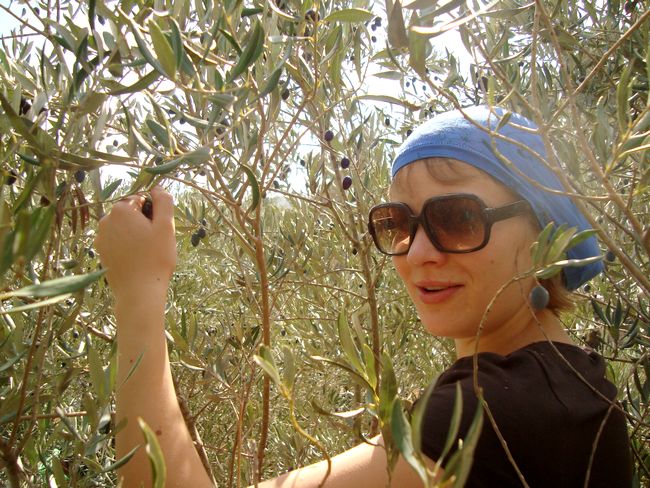
2011 will be the 8th year the annual JAI / ATG Olive Picking Program in Palestine from October 15th to 24th 2011. This event is of special significance to the Palestinian economy when all energies and efforts are mobilised.
Since the beginning of the second Intifada in 2000, the olive harvest has been overshadowed by the Israeli policies of repression, closure, blockage of streets, confiscation of agricultural lands, as well as repeated attacks against Palestinian farmers by Israeli settlers. Now with the construction the Apartheid Wall and the continuous expansion of Israeli settlements at the expense of agricultural land in the occupied Palestine , many farmers are separated from their trees, and help is most needed.
The objective of this program is to mobilise as many people as possible for olive picking, especially in areas that are situated in proximity to Israeli settlements and bypass roads, in order to help Palestinian farmers harvest their olive trees which they might be unable to do without international support. Also, the event has brought up awareness to hundreds of people from many countries around the world about real life under the Israeli Military Occupation, and the experience itself was referred to by several participants as a life changing one. You too are invited to join us for this event.
Besides picking olives, the program will feature introductory presentations about the organising institutions, the current situation in Palestine and the effect of the Apartheid Wall, tours in the old city of Jerusalem and the Church of the Nativity in Bethlehem , a tour of Hebron , cultural evenings and social gatherings.
There will be opportunities to visit the dead sea prior to and after the program and on the day off as well as visiting holy places of interest including historical sites such as the Al Aqsa and Ibrahimi mosques and Nativity.
Olive Picking 2011–
15th – 24th October ( Starting Saturday 15th October 2011 for 9 nights )
Click for Olive Picking 2011 – Proposed schedule
More Information:
- The cost of the program including accommodation in a double room, meals, guides, local transportation and other relevant expenses is $650 or the equivalent in your local currency. – please check the currency converter – http://www.xe.com/ucc/
- Accommodation can be arranged at a hotel or with a local family.
- Travel from and to the airport is not included in the cost but can be arranged for groups.
To learn more about previous seasons please go to the video and watch a 10 minutes film about the event here:
http://www.youtube.com/watch?v=9UYxAIxY2xA
Israel detains Al-Jazeera reporter alleging ties with Hamas
Palestine Information Center – 16/08/2011
JENIN — Al-Jazeera’s bureau chief in Afghanistan Samer Allawi is being held by Israeli intelligence agency Shin Bet for alleged affiliation to Hamas.
An Israeli military court extended Allawi’s term of detention on Tuesday after Shin Bet filed an indictment against him alleging that he is affiliated to Hamas and had relations with some of the commanders of its armed wing.
Allawi has denied all charges, saying the Israeli authorities were trying to produce fraudulent charges and that his arrest was actually based on his work as a reporter. He said interrogations focused on his professional work, social ties, and financial affairs.
The defense has refuted the possibility of Shin Bet having any evidence to support the charges.
Allawi, 46, was arrested while departing from the West Bank on Tuesday Aug. 9 after a three-week visit to his home village of Sebastia northwest of Nablus city.
He told the lawyer of the Palestinian Prisoners’ Society last week that the Israeli intelligence tried to recruit him and that when he refused to work with them he was threatened with being accused of something serious.
Israeli police jeep kills Palestinian
Press TV – August 17, 2011
A Palestinian pedestrian has been killed after an Israeli border police vehicle hit him in East al-Quds (Jerusalem) suburb near an Israeli settlement neighborhood. The 38-year-old victim Amin Talab Dabash was hit by an Israeli police jeep in Har Homa in East al-Quds, AFP reported on Wednesday.
A spokesman for the Israeli border police, however, claimed that the victim died in a traffic accident.
“Last night in the area of Har Homa, there was an accident when one of our jeeps hit a pedestrian. As a result of the accident, he died,” the Israeli spokesman said.
“He was crossing the road in a dark area, an area without lighting and the jeep hit him,” he added.
The Dabash family accuses Israel’s border police of having intentionally killed him.
At least 1,000 Palestinians attended Dabash’s funeral chanting slogans against the Israeli regime.
Settlers torch farmland near Nablus
By Saed Bannoura | IMEMC & Agencies | August 16, 2011
Ma’an Images
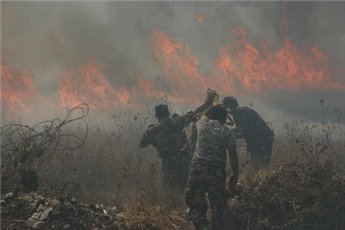
A group of armed extremist Israeli settlers torched dozens of dunams of farmland near the Homesh former settlement, north of Nablus city, in the northern part of the West Bank on Tuesday evening.
Ghassan Douglas, a Palestinian official in charge of settlements file in the northern part of the West Bank, stated that the settlers set ablaze all trees planted around the evacuated settlement and that the fire consumed hundreds of almond trees and evergreens.
He added that the trees belong to the local Palestinian residents, and that the attack was carried out just as the residents were preparing to break their fast as the Muslims are marking the holy month of Ramadan.
On Sunday evening, July 31, a group of fundamentalist Israeli settlers set ablaze, 150 Dunams of farmlands that belong to residents of Ein Jaloud village, near the northern West Bank city of Nablus.
On Friday July 15, settlers torched Palestinian olive orchards in Jabal Suleiman area, close to Burin village, south of Nablus.
The attack was carried out by a group of twenty heavily armed settlers who set ablaze at least 80 Dunams of farmlands, including dozens of olive trees.
Israeli soldiers arrived at the scene but failed to stop the settlers, but instead, obstructed the work of local firefighters.
The repeated attacks by the settlers are part of what they dub as “Price Tag” and include attacking and torching mosques in the West Bank, in addition to attacking farmers and their lands. The settlers hold the Palestinians responsible for the few random settlement outposts that were evacuated by the Israeli army in the West Bank.
Gaza: Soldiers shoot 75 year old woman along with ten goats
16 August 2011 | International Solidarity Movement
Selma Al Sawarka, or Um Ahmad, is an active woman, a mother of seven, and a grandmother of 35, who has never quit working. August 10, 2011 dawned like most days do for her; she went out to graze her family’s goats. She took her neighbor with her, 15 year old Keefa Al Bahabsa.
They went to the same land they usually go to. At 9:30 that morning they saw an Israeli tank and an Israeli jeep near the border. Not an uncommon sight. The tank and jeep left. About 30 minutes later, the jeep returned, three soldiers got out, and opened fire on Um Ahmed and Keefa. Um Ahmed was shot in the leg, Keefa fled to get help. The soldiers also shot ten of the family’s goats.
Um Ahmed is used to being shot at by the Israelis as her land is only 600 meters from the border. Usually, she says, the soldiers shoot around her, or into the air, trying to drive her from her land; she doesn’t know why today was different, why they shot directly at her, why they shot her in the leg. Her scarf also has bullet holes in it; only through the grace of God is she still here.
It took half an hour for Keefa to return with help, they loaded Um Ahmed onto a donkey cart, and went to the main road to meet a taxi to take her to the hospital. When I met Um Ahmed she was laying on a mat on the floor, recovering from being shot. A pale blue scarf covered her head. Bracelets adorned her wrists. Her daughter sat next to her. The room was simple, some mats on the floor, two chairs for the guests, a dresser, and small stand with a TV.
On the wall was a picture of her son Mustapha. He was killed by the Israeli’s on Dec, 15, 2004. Sometimes, the soldiers, or even the settlers themselves, would close the road near Netzarim settlement, the only way to go anywhere was to leave the road, and walk on the beach by the sea. Mustapha was shot and killed as he walked on the beach. The house we are in used to be Mustapha’s house. Beside the TV is another picture, another of her sons, this one has been in prison for the last ten years. He has eleven years left on his sentence. Um Ahmed, like all Gazan mothers, is not allowed to visit her son in prison, for four years this has been a blanket Israeli policy. Instead, she looks at this picture, she thinks about him in prison, while her leg heals.
Donors help keep Palestinians in cages
By Charlotte Silver | The Electronic Intifada | 16 August 2011
Ramallah – “Israel besieges us, puts us in cantons — in cages — and the international community is feeding us in these cages. It’s anything but developmental and it’s helping Israel’s colonization, ethnic cleansing and dispossession,” Dr. Samia Botmeh said, as she sat in her office in the Center for Development Studies (CDS) at Birzeit University near Ramallah in the occupied West Bank.
Despite the massive amounts of development aid that have been poured into the West Bank, the productive capacity of the Palestinian economy — measured by examining the agricultural and manufacturing sectors — is half that of 1994, and accounts for no more than 12 percent of employment. While the World Bank and Palestinian Authority boast an 8 percent growth in gross domestic product (GDP), real per capita income is still 8.4 percent lower than what it was in 1999, signifying that the GDP growth is not reflective of income growth for the average Palestinian.
Egypt provides an elucidative comparison. Two decades of serious neo-liberal reforms produced a GDP growth in Egypt that was similarly applauded by the International Monetary Fund (IMF): between 2006 and 2008, GDP grew 7 percent and there was a 4.6 percent spike in 2009 alone. However, as was made stunningly clear at the end of January, the country’s GDP growth had not trickled down to the majority of the people: unemployment had actually increased and 40 percent of the population lived on less than two dollars per day.
With former IMF representative Salam Fayyad at the helm since 2007, the PA has adopted the strategy of neo-liberal “good governance” as its framework for the state-building project. As post-colonial states have done in the past, the PA has sought to create an environment conducive for efficient and free-flowing markets by privatizing public services, emphasizing private property rights and reducing corruption. This agenda — state-building through neo-liberal policies — is most patently set forth in a PA program titled “Ending the Occupation, Establishing a State.”
As Mustaq H. Khan, an economics professor at London’s School of Oriental and Afrian Studies, pointed out in a lecture in Ramallah last winter, the injection of development aid into Palestine has deceptively flattered the PA’s good governance program, leading onlookers and promoters such as the IMF and World Bank to attribute the boost in GDP to a successful market economy (“Post-Oslo State-Building Strategies and their Limitation,” 1 December 2010 [PDF]).
There is still a stark contrast between the perceived improvement in the Palestinian economy and the actual standard of living for the majority of Palestinians. Development aid — which comprises roughly 40 percent of Palestine’s GDP — has been complicit in obscuring economic reality and in some cases truncating Palestine’s struggle for national liberation.
In June 2011, Birzeit University held a conference at which activists and academics spoke with donors and a representative from the PA on the failures of development, as well as the troubling role development aid plays in Palestine’s national movement.
“The framework of development is extremely unrealistic and problematic,” Dr. Samia Botmeh told The Electronic Intifada. The framework under scrutiny at Birzeit was the United Nations Development Programme’s Conflict-Related Development Analysis (CDA), which seeks to maximize the impact of development aid in conflict zones.
Botmeh added that the current international framework for assessing development aid in the West Bank treats the Israeli-occupied region either as a conflict zone or a post-colonial zone. “This is completely unrealistic because we are not in a conflict, we are in a colonization process,” she said.
The conference took place after the university’s Center for Development Studies concluded a project commissioned by the UNDP that examined how development funds could be better allocated in the occupied West Bank and Gaza Strip amid Israel’s continued occupation.
Because the CDA framework attempts to implement “development” projects while avoiding any political position, the study found that it implicitly assumes both parties have a reason to compromise. This fundamentally flawed approach refuses to acknowledge — and therefore address — the stark power imbalance that allows Israel to remain intransigent.
Realizing that reallocating funds would not address the fundamental hindrances to achieving economic self-determination through development in Palestine, the center articulated what development should look like in the context of an active colonization process. “Development should be about more than helping people survive; it should be about ending colonization,” Botmeh explained.
The Center for Development Studies’ critique shows how development fails to achieve much of anything tangible for Palestinians, and — even more ominously — serves to fortify Israel’s occupation and further annexation of land.
Development confined to “state-building”
After the implementation of policies dictated by the Oslo Accords, signed by Israel and the Palestine Liberation Organization in the mid-1990s, international aid to Palestine took a turn toward development. Previously, aid to Palestine was earmarked for “humanitarian” purposes such as UN operations and charity. With the establishment of the Palestinian Authority as a transitional government, development aid was ostensibly intended to promote an independent economy that would facilitate a smooth transition to a Palestinian state.
After 18 years of an ostensible peace process — of which the agency of the Palestinian national liberation struggle has been confined to a “state-building” project by the PA and Israel — Palestinians’ standards of living have decreased, while inequality has increased.
Botmeh believes that the underlying assumption of this development aid is that it is being funneled into a post-colonial state and that Israel has an intention to withdraw from the West Bank and Gaza Strip. These assumptions, blatantly oblivious to any political reality, have allowed development aid to reinforce Israel’s colonization through the continued degradation of Palestine’s territorial contiguity and the ongoing depopulation of Area C — more than 60 percent of the West Bank, including East Jerusalem, that is under full Israeli military control.
Under the Oslo accords, the occupied West Bank and Gaza Strip were carved up into areas A, B and C, the last of which is administered and controlled by the Israeli government and its military. Israel has declared three-quarters of the land as “closed military zones” or nature reserves, and therefore “off-limits” to Palestinians. Approximately 40,000 Palestinians live in Area C.
The 1999 deadline for the termination of the West Bank’s geographic stratification into Areas A, B and C has long passed. Far from assisting in the formation of a viable state, development aid has served to entrench the partitioning of the land.
Peter Lundberg, a representative of the Swedish International Development Cooperation Agency, confirms these faults in the current development paradigm in Palestine. Speaking from the perspective of an international donor, Lundberg excoriated the complicity of development aid in fragmenting Palestinians by only working in Area A due to Israeli restrictions in Area C.
“Donors and the PA have been too focused on state-building, which is important, but they are going to lose critical parts of the land,” Lundberg said. “Development should help Palestinians stay on their land; too many have left [their land in] Area C.”
Because implementing projects in Israeli-controlled Area C are logistically burdensome and in many cases impossible, donors are inclined to contribute to projects in Area A.
According to Lundberg’s statistics, there has been an exodus of Palestinians from Area C mostly due to the impossible living conditions Israel has created and the predatory nature of surrounding settlements. Israel does not allow communities to be connected to sources of water or electricity and refuses nearly every request for a building permit, thus leading to the destruction of water-collecting devices, schools and homes. In contrast, settlements sitting next to these Palestinian villages are afforded free-running water, electricity, roads and expanding infrastructure.
In 1967 there were approximately 200,000 Palestinians living in the Jordan Valley, which is designated Area C, except for the Palestinian city of Jericho. Today, there are only 56,000, 40,000 of whom live in Jericho (in Area A), according to statistics from the international aid agency Save the Children.
The devastating picture that these statistics reveal is that donors have been complicit in aiding Israel’s process of cantonizing the West Bank into the 18 percent that comprises Area A. By doing so they have helped to surrender the majority of the West Bank’s land and agriculture — which could form the basis of a genuine self-sustainable Palestinian economy and state — to Israel’s control.
Neo-liberalism undermining Palestinian rights for self-determination
Raja Khalidi, a senior economist with the United Nations Conference on Trade and Development (UNCTAD), has written that the development enterprise — representing $1.5 billion a year — is taking place inside territories that have been tagged by the World Bank, European Union, IMF and United States as a site for expanding a neo-liberal project (see “Neoliberalism as Liberation: The Statehood Program and the Remaking of the Palestinian National Movement,” Journal of Palestine Studies, Vol 40, no. 2, Winter 2011).
In the PA’s neo-liberal paradigm — as enshrined in the “Palestinian Reform and Development Plan” of 2008-10 and “Ending the Occupation, Establishing the State” — economic growth is promised as a consolation for occupation rather than a strategy to resist it.
Speaking at the conference, Khalidi remarked on the absurdity of such an agenda in the context of an occupation that ultimately determines Palestine’s economy. “For the last three years, the PA has been routing out internal obstacles to state-building, while the PA has no structure to tackle external obstacles,” he said.
Moreover, without sovereignty, genuine economic growth is out of reach. Khalidi explained that the PA is not only unable to counteract Israel’s aggressive policies of colonization but it also does not have the ability to exercise control over Palestine’s macro-economic policies — such as its own currency and control over interest or exchange rates.
Development aid has long been faulted for its inadvertent assistance in sustaining the occupation by reducing its humanitarian impact and thus making it more palatable. However, Omar Barghouti, a leading figure of the boycott, divestment and sanctions (BDS) movement, revealed the disingenuous nature of international development aid.
“Development exudes complicity in colonialism; it’s intentional and it’s complicit — ignorance is not an excuse,” he said at the conference.
Barghouti proffered several examples of countries throwing some money at the cause of development in Palestine while concurrently supporting projects or companies that actively undermine Palestinian sovereignty.
Veolia, a French transportation corporation that according to Barghouti is mostly owned by the state, is currently building Jerusalem’s new light rail system. The Jerusalem light rail connects West Jerusalem to illegal settlement blocs in occupied East Jerusalem. Despite targeted pressure on Veolia to withdraw from the light rail project — part of a global BDS campaign that has cost the company up to $10 billion, according to Barghouti — the company and by extension France have held onto their contract with Israel.
Restoring class struggle to the national liberation struggle
Adam Hanieh, a lecturer in development studies at the School of Oriental and African Studies, situates development aid in the longer arc of Israel’s colonization of the land through systematic fragmentation of the Palestinian people and nation. In his lecture at Birzeit, Hanieh restored the importance of class struggle to the goal of national liberation and exposed development aid as working against Palestinian unity undivided by wealth or class, against the occupation.
“Sixty-three years of colonization have seen the division, fragmentation and fracturing of the Palestinian people. Development must confront this fragmentation, not aid it,” Hanieh explained to the audience.
Illustrating how neo-liberalism has encouraged the notion that the solutions to problems are individual in nature rather than collective, Hanieh stressed that much of the “development” one sees arising in the West Bank benefits Israeli business. For example, consumption in Ramallah’s flourishing restaurant and café culture is mostly funded by this development aid — and in turn sustains the importation of Israeli products. Poignantly, this new consumer class — enabled by development aid — creates one more isolated stratum of Palestinian society.
All this continues against the backdrop of the regional popular uprisings against, among other things, neo-liberal policies. These uprisings showcase an exemplary shaking off of dictators and the present world order and the inspiring potential of class struggle.
If development aid programmes set freedom — rather than the introduction of a neo-liberal state — as their principal objective for Palestinians, then they may begin to counter the 63-year process of confiscation and colonization. Otherwise, they will be offering that process a helping hand.
Charlotte Silver is a journalist based in the West Bank. She can be reached at charlottesilver A T gmail D O T com.
Gaza teenager shot dead
Ma’an – 16/08/2011
GAZA CITY — Israeli forces shot dead a Palestinian teenager near the central Gaza Strip city of Deir Al-Balah late Tuesday, medical officials reported.
Medics said the Palestinian, who was not identified, suffered “more than 10” gunshots to the head and upper body after soldiers east of the Al-Masdar area opened fire.
Gaza health ministry official Adham Abu Salmiya told Ma’an that an ambulance crew transferred the teenager’s body to the Al-Aqsa Martyrs Hospital in central Gaza.
An Israeli military spokeswoman told Ma’an that “IDF forces opened fire at a suspect approaching the security fence. The forces identified a hit,” the official said.
The teenager had approached the border east of the refugee camp of Maghazi in central Gaza, Agence France-Presse quoted Palestinian witnesses as saying.
Earlier, Abu Salmiya said Israeli airstrikes killed one man and injured seven others in the central and southern Gaza Strip, in what the army called retaliation for a rocket attack hours before.
Featured Video
Laith Marouf: Hezbollah’s position on US-Iran ceasefire
or go to
Aletho News Archives – Video-Images
From the Archives
The Dirty Little Secret behind the “Global Terrorism Index”
The Omission of Israeli Terrorism in the Occupied Palestinian Territories
By Karin Brothers | Global Research | December 6, 2014
… The Israeli settlements — all of which are illegal – have been identified as a major impediment to peace. The refusal of a major “global” terrorism report to name the Israeli settlers as one of the groups most responsible for terrorism not only misrepresents a major source of regional violence but exposes the Global Terrorism Index as a propaganda tool that supports a U.S. agenda.
In recent years, governments have been attempting to thwart terrorism by blocking supportive fund-raising. When it comes to Israeli settlements, however, the US and Canada actually encourage fund-raising by giving organizations (such as Christian Friends of Israeli Communities (CFOIC) and the Jewish National Fund) financial support in the form of donor tax-deductions.
Charities which provide funds for the Israeli settlements should be regarded as terror-financing organizations. They should not only lose their tax-deductible status, but they should be banned because they support the violation of international humanitarian law. The terror-financing laws that are being strictly enforced for Muslim charities should be applied to Christian and Jewish charities as well. … Read full article
Blog Roll
 Aletho News
- The ‘Opposition Party’ Has Done Nothing to Stop the Iran War and Much to Goad Trump Into Continuing It
- Moscow backs Tehran on status of Lebanon in US-Iran deal
- How UK Regulator Ofcom Quietly Bypassed International Law to Police American Speech
- The Black Cube Files: How Former Mossad Operatives Flipped a Nation
- Laith Marouf: Hezbollah’s position on US-Iran ceasefire: What you’re not being told
- Israel’s priority lies in destroying chances of peace between Iran, US: Ex-UN nuclear chief
- Ceasefire for all or for none: Iran shuts Hormuz over Lebanon attacks
- Strait of Hormuz is Iran’s ‘nuclear weapon’ that forced US retreat: Medvedev
- Energy crisis will last for months – Kremlin envoy
- Europe’s quiet role in the war on Iran
- If Americans Knew
- This is ceasefire? Israel’s biggest massacre yet in Lebanon, another journalist killed in Gaza – Daily Update
- Tucker Carlson on Israel: This Is the Behavior of an Ally? Really?
- Gazans face a triple crisis: severe shortages of water and bread, healthcare in tatters
- NY Times reports how Netanyahu took the US into Iran War
- A sigh of relief over Iran, but Gaza and Lebanon in dire straits – Daily Update
- Thousands dead and neighborhoods razed to the ground: Aid agencies fear southern Lebanon is becoming the new Gaza
- The war the US is fighting for Israel could cost trillions
- ‘Cigarette Burns, Nail Wounds’: Toddler Tortured in Gaza to Coerce Father
- Trump Says US Sent ‘a Lot of Guns’ to Protesters in Iran
- Israeli forces destroy 17 UN peacekeeper cameras in south Lebanon
- No Tricks Zone
- An Inconvenient Tree: Uncovered In Alps… Europe Much Warmer Than Today 6000 Years Ago
- New Study Reports A 60% Slowdown In Greenland’s Ice Loss Rate In The Last Decade
- Low Intensity Tornado Wrecks Major Solar Farm, Creating A Potential Toxic Dump
- New Study Finds Warming Saves Lives…Cold Temperatures 12 Times More Deadly Than Excess Heat
- German Science Blog Accuses PIK Climate Institute Of Hallucinating Climate Tipping Points
- Devastating Assessment Of Comirnaty Vaccine By Former Senior Pfizer Europe Toxicologist
- New Study: CO2 Is ‘Effectively Negligible’ As An Explanatory Climate Change Factor Since 2000
- Former Pfizer Toxicologist Dr. Helmut Sterz Tells Bundestag Hearing Pfizer Vaccine Should Have Never Been Approved
- Energy Expert: Germany’s Nuclear Phaseout Was A “500 Billion Euro Mistake”
- New Research: South Australia’s Mid-Holocene Sea Surface Temperatures Were 4°C Warmer Than Today
 Aletho News