US, South Korea launch provocative joint military drill
Press TV – August 16, 2011
The United States and South Korea are carrying out a joint military exercise within the East Asian country’s territories despite opposition from neighboring North Korea.
The Ulchi Freedom Guardian (UFG) annual military drill, launched on Tuesday, is reportedly aimed at strengthening the defense capabilities of the alliance against any possible attack by North Korea, South Korea’s Yonhap News Agency reported.
The Combined Forces Command (CFC) has said in a statement that the UFG will try to enhance the US-South Korea’s joint ability “by exercising senior leaders’ decision-making capabilities and by training commanders and staffs from both nations in planning, command and control operations, intelligence, logistics, and personnel procedures.”
“It is challenging and realistic training focused on preparing, preventing and prevailing against the full range of current and future external threats to the Republic of Korea and the region,” claimed the commander of CFC, General James D. Thurman.
The military exercise provoked severe criticism from the North, as the state had earlier appealed for cancellation of the drill.
Pyongyang cited the move as “extremely provocative,” calling it a preparation for an “all-out war” against the North and the “largest-ever nuclear war exercise”.
“The Korean peninsula is faced with the worst crisis ever. An all-out war can be triggered by any accidents,” North Korean media reported on Tuesday.
“The US war-mongers are planning to carry out a realistic war drill to remove our nuclear facilities with a mobile unit led by the US 20th Support Command which was sent to Iraq to find and disable weapons of mass destruction,” they added.
The North had previously called on the two states to cancel the drill, describing the move as a blow to new efforts to restart six-nations talks aimed at dismantling Pyongyang’s nuclear program.
Pyongyang usually views such exercises as a rehearsal for invasion, and launches its own counter-maneuvers.
Tensions have been running high on the Korean Peninsula since November 2010, when an exchange of artillery fire left four South Koreans dead on a border island.
The North accuses US President Barack Obama of plotting with regional allies to topple the country’s government, insisting that its nuclear program is a deterrent to US forces in the region.
From Brixton to Tottenham
By MICHAEL DICKINSON | Counterpunch | August 16, 2011
Following the recent disturbances in England in inner city areas of high unemployment and poverty it is expected that the final count of those arrested for riot and looting could reach as high as 4000. Reasons suggested by the press for the scale of the unrest include recreational violence, criminal opportunism, social irresponsibility, gang culture, greed, and cuts in public services, including the closure of youth clubs. But the prime factor that caused the mayhem to spread must come down to local tensions with the police, and their fatal shooting of Mark Duggan, a black man travelling in a minicab.
Similarly, in the early 1980’s young black men in Brixton were victimised by the widespread use of the “sus” law, which enabled police officers to stop and search members of the public even if they had no hard evidence that a crime had been committed. And the shooting of a black woman, Cherry Groce, in her own home by police investigating a robbery in September 1985 was the trigger for a simmering resentment to explode.
I was living in a squat in Brixton at the time. We were just getting ready for supper when news came on the television about the shooting. Apparently, in a search of her flat for her son who was wanted on a suspected firearms offence, Mrs. Groce had been shot dead in bed by a policeman. (We learned later that she wasn’t killed but had been paralyzed from the waist down from the shot.) The news said a group of protesters had gathered at the local police station chanting anti-police slogans and demanding disciplinary action against the officers involved. I said we should get down there and join them. While my squatmates hummed and hawed I decided not to waste any time and set off for Brixton Police Station. As I approached the center I met people coming from it warning me to go back as the protest outside the police station had turned into a battle which was spreading through the streets, but I decided to continue. I saw people coming out of smashed shop windows with goods, people running, throwing stones at lines of charging police, a few cars and buildings burning, lighting the night with orange flames. Police cars and vans rushed around wailing.
Not everyone was out on a riot. Many like myself had just come to see what was going on. (I had my right arm set in a plastercast anyway from an earlier accident.) Halfway up Railton Road, the notorious ‘Front Line’ a barricade of bins and boxes was being erected by rioters. I found a large pile of old discarded newspapers and added them to the defence in solidarity, then went to visit two young women friends, Helena and Rachel, who lived in a flat nearby. We had a chat and a drink and I persuaded them to come out and see what was going on. There was a good view of Railton Road across a tarmacked park from the end of their street. A crowd of mainly black residents had congregated there and were watching the scene. The barricades across the road were now burning and molotov cocktails were being hurled at the charging shield and baton wielding army of crash-helmeted police force. The mood of the onlookers was excited and friendly and they laughed and cheered when I shouted across the tarmac at the police, telling them to get out of Brixton and leave us alone. A few voices joined me.
Helena suggested we go back into the flat and listen to the police radio she had hacked into and learn what was happening. Apparently Brixton was out of control and people were being arrested all over the place.
When we went back out a bit later the barricades were smouldering and the riot police were having a breather, seated with their shields in front of them on the benches on the other side of the park. The onlookers were still crowded together watching. When one of them saw me they said “Ah, here’s Rambo again! (In reference to the small black cyclist’s helmet I was wearing.) Give them some more jaw, Rambo!”
So I made my voice reach the resting cops across the square.
“Do your mothers know you’re out? Isn’t it time you were home in bed? Get out of Brixton! You’re not wanted here!”
Suddenly the gang of police stood up and started drumming their batons against their shields. At the same time one of the crowd shouted a warning.
“There’s a police van coming up the street! Run for it everyone!”
The onlookers began to scarper in every direction, and at that moment the line of bobbies began to charge towards us. I began to run but suddenly stopped and began to walk instead. Why should I flee? I hadn’t done anything wrong.
One of the charging policemen reached me and grabbed my arm.
“Let’s hear you shouting now, Rambo!” he said, and another cop grabbed my helmet and chucked it away. I was bundled into the back of the police van which had now arrived and was driven back into the heart of Brixton, stopping and picking up other young men, black and white, along the way, who had been arrested. The van was soon full and we were driven to a police station where we were made to line up outside while they dealt with detainees ahead of us. An officer handed out leaflets.
“Read and inwardly digest,” he said. I took one and shoved it into my mouth, biting and chewing. It didn’t taste very nice so I didn’t pursue the joke. Inside mug shots were being taken of all those arrested. One guy’s nose was pouring with blood as his picture was taken. Then it was time for fingerprints. I refused to have mine done. When asked why not, I said it was my right, and a senior officer confirmed this, but he said it might make matters difficult for me later. Then I was put into a small cell with about ten other guys and we were there for the rest of the night, most of us seated on the floor. At one point two policemen came and removed one black guy and made him take his trousers and underpants down outside the cell before putting him back in again.
In the morning my cellmates began to be released one by one, collecting summons for their court appearances on various charges connected with the riots of the previous night. Finally there was just me in the cell, and when, by lunchtime, I demanded to know why I was being kept, I was told that if I gave my fingerprints I would be released. What else could I do? I gave them and got my summons to appear in court a couple of days later.
Before that, the next morning at about seven the front door of our squat was battered down by police officers saying they were looking for goods looted in the riots. We were confined to our rooms while they searched. I objected when they started going through my letters and private documents, saying that none of them had been stolen, but there was nothing I could do. After combing the flat they took away one of my squatmates, Frank, to question at the station because he had a suspiciously large amount of rolling tobacco, but he hadn’t stolen it and no charges were brought.,
Meanwhile I got Helena and Rachel to come along to my court hearing, and a neighbour of theirs who had been in the crowd that night to act as witnesses to the fact that I had done nothing wrong. A lawyer was provided. After I talked to him he said that considering my list of previous arrests there was a possibility I might be facing time in prison. I was a little worried at first, but when the judge heard the circumstances presented as police evidence against me he quashed the charge.
I was charged with ‘Incitement to Racial Hatred’. The story that the arresting officer told in the dock was extraordinary. He said that the accused (me) had been in the company of a gang of black youths. When I had appeared on the scene where the police were resting I had pointed to them and announced: “There they are! Kill the devils!” And my little gang had proceeded to throw bricks and stones at them.
“Just a minute,” said the judge. “This man is white. Him telling black people to kill white people cannot be classed as ‘Incitement to Racial Hatred’. It only works if you are inciting hatred of another race, not your own. This is a waste of time. Case dismissed.”
And so to my relief I was free. Free? Well, at least not in prison.
In 1987 Inspector Douglas Lovelock, the officer who shot Cherry Groce was acquitted of all charges, including malicious wounding, and was reinstated. Mrs Groce received compensation but remained paralyzed for the rest of her life. She died in May 2011.
Meanwhile, the identity of the policeman who shot Mark Duggan remains unclear.
Michael Dickinson can be contacted at his website – http://yabanji.tripod.com/
British police kill indiscriminately
Press TV – August 16, 2011
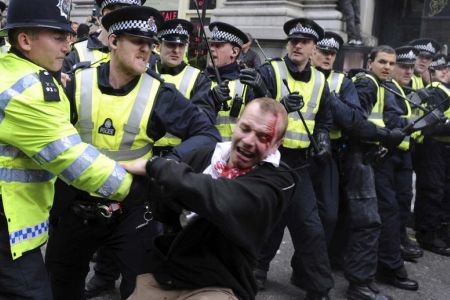
British police have played a significant role in triggering civil disobedience in the UK through their unprofessional and brutal way of dealing with innocent civilians.
Mark Duggan, recently killed in a police shooting in the London suburb of Tottenham and whose death sparked a wave of street protests across Britain, Ian Tomlinson, an English newspaper vendor who was killed during G20 summit protests in London, Jean Charles de Menezes, who was shot seven times in the head after the London bombings of July 7, 2005, and David Emmanuel , a British reggae singer who was killed during a police raid on his home, all are the names included in a long list of people killed at the hands of British police forces.
Independent Police Complaints Commission (IPCC), a police watchdog that deals with complaints against police has been established to investigate police’s crimes.
The IPCC’s job is to make sure that complaints against the police in England and Wales are dealt with effectively, it claims.
The body claims to be setting standards for the way the police handle complaints against themselves and, when something has gone wrong, it helps the police learn lessons and improve the way it works.
But they neither have learnt lessons nor have they tried to improve their performance, the example of which are:
1- Mark Duggan, whose family said it has no trust in the IPCC. The police shooting victim’s friends and family said that they don’t feel the police watchdog is sufficiently independent. The police watchdog has admitted it may have wrongly led journalists to believe that Mark Duggan fired at officers before he was killed. The Independent Police Complaints Commission has confirmed that it may have “inadvertently” given reporters misleading information in the early stages of the investigation. It was initially reported that Duggan, 29, shot at police. But ballistic tests later found that a bullet which lodged itself in one officer’s radio was police issue. An inquest into Duggan’s death heard the father-of-four died from a single gunshot wound to the chest.
2- Ian Tomlinson was an English newspaper vendor who collapsed and died in the City of London after he was confronted with the police while on his way home from work during the 2009 G20 summit protests. A first postmortem examination indicated he had suffered a heart attack and had died of natural causes. A video footage later showed that a baton wielding police had struck him on the leg from behind and the pushed him on the ground. The video showed no provocation on Tomlinson’s part. He also was not a protester, and at the time he was struck was walking along with his hands in his pockets. The victim walked away after the incident, but collapsed and died moments later.
3- Jean Charles de Menezes was killed in the aftermath of the London bombings of July 7, 2005. He was a Brazilian man shot in the head seven times at Stockwell tube station on the London Underground by the Metropolitan Police. Police misidentified the victim as one of the fugitives involved in the previous day’s failed bombing attempts. The IPCC launched two probes into the incident, none of which brought disciplinary charges against police officers involved.
4- David Victor Emmanuel, known as Smiley Culture, was killed on March 15, 2011 during a police raid on his home. The 48-year-old was a British reggae singer and deejay known for his fast chat style. Police claimed that the victim died of a self-inflicted wound, while officers were searching his house in Warlingham, Surrey. But a post-mortem examination revealed that he had died from a single stab wound to his heart. His death triggered peaceful protests, but it was little reported.
The IPCC was faced with a crisis in February 2008 after more than one hundred lawyers who had specialized in handling police complaint resigned from its advisory body.
They lashed out at IPCC for its indifference towards complaints, favoritism towards police and rejecting complaints, which were strongly documented. Meanwhile, there have happened more than 400 deaths at the hands of police officers in the past ten years alone but no policeman has ever been convicted of murder or manslaughter for just one single death so far.
Is Benny Morris (Professor, Ben-Gurion University) a Serious Historian or Plain Old Racist?
London BDS | 28 July 2011
London BDS is pleased to announce that a video about Benny Morris with footage of what really happened on his visit to London has now been released. People should draw their own conclusions about why Benny Morris referred in a press interview to ‘Brownshirts’, ‘Muslim mobs’ and ‘broken English’.
Benny Morris gave numerous interviews after his lecture at the London School of Economics in June 2011. Typical of these was his interview with The National Interest Magazine in which he claimed that he was accosted outside the lecture by a Muslim mob:
“As I walked down Kingsway, a major London thoroughfare, a small mob—I don’t think any other word is appropriate—of some dozen Muslims, Arabs and their supporters, both men and women, surrounded me and, walking alongside me for several hundred yards as I advanced towards the building where the lecture was to take place, raucously harangued and bated me with cries of “fascist,” “racist,” “England should never have allowed you in,” “you shouldn’t be allowed to speak.” Several spoke in broken, obviously newly acquired, English. Violence was thick in the air though none was actually used. Passersby looked on in astonishment, and perhaps shame, but it seemed the sight of angry bearded, caftaned Muslims was sufficient to deter any intervention. To me, it felt like Brownshirts in a street scene in 1920s Berlin—though on Kingsway no one, to the best of my recall, screamed the word ‘Jew’.”
Please take the time to watch the whole video – it’s a good guide to Benny Morris and what he stands for. The encounter with Benny Morris on London’s Kingsway is also included.
An article to accompany the highly-recommended 34 minute video can be found here.
If you don’t have time to spare, an abridged version commences at 30.00 min.
Teenagers heckle UK PM during speech
Press TV – August 15, 2011
A group of British teenagers heckled Prime Minister David Cameron, when he was addressing his constituency gathering in Witney, Oxfordshire about a broken society.
Cameron was heckled by the teenagers when he made a pledge to reverse the moral collapse in the society and to fix Britain’s “broken society”, according to the British media reports.
The Prime Minister declared “a concerted, all-out war on what he called as gangs and gang culture”.
“It is a major criminal disease that has infected streets and estates across our country,” he said.
Cameron announced a series of tough measures, among them plans to have school leavers take part in a National Citizen Service, to deal with social problems.
Under the plan, Cameron pledged to introduce a non-military national service program, in which it would be obligatory for all 16-year-olds to participate and spend time volunteering in hospitals and community centres.
But the young audience was unimpressed, heckling the Conservative leader.
“He is blaming everyone but himself,” said Jake Parkinson, 17, unemployed. “The rich get richer, the poor get poorer. I’d love to go to university, but it’s the money that is putting me off.”
There were whistles when Cameron entered the stuffy, cramped room and “chicken” noises at the end from teenagers who accused him of leaving early and being too scared to answer all of their questions.
Many in Witney said they thought the biggest threat to public order came from a government austerity drive that they say will inevitably lead to the closure of social services funded by the state or third parties, such as charities.
“He wants people to get in touch with their families, but for some people their families aren’t there and the youth centre is the only place where they can talk to people,” said Ryan Clayton, 15. “But he’s shutting all the youth centres.”
Unemployed father-of-two Martin Lawson Smith said the wide gap between Britain’s rich and poor had fuelled the discontent.
“I don’t think broken families and morals are the problem,” he said. “It’s more the inequality that there is in society.”
No level playing field for Palestinian athletes
By Samah Sabawi | Mondoweiss | August 15, 2011
With much fanfare, the Peace Team has come once again to Australia to compete in the Australian Football League International Cup. Indeed, what can be more appealing for those of us who are passionate about peace in Israel/Palestine than to welcome this team of Palestinian Israeli youth who have learned to play and interact together not as enemies but as teammates? The answer: the idea that when members of this team return to their homes, the Palestinian players would not have to go through dehumanizing checkpoints, around high barbed wire walls and into Bantustans surrounded and suffocated by a matrix of Jewish-only roads, settlements and security zones.
The AFL Peace Team was created in 2008 in order to compete in the AFL International Cup. It is made up of an equal number of Israeli and Palestinian players supported by the Israeli Peres Center – an Israeli organization that aims to promote “peace and reconciliation”. However, the team has come under heavy criticism from Palestinian and other human rights groups who insist that reconciliation is the process of bringing two people together and establishing friendly ties between them after an argument or a disagreement has ended. Reconciliation is the healing phase and as such, cannot be implemented while the environment that breeds the mistrust and the conflict continues to exist.
So far this year, Israel has announced the building of thousands more new Jewish-only homes on stolen Palestinian land in the West Bank. According to UN agencies and human rights groups, Palestinian homes have been demolished by Israel at record rates this year. Israel still maintains a crippling inhumane siege against Palestinians in Gaza while it continues to pursue a process of Judaization in East Jerusalem that is rapidly driving Palestinian residents out of their homes to be replaced by Jewish settlers. In such an environment, how can reconciliation even begin?
The Peres Center fails to understand that peace cannot be achieved by parading Palestinians in the Peace Team around the world in efforts to showcase Israel’s ‘fair play’ in sports without even once addressing the real challenges Palestinian athletes face as a result of Israel’s 43 years of occupation and the devastating impact Israel’s policies have had on Palestinian sports and sports infrastructure. The Peres Center would have met its goals of laying the foundations of ‘peace and reconciliation’ better had it issued a statement calling on its government Israel to lift its crippling blockade and siege of Palestinian sports’ events and athletes.
While the peace team promotes the illusion that Palestinian athletes have equal opportunities to compete and to excel in their fields, in reality, the effect of Israel’s policies tell a different story. The Palestinian National Football (soccer) Team, which was founded in 1952 but only became recognized by FIFA after the creation of the Palestinian Authorities in 1998, has faced insurmountable challenges imposed by Israel aiming to isolate Palestinians in all fields, sports as well as academic, medical and cultural. This year, Israeli policies of occupation have sabotaged the Palestinian team putting them at a great disadvantage as key members of the team were prevented from traveling into the West Bank from Gaza.
This is not news for those who follow this conflict. Many Palestinian athletes have in the past suffered Israel’s blanket boycott on Palestinian sports. Palestinian Olympic players and youth teams are frequently denied both exit and re-entry when traveling from Gaza to the West Bank. In the qualifying rounds for the 2006 World Cup, five key players were prevented exit from Gaza by the Israeli authorities and so as a result Palestine failed to qualify. A year later the Palestine National Team was prevented by Israel from traveling to play a World Cup Qualifier in Singapore and so it was eliminated. In May 2008 the same team was unable to attend the AFC Challenge Cup, which meant they were denied qualification for the 2011 Asia Cup.
This system of Israeli permits that restrict and confine Palestinians, denying them their right to travel, reminds us of the “pass laws” of Apartheid South Africa that were put in place to limit the movement of Black South Africans and keep them in their segregated communities. Such blanket confinement of an entire population is a form of collective punishment and is in violation of Article 33 of the Geneva Conventions.
Unfortunately, Israel’s assault on Palestinian sports and athletes is not limited to its system of permits. During Operation Cast Lead in 2008-09 Israel’s indiscriminate bombardment of Gaza, which destroyed huge areas of the city, flattening houses, schools, hospitals and mosques also destroyed the Rafah National Stadium. Over 1,400 people in Gaza were killed including football players Ayman Alkurd, Shadi Sbakhe and Wajeh Moshate.
So while Israel’s Peres Center parades its token ‘peace team’ of Palestinian and Israeli athletes in a clear effort to normalize the occupation and to reduce the criticism and pressure Israel faces from human rights groups and the international community over its oppression of Palestinians, let us take a moment to consider the harsh conditions that Palestinian athletes endure in their daily lives. Of course an Israeli Palestinian team is worth celebrating, but only if it comes from an Israeli Palestinian society that is free of discrimination, where Palestinians and Israelis live as equals both on and off the playing field.
Samah Sabawi is an Australian Palestinian writer and political analyst. She is Public Advocate for Australian for Palestine.
Will TVA gamble with nuke plant?
TVA board to consider gamble completing Bellefonte Nuclear site
Enformable | August 14, 2011
Later this month, the board of the Tennessee Valley Authority could take up a proposal to complete the Bellefonte nuclear power plant in northeast Alabama.
TVA administrators are conducting a campaign to gain public support for the project and nuclear energy in general despite a dangerous incident at a Japanese plant this year.
The Bellefonte Nuclear Generating Station is a partially completed nuclear power plant located in Hollywood, Alabama. A total of four reactors have been proposed over a period of 40 years, and billions of dollars have been spent, but no electricity has yet been produced. The site has sat idle for more than 20 years and some spare parts have been taken from the two incomplete units.
In 1974, TVA announced it would build two 1,200 megawatt nuclear reactors at Bellefonte, located in Jackson County, Ala., and construction began on Unit 1 but was halted in 1988 because of decreased power demand. TVA kept the unit in deferred status until 2005, when it decided to cancel construction.
TVA says reviving the Bellefonte plant would cost about $4.8 billion and take several years…
Mr. Gundersen’s expert analysis identifies seven specific areas of risk that, in Fairewinds’ opinion, will cause further delays, additional costs, and even possible suspension of the Bellefonte project if TVA decides to move forward with its construction. They are:
1. Bellefonte’s Unique Design
2. Groundwater Intrusion That Is Weakening It’s Foundations
3. Missing Critical Nuclear Quality Assurance Documents and Complete Records
4. Cannibalization of Bellefonte’s Operating Systems
5. Containment Problems Unique to Bellefonte
6. Historical Precedent
7. Post-Fukushima Lessons Learned
~
Bellefonte Nuclear Generating Station http://en.wikipedia.org/wiki/Bellefonte_Nuclear_Generating_Station
Unexplained Gaza communications “blackout” highlights Israeli control of networks
By Benjamin Doherty – The Electronic Intifada – 08/14/2011
On Tuesday, Gaza disappeared from the world’s telecommunication networks for between 12 and 18 hours. This was an anxious time for both Gaza’s residents and those trying to contact friends, colleagues and loved ones from the outside.
The Gaza Strip, home to 1.6 million Palestinians, the vast majority of them refugees, depends on telecommunications to maintain a tenuous link to the outside world, from which it has been physically isolated due to five years of Israeli siege and blockade. The sudden cutoff also sparked fears of an imminent Israeli attack.
Though there was relief when communications were re-established, there has been no satisfactory explanation of the blackout, who was responsible for it, and whether or not it could happen again.
What happened to Gaza’s networks last week?
Ma’an News Agency was the first to report the problem, and a few Twitter users in Gaza remained online because they had BlackBerry service or were able to connect to the Orange network via its towers on the Israeli side of the boundary with Gaza.
The blackout has not been fully explained, and statements from Israeli and Palestinian officials are not consistent. The initial reports of Israeli bulldozers do not mention if the bulldozers were actually digging in the ground. One incident should not have disconnected the entire Gaza Strip, because there are multiple lines at different locations that connect Gaza’s networks to the West Bank. […]
[An Israeli occupation forces] spokesperson denied involvement in the disconnection, but they were very specific about what they were denying. […]
Occupied Lineman
To repair broken equipment in Israel, the Palestinian companies that maintain them must either receive permission from the Israeli authorities or find an Israeli contractor to perform the work. During Israel’s three-week long assault on Gaza in 2008-09, millions of dollars of damage was done to Gaza’s telecommunications infrastructure, but even then, the network did not completely fail as it did last week.
Under the terms of the Oslo Accords, Israel agreed to allow Palestinians’ to develop an independent telecommunications infrastructure, but the communications infrastructure in West Bank and Gaza Strip remains completely dependent on Israel. In fact, Palestinians (along with Israelis) are prohibited from connecting to international networks through any other country. Despite this, Paltel announced its intention to develop an alternate connection through networks in Jordan earlier this year.
In a useful and well-documented paper, Helga Tawil-Souri gives a detailed introduction to the history of Palestinian telecommunications under Israeli occupation and what she terms the “Hi-tech enclosure of Gaza,” the electronic counterpart of Israel’s ongoing physical siege of the territory.
Moreover, Palestinian writer and entrepreneur Sam Bahour, who was part of the core team that established Paltel, has emphasized the importance of telecommunications to economic development and how Israel’s occupation has enriched Israeli companies and hindered Palestinian development in general. … Full article
Featured Video
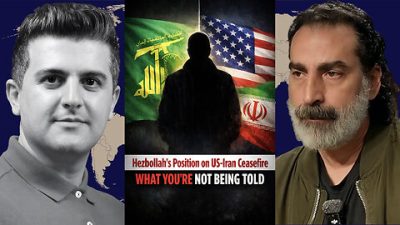
Laith Marouf: Hezbollah’s position on US-Iran ceasefire
or go to
Aletho News Archives – Video-Images
From the Archives
The Dirty Little Secret behind the “Global Terrorism Index”
The Omission of Israeli Terrorism in the Occupied Palestinian Territories
By Karin Brothers | Global Research | December 6, 2014
… The Israeli settlements — all of which are illegal – have been identified as a major impediment to peace. The refusal of a major “global” terrorism report to name the Israeli settlers as one of the groups most responsible for terrorism not only misrepresents a major source of regional violence but exposes the Global Terrorism Index as a propaganda tool that supports a U.S. agenda.
In recent years, governments have been attempting to thwart terrorism by blocking supportive fund-raising. When it comes to Israeli settlements, however, the US and Canada actually encourage fund-raising by giving organizations (such as Christian Friends of Israeli Communities (CFOIC) and the Jewish National Fund) financial support in the form of donor tax-deductions.
Charities which provide funds for the Israeli settlements should be regarded as terror-financing organizations. They should not only lose their tax-deductible status, but they should be banned because they support the violation of international humanitarian law. The terror-financing laws that are being strictly enforced for Muslim charities should be applied to Christian and Jewish charities as well. … Read full article
Blog Roll
 Aletho News
- Spain orders reopening of Tehran embassy, condemns Israel’s carpet bombing of Lebanon
- Israel faces ‘unsustainable’ strategic crisis following 40-day war against Iran: Analyst
- Iran restricts Hormuz access to 15 vessels per day under ceasefire terms: Report
- The ‘Opposition Party’ Has Done Nothing to Stop the Iran War and Much to Goad Trump Into Continuing It
- Moscow backs Tehran on status of Lebanon in US-Iran deal
- How UK Regulator Ofcom Quietly Bypassed International Law to Police American Speech
- The Black Cube Files: How Former Mossad Operatives Flipped a Nation
- Laith Marouf: Hezbollah’s position on US-Iran ceasefire: What you’re not being told
- Israel’s priority lies in destroying chances of peace between Iran, US: Ex-UN nuclear chief
- Ceasefire for all or for none: Iran shuts Hormuz over Lebanon attacks
- If Americans Knew
- This is ceasefire? Israel’s biggest massacre yet in Lebanon, another journalist killed in Gaza – Daily Update
- Tucker Carlson on Israel: This Is the Behavior of an Ally? Really?
- Gazans face a triple crisis: severe shortages of water and bread, healthcare in tatters
- NY Times reports how Netanyahu took the US into Iran War
- A sigh of relief over Iran, but Gaza and Lebanon in dire straits – Daily Update
- Thousands dead and neighborhoods razed to the ground: Aid agencies fear southern Lebanon is becoming the new Gaza
- The war the US is fighting for Israel could cost trillions
- ‘Cigarette Burns, Nail Wounds’: Toddler Tortured in Gaza to Coerce Father
- Trump Says US Sent ‘a Lot of Guns’ to Protesters in Iran
- Israeli forces destroy 17 UN peacekeeper cameras in south Lebanon
- No Tricks Zone
- An Inconvenient Tree: Uncovered In Alps… Europe Much Warmer Than Today 6000 Years Ago
- New Study Reports A 60% Slowdown In Greenland’s Ice Loss Rate In The Last Decade
- Low Intensity Tornado Wrecks Major Solar Farm, Creating A Potential Toxic Dump
- New Study Finds Warming Saves Lives…Cold Temperatures 12 Times More Deadly Than Excess Heat
- German Science Blog Accuses PIK Climate Institute Of Hallucinating Climate Tipping Points
- Devastating Assessment Of Comirnaty Vaccine By Former Senior Pfizer Europe Toxicologist
- New Study: CO2 Is ‘Effectively Negligible’ As An Explanatory Climate Change Factor Since 2000
- Former Pfizer Toxicologist Dr. Helmut Sterz Tells Bundestag Hearing Pfizer Vaccine Should Have Never Been Approved
- Energy Expert: Germany’s Nuclear Phaseout Was A “500 Billion Euro Mistake”
- New Research: South Australia’s Mid-Holocene Sea Surface Temperatures Were 4°C Warmer Than Today
 Aletho News