The Myth of Greek Profligacy
By MARSHALL AUERBACK | CounterPunch | October 24, 2011
Historically, Greeks are very good at constructing myths. The rest of the world? Not so much. Reading the press, one gets the impression of a bunch of lazy Mediterranean scroungers, enjoying one of the highest standards of living in Europe while making the frugal Germans pick up the tab. This is nonsensical propaganda, designing to justify the continued collective execution being inflicted on Athens for the sins of its fathers and grandfathers. As if Greece is the only country ever to cook its books in the European Union! The heart of the problem is in the antiquated revenue system that supports that state, which results in a budget shortfall consistently about 10 per cent of GDP. The top 20 per cent of the income distribution in Greece pay virtually no taxes at all, the product of a corrupt bargain reached during the days of the junta between the military and Greece’s wealthiest plutocrats. No wonder there is a fiscal crisis.
So it’s not a problem of Greek profligates, or an overly generous welfare state, both of which suggest that the standard IMF style remedies being proposed here are bound to fail, as they are doing right now. In fact, given the non-stop austerity being imposed on Athens (which simply has the effect of deflating the economy further and thereby exacerbating the very problem the Greeks are trying to eliminate), the Greeks really are getting close to the point where they should just default and shift the problem back to those imposing the austerity. It can’t be worse than the slow execution they are facing today.
In reality, the Greeks have one of the lowest per capita incomes in Europe (€21,100), much lower than the Eurozone 12 (€27,600) or the German level (€29,400). Further, the Greek social safety nets might seem very generous by US standards but are truly modest compared to the rest of the Europe. On average, for 1998-2007 Greece spent only €3530.47 per capita on social protection benefits–slightly less than Spain’s spending and about €700 more than Portugal’s, which has one of the lowest levels in all of the Eurozone. By contrast, Germany and France spent more than double the Greek level, while the original Eurozone 12 level averaged €6251.78. Even Ireland, which has one of the most neoliberal economies in the euro area, spent more on social protection than the supposedly profligate Greeks.
One would think that if the Greek welfare system was as generous and inefficient as it is usually described, then administrative costs would be higher than that of more disciplined governments such as the German and French. But this is obviously not the case, according to Eurostat. Even spending on pensions, which is the main target of the neoliberals, is lower than in other European countries.
Furthermore, if one looks at total social spending of select Eurozone countries as a per cent of GDP through 2005 (based on OECD statistics), Greece’s spending lagged behind that of all euro countries except for Ireland, and was below the OECD average. Note also that in spite of all the commentary on early retirement in Greece, its spending on old age programs was in line with the spending in Germany and France.
In fact, Greece has one of the most unequal distributions of income in Europe, and a very high level of poverty, as the following table shows. Again, the evidence is not consistent with the picture presented in the media of an overly generous welfare state—unless the comparison is made against the situation in the US.
Of course, these facts don’t matter. The prevailing myth is that Greece is in the words of the FT’s John Authers, “a country that was truly profligate”, with little in the way of data to support that assertion. The country, however, is truly stuck: they can’t devalue, they can’t pay their way, at current prices, and nobody will voluntarily finance them. So they must exit and devalue or drop their domestic prices. The massive default, though inevitable, is just a step along the way.
To make the problem worse, export earnings also seem to face their own structural cap that is consistently exceeded by import spending, which means that the debt that finances the government shortfall is increasingly held abroad. The debt is issued under Greek law, but now it is payable in Euros which Greece is powerless to print. In this sense, ironically, the fiscal crisis is a consequence of Greece’s success, after a long preparation, in joining the European Union, and hence giving up its own currency.
The point is that, if this analysis of the source of the problem is correct, then standard IMF austerity policy is unlikely to do much to help. If the problem is not the level of wages, or the size of the welfare state, then pushing wages down and shrinking the welfare state is not going to do much. Greece, after all, is still a democracy and if one is to judge from the intensifying riots in the country, it is far from clear whether Greece (or any other euro zone member for that matter) is really willing to cut spending and raise tax rates enough to make a difference. This much is implicitly being conceded by the “Troika” – European Commission (EC), the International Monetary Fund (IMF), and the European Central Bank (ECB), which was submitted to the EU Summit yesterday, and will no doubt be a part of the deliberations in the Greek debt restructuring proposals to be hammered out by Oct. 26th.
On the first page of the document is not only a pretty open and blatant admission that expansionary fiscal consolidation (EFC) has proven to be a contradiction in terms, at least in Greece, but there is also a serious policy incompatibility problem, at least over the intermediate term horizon, with efforts at internal devaluation (ID) – that is, attempting nominal domestic private income deflation in order to improve trade prospects when one has a fixed exchange rate constraint.
While they stop short of recognizing that their demands and the actions they have imposed on Greek policymakers are setting off a debt deflation implosion of the Greek economy (never mind rupturing any semblance of a social contract, and ripping the social fabric to shreds as well – this is, after all, the jackboot version of neoliberal “reform” designed to stamp out any last vestige of social democracy and organized labor in the eurozone) this is a very large concession for the Troika to have taken.
To admit that EFC is not working, and that pursuing ID will aggravate matters further, including the ability of Greece to hit fiscal targets, is a fairly large step in the recognition of the reality of the situation. This is not something the faith based neoliberal economists in the Troika organizations are often prone to do. It is not what their incentive structures, formal and informal, tend to encourage them to do.
So why pursue it? Well, let’s face it: this has far less at this stage to do with Greece (even as the prevailing mainstream myth continues to perpetuate the picture of a lazy, unproductive country full of profligates and scroungers), than punishing other potential fiscal recalcitrants. They are scapegoating the Greeks – in order to make sure that should Greece take the rumored “hair cut” on its debt and restructure, the other peripheral countries – especially Italy – won’t get any ideas and be tempted down the same path. This is the strategy to prevent what is euphemistically called the “contagion impact”. In reality, it is also called the principle of collective guilt, destroying the livelihoods of thirteen million people for political reasons. Given their own history, the Germans above all other nations, should understand this phenomenon.
If the prevailing mix of fiscal austerity policies continue, there will be spill-over effects to nations that export to Greece. To be sure, Greece is a tiny market in Euroland, but its fiscal problems are by no means unique. As the bigger economies like Spain and Italy also adopt austerity measures, the entire continent can find government revenue collapsing – even Germany, where economic deceleration has become markedly more noticeable in the past few months. Worse, exports to neighbors will be hurt by reduction of demand. Finally, if austerity succeeds in lowering wages and prices in one nation it can lead to competitive deflation, only compounding the problem as each country tries to gain advantage in order to promote growth through exports. What is most remarkable to us is that the largest net exporter, Germany, does not appear to recognize that its insistence on fiscal austerity for all of its neighbors will cook its own golden egg-laying goose.
Angela Merkel likes to say that no real economic union is possible if one party to the union (Greece) works shorter hours and takes longer holidays than another (Germany). What she should say is that no real economic union is possible if the governing plutocrats of ALL nations (not just the billionaire Greek shipowners who probably have already moved their money offshore, but also wealthy bankers who have suffered no consequence of their own fraudulent and willfully destructive lending practices) consistently evade their fair share of the cost of that party’s own state expenditure, expecting the union either to pay the bill itself, or to force the bottom 80 per cent to pay it.
Greece is not a special case, but rather a case in point of what happens when you impose fiscal consolidation on countries with high private debt to GDP ratios, high desired private net saving rates, and large, stubborn current account deficits. What is needed is a way to redistribute demand toward the trade deficit nations—for example, by having the trade surplus nations spending euros on direct investment in the trade deficit nations. Germany did this with East Germany. Such a mechanism could be set up under the aegis of the European Investment Bank very quickly. Effective incentives to “recycle” current account surpluses in this manner via foreign direct investment, equity flows, foreign aid, or purchases of imports could be easily crafted. If it could be accomplished, it will be a way Greece and the others could become competitive enough to secure their future through higher exports.
Failure to embrace this kind of growth option will ultimately give the Greeks little alternative but to default, leaving the euro zone’s policy makers with an even bigger and costlier mess on their hands. Admittedly, this will not fully solve Greece’s problems as they would likely have to leave the euro zone as well and reintroduce the drachma. This would entail capital controls, which will cause people to head for the exits (this is, after all, a country with lots of boats). If they default, it would be more akin to a “Samson moment” for the entire euro zone. Like Samson in his last days, blinded and beaten by the Philistines, Greece is weakened, blind and bound. Default would represent one last defiant burst of strength with which it “pulls down the temple” (in this case the euro zone) via default and takes down everybody. Myth-making at the expense of the Greeks does not serve anybody’s interests, as there will be a cascade of defaults everywhere, and a Soviet style collapse in incomes, hardly an enticing prospect for the global economy. Not an attractive ending, but this is the kind of outcome which the troika’s self-surviving, immoral and cruel policies could lead to. The Greeks, and the vast majority of Europe’s citizens, deserve better.
MARSHALL AUERBACK is a market analyst and commentator. He can be reached at MAuer1959@aol.com
Harvesting olives as a statement of resistance
Ben Lorber | The Electronic Intifada| 24 October 2011
Nablus – Palestinian villages across the West Bank are undertaking their annual olive harvest this October, amid fears of harassment and violence from Israeli settlers and soldiers.
While the Palestinian olive harvest is a tradition that stretches back countless generations, the phenomenon of settler violence during the olive harvest is only as old as the illegal Israeli settlements themselves. Every year around October, grandparents, parents and children saddle up the donkey and, tree by tree, day by day, methodically comb, scrape and pick sack-fulls of olives from their family’s allotted portion of the 10 million olive trees that dot the hills and mountains of the West Bank and Gaza.
According to an Oxfam report, “more than 80 percent of olive farmers are small-medium scale farmers, owning olive orchards equal to or less than 25 dunams (a dunam is the equivalent of 1,000 square meters) in size … olive cultivation provides employment and income for around 100,000 farming families who are olive oil producers … in a good year, the olive oil sector contributes over $100 million income annually to some of the poorest communities” (“The Road to Olive Farming: Challenges to Developing the Economy of Olive Oil in the West Bank,” October 2010 [PDF]).
This way of life, vital for the economic survival of countless Palestinian families, is becoming increasingly threatened — both by the hostility and violence of settlers who live near Palestinian villages, and by the crippling restrictions and regulations of the Israeli military.
Surrounded by settlements
The village of Burin, near Nablus, offers a prime example of the dangers faced by the 2011 olive harvesters. Burin’s 4,000 inhabitants live in a valley, surrounded on all hilltops by Israeli settlements — Yitzhar, Har Bracha, and a Yitzhar “outpost.” Last month, settlers from Yitzhar, proud birthplace of the “price-tag” campaign of racist violence, burned 200 olive trees as villagers were celebrating a wedding (“Yitzhar settlers violently crash Burin wedding, military watches,” International Solidarity Movement, 6 September 2011).
This followed a similar attack in late June, described by Burin residents as the worst attack in 10 years, as 2500 olive trees on more than 900 dunams of land were destroyed, according to a report by the Monitoring Israeli Colonizing activities in the Palestinian West Bank and Gaza project (“Israeli colonists Set tens of Olive Fields Alight in Burin,” 2 July 2011).
Ghassan Najjar, director of the Burin Community Center, told The Electronic Intifada that “every year it is getting worse, and this year it is a lot worse. It used to be they burned trees once a year, but this year they have burned trees four times since April. Since April, they have cut down and burned entire areas to clear the land so we can use nothing.”
The olive harvest is frequently a target for settler attacks in Burin. Between 9-16 October 2010, the Israeli human rights group B’Tselem reported four separate settler attacks against Burin olive harvesters (“List of incidents in which damage was caused to Palestinian olive trees or property,” 28 October 2010).
Over the course of the 2009 olive harvest, almost 250 olive trees were cut down by settlers, often with chainsaws, as activists with the Michigan Peace Team documented in October 2009 (“Burin tree massacre,” 3 October 2009).
“Like a sister to me”
Ibrahim El Buriny is a 27-year old olive harvester whose family has combed the trees on Burin’s hillsides for generations. “This land is like a sister to me,” he said. “My grandfather bought this land in 1975 from the village of Huwara. They have records. The papers are in the PA and Israeli databases.”
On the first day of this year’s harvest in Burin, he spoke of how settler attacks in the last five years have escalated. “Settlers are getting more radical as they are growing stronger,” he said. “They are growing in numbers and are better armed … Usually groups of 25 settlers come [from the hilltops down to] us, many with guns. [Or] settlers will get out of their car on the main road, curse at us and shoot at us. The soldiers come and defend the settlers … there are two alternatives — either run and leave all the olives, or stay. If we can, we scare them or chase them away.”
Settlers burn olive groves in an attempt to physically erase Palestinians’ claim to the land, and they attack olive harvesters intending to terrify Palestinians into submission and exile. One-third of Yitzhar sits on privately owned Palestinian land, according to data provided by the Israeli Civil Administration (“Guilty! Construction of Settlements on Private Palestinian Land,” Peace Now, March 2007).
For the settlers of Yitzhar, a burning Palestinian olive tree signifies exactly what a burning cross signified to the Ku Klux Klan in the US of the 1950s — in either case, the message is racial intolerance, and the purpose is ethnic cleansing. “The settlers use fear, they intimidate people to leave their homes … they say ‘we cut down the trees because a Palestinian touched this and made it dirty. This is our land and we can do whatever we want,’” Najjar said.
“We can’t leave”
For the Palestinians of Burin, the olive harvest — in the face of settler violence — becomes a political statement of resistance. “The land is like our mother and father,” said El Buriny. “We can’t leave our land, and who would leave their land? That’s the number one reason [we continue to harvest]. But in our situation, we also need [to harvest] this land for the money as well. [But] even if we had money we wouldn’t give up our land. Even if they forbid us from our land, we are not going to drink a cup of fear, and we’re not gonna stay quiet.”
Najjar echoed this determination emphatically. “Olives are the most important farming product here for us. Of course the olive harvest is important for the olives and for the resistance. We know for certain that if we leave the land they will steal it, and claim it is their land.”
As an aside, Najjar added, “we know for certain that it’s not their land, because they burn it.”
Oftentimes, settler attacks spark confrontations between farmers and settlers. El-Buriny, while stressing that villagers almost never retaliate, insisted on their right to repel the attacker, and to defend themselves, and their olive trees, if in danger. “How can we let someone come on our land, and not let us be on our land, and hit us, and curse at us, and stay quiet? … All we have is a rock to defend ourselves. We don’t have anything but a rock, our hearts, and God,” he explained.
As conflicts have escalated in recent years, the Israeli military has committed itself to administrative and on-the-ground interference in the olive harvest. Its stated intention has even been to protect Palestinian farmers from settler attacks.
In the words of the 2008 United Nations report “The Olive Harvest in the West Bank and Gaza,” “As a military occupying power, the [Israeli army] is obligated to ensure public order and life in the Occupied Territories and the Government of Israel has repeatedly committed to ensuring that Palestinian farmers have access to their fields … according to the Israeli authorities, the IDF and the police will be present at friction points for designated few-day periods to ensure protection for Palestinian farmers from settler harassment” (“The olive harvest in the West Bank and Gaza,” October 2008 [PDF]).
In reality, however, the presence of the Israeli army only offers a minimal amount of meaningful protection for Palestinian farmers, and serves rather to intensify the administrative barriers and physical dangers facing the farmers during their olive harvest.
In 2008, Omar Suleiman, an olive harvester from Kafr Qalil near Nablus, was harvesting with his son when, he told The Electronic Intifada, “six or seven settlers came over the hills with guns and said ‘this is not for you, this is for us, go!’ Since then, the military comes to protect us.”
To a certain extent, he said, “the soldiers are here to make sure there are no problems between settlers and Palestinians.” However, the presence of the Israeli army means that “now, for the last three years, we have to ask the army for permission [to harvest] … [and] if the settlers come to attack us again, the soldiers will help them.” Najjar echoed this claim that “the soldiers are there to protect the settlers. Most of the army are settlers anyway.”
To regulate the olive harvest, the Israeli District Coordination Committee (DCO) provides farmers with permits to access their own land with the “protection” of Israeli forces. Thus, Palestinian families often harvest their land in plain view of the military jeeps and white DCO vans parked on the adjacent hillside. Far from sheltering the Palestinians under a benevolent wing of protection, however, the army will frequently forbid families from accessing their land, usually with no explanation. Additionally, the DCO decides on which days farmers can legally access their land, and usually allots only one or two days for harvesting time, not nearly enough for the majority of families. Finally, if a family does not request a permit from the DCO, the army is given a pretext to prevent them from harvesting, especially if their land is close to a settlement.
On 12 October this year, the Israeli military drove up to the fields of Burin at 9am and ordered the families, on the first day of harvesting, to leave their harvest. Soldiers refused to give an explanation. The military then stated that families would be allowed to return to their fields for the next three days. Two days later, however, the military returned to kick one family off of their land, declaring the area a closed military zone and again offering no further explanation.
Najjar was present with his family when they were ordered to stop harvesting on 12 October. “This is normal for us,” he said later that day. “We are used to it.”
He continued: “This is not the first time we have been kicked off our land. That is no reason for us not to go back and continue work. If my father was not there, I would have been angry and refused to leave. But in front of my father I controlled my emotions, and did not show that I was upset.”
Israeli army’s inaction toward settler violence
Realistically, the presence of the Israeli military during the olive harvest, far from meaningfully alleviating the threat of settler violence, works instead to thicken the layers of oppression through which the Palestinians must struggle in order to make it to their olive trees and back.
In October 2010, Oxfam noted that, “in the first six months of 2010, the United Nations reported that hundreds of dunams of agricultural land and thousands of olive trees and other crops had been damaged in settler-related incidents. Israeli NGO [non-governmental organization] Yesh Din, an Oxfam partner, recently published a study in which it did not find a single case where the Israeli authorities had taken action to bring those involved to court.” (“Palestinian olive oil profits in the West Bank could double if Israeli restrictions ended,” Oxfam, 15 October 2010).
As the settlers grow more radicalized and Israeli regulations grow more dense, October 2011 may be a rough olive harvest for Palestinians in the West Bank. However, Omar Suleiman from Kufr Qalil offered a glimmer of hope. While an Israeli military jeep, a DCO van, and a small group of settlers sit perched together on the opposite hillside, he continued to affirm the pride, steadfastness and determination of his people.
“This settlement [pointing to Har Bracha] came here 20, 30 years ago. Israel has been here for 60 years. My family has had this land for 4,000 years.”
Ben Lorber is an activist with the International Solidarity Movement in Nablus. He blogs at freepaly.wordpress.com.
Israeli forces make multiple arrests across the West Bank
Ma’an – 24/10/2011

NABLUS — Israeli forces made multiple arrests overnight Sunday and Monday morning in several districts across the West Bank, the Israeli army and Palestinian police said.
An Israeli army spokeswoman said six men were detained in Hebron, two southeast of Qalqiliya and two southwest of Bethlehem in the village of Umm Salamuna.
Palestinian police said in a statement, however, that nine men were detained across the West Bank, seven of whom were named.
Five were detained in Hebron, three north of Ramallah and one in the Qalqiliya district, police said.
Handhalah Yousif Rashid, 18, Majd Walid Abu An-Nujoum, 18, and Ramzi Hisham Natour were detained at a flying checkpoint Israeli forces erected at the entrance to Turmusayya, near Ramallah, the statement said.
In Hebron, Israeli forces erected a checkpoint near the Ibrahimi Mosque and detained 16-year-old Tariq Irsheid, police said.
Israeli forces also detained 37-year-old Farouq Issa Ashour and Hasan Badawi Abu Sneina, 21, from Hebron. Police identified the man detained in Qalqiliya as 34-year-old Fahd Ali al-Sheikh.
An Israeli army spokeswoman said the men will be taken for routine security questioning.
The prisoner rights group Addameer estimates that Israel has jailed 650,000 Palestinians since 1967.
In Israel, it is very clear where you can and cannot live as a Palestinian
Palestine Monitor | October 22, 2011
With the legalizing of admissions committees and strict restrictions on building in Palestinian communities, Palestinians will soon have nowhere else to live in Israel.
After a six-year legal campaign, a Palestinian-Israeli couple has been granted the right to build a home in the communal settlement of Rakefet in the Misgav Regional Council, located in the southern Galilee. However, their victory does not portend the softening of ethnically divided communities in Israel, nor the broadening of living options available to Palestinians living inside Israel. In fact, their long-awaited acceptance may just be the last of its kind.
Ahmed and Fatina Zabeidat are from Sakhnin, a Palestinian town close to Rakefet in the Lower Galilee. They applied for residency in the settlement in 2005. Both architects, the Zabeidats wanted the space to design and build their own home.
The Zabeidats chose Rakefet for its spacious and quiet environment. Sakhnin, like all Palestinian towns in Israel, suffers from overcrowding for several reasons. Firstly, residents of the town live on about 2,500 acres compared to its size of 25,000 acres in 1948. Secondly, the state continually fails to implement a master plan in the town and the Misgav council rarely issues building permits, which means there are many cases of illegal building and consequent demolition orders.
At Rakafet, anyone who wants to live in the community has to pass through an admissions process. Rakefet’s admissions committee rejected the Zabeidats application, citing grounds of “social unsuitability.”
Under the sanction of the Israel Land Administration, admissions committees have been allowed to filter new residents in the interest of preserving the character of small communities.
For decades, admissions committees have operated in the Naqab and Galilee. Such committees exist in 695 communities, accounting for 68.5% of all towns and 85% of villages in Israel. Significantly, each includes a senior member of the Jewish Agency or the World Zionist Organization.
These groups have been pivotal in the state’s continuing settlement enterprise. The World Zionist Organization was founded in 1897 as an umbrella for the Zionists’ colonising project and today consists of pro-Israel groups spread throughout dozens of countries. The Jewish Agency was created in 1948 to manage the absorption of Jewish immigrants and has since succeeded in bringing around 3 million Jews to Israel.
But the right of these admission committees to preserve its community’s character—albeit defined nebulously—was codified in Israeli law last March.
The law, known as the Admissions Committee Law gave authority to these committees operating in communities with fewer than 400 families, to filter applicants based on their “social suitability,” a caveat widely suspected of legalizing the maintenance of a place’s ethnic homogeneity. In short this law is most likely used to keep towns Jewish.
While the explicit discrimination of applicants based on their national belonging is prohibited, Suhad Bishara of Adalah, the Legal Centre for Arab Minority Rights, argues that the requirements for entry are vague enough to facilitate the exclusion of marginalized groups, such as Palestinian citizens of Israel.
In 2005, Rakefet’s admissions committee rejected the Zabeidats on the grounds that they were socially unsuitable. Fatina was “too individualistic,” the committee told Haaretz, while Ahmed “lacked interpersonal sophistication and has difficulty integrating naturally into society.” The committee also claimed that the Zabeidats would not be sufficiently active members in their particularly small community.
But the Zabeidats believed they were rejected because they are Palestinians. So they approached Adalah and brought a petition to the Supreme Court against the decision in 2007.
“The committee claimed Fatina and Ahmed were motivated more by challenging the system than an honest intention to live in a small community,” explains Bishara, the Zabeidat’s attorney.
The Supreme Court ruled that Rafeket needed to assemble a new team on its admissions committee and reconsider their decision to reject the Zabeidat’s application; they also ruled that while the admissions committees were permitted to conduct interviews to assess the couple’s suitability, they could not use psychological testing—a practice widely used–in the application process to communal towns.
Again, the Zabeidat’s submitted an application to be reviewed by the new admissions committee and filed an appeal to the ILA, which has the authority to arbitrate in the dispute. But they were rejected a second time.
However, in a surprising turn of events, the ILA’s new general director, Ronen Cohen Schorr, decided independently—and to the chagrin of the ILA appeals committee—to grant the Zabeidats the land they desired.
He told Haaretz he was “convinced of the honest desire of the petitioners to blend into the life of the community and believes that their acceptance is not likely to damage the community.” The High Court confirmed his decision, giving Rakefet’s authorities 90 days to allot land to the Zabeidats.
Challenging the committees
The Zabeidats may have won this battle, but Adalah claims that the mere notion of being “incompatible” with a community is severely problematic.
In June, Adalah—with support from other rights groups—filed a petition in the High Court against the very principle of acceptance committees. The stipulation of “incompatibility,” they argued, is vague enough to be applied to any marginalized candidates, such as Palestinians, single parent families, gay couples, Mizrahi Jews and people with disabilities. In the past, all of these groups have been denied entrance to communal settlements.
For Bishara, the decision to cement acceptance committees in national law—in the form of the Admissions Committee Law—came as a means of blocking criticism of this often prejudicial selection process. Fortunately for the Zabeidets, Admissions Committee Law could not be applied retroactively. “The law is meant to bypass any potential court decision” that may curtail the practice, Bishara explains.
In 2000, the Supreme Court ordered the Jewish community of Katsir in the Wadi Ara region of central Israel to allow a Palestinian Israeli couple, Adel and Iman Kaadan, to buy a house in the town.
While critics slate the Admissions Committee Law as institutionalizing racism, supporters contend the law protects the particular character of these community settlements.
One sponsor of the law, David Rotem of the far right Yisrael Beiteinu party, explained in December 2009 that it would allow Jewish Israelis the power to “establish a place where everybody is an army veteran, a Yeshiva alumni, or something of that sort.”
Yisrael Hasson of the Kadima party noted in December 2010 how the law “reflects the Knesset’s commitment to work to preserve the … Zionist dream in practice in Israel” through “population dispersal.”
But Adalah argues that communal settlements no longer follow a collective way of life, as they once may have. Furthermore, Adalah contends that since Zionism is the dominant culture in Israel and has thus already been realized, there is no need to “preserve” it.
Admission committees frequently adopt criteria that specifically vets out Palestinians. In June 2009, the communities of Manof and Yuvalim changed their communal bylaws to make loyalty to Israel as a Zionist state a prerequisite to residency. Their example was replicated in other communities before the Loyalty Oath Bill was passed in October 2010.
Palestinian voices in Israel decry the segregation efforts. Though present in most fields of life, segregation is particularly blatant in housing policies. “The map is very clear where you can and cannot live as an Arab,” Bishara notes.
Many communal settlements were built in the Galilee and Naqab throughout the ’70s and ’80s, financed by the Jewish National Fund and Jewish Agency as part of the Judaization drive, which was concentrated in these Palestinian majority areas.
No new towns or villages have been built for Palestinians in Israel since the state was created. Governments refuse to license master plans for Palestinian communities to enable socio-economic development and improve standards of life.
Observers of Israeli society point to tensions emerging between Israel’s self-image as a democracy and the anti-democratic legislation of recent years, which are becoming increasingly awkward for Israel’s exponents to account for.
While the Zabeidets had the means and energy to wage a legal battle to make a home in Rafeket, undoubtedly most Palestinian Israelis have deferred to the de facto segregation of Jews and non-Jews. However, with the growing frequency of laws such as that governing acceptance to small towns this segregation may soon become de jure.
As settlers disrupt olive harvest, Israeli officer declares: “I am the law, I am God.”
22 October 2011 | International Solidarity Movement
West Bank – Intimidation of Palestinians in the Israeli-controlled H2 section of Hebron continued today as the Israeli military and settlers harassed Palestinians and international observers as they attempted to pick olives on their land in Tel Rumeida.
Around 40 students from different Palestinian universities marched onto the land at 11AM Saturday morning and began to pick olives along with local families, activists from Youth Against Settlements (YAS) and international observers.
At 12:30 PM the Israeli police confiscated identity passes for 20 Palestinians and, whilst checking their details, forced the group to stand together and individually filmed their faces.
The police declined to justify their actions, only insisting that they had a right to check the details of those present. The Israeli military became increasingly belligerent as protesters challenged the legality of the actions and began to push and shove Palestinians and international observers. After around 20 minutes the police returned the passes and allowed the detained Palestinians to leave. They then ordered international observers to leave the olive groves or be arrested, claiming that the Palestinian-owned olive grove is “Israeli land” and that it was illegal to be on the land and “illegal to be in a group.”
Rafi Dagan, an Israeli commanding officer, stated “I am the law. I am God” when asked to explain why he was flouting Israeli law by forcing people to leave Palestinian land under threat of arrest, without any paperwork to show that it was a closed military zone.
Earlier in the day, Israeli soldiers had pushed photographers attempting to document the olive harvest and confiscated an international observer’s passport for several minutes. Under Israeli law, passports may be shown to the Israeli military but it is illegal for them to be taken away. The Israeli military also briefly detained a young Palestinian man, apparently for running through the olive groves with a Palestinian flag, although he was released after around 10 minutes.
In addition to intimidation by the military, Israeli settlers arrived on the Palestinian land within minutes of the olive harvest beginning and began to harass people picking olives. A group of around 10 settlers gathered in the lower olive groves in Tel Rumeida at 11:55am where Palestinians were busy picking olives. Baruch Marzel, a prominent extremist settler, stood on a Palestinian flag in an obvious attempt to provoke olive harvesters. The military intervened as anger flared between the two groups and sent settlers back to their settlement.
Badia Dwaik, 38, is the Deputy Coordinator of Youth Against Settlements, a nonviolent Palestinian group campaigning against Israeli settlements. He stressed that olive harvesting in Tel Rumeida is not just about economic necessity; it is a form of political defiance and a way to “confirm our existence and to encourage the people to resist”.
The Palestinian land in Tel Rumeida is surrounded by four illegal Israeli settlements. A Palestinian educational centre overlooks steep, dusty terraces to the south which contain around 200 olive trees. The centre, established in 2006 after the building was reclaimed from Israeli military control, and the olive groves below have been subject to repeated attacks and incursions by settlers in recent years. Anti-Palestinian graffiti and the Star of David is clearly visible under fresh coats of paint on the walls at the back of the building, only metres away from a settlement.
The olive groves contain around 200 olives trees and olives were picked on around 70 trees today. Badia Dwaik lamented the poor quality of the olives and the sparse fruit on many of the trees, saying that Palestinians are often unable to tend the land for fear of settler attacks. There is also a chronic shortage of water in Hebron and the owners of the trees are denied permits to dig the land. For example, the YAS reported having problems with water circulation for three days and discovered today that the water lines had been deliberately cut.
According to Badia Dwaik, the YAS intend to continue picking the olives in the coming weeks as “people are scared to come and pick olives alone. And it gives a message: we will continue and never give up.”
Fjordman Back at Gates of Vienna whose Tipsters Include Caroline Glick
By Farha Khaled | LoonWatch | 21 October 2011
Islamophobic blogs like Gates of Vienna, popular with white supremacists have Israeli American fans who have adopted a hard line pro Israel agenda. It also appears that ‘Fjordman‘ is back at Gates of Vienna. He was cited recently as a tipster alongside Caroline Glick, the senior editor at The Jerusalem Post.
A closer scrutiny of Gates of Vienna the white supremacist blog which published ‘Fjordman‘ until he went into hiding after the Norway massacre shows it is run by a couple living in Virginia, USA, one Baron Bodissey whose real name is Edward May popularly known as ‘Ned May‘ and his wife who edits the blog under the pseudonym ‘Dymphna.’ It claims to focus on the ‘Great Jihad’ in Europe, regularly publishing essays promoting white supremacism, calls for a Muslim Holocaust and is filled with vile anti Islam bigotry, lies and polemics dressed up as ‘counter jihadism’. Anders Brievik has posted comments there. In the past too, discussions of exterminating the ‘Muslim’ problem caused waves as in ‘Thinking the Unthinkable‘ in which options to rid the world of Muslims were discussed.
Gates of Vienna has a pro Israel focus which Ned and Dymphna go to great pains to emphasise. A cynic may suspect there are ulterior motives at play here. The connection between Zionism and organized Islamophobia is clear and comes as no surprise now. Fear Inc. a six month study by the Centre for American Progress, details how an Islamophobia industry is being funded and peddled by a small minority of conservatives. What is popularly known as ‘Islamism’ has its Zionist counterpart, as explored in a recent LoonWatch series ‘Why Religious Zionism, Not Judaism, Is The Problem‘.
 Indeed Dymphna regularly does the rounds at right wing Zionist websites posting comments moaning about their poverty. One such blog is the rabidly anti Palestinian and Islam hating blog ‘Sultan Knish‘ run by Daniel Greenfield an Israeli sabra living in New York, who is a fellow at the David Horowitz Freedom Centre the same organisation that sponsors Jihad Watch. Daniel is obsessed with a pathological hatred for Muslims and a delusion that the US military exists to carry out his fantasy of a war on Islam. Daniel’s postings regularly dehumanise Muslims, and are filled with anti Islam screeds which he fabricates on whim, not unlike Ned May. He also has a Torah Parsha blog and this video shows him in a debate about New Media. In a common theme amongst neo cons, Daniel complains there is a plot to destroy the US military by Obama. In one blog post ‘Winning the War on Terror‘ he suggests genocide:
‘We would have to be willing to kill millions, directly or indirectly, while maintaining an alliance that would defy Russia, China and the First World nations that would accuse us of genocide. The real name for this war might well turn out to be World War III. It would take a Churchill or a Roosevelt to launch something like that, and while the world would be radically different afterward, it might well turn out to be radioactively different too.’
Whilst Daniel’s crowd propagate that Muslims are out to destroy the USA, the truth is these very neo conservatives bankrupted the US economy by leading it into trillion dollar wars on fake premises and fabricated evidence. As Julian Borger reported in The Guardian, the evidence for the Iraq war was fabricated by the now defunct ‘The Office of Special Plans‘ affiliated with hard line Likudniks. […]
Far right Islamophobic activists have forged alliances of convenience with radical Zionists and regard Israel as an ally, not least because they see Israel’s treatment of Palestinians as a role model for how Muslims should be treated. Hard line Zionists see it as an opportunity to lessen the growing Muslim presence and influence in the USA and Europe which they see as detrimental to a greater Israel. Stooges like Geert Wilders are funded in the hope they can halt Muslim immigration and influence. Marginalised as they are, some European nationalist groups are willing to shed their traditional Jew hatred in an attempt to find allies, but as often happens in marriages of convenience, it doesn’t take much for cracks to appear. Pamela Geller’s association with the EDL caused waves when Roberta Moore claimed they had Jew hating members and were not sufficiently pro Israel. In Europe, German newspaper Der Spiegel probed this alliance in ‘The Likud Connection‘ showing how some marginalized right wing populists are going the Geert Wilders way. This bizarre coupling has split the far right movement in Europe which has traditionally been anti-semitic.
Meanwhile, Ned May, an EDL activist, serves as director of International Free Press Society an American and Denmark based group whose members claim to fight threats to free speech from ‘forces within Islam’. IFPS’s board members include the familiar names Bat Ye’or, Robert Spencer, Andrew Bostom and affiliates like Aish Ha Torah. Incidentally, one of the listed advisers for IFPS is Rachel Ehrenfeld an “expert on terrorism” and author of ‘Funding Evil’ in which she made allegations of terror funding against the now deceased Saudi billionaire Khalid bin Mahfouz for which he sued.
Ned often mixes in a pro Israel and pro Jewish stance liberally peppering his polemics with quotes from the Talmud and expresses a desire (like Dymphna) to be in the pay of Mossad. In this he has help from fellow bloggers like his friend, a Jerusalem based Israeli American lawyer, one Carl Mordechai Sherer, who runs Israel Matzav as ‘Carl in Jerusalem‘. Charles Johnson banned Carl from Little Green Footballs where he was a heavy commenter for posting a link to Gates of Vienna with a curt ‘I will have nothing to do with people who promote fascist creeps‘. Stung by LGF’s criticism, a blog war followed, in which Ned May tries to salvage some dignity for his cesspool.
A particularly revealing blog post is where Carl can be seen giving Ned advice on the legality of declaring Jewish rights to Israel as an indigenous people, stating he fully supported a ‘greater Israel’ though the world won’t allow it. Ned in turn laments a common Nazi theme which he modifies to this convoluted logic:
‘Regardless of the merits of the case, I agree with Carl that the Declaration on the Rights of Indigenous Peoples will never be applied to Jews — or to white Europeans, for that matter.
“Indigenous Peoples” are “brown” peoples, especially Muslims, American Indians, Australian Aboriginals, and black Africans. Anything using the term that is passed by the UN will only be allowed to apply to those peoples, and never to Jews or Caucasians.’
Ned May must be unaware of the millions of Caucasian Muslims including Russians, American Muslims, British and other European converts. Carl, who did not see fit to tell his friend that most Israeli’s are non Caucasian Sefardi Jews was however, quick to hypocritically cry ‘Nazi’ at white supremacist Occupy Wall St protesters.
Incidentally, Carl, who has lauded Fjordman’s postings at Gates of Vienna gushes at Israel Matzav:
‘For those who have never been to Gates of Vienna, go check it out. It’s some of the highest level intellectual material you will ever read on the Internet.’
How high is that ‘intellectual level’ ? Let us quote Ned verbatim where he explains the purpose of Gates of Vienna is to spread lies at a grassroots level, in short; telling a lie often enough makes one believe it. Not just to lie but to oversell it. In a blog titled ‘Overselling the Meme‘ he states:
‘This must be accomplished at a level well below that of the celebrities and famous pundits, because action on that battlefield invites a massive and well-funded counterattack by CAIR, ISNA, the OIC, etc.’
Using hyperbole and flowery nonsense, he spells out his mission in life:
‘As a propagandist, my task is to spread the meme and not to sweat the nuances. Nuances can be argued about and nailed down by scholars in the centuries after Islam — as a culture, a political ideology, and a religion — is totally destroyed. We don’t have the luxury for such finicky scholasticism right now.’

Perhaps the best known Israeli tipster for Gates of Vienna is The Jerusalem Post’s Caroline Glick an Israeli American known for her right wing views, and who serves as editor for the Israeli political satire website Latma TV. Caroline was cited approvingly in Breivik’s manifesto. It appears that Fjordman is once more back at Gates of Vienna, for on 13th October 2011, the credits included :
‘Thanks to C. Cantoni, Caroline Glick, Fjordman, heroyalwhyness, JP, and all the other tipsters who sent these in.’
When Israel was forced to offer an apology for Latma TV releasing ‘We Con the World,’ a satire mocking the dead Gaza flotilla activists, the Huffingon Post’s Eileen Read wrote ‘The Jerusalem Post Should Fire Caroline Glick for Making a Racist Video in which she opined:
‘But this is lower than I’ve ever seen someone go who carries a management title at a journalism organization. I’m ashamed to say that Glick and I are both Columbia alums. Even if she hates people of another race or religion and is allowed by her editors to poke fun at them in a tasteless and blatantly racist way, she should be fired for making fun of the dead.’
This incident was not the first time Caroline Glick had received flak for her radical opinions. In the aftermath of the Norway massacre, the Jerusalem Post published editorials that had tried to link the tragedy to Europe’s immigration policies. Norwegians took offence at sentiments expressed by Glick amongst others and voiced their objections to Israeli diplomats as to how the tragedy was being exploited. Some weeks later, the Jerusalem Post’s Editor in Chief published ‘Apology to Norway‘ an editorial in which he expressed remorse:
‘As Senior Contributing Editor Caroline B. Glick suggested in her column last Friday, the fact that Breivik’s warped mind cited a group of conservative thinkers including herself as having influenced his thinking in no way reflects on them.
“As a rule, liberal democracies reject the resort to violence as a means of winning an argument. This is why, for liberal democracies, terrorism in all forms is absolutely unacceptable,” she wrote. “Whether or not one agrees with the ideological self-justifications of a terrorist, as a member of a liberal democratic society, one is expected to abhor his act of terrorism. Because by resorting to violence to achieve his aims, the terrorist is acting in a manner that fundamentally undermines the liberal democratic order.”
It later emerged that Breivik, a Christian radical, had posted on the Internet an extremely anti-Muslim manifesto that supported far-right nationalism and Zionism.’
He then moves on to vocalise the Jerusalem Post’s stance:
‘This is certainly not the kind of support Israel needs. It is the type of Islamophobia that is all too reminiscent of the Nazis’ attitude toward the Jews. Jews, Muslims and Christians in Israel and around the world should be standing together against such hate crimes.’
Caroline has also given explicit permission for Gates of Vienna to publish a Norwegian version of Norway’s Problem which Ned did after writing:
‘Under normal circumstances, Gates of Vienna does not publish in any languages other than English (in its American, British, Canadian, and Australian variants). However, we are making an exception for the following opinion piece by Caroline Glick.’
Setting the tone for this unique honour, Ned continues:
‘The result was the column below. Several Scandinavians requested that we publish a Norwegian translation, and with Ms. Glick’s permission it was kindly translated by Cecilie.’
Indeed! We have here one of Israel’s ‘most important’ women and the Senior Contributing Editor of the Jerusalem Post giving permission to publish a translated version of her article at a hate site (that credits and links back to her) espousing views deemed repugnant by her editor-in-chief. One can recall the hue and cry when Octavia Nasr tweeted about a Hezbollah sheikh’s death that led to CNN firing her!
Gates of Vienna may be bottom feeders in the world of Islamophobia, but clearly their unsettling involvement with prominent hatemongers is more than just a cause for concern.
Farha Khaled is a columnist for the Arab News. She can be followed on Twitter http://twitter.com/farhakhaled
Will Rick Perry kill another innocent man?
Mary Shaw | The People’s Voice | October 23rd, 2011
Texas governor and Republican presidential contender Rick Perry has faced criticism from the left (and applause from the right) for his heavy-handed use of the death penalty. And Perry has said that he loses no sleep over the possibility that he may have executed an innocent man.
This is despite the fact that it appears that Perry has done just that – and could very likely do it again very soon.
In 2004, Texas death row prisoner Cameron Todd Willingham was executed for an alleged arson that claimed the lives of his three daughters in 1991. However, a later forensic review of the case led to the conclusion that “a finding of arson could not be sustained.” In other words, the fire for which Willingham was executed was probably just an accident.
Instead of acknowledging that an innocent man may have been executed, and working to correct the system that allowed such a grievous error, Governor Perry appears to have taken steps to impede the investigation into the Willingham fiasco.
And now we have another Texas death row prisoner, Henry Watkins “Hank” Skinner, facing a November 9 execution date for a triple murder, despite the existence of untested DNA evidence that Skinner says could prove his innocence.
Skinner had been convicted and sentenced to death for the New Year’s Eve murder in 1993 of his girlfriend Twila Busby and her two adult sons. The DNA in question went untested during the original trial because Skinner’s attorney was afraid that it could incriminate his client – a decision that Skinner contends he never agreed with.
Earlier this year, the U.S. Supreme Court ruled 6-3 that Skinner may pursue a civil rights claim to obtain the DNA testing. In the meantime, however, Texas has jumped the gun. Instead of waiting for the civil rights suit to unfold, and for the DNA to be tested to ensure they’ve got the right guy, the state went ahead and scheduled the November execution.
What are they afraid of – the possibility that Skinner’s conviction, like Willingham’s, might be proven wrong?
Governor Perry, as noted above, has bragged that he really does not care. Neither, apparently, does anyone else in charge of the busiest death chamber in the country.
Killing a prisoner, apparently, is more important to them than killing the right prisoner.
Killing a prisoner, apparently, is more important to them than true justice.
Mary Shaw is a Philadelphia-based writer and activist. E-mail: mary@maryshawonline.com
Erekat: Freeze on govt settlements ‘false distinction’
Ma’an – October 22, 2011
BETHLEHEM — PLO official Saeb Erekat has rejected the distinction between government and private construction in Israeli settlements, the premise of Israel’s “offer” for a partial building freeze reported by Israeli media on Friday.
As all settlement building on Palestinian lands is illegal under international law, differentiating public and private-led expansion is a “false distinction,” a statement from the former chief negotiator said on Friday.
Israeli Prime Minister Benjamin Netanyahu proposed to freeze government settlement construction in an offer put to President Mahmoud Abbas by Colombian Foreign Minister Maria Angela Holguin on Wednesday, the Israeli daily Haaretz and a Palestinian official said.
Private construction constitutes around 80 percent of settlement activity, according to recent studies.
“Looting is not made legal under any circumstance,” Erekat said. “Attempting to draw such false distinctions exposes the true intentions of the Israeli government.”
Diplomats are trying to renew direct talks between Israeli and Palestinian officials as the UN Security Council considers Palestine’s application for full membership of the global body, which Israel and the US have vowed to scupper.
A Quartet proposal aired on Sept. 23 — as Abbas handed the bid to UN officials — has faltered as the deadline it set for a preliminary meeting within one month passed without an appointment.
Days later, Netanyahu told Israeli newspaper The Jerusalem Post that Palestinian insistence on a settlement halt was a “pretext” to avoid talks, and implied that a new settlement freeze was unlikely.
“We already gave at the office,” Netanyahu told the Post, referring to a 10-month partial settlement freeze that Israel refused to renew in late September 2010, leading to the breakdown of direct talks launched weeks earlier.
Palestinian officials say they cannot negotiate with Israel while it builds on lands needed for the viability of a future Palestinian state.
On Sept. 27, Israel approved the construction of 1,100 new homes in Gilo settlement, and in early October started building 11 units as part of a 300-home project in Pisgat Zeev settlement, both in East Jerusalem.
An Israeli peace group also revealed in October that Israel has formally submitted plans to build 2,610 homes near Gilo, including new neighborhood Givat Hamotos, which will cut off Bethlehem and the West Bank from East Jerusalem’s southern sector.
East Jerusalem was annexed by Israeli in a 1967 war, in a move never recognized by the international community. Israel claims Jerusalem as its undivided capital, while Palestinians say the occupied east must be the capital of a future Palestinian state.
“Might does not make right. We will not compromise our positions based on the power politics of the day,” Erekat said Friday. “International law has been, and will continue to be, the basis for our positions on this and all other issues.”
What Quantitative Easing Really Means
By ISMAEL HOSSEIN-ZADEH | CounterPunch | October 21, 2011
Stripped from the fancy (and mystifying) jargon, quantitative easing (QE) simply means increasing the quantity of money supply, or easing credit conditions—in the hope of stimulating the stagnant economy. This is usually done by having central banks inject a pre-determined quantity of money into the coffers of commercial banks in return for the purchase of their financial assets, which consist largely of government bonds. Although it is typically done electronically, or on paper, its practical effect is the same as printing money.
This is supposed to be an expansionary monetary policy designed to promote economic recovery. The rationale behind the policy is that the addition of new funds to the capital base of the commercial banks (at or near zero interest rates) will enable them to, in turn, extend new credit to businesses and/or manufacturers at reasonably low rates so that they would, then, be encouraged to borrow, to expand, to hire and, therefore, create growth and prosperity.
While under certain circumstance (when money supply or capital markets are tight, interest rates are too high and effective demand or purchasing power is strong) this may work, under the current market conditions (where there is no shortage of capital, interest rate or the cost of borrowing is already low, and effective demand is very weak) it is bound to fail—as it has actually failed miserably.
Borrowing and investing in the production of goods and manufactures is weak not because there is a shortage of investible funds (corporations are sitting on more than $2 trillion in cash but not hiring) or because the cost of borrowing is too high, as is implicitly assumed by the QE gurus, but because the macro-level purchasing power is too weak and the uncertain market conditions do not warrant investment and expansion. Furthermore, corporations prefer to produce not at home but where the labor is cheapest globally.
Likewise, the reluctance on the part of banks to extend credit to manufacturers is not because they lack capital, but because they find it more profitable to invest in speculation, that is, in buying and selling of assets and/or securities such as bonds, stocks, commodities, real estate, currencies, and the like—destabilizing activities that tend to create asset price bubbles, inevitably followed by bursts. Parasites discovered a long time ago that it is easier to suck the existing blood out of the body of living organisms than producing it from scratch. Karl Marx used an even better metaphor to characterize parasitic finance capital: “The complete objectification, inversion and derangement of capital as interest-bearing capital. . . . It appears as a Moloch demanding the whole world as a sacrifice belonging to it of right.”
This explains why instead of increasing industrial production and raising employment the 1,200 billion dollars of money that the Federal Reserve Bank has pumped into the coffers of commercial banks through two rounds of QEs has simply resulted in further financialization of the economy; which goes to explain the significant bubbling of some asset prices of the past few years, especially the considerable rise in certain share prices as well as the drastic rise in the price of a number of important commodities such as rice, wheat, and oil.
By the same token, it also explains why the QE policy has further exacerbated income and wealth inequality, both in Europe and the United States, as it has helped only the financial elite without any help to the public. “The evidence suggests that QE cash ends up overwhelmingly in profits, thereby exacerbating already extreme income inequality and the consequent social tensions that arise from it,” reports Dhaval Joshi, of BCA Research. Joshi further points out that real wages – adjusted for inflation – have fallen in both the US and UK, where QE has been used to promote growth. “The shocking thing is, two years into an ostensible recovery, [UK] workers are actually earning less than at the depth of the recession. Real wages and salaries have fallen by £4bn. Profits are up by £11bn. The spoils of the recovery have been shared in the most unequal of ways.” In Germany, meanwhile, where there has been no quantitative easing, real wages have risen.
It is not unreasonable, therefore, to conclude that the financial oligarchy is using QE essentially as a legal, policy tool to further enrich itself at the expense of everybody else. Not only were the Wall Street gamblers able to bail themselves out by means of $16 trillions of taxpayers’ dollars, but now they are also showering themselves with additional trillions of QE dollars to grow even richer and bigger.
Let us assume for a moment that, as the Federal Reserve and the government claim, QE is honestly designed to be an expansionary monetary policy intended to stimulate the economy. If so, why is then the government at the same time pursuing a fiscal policy that is contractionary, that is, moving in the opposite direction of the monetary policy by cutting social spending at all levels of the public sector?
The answer is that while from the viewpoint of national or public interests the two policies contradict each other, they are quite consistent from the viewpoint of Wall Street gamblers; both the supposedly expansionary monetary policy and the brutally austere contractionary fiscal policy serve the nefarious interests of the financial aristocracy. It is hard to believe that economic policy makers do not see the obvious: that their monetary and fiscal policies contradict each other. But, then, it is perhaps not so much a matter of economic knowhow or policy expertise as it is of wicked preferences and warped loyalties to the powerful special interests to be served.
The Real Agenda Behind the Cain Tax Scheme
By MIKE LOFGREN | CounterPunch | October 21, 2011
The tax plan of Republican candidate Herman Cain is the best current example of the real agenda of the GOP. It is a masterpiece of marketing, with its simple “9-9-9” label being reminiscent of a two-for-one pizza special. It would lower all Federal income tax rates to a single 9-percent rate, set the corporate rate at 9 percent, and levy a national sales tax of 9 percent. It has the sort of meretricious simplicity that appeals both to the simple-minded and the mainstream media. True to its “horserace” philosophy of covering politics, early on most of the the press declared Cain’s plan a brilliant campaign move without making any effort to evaluate its substantive merits.
Bruce Bartlett, formerly an economist in the Reagan and George H.W. Bush administrations (and a fellow Republican apostate), analyzed the 9-9-9 tax plan. His conclusion: it decreases revenue as it drastically cuts the taxes of the wealthy and – here’s the kicker – raises taxes on the least well-off. And it does not in fact tax all income at 9 percent (so much for its appealing tripartite simplicity): it lowers the capital gains and dividend rates to zero. Generally, the richer the individual is, the more likely his income is to be derived from capital gains and dividends, which are already taxed at less than half the top marginal income tax rate. This current inequity in the tax code accounts for the fact that the 400 richest Americans have been paying an average effective Federal income tax rate of 17-18 percent since passage of the Bush tax cuts: little more than half the effective rate they had paid since the early 1990s – even as their combined income quadrupled. Cain’s plan would sharply increase this disparity.
The usual rationale for reducing tax rates on capital below the rates on labor – and Cain abolishes them entirely – is that capital gains and dividends are “double taxed,” that is, the corporation that pays them out is taxed, and the recipient is taxed. But this is a smokescreen. The American revenue system is about taxing individual legal entities. Taxes on an individual, be he a wager-earner or sole proprietor of a business, are only levied once; that said, all income from whatever source (unless it is specifically exempt) is taxed in those cases. Corporations, on the other hand, pay rates on profits, a narrower category whose definition is more susceptible to creative bookkeeping. This is how GE can pay zero Federal taxes in a given year; yet that does not preclude its shareholders from realizing capital gains. Those GE shareholders are individual entities who are legally separate from the corporations whose shares they own. They are taxed once on the investment income they receive.
While Bartlett did not do a net estimate of the total revenue change, it appears to me that just executing the tax cuts in only the second phase of Cain’s three-phase plan would result in gross revenue losses of over a trillion dollars per year (so much for the GOP’s abiding concern for the deficit). The plan’s revenue raisers, on the other hand (including its Federal consumption tax with no allowance for deductions, even for food), would fall disproportionately on the non-rich and would in any case be unlikely to make up the revenue loss.
As Bartlett describes it, the Cain plan would eliminate deductions to corporations for the workers they hire. Therefore, Corporate America would have even less incentive to hire workers than now, when they are sitting on close to $2 trillion in cash. They would have all the more incentive to park their loot at a commercial bank (which would in turn park the deposits at a Federal Reserve bank), or arbitrage sweat labor overseas. On the other hand, according to Bartlett’s reading, corporations could borrow money to pay shareholder dividends and deduct the expense!
The Tax Policy Center did a distributional analysis of Cain’s plan. The Center’s conclusion: “A middle income household making between about $64,000 and $110,000 would get hit with an average tax increase of about $4,300, lowering its after-tax income by more than 6 percent and increasing its average federal tax rate (including income, payroll, estate and its share of the corporate income tax) from 18.8 percent to 23.7 percent. By contrast, a taxpayer in the top 0.1% (who makes more than $2.7 million) would enjoy an average tax cut of nearly$1.4 million, increasing his after-tax income by nearly 27 percent . . . a typical household making more than $2.7 million would pay a smaller share of its income in federal taxes than one making less than $18,000.”
So much for the policy; what of the political strategy? At first I wondered: did Herman Cain dream this plan up himself? If not, who whispered it in his ear, and what interests did that person represent? Now we know: Rich Lowrie, a Cain economic advisor who lives in Gates Mills, Ohio, a village of 2400 inhabitants east of Cleveland, and one of the wealthiest suburbs in the country. Lowrie’s day job is as an investment advisor, and he has been involved with such groups as the Koch brothers-funded Club for Growth and Americans for Prosperity. His plan has had substantive input from long-time Republican operatives Arthur Laffer (who, with his Laffer Curve, is one of the fathers of the current generation of crackpot right-wing economists), and Steve Moore, a pioneer in the operation of 501(c)4 organizations that promote the political views of billionaires while remaining tax-exempt.
Still, it is a little surprising that after the greatest financial meltdown in 80 years, widespread unemployment and destitution, and rising public anger over the greatest income disparity in America since the 1920s, a declared presidential candidate would tout a plan that would raise taxes on low and moderate income-earners while drastically reducing them on the wealthy. Potential Republican primary voters are notoriously tolerant of lunatic-fringe nostrums, but one would think even they might blanche at a plan that would raise taxes on the majority of them.
But, at least so far, not a bit of it. Cain surged in the polls after unveiling his tax plan. According to the mainstream media, he surged because of it. The underlying causes of this phenomenon would make a fascinating case study in psychopathology. Nevertheless, one suspects that Cain will begin to sink in the polls now that the big media have finally begun to evaluate 9-9-9 and as his rivals start to chip away at his front-runner status. Still, Cain’s tax plan is a startling illustration of how to use kamikaze tactics to advance a political agenda.
In the case of other policies with substantial fiscal (and social) consequences, for instance the privatization of Social Security, right-wing think tanks fronting for billionaires have worked for decades to mainstream heretofore politically unthinkable policies by endlessly repeating simple, misleading memes and touting faked “analysis.” Eventually they succeed in changing the debate and dragging the Washington Consensus (regardless of what the country at large thinks) in the direction of serving our ever-more-entrenched plutocracy.
Viewed in the light of how he advanced the GOP’s tax agenda, Cain is not a “vanity” candidate or a joke, even if he has no realistic chance of winning. His strategic purpose would appear to be to normalize bad policy and shape the Beltway’s hive mind gradually to accept a tax system with few major precedents – save that in France’s ancien régime, where the aristocracy was exempt from taxes while the poor were squeezed. And we all know how well that historical episode ended.
While Cain’s lowering of taxes on the wealthy is a well-known formula in the GOP’s playbook, the really interesting and heretofore less well-known aspect of his plan was its increase in taxes for the working poor. Republicans have of late become quite uncharacteristically enamored of raising taxes, but not on the rich. They are targeting the less well-off.
The first public laying of the groundwork for the idea of taxing low-income earners came in a November 2002 Wall Street Journal editorial page comment. The working poor, less well-off retirees, and others who do not pay Federal income taxes were “lucky duckies.” The Journal followed up with two additional editorials using that infantile phrase.
Most Republican office holders did not yet come out publicly to make the Journal’s argument. But a few, like Jim DeMint and Orin Hatch, occasionally commandeered the Senate chamber to denounce a tax policy that has allegedly allowed almost half of Americans to avoid paying Federal income taxes.
Since Obama’s election, Republicans have amped up the “soak the poor” theme. They are strangely lukewarm about maintaining a payroll tax cut, despite the fact that it would increase the purchasing power of tens of millions of Americans who would have no choice but to recycle the money into the economy in order to buy necessities. Strange behavior indeed from a party that never met a tax cut it didn’t like.
And now Rick Perry is said to be producing a flat tax, one likely to be similarly regressive in the manner of 9-9-9, even if differing in details. The normalization of bad policy continues.
Cain has never bothered to put together a proper campaign organization. Given that his campaign is spending tens of thousands of dollars of scarce funds to buy copies of his auto-hagiography, it is possible that his whole candidacy, like that of Donald Trump or Sarah Palin, is mainly a bid to boost his personal income: book sales, speaking fees, a gig as a Fox News commentator. As year chased weary year in the pizza pie business, Cain no doubt grew tired of being a huckster for his own brand of ketchup sauce and easer-like mozzarella on a soggy cardboard crust; he wanted to augment his income in the more respectable realm of ideas. The Club for Growth, Americans for Prosperity, Americans for Tax Reform, and all the other front organizations for billionaires would agree: regardless of what happens to his candidacy, Herman Cain has succeeded in the world of ideas.
Mike Lofgren is a former professional staff member of the House and Senate Budget Committees. He retired this year.
Featured Video
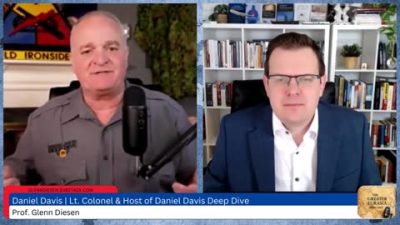
Daniel Davis: China & Russia Will Defend Iran
or go to
Aletho News Archives – Video-Images
From the Archives
Sugar: Killing us Sweetly
Staggering Health Consequences of Sugar on Health of Americans
By Dr. Gary Null | Global Research | February 3, 2014
In September 2013, a bombshell report from Credit Suisse’s Research Institute brought into sharp focus the staggering health consequences of sugar on the health of Americans. The group revealed that approximately “30%–40% of healthcare expenditures in the USA go to help address issues that are closely tied to the excess consumption of sugar.”[1]The figures suggest that our national addiction to sugar runs us an incredible $1 trillion in healthcare costs each year. The Credit Suisse report highlighted several health conditions including coronary heart diseases, type II diabetes and metabolic syndrome, which numerous studies have linked to excessive sugar intake.[2]
Just a year earlier in 2012, a report by Dr. Sanjay Gupta appearing on 60 Minutes featured the work of Dr. Robert Lustig, an endocrinologist from California who gained national attention after a lecture he gave titled “Sugar: The Bitter Truth” went viral in 2009. Lustig’s research has investigated the connection between sugar consumption and the poor health of the American people. He has published twelve articles in peer-reviewed journals identifying sugar as a major factor in the epidemic of degenerative disease that now afflicts our country. The data compiled by Lustig clearly show how excessive sugar consumption plays a key role in the development of many types of cancer, obesity, type II diabetes, hypertension, and heart disease. His research has led him to conclude that 75% of all diseases in America today are brought on by the American lifestyle and are entirely preventable.[3]
Until the airing of this program, no one in the “official” world acknowledged anything wrong with sugar, here is a sampling of some the latest research available to them if they chose to look… continue
Blog Roll
 Aletho News
- Why Trump’s war on Iran will fail
- Lebanon: Between sovereignty and the mirage of normalization
- Ukraine Given $43Bln in Proceeds From Russian Assets Frozen by G7 Since 2024 – Estimates
- The military is babying F-35s to hide their true cost to taxpayers
- Ukrainian military analyst praises use of drones against ‘Russian-Hungarian-Slovak friendship’
- Von der Leyen warns Hungary: We have ways of making you talk
- EU manipulating polls in bid to oust Orban – German opposition leader
- Daniel Davis: China & Russia Will Defend Iran
- The US’ self-directed ‘China nuclear threat’ will only be a waste of effort: Global Times editorial
- Female Iranian academic sentenced to 4 years in prison in France over protesting Israel’s genocide in Gaza
- If Americans Knew
- ‘Terror Was Needed to Make Arabs Leave’: What the Israeli Army Did in 1948, Revealed
- 17,000 Unaccompanied Orphans in Gaza, in World’s Biggest Orphan Crisis
- Israeli leaders want to buy global legitimacy – Not a ceasefire Day 140
- Israel warns of a Ramadan escalation — while doing everything to provoke one
- Democrats Should Release Their 2024 Election Autopsy – and Stop the Gaza Denial
- Israel responsible for 2/3 of press killings worldwide – Not a ceasefire Day 139
- Are the Jews indigenous to Palestine?
- AIPAC Wants to Kill a Bill that would Ensure Israel Complies with Ceasefire
- Former Israeli PM, in Epstein Files, Dreamed of Israeli Eugenics and Pretty Converts
- Israeli settlers join ‘safari’ tour of Palestinian prisoners
- No Tricks Zone
- Surprising Discovery: Sahara Is Greening…Billions Of Trees Where Once Thought To Be Barren
- New Research Reaffirms Clouds, Aerosols, And Surface Solar Radiation Are ‘Driving The Climate System’
- Germany: Electric Car Catches Fire At Charging Station, Sets Off Local “Inferno”, Widespread Damage
- New Study: Canada’s New Brunswick Was 1°C Warmer Than Today During The Medieval Warm Period
- Coal Power Back In Trend As Globe Tries To Keep Pace With Growing Demand For Power
- New Study: A 4°C Warmer Beaufort Sea Had ‘No Sea Ice’ 11,700 – 8200 Years Ago
- Unfudging The Data: Dutch Meteorological Institute Reinstates Early 20th Centruy Heat Waves It Had Erased Earlier
- German Gas Crisis…Chancellor Merz Allegedly Bans Gas Debate Ahead of Elections!
- Pollen Reconstructions Show The Last Glacial’s Warming Events Were Global, 10x Greater Than Modern
- Germany’s Natural Gas Storage Level Dwindles To Just 28%… Increasingly Critical
 Aletho News