David Albright: Purveyor of Nuclear Lies
Larouche | November 12, 2011
David Albright, the founder and director of the Institute for Science and International Security, in Washington, D.C., remains at the center of provocative press coverage of the Iranian nuclear program and the International Atomic Agency (IAEA) report issued (to governments) on Nov. 8. “The IAEA cannot get any more cooperation from Iran,” Albright declared to the PBS Newshour’s Ray Suarez, a few hours after the IAEA report was issued. “And I think the time has come that the Board of Governors probably needs to pass a resolution calling on Iran to cooperate with the IAEA and give them some time to cooperate. And then probably, if they don’t, this would then be referred to the Security Council for further consideration.”
Albright seems committed to playing the same kind of pernicious role he played in the run-up to the invasion of Iraq in 2003, this time with respect to Iran.
Albright was a key figure in bringing to the West, Khidir Hamza, who was sold to, and then by, the pro-war neo-cons as “Saddam’s bomb maker.” Hamza was brought out of Iraq by Albright in 1994, and was then employed by him at ISIS from 1997 to 1999. They co-wrote a book and a number of articles on Iraq’s alleged nuclear program. In one article, entitled “Iraq’s Reconstitution of its Nuclear Weapons Program,” published in Arms Control Today in October 1998, they claimed “Iraq is suspected of having made progress on a number of bottlenecks in its weapons program, at least those that could be done with little chance of detection by inspectors.” They warned that if the UN inspection program were to become ineffective “Iraq could reconstitute major aspects of its nuclear weapons program.”
Hamza was later exposed as a fraud and a liar by former UN weapons inspector Scott Ritter. “Had Albright in fact been a true nuclear expert, especially one fortified with firsthand experience as a former UN weapons inspector, he would not have had any association with Khidir Hamza, the disgraced Iraqi defector who claimed to have firsthand knowledge of Saddam Hussein’s nuclear program.” Ritter wrote in a 2008 article, “The Nuclear Expert Who Never Was.” “A true nuclear expert would have recognized the technical impossibilities and inconsistencies in Hamza’s fabrications.” Hamza, however, did prove to be very useful to the neo-cons in driving the United States into the needless invasion of Iraq.
Albright and Hamza eventually parted ways, but Albright continued to play his role, as well. On Sept. 7, 2002, Albright published a piece arguing that what had been a uranium extraction facility prior to the 1991 Gulf War, was active once again. “Unless inspectors go to the site and investigate all activities, the international community cannot exclude the possibility that Iraq is secretly producing a stockpile of uranium in violation of its commitments under Security Council resolutions. The uranium could be used in a clandestine nuclear weapons effort,” he wrote. He based his conclusion on commercially available satellite pictures.
While he later became skeptical of claims that Iraq was on the cusp of building a nuclear bomb, he never wavered from the other claims of chemical and biological weapons, also part of the case for war. “In terms of the chemical and biological weapons, Iraq has those now,” he told CNN on Oct. 5, 2002. “How many, how could they deliver them? I mean, these are the big questions.” The fact that no nuclear, chemical or biological weapons were ever found by the occupying forces showed the fraud of these claims.
Ritter’s exposé of Albright’s lack of expertise received backup from Alexander DeVolpi in a Feb. 15, 2009 posting in response to comments posted in defense of Albright on Ritter’s article, including from Frank Von Hippel of Princeton University. DeVolpi is a retired nuclear engineer from the Argonne National Laboratory, and a veteran of 40 years of field work in nuclear physics, nuclear reactors and arms control. Of Albright, he says: “Dave’s a friendly guy, but I always found him shallow on experience, and now realizing that he was once on the research staff of Princeton University’s Center for Energy and Environmental Studies, I have a better understanding of his predisposition and educational preparation. With no substantive foundation, he has expressed himself as philosophically opposed to nuclear power. This is not uncommon, particularly with academics associated with Princeton who evince no hands-on or other practical field experience regarding nuclear-weapons, nuclear reactor technology or verification methodology.”
No comments yet.
Featured Video
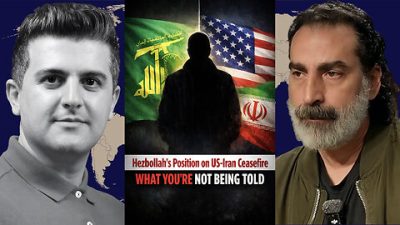
Laith Marouf: Hezbollah’s position on US-Iran ceasefire
or go to
Aletho News Archives – Video-Images
From the Archives
The Dirty Little Secret behind the “Global Terrorism Index”
The Omission of Israeli Terrorism in the Occupied Palestinian Territories
By Karin Brothers | Global Research | December 6, 2014
… The Israeli settlements — all of which are illegal – have been identified as a major impediment to peace. The refusal of a major “global” terrorism report to name the Israeli settlers as one of the groups most responsible for terrorism not only misrepresents a major source of regional violence but exposes the Global Terrorism Index as a propaganda tool that supports a U.S. agenda.
In recent years, governments have been attempting to thwart terrorism by blocking supportive fund-raising. When it comes to Israeli settlements, however, the US and Canada actually encourage fund-raising by giving organizations (such as Christian Friends of Israeli Communities (CFOIC) and the Jewish National Fund) financial support in the form of donor tax-deductions.
Charities which provide funds for the Israeli settlements should be regarded as terror-financing organizations. They should not only lose their tax-deductible status, but they should be banned because they support the violation of international humanitarian law. The terror-financing laws that are being strictly enforced for Muslim charities should be applied to Christian and Jewish charities as well. … Read full article
Blog Roll
 Aletho News
- Laith Marouf: Hezbollah’s position on US-Iran ceasefire: What you’re not being told
- Israel’s priority lies in destroying chances of peace between Iran, US: Ex-UN nuclear chief
- Ceasefire for all or for none: Iran shuts Hormuz over Lebanon attacks
- Strait of Hormuz is Iran’s ‘nuclear weapon’ that forced US retreat: Medvedev
- Energy crisis will last for months – Kremlin envoy
- Europe’s quiet role in the war on Iran
- Forty days that shook the Empire: How Iran turned the tables on US and prevailed
- Netanyahu unilaterally declares Lebanon outside of ceasefire deal
- Israeli leaders: ‘Not a single goal’ achieved in war with Iran
- What on earth just happened? Trump, Iran, and the unlikely ceasefire
- If Americans Knew
- Gazans face a triple crisis: severe shortages of water and bread, healthcare in tatters
- NY Times reports how Netanyahu took the US into Iran War
- A sigh of relief over Iran, but Gaza and Lebanon in dire straits – Daily Update
- Thousands dead and neighborhoods razed to the ground: Aid agencies fear southern Lebanon is becoming the new Gaza
- The war the US is fighting for Israel could cost trillions
- ‘Cigarette Burns, Nail Wounds’: Toddler Tortured in Gaza to Coerce Father
- Trump Says US Sent ‘a Lot of Guns’ to Protesters in Iran
- Israeli forces destroy 17 UN peacekeeper cameras in south Lebanon
- US-Israeli strikes ‘completely destroy’ synagogue in Tehran
- Archbishop for US Military Says Iran War Is Unjust Under Catholic Teaching
- No Tricks Zone
- An Inconvenient Tree: Uncovered In Alps… Europe Much Warmer Than Today 6000 Years Ago
- New Study Reports A 60% Slowdown In Greenland’s Ice Loss Rate In The Last Decade
- Low Intensity Tornado Wrecks Major Solar Farm, Creating A Potential Toxic Dump
- New Study Finds Warming Saves Lives…Cold Temperatures 12 Times More Deadly Than Excess Heat
- German Science Blog Accuses PIK Climate Institute Of Hallucinating Climate Tipping Points
- Devastating Assessment Of Comirnaty Vaccine By Former Senior Pfizer Europe Toxicologist
- New Study: CO2 Is ‘Effectively Negligible’ As An Explanatory Climate Change Factor Since 2000
- Former Pfizer Toxicologist Dr. Helmut Sterz Tells Bundestag Hearing Pfizer Vaccine Should Have Never Been Approved
- Energy Expert: Germany’s Nuclear Phaseout Was A “500 Billion Euro Mistake”
- New Research: South Australia’s Mid-Holocene Sea Surface Temperatures Were 4°C Warmer Than Today
 Aletho News
Leave a comment