Israeli Forces Destroy Agricultural Ponds East of Hebron, Knesset Mulls Settlement Law
PNN | 17.11.11
On Thursday, Israeli forces destroyed agricultural ponds, farming equipment, irrigation systems and crops in the al-Baq’a area east of Hebron. Meanwhile, Israeli Knesset members proposed a law obligating the state to sign all future construction tenders for 10 West Bank settlements.
“Israeli forces, accompanied by the civil administration, the borders guards and police, raided with their bulldozers and vehicles the area and started demolishing the agricultural ponds that farmers use for irrigation,” farmer Ayad Jaber told Palestinian government news wire Wafa.
“Badawi al-Rajbi is one of the owners whose ponds were repaired many times after the Israeli forces demolished them during the past years,” said Jaber. “The Israeli troops keep demolishing these ponds, so they can expel farmers and steal their lands in order to expand Kiryat Arba and Kharsena settlements.”
The al-Baq’a area is considered to be one of the most fertile lands in Hebron.
The Israeli Knesset will discuss on Sunday a proposed law obligating the state to invest in settlement expansion under the framework of “natural growth.”
According to the Israeli Haa’retz newspaper, the Security and the Construction ministers would be forced to issue tenders for the construction of residential units in 10 settlements: Ma’ale Adumim, Ariel, Beitar lllit, Modi’in lllit, Alfei Menashe, Efrat, Karnei shomron, Beit Aryeh, Ornit, and Kiryat Arba.
The law was proposed by the Knesset members from the right-leaning parties Likud and Yisrael Beitenu. According to the law, Defense Minister Ehud Barak would be responsible for issuing construction permits in the West Bank.
Executed Britons
By Craig Murray on November 19, 2011
The two British men executed by US drone attacks in Pakistan were not killed in combat. They were assassinated while going about normal life. This is a most barbarous practice, which amounts not just to execution without trial, but to inaccurate execution killing many who were never accused in the first place.
Being British does not make these particular victims more important than the thousands of others – including numerous women and children – that the US has assassinated in this way. But it does give the British government a standing to protest. Sadly there is no chance that the neo-cons in power will do anything about it. If there was one area where you might have expected the Lib-Dem presence in government to give it a slightly more liberal tinge, it was foreign affairs. In fact, there has been no evidence of that whatsoever.
Hamas: Israel arrested 64 Palestinians over the past week
Palestine Information Center – 20/11/2011
RAMALLAH — The Israeli occupation forces (IOF) arrested 64 Palestinian citizens in the West Bank over the past week including 14 children, a press release by Hamas issued on Saturday said.
It pointed out that the largest number (17) were arrested in Al-Khalil followed by (12) in Bethlehem, (10) in Qalqilia, (6) in each of Nablus and Ramallah, (4) in each of Jenin and Salfit, (3) in occupied Jerusalem and one in each of Jericho and Tulkarem.
The report said that three of those arrested were journalists while five were recently released from PA security prisons.
Israeli occupation forces detain Palestinians, settlers attack others
Palestine Information Center – 20/11/2011

AL-KHALIL — Israeli occupation forces (IOF) detained a Palestinian man in Yatta village, south of Al-Khalil, on Sunday while settlers assaulted two others in the city of Al-Khalil.
Eyewitnesses said that a group of IOF soldiers stormed the family home of Nazih Nawaja’a and took him away after searching the house.
Meanwhile, settlers assaulted two Palestinians in Al-Khalil while another group of settlers broke into the home of a Palestinian in the Old City of Al-Khalil and destroyed his furniture and personal belongings.
In the same neighborhood, the settlers attacked the home of Hani Jaber who was recently released in the prisoners’ exchange deal between Hamas and Israel. The IOF soldiers arrested Jaber’s brothers instead of the settlers.
Settlers had raised a $100,000 “bounty” for the head of Jaber.
Israeli police shut down Jewish-Palestinian radio station
By Yossi Gurvitz | +972 | November 19 2011
A small radio station, “Kol Hashalom,” unique in that it was directed jointly by a Palestinian and a Jew, was abruptly shut down by the Israeli police on Thursday.
Kol Hashalom, which roughly means “All for Peace,” had been active for the last seven years. It was a joint venture of the Palestinian NGO Biladi and the Israeli NGO Jewish-Arab Center for Peace, and was directed by former Meretz MK Mossi Raz and Meissa Bransie-Senyura. The station broadcast from Ramallah, under a license granted by the Palestinian Authority to the Biladi company. (Full disclosure: I participated as a co-host in a Kol Hashalom broadcasts about a year ago).
Naturally, the very idea of a Jewish-Palestinian radio was anathema to the Jewish right (can you seriously call it “Israeli” anymore, when its essence is the eradication of Israeli identity?). So, in September, one of the leaders of the campaign for the destruction of Israeli democracy, Likud MK and Sarah Palin fan Danny Danon, demanded (Hebrew) that the station be shut down. Danon claimed the station was “inciting against Israel,” specifically that it was calling upon people “to reject political decisions arrived at democratically.” To wit, to support Palestinian statehood.
On November 4th, the Ministry of Communication sent a letter to Kol Hashalom, saying it is acting illegally and must close down immediately. The managers, having consulted their legal counsel, sent a letter last week denying all those claims. On Thursday, a day later – unheard-of speed for the Israeli police – Raz was summoned for a police interrogation, where he was informed that he was suspected of managing an illegal radio station, and that if he does not order it to shut down immediately, he would be arrested and the police would raid the station’s Jerusalem offices.
In a phone conversation with Raz today, he noted that a threat of detainment over the claim of running an illegal radio station is unprecedented. As far as I recall, in all of the years of the saga surrounding settler radio Channel 7, never were any of its managers arrested – even though its broadcasting interfered with the radio frequencies of the Ben Gurion Airport, and even though it never even claimed to be legal or licensed.
Kol Hashalom, again, is based in Ramallah (the Jerusalem offices serve for its internet broadcast) and has a Palestinian license. Raz says the interrogators presented him with two arguments. One, that the station broadcasts in Hebrew, for a Hebrew-speaking public, which means it is an Israeli station which bypasses the law. Really? I guess the police don’t know that bypassing the law is, by definition, not breaking it. Raz, sarcastically, suggests the police should immediately arrest the anchors of the Persian Voice of Israel: According to the logic of the police, it is an Iranian radio station and the anchors are obviously Iranian spies.

Mossi Raz, who is sure that the closing of the station is part of an assault on the media. (Photo: Yossi Gurvitz)
The second argument of the police was dubbed by Raz as the “I’ve murdered my parents, have pity on an orphan” argument: They said that Israel has never granted the Palestinian Authority any frequencies, even though it was obligated to do so in the Oslo Accords. This argument suffers from two problems: Raz noted that the Accords grant the PA the right to grab their own frequencies if Israel doesn’t allocate them within a certain time frame. Secondly, and more importantly, this argument basically says that ALL Palestinians radio stations are, without exception, illegal – yet strangely enough the Israeli police only bother itself with the Jewish-Palestinian one. This can be seen as even more proof of the Israeli occupation of the West Bank: Israel claims the right to shut down a radio station licensed by the so-called autonomous PA.
This stinks to high heaven, and looks suspiciously like – as Raz says openly – a part of the continuing effort of Netanyahu and his right-wing allies to overtake the media and silence their political rivals. Raz, fearing a raid on the Jerusalem offices, ordered the broadcasts to be shut down on Thursday, and now Kol Hashalom is preparing an appeal to the High Court of Justice. Developing.
Al Baqa’a: The struggle of a family in the shadow of illegal annexation
17 November 2011 | International Solidarity Movement, West Bank
“The Israelis hope that that the young people leave, the old people die, and then they can confiscate the land and the houses” says Sami, an activist working in Al Baqa’a, a windswept valley situated a few kilometers east of Hebron.

Atta and Rodni Jaber at their house in Al-Baqa’a, near Hebron
The Jaber family’s experiences of living in Al Baqa’a are similar to many other Palestinians in the area, in that their ordinary family faces extraordinary pressure on a daily basis from the Israeli military and nearby settlers.
Rodni Jaber is the mother of three daughters and a son. Dressed in a bright pink jumper and a floral headscarf, she is cheerfully voluble and keen to tell her family’s story.
“We have had our house demolished twice, this our third house on the land. We lived in a tent for six months and after that we got a court decision to live in this area within 150sqm, so we started to build this home.”
Rodni and Atta Jaber work as farmers growing grapes, raspberries and tomatoes in the milder months and radishes and turnips in the winter. Neat lines of cauliflower grow next to their stone house situated halfway up the hillside facing west towards Al Bwayre and the illegal Israeli settlements and outposts of Al Bwayre mountain.
The family owns 31 dunums of land (1 dunum = 1000 msq). Despite having papers dating from the era of the Ottoman Empire proving that the family owns the land, their house still has a demolition order in place.
“We went to the court, and we have a postponement by the Israeli military to destroy this house” says Rodni. “We are not here legally – by Israeli law – but they let us live here for the moment.”
Around 900 Palestinians live in Al Baqa’a valley. Many of the houses in the area are subject to demolition orders as the Israeli authorities and the settlers attempt to make life impossible for the Palestinians in the area to expand Israeli settlements. Local residents and activists claim to have in their possession a map on which red lines outline areas in Al Bwayre and Al Baqa’a valley that have been designated by Israeli engineers as places for the construction of 500 new housing units for Israeli settlers. Much of the land is currently inhabited by Palestinians and will need to be cleared to make way for the proposed development.
In addition to experiencing house demolitions and harassment from the military, the Jaber family has been subjected to repeated attacks by Israeli settlers from nearby Al Bwayre and Qiryat Arba settlements and various outposts.

The Jaber family’s house in Al-Baqa’a Valley
The family’s house and land was attacked by settlers around a month ago. The Israeli military arrived in jeeps but declined to intervene as the settlers attempted to set fire to the house. Rodni Jaber explains:
The soldiers were there just to protect the settlers. The settlers told us to leave the house and said ‘this is our land’ . They even began to complain to the soldiers asking them to kick us out of the house saying that ‘the land is for Abraham and not for them’, putting pressure on the soldiers…They [the settlers] tried to burn the house and I began to push them to stop, I even called the Israeli police to come and see what the settlers were doing. All the family fled as we were afraid of being burned in the house.
They failed to set fire to the house. This was just one incident in a long line of attacks on the family over the years; “I lost a baby [because I was attacked by settlers]. I was 4 months pregnant at that time and they attacked me and I lost it. I have been attacked many times by the settlers and I have been in hospital many times.
Nine or ten years ago an ‘operation’ happened on the highway here by the Palestinian resistance against the settlers. After that, the settlers gathered in Qiryat Arba and came here. They broke the door, entered the house and burned it…I left without shoes and wearing my pajamas. The settlers kicked my family out for three days….The soldiers then occupied the house for 40 days. We got a high court decision to return – when we came back to the house everything was broken. At that time settlers also went to my brother’s family [who lives near the house] and they shot him in the stomach – he survived but he has a plastic stomach now.
Al Baqa’a residents live under full Israeli civil and military control in Area C, so how do they protect themselves when the soldiers stand-by and facilitate settler attacks on the family?
Rodni stated that ”The chief of police has been to the area and said ‘If something happens just call me’. We got a paper from the DCO (District Coordination Offices) saying that the Israeli soldiers have to protect this house. We got this when we were attacked in 2001. But they don’t do anything – it’s just paper… Most of the Palestinian people in this area are from my family so we try to protect each other. If they attack a house they try to go to the house to protect it.”
A cousin of the family was attacked last week as he rode a donkey in the valley; settlers hit him on the head with metal piping. He was hospitalized and his wounds were stitched up, luckily he was not badly injured. […]
As Rodni talks, her husband Atta returns from work, wearing a woolen hat against the Autumn chill. He talks eloquently about Palestinian history and recounts his memories of Al Baqa’a Valley during the Six Day War in 1967.
“I was five years old when they occupied the West Bank, I still remember that day. The Israelis bombed the people and the Jordanian army here and they killed maybe 150 people in that time. Everybody had put white keffiyehs out as white flags to show that this is a peaceful area.”

A ruined house destroyed by the Israeli military in Al-Baqa’a Valley
As well as talking about the area’s history and the threat from settlers and the Israeli military, Atta described the mundane challenges of daily life in Al Baqa’a valley.
”We have a lot of problems in this area; there are no schools to send our children, we don’t have any clinics or hospitals. We don’t have water – the settlers have water 24 hours a day. We connected pipes to the settlement after we had submitted a lot of applications with the Israeli administration and water companies. In 1998 we applied to the company to have water but Israel prevented this. Under the Geneva Conventions it says that you are responsible for those that you occupy, but they want to transfer us from this area even though we have been the owners of the land for hundreds of years.”
Atta and Rodni refuse to be daunted by the problems they face. When asked about what the future holds for their family, Atta evades directly answering the question and replied in broader terms.
“It is not just my future, it is about all Palestinians’ future. Their tragedy and suffering becomes greater everyday.”
Featured Video
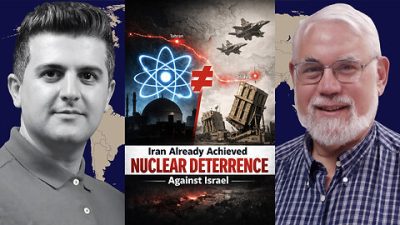
Prof. Ted Postol: Iran Already Achieved Nuclear Deterrence Against Israel
or go to
Aletho News Archives – Video-Images
From the Archives
How the occupied mentality syndrome works
Saudi Arabia on the American chessboard – Part 3
By B. J. Sabri | American Herald Tribune | June 27, 2016
Read part 2: “The occupied mentality Syndrome“
Previously I argued whether Saudi Arabia’s repeated involvements in U.S. interventions and wars stem from free national will or in response to a specific condition. For starters, in Saudi Arabia there is no national will. In Saudi Arabia, the national will is the will of the Al Saud clan. Still, when a major Arab state allies itself with a superpower that committed unspeakable crimes against humanity in almost every Arab country, then something is wrong. This fact alone should compel us to examine the U.S.-Saudi relation for one exceptional reason. As a result of the U.S.-Saudi wars, hundreds of thousands of people in Afghanistan, Iraq, Iran, Libya, Syria, Yemen, and Somalia have lost their lives. Millions became displaced in their own homelands. And millions more rendered refugees.
Attributing the Saudi policies to the bonds of “partnership” with the U.S. is frivolous. There are no bonds between these two thugs except those of business, military deals, secret plots, and wars. Proving this point, bonds such as these have no space for the American and Saudi peoples to share significant cultural or societal exchanges. If partnership is not the reason for the Saudi contribution to the U.S. strategy of empire and imperialism, then another reason must exist.
This leads to three possibilities. … continue
Blog Roll
 Aletho News
- NIAID/NIH and USDA Fund Bioengineered Chimeric Influenza Viruses Built Using Pandemic H1N1 Components: Journal ‘Science Advances’
- Hezbollah hits Israeli warship off Lebanon’s coast, sets it aflame
- Iran slams US strikes on B1 bridge, Mahshahr petrochemical plants as ‘blatant acts of state terrorism’
- In letter to UN chief, Araghchi warns of dire consequences of US-Israeli attacks on Iran’s nuclear facilities
- Why the CIA conspiracy to invade Iran with Kurdish militias failed
- Why Are Upbeat US Claims About Mission to Rescue Pilot ‘Highly Questionable’?
- Aircraft destroyed during US ‘rescue’ of downed F-15 pilot cost more than $100 million each
- Washington University removes professor who condemned US-Israeli war on Iran
- Russia Warns of Retaliation as UK Authorizes Seizure of Vessels
- Serbia thwarts plot to bomb Russia-Hungary gas pipeline – Vucic
- If Americans Knew
- In Iran, Israel-US take aim at “reason, research, and freedom of thought” – Daily Update
- US loses planes over Iran, Israel downgrades Lebanon war goals – Daily Update
- Israel Is Blocking Palestinians from Easter at Church Where Jesus Resurrected
- Plot to assassinate Palestinian activist follows harassment campaign promoted by Zionist groups and elected officials
- Prominent New York synagogue hosts presentation on why U.S. Jews should support the ethnic cleansing of Gaza
- Tapper vs. Piker: Is the CNN Anchor Auditioning for David Ellison?
- Shouldn’t Democrats Be Able to Condemn Genocide?
- Israel-US kill negotiators, destroy civilian structures, but Iran’s military capabilities still largely intact – Daily Update
- ‘War crime’: Global condemnation as Israeli ministers celebrate death penalty law targeting Palestinian prisoners
- 7 Ways Israel Is Turning Lebanon Into Gaza
- No Tricks Zone
- An Inconvenient Tree: Uncovered In Alps… Europe Much Warmer Than Today 6000 Years Ago
- New Study Reports A 60% Slowdown In Greenland’s Ice Loss Rate In The Last Decade
- Low Intensity Tornado Wrecks Major Solar Farm, Creating A Potential Toxic Dump
- New Study Finds Warming Saves Lives…Cold Temperatures 12 Times More Deadly Than Excess Heat
- German Science Blog Accuses PIK Climate Institute Of Hallucinating Climate Tipping Points
- Devastating Assessment Of Comirnaty Vaccine By Former Senior Pfizer Europe Toxicologist
- New Study: CO2 Is ‘Effectively Negligible’ As An Explanatory Climate Change Factor Since 2000
- Former Pfizer Toxicologist Dr. Helmut Sterz Tells Bundestag Hearing Pfizer Vaccine Should Have Never Been Approved
- Energy Expert: Germany’s Nuclear Phaseout Was A “500 Billion Euro Mistake”
- New Research: South Australia’s Mid-Holocene Sea Surface Temperatures Were 4°C Warmer Than Today
 Aletho News