Venezuela Withdraws Consular Personnel in Miami
Venezuelan Ministry for Foreign Affairs | January 16, 2012
Caracas – The government of the Bolivarian Republic of Venezuela has verified with extreme concern the increase in threats against Venezuelan consular personnel in Miami, Florida.
The U.S. government’s decision to declare the Consul General of the Bolivarian Republic of Venezuela persona non grata based on groundless accusations irresponsibly spread by a television network that is better known for its soap operas than for its journalistic seriousness, is an unfair and immoral measure that demonstrates the submission of Washington’s agenda to extremist and violent political sectors in the state of Florida.
Since the release of those unspeakable speculations, Venezuelan diplomatic and consular personnel have been threatened and intimidated, and in light of the criminal and terrorist nature of individuals and organizations that the U.S. government harbors in the state of Florida, this places them in real, serious and imminent danger.
In order to preserve their physical and moral integrity, the government of the Bolivarian Republic of Venezuela has decided to return its consular personnel in Miami to Caracas, and undertake a full evaluation of the operational and security conditions of the Consulate General.
Litani Project Launched: “New Victory against Israel”
Al-Manar | January 17, 2012
Lebanese Speaker Nabih Berri and Prime Minister Najib Miqati launched the 300-million dollar Litani River project to irrigate land in southern Lebanon on Tuesday.
Berri said at the launch at the Grand Serail: “Today we are witnessing one of the chapters of Lebanon’s victory against Israel.”
“We thank Kuwait, its emir, and people, as well as the Lebanese government that helped make this project a reality and defeat Israel’s aspirations to exploit Lebanon’s water wealth,” he added.
“Its success cannot be achieved without fortifying Lebanon’s stability,” Miqati noted adding that it was possible through the Lebanese government’s efforts and foreign aid.
“The Litani project will encourage our people to remain in their homeland,” Miqati stated.
He thanked Kuwait for its contributions to the project, congratulating the residents of the South on the achievement.
“Exploiting water wealth is Lebanon’s right and the country is entitled to defend it against foreign aggression,” the premier stressed.
The Litani River project is aimed at irrigating agricultural land in southern Lebanon.
It provides irrigation water to lands that lie 800 meters above sea level, As Safir newspaper reported Monday.
Speaker Berri said earlier this month that the irrigation and hydroelectric project in addition to the implementation of oil exploration decrees would be seen as the culmination of the government’s achievements.
Those two projects will be a source of pride for Miqati’s government after consecutive cabinets since 1943 failed to implement them, he said.
“They will make a development and economic renaissance,” Berri added.
Occupy Belfast seizes bank building
Press TV – January 16, 2012
The UK’s Occupy protesters have occupied the vacant building of Bank of Ireland in Belfast city centre, Northern Ireland, media reports said.
Police said that a number of youths broke into the disused former headquarters of the Bank of Ireland on the city’s main thoroughfare, Royal Avenue, the daily The Guardian reported.
They said that about a dozen protesters, some of whom were masked, remained inside the building at the corner of North Street and Royal Avenue.
Some of the demonstrators had occupied the top floor and draped anti-capitalist banners over the exterior, the report said.
A police helicopter hovered over the former bank but did not initially attempt to make any arrests.
Bank of Ireland is one of the Irish banks rescued from collapse by billions of euros from the Republic’s taxpayers.
The Royal Avenue branch near to the Belfast Telegraph newspaper has been closed for several years.
“Occupy Belfast have taken control of the Bank of Ireland on Royal Avenue in opposition to soaring homelessness, lack of affordable social housing and home repossessions”, said a statement from the anti-capitalist demonstrators.
Stating that they hoped for the “building of a housing campaign”, the protesters added: “Banks take our houses so we take their buildings. This is a repossession for the community!”
Occupy protests have been held across the world, with the most high-profile demonstrations taking place outside Wall Street in New York and St. Paul’s Cathedral in London.
In Belfast a small band of Occupy activists have been camped out for the last few months on Writer’s Square facing onto St Anne’s Cathedral in Donegall Street.
UK Labour Party student officials face backlash over free tour of Israel, settlements
By Asa Winstanley – The Electronic Intifada – 16 January 2012
London – A member of the UK’s National Union of Students Executive Council has denounced several youth and student officers from the opposition Labour Party for taking part in an all-expenses-paid tour of Israel and its illegal settlements in the occupied West Bank. The Labour students delegation met with Captain Barak Raz, an Israeli army spokesperson and other Israeli officials.
The Union of Jewish Students (UJS), a pro-Israel group, paid for the entire junket. The 4-9 January tour was led by Dan Sheldon, UJS campaigns officer. It included meetings with Tony Blair, the former UK prime minister who now works as a representative of the Middle East “Quartet” (the US, European Union, UN and Russia), and Mark Regev, chief spokesman for Israeli Prime Minister Benjamin Netanyahu.
Delegation member Joe Vinson told The Electronic Intifada that the group had “visited the [Israeli] settlements” in the West Bank as well as “various religious landmarks” on a “fact-finding mission to explore the conflict.” Of the settlements, Vinson said it was “not ideal that Israel is building on Palestinian territory.” All Israeli settlements in the West Bank are illegal under international law, a position upheld by successive UK governments. Vinson is president of Cornwall College Students’ Union.
Vinson defended the tour, claiming it had given the Palestinian perspective as well as the Israeli. “We didn’t control the agenda,” it was set by the UJS, Vinson said. “Not for one minute do I think that the UJS tried to use it as a Zionist propaganda trip, they were very conscious to give the two sides of the argument throughout the whole trip.”
“Unbiased” propagadanda
Vinson said that Captain Raz “didn’t give us much opinion, it was very much an unbiased point of view that he gave us. It was mostly information about what they do to ensure that peace is consistent in the West Bank.” He added, “it was interesting, but didn’t really give us much to go on.” During the trip, Vinson wrote on his Twitter account that he had been “Really glad to meet” Captain Raz.
@JoeVinson
Joe Vinson Really glad to meet @CaptainBarakRaz. Very interesting to hear about his time serving in the West Bank.
Jan 06 via Twitter for iPhoneFavoriteRetweetReply
Asked if he thought it was problematic to visit settlements as part of an Israeli delegation, Vinson said, “I certainly see the issues that surround that and the international law” but that it was crucial “to get opinions from all sides of the argument.”
When pressed, Vinson said OneVoice Palestine was the only Palestinian group his delegation had met. OneVoice is an Israeli-Palestinian group founded by Israeli businessman Daniel Lubetzky. It has often been criticized by Palestinians for encouraging normalization between Israelis and Palestinians in violation of the Palestinian civil society call for boycott, divestment and sanctions on Israel.
A “Palestinian perspective” given by Israelis
Vinson admitted that “we didn’t meet with as many Palestinians as we did Israelis” but said that the guide for the tour “was always trying to put the Palestinian perspective across, we were always asking him questions about things from a Palestinian perspective.” According to other members of the delegation writing on Twitter, this guide who supposedly gave “the Palestinian perspective” was Jeremy Leigh of tour group Jewish Journeys. “Born in the UK and a graduate of the Reform Zionist youth movement, RSY-Netzer, [Leigh] has been living in Israel since 1992,” says the group’s website.
The Electronic Intifada asked Vinson what he thought qualified Leigh to give a “Palestinian perspective.” He replied: “the fact that he’s lived there for 20 plus years and I guess he acknowledges both sides of the argument.”
Also on the delegation were: Emma Meehan, the secretary of Scottish Young Labour and a vice-president of Edinburgh University’s Students’ Union; Ruth Brewer, of Liverpool Labour Students; Jess Leigh, the vice-chairperson of Labour Students; Sam Woodcock, co-chairperson of Manchester Labour Students; and Nick Pringle, northern coordinating officer of Labour Students. Labour is now Britain’s main opposition party, having been in government from 1997 to 2010.
Student activists denounce tour
James Haywood of the National Union of Students (NUS) Executive Council denounced the tour. Haywood said, “for elected officers to accept all-expenses-paid trips to Israel is scandalous, all the more so that it was arranged by an openly pro-Israel organization. I’m not surprised that these officers didn’t meet Palestinian refugees, students and activists — because they would have seen the truth of the racism and oppression they suffer from daily.”
Haywood, a Palestine solidarity activist and an elected student officer, is on the same NUS Society and Citizenship committee as Vinson.
Majdi Hafi, president of the Student Council for Birzeit University in the West Bank told Edinburgh student newspaper The Journal he was “very disappointed and shocked” to learn of the trip.
“As students at Birzeit University we were looking forward to working towards forming closer relations” with the Edinburgh Students’ Union, he wrote. But he said the trip’s “sole aim is to whitewash Israel’s crimes and the suffering of the Palestinians.”
He said the delegates had shown “a blatant disregard for the history of student activism for human rights at Edinburgh University,” and called upon “the other sabbatical officers, and the wider student body [to] distance themselves from this shameful trip and condemn Ms. Meehan for taking part.”
Liam O’Hare, president of Edinburgh Students for Justice in Palestine, told The Journal he was “horrified” that Meehan had chosen to join the trip, which he said was “designed to whitewash the continued ethnic cleansing of Palestinian people.” The trip “has brought the union into disrepute,” he said, promising to protest against it in all relevant forums.
Shallow understanding
Vinson said the tour was a fact-finding mission to encourage debate and improve understanding. If that was really its aim, it seems to have been pretty unsuccessful judging from what delegates have publicly discussed about their trip.
In one now-deleted Tweet, Ruth Brewer commented on the looks of Israelis: “I don’t understand why people boycott Israeli goods, the lads here are fine to dine.”
The Electronic Intifada asked Vinson how the trip facilitated discussion when they had met with only one Palestinian group, and he had mentioned not discussing the conflict with Captain Raz. He confusingly replied they they had asked Raz “why some Palestinian settlements were being pulled down in Israeli areas and vice versa.” When asked if he meant Israeli settlements, Vinson said “sorry, other way around.”
Brewer tweeted that they had spent the day in East Jerusalem and the Gush Etzion settlement, then “took a short cut through the West Bank” to Tel Aviv where she was “enjoying cocktails.” She later deleted this tweet and several others. – Full article
Japanese protest against nuclear power
Press TV – January 15, 2012
Almost two thousand people have taken to the streets in Japan’s southeastern city of Yokohama to demand an end to nuclear energy in the Asian country following the Fukushima Daiichi nuclear disaster last year.
The demonstrators marched in the port city, which is the capital of Kanagawa Prefecture and located about 30 kilometers (18 miles) south of the country’s capital Tokyo, on Saturday, chanting in chorus: “We don’t need nuclear power. Give back our hometown. Protect our children.”
The protest was organized by several anti-nuclear and environmental groups. Residents evacuated from areas around the Fukushima Daiichi plant also took part in the rally.
Last week the Japanese government announced plans to introduce legislation that will require nuclear reactors to be shut down after 40 years of use, in an attempt to improve safety.
However, media observers say the bill may include loopholes to allow some old nuclear reactors to continue their operation, provided that tests confirm their safety.
The plan comes as most of the 54 nuclear reactors in Japan will be older than 40 years in the near future.
Japan has already decided to scrap six reactors at the crippled Fukushima Daiichi nuclear power plant. The government has said it will take 40 years to fully decommission the plant.
The Fukushima Daiichi plant has leaked radiation into air, soil and the Pacific Ocean ever since it was hit by a 9-magnitude earthquake and a devastating tsunami on March 11, 2011.
The massive tremor triggered a nuclear crisis by knocking out power to the cooling systems and causing the reactor meltdowns at the nuclear power plant on Japan’s northeast coast.
The Toxic Crash of Phobos-Grunt
By KARL GROSSMAN | CounterPunch | January 16, 2012
Russia’s Phobos-Grunt space probe, with 22 pounds of radioactive Cobalt-57 on board, fell to Earth Sunday. The probe was launched in November to go to Phobos, a moon of Mars, but its rocket system failed to fire it onward from low Earth orbit.
There is some confusion as to where pieces of the 14.9-ton probe fell. The Associated Press reported Sunday that “pieces…landed in water 1,250 kilometers west of Wellington Island in Chile’s south, the Russian military Air and Space Defense Forces said in a statement.” The AP dispatch, datelined Moscow, quoted a spokesman, Colonel Alexei Zolotukhin, as saying that this “deserted ocean area is where Russia guides its discarded space cargo ships serving the International Space Station.”
But, the article went on: “RIA Novosti news agency, however, cited Russian ballistic experts who said the fragments fell over a broader patch of Earth’s surface, spreading from the Atlantic and including the territory of Brazil. It said the midpoint of the crash zone was located in the Brazilian state of Goias.”
“The $170 million craft was one of the heaviest and most toxic pieces of space junk ever to crash to Earth, but space officials and experts said the risks posed by its crash were minimal because the toxic rocket fuel on board and most of the craft’s structure would burn up in the atmosphere high above the Earth anyway,” said the article by Vladimir Isachenkov.
What happened demonstrates what could have occurred to the plutonium-fueled rover which NASA calls Curiosity which it launched on November 26 on a voyage to Mars. Curiosity’s launch went without incident. It is now on its way to Mars. But it could have ended up like Phobos-Grunt—falling back to Earth from orbit, its 10.6 pounds of plutonium released as deadly radioactive dust.
Moreover, the United States and Russia are both planning to launch other space devices with nuclear materials on board. Accidents involving discharge of nuclear materials is inevitable—they’ve already occurred in both the U.S. and Russian/Soviet space programs.
NASA is not only planning more space missions using plutonium but it is developing nuclear-powered rockets. Some of the rocket designs go back to the 1950s and 60s and the projects had come to an end out of concern of such a rocket blowing up on launch or falling back to Earth. Further, NASA is planning nuclear-powered colonies on the Moon and Mars. These nuclear power systems would be launched from Earth—and there could be release of radioactive material in an accident on launch or a subsequent crash back to Earth.
Involved is a lethal game of space-borne nuclear Russian roulette.
The Phobos-Grunt space probe “got stranded in Earth’s orbit after its Nov. 9 launch,” said the AP, “and efforts by Russian and European Space Agency exports to bring it back to life failed.” Roscosmos, the Russian space agency, then estimated that Phobos-Grunt would fall to Earth in January and it would come down along a swatch that included southern Europe, the Atlantic, South America and the Pacific.
Roscosmos “predicted that only between 20 and 40 fragments” of the probe “with a total weight of up to 200 kilograms—440 pounds—would survive the re-entry and plummet to Earth,” the AP said.
The Cobalt-57 was contained in “one of the craft’s instruments,” said AP. Roscomos, it said, claimed the Cobalt-57 posed “no threat of radioactive contamination.”
Indeed, Cobalt-57 is not plutonium, considered the most deadly radioactive substance. Nevertheless, it still can be harmful.
As the U.S. Department of Energy’s Argonne National Laboratory says in a “Human Health Fact Sheet,” available at http://www.evs.anl.gov/pub/doc/Cobalt.pdf, Cobalt-57 has a half-life of 270 days, “long enough to warrant concern.” (The hazardous lifetime of a radioactive material is 10 to 20 times its half-life.) The “Human Health Fact Sheets” notes that Cobalt-57 can cause cancer. It “can be taken into the body by eating food, drinking water, or breathing.”
The AP article Sunday said the $170 million Phobos-Grunt involved “Russia’s most expensive and most ambitious space mission since Soviet times.” The last Soviet interplanetary mission occurred in 1996: a probe to go to Mars “built by the same Moscow-based NPO Lavochkin company” which constructed Phobos-Grunt, said AP. The Mars 96 space probe had plutonium on board.
It also “experienced an engine failure and crashed shortly after its launch,” said AP. The Mars 96 space probe “crash drew strong international fears because of around 200 grams of plutonium on board. The craft eventually showered its fragments over the Chile-Bolivia border in the Andes Mountains, and the pieces were never recovered.”
The AP article said the “worst ever radiation spill from a derelict space vehicle,” the crash back to Earth in 1978 of the Cosmos 954 satellite that contained a working nuclear reactor. Radioactive debris fell over northwestern Canada.
The worst U.S. accident involving a space device with nuclear materials was the fall from orbit in 1964 of a satellite powered by 2.1 pounds of plutonium. The fiery re-entry resulted in a wide dusting of fine particles of plutonium from its SNAP 9-A nuclear system over the Earth, according to subsequent research. Dr. John Gofman, professor of medical physics at the University of California at Berkeley, long linked this accident to an increase in global lung cancer. A millionth of a gram of plutonium is a fatal dose.
This mishap was cited in the Final Environmental Impact Statement that NASA prepared for the Curiosity mission as being among the three accidents which have occurred among the 26 U.S. space missions that have used plutonium. In the wake of the SNAP 9-A accident, NASA switched to solar energy on satellites. Now all satellites and the International Space Station are solar powered.
Still, there has continued to be a push through the years for using nuclear power in space with that drive accelerating in recent times. Major U.S. space nuclear power work is now underway at NASA’s Marshall Space Flight Center in Alabama.
“NASA’s Marshall Space Flight Center here is expanding the scope of its nuclear technology work,” wrote Frank Morring, Jr. in Aviation Week on November 15. Marshall has been working “with the Department of Energy on nuclear power technology that might one day power a lunar outpost,” said the article. “That work continues, but it has expanded to encompass another technology goal under the new Obama policy: advanced in-space propulsion.”
The Obama administration is also seeking construction of a facility at Idaho National Laboratory to produce the isotope of plutonium that is used in space nuclear systems, Plutonium-238. It is an “ill-conceived plan” that risks the public’s safety, says James Powell, executive director of Keep Yellowstone Nuclear Free. The organization has been fighting the opening of the facility.
Because Florida is where the Kennedy Space Center is located, is on the front line for launches in the U.S. space nuclear program. Pax Christi of Tampa Bay and other Florida groups were active in protesting the Curiosity launch. They took to the streets with signs declaring: “No Nukes In Space” and “Danger: Launching of NASA Mars Probe With 10 Lbs. Plutonium. Don’t Do Disney.” That referred to Disney theme parks in Orlando.
NASA’s Final Environmental Impact Statement for the Curiosity mission said a launch accident releasing plutonium had a 1-in-420 chance of happening and could “release material into the regional area defined…to be within…62 miles of the launch pad,” That would take in Orlando.
“Overall” on the Curiosity mission, NASA said the odds were 1-in-220 of plutonium being released. This included in a fall back to Earth, as the Phobos-Grunt space probe suffered.
John Stewart of Pax Christi of Tampa Bay maintained before the Curiosity launch: “NASA is planning a mission that could endanger not only its future but the state of Florida and beyond. The absurd—and maddening—aspect of this risk is that it is unnecessary. The locomotion for NASA’s Sojourner Mars rover, launched in 1996, and the Spirit and Opportunity Mars rovers, both launched in 2003, was solar powered, with the latter two rovers performing well beyond what their engineers expected. Curiosity’s locomotion could also be solar-powered. NASA admits this in its EIS, but decided to put us all at risk because plutonium-powered batteries last longer and they want to have the ‘flexibility to select the most scientifically interesting location on the surface’ of Mars.”
Beyond the potential price in lives, space nuclear power has a high cost financially. The potential clean-up costs for dispersal of the 10.6 pounds of plutonium on Curiosity would be, said the Final Environmental Impact Statement for the mission, $267 million for each square mile of farmland contaminated, $478 million for each square mile of forests and $1.5 billion for each square mile of “mixed-use urban areas.” The Curiosity mission itself costs $2.5 billion.
Bruce Gagnon, coordinator of the Global Network Against Weapons & Nuclear Power in Space, contends: “The taxpayers are being asked once again to pay for nuclear missions that could endanger the lives of all the people on the planet. Have we not learned anything from Chernobyl and Fukushima? We don’t need to be launching nukes into space. It’s not a gamble we can afford to take.”
~
Karl Grossman, professor of journalism at the State University of New York/College of New York, is the author of the book, The Wrong Stuff: The Space’s Program’s Nuclear Threat to Our Planet (Common Courage Press) and wrote and presented the TV program Nukes In Space: The Nuclearization and Weaponization of the Heavens (www.envirovideo.com).
Israeli soldiers beat and arrest two teenagers in Hebron
By Michael McRay | CPTnet | January 16th, 2012
On 12 January 2012 at 5:20pm, Israeli soldiers forcibly entered the Zaru family home near the Qitoun checkpoint in al-Khalil (Hebron), assaulting the mother and two sons. The invasion was a result of an earlier encounter between the soldiers and Anas, the older of the sons, age 18 and developmentally disabled. That morning, Anas was coming home through the Qitoun checkpoint after refilling the cooking gas tank for the household. When he tried to enter the door of the checkpoint corridor, the soldiers closed it. He knocked repeatedly on the door until the soldiers shouted at him, “Why are you knocking?”
“Because you will not open the door to let me through,” he responded. When the door opened and he passed through, the soldiers knocked the gas tank away, shoved him to the ground, and began beating him. When Anas tried to get up, he stumbled into one of the soldiers, who then claimed Anas had attacked him. They took him into a side alley to continue the beating out of public sight.
A witness had called Anas’ father, who arrived and took Anas home. The soldiers did nothing during the day, though Palestinians saw Israeli soldiers lingering outside the Zaru home throughout the afternoon. Only a few minutes after observers from TIPH had passed by on an evening patrol, the soldiers stopped Anas in front of his house. They said they had come for Noor, Anas’ 16 year-old brother, and would destroy the house if Anas did not bring Noor. Anas called Noor, who appeared at the front door up the stairs. Before he could come down, the soldiers ran up the stairs and grabbed him, dragging him down the stairs. They handcuffed and blindfolded both boys outside. As they beat Anas, they pointed a gun to his head and threatened to kill him if he opened his mouth about what was happening.
The mother demanded to know why her boys were being taken, but the soldiers shoved her and told her to “go home.” They forced Noor against the wall outside the house and began beating him with the butt of their rifles. He suffered frequent blows to the head. They then arrested Noor and Anas, escorting them to the military base. During the escort, Noor began vomiting and then fainted from a concussion. Once at the military base, he fainted again.
The soldiers released Anas within the hour and transferred Noor to the police station, evidently in an attempt to press charges. Due to the immediate actions of locals and international observer teams, the Red Cross, the Hebron Rehabilitation Committee, Israeli Civil Administration, law offices, and other organizations soon got involved. Noor went home that night with a fractured skull, and additional injuries to the head, eye, hands, back, ribs, shoulders, and stomach. He was unable to sit when he arrived home because the pain was too overwhelming.
The soldiers have suffered no repercussions.
Nigeria slashes fuel prices over strike
Press TV – January 16, 2012
Nigerian President Goodluck Jonathan has ordered a decrease in fuel prices in a bid to end a nationwide strike heading into a second week.
President Jonathan said that the government decided to reduce petrol prices by 30 percent to 97 naira (about 60 US cents) per liter “after due consideration and consultations with state governors and the leadership of the National Assembly.”
“[The] government will continue to pursue full deregulation of the downstream petroleum sector,” he said in a televised address on Monday.
Jonathan made the remarks after the latest round of talks between the government and trade unions ended with no sign of a compromise over the removal of fuel subsidies.
On January 1, the government hiked petrol prices to more than double from 65 naira (40 cents) per liter to about 150 naira (92 cents).
The decision sparked nationwide strikes and protests that paralyzed the oil-rich country since January 9. The strikes also cost the economy billions of dollars in lost revenue.
The unions on Sunday vowed in a statement to continue the strikes and protests if the government did not reverse its decision on the subsidies.
The unions had demanded the government to restore an estimated USD 8 billion a year in fuel subsidies, but the government only promised to slightly lower the prices.
Nigeria produces over 2 million barrels of crude per day and is a key supplier to the US, Europe, and Asia.
The developments come as concerns over Nigerian oil supplies have pushed up global oil prices.
~
Occupy Nigeria – Week 2!
FlorinSandu | January 16, 2012
Surprising enough for many, the strike over the removal of fuel subsidy is entering its second week today despite the announcement made early this morning by president Goodluck Jonathan through national newspapers that the official price of fuel is now 97 naira, down from 141 naira.
It seems that labor unions and civil society activists are holding their ground for now and respecting one of the main mottos of the Occupy Nigeria movement: “down to 65 or no deal!”. At the same time, the various scattered episodes of street violence across the country has made the unions call off street protests while still continuing with the strike.
The FG , in an attempt to prevent more street protests in Lagos today, has sent military troops and created various checkpoints across the important meeting points of protesters throughout the past week, such as the Ojota area and Ikorodu road. However, protesters are now meeting at the famous Afrika Shrine in Ikeja to continue with their protest in a peaceful manner.
The president is expected to adress the nation today, and rumours of the strike coming to an end soon are in the air.
Why hasn’t NGO Monitor’s US fundraiser filed legally required public disclosures with Internal Revenue Service?
By Ali Abunimah | The Electronic Intifada | January 15, 2012
NGO Monitor, the far-right Israeli group that fashions itself as a transparency watchdog, suffers from a mysterious lack of transparency itself.
The legally-mandated public disclosures required of US nonprofits are nowhere to be found for NGO Monitor’s US-based fundraising arm known as REPORT.
Indeed, The Electronic Intifada has obtained an Internal Revenue Service document that shows REPORT was warned of the consequences of failing to file its public disclosures.
NGO Monitor has engaged in regular public attacks on The Electronic Intifada and on numerous Palestinian, Israeli, Jewish and other organizations it perceives as being hostile to Israel. The group has close ties to Israel’s government and military establishments.
NGO Monitor has also recently spearheaded an attack on the Center for American Progress, a think tank close to the Obama administration, alleging that bloggers employed there had made “anti-Semitic” statements (More background on NGO Monitor is available from the Institute for Policy Studies).
REPORT and American Friends of NGO Monitor
According to NGO Monitor’s website:
NGO Monitor receives significant financial support from Research + Evaluation = Promoting Organizational Responsibility and Transparency (REPORT) (Formerly AFNGOM), which provided a grant of $500,000 in 2010.
REPORT, formerly American Friends of NGO Monitor (AFNGOM) is recognized as a 501(c)(3) tax-exempt organization by the United States Internal Revenue Service (IRS).
REPORT maintains a separate website on which it confirms that NGO Monitor is one of the three projects it supports.
Public disclosure requirements for US nonprofits
IRS Form 990, also known as “Return of Organization Exempt From Income Tax,” is familiar to almost anyone who works in the nonprofit world.
It provides basic financial information about a nonprofit organization, how it spends its money, and it lists board members and the compensation of the highest paid employees. It also requires the organization to disclose whether it has engaged in lobbying activities among other information.
All 501(c)(3) nonprofits with receipts over $25,000 – except for religious organizations and certain state institutions – must file Form 990 and it is the only public report that such nonprofits are required to file.
NGO Monitor knows all about 990s as it spends a lot of time trawling through those of organizations it targets in order to look for information it can distort or use to attack them.
Given that NGO Monitor acknowledges it received a grant of $500,000 from REPORT in 2010, it would certainly have had to file a 990 for that year.
REPORT’s 990 forms unavailable through public databases
There are two widely-recognized sources for easily obtaining 990 forms for any 501(c)(3) tax-exempt organization required to file: Guidestar and the Foundation Center.
The Guidestar page for REPORT indicates that the organization was recognized by the IRS in 2009, but there are no 990s available for either 2009 or 2010.
Similarly, a search on the Foundation Center, using either the name or the IRS identification number – known as an EIN – of REPORT (26-2971061) turned up no result.
The absence of a 990 for 2009 can explained by the fact that the organization was only recognized by the IRS in that year and did not have $25,000 or more in gross receipts.
But there should be a Form 990 for 2010. Where is it?
IRS warns REPORT in letter about failing to file
The Electronic Intifada has obtained a 14 October 2011 letter from the IRS to Harry Teichman, a board member of REPORT, whose name also appears in online databases as a tax lawyer. The letter is signed by Cindy Thomas, Manager of the IRS Exempt Organization Determinations unit. The letter begins:
This is in response to your Aug. 31, 2011, request for information regarding your tax-exempt status. Our records indicate that you were recognized as exempt under section 501(c)(3) of the Internal Revenue Code in a determination letter issued in April 2009.
Our records also indicate that you are not a private foundation within the meaning of section 509(a) of the Code because you are described in section(s) 509(a)(1) and 170(b)(1)(A)(vi).
What does this mean? Did Teichman inquire about the tax-exempt status fearing it had already been forfeited due to a failure to file a 2010 report? Was REPORT seeking some loophole through which it could avoid filing? Were the forms lost in the mail? We can only speculate. But what is clear is that as of January 2012, a Form 990 for 2010 is nowhere to be found.
It may be significant that the IRS letter warns REPORT of the consequences of refusing to file:
failure to file an annual information return for three consecutive years results in revocation of tax-exempt status as of the filing due date of the third return for organizations required to file.
REPORT and NGO Monitor
Guidestar does reveal that one Dov Yarden is the “chief executive” of REPORT. Dov Yarden is also the “Chief Executive Officer” of NGO Monitor, listed on its website just below its president, Gerald Steinberg.
REPORT exists chiefly to raise tax-exempt funds in the US and channel them to Jerusalem-based NGO Monitor. So it should be easy enough for Gerald, a stickler for transparency so he claims, to ask Dov to immediately publish the 2010 990 form that the public is entitled to see, if it exists, or to file it with the IRS as required by law at once.
It’s time for NGO Monitor to practice a bit of the transparency it preaches to everyone else.
~
IRS Letter to REPORT available at source.
More deaths and injuries from US tear gas in Palestine, around the Middle East, and in Oakland
15 January 2012 | Adalah-NY
US-made tear gas, manufactured by companies like Combined Systems Inc. (CSI), Defense Technology, and Nonlethal Technologies, continues to be used by governments including Egypt, Israel, Yemen, Bahrain and the United States to repress popular protest movements for social justice.
In response, human rights advocates will protest again on Martin Luther King Jr. Day, January 16th, 2012, outside CSI’s Jamestown, Pennsylvania headquarters (see past Protests against Israel’s tear gas use). In advance of the protest, reports indicate that CSI has replaced the Israeli flag that previously flew alongside the US flag outside its headquarters with a Pennsylvania state flag.
Strong evidence that CSI canister killed Palestinian protester Mustafa Tamimi
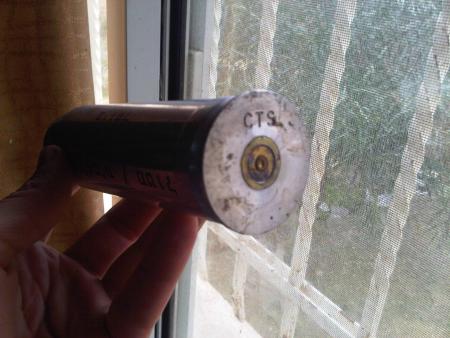 On December 9, 2011, in the village of Nabi Saleh in the West Bank an Israeli soldier inside an armored military jeep fired a tear gas canister at close range directly at the face of Palestinian protester Mustafa Tamimi during a protest against the expansion of Israeli settlements on Nabi Saleh’s land. Mustafa died from his wounds the next day. Protesters did not manage to collect the actual tear gas canister fired at him. However, residents of Nabi Saleh have collected samples of the types of tear gas canisters that the Israeli army uses against Nabi Saleh’s weekly protests, including the specific type of tear gas canister – same size and shape – that hit Mustafa. The type of canister that killed Mustafa can be seen in the January 11 and 13, 2012, photos below taken in Nabi Saleh by Bilal Tamimi. The canister has a headstamp on it that reads CTS. CTS stands for Combined Tactical Systems, a brand name of Combined Systems Inc., in Jamestown, PA. Adalah-NY received these photos from the Popular Struggle Coordination Committee.
CSI canisters and tear gas, shot by Israeli soldiers during protests against Israel’s settlements and wall on Palestinian land, also caused the deaths of protesters Bassem and Jawaher Abu Rahmah in Bil’in, the severe injury of protester Tristan Anderson, a US citizen, in Ni’lin, as well as severe injuries to many other Palestinian protesters (more information on these protesters).
CSI is the primary supplier of tear gas to the Israeli military as well as a provider to Israel’s police (and border police). Until a January 2012 change to it’s website, CSI listed Israeli Military Industries and Rafael Armament Development Authority as among its military customers and development partners (see old webpage). CSI’s founders, Jacob Kravel and Michael Brunn, are Israeli-Americans.
 In addition to ubiquitous CSI/CTS canisters found at Palestinian protests, evidence of CSI sales and shipments to Israel is clear. An April 30, 2008, cable available through Wikileaks from the US State Department in Washington DC to the US State Department in Tel Aviv requests clearance for shipment to Israel’s police of the following equipment from CSI: 1,000 Rubber Ball Hand Grenades, 1,000 Tactical Grenades Flash Bang, 1,000 Sting-Ball Grenades, 1,000 Flash Bang Training, and 1,000 Super-Sock Bean Bags. The shipment was part of a larger $5 million agreement between the Israeli police and CSI. An Israeli government website shows that on August 4th, 2011, the Israeli police purchased 6 million shekels ($1.56 million) worth of stun grenades from CSI without issuing a tender.
The PIERS Export Database of US Trade activity is helpful in identifying CSI shipments of tear gas to a number of countries, including Egypt, Tunisia and Algeria (see further information below). However, searching PIERS does not turn up CSI shipments to Israel. The photo of a CSI container at right reveals two reasons. The bottom label in the photo shows that the tear gas container was shipped via Israel’s national airline El Al, and PIERS only tracks shipments by sea. Additionally, the bottom label shows the CSI container was sent to Israel’s Ministry of Defense by Interglobal Forwarding Services, in Bayonne, New Jersey. A search on PIERS for Interglobal Forwarding Services over the past year shows over 1,300 shipments, some evidently including tear gas, by Interglobal from the US to Israel’s Ministry of Defense. But the shipments are listed under Interglobal’s name, and do not show manufacturers’ names.
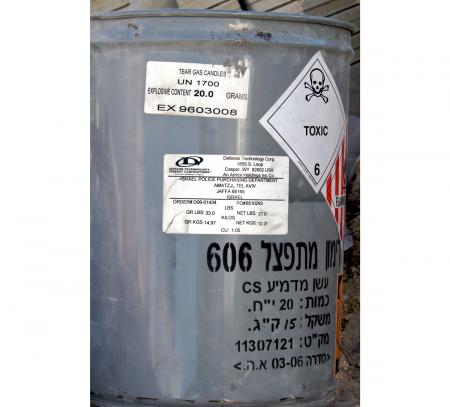
The US company Defense Technology has also provided some tear gas to Israel’s police (see information on Defense Technology in the Middle East and Oakland below, and a photo of a Defense Technology tear gas container in Jerusalem below).
CSI tear gas kills and injures Egyptian protesters
CSI tear gas is also the primary tear gas that has been used by the Egyptian security forces to repress popular protests for democracy in Egypt over the last year, causing protester deaths and injuries. Amnesty International highlighted the shipment of CSI tear gas to Egypt in its December 6, 2011, call for the US government to stop sending tear gas and weapons to the Egyptian government due to tear gas-related deaths and injuries to Egyptian protesters. Using the PIERS database, Amnesty International documented three specific shipments of tear gas from CSI in the US to Egypt in 2011 that were approved by the US State Department, despite the Egyptian security forces’ record of using of tear gas to kill and injure protesters in efforts to crush protests.
As additional documentation, a July 11, 2008, cable from the State Department in Washington DC to the State Department in Cairo available through Wikileaks requests information to finalize the shipment from CSI to Egypt’s Ministry of Interior of 20,000 CS Smoke Hand Grenades, 20,000 CS Smoke Long Range Cartridge, and 4,000 CS Window Penetrating Cartridges, together valued at $621,000.
CSI in the Middle East and worldwide
CSI canisters were also seen (for example at 27 seconds in this Tunisian video) and blamed for protester deaths in Tunisia. The PIERS database reveals an April 1, 2010, CSI shipment of 5.540 kilograms of “grenade cartridges” and “ammunition launchers” to Tunisia. PIERS also shows an April 8, 2011, shipment by CSI of 12,663 kilograms of “ammunition” to Algeria. There is some evidence of use of CSI tear gas by the Yemeni government against protesters.
Other CSI customers include the Netherlands and Germany (information available via PIERS), and (via Wikileaks) Guatemala, India, Timor-Leste, Hong Kong, Argentina, Thailand, Trinidad and Tobago, Cameroon (via Israel), and Sierra Leone.
Defense Technology in the Middle East and Oakland
A Corporate Watch report shows that the US company Defense Technology has provided tear gas to Israel’s police. Defense Technology is headquartered in Casper, Wyoming, and is owned by the UK arms giant BAE Systems. BAE Systems also owns the US arms company Armor Holdings and bought Federal Laboratories, another US company that previously provided tear gas to Israel, and other countries, and was the object of protests and lawsuits during the first intifada (See section on Past Deaths from Israeli tear gas).
Tear gas canisters with Defense Technology and Federal Laboratories have also been used by the Yemeni and Egyptian governments against pro-democracy protesters.
The city of Oakland has also used Defense Technology tear gas in its efforts to stop popular protests by Occupy Oakland. Occupy Oakland protester Scott Olsen, a former US marine, was seriously injured when he was struck in the head by an Oakland police projectile, very likely manufactured by Defense Technology.
US government approval of and funding of tear gas shipments
There is clear documentation, and State Department confirmation that the State Department approves sales of tear gas to foreign governments by US companies as “Direct Commercial Sales.” A US State Department webpage shows many examples in different years of State Department regulated and approved Direct Commercial Sales by US companies of tear gas to countries like Egypt, Israel, and Bahrain. Wikileaks cables also confirm the US State Department approval process for US tear gas sales, as have a number of statements by the State Department. However, in US government records of the US’s “Foreign Military Sales” (FMS), sales of military items by the US government to other governments, use line item descriptions that are too broad to identify whether items like tear gas are being sold by the US government under FMS. Most importantly, because US military aid (“Foreign Military Financing” or FMF) is not reported transparently by the US government, it is not possible for the public to know whether or not the billions of dollars of tax dollars given as military aid to countries like Israel, Egypt, Yemen and Bahrain are paying for US tear gas transferred to those countries through Direct Commercial Sales, or possibly through Foreign Military Sales.
Featured Video

No Threat Can Force Iran’s Surrender /Trita Parsi & Lt Cl Daniel Davis
or go to
Aletho News Archives – Video-Images
From the Archives
What is the Israeli Lobby in Australia Doing in Interfaith Dialogue?
By Ali Kazak | Dissident Voice | October 11, 2015
For years Israel and its lobby around the world have been trying to normalise their relations with Arabs and Muslims without solving the Palestine Question.
One of the methods they resorted to in the last few years is using human rights and community organizations such as interfaith dialogue and Multiculturalism to achieve this objective and to: isolate the Palestinians, marginalise the Palestine question, end Israel’s isolation, and prevent criticism of Israel, knowing that these organisations will be the first to stand against Israel’s violations, racial and religious discrimination.
The group responsible for this task in Australia is The Australia/Israel & Jewish Affairs Council (AIJAC); its Director of International & Community Affairs, Jeremy Jones is in charge of lobbying religious community organizations, specifically Muslims and Christians. Consequently he convened the Faith Communities for Reconciliation, founding participant in the Australian Partnership of Religious Organisations and the Australian National Dialogue of Christians, Muslims & Jews.
AIJAC is a private political propaganda group. It is recognised as the main Israeli lobby in Australia. It coordinates its activities and works intimately with the Israeli embassy in Canberra and different institutions in Israel. It is privately funded by some Jewish businessmen. It monitors closely Australian politicians, the media, ethnic and religious groups, (especially Arabs and Muslims), unions and academics on their stands towards Israel and the Palestine question. … continue
Blog Roll
 Aletho News
- Envoy warns UN on Trump’s threat to ‘obliterate’ Iran’s civilian infrastructure
- The Larak Corridor: Iran’s Rial Gate With No US, No Israel, and No Way Around
- ‘Economic terrorism’: Steel facilities hit again in US-Israeli strike
- ‘War Crime’: Iran condemns attacks on Arak, Ardakan nuclear sites
- Two-thirds of Americans want quick end to Iran war even if goals unmet
- Trump to Give “Important Update on Iran” Wednesday in Prime-Time Speech
- Theodore Postol: Iran’s Missiles & Drones Were Underestimated
- Iran To Target Military Industrial-Tech Complex That Facilitated Gaza Genocide
- Collapsing Empire: The Resistance Disarms ‘Israel’
- Suicide Should Not Be a Government Service
- If Americans Knew
- Israel wants US to bomb more of Iran’s civilian structures (113,000 is not enough) – Not a ceasefire Day 173
- Ann Coulter Rips Into Fox News for Iran War Coverage
- Joe Kent Urges Americans To Call White House and Congress To Object To Sending Troops Into Iran
- DNC Resolution to Reject AIPAC Funding Puts Democratic Leaders in the Hot Seat
- Swedish foundation to build 400 schools as over 650,000 Gaza children remain without education for 2 years
- Israeli army admits photshopping image of slain Lebanese journalist
- This is how Israel is systematically killing health workers under the cover of war in Lebanon
- Carrying life under fire: Israeli invasion of Lebanon leaves pregnant women facing deadly risks
- Champagne all around for the new death penalty (for Palestinians) law – Not a ceasefire Day 172
- Why are Palestinian books struggling to be seen on Amazon?
- No Tricks Zone
- New Study Finds Warming Saves Lives…Cold Temperatures 12 Times More Deadly Than Excess Heat
- German Science Blog Accuses PIK Climate Institute Of Hallucinating Climate Tipping Points
- Devastating Assessment Of Comirnaty Vaccine By Former Senior Pfizer Europe Toxicologist
- New Study: CO2 Is ‘Effectively Negligible’ As An Explanatory Climate Change Factor Since 2000
- Former Pfizer Toxicologist Dr. Helmut Sterz Tells Bundestag Hearing Pfizer Vaccine Should Have Never Been Approved
- Energy Expert: Germany’s Nuclear Phaseout Was A “500 Billion Euro Mistake”
- New Research: South Australia’s Mid-Holocene Sea Surface Temperatures Were 4°C Warmer Than Today
- Storing Green Energy To Last Germany 10 Days Would Require A 60-Million Tonne Battery
- New Studies: UK Sea Levels Were 4 Meters Higher Than Today During The Mid-Holocene
- Destructive Green New Deal: German Energy And Metal Group Warns Of Drastic Crisis
 Aletho News