Rallies Worldwide to Mark the 9th Anniversary of the Disappearance of Aafia Siddiqui
Please also note that events scheduled for Saturday include a rally in New York at 12 noon, and a rally in Toronto (sisters only) at 6 pm. On Friday (March 30), there is also a rally in Fort Worth, Texas at 3.30 pm.
By Andy Worthington – 29.3.12
 On Saturday, outside the US Embassy in Grosvenor Square, London, I will be speaking at an event marking the ninth anniversary of the disappearance in Pakistan of Dr. Aafia Siddiqui, who vanished for five years and five months, and then mysteriously reappeared in Afghanistan in August 2008, where she was arrested, and then allegedly tried to shoot at the US soldiers who were holding her.
She was subsequently flown to New York, where, in September 2010, after a trial at which she did not appear to be well, although her mental health was not considered to be an issue worthy of scrutiny, she was sentenced to 86 years in prison, which she is serving in a notorious psychiatric prison, FMC Carswell, in Texas.
The rally outside the US Embassy, organized by the Justice for Aafia Coalition, takes place from 3 pm to 6 pm, and the speakers, and the timing of speeches, are as follows:
1500: Introduction
1510: Sultan Sabri (Croydon Muslim Association)
1520: Raza Karim
1530: Andy Worthington (journalist, author of The Guantánamo Files)
1540: Asif Hussain
1550: Raza Nadim (MPACUK – Muslim Public Affairs Committee)
1600: Sheikh Suliman Ghani (Imam, Tooting Islamic Centre)
1610: Anas Altikriti (Cordoba Foundation)
1620: Ken O’Keefe (anti-war activist)
1630: Statement of Support from the Haldane Society of Socialist Lawyers
1635: Joy Hurcombe (Save Shaker Aamer Campaign) reads out Statement of Support from Walter Wolfgang
1645: Omar Deghayes (former Guantánamo prisoner)
1655: Adnan Rashid (Hittin Institute)
1705: Sultana Parvin
1715: Uthman Lateef (Hittin Institute)
1725: Conclusion
I hope to see some of you down there, as the case of Aafia Siddiqui, which I have been following for many years, remains deeply troubling. My previous articles can be found here, and below is a re-cap of her story, drawn largely from an account of the website of the Justice for Aafia Coalition.
Please also note that other events scheduled for Saturday include a rally in New York at 12 noon, and a rally in Toronto (sisters only) at 6 pm. On Friday (March 30), there is also a rally in Sandton, South Africa at 2 pm, and another in Fort Worth, Texas at 3.30 pm.
The story of Aafia Siddiqui
Nine years ago, on March 30, 2003, Aafia Siddiqui, a Pakistani citizen, and a cognitive neuroscientist, disappeared in Karachi along with her three children, the youngest of whom, Suleman, was just a baby. For the next five years their whereabouts were unknown, and have never been publicly acknowledged by either the Pakistani or the US government, even though it seems clear that she was held in secret detention, where she was severely abused. Former Bagram prisoners have stated that a female prisoner was held in the prison, identified by the number “650,” and have said that they heard her horrific screams.
Following demands for her recovery by human rights organisations and the Pakistani public, Aafia resurfaced in Afghanistan in August 2008, framed with the attempted murder of US personnel. Transferred to the US, she was convicted in a shocking miscarriage of justice and was sentenced in September 2010 to 86 years in prison. She is currently held in isolation at FMC Carswell, Texas, a facility notoriously referred to as the “hospital of horrors.” She is denied any meaningful contact with her family and is unlikely to see her children again.
Whilst the two elder children were released in 2008 and 2010 respectively, the whereabouts of her youngest child, Suleman — only six months old at the time of the abduction — remain unknown, although it is believed that he may have been killed art the time of her initial capture. Most recently, disturbing reports have emerged that her health is deteriorating and there are serious concerns that she may have cancer.
To request Aafia Siddiqui’s repatriation to Pakistan, please contact the following officials in the US and Pakistani governments:
Eric Holder: Attorney General, U.S. Department of Justice, 950 Pennsylvania Avenue, NW Washington, DC 20530-0001, Tel: +1 202 353 1555, Email: AskDoJ@usdoj.gov
Hilary Clinton: Secretary of State, U.S. Department of State, 2201 C Street, N.W. Washington DC 20520, Tel: +1 202 647 4000, Fax: +1 202 261 8577, Email: questions@friendsofhillary.com
Mr. Asif Ali Zardari: President of Pakistan, President’s Secretariat, Islamabad, PAKISTAN, Tel 92 51 920 4801/921 4171, Fax 92 51 920 7458, Email: publicmail@president.gov.pk
Mr. Syed Yousaf Raza Gilani: Prime Minister of Pakistan, Prime Minister House, Islamabad, PAKISTAN, Fax: + 92 51 922 1596, Email: secretary@cabinet.gov.pk
Mr. Rehman Malik: Minister of Interior, Room No. 404, 4th Floor, R Block, Pak Secretariat, Islamabad, PAKISTAN, Tel: +92 51 921 2026, Fax: +92 51 920 2624, E-mail: minister@interior.gov.pk, ministry.interior@gmail.com, interior.complaintcell@gmail.com
Makhdoom Shah Mahmood Qureshi: Foreign Minister, Ministry of Foreign Affairs Islamabad, Pakistan, Tel: +92 51 921 0335, Fax: +92 51 920 7600, Email: smhq148@hotmail.com
You can also write to Aafia:
Aafia Siddiqui # 90279-054
FMC Carswell
Federal Medical Center
P.O. Box 27137
Fort Worth, TX 76127
U.S.A.
And to send a message of support to her family, email: support@justiceforaafia.org
Related articles
- Aafia’s lawyer seeks reversal of her conviction (nation.com.pk)
Scores Injured as Israeli Troops Attack West Bank land Day Protests
By George Rishmawi & Ghassan Bannoura | IMEMC | March 30, 2012
 Thousands of Palestinians marked land day, on Friday, Palestinian sources said that 100 civilians were injured when Israeli troops attacked protesters in Ramallah and Bethlehem cities.
Marking the 36th anniversary of land day today Palestinians and their supporters marched for Jerusalem demanding an end to the Israeli occupation of the city. Protests were organized near the Israeli Lebanese borders as well as the borders with Jordan.
The Land day commemoration started in 1976, when Palestinian residents of the Galilee to the Negev protested Israel’s plan to expropriate thousands of dunams of land for security and settlement purposes. Israeli military and police attacked the protests leaving 6 killed, hundreds injured.
Today After the midday prayers, people marched from Ramallah city, central West Bank, towards Qalandiya checkpoint that separates Ramallah from Jerusalem.
Troops fired tear gas and sound bombs then later used rubber-coated steel bullets. 80 Palestinians were injured. Witnesses told IMEMC that among those injured were two Palestinian medics.
In Bethlehem 20 residents were injured, seven were moved to hospitals, when soldiers fired tear gas and sound bombs at land day protesters. The marchers were first stopped by the Palestinian security forces however they managed to reach the gate of the wall separating Bethlehem from Jerusalem. As protestors reach the gate, youth threw rocks and firebombs at the wall and the nearby military tower.
“We are here to tell the Israeli occupation that Jerusalem is Palestinian and will never forget it.” One of the protesters told IMEMC.
Israeli troops responded by firing tear gas and sound bombs. A source from the Palestinian Red Cresent Society told IMEMC that one resident was hit with a tear gas canister in his back causing burns and bruises.
The wounded was identified as Yousef Sharqawi from Bethlehem. Another activist from the US was hit with a tear gas canister in his head and was transferred to the hospital for medical treatment. Field medics said his wound is moderate.
Photo of Land Day Protest in Bethlehem Today – by Ghassan Bannoura
Related articles
- On the eve of Land Day: Al Quds anticipates the Global March (alethonews.wordpress.com)
- Palestinian badly injured after Israelis fire tear gas at head (alethonews.wordpress.com)
- Israel Warns Against Global March to Jerusalem (alethonews.wordpress.com)
- 5 injured in West Bank demonstrations (alethonews.wordpress.com)
Palestinian lawmaker wounded in Land Day protest

Palestinian lawmaker Mustafa Barghouti
Press TV – March 30, 2012
Palestinian lawmaker Mustafa Barghouti has been injured by Israeli forces attacking peaceful demonstrations marking international Land Day, Press TV reports.
Barghouti was wounded on Friday in the city of al-Quds (Jerusalem) where he attended a Land Day rally.
Israeli forces opened fire on peaceful pro-Palestinian rallies across the occupied Palestinian territories, with clashes underway between Israeli troops and Palestinians in the occupied West Bank city of Qalandiya.
Earlier reports said at least two protesters were injured by Israeli troops and several others were arrested.
More demonstrations were planned for after the Friday Prayers across the West Bank and Gaza Strip as well as in East al-Quds (Jerusalem) despite Tel Aviv restricting access to al-Aqsa Mosque for the weekly prayers.
Pro-Palestinian rallies have been held near border areas in Lebanon and similar demonstrations are expected in Egypt, Jordan, and Syria where activists will also march towards the Palestinian borders.
The rallies, joined by international human rights activists, are part of an international campaign named Global March on al-Quds (Jerusalem), a peaceful international movement that also condemns the Israeli occupation of the holy city.
The event marks Land Day and the Israeli military’s deadly attack on Palestinians peacefully protesting Tel Aviv’s land policies in 1967.
The demonstrations have prompted Tel Aviv to deploy thousands of police and armed forces across the occupied Palestinian territories and around border areas near Lebanon and Jordan.
Related articles
- Marwan Barghouti: A Decade of Defiance (alethonews.wordpress.com)
- On the eve of Land Day: Al Quds anticipates the Global March (alethonews.wordpress.com)
- The Global March to Jerusalem, a brave and admirable attempt to awaken the world’s conscience (altahrir.wordpress.com)
- Israel Warns Against Global March to Jerusalem (alethonews.wordpress.com)
- American arms used to kill Palestinians; US complicit in Israeli crimes: Report (alethonews.wordpress.com)
MKO is US’ only hope to stop Iran nuclear program: NY ex-mayor

Press TV – March 29, 2012
The former mayor of New York says the terrorist group of Mujahedin-e Khalq Organization (MKO) is the United States’ only hope to stop Iran’s nuclear energy program through a military attack.
Speaking at a conference in Paris, Rudolph Giuliani noted that the United States should use the MKO to militarily attack Iran’s nuclear program, International Business Times reported.
The conference was also attended by former US Attorney General Michael Mukasey, former Homeland Security chief Tom Ridge, former US Ambassador to the United Nations John Bolton and former Rhode Island Representative Patrick Kennedy.
“I have a feeling that the only thing that will stop [Iran] and the only thing that will stop [President Mahmoud] Ahmadinejad is if they see strength, if they see power, if they see determination, if they see an America that is willing to support the people that want to overthrow the regime of Iran,” he added.
Giuliani’s remarks come despite the fact that MKO, along with 49 other groups including al-Qaeda, is on the US State Department’s list of Foreign Terrorist Organizations which considers providing “material support or resources” for such groups or accepting donations from them as illegal.
Despite that law, three top-ranking former US officials are currently being investigated by the Treasury Department for accepting speaking fees from the MKO.
Former Pennsylvania Gov., Philadelphia mayor, and Democratic National Chairman Ed Rendell was the first to face federal scrutiny for accepting speaking fees from the MKO. Earlier this month ex-FBI Director Louis Freeh and a former chairman of the Joint Chiefs of Staff, retired Gen. Hugh Shelton, were also subpoenaed.
In the past few years, dozens of other US politicians have been paid by the MKO, including former Vermont Gov. and Democratic National Chairman Howard Dean, retired Gen. Wesley Clark, former New Mexico Gov. Bill Richardson, Bush’s White House Chief of Staff Andy Card and even former Rep. Lee Hamilton, who was also co-chairman of the 9/11 Commission.
Giuliani, who charges as much as USD 100,000 per speaking engagement, was asked to appear at the Paris conference by the so-called French Committee for a Democratic Iran. The US Treasury Department charges that these types of Iranian organizations are clandestinely funneling money from the MKO into speakers’ pockets.
Related articles
- Giuliani claims ‘terrorist’ MEK only chance for regime change in Iran (rt.com)
- PressTV: ‘Israel funds MKO; MKO funds US politicians’ (jhaines6.wordpress.com)
- US leaders charged for accepting money from anti-Iran terrorist group (alethonews.wordpress.com)
- PressTV: US paper: MKO deserves Nobel Prize for killing Iran experts [It seems the sickness increases.] (jhaines6.wordpress.com)
On the eve of Land Day: Al Quds anticipates the Global March
29 March 2012 | International Solidarity Movement, West Bank
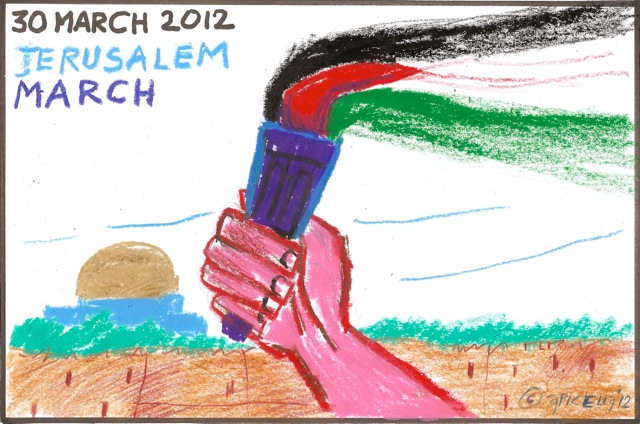
March 30 is Land Day in Palestine. The events of the day annually commemorate the events of 1976, when Israeli authorities seized massive quantities of land from Palestinian owners, and then killed several and injured dozens to crack down on the general strike called to protest the theft.
This year on Land Day, March 30, people from around Palestine and the world will march towards Al Quds (Jerusalem) to protest the theft in progress today: the isolation and ethnic cleansing taking place in Al Quds, as well as throughout occupied Palestine through illegal settlement activity. Marches are planned towards Al Quds from multiple points in the West Bank, Gaza, inside the Green Line, Jordan, Lebanon, Egypt, and Syria, as well as in Asia, North America, and Europe. The global march aims to highlight the colonization of Al Quds by Zionists and the refusal of access for Palestinians to the holy city.
According to multiple treaties and UN resolutions, Al Quds is recognized as the capital of a future Palestinian state. Israel seized control of the city in 1967. Al Quds has long been the center of religious, cultural, health, and commercial life for Palestinians, and an estimated 270,000 Palestinians reside in the eastern parts of the city (OCHA 2011).
The Palestinian population and presence in Al Quds is currently under extreme pressure from Israeli authorities and illegal settlers as the Zionist state seeks to take complete control of the city, drive out the Palestinian inhabitants, and eliminate any hope of its future as a Palestinian capital. This pressure is manifested in various ways:
Isolation
Fadwa Khader, an Al Quds resident and organizer of the Global March on Jerusalem remembers a time when Al Quds was “the most important place in Palestine.” Now, the apartheid wall and associated military closures prevent the majority of Palestinians from traveling to Al Quds for any reason. The city’s status as a center of Palestinian life is fading, due to its isolation from the rest of the West Bank. But material realities will not erase Al Quds’s place in the hearts of the Palestinian people. One needs only to view the multitude of images of Al Aqsa mosque in Palestinian homes, businesses, and streets to understand this.
Removal and Denial of Residency
In a systematic effort aimed at reducing the number of Palestinian residents of Al Quds, Israeli authorities seize any opportunity to rescind the residency permits of individuals, even those who are born and have lived their entire lives in the city. If Palestinian residents are known to have lived in the West Bank or abroad, even temporarily, they risk the withdrawal of their residency rights and may never be allowed into Al Quds again, even to visit family.
Fadi, whose name has been changed to protect his identity, is a Palestinian who resided in Jordan for example, has retained his Jerusalem IDs. Yet his children who were born in Jordan and whose mother is a Palestinian refugee, have been unable to attain their Jerusalem IDs. “My family’s history is in this city,” said Faid. “The lack of jobs, and the bleak future of Palestinians here forced me to seek these elsewhere. Now that I have returned and have brought my children with me, my children are unable to maneuver throughout the city as they are undocumented in their own father’s hometown. Israel refuses to recognize them as the children of a Jerusalemite, but we will remain here, even if that means that my children and wife live without an ID or any rights.” Fadi continued after a long silence and the evident hurt in his eyes. “This is our resistance to Zionism.”
This policy has the effect over time of reducing the Palestinian population in Al Quds and preventing residents from traveling or living elsewhere for fear of losing residency.
Pressure on existing residents
Fadwa Khader noted another component of Israel’s campaign for the complete colonization and ethnic cleansing of Al Quds: the application of pressure to Palestinian residents in order to drive them out of the city. One way this is manifested is in the denial of municipal services in the eastern parts of the city inhabited by Palestinians.
The residents here pay the same taxes as the Jewish residents of West Al Quds. Despite this, the municipality of Jerusalem does not provide adequate services to the Palestinian neighborhoods of the city. Ninety percent of the municipality’s sewer lines and paved roads and sidewalks are in West Al Quds (B’tselem). In some neighborhoods, cleaning services come only once every three days as opposed to three times a day in West Al Quds. n February the Wadi Hilweh Information Center reported the Jerusalem Municipality created a dump at the door of Palestinian neighborhoods.
Khader notes the dual nature of this denial of services: First, to make life in Al Quds miserable and untenable in an effort to convince existing residents to leave. Second, to demonstrate to the internationals that visit Al Quds that the Palestinian residents “don’t care about their neighborhoods” and live in filth.
Pressure is also applied to Palestinian resident through settlement of East Al Quds neighborhoods by extremist Israelis, evictions of Palestinian families, and demolitions of Palestinian homes. The neighborhoods of Sheikh Jarrah and Silwan have been particularly affected by this strategy. The goal of the Israeli authorities and Zionist activists is to forcibly settle Jews in East Al Quds through the seizure of land and homes and settlement of Israelis in these areas. In addition, home demolitions make life increasingly untenable for affected residents.
The Global March this Land Day will seek to highlight these issues and call for an end to Israeli Zionist settlement policy, access restrictions, occupation, and ethnic cleansing in Al Quds and throughout occupied Palestine.
Khader has a message for the international Palestine solidarity movement:
“We want to live in peace and liberty and to feel free. Can you imagine how we suffer and sacrifice for this dream?”
She noted that there can never be a real Palestinian state as long as the Israelis continue to steal land and water, to control borders, and to separate cities and villages of Palestine from each other.
Still, she is hopeful.
“We won’t give up hope. We believe in you (international solidarity activists). You are our voice outside of Palestine, calling for dignity, liberation, and an end to the occupation.”
Related articles
- PRESS RELEASE: Israel’s Criminal Policy in Al Quds (Jerusalem) (altahrir.wordpress.com)
ISRAEL: Water being used to coerce Bedouin villagers, says NGO
IRIN | March 29, 2012

Photo: Jillian Kestler-D’Amours/IRIN
The Bedouins in Umm al-Hieran village live several kilometers away from a source of clean water and rely on trucks to get their supply
UMM AL-HIERAN, NEGEV DESERT – Salim Abu al-Qi’an’s family live in Israel’s Negev desert in the “unrecognized” Bedouin village of Umm al-Hieran, 9km from the nearest source of clean water.
“There is no water in the village. We truck it in. It costs about 50 shekels [US$13.4] per cubic metre of water,” explained the 53-year-old village leader. “There is a pipe that’s about 8km long, but it’s too old, and the planning authorities don’t allow us to put a new one under the ground. We are asking for better access to water, a new pipe that should be close to the village.”
The Israeli authorities forced Umm al-Hieran residents to move to the area where the village now sits in 1956, shortly after the military had evicted them from their original homes in the Wadi Zuballa area of the Negev desert.
In 2004, the villagers faced a new threat of expulsion, as the Southern District Planning Committee unveiled a master plan which involves once again displacing Umm al-Hieran, and building the Jewish community of Hiran in its place. According to the Israeli government, the 500 residents of Umm al-Hieran are trespassers who are illegally squatting on state land.
Some 80-90,000 Bedouin citizens of Israel live in unrecognized villages in the southern Negev, according to a report by the Association for Civil Rights in Israel. As a result of their unrecognized status, nearly every structure in these communities can be demolished at any time, and residents do not receive basic services from the state, including electricity, paved roads, healthcare facilities, schools, and water.
Constitutional right
In June 2011, however, the Israeli Supreme Court ruled that the right to water was a constitutional right, and that the state must guarantee a “minimum access to water” for the residents of the unrecognized villages. Still, the court did not specify what constituted a fair minimum.
Shortly thereafter, a Haifa court, acting as a water tribunal, rejected Umm al-Hieran’s application to be connected to the local water network. The court argued that the villagers had minimum access to water, and suggested they buy water from private citizens in towns connected to the water network, or move into nearby government-planned Bedouin townships.
According to Sawsan Zaher, an attorney at Adalah, the Legal Center from Arab Minority Rights in Israel, which has represented al-Qi’an’s family and the residents of Umm al-Hieran in their legal struggle, the water tribunal’s decision means that “a constitutional right, which is the right to water as part of the right to a minimal standard of living, [will] be provided by private actors and not by the state. This is in contradiction to constitutional law. The duty is on the state to fulfil this right and protect it even.”
Adalah has filed an appeal to Israel’s Supreme Court, asking that “minimum access to water” be explicitly defined, and challenging the constitutionality of forcing Umm al-Hieran residents to purchase water from non-state actors.
“Despite the fact that they are citizens, they are not entitled to the same level of rights as other citizens of Israel. Why? Because they are living in unrecognized villages,” Zaher told IRIN.
“We want you to move out”
“The purpose is not hidden any more. It is revealed and it’s very official: we are not connecting you to water because we want you to move out. This is the policy. It’s a kind of punishment. This is in huge contradiction with human rights and logic and humanity – to come and punish people by not giving them water for political purposes,” Zaher said.
In a 9 March report, the UN Committee on the Elimination of Racial Discrimination raised concerns about Bedouin communities in Israel, particularly with regard to Bedouin home demolitions, and inequalities between Bedouin and Jewish citizens’ access to land, housing, education, employment and public health.
Israel’s proposed Law for the Regulation of Bedouin Settlement in the Negev, which would forcibly displace 30,000-60,000 of the 80,000-90,000 Bedouins living in unrecognized villages, should be shelved, the UN Committee found, since it legalizes “the ongoing policy of home demolitions and forced displacement of the indigenous Bedouin communities”.
According to Salim Abu al-Qi’an, forcibly displacing residents of Umm al-Hieran to the nearby government-planned Bedouin township of Hura is indeed the motivation behind denying them direct access to high-quality water.
“They want to push us to leave the village and to displace us,” he told IRIN. “Even though we are an unrecognized village, this is nicer than to live in Hura. There are no services there. Sewage and garbage is in the street. There’s not enough space. It’s another refugee camp.”
Related articles
- Stop the JNF campaign makes steady gains as Israel charity goes “on the retreat” in UK (alethonews.wordpress.com)
- 2,600 Bedouins threatened with displacement as Israeli settlements expand (alethonews.wordpress.com)
- Professor of Hate: Israeli “scholar” urges ethnic cleansing of Bedouins (alethonews.wordpress.com)
- Jewish Agency: goal of Israeli government plan to block Bedouin “incursion” (alethonews.wordpress.com)
- Israeli bulldozers destroy Palestinian wheat crops in Negev (altahrir.wordpress.com)
Calls on EU Parliament to press Israel into releasing Palestinian MP Hajj
Palestine Information Center – 29/03/2012
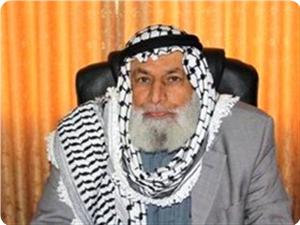 GAZA — The international campaign for freeing kidnapped Palestinian MPs informed the Inter-Parliamentary Union and the European Parliament about the deterioration of the health of detained MP Ahmad Ali Hajj who has been on hunger strike for 15 days.
The campaign called, in letters to both Mr. Martin Stchaulz President of the European Parliament and Mr. Anders Johnson Secretary-General of the Inter-Parliamentary Union, to exert international parliamentary pressure on the occupation to release the MP Ali Al-Hajj, warning that his health is worsening by the day.
Hajj (74 years) is at risk of death at any moment because of his serious health condition. He has already lost 10 kg as a result of his hunger strike to protest administrative detention without charge or trial, in addition to losing 70% of his ability to hear and other ailments, the campaign added.
27 Palestinian MPs are still detained in the occupation jails in violation of the international law and their parliamentary immunity, the campaign said, pointing to the occupation’s arbitrary measures against the elected representatives, especially administrative detention for years on end. The campaign stated that the international silence toward this blatant violation of human rights gives the occupation a green light to commit more crimes towards people’s representatives.
Related articles
- Marwan Barghouti: A Decade of Defiance (alethonews.wordpress.com)
- European MPs call on Israel to release Palestinian lawmakers (alethonews.wordpress.com)
- Israel bars Palestinian MP from going to Geneva to attend UN conference (alethonews.wordpress.com)
- Stop the JNF campaign makes steady gains as Israel charity goes “on the retreat” in UK (alethonews.wordpress.com)
- European Parliament Calls on Israel to Respect Signed Agreements (altahrir.wordpress.com)
Deal reached to free Hana Shalabi
Ma’an – 29/03/2012
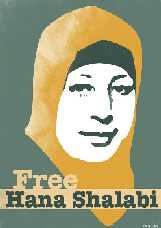 BETHLEHEM — A deal to release Palestinian hunger-striker Hana Shalabi to the Gaza Strip temporarily was reached late Thursday, officials with knowledge of the negotiations told Ma’an.
The officials say Shalabi will be sent to Gaza for three years in exchange for giving up a 43-day strike against Israel’s policy of holding detainees without charge.
The Palestinian prisoners society confirmed the deal in a statement praising Shalabi’s resolve. It expressed its appreciation for her efforts to bring attention to Israel’s policies toward prisoners.
Qadoura Fares of the prisoners society said Shalabi agreed to the deal “in return for ending her strike and being freed. … We reject deportation, but this is her decision and her own life,” Fares said.
Shalabi’s lawyer, Jawwad Boulous, also confirmed the agreement.
According to a high-ranking Palestinian source, the deal was reached after Palestinian officials and Red Cross intervened to confirm that Shalabi approved.
The Palestinian Authority minister of civil affairs, Hussein al-Sheikh, said the leadership in Ramallah was not involved in the negotiations as it rejects Israel’s deportation policy.
The deal apparently followed talks between Shalabi and the Israeli government, he said.
Al-Sheikh added that Israel is responsible for the hunger-striker’s well-being and should instead release Shalabi unconditionally to her home and family in the West Bank, not to Gaza. … Full article
Related articles
- Palestinian hunger striker Hana Shalabi hospitalized (alethonews.wordpress.com)
- Hana Shalabi to continue hunger strike despite sentence reduction (alethonews.wordpress.com)
- Hana al-Shalabi on hunger strike against renewed administrative detention (alethonews.wordpress.com)
- Lawyer: Hana Shalabi’s health is deteriorating (altahrir.wordpress.com)
- Palestinians protest Israeli detention of woman without charges (rt.com)
Israeli settlers storm into Palestinian home, occupy residence
Al Akhbar | March 29, 2012
Israeli settlers invaded a home in a Palestinian-owned building in the occupied West Bank city of Hebron and took up the apartment as their own, residents and Israeli security forces said on Thursday.
“At 1:30am we heard noises and it was the settlers,” Montasser Abu Rajab, who lives on the first floor of the building in Hebron’s Old City, said.
“They broke the main door and brought their furniture in, accompanied by the army, who locked us in our house,” he said.
Palestinian sources in Hebron said that the property belonged to the Abu Rajab family, who had sold the second floor of the house to another Palestinian family.
But the Israeli army – who confirmed the incident – claimed that “the title to the property is contested.”
“The area has been declared a closed military zone, and soldiers have been put in place to keep the calm,” a spokeswoman for the Israeli army said.
Israeli police spokesman Micky Rosenfeld said “police have been dispatched to the scene to verify the legal status of the house and the property titles that are apparently the subject of litigation.”
The settlers also claimed that they had titles to the property, which is located near a prominent religious site for both Muslims and Jews.
Speaking to Israeli public radio, right-wing Israeli lawmaker Michael Ben Ari, of the National Union party, said it was “time to recover all the Jewish homes in Hebron stolen by the enemy.”
Right-wing Israeli politicians and figures often incite violence against Arabs, with Palestinians frequently attacked and harassed by settlers as well as the Israeli military, often with impunity.
House demolitions and evictions are among the serious threats indigenous Palestinians face on their native land, as Israel continues to build Jewish-only settlements in the West Bank, including in Hebron, in defiance of the international community.
Israeli settlements in the West Bank are considered illegal under international law, with the territory being only a fraction of historical Palestine on which the Israeli state is now situated.
Israel maintains a military occupation of the West Bank and Jerusalem, imposing harsh restrictions on native Palestinians while providing privileges to illegal Jewish settlers.
(Al-Akhbar, AFP)
Related articles
- Hebron teen ‘shot by Israeli settler’ (alethonews.wordpress.com)
- Settlers Attack Two Towns Near Hebron (alethonews.wordpress.com)
- Settler Violence: Broken Glass on Shuhada Street (alethonews.wordpress.com)
- Settlers Install New Outpost Near Hebron (alethonews.wordpress.com)
- International Solidarity Movement volunteers encounter settler attack and sexual harassment in Hebron (alethonews.wordpress.com)
- Israeli demolition ‘displaces 120′ in Hebron village (alethonews.wordpress.com)
- Soldiers raid community center, arrest local activist (alethonews.wordpress.com)
Featured Video

Meet The Ellisons: Zionists, Technocrats, Moguls
or go to
Aletho News Archives – Video-Images
Frlom the Archives
With apparently fabricated nuclear documents, Netanyahu pushed the US towards war with Iran
By Gareth Porter | The Grayzone | April 29, 2020
President Donald Trump scrapped the nuclear deal with Iran and continued to risk war with Iran based on Israeli Prime Minister Benjamin Netanyahu’s claim to have proven definitively that Iran was determined to manufacture nuclear weapons. Netanyahu not only spun Trump but much of the corporate media as well, duping them with the public unveiling of what he claimed was the entire secret Iranian “nuclear archive.”
In early April 2018, Netanyahu briefed Trump privately on the supposed Iranian nuclear archive and secured his promise to leave the Joint Comprehensive Plan of Action (JCPOA). That April 30, Netanyahu took the briefing to the public in a characteristically dramatic live performance in which he claimed Israel’s Mossad intelligence services had stolen Iran’s entire nuclear archive from Tehran. “You may well know that Iran’s leaders repeatedly deny ever pursuing nuclear weapons…” Netanyahu declared. “Well, tonight, I’m here to tell you one thing: Iran lied. Big time.”
However, an investigation of the supposed Iranian nuclear documents by The Grayzone reveals them to be the product of an Israeli disinformation operation that helped trigger the most serious threat of war since the conflict with Iran began nearly four decades ago. This investigation found multiple indications that the story of Mossad’s heist of 50,000 pages of secret nuclear files from Tehran was very likely an elaborate fiction and that the documents were fabricated by the Mossad itself. … continue
Blog Roll
 Aletho News
- Meet The Ellisons: Zionists, Technocrats, Moguls
- US failures in Iran reveal Russia is key to South Korea’s strategic security
- ‘All ports in Persian Gulf will be legitimate targets if Iranian ports are attacked’
- 40 Years of Endless War, Data Point by Data Point
- Department of War Using Palantir AI to Pick Targets in Iran
- American bases do not protect – they attack the peoples of the Persian Gulf
- ‘We’ve Obliterated Their Missiles’
- Syrian president vows ‘absolute support’ to disarm Hezbollah
- Ukraine attacking Russian gas pipeline to stop deliveries to Europe – Defense Ministry
- ‘Heinous crime’: Iran denounces Israeli assassination of 4 Iranian diplomats in Lebanon
- If Americans Knew
- Israeli strategic plans to “remake the Middle East” from the 1950s and since
- Honoring Gaza’s women who refused to let the world look away
- 97% of victims of war on Iran are Iranian, 98% of victims in war on Gaza are Gazans – Not a ceasefire Day 152
- Early Iran strikes cost $5.6 billion in munitions, Pentagon estimates
- Israel Decided the War, But Trump’s America Fights and Pays the Bill
- Conscientious Objector Group: Phone ‘Ringing Off Hook’ As Huge Mobilization Underway
- U.S. support for Israel continues to plummet, despite media’s best efforts
- Threats and missiles fly, death tolls soar in Iran, Lebanon, Gaza – Not a ceasefire Day 151
- Lebanon: Israel’s White Phosphorous Use Risks Civilian Harm
- Corporate Media Go All Out To Support The US-Israeli War On Iran
- No Tricks Zone
- Destructive Green New Deal: German Energy And Metal Group Warns Of Drastic Crisis
- New Study Documents A 20-Year Pause In Arctic Sea Ice Decline – Driven By Internal Variability
- Wake-up Call: Survey Shows Majority Of Germans Now Favor Postponing Climate Targets!
- Televised! Leading German Political Candidate Tells Schoolchildren CO2 Makes Sun Hotter!
- New Study: A Century Warming Of 1.1°C Is ‘Commonplace’ And ‘Not Unusual’ During This Interglacial
- New Study: ‘Internal Noise’ And Volcanic Forcing Can Trigger 10-15°C Warming Within Decades
- Glaciers Worldwide Are Suddendly Surging, Experts Blame Warming!
- Surprising Discovery: Sahara Is Greening…Billions Of Trees Where Once Thought To Be Barren
- New Research Reaffirms Clouds, Aerosols, And Surface Solar Radiation Are ‘Driving The Climate System’
- Germany: Electric Car Catches Fire At Charging Station, Sets Off Local “Inferno”, Widespread Damage
 Aletho News