The Left Radicalism of Jean-Luc Mélenchon
By PHILIPPE MARLIERE | CounterPunch | April 17, 2012
Superbly ignored by the media until recently, Jean-Luc Mélenchon is the new flavour of the day in the French presidential campaign. In truth, while trying to account for his dramatic rise in the polls – latest reports put him at 17% of the vote – most commentators could not help pour scorn on the Left Front candidate.
A survey of the main articles recently published in the British media provides a compelling case study of political prejudice and misunderstanding. Mélenchon is described as an “Anglo-Saxon basher with a whiny voice” (the Independent), a “populist” who’s “on the hard-left” (all newspapers) and a “bully and a narcissist, out to provoke” (BBC). More sympathetic commentaries compare him to George Galloway or depict him as a “far-left firebrand”, a “maverick” and the “pitbull of anti-capitalism”.
It is striking that the more favourable assessment of Mélenchon’s politics remains off the mark. Mélenchon is seen as a “lovable but old-fashioned leftwinger”. This fails to capture the essence of his political ambitions. Mélenchon’s rise has nothing to do with “1970s-style politics and nostalgia”, but is linked instead to his resolute take on the current capitalist crisis. He tells audiences that the austerity policies implemented across Europe are not only unfair but also counterproductive (even the Financial Times agrees). Mélenchon’s debating skills serve his cause, but he is also a lettered pedagogue: a dignified politician who has never participated in vulgar reality shows. What is more, Mélenchon is a French republican and a socialist, not a “far-left” or a fringe politician. He spent 30 years in the Socialist party unsuccessfully arguing that it should be a force at the service of ordinary workers, and he was a cabinet minister in Lionel Jospin’s government.
Oratory is politically useless if one does not have an important message to deliver. Mélenchon has one: neoliberalism has failed, so it would be suicidal to persist with its inadequate policies. The French MEP also had a credible programme. In didactically crafted speeches or in media interviews, he radically departs from mainstream politicians by explaining that the economic crisis is systemic, that is to say that it is due to our flawed political choices and priorities. Our societies have never been as productive and wealthy as today, but the majority of the population are getting poorer despite working harder and harder. The problem is not a question of wealth production (as neoliberals and Blairite social democrats would have us believe), but of redistribution of wealth.
In France raging pundits and opponents call the Left Front programme an “economic nightmare” or a “delirious fantasy”. Shouldn’t they instead use this terminology to describe the banking debacle or austerity policies across Europe? Mélenchon’s growing number of supporters view it as common sense and salutary: a 100% tax on earnings over £300,000; full pensions for all from the age of 60; reduction of work hours; a 20% increase in the minimum wage; and the European Central Bank should lend to European governments at 1%, as it does for the banks. Here are a few realistic measures to support impoverished populations. Is this a revolution? No, it is radical reformism; an attempt to stop the most unbearable forms of economic domination and deprivation in our societies. Fat cat bosses may leave France; they will be replaced by younger and more competent ones who will work for a fraction of their wages.
“Humans First!” is more than a manifesto title, it is a democratic imperative: a sixth republic in place of the current republican monarchy; the nationalisation of energy companies (as energy sources are public goods) and, less often noticed, the ecological planning of the economy, the core of Mélenchon’s political project.
Mélenchon has done French democracy a further favour. In a memorable TV debate, he emphatically defeated the extreme right for the first time in 30 years. Concentrating on policy details, Mélenchon demonstrated that Marine Le Pen’s programme was regressive for women. Furthermore, he smashed to pieces the myth of the Front National as a party that has the working class’s best interests at heart. Le Pen appeared lost for words and ill at ease.
Mélenchon’s campaign politicises the young. He appeals to the working class, which, contrary to some claims, has largely shunned Le Pen and which has been abstaining from the vote. For the first time in decades, Mélenchon is helping the left to reconnect with the popular classes. For Mélenchon, free market politics does not work and inflicts unnecessary suffering on the people. No other European politician is better placed than he is to convincingly argue that point.
Philippe Marlière is a Professor of French and European politics at University College London (UK). He can be reached at: p.marliere@ucl.ac.uk
Related articles
- Thousands Rally in France Behind Call for ‘Civic Insurrection’ (commondreams.org)
The cost and consequences of exposing the drone wars
Drone Wars UK – 16/04/2012
As secret and unaccountable US and British drone strikes continue in remote corners of the globe, closer to home (but firmly behind closed doors), the drone industry continues to research and develop a drone-filled future.
Over the past couple of weeks, protesters in the UK and the US have gathered to turn the spotlight on the increasingly secret use and development of armed drones. In Bristol, at the beginning of April, the great and good of the drone industry came together at the Annual International UAV Conference to be met with a good-natured, noisy protest. Meanwhile, across the Atlantic at the Creech Air Force base, members of the faith-based group Nevada Desert Experience delivered an ‘Indictment for the Violation of Human Rights’ to the commander of the base. At each demonstration protesters were arrested and jailed.
But it’s not just protesting against the drone wars, that can bring serious trouble. Pakistani human rights lawyer Shahzad Akbar, who represent victims of US drone strikes in Pakistan is being denied a travel visa to enter the US to speak at a conference organised by Code Pink and others. Speaking from Pakistan by telephone, Akbar told the Guardian:
“Denying a visa to people like me is denying Americans their right to know what the US government and its intelligence community are doing to children, women and other civilians in this part of the world. The CIA, which operated the drones in Pakistan, does not want anyone challenging their killing spree. But the American people should have a right to know.”
Abdulelah Haider Shaye in court detention cell
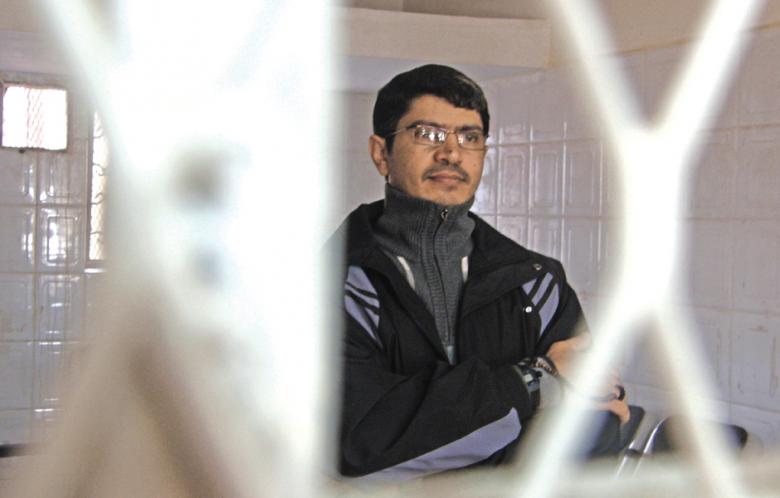
However it is Yemeni journalist Abdulelah Haider Shaye who is suffering the most for exposing the drone wars.
In 2010 Shaye revealed that an airstrike that took place in al Majala, Yemen in December 2009 killing 14 women and 21 children was launched by US drones, not the Yemeni air force, thus embarrassing both the Yemeni and US authorities. Later, Shaye also interviewed AQAP leaders including Anwar Al-Awlaki challenging them about their methods.
In August 2010, Shaye was kidnapped from his house by Yemeni security forces and disappeared for a month. He turned up in detention after being beaten and was sentenced to five years imprisonment for associating with terrorists. Amnesty International and other human rights groups have campaigned for his release, and it looked as though in February 2012 he was about to be freed. However a few days before Ali Abdullah Saleh, was forced to step down as President, Obama called him to “express concern” at the news that Shaye was about to be pardoned. Shaye release was immediately halted and he remains in prison.
Related articles
- Why Is President Obama keeping a journalist in prison in Yemen? (truthaholics.wordpress.com)
- Obama’s personal role in a journalist’s imprisonment (federaljack.com)
- Obama and Shaye: Will the White House Explain its Actions? (motherjones.com)
- Is Barack Obama a Murderous Sociopath? (motherjones.com)
- Pakistani Lawyer Representing Victims of Drone Strikes Prevented From Speaking in U.S. (alethonews.wordpress.com)
- Cluster Bombs: Still Legal, Still Lethal (conflictofconscience.wordpress.com)
‘External forces hampering truce in Syria’ – Lavrov
RT | April 17, 2012
The truce in Syria is still very fragile and all the influential parties on either side of the conflict should be guided by the interests of the Syrian people rather than their own ambitions, says Russian Foreign Minister Sergey Lavrov.
“Indeed, there are forces which are interested in the failure of the Kofi Annan plan, they were saying that even before the plan was released,” Lavrov stated on Tuesday. “And they are doing their best to make their wish come true through arms deliveries to opposition forces and by encouraging militants’ activities.”
This leads to retaliation measures from the government Lavrov added, “so that things are not going smoothly” for now.
Kofi Annan’s peace plan implies a ceasefire under the control of the United Nations, providing humanitarian aid to the victims of the conflict and starting dialogue between the conflicting sides. The proposal was unanimously adopted by the Security Council on March 21.
The Russian Foreign Minister also said that “some countries, some external forces are not interested in the success of the current peaceful efforts of the Security Council.”
These forces he went on to say are trying to substitute the Security Council with various unofficial formats and are using all tools to convince the Syrian opposition no to cooperate with the government.
Lavrov called this stance “counterproductive” and “regrettable”.
Related articles
- Syria and the Annan Plan: The Devil in the Details (alethonews.wordpress.com)
Air France accused of racism after banning non-Jew from flight
Al Akhbar | April 17, 2012
French activists participating in the Welcome to Palestine campaign over the weekend accused Air France of racism on Tuesday after the airline asked passengers if they were Jewish as part of a strategy to prevent the activists from boarding.
“The racism of Israel and Air France was brought in plain light on Sunday…It was proven that one had to declare themselves Jewish or holder of an Israeli passport to have the right to travel,” the French contingent of Welcome to Palestine 2012 said in a press release on their website.
The activists noted the case of a passenger named as Horia, who had successfully boarded the plane, but was then asked by an air hostess whether she was Jewish before the flight had taken off.
An Air France employee signed Horia’s response on an official document (see below), and was then allegedly told by Air France personnel that she was prohibited to travel to Tel Aviv, according to activists.
Coordinator for the French chapter of Welcome to Palestine 2012, Maximilien Shahshahani, told Al-Akhbar that Air France was colluding with Israel’s secret service, Shin Bet, in determining which activists were not permitted to board Sunday’s flight to Tel Aviv.
“Shin Bit shared a blacklist of names with Air France, but told the airline to double check [others not blacklisted] with a series of questions,” he said.
The questions were also asked of other passengers, Shahshahani said, who were not participating in the Welcome to Palestine campaign.
“We saw another passenger, to which the same questions were asked. The response to the second question was that they were Jewish. The passenger was extremely shocked by the nature of the questions,” he said.
Air France in a statement issued on its website said Israeli authorities demanded that the airline question one of the passengers, without detailing what kind of questions were asked.
“The Israeli authorities requested that one of the passengers be questioned. The answers did not satisfy the Israeli authorities, the passenger had to disembark the flight at their demand,” Air France said.
Hundreds of activists, mostly from Europe, were due to fly into Tel Aviv international airport on Sunday as part of a global campaign to raise awareness of the restriction of movement and travel for Palestinians brought by Israel’s military occupation.
But, as in 2011, Israel threatened airlines that they faced sanctions if they did not prevent activists from boarding their flights, providing them with a list of names.
“You are ordered not to board them [activists] on your flights to Israel. Failure to comply with this directive will result in sanctions against the airlines,” a stern statement from Israel’s Ministry of Interior to airlines, obtained by activists, read.
Dozens still managed to board flights to Israel, with the official website for the French contingent of Welcome to Palestine saying that 40 French activists were detained upon arrival.
Preparations for legal proceedings against Air France are underway, Shahshahani said.
Welcome to Palestine has become an annual campaign, which is part of a growing international movement to highlight the continued suffering of Palestinians living under Israeli occupation and Israel’s apartheid policies.

An alleged Air France document showing questions asked of a passenger boarding a flight to Israel on Sunday 15 April 2012. (Photo: Handout – Welcome to Palestine 2012)
Related articles
- Israel and Air France racism overt (altahrir.wordpress.com)
- Europe’s airlines enforce Israeli travel ban on activists hoping to repair Palestinian schools (altahrir.wordpress.com)
- ‘Flytilla’ for Palestine hit by arrests as Israel clamps down (alethonews.wordpress.com)
1,600 Palestinian prisoners begin open-ended hunger strike in Israeli jails
Press TV – April 17, 2012
About 1,600 Palestinian prisoners have begun an open-ended hunger strike in the Israeli jails across the occupied territories to protest imprisonment without charge and solitary confinement exercised by the Tel Aviv regime.
Palestinian prisoners began the hunger strike on Tuesday, April 17, which marks Palestinian Prisoners Day.
Meanwhile, thousands of people held demonstrations in towns and cities across the occupied West Bank and the Gaza Strip on Tuesday to express solidarity with the prisoners.
Qadura Fares, head of the Palestinian Prisoners Club, said, “We are united and undivided when it comes to prisoners, and we will stand by them until they get their demands.”
Fares made the remark in an address to a gathering in the northern West Bank city of Nablus on Tuesday.
In addition to the West Bank, about 2,000 people marched to the headquarters of the Red Cross in Gaza City and set up a tent in solidarity with the Palestinian hunger strikers.
The hunger strike in Israeli jails has begun as reports say the Tel Aviv regime is expected to release Palestinian prisoner Khader Adnan, who went on a hunger strike for 66 days in protest at being held without charge under an administrative detention order.
Adnan’s lawyer said the Palestinian inmate will be released later on Tuesday but it has not been clear exactly when or where he is scheduled to be freed.
The administrative detention, often implemented by the Israeli regime against the Palestinian population, is a sort of imprisonment without trial or charge, allowing regime forces to make arrests without formal charges for up to six months. However, the detention order can be renewed for indefinite periods of time.
According to an April 1, 2012 report published by the non-governmental Palestinian prisoner support and human rights association, Addameer, at least 4,610 “political” Palestinian prisoners are held in Israeli jails.
Related articles
- 1600 Detainees To Declare Hunger-Strike on April 17 (alethonews.wordpress.com)
France refuses to give Press TV team visas; no explanation offered
Press TV – April 16, 2012
The French Embassy in Tehran has refused to issue visas for a Press TV team that wanted to participate in the annual MIPTV and MIPDOC film festivals in Cannes, France, Press TV reports.
The Press TV team completed the application procedure on February 15 and was told by the visa section of French Embassy in Tehran that the initial response would come on March 7, 2012.
The embassy, however, gave no clear answer to the application until April 9 when a French Embassy employee contacted Press TV to announce that visa requests for the team had been rejected. No clear explanation was given for the rejection.
Press TV officials also wrote a letter to French Ambassador to Tehran Bruno Foucher asking him to provide them with a proper explanation. The French embassy, however, gave no answer to the letter.
MIPDOC and MIPTV festivals are purely cultural events which were held in the southern French port city of Cannes from March 30 to April 4, 2012.
Press TV has been regularly participating in both festivals since 2008.
In addition to Press TV crews, eyewitnesses said, it has become a habit for the French embassy to refrain from issuing visas to Iranian university professors and even physicians who want to participate in scientific events in France.
Experts believe that the measure is a clear sign that the incumbent French government is not willing to continue cultural and media cooperation with Iran.
This is not the first time that a major member of the European Union has taken hostile positions on Press TV and its staff.
In late January, the British Office of Communications (Ofcom) took a questionable measure and without offering a valid response to the Press TV CEO’s letters, revoked the channel’s broadcasting license and finally removed it from the Sky platform. Before revoking Press TV license, Ofcom had hit Press TV with a fine of 100 thousand pounds.
The British media regulator stepped up pressure on Press TV after the news channel covered British police crackdowns on anti-austerity protesters in London and other British cities.
Also, on April 3, under pressure from the German government, Munich media regulatory office (BLM) made an illegal decision to remove Press TV from the SES Astra satellite platform.
Vice President of the SES Platforms Services Stephane Goebel wrote in an e-mail to the Islamic Republic of Iran Broadcasting officials that the BLM had asked Press TV be immediately removed from the platform claiming that the channel did not have a license for broadcast in Europe.
Experts believe that such moves are clearly part of a scheme orchestrated by the West to silence the voice of the Iranian English-language channel.
Related articles
- US, Israeli cyber attack on Press TV fails (disclose.tv)
- UK threatens to confiscate Press TV property in London (1oneday.wordpress.com)
The Disturbing Privacy Dangers in CISPA
By Trevor Timm | EFF | April 15, 2012
This week, EFF – along with a host of other civil liberties groups – are protesting the dangerous new cybersecurity bill known as CISPA that will be voted on in the House on April 23. Here is everything you need to know about the bill and why we are protesting:
What is “CISPA”?
CISPA stands for The Cyber Intelligence Sharing and Protection Act, a cybersecurity bill written by Rep. Mike Rogers (R-MI) and Dutch Ruppersberger (D-MD) (H.R. 3523). The bill purports to allow companies and the federal government to share information to prevent or defend from cyberattacks. However, the bill expressly authorizes monitoring of our private communications, and is written so broadly that it allows companies to hand over large swaths of personal information to the government with no judicial oversight—effectively creating a “cybersecurity” loophole in all existing privacy laws. Because the bill is so hotly debated now, unofficial proposed amendments are also being circulated [link] and the actual bill language is in flux.
Under CISPA, can a private company read my emails?
Yes. Under CISPA, any company can “use cybersecurity systems to identify and obtain cyber threat information to protect the rights and property” of the company. This phrase is being interpreted to mean monitoring your communications—including the contents of email or private messages on Facebook.
Right now, well-established laws, like the Wiretap Act and the Electronic Communications Privacy Act, prevent companies from routinely monitoring your private communications. Communications service providers may only engage in reasonable monitoring that balances the providers’ needs to protect their rights and property with their subscribers’ right to privacy in their communications. And these laws expressly allow lawsuits against companies that go too far. CISPA destroys these protections by declaring that any provision in CISPA is effective “notwithstanding any other law” and by creating a broad immunity for companies against both civil and criminal liability. This means companies can bypass all existing laws, as long as they claim a vague “cybersecurity” purpose.
What would allow a company to read my emails?
CISPA has such an expansive definition of “cybersecurity threat information” that many ordinary activities could qualify. CISPA is not specific, but similar definitions in two Senate bills provide clues as to what these activities could be. Basic privacy practices that EFF recommends—like using an anonymizing service like Tor or even encrypting your emails—could be considered an indicator of a “threat” under the Senate bills. As we have stated previously, the bills’ definitions “implicate far more than what security experts would reasonably consider to be cybersecurity threat indicators—things like port scans, DDoS traffic, and the like.”
A more detailed explanation about what could constitute a “cybersecurity purpose” or “cyber security threat indicator” in the various cybersecurity bills can be read here.
Under CISPA, can a company hand my communications over to the government without a warrant?
Yes. After collecting your communications, companies can then voluntarily hand them over to the government with no warrant or judicial oversight whatsoever as long is the communications have what the companies interpret to be “cyber threat information” in them. Once the government has your communications, they can read them too.
Under CISPA, what can I do if a company improperly hands over private information to the government?
Almost nothing. CISPA would affirmatively prevent users from suing a company if they hand over their private information to the government in virtually all cases. A broad immunity provision in the proposed amendments gives companies complete protection from user lawsuits unless information was given to the government:
(I) intentionally to achieve a wrongful purpose;
(II) knowingly without legal or factual justification; and
(III) in disregard of a known or obvious risk that is so great as to make it highly probably that the harm of the act or omission will outweigh the benefit.
As Techdirt concluded, “no matter how you slice it, this is an insanely onerous definition of willful misconduct that makes it essentially impossible to ever sue a company for wrongly sharing data under CISPA.” This proposed immunity provision is actually worse than the prior version of the bill, under which companies could be sued if they acted in “bad faith.”
What government agencies can look at my private information?
Under CISPA, companies are directed to hand “cyber threat information” to the Department of Homeland Security (DHS). Once it’s in DHS’s hands, the bill says that DHS can then hand the information to other intelligence agencies, including the National Security Agency, at its discretion.
Can the government use my private information for other purposes besides “cybersecurity” once they have it?
Yes. When the bill was originally drafted, information could be used for all other law enforcement purposes besides “regulatory purposes.” A new amendment narrows this slightly. Now—even though the information was passed along to the government for only cybersecurity purposes—the government can use your personal information for either cybersecurity or national security investigations. And as long as it can be used for one of those purposes, it can be used for any other purpose as well.
Can the government use my private information to go after alleged copyright infringers and whistleblower websites?
Up until last Friday the answer was yes, and now it’s changed to maybe. In response to the overwhelming protest from the Internet community that this bill would become a backdoor for SOPA 2, the bill authors have proposed an amendment that rids the bill of any reference to “intellectual property.”
The bill previously defined “cyber threat intelligence” and “cybersecurity purpose” to include “theft or misappropriation of private or government information, intellectual property, or personally identifiable information.” Now the text reads:
(B) efforts to gain unauthorized access to a system or network, including efforts to gain such unauthorized access to steal or misappropriate private or government information
But it is important to remember that this proposed amendment is just that: proposed. The House has not voted it into the bill yet, so they still must follow through and remove it completely.
A more detailed explanation of how this provision could be used for copyright enforcement and censoring whistleblower sites like WikiLeaks can be read here.
What can I do to stop the government from misusing my private information?
CISPA does allow users to sue the government if they intentionally or willfully use their information for purposes other than what is described above. But any such lawsuit will be difficult to bring. For instance, the statute of limitations for such a lawsuit is two years from the date of the actual violation. It’s not at all clear how an individual would know of such misuse if it were kept inside the government.
Moreover, suing the government where classified information or the “state secrets privilege” is involved is difficult, expensive, and time consuming. EFF has been involved for years in a lawsuit over Fourth Amendment and statutory violations stemming from the warrantless wiretapping program run by the NSA—a likely recipient of “cyber threat information.” Despite six years of litigation, the government continues to maintain that the “state secrets” privilege prevents the lawsuit from being heard.
Given that DHS is notorious for classifying everything—even including their budget and number of employees—they may attempt to prevent users from finding out exactly how this information was ever used. And if the information is in the hands of the NSA and they claim “national security,” then it would get even harder.
In addition, while CISPA does mandate an Inspector General should issue a report to Congress over the government’s use of this information, its recommendations or remedies do not have to be followed.
Why are Facebook and other companies supporting this legislation?
Facebook and other companies have endorsed this legislation because they want to be able to receive information about network security threats from the government. This is a fine goal, but unfortunately CISPA would do far more than that—it would eviscerate existing privacy laws by allowing companies to voluntarily share users’ private information with the government.
Facebook released a statement Friday saying that they are concerned about users’ privacy rights and that the provision allowing them to hand user information to the government “is unrelated to the things we liked about HR 3523 in the first place.” As we explained in our analysis of Facebook’s response: the “stated goal of Facebook—namely, for companies to receive data about cybersecurity threats from the government—does not necessitate any of the CISPA provisions that allow companies to routinely monitor private communications and share personal user data gleaned from those communications with the government.” Read more about why Facebook should withdraw support from CISPA until privacy safeguards are in place here.
What can I do to stop this bill?
It’s vital that concerned Internet users tell Congress to stop this bill. Use EFF’s action center to send an email to your Congress member urging them to oppose this bill.
Related articles
- Worse than SOPA? CISPA to censor Web in name of cybersecurity (alethonews.wordpress.com)
- Facebook defends CISPA support, completely misses the point (digitaltrends.com)
- What You Need to Know About CISPA (readwriteweb.com)
- What Facebook Wants in Cybersecurity Doesn’t Require Trampling On Our Privacy Rights (eff.org)
- Say ‘hello’ to CISPA, it will remind you of SOPA (news.cnet.com)
Argentina to nationalize Spanish owned oil firm
Press TV – April 16, 2012
The Argentine government says it will present a bill to the country’s senate for the nationalization of the YPF oil company which is owned by Spanish firm Repsol.
Argentine President Cristina Fernandez said on Monday that the bill would allow the government to expropriate 51 percent of YPF shares, while the country’s oil producing provinces would get 49 percent.
“This president is not going to answer any threat, is not going to respond to any sharp remark, is not going to echo the disrespectful or insolent things said,” Fernandez said.
YPF has been under heavy pressure from the Argentine government over the past two months for not investing enough in the country’s oil fields.
The move has already been criticized by the Spanish government. Spanish officials say Argentina risks becoming “an international pariah” if it takes control of the YPF, in which Repsol has a 57.4 percent stake.
Spain is Argentina’s largest foreign investor and YPF is Argentina’s biggest oil company.
Related articles
- Repsol YPF ups Argentine shale deposit potential (seattletimes.nwsource.com)
Israeli military court sentences Palestinian journalist
Palestine Information Center – 16/04/2012
 RAMALLAH — The Israeli military court in Ofer passed a four-month imprisonment term against Suhaib Al-Asa, 26, along with 3000 shekels fine.
Aziz, the father of Suhaib Asa, said that the sentence falls in line with the Israeli occupation authority’s constant attacks on the Palestinian people and journalists.
He said that the sentence also reflects the IOA fears of a free press that defends Palestinian rights.
Israeli occupation forces stormed the home of Asa, who works with Bethlehem 2000 radio station and a correspondent for a website, in Obaidiya to the east of Bethlehem on 5 February and took him away after searching his home and confiscating personal computers.
Related articles
- Detained journalist boycotts Israeli military court (alethonews.wordpress.com)
Featured Video

Meet The Ellisons: Zionists, Technocrats, Moguls
or go to
Aletho News Archives – Video-Images
Frlom the Archives
Who Rules America?
The Power Elite in the Time of Trump
By James Petras | Axis of Logic | September 6, 2017
Introduction
In the last few months, several competing political, economic and military sectors – linked to distinct ideological and ethnic groups – have clearly emerged at the centers of power.
We can identify some of the key competing and interlocking directorates of the power elite:
- Free marketers, with the ubiquitous presence of the ‘Israel First’ crowd.
- National capitalists, linked to rightwing ideologues.
- Generals, linked to the national security and the Pentagon apparatus, as well as defense industry.
- Business elites, linked to global capital.
This essay attempts to define the power wielders and evaluate their range of power and its impact. … continue
Blog Roll
 Aletho News
- Iran Does Not Consider Israel Party to Talks to Need Mediators With It – Ambassador
- Macron’s aircraft carrier and warplanes to the Persian Gulf is a dangerous vanity project
- Meet The Ellisons: Zionists, Technocrats, Moguls
- US failures in Iran reveal Russia is key to South Korea’s strategic security
- ‘All ports in Persian Gulf will be legitimate targets if Iranian ports are attacked’
- 40 Years of Endless War, Data Point by Data Point
- Department of War Using Palantir AI to Pick Targets in Iran
- American bases do not protect – they attack the peoples of the Persian Gulf
- ‘We’ve Obliterated Their Missiles’
- Syrian president vows ‘absolute support’ to disarm Hezbollah
- If Americans Knew
- Israeli strategic plans to “remake the Middle East” from the 1950s and since
- Honoring Gaza’s women who refused to let the world look away
- 97% of victims of war on Iran are Iranian, 98% of victims in war on Gaza are Gazans – Not a ceasefire Day 152
- Early Iran strikes cost $5.6 billion in munitions, Pentagon estimates
- Israel Decided the War, But Trump’s America Fights and Pays the Bill
- Conscientious Objector Group: Phone ‘Ringing Off Hook’ As Huge Mobilization Underway
- U.S. support for Israel continues to plummet, despite media’s best efforts
- Threats and missiles fly, death tolls soar in Iran, Lebanon, Gaza – Not a ceasefire Day 151
- Lebanon: Israel’s White Phosphorous Use Risks Civilian Harm
- Corporate Media Go All Out To Support The US-Israeli War On Iran
- No Tricks Zone
- Destructive Green New Deal: German Energy And Metal Group Warns Of Drastic Crisis
- New Study Documents A 20-Year Pause In Arctic Sea Ice Decline – Driven By Internal Variability
- Wake-up Call: Survey Shows Majority Of Germans Now Favor Postponing Climate Targets!
- Televised! Leading German Political Candidate Tells Schoolchildren CO2 Makes Sun Hotter!
- New Study: A Century Warming Of 1.1°C Is ‘Commonplace’ And ‘Not Unusual’ During This Interglacial
- New Study: ‘Internal Noise’ And Volcanic Forcing Can Trigger 10-15°C Warming Within Decades
- Glaciers Worldwide Are Suddendly Surging, Experts Blame Warming!
- Surprising Discovery: Sahara Is Greening…Billions Of Trees Where Once Thought To Be Barren
- New Research Reaffirms Clouds, Aerosols, And Surface Solar Radiation Are ‘Driving The Climate System’
- Germany: Electric Car Catches Fire At Charging Station, Sets Off Local “Inferno”, Widespread Damage
 Aletho News