Occupied Lives: I have no future
Palestine Center for Human Rights | August 8, 2012

Ahmad Dalloul in front of his destroyed factory in Tel-el-hawa
Mamoun Ahmad Dalloul (36) lives in Tel-el-hawa with his wife and 9 children. Until recently, he owned a dairy-products factory that produced milk, cheese and yoghurt. Since December 2008, Mamoun has re-built his factory 4 times after it was repeatedly targeted and destroyed by Israel’s forces. On 04 June 2012, at around 1:00, his factory was targeted and destroyed by Israel’s forces for the 5th time.
On the evening of the most recent attack, Mamoun received a call from his brother, who lives adjacent to the factory, informing him that the factory had been destroyed by a missile from an F16: “I rushed to my factory and, when I arrived, there were firefighters and police. The neighbors were panicking and standing in the streets. I was told that a missile had hit the factory and then penetrated 6 or 7 meters into the ground. There was something like an earthquake for 5 minutes, and then the missile exploded and pulled everything into the crater. I do not know what kind of missile it was.”
After 5 attacks on his factory, Mamoun is devastated: “The first time my factory was destroyed was in December 2008 during Operation Cast Lead. The factory was very big and on the ground floor of our residential apartment. I received a call from Israel’s forces, who told me that the building would be targeted in the next 15 minutes. My family and I fled immediately. 3 missiles were fired from an F16 and the building was completely destroyed. In just a few minutes, we lost everything. We were suddenly homeless and I had lost my only source of a livelihood.”
Mamoun and his family were forced to shuffle from one household to another, looking for a place to stay: “We would stay at my parents’ house for a few days then move to my brother-in-law’s house and spend a few more at my brother’s house. My son kept asking why we had no home. Finally, as my wife is a refugee, UNRWA built us a single residential unit. I then rebuilt my factory in Sabra, which is in central Gaza City. It was very small and modest because there was barely any construction material in Gaza, as well as money constraints. 6 months later, it was destroyed by Israel’s forces. I then partnered with someone else and tried to rebuild in a different location, but it was destroyed while we were still constructing.”

A crater made by the missile fired from an F16 on 04 June 2012
At this point, Mamoun had given up and decided to not rebuild his factory: “The first 2 times, I rebuilt because this is my only source of a livelihood. There are hardly any employment opportunities in Gaza. My factory provided work for 120 individuals, including my 3 brothers and my son. I saw how they were all suffering without work and thought that the factory would at least provide them with the income to support themselves and their families. I had enough after the 3rd attack, but a representative of the European Commission came to visit from Jerusalem and said they would mediate on my behalf. They promised that the factory would not be targeted again. Each time I bought new machines, they came and took pictures and reassured me all was well. I was encouraged by this and started to develop the factory slowly. Then, just like that, it was targeted and destroyed again. They did not keep their promise.”
Each attack has resulted in severe economic hardship for Mamoun and his family: “I have had to borrow money and my savings are almost depleted. I sold 2 pieces of my land to rebuild my factory. I even sold the house that UNRWA gave us to set up the factory and have a source of income. I can no longer sustain the expenses for my family. For a while, people would not even let me rent an apartment in their buildings, because they thought it would be targeted.”
Mamoun feels that his story is one of many that illustrate the suffering of Gaza: “There are people who are displaced and dying. I know what it feels like to be homeless. My children have had to grow up seeing dead people, war and destruction. They no longer even react to airstrikes, because this is what they are used to. My factory was a civilian establishment and I did not plan any resistance activities there. Why would I want to put my family in such danger? I am tired of this destruction. I have no future now. Why can’t we be left to live in peace and stability like other people in the world?”
The direct targeting of a civilian object constitutes a war crime, as codified in Article 8(2)(b)(ii) of the Rome Statute of the International Criminal Court. Similarly, under the Fourth Geneva Convention Article 53, the destruction of private property is prohibited unless rendered absolutely necessary by military operations. The destruction of such factories infringes upon human rights principles, including the right to work and right to attain an adequate standard of living contained in Article 11 of the International Covenant on Economic, Social and Cultural Rights.
Related articles
- Owner of dairy factory hit by Israel urges world action (alethonews.wordpress.com)
- Israel Destroys EU Development Projects Worth €29 Million (altahrir.wordpress.com)
Stuxnet, Flame… Gauss: New spy virus found in Middle East
RT | August 9, 2012
A new virus dubbed Gauss has attacked computers in the Middle East spying on financial transactions, emails and picking passwords to all kind of pages. The virus resembles Stuxnet and Flame malware which was used to target Iran, Kaspersky Lab says.
Gauss has infected hundreds of personal computers across the Middle East – most of them in Lebanon, but also in Israel and Palestinian territories. Kaspersky Lab has classified the virus, named after one of its major components, as “a cyber-espionage toolkit”.
The malicious malware spies on transactions in banking systems and steals passwords and credentials to social networks, emails and instant messaging accounts. It can also collect system configurations.
Though Gauss seems to be specifically designed for several Lebanese online banking systems, it can also go after Citibank and PayPal users.
It is not immediately clear who may be behind the new Trojan virus, but Kaspersky Lab says the “nation-state sponsored” toolkit has features characteristic of Flame, DuQu and Stuxnet malware, which targeted machines in Iran.
“After looking at Stuxnet, DuQu and Flame, we can say with a high degree of certainty that Gauss comes from the same ‘factory’ or ‘factories,‘” Kaspersky Lab said in their report on Thursday. “All these attack toolkits represent the high end of nation-state-sponsored cyber-espionage and cyber war operations.”
The researchers cannot say whether Gauss was meant to simply spy on account transactions, or to steal money from targets. But given the high probability of a nation-state actor behind it, the virus may be a counterintelligence tool, which could be used to trace funding of various groups or individuals.

Gauss has attacked over 2,500 personal computers in the Middle East. Only one attack has so far been reported in Iran (image from http://www.securelist.com)
The virus is yet to be fully exposed, as the Moscow-based internet security company is still trying to crack its payload, a section that sends and receives instructions from an outside source once it has infiltrated a system. The company is asking for assistance from any cryptographers since the payload is highly encrypted and its purposes remain unclear.
The virus was first spotted in June this year while Kaspersky Lab was looking for variants of Flame. Gauss appears to have been most active from May to July 2012, until its control and command infrastructure stopped functioning. Now the virus is in a dormant state.
Still, the malware, apparently created back in 2011, managed to spread much farther than Flame, which attacked around 700 PCs across the Middle East this spring.
Flame and Stuxnet are widely speculated to have been ordered by the US and Israel to hit Iran’s nuclear program. Western officials gave a tentative confirmation the CIA, the National Security Agency and the Israeli military were all involved in developing the Flame spying toolkit.
As for the Stuxnet attack, which in 2010 damaged uranium enrichment centrifuges in Iran, Washington has so far declined to comment on if it was behind the sabotage.
Now Gauss, which shares parts of its code with Flame, appears to add to the US and Israel’s presumed cyber arsenals.
National disaster: Millions of children prescribed antipsychotic drugs they don’t need
RT | August 8, 2012
Are doctors going crazy? US psychiatrists prescribe antipsychotic drugs to children in one third of all visits, which is a rate almost three times higher than during the 1990’s.
Roughly 90 percent of antipsychotic prescriptions written between 2005 and 2009 were prescribed for something other than what the US Food and Drug Administration approves them for.
Researchers say the increase in antipsychotic drug prescription is largely to treat disruptive behaviors, including attention deficit and hyperactivity disorder (ADHD) – even though those disorders are not treatable by antipsychotics.
Medications such as Abilify and Risperdal, which are used primarily to treat patients with schizophrenia, are increasingly being prescribed “off label” to control youngsters with ADHD who have problems controlling their behavior.
“Only a small proportion of antipsychotic treatment of children (6 percent) and adolescents (13 percent) is for FDA-approved clinical indications,” said Dr. Mark Olfson, a professor of clinical psychiatry at Columbia University, in an interview with Reuters.
Children with ADHD are most often taking drugs approved for schizophrenia, bipolar disorder and irritability with autism.
“People from all walks of life are taking medications for mental-health conditions,” psychiatrist David Muzina told the Wall Street Journal.
In 2010, Americans spent $16.1 billion on antipsychotic drugs meant to treat bipolar disorder, schizophrenia and depression.
But whether they are effective or not, the drugs have been known to cause other health problems, such as diabetes, high cholesterol, muscular tics and weight gain. A University of Massachusetts study found that kids taking antipsychotics were four times more likely to develop diabetes.
Between 1993 and 2008, 31 children died from taking Risperdal and more than 1,200 suffered serious health problems.
“We have a national catastrophe,” Dr. Peter Breggin told US News & World Report. “This is a situation where we have ruined the brains of millions of children.”
But in many cases, antipsychotic drug prescriptions are not even necessary to treat behavioral disorders. There are psychosocial interventions, such as parent management training, that are able to reduce aggressive and disruptive behaviors in kids, Olfson said.
Instead of taking the time and money to gradually reduce their children’s behavioral problems, parents are opting for antipsychotic medications for an instant fix.
Drugged from a young age onward, many American children will grow up dependent on serious antipsychotic drugs they had no need for.
Related articles
- More Children Being Prescribed – Quote “Lobotomizing” Antipsychotics Than Adults Now. (engineeringevil.com)
- Antipsychotics Aren’t Helpful to Children (madinamerica.com)
- Antipsychotics for ADHD Skyrocket (madinamerica.com)
Iran Conference: Setting the Stage for Dialogue in Syria
By Elie Chalhoub | Al Akhbar | August 9, 2012
A “Consultative Meeting on Syria” in Tehran aims to promote a Syrian political solution and establish a counterweight to the self-styled “Friends of Syria.”
Iran’s position on Syria is unchanged: the crisis can only have a Syrian solution, based on dialogue between the warring parties. It aims to persuade as many countries as possible to support that option, and establish an alternative to the coalition of states complicit in the bloodletting in Syria.
Iran is looking ahead to the aftermath of what it expects to be the Syrian regime’s “victory” in Aleppo. Once that is achieved, Tehran believes, the powers backing the rival sides in Syria will have no alternative but to negotiate.
Turkey’s position is crucial in this regard, as it would clearly have a major impact if it opted to intervene directly in the battle for Aleppo. This in turn explains the sudden and sharp deterioration in relations between Ankara and Tehran, with the latter threatening to freeze trade with the former.
The Iranians have been preparing for today’s “Consultative Meeting on Syria,” hosted by the Foreign Ministry, for around two weeks, according to Iranian sources. Their contacts focused on states that are “not directly complicit” in the Syrian crisis, in addition to Turkey, which was also invited.
The sources said outgoing UN/Arab League envoy Kofi Annan was invited too, in the hope that he could be persuaded not to abandon his mission, but decided, apparently under pressure from various parties, not to attend.
On the eve of the conference, 20 countries were due to send delegates to the gathering, including Russia, China, Turkey, Pakistan and India, and seven Arab states (Iraq, Algeria, Tunisia, Mauritania, Kuwait, the UAE, and Oman). Eight countries were to be represented by their foreign ministers, the others at a less senior level.
Lebanon decided not to take part in line with its policy of non-involvement in Syrian affairs. Iraq was to send high-level delegates other than Foreign Minister Hoshyar Zebari, who “represents the American face of the Iraqi regime,” according to the sources. But Iraqi diplomatic efforts led to an agreement that would have Zebari attend along with the minister of national security. The sources added that many of the countries invited had – like Annan, who initially agreed to attend – come under heavy pressure to stay away, or at least to lower the level of their representation.
The Iranian sources said the principal objective of the conference is to “bring the Syrian opposition and regime together around the negotiating table, with the aim of arriving at a Syrian solution to the crisis in Syria.”
They said Iran had obtained undertakings from “a fair number” of Syrian opposition groups to support such talks, as well as the endorsement of President Bashar al-Assad, who conferred in Damascus earlier this week with the secretary of Iran’s National Security Council, Saeed Jalili.
“We want this conference to be a counter to the Enemies of Syria (Friends of Syria) group, which has been promoting militarization, violence and sectarianism,” they said. “The hope is to persuade the maximum number of states to encourage and take part in an intra-Syrian solution.”
The thinking in Tehran is that the Syrian regime is bound to prevail in the battle of Aleppo, and that “after that, the time will come for negotiations between the forces that wanted to destroy the Syrian state and bring down the regime, and the states that want to make a political solution succeed and find a Syrian way out of the crisis.” Thursday’s conference is part of a process of “preparing the ground for such negotiations.” […]
It is significant that close US allies and supporters of the Syrian rebels – Turkey, Kuwait, Oman, the UAE and Tunisia – were to attend the Tehran conference. “That is the strongest evidence of the opposition front cracking, and of its willingness to enter into a dialogue once the dust has settled on the Battle of Aleppo,” they said. However, it seems that diplomatic pressure succeeded in the end in keeping Kuwait and UAE from participating. … Full article
US: NRC HALTS NUCLEAR REACTOR LICENSING DECISIONS
Decision Follows 24 Groups’ June Petition in Wake of Major Waste Confidence Rule Decision; Most Reactor Projects Already Stymied by Bad Economics and Cheaper Fuel Alternatives
SACE – August 7, 2012
WASHINGTON, D.C. – The U.S. Nuclear Regulatory Commission (NRC) acted today to put a hold on at least 19 final reactor licensing decisions – nine construction & operating licenses (COLS), eight license renewals, one operating license, and one early site permit – in response to the landmark Waste Confidence Rule decision of June 8th by the U.S. Court of Appeals for the D.C. Circuit.
The NRC action was sought in a June 18, 2012 petition filed by 24 groups urging the NRC to respond to the court ruling by freezing final licensing decisions until it has completed a rulemaking action on the environmental impacts of highly radioactive nuclear waste in the form of spent, or ‘used’, reactor fuel storage and disposal.
In hailing the NRC action, the groups also noted that most of the U.S. reactor projects were already essentially sidetracked by the huge problems facing the nuclear industry, including an inability to control runaway costs, and the availability of far less expensive energy alternatives.
Diane Curran, an attorney representing some of the groups in the Court of Appeals case, said:
“This Commission decision halts all final licensing decisions — but not the licensing proceedings themselves — until NRC completes a thorough study of the environmental impacts of storing and disposing of spent nuclear fuel. That study should have been done years ago, but NRC just kept kicking the can down the road. When the Federal Appeals Court ordered NRC to stop and consider the impacts of generating spent nuclear fuel for which it has found no safe means of disposal, the agency could choose to appeal the decision by August 22nd or choose to do the serious work of analyzing the environmental impacts over the next few years. With today’s Commission decision, we are hopeful that the agency will undertake the serious work.”
Stephen Smith, executive director of Southern Alliance for Clean Energy, petitioner to the Court, said:
“We’re pleased with the Nuclear Regulatory Commission’s ruling; it is long overdue. Nuclear power is not a clean generating source when it creates long-lived radioactive and toxic waste that has no long-term safe disposal technology in place. We believe it is appropriate to halt nuclear licensing decisions and stop creating an inter-generational debt of nuclear waste that will burden our children and grandchildren for centuries to come.”
Lou Zeller, executive director of Blue Ridge Environmental Defense League, another petitioner to the Court, said:
“It appears that the Commissioners have, at least initially, grasped the magnitude of the Court’s ruling and we are optimistic that it will set up a fundamentally transparent, fair process under the National Environmental Policy Act to examine the serious environmental impacts of spent nuclear fuel storage and disposal prior to licensing or relicensing nuclear reactors.”
Former NRC Commissioner Peter Bradford said:
“It is important to recognize that the reactors awaiting construction licenses weren’t going to be built anytime soon even without the Court decision or today’s NRC action. Falling demand, cheaper alternatives and runaway nuclear costs had doomed their near term prospects well before the recent Court decision. Important though the Court decision is in modifying the NRC’s historic push-the-power-plants-but-postpone-the-problems approach to generic safety and environmental issues, it cannot be blamed for ongoing descent into fiasco of the bubble once known as ‘the nuclear renaissance’.”
In June, the following groups filed the petition with the NRC:
• Beyond Nuclear, Inc. (intervenor in Fermi COL proceeding, Calvert Cliffs COL proceeding, and Davis-Besse license renewal proceeding; potential intervenor in Grand Gulf COL and Grand Gulf license renewal proceedings);
• Blue Ridge Environmental Defense League, Inc. and chapters (“BREDL”) (intervenor in Bellefonte COL proceeding and North Anna COL proceeding; previously sought intervention in W.S. Lee COL proceeding);
• Citizens Allied for Safe Energy, Inc. (former intervenor in Turkey Point COL proceeding);
• Citizens Environmental Alliance of Southwestern Ontario, Inc. (intervenor in Fermi COL proceeding and Davis-Besse license renewal proceeding);
• Citizens for Alternatives to Chemical Contamination (intervenor in Fermi COL proceeding);
• Don’t Waste Michigan, Inc. (intervenor in Fermi COL proceeding and Davis-Besse license renewal proceeding);
• Ecology Party of Florida (intervenor in Levy COL proceeding);
• Eric Epstein (potential intervenor in Bell Bend COL proceeding);
• Friends of the Earth, Inc. (potential intervenor in reactor licensing proceedings throughout U.S.);
• Friends of the Coast, Inc. (intervenor in Seabrook license renewal proceeding);
• Green Party of Ohio (intervenor in Davis-Besse license renewal proceeding);
• Dan Kipnis (intervenor in Turkey Point proceeding);
• National Parks Conservation Association, Inc. (intervenor in Turkey Point COL proceeding);
• Mark Oncavage (intervenor in Turkey Point COL proceeding);
• Missouri Coalition for the Environment, Inc. (Petitioner in Callaway license renewal proceeding; intervenor in suspended Callaway COL proceeding)
• New England Coalition, Inc. (intervenor in Seabrook license renewal proceeding);
• North Carolina Waste Reduction and Awareness Network, Inc. (admitted as an Intervenor in now-closed Shearon Harris COL proceeding);
• Nuclear Information and Resource Service, Inc. (intervenor in Calvert Cliffs COL proceeding and Levy COL proceeding);
• Public Citizen, Inc. (intervenor in South Texas COL proceeding; admitted as intervenor in now-closed Comanche Peak COL proceeding; potential intervenor in South Texas license renewal proceeding);
• San Luis Obispo Mothers for Peace, Inc. (intervenor in Diablo Canyon license renewal proceeding);
• Sierra Club, Inc. (Michigan Chapter) (intervenor in Fermi COL proceeding);
• Southern Alliance for Clean Energy, Inc. (intervenor in Watts Bar Unit 2 OL proceeding, Turkey Point COL proceeding, Bellefonte COL proceeding; former intervenor in Bellefonte CP proceeding);
• Southern Maryland CARES, Inc. (Citizens Alliance for Renewable Energy Solutions) (intervenor in Calvert Cliffs COL proceeding);
• Sustainable Energy and Economic Development (“SEED”) Coalition, Inc. (intervenor in South Texas COL proceeding; admitted as intervenor in now-closed Comanche Peak COL proceeding; potential intervenor in South Texas license renewal proceeding).
The 24 groups that sponsored the June 18th petition will strategize in September regarding next steps.
On June 8th, the Court threw out the NRC rule that permitted licensing and re-licensing of nuclear reactors based on the supposition that (a) the NRC will find a way to dispose of spent reactor fuel to be generated by reactors at some time in the future when it becomes “necessary” and (b) in the mean time, spent fuel can be stored safely at reactor sites.
The Court noted that, after decades of failure to site a repository, including twenty years of working on the now-abandoned Yucca Mountain repository, the NRC “has no long-term plan other than hoping for a geologic repository.” Therefore it is possible that spent fuel will be stored at reactor sites “on a permanent basis.” Under the circumstances, the NRC must examine the environmental consequences of failing to establish a repository when one is needed.
The Court also rejected NRC’s decision minimizing the risks of leaks or fires from spent fuel stored in reactor pools during future storage, because the NRC had not demonstrated that these future impacts would be insignificant. The Court found that past experience with pool leaks was not an adequate predictor of future experience. It also concluded that the NRC had not shown that catastrophic fires in spent fuel pools were so unlikely that their risks could be ignored.
Contact
Alex Frank, (703) 276-3264 or afrank@hastingsgroup.com
Related articles
- NRC Petitioned To Stop Final Licensing Decisions For Nearly Three Dozen Nuclear Reactors In Wake Of Waste Confidence Ruling (prnewswire.com)
- NRC puts nuclear licensing decisions on hold (miamiherald.com)
- Nuclear Regulatory Commission Puts Callaway Licensing Decisions On Hold (stlouis.cbslocal.com)
- *Just In* U.S. Freezes All Nuclear Reactor Construction & Operating Licenses (enenews.com)
- Waste Issue Halts U.S. Nuclear Reactor Licensing (ipsnews.net)
Orwellian Ramifications Begin to Unfold in Syria
By Ismail Salami | Dissident Voice | August 9th, 2012
There is a horrible speculation that the insurgents in Syria may have seized hold of chemical weapons.
Apart from the catastrophically unthinkable havoc the rebels can wreak in Syria and in the region with the WMDs, the rhetorical question which remains is how these weapons of mass destruction have fallen into the hands of the insurgents who are chiefly composed of Wahhabi al-Qaeda mercenaries of different nationalities including Afghans, Iraqis, Turkish, Yemenis, Jordanians, Pakistanis, and Saudis.
The situation in Syria is assuming Orwellian ramifications and the possibility to clearly understand or dissect the situation in the country is not an easy task.
In addition to the active role the Saudi-backed Wahhabis, CIA and some western intelligence organizations are playing in Syria, there is one entity, namely Israel which is stealthily espying every single development in Syria.
For the first time, an Israeli spy official clearly stated that Israel supports regime change in Syria and that it really demands an end to the government of President Bashar Assad.
“I hope it will happen, even though I don’t know when or how,” Intelligence Agencies Minister Dan Meridor said on Tuesday.
The top spy chief implicated why Assad should go and how it would damage the Islamic Republic of Iran.
“I am not going to try to calculate when Assad’s end will come, but when it happens, Iran’s biggest ally will be gone.”
Taking it for granted that Assad is doomed to go, he said, “I hope the new Syria will understand that joining Iran is a mistake that brings isolation from the Western world.”
Such a feeble perception of the Syrian situation is indicative of one who is either too optimistic or one who is well aware of what is going on behind the scene and that which is not visible to the ordinary people with no intelligence savvy.
Furthermore, Dan Meridor does not seem to understand that the situation in Israel is spiraling out of control with people protesting against social injustice almost on a daily basis. Since last month, four Israelis have set themselves ablaze from an extremity of despair.
On August 5, John McCain and Lindsey O. Graham, both Republicans, who represent Arizona and South Carolina in the Senate, respectively and Joseph I. Lieberman, an independent, who represents Connecticut in the Senate advised the US government to directly and openly provide assistance, including weapons, intelligence and training, to the insurgents in Syria as they claim President’s Assad’s ‘brutality’ is no longer to be tolerated.
“It is not too late for the United States to shift course. First, we can and should directly and openly provide robust assistance to the armed opposition, including weapons, intelligence and training. Whatever the risks of our doing so, they are far outweighed by the risks of continuing to sit on our hands, hoping for the best.”
Another part of this sabotage axis against Syria is Turkey which plays a very treacherous role in snowballing the Syrian crisis. Turkey has supplied the rebels with dozens of man-portable air defense systems (MANPADS).
According to NBC, the missile supplies might have been provided by Turkey, Saudi Kingdom and Qatar monarchy, the three countries which have made strenuous and costly efforts to overthrow the government of Bashar Assad.
In a press conference at the United Nations in New York City, a Syrian UN representative announced that Turkey shipped US-made Stinger anti-aircraft missiles to rebels via Turkey, saying that Turkey was pleased with Kofi Annan’s resignation because Ankara and Washington were initially opposed to his six point peace plan.
In fact, Turkey should be grateful to Syria what it has done for it in the past. It is acknowledged by many pundits that it was Bashar’s father Hafiz Assad who made peace between Turkey and the Kurds living on both sides of the country, thereby vaccinating Turkey for years against any attacks on the part of the Kurds.
The antagonistic policies of Turkey have left President Bashar Assad with no choice but to grant autonomy to the Kurds in Syria who can foment dilemma for the Ankara government and get Prime Minister Tayyip Erdogan into hot water.
The ongoing Kurdish insurgency has reportedly claimed the lives of at least 48,000 over the past two decades.
Prime Minister Recep Tayyip Erdogan is sharply aware of what a deep impact this decision can exercise on the security of Turkey.
He claimed the two groups had built a “structure in northern Syria” that for Turkey means “a structure of terror.”
Turkey is making a tactical mistake by supporting terrorism in Syria and supplying them with weapons, military training and human resources. Turkey will certainly fall into the pitfall it has dug for Syria and the insecurity it envisages for Syria will ultimately recoil against the government itself.
As for Washington and NATO, they are making a selfsame mistake.
The two are fondling terrorism and extremism by throwing support behind the insurgents in Syria. They know that a popular uprising in the true sense of the word is not clearly discernible in Syria and that what has been taking place in Syria is a string of militancy and terrorist operations funded by the Saudis and the Qataris and some western countries who are waiting to reap the benefits of their atrocities in case Bashar Assad’s government collapses. Such a day, if it comes, will open a new chapter of horror in the Middle East with no end in sight.
The unfurling reality is that the hostile states and powers antagonizing Bashar Assad are gradually getting caught up in the labyrinthine Orwellian pitfall of their own folly and that they are consciously or unconsciously working in the best interests of the Zionist regime.
Related articles
- Aleppo rebels crushed (english.ruvr.ru)
Israeli Mayor to Demolish UN Humanitarian Agency Emergency Shelter
By Kelly Joiner | International Middle East Media Center Editorial Group & Agencies | August 09, 2012
Israeli Mayor of occupied Jerusalem, Nir Bakat, approved the demolition of two structures built by the United Nations (UN) as temporary emergency shelter for Palestinian families after Israel demolished their homes.
Israel strongly condemned the erection of the emergency shelters in the East Jerusalem neighborhood of Beit Hanina. Israel accused the UN of overstepping its bounds and asserted that the trailer homes are illegal and should be demolished according to reports in the Israeli dailies Ha’aretz and The Jerusalem Post as well as the Palestine News Network.
Maxwell Gaylard, the UN Humanitarian Coordinator for the Occupied Palestinian Territories defended the agencies actions as emergency humanitarian assistance provided when the Palestinian families turned to the UN agency for help.
Gaylard echoed the concerns of other human rights groups in the area and noted that Palestinians in East Jerusalem apply for housing permits but do not receive them. He added, “Where else could we put [the shelters]? We are helping the Palestinians on land that is theirs. Beit Hanina is occupied Palestinian territory.”
Other officials at the agency noted that they did not require a permit for building because in addition to being build on Palestinian land, they are only an emergency solution, are not connected to utilities, and do not have foundations.
An Israeli spokeswoman said in a statement, “Israel is not a banana republic, but a state of law and order. The UN can help to advance the residents’ quality of life in keeping with the law and we hope the construction violation at the site is not in accordance with the UN.”
The shelters have the UN agency’s logo on them along with the flags of the donor countries of Great Britain, Sweden, Switzerland, Norway, Spain, The Netherlands and Ireland. Israeli officials claimed that the flags were only there to embarrass Israel in these countries as it destroys their donations.
If Israel is embarrassed by people outside of its borders watching as they demolish emergency housing for families, perhaps they should reassess their decision to do so.
Related articles
- Israel destroys Palestinian commercial stores in Beit Hanina (alethonews.wordpress.com)
- Israel to Annex More of East Jerusalem (alethonews.wordpress.com)
- New Regulation Bars Palestinians and Immigrants from Using Israeli Courts (alethonews.wordpress.com)
Israel evacuated military outpost near Rafah hours before Sinai attack
MEMO | August 8, 2012
Israel evacuated military outpost near Rafah hours before Sinai attackThe Israel Defence Forces knew about the attack which targeted an Egyptian army post on the border between Egypt and the Gaza Strip, and evacuated an outpost close to the area where the attack took place in advance of the incident. The IDF’s southern area commander was involved in taking the decision to evacuate army personnel.
According to reports on Hebrew Radio, intelligence warning about Sunday’s attack was received last Friday; this pushed the IDF to take a number of preventive measures a few hours before the bombings. The moves included ordering all Israeli tourists and nationals to leave Sinai and the evacuation of an Israeli military outpost near the attack site.
The radio reports claim that the IDF noticed a small Egyptian armoured vehicle about two kilometres from the border which started to weave its way around concrete barriers before it was fired upon by the Israeli soldiers. Nevertheless, the vehicle managed to make its way towards the Karam Abu Salem crossing point where heavy machine guns were used against it. It is alleged that the focus was on a small cart which apparently contained high explosives and exploded as soon as it was targeted by the Israelis.
Related articles
- Analysts say Sinai attack attempt to strain Egypt-Gaza relations (alethonews.wordpress.com)
- August 5 Sinai Attack Bears All the Hallmarks of an Israeli False Flag (alethonews.wordpress.com)
- Former Fatah strongman Dahlan accused of taking part in Sinai attack (alethonews.wordpress.com)
African ambassadors feel unsafe in Israel
MEMO | August 7, 2012
Ambassadors of African countries in Israel have expressed their concern over racial discrimination against African employees and migrants in Israel. According to Israeli media sources, Ghana’s ambassador complained to Israel’s Deputy Foreign Minister Danny Ayalon that his wife is picked on when she goes shopping.
“If that is what happens to an ambassador’s wife, what are the rest of the Africans employed here supposed to do or say?” asked Henry Hanson-Hall. “Even I am afraid of being arrested or picked on.”
The ambassadors of six countries met with Ayalon to discuss the issue of discrimination against African migrants and employees: the senior diplomats for Angola, Ghana, Nigeria, Kenya, Ethiopia and the Ivory Coast attended the meeting in Jerusalem. All told the minister that they are afraid of walking down the street for fear of being insulted by Israelis.
Reports said that there is a consensus among all African diplomats that Israel has the right to remove African migrants but, at the same time, they emphasised that migrants have to receive good treatment. They also said that the ill-treatment of Africans harms Israel’s reputation in their home countries.
Mr Ayalon said that he appreciated the meeting with the African diplomats and that it is important for the Foreign Ministry to hear their views so that the problem can be solved together. He added that there has to be cooperation between Israeli and the African diplomats to facilitate the deportation of illegal migrants to their countries of origin in a “respectful and sensitive manner”.
There are no clear statistics for the number of African migrants in Israel. Unofficial reports say that the figure is 90,000 but Israeli government reports put it at 62,000. Around 25,000 live in southern Tel Aviv, by far the greatest concentration of migrants in Israel. The rest are scattered around the country with, for example, only 1,100 in Jerusalem. Asylum seekers from the Sudan and Eretria make up 85 per cent of all migrants. Reports suggest that many migrants have not been accepted as asylum seekers, but have renewable identification documents until they are deported.
According to international law, migrants from the Sudan, Eretria and Congo should not be deported because their countries are areas suffering from armed disputes.
Networks of human traffickers based in Egypt, Israel and Europe help migrants to get to Israel as they flee from a dire economic situation or instability in their countries.
The Israeli government is trying to resolve this issue under the pretext of “preserving the Jewish identity” of the state. Right-wing and religious parties say that if migrants are not stopped, today’s 60,000 will become 600,000 in a few years, in a total population of 7.8 million.
Related articles
- Eritreans, Ethiopians fear rising anti-African racism and violence in Israel (bikyamasr.com)
- Jerusalem apartment housing migrants firebombed (guardian.co.uk)
Adam Davidson’s Journalistic Corruption: NPR Host Boosts for Wall Street, While Taking Undisclosed Banking Money
By Yasha Levine and Mark Ames • S.H.A.M.E. • August 8, 2012
“I feel like the voice of business journalism is sort of, it’s an authoritative voice of God.”
—Adam Davidson
Adam Davidson is the co-creator and host of the popular economic news radio program Planet Money. On air, Davidson plays the role of an earnest, brainy reporter who’s doing his best to make sense of the complicated, jargon-filled world of finance to report business news in a way that NPR listeners can understand. However, behind the dweeby, faux-naive facade Adam Davidson presents to his listeners, is a shrewd propagandist with a long, consistent history of shilling for powerful and destructive interests—and failing to disclose his financial ties to the companies and industries he reports on.
Over the years, Davidson has boosted for the Iraq War and whitewashed the occupation of Iraq, praised sweatshop labor and “experimenting on the poor,” attacked the idea of regulating Wall Street, parroted libertarian propaganda about the government’s inability to directly create jobs, argued for “squeezing the middle class,” and shamelessly fawned over Wall Street for allegedly blessing Americans with “just about anything that makes you happy.” (Read Adam Davidson’s full S.H.A.M.E. profile.)
While Adam Davidson has recently come under increasing scrutiny for using his NPR platform to promote the narrow interests of the super-wealthy in this country, little attention has thus far been given to Davidson’s corruption—his numerous financial conflicts of interest that seriously undermine his claims to being a journalist, and instead reveal Davidson as a glorified product spokesman for his Wall Street sponsors.

Adam Davidson gained national media recognition as an on-air personality in 2008, after co-producing an episode for This American Life called “The Giant Pool of Money” about the implosion of subprime lending. Although Davidson’s segment was praised for making the murky world of finance easier to understand, his framing of the subprime housing debacle served another purpose: It let Wall Street off the hook for its role in rampant criminal mortgage fraud and predatory lending.
“This was a crisis that was caused by willing participation of every single person. Nobody was coerced,” said Davidson’s co-producer and partner in Planet Money, Alex Blumberg. “And there was fraud. But that was not what caused the crisis. What caused the crisis was something bigger and more systemic that required the involvement of everybody at every step.”
This evasion-by-exaggerating-the-complexity strategy is one that Davidson and Planet Money have deployed often to whitewash and deflect the role of criminality in the housing crisis. Among the show’s fans was Treasury Secretary and former New York Federal Reserve Bank chief Timothy Geithner: “Yeah, they did a good job.”
As a piece of journalism, Davidson’s report on the subprime fraud was a failure bordering on journalistic malpractice. By absolving the role of rampant predatory criminality and spreading blame in a grand false equivalency, Davidson provided a narrative frame that comforted the American Establishment at a time when it badly needed comforting, and was duly rewarded for his services. The mainstream media joined Timothy Geithner in lavishing praise on Davidson’s subprime fraud whitewash, and awarded him and his partner with the prestigious “Peabody Award” while New York University’s Journalism Institute named the segment one of the “Top Ten Works of Journalism of the Decade.”
Thanks to this broad acceptance and praise of Davidson’s whitewash, he was given his own show, which launched just as the entire financial system began to meltdown.
The new show, called Planet Money, was a partnership between NPR and Chicago Public Media’s This American Life, and was molded on Davidson’s successful subprime episode. Not surprisingly, Planet Money was compromised almost from the very start.
In early 2009, just a few months after Planet Money was launched, NPR announced it had secured Ally Bank (formerly GMAC) as the show’s exclusive sponsor. It was an unusual setup for NPR, and unusual (and highly dubious) for anything that called itself journalism, because it meant that a major, troubled financial institution was the only source of money for a news program about finance. At the time that the unusual agreement was signed, Planet Money was the only NPR program underwritten by a single exclusive sponsor. The arrangement raised eyebrows and would have been unthinkable before the crisis—but even by post-crisis funding arrangements, Planet Money’s deal with Ally Bank stood out as such an obvious violation of basic journalism standards that even Ad Age, the advertising industry’s trade publication, was taken aback by the “close alignment of message and news program.”
To understand why Davidson’s arrangement with Ally Bank is so odious, a little background is needed. Ally Bank is a subsidiary of Ally Financial, a giant financial services company formerly known as GMAC. There’s a good reason why GMAC would have wanted to change its name to “Ally Financial” after the financial collapse: The bank is one of the biggest mortgage servicers in the country, and has been one of the very worst offenders in foreclosure fraud and in the very same subprime fraud that Davidson whitewashed as a “blameless” phenomenon. GMAC deserves far more blame—and jail time—than any of the subprime borrowers it fleeced and ruined. Since GMAC collapsed in late 2008, it has received more than $17 billion of taxpayer bailout funds in a series of bailouts. As of August 1, 2012, 74% of Ally Financial was still owned by the U.S. Government. [ 1 ]
At the time Ally signed its sponsorship agreement with Planet Money, the bank was being investigated across the country for foreclosure fraud, robo-signing fraud, and student loan fraud. Even as bad bailed-out banks go, GMAC/Ally is considered one of the worst, most tainted of them all.

GMAC goes from thief to Ally…
Planet Money‘s relationship with Ally is a textbook example of “conflict of interest” of the sort every journalist is taught to shun. The bank had a clear and demonstrable interest in Planet Money‘s coverage of the financial industry, especially issues that affected the bank’s bottom line. As Planet Money‘s sole sponsor at a time when NPR funds were falling, Ally obviously wielded considerable power.
After Davidson sprang a vicious and bizarre smear-attack on Elizabeth Warren in 2009, some NPR listeners started to get wise to Planet Money‘s corruption problem, and made their concerns known. Following months of complaints from readers pointing to the conflict-of-interest and the way Planet Money‘s segments dovetailed with the banking lobby’s own propaganda—and with Ally’s interests—NPR’s Ombudsman was forced to issue a public statement on the Ally-Planet Money relationship. Perhaps not surprisingly, the NPR Ombudsman decided that listeners’ concerns over the conflict-of-interest were “cynical”—as if the problem lay in listeners’ psychology, rather than in Planet Money’s violation of basic journalism ethics. The NPR Ombudsman went further, arguing essentially that if listeners who complained about corruption weren’t cynical, then they were ignorant.
Despite Davidson’s long experience in sales and underwriting for public radio, he claimed he was out of the loop when it came to the deal his own show, Planet Money, cut with its sole sponsor, Ally Bank: “I have nothing to do with the underwriting stuff. We don’t pay any attention to the fact that they are a sponsor. We wouldn’t for a second give them any special treatment — positive or negative.”
And yet, the actual record proves that NPR readers were right to suspect and criticize the arrangement, and that Davidson was wrong in claiming that Planet Money has not consistently pushed a narrative so in synch with Ally Bank and the financial industry that it boggles the mind how he has gotten away with it. Planet Money coverage hasn’t just been friendly to banks and the finance industry in general—some of it has been suspiciously lined up and in synch with specific policy priorities of its exclusive sponsor, Ally Bank.
One example: In 2009, just as Planet Money inked its exclusive sponsorship deal with Ally Bank, Davidson began broadcasting a number of segments critical of the proposed Financial Consumer Protection Agency Act of 2009, questioning the need to regulate consumer financial products like mortgages and credit cards in order to protect people against bank fraud. “Will it work at all?” Davidson asked in one of his fake “gee-whiz” questions. “Is this just one more layer of regulation in a regulatory system that fundamentally broke down?”
In May 2009, in the heat of the banking industry’s massive pushback, Davidson essentially mugged Elizabeth Warren, the chief architect of the financial consumer protection bill, in an interview that took a sharp and bizarre hostile turn early on. Davidson surprised Warren and his own listeners with uncharacteristic personal smears, trying to portray her as a clueless, power-hungry ideologue. Davidson’s attack on Warren was so out-of-line and uncharacteristically hostile that it sparked a torrent of criticism from NPR listeners who couldn’t understand why Davidson or NPR would do such a thing. Keep in mind, this was in the spring of 2009, when unemployment was still shooting through the roof, the future of the economy was in doubt, and talk of a 1930s style Great Depression-2 was still front-and-center.

It’s worth going back and listening to the interview to get a sense of just how malevolent Davidson really was, and is. Here’s an excerpt, courtesy of Corrente:
ADAM DAVIDSON: What it feels to me is what you are missing is that — I think we put aside your pet issues. We put them aside. We put them aside until this crisis is over.
ELIZABETH WARREN: The cr– What you’re saying makes no sense. Now come on. [interpolate Davidson sputtering and attempting to interrupt throughout.] It makes no sense. On an emergency basis, on one day, one week, one month, there’s no doubt in my mind we’ve got to step in, we’ve got to make sure we have a functioning banking system. I think I’ve said that like nine times now. Of course we’ve got to have a functioning banking system.
DAVIDSON: Wait a minute. I want to make you go farther. I want to make you madder before I —
ELIZABETH WARREN: No no no. [Davidson snickers] We’re now at what — we’re now seven, eight months into this. And it’s the second part of what you said. We can’t do anything about the American family until this crisis is over? This crisis will not be over until the American family begins to recover. [More Davidson sputtering.] This crisis does not exist independently —
DAVIDSON: That’s your crisis.
ELIZABETH WARREN: No it is not my crisis! That is America’s crisis! If people cannnot pay their credit card bills [Davidson tries to interrupt] if they cannot pay their mortgages —
DAVIDSON: But you are not in the mainstream of views on this issue. You are not —
ELIZABETH WARREN: What, if they can’t pay their credit card bills the banks are gonna do fine? Who are you looking at?
DAVIDSON: The [sputters]–
ELIZABETH WARREN: Who says a bank a bank is going to survive — Who is not worried about the fact that the Bank of America’s default rate has now bumped over 10%? That’s at least the latest data I saw. So the idea that we’re going to somehow fix the banks and then next year or next decade we’re going to start worrying about the American family just doesn’t [Davidson talking over] make any sense.
DAVIDSON: The American families are not — These issues of crucial, the essential need for credit intermediation are as close to accepted principles among every serious thinker on this topic. The view that the American family, that you hold very powerfully, is fully under assault and that there is — and we can get into that — that is not accepted broad wisdom. I talk to a lot a lot a lot of left, right, center, neutral economists [and] you are the only person I’ve talked to in a year of covering this crisis who has a view that we have two equally acute crises: a financial crisis and a household debt crisis that is equally acute in the same kind of way. I literally don’t know who else I can talk to support that view. I literally don’t know anyone other than you who has that view, and you are the person [snicker] who went to Congress to oversee it and you are presenting a very, very narrow view to the American people.
The Columbia Journalism Review described the Planet Money interview as a “disaster” and “really cringeworthy stuff from Davidson,” who was so rude and unprofessional that NPR’s Ombudsman was forced to issue a public apology for his behavior. Davidson’s excuse: he had been traveling for a NPR fundraiser and was “very, very tired.”
What Adam Davidson did not disclose to the public was that at the same time he was smearing Elizabeth Warren and attacking legislation that would protect consumers against the sort of bank fraud that has devastated millions of Americans, Ally Bank, the sole sponsor underwriting Davidson’s Planet Money show and his salary, was simultaneously spending hundreds of thousands lobbying against the Financial the Consumer Protection Agency Act of 2009.
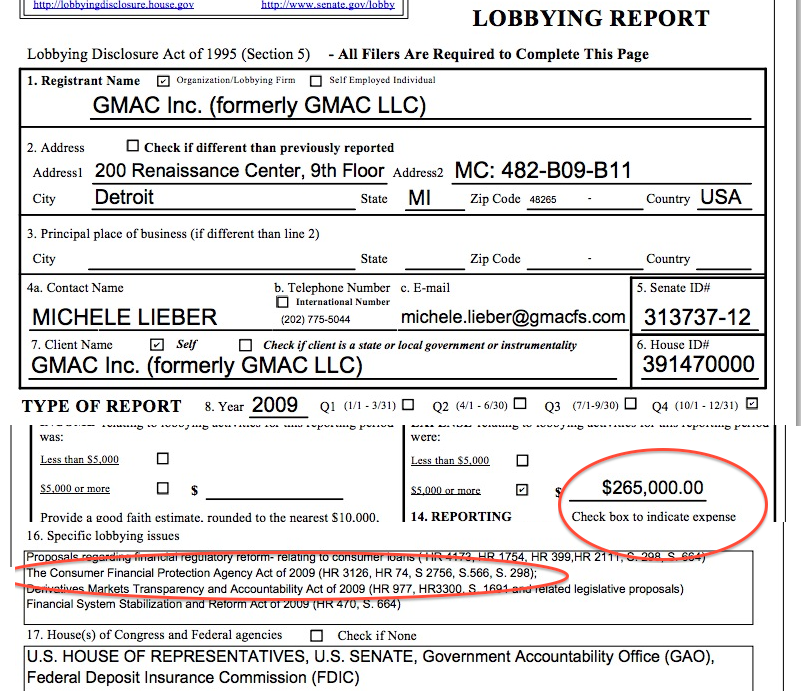
Evidence: Here’s just one of GMAC’s lobbying disclosure forms mentioning the Consumer Financial Protection Agency Act of 2009
Ally Bank is not the only financial company funding Adam Davidson’s career, and filling up his bank accounts.
On top of Ally Bank’s exclusive sponsorship of Planet Money, Davidson earns lucrative speaking fees from banks and financial companies, including J.P. Morgan, Well Fargo, Bank of America and Goldman Sachs—the same companies he covers as a journalist. Davidson is frequently the only journalist/reporter booked to speak at these events; other speakers usually work in finance.
Davidson has yet to disclose his corporate clients and how much they pay him, but here is a partial list of Davidson’s speaking gigs from the last two years compiled from various publicly available sources:
- In April 2011, Davidson was the headlining speaker at the 9th Annual “Women’s World Banking” Microfinance and the Capital Markets Conference. The conference was hosted by J.P. Morgan, but the organization itself is funded by the world’s biggest banks and corporations, including BP, Morgan Stanley, Pfizer, Barclays Capital, VISA, ExxonMobil—just to name a few.
- In 2011, Davidson spoke at another microfinance conference, this once was also funded by Morgan Stanley, Citi, Bank of America, Deutsche Bank and CapitalOne.
- In 2012, Davidson spoke at the 27th Annual Conference for the Treasury & Finance Professional. Sponsors of the event included Bank of America, BlackRock, BNY Mellon, Bloomberg, Citibank, Findelity Investments, Goldman Sachs, J.P. Morgan, Morgan Stanley, Well Fargo and about a dozen of the most powerful financial the largest financial companies in the world.
These speaking fees are a huge unaddressed problem in news media and academia. As explained by Charles Ferguson, director of Inside Job and author of Predator Nation, the problem with speaking fees is that they are “sometimes used to launder or disguise payments . . . for lobbying and policy advocacy.” That is why, for example, Obama’s former economy czar Larry Summers was roundly criticized for taking hundreds of thousands of dollars in speaking fees in 2008 from the same banks he was bailing out in 2009.
Chicago Public Media, which co-owns “Planet Money” through its ownership of “This American Life”, explicitly bars conflicts-of-interest: “WBEZ journalists must uphold the trust of the public by not overlapping individual interests with professional responsibilities. WBEZ journalists may not accept any form of compensation from the individuals, institutions or organizations they cover.”
Neither NPR nor This American Life would comment on S.H.A.M.E.’s investigation into Adam Davidson’s conflicts of interest. We will be seeking to get comment from Davidson’s other employer, The New York Times, about their policy on journalists having conflicts-of-interest.
Notes
See Naked Capitalism’s coverage of GMAC/Ally’s mortgage fraud.
Nagasaki: The Worst War Crime Ever
Dock Billin | Multiply | August 8, 2011
It was just short of eleven in the morning of a mild late summer day. The streets of the city were teeming with people going to work, while children played in the parks and in the medical college, professors were lecturing to their students on medicine and surgery.
High over the city, above the layer of clouds in the sky, a silver aeroplane was flying along on four throbbing motors. The crew had already been in the air for many hours and was growing tense and weary. They had flown to another city, where they were to deliver their cargo, but that had been obscured by smog and cloud, so they had come to this, their secondary destination. Getting low on fuel and experiencing some engine trouble, they were looking for a break in the cloud cover so that they could see where to release their cargo, a gift for the two hundred thousand people below.
A sudden hole opened in the cloud cover, and the B-29 started its bombing run.
It was the ninth of August, 1945, and the city below was about to become a funeral pyre.
When the accounts are written of the atom bomb, one name, and one alone, stands out in the histories – Hiroshima. It’s as though the atomic age is symbolised by that city. Tagged on, sometimes, to the end of it, is another name – Nagasaki – as though it were no more than an afterthought, ignored by most people except as a footnote. But Nagasaki was a city in its own right, bombed separately from Hiroshima, and with its own personalised tragedy.
In order to understand the tragedy of Nagasaki, it’s necessary first to examine the decision to use the atom bomb and the reasoning behind the bombing of Hiroshima.
The prelude to the atom bombing:
I have written previously[1] and in detail about why I consider the bombing of Hiroshima to have been an inexcusable war crime, not only in hindsight, but even given the information available at the time to the people involved. I’ll repeat a point I made earlier:
Japan was finished, and was all ready to sue for peace; the only condition it made was that the position of the Emperor should be protected. The Japanese government under Kantaro Suzuki that took office in April 1945 did so with the one single objective of ending the war. All this was known to the Western Allies, since the Japanese codes had long since been broken.
By May 1945, the Japanese were suing for peace through Switzerland and Moscow – peace on any terms, just so long as the position of the Emperor was protected.
These are the terms the Japanese offered as early as 20 January 1945, and repeated through the USSR in July[1,3]:
* Complete surrender of all Japanese forces and arms, at home, on island possessions, and in occupied countries.
* Occupation of Japan and its possessions by Allied troops under American direction.
* Japanese relinquishment of all territory seized during the war, as well as Manchuria, Korea and Taiwan.
* Regulation of Japanese industry to halt production of any weapons and other tools of war.
* Release of all prisoners of war and internees.
* Surrender of designated war criminals.
These are the exact same terms that the Americans accepted at the official Japanese surrender in September 1945. The war could have been over as early as January 1945 – if the US government had wanted it so.
The justification for the bombing:
The rationale for the atom-bombing of Hiroshima (and Nagasaki) rests on these ideas:
First claim: that the atom bomb was necessary to end the war.
In reality[1,2,3], the Japanese were suing for peace long before the A Bombing. Also, the fact is that wars are fought by militaries, and in this case the actual military forces involved (who would have been in a position to decide if they needed the Bomb to end the war) were kept completely out of the picture. Even General Douglas MacArthur, the theatre commander in the Pacific, was told of the Bomb’s existence a mere five days before it was used on Hiroshima[2]. And European theatre commander General Dwight Eisenhower (later US President) was strongly opposed to its use, and was to comment in an interview to Newsweek in 1963, “We didn’t have to hit them with that awful thing.”
In 1945 the Japanese were in desperate circumstances. Japan
… already had been defeated militarily by June 1945. Almost nothing was left of the once mighty Imperial Navy, and Japan’s air force had been all but totally destroyed. Against only token opposition, American war planes ranged at will over the country, and US bombers rained down devastation on her cities, steadily reducing them to rubble.
What was left of Japan’s factories and workshops struggled fitfully to turn out weapons and other goods from inadequate raw materials. (Oil supplies had not been available since April.) By July about a quarter of all the houses in Japan had been destroyed, and her transportation system was near collapse. Food had become so scarce that most Japanese were subsisting on a sub-starvation diet .[3]
While it is true that for public consumption the Japanese government was calling on its people to resist to the end, as any adult knows, the public statements of governments are to be treated with circumspection. Starving Japanese civilians armed with bamboo spears[6] would have had little impact on the kind of invasion fleet the Allies could have summoned by 1 November 1945, the projected date for the invasion, if any invasion had actually been required. But
(t)he United States Strategic Bombing Survey concluded that,”… certainly prior to 31 December, 1945, and in all probability prior to 1 November, 1945, Japan would have surrendered even if the atomic bombs had not been dropped, even if Russia had not entered the war, and even if no invasion had been planned or contemplated.” [4]
It’s also true that the atom-bombings of Hiroshima and Nagasaki were not the last major bombing raids on Japan during the Second World War. In a broadcast from Tokyo the day after the Nagasaki bombing, 10th August (and also two days after the USSR invaded Manchuria), the Japanese government announced its readiness to accept the joint American-British “unconditional surrender” declaration of Potsdam, “with the understanding that the said declaration does not compromise any demand which prejudices the prerogatives of His Majesty as a Sovereign Ruler.”[3]
Yet, on the day and evening of the 14th August, while Japan was preparing for the announcement of the unconditional surrender, General Henry Harley “Hap” Arnold dispatched over a thousand planes to fire-bomb Tokyo. Not even one was lost, and the official Japanese surrender was announced before the last one landed back at its base[5]. If the A-Bombing had actually ended the war, what was the necessity for this act, unless one wants to call it deliberate terrorism?
At the same time, there’s the fact that, as I said, the USSR entered the war on 8th August, as it was treaty bound to do three months after the end of the war in Europe. In many ways, it was this decision that forced the Japanese surrender, not the A-Bombing[6]. They did not want the Communists to occupy parts of their homeland.
Also –
American leaders who were in a position to know the facts did not believe, either at the time or later, that the atomic bombings were needed to end the war…
Shortly after “V-J Day,” the end of the Pacific war, Brig. General Bonnie Fellers summed up in a memo for General MacArthur: “Neither the atomic bombing nor the entry of the Soviet Union into the war forced Japan’s unconditional surrender. She was defeated before either these events took place.”
Similarly, Admiral Leahy, Chief of Staff to presidents Roosevelt and Truman, later commented:
It is my opinion that the use of the barbarous weapon at Hiroshima and Nagasaki was of no material assistance in our war against Japan … The Japanese were already defeated and ready to surrender because of the effective sea blockade and the successful bombing with conventional weapons … My own feeling was that in being the first to use it, we had adopted an ethical standard common to the barbarians of the Dark Ages. I was not taught to make war in that fashion, and wars cannot be won by destroying women and children.
If the United States had been willing to wait, said Admiral Ernest King, US Chief of Naval Operations, “the effective naval blockade would, in the course of time, have starved the Japanese into submission through lack of oil, rice, medicines, and other essential materials.” [3]
Besides, unlike the standard version of the story, the Japanese leaders of the time weren’t particularly impressed by the A-Bomb. Nobody knew much about these weapons at the time, and the initial number of casualties was less than those inflicted during the fire-bombing of Tokyo on the night of 9th March 1945 when over a hundred thousand Japanese were burned alive and boiled to death in the city’s canals[3]. It was just another enemy weapon[3], and the murder of a few hundreds of thousand civilians was passé by that stage of the war, when 67 Japanese cities had been destroyed by fire-bombing[7].
Therefore, it’s certain that the claim that the A-Bombing was necessary to end the war was false, and was known to be false even when the decision was being made.
Second claim : That the atom bomb was required to save a million American lives.
This claim rides piggyback on the first, and is predicated on an invasion and prolonged fighting for the Japanese home islands. However, as we’ve seen, no invasion would have been necessary, and the people in power were well aware that no invasion would have been necessary. Even so, the figure of a million American dead is widely inflated.
(T)he worst-case scenario for a full-scale invasion of the Japanese home islands was forty-six thousand American lives lost.[7]
Even if it were true that a million American soldiers would have died in the invasion of the Japanese home islands, did that justify nuking over a quarter of a million civilians[7]? How is that different from torturing and massacring the inhabitants of a city to break the will of their fighting men to resist[8]? And in what way does that qualify as not terrorism, if we define “terrorism” as the use of applied fear to influence the actions of a target government or populace?
Third claim: That Hiroshima and Nagasaki were heavily-defended military bases and hence legitimate targets.
This is actually one of the more transparent myths of the entire episode. Hiroshima was chosen as a target of the atom-bombing because it had never been bombed[9]; and it had never been bombed because it was not militarily significant (about 95% of the casualties in the city were civilian). In fact,
… almost all of the victims were civilians, and the United States Strategic Bombing Survey (issued in 1946) stated in its official report: “Hiroshima and Nagasaki were chosen as targets because of their concentration of activities and population.” [3]
As we shall see, Nagasaki was a third-hand choice for the bomb; it was meant to be used elsewhere, because Nagasaki had already been bombed five times before and wasn’t thought to be a prime target.
Fourth claim: The Japanese somehow “deserved” Hiroshima (and Nagasaki) because of the attack on Pearl Harbour.
This is part of the justification put out by Truman himself, [4]
“Having found the bomb we have used it. We have used it against those who attacked us without warning at Pearl Harbor (sic), against those who have starved and beaten and executed American prisoners of war, and against those who have abandoned all pretense (sic) of obeying international law of warfare.”
The simple fact is that the Japanese people were not, at the time, ruled by anything resembling a democracy. They had no part in the decisions that were taken in their name, and are no more to blame, collectively, than the people of the United States are collectively to blame for the invasion of Iraq – less so, indeed, because the US is (on the surface of it) a democracy.
The attack on Pearl Harbour, in any case, was far from the simple story of an unexpected and illegal attack on the US as is usually claimed. In reality, the attack had been made inevitable by a game of political brinkmanship and pushing Japan to the point where it had no option but to strike back. It was a pre-emptive strike… a strike the US celebrates to this day. The purpose of this article is not to get diverted into a discussion of the attack on Pearl Harbour; but it will note that while the official story is of a vicious and unprovoked attack, there are excellent reasons to believe that it was not.[10]
But even if the attack on Pearl Harbour had been a vicious and unprovoked attack, it was a military attack on a military base, and any civilians killed were accidental casualties (“collateral damage” in the words of the same people who decry the attack while occupying Iraq and Afghanistan and bombing Pakistan and Libya). The attacks on Hiroshima and Nagasaki were designed to kill civilians[3], and therefore were not a proportionate, legal or moral response to the attack on Pearl Harbour.
Therefore, none of these four justifications for the bombing stands up to examination.
Some words about the Atom Bomb:
This would probably be the right place to briefly discuss the atom bomb itself – as it was used in Hiroshima and then at Nagasaki. (You’ll see the point of this digression in a minute.)
With apologies to those to whom this is hardly news, there are two distinct types of nuclear bomb. Both depend on bringing together an unstable mass of radioactive metal, known as the critical mass, which then spontaneously undergoes change into a smaller mass of other materials with the missing mass converted into energy. This energy is gigantic compared to the amount of missing mass, because it follows Einstein’s famous equation E=mc2where E is the energy obtained from converting a mass m and c is the speed of light. Since the speed of light is 300,000 kilometres per second, the energy obtained by converting just one gram of material is huge indeed. That’s why nuclear bombs are so powerful; the Hiroshima bomb had a yield of 13.5 kilotons (the equivalent of 13,500 tons – not kilograms, tons – of TNT), and Nagasaki suffered 21 kilotons. And these were small bombs by today’s standards.
Now, there are two metals that can be used to construct an atom bomb. One is Uranium 235, and the other, Plutonium 239. In the case of Uranium 235, the technique used is relatively simple, and is called the gun type device. A “bullet” of the metal, weighing less than the critical mass, is fired by explosives into a sphere of the same metal, also weighing less than the critical mass, but the two together weigh more than the critical mass and “nuclear fission” occurs as the atoms split to release the above-mentioned energy. The gun-type device is simple and can be expected to work without testing, and this was the design of the (untested) bomb dropped over Hiroshima.
The plutonium bomb is a different matter. Because of certain inherent problems with the presence of Plutonium 240 as an impurity, the gun type device is unusable. Instead, the technique used is the implosion device, where explosives are used to compress a sphere of plutonium from all sides until it achieves a mass greater than the critical level, and explodes. This method happens to be both more efficient and safer than the gun-type device, and is used for most modern nuclear weapons.[11]

The thing about the implosion device is that it could not be reliably expected to work without testing, because its utility was still entirely theoretical at the time of construction and because of the fact that a highly complex triggering device has to be used to compress the sphere evenly and quickly into a supercritical mass. Therefore, it required a test – and this was the device that was tested at Alamogordo in New Mexico on 16th July 1945, which was called the “Trinity” test and was the world’s first nuclear explosion.
While the uranium bomb (“Little Boy”) was used on Hiroshima, the far more complex and expensive plutonium bomb (“Fat Man”) was used on Nagasaki.
Which leads us to one possible reason why the bomb was used…
The possible real reasons for the use of the atom bomb:
- The political reason: By 1945, the alliance between the USSR and the Western Allies was fast breaking down. It was little more than a formality which would obviously end once the war was over. Before the Germans were even defeated, American pilots flying close to the Eastern front with secret equipment in their aircraft were ordered by their superiors to bail out over German territory in case of emergency rather than land on the Soviet side of the lines (vide John Toland, The Last Hundred Days)[12]. The Western Allies were more concerned about their ally, the USSR, laying hands on their equipment than their enemies, the Germans, capturing it.
While at Yalta in February 1945, Stalin agreed to enter the war against Japan three months after the end of the war in Europe, which would mean the USSR’s declaring war on Japan on 8th August (since the European war ended on 8th May). The Americans and British were well aware of this, and Truman himself had written to his wife that the Soviet Union’s entry into the war would hasten Japan’s downfall[13]. Obviously, once the war ended, the two competing systems – communism and capitalism – would be scrambling for the prize of ruling the post-war world. The atom bombing was the first shot in the Cold War. [17]
Truman, in fact, postponed the July Potsdam conference with Stalin until he was certain that the Alamogordo test was successful, and his Secretary of State and advisor Byrnes’
… general viewpoint is consistent and clear. He saw the atomic bomb as a way to impress the Soviets. [14]
Also, as William Craig describes in The Fall Of Japan, by 25th August OSS (the organisation that is now the CIA) agents in China were openly threatening the Chinese Communists, still their official allies against the Japanese, with the use of the nuclear bomb unless they fell into line and stopped their “banditry”.[15]
The political factor behind the bombing is therefore pretty clear.
- The revenge factor: Throughout the war, the Western nations had categorised the Japanese as something less than human, and Western propaganda had consistently portrayed them as monstrous rats or monkeys. The use of the atom bomb on them was a nice, satisfying way of exacting revenge, as Truman himself said (see above).

- Scientific curiosity: Just because scientists are scientists we can’t expect them to be necessarily ethical or moral. The scientists wanted to know which bomb was more powerful, and one important reason for the atom-bombing of Nagasaki was merely to see if the implosion device would cause more devastation than the Hiroshima bomb.[16] The fact that the programme had cost two thousand million dollars (at the then value) was also a powerful incentive to use the bomb – to justify the money spent.
Hiroshima, in fact, was chosen as a target for two reasons: first, because it was a “virgin” city, never having been bombed[17], and therefore would provide an excellent test-bed for the Bomb; and also because of its topography (surrounded on three sides by hills) which would allow the blast to be focused back on the city and cause even greater destruction.
Could the Bomb have been used otherwise?
Let’s – for the sake of argument – assume that the atom bomb really ended the war. What were the alternatives to dropping the bomb on Hiroshima and Nagasaki?
Alternative No 1: Warning the Japanese through neutral nations of the existence of the bomb and the willingness to use it. Whether this would have been effective of not, it certainly wasn’t tried.
Alternative No 2: Making a “demonstration” – dropping the bomb over an isolated Japanese military base, over an unpopulated area, or over the sea within sight of the Japanese coast. This, too, was never tried, and never, apparently, contemplated.
The argument usually goes that the bomb actually had to be used for the Japanese to appreciate its true destructive power, and without that they wouldn’t have surrendered. The argument further goes that the use of only one bomb wouldn’t be effective, because the hardliners in the Japanese military and government wouldn’t believe that the US had more than one of the bombs.
Again, for the sake of argument, let’s assume that this line of thinking has merit – that the Japanese would have not surrendered unless the Bomb was actually used on one or more of their cities.
This raises some questions:
1. If the Hiroshima bomb was used on 6th August, why was the Nagasaki bomb used just three days later? It was an impossibly short time for the Japanese government to assimilate information about the bomb, given the utterly destroyed state of Japanese communications, and decide on surrender. Besides, it was only at Nagasaki (vide Craig, The Fall Of Japan) that a message was dropped (taped to an instrument package parachuted to study the explosion) to a Japanese nuclear scientist – a Professor Sagane – who had earlier studied in the US, informing him of the nature of the atom bomb. So, the Japanese were not even given the time to know of their danger and think of surrender – before both bombs had been used.
2. Let’s for the sake of argument assume that Hiroshima had to be destroyed to force a Japanese surrender, and a second bomb had to be dropped to make the point that the US had more than one bomb. If that is so, why wasn’t the second bomb used as a demonstration, and dropped somewhere the Japanese could see its effect for themselves, and not on civilians? What possible justification can there have been for destroying a city?
And this is why I consider Nagasaki to have been an even worse war crime than Hiroshima – because, following the arguments of the pro-bomb lobby to their logical conclusion, the bombing of the latter city comes across as even more wanton and pointless, even more of a war crime and a terrorist act.
While I am on the subject, as I’ve written elsewhere [18]
I view the atom-bombing of Hiroshima and Nagasaki as a complete and despicable war crime. I view it as such because – like using Agent Orange in Vietnam or depleted uranium today everywhere from Kosovo to Libya – the effects extend to future generations, meaning people who are not only not guilty of any part in the conflict, but weren’t even born when it took place. No amount of self-justification can excuse that.
Secondly, I view nuclear weapons as the closest thing we have to an absolute evil, because it gives its possessors the choice to wipe out virtually all life on earth in defence of a political or economic ideology; a way of wiping out everything in some kind of universal Gotterdammerung. Just as you wouldn’t let a petulant child get its hands on a firearm, you wouldn’t want a nation – any nation – to have the means to blow everything away in a fit of temper. Don’t think it can’t happen – it very nearly has.
It is true (as I shall discuss in a moment) that the bombing of Nagasaki killed far fewer people than the bombing of Hiroshima even though the bomb was far more powerful[19]; but that was more by accident than by intent, and surely in these situations intent is what matters. Is a man who kills a hundred people more of a criminal than one who kills merely fifty? And is the latter guiltier than one who has dispatched only five or so?
The targeting of Nagasaki:
Let’s say something here that a lot of people don’t know: Nagasaki was not a primary target for the Bomb. The list of potential Japanese targets had at first four names on it – Kyoto, the ancient Japanese capital; Kokura, Hiroshima and Nagasaki. Kyoto was scratched early on because of its cultural and religious significance to the Japanese people, and Niigata substituted. That city was subsequently scratched because it was considered too far to be reliably attacked, what with having to fly there carrying the immense weight of the atom bomb, and the target list came down to three – Hiroshima and Kokura, with Nagasaki (which had already been bombed five times[20] and therefore wasn’t a “virgin” city like Hiroshima) as the alternate target.
When the B 29 bomber (Bockscar) carrying “Fat Man” took off from Tinian, it was supposed to bomb Kokura, but the target was covered by smog and cloud[20]. The crew were under strict orders not to bomb by radar, but only after visually identifying the aiming point. Despite three passes over the target, they were unable to do so, and by this time the Japanese below had opened up with some anti-aircraft fire (the only occasion during the two atom bombings that any opposition at all was encountered. That a tiny number of unescorted and unarmed bombers – three at Hiroshima, two at Kokura/Nagasaki – could fly over Japanese cities in broad daylight unmolested is clear proof of the utterly parlous nature of Japanese defences at the time). The plane then flew to Nagasaki, which was covered by cloud and smog as well. By then, fuel was getting low, and there was just enough for one pass over the target. There was only one hole in the cloud which afforded some view of the city, and “Fat Man” was dropped through that hole, with a racetrack as the makeshift aiming point.
The bombing of Nagasaki:
As Fat Man fell through the air over Nagasaki, arming wires were extracted, barometric switches were closed, and electrical switches were triggered at a pre-set altitude of 500 metres. The detonators arranged around the plutonium core exploded, driving the metal ball on itself until it reached a supercritical mass. A moment later, with an intense bluish-white light, the bomb exploded over the city. People below simply vanished, vaporised in an instant. Further from the blast site, they were blinded, their skin burned away, their bodies blasted with radiation, and all of them died. Many who were not killed by the blast or radiation were crushed under falling buildings, and yet others roasted alive by the mass fires that followed. Those further from the blast and fires soon began to suffer the effects of radiation sickness: diarrhea, weakness and fever, agonising pain, their urinary flow stopping as the inner lining of their bladders came away. Most of them soon died. Those who survived lost their hair and teeth, followed by a lifetime of health problems, frequently involving cancer and passing on mutations to their children.
Everything happened as it had happened at Hiroshima, in fact; but, as I’ve mentioned, the casualty toll was

As the fireball from the explosion rose, it sucked up superheated air along with moisture, smoke and soot from the incinerated city, and condensed it all in a tower of cloud that spread out at the top – into the image of the mushroom cloud that is familiar to us all. And the moisture condensed and fell along with the soot and dirt as a black rain, just as it had done at Hiroshima.
The reason for the lower casualty toll is as follows: the implosion type plutonium device was far more powerful than the gun-type bomb used on Hiroshima. It was, however, dropped far off-centre (towards the north-west) and failed to hit the middle of the city as planned. Nagasaki is also, unlike Hiroshima, a hilly city broken up by stretches of water Large portions of the city were protected from blast by the hilly terrain, and the mass fires that started could not cross open stretches of water to ignite a firestorm as in Hiroshima. That is why “only” some 87000 died[20] – as opposed to more than twice that number at Hiroshima. (It’s a different matter that an even higher proportion of them were civilians, including a number of Western prisoners of war whose presence was known to the US – but the bombing went ahead anyway.[21])
When you remember that the most notorious “terrorist” strike in history killed fewer than 3000 people, and that that strike became the reason for wars that have to date destroyed two nations and devastated several others, it brings the crimes of Hiroshima and Nagasaki even more into focus.
The whitewash:
It’s worth noting that by 1947, Harry Truman had apparently begun feeling a need to whitewash his own part in the decision to use the bomb. He had the first film on Hiroshima censored extensively, falsifying history and reinventing his and every other major participant’s role in it[22]. It’s difficult to see this effort as anything but an admission of guilt, yet it established the modern myth of how the Bomb had to be used, most reluctantly, to end the war. It wasn’t a very effective propaganda device, of course, but the people of the US were eager to believe that the bombing was not a crime – so they took the opportunity to believe it.
The modern government of Japan is hardly free of guilt either. It made no effort to help the hibakusha – the survivors of the atomic bombing – until the 1950s, and to this day said help is far from adequate[23]. Besides, Japan till today operates on a US-written constitution and has a government that cannot exert full sovereignty over its own territory – no government which cannot ask an allegedly allied nation to remove its troops from its own territory[24] can be said to be sovereign – and cannot be expected to annoy the Americans. Therefore, the whitewash tends to be bilateral.
Conclusion:
Obviously, I believe that the atom bombing of the two cities was a war crime, and that the people who ordered the bombings were war criminals. However, were the people who actually carried out the bombings – the pilots and crew of the two planes, and the pilots and crew of the observation planes that accompanied them – war criminals?
Under normal circumstances, one would have said they weren’t. In a war that had crossed all limits of savagery, I’d have said that they were soldiers carrying out their orders. But there’s what happened afterward.
In 1995, the Smithsonian Institution wanted to hold an exhibition showing the effect of the atom-bombing of Hiroshima. One of the most strident opponents of the exhibition (which ultimately was aborted) was an old man who claimed it was a “damned big insult”. This old man was someone who had – in 1975 – flown a recreation of the attack of Hiroshima at an air show, complete with mushroom cloud, and claimed he had not intended it to be offensive. Yet, obviously, he found showing the effects of the bomb itself offensive to himself.[7]
Who was he? His name was Paul Tibbets, and he was the man who had flown the B 29, Enola Gay, which had dropped the Hiroshima bomb. His bombardier, too, went to his grave declaring he would do it again if the opportunity arose.
Whether Tibbets was a war criminal or not, therefore, at least in retrospect, might be a matter of opinion. However, I’d like to point out one thing:
After returning from a mission where they had just barbecued over a hundred thousand human beings, the crew of the Enola Gay celebrated with a barbecue.[25]
So what can be done? I believe that an apology is a good place to begin. It’s necessary because even though an apology won’t help the victims of the Bomb, it will acknowledge that bombing them was wrong; and only if one admits wrong will one begin to guard against the tendency to do it again. After the end of the Second World War, the USA has threatened the use of nuclear weapons many times – against Korea, China, Cuba and Vietnam, against Iraq, North Korea and now against Iran. If the only nation ever to use nuclear weapons and threaten their use apologised for doing so, it might guard against the tendency to use these weapons or threaten their use – and in the modern world, if one country can use them, another can; and once there’s a major exchange, no matter who is guilty of starting it, there can be no turning back from the road to utter global ruin.
Not that any apology will ever be forthcoming, of course, but there’s no harm dreaming.
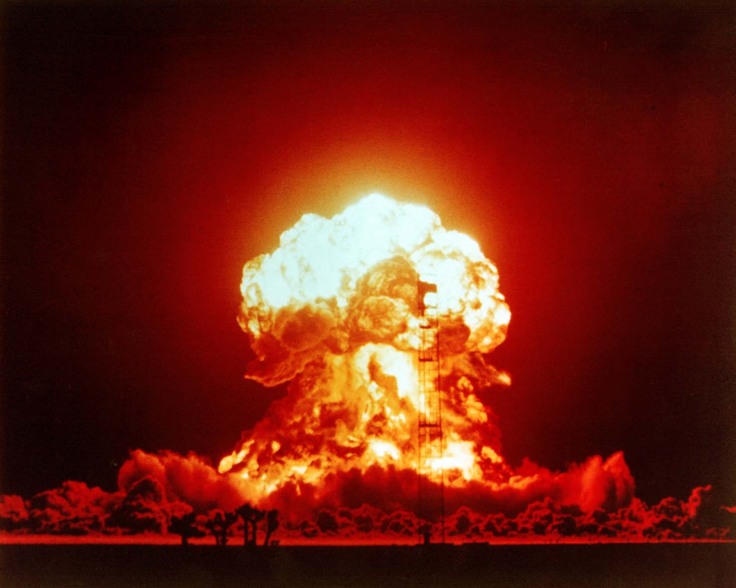
Sources:
[1] http://subversify.com/2010/08/13/mushroom-cloud-over-hiroshima/
[2] http://www.lewrockwell.com/orig2/denson7.html
[3] http://www.ihr.org/jhr/v16/v16n3p-4_Weber.html
[4] http://warisacrime.org/content/truman-lied-hundreds-thousands-died
[5] http://www.lewrockwell.com/vance/vance180.html
[6] http://www.boston.com/news/world/asia/articles/2011/08/07/why_did_japan_surrender/?page=full
[7] http://lewrockwell.com/gregory/gregory232.html
[8] http://www.fff.org/freedom/0995g.asp
[9] http://www.hiroshima-spirit.jp/en/museum/morgue_e12.html
[10] http://www.lewrockwell.com/orig/stinnett1.html
[11] http://en.wikipedia.org/wiki/Fat_Man
[13] http://www.commondreams.org/view/2011/08/06-3
[14] http://www.h-net.org/~hst203/readings/alperovitz.html
[15] http://www.amazon.com/Fall-Japan-Blazing-Weeks-World/dp/0941968081
[16] http://www.lewrockwell.com/orig5/kohls1.html
[17] http://www.mukto-mona.com/Articles/Brian_Mitchell/hiroshima_reason.htm
[18] http://bill-purkayastha.blogspot.com/2011/07/review-black-rain.html
[19] http://www.aasc.ucla.edu/cab/200708230009.html
[20] http://www.historylearningsite.co.uk/bombing_of_nagasaki.htm
[21] http://www.thenation.com/blog/162596/hidden-history-american-pows-were-killed-hiroshima
[25] http://www.infinityplus.co.uk/stories/history.htm
Related articles
- Hiroshima marks anniversary of atomic bombing (news.xinhuanet.com)
Featured Video

Meet The Ellisons: Zionists, Technocrats, Moguls
or go to
Aletho News Archives – Video-Images
Frlom the Archives
Who Rules America?
The Power Elite in the Time of Trump
By James Petras | Axis of Logic | September 6, 2017
Introduction
In the last few months, several competing political, economic and military sectors – linked to distinct ideological and ethnic groups – have clearly emerged at the centers of power.
We can identify some of the key competing and interlocking directorates of the power elite:
- Free marketers, with the ubiquitous presence of the ‘Israel First’ crowd.
- National capitalists, linked to rightwing ideologues.
- Generals, linked to the national security and the Pentagon apparatus, as well as defense industry.
- Business elites, linked to global capital.
This essay attempts to define the power wielders and evaluate their range of power and its impact. … continue
Blog Roll
 Aletho News
- Iran Does Not Consider Israel Party to Talks to Need Mediators With It – Ambassador
- Macron’s aircraft carrier and warplanes to the Persian Gulf is a dangerous vanity project
- Meet The Ellisons: Zionists, Technocrats, Moguls
- US failures in Iran reveal Russia is key to South Korea’s strategic security
- ‘All ports in Persian Gulf will be legitimate targets if Iranian ports are attacked’
- 40 Years of Endless War, Data Point by Data Point
- Department of War Using Palantir AI to Pick Targets in Iran
- American bases do not protect – they attack the peoples of the Persian Gulf
- ‘We’ve Obliterated Their Missiles’
- Syrian president vows ‘absolute support’ to disarm Hezbollah
- If Americans Knew
- Israeli strategic plans to “remake the Middle East” from the 1950s and since
- Honoring Gaza’s women who refused to let the world look away
- 97% of victims of war on Iran are Iranian, 98% of victims in war on Gaza are Gazans – Not a ceasefire Day 152
- Early Iran strikes cost $5.6 billion in munitions, Pentagon estimates
- Israel Decided the War, But Trump’s America Fights and Pays the Bill
- Conscientious Objector Group: Phone ‘Ringing Off Hook’ As Huge Mobilization Underway
- U.S. support for Israel continues to plummet, despite media’s best efforts
- Threats and missiles fly, death tolls soar in Iran, Lebanon, Gaza – Not a ceasefire Day 151
- Lebanon: Israel’s White Phosphorous Use Risks Civilian Harm
- Corporate Media Go All Out To Support The US-Israeli War On Iran
- No Tricks Zone
- Destructive Green New Deal: German Energy And Metal Group Warns Of Drastic Crisis
- New Study Documents A 20-Year Pause In Arctic Sea Ice Decline – Driven By Internal Variability
- Wake-up Call: Survey Shows Majority Of Germans Now Favor Postponing Climate Targets!
- Televised! Leading German Political Candidate Tells Schoolchildren CO2 Makes Sun Hotter!
- New Study: A Century Warming Of 1.1°C Is ‘Commonplace’ And ‘Not Unusual’ During This Interglacial
- New Study: ‘Internal Noise’ And Volcanic Forcing Can Trigger 10-15°C Warming Within Decades
- Glaciers Worldwide Are Suddendly Surging, Experts Blame Warming!
- Surprising Discovery: Sahara Is Greening…Billions Of Trees Where Once Thought To Be Barren
- New Research Reaffirms Clouds, Aerosols, And Surface Solar Radiation Are ‘Driving The Climate System’
- Germany: Electric Car Catches Fire At Charging Station, Sets Off Local “Inferno”, Widespread Damage
 Aletho News