Riot Grrrls and Followers Ride the Bernays Highway
Kenny’s Side Show | August 19, 2012
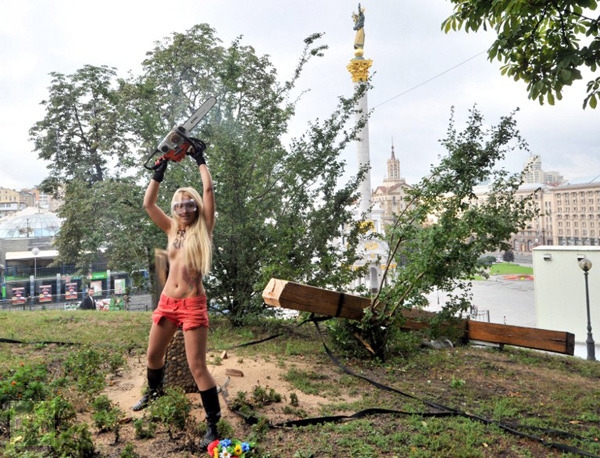
Haven’t we had about enough of this? In the words of some TV writers, this whole Pussy Riot episode is fake, fake, fake, fake and useful idiots all over the world fall for the script. When so called ‘celebrities’ like Madonna and Paul McCartney show their support, well, you know you’ve been had.
Overall, even the alternative media has failed to expose this blatant psyops. Check out Noor’s posts on this, here and here. Not everyone is fooled.
A fairly good summary comes from someone on the girl’s facebook page:
Freedom of speech is going into a Russian Orthodox Christian Church wearing KKK masks and denouncing Putin and Christianity? Really? What if some women went into a Synagogue in this country and sang some anti-semitic epithets? You better bet your Zionist owned ass that they would be tried as terrorists and disappeared into a Luciferian dungeon for the rest of their lives. This Pussy Riot stunt and the naked Ukrainian girl that chainsawed a Cross to the ground, is just Western backed agitation and BS propaganda. I’m all for free speech and women’s rights but this ain’t it. Ever since Putin kicked out the Jewish Oligarchs from Russia, the CIA/Mossad have been backing stunts like this. Don’t believe the hype. And Kasparov’s real name is Garik Weinstein, Zionist agent. And no culture that bases itself in a cesspit of Luciferianism, Propaganda, Pedophilia, Immorality and Insanity – all designed by Zionists who enjoy dumb goyim fighting amongst each other, will ever lead to a revolution that means anything. Only thing thing Pussy Riot will be good for is the headlining act at a FEMA Camp near you.
And from a comment here:
So obvious. The endless media coverage is of course the first tip off. Russia is standing in the way of certain designated “enemies”(Syria and Iran) and Israel and the US don’t appreciate it. Pussy Riot=obvious psy op.
And here:
The heavy sentence they received is probably the Russian’s way of sending a message to the people that they are not going to tolerate them siding with the US state department in an effort to destabilize the country. This is Putin after all. He’s making a point. And it’s probably not going to the missed by the others in Russia who are trying to help neo-liberalize the country and take them back to the Yeltsin years of corruption and pillaging the nation.
What really topped it off for me was the topless chain saw wielding Ukrainian girl cutting down a cross that was a memorial for those murdered and starved by Stalin’s bolshevik killers. One doesn’t have to be traditionally religious in the least to see it for what it is…an attack on true history that some would want us to forget.
We can understand the paid provocateurs. They do it for the money and the little fame it brings them. It’s the blind followers that are worrisome.
From Propaganda by Edward Bernays
The conscious and intelligent manipulation of the organized habits and opinions of the masses is an important element in democratic society. Those who manipulate this unseen mechanism of society constitute an invisible government which is the true ruling power of our country.
Small groups of persons can, and do, make the rest of us think what they please about a given subject.
There are invisible rulers who control the destinies of millions. It is not generally realized to what extent the words and actions of our most influential public men are dictated by shrewd persons operating behind the scenes.
Nor, what is still more important, the extent to which our thoughts and habits are modified by authorities.
Women are just as subject to the commands of invisible government as are men.
NY state senator poses with weapon on Syria border

Photo released August 15, 2012 shows NY State Sen. David Storobin (L) and his chief of staff, Paul Gullo, (R) with Israeli Gen. Shmulik Olansky (C) on Syrian border
Press TV – August 19, 2012
A New York state senator has taken up arms while posing for a picture in an Israeli army uniform on the Syrian border during an official trip to Israel.
A New York state senator has been photographed with a weapon in his hands and posing for a picture in an Israeli army uniform on the Syrian border during an official trip to Israel.
A photo posted online on August 15 showed State Sen. David Storobin in an Israeli army uniform and with a rifle in his hands side-by-side with Israeli officers.
Storobin, who is running for reelection as a Republican, is seen standing next to Gen. Shculik Olansky, who is in charge of Israel’s Golan Heights Armor Division.
Storobin’s chief of staff, Paul Gullo, also appears in the image released by Storobin’s campaign.
The provocative move is the latest show of US support for armed gangs attempting to topple the Syrian government.
Syria has been experiencing unrest since March 2011. Damascus says outlaws, saboteurs, and armed terrorists are the driving factor behind the unrest and deadly violence while the opposition accuses the security forces of being behind the killings.
The Syrian government says that the chaos is being orchestrated from outside the country, and there are reports that a very large number of the armed militants are foreign nationals, mostly from Egypt, Algeria, Saudi Arabia, and Afghanistan.
Egyptian president to attend NAM summit in Tehran
Press TV – August 18, 2012
Egypt’s official news agency, MENA, said on Saturday that President Mohamed Morsi plans to attend the upcoming Non Aligned Movement (NAM) summit in Tehran.
Morsi’s trip to Tehran will be the first such visit since Iran and Egypt severed ties more than 30 years ago after Cairo signed the 1978 Camp David Accord with the Israeli regime and offered asylum to the deposed Iranian dictator, Mohammad Reza Pahlavi.
The 16th summit of the NAM member states will be held in the Iranian capital on August 26-31.
The Leader of the Islamic Revolution Ayatollah Seyyed Ali Khamenei will address the Tehran NAM summit.
United Nations Secretary General Ban Ki-moon is also expected to partake in the event during which the Islamic Republic will assume the rotating presidency of the movement for three years.
NAM, an international organization with 120 member states and 21 observer countries, is considered as not formally aligned with or against any major power bloc.
NAM’s purpose, as stated in the Havana Declaration of 1979, is to ensure “the national independence, sovereignty, territorial integrity and security of non-aligned countries.”
Related articles
- Iran plans to establish international NAM news agency (alethonews.wordpress.com)
- Ahmadinejad personally invites Morsi to attend Non-Aligned Movement summit in Tehran (alethonews.wordpress.com)
- Official: Almost 8,000 Diplomats to Attend NAM Summit in Tehran (english.farsnews.com)
- U.N. Chief’s Presence at Tehran Summit Sends Wrong Message, Says State Dep’t (cnsnews.com)
Khan Al Luban: Settlers invade again
18 August | International Solidarity Movement, West Bank
On Saturday August 11th 2012 the same events as three days earlier took place at Khan Al Luban. A group of four illegal settlers, from Mal´al Levona, armed with guns and wooden sticks came into Khan al Luban at 22:30 p.m. The settlers yet again broke into the house owned by Khalid al-Hamed Daraghani where international activists and the two sons of Khalid were staying.
When the settlers arrived Khalid’s sons and the international activists asked them to leave the property, but they refused and instead sat down near the spring on Daraghani’s land. After about half an hour two Israeli police cars arrived along with two military jeeps after having received a call from the settlers. A few minutes later two more military jeeps arrived at the scene. By then the Daraghani land was full of Israeli police, soldiers and security guards from the illegal settlement. The soldiers entered the house searching for weapons, but as usual they didn’t find anything.
Around midnight the soldiers, police, security personnel and settlers left the area, while Jamal, the oldest son of Khalid, and the international activists remained in the house. Throughout the night settlers stayed on patrol in the street near the Daraghani house, shouting and honking their car horns.
At 7:30 am the following morning, a border police car stopped near the Daraghani house on the road leading up to the illegal settlement of Mal´al Levona. The border policemen then proceeded to break into the house, aggressively asking for passports and other documents. Like the night before the house was searched and no bag, cigarette package or piece of clothing went unturned.
After a short dispute over a cigarette, Jamal was brutally pushed into one of the rooms by the police officers where he received several blows to the face before he was handcuffed and taken away. Jamal was taken to the police station of Binyamin, wrongly accused of having hit a soldier. He was released on bail the day after.
The continued pressure of the Israeli occupation forces and illegal settlers remain a constant threat during both days and nights in Khan al Luban.
Related articles
- Jewish Settlers Empty Palestinian Well, Flood Farmlands (alethonews.wordpress.com)
- Renegade Jewish Settlers (alethonews.wordpress.com)
- Ultimate goal of Israeli policies in Hebron: ethnic cleansing (alethonews.wordpress.com)
- Hebron: settler illegally enters Palestinian home (occupiedpalestine.wordpress.com)
- Report details Israeli violations and seizure of West Bank land (occupiedpalestine.wordpress.com)
International Solidarity Movement call to action: Olive Harvest 2012
International Solidarity Movement | August 18, 2012
 … The olive tree is a national symbol for Palestinians. As thousands of olive trees have been bulldozed, uprooted and burned by Israeli settlers and the military – (over half a million olive and fruit trees have been destroyed since September 2000) – harvesting has become more than a source of livelihood; it has become a form of resistance.
The olive harvest is an annual affirmation of Palestinians’ historical, spiritual, and economic connection to their land, and a rejection of Israeli efforts to seize it. Despite efforts by Israeli settlers and soldiers to prevent them from accessing their land, Palestinian communities have remained steadfast in refusing to give up their olive harvest.
Palestinian and International Solidarity Movement volunteers join Palestinian farming communities each year to harvest olives in areas where Palestinians face settler and military violence when working their land. Your presence can make a big difference. It has been proven in the past to deter the number and severity of attacks and harassment. The presence of activists can reduce the risk of extreme violence from Israeli settlers and the Israeli army and supports Palestinians’ assertion of their right to earn their livelihoods and be present on their lands. International solidarity activists engage in non-violent intervention and documentation and this practical support enables many families to pick their olives. In addition, The Olive Harvest Campaign also provides a wonderful opportunity to spend time with Palestinian families in their olive groves and homes.
The campaign will begin on the 8th of October and run until the 15th of November. … Read full article
Related articles
- My Beloved Olive: Palestinian Farmers On their Land (alethonews.wordpress.com)
Tunisia: Al-Nahda’s Failures Lead Sidi Bouzid to Rise Again
By Christopher Barrie | Al Akhbar | August 17, 2012
On Tuesday August 14, the central Tunisian governorate of Sidi Bouzid held a general strike to call for the release of several protesters detained during the demonstrations held over the preceding weeks and to demand concrete plans for development in the region.
Tuesday’s events come after a series of city-wide general strikes which, from the month of May, have swept through Tataouine, Monastir, Kasserine and Kairouan. The recent events in Sidi Bouzid, cradle of the Tunisia’s 2011 revolution, should be considered the culmination of an extended standoff, not only between the al-Nahda-led ruling coalition and Tunisia’s main trade union federation, the UGTT, but also between those in power and those who are yet to see the revolutionary demands of “work, freedom, and national dignity” realized.
Tensions in Sidi Bouzid have been mounting over a period of months. However, the origins of this most recent wave of unrest can be linked to July 26 when a large number of day workers in the region attacked the al-Nahda party offices in protest at a two-month delay in their wages being paid. The Interior Ministry estimated the numbers involved at 150 while union officials claimed more than 1,000 took part.
The response of al-Nahda to these events was typical. Refusing to recognise the genuine demands of the chronically unemployed and disenfranchised in the southern regions of Tunisia, party officials claimed that those demonstrating had been manipulated by rival political parties, seeking to sow instability and dissent for their own ends. The police fired warning shots and tear gas canisters to disperse the protest.
Tensions have been further exacerbated in recent months by ongoing water shortages in the region. Over the past six months, drinking water has commonly only been available in the evenings and has occasionally been cut off for the entire day. Mohamed Najib Mansouri, the governor of Sidi Bouzid, claimed that one of the reasons for these shortages was the failure of residents to pay their bills. It is more likely that the local infrastructure has been unable to sustain the increased consumption of water during an especially hot and dry summer.
On Thursday August 9, a protest was organised by the December 17th Progressive Forces Front in conjunction with the December 17th Committee for the Protection of the Revolution, the UGTT and a number of opposition parties.
As well as demands for a guaranteed supply of water to the region, the protesters’ demands included the settlement of the status of workers, the resignation of the regional commander of the National Guard, the resignation of Governor Mohamed Najib Mansouri and the dissolution of the Constituent Assembly, in view of its failure to respond to the legitimate demands of the residents of Sidi Bouzid.
In response to the protests, police fired tear gas and rubber bullets into the crowds. One man was hospitalised having been struck in the stomach by a rubber bullet and four others were taken to hospital after inhaling tear gas.
Following these events, al-Nahda once again ignored the grievances of those protesting, this time claiming that rival party Nidaa Tunis was behind the protests. Indeed, a spokesperson from the ruling Islamist movement went so far as to claim that Nidaa Tunis, created in June of this year by former interim prime minister Beji Essebsi, represented the political arm of Ben Ali’s defunct Constitutional Democratic Rally (RCD) party and that they had “proof that some figures within the region known to be close to Nidaa Tunis sided with criminals, thieves and alcohol vendors to spread anarchy in Sidi Bouzid”.
Despite President Moncef Marzouki’s efforts to quell the the growing tension in the region, the general strike went ahead on Tuesday with over 1,000 protesters assembling outside the court house.
The events of recent weeks mark a significant development in the mounting levels of anger at the failures of the majority Islamist party. More than the ruling coalition as a whole, it is now al-Nahda which is perceived to be behind the lack of real progress in Tunisia. What’s more, one should not be surprised at the police’s violent handling of these protests. Prime Minister Hamadi Jebali and Interior Minister Ali Larayedh have previously made it clear that they are willing to use force in order to maintain order in the country. Sadok Chourou, a prominent figure within the al-Nahda ranks claimed in January that strikers were “enemies of God” and that they should suffer the same fate as apostates.
It is the protesters themselves who are blamed for the ongoing instability within Tunisia and not the failures of the ruling coalition and, specifically, al-Nahda. And yet, one need only look at actions of the ruling parties in order to see the falsity of such a claim. Negotiations up until now have been dogged by political outbidding and brinkmanship which has severely hindered the transitional process, as seen in al-Nahda’s attempts to prevent the transition to an independent judiciary, its decision to level a sentence of up to two years for attacks on “sacred values” or its recent rewording of the draft constitution to define the status of women as “complementary to men.”
Furthermore, the economic alternatives being proposed will likely do little to alleviate the situation of many in the southern regions of Tunisia which have traditionally suffered from high levels of unemployment and a lack of investment. Relying principally on foreign and private investment, the government aims to to provide 100,000 more jobs in Tunisia and predicts a level of 3.5 percent GDP growth for 2012. The latter of these two predictions seems increasingly unlikely considering that Tunisia has, to date, experienced four consecutive quarters of negative growth. With levels of unemployment at 18.1 percent, the aim to create 100,000 jobs will also do little to abate social unrest in a country which counts over 709,000 (of an active workforce of 3.9 million) unemployed.
With Minister for Investment Riadh Bettaib announcing last Friday that Tunisia can expect to receive a further $1 billion in World Bank loans alongside his continued insistence on boosting foreign direct investment (FDI) and tourism revenues, it is clear that the proposed model for economic development differs very little from the neoliberal agenda of the former regime.
Of course, alongside the social context of these protests, one must also take into account the political dimension of what is occurring. Tuesday’s general strike was called by the UGTT and the protests of the past week have found support among a broad range of opposition political parties, including the centrist Republican Party, al-Watan (The Nation), and several leftist parties, including the Workers’ Party. While it is important not to discount the role played by opposition political forces in these mobilisations, it remains the case that the principal drivers of this spell of popular contestation have been the young and unemployed in the region whose demands, as has commonly been the case, are channeled through the UGTT. Malek Khadraoui, a writer and activist who has been present throughout the latest wave of strikes and protests in Sidi Bouzid, further comments that, while some opposition parties may be seeking to capitalize on recent events, “the youth in the region harbour a deep distrust towards political parties” and the real cause of these events is the inability of the ruling coalition, and particularly al-Nahda, to respond to their demands.
It is difficult to predict where this latest spell of social upheaval is headed. An International Crisis Group report published this June remarked that it would be an exaggeration to “raise the spectre of a second insurrection,” but that the continued political instability within Tunisia alongside sustained levels of socioeconomic insecurity could “negatively feed on each other and risk snowballing into a legitimacy crisis for the newly elected government.”
In the same report, economist Lotfi Bouzaiane comments that one of the principal demands of the revolution was “the right to work.” Prior to the revolution, he says, it was Ben Ali who insisted that “to find work you just had to wait for the economy to grow!”
Following this latest wave of strikes and demonstrations, it is becoming ever more difficult to distinguish between the rhetoric of the former regime and Tunisia’s new ruling coalition, so committed is it to denouncing any expression of popular dissent in the name of national stability and economic growth. In the absence of any real answers to the demands of those in Sidi Bouzid and elsewhere, the government is increasingly having recourse to violent means of repression. It appears that Tunisia’s uncommonly hot summer may precede an even hotter Autumn.
Christopher Barrie is a student and journalist currently working in Tunisia at Nawaat.
Related articles
Featured Video

The Most Important Bet You’ve Never Heard Of
or go to
Aletho News Archives – Video-Images
From the Archives
The Occupied Mentality Syndrome
Saudi Arabia on the American chessboard – Part 2
By B. J. Sabri | American Herald Tribune | April 19, 2016
Since the Korean War, but particularly since the Iranian Revolution of 1979 until today, the United States has been steadily escalating its military presence in the Persian Gulf. Taking advantage of many colossal events of the past 36 years, [1] the hyper-empire has institutionalized its massive presence on land and sea, and expanded its objectives to include the unambiguous physical control of the area, as well as the clear understanding that local Arab governments should abide by them. The pretext is always the same: in “defense” of the national interests and security of the United States. From observing how the United States has been interacting with the governments of the region, and by judging from the size of its expeditionary force, we could reach a basic conclusion. The United States is occupying, de facto, the entire Arabian Peninsula. (Yemen, devastated by Saudi and American jets is yet to be conquered. Oman? Britain returned not as colonial ruler but as a soft occupying power.)
Under this articulation, Saudi Arabia, Qatar, Kuwait, and the United Arab Emirates are virtually occupied countries. If we compare this type of occupation to the mandate and protectorate regimes of the past, the results might be identical—the nations affected by it lose sovereignty. When Arab governments comply with the objectives of a foreign power that station military forces on their national milieu, then that power controls them in multiple ways including how they react to policy deliberations and what decisions they intend to take on specific issues. A good method to verify the concept of effective occupation is this: take notice of what the United States says and wants, and then compare it to what the gulf rulers do in response. (I shall discuss this detail at some point in the upcoming parts.)
If the presence of US forces or other means of political pressure are a factor in Saudi Arabia’s interventionist Arab wars, then we need to debate this issue. However, from the history of resistance to colonialism, we learnt: if a powerful state imposes its order on a nation by military means or other forms of coercion, and if this nation does not resist that imposition, then a mental subordination to the powerful state will ensue. This is especially true in the case of Saudi Arabia. One single event, 9/11, has transformed it from a US “ally” into an instant political hostage of the American Empire. … continue
Blog Roll
 Aletho News
- Forced to backtrack: ‘Israel’ drops Hezbollah disarmament goal
- Britain’s Lebanon surveillance network: A digital map for war
- Bahrain faces scrutiny for opposition crackdown after detainee killed
- Hegseth’s Pentagon Purge Designed to Prevent a Mutiny: Karen Kwiatkowski
- Greek shipping firms secretly transporting oil, weapons to Israel
- UN vote on Hormuz force delayed as Iran issues warning
- Trump and the debris of Iran war
- IRGC hits US tech giant Oracle’s data center, computing site in UAE over new assassinations
- Bombing Iran Back Into the Stone Age /Lt Col Daniel Davis & Jim Jatras
- UAE rejects report claiming it is ready to join war on Iran to reopen Hormuz
- If Americans Knew
- Israel-US kill negotiators, destroy civilian structures, but Iran’s military capabilities still largely intact – Daily Update
- ‘War crime’: Global condemnation as Israeli ministers celebrate death penalty law targeting Palestinian prisoners
- 7 Ways Israel Is Turning Lebanon Into Gaza
- World’s Leading Football Bodies Under Fire Over Israel Policies
- Experts warn of possible use of nukes against Iran
- Israeli invasion of Lebanon could be worse than 1982, warn European officials
- Passover: Liberation and collective punishment
- Trump says the quiet part out loud: (Israel’s) war on Iran > Americans’ health – Daily Update
- Gaza families reunite years after babies evacuated amid Israel’s war
- International Rescue Committee warns Gaza’s children face grave protection risks
- No Tricks Zone
- Low Intensity Tornado Wrecks Major Solar Farm, Creating A Potential Toxic Dump
- New Study Finds Warming Saves Lives…Cold Temperatures 12 Times More Deadly Than Excess Heat
- German Science Blog Accuses PIK Climate Institute Of Hallucinating Climate Tipping Points
- Devastating Assessment Of Comirnaty Vaccine By Former Senior Pfizer Europe Toxicologist
- New Study: CO2 Is ‘Effectively Negligible’ As An Explanatory Climate Change Factor Since 2000
- Former Pfizer Toxicologist Dr. Helmut Sterz Tells Bundestag Hearing Pfizer Vaccine Should Have Never Been Approved
- Energy Expert: Germany’s Nuclear Phaseout Was A “500 Billion Euro Mistake”
- New Research: South Australia’s Mid-Holocene Sea Surface Temperatures Were 4°C Warmer Than Today
- Storing Green Energy To Last Germany 10 Days Would Require A 60-Million Tonne Battery
- New Studies: UK Sea Levels Were 4 Meters Higher Than Today During The Mid-Holocene
 Aletho News