New Yorker Magazine Concocts Case for Bombing Syria
By JOHN W. FARLEY | September 12, 2012
In the September 17 issue of The New Yorker, David Makovsky has a piece entitled The Silent Strike: How Israel bombed a Syrian nuclear installation and kept it secret Makovsky tells a tale about how Israel took out a Syrian nuclear threat. There is one slight problem: Makovsky’s tale should have been published as “fiction”. How do I know? I’ve heard this story before.
It is an unquestioned fact that Israel bombed something in Syria back in September 2007. But what was that something? The Israelis claimed that they bombed a Syrian nuclear reactor, but journalist Laura Rozen shot that story down very convincingly. She interviewed Joseph Cirincione, then director of nuclear policy with the Center for American Progress, who identified the bombed site as a non-nuclear Syrian military base. It’s where Syria stores their missiles, which they buy from Iran and North Korea. It’s not a nuclear reactor or any kind of nuclear installation at all. Back in 2008, the mainstream media (AP, Tom Jelton of NPR, ABC News) referred to the “Syrian nuclear reactor” as if it were an established fact, when it was actually malarkey.
Back in 2008, I relied on Laura Rozen’s investigative reporting and the detective work of antiwar Libertarian blogger Justin Raimondo to produce a piece, Syrian Nukes: the Phantom Menace, published on CounterPunch. It’s valuable background reading and a refutation of the Makovsky piece.
What Cirincione told the BBC back in 2007 applies today as well: “This appears to be the work of a small group of officials leaking cherry-picked, unvetted ‘intelligence’ to key reporters in order to promote a preexisting political agenda.” Cirincione added “If this sounds like the run-up to the war with Iraq, then it should.”
It often pays to ask who the “expert” is and where he is coming from. So who is David Makovsky? He is a Senior Fellow of Washington Institute for Near East Policy (WINEP), which is an offshoot of AIPAC. WINEP is part of the Israel Lobby, but has the public appearance of impartial expertise, compared with the brazen bias of AIPAC. Makovsky was the executive editor of the very hawkish Jerusalem Post for over a decade. Makovsky has co-authored a book on Middle East politics and policy with Dennis Ross, the well-known US diplomat and Israeli shill. Makovsky is very well connected to the Israel Lobby.
With his New Yorker article, Makovsky is building the case for an attack on Iran’s uranium enrichment facilities by Israel and/or the US, by comparing it to a highly fictional account of Israel’s 2007 attack on a (non-nuclear) military base, which Makovsky falsely claims was a Syrian nuclear reactor. Much of the Israeli ruling class (ex-Mossad directors, generals, politicians) is opposed to attacking Iran, as are Israeli Jews as a whole. The opposition is on pragmatic grounds: well-grounded worry about the consequences of (another) open-ended war. To allay these fears (mainly among Americans, more than Israelis), Makovsky serves up a soothing fairy tale: Israel bombed a Syrian nuke in 2007 and everything turned out OK, so if Israel bombs Iran it will also turn out OK.
Related article
- John McCain: U.S. must arm Syria rebels to ‘deter Iran from nuclear ambitions’ (theuglytruth.wordpress.com)
Israel, The Day After
By Gilad Atzmon – September 12, 2012
Last week, an interesting article by Daniel Gordis appeared on Tablemag.com. Gordis, a committed Zionist intellectual, is concerned about the inevitable collapse of the Jewish state and its impact on world Jewry in general and American Jews in particular.
Although it’s reassuring that Zionist scholars are now realising that that the Jewish State is on its way out, even more importantly, Gordis’ article gives us a glimpse into contemporary Jewish identity politics, Jewish culture and Zionist collective psychosis. And interestingly, Gordis reaffirms each and every critical argument I myself raise in my latest book The Wandering Who.
Gordis is tormented by polls that suggest that the centrality of Israel within Jewish American life is declining. Apparently, a recent survey suggests that 50 percent of young Jewish Americans (35 years old and younger) would not see the destruction of Israel as a ‘personal tragedy’.
In his attempt to explain such a dramatic change in Jewish Diaspora Jewish attitude, Gordis refers to Peter Beinart’s take on the subject: that young American Jews feel safe, and unlike their parents, do not fear anti-Semitism. Beinart is correct. Western Jews are no longer anxious. On the contrary, contemporary Jewish political arrogance knows no limits. AIPAC and similar Western Jewish lobbies have been openly pushing for interventionist wars for more than a decade and some influential Jews have been open in exploring different forms and aspects of Judeocentric domination of the media, banking, culture and politics. In fact it seems that many Jews are not troubled at all by a possible rise of anti Semitism and are unconcerned with any possible consequences of their own actions.
To a certain extent this sense of Jewish omnipotence may be seen as a direct continuum of Israeli strength; when young American Jews witness their American elected politicians dancing shamelessly to AIPAC’s Klezmatic noise, naturally they are filled with a sense of invincible might and it is this that is the essence of contemporary Jewish collective power – a power that can only be realised in connection with Israeli strength.
Pre Traumatic Stress Again
Gordis is there to shake Jewish Diaspora confidence by reintroducing the old tribal collective fear. He writes: “Theodor Herzl did what he did and wrote what he wrote because Jewish life in the Diaspora had become, to use Hobbes’ phrase, ‘poor, nasty, brutish, and short.’” According to Gordis, contemporary Jews are too self-possessed and feel far too safe. “What happened back then, they assert, could not happen today.” But Gordis believes they are deluded. “American Jews’ confidence resembles that of the Jews of Cordoba—who were forcibly converted, burned alive at the stake, and summarily expelled in the Spanish Inquisition.” Similarly, he asserts that, “the Jews of Berlin in 1930 also believed they had found the ultimate enlightened home, that the dark days of Europe would never return. And in the space of but a few years, German Jewry was erased.” Here, Gordis conveys a clear message – in the light of a new potential Shoa “American Jewish life as it now exists would not survive the loss of Israel.”
In The Wandering Who I explore the impact of Pre-Traumatic Stress Disorder (Pre-TSD) and I refer in particular to that uniquely Jewish collective tendency to be culturally, spiritually and politically shaped by some phantasmic, imaginary, future, disastrous event. Jewish politics is always formed by future trauma. Accordingly, Gordis message to his fellow Jews is clear. It isn’t the Shoa of the past that should unite us, it is actually, the Shoa ahead that should reawaken our Zionist bond.
Gordis message to American Jews is clear. A strong Israel together with AIPAC’s control of American foreign policy is good for the Jews and any alternative is a recipe for disaster. “When some 400 mostly Orthodox rabbis marched on Washington in the October 1943, President Roosevelt simply refused to meet them and departed the White House via a rear door. There were no mass protests, no caravans of buses to Washington to demand help for their European kin.” Nowadays, the situation has changed dramatically. The presidency of the USA is a democratically elected position reserved for that candidate who has bought the trust of the Jewish Lobby.
“Jews today no longer think of themselves as a tiptoeing people,” says Gordis. And why should they? Thanks to Israel and its powerful lobby, they regard themselves as the most influential and powerful ethnic group on the planet. In America, AIPAC dominates foreign policy, in Britain 80% of leading party MPs are members of the powerful CFI (Conservative Friends of Israel) and in France CRIF runs the show. Take it from Gordis a Zionist official mouthpiece; “Israel has changed the existential condition of Jews everywhere, even in America. Without the State of Israel, the self-confidence and sense of belonging that American Jews now take for granted would quickly disappear.” In short, Jews can run the show – but only as long as Israel is unbeatable.
And he’s not wrong. Like so many Zionists, Gordis is both honest and consistent – a quality I rarely find within the Jewish anti-Zionist discourse. Gordis openly admits that we are dealing here with a clear paradox. The sense of belonging and security that leads many American Jews to believe that they do not need the state of Israel is itself a product of that very same state of Israel. That lethal arrogance that led Zionists such as Bernard Henri Levi, or Jewish Chronicle writer David Aaronovitch to advocate interventionist global wars should be seen as the outcome of a strong Jewish State – a state that quite literally gets away with murder.
Symbolic Identifier
In The Wandering Who I suggest that Israel operates as a key Jewish symbolic identifier so that Jews construct their identity in reference to their Jewish state. This is not only true for Zionist Jews but is also the case for those so-called ‘anti Zionist Jews’ whose identity is inherently tied to their opposition to Zionism and Israel. The disappearance of Israel would leave their political identity stark naked.
Gordis detects a similar pattern amongst American liberal Jews. “Though many American Jews, especially the younger among them, now believe the loss of Israel would not be tragic, Israel continues to energize them in ways that no other issue does.” Gordis continues “Israel is not just a homeland to Israelis. It is also a ‘state unto the Diaspora’; the state that, even from afar, secures the life and instils the passions of Jews all over the world.” This is true not only for Zionists, but also to those very few Jewish anti-Zionists who, by means of negation, ‘passionately’ cling to Israel.
Apocalypse Soon

Gordis seems to realise that, for Israel, the game is over, but he realises that this may also entail a collapse of Jewish power. “The loss of Israel would fundamentally alter American Jewry. It would arrest the revival of Jewish life now unfolding in parts of Europe. And Israeli Jewry would be no more. The end of Israel would, in short, end the Jewish people as we know it.”
The current ‘Jewish golden epoch’ is coming to its inevitable end. Yet, the question that remains is whether our Zionist and Israeli leaders would let our planet survive the collapse of their latest Jewish empire? Following Netanyahu, Barak and AIPAC’s relentless push for Armageddon, and bearing in mind that collective suicidal narratives such as Samson and Masada are so precious within the Zionist and Israeli discourses, we should stay on high alert. Sadly, turning our planet into dust is fully consistent with the Israeli and Zionist mission.
It is down to world leaders to dismantle Israel and its powerful Jewish lobbies wisely and carefully, accepting all the time that we are dealing with a very lethal entity. But it’s also down to each one of us to be fully attentive to Gordis’s exchange with his fellow Diaspora Jews. It’s down to us to oppose any form or symptom of Jewish power: Zionist, ‘anti’ Zionist and Sabbath Goyim alike. It is down to us to save ourselves and our universe, but also to save the Jews who are, unfortunately, once again, about to bring yet another disaster on themselves and on us all.
Related articles
- Chomsky: ‘I support Israel, but…’ (alethonews.wordpress.com)
Tunisian newspapers strike over government clampdown
Al Akhbar – September 11, 2012
Staff at two Tunisian newspapers held strikes on Tuesday protesting a government clampdown on freedom of expression, as the country’s media accuses authorities of tightening their grip on the press.
French-language daily Le Temps and Arabic-language Essabah held a day-long strike after talks broke down between unions and the government, led by the Islamist al-Nahda party.
“We are striking to defend our right to freedom of expression and the right of the Tunisian people to receiving reliable information,” unionist and journalist Sana Farhat told AFP.
Newspaper unions pushed the strike after suspending negotiations with the government on Monday, during which there had been a lack of progress on the media crisis.
“The government showed no willingness to go back on its recent appointment of controversial figures at the top of some media establishments,” said Nejiba Hamrouni, president of the National Union of Tunisian Journalists (SNJT).
Journalists have protested the government’s appointment of a new director, Lotfi Touati, to the Dar Assabah press group, which owns Le Temps and Essabah, considering him too close to al-Nahda.
AFP tried to reach Touati by telephone, but was told he was out of his office.
International NGOs have criticized the Tunis government for seeking to manipulate the media, including by appointing new directors to head public media groups without consulting their staff.
The government wants to “bring editorials in line with its propaganda ahead of the next elections,” said Farhat, referring to general elections due in 2013.
Elections in 2011 which followed the ouster of former western-backed dictator Zine El Abidine Ben Ali in a popular uprising propelled the Islamists to power.
(AFP)
Related articles
- Tunisia: Al-Nahda’s Failures Lead Sidi Bouzid to Rise Again (alethonews.wordpress.com)
US: House to Vote on FISA Amendments Act Wednesday
By Michelle Richardson, ACLU Washington Legislative Office – September 10, 2012
It’s back. On Wednesday the House of Representatives is scheduled to vote on a five-year reauthorization of the FISA Amendments Act (FAA), the 2008 law that legalized the Bush administration’s warrantless wiretapping program and more. It permits the government to get year-long orders from the secret Foreign Intelligence Surveillance Act (FISA) court to conduct dragnet surveillance of Americans’ international communications—including phone calls, emails, and internet records—for the purpose of collecting foreign intelligence. The orders need not specify who is going to be spied on or even allege that the targets did anything wrong. The only guarantees that the FAA gives are that no specific American will be targeted for wiretapping and that some (classified) rules about the use of intercepted information will be followed.
After four years, you’d hope that some basic information or parameters of such a massive spying program would be divulged to the public, or at least your rank-and-file member of Congress, but they haven’t. Only a small handful of members have either personally attended classified briefings or have staff with high enough clearances to attend for them. Sen. Ron Wyden—who has been on the Senate Intelligence Committee for years—has even been stonewalled by the Obama administration for a year and a half in his attempts to learn basic information about the program, such as the number of Americans who have had their communications intercepted under the FAA.
Yet the House ambles on, ready to rubber stamp another five years of expansive surveillance that can pick up American communications without meaningful judicial oversight and without probable cause or any finding of wrongdoing. Instead of blind faith in the executive branch, every member of the House should demand that the administration publicly disclose the following before proceeding with reauthorization:
Can you believe that 435 members of Congress who have sworn to uphold the Constitution are about to vote on a sweeping intelligence gathering law without this basic information?
Act now to let them know that it’s time for Congress to fix FISA.
Related articles
- Testing “The Most Transparent Administration in History” (cato-at-liberty.org)
- NSA Surveillance Violated Constitution, Secret FISA Court Found (cato-at-liberty.org)
Report: Israel urges US, EU to send funds to Ramallah
Ma’an – 11/09/2012
BETHLEHEM – The Israeli government has appealed to Washington and the EU to transfer hundreds of millions of dollars to rescue the collapsing Palestinian economy amid mass protests in the West Bank, Israeli media reported Tuesday.
Prime Minister Salam Fayyad has said the Palestinian Authority is unable to pay August salaries in full or on time because donor funds have not arrived. He said last week the PA was waiting for the US Congress to approve a request by President Barack Obama’s administration to pay $200 million to the Ramallah government.
The Hebrew-language newspaper Maariv said the European Union had reduced its financial aid to the PA due to economic crisis in Europe.
Protests against rising costs of living in cities across the West Bank have called for the resignation of Fayyad and President Mahmoud Abbas, and demanded the cancellation of the PA’s economic agreement with Israel, the Paris Protocol.
In Hebron and Nablus on Monday night, protesters threw rocks at PA security forces and dozens of security officers and demonstrators were injured.
Israel fears that demonstrations and strikes in cities across the West Bank against rising costs of living could weaken the PA and its security services, which coordinate with Israeli forces under agreements laid out in the Oslo Accords, Maariv reported.
Israeli officials fear protests could develop into a third intifada and the collapse of the PA, and protesters might attack Israel’s illegal settlements in the West Bank, the report added.
Related articles
Palestinian universities set strike for Wednesday
Ma’an – 11/09/2012
HEBRON – Employees at all Palestinian universities will go on general strike Wednesday protesting the government’s failure to respond to their demands, a joint committee of the employees’ union and the union of students councils said Tuesday.
The committee explained in a statement that both academics and students could understand the ongoing popular protests in the streets. “The occupation is behind all our calamities and problems,” the statement added.
“After the Palestinian government has failed to undertake its basic duties toward the different sectors in the Palestinian society, especially the education sector, despite being given enough chances, you have to listen to the cries of anger and to comply with the popular demands,” the statement said addressing the PA premier.
The statement urged the protestors to keep their movement peaceful and show a sense of responsibility.
On the other hand, schools will operate normally, according to the secretary general of the Palestinian general federation of teachers, Muhammad Suwwan.
Settlers destroy 18 olive trees Burin
September 11, 2012 | International Solidarity Movement, West Bank
Eighteen Palestinian-owned olive trees were destroyed by settlers in the village of Burin, near Nablus, when settlers attacked the Palestinian land Tuesday 4 September 2012. Burin, located in the northern West Bank, comes under frequent attack from the settlements of Yitzhar and Bracha that encircle the village.
Under the cover of dark, settlers from Yitzhar entered the olive grove of the Nasser Qadous family and began cutting the branches from his trees. This is not the first attack on his land. Two years ago the settlers burned his land, which consists of 5 dunums. The following morning Nasser Qadous arrived in the olive grove and found all his olive trees destroyed. After one hour the Israeli army, police, and The District Coordination Office (DCO) arrived at his land. They spoke with Nasser but he says that they have taken no action to find those responsible.
Background:
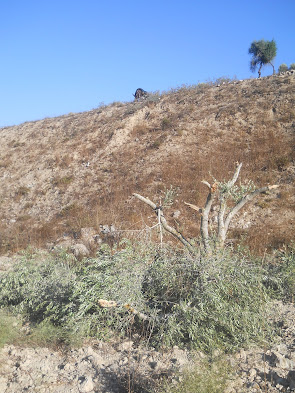 Located seven kilometers southwest of Nablus, Burin is the home to 3000 residents. From every position within the village you can see evidence of the Zionist occupation. Three of the most volatile settlements within the West Bank, Yitzhar, Bracha and Givat Arous reside on the hilltops of Burin. Yitzhar is the largest of the three settlements and was founded in 1984. Yitzhar consists of 1233 dunams and according to Peace Now, 35 per cent of the land is privately owned Palestinian land. The villagers in Burin are predominantly farmers and the fields that surround the village full of olives trees are testament to this. However, the land has been under threat since the start if the occupation in 1967.
Yitzhar settlement is notorious for its fanatically ideological residents, the violence they inflict on neighboring Palestinian communities, and the extremist doctrines they espouse. Settlers have frequently launched attacks with rocks, knives, guns and arson on Palestinian families and property in the area. In one of the most extreme act of terrorism students of the Yitzhar Od Yosef Hai yeshiva fired homemade rockets on Burin in 2008.
Despite West Banks settlements’ status as illegal under international law, Yitzhar was included in the Israeli governments’ recent “national priority map” as one of the settlements earmarked for financial support. Construction has continued unabated in both Yitzhar and Bracha. Yitzhar and Bracha also receives significant funding from American donations, tax-deductible under U.S. government tax breaks for ‘charitable’ institutions.
Related articles
- One year after killings: Iraq Burin continues its struggle (alethonews.wordpress.com)
- Sleepless nights in Burin (occupiedpalestine.wordpress.com)
- 8 injured as settlers stone bus carrying worshipers (alethonews.wordpress.com)
- Settlers of notorious illegal Yitzhar settlement destroy olive trees in Nablus village (occupiedpalestine.wordpress.com)
- Israeli Terrorist set fire to around 130 olive trees in a northern West Bank village (windowintopalestine.blogspot.com)
Featured Video

Meet The Ellisons: Zionists, Technocrats, Moguls
or go to
Aletho News Archives – Video-Images
Frlom the Archives
With apparently fabricated nuclear documents, Netanyahu pushed the US towards war with Iran
By Gareth Porter | The Grayzone | April 29, 2020
President Donald Trump scrapped the nuclear deal with Iran and continued to risk war with Iran based on Israeli Prime Minister Benjamin Netanyahu’s claim to have proven definitively that Iran was determined to manufacture nuclear weapons. Netanyahu not only spun Trump but much of the corporate media as well, duping them with the public unveiling of what he claimed was the entire secret Iranian “nuclear archive.”
In early April 2018, Netanyahu briefed Trump privately on the supposed Iranian nuclear archive and secured his promise to leave the Joint Comprehensive Plan of Action (JCPOA). That April 30, Netanyahu took the briefing to the public in a characteristically dramatic live performance in which he claimed Israel’s Mossad intelligence services had stolen Iran’s entire nuclear archive from Tehran. “You may well know that Iran’s leaders repeatedly deny ever pursuing nuclear weapons…” Netanyahu declared. “Well, tonight, I’m here to tell you one thing: Iran lied. Big time.”
However, an investigation of the supposed Iranian nuclear documents by The Grayzone reveals them to be the product of an Israeli disinformation operation that helped trigger the most serious threat of war since the conflict with Iran began nearly four decades ago. This investigation found multiple indications that the story of Mossad’s heist of 50,000 pages of secret nuclear files from Tehran was very likely an elaborate fiction and that the documents were fabricated by the Mossad itself. … continue
Blog Roll
 Aletho News
- Meet The Ellisons: Zionists, Technocrats, Moguls
- US failures in Iran reveal Russia is key to South Korea’s strategic security
- ‘All ports in Persian Gulf will be legitimate targets if Iranian ports are attacked’
- 40 Years of Endless War, Data Point by Data Point
- Department of War Using Palantir AI to Pick Targets in Iran
- American bases do not protect – they attack the peoples of the Persian Gulf
- ‘We’ve Obliterated Their Missiles’
- Syrian president vows ‘absolute support’ to disarm Hezbollah
- Ukraine attacking Russian gas pipeline to stop deliveries to Europe – Defense Ministry
- ‘Heinous crime’: Iran denounces Israeli assassination of 4 Iranian diplomats in Lebanon
- If Americans Knew
- Israeli strategic plans to “remake the Middle East” from the 1950s and since
- Honoring Gaza’s women who refused to let the world look away
- 97% of victims of war on Iran are Iranian, 98% of victims in war on Gaza are Gazans – Not a ceasefire Day 152
- Early Iran strikes cost $5.6 billion in munitions, Pentagon estimates
- Israel Decided the War, But Trump’s America Fights and Pays the Bill
- Conscientious Objector Group: Phone ‘Ringing Off Hook’ As Huge Mobilization Underway
- U.S. support for Israel continues to plummet, despite media’s best efforts
- Threats and missiles fly, death tolls soar in Iran, Lebanon, Gaza – Not a ceasefire Day 151
- Lebanon: Israel’s White Phosphorous Use Risks Civilian Harm
- Corporate Media Go All Out To Support The US-Israeli War On Iran
- No Tricks Zone
- Destructive Green New Deal: German Energy And Metal Group Warns Of Drastic Crisis
- New Study Documents A 20-Year Pause In Arctic Sea Ice Decline – Driven By Internal Variability
- Wake-up Call: Survey Shows Majority Of Germans Now Favor Postponing Climate Targets!
- Televised! Leading German Political Candidate Tells Schoolchildren CO2 Makes Sun Hotter!
- New Study: A Century Warming Of 1.1°C Is ‘Commonplace’ And ‘Not Unusual’ During This Interglacial
- New Study: ‘Internal Noise’ And Volcanic Forcing Can Trigger 10-15°C Warming Within Decades
- Glaciers Worldwide Are Suddendly Surging, Experts Blame Warming!
- Surprising Discovery: Sahara Is Greening…Billions Of Trees Where Once Thought To Be Barren
- New Research Reaffirms Clouds, Aerosols, And Surface Solar Radiation Are ‘Driving The Climate System’
- Germany: Electric Car Catches Fire At Charging Station, Sets Off Local “Inferno”, Widespread Damage
 Aletho News