Greta Berlin in Salem, MA
By Ariadna Theokopoulos | Deliberation | October 7th, 2012
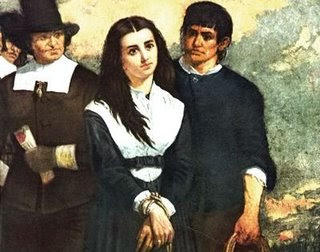
A lucky few had front row seats at Great Berlin’s Oyer and Terminer cybertrial.
The hall was packed and it was standing room only for most attendees.
Hushed whispers, excited twitters, and face-to-face exchanges in the back seats created an ominous droning sound.
“What did she do exactly?”
“You don’t know?! She posted a video.”
“So?”
“No, I mean one of those.”
“No friggingfreespeech way! She didn’t clear it with anyone?”
“No, she claimed it was not supposed to be widely disseminated; she probably knew it might create a furore, but it somehow got sent out of the Freegaza account.”
“But someone said it was just one of those stupid videos that bark up the wrong tree, chewing the old cud about the Jews’ role in the holocaust.”
“No, it is a lot worse. It is one of those provocative videos, like David Duke’s. You know the BDS saying: “You post, you’re toast.”
“That’s an incredibly dumb video though. Like there isn’t enough current stuff to talk about regarding the role of the Jews in the banking collapse, for one thing.”
“That would not be an approved video either. One of these days I swear I’ll see you up there in Greta’s box. Don’t you get it? It can’t be about the Jews, it is only about Israelis, and not all of them, only the bad ones, like Netanyahu.”
“Did she say that she liked the video and approved of its content?”
“That’s another silly question. What’s wrong with you today? It does not matter that she did not say that. It is bad enough that she watched it and/or sent it on. If we all did stupid things like that where would we be? We’d all be watching and reading anything and discussing it!”
We cannot afford to… wait, how did he put it?
“Who?”
“Can’t remember his name exactly Steve Damsel or Hamsel from Jerusalem, formerly from the US. In his blog called Desert Peace he called her “a witch” and said “we can’t afford to alienate anybody.”
“Smart guy. He is right: what kind of protest movement would we be if we upset people?”
“I read Emily Hauser in the Daily Beast. She explained that Greta harms the Palestinian cause and Emily knows her onions. Her Palestinian onions, as it were, because she said she was talking “as a Jew, a Zionist, and an Israeli.” She even added “as a pro-Palestinians activist I’m pretty pissed off.”
“Shhhhhh@! He is coming!”
“Who?”
“Ali Abounimah. Don’t you recognize him by his limp?”
“What happened to him?”
“Atzmon caught his you know what in a revolving door.”
“What ‘you know what’?”
“I don’t know if the word is on the approved list. In Yiddish it’s beitsam. I guess I can say it in Spanish: cojones.
And since you still look clueless I’ll tell you the revolving door was the business with Ali saying culture does not matter.
Well, Atzmon turned the revolving door back on him with Goldhagen or something and Ali has been limping ever since.”
“Oh, no, he’s coming closer to Greta and sniffing her. He can sniff Atzmon on anybody from a mile away. He looks ready to pounce on her.”
“How can he pounce while limping and wrapped in that djellaba?”
“It’s a judge’s robe but he had it cut like a djellaba: makes him look more Palestinian.
“I hear Naomi Klein resigned from the FG advisory board. A way of saying she can’t be associated with an organization that watches videos. Those videos.“
“Who will speak for the accused? Will someone say anything about her contribution, or that doesn’t count? She founded FG, didn’t she?”
“Maybe, but only in the introduction prior to reading her charges. Makes them, you know, balanced.”
“But the Palestinians? I mean the Palestinians in Palestine, especially Gaza?”
“What about them? What do they have to do with this? Leave them out of this discussion. This is far more important. It’s all about racism, that is, its worst form ever, anti-Semitism.
Which is why Ali monitors discussions of a group of 1,000 members or more. You can’t have people flapping their jaws on their own.”
“You’re right. Greta was on probation anyhow. She went off the reservation by saying Atzmon had been ‘demonized.’ I swear that’s the word she used. I think Ali will tear her flesh off the bone, just watch.”
“How do you know?”
“Haven’t you read Harry’s Place? They’re challenging Ali to prove he is not an anti-Semite, and giving him a list of the next candidates for Oyer and Terminer.
Here, read this copy:
“I’m not sure he really believes what he’s saying.
The thing is, Ali Abunimah’s website isn’t much better at all. Abunimah encourages antisemites of similar stock to Greta Berlin, to write for the Electronic Intifada.
Electronic Intifada still lists Sonja Karkar as an author.
…
Electronic Intifada recently published Stephen Salaita.
Stephen Salaita is a fan of the antisemite Gilad Atzmon.
…
Ali Abunimah himself has condemned Atzmon for years for antisemitism. Whilst dismissing Atzmon, Abunimah claimed “We must protect the integrity of our movement”. But he still lets one of Atzmon’s admirers write on his blog.
Abunimah also publishes the antisemite Ben White.”
“Some say this is guilt by association and they say it like there’s anything wrong with it as an accusation. Harry’s Place called Ali a “weird and creepy guy.” Next stop: anti-semitesville. So Ali has to, you know, put out.”
“But why isn’t it starting?”
“They’re waiting for Avi Mayer, you know who he is, the head honcho of the Jewish Agency for Israel.”
“But what is he doing here? He is not FG. In fact he says the Free Gaza Movement endorses violence against Israel.”
“No, in this he is with us. In a manner of speaking. It’s complicated.
At any rate, this is the kind of video that should not be circulated at all, so when the FG deleted it from their tweet account, Avi Mayer used a screenshot he had taken of it and posted it.”
“Why?!?”
“Obvious: so everyone can see what they better not watch and pass around.“
“I am beginning to pity her, if he cross examines her.”
“I know, he is merciless.”
“No, worse: I am told he has a killer halitosis.”
“Quiet now, they’re ready to begin.”
Norman Finkelstein and Neocon Denial
By Stephen J. Sniegoski | The Passionate Attachment | October 7, 2012
While a number of mainstream media pundits have acknowledged that the neocons played a major role in bringing about the war on Iraq (though usually without mentioning their connection to Israel or their predominantly Jewish ethnicity), there are stringent critics of Israel and US policy in the Middle East who totally reject this interpretation. One of the most notable of these is Norman Finkelstein, who expounds on his view in his latest book, “Knowing Too Much.” Because I must limit the length of this article, my argumentation must be kept to a minimum. My book, “The Transparent Cabal: The Neoconservative Agenda, War in the Middle East, and the National Interest of Israel,” provides a detailed and extensively-documented account of all the issues covered here. It should be added that Finkelstein has labeled my book as conspiratorial—which is just the opposite of what the word “transparent” in the title conveys and what is explicitly stated in the book—and he denies that there is any evidence for my contentions. It does not appear that Finkelstein has actually read my book; he probably considers it not worth reading.
Despite denying that the neocons had an effect on US Middle East policy, Finkelstein does grant that the “Jewish neocons pushed long and hard for an attack on Iraq.” (p. 75, “Knowing Too Much”) Contrary to Finkelstein, the very fact that for many years the neocons had been the major exponents of an attack on Iraq, which did become US policy, is at least prima facie evidence for their vital role in bringing about the war. Finkelstein, however, firmly holds that the neocon agenda was irrelevant to US policy, and that what was achieved was done by others and would have occurred even if the neocons had not existed.
Finkelstein does accurately point out that “Every reconstruction of the 2003 war places Cheney and Rumsfeld at the helm of the decision-making process.” (p. 76, “Knowing Too Much”) Then he devotes some space to refuting John J. Mearsheimer and Stephen M. Walt’s alleged insinuation that the two officials were “duped” by the neoconservatives. (The two academic scholars wrote the bombshell essay, “The Israel Lobby and U.S. Foreign Policy,” later expanded into a book. And I should add that it is not apparent from my reading of their book that Mearsheimer and Walt necessarily imply that Cheney and Rumsfeld were “duped.”) Finkelstein maintains that “Cheney and Rumsfeld did not only partake of the ‘belief’ of Jewish neoconservatives that Saddam posed a mortal danger. Their own ‘American nationalist’ strategic vision also largely coincided with the neoconservative agenda.” In essence, they “shared basic assumptions.” (p. 78, “Knowing Too Much”) From these claims, which I would qualify but not fundamentally differ with, Finkelstein manages to derive the idea that Cheney and Rumsfeld were not influenced by the neocons, but somehow came up with the same war agenda independently. Evidence would indicate that this is highly unlikely to have been the case.
Undoubtedly, Cheney and Rumsfeld, rather than being tricked by the neocons, were in league with them, but it also seems almost certain that they were actually influenced by the neocon agenda. For Rumsfeld and, even more so, Cheney were personally close to the neocons. Prior to the start of the George W. Bush administration, Cheney, for example, was involved in a number of key neoconservative organizations: the board of advisors of the Jewish Institute for National Security Affairs (JINSA); the board of trustees of the American Enterprise Institute (AEI); and the Project for a New American Century (PNAC). It would seem reasonable to believe that, instead of independently fashioning their own “strategic vision” that harmonized completely with that of the neocons, Cheney and Rumsfeld were influenced by the neocons’ well-developed positions, including specific strategies for action, which meshed with their own more general foreign policy attitudes—e.g., a proclivity for unilateral, aggressive action.
Although Cheney had for years identified with a tough-minded, militaristic foreign policy, he had, as Secretary of Defense, loyally adhered to the George H.W. Bush administration policy in 1991 of eschewing an occupation of Iraq, and continued to identify with that position after the end of the administration. As late as a 1996 interview for a documentary on the 1991 Gulf War for PBS’s “Frontline” program, Cheney declared: “Now you can say well you should have gone to Baghdad and gotten Saddam, I don’t think so [rather] I think if we had done that we would have been bogged down there for a very long period of time with the real possibility we might not have succeeded.”
In short, it seems reasonable to conclude that during the latter 1990s, Cheney was persuaded by neocon claims backed by numerous facts and factoids that Saddam was dangerous—though whether he really believed that Saddam was a “mortal danger” is questionable—and that his removal would be good thing for the United States that would outweigh the costs of a war. Although Cheney undoubtedly must have realized that the neocons had cherry-picked and exaggerated the intelligence claims, his involvement in the highest levels of government and partisan politics for many years had habituated him to having the truth twisted to advance policy goals.
Furthermore, Cheney was known to pick up newer views expressed in conservative circles that entailed marked changes in his actual policy prescriptions, though leaving his overall conservative attitude unaffected. For example, in regard to economic policy, he moved from being a budget-balancer to a supply-sider willing to tolerate large budget deficits. (Barton Gellman, “Angler: The Cheney Vice Presidency,” 2008, pp. 257-259) And, as Vice President, Cheney specifically relied on advice from the eminent historian of the Middle East, Bernard Lewis, a right-wing Zionist and one of the neocons’ foremost gurus, who strongly advocated war against Iraq and other Middle Eastern states. (Gellman, “Angler,” p. 231) So while the neocon Middle East war agenda did resonate with Cheney’s general militant stance on foreign policy, there is little reason to think that he would have come up with the specifics of the policy, including even the identification of Iraq as the target, if it had not been for neocon influence.
The influence of ideas per se was not the only factor that likely motivated Cheney. The fact that Cheney and his wife, Lynne, who was with the American Enterprise Institute (known as “neocon central”), had close personal and professional relations with the neocons also would have predisposed him to give his support to the neoconservatives and their agenda.
There is certainly no inherent reason why “American nationalists” (as Finkelstein styles Cheney and Rumsfeld) qua “American nationalists” would identify with Israeli interests and pursue wars in the Middle East against the Islamic states. If global power were the American nationalist goal, one could easily argue that supporting the Islamic world would best serve its advancement. For by pursuing such an alternative policy, the United States would have the support of the major oil-producing region of the world. And if the more than one billion Muslims were friendly to the United States, they could be used, if such a weapon were necessary, to undermine America’s most powerful military adversaries—Russia and China—since both have restive Muslim populations.
It should be noted that representatives of the “realist” camp of foreign policy, which focuses on concrete national interests rather than ideals—and includes such luminaries as Brent Scowcroft, National Security Advisor for George H. W. Bush; James Baker, Secretary of State for George H. W. Bush; and Zbigniew Brzezinski, National Security Advisor to Jimmy Carter—did not push for the war on Iraq, and Brzezinski and Scowcroft openly opposed it.
Furthermore, large numbers of nationalist conservatives, such as Pat Buchanan and other traditional conservatives, have opposed globalist American intervention and believed from the outset that wars in the Middle East were not in America’s interest. These conservative nationalists had supported a hard-line Cold War policy long before the neoconservatives came onto the scene—though while opposing Communism they were wary of American global involvement, especially nation-building, perceiving the global policy against Communism as a something of a necessary evil. During most of the Cold War, they had been the dominant face of American conservatism, but the neocons, by the end of the 1980s, would achieve a leading position in the conservative movement. They quickly purged or marginalized those who dissented from their positions, especially in regard to Israel, and mainstream conservatism itself was transformed in a neoconservative direction, a change which has been lauded by the neocons and lamented by those purged and marginalized conservatives and their followers, now called paleoconservatives. The upshot of all of this is that being an “American nationalist” did not ipso facto make one a supporter of the neoconservative Middle East agenda, as Finkelstein would imply.
Being in charge of the incoming Bush administration transition team, Cheney used that position to staff national security positions in the government with his neocon associates. While the neocons could not actually make the ultimate decisions in the Bush administration, they were in sufficiently authoritative positions inside the administration to influence the decisions that would be made. And the anger and fear resulting from the 9/11 terror attacks enabled the neocons, with their already existing war agenda, to markedly increase their influence in the administration. Significantly, the administration’s neocons were not only providing what was regarded by President Bush as expert advice but, as mentioned above, they also cherry-picked the spurious intelligence that depicted Saddam Hussein as a threat to the United States.
The formidable power of the neoconservatives in the Bush administration derived from the fact that they worked in unison to advance their war agenda and override and marginalize all opposition. Not only was there no consensus for war in the foreign policy and national security components of the executive branch, but crucial aspects of the neocon war agenda were opposed by significant elements of the military brass, the State Department, and the CIA.
Bob Woodward in his “Plan of Attack” (p. 292) notes that Secretary of State Colin Powell saw a “separate little government,” consisting of “Wolfowitz, Libby, Feith,” and what Powell privately called Feith’s “Gestapo office.” According to Colonel Lawrence Wilkerson, who served as Powell’s chief of staff, “There were several remarkable things about the vice president’s staff. One was how empowered they were, and one was how in sync they were. In fact, we used to say about both [Rumsfeld’s office] and the vice president’s office that they were going to win nine out of ten battles, because they are ruthless, because they have a strategy, and because they never, ever deviate from that strategy . . . . They make a decision, and they make it in secret, and they make [it] in a different way than the rest of the bureaucracy makes it, and then suddenly foist it on the government – and the rest of the government is all confused.”
Regarding the concomitant loss of power by the State Department, Wilkerson remarked: “I’m not sure the State Department even exists anymore.”
Also of vital importance was a cohesive neocon network outside the Bush administration, which helped to mobilize crucial public support for the war. Social anthropologist Janine R. Wedel in her book, “The Shadow Elite: How the World’s New Power Brokers Undermine Democracy, Government, and the Free Market,” provides a detailed description of the neoconservatives as an example of an interlocking network of organizations, agencies, and think tanks united behind a shared agenda that was capable of driving government policy.
It seems apparent that without all-out support from the neocon network, Cheney and Rumsfeld could not have brought about the attack on Iraq, even if that had been their goal. For the neocon network had to overcome significant opposition to achieve the implementation of their war agenda, as well as generate public and congressional support for war. For example, the neocons had championed Ahmed Chalabi and enabled much of his spurious intelligence to receive the imprimatur of the US government—though the established intelligence community regarded him as a con man.
Although Cheney and Rumsfeld could not have brought off the war without the neocon network, those two were not indispensable to the neocons, who could have likely achieved war with other individuals at the helm. For example, the hawkish pro-Israel John McCain was the favorite Republican candidate for numerous neocons in 2000 (and, of course, was the Republican presidential nominee in 2008). Given McCain’s penchant for neoconservative foreign policy advisors, his advocacy of forcible regime change in Iraq prior to 2001, and his staunch support for the attack on Iraq during the war build-up (and his later hawkishness on Iran), there is no reason to think that a President McCain, surrounded by neocon advisers, would have avoided a war on Iraq.
Nothing of what I have written is intended to imply that the neoconservatives were the sole cause for the war on Iraq or that they single-handedly drove the country to war. While neoconservatives spearheaded the war on Iraq, and without the neoconservatives the war would have been highly improbable, they obviously needed auxiliary support, in which category I would include Cheney and Rumsfeld. Most significantly, the 9/11 terror attacks created the ideal milieu to generate government and popular support for such a military endeavor, as those attacks certainly enabled the neocons’ Iraq war agenda to move to the forefront in the Bush administration. Without the popular fear and anger generated by the 9/11 attacks, it is unlikely that the neocons would have been able to successfully promote a war on Iraq. Nonetheless, the neoconservatives were the primary actors. It was they who created the war agenda, and it was they who played a key role in its implementation.
Indigenous Guatemalans want justice for 6 dead
Press TV – October 6, 2012
Clashes between Guatemalan security forces and thousands of indigenous people holding a demonstration against rising electricity prices in a poor rural area west of the capital have left six people dead.
On Friday, thousands of people attended the funeral processions of the six peasants who died on Thursday. The mourners shouted “Justice! Justice!”
“We’ve determined that the number of people who died rose to six,” said Ana Julia Solis, a spokesperson for the national human rights prosecutor’s office.
The government said demonstrators were blockading a highway near the town of Totonicapan, about 170 kilometers west of Guatemala City, when unidentified gunmen opened fire, killing six people and injuring 34. However, local activists said soldiers and police killed the protesters.
At a press conference on Friday, Guatemalan President Otto Perez said the military was not involved in the killings, adding that he had information that attackers in a civilian truck opened fire on the demonstrators.
Related articles
- Guatemala demonstrators killed while protesting electricity rates (alethonews.wordpress.com)
Israeli police smash boy’s head to the ground in Aqsa incursion
Al Akhbar | October 6, 2012
A video has surfaced showing Israeli police smashing a teenage boy’s head to the ground during an incursion into the revered Aqsa compound in Jerusalem Friday. Police had fired tear gas and stun grenades at a group of worshipers Friday protesting the entry of illegal Jewish settlers into Islam’s third holiest site earlier this week.
The video exposes further the brutality of Friday’s attack where witnesses reported several arrests and some injuries. It shows a boy being dragged across the ground, and pinned down as he screams “Khalas”, or enough. Police then punch his head against the stone floor in a swift and forceful swing of the arm.
Many youth and injured sought refuge in the Haram el-Sharif mosque, or Dome of the Rock, as police clad in black stood stationed around it during the incursion.
Reuters reported that protesters hurled stones at police during their protest, and Israeli police spokesman Micky Rosenfeld claims that one of the demonstrators tried to stab a police officer and that only one Palestinian was arrested.
Israelis have made repeated threats to demolish the Aqsa mosque, considered the third holiest site in Islam, in order to build a Jewish temple in its stead. The move would accelerate redemption, according to some Jewish religious authorities.
Some thirty illegal Jewish settlers toured the compound this week under heavy police protection, a move that has been interpreted by Palestinians as an attempt to assert Israeli claims to the site, named Temple Mount in Jewish tradition.
Solidarity Ship Sailing to Gaza
IMEMC News | October 6, 2012
The Helsingin Sanomat Swedish paper reported that Estelle, a Swedish-owned ship sailing under a Finnish flag, is on en route to the besieged Gaza Strip carrying tons of aid supplies to the besieged coastal region.
The ship used to be owned by the Estaas Aid Organization in Finland, and was sold to the Swedish “Ship To Gaza” solidarity group last winter.
17 persons, including Swedish and Norwegian nationals, will be trying to reach Gaza to deliver construction materials in addition to humanitarian and medical supplies
The solidarity activists said that they are well aware of the fact that Israel’s Navy will likely attack them and prevent them from reaching Gaza, but said that the main aim of this trip is to raise awareness to the fact that the coastal region is still under Israeli siege.
The ship will likely arrive close to the Gaza shore, an area Israel considers as restricted, by October 20.
As part of its illegal blockade on Gaza, Israel’s naval blockade extends to 20 nautical miles (around 37 kilometers) from the coast of Gaza, but previous Israeli attacks against solidarity ships were carried out as far as 65 kilometers from the shore.
Related articles
- Former Member of Parliament joins ship to Gaza: ‘Time for Canadian politicians and people to speak up’ (alethonews.wordpress.com)
Digging a hole? 12,000 S. African striking miners sacked ‘in absentia’
RT | October 5, 2012
Up to 12,000 employees of Anglo American Platinum received messages Friday saying they were fired. The mining powerhouse dismissed the workers after a three-week strike. The labor stand-off has already taken 48 lives across South Africa since August.
The news was broken to the employees via SMS and emails.
Commenting on the move, Amplats declared miners had failed to appear before disciplinary hearings “and have therefore been dismissed in their absence.” The miners had been warned that would happen if they failed to turn up, the company said.
The world’s largest platinum producer says its lost over $80 million in revenues since a major strike gripped their mines in mid-September, involving at least 20,000 miners.
“Despite the company’s repeated calls for employees to return to work, we have continued to experience attendance levels of less than 20 percent,” the firm said in a statement quoted by Agence France Presse.
Strike leader Gaddafi Mdoda was one of the those fired on Friday. He says that even if Amplats no longer employs them, this is no reason to end the struggle. The mineworkers are demanding 12,500 rand (about $1,500) in take-home salary, their current wages are reported to be around $500.
Amplats says they still continue “exploring the possibility of bringing forward wage negotiations within our current agreements”.
The sackings came hours before another striking miner was mortally wounded in clashes with police, bringing the total number of protesters killed since strikes began in August, to 48. Police would not confirm the cause of death, but protesters say he was shot with a rubber bullet.
The strikes peaked at over 75,000 participants, or 15 percent of workforce in the mining sector. Clashes with police often turned violent, involving tear gas, rubber bullets and water cannon. In a single day thirty-four strikers were killed by police at Lonmin’s Marikana platinum mine, on August 16.
Despite the growing tensions, negotiations with mine owners don’t appear to be yielding any substantial results. A rare breakthrough was reached at the Lonmin platinum mines, where the worst violence broke out, with salaries being boosted 22 per cent. But on Thursday, South Africa’s Chamber of Mines, the main industry body, said wage talks will not be based on that precedent. This may force coal miners to join platinum, gold, iron ore and diamond miners in further work stoppages.
Israeli army turns Palestinian homes in Hebron into military barracks
MEMO | October 4, 2012
 The Israeli occupation forces have turned the roofs of Palestinian homes in the ancient city of Hebron, south of the West Bank, into military barracks and control points under the pretext of providing security for Jewish settlers during the Hebrew celebrations of the Sukkot Feast.
Human rights sources in the Hebron Rehabilitation Committee reported that a large number of Israeli forces took over the roofs of several Palestinian homes along the lanes of the old town. These houses, including the family home of the Islam Al-Fakhouri in Al-Sahla area, have been turned into military barracks and control towers while the families have been forced to leave.
Israeli soldiers also commandeered the roofs of the Abdulmutallab Abu Sunaina, Imran Abu Rumaila, Daoud Jaber, Nader Salaymeh and AliAl-Rajabi households turning them into control points.
Sources also point out that the regions extending between the settlement of Kiryat Arba, the Cave of the Patriarchs, Tel Rumeida, Al-Shuhada, Al-Ras, and Wadi El-H’aseen streets; and the areas of Al-Masharqa Al-Fawqa and Tahta, are subjected to a blanket Israeli police and army presence.
Related articles
- Army Kidnaps Two Palestinians In Hebron (imemc.org)
- Soldiers Kidnap A Child In Hebron (imemc.org)
- Israeli high court rejects south Hebron village petition (alethonews.wordpress.com)
- Jewish Settler’s Vehicle Rams Child in Hebron Hit and Run (alethonews.wordpress.com)
- Soldiers Physically Attack Palestinian Youth In Hebron (alethonews.wordpress.com)
- Jewish Settlers Invade Palestinian Home In Hebron, Attack Family Members (alethonews.wordpress.com)
- Four Residents, Including Two Children, Kidnapped By The Army In Hebron (imemc.org)
- Hebron: Soldiers invade Kultuba School, attempt arrest 2 sixth grade students (occupiedpalestine.wordpress.com)
- Soldiers Kidnap A Child playing near the Ibrahimi mosque In Al-Khalil (occupiedpalestine.wordpress.com)
SOPA Is Dead, Says MPAA’s Chris Dodd, But What Comes Next?
By Parker Higgins and Trevor Timm | EFF | October 4, 2012
Earlier this week, Chris Dodd, a 30-year veteran of the Senate and now chairman and CEO of the Motion Picture Association of America (MPAA), spoke in San Francisco at an event aimed at addressing “the shared future of the content and technology industries.” It’s a testament to the continuing impact of January’s blackout protests against Stop Online Piracy Act (SOPA) that Dodd should frame the discussion this way, and his conciliatory words during the talk struck a refreshing tone. But given that less than a year ago he was the nation’s leading advocate for a bill that would have censored large parts of the Internet, there’s still a long way to go.
Dodd made many positive comments during his speech, voicing strong support for freedom of speech online and calling on the content industry to move away from criminal actions against file-sharers. He also conceded that SOPA and PIPA are “dead,” and when pressed by EFF in discussion afterwards, he was emphatic that his organization no longer wanted to pursue legislation as the solution to the problems purportedly facing the content industry.
But let’s not forget that he serves as the chairman and CEO of one of the most influential lobbying groups in Washington, and that the actions of the industry have yet to back up his rhetoric. In fact, the evidence suggests the opposite is true.
After all, his words stand at odds with a statement in April that he was “confident” negotiations on SOPA 2.0 were taking place, and the MPAA is again distributing talking points to members of Congress touting copyright maximalism. We also know SOPA’s author Lamar Smith tried to re-introduce components of that bill again in July. And even now, the content industry’s “six strikes” agreement with ISPs is moving forward, and US Trade Representatives are secretly negotiation dangerous new copyright rules into international agreements like the Transpacific Partnership Agreement (TPP).
Dodd’s statements, such as “I would do anything and everything I could to protect the vitality of the internet,” stand in stark contrast to the content industry’s advocacy for the due-process-free domain name seizures conducted by Homeland Security during the past two years. Websites accused of copyright infringement on flimsy evidence were censored for a more than a year before the Justice Department abandoned the cases with no explanation. The Justice Department’s prosecution of Megaupload, a case now falling apart, also led to many innocent people losing property they stored online.
Unfortunately, Dodd’s most impassioned advocacy for the First Amendment came not when sticking up for the Internet, but when defending his job lobbying. The man who once pledged he would not become a lobbyist when he left the Senate, said freedom of speech is “critically important” because it allows lobbyists — now “experts” in his view — to inform legislators about the issues. But when members of the public speak out in one of the largest grassroots efforts in US history, Dodd and the MPAA derided it as a “stunt” and a “gimmick” and accused companies that participated in the protest of an “abuse of power.”
But more broadly, Dodd’s speech indicated that the MPAA and other content groups still remain fiercely opposed to evidence-based policy-making, in legislation and other areas. Even as Dodd pulled the heartstrings with stirring words about the middle-class jobs that the entertainment industry creates, he continued to cite bogus stats about the industry. Repeatedly he referred to the 2.1 million such jobs, despite the fact that the Congressional Research Service has pegged the number at around 374,000 — an order of magnitude off. Blatantly bogus numbers like these have become a hallmark of the content industry efforts to pervert the copyright system, so much so that the Government Accountability Office recommended other government bodies should stop citing MPAA-backed studies.
Dodd’s speech echoed the recent messages from other content industry representatives: the content and the tech industries have to work together, not as adversaries, to make “an Internet that works for everyone.” Here again, the disregard for ordinary users makes a nice commitment ring hollow. For one thing, the content industry missed plenty of opportunities before introducing SOPA and PIPA to get input from Internet users and the tech industry. They even refused to show up at the negotiating table when the tech industry was willing to work with them. But more fundamentally, Hollywood’s new rhetoric reframes “innovation” as “innovation by permission” — and the public is worse off for it.
The fundamental goals of copyright are sound: it’s a good thing when policy promotes the progress of science and the useful arts. But by continuing to reject evidence about how copyright works, by relegating freedom of speech to economic concerns, and by leaving the public out of the discussion, Dodd and the MPAA are working against those noble goals.
10 Shocking U.S. Police Brutality Videos Caught on Surveillance Cameras
By Clint Henderson – This Can’t Be Happening – 10/04/2012
This top 10 list is controversial, and not for the faint of heart. These unnerving videos include police officers and their unwarranted BEAT-DOWNS of the following: a special-ed kid, a grandmother trying to pay her bills at a Hooters, a homeless man with schizophrenia, and a woman already handcuffed and at the police station who had just gotten in a car wreck (no alcohol involved)… to name a few. Do these cops truly believe they are above the law? You decide:
10) Greenville County Police taser and punch 18-year-old in the face 13 times (Sep 26, 2009)
Greenville, SC – An 18-year old beaten over and over by an undercover police officer. As you watch and count the punches, you feel like “Wow, is he ever going to stop…?” Yes, the kid was at a known drug house and was possibly buying drugs or maybe had some sort of connection with drugs, but damn! As a user he’s actually more a victim than a perp.
9) LAPD Officers Slam Defenseless Cuffed Woman to Ground (August 29, 2012)
A security camera from Del Taco captured this footage of a nurse, Michelle Jordan, being pulled over on a routine traffic stop (she was texting on her cell-phone while driving) and handled quite excessively by two officers. Fast-forward to view the bruises on her face and body brought on by the police officers use of excessive force. Note the officers, who included a 20-veteran with the rank of commander, fist-bumping after each man had tackled her.
8) Police Officer Attacks Grandmother at Hooters (Nov 18, 2010)
Fast forward to about 1:00 in the clip to see where the off-duty police officer starts getting rough with this grandmother and Hooters patron in Oak Lawn, Illinois. It all started over an issue with the bill, which got completely out of hand.
7) Denver Police Brutality Caught on Tape, Camera Pans Away… (August 17, 2010)
The video surveillance you see here was actually recorded by the police officer’s own equipment. Knowing that, it’s very interesting how the camera pans away, just as the officer begins pummeling the innocent bystander talking on his cell phone.
6) Officer Beats Special Ed Student Over an Un-tucked Shirt (Oct 27, 2010)
A special needs kid, 15-year old Marshawn Pitts, was at the wrong place at the wrong time in Dolton, Illinois. What began as verbal abuse over something as silly as his shirt not being tucked in, led to strong physical abuse and a broken nose at the hands of an “unidentified police officer”.
5) Houston Police Beat Handcuffed 15-Year-Old Boy (Feb 7, 2011)
The end of a pursuit is caught on a security camera, where 15-year old Chad Holley falls on the ground and surrenders. I don’t think the cops want it to be that easy on him… Watch while he lays there with his hands on top of his head only to get kicked about a hundred times and have his head stomped in.
4) Rhode Island Police Officer Kicks Woman in Handcuffs (Sep 2, 2012)
Here we have a 2009 case where a Rhode Island police officer (Edward Krawetz) kicked a woman in the face, while she sat handcuffed on the ground. The video surveillance only recently went public. Officer Krawetz was convicted of “felony battery with a dangerous weapon” and sentenced to a 10-year suspension — an unusually stiff response to police brutality, which is probably only because the incident was recorded. Significantly, this was actually not his first assault charge (the other’s weren’t recorded).
3) Police Turn Off Security Camera and Beat Woman to Bloody Pulp (Sep 23, 2009)
This woman was taken into the police station under “suspicion of DWI.” She had just gotten in a wreck and the police assumed that alcohol was involved. Fast forward and you’ll see the Shreveport, Louisiana officer turn off the surveillance camera and when it comes back on, you’ll notice the woman lying in a pool of her own blood.
2) Kelly Thomas – Fatal Police Brutality of Homeless Man with Schizophrenia (May 8, 2012)
Kelly Thomas is a schizophrenic drifter who was tased and brutally beaten to death by officers Manuel Ramos and Corporal Jay Cicinelli. It was recorded using surveillance video taken from the Fullerton, California, Transportation Center.
1) Eugene Gruber – Police Brutality and Killing: Jail Security Footage – Chicago (Apr 18, 2012)
Talk about scary. This Chicago Tribune article says it best:
“Eugene Gruber was drunk, hostile and uncooperative when he walked into the Lake County Jail, but a day later, he was paralyzed, had a broken neck and barely registered a pulse after an encounter with guards, records show”
Featured Video
Total War – Attacking Nuclear Plants, Desalination & Infrastructure
or go to
Aletho News Archives – Video-Images
From the Archives
The Heirs of Meyer Lansky Want Compensation from Cuba. They Shouldn’t Get a Dime.
By Jack Colhoun | History News Network | June 19, 2016
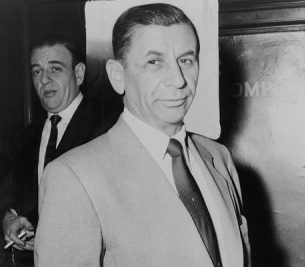
Meyer Lansky
The heirs of Meyer Lansky, the impresario of the North American Mafia gambling colony in Cuba (1933-1958) are betting on a big payback from the negotiations between the United States and Cuba to normalize relations between the two countries. Compensation claims by U.S. citizens or businesses for properties nationalized by the Cuban revolution are among the issues under discussion.
Lansky’s daughter Sandi, her son Gary Rapoport, and her brother Paul have filed a compensation claim against Cuba for the Riviera Hotel and Casino with the U.S. Foreign Claims Settlement Commission. The Cuban revolution confiscated the Riviera and other Mafia-owned properties after it toppled the gangster-linked regime of General Fulgencio Batista in 1959.
“It was through my grandfather’s hard work that the hotel was built,” Rapoport told the U. K. Daily Mail Online on December 23, 2015. “We are his natural relations . . . . By right, it should be our property.” He says the Riviera is valued at $70 million. The Tampa Bay Tribune, Reuters, and Haaretz have also covered the story.
The Riviera, which overlooks the Straits of Florida, was the crown jewel of Lansky’s casinos, hotels, and nightclubs in Havana. When the Riviera opened in December 1957, it was the largest Mafia-owned hotel-casino outside Las Vegas. The hotel’s 440 double rooms were booked solid for the winter season of 1957-1958.
However, the narrative that the success of the Riviera was the product of Meyer Lansky’s “hard work” is undercut by Lansky’s own assessment of his arrangement with Batista. … continue
Blog Roll
 Aletho News
- Seyed M. Marandi: Total War – Attacking Nuclear Plants, Desalination & Infrastructure
- Israel systematically torturing Palestinians in custody: UN special rapporteur Albanese
- How the US-Israeli aggression against Iran is affecting the war in Ukraine
- Italy Is Caught Between Two Wars. Russia’s LNG Tanker
- Iran Beats US & Israeli Missile Defenses by Exploiting Their Weaknesses
- Report: White House Making ‘Detailed Preparations’ for Invasion of Iran
- US Air Defenses Not Suited for Modern Combat — Ex-Air Force Officer
- Eight Iraqi resistance attacks hit US Victoria base near Baghdad airport
- US Dirty War Iran Revelations 2026: Ex-Counterterrorism Chief Joe Kent Exposes Proxy Strategy
- Iran’s Dimona Strike Shatters Myth of ‘Impenetrable’ THAAD, Patriot & Arrow Air Defenses – Analyst
- If Americans Knew
- Lebanon deaths top 1,200; Palantir AI to be embedded across US military – Not a ceasefire Day 163
- Israel’s assassination game: Take all pragmatists off the board
- Food shortages return to Gaza as Israel tightens aid restrictions under the cover of its war on Iran
- Trump demands trillions in payments from Gulf countries, billions from Harvard – Not a ceasefire Day 162
- Meet the former fashion blogger and shady doctor behind the ‘30,000 dead’ Iran psy-op
- Vatican Secretary of State to Trump, Israel: End the war as soon as possible
- The Majority of Americans Believe War Against Iran Benefits Israel More Than US
- Efforts to shut down pro-Palestinian speech face series of setbacks in court
- What has Israel done to my brother?
- Eid without worship in Al Aqsa – Not a ceasefire Day 161
- No Tricks Zone
- Former Pfizer Toxicologist Dr. Helmut Sterz Tells Bundestag Hearing Pfizer Vaccine Should Have Never Been Approved
- Energy Expert: Germany’s Nuclear Phaseout Was A “500 Billion Euro Mistake”
- New Research: South Australia’s Mid-Holocene Sea Surface Temperatures Were 4°C Warmer Than Today
- Storing Green Energy To Last Germany 10 Days Would Require A 60-Million Tonne Battery
- New Studies: UK Sea Levels Were 4 Meters Higher Than Today During The Mid-Holocene
- Destructive Green New Deal: German Energy And Metal Group Warns Of Drastic Crisis
- New Study Documents A 20-Year Pause In Arctic Sea Ice Decline – Driven By Internal Variability
- Wake-up Call: Survey Shows Majority Of Germans Now Favor Postponing Climate Targets!
- Televised! Leading German Political Candidate Tells Schoolchildren CO2 Makes Sun Hotter!
- New Study: A Century Warming Of 1.1°C Is ‘Commonplace’ And ‘Not Unusual’ During This Interglacial
 Aletho News