Ending UK nukes ends housing problems: Campaign for Nuclear Disarmament
Press TV – November 29, 2012
British anti-nukes campaigners are pressuring the government to change course on replacing its Trident nuclear weapons system at an annual cost of £3 billion and rather spend the money on housing.
Campaign for Nuclear Disarmament (CND) said £3 billion is enough to build 30,000 homes in Britain every year that would fully eliminate the country’s need to build extra homes for social housing while creating 60,000 new jobs each year.
“Around 30,000 extra homes need to be built in the UK every year to meet the need for social housing. This would cost about £3 billion annually. £3 billion is what this country is currently spending every year on nuclear weapons,” the campaign group said.
“It’s a straight swap, homes or bombs. That’s why we’re calling on the government to get rid of Trident and build homes instead,” it added.
The CND has also launched a letter-writing campaign to British Chancellor George Osborne ahead of the December 5 parliamentary announcement on the way forward for the economy to pressure him to change policy on Trident.
This comes as Britain is pushing full steam ahead with a Trident replacement plan that the CND earlier estimated to cost the country more than £100 billion.
British Defense Secretary Philip Hammond has announced a multi-million pound contract worth £350 million for a new generation of nuclear missile submarines.
The £350 million contract is part of the £3 billion awarded last year to giant arms producer BAE Systems to pursue work on a new Trident fleet.
The British coalition government’s junior partners in the Liberal Democrat camp are also opposed to the Conservative-led plan for a like-for-like replacement for Trident.
Lib Dems argue that the justifications for keeping an equal to the submarine-launched Trident nukes are now lacking as the system was designed to counter the threats from the Soviet Union, which has ceased to exist for over two decades.
Trident, which is based in Clyde, Scotland, also faces another challenge from the Scottish National Party (SNP) that says it does not want the nukes on Scotland’s soil if they can secure independence in the coming years.
Related articles
- UK to announce new Trident nukes contract (alethonews.wordpress.com)
- Our best chance to get rid of nukes (morningstaronline.co.uk)
- Nicola Sturgeon accuses UK government of ‘dumping’ WMDs on the Clyde (scotsman.com)
- Con-Dems put extra £350m into Trident (morningstaronline.co.uk)
- Politics News: Protestors gather outside Senedd to voice nuclear concerns (walesonline.co.uk)
Obama and GOP Play Tag Team on Entitlements
A Black Agenda Radio commentary by Glen Ford | November 27, 2012
It seems that every breathless moment of corporate media news is choreographed to convince Americans that austerity is as inevitable as tomorrow’s weather. The objective of this con game is to gut Social Security, Medicare and Medicaid. The two principle parties engaged in negotiations – the White House and congressional Republican leaders – are both agreed that entitlements must be put under the knife. The “grand bargain” that both Obama and the GOP seek has already been made, in principle. Austerity is the common language and goal of the talks, and nobody that counts in the discussions is defending entitlements.
There is only one problem: the vast majority of Americans oppose cuts in Social Security, Medicare and Medicaid.
This is the great difficulty facing both Obama and the Republicans: the fact that the public favors the maintenance and even expansion of the meager U.S. social safety net. The disagreement, the great debate, is not between Republicans and the White House, who both agree on putting entitlements on the chopping block. The disagreement is between strong majorities of the American people, who want no tampering with the three entitlement programs, and Obama and his Republican friends, who are hell bent on so-called entitlement “reform.”
This is not a fight between the two parties; it is a choreographed beat-down of the American majority by corporate Democratic and Republican thugs, aided by shrieking corporate media banshees screaming, Watch out for the cliff, Watch out for the cliff!.
The “grand bargain” was struck back in the summer of 2011, when both sides agreed on roughly $4 trillion in cuts. The agreement only unraveled because a presidential election was drawing near, and the two parties needed to pretend that they were separated by vast political differences. Now that the election is over and the verdict is in, corporate Democrats and Republicans can abandon the pretense of a great ideological divide, and return to their shared mission of cutting entitlements. Both hide behind the phony “fiscal cliff” to convince the public that the pending theft of entitlements is an unstoppable act of nature, rather than a conspiracy of corporate henchmen, against the clear wishes of the majority of Americans.
Robert Reich, the liberal former Labor Secretary in President Bill Clinton’s administration, says that Obama is not behaving like a president who is serious about facing down the Republicans. If he were, Obama would let the Bush tax cuts die at the end of this year, and then have Democrats introduce new tax cuts for the middle class. The president could dare the Republicans to hold middle class tax cuts hostage to cuts for the rich. In that kind of face-down, Obama would likely win.
But Obama is not trying to outmaneuver Republicans; he and the GOP have teamed up to stampede the public – the suckers in this game – into giving up their entitlements. As David Swanson puts it, we are not witnessing the making of a grand bargain, but a “grand catastrophe.”
Minneapolis Congressman Keith Ellison, the Black co-chairman of the Congressional Progressive Caucus, says he and the other 75 members “are not going to allow the most vulnerable Americans to shoulder the burden of this fiscal problem.” But the left wing of the Democratic Party can only stop the forces arrayed against entitlements by actively opposing their own president, who is playing austerity tag team with the Republicans. And the so-called progressives don’t have it in them.
Glen Ford can be contacted at Glen.Ford@BlackAgendaReport.com.
Israel’s War on Palestinian Children
By VIJAY PRASHAD | CounterPunch | November 29, 2012
On 18 November, the Israeli armed forces bombed a house and killed the al-Dalou family, all ten members that were present and two neighbors. When the dust and fires settled, it became clear that amongst the dead were five children and five women. Among them was Mohammed Jamal al-Dalou, 29, who his neighbors said worked at a grocery store. The Israeli military said at the time that there was an error: either its ground operatives failed to laser-paint the correct target or its munitions misfired (as reported by Gili Cohen at Ha’aretz). Hamdi Shaqqura of the Palestine Centre for Human Rights in Gaza noted, “There is now a complete disregard for human life, shown by the attack on the Dalou family home in the middle of a residential area. This was not the home of a militant.”
Now, with the ceasefire in place, the Israeli military’s spokesperson Lt. Col. Avital Leibovich has reversed the Israeli view. “There was no mistake from the IDF,” she noted. “It’s tragic when a terror operative is hiding among civilians but unfortunately it is part of Hamas and Islamic Jihad tactics.” The Israelis now say that al-Dalou was a member of the police unit of Hamas charged with the security detail for high-level officials. In other words, al-Dalou sounds like a functionary of the Hamas organization. The Israelis are not saying that he was part of the military wing, let alone was part of any unit that had either done or planned to undertake any kind of operations in Israel. At most, al-Dalou was a Hamas bodyguard and driver. His terror level is even lower than that of Salim Hamdan, Osama Bin Laden’s driver who was acquitted by a US appeals court in mid-October.
It is contrary to the customs of war to bomb civilian areas. The jargon of warfare (Proportionality and Distinction) makes it clear that the threshold for prevention of civilian casualties must be very high and the imminent threat from the person being targeted must be demonstrable. The attack on the Dalou home meets none of these tests. Mohammed al-Dalou was at home, not “hiding among civilians,” as the Israeli spokesperson put it. The IDF bombed his home, knowing that his family would be inside. To have bombed a family as they cowered in their home is reminiscent of the Israel’s Dahiya Doctrine, so baldly enunciated by Israel’s General Gadi Eisenkott, “What happened in the Dahiya quarter of Beirut in 2006 will happen in every village from which Israel is fired on. We will apply disproportionate force on it and cause great damage and destruction there. From our standpoint, these are not civilian villages, they are military bases. This is not a recommendation. This is a plan. And it has been approved.” To bomb civilian areas, then, is part of the Israeli government’s plan – and it is a violation of the international rules of war.

Why did the IDF kill and injure so many children during this bombing run? Seventy-five percent of the population of Gaza is under 25. This means that if the IDF attacks civilians, it is more likely to kill or maim children than adults. Israeli officials conceded by the fourth day of the bombing that there was a “decline in the number of quality targets available to Israeli intelligence and Israel Air Force” (as reported by Avi Issacharoff in Ha’aretz). Israel took to “bombing real estate” – empty Hamas facilities – and bombing secondary and tertiary targets, which included residential areas and UN facilities (the Palestine Chamber of Commerce estimates that the damage amounts of $300 million, a fortune in the impoverished Strip). In congested Gaza no amount of “precision” bombing is going to prevent the “flattening” of the civilian population and its infrastructure. Whether Mohammed al-Dalou is a member of Hamas or not, Israel was prepared to attack his home in a residential area. This was not a “quality target.”
Among the “secondary targets” were the media center, which was bombed because of the presence of a Hamas media unit in the building, and it bombed a car owned by the Hama-run al-Aqsa television channel (Mahmoud al-Kumi and Hussam Salama, cameramen for al-Aqsa, died in this attack). Lt. Col. Leibovich said, “The targets are people who have relevance to terror activity.” The al-Aqsa car also had Mohamed Abu Aisha, director of al-Quds Educational Radio, and the car in front of them was carrying the New York Times’ translator. Israel did not care for freedom of speech and the freedom of journalists to travel in war zones. It sent out a tweet, “Advice to reporters in #Gaza. For your own safety, stay away from #Hamas positions and operatives.” In other words, Israel declared it a terrorist act to talk to Hamas during its bombardment. One of those who made the mistake was Omar Misharawi, age 11, son of Jihad Mishrawai, a BBC cameraman. Their house in Gaza City drifted too close to Israeli positions.
Concern for the human rights of the Palestinians is minimal. No wonder that Raji Sourani, the director of the Palestine Centre for Human Rights in Gaza, came on Democracy Now and said quite plainly that Palestinians are entitled to protection, that “Geneva Conventions are not for the intellectuals or academics; it’s for civilians to have it on their skin, to be protected at the time of war, not peace.” To have rights on the skin is a decisive image: it is on the skin that the bombs begin their intrusion into the world of the civilian. Impunity delivered to Israel from one callous US administration after another provides the bombs with permission to break the skin of the Palestinians. “We are the targets of this war,” said Sourani, meaning that it is civilians, and children, who carried the weight of the cynicism from the Israeli and US governments.
The noise, the stress and the danger of the war take its toll on children. UNICEF’s Communications officer in Gaza, Sajy Elmughanni says, “My one year old son Kamal has not been the same since the air strikes started. He used to be a happy baby, but now he sits and stares blankly. It makes me feel powerless.” Meanwhile, in a classroom in Gaza, children gather for their first day. Desks have been left empty for the dead. One desk has a sign. It reads: The Dear Martyr Sarah al-Dalou. She came too close to a terrorist.
Guatemala’s ‘Little School of the Americas’
By Dawn Paley | Upside Down World | November 19, 2012
COBAN, GUATEMALA—Since February, forensic anthropologists have turned up over 400 skeletons at a military base in Coban, Guatemala, in what has fast become one of the largest discoveries of a clandestine mass grave in the country. During the country’s 36 year long internal armed conflict that led to acts of genocide, the base at Coban was a center of military coordination and intelligence.
But what sets this dig apart is that it is taking place at a military base that remains active today: foreign military and police arrive regularly at the base to train troops from Guatemala, El Salvador, Nicaragua, Honduras, and the Dominican Republic. [1] In 2006, the military zone in Coban was renamed CREOMPAZ, which stands for Regional Training Command for Peacekeeping Operations.
The horrid history of the military base in Coban—and the impunity with which mass killings of men, women and children were carried out—provides a disturbing backdrop for present day “peacekeeping” operations.
Evidence of the ongoing excavation is all over Guatemala’s capital city, in the form of ads gracing billboards and bus stops. On the right hand side of the ad is a stock photo of a woman in a surgical mask, looking at a medical instrument. In Los Angeles, it might be a weight loss ad, in Houston, promotion for a private hospital. Not here. Instead, text across the top reads: “Do you have a family member disappeared between 1940 and 1996?” Then, “with DNA we are identifying them. A spit sample is enough.”
The Forensic Anthropology Foundation of Guatemala (FAFG) put the ad campaign together in attempt to identify the skeletons of the disappeared by matching them with DNA from their living family members. FAFG anthropologists are at work around Guatemala, digging, dusting, recording and finally exhuming human remains.
CREOMPAZ is one of the largest current excavations.
“We have a few more than 400 trenches, where we’ve found I think 60 graves, and we’ve found 426 skeletons, mostly men, like everywhere else, but there’s also women, and what’s particular to CREOMPAZ is that there are also many children,” said José Suasnavar, the executive sub-director of FAFG, during an interview in Guatemala City in October. FAFG is the only group in Guatemala dedicated to identifying the estimated 50,000 disappeared during the country’s internal armed conflict.
Most of the dead found at CREOMPAZ are believed to be people who disappeared from communities around the country. Men and women kidnapped by the army on their way to the shop to buy some food for their children, people who said goodbye to their families one morning and headed off to school or to work, never to be heard from again. Evidence uncovered by forensic anthropologists shows that people disappeared from various regions were later brought to the base at Coban by soldiers for interrogation and torture, followed by extrajudicial execution and secret burial.
“What is radically different about this military base… is that here there is up to 62 people buried in one single grave, representing a single event,” said Sausnavar.
There are few bullet wounds among the dead, according to Sausnavar. Most of the skeletons still show evidence of being bound, and many reveal bones that had been broken, healed and re-broken, indicating that the dead had been tortured and interrogated, some for lengthy periods of time, before they were killed and thrown in the pits.
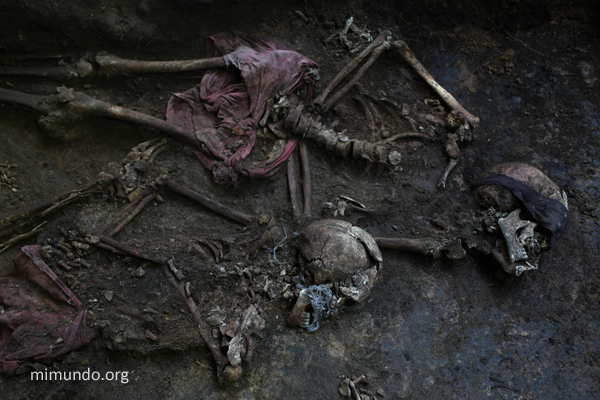
As this image displays, most of the 24 human remains found in Mass Grave 16 were found bound, tied, blindfolded and only wearing underwear.
The dig in Coban is revealing the gruesome reality of the country’s internal armed conflict, where people labeled subversives—political and student activists, Indigenous leaders and community members, and others— were kidnapped and tortured en masse. Children were also murdered before being dumped in clandestine graves at the base. All of this took place within the protective confines of a military controlled area.
Of the 28 former military areas the FAFG has dug since 1996, 24 have turned up bodies. Some of those digs are still works in progress, while more military bases, zones and detachments remain to be investigated. The dig at CREOMPAZ has turned up by far the largest number of corpses of any base.
“When the peace accords were signed, many military bases or detachments were reduced and closed. But the military remained here the whole time,” said Suasnavar of the base at Coban. “They say to us ‘we didn’t know that that happened, it was another time, it was other people, but you found it so there’s no other option than to keep working,’ right, those have been the words that they use with respect to our findings. But the continuity in the structure and function and the territorial control of this location has been strictly military.”
Regardless of the mass graves at the base, military and police training continues there, supported by countries like the US and Canada.
“The facilities have a sort of rank as a military organization of the United Nations, in fact the Guatemalan soldiers and officials that are based there wear the distinctive blue helmets,” said Iduvina Hernández Batres from the Guatemala City based organization Security and Democracy (Sedem). “This is happening, and this unit exists there, regardless of the fact that this property has been documented to have constituted an enormous clandestine cemetery.”
In 2011, the Ottawa-based Pearson Centre carried out a workshop at CREOMPAZ about “police and military cooperation in peace operations.” [2] Canada’s Department of Foreign Affairs and International Trade and the US Southern Command jointly funded the event. Soldiers trained at CREOMPAZ have been deployed as part of UN missions in Haiti and the Democratic Republic of Congo.
For some, like Ka’koj Ba Tiul, a Maya Poqomchi’ anthropologist and professor, CREOMPAZ has received an unwarranted facelift by rebranding the military base as a peacekeeping center.
“It is a school of assassins. The hidden side is the training of teams of military counterintelligence,” said Ba Tiul, who calls CREOMPAZ “the little School of the Americas.”
“There are instructors from Argentina, instructors from Chile, instructors from Colombia, instructors from North America, and instructors from Israel,” said Ba Tiul in an interview at his home just over a dozen kilometers from the base. “It is where they are training all of those who will form part of the modern counterinsurgency model for Guatemala and Central America.”
Dawn Paley is a freelance journalist. See more of her work at her website, dawnpaley.ca. Images by James Rodríguez. See more of his work at mimundo.org.
[1] http://www.canadainternational.gc.ca/guatemala/development-developpement/start.aspx?lang=eng&view=d
Origins of Israel’s Anti-Arab Racism
By Lawrence Davidson | Consortium News | November 28, 2012
By the middle of the 19th Century, the multi-ethnic empire was on its way out as the dominant political paradigm in Europe. Replacing it was the nation-state, a political form which allowed the concentration of ethnic groups within their own political borders.
This, in turn, formed cultural and “racial” incubators for an “us (superior) vs. them (inferior)” nationalism that would underpin most of the West’s future wars. Many of these nation states were also imperial powers expanding across the globe and, of course, their state-based chauvinistic outlook went with them.
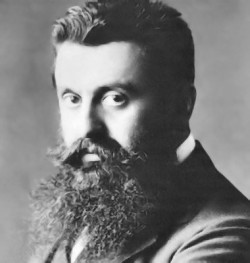 Zionism was born in this milieu of nationalism and imperialism, both of which left an indelible mark on the character and ambitions of the Israeli state. The conviction of Theodor Herzl, modern Zionism’s founding father, was that the centuries of anti-Semitism were proof positive that Europe’s Jews could not be assimilated into mainstream Western society. They could only be safe if they possessed a nation state of their own.
This conviction also reflected the European imperial sentiments of the day. The founders of modern Zionism were both Jews and Europeans, and (as such) had acquired the West’s cultural sense of superiority in relation to non-Europeans.
This sense of superiority would play an important role when a deal (the Balfour Declaration) was struck in 1917 between the World Zionist Organization and the British Government. The deal stipulated that, in exchange for Zionist support for the British war effort (World War I was in progress), the British would (assuming victory) help create a “Jewish national home” in Palestine. It was no oversight that neither side in this bargain gave much thought to the Palestinian native population.
Years later, beginning in 1945 (at the end of World War II), the British were forced to officially give up the imperial point of view. They came out of the war with a population burdened by extraordinary high war taxes.
Retaining the empire would keep those taxes high and so the British voters elected politicians who would transform the empire into a commonwealth, granting independence to just about all of Britain’s overseas territories. One of those territories was Palestine.
It is interesting to note that in other European colonies, where large numbers of Europeans resided, the era following World War II saw their eventual evacuation as power shifted over to the natives. Kenya and Algeria are examples which show that this process was hard and bloody, but it happened.
And when it did happen, the official imperial mind set was defeated. That does not mean that all Europeans (or Westerners) saw the light and ceased to be racists, but that their governments eventually saw the necessity to stop acting that way.
Some Consequences
Unfortunately, in the case of Palestine, this process of de-colonization never occurred. In this case the European colonists did not want the imperial mother country to stay and protect them. They wanted them out so they could set up shop on their own. They got their chance after the British evacuated in 1947.
Soon thereafter, the Zionists began executing a prepared plan to conquer the “Holy Land” and chase away or subjugate the native population. And what of that imperial point of view which saw the European as superior and the native as inferior? This became institutionalized in the practices of the new Israeli state.
That made Israel one of the very few (the other being apartheid South Africa) self-identified “Western” nation states to continue to implement old-style imperial policies: they discriminated against the Palestinian population in every way imaginable, pushed them into enclosed areas of concentration and sought to control their lives in great detail.
If one wants to know what this meant for the evolving character of Israel’s citizenry who now would live out the colonial drama as an imperial power in their own right, one might take a look at a book by Sven Lindqvist entitled Exterminate All The Brutes (New Press 1996). This work convincingly shows that lording it over often resisting native peoples, debasing and humiliating them, regularly killing or otherwise punishing them when they protest, leads the colonials to develop genocidal yearnings.
There is evidence that the Zionists who created and now sustain Israel suffer from this process. For a long time Israeli government officials tried genocide via a thought experiment. They went about asserting that the Palestinians did not exist.
The most famous case of this was Israeli Prime Minister Golda Meir, who on June 15, 1969, claimed that “there were no such thing as Palestinians. … They do not exist.” One of the reasons she gave for this opinion was that the Arabs of Palestine never had their own nation state.
Others took a different approach by denying not so much the existence of Palestinians, but rather their humanity. At various times and in various contexts, usually in response to acts of resistance against occupation, Israeli leaders have referred to the Palestinians as “beasts walking on two legs” (Menachem Begin); “grasshoppers” (Yitzhaq Shamir); “crocodiles” (Ehud Barak); and “cockroaches” (Rafael Eitan).
Of course, these sentiments were not confined to the Israeli leadership. They soon pervaded most of the Zionist population because the old imperial superiority-inferiority propaganda had become a core element of their basic education. The Israelis have taught their children the imperial point of view, augmented it with biased media reporting, labeled the inevitable resistance offered by the Palestinians as anti-Semitism and took it as proof of the need to suppress and control this population of “Others.”
And, from the Zionist standpoint, this entire process has worked remarkably well. Today all but a handful of Israeli Jews dislike and fear the people they conquered and displaced. They wish they would go away. And, when their resistance gets just a bit too much to bear, they are now quite willing to see them put out of the way.
Thus, during the latest round of resistance rocket fire from Gaza and the vengeful killing that came from the Israeli side, we heard the following: “We must blow Gaza back to the Middle Ages destroying all the infrastructure including roads and water” (Eli Yishai, present Deputy Prime Minister); “There should be no electricity in Gaza, no gasoline or moving vehicles, nothing. … We need to flatten entire neighborhoods … flatten all of Gaza” (journalist Gilad Sharon in the Jerusalem Post); “There are no innocents in Gaza. Mow them down … kill the Gazans without thought or mercy.” (Michael Ben-Ari, member of the Knesset); Gaza should be “bombed so hard the population has to flee into Egypt” (Israel Katz, present Minister of Transportation); Gaza should be “wiped clean with bombs” (Avi Dichter, present Minister of Home Front Defense); Israeli soldiers must “learn from the Syrians how to slaughter the enemy” (prominent Israeli Rabbi Yaakov Yosef).
Finally, there were the numerous, spontaneous demonstrations of ordinary Israeli citizens, both in the north and south of the country, where could be heard chants and shouts such as “They don’t deserve to live. They need to die. May your children die. Kick out all the Arabs.”
If it wasn’t for the fact that the outside world was watching, there can be little doubt that the famed Israeli armed forces would have been tempted to do all that these ministers, clerics and citizens wished. After Prime Minister Netanyahu agreed to a cease-fire, a group of Israeli soldiers showed their frustration by using their bodies to spell out (in Hebrew) the words “Bibi Loser” (Bibi is a nickname for Netanyahu).
It was a pre-arranged photo-op and the picture can now easily be found on the Web. What seems to really irk the Israeli citizenry is not that Bibi killed and maimed too many innocent Palestinian civilians, but rather that he did not kill and maim enough of them to grant Israelis “safety and security.”
Throughout history it has been standard operating procedure to demonize those you fight and demote to inferior status those you conquer. But as Lindqvist’s work shows, there was something different about the way Europeans went about this business. The deeply racist outlook that underlay modern imperialism made it particularly perverse.
Now that apartheid South Africa is no more, the Israelis are the last surviving heirs to that dreadful heritage. So much for a “light unto the nations.” That proposition has quite failed. Wherever the Israelis and their Zionist cohorts are leading us, it is not into the light, it is to someplace very very dark.
~
Lawrence Davidson is a history professor at West Chester University in Pennsylvania. He is the author of Foreign Policy Inc.: Privatizing America’s National Interest; America’s Palestine: Popular and Official Perceptions from Balfour to Israeli Statehood; and Islamic Fundamentalism.
Related articles
- Disturbing Quotes From Leading Zionists (dogmaandgeopolitics.wordpress.com)
US ‘suicide’ label for dead of Yemeni Gitmo inmate discounted
Press TV – November 29, 2012
US military’s claim that a Yemeni inmate found dead in September at Guantanamo Prison camp had committed suicide by medication drug overdose has been discounted by American and Yemeni officials.
The circumstances surrounding the death of Adnan Farhan Abdul Latif, one of the first men taken captive by American forces after their invasion of Afghanistan, have raised suspicions since the military announced over two months ago that a guard at the notorious prison and torture camp had found him “unconscious and unresponsive” in his cell, The New York Times reported Thursday.
While a US military medical examiner labeled Latif’s death as “suicide,” how he gained access to additional drugs is reportedly still under probe.
Yemeni officials have refused to accept the remains of the inmate until they get answers about the exact cause of his death. This is while a Pentagon official delivered an autopsy report to the Yemeni ambassador in Washington earlier this month, describing Latif’s death as ‘suicide,’ the daily adds, citing a report this week by the Web site, Truth-out.org.
However, Latif’s former lawyer, David Remes, expressed skepticism about how Latif could have saved his daily medications for an overdose without detection considering that he was under “intense scrutiny” by guards and prison cameras.
Remes further suggested that authorities at the military prison may have deliberately given Latif access to too much medication “hoping he would kill himself,” the report adds.
Moreover, Remes reiterated that shortly before Latif’s death, other Guantanamo detainees said guards had told Latif that they were taking him to a disciplinary cellblock, which he resisted. He was then placed in a specific cell which “he hated because of droning noise from an adjacent electric generator,” the report notes.
“Adnan (Latif) was a thorn in their sides,” Remes said. “The guards would ask other prisoners how to handle him. He refused to submit. He wouldn’t allow them to set the terms of his imprisonment. He was a constant problem.”
Latif, was seriously injured in an auto accident in his native Yemen and was in Afghanistan, seeking free or charity medical treatment when he was taken captive by US-led occupation forces.
He had been cleared for transfer back to his homeland before by both the Bush and Obama administrations; however he wasn’t sent home.
In 2010, a federal judge ordered Obama administration to free Latif, arguing that the evidence against him was too weak. However, an appeals court panel reversed that ruling in 2011.
According to the report, executive branch panels under the Bush and Obama administrations had repeatedly cleared the Yemeni inmate for repatriation, but he was still kept at Guantanamo “because both administrations were reluctant to send detainees to Yemen amid an Islamist insurgency.”
Venezuela Again the Target of Human Rights Accusations
By Chris Carlson | Venezuelanalysis | November 26th, 2012
Venezuela has become the target once again of accusations regarding supposed human rights violations after the UN Human Rights Commission published a decision in the case of Eligio Cedeño last week, and new allegations of rape were made in the case of Maria Lourdes Afiuni.
In the case of Venezuelan businessman and banker Eligio Cedeño, the United Nations Human Rights Commission published a decision last week accusing the Venezuelan government of violating Cedeño’s human rights when he was detained without trial from 2007 to 2009.
Cedeño was arrested in 2007 after the Venezuelan Attorney General accused him of conducting illegal currency transactions that allegedly led to the theft of more than US$ 25 million from Venezuela’s central bank.
Cedeño has claimed that he is a victim of government persecution, and that he was imprisoned for his support of political opponents of the Chavez government, however it has been pointed out that Cedeño was not politically active, nor a well-known opponent of the government at the time of his arrest.
“How can it be that every time [the government] tries to apply justice those being processed are suddenly called political prisoners?” one state official asked recently.
Venezuela held Cedeño in custody during the nearly three-year investigation and trial, citing the concern that he would flee the country if released. That concern seemed to be confirmed when Cedeño fled to the United States after being released on parole in 2009.
The Human Rights Commission, however, criticized the Venezuelan government for having kept Cedeño detained for longer than the two years stipulated by Venezuelan law.
Venezuela’s Attorney General’s office has argued that it had been granted a 16-month extension by the Venezuelan Appeals Court, a measure that is permitted by law, and that the trial had taken longer than normal due to various legal mechanisms employed by the defense attorneys.
Cedeño remains in the United States, where Venezuela’s extradition requests have been denied. No official response from the Venezuelan government has been offered on the Commission’s decision.
Alleged rape of Maria Lourdes Afiuni
The related case of the ex-judge Maria Lourdes Afiuni also took a new turn this week when she alleged that she had been sexually assaulted during her imprisonment at a women’s prison in 2010.
The allegation was revealed in a recently published book on the Afiuni case by Venezuelan journalist Francisco Olivares, along with several other charges of mistreatment alleged by the ex-judge.
Afiuni was arrested in 2009 after she was accused of facilitating the release and flight of Cedeño, allowing him to escape to the United States.
Prison authorities have said the recent rape allegations are false, and pointed to the fact that they come nearly two years after Afiuni was released from prison on house arrest due to health concerns.
“Why would she wait two years to say that she had been raped?” said Isabel González, ex-director of the women’s prison where Afiuni was held.
“In this book [Afiuni] says that she was a victim of mistreatment and rape during her stay at [the women’s prison], but all of those accusations are false. They are very serious statements that harm our dignity and create a lot of worry and unrest among the prisoners and their families,” González said.
Government officials assure no such accusations were ever made by Afiuni during her time in the prison, and fellow prisoners at the women’s prison have also expressed doubt that the allegations could be true.
However, officials have said the government will carry out an investigation into the case, and could potentially present Afiuni with defamation charges.
“We have to be clear that we are talking about Eligio Cedeño and [Maria Lourdes] Afiuni,” said Laila Tajeldine from the Ministry of Prison Services. “He is a white-collar criminal, and she is the woman that helped him get off free and escape. And now they call them political prisoners?” she asked rhetorically.
Opposition lawmakers are reportedly preparing a list of supposed “political prisoners” to be presented to Venezuelan President Hugo Chavez in hopes that the government would grant them amnesty, and allow those living in exile to return to the country.
President Chavez has long maintained that there are no political prisoners in Venezuela, but has showed openness to dialogue with his adversaries after his reelection last month.
It Rains Rockets from Gaza, Never Bombs from Israel
By Stuart Littlewood | Palestine Chronicle | November 27, 2012
Alistair Burt is the UK Foreign Office minister in charge of Middle East affairs. He is also a former officer of the Conservative Friends of Israel lobby group. He resigned from that position when he became a minister, but leopards don’t suddenly change their spots.
Judge for yourself.
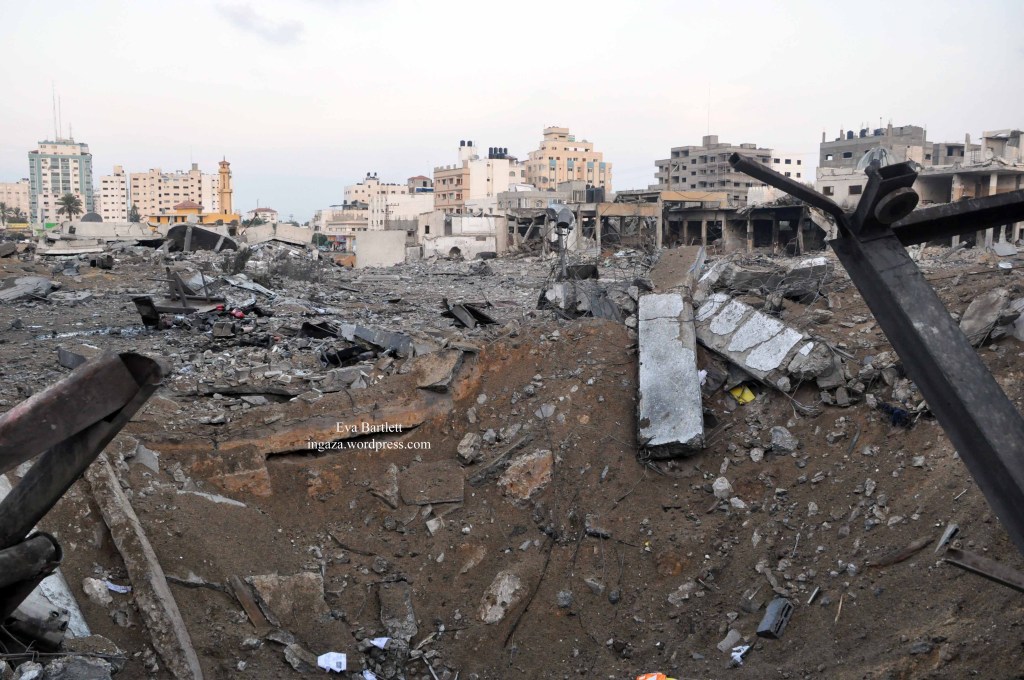
I sent a question through my MP asking why Government ministers such as Burt quote exact numbers of rockets fired from Gaza without also giving the corresponding numbers of bombs, rockets, shells and other ordnance poured into Gaza by the Israeli military.
In his letter of reply Burt says “there are no reliable statistics on the number of bombs and other ordnance fired by Israel on Gaza and Israel does not make public this information”.
In that case, should he not make it clear when quoting Gaza’s rocket numbers that Israel refuses to provide numbers of their own vastly superior missiles used to bombard Gaza?
Yesterday in Parliament David Amess, another officer of the Conservative Friends of Israel, was playing the familiar game of planting Parliamentary questions designed to deflect attention from Israel’s malodorous reputation. He asked Mr Burt what recent reports the Secretary of State for Foreign and Commonwealth Affairs [William Hague] had received on the number of rockets fired from Gaza into Israel since 30 October; what recent discussions he has had with the government of Israel on such attacks; and if he would make a statement.
Mr Burt obligingly replied: “We have received reports that 287 rockets were fired from Gaza into Israel between 30 October and 14 November. According to Israeli Defence Forces figures, 1,443 rockets were fired during the period 14-21 November.” He added that Mr Hague spoke to Mr Lieberman on 17 and 21 November and he, Burt, spoke to him on 21 November and again on 22 November.
Such precision is of course commendable but grossly lopsided and plainly calculated to mislead Parliament and public. It is astonishing that in all its discussions with Israel’s ministers the Foreign Office hasn’t managed to extract data on Israeli bombing and rocket attacks.
Mr Burt, I venture to suggest, ought to paint a balanced picture and not simply regurgitate Israeli propaganda without caveats and facts from the other side. He should inform the Israeli authorities that British ministers will not in future quote figures for Palestinian rockets unless accompanied by corresponding numbers of Israel’s. These should then be cross-checked with Palestinian and independent sources for proper monitoring.
The same goes for any remarks about Iran’s so far non-existent nukes. There should be equal emphasis on Israel’s vast arsenal of WMDs.
Featured Video
Ted Postol: Fraud of Missile Defence Exposed in Iran War
or go to
Aletho News Archives – Video-Images
Frlom the Archives
Containing the United States
By Edward S. Herman | Z Magazine | September 2016
“Containing the United States” is, of course, a ridiculous and self-contradictory idea in the U.S. and Western ideological and propaganda system. We all know that the United States had to “contain” the Soviet Union from 1945 to 1991, and since then has had the task of containing Russia and China. Only they threaten, bully, aggress and worry countries like Poland and Vietnam. Obama has had to reassure them both of our steadfast stand against Russian and Chinese military attacks. NATO has, of course, expanded greatly over the past several decades, despite the deaths of the Soviet Union and Warsaw Pact, but only to contain the renewed Russian — and Iranian, Libyan, Syrian and other — military threats; and we have “pivoted” to Asia, supported Japanese rearmament, bolstered our own forces in that area and jousted with the Chinese in their coastal waters solely to contain China. Earlier we had been obliged to contain North Vietnam, or was it the Soviet Union in Vietnam? Or China? Or “communism”? Or maybe all of them? Or none of them, but just needing an excuse to enlarge power?
The parallel propaganda has taken many forms. One is accepting as a premise that the United States only acts defensively and has no internal forces and interests that drive it to enlarge its sphere of control. I noted in an earlier article how Paul Krugman claims that internal Russian problems may well be the explanation of Russian “aggression,” but how at the same time it never occurs to him that the huge U.S. transnational corporate interests and “defense” establishment, and the pro-Israel lobby’s activities, might possibly make for an expansionist dynamic here.2 This reflects the standard establishment perspective that we are good and only react to evil. This was the view sustaining and justifying the invasion and occupation of Iraq from 2003. That attack was taken here as not evil but a response to evil, even if involving lies and mistakes, hence not describable as “aggression.” … continue
Blog Roll
 Aletho News
- Corporate Media Go All Out To Support The US-Israeli War on Iran
- Trump press conference reveals a man who wants out of war
- When Tel Aviv decides, Washington fights
- Top official: Iran ready for a long war with US, no more diplomacy
- How Iran’s Toxic Rain Reveals US-Israel Discord
- Trump Admits He Is Destroying Iran For Israel
- Iran’s latest move in the GCC countries was a stroke of genius
- Blackmail and death threats, Zelensky embarrasses the EU, but there’s no condemnation
- Israel threatens to kill Iran’s new leadership
- Possible Scenarios for the Middle East
- If Americans Knew
- Lebanon: Israel’s White Phosphorous Use Risks Civilian Harm
- Corporate Media Go All Out To Support The US-Israeli War On Iran
- US-Israel war on Iran is creating a steady growing number of amputees
- Israel planned this war on Iran for 40 years. Everything else is a smoke screen
- The wrong question about the war in Iran
- ‘Your Tax Dollars Being Used to Raise Your Gas Prices’: US-Israel Bomb Major Iranian Oil Depots
- ‘Bogus Evidence’: Former Nuclear Watchdog Head Debunks US Justification for Iran War
- EXPLAINER – Dimona: What to know about Israel’s nuclear site
- Fires and toxic air in Iran (thanks, Israel) – Not a ceasefire Day 150
- At Israel’s hands, Iran is burning, Lebanon and Gaza are crumbling – Not a ceasefire Day 149
- No Tricks Zone
- Wake-up Call: Survey Shows Majority Of Germans Now Favor Postponing Climate Targets!
- Televised! Leading German Political Candidate Tells Schoolchildren CO2 Makes Sun Hotter!
- New Study: A Century Warming Of 1.1°C Is ‘Commonplace’ And ‘Not Unusual’ During This Interglacial
- New Study: ‘Internal Noise’ And Volcanic Forcing Can Trigger 10-15°C Warming Within Decades
- Glaciers Worldwide Are Suddendly Surging, Experts Blame Warming!
- Surprising Discovery: Sahara Is Greening…Billions Of Trees Where Once Thought To Be Barren
- New Research Reaffirms Clouds, Aerosols, And Surface Solar Radiation Are ‘Driving The Climate System’
- Germany: Electric Car Catches Fire At Charging Station, Sets Off Local “Inferno”, Widespread Damage
- New Study: Canada’s New Brunswick Was 1°C Warmer Than Today During The Medieval Warm Period
- Coal Power Back In Trend As Globe Tries To Keep Pace With Growing Demand For Power
 Aletho News