Former mayor put in administrative detention
Ma’an – 20/01/2013
 NABLUS – A former Palestinian mayor detained by Israeli forces this week will be held in administrative detention for six months, a prisoners group said Sunday.
Sheikh Jamal Tawil, who had held the mayoral post in al-Bireh, a neighborhood of Ramallah in the central West Bank, was detained on Tuesday.
The Solidarity Foundation for Human Rights said Ofer military court gave the former mayor six months in detention without charge.
Tawil was arrested by Israeli forces during the first intifada and held for several months under administrative detention at the time.
As of December, 178 Palestinians were being held without charge in Israeli jails, including seven elected members of the Palestinian parliament, according to prisoners rights group Addameer.
Related articles
- Prisoner Omar Barghouti: A Story of a Life Behind Bars (occupiedpalestine.wordpress.com)
- Detainees In Eshil Go On Hunger Strike (altahrir.wordpress.com)
Iran to set up camp for displaced Rohingyas in Myanmar

A Rohingya man sits at his burnt home at a village in Minpyar in Rakhine state, Myanmar, on October 28, 2012.
Press TV – January 19, 2013
An Iranian MP says the Islamic Republic plans to set up a camp in Myanmar to help the efforts to provide relief to the country’s Rohingya Muslims.
On Saturday, Majlis (parliament) National Security and Foreign Policy Committee Deputy Chairman Mansour Haqiqatpour said agreements have been reached with senior Myanmar officials to set up a camp in Rakhine state that can accommodate thousands of Rohingya refugees and where food can be provided for them.
He stated that Tehran will soon put forward its own plan for the cessation of violence against Rohingya Muslims and the restoration of the social rights of the Muslim community.
Earlier this month, an Iranian parliamentary delegation visited Myanmar to examine the situation of the Rohingya Muslims and find ways to help them.
Officials of the Iranian Foreign Ministry, the country’s Red Crescent Society (IRCS), and the Imam Khomeini Relief Committee accompanied the Iranian lawmakers during their visit to Myanmar.
Some 800,000 Rohingyas are deprived of citizenship rights due to the policy of discrimination that has denied them the right of citizenship and made them vulnerable to acts of violence and persecution, expulsion, and displacement.
The Myanmar government has so far refused to extricate the stateless Rohingyas in the western state of Rakhine from their citizenship limbo, despite international pressure to give them a legal status.
Rohingya Muslims have faced torture, neglect, and repression in Myanmar since it achieved independence in 1948.
Hundreds of Rohingyas are believed to have been killed and thousands displaced in recent attacks by extremists who call themselves Buddhists.
The extremists frequently attack Rohingyas and have set fire to their homes in several villages in Rakhine. Myanmar Army forces allegedly provided the fanatics containers of petrol for torching the houses of Muslim villagers, who are then forced to flee.
Myanmar’s government has been accused of failing to protect the Muslim minority.
Myanmar opposition leader Aung San Suu Kyi has also come under fire for her stance on the violence. The Nobel Peace laureate has refused to censure the Myanmarese military for its persecution of the Rohingyas.
Rohingyas are said to be Muslim descendants of Persian, Turkish, Bengali, and Pathan origin, who migrated to Myanmar as early as the 8th century.
Related articles
- Thai Military warns against setting up Rohingya camp (thesail.wordpress.com)
- At least 600 Rohingya Muslims detained in Thailand (worldbulletin.net)
Health Insurance is Not Healthcare
By JP Sottile | January 18, 2013
Insurance companies make a simple wager with you each time you sign a policy. They are betting that, over the life of the policy, they will pay out less to you and your beneficiaries than you will pay them.
Insurance companies of all kinds make tidy profits on this simple wager. If they don’t, sometimes the government will bail them out.
Either way, insurance is still just a bet. And in America, we do not have a healthcare system. We have a health insurance industry.
That industry has been one of the most profitable sectors of the economy for well over a decade. But costs skyrocketed and care suffered. We heard horror stories about rationed care, denied procedures and corporate bureaucracies run amok. Ironically, these were the horror stories we were supposed to hear if the government took the reigns of the “best healthcare system in the world.”
So, instead of a single-payer healthcare system, we got The Affordable Care Act—aka Obamacare. Instead of retiring the health insurance industry and its actuarial tables and profit margins and wagers, Obama “saved” the health insurance industry and enshrined it in perpetuity as the “Health Insurance-Industrial Complex.”
As the Affordable Care Act’s provisions begin to take effect, the folks in the Complex are wasting no time doing what they can to keep their profits tidy. Leading insurers in California are seeking increases in premiums ranging from 20% to 26%. Regulators in Florida and Ohio have already approved increasing premiums as much as 20%, and, since the ACA doesn’t set federal standards, insurance companies are moving in a number of states to force these spikes in premiums.
Remember, if you can “afford” health insurance, you have to buy it. If you refuse, you’ll pay a penalty to the government at tax time. Some are exempt from this mandate. But, in effect, the ACA has guaranteed the health insurance industry a captive market.
Meanwhile, they continue to change the terms of all those bets they’ve placed against millions of Americans and the cost of the “best healthcare in the world” continues to rise. When compared to other nations with some form of single-payer system, the difference is so stark that it’s almost obscene. It’s not just the $800 difference between an MRI in France versus the U.S., it’s almost every part of a system that has at its heart the relentless desire to turn a profit.
Even worse, a much-ballyhooed part of the promised “21st Century transformation” into greater “affordability” has turned out be little more than a profiteering scheme.
Remember the “streamlining” and “cost savings” guaranteed from the conversion to electronic medical records? Well, it hasn’t quite panned out. In fact, the only real beneficiaries of the conversion are companies like General Electric that sell electronic medical records systems. Not coincidentally, GE and other interested parties funded the key RAND study in 2005 that both predicted $81 billion in savings for America’s health care system and also became the driving rationale for the profitable conversion.
This type of closed system is par for the course in Washington, D.C.
Every door revolves in the nation’s only recession-proof city. Is it any surprise that the woman who wrote the Affordable Care Act is now leaving the White House for a job with health care giant Johnson & Johnson? Liz Fowler worked for Senator Max Baucus (D-MT) during the drafting of the ACA and had the primary responsibility for authoring the legislation. After its passage, she migrated to the White House to help with implementation. Seems reasonable enough. However, it is important to note where she was before joining the staff of Senator Baucus. Yup, you guessed it…she was a bigwig at WellPoint, the nation’s second leading health insurance company with nearly 54 million policyholders.
All of this makes you wonder who knew whom in the breast milk-pump industry, which is seeing a huge spike in its profits thanks to a new coverage requirement written into the ACA.
It may be too early to render judgment on a law that hasn’t yet been fully implemented, but it is not too early to determine that the profit motive might simply be incompatible with the equitable delivery of healthcare. As matter of course, businesses try to lower costs and increase revenue. That may be okay when they sell scissors or candlesticks, but it seems ill-suited to deliver labor-intensive care for those who are most vulnerable.
And as far as the health of the insurance industry, it’s a safe bet that they’ll keep coming out on top as the Affordable Care Act is fully implemented.
JP Sottile is a freelance journalist, published historian, radio co-host and documentary filmmaker (The Warning, 2008). His credits include a stint on the Newshour news desk, C-SPAN, and as newsmagazine producer for ABC affiliate WJLA in Washington. His weekly show, Inside the Headlines w/ The Newsvandal, co-hosted by James Moore, airs every Friday on KRUU-FM in Fairfield, Iowa. He blogs under the pseudonym “the Newsvandal.”
Anti-corruption demonstrations held across Spain
Press TV – January 19, 2013
People in Spain have staged demonstrations in several cities across the country to voice their anger at the corruption in the eurozone member state which is in the grip of a sharp economic downturn, Press TV reports.
On Friday, angry protesters assembled near the headquarters of Prime Minister Mariano Rajoy’s centre-right Popular Party in the capital Madrid, chanting slogans. The building was protected by riot police and metal barriers.
The demonstrations were sparked by a recent report by the centre-right newspaper El Mundo disclosing that senior members of Popular Party collected undeclared salaries, largely from private companies.
The paper added that former Popular Party treasurer Luis Barcenas gave envelopes which contained 5,000-15,000 euros (USD 6,500 -20,000) to party officials in addition to their official salaries during two decades.
The newspaper, however, highlighted that Rajoy did not receive such kind of payments and he ordered Popular Party secretary general Maria Dolores de Cospedal to end the practice in 2009.
“The Popular Party’s accounts are clear, transparent and inspected by the Court of Auditors,” Cospedal said, denying allegations that party members got undisclosed payments under her supervision.
This comes as on January 16, Spanish media reported that Barcenas along with several others held a Swiss bank account with some 22 million euros.
“The thieves… are taking all the money. Undoubtedly who is going to suffer the consequences are the poor people,” a protester told Press TV.
As the fourth largest eurozone economy, Spain must lower its deficit to 4.5 percent in 2013 and 2.8 percent in 2014.
Economists, however, say those targets will be difficult to meet amid poor prospects for the country’s economic recovery.
Battered by the global financial downturn, the Spanish economy collapsed into recession in the second half of 2008, taking with it millions of jobs.
How the Media First Reported Abdulrahman Al-awlaki’s Assassination
By David Kretzmann | July 22nd, 2012
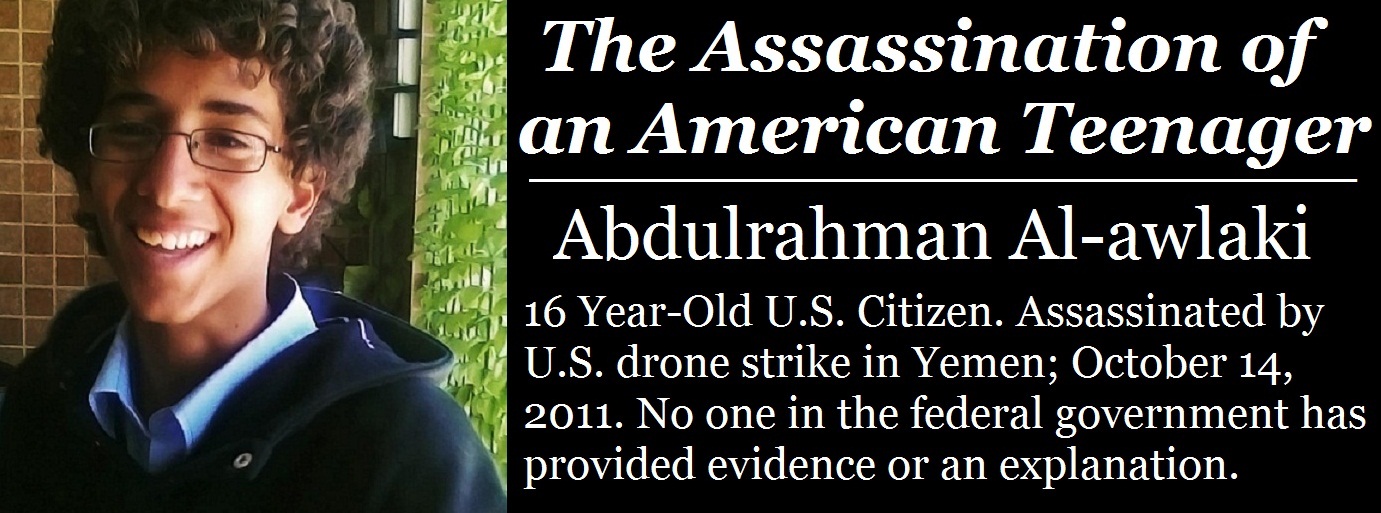
How was Abdulrahman’s targeted assassination initially reported in the media? Some quotes that sound very familiar with the usual semantics of all media coverage on drones and suspects:
“Yemeni officials told reporters that nine members of Al Qaeda in the Arabian Peninsula were killed in the strike near the town of Azzan in southeastern Yemen, including Awlaki’s 21-year-old son…” – LA Times, October 15, 2011
“Report: Al-Awlaki’s son among dead in U.S. airstrike on Yemen al-Qaida militants” – headline from Haaretz, October 15, 2011
“Official: Drone attack kills Al-Awlaki’s son in Yemen… The attacks, carried out in the Shabwa district, killed seven suspected militants, the defense ministry said.” – CNN, October 15, 2011
“Awlaki’s son is also among the 24 militants killed in air strikes targeting al-Qaeda in Yemen, local officials said.” – Al Arabiya News, October 15, 2011
“Three drone attacks in Yemen Friday night killed seven suspected militants including Anwar Al-Awlaki’s son, a security official said. Carried out in the Shabwa district, where the younger Awlaki had been holed up for more than eight months” – Business Insider, October 15, 2011
“U.S. drone strike in Yemen kills nine jihadis, including Awlaki’s son” – Hot Air, October 15, 2011
Lie #1: Abdulrahman is a 16 year old American teenager, not a 21 year old militant.
Lie #2: U.S. claimed al-Banna was the actual target. The problem with that excuse is that al-Banna is alive and well, and was never at that site. Since that revelation, the Obama Admin. simply states there is no official record of the death of Abdulrahman, and sweeps the story under the carpet so it doesn’t even have to take accountability that the crime even happened.
Lie #3: The media says Abdulrahman was hiding in the mountains for months. Actually, he left his home a couple weeks before to find out about his father, and even during that time he was living and moving around in the open, far from hiding.
It seems that being a suspected militant is enough to make you a viable target. And the criteria for determining what makes you a suspect is easily adjustable to their convenience it seems.
Barack Obama: the first U.S. president to use targeted assassination against a child.
Taken from: Abdulrahman Anwar Alawlaki – A crime we’ll never forget
France’s Mali Debacle
By BARRY LANDO | CounterPunch | January 18, 2013
Paris – Within the next few days, France will have deployed some 2,500 troops to Mali. That’s as large a commitment as France made to what became a profoundly unpopular war in Afghanistan. No one knows how long the troops will be there, but the price tag will surely be tens if not hundreds of millions [or billions rather] of Euros, this to born by a French economy already in woeful shape.
The danger is that President Francois Holland and the French state, may shortly find themselves in the disastrous situation of the hapless coyote in the cartoon, Roadrunner, so intent on chasing his prey that he scurries right over a cliff and suddenly finds himself flailing in mid air, about to plunge to the desert below.
President Holland said the menace of a radical Islamic takeover was so imminent that he had no choice but to intervene—to save not just Mali, but all of Western Africa, and, the French now imply, Europe as well.
Strange thing though, despite the supposed urgency of the situation, France has had precious little luck so far in convincing its European partners to contribute their own troops to the intervention. Indeed, the last thing those countries want, after the traumatic experience of Iraq, Libya and the Afghan crusade, is to become enmeshed in what risks to be an open-ended conflict, on behalf of an unelected Malian government, against a vague assortment of ethnic rebels and jihadis in the desert wilds of North Africa. Thus, so far there have been a lot of pats on the back from France’s allies, offers of logistic support, intelligence, a few troop transports, drones, but that’s it.
“You say, ‘We’ll give you nurses and you go get yourselves killed,’” said French deputy Daniel Cohn-Bendit, railing at his fellow deputies in the European Parliament. “We [Europe] will only be credible if French soldiers are not the only ones getting killed.”
Actually, it was surprising to learn that France, still considered a major military power, doesn’t have the capability to transport a couple of thousand troops and their equipment to North Africa. France even had to rely on an offer from the Italians for tankers to handle in-flight refueling of French fighter jets.
Despite the tepid response from France’s allies, French government spokesman are still reassuring the public that French troops are not going to play the major combat role in the coming ground battles.
The fact is, that even if they wanted to play a major role, there are nowhere near enough French boots on the ground. It’s instructive to speculate on France’s combat strength, using what is known as the “tooth to tail” ratio, that is, the number of support troops in the rear needed to support each combat soldier at the front. For the U.S. military that ratio is about three to one. If we use the same figure for France, that means that out of 2500 French troops deployed to Mali, probably about 600-700—a thousand at best–would actually see front-line combat.
And Mali, don’t forget, is twice the size of France, or Afghanistan or Texas.
The actual down-and-dirty fighting, we are told, is to be done by troops from West Africa, some of whom have finally begun arriving in Mali. But all the reports about those contingents indicate a woeful lack of equipment, morale, and training, particularly in being able to fight a guerrilla war in the desert reaches of the Sahel.
After months of discussion, this week—in the wake of the hostage crisis in Algeria– France’s European allies finally agreed to dispatch 250 troops to help train the Malian army and perhaps other African units. But—unless the fallout from the Algerian disaster changes things–it’s already determined that those European trainers are to be non- combatants. They will not even be advising the Malian soldiers in battle. As one senior EU official made very clear. “We will not go north. We will stay in the training areas,”
By the way, one thing I can never figure out—whether it be Mali or Afghanistan–we‘re always hearing about how the forces being backed by the U.S. and its allies, like France in this case, invariably seem to be poorly trained and equipped and demoralized, despite hundreds of millions of dollars and years of training. [Think Afghanistan where only one out of 23 battalions is able to function independently of U.S. support.]
Meanwhile, the ragtag rebels they’re combating, usually from those same third world countries, like the Taliban in Afghanistan or the Tuareg in Mali are portrayed as dedicated, fierce, battle-hardened warriors, who wreak havoc on their opponents with often the most primitive improvised weapons or suicide bombs. Reports are that it will take many weeks, probably months, before the various African troops will be ready to do any serious fighting. And there are other problems to deal with apart from training and equipment: the danger, for instance, of unleashing Christian soldiers from Nigeria to suppress Islamic rebels in Northern Mali.
Ironically, as I’ve pointed out in a previous blog, while France’s allies are hanging back, the Chinese, who have huge economic interests and construction projects underway in every one of Mali’s neighbors, continue to go about their business, apparently still content to leave the police work to France and Europe and the West African states.
The French, for the record, insist that the groups they are battling in Mali –and now in Algeria–are all lumped together as “terrorists”, linked to al-Qaeda. There is no recognition of the fact that most of the different rebel groups, are mostly driven by strong ethnic and nationalist aspirations, as much as by religion–not that different perhaps, from the Taliban in Afghanistan.
In that case, it’s obvious that the only way this conflict will ultimately be settled is not by somehow eradicating the “terrorists”, but by sitting down to negotiate a deal, as will probably be the case in Afghanistan.
In Mali, such a deal may not be that different from the kind of settlement that was offered the Tuareg years ago after a series of rebellions, but which the Malian government ultimately reneged on.
So, how do the French feel about this?
Estimates are that anywhere from 400,000 to one million French took to the streets of Paris last weekend. A counter-protest, expected to draw hundreds of thousands of other militant French, is now being organized. Tempers are flaring.
What’s the issue?
Mali?
Well, actually, no. It’s whether the French government should legalize gay marriage.
As for the intervention in Mali, at first the French, from all ends of the political spectrum, seemed to be solidly behind their government and their fighting men.
That consensus is already unraveling, and it’s certain that as the intervention drags on, the casualties and costs mount, and France’s European allies still drag their heels, the patriotic surge will flag
Which bring us back to the Roadrunner. At some point the French may suddenly look down to find that their president has taken them over a precipice, and they’re suspended there, gazing in horror at the chasm below.
Related articles
- France Formally Requests US Military Aid for Mali Invasion (economicpolicyjournal.com)
UK terror hypocrisy: Mali vs. Algeria
Press TV – January 19, 2013
British Prime Minister David Cameron called off his long-awaited speech on the relations with the European Union on Friday to deal with the hostage-taking in Algeria as his country actively assisted France in its military intervention in Algeria’s neighbor Mali.
Cameron was outraged by, what he described in an address to the MPs on Thursday, as the Algerian government’s “all guns blazing” tactic against the “terrorist” kidnappers at BP’s In Amenas gas plant because it could endanger British and other western lives.
“I won’t hide, of course I was… we were disappointed not to be informed of the assault in advance,” Cameron told the MPs.
In effect, Cameron was telling Algeria that they are not supposed to be fighting “terrorists” at the cost of British lives while he and his French allies were – and are — exactly killing innocent Malians for the alleged ‘greater good’ they tend to name fighting terrorism.
There are no precise figures on the number of Malian civilians killed in the French Britain-assisted airstrikes near the country’s borders with Algeria but Human Rights Watch said on the second day of the attacks last Sunday that 10 civilians including three children, were killed during airstrikes.
The situation has also been grave enough for international organizations to call for restraint.
“Forces involved in armed attacks should avoid indiscriminate shelling at all costs, and do their utmost to prevent civilian casualties,” said Paule Rigaud, Amnesty International’s Africa deputy director.
However, there has been no such restr aint to the point that United Nations High Commissioner for Refugees (UNHCR) Melissa Fleming warned on Friday “that in the near future there could be up to 300,000 people additionally displaced inside Mali, and over 400,000 additionally displaced in the neighboring countries” many of them escaping indiscriminate attacks on Malian rebels and civilians.
Nor has Cameron advised French president Francois Hollande to hold back attacks to avoid collateral damage to women and children probably because their skins are not as white as the British hostages in Algeria.
This comes as Hollande said on Friday that the attack and hostage crisis in the remote desert gas plant show the French military intervention in Mali was justified.
However, one comes to think that matters are exactly the other way round, especially after the hostage-takers said their move was in response to the French intervention in Mali.
One should also note a report by Amnesty International on brutality on the part of the ally of Britain and France, the Malian government, against the Tuareg ethnic minority where rebels are rooted.
When the conflict originally exploded, Tuaregs were arrested, tortured, bombed and killed by the security forces, “apparently only on ethnic grounds”, Amnesty said in a report on December 21.
Meanwhile, last July, 80 inmates arrested by the Malian army were stripped to their underwear, jammed into a 5 sqm cell and cigarettes were burnt into their bodies.
Also, back in September 2012, 16 Muslim clerics were rounded up at a checkpoint and summarily executed by the Malian army, which is now Britain’s ally.
Indeed, Britain could apparently pat itself on the back for setting the stage for the kidnapping of its own nationals in Algeria by helping the Malian government.
Britain should also answer whether the “botched” Algerian operation to free hundreds of hostages that left a few western hostages killed would have been also botched if the hostages were not white westerners, or if the scenario was one of British forces and its allies pounding Malian targets with huge civilians casualties on people with darker skins.
‘Gate of Dignity’ built on lands of Beit Iksa north of Jerusalem
IMEMC News | January 18, 2013
The Palestinian village of Beit Iksa overlooking Jerusalem just built a new village they called Bab Al-Karama (Gate of Dignity) on their land behind the apartheid wall that Israel has built on their land and call on Palestinians and Internationals to join them in their popular struggle to hold on to their lands.
The wall Israel is building on the village land would leave 96% of the village land inaccessible and behind the segregation wall.
Over the past 24 hours, the villagers built a mosque and set up 5 tents for dwelling on their land behind the wall.
 The head of the Beit Iksa village council Mr. Kamal Hababa stated that idea of building this village extension is to protect their legally owned lands and to be the second such village built to protect from growing efforts at transforming Arab Jerusalem.
Already the threatened village land behind the wall is 7,411 dunums which amounts to half the total threatened lands of the eight Palestinian villages northwest of Jerusalem and 96% of the village land of Beit Iksa. Colonial Jewish only settlements built on Palestinian lands beyond the Green line in this area include Ramot, Neve Shmuel, Har Shmuel, and Givat Ze’ev.
The erection of Bab Al-Karama village comes shortly after Palestinian activists erected a village they called Bab Ashams to counter Israeli settlement construction in the area known as E1, located between Jerusalem and Jericho, which signals a new model in popular struggle against the ongoing expansion of the Israeli settlements in the West Bank.
Turkey Mulls Future Kurdish Scenarios
By Hüsnü Mahalli | Al Akhbar | January 18, 2013
Istanbul – In what may be described as a very odd move by Prime Minister Recep Tayyip Erdogan and the Turkish authorities, tens of thousands of Kurds in the southeastern city of Diyarbakir were allowed to participate in the funeral of three Kurdish activists – including a founding member of the Kurdistan Workers’ Party (PKK) – who were assassinated in Paris on 9 January 2013.
To be sure, Turkish warplanes had carried out airstrikes against PKK positions and encampments in northern Iraq prior to the funeral. Perhaps this was a government message to the Turkish population that the war on Kurdish “terror” would continue, even if the government allowed the slain leaders of the Kurdish “terrorist” group to be buried in a massive funeral procession in Turkey.
Kurdish leaders in Turkey appealed to the participants in the ceremony not to raise PKK flags or portraits of PKK leader Abdullah Öcalan, who has been imprisoned by the Turkish authorities since 1999. These directives are possibly a first for a Kurdish demonstration.
And indeed, tens of thousands gathered yesterday at a square in Diyarbakir, the largest Kurdish city in Turkey, many wearing white scarves, a symbol of peace. The mourners refrained from chanting any “radical” slogans that may have provoked Turkish nationalist factions.
In the meantime, a delegation from the European Committee for the Prevention of Torture (CPT) met with Öcalan to inquire about his conditions in prison. According to the Turkish media, secret talks between the government and the PKK leader continue, with a view to reach a secret deal that serves both sides’ interests. To many, this is seen as a starting point for the final settlement to the Kurdish question in Turkey.
One key demand by Öcalan is to be released under a comprehensive general amnesty issued by the government for all leaders, members, and followers of the PKK. Only then would he instruct the party’s armed fighters to cease their attacks against Turkey once and for all.
After that, political demands such as recognizing the Kurdish national identity in the constitution would be discussed between the PKK and the Turkish government.
Through its media, the Turkish government has been able to persuade a majority of the Turkish people that a political solution to the Kurdish question is both necessary and urgent, and that reaching one would serve the national interests of the state. Yet independent opinion polls show that most Turks would not readily accept Öcalan’s release or amnesty for PKK followers.
For one thing, this would mean that in the future, Öcalan could become an important figure in Kurdish, and even Turkish, political life, especially if the Turkish government were to give autonomy to the Kurds in southeast Turkey.
In this vein, press reports have often alluded to a Turkish plan for a quick resolution to the Kurdish question, which seeks to counter any undesirable scenarios in Syria, which also has a sizable Kurdish population. Particularly so when the Syria-based Kurdish Democratic Union Party (PYD), which is allied with the Turkish chapter of the PKK, controls the Kurdish regions in Syria adjacent to the Kurdish regions in Turkey and northern Iraq.
This may help explain the strategic alliance between Ankara and Iraqi Kurdish leaders Massoud Barzani and Jalal Talabani. The alliance seeks to influence Kurdish public opinion in Syria, and to convince Syrian Kurds of the need for cooperation and rapprochement with Turkey.
Turkey has provided all kinds of support for the Kurdistan Regional Government (KRG) of Iraq as it makes profits to the tune of billions of dollars in trade and oil deals.
This has allowed Ankara to become a key player in internal Iraqi affairs, owing to its alliance with Barzani and Talabani, as well as Iraq’s Sunni Deputy Prime Minister Tariq al-Hashemi.
On a related note, it has become an open secret that Erdogan’s moves concerned with the Kurdish question have a lot to do with its most important ally: Washington DC. Next month, Erdogan will travel to the US to hold talks over future scenarios.
Meanwhile, there are reports that the situation may soon heat up in Iran’s Kurdish regions with the approach of Iran’s presidential election. This may prompt Ankara to move faster towards containing Kurdish populations in the region under an umbrella of pan-Islamic sentiment.
Just like the Turkish political and ideological model was endorsed by the Muslim Brotherhood in the countries of the Arab Spring, this Turkish umbrella may take a form that is acceptable for Arab and the Muslim nations. Most probably, it will involve a model of moderate and democratic Islam, that is to say, one that is consistent with US interests.
See also; prominent Zionist suggests rapprochement:
Featured Video
No Threat Can Force Iran’s Surrender /Trita Parsi & Lt Cl Daniel Davis
or go to
Aletho News Archives – Video-Images
From the Archives
What is the Israeli Lobby in Australia Doing in Interfaith Dialogue?
By Ali Kazak | Dissident Voice | October 11, 2015
For years Israel and its lobby around the world have been trying to normalise their relations with Arabs and Muslims without solving the Palestine Question.
One of the methods they resorted to in the last few years is using human rights and community organizations such as interfaith dialogue and Multiculturalism to achieve this objective and to: isolate the Palestinians, marginalise the Palestine question, end Israel’s isolation, and prevent criticism of Israel, knowing that these organisations will be the first to stand against Israel’s violations, racial and religious discrimination.
The group responsible for this task in Australia is The Australia/Israel & Jewish Affairs Council (AIJAC); its Director of International & Community Affairs, Jeremy Jones is in charge of lobbying religious community organizations, specifically Muslims and Christians. Consequently he convened the Faith Communities for Reconciliation, founding participant in the Australian Partnership of Religious Organisations and the Australian National Dialogue of Christians, Muslims & Jews.
AIJAC is a private political propaganda group. It is recognised as the main Israeli lobby in Australia. It coordinates its activities and works intimately with the Israeli embassy in Canberra and different institutions in Israel. It is privately funded by some Jewish businessmen. It monitors closely Australian politicians, the media, ethnic and religious groups, (especially Arabs and Muslims), unions and academics on their stands towards Israel and the Palestine question. … continue
Blog Roll
 Aletho News
- The war of liberation of the Arab and Islamic peoples expands across the Gulf
- Envoy warns UN on Trump’s threat to ‘obliterate’ Iran’s civilian infrastructure
- The Larak Corridor: Iran’s Rial Gate With No US, No Israel, and No Way Around
- ‘Economic terrorism’: Steel facilities hit again in US-Israeli strike
- ‘War Crime’: Iran condemns attacks on Arak, Ardakan nuclear sites
- Two-thirds of Americans want quick end to Iran war even if goals unmet
- Trump to Give “Important Update on Iran” Wednesday in Prime-Time Speech
- Theodore Postol: Iran’s Missiles & Drones Were Underestimated
- Iran To Target Military Industrial-Tech Complex That Facilitated Gaza Genocide
- Collapsing Empire: The Resistance Disarms ‘Israel’
- If Americans Knew
- Israel wants US to bomb more of Iran’s civilian structures (113,000 is not enough) – Not a ceasefire Day 173
- Ann Coulter Rips Into Fox News for Iran War Coverage
- Joe Kent Urges Americans To Call White House and Congress To Object To Sending Troops Into Iran
- DNC Resolution to Reject AIPAC Funding Puts Democratic Leaders in the Hot Seat
- Swedish foundation to build 400 schools as over 650,000 Gaza children remain without education for 2 years
- Israeli army admits photshopping image of slain Lebanese journalist
- This is how Israel is systematically killing health workers under the cover of war in Lebanon
- Carrying life under fire: Israeli invasion of Lebanon leaves pregnant women facing deadly risks
- Champagne all around for the new death penalty (for Palestinians) law – Not a ceasefire Day 172
- Why are Palestinian books struggling to be seen on Amazon?
- No Tricks Zone
- New Study Finds Warming Saves Lives…Cold Temperatures 12 Times More Deadly Than Excess Heat
- German Science Blog Accuses PIK Climate Institute Of Hallucinating Climate Tipping Points
- Devastating Assessment Of Comirnaty Vaccine By Former Senior Pfizer Europe Toxicologist
- New Study: CO2 Is ‘Effectively Negligible’ As An Explanatory Climate Change Factor Since 2000
- Former Pfizer Toxicologist Dr. Helmut Sterz Tells Bundestag Hearing Pfizer Vaccine Should Have Never Been Approved
- Energy Expert: Germany’s Nuclear Phaseout Was A “500 Billion Euro Mistake”
- New Research: South Australia’s Mid-Holocene Sea Surface Temperatures Were 4°C Warmer Than Today
- Storing Green Energy To Last Germany 10 Days Would Require A 60-Million Tonne Battery
- New Studies: UK Sea Levels Were 4 Meters Higher Than Today During The Mid-Holocene
- Destructive Green New Deal: German Energy And Metal Group Warns Of Drastic Crisis
 Aletho News