Revolving Door at SEC is in a Whirl as Hundreds Hired by Industry they Regulated
By Noel Brinkerhoff, Danny Biederman | AllGov | February 13, 2013
Charged with regulating Wall Street, the Securities and Exchange Commission (SEC) has become a launching pad for former agency employees—by the hundreds—to become part of the industry they once oversaw.
A new report from the watchdog group Project on Government Oversight (POGO) says that more than 400 ex-SEC staffers were working for the industry between 2001-2010.
The study also found numerous other concerns with the “revolving door” between the SEC and financial firms. These included agency workers trying to help corporations influence agency regulations, defending companies suspected of breaking the law, and helping them avoid tougher enforcement actions.
Perhaps the most high-profile concern in this arena is President Obama’s nomination of Mary Jo White to become the new SEC chief. During her most recent job at the firm of Debevoise & Plimpton, White’s clients included JPMorgan Chase, General Electric, Verizon Communications, former Bank of America chief executive Kenneth Lewis, and Rajat Gupta, the former Goldman Sachs board member convicted of insider trading.
“The revolving door is moving faster than ever,” Senator Charles Grassley (R-Iowa) said after reading POGO’s findings. “The SEC has to fix this problem once and for all. That involves more disclosure, more meaningful restrictions, and top-to-bottom application of the rules without waivers that make any restrictions meaningless.”
Dresden bombing, Britain’s forgotten war crime of WWII
Press TV – February 14, 2013
While Britain claims to be an advocate of human rights in Afghanistan, Iraq, Syria, and many other countries around the world, British history itself is corroborating evidence that Britain, the greatest human rights preacher has also been the most flagrant human rights offender.
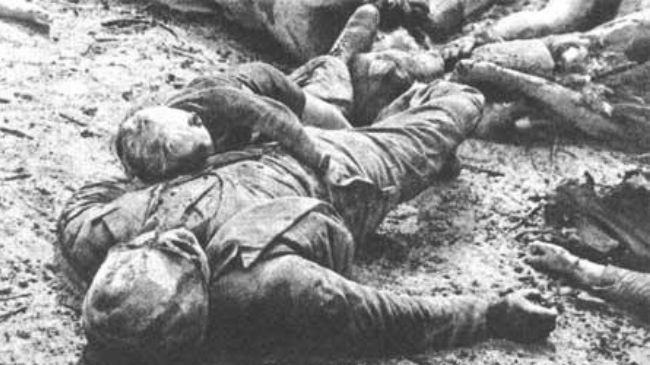
More than 500,000 German civilians and refugees, mostly women and children, were slaughtered by Britain’s saturation bombing in 1945, one of the worst massacres of all time.
Over 700,000 phosphorus bombs were dropped on 1.2 million defenseless inhabitants of German city Dresden under Britain’s then Prime Minister Winston Churchill’s order, which not only reduced one of the greatest centers of northern Europe to flaming ruins, but also led to one of the worst war crimes of the Second World War.
Dresden’s bombing on February 13, 1945 was so relentless that some historians believe it was the height of Winston Churchill’s madness.
“I do not want suggestions as to how we can disable the economy and the machinery of war, what I want are suggestions as to how we can roast the German refugees on their escape from Breslau,” Churchill said once.
Toward the end of the war, Churchill’s desired firestorm was finally created. More than 260,000 bodies and residues of bodies were counted after British Royal Air Force (RAF) and the United States Army Air Force (USAAF) assaulted Dresden. However, those who perished in the centre of the city could not be traced, as the temperature in the area reached 1,600 degrees Centigrade.
Dresden’s citizens barely had time to reach their shelters and those who seek refuge underground often suffocated as oxygen was pulled from the air to feed the flames. Others perished in a blast of white heat, heat strong enough to melt human flesh.
When the bombing started, no one could imagine that in less than 24 hours all those innocent people could die screaming in Churchill’s firestorms.
If there was ever a war crime, certainly the Dresden bombing would rank as one of the most sinister of all time. Sadly, however, Churchill, who ordered the slaughter of up to a half million innocent people in this horrifying tragedy, was knighted by Britain’s Queen Elizabeth II in 1953.
The British queen made Churchill a knight of the Order of the Garter, Britain’s highest order of knighthood.
Related articles
The Pentagon’s Budget Crunch: No Dissenting Views
By Peter Hart | FAIR | February 13, 2013
We’ve noted many times that when it comes to corporate media coverage of the so-called budget “sequester”–the immediate cuts to military and social spending set to hit in a matter of weeks–what matters most is what will happen to the military. The Washington Post had a whole piece (2/13/13) devoted to yet another round of complaints from military leaders–without a single comment from anyone who might take the view that cutting military spending would not be such a disaster.
“Defense Officials Again Sound Alarm on Sequestration,” said the Post headline, signaling that readers were probably well aware by now that this perspective has been heard loud and clear. Steve Vogel was reporting on a Senate Armed Forces Committee hearing that featured a series of military leaders warning of the disaster to come– “the looming sequestration cuts represent a dire and unprecedented threat to the U.S. military.”
The quotes all reiterated that point: “The wolf is at the door,” we may return to “a hollow Army,” military forces would be “degraded and unready,” and on a scale of 1 to 10, “it sure feels like a 10.”
Apparently the Post’s idea of balance is quoting spokespeople from different branches of the military–the Army’s point of view, but also someone from the Marine Corps!
Near the end, Vogel writes:
The military panel met with a sympathetic audience Tuesday, as most members of the Senate panel expressed support for protecting the defense budget from automatic, across-the-board cuts.
The senators’ failure to challenge the military line is all the more reason to seek out a different perspective; say, someone who would point out that military spending skyrocketed since the 9/11 attacks, and the current round of reductions–both as part of the sequester and a separate set of budget cuts–still leave total military spending levels at around 2006 levels.
There are military analysts who could provide a different take on the supposed crisis in military spending. An article like this could use another point of view.
Related article
- Yes, Of Course We Should Cut Military Spending! (businessinsider.com)
PBS Goes to Israel and Palestine–Mostly Israel
By Peter Hart | FAIR | February 12, 2013
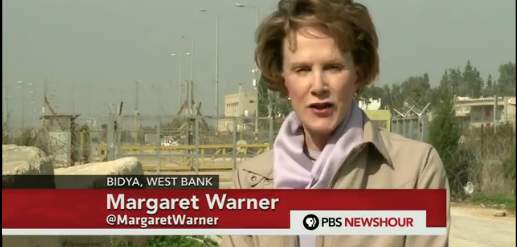
On the January 22 broadcast of the PBS NewsHour, correspondent Margaret Warner reported on the outcome of the Israeli elections. It told the same story as most other reports on the issue, trying to sort out the implications for Prime Minister Benjamin Netanyahu. Palestinians basically do not exist in the report; Warner makes one reference to ultra-right Israeli politician Naftali Bennett, who she says believes “the time for negotiating with the Palestinians is over.”
But what was most intriguing was a comment at the end of the piece, from anchor Gwen Ifill: “We will hear more from Margaret as she travels through Israel, the West Bank and Gaza over the next week and a half.”
That sounded like it could be be an interesting opportunity for TV viewers to get a glimpse of Palestinian life. But that’s not what PBS chose to put on the air.
The next installment (1/25/13) was also about the Israeli elections: “So, Margaret, a few days after the election, what kind of government seems to be taking shape?” asked anchor Jeffrey Brown. The emphasis was on Israeli society: “How divided does it feel politically and culturally?”
Warner explained that
the old divide used to be over how much and how to deal with the Arabs and the Palestinians in particular and whether to give land for peace. The new divide is very cultural, and it is between the ultra-orthodox religious and also the pro-settler nationalist movement, which aren’t the same.
Later on Brown asked Warner to explain what her reporting would be touching on. Warner explained that the big stories are “the Iranian nuclear program, the conflict in Syria, and the Israeli/Palestinian issue.” She added that, “of course, we have talked to a lot of Israelis. But, yesterday, for instance, we went up to the Golan Heights, which is, you know, land that the Israelis captured from the Syrians.” So Israelis one day, Israeli-occupied land the next day. Warner nonetheless promised “some textured stories next week that look at all three of those.”
The next report (1/28/13) was again about the Israeli elections–a look at the relationship between Netanyahu and Barack Obama, including their plan to deal with “the threat posed by Iran’s nuclear program.” Warner started in Israeli-occupied Golan Heights:
The sweeping vistas of the Golan Heights plateau and the bucolic life of the Israelis who live here bear quiet witness to the strategic importance of this area, which Israel captured from Syria during the 1967 Arab/Israeli war.
The report was entirely about how Israeli officials view the possibility of the Syrian war “spilling over” into the land they were occupying. Warner shifts the focus to include a look at Tel Aviv, where houses include safe rooms, and she recalled
the conflict last November,when radical Palestinian groups in Hamas-controlled Gaza fired rockets into Tel Aviv, sending residents scrambling to their shelters.
In Gaza, such safe rooms mostly do not exist; over 100 civilians were killed in those Israeli attacks.
At the end of the piece, anchor Gwen Ifill previewed the next installment: “Margaret’s next story looks at the debate in Israel over how to deal with the threat of a nuclear-armed Iran.”
And that’s exactly what viewers got on January 30, a report that started out with Warner’s unsubstantiated claims about an Israeli airstrike inside Syria, relying on what the Israeli and U.S. governments were saying. Warner also referred to how several nations were “concerned about Iran’s nuclear weapons program”–a false description of the state of Iran’s nuclear enrichment program, which has not been shown to be connected to any weapons program.
On January 31, Warner was back–with another report about what Israelis think of the world. Anchor Judy Woodruff offered this description:
Tonight, Margaret Warner, on assignment in the Middle East, reports on the growing debate within Israel about how much of a threat Iran really is.
The piece was an exploration of Iran from various Israeli perspectives–from those who see Iran as an “existential threat” to those who do not. Current and former military officials occupied much of the conversation. And Warner took a look at an Israeli emergency medical facility.
It wasn’t until the February 1 broadcast–in a series that was supposed to take viewers around Israel, the West Bank and Gaza–that viewers actually started hearing from Palestinians.
The report started with a furniture business in the West Bank, which used to do a lot of business with Israelis. “Then came the second Palestinian intifada, or uprising,” explained Warner, “that brought suicide bombings and terror to Israel.”
Had violence ever been “brought” to Palestinians in Gaza or the West Bank? Warner didn’t say.
And years later, this West Bank shopping district “has become a virtual ghost town.” Israelis and Palestinians are not hopeful about the future and are suspicious of each other. Warner makes a brief stop in Gaza, interviewing a Palestinian fisherman who used to work alongside an Israeli who lived in a Gaza settlement.
So what the PBS NewsHour gave viewers was the view from Israel–with a few moments at the end of the series to include Palestinian perspectives, never as subjects in their own right, but to illustrate a “divide” that exists on “both sides.”
On February 5, anchor Jeffrey Brown remarked, “All last week, Margaret Warner and a NewsHour team reported from Israel on many facets of its increasingly tense relations with its neighbors.” That is a far more accurate description of what PBS actually gave viewers.
Related articles
Egypt floods Gaza lifeline tunnels
Al-Akhbar | February 13, 2013
Egyptian forces have flooded smuggling tunnels under the border with the Palestinian-ruled Gaza Strip in a campaign to shut them down, Egyptian and Palestinian officials said.
The network of tunnels is a vital lifeline for Gaza, bringing in an estimated 30 percent of all goods that reach the enclave and circumventing a deadly blockade imposed by Israel for more than seven years.
Reuters reporters saw one tunnel being used to bring in cement and gravel suddenly fill with water on Sunday, sending workers rushing for safety. Locals said two other tunnels were likewise flooded, with Egyptians deliberately pumping in water.
“The Egyptians have opened the water to drown the tunnels,” said Abu Ghassan, who supervises the work of 30 men at one tunnel some 200 meters (yards) from the border fence.
An Egyptian security official in the Sinai told Reuters the campaign started five days ago.
“We are using water to close the tunnels by raising water from one of the wells,” he said, declining to be named.
While Gaza’s rulers have been reluctant to criticize Mursi in public, ordinary Gazans are slightly more vocal.
“Egyptian measures against tunnels have worsened since the election of Mursi. Our Hamas brothers thought he would open up Gaza. I guess they were wrong,” said a tunnel owner, who identified himself only as Ayed, fearing reprisal.
“Perhaps 150 or 200 tunnels have been shut since the Sinai attack. This is the Mursi era,” he added.
Dozens of tunnels had been destroyed since last August following the killing of 16 Egyptian soldiers in a militant attack near the Gaza fence.
Cairo said some of the gunmen had crossed into Egypt via the tunnels – a charge denied by Palestinians – and ordered an immediate crackdown.
The move surprised and angered Gaza’s rulers, the Islamist group Hamas, which had hoped for much better ties with Cairo following the election last year of Egyptian President Mohamed Mursi, an Islamist who is ideologically close to Hamas.
A Hamas official confirmed Egypt was again targeting the tunnels. He gave no further details and declined to speculate on the timing of the move, which started while Palestinian faction leaders met in Cairo to try to overcome deep divisions.
The tunnelers fear the water being pumped underground might collapse the passage ways, with possible disastrous consequences.
“Water can cause cracks in the wall and may cause the collapse of the tunnel. It may kill people,” said Ahmed Al-Shaer, a tunnel worker whose cousin died a year ago when a tunnel caved in on him.
Six Palestinians died in January in tunnel implosions, raising the death toll amongst workers to 233 since 2007, according to Gazan human rights groups, including an estimated 20 who died in various Israeli air attacks on the border lands.
Israel imposed its vicious blockade on the coastal strip in 2007. Food imports to Gaza were cut by nearly 75 percent, from 400 trucks per day to 106 by the start of the blockade.
At one stage an estimated 2,500-3,000 tunnels snaked their way under the desert fence but the network has shrunk markedly since 2010, when Israel eased some of the limits they imposed on imports into the coastal enclave.
All goods still have to be screened before entering Gaza and Israel says some restrictions must remain on items that could be used to make or to store weapons.
This ensures the tunnels are still active, particularly to bring in building materials. Hamas also prefers using the tunnels to smuggle in fuel, thereby avoiding custom dues that are payable on oil crossing via Israel.
(Reuters, Al-Akhbar)
Palestinians’ Life in the Shadow of the Barrier Wall
By Hasan Afif El-Hasan | Palestine Chronicle | February 12, 2013
Since 1967 Israeli-Arab war, the Palestinians in the occupied lands have to contend in their daily lives with Jewish-only settlements, settler-only highways, check points and roadblocks, earth mounds and trenches, land confiscation, house demolition, raids, detention, extrajudicial assassinations, and daily attacks on besieged Gaza. And in 2002, Israel started building the barrier wall in and around the West Bank delineating unilaterally a de facto Israeli border. The wall delivered settlements and land for their growth on the Israeli side of the wall. The Arab League managed to bring the subject to the attention of the UN Security Council, but the US vetoed a resolution condemning the construction of the wall as a violation of international law. The wall, many observers refer to as the ‘Apartheid wall’, was declared illegal by the International Court of Justice in a 2004 advisory opinion because it was built in the West Bank Palestinians’ land.
The Israelis call the wall ‘a fence’ arguing that ‘good fences make good neighbors’, but unlike this structure, fences are not built in the neighbor’s land. Even the infamous Cold War Berlin Wall that was constructed by the East German Communist regime was built on East Germany’s territory. The Israeli barrier wall is made of precast concrete slabs, twenty-five feet high capped with surveillance towers and cameras. It has been erected in the West Bank lands mostly three to five miles to the east of the defunct Green Line (the border of Israel proper), creating many Palestinian enclaves and cutting off access to Palestinians’ agricultural land and water resources in closed areas on the other side of the barrier.
The wall created enclaves in Greater Jerusalem area, Ramallah, Bethlehem, Qalqilya and Tulkarm hinterlands where families are divided and communities are denied access to schools, health services and workplaces. ‘More than 49,000 Palestinians have been trapped between the wall and the Green Line’; their human rights are being violated by restricting their liberty of movement. Palestinians wishing to visit friends or families on the other side of the wall require permits to go through guarded gates, and they need special permits to stay overnight. 200,000 Palestinians are enclosed by the wall in East Jerusalem area that had been annexed by Israel immediately after the 1967 war.
The oppressive structure that snakes around large population and urban centers carves more than 450-mile path through the West Bank creating economic hardship and inhumane conditions on the Palestinian population. Building the wall in Palestinian lands is part of Israel’s master-plan of annexing major settlement blocks and security zones and dividing the Palestinian-populated parts of the West Bank into non-contiguous cantons. According to the Israel’s human rights organization, B’Tselem, ‘major parts of the wall route were set with the [settlements] expansion plans in mind.’ The wall was described by Yedioth Ahronoth daily newspaper on May 26, 2003 as the largest infrastructure project in Israel’s history.
In the area of Qalqilya town, the path of the wall was planned to expropriate thousands more acres of Palestinian land for nearby Alfei Zahran settlement and its satellites. Qalqilya, home for 45,000 Palestinians, is located in the north of the West Bank on rich lands and water reserves. After the 1948 war and the border adjustment of the Jordanian-Israeli truce agreement, Qalqilya lost most of its best farmland to Israel including thousands of acres of citrus groves, and the town became home for thousands of Palestinian refugees who fled or were expelled from the territories that became Israel.
The people of Qalqilya proved their resilience and survival spirit by starting from scratch, clearing their remaining land for cultivation and extracting water from underground Western Aquifer; and through hard work, they re-established their town as a major agriculture producer in the West Bank and services center for the thirty villages in its district. Its citrus fruits and vegetable products were sold in the West Bank markets and exported to Jordan and the Gulf States.
Qalqilya’s location only fifteen miles from the Mediterranean and its proximity to Israel’s narrow ‘waist’ has been a liability. In 1967 Israeli-Arab war, seventy percent of the Qalqilya town was destroyed by Israel’s tanks and air-force bombardment as an attempt to cleanse the city. The Israeli military rounded thousands of its residents and bussed them to the border with Jordan. The Israeli occupation authorities confiscated Qalqilya’s land as they did everywhere in the occupied lands, built Jews-only settlements, imposed quotas on the town’s existing water wells and restricted drilling for agricultural use. At the same time, drilling of underground water for the Jewish settlements has been limitless. Nineteen settlements have been built in Qalqilya district cultivated farmland today. And in 2003, the town people were horrified when the Israeli military revealed that their town would be encircled by the barrier wall.
The wall cuts Qalqilya city off from neighboring villages and isolates it from the land and water resources on which the town’s people livelihood depends. Like many communities in the wall path, Qalqilya has become a town caged in by concrete slabs and electronic fences linked to depleted hinterlands via underpasses and tunnels while the settlers travel without restrictions on Jews-only roads. Farmers have to travel miles to reach their land across the wall causing decline in cultivation and productivity. The wall and the land confiscation deprived Qalqilya of its role as a regional commercial center, made life in the town and surrounding villages too difficult, and work opportunities hard to get. The once vibrant commercial area workshops and stores in Qalqilya are closed down due to the declining economic conditions. The role of agriculture as an earner diminished, thousands of families whose bread-winners cannot find work in agriculture or commerce anymore depend on social assistance for survival today. The brutality of the occupation and the deteriorating economic conditions must have taken their toll on civil life with families splitting and children traumatized.
‘More than 4000 of Qalqilya’s citizens had migrated [after the wall has been built]’, writes Ray Dolphin in his book ‘Unmaking Palestine’. The effect of the wall on Qalqilya Town is no different from its impact on many West Bank communities. Many youth from communities impacted by the wall had to leave to other West Bank cities or to neighboring Arab countries, thus the wall might have accomplished cleansing much of its path, something Israel tried and failed to achieve in the 1967 war.
– Hasan Afif El-Hasan is a political analyst. His latest book, Is The Two-State Solution Already Dead? (Algora Publishing, New York), now available on Amazon.com and Barnes & Noble.
Related articles
- Israeli Authorities Change Route Of Wall To Fully Annex Jerusalem For Israel (alethonews.wordpress.com)
- Israel greenlights construction of hundreds of settlement homes (alethonews.wordpress.com)
Jewish settler’s ‘bio-war’ against the ancient city of Sabastiya
International Solidarity Movement | February 12, 2013
Sabastiya, Occupied Palestine – Sabastiya is an ancient city located just 10 km north of Nablus, West Bank. It contains Canaanite, Israelite, Hellenistic, Herodian, Roman and Byzantine ruins as well as the tomb of John the Baptiste. The winding city streets along with its history make Sabastiya an ideal place to visit. Yet, as charming and beautiful as the old city is, the nearby Israeli settlement of Shafi Shamrom is making lives of Sabastiya’s residents very difficult: settlers uprooted olive trees, introduced wild boars into the environment to damage the land, and most recently, sewage has started leaking from the settlement flooding Palestinian fields.
In 2001 settlers uprooted and destroyed around 1000 olive trees, substantially damaging the land of several families. In 2006 the army put up a fence in an attempt to confiscate the land where the trees had originally been. Sabastiya’s farmers acted: they pulled the fence down in a defiant act of resistance and since that time there have been no further attempts to install it again.
The most recent and disturbing action on the part of illegal settlers of Shafi Shamron is pumping their raw, untreated sewage directly onto Palestinian fields. As the sewage is absorbed into the land, olive and apricot trees are rendered diseased and, according to the residents, “poisoned”. The flow of human waste begins from a pipe on the perimeter of the settlement, creating a sort of reservoir which then runs through the adjacent Palestinian fields, compelling each subsequent land owner to create a canal in order to drain the sewage water on to his neighbors land and further away.
Residents of Sabastiya are currently bringing legal action against Shafi Shamron in order to stop the settlement from dumping its sewage on Palestinian lands. The malodorous sewage running through the fields must remind a regular visitor of non-violent protests of a very effective strategy used by the army; the “skunk” water, which is chemical liquid smelling of excrement commonly sprayed on protesters. Settlers are evidently using a similar technique to make local residents’ lives even more difficult.
Related articles
- Farming Injustice (alethonews.wordpress.com)
- Resist the land grab: donate a tree (palsolidarity.org)
- Israel’s Colonial Terrorism: Settlers drench Palestinian land with wastewater (occupiedpalestine.wordpress.com)
- Israel must remove all Jewish settlers from occupied West Bank – UN inquiry (alethonews.wordpress.com)
Israel bars reports on secret prisoner
Al-Akhbar | February 12, 2013
Israel’s Office of the Prime Minister on Tuesday summoned the owners and top editors of country’s media establishments to forbid them from publishing reports on a prisoner who had been secretly jailed in 2010.
Haaretz reported that the office called an “emergency meeting” with the Israeli Editors Committee where they were reportedly ordered to “withhold publication of information pertaining to an incident that is very embarrassing to a certain government agency.”
The order comes in response to a new investigative report by Australia’s ABC TV news program Foreign Correspondent which alleges to have revealed the identity of a former inmate in Israel’s Ayalon Prison who was found dead in his cell in 2010.
The secret inmate, known as “Prisoner X,” was reportedly kept in a cell built for the man who assassinated former Israeli Prime Minister Yitzhak Rabin.
Haaretz had earlier posted, then quickly removed a story linking to the Australian report, presumably under government orders.
At 12:38pm, the newspaper Tweeted the story, which was titled: “Report: Security prisoner who committed suicide in Israeli prison in 2010 was Australian.” Less than two hours later a user pointed out that the story had vanished.
No details had previously been released about the prisoner’s identity or reasons behind his incarceration.
The ABC report, which came out Tuesday, identified the man as Ben Zygier, an Australian citizen who had been living in Israel for 10 years before his death.
The report said it had found evidence to suggest that Zygier had been recruited by Israel’s Mossad spy agency, but that it remained unclear why he was being secretly held.
An Israeli court order – issued shortly after his imprisonment in 2010 – that barred media from covering the story remains in effect, the report added.
The prisoner was found hanging from his cell after being held for several months in an apparent suicide.
Media scholars have written on Israel’s tight media restrictions over issues it claims may compromise the security of the Jewish state.
Related article
US military plans to keep 8,000 troops in Afghanistan after 2014
Press TV – February 12, 2013
The US Defense Department is pushing for a compromise plan to maintain nearly 8,000 American troops in Afghanistan after the scheduled 2014 drawdown of US-led forces in the war-torn nation.
The plan further intends to significantly reduce American troop presence in Afghanistan over the following two years after the “phased” drawdown scheme, calling for slashing the number of troops in the country to between 3,500 and 6,000 by 2016, The Washington Post reports, citing senior US government and military authorities.
The plan, according to the report, represents a bid to “strike a compromise” between senior Pentagon commanders, who called for 10,000 US soldiers to remain in the country after 2014, and several top civilian advisers to President Barack Obama, who have advocated a much smaller long-term troop presence.
Another option under serious consideration called for even greater reduction of US troops in the country to below 1,000 by early 2017, “with most of the personnel operating from the giant US Embassy in Kabul.”
Under the option, according to senior military authorities cited in the report, elite Special Operations commandos would not be based in Afghanistan after 2016. Instead, they would be flown into the country from US warships in the area or bases in nearby countries “to conduct counterterrorism missions.”
Afghan President Hamid Karzai, meanwhile, has expressed his support for a continued US military presence in his country although the decision “and the provision of immunity to American forces” may require the approval of the nation’s legislators.
Nearly 66,000 US soldiers are currently deployed in Afghanistan, but the Obama administration is expected to announce soon the number of troops that will be brought back this year as part of its phased drawdown approach.
As Secretive “Stingray” Surveillance Tool Becomes More Pervasive, Questions Over Its Illegality Increase
By Trevor Timm | EFF | February 12, 2013
A few months ago, EFF warned of a secretive new surveillance tool being used by the FBI in cases around the country commonly referred to as a “Stingray.” Recently, more information on the device has come to light and it makes us even more concerned than before.
The device, which acts as a fake cell phone tower, essentially allows the government to electronically search large areas for a particular cell phone’s signal—sucking down data on potentially thousands of innocent people along the way. At the same time, law enforcement has attempted use them while avoiding many of the traditional limitations set forth in the Constitution, like individualized warrants. This is why we called the tool “an unconstitutional, all-you-can-eat data buffet.”
Recently, LA Weekly reported the Los Angeles Police Department (LAPD) got a Department of Homeland Security (DHS) grant in 2006 to buy a stingray. The original grant request said it would be used for “regional terrorism investigations.” Instead LAPD has been using it for just about any investigation imaginable.
In just a four month period in 2012, according to documents obtained by the First Amendment Coalition, the LAPD has used the device at least 21 times in “far more routine” criminal investigations. The LA Weekly reported Stingrays “were tapped for more than 13 percent of the 155 ‘cellular phone investigation cases’ that Los Angeles police conducted between June and September last year.” These included burglary, drug and murder cases.
Of course, we’ve seen this pattern over and over and over. The government uses “terrorism” as a catalyst to gain some powerful new surveillance tool or ability, and then turns around and uses it on ordinary citizens, severely infringing on their civil liberties in the process.
Stingrays are particularly odious given they give police dangerous “general warrant” powers, which the founding fathers specifically drafted the Fourth Amendment to prevent. In pre-revolutionary America, British soldiers used “general warrants” as authority to go house-to-house in a particular neighborhood, looking for whatever they please, without specifying an individual or place to be searched.
The Stingray is the digital equivalent of the pre-revolutionary British soldier. It allows police to point a cell phone signal into all the houses in a particular neighborhood, searching for one target while sucking up everyone else’s location along with it. With one search the police could potentially invade countless private residences at once.
In another recent development, the FBI handed over two documents—out of an estimated 25,000 they have on Stingrays—to EPIC as part of the privacy group’s Freedom of Information Act lawsuit to obtain more information about the use of mysterious devices. As Slate’s Ryan Gallagher reported:
Two heavily redacted sets of files released last month show internal Justice Department guidance that relates to the use of the cell tracking equipment, with repeated references to a crucial section of the Communications Act which outlines how “interference” with communication signals is prohibited.
It’s a small but significant detail. Why? Because it demonstrates that “there are clearly concerns, even within the agency, that the use of Stingray technology might be inconsistent with current regulations,” says EPIC attorney Alan Butler. “I don’t know how the DOJ justifies the use of Stingrays given the limitations of the Communications Act prohibition.”
The documents also suggest that the FBI is loaning out the devices to local police.
On March 28th, the judge overseeing the Rigmaiden case, which we wrote about previously, will hold a hearing on whether evidence obtained using a stringray should be suppressed. It will be one of the first times a judge rules on the constitutionality of these devices in federal court.
It’s time for local police and federal law enforcement agencies to come clean about the technology and how they are using it, before more ordinary citizens have their constitutional rights violated.
Related articles
- FBI Uses Portable Device to Track Cell Phone Users (alethonews.wordpress.com)
- LAPD Makes Routine Use of Indiscriminate ‘Anti-Terrorism’ Surveillance (reason.com)
Featured Video

US IRAN TALKS: Who Are the Crazy Ones Here? /Lt Col Daniel Davis
or go to
Aletho News Archives – Video-Images
From the Archives
Woolsey Fire started at Santa Susana Field Lab — where “radioactive materials released were never accurately measured”
By John Laforge | CounterPunch | November 30, 2018
In my Nov. 16 column, I reported on potential radiation risks posed by California’s Woolsey wildfire having burned over parts or all of the Santa Susana Field Laboratory—south of Simi Valley, Calif., 30 miles outside Los Angeles—site of at least four partial or total nuclear reactor meltdowns.
The field laboratory operated 10 experimental reactors and conducted rocket engine tests. In his 2014 book Atomic Accidents, researcher James Mahaffey writes, “The cores in four experimental reactors on site … melted.” Reactor core melts always result in the release of large amounts of radioactive gases and particles. Clean up of the deeply contaminated site has not been conducted in spite of a 2010 agreement.
Los Angeles’s KABC-7 TV reported Nov. 13 that the Santa Susana lab site “appears to be the origin of the Woolsey Fire” which has torched over 96,000 acres. Southern Calif. Public Radio said, “According to Cal Fire, the Woolsey Fire started on the afternoon of Thursday, Nov. 8 … on the Santa Susana site.” … continue
Blog Roll
 Aletho News
- US IRAN TALKS: Who Are the Crazy Ones Here? /Lt Col Daniel Davis
- Talks with the US end without a deal over excessive US demands: Iran
- Feeling Better, Getting Worse: How Psychiatric Drugs Create the Illusion They Cure
- ‘Nobody Told Me’: Former Mental Health Patient Calls Out Dangerous Side Effects of Psychiatric Drugs
- Dr. Abu-Sitta: Beirut ‘felt like a day in Shifa Hospital’
- Iran Has Won the War, It Will Be Up to the US to Secure the Peace: Mohammad Marandi
- Iran condemns assassination threats against Iranian negotiators amid US talks
- Brussels cannot say where its own pipeline inspectors are as Hungary’s oil lifeline remains shut
- Israel’s Iran War: Myth and Reality
- Between war and industrial breakdown: The US-Israeli attrition crisis
- If Americans Knew
- Pro-Israel ‘Thinktanks’ and Individuals who Influence U.S. Foreign Policy
- Mearsheimer reveals how Israel dictates US policies on Iran, Gaza – video
- After killing 350+, Israel still has a “score to settle” with Lebanon before ceasefire – Daily Update
- Military aid to Israel emerges as the latest political litmus test for Democrats
- The only Palestinian children’s rights organization closes following years-long Israeli campaign against it
- ‘I Can’t Forget the Smell’: Lebanese Reel After Israel Kills Over 300 in Single Day
- DNC Shoots Down Resolutions Calling Out AIPAC and Limiting Arms to Israel
- TCN: Is Israel Blackmailing President Trump?
- Israel killed at least 303 Lebanese yesterday – who were they? Daily Update
- Amnesty: Urgent – Protect Lebanese civilians from brutal escalation in Israeli attacks
- No Tricks Zone
- German Expert: Heat Dome Led To Record Temps In Western USA…Warmer In 1934, 1936
- New Study: No Linear Warming Or Glacier Retreat Along Northern Antarctic Peninsula Since 1980s
- An Inconvenient Tree: Uncovered In Alps… Europe Much Warmer Than Today 6000 Years Ago
- New Study Reports A 60% Slowdown In Greenland’s Ice Loss Rate In The Last Decade
- Low Intensity Tornado Wrecks Major Solar Farm, Creating A Potential Toxic Dump
- New Study Finds Warming Saves Lives…Cold Temperatures 12 Times More Deadly Than Excess Heat
- German Science Blog Accuses PIK Climate Institute Of Hallucinating Climate Tipping Points
- Devastating Assessment Of Comirnaty Vaccine By Former Senior Pfizer Europe Toxicologist
- New Study: CO2 Is ‘Effectively Negligible’ As An Explanatory Climate Change Factor Since 2000
- Former Pfizer Toxicologist Dr. Helmut Sterz Tells Bundestag Hearing Pfizer Vaccine Should Have Never Been Approved
 Aletho News