UK activists to call for Israel sports boycott
Press TV – May 18, 2013
Pro-Palestine activists are to march on the Union of European Football Associations (UEFA) annual congress in London, demanding relocation of upcoming European under-21s championships in Israel.
In a press release on its official website on Tuesady, the Innovative Minds (inminds) campaign group said British activists are expected to take part in the march starting from St. Pancras railway station to Grosvenor House Hotel on Park Lane in London on Friday May 24, when delegates from UEFA’s 53 full member associations are due to gather in the UK’s capital.
The protesters will demand the governing body of football in Europe not hold the European Under-21 championships in Israel on June 5-18 and kick the apartheid regime of Israel out of UEFA.
They will also call for the immediate release of the Palestinian footballers Mohammed Sadi Nimer and Omar Abu Roweis who are kept in Israeli prisons.
Both footballers, who were abducted by Israeli forces in February 2012 raids on their homes, have been tortured at the regime’s interrogation centers.
Mahmoud Sarsak, another young footballer from Rafah refugee camp in Gaza, who had played professionally for the Palestine National Football Team, was incarcerated in Israel for three years without charge or trial.
Upon his release in July 2012 after a three-month hunger strike, he called for a sports boycott of Israel, saying, “I call on all those who spoke out for my release and the release of the Palestinian hunger strikers, to once again show their commitment to justice and equality by insisting that UEFA move their competitions away from Israel.”
Related articles
- Israel, Hawking and the Pressing Question of Boycott (alethonews.wordpress.com)
- Move football tournament out of Israel, says growing campaign (altahrir.wordpress.com)
Israeli forces open fire on Palestinians, injure 11
Al-Akhbar | May 18, 2013
Israeli troops shot and wounded nine Palestinians near the West Bank city of Ramallah on Friday night, and injured two others north of Hebron, security officials and medics said.
Palestinian security officials said that Palestinians from the Jalazoun refugee camp, near Ramallah, were hurling stones at Israeli motorists near an illegal Jewish settlement before coming under fire from soldiers.
They said that six of the injured were sent home after receiving first aid at a Palestinian hospital and three were kept in, although none of them was in life-threatening condition.
An army spokeswoman said that troops opened fire with 0.22 ammunition after tear gas and rubber bullets failed to disperse the crowd of about 50 people engaged in “a violent disturbance.”
Earlier in the day, troops fired tear gas at Palestinians demonstrating against the confiscation of land by Israel in the nearby village of Deir Jarir.
On Saturday the Israeli army used road blocks to shut the main road connecting Deir Jarir and other villages with Ramallah near the location of the attack, according to the head of the village council Imad Alawi.
Alawi told Wafa news agency that the road is the only direct passage to Ramallah for seven villages in the area. Its closure means Palestinians traveling to Ramallah must now take an extended route through the notorious Qalandia checkpoint.
It was unclear if the closure was directly linked to incidents on Friday.
And also on Friday, in al-Arrub refugee camp north of Hebron, Israeli forced shot two Palestinians with rubber-coated bullets, breaking the jaw of one man, and hitting the other in the hand, according to medics.
Luay al-Badawi was hit in the face with a plastic-coated bullet that broke his jaw, and then shot again in the head, Red Crescent official Nasser Qabaja told Ma’an news agency.
 Badawi is in a critical condition in Al-Ahli Hospital in Hebron, Qabaja said.
Witnesses said a second man, who was not identified, was shot in the hand.
Locals said clashes erupted after Israeli forces stormed the camp. Residents confronted the soldiers and threw stones at them, and the soldiers fired tear gas and rubber coated-coated bullets.
An Israeli military spokeswoman said soldiers responded to a “violent riot in which Palestinians hurled rocks at Israeli security forces” with “riot dispersal means.”
She told Ma’an that forces used rubber bullets and that two Palestinians were injured.
(AFP, Wafa, Ma’an)
Related articles
- Jewish settlers attack West Bank village with Israeli army support (alethonews.wordpress.com)
- Live ammunition fired at Deir Jarir demonstration against land grab and settler violence (palsolidarity.org)
New York Times, sarin and skepticism
Iraq Then, Syria Now?
FAIR | May 15, 2013
During the run-up to the Iraq War, the New York Times amplified erroneous official claims about weapons of mass destruction (FAIR Action Alert, 9/8/06). Looking at the paper’s coverage of allegations of chemical weapons use by Syria, some of the same patterns are clear: an over-reliance on official sources and the downplaying of critical or skeptical analysis of the available intelligence.
In “Syria Faces New Claim on Chemical Arms” (4/19/13), the paper told readers that, according to anonymous diplomats, Britain and France had sent letters to the United Nations about “credible evidence” against Syria regarding chemical weapon use. On April 24, the Times reported that Israel had “evidence that the Syrian government repeatedly used chemical weapons last month.”
The next day (4/25/13), the Times reported that, according to an unnamed “senior official,” the White House “shares the suspicions of several of its allies that the Syrian government has used chemical weapons.” The article spoke of the “mounting pressure to act against Syria,” adding, “Some analysts say they worry that if the United States waits too long, it will embolden President Bashar al-Assad.”
And then on April 26, under the headline “White House Says Syria Has Used Chemical Arms,” the Times reported:
The White House, in a letter to Congressional leaders, said the nation’s intelligence agencies assessed ”with varying degrees of confidence” that the government of President Bashar al-Assad had used the chemical agent sarin on a small scale.
The story included a source, Sen. Dianne Feinstein (D.-Calif.), who presented the intelligence as more definitive: She “said the agencies actually expressed more certainty about the use of these weapons than the White House indicated in its letter.”
An April 27 Times report warned that there were dangers in waiting too long to respond to the charges that Syria has used chemical weapons:
If the president waits for courtroom levels of proof, what has been a few dozen deaths from chemical weapons–in a war that has claimed more than 70,000 lives–could multiply.
In following days, the accusations of chemical weapons use were presented uncritically as the premise for political stories: pondering how the White House would “respond to growing evidence that Syrian officials have used chemical weapons” (4/28/13) or noting Republican attacks on the White House following “revelations last week that the Syrian president, Bashar al-Assad, is believed to have used chemical weapons against his own people” (4/29/13).
On May 5, the Times was again weighing in on the political ramifications:
Confronted with evidence that chemical weapons have been used in Syria, President Obama now finds himself in a geopolitical box, his credibility at stake with frustratingly few good options.
Then, on May 5 came an unusual shift: Carla Del Ponte, a member of a United Nations team investigating human rights abuses in the Syrian civil war, claimed that the UN had collected evidence that chemical weapons had been used in Syria–but by the rebels, not by the government.
After running a Reuters dispatch on May 6, the Times published its own piece on May 7, a report that talked about “new questions about the use of chemical weapons.” But the emphasis was clearly on rebutting the charges: The paper reported that the White House had “cast doubt on an assertion by a United Nations official that the Syrian rebels…had used the nerve agent sarin.” The piece included three U.S. sources–one named, two unnamed–who questioned the Del Ponte claims.
The article went on to reiterate that the White House was weighing other options based on “its conclusion that there was a strong likelihood that the Assad government has used chemical weapons on its citizens.”
Outside the New York Times, though, doubts about the evidence pointing to Syrian use of poison gas were evident from the very start. McClatchy’s Jonathan Landay (4/26/13) reported that one source characterized the U.S. intelligence as “tiny little data points” that were of “low to moderate” confidence.
An April 30 report from GlobalPost noted that a “spent canister” at the scene of one attack “and the symptoms displayed by the victims are inconsistent with a chemical weapon such as sarin gas.” A subsequent GlobalPost dispatch (5/5/13) reported that blood samples tested in Turkey were not turning up evidence of sarin exposure.
NBC reporter Richard Engel (5/8/13) traveled to Syria with rebel forces to examine evidence they had collected. He seemed to concur with the GlobalPost reports that the chemical exposure could very well have been from a type of tear gas.
By May 7, McClatchy was reporting that the case was looking weaker, noting that
no concrete proof has emerged, and some headline-grabbing claims have been discredited or contested. Officials worldwide now admit that no allegations rise to the level of certainty…..Existing evidence casts more doubt on claims of chemical weapons use than it does to help build a case that one or both sides of the conflict have employed them.
It is clear that the Times has promoted a storyline that treats the chemical weapons claims as more definitive than they are, and has given scant attention to subsequent revelations about the evidence.
In a recent column (5/5/13), Times public editor Margaret Sullivan argued that the paper still faces problems with its credibility based on its reporting about Iraq’s weapons of mass destruction over 10 years ago. The Times “pledged more skeptical and rigorous reporting” going forward, and Sullivan argues that the Times “has taken important steps” in that direction.
But does the paper’s handling of the Syria chemical weapons stories demonstrate that the paper has learned lessons? Or is it repeating the same mistakes?
ACTION:
Ask the New York Times public editor to evaluate the paper’s reporting on Syria and chemical weapons.
CONTACT:
New York Times
Margaret Sullivan, Public Editor
public@nytimes.com
IRS chief defends targeting of groups as ‘obnoxious,’ not illegal
By Bernie Becker and Peter Schroeder – The Hill – 05/17/13
Acting IRS chief Steven Miller on Friday said he did not believe agency officials did anything illegal when giving extra scrutiny to conservative groups seeking tax-exempt status.
Miller, who was forced to resign this week by President Obama, said he didn’t believe the scrutiny was illegal even as he apologized for the IRS’s actions, which have turned into a political storm for the White House.
He also admitted under questioning from House Ways and Means Committee members that facts could emerge that might change whether he thinks anyone in the agency committed a crime, and he said one staffer involved in the extra scrutiny was reassigned and another received counseling.
Facing tense, and at times hostile, questions from GOP lawmakers at the first congressional hearing on the IRS controversy, Miller said the screening process the IRS used was “obnoxious” and called the customer service the agency offered “horrible.”
Miller stressed that the extra attention happened because IRS officials faced an avalanche of applications for tax-exempt status.
But he also pushed back on GOP lawmakers who said the IRS was targeting conservatives, calling that a “loaded” statement.
“When you talk about targeting, that’s a pejorative term,” Miller said.
Asked if the IRS’s actions had been illegal, he responded: “I don’t believe it is.”
He then added of the behavior: “I don’t believe it should happen.”
Miller’s answers did not sit well with GOP lawmakers throughout Friday’s hearing, and his comments fly in the face of top Republicans like Speaker John Boehner (R-Ohio), who have said that agency staffers should be jailed.
Republicans on Friday accused the acting IRS chief of lying to them about the extra scrutiny given to conservative groups seeking tax-exempt status. Miller found out about that special attention more than a year ago but declined to tell lawmakers.
At the start of Friday’s committee hearing, Chairman Dave Camp (R-Mich.) rattled off several different violations he believes the IRS committed.
Camp also linked the IRS uproar to what he called a “culture of cover-ups and political intimidation in this administration,” an apparent reference to last year’s attack in Benghazi, Libya, and the Justice Department’s subpoena of reporter records.
“This systemic abuse cannot be fixed with just one resignation,” Camp said. “And, as much as I expect more people need to go, the reality is this is not a personnel problem. This is a problem of the IRS being too large, too powerful, too intrusive and too abusive of honest, hardworking taxpayers.”
But Republicans on the panel have also expressed frustration throughout the hearing at Miller’s sometimes feisty answers, with the acting chief maintaining that he did not lie to them.
“You’re not going to cooperate with me, Mr. Miller, and you’ve been uncooperative in this hearing,” Rep. Dave Reichert (R-Wash.) told the IRS official.
Democrats acknowledged that the IRS had made serious mistakes and generally agreed with Miller’s statements that agency officials did not target Tea Party and conservative groups for political reasons.
“What I’m trying to point out, and basically to debunk, is the notion or idea the political statements — and, I believe, nonfactual statements by Chairman Camp — to link these scandals to the White House,” said Rep. Joe Crowley (N.Y.), a member of House Democratic leadership.
Democrats also stressed repeatedly that the Doug Shulman, who was IRS commissioner when the targeting took place, was nominated by former President George W. Bush. And several said that the major issue was the cloudy regulations guiding which groups should be granted tax-exempt status.
Miller is testifying along with Russell George, the Treasury inspector general whose report details what he called “ineffective management” at the agency.
George’s report found that the IRS asked for excessive information from conservative groups, including donor lists and whether group leaders wanted to run for public office. The IRS also applied inconsistent principles when deciding which groups to give extra screening, the report said, leading some groups to wait months or years for approval.
According to the inspector general’s report, Lois Lerner, the IRS official who first disclosed the targeting, found out in June 2011. Lerner pushed for the screening guidelines to be changed, but other IRS officials eventually went around her to change them again.
George’s report also says that IRS staffers assert that lower-level employees crafted the screening process and that they were not influenced by any outside group.
Miller on Friday acknowledged that Lerner’s disclosure of the IRS targeting last Friday came from a planted question.
Camp had said in his opening statement that he was interested in hearing why the IRS targeting occurred and why the agency kept it secret for so long, who started the extra scrutiny, and when President Obama and his administration found out.
But in a hearing break, he told The Hill that he wasn’t satisfied with the answers the panel was getting from Miller, a feeling shared by other Republicans.
“On the one hand, you’re arguing today that the IRS is not corrupt,” said Rep. Peter Roskam (R-Ill.). “But the subtext of that is you say, ‘Look, we’re just incompetent.’ And I think it is a perilous pathway to go down.”
Over 70 states refuse to say yes to anti-Syria resolution
Press TV – May 16, 2013
More than 70 countries have refused to say yes to an Arab-backed resolution against Syria at the United Nations General Assembly.
Russia, China and Iran were among the 12 countries that opposed the resolution on Wednesday.
Russia called the resolution, co-sponsored by the United States, “counterproductive and irresponsible.”
The resolution was adopted by a vote of 107-12 with 59 abstentions. Argentina, Brazil, and more than a dozen other Latin American and Caribbean countries abstained from voting.
Russian Deputy Ambassador to the UN Alexander Pankin called the resolution “very harmful and destructive,” saying it disregards “illegal actions of the armed opposition.” He also accused the resolution’s Arab sponsors of attempting to replace the Syrian government instead of trying to find a political solution to the crisis in Syria.
Syrian Ambassador to the UN Bashar Ja’afari also stated that the resolution “seeks to escalate the crisis and fuel violence in Syria.”
The non-binding resolution, which was drafted by a number of Arab states, calls for a “political transition” and refers to the foreign-backed militants in Syria as “effective representative interlocutors” needed for the transition.
The Syria crisis began in March 2011, and many people, including large numbers of soldiers and security personnel, have been killed in the violence.
The Syrian government says that the chaos is being orchestrated from outside the country, and there are reports that a very large number of the militants are foreign nationals.
Damascus says the West and its regional allies, such as Qatar, Saudi Arabia, and Turkey, are supporting the militants.
In an interview recently broadcast on Turkish television, Syrian President Bashar al-Assad said that if the militants take power in Syria, they could destabilize the entire Middle East region for decades.
“If the unrest in Syria leads to the partitioning of the country, or if the terrorist forces take control… the situation will inevitably spill over into neighboring countries and create a domino effect throughout the Middle East and beyond,” he stated.
PALESTINE REFLECTION: A right to education
CPTnet | May 16, 2013
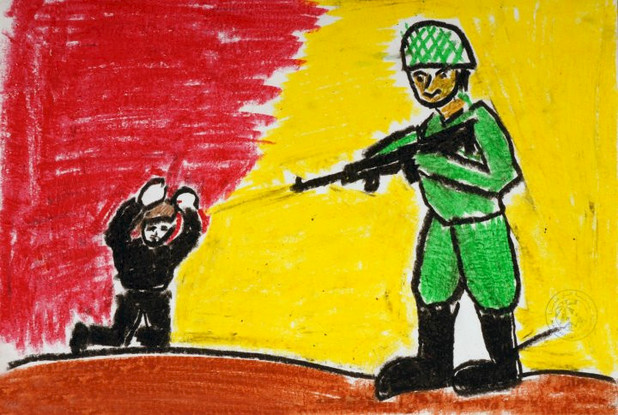 On May 12, we arrived at Al Fakheit School where we were met by “Al Jazeera” journalists filming a documentary about the difficulty that children face in getting to school in Occupied Palestine. They told us about one school near East Jerusalem where children have to pass through a sewer pipe to reach their school.
As we were describing similar difficulties faced by children in the South Hebron Hills, and the dangers of living in a live firing zone, the headmaster approached us looking crestfallen. He told us that soldiers had just stopped three teachers as they were driving to Jinba School and told them that the police would arrest them since they were not allowed to be in a closed military area. Police then came and took the teachers into a nearby illegal Israeli settlement and held them for two hours before release. They allowed two teachers to continue on to the school, but made one return home. The police had previously arrested him at a non-violent protest against the firing zone, and said he was not permitted to return to the area.
Children in Al Fakheit and Jinba face daily disruptions from the army, whose helicopters often hover over their schools. As we were playing football with the children in Jinba, they suddenly started shouting “jesh, jesh” (army, army) and we saw a large military jeep whiz through the village, passing very close to the school and houses. Within five minutes it was back again, speeding through the village, kicking up stones and dust. Children have got used to the military presence near their homes, but are still fearful of what might happen. Will the army stop and arrest someone? Will they come to demolish something? On our way home, we stopped in the village of Mirkez. An old lady invited us in for tea. She told us that a few days ago, while a 14-year-old boy was herding his flock, the army took him into a nearby settlement but later released him.
Imagine the insecurity of living in an area where soldiers or police could pick you up any day for no reason. The people living in this area also face threats and acts of violence from settlers. A few days before our visit, settlers damaged 60 thirty-year-old olive trees. The olive tree is a symbol of peace. Villagers in the South Hebron Hills are committed to non-violent resistance. I am inspired by their continued strength and struggle. They face so many obstacles just trying to do things that people I know take for granted, like getting an education and grazing their sheep on their own land. Who knows how the daily intimidation and fear will affect these children in the future? I hope and pray that when they are ready to bring up children themselves, the occupation will have ended, and they will be able to go to school and herd their flocks free of fear.
~
Please sign this petition to tell Israel that this behavior must stop.
Related articles
- “Nothing forbidden for them, but nothing allowed for us” (alethonews.wordpress.com)
- ‘Price tag’ attack in South Hebron Hills (palsolidarity.org)
Cutting Social Security and Not Taxing Wall Street
By Dean Baker | Truthout | May 15, 2013
As we move towards the fifth anniversary of the great financial crisis of 2008, people should be outraged that cutting Social Security is now on the national agenda, while taxing Wall Street is not. After all, if we take at face value the claims made back in 2008 by Fed Chairman Ben Bernanke and former Treasury Secretaries Henry Paulson and Timothy Geithner, Wall Street excesses brought the economy to the brink of collapse.
But now the Wall Street behemoths are bigger than ever and President Obama is looking to cut the Social Security benefits of retirees. That will teach the Wall Street boys to be more responsible in the future.
Most people are now familiar with President’s Obama’s proposal to cut Social Security by reducing the annual cost of living adjustment. While the final formula is somewhat convoluted, the net effect is to reduce benefits by an average of roughly 3.0 percent.
Since Social Security benefits account for more than 70 percent of the income of a typical retiree, this cut is more than a 2.0 percent reduction in income. By comparison, a wealthy couple earning $500,000 a year would see a hit to their after-tax income of just 0.6 percent from the tax increase that President Obama put in place last year.
While President Obama is willing to make seniors pay a price for the economic crisis, his administration his unwilling to impose any burdens on Wall Street. Specifically, it has consistently opposed a Wall Street speculation tax: effectively a sales tax on trades of stock and derivatives. The Obama administration has even used its power to try to block efforts by European countries to impose their own taxes on financial speculation.
If the idea of taxing stock trades sounds strange, it shouldn’t. The United States used to impose a tax of 0.04 percent until Wall Street lobbied to eliminate it in the mid-1960s. Many countries, including the United Kingdom, Switzerland, China, and India already impose taxes on stock trades.
The tax in the UK is 0.5 percent on stock trades (0.25 percent for both the buyer and the seller). It dates back more than 3 centuries. The country raises more than 0.2 percent of GDP ($32 billion in the United States) from the tax each year. The tax has not prevented the London stock exchange from being one of the largest in the world.
There are currently two bills in Congress for a similar tax in the United States. A bill by Minnesota Representative Keith Ellison would impose the same tax as the UK on stock trades and would apply a scaled rate to options, futures, credit default swaps and other derivative instruments. It could raise more than $150 billion annually or more than $2 trillion over the ten year budget window.
A second bill has been put forward by Iowa Senator Tom Harkin and Oregon Representative Peter DeFazio. This bill would apply a 0.03 percent tax to trades of stock and a wide range of other financial assets. According to the Joint Tax Committee, the bill would raise close to $40 billion a year or over $400 billion over a ten-year budget window once it is implemented.
Unfortunately the administration has consistently opposed both bills. It claims that it is concerned about the incidence of these taxes – that ordinary investors would see large burdens from the tax. It also claims to be worried that the taxes will disrupt financial markets by making trading more costly.
Neither of these stories passes the laugh test. Ordinary investors don’t trade much, and therefore are not going to feel much impact from the tax. If someone with $100,000 in a 401(k) (this is much larger than the typical 401(k)) turns it over at the rate of 50 percent annually, they would pay $15.00 each year as a result of the Harkin-DeFazio tax.
Furthermore research shows that investors reduce their trading as costs increase. This means that if the tax increases trading costs by 20 percent, then investors will reduce their trading by roughly the same amount (in this example, turnover would fall to 40 percent annually). That means that the net cost of turnover in a 401(k) will barely change for a typical investor as a result of the tax. Wall Street would just see much less business.
So the Obama administration wants us to believe that it is willing to cut the Social Security benefits of retiree living on $15,000 a year in Social Security by $450 but it opposes a Wall Street speculation tax because it is concerned that investors with $100,000 in a 401(k) may pay a few dollars a year in additional trading costs. Only a reporter with the Washington Post would believe a story like that.
The other part of the Obama administration’s story is equally laughable. The cost of financial transactions has plummeted in the last four decades because of computers. Even the Ellison tax rate would just raise costs back to their mid-80s level. The Harkin-DeFazio tax rate would probably still leave costs lower than they were in 2000.
The country certainly had a vibrant capital market and stock exchange in the 1980s, taking costs part of the way back to this level will not prevent Wall Street from serving its proper role of transferring capital from savers to borrowers. It will just clamp down on speculation.
The basic story is very simple. Wall Street bankers have a lot more political power than old and disabled people who depend on Social Security. That is why President Obama is working to protect the former and cut benefits for the latter.
Decades of Political Tyranny at the IRS
By Karl Grossman | May 16, 2013
President Barack Obama got it right and wrong Monday when he stated, “If you’ve got the IRS operating in anything less than a neutral and nonpartisan way, then that is outrageous, it is contrary to our traditions.”
He was right in declaring it was “outrageous” for the IRS to target conservative organizations for tough tax treatment. But he was incorrect in saying “it is contrary to our traditions.”
For the U.S. Internal Revenue Service has for decades gone after organizations and individuals that take stands in conflict with the federal government at the time. This has been a tradition, an outrageous tradition.
It is exposed in detail by David Burnham, longtime New York Times investigative reporter, in his 1991 book A Law Unto Itself: The IRS and the Abuse of Power. He relates how President Franklin D. Roosevelt likely “set the stage for the use of the tax agency for political purposes by most subsequent presidents.” Burnham writes about how a former U.S. Treasury Secretary, banker Andrew Mellon, was a special IRS target under FDR. During the presidencies of Lyndon Johnson and Richard Nixon, he recounts, the focus of the IRS’s efforts “at political control” were civil rights organizations and those against the U.S. engaging in the Vietnam War. Nixon’s “enemies list” and his scheme to use the IRS against those on it is what the current IRS scandal is being most compared.
History Professor John A. Andrew III in his 2002 book Power to Destroy: The Political Uses of the IRS from Kennedy to Nixon—its title drawn from U.S. Supreme Court Chief Justice John Marshall’s dictum “The power to tax is the power to destroy”—focuses further on this tradition. He tells of how John F. Kennedy administration’s “Ideological Organizations Project” investigated, intimidated and challenged the tax-exempt status of right-wing groups including the John Birch Society. Then, with a turn of the White House to the right with Nixon came investigations, he writes, of such entities as the Jerry Rubin Foundation, the Fund for Investigative Journalism and the Center for Corporate Responsibility.
During the Reagan administration, I had my own experience with the IRS—ostensibly
because of a book I wrote. Nicaragua: America’s New Vietnam? involved reporting from what was then a war zone in Nicaragua and in Florida—where I interviewed leaders of the contras who were working with the CIA to overthrow Nicaragua’s Sandinista government—and Honduras, being set up as a tarmac for U.S. intervention in Nicaragua. I visited a U.S. military base there. The book warned against a U.S. invasion of Nicaragua (subsequently decided against by the Reagan White House after the Iran-contra scandal). The book was published in 1985 and soon afterwards I was hit with an IRS audit. It would be more, I was informed, than my showing up at an IRS office. The IRS was to come to my house for a “field audit.”
The investigator sat on one side of our dining room table and on the other side was me and my accountant, Peter Berger of Shelter Island. What would be an all-day event started with the investigator asking me to detail how much my family spent on food each week and then, slowly, methodically, going through other expenses. Then he went through income. He obviously was seeking to determine on this fishing expedition whether income exceeded expenses. He went through receipts for business expenses including restaurant receipts, asking who I ate with. He sorted through receipts for office supplies. By mid-afternoon, he had gotten nowhere. At that point, having been hours together, a somewhat weird relationship had been formed. And he began to tell me how his dream in college was to become a journalist. He expanded on that, and then asked: “Have you ever faced retaliation?”
“What do you think this is?” I responded.
He was taken back—insisting my name had come up “at random.”
In the end, all he did was trim some of what was listed as business use of my home phone.
Was I being retaliated against for the book I had written? One would never know. Recently, I ran into accountant Berger, now retired, and he commented about how that day at my house was the strangest IRS audit he had ever been involved in.
The IRS has been beyond reform. Burnham writes in A Law Unto Itself: The IRS and the Abuse of Power that a “political imperative of not messing with the IRS” has become “close to being a law of nature almost as unbending as the force of gravity.” It is “rarely examined by Congress.”
President Obama announced yesterday that the acting commissioner of the IRS was asked and agreed to tender his resignation as a result of the scandal. That’s a small start. Far more important is somehow ending the tradition of IRS political tyranny. Fundamental change in the IRS is called for.
Karl Grossman, professor of journalism at the State University of New York/College of New York, is the author of the book, The Wrong Stuff: The Space’s Program’s Nuclear Threat to Our Planet. Grossman is an associate of the media watch group Fairness and Accuracy in Reporting (FAIR).
US attorney claims no knowledge of AP phone taps
RT | May 16, 2013
US Attorney General Eric Holder has claimed he was unaware of the subpoenas for AP’s phone records, but defended them as a necessary measure. Holder recused himself from the case that has been branded as an “unprecedented intrusion” into press freedom.
US lawmakers questioned the attorney general at a House Judiciary Committee about the two months of AP phone records obtained by the Justice Department without permission. In a session that saw the attorney on the back foot amid calls for his resign, he maintained his ignorance in the “ongoing matter.”
Flatly denying any prior knowledge to the subpoenas and who had issued them, he stated that he was 99 per cent sure that deputy attorney general James Cole had issued them.
“The matter is being supervised by the deputy attorney general. I am not familiar with the reasons why the subpoena was constructed in the way that it was because I’m simply not a part of the case,” Holder told the committee, adding he was confident that the people who are involved in the investigation adhered to Justice Department regulations.
Investigators wish to discern why it was necessary to gather so much information from AP phone records. The Justice Departments claims that the records were seized as part of an investigation into leaked data on a CIA operation in Yemen to stop an airliner bombing plot on the anniversary of the death of Osama Bin Laden.
Holder stressed that the leak was very serious and had put the safety of the American people at risk and as such the Justice Department’s action was justified.
Passing the buck
The Justice Department admitted its surveillance of AP’s phone lines in a letter to the organization’s heads last Friday. AP’s Chief Gary Pruitt reacted with ire, condemning the intrusion as a gross violation of press freedom that is inexcusable. AP estimates that over 100 of its journalists were affected by the phone surveillance and has implicated the involvement of the attorney general, alleging that subpoenas require his signature to be carried out.
There was a degree of frustration at Holder’s answers during the hearing due to his inability to answer questions on the subpoenas and why the Justice Department failed to negotiate with AP prior to the subpoenas, which is usually standard practice in such situations.
“There doesn’t appear to be any acceptance of responsibility for things that have gone wrong,” Rep. James Sensenbrenner, R-Wis., told Holder. He suggested that Justice Department office should stop by Harry S Truman Presidential Library and take a photo of the famous sign, “The buck stops here.”
The White House has also claimed ignorance, stating that it had no knowledge of “any attempt by the Justice Department to seek phone records of the AP.”
US obstructing global disarmament: Iran
Press TV | May 16, 2013
Iran’s Foreign Ministry Spokesman Abbas Araqchi says the United States’ opposition and lack of commitment to various international disarmament conventions are obstacles to advancing the issue of global disarmament.
Pointing to the US’s 16-year opposition to bringing up the issue of disarmament in the UN Disarmament Conference, Araqchi said, “The US has, for all practical purposes, taken the conference hostage and is hindering its effective performance in advancing international peace and security.”
He said that the US opposition to the protocol to the Biological Weapons Convention, its non-adherence to its commitments under the Chemical Weapons Convention to eliminate its arsenal by 2012, and efforts to prevent global denuclearization as well as a nuclear-free Middle East are all part of Washington’s black record of non-compliance with international obligations and disrespect for international mechanisms on global disarmament and security.
Reacting to Washington’s recent decision to boycott the upcoming UN Conference on Disarmament because of its chairmanship by Iran, Araqchi said, “Iran is among the first founders of the [UN] Disarmament Conference, and as an independent country, it has always played an instrumental and constructive role in advancing the objectives of the conference, in particular that of nuclear disarmament.”
In a statement issued on Monday, Erin Pelton, the spokesperson for the US Mission to the United Nations, said that the US would not send its ambassador to the conference, adding the US believes the Islamic Republic of Iran should be barred from any formal or ceremonial positions in UN bodies.
Araqchi further noted, “Iran has also played a key role in negotiations on international treaties, including the Chemical Weapons Convention.”
Describing Iran as a victim of weapons of mass destruction (WMDs), the Iranian spokesman said the Islamic Republic of Iran along with other peace-loving nations of the world will continue to tap into all national and international potential to contribute to the creation of a WMD-free world.
Iran proposed the idea of a nuke-free Middle East and is among the flag-bearers of nuclear disarmament, he highlighted.
Iran will accede to the rotating presidency of the 65-nation UN Conference on Disarmament, based in Geneva, on May 27 and it will hand it over to another country on June 23 in an alphabetical order.
The conference seeks to reach an agreement on global nuclear disarmament and stopping the development of other weapons of mass destruction.
Related article
- Canada not to attend UN disarmament talks under Iran presidency (alethonews.wordpress.com)
Featured Video
Bombing Iran Back Into the Stone Age /Lt Col Daniel Davis & Jim Jatras
or go to
Aletho News Archives – Video-Images
From the Archives
The Occupied Mentality Syndrome
Saudi Arabia on the American chessboard – Part 2
By B. J. Sabri | American Herald Tribune | April 19, 2016
Since the Korean War, but particularly since the Iranian Revolution of 1979 until today, the United States has been steadily escalating its military presence in the Persian Gulf. Taking advantage of many colossal events of the past 36 years, [1] the hyper-empire has institutionalized its massive presence on land and sea, and expanded its objectives to include the unambiguous physical control of the area, as well as the clear understanding that local Arab governments should abide by them. The pretext is always the same: in “defense” of the national interests and security of the United States. From observing how the United States has been interacting with the governments of the region, and by judging from the size of its expeditionary force, we could reach a basic conclusion. The United States is occupying, de facto, the entire Arabian Peninsula. (Yemen, devastated by Saudi and American jets is yet to be conquered. Oman? Britain returned not as colonial ruler but as a soft occupying power.)
Under this articulation, Saudi Arabia, Qatar, Kuwait, and the United Arab Emirates are virtually occupied countries. If we compare this type of occupation to the mandate and protectorate regimes of the past, the results might be identical—the nations affected by it lose sovereignty. When Arab governments comply with the objectives of a foreign power that station military forces on their national milieu, then that power controls them in multiple ways including how they react to policy deliberations and what decisions they intend to take on specific issues. A good method to verify the concept of effective occupation is this: take notice of what the United States says and wants, and then compare it to what the gulf rulers do in response. (I shall discuss this detail at some point in the upcoming parts.)
If the presence of US forces or other means of political pressure are a factor in Saudi Arabia’s interventionist Arab wars, then we need to debate this issue. However, from the history of resistance to colonialism, we learnt: if a powerful state imposes its order on a nation by military means or other forms of coercion, and if this nation does not resist that imposition, then a mental subordination to the powerful state will ensue. This is especially true in the case of Saudi Arabia. One single event, 9/11, has transformed it from a US “ally” into an instant political hostage of the American Empire. … continue
Blog Roll
 Aletho News
- Now everyone is dumping US government bonds
- Brazilian Congressman seeks to bar Israeli military personnel from entering Brazil
- Official reveals evidence of Arab states’ involvement in US-Israeli war on Iran
- His Majesty’s head-chopper: Syria’s MI6-backed president bows to King Charles
- Forced to backtrack: ‘Israel’ drops Hezbollah disarmament goal
- Britain’s Lebanon surveillance network: A digital map for war
- Bahrain faces scrutiny for opposition crackdown after detainee killed
- Hegseth’s Pentagon Purge Designed to Prevent a Mutiny: Karen Kwiatkowski
- Greek shipping firms secretly transporting oil, weapons to Israel
- UN vote on Hormuz force delayed as Iran issues warning
- If Americans Knew
- Israel Is Blocking Palestinians from Easter at Church Where Jesus Resurrected
- Plot to assassinate Palestinian activist follows harassment campaign promoted by Zionist groups and elected officials
- Prominent New York synagogue hosts presentation on why U.S. Jews should support the ethnic cleansing of Gaza
- Tapper vs. Piker: Is the CNN Anchor Auditioning for David Ellison?
- Shouldn’t Democrats Be Able to Condemn Genocide?
- Israel-US kill negotiators, destroy civilian structures, but Iran’s military capabilities still largely intact – Daily Update
- ‘War crime’: Global condemnation as Israeli ministers celebrate death penalty law targeting Palestinian prisoners
- 7 Ways Israel Is Turning Lebanon Into Gaza
- World’s Leading Football Bodies Under Fire Over Israel Policies
- Experts warn of possible use of nukes against Iran
- No Tricks Zone
- Low Intensity Tornado Wrecks Major Solar Farm, Creating A Potential Toxic Dump
- New Study Finds Warming Saves Lives…Cold Temperatures 12 Times More Deadly Than Excess Heat
- German Science Blog Accuses PIK Climate Institute Of Hallucinating Climate Tipping Points
- Devastating Assessment Of Comirnaty Vaccine By Former Senior Pfizer Europe Toxicologist
- New Study: CO2 Is ‘Effectively Negligible’ As An Explanatory Climate Change Factor Since 2000
- Former Pfizer Toxicologist Dr. Helmut Sterz Tells Bundestag Hearing Pfizer Vaccine Should Have Never Been Approved
- Energy Expert: Germany’s Nuclear Phaseout Was A “500 Billion Euro Mistake”
- New Research: South Australia’s Mid-Holocene Sea Surface Temperatures Were 4°C Warmer Than Today
- Storing Green Energy To Last Germany 10 Days Would Require A 60-Million Tonne Battery
- New Studies: UK Sea Levels Were 4 Meters Higher Than Today During The Mid-Holocene
 Aletho News