Boundless Informant: NSA’s complex tool for classifying global intelligence
RT | June 9, 2013
A new batch of classified NSA docs leaked to the media reveals the details of a comprehensive piece of software used by NSA to analyze and evaluate intelligence gathered across the globe as well as data extraction methods.
The top-secret documents released by the Guardian shed light on the National Security Agency’s data-mining tool being used for counting and categorizing metadata gathered and stored in numerous databases around the world.
Known as Boundless Informant, the software provides its operator a graphical insight on how many records were collected for a specific “organizational unit” or country, what type of data was collected and what type of collection was used. The program also allows determining trends in data collection for both strategic and tactical decision making, according to the slides.
One of the slides contains a part of the Informant’s user interface showing a world map with countries color-coded ranging from green to red depending on the amount of records collected there. While Iran, Pakistan and some other states are predictably “hottest” according to the map, the agency collected almost 3 billion intelligence pieces in the US in March 2013 alone.
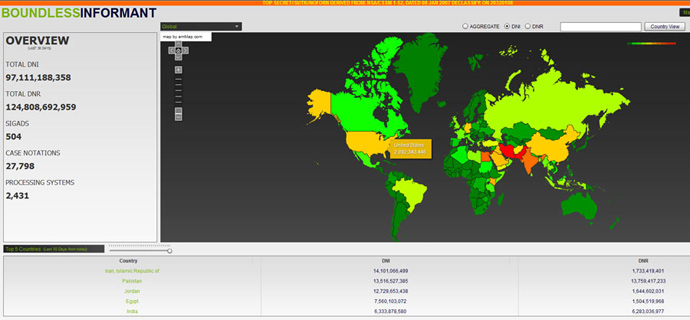
The map showing how much data is being collected in different countries across the globe (image from the Guardian)
The insight on the software being used by the NSA comes amid the agency spokesperson Judith Emmel’s claims that the NSA cannot at the moment determine how many Americans may be accidentally included in its surveillance.
“Current technology simply does not permit us to positively identify all of the persons or locations associated with a given communication,” Emmel said Saturday adding that “it is harder to know the ultimate source or destination, or more particularly the identity of the person represented by the TO:, FROM: or CC: field of an e-mail address or the abstraction of an IP address.”
NSA data sources
Another slide from the internal NSA presentation redacted by the Guardian editors details the data gathering methods used in the NSA global surveillance program.
The first method suggests interception of data from “fiber cables and infrastructure as data flows past” under the FISA Amendments Act (FAA) of 2008, Section 702.
The second distinguished method is data collection “directly from the servers of the US service providers.”

The slide detailing methods of data extraction under the FISA Amendment Act (image from the Guardian)
The presentation encourages analysts to use both methods for better results.
Google, Facebook negotiated ‘secure portals’ to share data with NSA?
Meanwhile, a report by the New York Times revealed that Internet giants, including Google and Facebook, have been in negotiations with the US security agency over ‘digital rooms’ for sharing the requested data. The companies still insist there is no “back door” for a direct access to user data on their servers.
The Internet companies seem more compliant with the spy agencies than they want to appear to their users, and are cooperating on “behind-the-scenes transactions” of the private information, according to a report that cites anonymous sources “briefed on the negotiations.”
According to the report, Google, Microsoft, Yahoo, Facebook, AOL, Apple and Paltalk have “opened discussions with national security officials about developing technical methods to more efficiently and securely share the personal data of foreign users in response to lawful government requests,” sometimes “changing” their computer systems for this purpose.
These methods included a creation of “separate, secure portals” online, through which the government would conveniently request and acquire data from the companies.
Twitter was the only major Internet company mentioned in the report that allegedly declined to facilitate the data transfer to the NSA in a described way. As opposed to a legitimate FISA request, such a move was considered as not “a legal requirement” by Twitter.
The sources claim the negotiations have been actively going in the recent months, referring to a Silicon Valley visit of the chairman of the Joint Chiefs of Staff Martin E. Dempsey. Dempsey is said to have met the executives of Facebook, Microsoft, Google and Intel to secretly discuss their collaboration on the government’s “intelligence-gathering efforts.”
NSA pressured to declassify more PRISM details
In response to the fury over US government’s counterterrorism techniques, Director of National Intelligence James Clapper for the second time in three days revealed some details of the PRISM data-scouring program.
Being one of the “most important tools for the protection of the nation’s security” the PRISM is an internal government computer system for collecting “foreign intelligence information from electronic communication service providers under court supervision,” Clapper said.
He also said that PRISM seeks foreign intelligence information concerning foreign targets located outside the US and cannot intentionally target any US citizen or any person known to be in the US. As for “incidentally intercepted” information about a US resident, the dissemination of such data is prohibited unless it is “evidence of a crime”, “indicates” a serious threat, or is needed to “understand foreign intelligence or assess its importance.”
Clapper also stressed that the agency operates with a court authority and that it does not unilaterally obtain information from the servers of US telecoms and Internet giants without their knowledge and a FISA Court judge approval.
Related articles
- The NSA Black Hole: 5 Basic Things We Still Don’t Know About the Agency’s Snooping
- NSA Document Leak Proves Conspiracy To Create Big Brother Style World Control System
- DOJ launches criminal probe of NSA leaker
- US security officials said NSA leaker, journalist should be ‘disappeared’ – report
- Government Spying: Should We Be Shocked?
- The NSA’s Favorite Weasel Word To Pretend It’s Claiming It Doesn’t Spy On Americans
- The “Congress knew” defense
- NSA memo pushed to ‘rethink’ 4th Amendment
Government Says Secret Court Opinion on Law Underlying PRISM Program Needs to Stay Secret
By Mark Rumold and David Sobel | EFF | June 7, 2013
In a rare public filing in the secret Foreign Intelligence Surveillance Court (FISC), the Justice Department today urged continued secrecy for a 2011 FISC opinion that found the National Security Agency’s surveillance under the FISA Amendments Act to be unconstitutional. Significantly, the surveillance at issue was carried out under the same controversial legal authority that underlies the NSA’s recently-revealed PRISM program.
EFF filed a suit under the Freedom of Information Act in August 2012, seeking disclosure of the FISC ruling. Sens. Ron Wyden and Mark Udall revealed the existence of the opinion, which found that collection activities under FISA Section 702 “circumvented the spirit of the law” and violated the Fourth Amendment’s prohibition on unreasonable searches and seizures. But, at the time, the Senators were not permitted to discuss the details publicly. Section 702 has taken on new importance this week, as it appears to form the basis for the extensive PRISM surveillance program reported recently in the Guardian and the Washington Post.
The government has seeked to block EFF’s FOIA suit by arguing that only the FISC, itself, can release the opinion. In an effort to remove that roadblock, EFF filed a motion with the FISC on April 22 seeking the surveillance court’s consent to disclosure, should the document be found to be otherwise subject to release under FOIA. In its response filed with the FISC today, the government offers a circular argument, asserting that only the Executive Branch can de-classify the opinion, but that it is somehow prohibited by the FISC rules from doing so.
The government’s argument is guaranteed to make heads spin. DOJ earlier argued that it lacks discretion to release the FISC opinion without the FISC’s consent, but DOJ now argues that if the FISC were to agree with EFF, “the consequence would be that the Government could release the opinion or any portion of it in its discretion.” But FISC material is classified solely because the Executive Branch demands that it be, so release of the opinion has always been a matter of Executive discretion.
Frankly, it’s difficult to understand what DOJ is saying. The Government seems to have a knee-jerk inclination towards secrecy, one that often – as in this case – simply defies logic. The government’s bottom line is this: their rules trump the public’s statutory rights. But it’s not the province of the Executive branch to determine which rights citizens get to assert.
The events of the past week have demonstrated that the public is angry about the NSA’s domestic surveillance program. EFF hoped the public outcry might lead the government to rethink it’s position in this case (and, notably, DOJ has in two other EFF cases). But, for now, the government is digging in its heels and refusing to budge. But a democracy demands more. When the government acts unconstitutionally, the public has a fundamental right to review, understand, and correct that government action. Despite the DOJ’s filing today, EFF intends to keep fighting against the government’s secret surveillance practices.
Related article
UK drone strikes violate international law: legal opinion piece
Press TV – June 8, 2013
Britain’s operating of killer drones in Afghanistan may be violating the international law, a legal firm representing peace campaigners has argued in an opinion piece.
The legal opinion by Public Interest Lawyers argues that the use of killer drones in Afghanistan is a breach of the international law under the European Convention for Human Rights (ECHR).
The document says that the ECHR’s article 2 requires the governments to use “no more [force] than absolutely necessary” during conflicts.
“Only when it is absolutely necessary to kill someone rather than arrest/disable them will the use of drones be lawful. And even then, drones may only be used for … self defence under 2(2)(c),” it says.
According to the Public Interest Lawyers, this means that the ECHR obliges Britain to the use of killer drones only in “situations in which there is an immediate threat to life” that “prevents the carrying out of ‘targeted killings’ and narrowly circumscribes their use even on ‘the battlefield'”.
“There is therefore a strong presumption that the UK’s drones programme is in breach of international law,” it adds.
The British Ministry of Defense announced back in April that they are operating killer drones in Afghanistan by remote-pilots from RAF Waddington base in Lincolnshire.
The ministry claims its operations are in accordance with applicable international humanitarian law.
This comes as drone attacks normally come with extreme “collateral damage” to the civilian population even when taking the American and British claims that they are targeting terrorists by terror drones as true.
Hundreds of civilians have been killed the remote-controlled killer drones strikes on various parts of Afghanistan over the past years.
Civilians’ casualties have triggered widespread protests against killer drone attacks in the Asian country with the Afghan government repeatedly calling for an end to the deadly assaults.
Related article
The NYT and Chemical Weapons in Syria
By Michael McGehee | NYTX | June 7, 2013
Last month when UN investigator Carla Del Ponte came out publicly to say, “There are strong, concrete suspicions but not yet incontrovertible proof of the use of sarin gas, from the way the victims were treated,” and, “This was use on the part of the opposition, the rebels, not by the government authorities,” it was quickly met with suspicion and denial, from the UN and the White House.
Jay Carney, the White House press secretary, said as much to reporters.
“We are highly skeptical of the suggestion that the opposition could have or did use chemical weapons,” Mr. Carney said. “We find it highly likely that any chemical weapon use that has taken place in Syria was done by the Assad regime. And that remains our position.” (NYT, 05/07/2013)
In the previous month both the US and Israel came out with the claim that the Syrian government had used chemical weapons.
On Tuesday the UN issued a report on the war-torn country, and The New York Times reported that, “There are reasonable grounds to believe limited quantities of toxic chemicals were used.”
However, the “paper of record” conveniently failed to note that the report immediately goes on to say that “It has not been possible, on the evidence available, to determine the precise chemical agents used, their delivery systems or the perpetrator.”
But there are two very important developments to this story which have been met with total silence.
The first is the hacking of Britam, a British defense company. Four months ago it was reported by Yahoo! that:
The Obama administration gave green signal to a chemical weapons attack plan in Syria that could be blamed on President Bashar al Assad’s regime and in turn, spur international military action in the devastated country, leaked documents have shown.
One of the leaked documents was an email. The email:
Phil
We’ve got a new offer. It’s about Syria again. Qataris propose an attractive deal and swear that the idea is approved by Washington.
We’ll have to deliver a CW to Homs, a Soviet origin g-shell from Libya similar to those that Assad should have.
They want us to deploy our Ukrainian personnel that should speak Russian and make a video record.
Frankly, I don’t think it’s a good idea but the sums proposed are enormous. Your opinion?
Kind regards
David
One of the parties who continues to feed the UN information about the use of chemical weapons in Syria is the United Kingdom. The NYT reported on Wednesday, Britain “repeated an earlier assessment that ‘a growing body of limited but persuasive information’ pointed to the use of the same toxin.”
After the email was leaked, claims of chemical weapons usage were made and then President Obama was hounded to act swiftly. Syria’s President Assad allegedly crossed Washington’s “red line.”
The June 4th UN panel report claims that, “It is possible that anti-Government armed groups may access and use chemical weapons. This includes nerve agents, though there is no compelling evidence that these groups possess such weapons or their requisite delivery systems.”
The Turkish news agency, Zaman, reported on May 28, 2013—that is, a week before the UN report was published—that Syrian rebels were arrested in Turkey and had Sarin gas in their possession.
While Russia Today covered the development, as well as Voice of Russia and Iran’s PressTV, no Western source published the development.
In all the coverage provided on Syria and chemical weapons—in the last year the NYT has provided more than 1,100 news items—we should suppose that a hacked email showing Washington supports a plan to use chemical weapons in Syria and blame it on the regime, and that rebels have been caught with Sarin nerve gas in Turkey, simply is not “all the news fit to print.”
Syria’s Fake Sectarian War
By Shamus Cooke | Worker’s Action | June 7, 2013
The fate of Syria and the broader Middle East balances on a razor’s edge. The western media is giving dire warnings of an impending sectarian war between Sunni and Shia Muslims, a war that could drown the Middle East in a flood of blood.
Such a war would be completely artificial, and is being manufactured for geo-political reasons. When the most influential Sunni figures in Saudi Arabia and Qatar — both U.S. allies — recently called for Jihad against the Syrian government and Hezbollah, their obvious intentions were to boost the foreign policy of Saudi Arabia and its closest ally, the United States, by destroying Iran’s key ally in the region.
Will Sunni Muslims in Syria — who are the majority — suddenly begin attacking their Shia countrymen and the Syrian government? Unlikely. A compilation of data from humanitarian workers in and around Syria compiled by NATO suggests that:
…70 percent of Syrians support the Assad regime. Another 20 percent were deemed neutral and the remaining 10 percent expressed support for the rebels.”
The pro-Assad 70 percent is mostly Sunni. This data flies in the face of the constant barrage of western media distortion about what’s happening in Syria. Previous polling compiled last year by Qatar had similar results, and was likewise ignored by the western media.
The above article quoted a source familiar with the data:
The Sunnis have no love for Assad, but the great majority of the community is withdrawing from the revolt… what is left is the foreign fighters who are sponsored by Qatar and Saudi Arabia. They are seen by the Sunnis as far worse than Assad.
Syrian Sunnis are likely disgusted by the behavior of the foreign extremists, which include a laundry list of war crimes, ethnic cleansing, as well as the terrorist bombing of a Sunni Mosque that killed the top Sunni cleric in Syria — along with 41 worshipers and 84 others injured. The Sunni cleric was killed because he was pro-Assad.
The recent calls for Jihad by the Saudi and Qatari Sunni leaders are likely in response to the Syrian government scoring major victories against the rebels. The rebels are now badly losing the war, in large part because they’ve completely lost their base of community support.
There are other key rebel supporters now taking urgent action to bolster the flagging rebel war effort. The leader of al-Qaeda, for example, made a recent plea for Sunnis to support the rebels against the Syrian government, while U.S. politician John McCain journeyed into Syria to meet with rebels — later identified as terrorists — to further commit the U.S. to the rebel side.
Meanwhile, The New York Times confirmed that the CIA had increased its already-massive arms trafficking program into Syria, while the European union agreed to drop the Syrian arms embargo, so that even more arms could be funneled to the rebels.
And to top it off, France now says it has proof that the Syrian government used chemical weapons against the rebels — a UN representative has suggested that just the opposite is the case — while the rebels are desperately trying to incite war between Syria and Israel by attacking the Syrian government on the border of the Israeli-occupied Golan Heights.
Also relevant is that the pro-Jihad religious leaders of Qatar and Saudi Arabia are taking a giant gamble in their recent anti-Hezbollah proclamations, and risk triggering political instability to these already-shaky regimes, which are hugely dependent on the religious leaders for support.
Hezbollah is still revered throughout the Muslim world for its military defeat of Israel in 2006; and most Muslims will likely be uninterested in waging Jihad in Muslim majority Syria. Also, attacking the Syrian government and Hezbollah would mean allying with Israel and the United States, not an ideal situation for most jihadists.
It’s very possible that the Syrian tinderbox could drag the surrounding Middle Eastern countries into a massive regional war, with Russia and the United States easily within the gravitational pull.
The Syrian conflict could end very quickly if President Obama rejected U.S. support for the rebels and demanded his U.S. allies in the region do the same. Obama should acknowledge the situation in Syria as it exists, and respect the wishes of the Syrian people, who do not want their country destroyed.
Instead, the U.S. is considering arming the rebels even more.
U.S. Senator John McCain revealed the unofficial U.S. government policy for Syria when he said that he would tolerate an extremist takeover of Syria if it weakened Iran.
At this point an extremist takeover of Syria will cost tens of thousands of more lives, millions more refugees, while exploding the region into a multi-country orgy of violence.
The media will blame such genocide on Islamic sectarian violence, and ignore the obvious political motives.
Hopefully, the social movement in Turkey will force the Turkish government out of the western-controlled anti-Syrian alliance, while empowering other Middle Eastern countries to do the same.
UN calls for record $5.2 billion aid package for Syria
Al-Akhbar | June 7, 2013
The United Nations on Friday launched a record $5.2-billion aid appeal to fund operations in Syria and neighboring nations, saying the number of people affected by the country’s brutal conflict was set to spiral.
The call for donations comes as the UN expects that 10.25 million Syrians – half the country’s population – will need humanitarian aid by the end of 2013.
The sum of aid being requested overshadows by far the $2.2 billion the UN sought in 2003 to help cope with the crisis sparked by the war in Iraq.
The $5.2 billion represents money needed across this year to pay for operations that have already been undertaken, are ongoing, or are due to be carried out until the end of December.
“The figure for the new appeal is both an expression of the alarm about the situation facing Syrians and an absence of a political solution,” said Adrian Edwards, spokesman for the UN’s refugee agency, the UNHCR.
It also marked a more than threefold increase on the $1.5 billion which the UN previously had said that it needed to cover operations this year.
The UN has so far received $1.0 billion of that sum, after launching an appeal last December.
In the latest appeal, the world body said that a total of $3.8 billion was needed to help Syrian refugees who have spilled across the country’s borders to escape fighting in their homeland.
The figure for operations inside Syria meanwhile was $1.4 billion.
According to UN estimates, more than 80,000 people have been killed and some 1.6 million Syrians have fled the country since the civil war began in March 2011 after a crackdown on protests against President Bashar al-Assad.
“The numbers represented in this plan are staggering,” said Amir Abdulla, deputy executive director of the UN’s World Food Program (WFP). “They’re not sustainable over the very long term.”
“They represent a tragedy for Syria and a burden on the region,” he told reporters.
The WFP, which has delivered 500 million meals in Syria so far this year, expects its weekly costs to rise from almost $20 million now to $36 million after September. It says it has a funding shortfall of about $725 million.
The WFP’s Syria Regional Emergency Coordinator Muhannad Hadi said: “We have reached a stage in Syria where some of the people, if they don’t get food from the World Food Programme, they simply do not eat.”
The overwhelming majority of the refugees have fled to neighboring Lebanon, Turkey, Iraq and Jordan, which are struggling to cope.
In Jordan, for example, one refugee camp is now the equivalent of the nation’s fifth-largest town.
With the revolt against Assad having morphed into a vicious, drawn-out conflict, the total number of refugees is expected to swell to at least 3.45 million by the end of this year, according to the UN appeal.
Within the country, a total of 6.8 million people are forecast to need aid this year, the majority of them people who have been forced to flee their homes because of the fighting.
“These are huge numbers. They are not sustainable over the very long term, which is why we hope that there will be a solution to the situation inside Syria,” said Abdulla.
“We hope that the world will respond, as millions of Syrians displaced in their home country, and refugees in neighboring countries, basically have little else to rely on at this time,” he added.
Syria’s pre-war population was 20.8 million.
“By the end of the year, half of the population of Syria will be in need of aid,” underlined Edwards.
The nature of the Syrian conflict has affected aid efforts, with convoys often having to clear dozens of checkpoints manned by different militias from both sides.
“In other operations, there’s often a front line when you’re dealing with two opposing forces. In this instance you’ve a very complex situation where there are pockets. There is no clear line. You’re dealing with a fragmented opposition who don’t follow a monolithic command and control structure,” said Abdulla.
(AFP, Reuters, Al-Akhbar)
Palestinian activist detained in Israeli raid
Ma’an – 08/06/2013
HEBRON – Israeli forces on Friday raided the al-Sumoud (“steadfastness”) center in Hebron and detained Jawad Abu Aisheh, 39, from the Old City, an official said.
The director of the center, Ahmad Amro, said six soldiers and two policemen stormed the center, causing damage. They also assaulted some of the activists there and threatened them.
Forces detained Jawad Abu Aished who lives near the center.
The coordinator of Youth Against Settlements, Badi Dweik, said that “detaining Abu Aisheh is proof that the Israeli authority helps and supports settlers in their attempts to control … the Old City.”
Dweik called on President Mahmoud Abbas and his new Prime Minister Rami Hamdullah to respond to Israel’s “continuous crimes” in the West Bank in general and Hebron in particular.
An Israeli army spokeswoman referred inquiries to the police. A police spokesman did not immediately return calls.
Hebron man arrested for filing complaint about settler attack
International Solidarity Movement | June 8, 2013
Hebron, Occupied Palestine – Human rights activist Jawad Abu Eysheh, 39, was arrested Friday 7th June following a complaint he made four months ago about a settler attack.
At 4:20 pm on 7th June, Israeli Police arrived at the house of the Hebron organisation Youth Against Settlements and demanded to see the ID’s of Jawad and three other men present. The police then told Jawad that they wanted to take him away ‘for investigation’, and called the Israeli military to escort Jawad away in handcuffs.

Jawad Abu Eysheh being handcuffed and arrested (Photo by Youth Against Settlements)
Jawad was then paraded through the adjacent illegal Tel Rumeida settlement and taken to the nearby checkpoint 56, before being transferred to the police station in the settlement of Givat Ha’avot outside the city centre.
The line of questioning from the police made clear that Jawad was being detained as a result of events that happened back in February, when Jawad and other activists were attacked by American-born extremist Baruch Marzel and other settlers.
Despite being a victim of that violent assault in February, it was Jawad who was subjected to arrest today, not the perpetrators. During his detention, Jawad was also forced to submit a DNA sample against his will, and to sign conditions that he will not speak with Baruch Marzel for the next 30 days. Jawad stated his is happy to comply with this stipulation at least. Jawad was released at around 9pm.As well as today’s arrest, Jawad has faced other harassment recently, including not being allowed to walk on the street where his factory space and uncle’s house are located.
The Israeli army and police in Hebron have a long history of harassing human rights defenders such as Jawad and his colleague Issa Amro, and of following the wishes of extremist settlers when deciding who to harass.
Related articles
- Jewish settlers setting up tent and planning road on Palestinian owned land in Al Khalil (alethonews.wordpress.com)
- Witnesses: Settlers open fire at Palestinian homes in Hebron village (altahrir.wordpress.com)
- Jewish settlers attack West Bank village with Israeli army support (alethonews.wordpress.com)
Israel bans guards from entering Aqsa compound
Ma’an – 08/06/2013
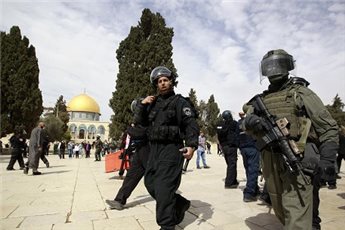
JERUSALEM – Israel on Friday banned 25 Al-Aqsa compound guards from the vicinity of the mosque for varying periods of time.
Samer Qweider was banned from entering Al-Aqsa until the end of Ramadan for allegedly verbally abusing rightists who tried to get into the compound.
Qweider told Ma’an that on May 28 he was banned from entering the compound for six days, and accordingly he returned to his job on Monday. After two days of working regularly he was told by Israeli police he was not allowed to enter the compound until Ramadan ends in mid-August.
Another guard, Fadi Bakeer, said that Israel wanted to “silence” the guards, and added that any guard who tried to stop rightists from entering the holy compound would be banned.
A religious department worker said that guards are pressured, arrested, beaten, banned, and fined. He added that his department has pleaded for King Abdullah II of Jordan for help.
Israeli authorities have allowed the Jordanian leadership a degree of control over the holy Muslim site as well as the Church of the Holy Sepulcher due to its historical connections to Jerusalem.
Israel seized the West Bank including East Jerusalem from Jordan in the Six-Day War of 1967.
Related article
- Palestine: The global march to Jerusalem to launch tomorrow in 40 states & demands to flock to Al-Aqsa Mosque (realisticbird.wordpress.com)
Russia slams the US for distorting results of trilateral talks on Syria
Press TV – June 7, 2013
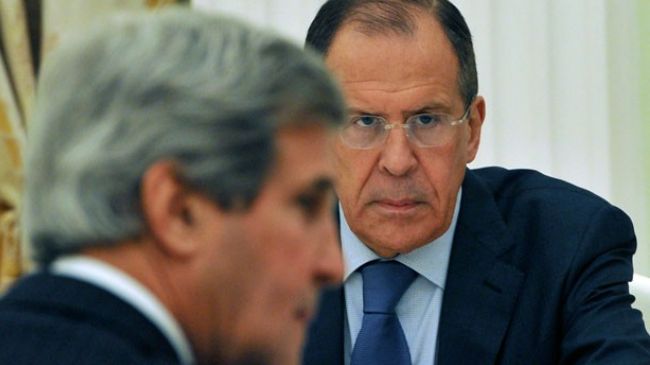
Russia’s foreign minister has censured the US Department of State officials for their ‘peculiar comment’ on the results of a trilateral meeting over Syria in Geneva.
The trilateral meeting on Wednesday was held with the participation of UN-Arab League Special Representative for Syria Lakhdar Brahimi and representatives from Russia and the United States. It served as a preparatory move to pave the way for the Geneva 2 talks on the issue of Syria.
During a Thursday press conference, Russian Foreign Minister Sergei Lavrov said, “I have heard that officials from the US Department of State have given a very peculiar comment on the results of yesterday’s meeting in Geneva between Russia, US, and UN.”
“In particular, the State Department representative stated that Russia, the United States and the United Nations agree that the goal of the new conference in Geneva must be the forming of a new transitional government in Syria. This really matches with what was written down last year,” he said.
“But, if the reports that I have received are true, the State Department went on to add that this should be a transitional government to which the current authorities in Damascus would hand over all their powers. If this was really said by the State Department, this is a very strong distortion of what the talks were about,” the Russian foreign minister added.
He made the remarks in response to an earlier statement by Jennifer Psaki, a spokesperson for the US Department of State, where she reportedly claimed that participants in the preparatory meeting had agreed that the forthcoming talks on Syria should focus on the formation of a transitional government, to which the current administration should give up all powers.
Lavrov further reiterated that Moscow would continue to push for Iran’s participation in the upcoming Geneva meeting despite opposition from some Western states.
Meanwhile, Brahimi has expressed hope that the Geneva conference would convene in July, as the preparatory meeting failed to set a date.
Syria – Israel Is Losing the Battle
By Gilad Atzmon | June 7, 2013
In the last week we have been following desperate British and French attempts to push for military intervention in Syria. It is far from being a secret that both governments are dominated by the Jewish Lobby. In Britain it is the ultra Zionist CFI (Conservative Friends of Israel) – apparently 80% of Britain’s conservative MPs are members of the pro-Israeli Lobby. In France the situation is even more devastating, the entire political system is hijacked by the forceful CRIF.
But in case anyone fails to grasp why the Jewish Lobby is pushing for an immediate intervention, Debka, an Israeli news outlet provides the answer. Seemingly, the Syrian army is winning on all fronts. Israel’s military and geo-political calculations have proven to be wrong.
According to Debka, “the battle for Damascus is over”. The Syrian army had virtually “regained control of the city in an epic victory”. The rebels, largely mercenaries, have lost the battle they “can’t do much more than fire sporadically. They can no longer launch raids, or pose threats to the city centre, the airport or the big Syrian air base nearby. The Russian and Iranian transports constantly bringing replenishment for keeping the Syrian army fighting can again land at Damascus airport after months of rebel siege.”
But it isn’t just the capital. Debka reports that “Hezbollah and Syrian units have tightened their siege on the rebels holding out in the northern sector of al Qusayr; other (Syrian army) units have completed their takeover of the countryside around the town of Hama; and a third combined Syrian-Hizballah force has taken up positions around Aleppo.”
Debka maintains that senior IDF officers criticized the Israeli defense minister (Moshe Ya’alon) who “mislead” the Knesset a few days ago estimating that “Bashar Assad controlled only 40% of Syrian territory.” Debka suggests that the Israeli defense Ministry has drawn on a “flawed intelligence assessment and were concerned that the armed forces were acting on the basis of inaccurate intelligence.” Debka stresses, “erroneous assessments… must lead to faulty decision-making.”
Debka is clearly brave enough to admit that Israeli military miscalculations may have led to disastrous consequences. It reports, “the massive Israeli bombardment of Iranian weapons stored near Damascus for Hezbollah, turned out a month later to have done more harm than good. It gave Bashar Assad a boost instead of weakening his resolve.”
Debka is obviously correct. It doesn’t take a genius to predict that an Israeli attack on an Arab land cannot be accepted by the Arab masses, not even by Assad’s bitterest Arab opponents.
Debka maintains that the “intelligence focus on military movements in Syria especially around Damascus to ascertain that advanced missiles and chemical weapons don’t reach Hezbollah laid to a failure in detecting a major movement by Hezbollah militia units towards the Syrian-Israeli border.”
Israel is now facing a new reality. It is facing Hezbollah reinforcements streaming in from Lebanon towards the Golan heights and its border with Syria.
Israel, Debka concludes, will soon find itself “face to face for the first time with Hezbollah units equipped with heavy arms and missiles on the move along the Syrian-Israeli border and manning positions opposite Israel’s Golan outposts and villages.”
Debka is correct to suggest that instead of “growing weaker, Iran’s Lebanese proxy is poised to open another war front and force the IDF to adapt to a new military challenge from the Syrian Golan.”
Rather than The Guardian or Le Monde, it is actually the Israeli Debka that helps us to grasp why Britain and France are so desperate to intervene. Once again, it is a Zionist war which they are so eager to fight.
Sadly enough, it isn’t The Guardian or The New York Times that is there to reveal the latest development in Syria and expose Israeli lethal miscalculations. It is actually a ‘Zionist’ Israeli patriotic outlet that is providing the goods. I actually believe that this form of harsh self-criticism that is embedded in Israeli culture, is the means that sustains Israeli regional hegemony, at least monetarily. This ability to critically examine and disapprove of your own leadership is something I fail to encounter in Western media. Seemingly, the media in Israel is far more tolerant toward criticism than the Zionist dominated Media in the West.
Have You Been Denied Entry?

Featured Video

Iran Is Not Our Enemy
or go to
Aletho News Archives – Video-Images
Frlom the Archives
The 52 Major Jewish American Organizations and Israel Celebrate Passover with the Slaughter of 25 Muslim, Christian and Secular Palestinians
By James Petras • Unz Review • April 8, 2018
Introduction
As of April 7, nearly three thousand unarmed Christian, Muslim and secular Palestinians have been wounded, over three dozen are in critical condition and at least twenty-five unarmed protestors, including children have been assassinated by hundreds of Israeli snipers and heavily armed troops shooting tank shells into crowds of civilians protesting their decades of incarceration by the racist Israeli state.
The Israeli government praised the ‘restraint and morality’ of the IDF, as did the fifty-two Major Jewish American Organizations (MJAO) who largely control the US Congress. These grotesque massacres began during the Christian Holy Week on Good Friday and Easter, coinciding with the Jewish Passover. The self-righteous officials of the MJAO and their relatives and friends broke matzos at joyful Seders as the blood of Palestinians soaked into ground at the fence containing the largest open-air prison camp in history, Gaza.
While tribal loyalties bonded the Israeli and Jewish American leaders, the politicians of the Western oligarchic electoral regimes refrained from criticizing the shocking display of brute force and even defended Israel’s cold blood mass killings of Palestinian civilians in their Gaza prison.
This paper will discuss and analyze the reasons for Israel’s willing Western accomplices and the centrality of its fifth column in the United States. … continue
Blog Roll
 Aletho News
- No time for losers: Why the war meant to save Israel may destroy it
- Top US Counterterrorism Official Resigns in Protest of Operation Against Iran
- Just Get Out! Now!
- Unpacking glaring contradictions in US-Zionist justifications for war against Iran
- Iranian model of warfare bleeds US dry while Persian Gulf states watch and learn: Analyst
- IRGC orders ‘defeated’ US to evacuate industrial facilities in region
- Hegseth’s call for ‘no mercy’ to Iranians deemed war crime
- Iran War Exposes Limits of US Military Power – Journalist
- Even The Neo-Cons Admit The Iran War Is Failing
- Inside the Caucasus Drone Corridor Fueling Tensions With Iran
- If Americans Knew
- Four news stories from Israeli media that illustrate Israeli “justice”
- CIA Prepares Criminal Referral of Tucker Carlson, as Israel and Its Loyalists Demand His Arrest
- Top US counterterror advisor resigns in protest of “war manufactured by Israel” – Not a ceasefire Day 158
- ‘I Liked the House’: When Israeli Soldiers Turn Palestinian Homes into Barracks
- ‘They Were All I Had’: Lebanese Father Buries Parents, 4 Daughters Killed by Israeli Bombing
- Israel and its supporters are causing attacks on Jewish institutions. Case in point: Michigan synagogue tragedy.
- These are the casualties and cost of the war in Iran 2 weeks into the conflict
- Chicago Teachers Union accuses AIPAC of swaying elections with ‘dark money’
- Predictions of another 9/11, amid Israel-US killing spree – Not a ceasefire Day 157
- As US-Israel war on Iran rages, Gaza faces massive dust storm – Not a ceasefire Day 156
- No Tricks Zone
- Storing Green Energy To Last Germany 10 Days Would Require A 60-Million Tonne Battery
- New Studies: UK Sea Levels Were 4 Meters Higher Than Today During The Mid-Holocene
- Destructive Green New Deal: German Energy And Metal Group Warns Of Drastic Crisis
- New Study Documents A 20-Year Pause In Arctic Sea Ice Decline – Driven By Internal Variability
- Wake-up Call: Survey Shows Majority Of Germans Now Favor Postponing Climate Targets!
- Televised! Leading German Political Candidate Tells Schoolchildren CO2 Makes Sun Hotter!
- New Study: A Century Warming Of 1.1°C Is ‘Commonplace’ And ‘Not Unusual’ During This Interglacial
- New Study: ‘Internal Noise’ And Volcanic Forcing Can Trigger 10-15°C Warming Within Decades
- Glaciers Worldwide Are Suddendly Surging, Experts Blame Warming!
- Surprising Discovery: Sahara Is Greening…Billions Of Trees Where Once Thought To Be Barren
 Aletho News