Tens of Thousands of California Inmates Join Pelican Bay Hunger Strikers
A Black Agenda Radio commentary by executive editor Glen Ford | July 10, 2013
About 30,000 California prisoners have joined the hunger strike begun, on Monday, by inmates at the Secure Housing Units at Pelican Bay. That’s more than four times as many as joined Pelican Bay inmates in their first hunger strike, in July of 2011, and two and a half times the number that struck in October of that year. So far, two-thirds of the state’s prisons have been affected.
The Pelican Bay inmates carry a certain moral authority, in that they represent the most long-suffering, intensely persecuted group in the largest and most barbaric prison system in the world – the approximately 80,000 U.S. prison inmates held under solitary confinement. Pelican Bay is the site of more than 1,000 solitary confinement cells, where prisoners are isolated from other human contact for at least 22 and a half hours a day. Around the state, about 4,500 people are held in Special Housing Units, or SHUs, with 6,000 more enduring some other form of solitary. Some of the SHU inmates have not seen the natural light of day for more than 20 years.
The State calls the SHU inmates the “worst of the worst” in order to justify a punishment regime more barbaric, in many respects, than any in recorded history – a massive, multi-billion dollar enterprise whose mission is to destroy the minds of men and women. Inmates are locked away for years on end for possession of literature, or for mere suspicion of political militancy. By far the largest number of SHU inmates are accused of belonging to gangs, and can only be released from solitary by accusing other inmates of gang affiliation – a process that is euphemistically called “debriefing” – thus turning everyone into a potential snitch against everyone else.
Prison is the ultimate surveillance regime, a place where the sense of self, of human agency, and of privacy is systematically crushed, in the name of security. It is no coincidence that the world’s prison superpower, the United States, which accounts for one out of every four incarcerated persons on the planet, is also engaged in spying on every other nation and population on Earth. It is as if the United States is determined to surveil – with the implicit threat to crush – every expression of the human soul.
Both U.S. global surveillance and American prison policies violate international law. The Center for Constitutional Rights has sued on behalf of the Pelican Bay inmates, citing the finding by the United Nations Special Rapporteur on Torture that any more than 15 days of solitary confinement violates international standards of human rights.
California’s inmates aren’t waiting for the UN or the courts to come to the rescue. They’ve issued five core demands, with elimination of long-term solitary confinement at the top, and insist that the hunger strike will not end until California signs a legally binding agreement. The very concept of negotiation with inmates is anathema to the Prison State, whose goal is to reduce human beings to objects, with no rights whatsoever. The Pelican Bay inmates have concluded that, if they are to have any chance to live, they must be prepared to die.
Glen Ford can be contacted at Glen.Ford@BlackAgendaReport.com.
Father and 7-year-old son illegally detained in occupied Hebron
International Solidarity Movement | July 10, 2013
Hebron, Occupied Palestine – On July 9th at around 4pm in occupied Hebron, Israeli soldiers arrested and held a seven-year-old boy in their military base along with his father. They kept the father handcuffed and blindfolded, and transferred them to the checkpoint separating the Israeli and Palestinian controlled areas of Hebron – Checkpoint 56 – and interrogated both of them while they waited for District Coordination Office (DCO) – the liasion for the Palestinian Authority.
 Israeli soldiers escorting Abu karem and his son to checkpoint 56 (Photo by ISM)

The young boy, Wadia, allegedly threw stones at soldiers, which precipitated his arrest. Bystanders say that Wadia threw a stone at a dog and a nearby soldier accused the Wadia of throwing stones at her. The soldiers handcuffed and blindfolded Wadia’s father, Abu Karam Maswathi, and transported both of them to the nearby military base where they were briefly held and questioned – this in spite of the fact the children under 12 cannot be arrested and charged with a crime under Israeli law[i].
While the soldiers led the father and son from the military base, Abu Karam was still blindfolded and handcuffed even though he was not technically being detained, which is said to be illegal under Israeli law. The two were led to Checkpoint 56 to await their release to the DCO, which is standard procedure for child arrests. However, today they were surrounded by around ten soldiers, who could be seen interrogating the detainees and trying to prevent internationals from filming. An Israeli military commander later arrived on the scene and reprimanded the soldiers for handcuffing and blindfolding Abu Karam in front of the international human rights workers because it’s “bad PR.”
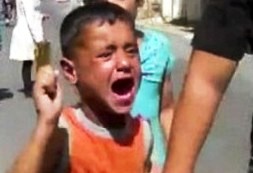 All this for a 7-year-old child allegedly throwing a stone.
[i]“Israel Police Treatment of Juveniles during the Period of Disengagement.” Israeli Ministry of Foreign Affairs. State of Israel, 15 Aug. 2005. Web. 09 July 2013.
NSA Blackmailing Obama? | Interview with Whistleblower Russ Tice
breakingtheset · July 9, 2013
Abby Martin talks to Russell Tice, former intelligence analyst and original NSA whistleblower, about how the recent NSA scandal is only scratches the surface of a massive surveillance apparatus, citing specific targets the he saw spying orders for including former senators Hilary Clinton and Barack Obama.
Supreme Court asked to end NSA spying program
RTAmerica · July 9, 2013
The National Security Agency continues to experience fallout for the surveillance programs which spy on millions of American’s phone records and online activities, and this time the Electronic Privacy Information Center is filing an emergency petition to end the spy program. Alan Butler, Appellate Advocacy Counsel for EPIC, joins us with the details on the demand.
Find RT America in your area: http://rt.com/where-to-watch/
Or watch us online: http://rt.com/on-air/rt-america-air/
Follow us on Twitter http://twitter.com/RT_America
Mossad agents detained Gaza man in Sinai
Ma’an – 10/07/2013
BETHLEHEM – Israeli Mossad agents detained a Palestinian in Egypt’s Sinai in June, Israeli media reported Wednesday.
An Israeli judge cleared news of the arrest for publication on Wednesday. Wael Abu Rida was detained on suspicion of “offenses of national security,” the Israeli daily Yedioth Ahronoth reported.
A magistrates’ court in Beersheba on Wednesday extended Abu Rida’s remand by eight days, the report said.
Judge Yuval Livadaro allowed the publication of some details in Israeli media, but extended the gag order of other details by 10 days.
The detainee’s wife, Amani Abu Rida, had told Ma’an on July 3 that her husband disappeared during a visit to Egypt for medical treatment.
The couple traveled together to Egypt on June 6. Wael Abu Rida suffers cerebral atrophy and sought treatment at a hospital in central Sinai, his wife said.
On June 21, Wael received a phone call and left without returning, his wife said.
The family later received a phone call from the International Committee of the Red Cross informing them that Wael was in Israeli custody, without giving any reason for the arrest.
After the phone call, Amani returned to the Gaza Strip.
Saudi Arabia and UAE to lend Egypt up to $8 billion
RT | July 9, 2013
The United Arab Emirates and Saudi Arabia will give Egypt money in the wake of its political and economic crisis. The UAE will provide Cairo with $1 billion and lend it a further $2 billion, while Saudi Arabia will give Egypt a $5 billion aid package.
The UAE loan would be in the form of a $2 billion interest free deposit in Egypt’s central bank, state news agency WAM reported on Tuesday. Abu Dhabi will also to give Egypt $1 billion.
The UAE delegation to Cairo included the Gulf country’s national security adviser, foreign minister and energy minister. The visit was to “show full support to the people of Egypt – political support, economic support,” Egyptian foreign ministry spokesman Badr Abdelatty told Reuters.
The UAE was one of the first countries to congratulate Egypt following the army’s decision to oust the Muslim Brotherhood’s Mohamed Morsi.
“The UAE stands by Egypt and its people at this stage and trusts the choices of its people. Egypt’s security and stability are the basis of Arab security,” WAM quoted UAE National Security Advisor Sheikh Hazza bin Zayad as saying.
The UAE’s foreign minister also stated that the Egyptian army proved that it was a “strong shield” and “protector,” which guarantees that the country embraced all the components of the people.
Saudi Arabia also approved a $5 billion aid package to Egypt Tuesday, comprising of a $2 billion central bank deposit, $2 billion in energy products, and $1 billion in cash, Saudi finance minister Ibrahim Alassaf said. […]
Multi-billion-dollar aid from Saudi Arabia and the UAE is another sign that these two countries had a hand in the military coup which took place in Egypt, believes RT’s contributing analyst in London, Afshin Rattansi.
“We now realize it is much more a Saudi-backed military coup. And as for this General al-Sisi person, who is a former military attaché in Saudi Arabia, he is Saudi’s man… Saudi Arabia, they’ve taken over the largest country in the Arab world,” Rattansi said.
He also described the current interim leaders of Egypt – President Mansour and Prime Minister Beblawi, as “puppets of Saudi Arabia”, who will be ousted at once if they attempt to criticize Saudi Arabia or the UAE. … Full article
Worldwide corruption on the rise as public trust plummets – report
RT | July 10, 2013
A report by Transparency International has revealed the extent of worldwide corruption over the last two years, with Israel and Greece showing the highest levels among developed countries. Politicians are considered the most corrupt among all sectors.
The Global Corruption Barometer 2013, conducted by the Berlin-based anti-corruption watchdog, is a sampling of over 114,000 opinions of people from 107 countries. The survey asked participants about corruption and the institutions engaged in it.
The report shows that corruption numbers have increased over the last two years, along with the number of people exhibiting distrust toward their governments and law enforcement agencies.
Before the 2008 financial meltdown, 32 per cent of people believed their governments to be effective at tackling corruption. That figure has now fallen to just 23 per cent. Transparency International said in a press release that the report “shows a crisis of trust in politics and real concern about the capacity of those institutions responsible for bringing criminals to justice.”
The survey asked participants to rank the corruption levels of various institutions from 1 to 5, with 1 being “not corrupt at all” and 5 being “extremely corrupt.”
Political parties were perceived to be the most corrupt institutions worldwide, scoring 3.8 out of 5. Police forces came in second place with a score of 3.7. Public officials, civil servants, and the parliament and judiciary came in third place, scoring 3.6.
The media came in ninth place, although it was voted to be the most corrupt sector in Britain. The UK media has lost the respect of many residents in recent years – around 69 per cent of survey participants now believe the media is corrupt, compared to just 39 per cent in 2010.
“This very sharp jump is in large part due to the series of scandals around phone hacking, the Leveson Inquiry, and the concentration of media ownership,” said Robert Barrington, head of the British wing of Transparency International.
Business and private sectors, along with the healthcare sector, came in at eighth on the corruption scale, with the education system not far behind. The military and NGOs took the 10th and 11th places.
Although religion came in last place on the corruption scale, it still ranked among the most corrupt in certain countries, including Israel, Japan, Sudan and South Sudan.
Of all OECD members surveyed, the corruption levels of Greece and Israel came in first and second place respectively, with their political and cultural institutions ranking at the top of the corruption meter.
Over 80 per cent of Israelis believe that one must have contacts very high up in the public sector in order to get anything done. Transparency International says it sees “deep-rooted failures of governance” in Israel. A similar figure was seen in Lebanon, Russia, and Ukraine.
Arab countries have seen a rise in corruption since their 2011 uprisings, although public anger against corrupt officials was what sparked the Arab Spring in the first place. The expectation of having cleaner, more transparent regimes did not match the countries’ political and business realities.
Of the four countries that experienced regime change in the aftermath of the Arab Spring, Egypt, Tunisia and Yemen feel that corruption has only increased since 2011. While 64 per cent of Egyptians think corruption is on the rise, a staggering 80 per cent of Tunisians believe that to be the case within their country. Eighty-four per cent of Lebanese citizens believe corruption to be on the rise in within their nation, while only around half of Libyans believe that corruption is worsening.
Egypt leads the pack in anti-police sentiments, largely because police violence has injured so many people over the past year. The 80 per cent disapproval rating dropped to only 45 per cent when Egyptians were asked about the military, which just several days ago ousted former Islamist-backed president Mohamed Morsi.
To glean more analysis on the increasing slide into corruption and public distrust of political institutions, RT talked to Finn Heinrich, who is director of research at Transparency International in Berlin. He sees the world as split into two major trends. The first is petty corruption and bribery in the southern hemisphere – mostly Africa, where citizens feel there is no other way to take care of one’s day-to-day needs. The second is corruption on a more official level, which is witnessed in the northern and western parts of the world – mainly in business and politics governed by financial greed.
As a way out of the situation, Heinrich believes “you really need to be in it in a long-term. You can’t expect quick gains from the fight against corruption. So, I think what we see in many of those countries are the upheavals which you find in many countries, including many post-communist countries, after revolution where old systems are no longer intact and new systems are yet to be built. So, corruption is on the rise. We hope that the new leaders, compared to their predecessors, are really taking the challenge of setting up systems of transparency and accountability much more serious.”
Heinrich thinks that only an integral and comprehensive effort can last, and that effort must include both the government and its citizens.
Transparency International is the world’s foremost organization on fighting corruption. It has 90 chapters worldwide, which aim to raise awareness and establish methods of tackling corruption and measuring its harmful effects.
US NSA Spied on Venezuela When President Chavez Died, Documents Reveal
By Tamara Pearson | Venezuelanalysis | July 9, 2013
Mérida – Brazilian daily O Globo, reporting jointly with Guardian journalist Glenn Greenwald informed today that according to the leaked National Security Agency (NSA) documents, the United States has also been spying on Venezuela’s petroleum industry. The information comes as governments confirm that whistleblower Edward Snowden has applied for asylum in Venezuela.
According to the leaked documents, the NSA also spied on other Latin American countries such as Mexico, Argentina, Colombia, and Ecuador.
O Globo reports that, “The United States doesn’t seem to be only interested in military affairs, but also in commercial secrets, such as Venezuela’s petroleum”.
According to the documents, NSA spied on Latin America through at least two programs, the Prism program from 2-8 of February this year, and the “Informant Without Limits” program from January to March.
One document describes Operation Silverzephyr, which accessed information through partnerships with private satellite and phone operators, focusing on Latin American countries. The document shows that the NSA agency collected information through telephone calls, faxes and emails, possibly using the program Fairview.
According to O Globo and the leaked NSA documents, Venezuela was also observed in 2008 through the X-Keyscore program, which identifies the presence of foreigners according to the language they use in emails. Further, in March this year it appears that Venezuela was a priority for the NSA’s spying. President Hugo Chavez died on 5 March, and presidential elections were called for 14 April.
U.S. reacts to Venezuela’s asylum offer
On Sunday U.S. legislators suggested sanctioning countries which grant asylum to Edward Snowden, who leaked the NSA documents to The Guardian. The chair of the U.S. House of Representative’s intelligence committee, Mike Rogers, said Latin American countries are “using Snowden as a public relations tool… we shouldn’t allow this… it’s a serious issue… some Latin American companies enjoy trade benefits from the United States and we’re going to have to revise that”.
Legislator Robert Menendez also said that any “acceptance of Snowden” would put that country “directly against the United States”. The Venezuelan government formally offered Snowden asylum on 5 July. Nicaragua and Bolivia have also done so.
“We’ve made very clear that he [Snowden] has been charged with felonies and as such, he should not be allowed to proceed in any further international travel other than travel that would result in him returning to the United States,” White House Press Secretary Jay Carney told reporters yesterday at his daily news conference.
Yesterday Maduro said that Venezuela has also formally received an asylum request from Snowden, who agencies report to have been in the Moscow airport since 23 June.
Russian legislator Alexei Pushkov also confirmed yesterday (via a Tweet that he later deleted) that Snowden had accepted Venezuela’s offer of political asylum. “It seems that that is the option he feels is safest,” Pushkov wrote. However, later today Wikileaks also tweeted that Snowden had not formally accepted asylum in Venezuela, but also deleted the tweets a few minutes later.
For Future Reactor Meltdowns, EPA Means “Extra Pollution Allowed”
By JOHN LaFORGE | July 9, 2013
As the nuclear power industry struggles against collapse from skyrocketing costs, bankrupting repair bills and investor flight (four operating reactors were permanently closed this year, more than in any previous 12 month period), the government seems to have capitulated to political pressure to weaken radiation exposure standards and save nuclear utilities billions. On April 15, the EPA issued new Protective Action Guides (PAGs) for dealing with large scale radiation releases — like the catastrophic triple reactor meltdowns at Fukushima, Japan that spread cesium and radio-iodine worldwide. The new PAGs are like a government bailout, saving reactor owners the gargantuan costs of comprehensive cleanup. And eerily, the new PAGs seem to presume the inevitability of radiation disasters that the industry — with its fleet of 100 rickety 40-year-old units — can’t currently afford to withstand.
According to Daniel Hirsch, President of Committee to Bridge the Gap, the latest PAGs took effect in April but can be amended — and EPA is taking comments. Hirsch says that the National Council on Radiation Protection’s plans for implementing the new PAGs “would allow the public to be exposed to extraordinarily higher levels of radiation than previously permitted” during reactor accident emergencies. The new PAGs also allow extremely high contamination of food, he says. “In essence,” Hirsch reports, the PAGs say “nuclear power accidents could be so widespread and produce such immense radiation levels that the government would abandon cleanup obligations” forcing people to absorb and live with far more cancers.
To cut costs, industry has long pushed for weakening radiation exposure rules. In 2002, Roger Clarke president of the International Commission on Radiological Protection (ICRP) warned in the Bulletin of the Atomic Scientists, “Some people think that too much money is being spent to achieve low levels of residual contamination.” The ICRP recommends exposure standards to governments for nuclear industry workers and the public.
Permissible radiation doses established by polluters
There is no exposure to ionizing radiation that’s safe. Even the smallest exposures have cellular-level effects that can lead to immune dysfunction, birth defects, cancer and other diseases. The National Academy of Sciences’ 7th book-length on the biological effects of ionizing radiation, BEIR-VII, declared that any exposure, regardless of how small, may cause the induction of cancer. BEIR-VII also explicitly refuted and repudiated the pop culture “hormesus” theory, promoted by industry boosters, that a little radiation is good for us and acts like a vaccination.
Today, the nuclear industry — military, industrial and medical — is required to keep radiation exposures only “as low as reasonably achievable.” This tragicomic standard is neither a medical nor scientific concept. It’s not based on health physics or biology. It’s merely the formal admission that radiation producers cannot keep worker or public exposures to a level that is safe — that is zero.
Exposure limits have been established at the convenience of the military and industrial producers of radioactive pollution, not by medical doctors of health physicists. The late Dr. Rosalie Bertell made clear 36 years ago in Robert Del Tredici’s book At Work In the Fields of the Bomb, “The people with the highest vested interest are the ones that are making the nuclear bombs. And it turns out they have complete control over setting the permissible [radiation exposure] levels.” Since then, little has changed in the regulatory world (although scientists have found that far more damage is caused by low dose radiation than was earlier thought possible): the ICRP’s 1990 recommendations to reduce worker and public exposures by three-fifths has yet to be adopted by the United States.
We can thank industrial and political roadblocks for that, yet in spite of them the government’s permissible dose (lazy reporters often write “safe” dose) of radiation has dramatically decreased over the years — as we’ve come to better understand the toxic, carcinogenic and mutagenic properties of low-level exposures. In the 1920s the permissible dose was 75 rem (radiation equivalent man) per year for nuclear industry workers. In 1936, the limit was reduced to 50 rem per year; then 20-25 in 1948; 15 in 1954; and down to 5 rem per year in 1958. The general public is officially allowed to be exposed to one-tenth the workers’ dose, or 0.5 rem per year. The ICRP’s 1990 suggestion was to cut this to 2 and 0.2 respectively.
With cancer rates at pandemic proportions, adding higher radiation exposures to the effects of 80,000 chemicals that contaminate our air, water and food only makes our chance of avoiding the dread disease slimmer. Rather than permitting increased doses of dangerous and sometimes deadly radiation, especially following reactor disasters, the government should be acting to prevent them — like Germany, Italy and Japan — by preparing the phase-out of the country’s accident-prone nukes.
Featured Video

The Most Important Bet You’ve Never Heard Of
or go to
Aletho News Archives – Video-Images
From the Archives
The Occupied Mentality Syndrome
Saudi Arabia on the American chessboard – Part 2
By B. J. Sabri | American Herald Tribune | April 19, 2016
Since the Korean War, but particularly since the Iranian Revolution of 1979 until today, the United States has been steadily escalating its military presence in the Persian Gulf. Taking advantage of many colossal events of the past 36 years, [1] the hyper-empire has institutionalized its massive presence on land and sea, and expanded its objectives to include the unambiguous physical control of the area, as well as the clear understanding that local Arab governments should abide by them. The pretext is always the same: in “defense” of the national interests and security of the United States. From observing how the United States has been interacting with the governments of the region, and by judging from the size of its expeditionary force, we could reach a basic conclusion. The United States is occupying, de facto, the entire Arabian Peninsula. (Yemen, devastated by Saudi and American jets is yet to be conquered. Oman? Britain returned not as colonial ruler but as a soft occupying power.)
Under this articulation, Saudi Arabia, Qatar, Kuwait, and the United Arab Emirates are virtually occupied countries. If we compare this type of occupation to the mandate and protectorate regimes of the past, the results might be identical—the nations affected by it lose sovereignty. When Arab governments comply with the objectives of a foreign power that station military forces on their national milieu, then that power controls them in multiple ways including how they react to policy deliberations and what decisions they intend to take on specific issues. A good method to verify the concept of effective occupation is this: take notice of what the United States says and wants, and then compare it to what the gulf rulers do in response. (I shall discuss this detail at some point in the upcoming parts.)
If the presence of US forces or other means of political pressure are a factor in Saudi Arabia’s interventionist Arab wars, then we need to debate this issue. However, from the history of resistance to colonialism, we learnt: if a powerful state imposes its order on a nation by military means or other forms of coercion, and if this nation does not resist that imposition, then a mental subordination to the powerful state will ensue. This is especially true in the case of Saudi Arabia. One single event, 9/11, has transformed it from a US “ally” into an instant political hostage of the American Empire. … continue
Blog Roll
 Aletho News
- Trump and the debris of Iran war
- IRGC hits US tech giant Oracle’s data center, computing site in UAE over new assassinations
- Bombing Iran Back Into the Stone Age /Lt Col Daniel Davis & Jim Jatras
- UAE rejects report claiming it is ready to join war on Iran to reopen Hormuz
- A New Resistance Front: How Does Syria Factor into the Regional War?
- Gulf states weigh pipeline expansion plans, hoping to bypass Hormuz
- Iran sets up ‘tollbooth’ system in Strait of Hormuz
- Wave 90: IRGC strikes US-linked industrial sites in Gulf
- Iran Says US-Israeli Claims of Its Military Strength Are Wrong
- Trump’s April Fools’ Address to the nation
- If Americans Knew
- ‘War crime’: Global condemnation as Israeli ministers celebrate death penalty law targeting Palestinian prisoners
- 7 Ways Israel Is Turning Lebanon Into Gaza
- World’s Leading Football Bodies Under Fire Over Israel Policies
- Experts warn of possible use of nukes against Iran
- Israeli invasion of Lebanon could be worse than 1982, warn European officials
- Passover: Liberation and collective punishment
- Trump says the quiet part out loud: (Israel’s) war on Iran > Americans’ health – Daily Update
- Gaza families reunite years after babies evacuated amid Israel’s war
- International Rescue Committee warns Gaza’s children face grave protection risks
- Iran’s Alleged 47-Year War on America: Debunking the 1,050 American Deaths Canard
- No Tricks Zone
- Low Intensity Tornado Wrecks Major Solar Farm, Creating A Potential Toxic Dump
- New Study Finds Warming Saves Lives…Cold Temperatures 12 Times More Deadly Than Excess Heat
- German Science Blog Accuses PIK Climate Institute Of Hallucinating Climate Tipping Points
- Devastating Assessment Of Comirnaty Vaccine By Former Senior Pfizer Europe Toxicologist
- New Study: CO2 Is ‘Effectively Negligible’ As An Explanatory Climate Change Factor Since 2000
- Former Pfizer Toxicologist Dr. Helmut Sterz Tells Bundestag Hearing Pfizer Vaccine Should Have Never Been Approved
- Energy Expert: Germany’s Nuclear Phaseout Was A “500 Billion Euro Mistake”
- New Research: South Australia’s Mid-Holocene Sea Surface Temperatures Were 4°C Warmer Than Today
- Storing Green Energy To Last Germany 10 Days Would Require A 60-Million Tonne Battery
- New Studies: UK Sea Levels Were 4 Meters Higher Than Today During The Mid-Holocene
 Aletho News