London faces calls to make its case for a possible war before parliament
Press TV – August 27, 2013
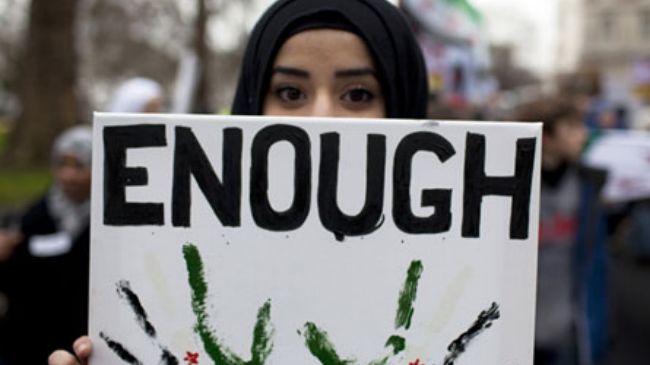
Opposition to a possible military intervention in Syria has intensified in Britain with the Labour party demanding that the government “make their case” before the parliament.
An alleged chemical attack hit parts of the Syrian capital Damascus on Wednesday killing hundreds of people.
Foreign-backed terrorists in the country claimed that the government forces were behind the assault in the Damascus suburbs of Ain Tarma, Zamalka and Jobar while medical charity Medecins Sans Frontieres, which treated those affected in the attack, said it cannot even “scientifically confirm” the use of chemical weapons.
Shadow Foreign Secretary Douglas Alexander said on Monday that the cabinet has to “make their case” in the parliament before they can make a decision whether to go to a new war, if any such decision is to be made.
“Given both the seriousness of the reported chemical weapons strikes in Syria, and the enduring and complex nature of the conflict itself, ahead of any action being taken I would fully expect the Prime Minister to make his case to Parliament,” Alexander said.
“[The Prime Minister must be] open about the objectives, the legal basis, and the anticipated effect of any [British military action],” he added.
Meanwhile, British Conservative MP John Baron, who is leading MPs’ demands for a parliamentary session on the matter, expressed serious concerns about Britain going to war without the approval of the UN Security Council because of a Russian opposition to military intervention in Syria.
“Essentially, it is a civil war. If the West intervenes without a UN resolution … I think there is a more serious risk of this escalating beyond Syrian boundaries,” he said.
This comes as legal experts have seriously questioned the legality of a military move against Syria, saying it would create a “controversial situation”.
“The difficulty here is there’s no threat as I understand it to the security of this country or the United States and therefore on what basis can we intervene?” Michael Caplan, an international lawyer, asked during an interview on BBC Radio 4.
Following the alleged chemical attack in Syria, which government forces say was a false flag attack by foreign-backed militants, Britain, the US and France have been beating drums of war to punish what Washington described as a “moral obscenity” by Bashar al-Asad government in Syria.
Russia has demanded evidence from the three on their claims but no proof has yet been presented or even announced to exist.
The situation has sparked fears that Britain is assisting the US to justify another war based on totally unfounded claims after former British PM Tony Blair tampered with evidence related to Iraq weapons of mass destruction to facilitate the invasion of the country in 2003.
The fears are especially strong because the Syrian government cannot have sensibly carried out a large-scale attack when UN weapons inspectors were stationed almost 20 kilometers away from the site of the attack, waiting to probe earlier claims of poisonous gas strikes.
Qualms are also fueled by sporadic reporting of Syrian foreign-backed militants being in possession of chemical weapons, including a Twitter post by Abdola Al-Jaledi, a former high-ranking member of the Jabaht al-Nusra militant group, which said his colleagues were in possession of chemical weapons.
Related article
- Syrian war drums beat ever louder (morningstaronline.co.uk)
Russia ‘regrets’ US decision to shelve Syria talks
RT | August 27, 2013
Moscow has voiced “regret” over a US decision to put off bilateral talks over Syria. Russia has sought to placate calls for military action over the alleged use of chemical weapons, saying there is no evidence of the Assad regime’s complicity.
The US government announced it was postponing bilateral talks with Russia late Monday, citing “ongoing consultations” over the Syrian government’s alleged use of chemical weapons.
Russian and American officials had been scheduled to meet in The Hague on Wednesday for bilateral talks on the Syrian conflict.
Russian Deputy Foreign Minister Gennady Gatilov tweeted a response to the move Tuesday morning, expressing concern over Washington’s decision.
“It is a pity that our western partners have decided to cancel the bilateral US-Russian meeting to discuss calls for an international conference on Syria,” Gatilov wrote on Twitter. He added in a later post that discussing terms for a political solution were needed now more than ever in the face of possible military intervention in Syria.
 Deputy Minister of Foreign Affairs Gennady Gatilov (RIA Novosti / Vladimir Fedorenko)

Foreign Affairs Committee chairman of the Russian Duma, Aleksey Pushkov also posted on his Twitter, alleging the US had already made the decision to strike Syria and they had gone too far.
A number of western countries including France, the US and the UK have condemned President Bashar Assad’s government for last week’s alleged chemical weapons attack in a Damascus suburb and called for a response, hinting at possible military action. On Monday, Russian President Vladimir Putin told British Prime Minster David Cameron in a phone conversation that there was still no evidence the Assad government was behind the attack.
However, Cameron insisted that Assad’s forces were behind the “chemical weapons” attack, saying that the Syrian opposition did not have the facilities to orchestrate such an attack. Cameron also cited the Syrian government’s delay in allowing a team of UN experts to examine the site as an indication that it had something to hide.
Washington has also seen an increase in rhetoric, urging action against the Assad government. Samantha Power, the US Ambassador to the UN, decried the Assad government for the attack on her Twitter account, and demanded accountability:
“Haunting images of entire families dead in their beds. Verdict is clear: Assad has used CWs against civilians in violation of int’l norm.”
Meanwhile, the UN weapons inspectors are due to start their second day of investigations in the Damascus suburb of Ghouta, where the toxic attack happened last Wednesday. The team’s convoy of vehicles came under fire from unknown assailants Monday as they visited the area.
In spite of the sniper attack, the team managed to collect samples for analysis and gather witness testimonies at a local hospital. Contradicting claims from the US and UK that the probe was too late to yield accurate results, the UN stressed the mission was still valid, although almost a week has passed since the supposed attack.
The alleged attack took place last Wednesday in an eastern suburb of Syria’s capital. Media published conflicting reports on the death toll, ranging from “dozens” to over 1,300 dead. French charity Medecins sans Frontieres (Doctors without Borders) put the death toll at about 355.
U.S. spied on UN: German weekly
Xinhua | August 26, 2013
BERLIN — The U.S. National Security Agency (NSA) bugged the video conferencing system at the UN headquarters in New York and cracked its encryption, German weekly Der Spiegel reported Sunday.
The tapping scheme succeeded in the summer of 2012, the magazine said, citing secret documents disclosed by former U.S. intelligence contractor Edward Snowden.
The move offered the NSA “a dramatic improvement of data on video conferencing and the ability to decrypt that data,” a quoted document said, noting that the number of decrypted communications jumped from 12 to 458 within three weeks.
Der Spiegel also reported that the U.S. intelligence agency spied on the European Union mission after it moved to its new embassy in New York last September.
The new embassy’s plans, as well as its IT infrastructure and servers, were among the copies of relevant NSA documents provided Snowden.
According to the documents analyzed by the weekly, the NSA also ran a monitoring program covering more than 80 embassies and consulates worldwide.
The program was called “the Special Collection Service” and operated without the knowledge of the host country, said the magazine.
NSA documents urged to keep the existence of the program as a secret at all costs, as “relations with the host country would be seriously damaged” if it was leaked, Der Spiegel reported.
Revelations about PRISM and other surveillance programs that obtain personal information by hacking phone calls and emails have embarrassed Washington and triggered outrage around the world.
Some EU privacy watchdogs are demanding an independent investigation into the extent of PRISM as well as other platforms used by the NSA.
U.S. President Barack Obama defended the spying program as a “modest encroachment” on privacy necessary to prevent terror attacks, but pledged to overhaul U.S. surveillance and turn it more transparent.
Egyptian media outlet condemns government intimidation
MEMO | August 26, 2013
The Cairo-based Rassd News Network has condemned the latest intimidation by the coup government which has seen the killing and arbitrary arrests of journalists, including of five of its own correspondents. The network’s Executive Director, Samihi Mustafa, and founding member Dr Abdullah Al-Fakharani are among those detained by the authorities since the start of the bloody campaign against anti-coup demonstrators.
According to Rassd, neither Al-Fakharani nor Mustafa, the father of a new-born boy, were armed when they were arrested. “They were only armed with the truth about what is going on out there,” said a spokesperson. “Professional journalists are attempting to break the media blackout imposed by the coup authorities and government-controlled media on what is happening in Egypt.” Freedom of expression, it was pointed out, is a basic human right.
Describing a “savage and vengeful” campaign of arrests, the spokesperson said that the government is targeting Rassd journalists after killing photographer Musaab Al-Shami while he was covering the violent assault on Rabaa Al-Adawiyya Square. He was shot in the head and chest by soldiers. Rassd correspondents Mahmoud Abdul-Nabi and his brother Ibrahim, both professional journalists, were arrested in Alexandria at the start of the coup. Both men are on hunger strike in protest at the conditions under which they are being held by the authorities.
Rassd not only condemned the killing, arrest and harassment of its staff but also holds the Egyptian coup government fully responsible for the safety and well-being of those in detention. It demanded their immediate release.
“We will not give up in our efforts to protect human rights and the right of journalists to carry out their work unimpeded by the brutal acts of the security forces,” said the Rassd spokesperson. “We will use all legal means to defend them and to hold accountable those responsible for their illegal detention.”
The network insists that it remains committed to the professional ethics of journalism, including accuracy, balance, independence and integrity, to convey the truth as it is without any bias or distortion. Rassd appealed to all colleagues in the profession, international press associations and human rights organisations to stand by all detained journalists, to press for their release, and to ensure their right to work without threats or harassment.
Related articles
- Four journalists killed covering Egypt clashes (alethonews.wordpress.com)
- UNESCO head deplores deaths of Egyptian journalists (dailynewsegypt.com)
Russia Warns US Again Against Syria Intervention
Al-Manar | August 26, 2013
Russian Foreign Minister Sergei Lavrov has warned US Secretary of State John Kerry over the “extremely dangerous consequences” of launching military action against Syria, the foreign ministry said Monday.
Russia, USLavrov told Kerry in a telephone call Sunday that Moscow was “deeply alarmed” by comments from US officials indicating a readiness to intervene in Syria over alleged use of chemical weapons which the Syrian government had strongly denied, it said in a statement.
“Sergei Lavrov drew attention to the extremely dangerous consequences of a possible new military intervention for the whole Middle East and North Africa region,” it added. Lavrov told Kerry that it appeared certain elements inside the United States wanted to launch military action in Syria outside of the United Nations to undermine joint US-Russia efforts to organize a peace conference.
The Russian minister urged his US counterpart “to refrain from using military pressure against Damascus and not to give in to provocations.” The ministry said Kerry promised to “attentively” study the arguments of the Russian side.
Russia underlined the necessity of an objective UN investigation into the claimed chemical attack and repeated its doubts that the Syrian government of President Bashar al-Assad was to blame. “There is mounting evidence that the incident was a pretence set up by the rebel opposition with the aim of accusing the Damascus government of everything,” the statement said.
Venezuela, Palestine sign oil deal
Press TV – August 25, 2013
Venezuela and Palestine have signed agreements including deals under which Caracas is to sell oil at a ‘fair price’ to the Palestinians.
The accords were signed on Saturday following a meeting between Venezuelan Foreign Minister Elias Jaua and his Palestinian counterpart Riyad al-Maliki.
“It is an agreement of cooperation and solidarity with our oil industry… a sale of fuel at a fair price,” Jaua said.
The agreement also assures “favorable” repayment terms as well as training of Palestinians on handling and distribution of oil.
Maliki, who is on a Latin America tour, said he was “extremely satisfied” with the agreement.
On August 23, Maliki visited Ecuador, where he discussed with Minister for Foreign Affairs and Human Mobility Ricardo Patino. After the meeting, the two ministers expressed interest in opening embassies in both countries to strengthen ties.
A day earlier, Guyana’s President Donald Ramotar said after meeting the Palestinian foreign minister that his country is in the process of appointing an ambassador to Palestine and reiterated Guyana’s continued support to Palestine.
A group of Latin American and Caribbean countries, including Brazil, Argentina, Venezuela, Bolivia, Uruguay, Ecuador, Chile and Chile, recognize Palestine as an independent state.
On April 10, the Latin American nation of Guatemala became the 132nd nation in the world to formally recognize the state of Palestine.
Genocide Tribunal Against Israel Fails Palestinian Victims
By Yoichi Shimatsu | Global Research | August 24, 2013
KUALA LUMPUR – Anyone with the chutzpah to accuse Israel of genocide is going to bring on a preemptive strike. That is as guaranteed as cream cheese on a bagel.
The word “genocide” is loaded, since many and probably most Jews believe themselves to have a monopoly on the term. Most often cited in reference to the Holocaust, the G word elicits an intense emotional reaction. “War crimes” is an acceptable term in international parlance, for even Israel’s most vociferous citizens grudgingly admit to instances of unrestrained violence against Palestinians.
“Genocide”, however, is in a class by itself, being the thermonuclear bomb of moral outrage. How dare supporters of Palestinian rights charge the Mideast’s “only democratic society” with systematic annihilation prompted by racial intolerance, economic greed, cultural chauvinism and religious bigotry?
Suspicion Mars Proceedings
The organizers of the Kuala Lumpur War Crimes Tribunal have brought on just such woe onto themselves by summoning a panel of international judges to rule on whether Israeli is guilty of genocide ever since its national birth in 1948.
The judicial proceedings got no further than the preliminary pretrial stage before it collapsed under acrimonious accusations ranging from prosecutors allegedly “poisoning minds” of Palestinian witnesses to outrage over a judge acting as ”an agent of the Mossad.”
The trigger for the heated denunciations between the prosecution team and the judicial panel was the prosecutors’ request for Judge Eric David, a law professor with the Free University of Brussels, to recuse himself (to voluntararily withdraw from the panel of judges).
The prosecutors had raised the issue of his earlier legal opinion to the effect that the People’s Mujaheedin (PMOI), an Iranian exile paramilitary which until recently was on the U.S. government’s list of terrorist groups should not be categorized as a terrorist entity.
According to media reports, the PMOI was involved in assassinating nuclear scientists and bombing factories in Iran. The group, largely based in Iraq , was militarily trained by the Israel secret service Mossad during the U.S.-led invasion of Iraq and subsequent occupation.
Co-Prosecutor Francis Boyle, a New York-based law professor, stated that the favorable opinion on that terrorist group implies that Judge David is politically aligned with the foreign policy of Israel , the defendant in the current tribunal on Palestinian rights. To this question of conflict of interest, Jurist David refused to give an answer, nor did the presiding judge demand him to respond.
Lead Prosecutor Gurdial Singh argued that the complainants, Palestinians who personally suffered war crimes by Israeli forces, had grounds for suspicion about Judge David’s impartiality given his past approval of Mossad-linked forces.
Gurdjial pointed out:
“This tribunal being a court of conscience, there must be not even a single blot on integrity.”
After tension-packed deliberations behind closed doors, the panel ruled in favor of Judge David without examining his controversial opinion and unanimously affirmed that he should serve on the tribunal. That ruling provoked Prosecutor Boyle to call for a mistrial, and the panel responded by accusing him of contempt of court. The proceedings soon descended into chaos and many more back-rooms parleys, before both sides agreed to an indefinite adjournment, possibly of several months, before the start of trial. In total, the preliminary session lasted less than two days, August 21-22, before it whimpered to a halt.
Procedure Matters
After many reporting assignments, along with a long stint at jury duty, in San Francisco criminal trials and New York City gun court, my immediate observation was that the panel of judges in Malaysia overemphasized courtroom decorum while inexplicably failing to follow basic judicial proceedings.
The stress on style rather than the substance of law revealed a “cultural” difference in courtroom custom between the hard-ball rhetoric bandied in American trials versus the polite and deferential manners in wig-adorned chambers under the British tradition. As sadly shown in Kuala Lumpur , however, decorum can often serve as a cloak for institutional inertia and possibly hidden agendas.
Issues of etiquette aside, the most grievous mistake was the panel’s opting for unanimous agreement as a group. Trials with more than one judge, these including tribunals and high courts, are organized for the exact opposite, that is to allow a divided opinion between the majority ruling and a minority dissent. At the Tokyo War Crimes Tribunal, whatever its merits and flaws, the guilty verdict of the majority of judges was famously opposed by the minority opinion of the Indian jurist Radhabinod Pal. In hindsight, that lone dissenting voice rings in our consciences to this day with its warning against victor’s “justice” and lynch “law”.
For a body of judges to act in unison in favor of one of their own profession is a gross violation of the principle of independence for each judge in a court of conscience. The disturbing thought that came to my mind was that insistence on acting as a group is completely out of place in a tribunal. Whether there was verbal manipulation in the judges’ chamber is privy only to those inside, leaving those of us on the outside with nothing but doubt.
Code of Silence
Prosecutors have a right to protest a violation of judicial procedures as the basis for mistrial, as was done by the co-prosecutor. Normally, when a capital crime is at issue, a mistrial can lead to a change of venue and a new judge and jury. If a court cannot possibly render a verdict on the basis of fairness, then another fairer arena must be found.
There were other serious problems: for example, the failure of the presiding judge to order the prosecutors to rephrase aggressive accusations as questions, and his neglect to demand that judge Eric David explain his past opinion to the satisfaction of all in the courtroom.
Judge David, one of the drafters of Bertrand Russell Tribunal on Israeli war crimes against Palestinians, did not give a single word of explanation, much less a convincing argument, for his legal opinion and tacit support of a Mossad-trained terrorist group that was a combatant in the Iraq War and responsible for violent acts against Iranian civilians that are illegal under international law.
His silence smacks not only of delivering selective justice but also of harboring a hidden agenda. Instead of ethical clarity, he chose to the muddy waters. If genuinely in support of the tribunal, he would have recused himself as the source of doubt, even if his intentions were misunderstood.
From the inception of this tribunal on Palestinian rights more than a year ago, the prosecution strategy has been to seek a genocide verdict against Israel , while the defense tactic is, logically, to water-down the ruling to less onerous guilt of war crimes falling far short of genocidal state policy.
Unfortunately, the reluctance of the unified panel to accept transparency and open debate in the proceedings reinforced the perception of judicial bias among the aggrieved complainants from Palestine . That some and possibly many of the jurists were either hesitant or predisposed to reject a verdict of genocide would be understandable in an Israeli courtroom. That such has happened in a predominantly Muslim country is simply astounding.
Perversion of Justice
Unfortunately, and to their eternal shame, many pro-Israeli legal professionals are not up to ethical par, as was shown in a major investigation at The Hague during the mid-1990s. I served as one of a handful of reporters on the case involving a weapons-loaded El Al cargo jet that crashed into an apartment building in Biljmeer district of Amsterdam, killing residents in an intense fire and harming emergency crews with toxic releases. The legal case was criminally undermined by massive amounts of Israeli bribery of witnesses (guised as unofficial out-of-court settlements), interference by the Israeli security team at Schipol Airport and the eventual silencing of the Dutch team that investigated the air traffic maneuvers of the plane.
That Israeli-subverted case never got to trial in The Hague , and I cannot but now fear that the same fate could await the Kuala Lumpur War Crimes Tribunal.
There are undoubtedly external factors aligned against the tribunal, other than the Israeli opposition to an undesirable verdict on Palestinian rights. Google, which cooperates with Israeli interests, posted warning signs on the website of the Kuala Lumpur foundation in its earlier tribunal hearings against the U.S. government for the illegal war on Iraq .
Closer to home, U.S. and allied intelligence agencies have actively promoted protests, similar to their Arab Spring sponsorship, to weaken the Malaysia government. Under the White House strategic pivot to Asia policy and the Pentagon’s Air-Sea Battle Concept, Malaysia is perceived as a potential foe of American geopolitical intervention. Is the pressure on from Tel Aviv and Washington to crack the Kuala Lumpur tribunal?
In Bad Faith
Laymen tend to perceive judges as men and women of ethical principle, non-partiality and free of preconceived biases. Sadly, the vast majority are not. One must remember that for every drone strike against a family home in a remote outland, a judge in a big city signs a writ of execution with not a whit of credible evidence. Constitutional guarantees have been reduced to a scrap of paper, and along with them so goes judicial standards.
For these very reasons, the tribunal in Kuala Lumpur must proceed and in accordance with the highest standard of international law. It is not a predetermined show trial nor a mock court, for this tribunal offers the legal strategy, the arguments and the precedent for the Palestinian Authority to press its long-overdue case in the International Court of Justice.
The Palestinian people have suffered prolonged and inexcusable violations of every human right under a state policy of eviction, banishment, imprisonment, torture and murder, repeatedly in an indiscriminate and cruel manner. If those who speak of the Rule of Law, for those who preside over our courts of law, cannot act, much less decide, against these inhumane practices and policies against a long-standing community, then there exists no law in Israel or at The Hague worthy of our respect and obedience.
The case of the Palestinian people versus the State of Israel is, in fact, a test of conscience for each and every one of us and proof of whether our global civilization is anything more than a facade for brute barbarism.
The Jewish people pride themselves at a moral lamp to humanity in darkness, but with only a few brave and notable exceptions in the cause of Palestinian rights, the dominant reaction of supporters of Israel has been toward obstruction of justice and outright injustice. The outcome can only be tragic for both peoples.
According to the Law Giver
The Hebrew term “Shoah” or calamity, which is also used to describe the Nazi policy against Jews, is the exclusive intellectual property of the Jewish people. “Genocide”, in contrast, is universal, applying to any nationality that faces systematic elimination.
To give credit where it is due, a Polish Jew coined the hybrid word “genocide”, which combines “genus”, Latin for family or breed, with “cide”, which translates as killing. A prosecutor in prewar Poland , before it was divided by German and Soviet forces, devised this word to describe the ultimate crime while drafting his book “Axis Rule in Occupied Europe” (published in 1944 by the Carnagie Foundation for International Peace). After immigrating to the United States , Lemkin joined the faculty of Rutgers Law School and drafted a genocide treaty adopted by the newly formed United Nations in 1948.
The Convention on the Prevention and Punishment of the Crime of Genocide, to summarize, forbids the killing, maiming and deliberate inflicting on a targeted group those conditions of life calculated to bring about its physical destruction in whole or in part.
This lawgiver made very clear that the genocide is applicable to any group threatened with “a coordinated plan” for the destruction of “essential foundations of the life of national groups, with the aim of annihilating the groups themselves” with objectives including disintegration of political and social institutions, of culture, language, national feelings, religion, and the economic existence of national groups, and the destruction of the personal security, liberty, health, dignity, and even their lives.”
Genocide does not necessarily mean the killing of every single member of a group since total extermination is often not feasible even with brutal efficiency.
Lemkin cited many genocide cases from our troubled world history, including “Christians of various denominations, Moslems and Jews, Armenians and Slavs, Greeks and Russians, dark-skinned Hereros in Africa and white-skinned Poles perished by millions from this crime.” The law must protect not just individuals but also groups of people, and by all accounts, the Palestinians are a group suffering most and probably all of the abuses cited.
Now 65 years after Lemkin formulated the rules of conduct, it becomes painfully apparent that yesterday’s victims can too easily become today’s perpetrators. What has anyone learned from their own suffering?
Yoichi Shimatsu is a Hong Kong-based journalist, is former editor with The Japan Times group in Tokyo and Pacific News Service in San Francisco.
Related article
Featured Video
9/11 In Perspective
or go to
Aletho News Archives – Video-Images
From the Archives
Still No End in Sight of the Murder and Mayhem Wrought by the 9/11 Culprits
By Prof. Tony Hall | American Herald Tribune | July 17, 2016
The Kevin Barrett-Chomsky Dispute in Historical Perspective – Fourth part of the series titled “9/11 and the Zionist Question”
Back in 2006 all but a prescient few, such as Christopher Bollyn, perceived it as premature to try to identify and bring to justice the actual perpetrators of the 9/11 crimes. There was still some residue of confidence that responsible officials in government, law enforcement, media and the universities could and would respond in good faith to multiple revelations that great frauds had occurred in interpreting 9/11 for the public.
Accordingly, the main methodology of public intellectuals like Dr. Kevin Barrett or, for instance, Professors David Ray Griffin, Steven E. Jones, Peter Dale Scott, Graeme MacQueen, John McMurtry, Michael Keefer, Richard B. Lee, A.K. Dewdney, Nafeez Mossadeq Ahmed, and Michel Chossudovsky, was to marshal evidence demonstrating that the official narrative of 9/11 could not be true.
The marshaling of evidence was spurred on by observations coming from government insiders like Eckehardt Wertherbach, a former head of Germany’s intelligence service. In a meeting in Germany with Christopher Bollyn and Dr. Andreas von Bülow, Wertherbach pointed out that, “an attack of this magnitude and precision would have required years of planning. Such a sophisticated operation would require the fixed frame of a state intelligence organization, something not found in a loose group like the one led by the student Mohammed Atta in Hamburg.”
Andreas von Bülow was a German parliamentarian and Defense Ministry official. He confirmed this assessment in his book on the CIA and 9/11. In the text von Bülow remarked that the execution of the 9/11 plan “would have been unthinkable without backing from secret apparatuses of state and industry.” The author spoke of the “invented story of 19 Muslims working with Osama bin Laden in order the hide the truth” of the real perpetrators’ identity. … continue
Blog Roll
 Aletho News
- Erdogan wants nukes: What a Turkish bomb would mean for the Middle East
- Ukrainian disruption of Russian oil pipeline triggers emergency in EU state
- Kaja Kallas: an uncomfortable figure useful to the EU’s Russophobic purposes
- German state blacklists right-wing party for first time
- Romania’s stolen elections were only the start: Inside the EU’s war on democracy
- Hawaii bills would allow gov’t to quarantine people, enter property without permission, seize firearms, and suspend laws
- Epstein files may contain ‘crimes against humanity’ – UN
- UK Government Plans to Use Delegated Powers to Undermine Encryption and Expand Online Surveillance
- Epstein Files Expose Israeli Occupation of America
- The Mandelson Molecule: Exposing the Architecture of Cross-Border Political Suppression
- If Americans Knew
- Why won’t Trump’s “Board of Peace” bring peace? – Not a ceasefire Day 131
- Help end the injustice against Shadi
- Israel’s Favorite American President
- Israel’s “Yellow Line” Is a Death Trap for Palestinians. We Drove Into It.
- Why Israel’s expanding occupation in Syria presents a critical legal test
- Gaza is not a natural disaster. It is the victim of genocide enabled by global inaction
- Netanyahu’s plan to “end” US aid to Israel is to give even more money under a different name
- Israel ceased firing on Gaza for just 15 days of the “ceasefire” – Not a ceasefire Day 130
- In Gaza, “rats run over our faces” – Not a ceasefire Day 129
- Israel-backed border guards, GHF-linked aid – Not a ceasefire Day 128
- No Tricks Zone
- Coal Power Back In Trend As Globe Tries To Keep Pace With Growing Demand For Power
- New Study: A 4°C Warmer Beaufort Sea Had ‘No Sea Ice’ 11,700 – 8200 Years Ago
- Unfudging The Data: Dutch Meteorological Institute Reinstates Early 20th Centruy Heat Waves It Had Erased Earlier
- German Gas Crisis…Chancellor Merz Allegedly Bans Gas Debate Ahead of Elections!
- Pollen Reconstructions Show The Last Glacial’s Warming Events Were Global, 10x Greater Than Modern
- Germany’s Natural Gas Storage Level Dwindles To Just 28%… Increasingly Critical
- New Study Rebuts The Assumption That Anthropogenic CO2 Molecules Have ‘Special’ Properties
- Climate Scientist Who Predicted End Of “Heavy Frost And Snow” Now Refuses Media Inquiries
- Polar Bear Numbers Rising And Health Improving In Areas With The Most Rapid Sea Ice Decline
- One Reason Only For Germany’s Heating Gas Crisis: Its Hardcore-Dumbass Energy Policy
 Aletho News