Australia Spies On its Own Citizens
The Australian security state is collecting intelligence on a scale never seen before
By Murray Hunter | Asia Sentinel | November 11, 2013
Through rapid technology advances the Australian security apparatus has grown to an Orwellian scale. This has not necessarily been at the design of any elected government but something the Australian bureaucracy was forthright in promoting.
The executive government has only superficial control over the Australian surveillance system. It is fully integrated with the NSA apparatus which immediately brings up an issue about sovereignty. This is not about a country’s sovereignty over land, but knowledge. The international exchange of security information is a challenge to human rights of Australian citizens that has to be grappled with.
Consequently, it is not in the interests of the Australian or US intelligence community for any public or even parliamentary discussion. The idea that the parliament and executive are in total control of government is a myth.
Through technology and its innovative applications, the concept of privacy has been reframed to the point of anything a person does outside of the home or on a computer is public domain, captured through any of the large array of assets that can be utilized for surveillance.
This has allowed the creation of a new premise that has grown up through the administrative arm of the Australian Government, one of compliance. Australia seems to have adopted an almost fanatical compliance culture where the administrators believe that they are the natural custodians of Australia’s security interests, over the temporarily elected politicians of the day.
Some of the methods the Australian security state utilizes for intelligence gathering, storing, and collation are well documented and summarized below:
- The Australian Government database is a highly sophisticated group of electronic document and records management system(s) (EDRMS) for collating, storing, and matching data between various agencies and levels of governments. Consequently data collected by the Australian Taxation Office (ATO), social security (Centrelink), Medicare, immigration, customs, and police enforcement agencies are integrated with relational databases and query systems. This is supplemented by individual agency databases with extremely detailed information on citizens. They carry an almost complete personal history of residential details going back decades, income, occupation, spouses, children, social security benefits, medical, and travel information, etc. These systems can be accessed by almost anybody within the public service. Every agency within the government has become part of the intelligence collection network. According to academics Paul Henman and Greg Marston of the University of Queensland, these systems that enable agencies to determine client eligibility for services are highly intrusive and used with a prevailing deep suspicion of citizens in regards to their continuing eligibility for services.
- The most recent revelations in the news about the ‘five eye’ countries eavesdropping on their citizens phone conversations, emails, and other electronic communications has been astounding. Through meta-data collection systems like PRISM and ECHELON are highly likely to be also operating within Australia due to the close relationship between the NSA and Australian intelligence community. According to AFP assistant commissioner Neil Gaughan, Australian intelligence has a much better relationship with the telecommunications companies than the US intelligence agencies. However, this doesn’t appear to be a new occurrence. A reliable source working within one of the Australian telephone companies when manual exchanges were operating confirmed that ASIO and state special branches had secret rooms within the exchanges to run phone tapping operations.
- The NSW police are using an Automated Number Plate Recognition (ANPR) system which takes continuous snapshots of car number plates. This is supplemented by tracking cars when they go through tolls.
- Law enforcement agencies have announced that they are preparing to utilize drones for crime surveillance in the not too distant future.
- State and Federal Governments have been encouraging citizens to inform on other citizens they suspect of breaking the law. Government campaigns have been very successful in achieving all-time high numbers of informants in crime, social security, and taxation related matters.
The incredible power of the above described databases are exponentially enhanced when coupled with recent developments in cellular, RFID, internet, and other computer technologies. When private data in retail, banking, travel, health and insurance, etc., is linked to Intelligence collected by government, the value of data becomes massively enriched. Data collected by private organizations and utilized by security services include:
- The internet domain is under constant surveillance. Companies like Google, Yahoo, Facebook, and Twitter utilize tracking cookies to gather data on users. Australian security agencies employ private contractors like the National Open Source Intelligence Centre (NOSIC) to monitor, collate, and report on publically accessible information about individuals and organizations.
- Many business organizations such as shopping centres and banks now utilize CCTV. These assets can be utilized by security organizations to track and monitor individuals. This is now being supplemented with media access control (MAC) systems which can track smartphones. This technology is already being used in three Westfield shopping centres.
- Numerous private databases like electronic tenancy database which has detailed information. These include tenancy history, insurance company records that detail individuals insured assets, bank records, and university records. These can all be accessed by security agencies.
- Mobile phones can be used as a means to track people through inbuilt GPS on smartphones, triangulation, or through electronic data-collectors designed to identify individual mobile phones in public places.
- People’s purchase history and movements can be tracked through the use of credit, debit, and loyalty card purchases.
Emails, phones calls, places people go, and purchase history, in the context of other data collected has the latent potential to build up a profile on anybody. Data from social media like Facebook can enhance these profiles greatly by adding thought and behavior information. It’s the collection of small bits of information that can be collated into big pictures. Australian intelligence can retro-actively analyse anybody with the data they have access to.
Since 2007, when amendments to the Telecommunications (Interception & Access) Act 1974 were made during the last days of the Howard Government, government agencies have the power to search meta-data without the individual’s knowledge or any warrant.
CCTV cameras have been installed in many communities without the development of privacy policies on how they should be used. The law has yet to catch up with the ability to collect data.
Up until the 1980s most intelligence gathering was targeted monitoring of specific groups where ‘persons of interest’ were identified for intensive surveillance. ASIO and state special branches were videotaping activists primarily from the ‘left’. Surveillance was undertaken by ASIO and state special branches, where operatives used electronic means for eavesdropping, keeping index cards and files on ‘persons of interest’, recording mainly hearsay information.
Even then, red flags emerged. Peter Grabosky of the Australian Bureau of Criminology pointed out that ‘thought and discussion of public issues may be suppressed……and….excess use of (surveillance) may inhibit democratic and political freedom more subtly’. In addition, he believed that malicious accusations made from erroneous records produce false information which made innocent people suffer at the hands of the security agencies.
This problem can’t be corrected as these records are not assessable to be corrected for errors. The Mohamed Haneef arrest by the AFP in July 2007 where it was alleged he was connected with a terrorist cell in the UK, but later exonerated, hints at the security services being very territorial and ‘out of control’, where ASIO knew of Dr. Haneef’s innocence but didn’t advise the APF.
Faceless bureaucrats are the ones defining who were the enemies of the state. There appears to be a general inability to discriminate between healthy dissent in a political democracy and subversion.
Where no tangible threats existed to national security, lesser ones were perceived to be grave threats or even invented – remember “weapons of mass destruction” in Iraq.
The rise of surveillance should not be understood as purely a technological development. It should be seen as a broader economic, social, and political paradigm shift within society where the balance of power has shifted away from the people and towards the state. There also appears to be a shift of power away from executive government towards an unelected bureaucracy. What makes this even more perplexing is that we don’t even know who these people really are.
The Sydney Morning Herald just ran a story that intelligence data was passed on to assist the mining giant BHP. Moreover, the human rights website WEBMOBILIZE alleges in a recent article that the Australian security apparatus is being used to steal intellectual property from companies and passing it over illegally to competitors. Some of the organizations that have been alleged to receive unlawfully gained IP include the University of Melbourne, Ageis Media, Telstra, Sensis, Deakin University, Belgravia Health and Business Group, Channel Nine, Nine Entertainment, Nine MSN, Corporate health management, Fairfax media, the Herald Sun, The Guardian, Nintendo, and the Australian Labor Party (ALP)and Liberal National Party (LNP).
There has been little in the way of public debate, nor much concern shown by the major political parties.
The powers to detain anyone under section 34D of the Australian Security Intelligence Organization Act 1979 for up to seven days without the right to reveal their detention, resembles the mechanisms of a police state.
With an annual growth rate of more than 20% and budget of over $4 Billion p.a., ASIO has a new $500 Million building in Canberra and a secret data storage facility is being built at the HMAS Harman Naval Base, near Canberra, where details are except from public account committees. When other government programs are being cut, the deep philosophical question of why there is a need to continue the increase of funding for surveillance of the nation’s citizens requires national discussion.
Mass surveillance doesn’t seem to have much to do with terrorism as it has to do with keeping check on what people are doing. It seems to be more of an intimidating compliance mechanism, aimed at protecting public revenue, preventing and detecting crime, tax evasion, and fraud.
The rapid increase in staff within ASIO from 618 in 2000 to 1860 in 2010 has meant that the organization now primarily relies upon young and inexperienced analysts in their 20s and 30s. This means that Australia is at the mercy of a “Gen Y” culture that has grown up connected to the cyber world where a sense of privacy is very different to generations before them. Newly uncovered evidence suggests that ASIO has gone to great lengths to spy on people who have broken no laws.
Through Australia’s history Australian Security Agencies have blundered in the assessments they have made on many issues. The 2004 Flood report commenting on the “failure of intelligence” on Iraq stated that these weaknesses included “a failure to rigorously challenge preconceptions”, and the absence of a “consistent and rigorous culture of challenge to and engagement with intelligence reports”. Flood found an inconsistency in assessments and very shallow analytical abilities within the security agencies he examined. On many occasions, particularly during the Howard years, intelligence analysis was ‘bastardized” by political agenda. Those who criticized the political agenda ran the risk of being reframed from dissidents and classed as deviants who come under security surveillance.
The question here, can government with a long history of cover-ups be trusted?
The dream of a fair, just, and equitable Australian society where sovereignty is in the hands of its citizens may be one of the greatest myths. Australia’s surveillance on its own has eaten into and taken away many of the rights and liberties of Australians, turning society into one of mistrust.
This cannot be really satisfactorily answered relying only on public domain knowledge. We can only make guesses. However one undeniable fact is that there is presently a hidden and totally unaccountable part of government that is changing the nature of society. It is here where no media organizations are asking any questions.
We have entered into a new period of governance. We are now in an age of governance by surveillance of the masses by a few unknown elite and unaccountable people. Communist totalitarianism may have collapsed in Europe in 1991 with the fall of the Soviet Union, but the “free world’s” version of surveillance and intelligence would have made Stalin, Honecker, and Ceauşescu very jealous.
The lack of transparency is becoming indefensible. Without scrutiny the Australian security apparatus is the loose cannon of the Bureaucracy which will cause many reverberations like the destruction of peoples’ livelihoods through IP theft, or the ruining of peoples’ reputations through persecution.
There has never been a public mandate for the development of such an extensive surveillance program. Is the money being spent justified?
House Votes to Protect Citigroup if It Gambles and Loses
By Noel Brinkerhoff and Danny Biederman | AllGov | November 12, 2013
One of the nation’s leading banks wants Congress to amend federal law adopted in the wake of the 2008 financial crisis so it and other Wall Street institutions can go back to gambling with risky investments and have taxpayers cover the losses again if they bet wrong.
Under the Dodd-Frank Act of 2010 (pdf), banks can no longer use monies backed by the Federal Deposit Insurance Corporation (FDIC) to invest in high-risk derivatives, such as “swaps.” This prohibition was adopted because derivatives crippled numerous key players on Wall Street five years ago, including Countrywide Mortgages, Bear Stearns, AIG, Lehman Brothers, Washington Mutual, Wachovia and others.
One of those “others” was Citigroup, which had to be bailed out by the federal government to the tune of $45 billion. A Citigroup lobbyist, though, was primarily responsible for authoring the Swaps Regulatory Improvement Act, which was approved by the U.S. House of Representatives two weeks ago.
The bill would wipe out Section 716 (pdf) of Dodd-Frank that requires banks to use a non-bank entity for trading commodity, energy and other swaps. In other words, if the legislation becomes law, financial institutions could return to conducting high-risk trading with funds that are backed by the FDIC (i.e. the taxpayer).
Dennis Anderson, who’s running for Congress from Illinois, says “to propose an easing of the controls on such behavior is irresponsible.”
“The behavior of these large banks and financial institutions cost all of us in loss of value in our retirement accounts, in lowered property values and, most importantly, in the general and deep recession that followed the failure of their gambling,” Anderson wrote at Daily Kos. “The idea of ‘too big to fail’ is still with us, and has grown even more threatening as these institutions have continued to grow.”
Citigroup was responsible for recommendations made in 70 lines of the 85-line bill, according to Eric Lipton and Ben Protess of The New York Times. In fact, reported the writers, a couple key paragraphs in the bill had been copied word for word from Citigroup’s submitted draft, which it had developed in conjunction with other Wall Street banks.
The legislation cleared the House on a 292-122 vote that saw 70 Democrats join all but three Republicans. Republicans voting against the measure were Representatives John Duncan of Tennessee, Walter Jones of North Carolina and Thomas Massie of Kentucky.
One of the Democrats supporting the change was Representative Carolyn Maloney of New York, the second-ranking Democrat on the House Financial Services Committee. She told The Hill that the bill would “protect safety and soundness,” per Federal Reserve Chairman Ben Bernanke.
“Even Federal Reserve Chairman Ben Bernanke opposed Section 716 as written, stating that the way it forces these activities out of insured depository institutions ‘would weaken both the financial stability and strong regulation of the derivatives activities,’” she said.
Bernanke has supported certain changes to the law, but never backed the Citigroup bill, according to the Times.
The White House said it opposes the bill, noting that the law is still being implemented by regulators. Legislation to amend it is “premature and could be disruptive and harmful to the implementation of these reforms,” it added.
Only about 40% of the rules required by the law have been implemented to date. Whether the Citigroup bill passes or not, such attempted legislation has “a chilling effect on regulators,” according to the Times.
“After inflicting so much pain and suffering on the American people, now is not the time to let the largest banks back into the casino,” Representative Maxine Waters (D-California) said in a statement.
Why are so many other Democrats supporting a bill that the Obama administration opposes? House aides interviewed by the Times theorized that “Republicans have enough votes to pass it themselves, so vulnerable House Democrats might as well join them, and collect industry money for their campaigns,” wrote Lipton and Protess.
Indeed, lawmakers who currently support bills advocated by big banks have, this month, received double the amount of donations from Wall Street firms as those who opposed such bills, according to MapLight, a nonprofit group that analyzes campaign financial records.
Additionally, Wall Street has, in the past few weeks, hosted special fundraisers for the bills’ co-sponsors.
A Democrat who supports the industry bills and is a top cash recipient of Wall Street—Representative Jim Himes of Connecticut, who was once a Goldman Sachs banker—confessed that the “system” has “problems.” “It’s appalling, it’s disgusting, it’s wasteful and it opens the possibility of conflicts of interest and corruption,” he told the Times. “It’s unfortunately the world we live in.”
To Learn More:
Heard about the Swaps Regulatory Improvement Act (H.R.992 – 113th Congress)? (by Dennis Anderson, Daily Kos)
House Votes for Bipartisan Change to Dodd-Frank on Bank Swaps (by Pete Kasperowicz, The Hill)
House, Set to Vote on 2 Bills, Is Seen as an Ally of Wall St. (by Eric Lipton and Ben Protess, New York Times)
Banks’ Lobbyists Help in Drafting Financial Bills (by Eric Lipton and Ben Protess, New York Times)
French starting to see Zionist lobby pull: Analysis
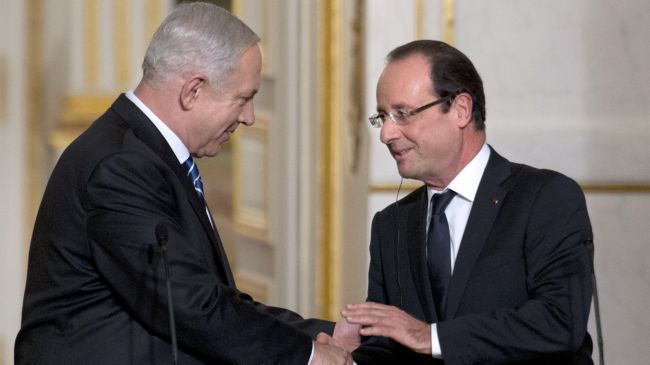
By Tahmineh Bakhtiari | Press TV | November 11, 2013
Since the formation of Israel and even before that, Tel Aviv has always resorted to lobbying to pursue its illegitimate objectives, including efforts to earn recognition for its so-called government.
Israel’s most active lobby is in the US, but it is also highly active in European countries such as Britain, Germany, France and even Italy and Spain.
This article seeks to discuss the influence of the Zionist lobby and France-Israel ties.
After a book by John Mearsheimer and Stephen Walt about the influence of the Israeli lobby on US foreign policy was published in 2007, French daily Le Monde published an article in October that year describing the Zionist lobby in France as a non-transparent and deceitful group. From that point, the issue of the Zionist lobby in France and its influence on the country’s foreign and domestic policy has been taken into consideration.
The Zionist lobby in France has extensive influence in three areas: A: Media and their affiliate companies, including Eutelsat; B: Political parties who receive campaign funding and media sponsorship from the Zionist lobby; C: Oil and arms companies.
The history of Zionist lobby in France
The Zionist movement led by Joseph Fisher started its activities in France between the first and second World Wars. Later in 1949, Fisher became Israel’s ambassador to Belgium. France had incurred heavy losses during World War II and that laid the groundwork for the presence of affluent Jews in different economic, social, judicial, cultural, religious and political arenas of the country.
At present, there are over 100 Jewish organizations and societies in France and all of the active Israeli parties have offices in Paris. In 1977, different Jewish groups in France merged and formed the Representative Council of French Jewish Institutions (Le Conseil Representatif des Institutions Juives de France (CRIF)).
The group is tasked with pursuing the interests of Israel inside France and its foreign policy. The group which owns a myriad of newspapers, magazines, TV networks and satellite service providers, has extensive influence in France’s political and legal bodies. Moreover, the Zionist lobby has a lot of lucrative businesses and financial institutions under its control.
The Zionist lobby in Israel has also formed certain groups for defaming, suing and even bringing to trial the individuals and groups which do not assert Israel’s interests. The French Union of Jewish students, the union of Jewish merchants in France, the SOS Racisme (established by the French Socialist Party to curry favor with Israel), the Organization of Lawyers without Borders France and the Anti-Defamation League are some examples.
French parties and the Zionist lobby
In domestic politics, some of the political parties are in competition with each other to forge friendly ties with Israel due to their need of pro-Israeli funds for victory in elections.
One of the examples of the Zionist Lobby’s sway in France is the naming of one the key roundabouts in Paris as David Ben-Gurion by the council of the city, which is comprised of rightist and socialist parties. Interestingly, the socialist mayor of Paris performed the ceremony with Shimon Peres.
Moreover, there are other Parisian squares named after the Zionist leaders such as Theodor Herzl and Yitzhak Rabin.
In 2012, around 112 French lawmakers, both rightists and leftists, held a festival in support of Israel. The move was aimed at opposing Palestine’s UN membership. The French parliamentarians stood up singing Israel’s national anthem.
The influence of the Zionist lobby in France reaches its peak during the election campaign in the country where each candidate competes with the others to ingratiate itself with Israel.
Among the French parties, the Socialist party has the closest ties with Israel and it adjusts most of its work plans, particularly vis-à-vis foreign policy, with the officials in Tel Aviv. The recent stance of Socialist French Foreign Minister Laurent Fabius regarding the nuclear talks with Iran was aligned with his illogical compliance with Tel Aviv’s policies towards Tehran.
Israel-France intelligence and security cooperation
Apart from the poisoning of Yaser Arafat, the former president of the Palestinian National Authority, and his hospitalization at a military hospital in Paris — which was a sort of French-Israeli intelligence and security coordination – the history of Paris-Tel Aviv ties is fraught with such cooperation.
From the outset of the fake Israeli regime, the French government authorized its intelligence apparatus to cooperate with the Mossad elements in assassinations of Arab and Palestinian fighters.
In 1965, under the presidency of Charles De Gaulle, Mossad abducted Mehdi Ben Barka, an opponent to King Hassan II, in cooperation with the French intelligence service. In 1972, Mossad killed Palestine Liberation Organization’s Representative to Paris, Mahmoud Al-Hamshri in cooperation with French intelligence elements.
Moreover, in the judiciary section, the French government has always acted in accordance with the interests of the Zionist lobby, the trial of Roger Garaudy, the writer of The Founding Myths of Israeli Politics, being an example.
Most of the world media are under the Zionist lobby’s sway and, using this powerful tool, they have managed to control world public opinion. That’s why when a media outlet moves in the path of actually informing the public, they spare no effort to prevent its activities.
The Zionist lobby in France puts pressure on the companies which provide services to the anti-Zionist satellite networks. The pressures by the Zionist lobby on the French Satellite service provider Eutelsat to stop the broadcasting of al-Manar, al-Alam, Press TV, Sahar and other networks is another example of such media sway.
Generally speaking, the Zionist lobby in France is enormously powerful in different spheres, despite its unpopularity among the French public. It has tried hard to portray Israelis as oppressed people. However, given the growth in public awareness, the information revolution and expansion of information dissemination tools, Zionism can no longer dominate public opinion.
The domineering and greedy nature of the Zionist regime and the futility of its claims about its opponents are being unmasked on a daily basis. This will lead to mounting pressure of public opinion’s pressure on the politicians. Nonetheless, for the time being, the majority of French politicians need the money and economic leverage of the Zionist lobby for the achievement of their objectives and the French media have to keep silent in order to survive and avoid the anti-Semitism tag.
In other words, at present France is under the domination of Zionists and their supporters, but the French public is gradually becoming aware of the fact.
~
Tahmineh Bakhtiari is an Iranian journalist and an expert on the Middle East and Latin America. Her writings have appeared in many print and online journals and newspapers including The Khorassan Daily, Jam-e Jam, Jomhuri Islami and Aftrab-e Yazd. Her book ‘The Genealogy of Zionism’ was published in 2001. Bakhtiari has a master’s degree in international relations.
Related article
Russia: Iran Not to Blame for Geneva Talks Failure
Al-Manar | November 12, 2013
Russia said the Islamic Republic of Iran was not to blame for the failed outcome of nuclear talks in Geneva last week, hinting at cracks in what had previously appeared to be a relatively united international front on the issue.
A source in the Russian Foreign Ministry said Tuesday that the account of the talks given by US Secretary of State John Kerry this week was an oversimplification of events, according to Ria Novosti.
“The draft of the joint document readied by the Americans was agreeable to the Iranians, but as decisions at the negotiations in this format are adopted by consensus, it was unfortunately not possible to come to a final agreement. This was not the fault of the Iranians,” the source said.
Kerry on Monday accused Tehran of backing away from a deal to limit its nuclear program in exchange for relief from sanctions that have stifled its economy. He said though that a deal could be reached in the coming months.
Tehran has pointed the finger at France for the failure to reach consensus in Geneva.
French Foreign Minister Laurent Fabius told French media during the talks on Saturday morning that his delegation did not agree with the draft under discussion.
“There are some points on which we are not satisfied,” Fabius was quoted as saying by Agence France-Presse news agency. AFP quoted Fabius as citing the “extremely prolific” Arak nuclear reactor and the issue of uranium enrichment.
Related article
- Russia Says Iran Not to Blame for Geneva Talks Failure (themoscowtimes.com)
Two Broken Cameras
By Yossi Gurvitz | November 11, 2013

Israeli soldiers try to arrest Activestills photographer Yotam Ronen, as Palestinian and international activists block 443 highway, which connects Tel Aviv and Jerusalem through the West Bank, during a protest against the violence of the Israeli settlers, October 16, 2012.
One morning last September, Nadel Shafiq Taher Shatiya heard the loudspeakers of the mosque in his village, in the Nablus region, announce that settlers were approaching the village’s land. Shatiya, a photojournalist by trade, grabbed two cameras and raced to the scene.
Based on his account, it turns out that when he arrived, several tractors and settlers – who, according to the reports received by Shatiya, came from thenearby Elon Moreh settlement – were trying to plough the village’s lands while several dozen Palestinian farmers tried to expel them. A settlement security vehicle showed up, and two settlers stepped out of it (Shatiya believes he can identify them), and started shooting live ammo at the farmers. Some of them took cover; Shatiya kept taking photos. That’s his job.
About ten minutes later, a large IDF force arrived at the scene, and did what it usually does: joined the settlers. The soldiers fired tear gas canisters and stun grenades at the farmers, and as the area is full of dry thorns, a fire broke out. The Palestinian farmers tried to put it out, and the two armed settlers demanded that the troops stop them (Yours truly was present for another incident, in which IDF soldiers fired at Palestinians who tried to put out a fire which had erupted after a demonstration due to canister fire.) The soldiers confronted the Palestinians, and Shatiya saw – and documented – one of the soldiers pull out a knife and threaten one of the farmers.
Our brave troops don’t know how to deal with nonviolent resistance. Major General (res.) ‘Amon Gilad became famous abroad when he told the American embassy “we don’t do Ghandi very well.” In such cases, the IDF’s instinct is to use excessive force. It makes for bad publicity, and the soldiers know that – so they try to suppress the evidence.
Shortly after Shatiya photographed the knife-wielding soldier, other soldiers assaulted him and took his cameras and camera bag from him. He witnessed another soldier tearing a phone out of the hands of a farmer, who was using it to document the incident; the farmer was beaten and detained.
So far, no surprises. Anyone who has either served in the West Bank or demonstrated there is familiar with the loving care the soldiers lavish on photographers. But in Shatiya’s case, the story underwent an unusual twist: the soldiers took his cameras to an officer, who turned them over, along with his camera bag, to a settler. Shatiya protested to the officer, saying “you’re in charge of security, and if, as part of your duty, you want to confiscate the cameras, keep them; why do you give them to the settler?” In return, the officer blamed Shatiya for the fire. Later on, Shatiya saw a settler moving among the detained Palestinians, telling the soldiers who should be kept in detention.
Turning the cameras over to the settler caused some fuss, with Israeli DCO officers telling the army it had no authority to detain journalists or confiscate their cameras, that only policemen may do so. This is inaccurate, by the way: in the West Bank soldiers have the same authority as cops, until the latter reach the scene. The Military Commander is the sovereign in the West Bank, as it is legally considered to be held under belligerent occupation; the police only act in the West Bank because they have been delegated that authority by the Military Commander. In the end, several officials promised Shatiya he’d get his cameras back, but afterwards they simply ignored and then began avoiding him.
Some 12 days after the incident, the Israeli DCO contacted the Palestinian DCO, and informed the latter Shatiya could come and retrieve his cameras. He found them broken and rubbed with sand. The damage to the cameras is estimated at 21,000 NIS (about 6,000 USD). That’s what happens when you try to document the most moral army between the Jordan and the Mediterranean while it fails to move into Ghandi mode.
So, to sum it up, we’ve had settler violence, immediately backed up by the army; the destruction of evidence by soldiers, using a settler for this purpose; yet another example of problematic cooperation between soldiers and settlers, where a settler tells soldiers who to detain and they obey, and, finally, another example of the security forces in the West bank misunderstanding their role. There’s a strain of thinking in Israel, particularly among the center and on the left, which says that the problem in the West Bank is the settlers, and that the soldiers are not at fault.
But the soldiers know full well that they are at fault – Had they felt no guilt, they wouldn’t have felt the need to destroy evidence, and they would neither have broken the farmer’s cell phone nor given Shatiya’s cameras to a settler, in order to rid themselves of responsibility for taking the cameras away from him. In the West Bank, the soldiers and the settlers are part of the same pattern, the pattern of an occupation whose inner logic is annexation by a quiet population transfer of the Palestinians.
Yizhak Shamir, an Israeli prime minister, once said that one is allowed to lie for Eretz Israel (the ‘Land of Israel”). The IDF soldiers take this one step further: in the name of Eretz Israel, they destroy evidence and intimidate journalists and innocent civilians.
Related video
Report: Fewer than 50K have signed up at HealthCare.gov
By Elise Viebeck | The Hill | November 11, 2013
Fewer than 50,000 people have successfully purchased private healthcare coverage using the struggling ObamaCare enrollment site, according to a report.
The figure represents about one-tenth of an initial enrollment target from the Obama administration that has been referred to by Republican lawmakers.
The report by the Wall Street Journal, citing two people familiar with the matter, comes as federal health officials prepare to release official sign-up figures from healthcare.gov for the first time later this week.
The administration has sought to lower expectations about the number, noting problems with HealthCare.gov and consumers’ tendency to purchase health coverage close to deadlines.
Health insurance companies serving the federal marketplaces have received data for between 40,000 and 50,000 enrollees, sources told the Journal.
The administration had hoped to sign up 500,000 people in the month of October, according to documents cited by House Ways and Means Committee Chairman Dave Camp (Mich.), a Republican.
Monday’s release was part of a flurry of estimates shedding light on aspects of ObamaCare enrollment.
Consulting firm Avalere Health reported that about 50,000 people had signed up for either private plans or Medicaid on 12 state-run marketplaces.
The administration and healthcare experts caution that early lags in enrollment can be rectified by big waves later on.
“Enrollment in new programs begins slowly and often takes several months to build momentum,” said Avalere CEO Dan Mendelson in a statement.
“While initial enrollment has been lagging, with aggressive marketing, there is still time for awareness of the program to grow and participation to begin.”
The Health and Human Services (HHS) Department said it could not confirm the Journal’s numbers.
“We have always anticipated that initial enrollment numbers would be low and increase over time,” said HHS spokeswoman Joanne Peters in a statement, citing Massachusetts’ experience with its healthcare reform law.
“As we have said, the problems with the website will cause the numbers to be lower than initially anticipated.”
Less Than 20% Of Americans Believe That There’s Adequate Oversight Of The NSA
By Mike Masnick | Techdirt | November 11, 2013
One of the key responses from the NSA and its defenders to all of these Snowden leaks is that there is “rigorous oversight” of the NSA by the courts and Congress. Of course, that talking point has been debunked thoroughly, but NSA defenders keep trotting it out. It appears that the public is not buying it. At all. A recent poll from YouGov found that only 17% of people believe that Congress provides “adequate oversight” on the spying of Americans. A marginally better 20% (though, within the 4.6% margin of error, so meaningless difference really) felt that Congress provides adequate oversight of the NSA when it comes to collecting data on foreigners. Basically, that part of the NSA story just isn’t particularly believable in light of everything that’s come out. Oh, and people are paying attention to the news. A full 87% had heard something about the spying on foreign countries — with only 14% thinking that such a program has helped US interests abroad.
Oh, and it gets worse. According to a different study, the more informed people are about the NSA, the less they like what the NSA is doing. The NSA has been insisting if people could only understand more about its actions they’d be much more comfortable with the agency’s actions, but this study suggests that’s not quite true either.
Neither of these findings should come as a shock to most people outside of the NSA, but for our friends over at the NSA reading this, it would appear that your talking points aren’t working. Perhaps, next time, try (1) telling the truth and (2) not trampling all over the Constitution.
Related articles
- Five Reactions To Dianne Feinstein Finally Finding Something About The NSA To Get Angry About (alethonews.wordpress.com)
- New Evidence of Criminality in Spying Agencies, Going as Far as Exploiting FOSS Sites to Spread Malware (techrights.org)
- Jim Sensenbrenner takes NSA reform case to European parliament (theguardian.com)
- NSA spying shows democracy is ‘fiction’ (rinf.com)
Australia Spied On Japanese Companies To Help Its Industries Negotiate Trade Deals
By Glyn Moody | Techdirt | November 12, 2013
As more information comes to light about the global snooping being conducted by the NSA and GCHQ, it is becoming clearer that much of it had little to do with combating terrorism, as a recent EFF article makes plain. But most damaging to the idea that massive surveillance was justified, because it was to protect people from extreme threats, is the revelation that commercial espionage was also being conducted. So far, the chief example of that is in Brazil, but The Sydney Morning Herald (SMH) now has information about large-scale industrial spying on Japanese companies carried out by Australian secret services:
BHP [BHP Billton — the world’s largest mining company] was among the companies helped by Australian spy agencies as they negotiated trade deals with Japan, a former Australian Secret Intelligence Service officer says.
A former diplomat has also confirmed Australian intelligence agencies have long targeted Japanese companies. Writing in The Japan Times, Professor Gregory Clark said Australian companies were beneficiaries of intelligence operations.
“In Australia, favoured firms getting spy material on Japanese contract policies and other business negotiations used to joke how [it had] ‘fallen off the back of a truck’,” Professor Clark wrote.
The article has more details, but doesn’t reveal how the materials were obtained. However, since Australia is part of the “Five Eyes” inner circle of snooping countries that also includes the US, UK, Canada and New Zealand, it seems likely that information of interest from those partners also found its way to Australian companies. SMH quotes Clark as saying:
Business information is a main target for [intelligence] agencies
It will be interesting to see if later releases from Snowden’s hoard of documents show any evidence of this Australian use of NSA materials for industrial espionage.Follow me @glynmoody on Twitter or identi.ca, and +glynmoody on Google+
Related article
Featured Video

The Most Important Bet You’ve Never Heard Of
or go to
Aletho News Archives – Video-Images
From the Archives
The Occupied Mentality Syndrome
Saudi Arabia on the American chessboard – Part 2
By B. J. Sabri | American Herald Tribune | April 19, 2016
Since the Korean War, but particularly since the Iranian Revolution of 1979 until today, the United States has been steadily escalating its military presence in the Persian Gulf. Taking advantage of many colossal events of the past 36 years, [1] the hyper-empire has institutionalized its massive presence on land and sea, and expanded its objectives to include the unambiguous physical control of the area, as well as the clear understanding that local Arab governments should abide by them. The pretext is always the same: in “defense” of the national interests and security of the United States. From observing how the United States has been interacting with the governments of the region, and by judging from the size of its expeditionary force, we could reach a basic conclusion. The United States is occupying, de facto, the entire Arabian Peninsula. (Yemen, devastated by Saudi and American jets is yet to be conquered. Oman? Britain returned not as colonial ruler but as a soft occupying power.)
Under this articulation, Saudi Arabia, Qatar, Kuwait, and the United Arab Emirates are virtually occupied countries. If we compare this type of occupation to the mandate and protectorate regimes of the past, the results might be identical—the nations affected by it lose sovereignty. When Arab governments comply with the objectives of a foreign power that station military forces on their national milieu, then that power controls them in multiple ways including how they react to policy deliberations and what decisions they intend to take on specific issues. A good method to verify the concept of effective occupation is this: take notice of what the United States says and wants, and then compare it to what the gulf rulers do in response. (I shall discuss this detail at some point in the upcoming parts.)
If the presence of US forces or other means of political pressure are a factor in Saudi Arabia’s interventionist Arab wars, then we need to debate this issue. However, from the history of resistance to colonialism, we learnt: if a powerful state imposes its order on a nation by military means or other forms of coercion, and if this nation does not resist that imposition, then a mental subordination to the powerful state will ensue. This is especially true in the case of Saudi Arabia. One single event, 9/11, has transformed it from a US “ally” into an instant political hostage of the American Empire. … continue
Blog Roll
 Aletho News
- Trump and the debris of Iran war
- IRGC hits US tech giant Oracle’s data center, computing site in UAE over new assassinations
- Bombing Iran Back Into the Stone Age /Lt Col Daniel Davis & Jim Jatras
- UAE rejects report claiming it is ready to join war on Iran to reopen Hormuz
- A New Resistance Front: How Does Syria Factor into the Regional War?
- Gulf states weigh pipeline expansion plans, hoping to bypass Hormuz
- Iran sets up ‘tollbooth’ system in Strait of Hormuz
- Wave 90: IRGC strikes US-linked industrial sites in Gulf
- Iran Says US-Israeli Claims of Its Military Strength Are Wrong
- Trump’s April Fools’ Address to the nation
- If Americans Knew
- ‘War crime’: Global condemnation as Israeli ministers celebrate death penalty law targeting Palestinian prisoners
- 7 Ways Israel Is Turning Lebanon Into Gaza
- World’s Leading Football Bodies Under Fire Over Israel Policies
- Experts warn of possible use of nukes against Iran
- Israeli invasion of Lebanon could be worse than 1982, warn European officials
- Passover: Liberation and collective punishment
- Trump says the quiet part out loud: (Israel’s) war on Iran > Americans’ health – Daily Update
- Gaza families reunite years after babies evacuated amid Israel’s war
- International Rescue Committee warns Gaza’s children face grave protection risks
- Iran’s Alleged 47-Year War on America: Debunking the 1,050 American Deaths Canard
- No Tricks Zone
- Low Intensity Tornado Wrecks Major Solar Farm, Creating A Potential Toxic Dump
- New Study Finds Warming Saves Lives…Cold Temperatures 12 Times More Deadly Than Excess Heat
- German Science Blog Accuses PIK Climate Institute Of Hallucinating Climate Tipping Points
- Devastating Assessment Of Comirnaty Vaccine By Former Senior Pfizer Europe Toxicologist
- New Study: CO2 Is ‘Effectively Negligible’ As An Explanatory Climate Change Factor Since 2000
- Former Pfizer Toxicologist Dr. Helmut Sterz Tells Bundestag Hearing Pfizer Vaccine Should Have Never Been Approved
- Energy Expert: Germany’s Nuclear Phaseout Was A “500 Billion Euro Mistake”
- New Research: South Australia’s Mid-Holocene Sea Surface Temperatures Were 4°C Warmer Than Today
- Storing Green Energy To Last Germany 10 Days Would Require A 60-Million Tonne Battery
- New Studies: UK Sea Levels Were 4 Meters Higher Than Today During The Mid-Holocene
 Aletho News