Calls for dividing Al-Aqsa temporally and spatially between Muslims and Jews
Palestine Information Center – 05/11/2013
OCCUPIED JERUSALEM — Al-Aqsa Foundation for Endowments and Heritage said Israeli groups seek to enact laws and regulations aiming at partitioning the Aqsa Mosque between Muslims and Jews, and defining times and areas where collective and individual Jewish prayers can be held.
The Foundation said in a statement that Israeli ministers, MKs and party members, in addition to Israeli organizations and decision-makers, are seeking to reach a political and religious consensus to change the status quo in the Aqsa Mosque, and turn it into a Jewish holy site under the occupation authority.
It stated that the Knesset Interior Committee held a session on Monday in this regard, attended by Deputy Minister of Religious Affairs Eli Ben Dahan who called on the new “Chief Rabbinate” to issue an advisory opinion allowing Jews to pray at Al-Aqsa Mosque.
For her part, the head of the Knesset Interior Committee, Likud party member Mary Rigab, pointed out that the aim of holding the consecutive sessions is to enact regulations that will define the times and areas where Jewish prayers will be held in the “Temple Mount”, regardless of the opinion of the “Chief Rabbinate”, and regardless of the threats of a third intifada.
Turkish patrol seizes over a ton of chemicals from smugglers attempting to enter Syria
RT | November 4, 2013
Turkish border guards seized three vehicles loaded with over 1,000 kg of chemicals as they tried to illegally cross the border into Syria. One of the smugglers was arrested, while others managed to escape.
The Turkish General Staff reported that the chemicals were seized after a convoy of three vehicles refused to stop and attempted to illegally cross the border near the southeastern Turkish town of Reyhanli on Saturday.
Paramilitary police were ordered to shoot out the tires of the vehicles to stop them. As the tires caught on fire, the three drivers jumped out and fled in the direction of Syria. One of them was arrested.
The vehicles contained 20 bags of sulphur, weighing about 50 kg each, and eight sealed barrels. Their contents were not immediately known.
Republican People’s Party (CHP) chairman Faruk Logoglu said in a statement on Monday that the barrels are suspected to contain chemical material. “Traffic was from Turkey to Syria,” he added.
The arrested suspect’s nationality has not been made public. He was taken into custody after interrogation by the Reyhanli district gendarmerie headquarters and is to be sent to the prosecutor’s office.
Chemical, biological, radiological, and nuclear defense (CBRN) units from the Disaster and Emergency Management Presidency have started examining the seized material, Logoglu’s statement said.
The Republican People’s Party has also criticized the release of a primary suspect in a similar case, saying that closing the investigation would be “a shame for Turkey,” Hurriyet newspaper reported, citing CHP’s deputy.
In May 2013, Turkish police seized a group of people after being informed that Syrian rebel groups were looking to obtain materials that could be used to produce chemical weapons.
A two -kilogram cylinder with what initially was suggested to be sarin gas was seized while searching the homes of Syrian militants from the Al-Qaeda-linked Jabhat al-Nusra Front following their detention.
Some of the suspects accused of establishing a connection with a network in Turkey to convey chemical materials were released after lab tests proved that the seized chemicals were not sarin gas.
The alleged use of sarin – considered one of the world’s most dangerous chemical warfare agents – in a Damascus suburb on August 21 provoked an international outcry which nearly led to a US military strike against the Syrian regime, as Western countries assumed it was the Assad government who used the chemical weapons.
However, while a UN investigation proved that sarin was used near Damascus, it did not say who was behind the attack. At the same time, Russia also analyzed samples taken in the Syrian town of Aleppo, where chemical weapons were allegedly used in March. Experts concluded that rebels – not the army – were behind the Aleppo sarin attack.
In September, Syria agreed to comply with Moscow’s offer to put its chemical weapons under international control for subsequent destruction, in order to avert a possible military strike. Damascus declared the possession of 1,300 tons of chemicals and precursors needed for chemical weapons production, as well as over 1,200 empty chemical munitions.
On Thursday, the Organisation for the Prohibition of Chemical Weapons (OPCW) said that Syria’s entire declared stock of chemical weapons has been placed under seal.
The organization acknowledged that Damascus has complied with the watchdog’s requirement, adopted on September 27, for the complete elimination of chemical weapons and production units in Syria before November 1.
The process of eliminating Syria’s chemical weapons stocks has a target finish date of mid-2014.
Arab ‘Thugs’ Steal Olives from Poor, Downtrodden Israeli Settlers
By Richard Edmondson | Fig Trees and Vineyards | November 4, 2013
Every now and then we run across stories in the Jewish media that are amusing for their unintended humor. Several days ago the Jewish Press published an article about West Bank Palestinians who crept into a Jewish-owned olive grove, apparently in the night, and stole a number of bushels of olives, breaking off tree branches in the process.
The story—a total of five paragraphs—is written by Yori Yanover, who, in common with most Israelis, refers to Palestinians not as Palestinians but as “Arabs,” and who additionally applies the word “thugs” to the particular thieves in question. (Truly a masterpiece of journalistic objectivity). We also are informed the theft took place at a Jewish-owned farm located between the West Bank settlements of Shiloh and Eli:
Someone should alert Philip Gordon – the US Middle East Czar who was so adamant in his condemnation of those pesky Jewish settlers out to ruin Arab olive trees, he should express at least the same amount of rage at what has taken place today in the Eretz HaTzvi farm, between the towns of Shiloh and Eli.
According to a report by the Tazpit news agency, Jewish farmers who arrived Thursday at the olive grove belonging to Eretz HaTzvi, discovered that Arab thugs had stolen bushels of olives and broke off tree branches. The damage is estimated in tens of thousands of dollars.
Note: we are talking about Jewish farmers who decided to grow their olive trees on stolen Palestinian land—and who now feel put upon because the people they stole the land from pilfered some of their olives. But that angle to the story seems to escape Yanover.
The author also goes on to quote one of the farmers, who speaks of “telltale signs” left by “Arab fruit thieves,” thus arousing our sympathy by letting us know that he, poor fellow, has had to deal with this sort of heinous thievery in the past:
“I arrived at the grove a short while ago, and from the highway I recognized the telltale sign of Arab fruit thieves – Jute sacks that were spread on the ground. Walking around the grove I identified many broken branches and a large amount of olives that fell out of the thieves’ sacks.”
Again note: we’re talking about some broken branches. Nothing is mentioned about whole trees being uprooted or destroyed. In fact, here is one of the photos that accompany the story. You’ll notice, of course, that a limb has been broken from a tree but that the tree itself is still standing:

And here is a second photo that accompanies the article. Again notice, a few broken limbs in the foreground, with unharmed, whole trees standing in the background.

I want to be clear: I do not think theft is ever justified, whether it be a single olive or an entire parcel of land. But at the same time it can be useful to us to put things into perspective. I have posted numerous articles about Palestinian olive groves that have been attacked and vandalized by Jewish settlers (see here, here, here, here, here, and here ). In many of these instances, whole trees have been uprooted or destroyed, and in some cases the number of trees destroyed was in the hundreds. But apparently many Jews are incapable of seeing things from the perspective of their victims. Here is a sampling of comments that accompanied the Jewish Press article:

The commenters seem almost out of touch with reality in a certain sense. But in the interest, again, of perspective, here’s a little dose of reality. The following comes from a report published last year entitled “When Settlers Attack,” by Yousef Munayyer for the Palestine Center:
Executive Summary
- Israeli settler violence presents a direct and consistent threat to Palestinian civilians and their property in the occupied West Bank and instances of Israeli settler violence are on the rise.
- From 2010 to 2011 there was a 39 percent increase in incidents of Israel Settler violence. In the five year period from 2007 through 2011 there has been a 315 percent increase. Conversely, over the same 5-year period, there has been a 95 percent decrease in Palestinian violence in the West Bank.
- There is a noticeable shift in the proportion of violence as it occurs geographically in the West Bank. In the past, the southern part of the West Bank saw the largest number of instances but in recent years the northern part of the West Bank is becoming increasingly targeted and has overtaken the southern part of the West Bank in terms of number of attacks.
- The period of the olive harvest annually brings a peak in violent settler activity. The presence of Palestinian civilians in olive groves, where they are easy targets for unrestrained and violent Israeli settlers, is the main reason why this occurs on an annual basis.
- There is a noticeable increase in the frequency and proportion of arson attacks employed by violent settlers. This suggests that violent settlers are increasingly choosing this method of violence and will continue to do so. The percentage of arson among all attack types in 2005 was 6 percent and has risen to 11 percent in 2011.
- While minimal variation in Israeli settler violence over time can be explained as a response to Israeli state actions against settlements, like the dismantlement of outposts, the vast majority of Israeli settler violence is not responsorial but rather structural and symptomatic of occupation.
- Over 90 percent of all Palestinian villages which have experienced multiple instances of Israeli settler violence are in areas which fall under Israeli security jurisdiction.
At the top of this piece I referred to Yanover’s article as providing us with “unintended humor,” and so it does. But what I also detect in it is an element of self pity.
America’s Moment of Truth on Iran
By Flynt Leverett and Hillary Mann Leverett | The Diplomat | November 4, 2013
America’s Iran policy is at a crossroads. Washington can abandon its counterproductive insistence on Middle Eastern hegemony, negotiate a nuclear deal grounded in the Nuclear Non-Proliferation Treaty (NPT), and get serious about working with Tehran to broker a settlement to the Syrian conflict. In the process, the United States would greatly improve its ability to shape important outcomes there. Alternatively, America can continue on its present path, leading ultimately to strategic irrelevance in one of the world’s most vital regions—with negative implications for its standing in Asia as well.
U.S. policy is at this juncture because the costs of Washington’s post-Cold War drive to dominate the Middle East have risen perilously high. President Obama’s self-inflicted debacle over his plan to attack Syria after chemical weapons were used there in August showed that America can no longer credibly threaten the effective use of force to impose its preferences in the region. While Obama still insists “all options are on the table” for Iran, the reality is that, if Washington is to deal efficaciously with the nuclear issue, it will be through diplomacy.
In this context, last month’s Geneva meeting between Iran and the P5+1 brought America’s political class to a strategic and political moment of truth. Can American elites turn away from a self-damaging quest for Middle Eastern hegemony by coming to terms with an independent regional power? Or are they so enthralled with an increasingly surreal notion of America as hegemon that, to preserve U.S. “leadership,” they will pursue a course further eviscerating its strategic position?
The proposal for resolving the nuclear issue that Iran’s foreign minister, Javad Zarif, presented in Geneva seeks answers to these questions. It operationalizes the approach advocated by Hassan Rohani and other Iranian leaders for over a decade: greater transparency on Iran’s nuclear activities in return for recognizing its rights as a sovereign NPT signatory—especially to enrich uranium under international safeguards—and removal of sanctions. For years, the Bush and Obama administrations rejected this approach. Now Obama must at least consider it.
The Iranian package provides greater transparency on Tehran’s nuclear activities in two crucial respects. First, it gives greater visibility on the conduct of Iran’s nuclear program. Iran has reportedly offered to comply voluntarily for some months with the Additional Protocol (AP) to the NPT—which it has signed but not yet ratified and which authorizes more proactive and intrusive inspections—to encourage diplomatic progress. Tehran would ratify the AP—thereby committing to its permanent implementation—as part of a final deal.
Second, the package aims to validate Iran’s declarations that its enrichment infrastructure is not meant to produce weapons-grade fissile material. Iran would stop enriching at the near-20 percent level of fissile-isotope purity needed to fuel the Tehran Research Reactor and cap enrichment at levels suitable for fueling power reactors. Similarly, Iran is open to capping the number of centrifuges it would install—at least for some years—at its enrichment sites in Natanz and Fordo.
Based on conversations with Iranian officials and political figures in New York in September (during Rohani and Zarif’s visit to the UN General Assembly) and in Tehran last month, it is also possible to identify items that the Iranian proposal almost certainly does not include. Supreme Leader Ayatollah Seyed Ali Khamenei has reportedly given President Rohani and his diplomats flexibility in negotiating a settlement—but he has also directed that they not compromise Iran’s sovereignty. Thus, the Islamic Republic will not acquiesce to American (and Israeli) demands to suspend enrichment, shut its enrichment site at Fordo, stop a heavy-water reactor under construction at Arak, and ship its current enriched uranium stockpile abroad.
On one level, the Iranian package is crafted to resolve the nuclear issue based on the NPT, within a year. Iran’s nuclear rights would be respected; transparency measures would reduce the proliferation risks of its enrichment activities below what Washington tolerates elsewhere. On another level, though, the package means to test America’s willingness and capability to resolve the issue on this basis. It tests this not just for Tehran’s edification, but also for that of other P5+1 states, especially China and Russia, and of rising powers like India and South Korea.
America can fail the Iranian test in two ways. First, the Obama administration—reflecting America’s political class more broadly—may prove unwilling to acknowledge Iran’s nuclear rights in a straightforward way, insisting on terms for a deal that effectively suborn these rights and violate Iranian sovereignty.
There are powerful constituencies—e.g., the Israel lobby, neoconservative Republicans, their Democratic “fellow travelers,” and U.S.-based Iran “experts”—that oppose any deal recognizing Iran’s nuclear rights. They understand that acknowledging these rights would also mean accepting the Islamic Republic as an enduring entity representing legitimate national interests; to do so, America would have to abandon its post-Cold War pretensions to Middle Eastern hegemony.
Those pretensions have proven dangerously corrosive of America’s ability to accomplish important objectives in the Middle East, and of its global standing. Just witness the profoundly self-damaging consequences of America’s invasion and occupation of Iraq, and how badly the “global war on terror” has eviscerated the perceived legitimacy of American purposes in the Muslim world.
But, as the drama over Obama’s call for military action against Syria indicates, America’s political class remains deeply attached to imperial pretense—even as the American public turns away from it. If Washington could accept the Islamic Republic as a legitimate regional power, it could work with Tehran and others on a political solution to the Syrian conflict. Instead, Washington reiterates hubristic demands that President Bashar al-Assad step down before a political process starts, and relies on a Saudi-funded “Syrian opposition” increasingly dominated by al-Qa’ida-like extremists.
If Obama does not conclude a deal recognizing Iran’s nuclear rights, it will confirm suspicions already held by many Iranian elites—including Ayatollah Khamenei—and in Beijing and Moscow about America’s real agenda vis-à-vis the Islamic Republic. It will become undeniably clear that U.S. opposition to indigenous Iranian enrichment is not motivated by proliferation concerns, but by determination to preserve American hegemony—and Israeli military dominance—in the Middle East. If this is so, why should China, Russia, or rising Asian powers continue trying to help Washington—e.g., by accommodating U.S. demands to limit their own commercial interactions with Iran—obtain an outcome it does not actually want?
America can also fail Iran’s test if it is unable to provide comprehensive sanctions relief as part of a negotiated nuclear settlement. The Obama administration now acknowledges what we have noted for some time—that, beyond transitory executive branch initiatives, lifting or even substantially modifying U.S. sanctions to support diplomatic progress will take congressional action.
During Obama’s presidency, many U.S. sanctions initially imposed by executive order have been written into law. These bills—signed, with little heed to their long-term consequences, by Obama himself—have also greatly expanded U.S. secondary sanctions, which threaten to punish third-country entities not for anything they’ve done in America, but for perfectly lawful business they conduct in or with Iran. The bills contain conditions for removing sanctions stipulating not just the dismantling of Iran’s nuclear infrastructure, but also termination of Tehran’s ties to movements like Hizballah that Washington (foolishly) designates as terrorists and the Islamic Republic’s effective transformation into a secular liberal republic.
The Obama administration may have managed to delay passage of yet another sanctions bill for a few weeks—but Congressional Democrats no less than congressional Republicans have made publicly clear that they will not relax conditions for removing existing sanctions to help Obama conclude and implement a nuclear deal. If their obstinacy holds, why should others respect Washington’s high-handed demands for compliance with its extraterritorial (hence, illegal) sanctions against Iran?
Going into the next round of nuclear talks in Geneva on Thursday, it is unambiguously plain that Obama will have to spend enormous political capital to realign relations with Iran. America’s future standing as a great power depends significantly on his readiness to do so.
Flynt Leverett and Hillary Mann Leverett are authors of Going to Tehran: Why the United States Must Come to Terms with the Islamic Republic of Iran (New York: Metropolitan, 2013) and teach international relations, he at Penn State, she at American University.
Related articles
Russia breaks oil output record
RT | November 2, 2013
Russian oil output, the largest in the world, reached 10.59 million bpd (barrels per day) in October, setting the record for the country’s post-Soviet period, Energy Ministry data showed.
The landmark was reached due to Rosneft increasing production at the Vankor field in the Krasnoyarsk Region, the Vedomosti paper reports.
The output at the field was 18.3 million tons last year, with the company planning Vankor reach 25 million tons annually.
Another influential factor is the larger amount of Gazprom-produced gas condensate, which has now reached 350,000 bpd.
The country’s total output in October reached 44,773 million tons, which is 1.3 percent higher than during the same period last year.
According to the International Energy Agency, Russia’s all-time production of black gold reached its peak at 11.41 million bpd in 1988, when it was still part of the Soviet Union.
The production of oil in Russia has been steadily growing since the setback caused by the global financial crisis in 2008, which saw output falling to about 9.8 million bpd.
In September 2009, it exceeded a monthly level of 10 million bpd, with the country overtaking Saudi Arabia as the world’s largest oil producer the next year.
Oil and gas remain the No.1 source of income for Russia, as hydrocarbons account for 80 percent of the country’s export.
Related article
Sun Sets on U.S. Wind Industry
Lisa Linowes | Wind Action | November 4, 2013
The U.S. wind power market staggered this year adding less than seventy (70) megawatts of new wind in the first three quarters. This is down from 4,743 megawatts installed during the same period in 2012.
Only three states reported wind expansions:
- California – Pattern Renewables added 42.7 MW to its controversial Ocotillo Wind Energy Facility;
- Colorado – Tri-State expanded its Colorado Highlands Wind Farm by 23.8 MW; and
- Alaska – Just 2 MW added.
The American Wind Energy Association (AWEA) wasted no time blaming the precipitous drop in installations on uncertainty surrounding the wind production tax credit (PTC), the federal incentive most often credited for market growth in the sector.
That’s a convenient excuse that might resonate with sympathetic members of Congress, but it’s not accurate.
Wind’s Bubble Bursts
AWEA’s CEO Tom Kiernan bellyached last week that his people were exhausted by the “boom-bust” behavior sparked each time the industry faced possible withdrawal of the PTC. He showed no remorse that big wind was still economically impotent despite decades of public handouts meant to stimulate self-growth. Instead he dug in and insisted the PTC be extended.
This is indicative of an industry that’s been coddled for too long and asked to show little in return. And why should it?
Every megawatt-hour generated by an eligible project during its first ten years of operation earns the production tax credit regardless of the location of the plant, the time of day and year when the energy is produced, or whether the energy is even needed. At $23/MWh, the PTC on a pre-tax basis ($35/MWh) equals or exceeds the wholesale price of electricity in many parts of the country. NO other form of reliable electric generation receives a federal subsidy as generous and condition-free as the PTC.
But wind didn’t falter in 2013 because of Congressional indecision.
We’ve long known that Section 1603, the cash grant program enacted under The American Recovery and Reinvestment Act of 2009 (ARRA), fueled a wind bubble that was certain to burst, and it did.
Under 1603, roughly 30,000 megawatts of new wind was installed, more than doubling the wind capacity in the country. As much as 90% of the 13,000+ MW of wind installed last year alone can be attributed to Section 1603, not the PTC.
In order to receive the grant, projects needed to be in-service by the end of 2012. Developers raced to meet the deadline which flushed the industry’s project pipeline. It will take several years before additional proposals reach the shovel-ready stage.
Forecasting Wind Growth Based on RFPs
Despite no growth, AWEA touted the rosy potential for new wind development by pointing at the number of utilities announcing RFPs (requests for proposal) for new renewables this year. Over 4,000 MW of new wind proposals are pending according to the trade group.
But RFPs and/or signed power contracts for the energy do not mean facilities will be built.
Consider the situation in New England as an example.
In September, four utilities in the Commonwealth of Massachusetts announced joint contracts to acquire 565 MW of new wind capacity from six wind projects to be sited in Maine and New Hampshire. Of the six projects, only one (Oakfield) has been approved for construction but the permit is under appeal in U.S. Federal Court.
Of the remaining five, one was withdrawn (Fletcher Mountain), and two (Passamaquoddy Wind Project and Peskotmuhkati Wind Project) were reported in breach of the utility contracts for failure to deliver the required development security payments.
Another (Bingham) was informed in August of serious environmental concerns by the Maine Department of Inland Fisheries and Wildlife. And the one New Hampshire project (Wild Meadows) is experiencing intense opposition from environmental groups and the host and surrounding communities. At this point, it’s not clear whether any of these projects will be built.
There are many other project proposals in the U.S. we can point to which are equally speculative but are likely still included in AWEA’s rosy forecast.
Other Challenges in the Wind
There are other significant challenges facing wind development which will make adding new projects more difficult. These include the lack of transmission capacity, record-low natural gas prices, and a growing, more organized public opposition to the towers.
Press reports about wind are increasingly negative and the PTC is starting to sound less like government ‘investment’ and more like corporate cronyism and government waste. Investors are rightfully worried about an industry that is subject to the whims of Congress and public opinion.
We are also learning lessons from the European Union which is several years ahead of the U.S. in terms of wind deployment.
Last month, CEOs from ten utilities in Europe responsible for nearly half of the energy capacity in the European Union argued for an end to wind and solar subsidies which they say are driving up energy prices for consumers and destroying Europe’s competitiveness. E.ON CEO Johannes Teyssen commented that the “subsidies are reaching a level which is totally unbearable. … This industry is the biggest kid on the block now, not a child any longer. And no longer needs a child’s nutrition.”
We agree!
Related articles
- Wind tax credit could be blown off (politico.com)
- BigWind moves to the back of the handout line (saveourskylineohio.com)
America’s Lead Iran Negotiator Misrepresents U.S. Policy (and International Law) to Congress

By Flynt Leverett and Hillary Mann Leverett | Going to Tehran | November 3, 2013
Last month, while testifying to the Senate Foreign Relations Committee, Wendy Sherman—Undersecretary of State for Political Affairs and the senior U.S. representative in the P5+1 nuclear talks with Iran—said, with reference to Iranians, “We know that deception is part of the DNA.” This statement goes beyond orientalist stereotyping; it is, in the most literal sense, racist. And it evidently was not a mere “slip of the tongue”: a former Obama administration senior official told us that Sherman has used such language before about Iranians.
–If a senior U.S. government official made public statements about “deception” or some other negative character trait being “part of the DNA” of Jews, people of African origin, or most other ethnic groups, that official would—rightly—be fired or forced to resign, and would probably not be allowed back into “polite society” until after multiple groveling apologies and a long period of penance.
–But a senior U.S. official can make such a statement about Iranians—or almost certainly about any other ethnic group a majority of whose members are Muslim—and that’s just fine.
Of course, it’s not fine. But that’s the America we live in.
Putting aside Sherman’s glaring display of anti-Iranian racism, there was another egregious manifestation of prejudice-cum-lie in her testimony to the Senate Foreign Relations Committee that we want to explore more fully. It came in a response to a question from Senator Marco Rubio (R-Florida) about whether states have a right to enrich under the Nuclear Non-Proliferation Treaty (NPT). Here is the relevant passage in Sherman’s reply:
“It has always been the U.S. position that Article IV of the Nuclear Non-Proliferation Treaty does not speak about the right of enrichment at all [and] doesn’t speak to enrichment, period. It simply says that you have the right to research and development.”
Sherman goes on to acknowledge that “many countries such as Japan and Germany have taken that [uranium enrichment] to be a right.” But, she says, “the United States does not take that position. We take the position that we look at each one of these [cases].” Or, as she put it at the beginning of her response to Sen. Rubio, “It has always been the U.S. position that Article IV of the Nuclear Non-Proliferation Treaty does not speak about the right of enrichment at all” (emphasis added).
Two points should be made here. First, the claim that the NPT’s Article IV does not affirm the right of non-nuclear-weapons states to pursue indigenous development of fuel-cycle capabilities, including uranium enrichment, under international safeguards is flat-out false.
Article IV makes a blanket statement that “nothing in this Treaty shall be interpreted as affecting the inalienable right of all the Parties to the Treaty to develop research, production and use of nuclear energy for peaceful purposes without discrimination.” And it’s not just “countries such as Japan and Germany”—both close U.S. allies—which affirm that this includes the right of non-weapons states to enrich uranium under safeguards. The BRICS (Brazil, Russia, India, China, and South Africa) countries and the Non-Aligned Movement (whose 120 countries represent a large majority of UN members) have all clearly affirmed the right of non-nuclear-weapons states, including the Islamic Republic of Iran, to pursue indigenous safeguarded enrichment.
In fact, just four countries in the world hold that there is no right to safeguarded enrichment under the NPT: the United States, Britain, France, and Israel (which isn’t even a NPT signatory). That’s it.
Moreover, the right to indigenous technological development—including nuclear fuel-cycle capabilities, should a state choose to pursue them—is a sovereign right. It is not conferred by the NPT; the NPT’s Article IV recognizes states’ “inalienable right” in this regard, while other provisions bind non-weapons states that join the Treaty to exercise this right under international safeguards.
There have been many first-rate analyses demonstrating that the right to safeguarded enrichment under the NPT is crystal clear—from the Treaty itself, from its negotiating history, and from subsequent practice, with at least a dozen non-weapons states building fuel-cycle infrastructures potentially capable of supporting weapons programs. Bill Beeman published a nice Op Ed in the Huffington Post on this question in response to Sherman’s Senate Foreign Relations Committee testimony, see here and, for a text including references, here. For truly definitive legal analyses, see the work of Daniel Joyner, for example here and here. The issue will also be dealt with in articles by Flynt Leverett and Dan Joyner in a forthcoming special issue of the Penn State Journal of Law and International Affairs, which should appear within the next few days.
From any objectively informed legal perspective, denying non-weapons states’ right of safeguarded enrichment amounts to nothing more than a shameless effort to rewrite the NPT unilaterally. And this brings us to our second point about Sherman’s Senate Foreign Relations Committee testimony.
Sherman claims that “It has always been the U.S. position that Article IV of the Nuclear Non-Proliferation Treaty does not speak about the right of enrichment at all [and] doesn’t speak to enrichment, period.” But, in fact, the United States originally held that the right to peaceful use recognized in the NPT’s Article IV includes the indigenous development of safeguarded fuel-cycle capabilities.
In 1968, as America and the Soviet Union, the NPT’s sponsors, prepared to open it for signature, the founding Director of the U.S. Arms Control and Disarmament Agency, William Foster, told the Senate Foreign Relations Committee—the same committee to which Sherman untruthfully testified last month—that the Treaty permitted non-weapons states to pursue the fuel cycle. We quote Foster on this point: “Neither uranium enrichment nor the stockpiling of fissionable material in connection with a peaceful program would violate Article II so long as these activities were safeguarded under Article III.” [Note: In Article II of the NPT, non-weapons states commit not to build or acquire nuclear weapons; in Article III, they agree to accept safeguards on the nuclear activities, “as set forth in an agreement to be negotiated and concluded with the International Atomic Energy Agency.”]
Thus, it is a bald-faced lie to say that the United States has “always” held that the NPT does not recognize a right to safeguarded enrichment. As a matter of policy, the United States held that that the NPT recognized such a right even before it was opened for signature; this continued to be the U.S. position for more than a quarter century thereafter.
It was only after the Cold War ended that the United States—along with Britain, France, and Israel—decided that the NPT should be, in effect, unilaterally rewritten (by them) to constrain the diffusion of fuel-cycle capabilities to non-Western states. And their main motive for trying to do so has been to maximize America’s freedom of unilateral military initiative and, in the Middle East, that of Israel.
This is the agenda for which Wendy Sherman tells falsehoods to a Congress that is all too happy to accept them.
Related articles
Palestinian Resistance Downs Israeli Drone in Gaza
Al-Manar | November 3, 2013
 Palestinian Resistance announced on Sunday its fighters has managed to control and then down an Israeli drone flying over the northern part of the Gaza Strip.
The Al-Qassam Brigades, the armed wing of Islamic Resistance movement, Hamas, said its fighters managed to down the drone.
This is the second time the resistance in Gaza manages to down an Israeli drone, as the Al-Qassam Brigades declared during the latest Israeli war on Gaza, a year ago, that it managed to down an Israeli drone, and documented the incident.
An Israeli military spokesperson stated Sunday that the drone fell inside the Gaza Strip, effectively falling in the hands of the resistance.
He said that the drone landed and crashed due to a “malfunction”, an issue that the resistance challenged.
Israeli military rules that mock attacks in Palestinian villages are acceptable
By Celine Hagbard | IMEMC News | November 4, 2013
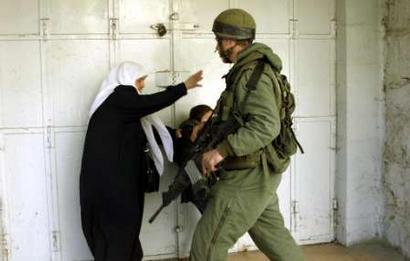
The Israeli Military’s Advocate General ruled Sunday that Palestinian villages can continue to be used for Israeli military training under the principle of “belligerent occupation”.
This is an Israeli military concept that allows its soldiers virtual impunity with regard to their behavior in the Occupied West Bank and Gaza Strip, under the pretext that the Israeli military is the sovereign authority over the entire territory. This edict contradicts international law and numerous United Nations resolutions that question the Israeli claim to sovereignty over all Palestinian land.
The Israeli military frequently invades Palestinian towns and villages, with soldiers running through streets and alleys with loaded automatic weapons, ransacking homes and terrorizing residents, for the purposes of ‘training’.
When a human rights organization filed a challenge to this practice earlier this year after several particularly egregious ‘training’ raids, the Israeli military said they would respond to the complaint. Today, several months later, the military ruled that the training is all in accordance with the dictates of martial law as it applies to the Israeli military occupation of Palestinian land in the West Bank and Gaza Strip.
According to the military Advocate General’s statement, there is “no legal obstacle to holding training in inhabited areas as part of maintaining security in the area. The orders issued for the drills that take place in populated urban areas include a statute requiring coordination with the ones doing the drill. It will also be made clear that as part of the training exercises, the soldiers must avoid putting the population at risk, damaging their property or causing unreasonable disturbance to their daily routine.”
However, the Palestinian residents subjected to these ‘training exercises’ and the human rights groups representing them have provided numerous examples of the soldiers tearing through homes and yards, breaking into houses, running up and down stairs and taking over rooftops of family homes as part of these exercises.
All of the villages where this training take place have experienced actual Israeli military invasions on a regular basis, and since the military makes no attempt to differentiate or announce that any particular invasion is a ‘training exercise’, the villagers are just as terrorized as they are during actual raids.
Related article
Featured Video
Pentagon insider says high US official Douglas Feith reported to Netanyahu
or go to
Aletho News Archives – Video-Images
Frlom the Archives
Who’s to blame for the Iraq war?
A not-so-trivial quiz
By Maidhc Ó Cathail | 14 March 2010
Maidhc Ó Cathail names and shames the top 19 politicians, academics and policy makers – all con men and all Zionist Jews – who lied and conspired to steer the US toward aggression against the Iraqi people. … continue
Blog Roll
 Aletho News
- Iranian model of warfare bleeds US dry while Persian Gulf states watch and learn: Analyst
- IRGC orders ‘defeated’ US to evacuate industrial facilities in region
- Hegseth’s call for ‘no mercy’ to Iranians deemed war crime
- Iran War Exposes Limits of US Military Power – Journalist
- Even The Neo-Cons Admit The Iran War Is Failing
- Inside the Caucasus Drone Corridor Fueling Tensions With Iran
- ‘Not our war’: Trump’s naval coalition to reopen Strait of Hormuz dead in the water
- Iran declares support centers for USS Gerald R. Ford legitimate targets
- Moscow issues warning over Trump’s Golden Dome plan
- Brussels wants ‘our sons to die for Ukraine’ – Orban
- If Americans Knew
- ‘I Liked the House’: When Israeli Soldiers Turn Palestinian Homes into Barracks
- ‘They Were All I Had’: Lebanese Father Buries Parents, 4 Daughters Killed by Israeli Bombing
- Israel and its supporters are causing attacks on Jewish institutions. Case in point: Michigan synagogue tragedy.
- These are the casualties and cost of the war in Iran 2 weeks into the conflict
- Chicago Teachers Union accuses AIPAC of swaying elections with ‘dark money’
- Predictions of another 9/11, amid Israel-US killing spree – Not a ceasefire Day 157
- As US-Israel war on Iran rages, Gaza faces massive dust storm – Not a ceasefire Day 156
- No let-up in attacks on Gaza as Israel takes on Iran, Lebanon – Not a ceasefire Day 155
- ‘Of Course’: IDF Drops Case Against Soldiers Accused of Raping Palestinian Prisoner
- Don’t Fall for the Regime Change Talk. Israel Is ‘Mowing the Lawn’ in Iran
- No Tricks Zone
- Storing Green Energy To Last Germany 10 Days Would Require A 60-Million Tonne Battery
- New Studies: UK Sea Levels Were 4 Meters Higher Than Today During The Mid-Holocene
- Destructive Green New Deal: German Energy And Metal Group Warns Of Drastic Crisis
- New Study Documents A 20-Year Pause In Arctic Sea Ice Decline – Driven By Internal Variability
- Wake-up Call: Survey Shows Majority Of Germans Now Favor Postponing Climate Targets!
- Televised! Leading German Political Candidate Tells Schoolchildren CO2 Makes Sun Hotter!
- New Study: A Century Warming Of 1.1°C Is ‘Commonplace’ And ‘Not Unusual’ During This Interglacial
- New Study: ‘Internal Noise’ And Volcanic Forcing Can Trigger 10-15°C Warming Within Decades
- Glaciers Worldwide Are Suddendly Surging, Experts Blame Warming!
- Surprising Discovery: Sahara Is Greening…Billions Of Trees Where Once Thought To Be Barren
 Aletho News