Did Iran Have to Give Up So Much to Get So Little?
By ISMAEL HOSSEIN-ZADEH | CounterPunch | December 6, 2013
The (interim) nuclear agreement that was signed on 24 November 2013 by Iran and the so-called P5+1 group in Geneva is questionable on a number of grounds.
The Irony and Absurdity of the Negotiations: When the Guilty Tries the Innocent
The underlying logic for the Iran nuclear negotiations was (and continues to be) altogether preposterous: on one side of the negotiating table sat major nuclear powers who are all in violation of the Nuclear Nonproliferation Treaty (NPT), which requires them to have either dismantled or drastically reduced their nuclear arsenal; on the other side, an NPT–compliant country (Iran) that neither possesses nor pursues nuclear weapons—a fact that is testified to both by the U.S. and Israeli intelligence agencies. Yet, in an ironically perverse way, the culprits have assumed the role of the police, the prosecutor and the judge, shamelessly persecuting and prosecuting the innocent for no other reason than trying to exercise its NPT-granted right to peaceful nuclear technology.
This obviously means that Iran is essentially negotiating under duress. Largely shut out of normal international trade, and constantly threatened by economic strangulation, it is essentially negotiating with a bullet to its head. As an astute observer of the negotiations has pointed out, “Iran voluntarily agreed to the [nuclear] deal the same way that a robbery victim voluntarily agrees to give up valuable possessions” to save his/her life.
The Imbalance between what Iran Gave and what it Took
To reach the interim deal, the Iranian negotiators agreed to a number of concessions with very little reciprocity in terms of relief from sanctions. These included: limiting its enrichment of uranium to only 3-5 percent purity, from the current level of 20 percent purity; rendering unusable its existing stockpile of 20 percent fuel for further enrichment; not using its more advanced IR-M2 centrifuges for enrichment; not activating its heavy-water reactor in Arak; and consenting to highly intrusive inspections.
This means that under the deal, the Iranian negotiators have agreed to more than freezing Iran’s nuclear technology; perhaps more importantly, they have reversed and rolled back significant scientific achievements and technological breakthroughs of recent years. One can imagine the feeling of disappointment (and perhaps betrayal) on the part of the many dedicated scientists, engineers and technicians who worked so hard to bring about such scientific advances; only to see them dishonored or degraded by reversing and freezing them at a much lower level.
In return for these significant concessions, the U.S. and its allies would agree: to unfreeze less-than 7 billion dollars of Iran’s nearly 100 billion dollars of oil revenue frozen in bank accounts overseas; to consider easing sanctions banning trade in precious metals, petrochemicals and auto industry; and to suspend the EU and U.S. sanctions on insurance and transportation services for the drastically reduced sale of Iran’s oil.
The most crippling sanctions on Iran’s oil and banks, which served as the financial facilitators of international trade, would remain intact under the proposed interim deal.
Threat to Iran’s Sovereignty
A careful reading of the interim agreement reveals that the Iranian negotiators gave up more than scaling down and freezing their country’s nuclear technology and/or knowledge. More importantly, if implemented, the deal effectively places Iran’s nuclear program (through IAEA) under total control of the United States and its allies. This is no speculation; it follows from the interim deal’s vastly invasive inspections regime, which is described under the subheading “Enhanced Monitoring”:
– Provision of specified information to the IAEA, including information on Iran’s plans for nuclear facilities, a description of each building on each nuclear site, a description of the scale of operations for each location engaged in specified nuclear activities, information on uranium mines and mills, and information on source material. This information would be provided within three months of the adoption of these measures.
– Steps to agree with the IAEA on conclusion of the Safeguards Approach for the reactor at Arak, designated by the IAEA as the IR-40.
– Daily IAEA inspector access when inspectors are not present for the purpose of Design Information Verification, Interim Inventory Verification, Physical Inventory Verification, and unannounced inspections, for the purpose of access to offline surveillance records, at Fordow and Natanz.
– IAEA inspector managed access to: centrifuge assembly workshops; centrifuge rotor production workshops and storage facilities; and, uranium mines and mills.
The fact that provisions of “enhanced monitoring” tend to infringe upon Iran’s national sovereignty was implicitly acknowledged by the Washington Post when it reported on the morning following the signing of the deal (24 November 2013) that, according to Western officials in Geneva, the Iranian concessions “not only halt Iran’s nuclear advances but also make it virtually impossible for Tehran” to make any changes in its nuclear technology “without being detected.”
Another indication of Iran’s national sovereignty being threatened is the interim deal’s establishment of “a financial channel to facilitate humanitarian trade for Iran’s domestic needs. . . . This channel could also enable: transactions required to pay Iran’s UN obligations; and, direct tuition payments to universities and colleges for Iranian students studying abroad.” Although the financial channel would be using Iran’s own money, currently frozen abroad, it would not be controlled or managed by Iranians—sadly reminiscent of Iraq’s “oil for food” neo-colonial deal under Saddam Hussein.
Did Iran Have to Give up so Much for so Little?
Deprived of more than half of its oil exports/revenue, and largely locked out of the international banking and/or trade system, the Iranian economy and its people are already gravely suffering from the ravages of economic sanctions. Additional sanctions, which are pre-packaged and frequently brandished as a Damocles’ Sword in the background of the nuclear negotiations, are bound to further depress Iran’s economy and the living conditions of its people.
Under these circumstances, Iran basically faced (or faces) two options. One option would be embarking on the path of a war economy, as it has, in effect, been subjected to a brutal economic war by the United States and its allies. This would be similar to the eight years (1980-88) of war with Iraq, when at the instigation and support of regional and global powers Saddam Hussein launched a surprise military attack against Iran. The other option would be compromising its legal and legitimate rights to peaceful nuclear technology in order to appease the global bully (the U.S.) and its minions in the hope that this may prevent a further tightening of the noose of economic sanctions around the neck of the Iranian people.
During the eight-year war with Saddam’s Iraq, not only did the Western powers and their allies in the region support the Iraqi dictator militarily but they also subjected Iran to severe economic sanctions. With its back against the wall, so to speak, Iran embarked on a revolutionary path of a war economy that successfully provided both for the war mobilization to defend its territorial integrity and for respectable living conditions of its population. By taking control of the commanding heights of the national economy, and effectively utilizing the revolutionary energy and dedication of their people, Iranian policy makers further succeeded in bringing about significant economic developments. These included: extensive electrification of the countryside, expansion of transportation networks, construction of tens of thousands of schools and medical clinics all across the country, provision of foodstuffs and other basic needs for the indigent at affordable prices, and more.
Despite its record of success, this option is altogether ruled out by today’s Iranian ruling powers. There are a number of reasons for this aversion to a regimented war economy. A detailed discussion of such reasons is beyond the purview of this essay. Suffice it to say that many of the revolutionary leaders who successfully managed the 1980-88 war economy have now become business entrepreneurs and prosperous capitalists. Having effectively enriched themselves in the shadow of the public sector economy, or by virtue of the political/bureaucratic positions they held (or still hold) in various stations in the government apparatus, these folks have by now lost all appetite they once had for the radical economic measures required by a war economy. Instead, they now seem eager to strike business and investment deals with their counterparts in the West.
More than any other social strata, President Rouhani and his administration represent the interests and aspirations of this ascending capitalist–business class in Iran. Representatives of this class wield economic and political power through the highly influential Iran Chamber of Commerce, Industries, Mines, and Agriculture (ICCIMA). Ideological and/or philosophical affinity between President Rouhani and the power-brokers residing within ICCIMA is reflected in the fact that, immediately upon his election, the president appointed former head of the Chamber of Commerce Mohammad Nahavandian, a U.S.-educated neoliberal economist and an advisor to former president Hashemi Rafsanjani, as his chief of staff.
It was through Nahavandian and the Iran Chamber of Commerce that, in September 2013, an Iranian economic delegation accompanied President Rouhani to the United Nations in New York to negotiate (behind the scenes) potential business/investment deals with their American counterparts. The Iran Chamber of Commerce also organized a number of economic delegations that accompanied Iran’s Foreign Minister Zarif to Geneva in pursuit of similar objectives in Europe.
It is understandable, therefore, why major factions within Iran’s ruling circles, especially the Rouhani administration and their allies and co-thinkers, have no stomach for a regimented, war-like economy; and why, instead, they opted for compromises over Iran’s nuclear program. The question remains, however, why did they make so many concessions in return for so little? Did they have to compromise as much as they did?
Two major reasons can be identified for why they could strike a better nuclear deal in Geneva than they actually did. For one thing, President Rouhani’s and his team of negotiators’ liaison with the P5+1 group got off on the wrong foot: they showed their hand prematurely by approaching the negotiations with a sense of desperation and an attitude of eagerness to reach a deal.
Indeed, it is fair to argue that President Rouhani condemned Iran to an unsound or flawed deal long before he was elected. He did so during his presidential campaign by pinning his chances for election on economic recovery through a nuclear deal. This was a huge mistake, as it automatically weakened Iran’s bargaining position and, by the same token, strengthened that of the United States and its allies. By exaggerating (perhaps opportunistically) the culpability of his predecessor in the escalation of economic sanctions against Iran, he committed two blunders: one downplaying the culpability of the U.S. and its allies; the other (and by the same token) placing the onus of reaching a nuclear deal largely on Iran.
Secondly, whereas the U.S. and its junior partners constantly brandished the so-called “stick” of additional sanctions in the background of the Geneva negotiations to extract more concessions from Iran, the Iranian side does not seem to have effectively used its country’s recent geopolitical successes in the region to resist the one-sided concessions. While the United States and its allies have in recent months experienced a major setback over the Syrian crisis, Iran and its allies (Russia, Syria, Hezbollah and, indirectly and minimally, China) have by the same token experienced success. And while the results of the U.S. military adventures of the past dozen years or so have been chaos and civil war in countries like Afghanistan, Libya, Yemen, Iraq, and Syria, Iran remains a relatively stable and an ascending regional power, indeed, a power-broker—sanctions-induced economic distress notwithstanding.
It is thus altogether reasonable to argue that had the Iranian negotiators (a) not gone to Geneva with such an openly eager attitude to reach a nuclear deal, and (b) taken more effective advantage of their country’s recent geopolitical successes in the region, they could have struck a better nuclear deal than they actually did. For example, while agreeing on the freezing of their nuclear technology was (under the circumstances) unavoidable, they could more strongly argue that there was no reason for them to roll back Iran’s scientific achievements from 20 percent enrichment of uranium to 5 percent—20 percent enrichment is both NPT-sanctioned, or legal, and required for the Tehran Research Reactor, which manufactures medical isotopes.
Likewise, while agreeing to more intrusive inspections of nuclear sites was (again, under the circumstances) inescapable, Iranian negotiators could reasonably resist allowing inspectors access to and monitoring of their country’s centrifuge assembly workshops, or its uranium mines and mills. Furthermore, the Iranian team could, again quite reasonably, insist on making the elements of the “final agreement,” which is supposed to remove all of the sanctions against Iran, more specific. As they now stand, these elements are so vague, fluid and inconsistent that they seem to be crafted in order to be broken.
Regime Change From Within
Ever since the 1979 revolution in Iran, which significantly undermined the U.S. influence in Iran and elsewhere in the region, the United States has been on a “regime change” mission in that country. Its efforts in pursuit of this nefarious goal are rather well established. They range from instigating and supporting Saddam Hussein to invade Iran, to training and supporting destabilizing terrorist organizations to attack Iran, to constant war and military threats, to efforts to sabotage the 2009 presidential election through the so-called “green revolution,” and to systematic escalation of economic sanctions.
Not only have these imperialistic schemes fallen short of their goal of “regime change” in Iran, they have, in fact, driven that country to become a major power in the region, which has further thwarted the geopolitical plans of the United States in the area. While the U.S.–supported mercenary forces in Syria as well as its allies in Ankara, Cairo and Riyadh have experienced serious setbacks in their efforts to overthrow the government in Damascus, the Iran-Russia-Syria-Hezbollah alliance has (by the same token) gained strength and prestige in recent months.
Having thus failed at its plots for “regime change” in Iran from without, the U.S. (or more precisely, a major faction of its ruling powers) now seems to have opted for regime change (or reform) from within; that is, through political and economic rapprochement with Iran. Even some of the U.S. allies such as Turkey, Qatar, Saudi Arabia, and Israel that have always been wary of Iran’s radical influence in the region, and who initially opposed vehemently the Iran–P5+1 nuclear agreement, are beginning to see the “moderating” or “stabilizing” benefits of the success of this tactic.
What has made this option more promising (to the U.S. and its client regimes) is the rise of an ambitious capitalist class in Iran whose chief priority seems to be the ability to do business with their counterparts in the West. These folks literally mean business, so to speak; for them, issues such as nuclear technology or national sovereignty are of secondary importance. As mentioned earlier, they are the staunchest supporters of President Rouhani and the unquestioning supporters of his lopsided concessions in the nuclear deal. Also as mentioned before, it was the representative delegations of this class of Iranian capitalists that accompanied President Rouhani and Foreign Minister Zarif to the United States and Europe in order to negotiate business/investment deals with their counterparts in the West.
To be sure, the jingoistic factions of the U.S. ruling circles, headed by the beneficiaries of war dividends and the Israeli lobby, continue to push for direct military intervention and/or further economic strangulation of Iran. But the leaders and/or beneficiaries of non-military industries such as oil, automobile, airlines, agriculture, and the like are lobbying the Obama administration for economic and political rapprochement with Iran.
Which of these two major factions of the U.S. ruling powers (Proponents of regime change from within or from without) would succeed, depends largely on the process and/or outcome of nuclear negotiations. While making threats of additional sanctions, the hardline or militaristic faction seem to be for now sitting on the fence: if Iran continues to make more one-sided concessions, which would basically mean giving up its right to a level of uranium enrichment that is necessary for its peaceful domestic needs, they would soften their positions and gradually lower their shrill and menacing voices. On the other hand, if Iran does not relent on its legal and legitimate enrichment rights, and insists that the U.S. and its allies need to reciprocate Iran’s interim concessions by lifting the sanctions, they would further harden their positions by calling for additional sanctions and/or military intervention. Under this latter scenario, proponents of rapprochement with Iran, having failed in their tactic of regime change/reform from within, would most probably join the hardliners, thereby embarking, once again, on the long-standing policy of regime change from without—back to square one, so to speak.
So, how would all of these new developments on both the Iranian and the U.S. side affect and/or be affected by the interim nuclear deal toward a “comprehensive final step”?
Problematic and Uncertain Future of the Interim Nuclear Deal
Components of the interim agreement are so vague, inconsistent and even contradictory that it makes them subject to divergent interpretations and, therefore, potential breaches of the deal in the future. This explains why soon after the agreement was signed conflicting understandings of it began to surface. While the Iranian president and his team of negotiators have frequently declared that the agreement acknowledges the country’s right to uranium enrichment, the U.S. side, headed by President Obama and Secretary of State John Kerry, has vigorously denied that right.
Equally vague and (potentially) problematic is the meaning of the “elements of the final step of a comprehensive solution.” According to Iran’s negotiators, the “final step” would “Comprehensively lift UN Security Council, multilateral and national nuclear-related sanctions,” as it is, indeed, stipulated as such in the interim agreement. However, the agreement immediately adds that the final step would “Involve a mutually defined enrichment program with mutually agreed parameters consistent with practical needs, with agreed limits on scope and level of enrichment activities, capacity, where it is carried out, and stocks of enriched uranium, for a period to be agreed upon.” And it is this ambiguous and condition-laden (“mutually defined enrichment…, mutually agreed parameters…, agreed limits on scope…, for a period to be agreed upon”) sentence in the interim deal that is frequently highlighted by the United States as governing the status of the “final step.”
This is an indication, as pointed out by Gareth Porter (among others), “of uncertain U.S. commitment to the ‘end state’ agreement.” U.S. reservations or unfaithfulness toward a clear, comprehensive and sanctions-free final deal, Gareth further points out, “came in a background press briefing by unidentified senior U.S. officials in Geneva via teleconference late Saturday night [23 November 2013]. The officials repeatedly . . . referred to the negotiation of the ‘comprehensive solution’ outlined in the deal . . . as an open-ended question rather than an objective of U.S. policy”. It is this ambiguous, unsure and noncommittal U.S. approach to the nuclear deal that serves as grounds for the pessimistic conclusion that the deal is facing an uncertain future.
Ismael Hossein-zadeh is Professor Emeritus of Economics, Drake University, Des Moines, Iowa. He is the author of The Political Economy of U.S. Militarism (Palgrave–Macmillan 2007) and the Soviet Non-capitalist Development: The Case of Nasser’s Egypt (Praeger Publishers 1989). His latest book, titled Beyond Mainstream Explanations of the Financial Crisis: Parasitic Finance Capital, is forthcoming from Routledge Books.
Share this:
Related
December 7, 2013 - Posted by aletho | Economics, Militarism, Timeless or most popular | European Union, Iran, Sanctions against Iran, United States
No comments yet.
Featured Video
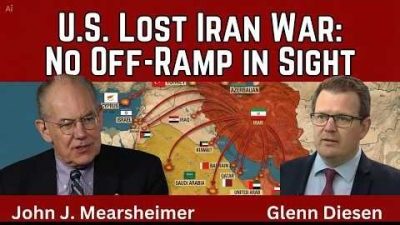
John Mearsheimer: US Already lost Iran war – No off-ramp in sight
or go to
Aletho News Archives – Video-Images
Frlom the Archives
70 Neocons Petition Congress To Effectively Allow Israel To Say When The US Should Attack Iran
By Damian Lataan | January 10, 2014
Seventy senior Israeli-centric neoconservatives have written an open letter to Congress imploring them to do more to ensure Iran complies with the conditions of any agreement finally reached with the P5+1 over Iran’s nuclear program.
While the neocons are ostensibly asking Congress to ensure compliance, it is clear that their real aim is to convince members of Congress to support the bill currently passing through the Senate which calls for tighter sanctions against Iran in the event of any waywardness on Iran’s part.
The neocons are eager to see the bill currently passing through the Senate with enough support to make it veto-proof, not so much because they are concerned about Iran’s so-called nuclear weapons program – there’s still not a skerrick of hard evidence that Iran has a nuclear weapons program – but, rather, because embedded within the bill is this clause:
… if the Government of Israel is compelled to take military action in legitimate self-defense against Iran’s nuclear weapon program, the United States Government should stand with Israel and provide, in accordance with the law of the United States and the constitutional responsibility of Congress to authorize the use of military force, diplomatic, military, and economic support to the Government of Israel in its defense of its territory, people, and existence…
Essentially, the clause is an automatic trigger for the US to attack Iran at any time the Israelis choose to launch a first strike – regardless of whether President Obama is in favour or not.
Partial list… continue
Blog Roll
-
Join 2,450 other subscribers
Visits Since December 2009
- 7,408,237 hits
Looking for something?
Archives
Calendar
Categories
Aletho News Civil Liberties Corruption Deception Economics Environmentalism Ethnic Cleansing, Racism, Zionism Fake News False Flag Terrorism Full Spectrum Dominance Illegal Occupation Mainstream Media, Warmongering Malthusian Ideology, Phony Scarcity Militarism Progressive Hypocrite Russophobia Science and Pseudo-Science Solidarity and Activism Subjugation - Torture Supremacism, Social Darwinism Timeless or most popular Video War Crimes Wars for IsraelTags
9/11 Afghanistan Africa al-Qaeda Australia BBC Benjamin Netanyahu Brazil Canada CDC Central Intelligence Agency China CIA CNN Covid-19 COVID-19 Vaccine Donald Trump Egypt European Union Facebook FBI FDA France Gaza Germany Google Hamas Hebron Hezbollah Hillary Clinton Human rights Hungary India Iran Iraq ISIS Israel Israeli settlement Japan Jerusalem Joe Biden Korea Latin America Lebanon Libya Middle East National Security Agency NATO New York Times North Korea NSA Obama Pakistan Palestine Poland Qatar Russia Sanctions against Iran Saudi Arabia Syria The Guardian Turkey Twitter UAE UK Ukraine United Nations United States USA Venezuela Washington Post West Bank WHO Yemen Zionism
 Aletho News
- John Mearsheimer: U.S. Already Lost Iran War – No Off-Ramp in Sight
- UK Parliament Plans ISP Blocking and Age Verification Powers
- World cannot remain silent as US and Israel attack ‘heritage of humankind’: Iran
- Emirati billionaire rebukes US senator over call for Gulf states to join war with Iran
- Op. True Promise 4: Iran’s missile blitzkrieg dismantles US war machine in West Asia
- Aramco CEO warns ‘catastrophe’ imminent if Strait of Hormuz remains shut
- What If Iran Says No?
- Trump Threatens to ‘Hit’ Iran ‘Twenty Times Harder’ Over Strait of Hormuz Oil Flows
- Spare the hypocrisy: Baghaei slams Ursula’s support for US
- Iran War Supporters Invent a New and Absurd Justification: It Is All About China
- If Americans Knew
- Israel Decided the War, But Trump’s America Fights and Pays the Bill
- Conscientious Objector Group: Phone ‘Ringing Off Hook’ As Huge Mobilization Underway
- U.S. support for Israel continues to plummet, despite media’s best efforts
- Threats and missiles fly, death tolls soar in Iran, Lebanon, Gaza – Not a ceasefire Day 151
- Lebanon: Israel’s White Phosphorous Use Risks Civilian Harm
- Corporate Media Go All Out To Support The US-Israeli War On Iran
- US-Israel war on Iran is creating a steady growing number of amputees
- Israel planned this war on Iran for 40 years. Everything else is a smoke screen
- The wrong question about the war in Iran
- ‘Your Tax Dollars Being Used to Raise Your Gas Prices’: US-Israel Bomb Major Iranian Oil Depots
- No Tricks Zone
- New Study Documents A 20-Year Pause In Arctic Sea Ice Decline – Driven By Internal Variability
- Wake-up Call: Survey Shows Majority Of Germans Now Favor Postponing Climate Targets!
- Televised! Leading German Political Candidate Tells Schoolchildren CO2 Makes Sun Hotter!
- New Study: A Century Warming Of 1.1°C Is ‘Commonplace’ And ‘Not Unusual’ During This Interglacial
- New Study: ‘Internal Noise’ And Volcanic Forcing Can Trigger 10-15°C Warming Within Decades
- Glaciers Worldwide Are Suddendly Surging, Experts Blame Warming!
- Surprising Discovery: Sahara Is Greening…Billions Of Trees Where Once Thought To Be Barren
- New Research Reaffirms Clouds, Aerosols, And Surface Solar Radiation Are ‘Driving The Climate System’
- Germany: Electric Car Catches Fire At Charging Station, Sets Off Local “Inferno”, Widespread Damage
- New Study: Canada’s New Brunswick Was 1°C Warmer Than Today During The Medieval Warm Period
Contact:
atheonews (at) gmail.com
Disclaimer
This site is provided as a research and reference tool. Although we make every reasonable effort to ensure that the information and data provided at this site are useful, accurate, and current, we cannot guarantee that the information and data provided here will be error-free. By using this site, you assume all responsibility for and risk arising from your use of and reliance upon the contents of this site.
This site and the information available through it do not, and are not intended to constitute legal advice. Should you require legal advice, you should consult your own attorney.
Nothing within this site or linked to by this site constitutes investment advice or medical advice.
Materials accessible from or added to this site by third parties, such as comments posted, are strictly the responsibility of the third party who added such materials or made them accessible and we neither endorse nor undertake to control, monitor, edit or assume responsibility for any such third-party material.
The posting of stories, commentaries, reports, documents and links (embedded or otherwise) on this site does not in any way, shape or form, implied or otherwise, necessarily express or suggest endorsement or support of any of such posted material or parts therein.
The word “alleged” is deemed to occur before the word “fraud.” Since the rule of law still applies. To peasants, at least.
Fair Use
This site contains copyrighted material the use of which has not always been specifically authorized by the copyright owner. We are making such material available in our efforts to advance understanding of environmental, political, human rights, economic, democracy, scientific, and social justice issues, etc. We believe this constitutes a ‘fair use’ of any such copyrighted material as provided for in section 107 of the US Copyright Law. In accordance with Title 17 U.S.C. Section 107, the material on this site is distributed without profit to those who have expressed a prior interest in receiving the included information for research and educational purposes. For more info go to: http://www.law.cornell.edu/uscode/17/107.shtml. If you wish to use copyrighted material from this site for purposes of your own that go beyond ‘fair use’, you must obtain permission from the copyright owner.
DMCA Contact
This is information for anyone that wishes to challenge our “fair use” of copyrighted material.
If you are a legal copyright holder or a designated agent for such and you believe that content residing on or accessible through our website infringes a copyright and falls outside the boundaries of “Fair Use”, please send a notice of infringement by contacting atheonews@gmail.com.
We will respond and take necessary action immediately.
If notice is given of an alleged copyright violation we will act expeditiously to remove or disable access to the material(s) in question.
All 3rd party material posted on this website is copyright the respective owners / authors. Aletho News makes no claim of copyright on such material.
 Aletho News
Leave a comment