Israeli Foreign Ministry accuses the Netherlands of encouraging the world to punish Israel
MEMO | December 12, 2013
Israel’s Foreign Ministry has summoned the Dutch Ambassador in Tel Aviv over the Dutch water supplier Vitens’ decision to end its partnership with the Israeli water company Merokot because of its operations in the occupied Palestinian territories.
Vitens, a state-owned company, announced on Tuesday that it had decided to end its partnership with the Israeli company because it is operating in the occupied Palestinian territories in a clear violation of international law. The company released an official statement saying: “Vitens attaches great importance to integrity and adhering to (inter)national laws and regulations.” It continued: “Following consultation with stakeholders, the company came to the realization that it is extremely difficult to continue joint work on projects, as they cannot be separated from the political environment.”
The Israeli Foreign Ministry has accused the Dutch government of encouraging the world to punish Israel and everything that is related to the Jewish settlements in the West Bank.
According to the Jerusalem Post, the Foreign Ministry summoned Dutch Ambassador Casper Veldkamp “to protest what it said were ‘ambiguous’ statements by the Dutch Foreign Ministry creating a pro-boycott atmosphere of Israel in the Netherlands, on Wednesday.”
Regional Cooperation Minister Silvan Shalom told Israel Radio that Vitens broke with Merokot due to pressure from Dutch Parliamentarians and Amnesty International. He responded by stating: “I say to the Europeans, you cannot cry and whine all the time that you are not part of the diplomatic process, and that the US leads it alone, when you take one sided, unbalanced and sometimes even hostile polices,” he said. “You want to be part of the process? Those who want to be part of the process have to come with a balanced policy toward the conflict, and only then come and demand to be part of the process.”
The Dutch Prime Minister Mark Rutte had visited Tel Aviv earlier this week to strengthen trade relations between the two countries, when the ceremonial visit turned into a crisis of confidence after a new Dutch security scanner donated for use at the Gaza border was refused by Israel. Rutte reportedly responded by saying “I do not understand the Israeli position,” and cancelled his visit to the Karem Salem crossing where the Dutch scanner was due to be installed. Rutte also cancelled his visit to Hebron when the Israeli security agency Shabak insisted on accompanying him. The prime minister had asked for Palestinian security services to accompany him, but Israel refused his request.
The Netherlands was one of the first European countries to demand labelling settlement products. Now, it is among the first to make the move to boycott them.
Related article
On Hersh, Higgins, Whitaker and Ghouta
Interventions Watch | December 12, 2013
A few brief thoughts on Seymour Hersh’s article on the chemical weapons attack in Syria in August: Elliot Higgins’ response to it; and Brian Whitaker’s take on things.
Here are the bits from Whitaker’s article that I thought were worth commenting on:
‘On one side of the chemical weapons debate is Seymour Hersh, the veteran investigative journalist, who suggested in an article for the London Review of Books that rebel fighters, rather than the Syrian regime, were to blame for the Damascus attacks’.
That isn’t really the point Hersh was making though, is it? The gist of the story was that the case against the Assad regime wasn’t as strong as the Obama regime made out, and that the Obama regime knew this.
As Hersh told Democracy Now – ‘I certainly don’t know who did what, but there’s no question my government does not’, and that Obama ‘was willing to go to war, wanted to throw missiles at Syria, without really having a case and knowing he didn’t have much of a case‘.
Hersh and his sources saw that as a major scandal: a President deciding to start a war, with all that entails, based on a case that was less than watertight.
They also refused to even entertain the possibility, at least in public, that a rebel faction may have been responsible, despite knowing that at least one rebel faction had ‘mastered the mechanics of creating sarin and was capable of manufacturing it in quantity’.
‘Given that Hersh has spent decades working for mainstream media, that Media Lens disapproves of anonymous sources’.
An apparent ‘Gotcha!’ moment, no? But maybe there’s a difference between people leaking and briefing anonymously to promote Establishment narratives and aims, and people leaking and briefing anonymously to challenge them. Hersh has, throughout his career, promoted the latter with a very good hit rate. Simply put, anonymous leaks designed to whistleblow are not the same as anonymous leaks designed to mislead and confuse.
‘Some of his other exposes have misfired, though’
Some examples might be nice.
‘he has often been criticised for his use of shadowy sources. In the words of one Pentagon spokesman, he has “a solid and well-earned reputation for making dramatic assertions based on thinly sourced, unverifiable anonymous sources”‘.
Hersh has spent decades shining lights into places ‘Pentagon spokesmen’ types don’t want him to look. So it’s not surprising that they’d try and discredit his work. Would Whitaker, for example, quote an Iranian military spokesman to try and rubbish the work of an Iranian dissident journalist? I doubt it. And the fact he does it here perhaps says much about his unexamined assumptions and biases.
‘Higgins, meanwhile, is the antithesis of a “corporate” journalist’.
At this point in his career, it’s not like Higgins is some obscure, insurgent outsider. He has had his work published in The New York Times and Foreign Policy, has had a lengthy profile written about him in The New Yorker, has worked with Human Rights Watch, and has been interviewed more than once on T.V. News. Does this make him wrong? Of course not. But the line between him and ‘old media’ isn’t quite as defined as Whitaker would like to make out.
It is perhaps instructive that in this case, Hersh struggled to get anyone to publish his chemical weapons piece, while Higgins had no problem in getting Foreign Policy, an Establishment journal if ever there was one, to publish his rebuttal pretty much straight away.
‘Hersh’s source on the supposed sarin-manufacturing capabilities is an unnamed “senior intelligence consultant”:
‘Already by late May, the senior intelligence consultant told me, the CIA had briefed the Obama administration on al-Nusra and its work with sarin, and had sent alarming reports that another Sunni fundamentalist group active in Syria, al-Qaida in Iraq (AQI), also understood the science of producing sarin’
. . . Interestingly, though, EAWorldView has an idea who this consultant might be. It notes that Michael Maloof, who formerly worked in the US Defense Department, has made very similar claims in an article for the right-wing World Net Daily, and also on the Russian propaganda channel, RT’.
Pure speculation, of course. Even if the source is Maloof, it doesn’t automatically follow that Maloof is wrong.
Nor is Maloof, or any other source Hersh might have, the only person to have suggested a rebel faction may have access to chemical weapons.
In May 2013 for example, Carla Del Ponte, one of the overseers of the UN commission of Inquiry on Syria, told Swiss T.V. that ‘there are strong, concrete suspicions but not yet incontrovertible proof of the use of sarin gas’ by rebel factions, and that she was ‘a little bit stupefied by the first indications we got . . . they were about the use of nerve gas by the opposition’.
Predictably, her comments quickly disappeared down the Memory Hole, even though she is a very credible and well respected source, and likely wasn’t just making it all up.
She was, incidentally, also smeared and/or discredited by those who simply don’t want to see any kind of challenge to the Establishment narrative on Syria, much like is happening to Hersh now.
Related articles
US: Anti-Iran ‘non-nuclear’ sanctions are OK
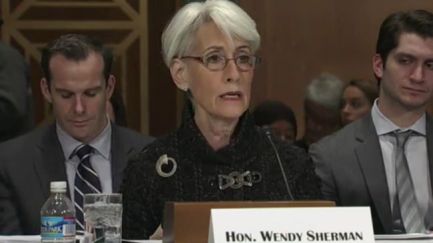
US State Department official Wendy Sherman at the Senate Banking Committee on Dec. 12, 2013

Press TV – December 13, 2013
The administration of President Barack Obama has told lawmakers in US Congress that they could pass new sanctions against Iran as far as they are not “nuclear-related.”
During a public testimony before the Senate Banking Committee on Thursday, State Department official Wendy Sherman, who led the US delegation in nuclear talks with Iran in Geneva, indicated that US lawmakers had the green light from the Obama administration to pass new anti-Iran sanctions as long as the sanctions are not “nuclear-related.”
“Given that there are different kinds of sanctions and the agreement focuses on nuclear-related sanctions,” Sen. Mike Crapo, the top Republican on the Committee, asked Sherman, “assuming we can specify exactly what that is and distinguish between the different sanctions, does that mean that Congress would be free to pass other sanctions measures while we are” negotiating over a final deal over Iran’s nuclear energy program?
“We have said to Iran that we will continue to enforce all of our existing sanctions, and we have said that this agreement pertains only to new nuclear-related sanctions,” Sherman answered.
In a phone interview with Press TV on Thursday, US Congress policy advisor Frederick Peterson said that the problem with some hawkish US lawmakers who are pushing for a new anti-Iran sanctions bill is exacerbated by the way the Obama administration is “misrepresenting” the interim deal between Iran and the P5+1 to the American people and Congress.
Meanwhile, the US Departments of Treasury and State announced new sanctions against a number of companies and individuals for “providing support for” Iran’s nuclear energy program.
Treasury Department official David Cohen, who also testified before the Senate Banking Committee on Thursday, said the new sanctions were “a stark reminder to businesses, banks, and brokers everywhere that we will continue relentlessly to enforce our sanctions.”
Iranian Deputy Foreign Minister Abbas Araqchi has hit out at Washington, saying that the new restrictions are in full contradiction with the recent nuclear deal between Tehran and the P5+1. Araqchi also said that Tehran is now assessing the current situation.
Related articles
Iran slams new US sanctions on firms, individuals
Press TV – December 13, 2013
Iran’s Deputy Foreign Minister Abbas Araqchi slams the new US sanctions targeting Iran, saying the bans run counter to the spirit of the recent nuclear deal reached between Tehran and six major world powers.
“This [US] move is against the spirit of the Geneva deal,” Araqchi said on Friday.
“We are assessing the current situation,” the senior member of Iran’s nuclear negotiating team added.
On Thursday, the administration of US President Barack Obama issued new sanctions against more than a dozen companies and individuals for “providing support for” Iran’s nuclear energy program.
The US Treasury Department said it was freezing assets and banning transactions of entities that attempt to evade the sanctions against Iran.
The sanctions came despite the nuclear deal inked between Iran and the five permanent members of the UN Security Council – Russia, China, France, Britain and the US – plus Germany in the Swiss city of Geneva on November 24 in a bid to set the stage for the full resolution of the West’s decade-old dispute with Iran over the country’s nuclear energy program.
Under the Geneva deal, the six countries have undertaken to lift some of the existing sanctions against the Islamic Republic in exchange for Iran agreeing to limit certain aspects of its nuclear activities during six months. It was also agreed that no more sanctions would be imposed on Iran in the same time frame.
Iran and the six powers ended four days of intense expert-level negotiations in Vienna, Austria, on Thursday.
Iranian Foreign Minister Mohammad Javad Zarif had earlier warned that the Geneva nuclear deal will be “dead” if the US imposes further sanctions against the Islamic Republic.
“The entire deal is dead. We do not like to negotiate under duress. And if Congress adopts sanctions, it shows lack of seriousness and lack of a desire to achieve a resolution on the part of the United States,” Zarif said in an exclusive interview with Time magazine in Tehran on Saturday.
Related articles
European Court of Justice officer argues against EU Data Retention Directive
DW | December 12, 2013
An EU law requiring companies to log telecommunications data for law enforcement breaches rights, an advocate-general of Europe’s top court has said. Germany in particular had challenged the Data Retention Directive.
Thursday’s opinion at the European Court of Justice in Luxembourg responds to challenges against the directive in Ireland and Austria. Adopted the by the EU in 2006 following attacks on the London tube and trains in Madrid , the Data Retention Directive specifies that firms must save telephone and Internet data – user, recipient and length of calls – for a period of up to two years.
“The directive constitutes a serious interference with the fundamental right of citizens to privacy,” Advocate-General Pedro Cruz Villalon said. “The use of those data may make it possible to create a both faithful and exhaustive map of a large portion of a person’s conduct strictly forming part of his private life, or even a complete and accurate picture of his private identity,” he added.
Cruz Villalon argued that the directive increased the risk that corporations and individuals could use the data for unlawful and possibly fraudulent or malicious purposes – even more so as private communication companies controlled the information rather than public authorities. Cruz Villalon also called the directive invalid because it failed to sufficiently specify the circumstances for data access, storage and use – leaving this for member states to define. In addition, Cruz Villalon called one year a disproportionately long time to hold so much information – let alone two.
Relevance, ‘even urgency’
The advocate-general did recognize the “relevance and even urgency” of data retention measures. Should the court decide to follow his opinion, Cruz Villalon suggested that it grant a grace period to change the directive, rather than taking immediate measures against it.
At any given time, the European Court of Justice has nine advocates general, who provide legal but nonbinding opinion ahead of deliberations and decisions by judges.
Germany does not currently comply with the Data Retention Directive, owing in large part to a Constitutional Court ban on the legislation in 2010. The forthcoming grand coalition government hopes to limit data storage in Europe to three months.
Mass Location Tracking: It’s Not Just For the NSA
By Catherine Crump | ACLU | December 12, 2013
Thanks to Edward Snowden we now understand that the NSA runs many dragnet surveillance programs, some of which target Americans. But a story today from Washington, D.C. public radio station WAMU is a reminder that dragnet surveillance is not just a tool of the NSA—the local police use mass surveillance as well.
DC’s Metropolitan Police Department uses cameras to scan vehicle license plates in huge numbers and saves all the data for two years, even though only a tiny fraction—0.01 %—turn out to be associated with any possible wrongdoing.
In 2012, the police in Washington scanned over 204 million license plates. But only 22,655 were associated with some possible wrongdoing (what the chart refers to as “hits”). And a hit isn’t evidence of guilt. It’s evidence your plate was in a database. And your plate may well be in a database because, as we’ve seen in other areas of the country (check out our report on the use of plate readers nationwide), these databases can include people who violated vehicle emissions programs or are driving on suspended or revoked licenses. These people shouldn’t be on the road, but they are also not major offenders.
The key point is this: 99.9 % of the data pertains to people not suspected of wrongdoing. Why should innocent drivers have their movements stored for two full years?
The new report echoes data first unearthed by the ACLU’s local office and revealed two years ago in testimony to local legislators.
This brings us back to the NSA program. What do the NSA and DC Metropolitan Police Department have in common? As we have discussed before, neither appears to be restrained by any sense of proportionality. The data collection is vast, and the gain is either uncertain or negligible. In the NSA’s case, it is storing records about every single phone call each of us makes and keeping it in a database for 5 years, even in the absence of any credible evidence that mass collection is needed to make us safer. (The MPD refused to comment on the plate reader program.)
When it comes to reforming surveillance, it is programs like these that are particularly good targets. While some may be willing to trade privacy for security, here we appear to be giving privacy away and the government either can’t or won’t make the case that we’re getting anything in exchange.
Related articles
Israel drops controversial Bedouin relocation plan

Ma’an – 12/12/2013
JERUSALEM (AFP) — Israel is scrapping a controversial draft law to relocate thousands of Bedouin residents of the Negev desert, an official said Thursday.
Benny Begin, tasked with implementing the so-called Prawer Plan, said he had recommended to Prime Minister Benjamin Netanyahu to “end the debate on the law” in parliament.
“The prime minister accepted this proposal,” he said at a Tel Aviv press conference, days after it emerged the governing coalition was divided on the proposed legislation.
The bill, which would have seen the demolition of some 40 unrecognized Bedouin villages in the Negev and the relocation of between 30,000 and 40,000 people, passed a preliminary ministerial vote in January.
But it faced intense objection from members of the parliament both from the Right, where lawmakers said the compensation in land and money offered to Bedouins was too generous, and from the Left, which said it was racist and accused the state of usurping the land of indigenous Palestinian inhabitants.
Israeli Foreign Minister Avigdor Lieberman posted on his Facebook page that the Israeli government “should re-examine the plan and consider a far-reaching plan that would annul the benefits the Bedouin were to receive.”
Following a heated debate this week at the parliamentary interior committee, coalition chairman Yariv Levin of Netanyahu’s Likud party said he would not make the Prawer Plan into law.
The move comes less than two weeks after worldwide protests against the plan, during which Israeli police and soldiers clashed with demonstrators, injuring and arresting dozens across Israel and the West Bank.
According to the Association for Civil Rights in Israel, the plan would have forcibly evicted nearly 40,000 Bedouin and destroy their communal and social fabric, condemning them to a future of poverty and unemployment.
Other estimates had put the number of Bedouin residents at risk at 70,000.
Ma’an staff contributed to this report
Israeli immigration denies entry to another Palestine peacemaker team member
CPTnet | December 12, 2013
On the night of December 5, 2013, Israeli immigration authorities denied entry to Patrick Thompson at the Allenby Bridge connecting Jordan to Occupied Palestine. Thompson was attempting to return for another stint on the team in Hebron. He initially told authorities that he was entering as a tourist, to visit Jerusalem, Bethlehem, Nazareth, Tel Aviv, and then points south, before re-entering Jordan. An Israeli official was concerned about his previous stay of four months in Israel.
After detailed questioning over a period of three hours and a search of his computer hard drive, authorities found a logo of CPT and told him they were denying him entry because he had lied to them. Thompson told them that he specifically did not mention his work with CPT or his destination as the West Bank because of the way Israeli authorities had treated many others when they volunteered this information willingly. Authorities denied entry to Jonathan Brenneman, another CPTer, in September, when he declared his membership in CPT and his plans to travel to Hebron. Thompson then waited another hour or so before the authorities officially denied him entry. When he boarded a bus to go back across the border into Jordan it was 1:30 a.m., a full six hours after his arrival at Israeli passport control.
Thompson is the fourth CPTer to whom Israel has denied entry this year. In addition to denying entry to Brenneman in September, authorities turned away two reservists in July because of stamps in their passports from their time with the Iraqi Kurdistan team—even though the Kurdish Regional Government has friendly relations with Israel.
Related article
US ‘defence’ budget includes additional military aid for Israel
MEMO | December 12, 2013
Lawmakers in the US Congress reached an agreement on Monday in both the House and the Senate on the proposed federal budget for 2014, which would allocate $520.5 billion for defence spending and $491.8 billion for non-defence.
The defence budget includes an increase in military aid to Israel that will be given as private aid, thus it will be in addition to the $3.1 billion dollars already given annually to Tel Aviv.
The budget is still awaiting formal approval and the exact amount of additional aid to Israel remains unclear.
Israeli newspaper Haaretz reported that the US House of Representatives Armed Services Committee had endorsed an increase of $488 million in military aid to Israel to pay for Israel’s procurement and development of additional rocket and missile interception systems. The newspaper noted that this sum is considerably higher than previously expected.
However, Reuters news agency reported that the additional military aid to Israel would exceed $500 million after a compromise defence bill proposed on Monday agreed to boost US spending on missile defence by $358 million to $9.5 billion, mandating another homeland defence radar and increased funding for US-Israeli cooperative efforts.
Israel’s Channel 7 News reported that US President Barack Obama had originally requested $220 million of additional private military aid to Israel to buy extra Iron Dome short-range interceptor missiles and the batteries they are launched from, which was approved.
According to the Israeli media network, in addition to the above, the supplementary aid will allocate $173 million in funding for US-Israeli cooperative missile defence programs, which includes “nearly $34 million to improve the Arrow weapon system and $22 million for work on developing another, more advanced interceptor,” noting that, “The move signals further cooperation between Boeing and Israel Aerospace Industries (IAI).”
The new budget will also allocate $117.2 million to Israel for the “development of the David’s Sling short-range ballistic missile defence system, which is being developed jointly by Israel’s state-owned Rafael Advanced Defence Systems and the US’s Raytheon.”
Furthermore, “An additional $15 million will be directed for US co-production of Iron Dome components. Raytheon has a joint marketing agreement with Israeli state-owned manufacturer Rafael Advanced Defence Systems for the Iron Dome system.”
Both the US and Israeli media are reporting that the supplemental funds are intended to protect Israel from the increasing threats coming from Iran, Gaza and Hezbollah in Lebanon.
In addition to the supplemental aid, US Secretary of Defence Chuck Hagel has promised Israel that the existing $3.1 billion package of military aid would remain intact, despite US spending cuts.
The final vote on the budget is expected to take place before Congress leaves for the year.
Haaretz noted that, “Despite frequent disputes with Prime Minister Benjamin Netanyahu’s government regarding the peace process with the Palestinians and the Iranian nuclear threat, US President Barack Obama’s administration continues to be extraordinarily generous when it comes to granting military aid. Israeli defence officials see last week’s decision as further evidence of the strength of the relationship between the two countries.”
Related article
- Congress triples Obama’s request on defense cooperation with Israel (timesofisrael.com)
Ukrainian president intends to sign EU deal: Ashton
Press TV | December 12, 2013
EU High Representative for Foreign Affairs and Security Policy Catherine Ashton says Ukrainian President Viktor Yanukovych “intends to sign” an agreement with the European Union to enhance economic and political relations with the bloc.
Ashton said on arrival for a meeting in Brussels on Thursday after her visit to Kiev that Yanukovych “made it clear to me that he intends to sign the association agreement.”
She added that the short-term economic and financial issues Ukraine faces could be “addressed by the support that not only comes from the EU institutions, but actually by showing that he has a serious economic plan in signing the association agreement.”
Ashton also said that the signature of the deal would help to bring in the kind of investment that the Ukrainian president is in need of.
The executive body of the European Union had said on December 9 that Ashton would travel to Ukraine on December 10 on a two-day visit, with a European Commission spokesperson noting that the visit aims to “support a way out of the political crisis in Ukraine.”
Last month, Kiev refused to sign the agreement with the bloc in a move that triggered major street protests by the opposition supporters, who want Ukraine to become closer to the EU and distance itself from Russia.
Clashes erupted several times between the anti-government protesters and police forces during the demonstrations. Several arrests were made in the course of the protests as well.
In an effort to calm the political unrest, President Yanukovych invited all parties, including the opposition, to engage in dialog. However, Ukrainian opposition leaders on Wednesday turned down his offer of negotiations, calling for dismissal of his government and release of the detained protesters.
On the same day, the US State Department said it is considering sanctions against Ukraine if security forces intensify the crackdown on anti-government protesters in the country.
Ukrainian Prime Minister Mykola Azarov and Interior Minister Vitaly Zakharchenko had vowed earlier that police would not act against peaceful protesters.
Featured Video

Your Enslavement Begins in Gaza: The ‘Board of Peace’
or go to
Aletho News Archives – Video-Images
From the Archives
The US: The Century of Lost Wars
By James Petras | Global Research | September 12, 2018
Introduction
Despite having the biggest military budget in the world, five times larger than the next six countries, the largest number of military bases – over 180 – in the world and the most expensive military industrial complex, the US has failed to win a single war in the 21st century.
In this paper we will enumerate the wars and proceed to analyze why, despite the powerful material basis for wars, it has led to failures. … continue
Blog Roll
 Aletho News
- Israeli troops executed Palestinian aid workers at ‘point blank range’: Report
- Iran war What if today’s Iran is resigned to a long, hellish war with the US?
- Why Israel Is Escalating Its War Crimes Against Lebanon
- Iran in the face of the armed diplomacy of imperialism
- The US build-up around Iran constitutes strategic war option, not ‘deterrence’
- Iran to US: Sanctions and war failed; try diplomacy and respect
- China supplies Iran with radar, surveillance tech to track US stealth aircraft: Report
- Zelensky rejects territorial concessions to Russia
- German leader of EU’s largest faction sounds the alarm of possibility of right-wing forces coming to power in France, Poland
- Putin: Developing Russia’s nuclear forces ‘absolute priority’
- If Americans Knew
- Maria Farmer: Epstein Victim Reveals Explosive Information Covered Up by Media
- Average of five Palestinians killed by Israel every day in Gaza since ceasefire – Not a ceasefire Day 136
- Palestinian church leaders admonish Christian Zionist Mike Huckabee – Not a ceasefire Day 135
- Ominous messaging from Trump’s “Board of Peace” – Not a ceasefire Day 134
- ‘Christians Out’: Jerusalem Church Tagged With Hate Graffiti, Police Investigating
- Israeli Settlers Kill American Teen
- ‘We returned from hell’: Palestinian journalists recount torture in Israeli prisons
- No mercy for Gaza in Ramadan – Not a ceasefire Day 133
- The Israeli Government Installed and Maintained Security System at Epstein Apartment
- Tucker Carlson interrogated in Israel, has passport seized after interviewing US ambassador
- No Tricks Zone
- New Research Reaffirms Clouds, Aerosols, And Surface Solar Radiation Are ‘Driving The Climate System’
- Germany: Electric Car Catches Fire At Charging Station, Sets Off Local “Inferno”, Widespread Damage
- New Study: Canada’s New Brunswick Was 1°C Warmer Than Today During The Medieval Warm Period
- Coal Power Back In Trend As Globe Tries To Keep Pace With Growing Demand For Power
- New Study: A 4°C Warmer Beaufort Sea Had ‘No Sea Ice’ 11,700 – 8200 Years Ago
- Unfudging The Data: Dutch Meteorological Institute Reinstates Early 20th Centruy Heat Waves It Had Erased Earlier
- German Gas Crisis…Chancellor Merz Allegedly Bans Gas Debate Ahead of Elections!
- Pollen Reconstructions Show The Last Glacial’s Warming Events Were Global, 10x Greater Than Modern
- Germany’s Natural Gas Storage Level Dwindles To Just 28%… Increasingly Critical
- New Study Rebuts The Assumption That Anthropogenic CO2 Molecules Have ‘Special’ Properties
 Aletho News